



Abstract
In this article, we study the influence of the room properties, hotel amenities, hotel location, and, more importantly, the characteristics of hotels in the surrounding area on the prices of hotel rooms. The effects of different determinants are estimated using the hedonic price model for a cross-section of 250 hotels in Dubai. In addition to the typical characteristics of hotels and hotel rooms such as hotel amenities, star rating, and room size, we include location-specific characteristics such as accessibility to public transportation, airport, and, more importantly, clustering variables to capture the effects of local competition and spillovers from surrounding hotels. Our results indicate significant and strong effects of accessibility to attractions, transportation, hotel’s star rating, and room size, as expected. Our estimations also indicate that local competition reduces the room price, and local quality spillover increases the room price, and both effects are predominantly limited to the hotel’s immediate surroundings. Our estimations indicate that having one more hotel in the immediate surroundings decreases the room price by about one percent, and an increase in the average quality of the hotels in the immediate surroundings by one star rating increases the room price by more than 20%.
Introduction
Dubai is flourishing thanks to the hospitality and tourism industry among the world cities. Aviation, tourism, entertainment, and hospitality industries have played a decisive role in Dubai’s miracle growth over the past four decades. Dubai has attracted millions of investors, expatriates, and tourists and developed a vibrant economy with leading regional and global tourism and hospitality industries. The number of passengers using Dubai International Airport (DXB) increased at an average annual rate of 8.3% between 2010 and 2018, and about 90 million passengers used the airport in 2018 (Department of Economic Development, Government of Dubai, 2019). 1 Dubai is ranked fourth in the world based on the number of visitors in 2018.
Similarly, the number of hotel rooms in Dubai increased at an average rate of 7.5% annually during the same period to more than 91,000 hotel rooms in 2018. Also, the number of hotels increased by 4% annually during this period. The share of the accommodation and food industry in the Dubai real Gross Domestic Product (GDP) consistently rose to 5.1% in 2018, and the share of the sector’s employment was 7.6% in the Dubai labor market in 2018. The hospitality industry is closely related and necessary for the tourism and aviation industries. Together, these closely related industries, hospitality, tourism, and aviation comprised about 25% of the Dubai GDP in 2019, 2 and generally, they give rise to even more economic activities in Dubai through economic multiplier effects. Dubai has established itself as a major transportation hub, tourist destination, and shopping center through careful planning, a business-friendly environment, and an open economy. The coordinated and well-planned activities of the airline, airport, tourism enterprises, and authorities have provided considerable incentives for passengers to visit Dubai and have established Dubai as a major tourist destination. Hence, Dubai surpasses the world average in terms of the number of air trips adjusted for the population (Lohmann et al., 2009). In 2019, Dubai welcomed 16.73 million visitors from all across the world, and as mentioned in Footnote 2, profits from the tourism sector make up 11.5% of the GDP of the emirate. 3 A critical factor in Dubai’s success in these industries has been the provision of diverse, dynamic, and competitive accommodation in the city that could satisfy all needs and demands of its visitors. Between 2010 and 2018, 137 new hotels entered the Dubai market, and the number of hotel rooms increased by 40,000 to cater to all kinds of demand. These statistics indicate how competitive the hotel industry is and highlight its importance in Dubai. Furthermore, the strategic location of Dubai makes it a popular stopover for international travelers transiting between Europe, Asia, and the rest of the Middle East (US-UAE Business Council, 2019).
Despite the significance of the tourism industry, academic studies of this growing sector and the factors affecting its profitability are surprisingly lacking for Dubai and the UAE. This article examines the relationship between room prices and room properties, hotel characteristics, and location-specific variables, including hotel clustering (economic geography) variables for localized competition, and quality spillovers, in Dubai. The determinants of hotel room prices (rates) have been studied in the literature. It has been argued that Dubai hotel customers are quite sensitive to room price (Stolz, 2017). A hotel room represents a composite commodity that comprises the room properties, hotel amenities and attributes, and location-specific characteristics (Zhang et al., 2011). These additional characteristics of hotel rooms both complicate and help the determination of prices of such composite commodities. Also, Suh and McAvoy (2005) and Balaguer and Pernías (2013) state that the location of a hotel is crucial in determining its price. Likewise, the concentration of hotels (dense clusters) may negatively affect prices through a direct local competition mechanism (Balaguer and Pernías, 2013). Our introduction of clustering variables in rings to capture localized competition and quality spillovers by distance is important and novel.
In an open and competitive market like Dubai, prices reflect consumers’ preferences (tourists) and connect them to the right hotel and hospitality services. In the competitive hotel industry in Dubai, which caters to all types of visitors, it is paramount that the hotel managers should identify market niches and accordingly adjust their hospitality services. Thus, it is essential to identify consumers’ preferences toward different services and amenities, including location-specific amenities, and their willingness to pay for those amenities and services. Among location-specific amenities, distances to tourist attractions and transportation hubs are particularly important (Yang et al., 2014). The hospitality industry managers and entrepreneurs (supply side) are eager to follow where the preferences of consumers lead them. Thus, the nature of a hotel room as a multifaceted commodity renders itself amenable to be studied by hedonic price models (Rosen, 1974). The hedonic price model relates the room prices to the room properties, hotel amenities and attributes, and location-specific characteristics. Similarly, in recent years, studies on hotel room prices commonly use the hedonic price model (Chen and Rothschild, 2010; Rigall-I-Torrent et al., 2011; Zhang et al., 2011). Thus, we employ the hedonic price model to identify and estimate the influence of determinants on hotel room prices in Dubai, including the economic geography variables.
We use a unique dataset collected for this study that consists of information on 250 hotels 4 out of the 380 hotels listed in Dubai on Booking.com, an online travel fare aggregator. We supplement the data with lists of locational amenities and economic geography variables to estimate hotel room prices in Dubai.
The rest of the article is organized as follows. The following section briefly discusses the theory of localized competition and spillovers. The Hedonic Price Model for Hotel Room Prices section provides a short description of the hedonic model that relates the room price to its characteristics, including economic geography variables. The Determinants of Hotel Room Prices section surveys the literature on hotel room prices and identifies its determinants. The Data section describes the data and variables. The Empirical Specifications section presents the empirical estimations. The final section concludes.
Clustering effects: Localized competition and spillovers
The localized market also influences the operation of a hotel. The hotels in the surrounding area (localized market) affect a hotel’s pricing and location decisions, costs, revenue, and profit margin (Yang et al., 2014). There is a balance between the costs and benefits of being close to other hotels (Baum and Haverman, 1997). We maintain that the localized market has aspects of an oligopoly market, where a larger number of local competitors put downward pressure on the price. In addition, clustering (agglomeration) brings about spillovers in the form of cost savings (by sharing intermediate inputs) or learning know-how (knowledge spillovers) that could help hotels to be more efficient and lower their costs, and to compete more effectively with one another (Arzaghi and Henderson, 2008; Duranton and Kerr, 2018; Kerr and Kominers, 2015). Though the cost-saving spillovers help the hotel’s bottom line, they eventually cause lower prices due to the local competition. There are also potential positive effects on prices from clustering if the hotels are close to the higher-quality hotels. They can benefit from the leftover demand for higher-quality hotels by being in the same location and providing access to the same local amenities and environments. A budget-oriented tourist may opt out of paying a premium for a luxury hotel room by staying in a budget hotel nearby and maintaining occasional access to those amenities and services. Also, they partially benefit from some of the amenities and services provided by the higher-quality neighbors. Their customers have access to various high-quality restaurants, bars, and entertainment (of course at a price) provided by higher-quality hotels. Thus, we particularly pay attention to certain location-specific and economic geography variables related to the clustering of hotels (number and quality) in the surrounding area. To our knowledge, the effect of clustering of hotels based on the quality of the hotels in the surrounding area and identifying the effect of the clusters at different distances (captured by the rings) on the prices have not been investigated in the literature. As we mentioned, the empirical implementation of these ideas is adopted from economic geography and urban economics literature. The economic geography suggests that these effects taper off by distance. In other words, the competition and spillover effects are smaller from the hotels farther away.
Hedonic price model for hotel room prices
We use the hedonic price model to analyze hotel room prices in Dubai and estimate how room properties, hotel amenities and attributes, and location-specific characteristics influence them. Rosen (1974) provides the underlying theory for the hedonic price model. In a competitive market, the producers adjust and tune the composite product, such as cars or houses, or in this case, hotel rooms, to match buyers’ preferences and capture a niche in the market. The theory shows that prices reflect the willingness to pay of the (group of) buyers for the composite product where the demand is segmented by the buyers’ preferences. Thus, we can use the price of composite products to estimate the willingness to pay for different characteristics and attributes of the product and determine their shadow value. Early applications of the hedonic price model focused on the market for cars (Ohta and Griliches, 1986) and houses (Goodman, 1978; Hanushek and Quigley, 1980), as both cars and houses have clearly identifiable components and are an excellent match for Rosen’s theory of implicit markets. Like cars and houses, hotel rooms come in many shapes, forms, and features. Hotel rooms also have clearly identifiable attributes such as size, amenities, access to facilities, and locations. In this respect, hotel room prices closely fit the hedonic price model. The hedonic price model has been the cornerstone of many studies on hotel prices in recent years (Chen and Rothschild, 2010; Rigall-I-Torrent et al., 2011; Zhang et al., 2011). We summarize and discuss some of the hedonic price regression results for hotel room prices in the literature in the following section.
Determinants of hotel room prices
Recently, Kim et al. (2020) and Zhang et al. (2011) present an extensive list of determinants of hotel room prices. Kim et al. (2020), in particular, categorize the variables into “General Attributes” and “Site-Specific Attributes.” In general, the determinants of hotel room prices entail a combination of room properties, hotel amenities and attributes (including quality), local amenities, and other location-specific economic geography variables. Specifically, hotel room properties refer to room characteristics, including room size—primarily defined as the size of a room in meters squared (Chen and Rothschild, 2010), Wi-Fi (Chen and Rothschild, 2010; Latinopoulos, 2018), TV (Chen and Rothschild, 2010; Espinet et al., 2003), the number of persons the room can accommodate (Latinopoulos, 2018), room service (Latinopoulos, 2018; Silva, 2015), sea view (Espinet et al., 2003; Latinopoulos, 2018), and breakfast inclusivity (Chen and Rothschild, 2010; Latinopoulos, 2018).
With regard to hotel amenities and attributes, past studies have included several features as independent variables, including access to a fitness center (Andersson, 2010; Chen and Rothschild, 2010), spa (Latinopoulos, 2018), swimming pool (Andersson, 2010; Chen and Rothschild, 2010; Espinet et al., 2003; Latinopoulos, 2018), private or public beach (Espinet et al., 2003; Latinopoulos, 2018), the hotel size measured by the number of rooms (Espinet et al., 2003; Kim et al., 2020), hotel age (Kim et al., 2020; Silva, 2015), parking options (Espinet et al., 2003; Latinopoulos, 2018), nursery services (Silva, 2015), and availability of outdoor sports (Latinopoulos, 2018) as independent variables.
Hotel quality attributes include hotel class, as measured by star ratings (Andersson, 2010; Espinet et al., 2003; Kim et al., 2020; Latinopoulos, 2018), whether the hotel is part of an international chain (Chen and Rothschild, 2010; Silva, 2015) or other quality certifications (Silva, 2015). In addition to this, hotel service quality can be measured by customer reviews (Andersson, 2010) and ratings on online booking sites (Kim et al., 2020; Latinopoulos, 2018).
The geographic location of a hotel also plays an integral role in influencing room prices. Location can be measured by the distance of hotels to airports (Kim et al., 2020), tourist attractions including business hubs and city centers (Andersson, 2010; Chen and Rothschild, 2010; Espinet et al., 2003), transportation hubs such as subway or metro stations (Chen and Rothschild, 2010), or relaxation spots such as forests and beaches (Latinopoulos, 2018). Researchers have additionally introduced spatial variables to capture competition and agglomeration effects from nearby hotels. Sánchez-Pérez et al. (2020) introduce a measure of competition among hotels in Spain by including the number of hotels in the neighborhood. Furthermore, they use a measure of agglomeration intensity among hotels in their estimations by introducing the number of hotels of the same category (Star Rating) in the area. While the first two yield a positive and significant effect on the room price of +0.001, the latter shows a negative and significant impact of −0.025 in both ordinary least squares (OLS) and quantile regressions. Alternatively, Balaguer and Pernías (2013) adopt a time-series analysis to measure the effect of spatial agglomeration on hotel room prices and price dispersions over all days of the week. In their analysis, competitors are divided into “close competitors” of the same quality rating and “other competitors” of all other official hotel categories. The results show that competition from the close competitors has a negative and significant coefficient for all days of the week, and competition from other competitors, albeit not significant, bears a positive coefficient for all days of the week. Furthermore, Kim et al. (2020) also find results in favor of the hypothesis that hotels located in areas of higher clustering have lower room rates than those located in areas of lower clustering.
Data
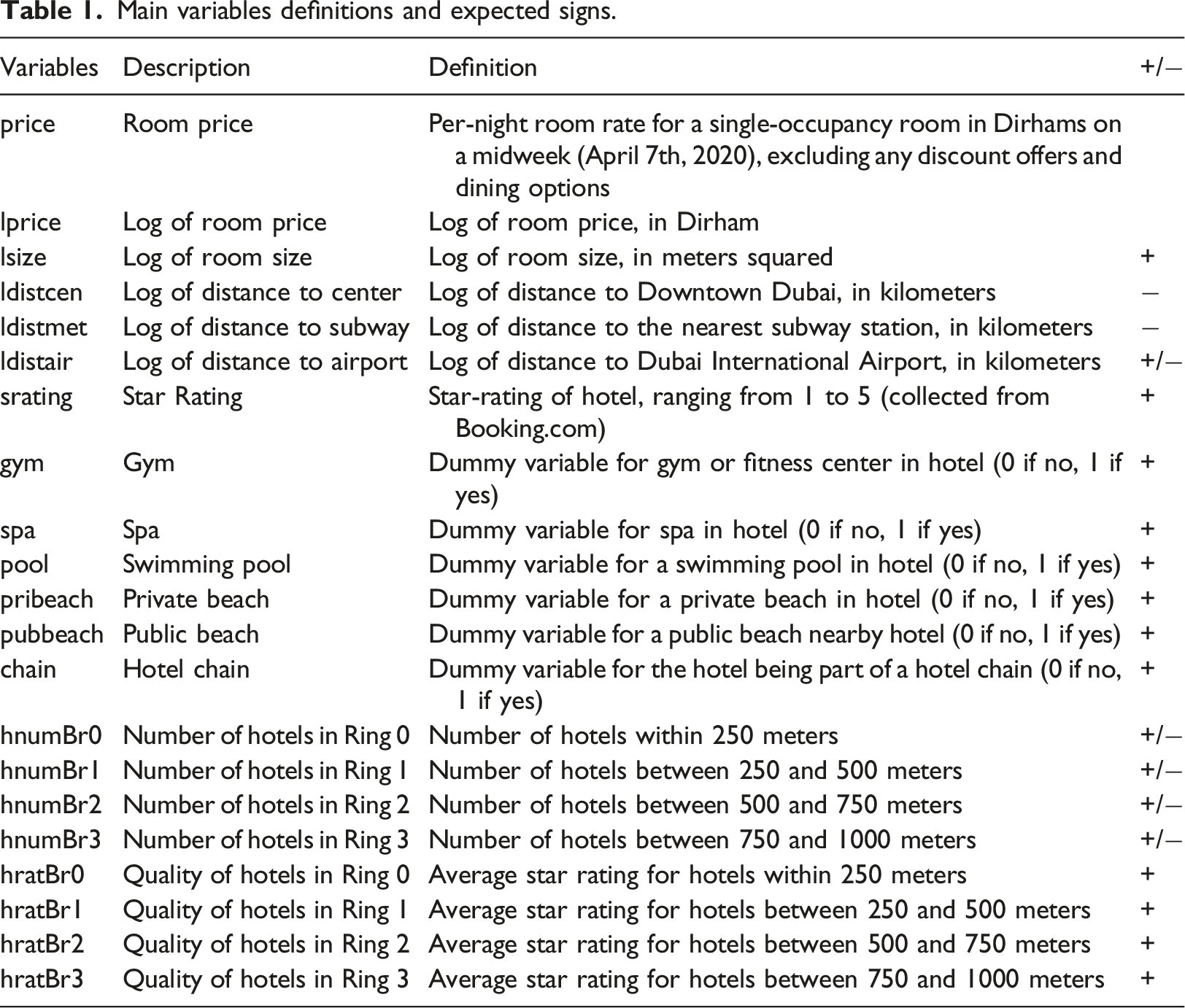
In this section, we provide a detailed definition, descriptive statistics, and other statistical analyses of the variables in the article. Table 1 provides a brief definition of the variables. The table also reports the expected effect (positive or negative) of each variable on the room price based on the findings of the previous literature and underlying economic theory. Table 2 reports descriptive statistics of all variables used in the regressions. Table 3 breaks down the average of the main variables for each Star Rating category.
Main variables definitions and expected signs.
Main variables descriptive statistics.
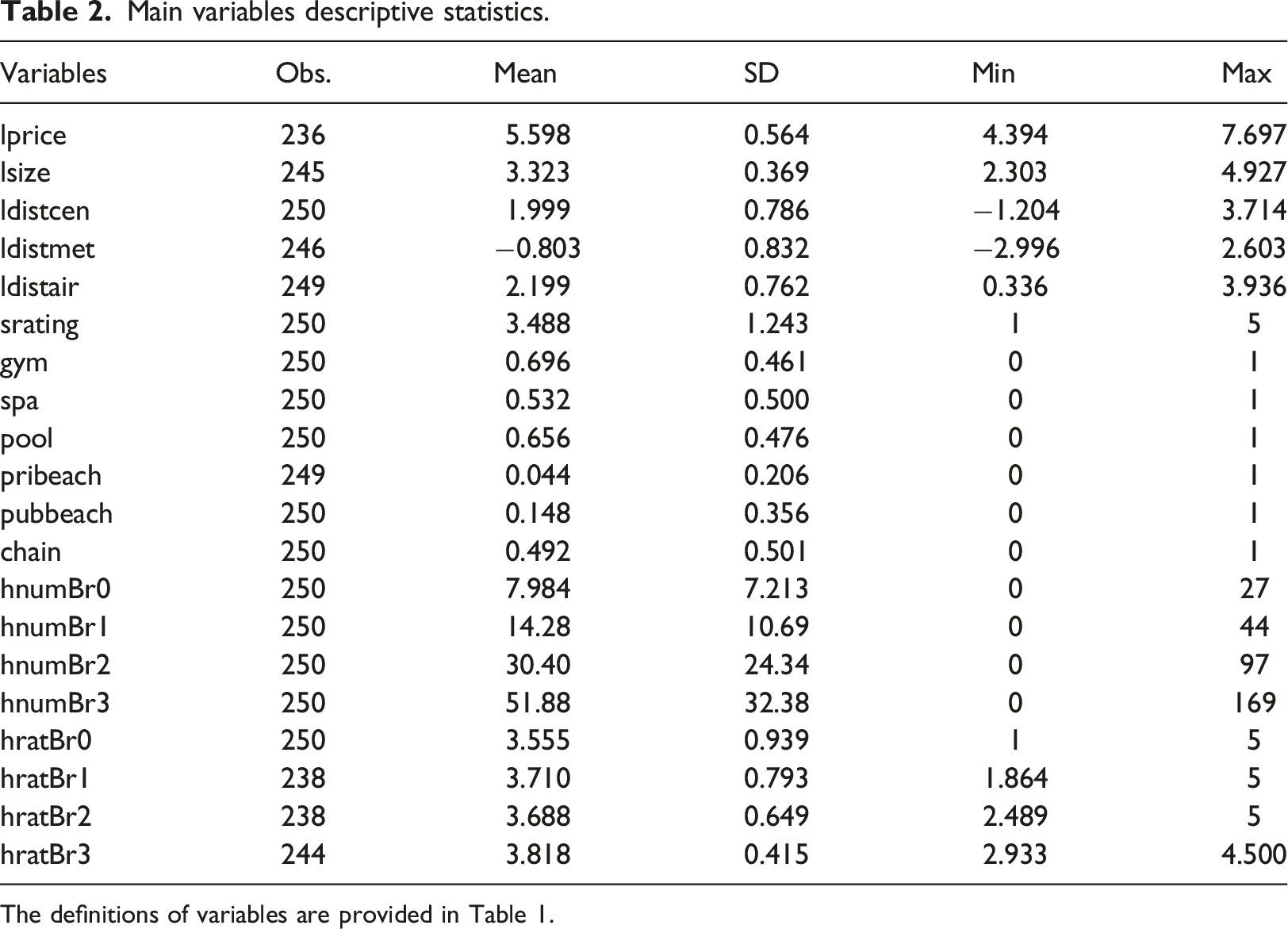
The definitions of variables are provided in Table 1.
Average values of the variables by star rating.
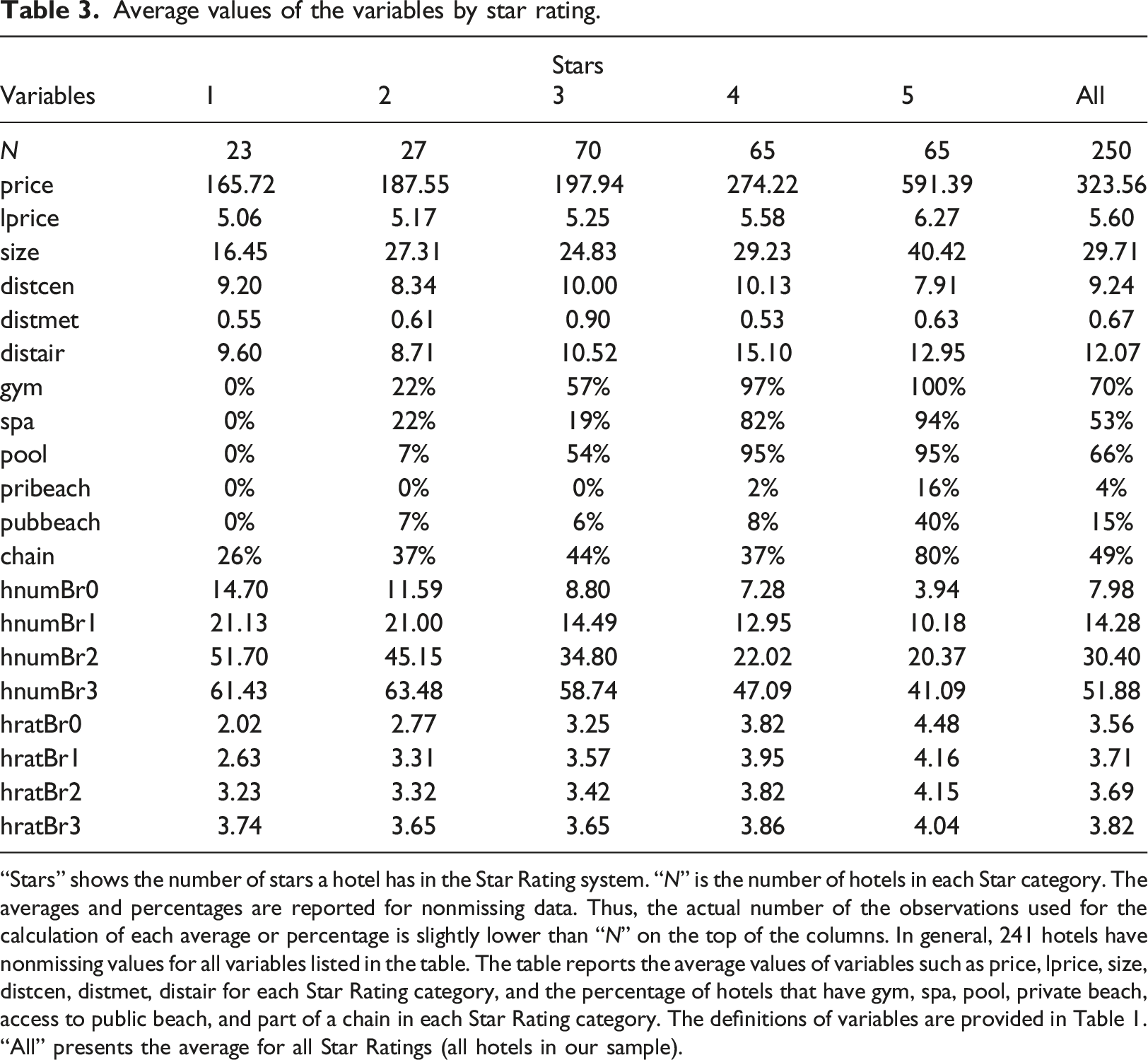
“Stars” shows the number of stars a hotel has in the Star Rating system. “N” is the number of hotels in each Star category. The averages and percentages are reported for nonmissing data. Thus, the actual number of the observations used for the calculation of each average or percentage is slightly lower than “N” on the top of the columns. In general, 241 hotels have nonmissing values for all variables listed in the table. The table reports the average values of variables such as price, lprice, size, distcen, distmet, distair for each Star Rating category, and the percentage of hotels that have gym, spa, pool, private beach, access to public beach, and part of a chain in each Star Rating category. The definitions of variables are provided in Table 1. “All” presents the average for all Star Ratings (all hotels in our sample).
We largely follow the literature classification of the determinants of hotel room prices. Specifically, we group the variables into three main categories: room properties, hotel amenities and attributes, and location-specific characteristics. Starting with the dependent variable, we provide a detailed description of all variables below.
Dependent variable and collection period
The dependent variable of this analysis is the price of a basic room, without any discounts or dining add-ons, as reported on Booking.com. The prices of the rooms are all taken pre-tax and in UAE dirhams. 5 Two versions of the per-night room rates are collected to detect and avoid any anomaly in daily prices. The first of these is a simple 1-night rate for a hotel room on 7 April 2020. The collection period is chosen to be a mid-week day during the off-peak season in Dubai in order to eliminate any price fluctuations due to seasonality. On the other hand, the second rate is collected as an average of per-night prices in the week starting 5 April 2020. We make sure that the period in which price figures are obtained does not coincide with any special events such as national holidays or holidays in countries that are the primary tourist sources to Dubai. It is worth mentioning that at the time of data collection, mostly in February, there was little to no discussion of the COVID-19 pandemic in the Dubai hotel market, and based on our experience with similar data in 2019, we do not think that pandemic concerns affected the price at the time of the data collection. 6 Prices are also collected well in advance of the dates of stay. We do not observe any significant statistical differences between the mid-week price and the week-average price. The correlation of the two variables is 0.97, and out of 236 hotels with nonmissing price observations, the prices are exactly the same for 67 hotels, the mid-week price is less than the week-average price for 57 hotels, and the mid-week price is more than the week-average prices for 112 hotels. More than half of the observations on the two prices (131 hotels) are within 10 dirhams (or US$2.72) of one another. Thus, for the rest of this article, we focus on the mid-week room prices on 7 April 2020, as the main price variable and the dependent variable in our estimations.
Customary covariates of hotel price
The independent variables used in this study broadly cover room properties, hotel amenities and attributes, and location-specific characteristics (Table 1).
Room properties include the size of a single double-occupancy room in squared meters reported on Booking.com. Hotel amenities consist of basic hotel-specific attributes, which are all binarily coded (1 if an amenity is available and 0 if it is not), including the availability of a fitness center (gym), spa, and swimming pool in a hotel, and whether there is access to a private beach within the hotel, or whether there is a public beach in the hotel vicinity.
As for the hotel quality indicator, we follow the literature to use the star rating as a proxy for hotel quality. The Star Rating system was first introduced in 1958 by the oil and gas company Mobil in the United States through their Forbes Travel Guide. In this rating system, hotels are given a rating of 1 to 5, where 5-star indicates the highest quality and experience for guests. The aim was to rate a hotel consistently on the quality and quantity of amenities it provides to customers. Currently, the Forbes Travel Guide has 1898 luxury properties in 73 countries on their website, including some in Dubai. 7 In countries like Spain, the system is regulated with detailed, legally specified guidelines. The UAE follows the same rating system as in Spain (Department of Culture and Tourism, 2018). As for the allocation of star rating, the website clearly states that Booking.com does not determine the star rating of accommodations; rather, it merely uses a hotel’s self-reported rating declared.
With respect to locational amenities, we include the ease of access to transportation hubs and tourist attractions. Thus, the location-specific variables include distances in kilometers to the city center (Downtown Dubai), Dubai International Airport, as well as the distance to the closest metro station. 8 Downtown Dubai is home to many popular tourist destinations, including The Dubai Mall and Burj Khalifa. The effects of transportation hubs, in our study, are measured as (i) the distance to Dubai International Airport, the primary airport for international flights, and (ii) the distance in kilometers to the nearest metro station. Note that because Booking.com provides distances only up to 750 m, the proximities to the nearest metro station for a few selected hotels are collected using Google Maps.
Local competition and spillovers covariates
We construct and use some economic geography variables to account for the potential local competition, clustering, and spillovers. These variables capture the number and average quality of nearby hotels by distance. They could influence the room price by introducing a higher level of local competition (Balaguer and Pernías, 2013; Sánchez-Pérez et al., 2020) or through the localization economies’ effects and positive spillovers (Arzaghi and Henderson, 2008; Duranton and Kerr, 2018; Kerr and Kominers, 2015). The competition could come from the number of hotels and their quality compared to a hotel in question. We also expect some positive spillovers on prices when the hotel is in the vicinity of high-quality hotels. To account for these factors, using the location of all 380 hotels listed on Booking.com, we calculate the number of surrounding hotels (cluster size) and the average quality of surrounding hotels (a measure of quality spillovers) within the ranges of distances. The distance between a particular hotel and other hotels around it is calculated based on the latitude and longitude coordinates for all 380 hotels listed on booking.com. Figure 1 shows the location of the hotels on the map. Using this information, we calculate the pairwise distances between all 380 hotels and use them to measure clustering, competition, and spillover effects within a particular radius. We identify clusters as hotels within 0–250 m (Ring 0, immediate vicinity), 250–500 m (Ring 1), 500–750 m (Ring 2), and 750–1000 m (Ring 3, farthest distance). Therefore, we count the number of hotels within a certain distance range from any particular hotel and compute the average star rating for these hotels.
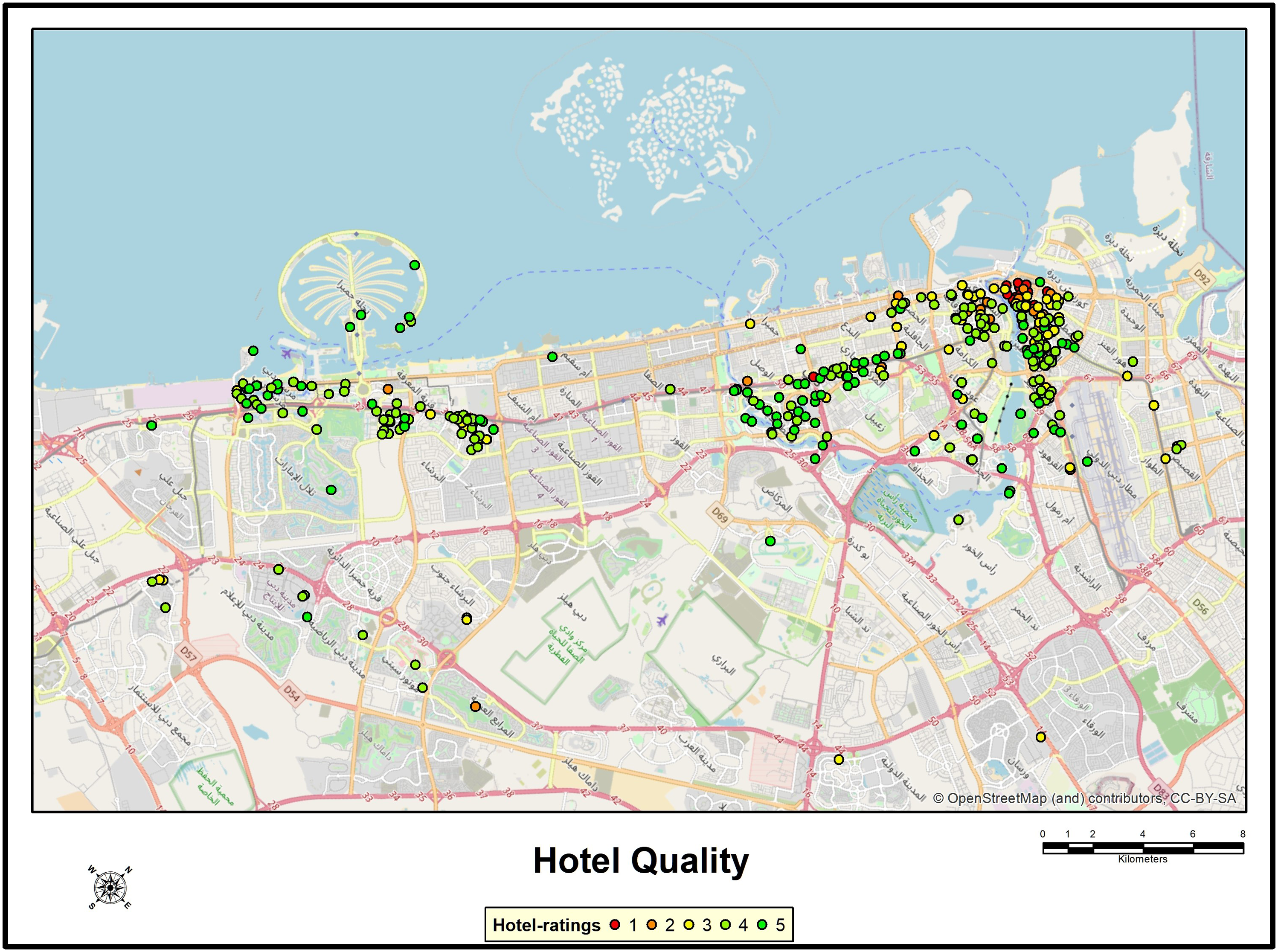
Geographical distribution of hotels and their quality in Dubai metro area.
In the Tables and Figures section, we provide some visual evidence of clustering among hotels in Dubai. In Figure 1, we can identify two main concentrations of hotels in Marina area and in Downtown Dubai, Bur Dubai, and Deira area. Figure 2 zooms in Downtown Dubai, Bur Dubai, and Deira area and marks some of the clearly observable clusters. Figure 3 shows the same for the Marina area. Further, following Duranton and Overman (2005), we graph the distribution of the pairwise distances between hotels in Figure 4. As presented in Duranton and Overman (2005), the distribution pattern presents some global and local clustering.
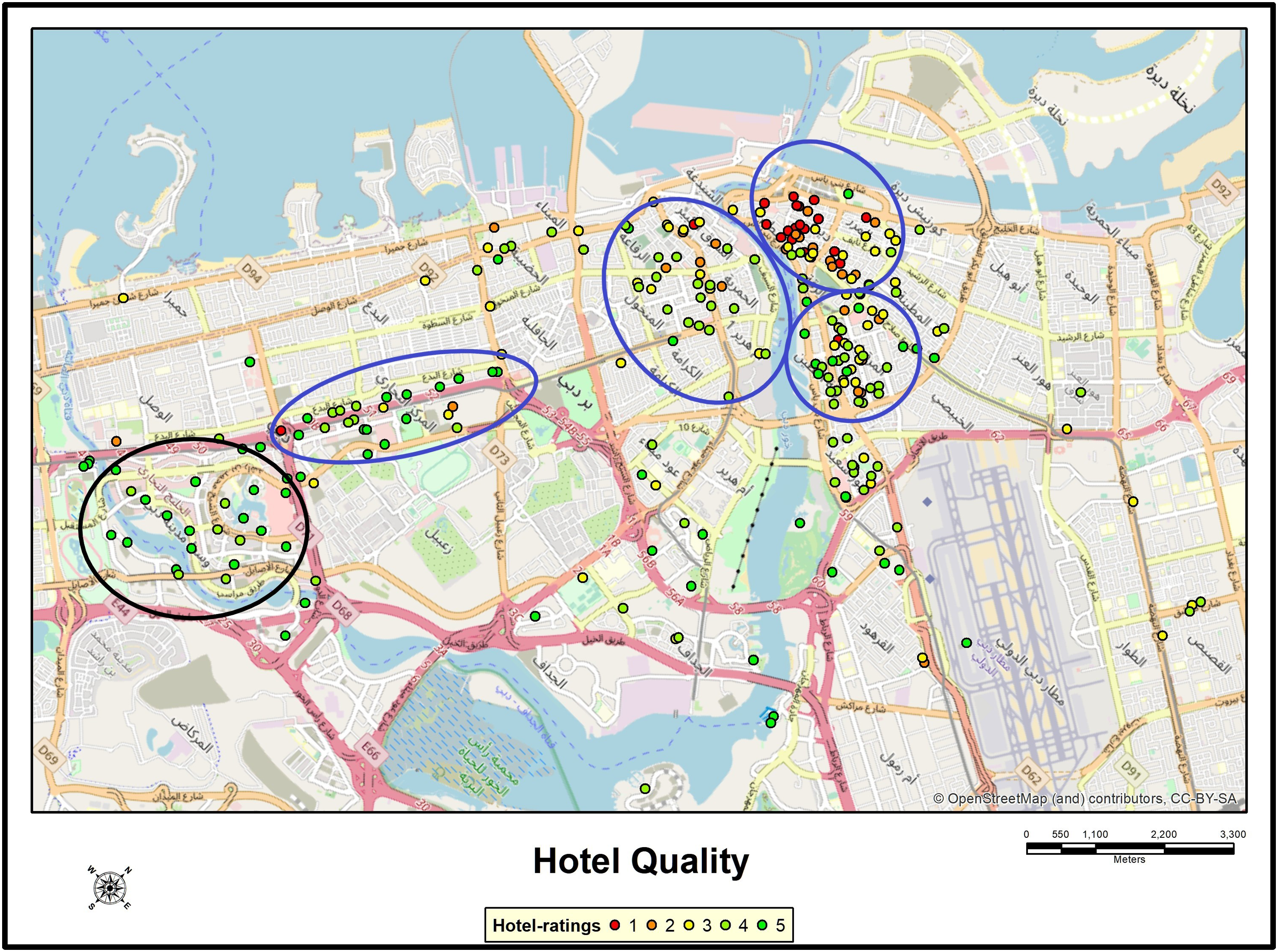
Geographical distribution of hotels and their quality in old Dubai and downtown Dubai.
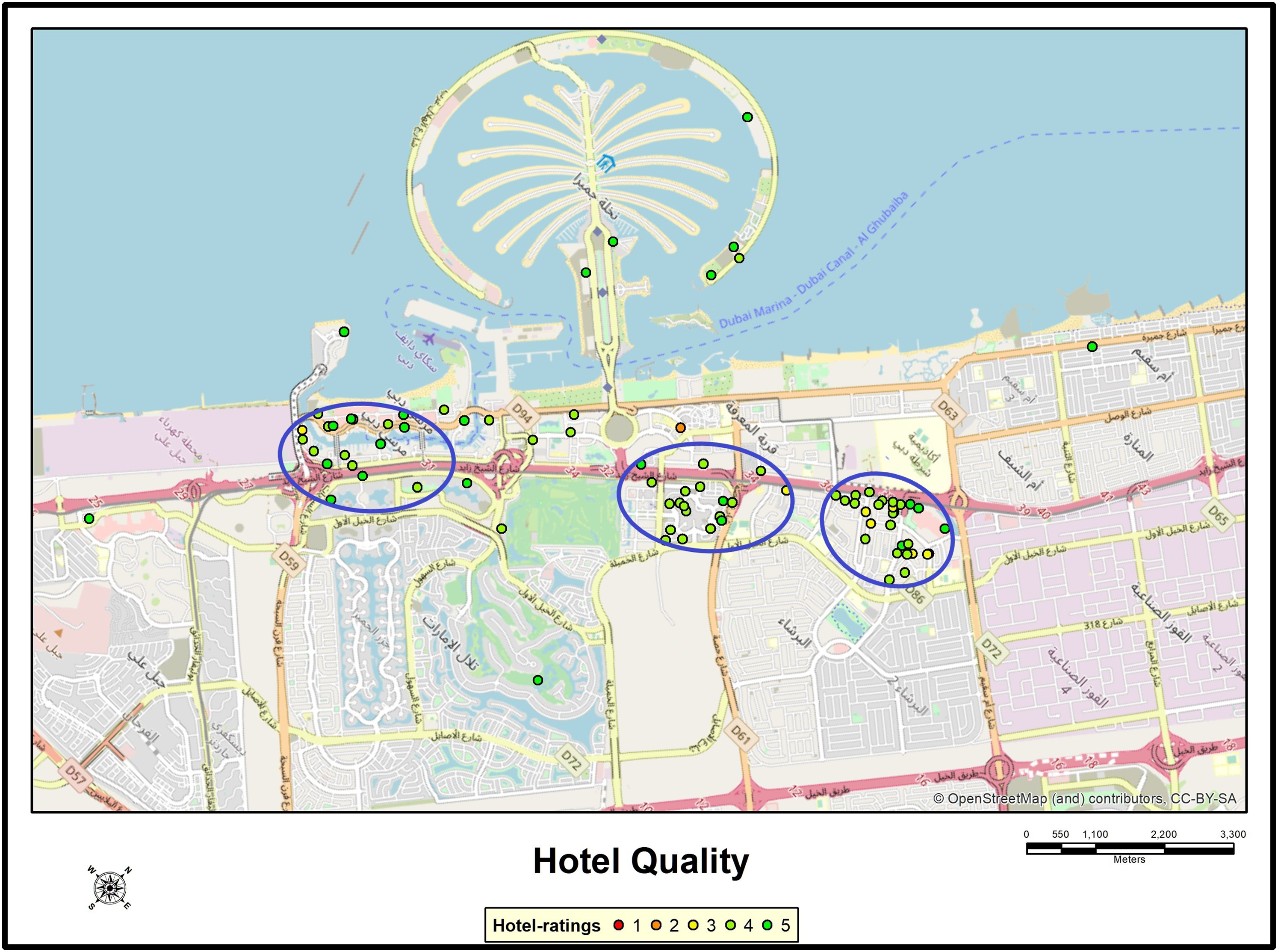
Geographical distribution of hotels and their quality in Marina.
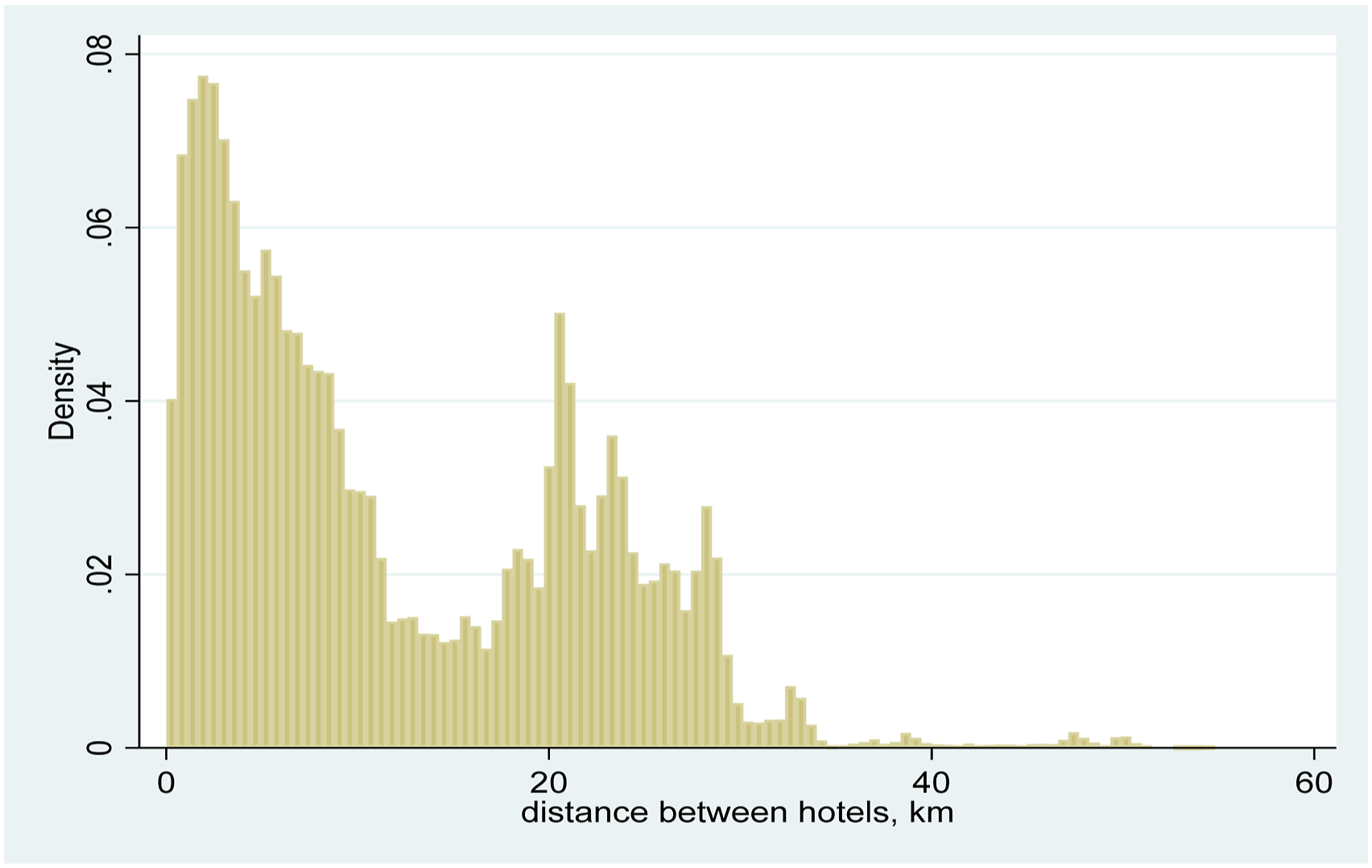
Distribution of pairwise distances between hotels.
Statistical analyses on variables based on hotel quality
In what follows, we briefly discuss the variables considered in the study for different star rating hotel quality. Table 3 provides the average room price, room size, the hotel amenities and attributes, and the location-specific characteristics of the hotel for each Star Rating category. There are 250 hotels in our sample, of which 23 are 1-star hotels, 27 are 2-stars, and 70 hotels have 3-stars, whereas 65 hotels are in 4 and 5-star categories each. The average per-night room rate for a single-occupancy room in UAE dirhams on a mid-week day (7 April 2020), excluding any discount offers and dining add-ons, goes from 166 dirhams (or US$45.23) in a 1-star hotel to around 600 dirhams (or US$163.49) in a 5-star hotel. The average price for a room at all hotels in our sample is 326 dirhams (or US$88.83). The basic statistical analysis confirms that average (log) prices among the star categories are significantly different, except between 1 and 2-star hotels and 2 and 3-star hotels. These findings are similar to those of Espinet et al. (2003).
There are also significant differences in the average room size and hotel location-specific characteristics among the different quality hotels. The average size of a room in all types of hotels is slightly less than 30 square meters. In general, the room size increases for higher-quality hotels. Interestingly, the room size in a 2-star hotel is, on average, larger than the room size in a 3-star hotel. 9 While the average distance to Downtown Dubai is about 9 km, the majority of hotels cluster within short distances to Downtown Dubai area. The hotels’ average distance to the nearest subway station is 673 m. The majority of hotels are within 450 m of the closest metro station, and 90% of hotels in the sample are within 1.1 km of the nearest metro station. The closest hotel types to the subway, on average, are 1 and 4-star hotels, and the farthest are 3-star hotels. The 4 and 5-star hotels are located farthest from the Dubai International Airport, which is the primary city airport for international flights.
Unsurprisingly, different quality hotels (based on star rating) provide a different set of in-hotel amenities and services, as summarized in Table 3. Almost all 4 and 5-star hotels provide access to a gym, spa, and swimming pool in the hotel. In contrast, none of the 23 1-star hotels possesses any of these amenities or services. The 2-star hotels also lack many of these amenities. Also, access to a private beach is limited to the 4 and 5-star hotels (chiefly 5-star hotels), and only a few 1, 2, and 3-star hotels have easy access to a public beach (8 out of 120 hotels). Most of the 5-star hotels (80%) belong to a hotel chain, compared to six of these 1-star hotels.
Empirical specifications
As we discuss in the Hedonic Price Model for Hotel Room Prices section, the hedonic regression model is ideal for estimating the contribution of different attributes and characteristics of the room, hotel, and location to the hotel room price. We use the following log-linear specification to estimate the effects (i.e., shadow price or value) of each component of the multifaceted good, which is the hotel room, on the log of the room price. Thus

Table 1 presents the full list of the variables and their detailed definitions, and Table 2 reports descriptive statistics for the variables. 10
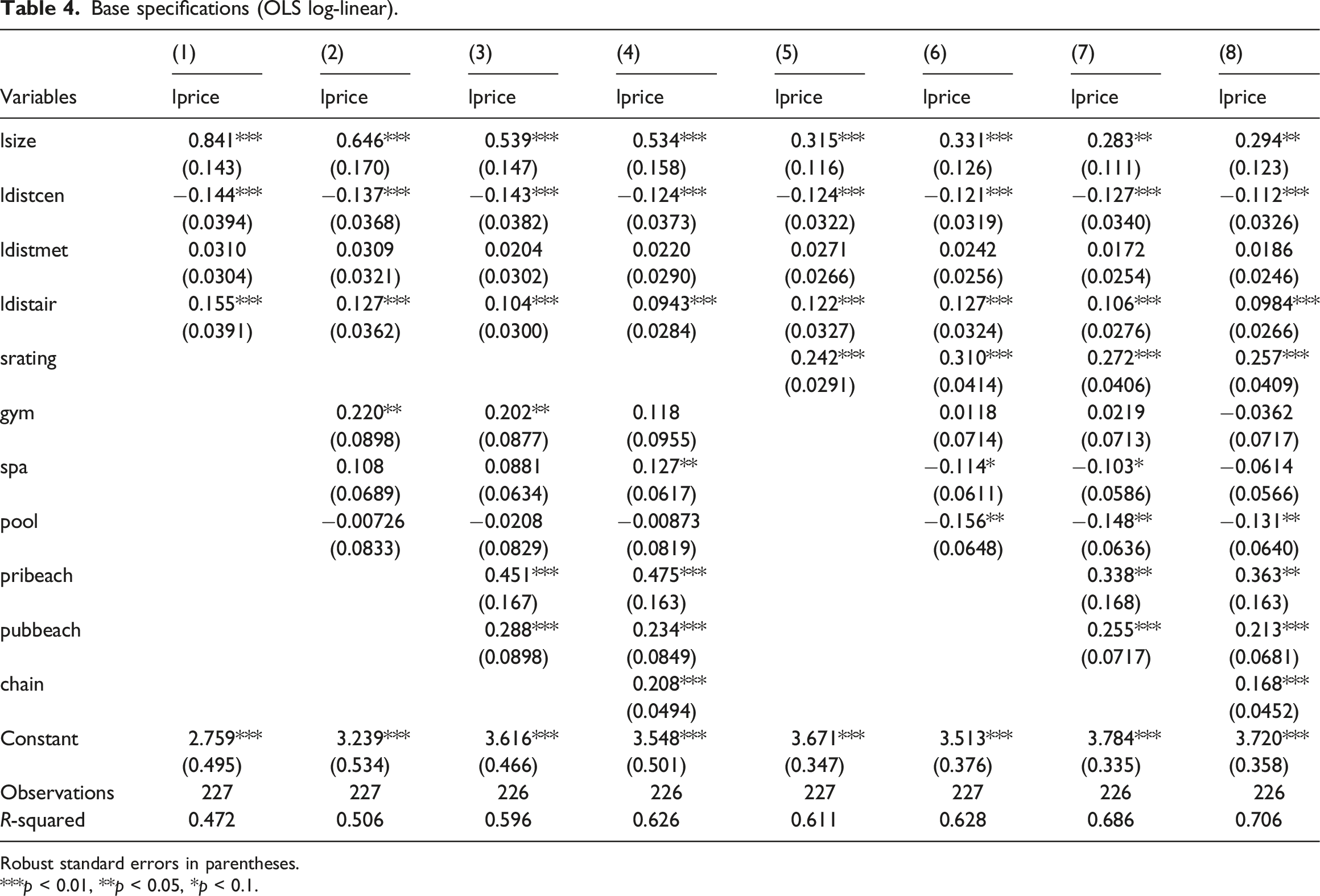
In our estimations, we start from the basic specification (S1), which is limited to the room size and the hotels’ distances to the major access points and landmarks in Dubai. We add the in-hotel amenities in the second specification (S2), access to beaches in the third specification (S3), and whether the hotel is part of a chain in the fourth specification (S4). In specifications S5 to S8, we add the Star Rating to specification S1 to S4 to see whether it captures all the effects of the hotel amenities and attributes on the room price. The results are reported in Table 4.
Base specifications (OLS log-linear).
Robust standard errors in parentheses.
***p < 0.01, **p < 0.05, *p < 0.1.
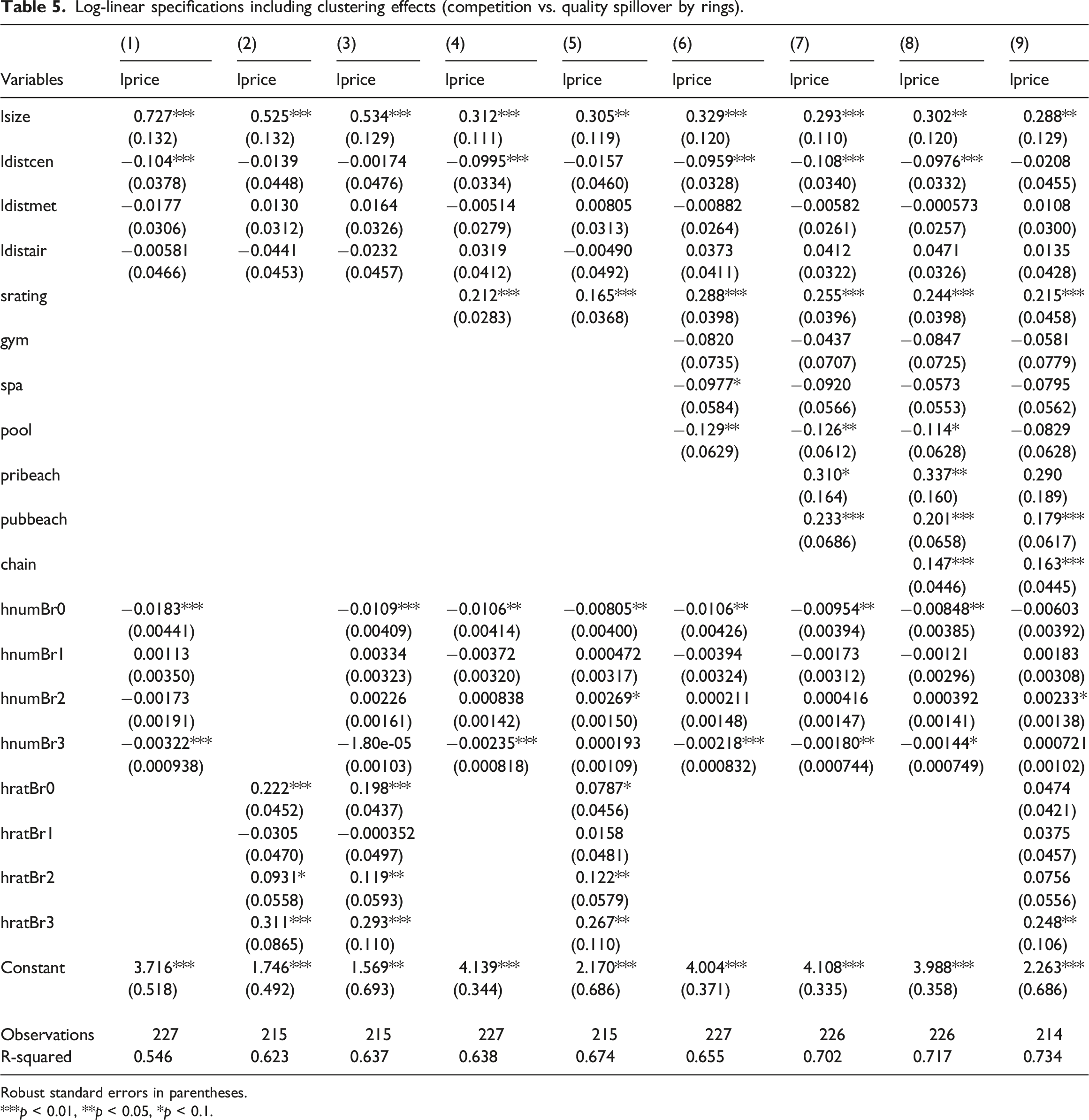
We introduce the variables related to hotel clustering into our basic specifications. Firstly, we include the number of hotels (all kinds) in the surrounding area within four rings (specifications S1, S4, S6, S7, and S8 in Table 5), where “hnumBr0” is the number of hotels within 250 m, “hnumBr1” is the number of hotels between 250 to 500 m, and so on. The influence of Ring
Log-linear specifications including clustering effects (competition vs. quality spillover by rings).
Robust standard errors in parentheses.
***p < 0.01, **p < 0.05, *p < 0.1.
In all specifications, we use a log-linear OLS estimation method and calculate the robust (White-corrected) standard errors for coefficients.
Results and discussion
Our results are presented in Tables 4 and 5. A glance reveals that our empirical models are able to explain at least 50% of the variation in the hotel room price 11 and as high as 70% in more detailed specifications in Table 5. This is quite high for cross-sectional analysis. This high explanatory power suggests that we have identified the main determinants of hotel room prices.
Starting with the room attributes, room size has a strong and statistically highly significant effect on room price across all specifications, as expected. In specifications with a full set of variables (columns 5 to 8 in Table 4 and 4 to 8 in Table 5), the estimated coefficient is about 0.3, which means that on average, a 10% (i.e., three squared meter) increase in the room size is associated with 3% (i.e., 10 AED or US$2.72) increase in the room price.
Similarly and as expected, proximity to the city center (Downtown Dubai) is a valuable location-specific characteristic. An increase in the distance to the city center reduces the price. The effect of the distance to the city center is negative, consistent, strong, and highly significant across the board. The estimated coefficient (in the relevant specifications) ranges from −0.1 to −0.12, which means that on average, a 10% (i.e., about 1 km) decrease in the distance to the city center is associated with 1 to 1.2% (i.e., 3 to 4 AED or about US$1 12 ) increase in the room price.
Interestingly, the distance to the metro station does not affect the room price, which may be because tourists usually use taxis for transportation. In most locations and for a significant part of the year, extreme heat prevents even a short walk of 5–10 min to a metro station.
The estimation indicates that the distance to the airport has a positive impact on the room price. We conjecture that tourists may want to stay away from the airport noise, traffic, and pollution—bearing in mind that tourists only need to have access to the airport twice during their stay, and the airport has well-designed transportation facilities to and from all places in Dubai. Thus, the distance to the airport could be an added plus. In addition, most tourist attractions are far away from the airport. Thus, staying in a hotel close to the airport means largely being away from the most attractive tourist attractions in Dubai.
In specifications S2 to S4 (columns 2 to 4) in Table 4, we find that most of the hotel amenities and characteristics have the expected signs. Access to a gym, private beach, public beach, and being part of a chain have positive effects on the room price. Our estimation indicates that access to a hotel gym is associated with about a 20% (about 70 AED or US$19) increase in the average room price. Access to a pool (though negative) is statistically insignificant and economically negligible (very close to zero in magnitude as compared to other hotel amenities). Access to a spa has the expected positive sign but is only significant in one specification.
Furthermore, in columns 5 to 8, we add hotel Star Rating to the regressions. The estimations indicate that a higher Star Rating has a significant and strong positive effect on the room price. One Star Rating increase could increase the room price by nearly 30% (using the estimated value in column 8), which means more than a 100 AED (about US$27) increase for the average room price. The introduction of the Star Rating, however, renders other hotel amenities insignificant and turns the access to a pool negative. We think this is due to the fact that the Star Rating is allocated to hotels based on access to those amenities and introducing in-hotel amenities, and the Star Rating causes the problem of collinearity. However, the coefficients on other hotel characteristics, namely, access to a public and private beach and being part of a chain, are principally unchanged.
In Table 5, we add the local competition and hotel clustering variables to the main specifications in Table 4. The results on the room attributes and hotel amenities and characteristics are principally unchanged. The noticeable exception is the coefficient on the distance to the airport. Although it is positive and significant in Table 4, it becomes insignificant in Table 5 specifications, as we include the economic geography variables (clustering benefits and competition). In Table 4, the distance to the airport might be picking up the impact as missing economic geography variables.
The number of hotels within the immediate vicinity (Ring 0, within 250 m) has a significant and strong negative impact on the room price. We interpret this result as a sign of severe competition from nearby hotels, similar to the findings of Balaguer and Pernías (2013) and Sánchez-Pérez et al. (2020). In addition, the cost-saving advantages of being in the cluster allow hotels to provide lower prices than otherwise when they are facing competition.
On the other hand, the average quality of hotels in the close vicinity has a positive and generally significant effect on room price. We associate this result to a hotel receiving positive spillovers from being close to high-quality hotels. It may receive the residual demand for those high-quality hotels. Also, high-quality hotels provide many amenities that are open to the public (nice restaurants, bars, entertainment, etc.) and attract tourists. A budget-oriented tourist may opt out of paying a premium for a luxury hotel room but may occasionally take advantage of those amenities by staying in the budget hotel nearby.
Our estimation indicates that both local competition and quality spillover effects are largely limited to the hotel’s immediate surroundings (Ring 0, within 250 m). There is no significant local competition or quality spillover effects from the hotels within 250 to 750 m (Rings 1 and 2). Surprisingly, the variables become statistically significant within 750 to 1000 m distance (Ring 3) with the expected sign for both coefficients (negative for local competition and positive for quality spillover). However, further investigation reveals that the local competition effect is not statistically significant whenever we include the quality spillover variables (columns 3 and 5); in other cases, when it is statistically significant, it is economically not as important as the effect of the nearby competition, because the coefficient magnitude is 5 to 6 times smaller than the coefficient for the nearby hotels. However, the quality spillover effect from the hotels within 750 to 1000 m distance is quite strong and significant in all specifications that include quality spillover variables. We conjecture that this is because, in most cases, budget hotels are not located closer than 750 m to high-quality hotels. Usually, high-quality hotels are stand-alone structures surrounded by large gardens and outdoor recreational facilities, limiting the locational proximity of other hotels. Other hotels still can benefit from the quality spillovers (restaurants, bars, facilities, etc.) but at a distance beyond the high-quality hotel’s property (750 m or more).
The estimations (e.g., columns 3 and 4) indicate that having one more hotel in the immediate surrounding area (within 250 m) decreases the room price by about 1% (i.e., 3 AED or US$0.82) on average, and an increase in the average quality of hotels in the immediate surrounding area by one star rating (in columns 2 or 3) increases the room price by more than 20% (i.e., 70 AED or about US$19) on average.
Conclusion and summary
From obscurity, Dubai has become a significant player in the world’s tourism industry over the past 40 years. In 2018, Dubai ranked the fourth city in the world in terms of the number of visitors and contained one of the largest concentrations of hotels in the world, with a whopping 91, 000 hotel rooms. Given the multiplier effects, hospitality, tourism, and aviation, as a whole, comprise about a quarter of the Dubai GDP in 2019. The city has a competitive and vibrant hotel industry that suits all tastes and budgets. This remarkable success results from a clear and realistic vision and a coordinated effort of various government agencies working with the private sector.
Despite the significance and success of the tourism industry in Dubai, academic studies on this growing business and the factors affecting its profitability are surprisingly lacking except for a few qualitative studies. In such a competitive market, hotel managers need to identify market niches and position their hospitality services accordingly to mitigate the possibility of direct competition. To this end, information about consumers’ preferences for different amenities and services and their willingness to pay for those amenities and services are critically important. Hotel managers and promoters can use the relationship between hotel room price and hotel amenities, services, and quality to achieve the optimal room and hotel services bundle and design effective marketing strategies. In this respect, identifying the role of amenities, services, and locational attributes in hotel room prices in Dubai is particularly useful for hotel managers and marketers. In addition, the relationship between prices and locational amenities and clustering variables (number and quality of hotels in close proximity) provides information about the nature and intensity of local price competition and spillovers.
In this article, we study the relationship between room prices and room properties, hotel characteristics, and location-specific variables, including hotel concentration (clustering), competition, and quality spillovers in Dubai. We employ a hedonic pricing model to investigate these relationships. We carefully identify the determinants of hotel room prices in the previous studies, where a hotel room represents a composite commodity that comprises room properties, hotel amenities and features, and location-specific characteristics. We pay particular attention to clustering effects that have been overlooked in previous hotel room price analyses.
Our unique dataset contains information on a large number of hotels in Dubai, exactly 250 hotels out of the 380 hotels in Dubai listed on Booking.com. Data are collected in March 2020 for April 2020 room prices. Overall, our results show that a higher room price is associated with a larger room size, a location far from the airport, and close to Downtown Dubai. Being close to metro stations does not influence the price. As expected, we find positive effects on the room price from hotel amenities and characteristics such as a gym, private beach, public beach, and being part of a chain. However, access to a pool or spa does not seem to have a clear-cut influence on the room price. We also find that customers are willing to pay a higher price for hotels with a higher star rating, as star rating guarantees a certain level of quality and presents access to a fixed set of amenities and services.
With regard to local competition, clustering, and quality spillovers, we observe severe competition from the hotels in close vicinity (within 250 m). The price is significantly lower in locations with a larger nearby number of competitors. On the other hand, we find some evidence of quality spillovers. We find that the room price is higher for the hotels in the proximity of high-quality hotels.
Footnotes
Acknowledgments
We would like to thank the participants at the 67th Annual North American Regional Science Association International Meeting 2020 and Economics Seminar Series at the American University of Sharjah for their helpful comments.
Declaration of conflicting interests
The author(s) declared no potential conflicts of interest with respect to the research, authorship, and/or publication of this article.
Funding
The author(s) received no financial support for the research, authorship, and/or publication of this article.
