




Abstract
This study examines the influence of economic uncertainty on tourism. The key hypothesis to test is that while economic uncertainty reduces outbound tourism, it may boost domestic tourism due to the economic-stagnant effects. Utilizing the framework of the theory of reasoned action to analyze a global sample of 124 countries over the period 1996–2017, we find some initial evidence showing that an increase in economic uncertainty encourages domestic tourism while reducing outbound tourism in the global sample. Notably, while these effects are consistent in the upper-middle-income economies, an increase in uncertainty has a positive impact on both domestic and outbound tourism in lower-middle-income economies and a negative impact on both domestic and outbound tourism in higher-income economies. The key implementation of this study is that tourism development is not always associated with economic development and stability; sometimes it could be a signal of economic stagnancy and inactiveness.
Introduction
Tourism is now one of the largest and fastest economic sectors all over the world (WTTC, 2018). The literature points out many profound influences of tourism on the economy, society, culture, and environment, for example, significant contributions to employment, trade activities, and socioeconomic development (Dogru and Bulut, 2018; Habibi et al., 2018). As such, governments are trying to advocate for tourism-led growth policies (Li et al., 2018). For this reason, understanding of drivers of tourism consumption would be essential for both literature and practice.
Theoretically, economists agree that travel decisions are made based on tourist’s disposable income, travel cost, and time preferences (Eugenio-Martin, 2003; Martin and Witt, 1987). Also, relative incomes among regions (Yang et al., 2014), employment status (Perles-Ribes et al., 2016), and travel costs (Otero-Giráldez et al., 2012) are named as main determinants of tourism. In addition, recent changes in socioeconomic structures have added new determinants to the literature, such as the aging population (Nikitina and Vorontsova, 2015). These emerging studies suggest that tourism is also a function of external environments. As such, we propose that there is a need to integrate tourism economics into a multidiscipline theoretical framework for a better understanding of the dynamics of tourism development in accordance with the fluctuation of the socioeconomic conditions.
In this line of literature, uncertainty and its impacts on tourism through the effects of economic policy uncertainty (EPU), that is, policy-related economic uncertainty, may play an essential role. 1 The EPU is built and introduced by Baker et al. (2016), which is an index formed by three underlying components: newspaper coverage of policy-related economic uncertainty, the number of federal tax code provisions set to expire in future years, and the disagreement among economic forecasters. 2
In fact, increases in economic uncertainty might cause delay or even cancelation of travel plans (Demir and Gozgor, 2018). Moreover, these effects may be different between domestic and outbound tourism. In outbound tourism, travel decisions are more complicated due to the lack of information and familiarity of the conditions at the destinations. Thus, increases in uncertainty may have more substantial negative impacts on outbound tourism than on domestic tourism.
Meanwhile, there is a possibility that rises in economic uncertainty may lead to an increase in domestic tourism as a result of the upsurge in nonbusiness time (economic-stagnant effects) in combination with the fall in outputs (incomes) (see Bloom (2009) for the impacts of economic uncertainty on output and employment). Specifically, economic uncertainty reduces the activeness of business activities and transactions, leading to increased nonbusiness time for both entrepreneurs and employees (Gozgor and Ongan, 2017), thereby boosting their intention to take on leisure activities, including traveling. However, increased economic uncertainty also causes a fall of outputs and, subsequently, disposable incomes. In comparison with higher costs and higher levels of uncertainty associated with outbound tourism, domestic traveling appears to be a better choice in this specific circumstance, thanks to its associated characteristics such as lower cost, less risky, and being planned in a short time.
Moreover, increased economic uncertainty is likely to exert stronger impacts on the official sectors (e.g. white-collar employees and entrepreneurs running registered businesses) since they face the taxation and are less flexible to external socks (Mumtaz and Surico, 2018). Meanwhile, the unofficial sectors (e.g. freelancers, unregistered businesses, and household businesses) face no taxation and are typically more flexible to adapt to economic shocks. As a result, the impacts of economic uncertainty on tourism may be more forceful in countries with a higher proportion of official sectors such as high-income economies (Medina and Schneider, 2018). Therefore, it is also expected that economic uncertainty may have dissimilar impacts on tourism in countries with different levels of income.
In general, in this study, we propose that there is a possibility that increases in economic uncertainty may not always exert a negative impact on domestic tourism. Unfortunately, tourism theories have conventionally focused on linking travel decisions to tourist’s personal characteristic and leave the potential influences of the surrounding environments, including the uncertainty embedded in the economic conditions largely unexplored. 3 To the best of our knowledge, there is no study on the influences of economic uncertainty on tourism.
This study thus makes contributions by investigating the impacts of economic uncertainty on both domestic and outbound tourism, using a global sample of countries of different income levels. Our key research aim is to test whether a higher level of economic uncertainty may lead to increased domestic tourism or not; and how does it may affect outbound tourism.
Specifically, the spending values of tourists on domestic and outbound tourism are regressed against economic uncertainty using a global sample of 124 countries over the period 1996–2017 while controlling for other covariates, including income, inflation, unemployment, urbanization, old population, and personal remittances.
We recruit the economic uncertainty index from the world uncertainty database (available at https://www.policyuncertainty.com) built by Ahir et al. (2018). This economic uncertainty index is calculated using frequency counts of “uncertainty” and its variants in the quarterly Economist Intelligence Unit (EIU) country reports, which is available for most countries around the world, while it is documented to have a strong correlation with the EPU (Ahir et al., 2018). Therefore, the use of this economic uncertainty index ensures the data availability for the global sample while it is still catching the economic uncertainty features of each country.
The panel-corrected standard errors (PCSE) model is employed as the main estimator, while feasible generalized least squares (FGLS), pooled ordinary least squares (OLS), robust pooled OLS, and year-effect pooled OLS are used as sensitivity/robustness checks. Moreover, all independent variables are also estimated in 1-year lags to deal with endogeneity. At last, the 5-year average values of all variables are calculated for estimation to confirm the results in the long run. All results are, in general, consistent and robust.
Our estimations show that economic uncertainty has a positive impact on domestic tourism and a negative impact on outbound tourism in a global sample. However, there are substantial variations in the impacts of economic uncertainty on tourism across three subsamples of 55 lower-middle-income economies (LMEs), 29 upper-middle-income economies (UMEs), and 40 higher-income economies (HIEs). Specifically, it is found that an increase in uncertainty has a positive impact on both domestic and outbound tourism in LMEs, and a consistently negative impact in HIEs. Only in the case of UMEs, an increase in economic uncertainty exerts a positive impact on domestic tourism and a negative impact on outbound tourism.
This study provides new global evidence on tourism decisions under uncertainty conditions. It suggests that the conventional frameworks investigating the determinants of tourism decisions need expanding to incorporate the effects of the surrounding environments. Our results show that failing to do so may lead to inappropriate or even incorrect policy implications and recommendations.
Literature and hypotheses
Economic uncertainty and tourism
In accordance with the conventional tourism decision theories, travel decisions are defined as a function of tourist’s disposable incomes, costs of travel, time preferences, and personal interests. For example, Gundelfinger-Casar and Coto-Millán (2018) show that tourists traveling to the Canary Islands from Spain are very sensitive to their incomes and the costs of transportation. Also, Martins et al. (2017) evidently show that increases in the world’s gross domestic product (GDP) per capita significantly boost tourism demands in 218 countries over the 1995–2012 period. Recently, demographic characteristics such as tourists’ age, gender, and religion are also explored to understand their associations with tourism decisions (Adongo et al., 2017; Thrane, 2016). The literature, unfortunately, remains silent on the potential impacts of external conditions such as economic and political uncertainty on tourism decisions.
In fact, the concept of uncertainty plays an essential role in the foundation of Keynesian economics (Gozgor and Ongan, 2017). Specifically, the work of Bloom (2009) proposing building the economic–political uncertainty (EPU) index has opened an emerging trend in examining the influence of economic uncertainty on dimensions of social development. For instance, Colombo (2013) finds negative impacts of economic shocks on the European Union’s industrial production and prices. Also, Junttila and Vataja (2018) notice that if we include EPU in the models forecasting the productivity of future economic activities, the model will perform better.
The extant literature has reached a consensus that an increase in economic uncertainty causes negative impacts on economic outputs, employment, investments, and consumptions (Cheng, 2017; Gupta et al., 2018). Therefore, it is reasonable to expect that economic uncertainty also exerts a negative impact on tourism. In fact, there is some initial evidence supporting the negative association between uncertainty and tourism. For example, Gozgor and Ongan (2017) show that an increase in EPU leads to significant long-run declines in domestic tourism spending in the United States over the 1998–2015 period. Also, Demir and Gozgor (2018) examine the impacts of EPU on tourism departures of a list of 15 countries and find that an increase in EPU causes a negative effect on outbound departures. 4 Despite these (fragmented) emerging evidence concerning the impacts of economic uncertainty on tourism, economic tourism scholars have not successfully proposed a framework which could investigate the impacts of economic uncertainty on both domestic and outbound tourism at the same time. This study this fills this gap.
Theory of reasoned action and travel intention
Theory of reasoned action (TRA) explains the relationship between an individual’s attitudes and behaviors (actions) (Fishbein and Ajzen, 1975). It is mainly used to predict how individuals will behave based on their preexisting attitudes and the surrounding conditions supporting/preventing the intended behaviors.
According to the TRA, intention to travel domestically/internationally could be illustrated with the following equation:

where: bi: the beliefs about the consequences of traveling domestically/internationally. These consequences would be evaluated from two perspectives: benefits (traveling experience) and costs (monetary, risks, and time of planning). ei: the weight an individual puts on each estimated consequence. nj: the estimated impacts of environmental factors influencing the intended traveling behavior, that is, the economic uncertainty in this study, holding all other institutional factors constant. This includes both the negative impacts (reduced outputs and slowdown economic activities) and positive impacts (increased nonbusiness time to travel). mj: the weight that economic uncertainty puts on traveling intention.
Using this framework, we could explain how individuals make domestic or outbound traveling decisions under the existence of economic uncertainty.
First of all, we examine the potential impacts of economic uncertainty on traveling intention. According to Lawson (1985), uncertainty is a pervasive fact of life opposing mathematical risks where there is no basis whatever upon which to form any calculable probability. Lawson proposes that economic agents become much reserved in their activities in this situation. For this reason, an increase in economic uncertainty causes a slowdown in economic transactions and a fall in outputs subsequently. In other words, economic uncertainty leads to lower disposable incomes, which would stimulate citizens to reduce consumptions, especially luxury consumptions such as (outbound) tourism. This theoretical mechanism is confirmed in previous studies, for example, see Gozgor and Ongan (2017), Demir and Gozgor (2018), and Balli et al. (2018). However, it is noteworthy that these studies focus on the impacts of economic uncertainty in one country (Gozgor and Ongan, 2017) or on outbound tourism only (Balli et al., 2018).
Meanwhile, economic uncertainty, due to its stagnant effects (Bloom, 2009; Colombo, 2013), also creates a “wait and see” attitudes among economic agents (e.g. organizations and entrepreneurs). Specifically, in such an uncertain situation, firms are likely to postpone their investment projects, new product development, and new market expansion (Bloom et al., 2007). Since the average level of activeness of economic activities becomes lower, individuals may have more time to take on leisure activities, including traveling. This increase in time allocated to nonbusiness activities is a combination of a series the consequences stemming from stagnant economy. For example, in terms of employees, they may have more leisure time due to reduced workload or even being unemployed; in terms of the self-employed and entrepreneurs, they may decide to delay their venturing activities until more information relating to their market potentials comes out, and the trajectory of the economy becomes clearer.
In short, an investigation on the potential impacts of economic uncertainty on traveling intention indicates that economic uncertainty exerts both positive effects (increased nonbusiness time to travel) and negative effects (reduced incomes) on traveling intentions.
We now examine the attitudes of individuals toward domestic and outbound traveling in the presence of economic uncertainty. The recent changes in the socioeconomic structures (Nikitina and Vorontsova, 2015) such as accelerated urbanization (Xu et al., 2010), new generations (Y and Z), and the booming of the middle-class citizens in developing countries (Haddouche, 2018) have significantly altered the values, perceptions, and consuming behaviors toward tourism products. Tourism, especially domestic traveling, can still be perceived as a luxury good in some countries, but this is not always true to all countries, particularly with the sharp rise of modern/young citizens around the world (Nguyen et al., 2020b; Theuns, 2014; Yeoman, 2011).
In addition, an individual’s attitudes toward domestic tourism versus outbound tourism are quite different in terms of their estimated travel planning, costs, and risks associated with the trips (Van Dao, 2011). Specifically, outbound tourism is typically associated with higher risks, higher monetary costs, and requires more complicated planning than domestic tourism. For this reason, it is expected that outbound traveling intention is strongly influenced by economic uncertainty. In contrast, domestic tourism would be simpler in terms of planning, costs, and associated risks (Kaosa-ard et al., 2013; Smeral, 2010). As such, it could be seen as an option for citizens to spend their nonbusiness time engendered from the falls in economic activeness in the situation of economic uncertainty.
This line of arguments leads to a situation in which individuals may put more weights on the estimated costs and risks required to participate in outbound traveling when they experience economic uncertainty. Such an attitude toward economic uncertainty reduces their intention to take outbound traveling but to select domestic traveling as a low-cost alternative, which is more appropriate to spend their risen leisure time while waiting for a clearer trajectory of the economy.
In summary, employing the TRA theory, we argue that economic uncertainty characterized by a reduction in outputs (incomes) and increased nonbusiness time may have two concurrent impacts on tourism. On the one hand, the decreased outputs and disposable incomes cause adverse shocks to tourism, creating negative attitudes toward high-cost and risky types of travel (e.g. outbound traveling). On the other hand, the “wait and see” attitudes resulted from the stagnant effects of economic uncertainty may act as a stimulus for tourism as citizens have more nonbusiness time to engage in leisure activities. This positive mechanism is expected to be applicable to mass domestic tourism, which is not always a luxury consumption product at this age. In addition to the lower costs, lower risks, and more straightforward travel planning of domestic tourism also indicate that an increase in economic uncertainty may favor domestic tourism over outbound tourism. Therefore, we propose that:
However, tourists in countries with different income levels may respond differently to economic uncertainty. We expect that the relative proportion of official to unofficial sectors plays an essential role in determining the average traveling intentions of an economy.
Specifically, underdeveloped countries are featured by a high proportion of unofficial sectors (e.g. the self-employed, household businesses, and informal businesses) (Medina and Schneider, 2018), which face lower costs (e.g. no taxation) and are more flexible to adapt to economic shocks (i.e. lower risks), thanks to their smallness and informal structures than the official sectors (e.g. registered businesses and contracted employees) (Din et al., 2016; Estrin and Mickiewicz, 2012). Therefore, under the presence of economic uncertainty, a number of citizens working in the unofficial sectors in these countries may find the uncertainty shocks mildly affect their (unofficial) businesses, at least in the short term. As a result, the moderate disruption of economic activities due to increased economic uncertainty may be treated as a chance for these individuals to travel.
Meanwhile, high-income countries typically have a higher proportion of official sectors (Medina and Schneider, 2018). An increase in economic uncertainty would cause a severe fall in output and employment to the sectors. Due to their bureaucracy and formality, the official sectors have to absorb a larger proportion of economic uncertainty (Kang et al., 2014). It is noteworthy that economic uncertainty has three underlying components: expected coming changes in economic policies and regulations reported by social media, number of federal tax code provisions set to expire in future years, and the disagreement among economic forecasters (Baker et al., 2016). The first two dimensions of economic uncertainty are directly relevant to the operation of the formal sectors. The more uncertainty in the economic policies and tax regulations, the more difficult it is for registered firms to execute their projects and make long-term investments (Kang et al., 2014). As a result, managers and employees of these firms with reduced workload (salary) or even being unemployed may not treat traveling, either domestically or internationally, as an appropriate consumption due to their substantially lower disposable incomes.
In short, we propose that in countries where the unofficial sector being dominant, the effect of increased leisure time is stronger than the effect of reduced incomes in the presence of economic uncertainty, leading to an upsurge in demand for domestic traveling. However, in countries where the official sector dominates, the effect of reduced incomes is stronger than the effect of increased leisure time, leading to an overall reduction of tourism demand. Therefore, we propose that:
Methodology and data
Given that the study examines the influence of economic uncertainty on domestic and outbound tourism, we borrow the theoretical framework built by Eugenio-Martin (2003) to propose the baseline function of tourism spending:

where Y is a proxy of tourism; ECO and DEMO are vectors of controlling drivers of tourism, including economic factors and demographical factors, respectively.
In this study, we target both domestic tourism and international (outbound) tourism. Thus, the ratio of domestic tourism spending to GDP is used as a proxy of domestic tourism (InTour), while the ratio of outbound tourism spending to GDP is used to present outbound tourism (OuTour). Both variables are collected from the World Tourism and Travel Council (WTTC) database. Moreover, the number of outbound tourism departures collected from World Development Indicators (WDIs—World Bank) and divided for the total population is also employed as an alternative proxy of outbound tourism (OuTour2). Furthermore, domestic and outbound tourism expenditures are also calculated in per capita forms (in logarithms) to represent domestic and outbound tourism (InTourpc and OuTourpc). We employ a set of alternative measures of tourism to ensure the robustness of the analysis as well as to be consistent with previous studies, such as Song et al. (2012) and Hassani et al. (2015).
For the control variables, there are two main dimensions to incorporate, that is, economic factors and social factors. In terms of economic factors, the literature suggests that tourist’s disposable income, cost of travel, time preferences, and personal interests are the main drivers of tourism spending (Eugenio-Martin, 2003; Martin and Witt, 1987; Yang et al., 2014), which are fully incorporated in our model. Specifically, income level (Income) is measured by the log of real GDP per capita; and an increase in income is expected to boost tourism demands (Song et al., 2012). Inflation is a proxy for the aggregated price levels, which is strongly related to the costs of traveling. It is also linked to lower purchasing power of domestic currency. In this study, inflation is measured by the annual change in GDP deflator (%), which is used to proxy for inflation (Inf).
Also, personal remittance presents additional incomes of domestic citizens, which would induce tourism as the effects of increased disposable money (Kumar, 2014). The ratio of personal remittances to GDP (Remit) is used as a proxy for personal remittances. We also control for demographical factors by adding three variables urbanization, unemployment, and old population into the model.
The unemployment ratio (Unem) represents the conditions of the labor markets. 5 The ratio of population ages above at 65 to the total population (Oldpop) represents the aging population, whereas the seniors may have stronger demands for tourism (Sakai et al., 2000). 6 Finally, the ratio of urban population to total population (Urban) represents the levels of urbanization, that is, the change in lifestyles and socioeconomic conditions of urban citizens in comparison with rural population (Xu et al., 2010). All six control variables are collected from WDIs.
Second, the uncertainty variable (UC) is added to equation (1) as an augmented determinant of tourism, which represents the influences of economic uncertainty on tourism decisions.

For the sake of robustness, we measure both aspects of uncertainty, that is, level and volatility. Specifically, we employ yearly average and yearly volatility of economic uncertainty in the empirical investigations. Following the literature, the EPU index, which is developed by Baker et al. (2016), is suggested as a good proxy of economic uncertainty for empirical investigation (Nguyen et al., 2020b). However, EPU is only available for advanced and large emerging economies (mostly 23 economies around the world), 7 which limits the ability to examine the impacts of economic uncertainty on the global sample. Therefore, this study employs the related uncertainty index from world uncertainty calculated by Ahir et al. (2018). This index is built for 143 countries using frequency counts of “uncertainty” and its variants in the quarterly EIU country reports. This index is demonstrated to be strongly correlated with EPU, which supports the use of this index instead of EPU. 8
This study collected the uncertainty index of each country from the database of world uncertainty https://www.policyuncertainty.com, which are in quarterly forms. The quarterly data of economic uncertainty index is aggregated into yearly mean (for four quarters in a year) as a proxy of economic uncertainty level (UC), and yearly standard deviation (for four quarters in a year) as a proxy of economic uncertainty volatility (UCvo), which are the two independent variables of our studies.
Due to the availability of data, the final sample has 124 countries with 55 LMEs, 29 UMEs, and 40 HIEs over the period 1996–2017 (see Table S1, Supplement, for the list of countries and Table S2 for the data description of three subsamples).
Empirically, the panel data estimation for panel data of country-level is as follows:

in which i, t denote country i at year t; α is coefficients;
Variables, definitions, measurements, sources, and data description.
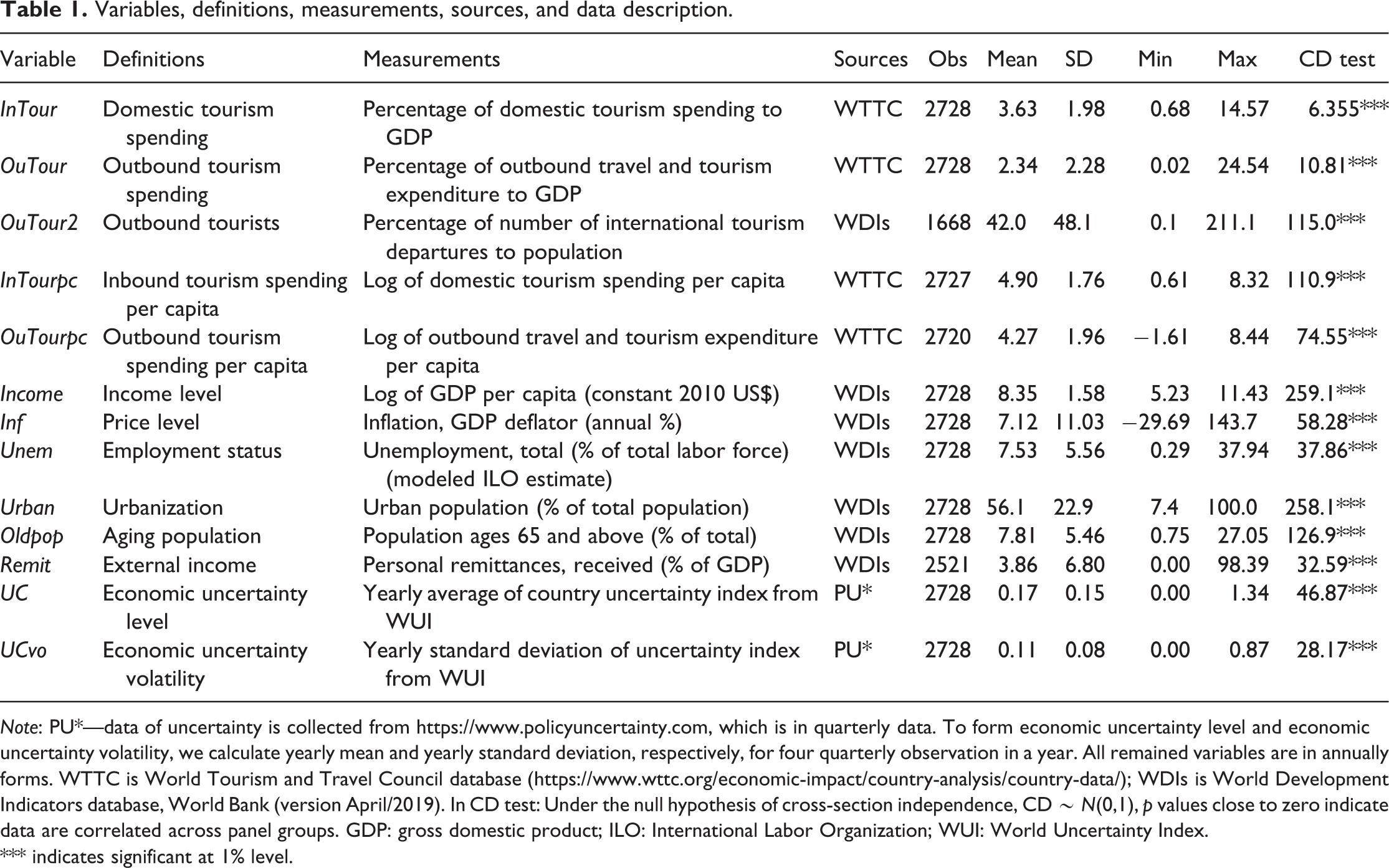
Note: PU*—data of uncertainty is collected from https://www.policyuncertainty.com, which is in quarterly data. To form economic uncertainty level and economic uncertainty volatility, we calculate yearly mean and yearly standard deviation, respectively, for four quarterly observation in a year. All remained variables are in annually forms. WTTC is World Tourism and Travel Council database (https://www.wttc.org/economic-impact/country-analysis/country-data/); WDIs is World Development Indicators database, World Bank (version April/2019). In CD test: Under the null hypothesis of cross-section independence, CD ∼ N(0,1), p values close to zero indicate data are correlated across panel groups. GDP: gross domestic product; ILO: International Labor Organization; WUI: World Uncertainty Index.
*** indicates significant at 1% level.
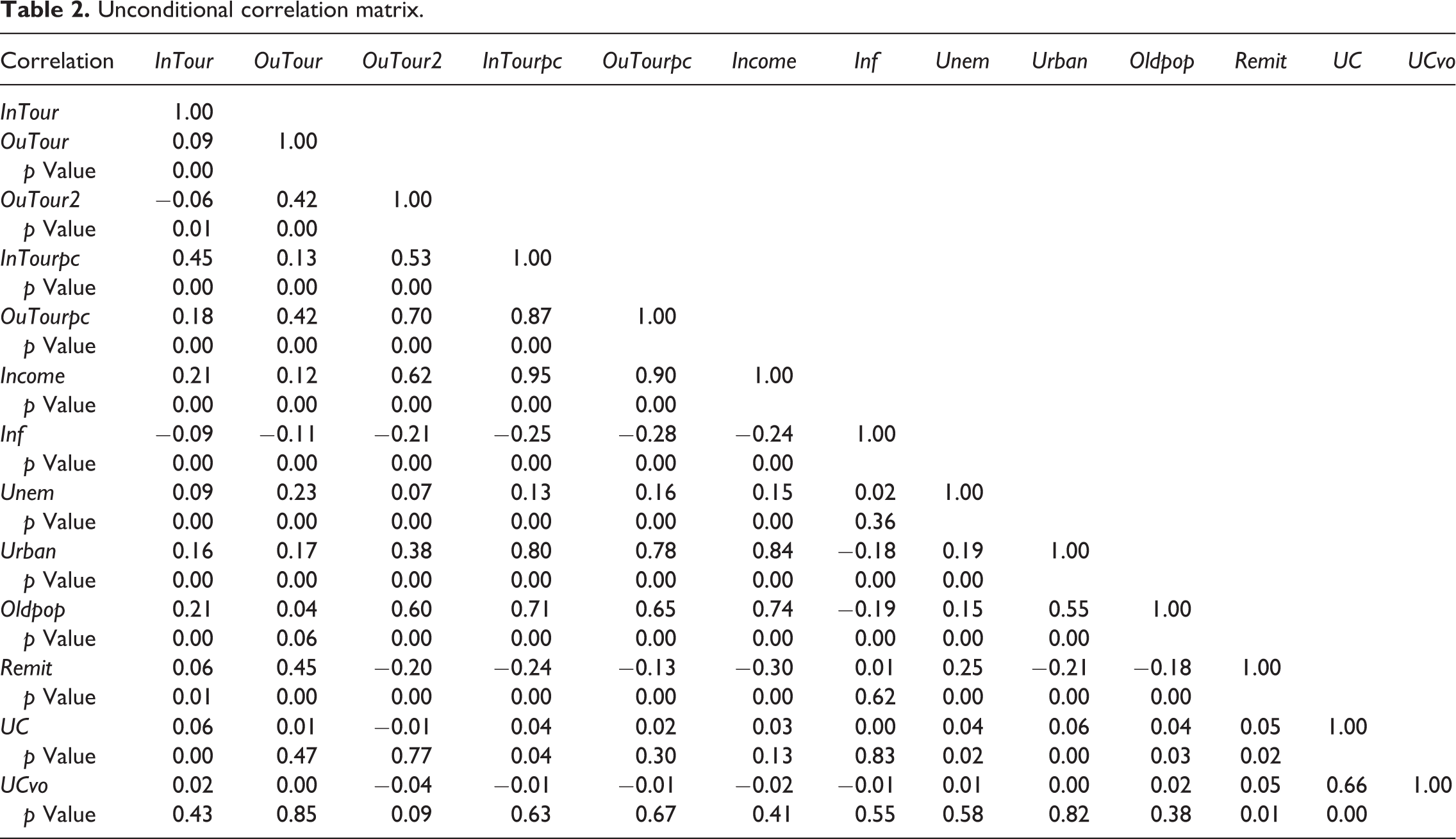
Unconditional correlation matrix.
Econometrically, the sample has large N (124 countries) over a relatively short period T (1996–2017), the cross-sectional dependence test Pesaran’s CD (Pesaran, 2004) is recruited to check for cross-sectional dependence. The results in Table 1 indicate the existence of cross-sectional dependence in all variables. In this case, the PCSE model is employed as the main estimator. The PCSE method (Beck and Katz, 1995) estimates the full N × N cross-sectional covariance matrix to correct for the contemporaneous correlation between the subjects, which works well in the sample with large N and small T (Hoechle, 2007). For these reasons, PCSE is the most suitable estimator given the nature of our sample (Bailey and Katz, 2011; Marques and Fuinhas, 2012).
However, the estimation of equation (3) also suffers from endogeneity as the possibility of feedback effects from tourism to economic development (Sokhanvar et al., 2018). To deal with this issue, we use all independent variables in 1-year lags. Another issue is heteroscedasticity, which is solved by recruiting the FGLS estimator (Liao and Cao, 2013; Zhang and Nian, 2013) as the robustness check. Furthermore, a bulk of other traditional estimators (i.e. pooled OLS, robust pooled OLS, and year-effect pooled OLS) are employed to check for the sensitivity/robustness of our findings. 9 The analysis for per capita variables of tourism is also conducted as another robustness check. In addition, to take into account the existence of unit roots, we employ a set of cointegration-based techniques (autoregressive-distributed lag (ARDL technique)) as a robustness check. We include the control variables one-by-one into the estimations to check for the consistency of the results. At last, we calculate the 5-year average of each variable from 1998 to 2017 (1998–2002, 2003–2007, 2008–2012, and 2013–2017) to check for the persistence of the results in long-run.
Results
The main results using PCSE model are reported in Tables 3 to 6. The results from different estimators (e.g. FGLS and pooled OLS) and different estimation strategies are reported upon requests. The per capita analysis is reported in Tables S3 to S5, Supplement.
Uncertainty and tourism.
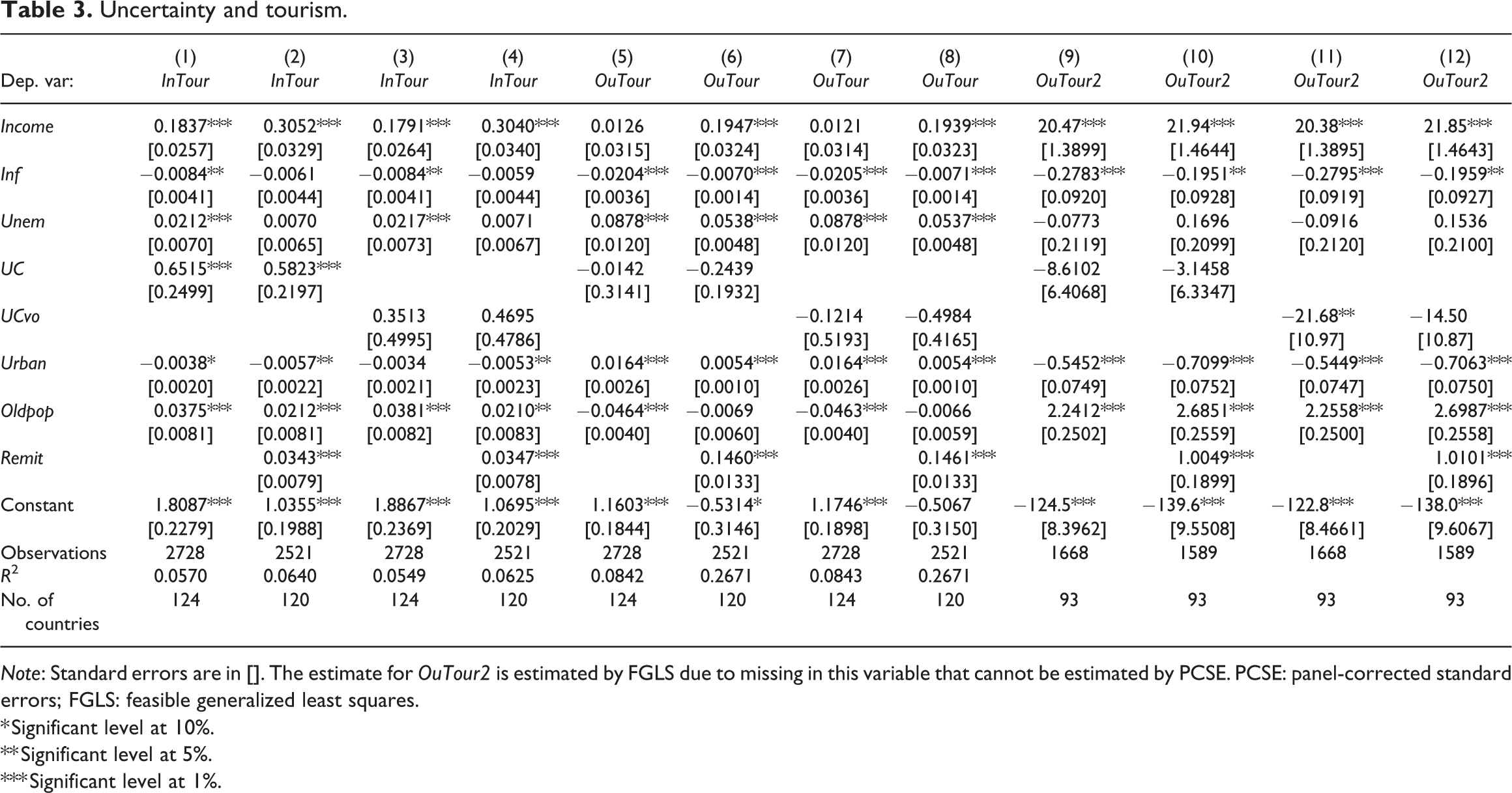
Note: Standard errors are in []. The estimate for OuTour2 is estimated by FGLS due to missing in this variable that cannot be estimated by PCSE. PCSE: panel-corrected standard errors; FGLS: feasible generalized least squares.
* Significant level at 10%.
** Significant level at 5%.
*** Significant level at 1%.
Uncertainty and domestic tourism in three subsamples.
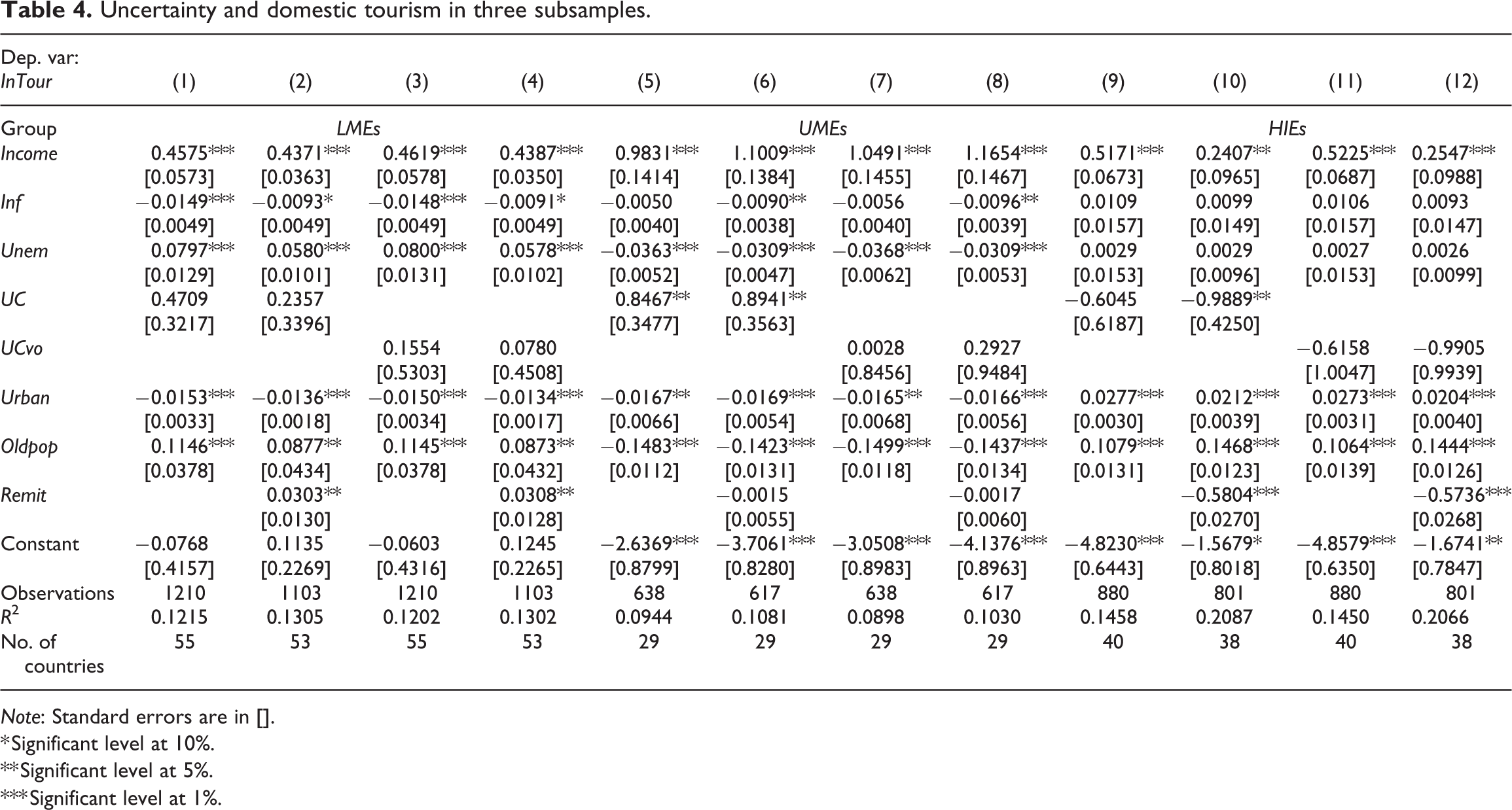
Note: Standard errors are in [].
* Significant level at 10%.
** Significant level at 5%.
*** Significant level at 1%.
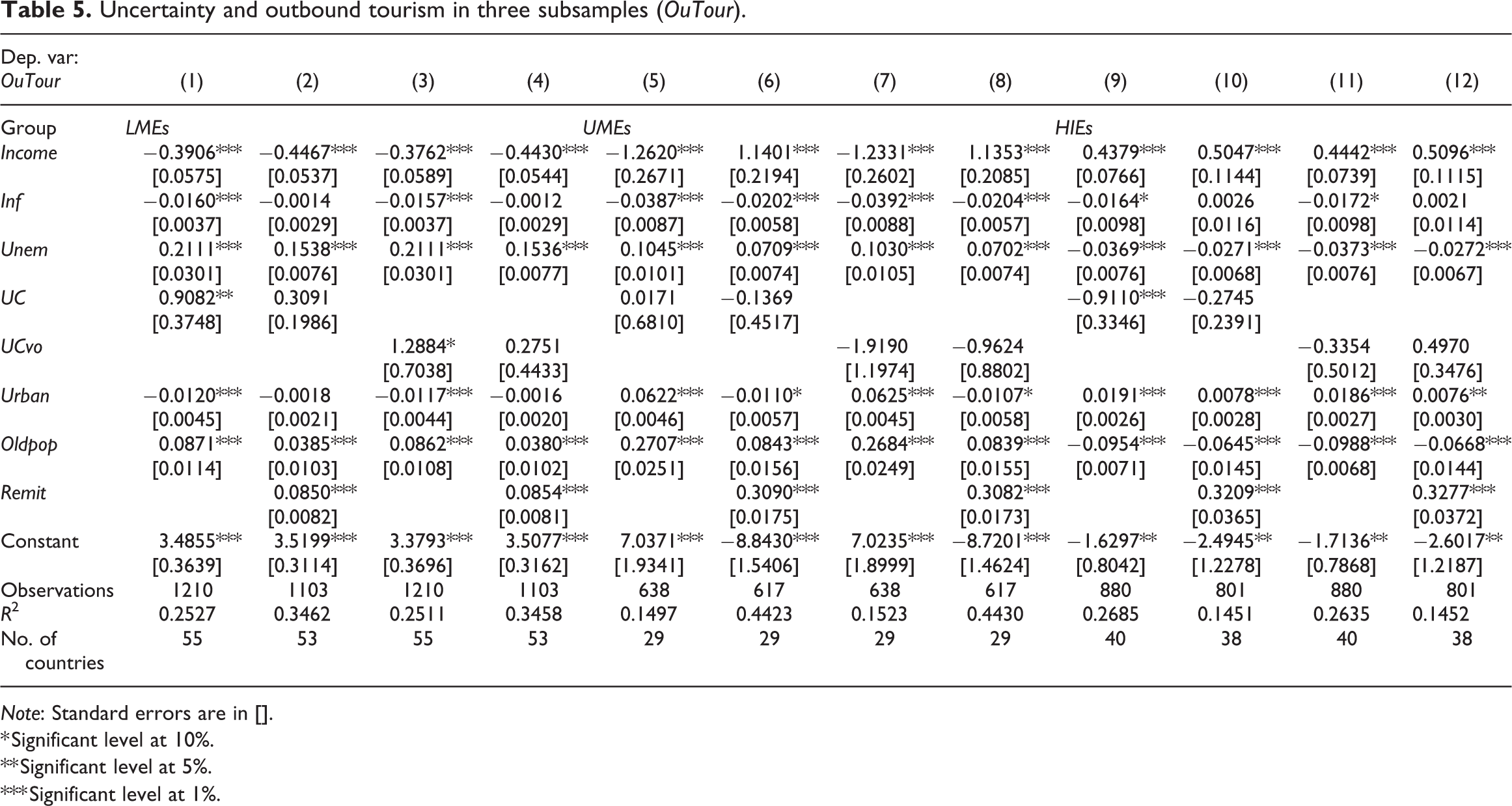
Uncertainty and outbound tourism in three subsamples (OuTour).
Note: Standard errors are in [].
* Significant level at 10%.
** Significant level at 5%.
*** Significant level at 1%.
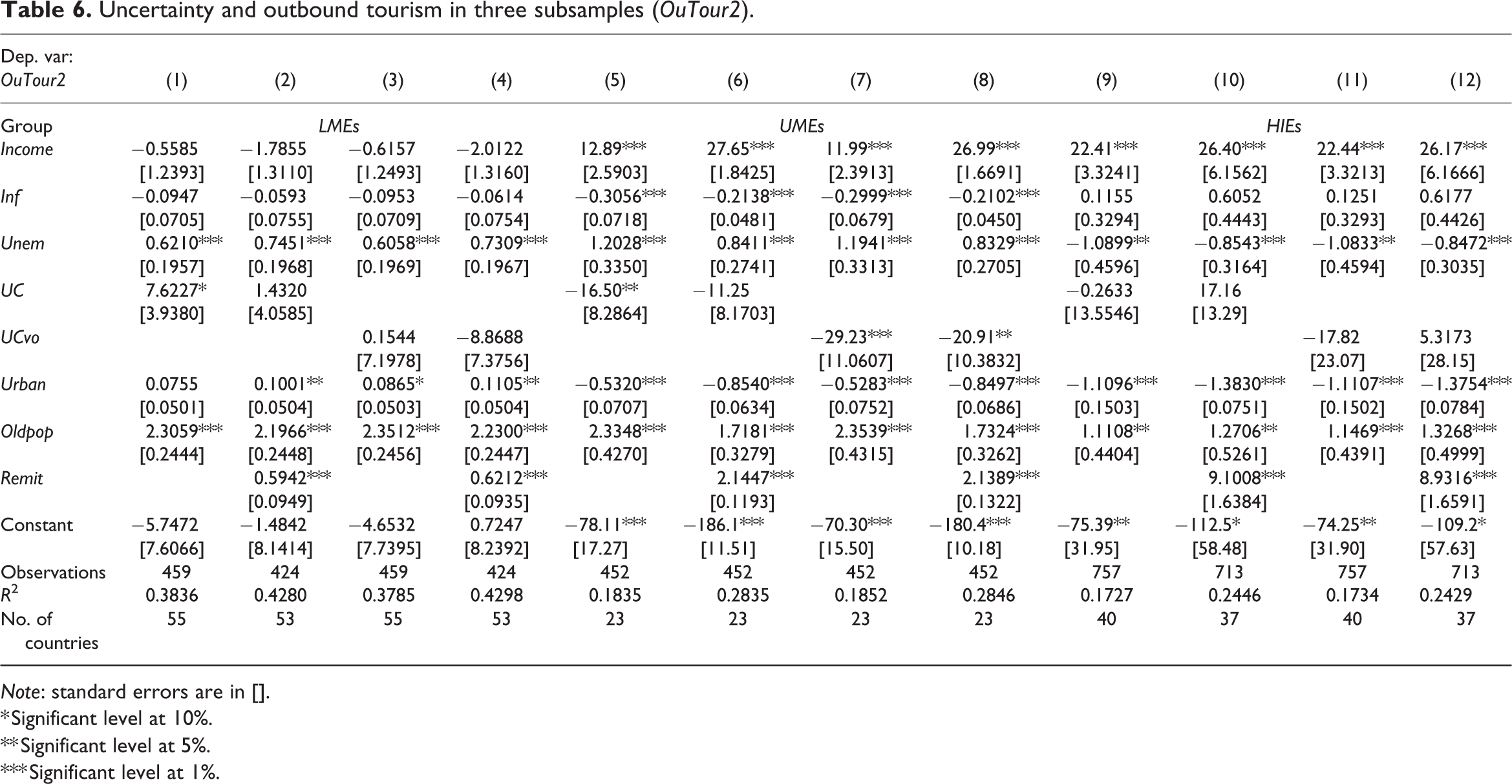
Uncertainty and outbound tourism in three subsamples (OuTour2).
Note: standard errors are in [].
* Significant level at 10%.
** Significant level at 5%.
*** Significant level at 1%.
Table 3 presents the impacts of economic uncertainty (in both measures of level and volatility) on domestic and outbound tourism. In terms of domestic tourism, the results show a significant positive impact of economic uncertainty level (UC) and insignificant positive impacts of economic uncertainty volatility (UCvo). In terms of outbound tourism, the results show a negative impact of both level and volatility of economic uncertainty on outbound tourism (OuTour and OuTour2). As such, it could be interpreted that an increase in economic uncertainty boosts domestic tourism and reduces outbound tourism.
Next, we examine the three subsamples LMEs, UMEs, and HIEs. The regression results are presented in Tables 4 to 6. Table 4 presents the impacts of economic uncertainty on domestic tourism spending; Table 5 presents the impacts of economic uncertainty in outbound tourism spending, and the impacts of economic uncertainty on outbound tourism departures are presented in Table 6.
Results in Table 4 show that increased economic uncertainty exerts a positive but insignificant impact on domestic tourism in LMEs. Interestingly, increased economic uncertainty has a significant favorable influence on domestic tourism in UMEs. Meanwhile, increased economic uncertainty exerts a significant negative impact on domestic tourism in HIEs. These findings imply the existence of different tourism consumption behaviors across income levels under economic uncertainty conditions. Specifically, our findings suggest that an increase in economic uncertainty induces higher domestic tourism in LMEs and UMEs, while it exerts a negative impact in HIEs.
The positive effects of uncertainty in LMEs and UMEs imply that economic uncertainty exerts a tougher adverse influence in these countries. The reason is that underdeveloped countries typically lack resources (e.g. capital, institutions) and experience to deal with uncertainty (Garau-Vadell et al., 2018). Meanwhile, HIEs, thanks to their stronger institutional settings and well-structured economic conditions, may suffer less from economic uncertainty.
Meanwhile, the negative impacts of economic uncertainty on tourism in HIEs can be explained by the fact that their economies have a high proportion of official sectors. That is, increased economic uncertainty lead to a significant reduction of disposable incomes for citizens working in these sectors as they face taxation and operational costs. Therefore, they would choose to reduce traveling as normal wisdom. Meanwhile, the economy of LMEs and UMEs is featured with a high proportion of unofficial sectors (Medina and Schneider, 2018), which face lower costs (no taxes and legal costs); as such, they may be less impacted by economic uncertainty, especially in the short term. Therefore, the disruption of economic activities due to economic uncertainty may provide these citizens time for traveling, which may be seen as a short break during the uncertainty. Therefore, our initial hypothesis that uncertainty is positively associated with domestic tourism is partially supported.
Results in Table 5 show another interesting finding, that is, economic uncertainty has a significant positive impact on outbound tourism spending (OuTour) in LMEs, while it has a negative impact in the contexts of UMEs and HIEs. As such, the results in UMEs and HIEs are consistent with the global sample. However, the positive impact of economic uncertainty on outbound tourism in LMEs is a puzzle. These countries are low and lower-income economies, why are their citizens willing to spend substantial fortunes to travel abroad in the uncertain conditions? One potential explanation could lie in the literature examining the extant waves of migration and the behaviors of refugees. Citizens in less developed countries, in the situation of economic and political uncertainty, are strongly motivated to consider finding jobs/moving to HIEs, which could be made initially through outbound tourism. Previous studies have documented a strong relationship between outbound tourism and immigration for jobs, especially from lower-income countries to higher-income countries (Gössling and Schulz, 2005; Kang and Page, 2000; Oigenblick and Kirschenbaum, 2002). Our findings thus highlight the role out outbound tourism as a first step toward migration, at least from the administrative point of view.
At last, Table 6 presents the results of the impacts of economic uncertainty on outbound tourism departures (OuTour2). The results are consistent with the findings presented in Table 5, in which increased uncertainty boosts outbound tourism in LMEs and lowers outbound tourism in UMEs and HIEs.
Key findings also remain in the per capita analysis (the results are presented in Tables S4 and S5, Supplement) and in the regression using cointegration-based ARDL technique to control for the existence of the unit-roots (the results are presented in Tables S6 and S7, Supplement).
Discussion and conclusion
This study investigates the dynamics of tourism under economic uncertainty conditions. Specifically, we hypothesize that economic uncertainty may exert dissimilar effects on (1) domestic versus outbound tourism and (2) countries with different income levels. To examine the potential heterogeneous effects of uncertainty, we employ a global sample of 124 countries consisted of three subsamples of 55 LMEs, 29 UMEs, and 40 HIEs over the period 1996–2017. For the sake of the robustness, we employ a set of alternative measures of tourism and uncertainty. Also, we estimate our models using different estimation techniques and estimation strategies.
This study makes a set of important contributions to the literature. First, it suggests that, at the global scale, economic uncertainty is positively associated with domestic tourism and negatively associated with outbound tourism. This is driven by the reduction of business activities and transactions in the circumstances of uncertainty, leading to an upsurge in the nonbusiness time for citizens. They may take this chance for their leisure consumptions such as tourism. Given the higher costs and higher levels of uncertainty associated with outbound tourism, domestic tourism appears to be a better choice. This finding stands in sharp contrast to the mainstream literature which argues that economic uncertainty exerts a negative impact on all economic activities, including service industries such as tourism (Fasani and Rossi, 2018; Nguyen et al., 2020a, 2020b; Zhang et al., 2019). In this study, we find that tourism is a special product that may be consumed more when some conditions are met: (1) citizens have more free time; (2) traveling is associated with low costs and low risks.
Second, this study reveals that there is substantial heterogeneity in the consumption behavior of tourists across countries with different levels of incomes. Specifically, there are two important findings that are worth a more detailed discussion. First, an increase in economic uncertainty induces higher domestic tourism in LMEs and UMEs, while it exerts a negative impact in HIEs. This finding thus suggests that the adverse effects of economic uncertainty are uneven across countries. HIEs may suffer more from uncertainty due to their high proportion of the official sector (Carrière-Swallow and Céspedes, 2013). Also, citizens working in the official sectors in HIEs may shape their consumption behavior, in which they treat traveling as an inappropriate consumption during the uncertainty.
Meanwhile, in LMEs and UMEs, a large proportion of citizens working in the unofficial sector may not be immediately influenced by the shocks. As such, they may consider domestic tourism as a means of spending their nonbusiness time during the uncertainty. We thus propose that increased tourism is not always the desired outcome and cannot be seen as a signal of economic stability and improved living standards. In contrasts, increased (domestic) tourism, in some specific circumstances, may serve as a warning of stagnant business activities and degraded economic activeness. As such, simply judging the health of the economies using tourism consumption as an indicator may lead to misunderstanding of the trajectory of the economic shocks.
Another finding to highlight here is that economic uncertainty exerts a negative impact in the contexts of UMEs and HIEs, while it has a positive impact on outbound tourism in LMEs. We explain this counterintuitive finding relying on the migration literature. Specifically, citizens in less developed countries, in the situation of economic and political uncertainty, are strongly motivated to consider finding jobs/moving to HIEs (Nejad and Young, 2016), which could be made initially through outbound tourism. In the literature, it has been confirmed that citizens in less developed countries are likely to take outbound tourism as a means to escape the chaotic economic and political environments in their home countries (Bianchi, 2000; Prideaux, 2005; Rappaport, 2019). This study thus proposes that there is a need to conduct more delegated research to expand our understanding of the links between outbound tourism, economic uncertainty, and migration.
By adding new evidence on the impacts of economic uncertainty on both domestic and outbound tourism, this study offers some important policy implications. First, policymakers should be aware that tourism development is not always associated with economic development and stability. It would be naïve to simply evaluate the growth of the tourism sector independent from a connection with the surrounding environments, including economic and political uncertainty. Our findings suggest that sometimes increased tourism may send a signal of weakening economic conditions.
Then, policymakers should take into account the possibility that citizens in lower-income countries may utilize outbound tourism as a first step toward migration. By analyzing the destinations and the traveling purposes of citizens, policymakers may understand the motivations of outbound tourism and thus exert better management on immigrants.
This study is not without limitations that should be acknowledged, but they also provide potential avenues for future research. First, the long-term effects found in this study may be limited because the sample was restricted to a short period of time (1996–2017). In the short-term scale, macroeconomic conditions may fail to present their full effects in the estimations. Future studies, therefore, should extend the proposed theoretical framework and retest it using a long-term scale of analysis. Also, due to the limited information available, we are restricted to the use of the country-level uncertainty index. Future study may employ alternative measures of uncertainty (e.g. surveys), which would allow a deeper understanding of the impact of economic uncertainty on tourism development.
Supplemental material
Supplemental Material, RR2-Supplementary - Economic uncertainty and tourism consumption
Supplemental Material, RR2-Supplementary for Economic uncertainty and tourism consumption by Canh Phuc Nguyen, Su Dinh Thanh and Bach Nguyen in Tourism Economics
Footnotes
Declaration of conflicting interests
The author(s) declared no potential conflicts of interest with respect to the research, authorship, and/or publication of this article.
Funding
The author(s) received no financial support for the research, authorship, and/or publication of this article.

Supplemental material
Supplemental material for this article is available online.
Notes
References
Supplementary Material
Please find the following supplemental material available below.
For Open Access articles published under a Creative Commons License, all supplemental material carries the same license as the article it is associated with.
For non-Open Access articles published, all supplemental material carries a non-exclusive license, and permission requests for re-use of supplemental material or any part of supplemental material shall be sent directly to the copyright owner as specified in the copyright notice associated with the article.
