



Abstract
How does coalition participation influence party membership? We argue that parties that take part in coalition governments are likely to experience less favorable party membership developments than parties governing alone because of the compromises they have to agree on in multi-party cabinets. This should be particularly likely for parties in ideologically diverse coalition governments since parties participating in such cabinets are more likely to have to deviate from originally promised policy positions; and for junior coalition partners, as they have less influence over policy and are less able to claim credit for government achievements. We evaluate these expectations on the basis of a new dataset that covers information on (1) the number of members in all German state parties between 1990 and 2023, (2) the ideological profile of the state parties, and (3) the status of a state party as a member of a state coalition government. We find that junior coalition partners lose significantly more members than parties that govern alone. Furthermore, an increasing programmatic distance within the cabinet on economic issues is related to a decreasing number of members of the respective government parties.
Introduction
The number of individuals who join political parties is in decline in almost all modern democracies (Kölln, 2016; Mair and Van Biezen, 2001; Scarrow and Gezgor, 2010; Van Biezen et al., 2012). Many established parties have started initiatives to make party membership more attractive. For instance, intra-party decision-making processes tend to be currently more inclusive than in the last decades (Peters, 2016; Van Haute and Ribeiro, 2022). One prominent example is the direct involvement of the party members in the selection of candidates for internal offices like the party chairperson and for public offices like the head of the executive (Cross et al., 2016; Detterbeck, 2013; Hopkin, 2001; Quinn, 2004; Sandri et al., 2016). For example, in Germany, the Social Democrats (SPD) selected their new party chairman in 1993 in a US-style primary. Yet, the overall negative trend in the development of party membership numbers did not change. In the German case, more than 1 million West Germans were members of the SPD in the mid-1970s, and in 2023, this figure was about 365.000. A similar pattern can be observed for the CDU, which has lost roughly half its members since peaking at over 700,000 in the mid-1980s.
Yet, besides this overall declining trend in European countries, there is fluctuation in the number of party members. Some parties show a net gain of members in specific time periods, whereas other parties lose members throughout a long time period. Existing research reveals significant variation in membership levels across different political parties. For example, Kölln (2014) shows that party membership decline is not a general trend. Instead, she demonstrates that membership decline is related to a party’s life cycle: the older – or the more consolidated – parties are, the fewer members they have. The development of the party membership of the German Greens and the far-right “Alternative for Germany” (AfD) underlines the findings by Kölln (2014). The number of members of the German Greens increased significantly over the last years since climate protection became a highly salient topic and the AfD gained members by increasingly adopting an anti-immigrant policy profile since 2015.
Given that parties are still the major linkage between the interests of the public and the political institutions that decide about public policy, a decline in party membership is likely to create problems for the adequate representation of the interests of all societally relevant groups in the political process. The dramatic decrease in the number of party members, in particular of catch-all parties that try to make policy offers for a wide range of individuals in a political system, could be seen as especially problematic for representation in democratic systems.
Concurrently, we see an increasing fragmentation of party systems in almost all modern democracies in the last decades. Not only did electoral volatility result increasingly in oftentimes seismic shifts in the strength of established political parties which had shaped the political landscape since World War II. But also new parties emerged, consolidated and sometimes became critical actors in the process of forming a new government, which became not only a more complicated process due to the new complexities of the party systems (e.g., Ecker and Meyer, 2020). Moreover, the number of multiparty cabinets that form after elections or during ongoing legislative periods increased due to the more complex party systems and the decreasing power of catch-all and mainstream parties. Even in countries such as the United Kingdom or Spain, coalition governments became ‘normal’ features of the political process, not only at the regional but also at the national level (e.g., Bergman et al., 2021; Bräuninger and Debus, 2025; Müller et al., 2024).
The aim of this paper is to contribute to our understanding of why there are changes and fluctuations in party membership by integrating theoretical approaches and empirical findings from research on coalition politics. We argue that, besides overall trends, the need for agreeing on policy compromises in coalition governments (see, e.g., Müller et al., 2024) should affect the number of party members. Parties that enter coalition governments are likely to experience comparatively less favorable membership developments, because the policy compromises required in coalitions can disappoint activists who joined the party precisely to advance its stated policy positions (e.g., Fortunato, 2021). This should in particular be more likely to occur in parties taking part in ideologically diverse coalition governments. Parties that substantially compromise their policy promises when entering government with ideologically distant coalition partners are likely to face greater member dissatisfaction since fewer election pledges and elements of the respective parties’ core ideology will be implemented during the legislative process.
We evaluate these expectations using a new dataset that covers information on (1) the number of members in all German state parties between 1990 and 2023, (2) the ideological profile of the state parties, and (3) the status of a state party as a (junior) member of a state coalition government. Analyzing several multi-level mixed-effects models, the results provide mixed evidence for our hypotheses. We find that being a member of a coalition government is negatively associated with changes in the party membership when compared to parties governing alone. However, when differentiating between junior and senior coalition partners, such an effect can only be found for junior partners. Furthermore, an increasing programmatic distance to other parties within the cabinet on economic issues is related to less favorable party membership developments of the respective government parties. These findings indicate that governing in multi-party cabinets is negatively related to party membership developments, and that because of the more complex party systems in Europe and beyond, the increasing need for governing in ideologically more heterogeneous coalitions is likely to result in a further decrease of party members. This could result in a further destabilization of the linkage role that political parties fulfill in connecting civil society with the political institutions in a democratic polity.
Literature on party membership
Many studies describe the development of party membership in modern democracies since the end of the Second World War and provide answers to the determinants of the decline and fluctuation in the number of party members. While the decline in party membership is generally acknowledged (e.g., Katz et al., 1992; Mair and Van Biezen, 2001; Scarrow, 2002; Scarrow and Gezgor, 2010; Tan, 1997; Van Biezen et al., 2012), more recent studies point out that one has to differentiate between ideological party families and the life cycle of a party. In a comparative study covering 47 parties from six European countries between 1960 and 2010, Kölln (2014) finds that almost a quarter (23%) did not experience a decline in party membership, showing no uniform trend in membership decline in the West European countries under study. Older, more consolidated parties, founded before 1945, were more affected and were shown to lose more members than those founded between 1945 and 1980. In addition, Kölln (2014) finds that some party families are more strongly affected by membership decline, while ecological parties were the only ones that show a significant increase in their number of members in the analyzed time period.
Scarrow and Gezgor (2010) focus on this differentiated trend in party membership development and examine who is joining today’s smaller parties. They find that there is a growing age gap between party members and the general population. However, party members seem to become more similar to their fellow citizens in most other aspects. The latter result indicates that – despite the decreasing membership numbers of older, catch-all parties like Christian Democrats, Conservatives or Social Democrats – these parties still have the potential to serve as linkages in a representative democracy in general and to link their parties to a wider electoral base.
Several parties changed their organizational structure and implemented elements of direct democracy – for instance in the candidate selection process – to make the respective party more attractive for potential members. Peters (2016) finds that implementing elements of direct democracy – either in the political system in general or within a party – is related to have higher levels of party membership. Van Haute and Ribeiro (2022) observe that (an adequate) representation of sub-groups like youth organizations or the representation of specific professional or social groups within the party structure can help to increase membership recruitment, or at least to slow down the decline of party membership.
A further branch of research focuses on the ideological orientations of party members. Kölln and Polk (2017) find that ideological incongruence between the party members and the respective party elite matters for the behavior of the members: if a party member is not in line with the position of the respective party’s leadership, she is not only more likely to vote for a different party, but also more likely to leave the party. While dissatisfaction with the leadership is the strongest predictor for leaving the party, Kölln and Polk (2017) show that also ideological disagreement between party members and the party elite is related with a higher probability that individuals leave the party.
In line with these results, Webb and Bale (2014) show – on the basis of survey data among members of the British Conservative Party – that those individuals who considered themselves as cultural conservatives and were concerned about immigration and European integration were more likely to support the United Kingdom Independence Party (UKIP) in the time period before Brexit. Using data from four surveys of party members (Bale et al., 2019), the results presented by Barnfield and Bale (2022) indicate that British party members leave parties mainly for political and ideological reasons. One key driver for leaving a party is “disillusionment” and “disagreement” of the members with the respective party leaders. This “disillusionment” is, according to the findings by Barnfield and Bale (2022), based on the subjectively perceived ideological differences between members and the party leadership.
What is, by contrast, not prominently considered in the existing literature on the development of party membership are the potential effects of participating in multi-party cabinets. Governing in coalitions always implies searching and agreeing on compromises, which could result in an increasing dissatisfaction of party members with the course of the party and its leadership during the legislative term when the coalition compromises are implemented.
Theoretical expectations
Previous research indicates that policy changes – whether from new parties or established parties moving toward more extreme positions – can affect party membership. When parties join the government they may face veto players or specific economic circumstances that make implementing their campaign pledges challenging (Elsässer and Haffert, 2022; Tsebelis, 2002; Wenzelburger et al., 2020). This is likely to result in decreasing support for the party among voters and members during the legislative term when politically active individuals like party members realize which promises and pledges their party cannot enforce despite being in government. For instance, the German Social Democrats faced a severe membership loss – including prominent members, like the former party chairman Oskar Lafontaine – when the SPD-led government of Chancellor Schröder implemented massive welfare cuts in the early 2000s.
A second reason for increasing dissatisfaction among party members, which could result in some supporters leaving the party, lies in the requirement of forming coalition governments, which always implies agreeing on policy compromises, in contrast to single-party governments. While compromises always indicate a shift from the party’s ideal point, the increasing fragmentation of party systems in general and the increasing parliamentary representation of ‘pariah parties’ from the far left and far right (De Lange, 2012; Van Spanje and Van Der Brug, 2007) raise the chances for the formation of more programmatically heterogeneous multi-party cabinets. In such constellations, coalition parties often have to agree on more far-reaching policy compromises during the coalition negotiation talks and in the daily business of coalition governance (e.g., Müller et al., 2024), risking their supporters’ and members’ disappointment when fewer policy pledges are implemented during the legislative process (e.g., Matthieß, 2020; Thomson et al., 2017).
Recent coalition research demonstrates that voters disapprove of coalition compromise, leading them to punish some governing parties electorally (Fortunato, 2019, 2021). A case study on the German ideologically very heterogenous ‘traffic light coalition’ between SPD, Greens and the fiscally conservative Free Democratic Party (FDP) shows that after a short honeymoon effect at the beginning of the term, the support for the three government parties among their voters declined dramatically because of the exacerbating policy conflicts between the three coalition parties (Debus et al., 2026). Drawing on panel data, the findings indicate that the sharp decline of previous voters’ support for the three coalition parties was strongest for the FDP which was not only the smallest party in the coalition, but also the party that was programmatically far away from the positions of its two coalition partners on the key policy domain of economic issues (Jankowski et al., 2022). We draw on such work here.
We argue that participation in coalition governments – in contrast to forming single-party governments – negatively affect party membership changes. Generally, voters respond positively when the party they voted for wins an election, especially when it becomes part of the government that forms in its aftermath (e.g., Anderson et al., 2005; Daoust et al., 2023). On the one hand, voters derive satisfaction from electoral success, and resulting enthusiasm could lead to incentives in joining the party a voter supported in an election. On the other hand, voters expect more utility from the system when the party is in government, which is likely to set incentives for becoming party members, be it in terms of policies they expect from the (new) government or in terms of posts the government distributes to individuals, for instance in the public sector (Daoust et al., 2024; Ennser-Jedenastik, 2014a, 2014b). However, the dynamics become more complex when parties enter coalition governments. Participation in such governments often requires parties to compromise on their policy positions, which can alienate their members and supporters in particular during the legislative period when the ‘honeymoon period’ directly after the election and the government formation process is over and when (new) party members realize that their party will not be able to enforce its pure policy positions when governing with one or more other parties.
Along these lines, Fortunato (2021) argues that voters tend to dislike when ‘their’ party is perceived as compromising, equating compromise with representational failure (but see Green-Pedersen and Hjermitslev, 2024; Plescia et al., 2022). Such compromises can lead to electoral penalties, as voters tend to punish compromising parties (Fortunato, 2019). Relatedly, research shows that coalition governments are less effective at fulfilling electoral pledges compared to single-party governments (Thomson et al., 2017), potentially eroding party member confidence when their party fails to deliver on commitments. Voters similarly punish such failures (Matthieß, 2020). Dissatisfied voters may respond to their party’s compromises by switching votes, abstaining, or leaving the party altogether.
Furthermore, coalition participation often blurs the ideological distinctiveness of parties in contrast to those parties who form single-party governments. Fortunato and Stevenson (2013) show that voters perceive coalition partners as ideologically closer than they actually are, while Spoon and Klüver (2017) find that voters struggle to correctly identify the policy positions of coalition parties. As members typically join parties close to their own preferences, they may come to feel less congruent with their party if they perceive it as shifting toward its coalition partner. This perceived incongruence between members and their parties increases the likelihood of exit from the party, even when the party’s actual position remains aligned with members’ preferences (Kölln and Polk, 2017). Drawing on this literature, we expect that.
Participation in coalition governments leads to less favorable party membership development compared to single-party governments.
Coalition governments vary in their characteristics, and in particular the ideological diversity is a key component for explaining the formation and the perception of multi-party cabinets. Building on this perspective, we expect that the negative effect of coalition participation on party membership should be stronger the more ideologically diverse a coalition government is. Voters expect that such coalitions require substantial policy concessions (Gschwend and Hooghe, 2008) and that their preferred party, if they enter such a government, will be unable to implement its policy agenda. For this reason, voters are more supportive of coalitions with ideologically similar partners (e.g., Plescia and Aichholzer, 2017).
Also, voter perceptions of shifts in party positions are particularly pronounced in heterogeneous coalitions. Falcó-Gimeno and Fernandez-Vazquez (2020) show that voters adjust their perceptions of party positions when parties enter coalitions with ideologically distant partners, often perceiving them as moving closer to their coalition allies. This perceived ideological shift can result in perceived ideological incongruence, alienating members who value consistency and ultimately contributing to membership decline. While we expect these mechanisms to apply to all coalition parties, we do not expect them to apply equally to all of them. In coalitions consisting of more than two parties, the costs of ideological discrepancies within the government will be higher for more extreme parties with a lot of distance to all their partners than for more central parties within the coalition. Extending the argument made when developing our first hypothesis, we expect that party membership changes are shaped both by coalition participation and by the ideological diversity of the coalition partners. Hence, we hypothesize that,
The greater the ideological distance to other parties within a coalition government, the less favorable the party membership development.
However, plenty of research on multi-party cabinets argues and shows that the coalition parties are not equally able to enforce their electoral pledges and general ideological views when negotiating the coalition agreement and in conflicts during the legislative period. Stronger parties will receive more payoffs, and cabinet parties which have a high degree of bargaining power are more able to enforce their office and policy preferences (e.g., Bäck and Carroll, 2025; Debus, 2008; Klüver et al., 2023). Therefore, we do not expect the negative effect of coalition government participation to apply evenly across all parties and coalitions. On the one hand, we expect junior coalition parties to be more likely to suffer from this effect than their senior counterparts. Compared to senior partners, junior partners have less influence over policy decisions and are less able to fulfill their electoral pledges (Thomson et al., 2017), potentially undermining their credibility and appeal to voters. Klüver and Spoon (2020) further show that junior partners are more likely to be punished in elections, reflecting their diminished capacity to deliver on their policy goals.
Moreover, coalition participation particularly distorts how voters perceive the positions of junior partners: Fortunato and Adams (2015) demonstrate that voters are more likely to project the senior partner’s ideological stance onto the junior partner than vice versa, diminishing the junior partner’s ability to maintain a distinct policy profile. The same argument outlined above should therefore be particularly relevant for junior partners: the more party members perceive their parties shifting their positions towards those of their senior coalition partners, the more likely it is for them to perceive a mismatch between the positions of the party and themselves, which might alienate them and lead to them leaving the party. Similarly, focusing on the German case, Debus et al. (2014) show that voters reward the Chancellor’s party for good economic performance, but not the junior coalition partner—even when that partner controls economic ministries. Drawing on this research, we hypothesize that.
Junior coalition partners experience less favorable party membership development than senior coalition partners.
Data and methods
We test our hypotheses on party membership development using annual membership data on individual parties in the German states between 1990 and 2023. We analyze all parties that were represented in the Bundestag at some point during this period: the SPD, the CDU, the Christian Social Union (CSU), the FDP, Alliance 90/The Greens, The Left, and the right-wing populist AfD. 1 Concentrating on the state level within a political system has several advantages from a research design perspective. The institutional context and the basic structure of party competition and coalition formation are more or less the same across the Länder and have remained relatively stable over time (see, e.g., Bräuninger et al., 2020). The institutional structure is therefore in some respects held constant, thereby minimizing potential confounding effects. This is a distinct advantage over analyzing party membership fluctuations at the national level in a comparative analysis where the institutional context varies significantly across countries.
From an organizational perspective, national parties in Germany are composed of 16 subnational party branches that compete under the same party label in elections at the regional level. Each subnational branch has its own leadership, decides about its policy profile in state party conventions, and chooses whether or not to participate in a state coalition government (Bräuninger et al., 2020). If there is, for example, a party leadership vote in a German state party branch or a vote on joining a coalition government, only members of the respective subnational branch are allowed to participate in this primary (e.g., Astudillo and Detterbeck, 2020; Detterbeck, 2013, 2016). In addition, the state parties are represented in proportion to their membership numbers on national party congresses, and the strength of state parties and their policy profile matter for the programmatic position adopted by the federal party (Bäck et al., 2016). 2
Our dependent variable measures the change in party membership in German state parties; we use membership data collected by Niedermayer (2020, 2024). 3 Three different measures are regularly used in the literature when analyzing party membership or its changes over time (cf. Katz et al., 1992). Party membership can be measured in absolute terms (M), as a fraction of the number of voters (M/V), or as a proportion of the total electorate (M/E). Each of these measures serves different analytical purposes and can lead to distinct conclusions about organizational trends. Absolute membership figures (M) are useful for assessing the aggregate strength and grassroots capacity of party organizations, as they indicate whether parties have sufficient supporters to maintain a local presence (Scarrow, 2002: 87). However, this measure is heavily influenced by demographic changes, such as population growth and is problematic for cross-national comparisons (Katz et al., 1992: 330–332). The membership-to-voter ratio (M/V) offers insights into how effectively parties convert their voters into members, providing a measure of their ability to bind supporters beyond election day (Kölln, 2014: 76). However, this measure is sensitive to fluctuations in voter turnout, which may distort interpretations of membership trends. For instance, a decline in voter turnout could artificially inflate the M/V ratio, even if the absolute number of members remains constant or decreases (Kölln, 2016: 468).
The membership-to-electorate ratio (M/E) is widely regarded as the most appropriate measure for longitudinal and comparative studies (e.g., Kölln, 2016; Krouwel, 2012; Scarrow, 2002). Standardizing membership figures relative to the total electorate, this approach minimizes distortions caused by changes in voter behavior or demographic shifts, making it particularly suitable for cross-national and temporal comparisons, as it provides a consistent framework for analyzing membership trends across different contexts. Analyzing the German states over a period of more than 30 years, we are dealing with a huge variety of electorate sizes, making M/E the best indicator for our purposes. While changes in M/E ratios can be measured in different ways (Katz et al., 1992: 331–332), we follow Kölln (2014: 81) and measure the change of the M/E ratio as:

This formula measures percentage changes in the ratio from year t-1 to year t. As membership is measured at the very end of each year, we model how coalition participation during a specific year affects membership changes in the same calendar year.
To test our hypotheses, we operationalize several variables related to coalition government participation. Coalition government participation is coded using a series of binary variables, one indicating whether the party was part of a coalition government in the respective year (for hypotheses 1a and 1b), and two additional variables indicating whether it was junior or senior member of the coalition (for hypothesis 2). We additionally control whether a party was in opposition, making single-party government the reference category. To measure ideological distance within coalitions, we rely on the dataset on party competition in the German Federal States (Bräuninger et al., 2020), which includes information on the ideological profile of state parties, measured by analyzing the state parties’ electoral manifestos using Wordscores (Laver et al., 2003). We measure this ideological distance in two dimensions: the economic and the socio-cultural dimension. We operationalize it as the average distance between the positions of the respective party and all other parties in the coalition on the respective dimension, meaning it takes the same value for both parties in two-party coalitions and varying values in three-party coalitions.
We control for several variables that may plausibly affect party membership independent of coalition participation and that have been shown to be relevant in previous literature on party membership (e.g., Bale et al., 2019; Kölln, 2016); or federal variables that have been shown to influence other aspects of state parties in previous studies (e.g., Bäck et al., 2016). First, we control for ideological polarization in parliament, which we measure as the distance between the two most extreme parties in parliament, also differentiating between the economic and the socio-cultural dimension and using the Wordscores measures by Bräuninger et al. (2020). We also regard whether the party is part of the federal government and whether there was a national election in a given year to account for the potential influence of national-level dynamics on state party membership, as well as for party age 4 , standardized using z-scores, to control for the effect of a party’s institutionalization on its membership development. We also take account of time passed since the beginning of our observation period as well as a squared polynomial of it to include (non-linear) time trends. 5
To test our hypotheses, we use linear mixed-effects models tailored to the time-series cross-sectional structure of our data. We estimate multilevel models with random intercepts at the party level and for states nested within parties, allowing baseline membership dynamics to vary across parties and across their state branches. To explicitly address temporal dependence, we model the residuals within each land-party panel as a first-order autoregressive (AR (1)) structure.
Results
Before evaluating our hypotheses, a short discussion of our dependent variable is necessary. The annual percentage change in the M/E ratio is inherently asymmetric: a 50% loss would require a 100% gain to return to the original level. As a consequence, even though party membership has generally been in decline across the German states and the median observation is negative, the mean annual M/E change in our sample is positive across groups of each government status. Positive values, therefore, should not be interpreted as evidence of membership growth in absolute terms. Rather, a predicted higher M/E change for one government type than another indicates relatively more favorable membership development, not necessarily an actual increase in members. Descriptive statistics for the dependent variable, broken down by government status, are presented in Appendix B.
Determinants of changes in party membership in the German States, 1990-2023.
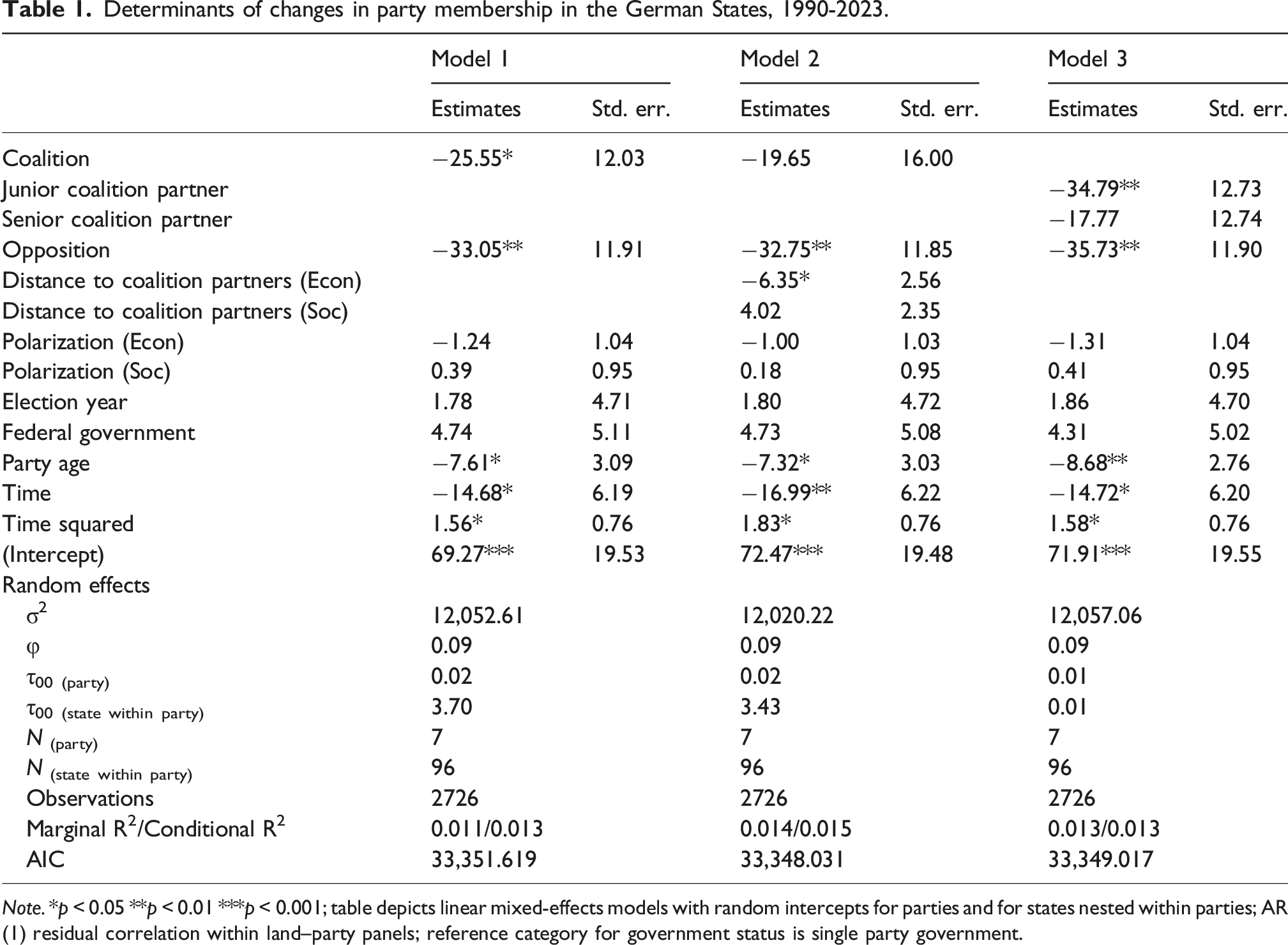
Note. *p < 0.05 **p < 0.01 ***p < 0.001; table depicts linear mixed-effects models with random intercepts for parties and for states nested within parties; AR (1) residual correlation within land–party panels; reference category for government status is single party government.
We do find evidence that the characteristics of a government are related to changes in the party membership. Model 1 indicates that governing in a coalition is associated with significantly more negative membership changes when compared to parties that govern in single-party governments. Parties in opposition also fare significantly worse in terms of membership development than parties governing alone. This provides support for the argument that more individuals join – or: leave to a lesser degree – parties if these parties gain executive office and can distribute goods in terms of policies or posts. If a party ends up in opposition or has to make compromises in a multi-party cabinet, it seems less attractive for utility-maximizing individuals to join a party.
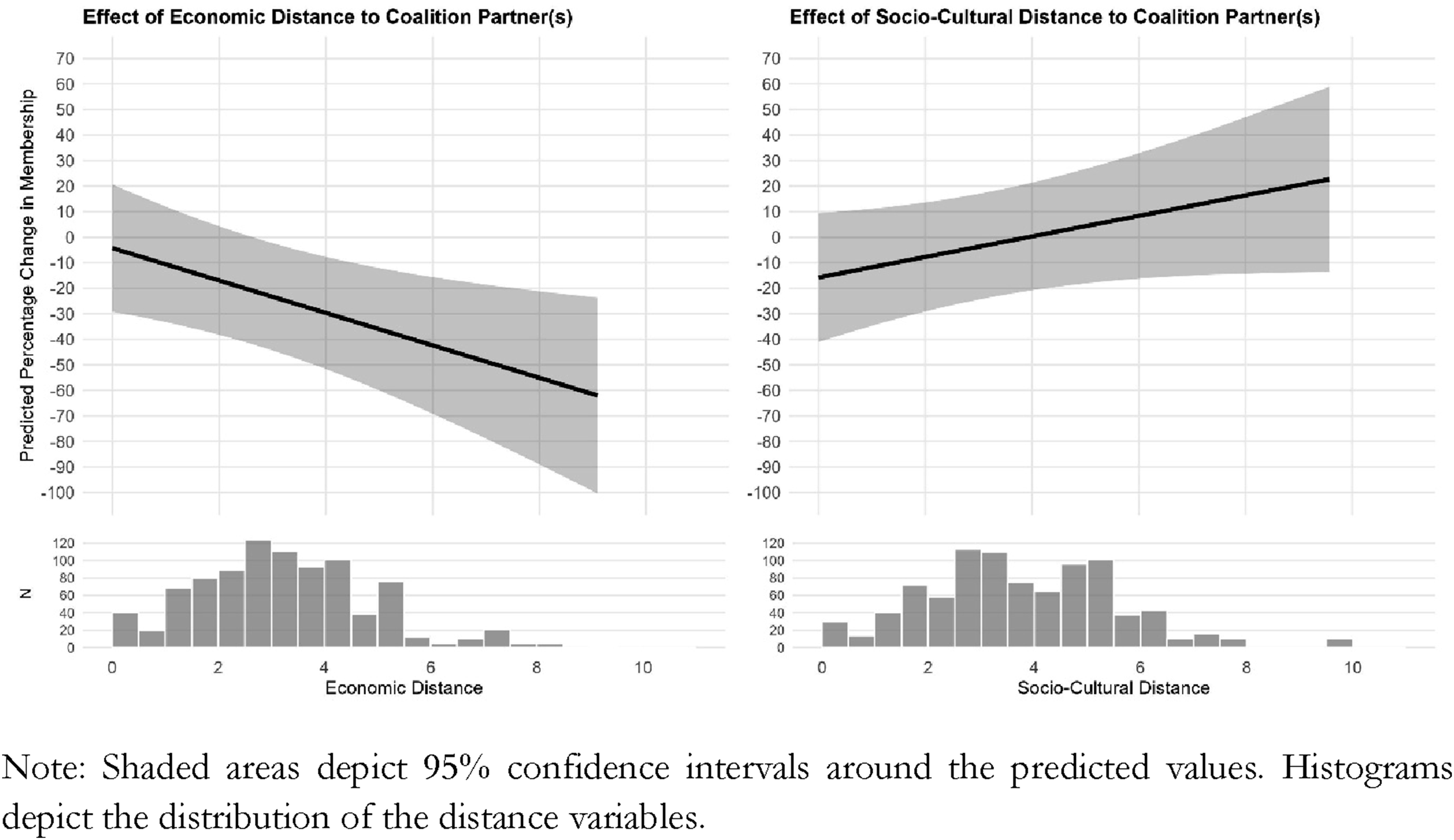
We also find that if a party governs in a coalition which is heterogeneous in economic issues (but not on societal affairs, the second major conflict line in German party competition), the effect on the party’s share of party members in the electorate tends to be more negative. This result, shown in model 2 of Table 1 and in Figure 2, signifies partial support for hypothesis 1b, indicating that ‘costly’ policy compromises, which are likely to emerge in coalitions between programmatically very different political parties, are associated with less favorable party membership development.
Notably, as the left panel of Figure 2 illustrates, the effect becomes statistically significant at economic distance values above approximately 2.7 (with the median value among coalition parties being 3.12 and the mean being 3.26), suggesting that low levels of ideological diversity on the economic dimension are not necessarily harmful to parties, but that, when programmatic differences become substantial that the negative consequences for party membership materialize. The more ideologically diverse a coalition government is, the less happy are the party members with the enforced positions of their party, which could explain less favorable party membership trajectories. In a similar vein, an ideologically heterogeneous government should be less likely to increase individuals’ benefits from being a party member, so that incentives for these individuals exist to leave the party.
Furthermore, it is, according to the third model and in line with hypothesis 2, in particular junior coalition partners which experience a statistically significant negative effect on their membership development. Because smaller coalition parties are less able to enforce their policy goals and general interests compared to their larger partners in the coalition government, members of the smaller coalition partners should be more disappointed and should see less utility in being member of the respective party. Figures 1 and 2 present predicted values for the different types of government participation, keeping all other values at their modes (for binary variables) and means (for metric variables), respectively. Predicted values for government participation variables. Predicted values for coalition governments by ideological diversity in government.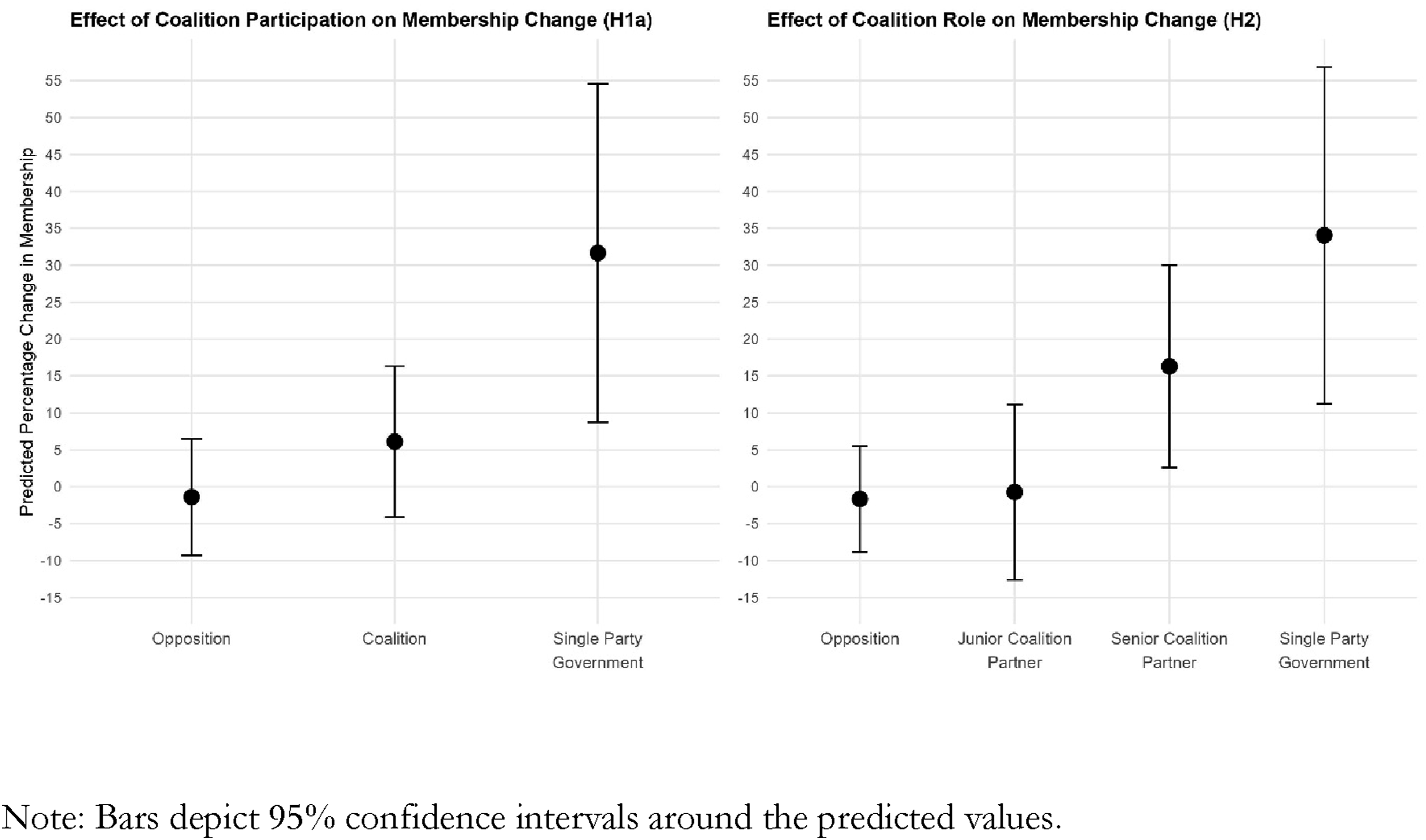
These findings remain robust when controlling for several variables that reflect, for instance, the partisan composition of the federal government and the age of the respective parties. In line with the findings by Kölln (2014), we see that older parties experience significantly less favorable membership development than younger parties. In addition, there is a general time trend towards less positive membership developments during the observation period. This supports previous findings from the comparative research on party membership (e.g., Scarrow and Gezgor, 2010; Van Biezen et al., 2012). There is, however, no evidence that an election to the federal parliament – the Bundestag – and the participation on the coalition that forms federal government is related to changes in the share of party members on the state level.
The Intraclass Correlation Coefficient (ICC) is very low for all models, suggesting that most of the variation is within groups rather than between groups and that the grouping structure is not contributing much to the model. Additionally, the AR (1) parameter is small (φ = 0.09 for all models), indicating weak residual serial correlation. Because of this, we also calculated simple linear regression models which we present in Appendix A. The results are very similar, and all key empirical findings are robust across the different model specifications.
Conclusion
In this contribution, we followed existing research on party membership in modern democracies and argued that – despite the overall trend in party membership decline – patterns of governing in multi-party cabinets should be related to the number of party members. We hypothesized that coalition participation should lead to less favorable membership developments compared to governing alone, particularly for junior coalition partners. In addition, we argued that participation in an ideologically diverse coalition should be particularly detrimental for the parties and lead to a reduction of party members because of the increasing number of ‘costly’ policy compromises which are likely to be unpopular among party members.
Testing this set of expectations on the basis of novel data for the German states over a time span of more than 30 years, the evidence is mostly in line with our hypotheses. We find that governing in coalitions is indeed more costly for parties, in particular for junior coalition parties, since they tend to lose more members than parties that govern alone. The evidence regarding ideological diversity in government is mixed: we find that increasing ideological diversity along the economic dimension negatively affects the development of party membership, but we do not find such an effect for ideological diversity along the societal dimension.
The results provide several incentives for future studies. First, adopting a comparative perspective seems promising. Data from the Political Party Database Project (Scarrow et al., 2017) could be a starting point for a comparative analysis of the relationship between coalition participation and the development of party membership. Secondly, individual-level data from party membership surveys is needed for evaluating whether party members who are unhappy with coalition governments tend to leave the party if the coalition compromises are far away from the policy preferences of their party. In addition, survey data among party members could help to explain if they left the party because of disappointment with the number of coalition compromises and/or with the reduced number of payoffs that individuals hope to receive when joining a political party. Third, we did not consider that parties forming coalition governments formulate detailed coalition agreements. Instead of focusing on the programmatic heterogeneity within a cabinet, one could look at the distance between the policy position of a government party’s election manifesto and the policy position in the negotiated coalition policy agreement. The higher this distance is, the more party members should be disappointed with the outcome of the coalition negotiation process, which should make a loss of party members more likely. Similarly, one could relate the patterns of office allocation in coalition governments to the development of party membership numbers. If a party could not win control over those cabinet posts that are highly salient for the respective party and for its members, an increasing loss of party members should be more likely.
Supplemental material
Supplemental material - The cost of compromise: How coalition participation shapes party membership
Supplemental material for The cost of compromise: How coalition participation shapes party membership by Marc Debus, Michael Imre, Hanna Bäck in Party Politics.
Footnotes
Acknowledgements
A previous version of this paper was presented at the Sogang International Conference on Party Activism and Democracy, July 17–19, 2025, Sogang University, Seoul, South Korea. We thank the conference participants and the reviewers for their valuable feedback and suggestions.
Declaration of conflicting interests
The authors declared no potential conflicts of interest with respect to the research, authorship, and/or publication of this article.
Funding
The authors received no financial support for the research, authorship, and/or publication of this article.
Ethical considerations
Since we are not dealing with individual-level data, we have not applied for ethical review for this project.

Data Availability Statement
Replication data for this article can be found at: https://doi.org/10.7910/DVN/6ANZAJ (Debus et al., 2026).
Supplemental material
Supplemental material for this article is available online.