



Abstract
This study examines the inclusion-moderation thesis within the context of Israeli populism, focusing on how government participation influences the communication styles of populist legislators. By analyzing a comprehensive dataset of tweets from Israeli lawmakers between 2015 and 2022, we explore whether holding office leads to a moderation of populist rhetoric. Our findings indicate that while coalition members generally exhibit reduced populist communication, this moderation varies significantly between ministers and backbenchers. Most importantly, in populist radical-right parties (PRRPs) backbench coalition legislators do not moderate: they maintain a populist communication style akin to their opposition counterparts. This research contributes to the understanding of populism in a non-European context and highlights the complexities of integrating radical parties into democratic governance, suggesting that moderation is not uniformly achieved across party lines.
Introduction
When do populist radical right parties adopt, communicate, and spread populist messages? Existing research has pointed to the importance of temporal, strategic, and electoral aspects on parties: we know that populist communications are often the weapon of outsider parties, those that face uphill electoral battles, or seek to weaponize a crisis. As governments formed or supported by populists become more prevalent, research has increasingly focused on the impact of governing by asking a crucial question: does taking up the reins of office somehow lead populists to moderate their behavior? The populist inclusion-moderation thesis relies on the assumption that, upon taking office, at least in polities accustomed to some form of liberal democracy, populists will adopt a political approach that is more integrated into a liberal democratic perspective (Zulianello, 2020). Whether or not this change takes place is crucial to several parameters (Caiani and Graziano, 2022): firstly, once they assume power, populists might adapt and work in a non-adversarial way with their “enemies,” such as the courts or state bureaucracy. Secondly, being part of government can lead to moderation by inducing populists to accept policies that are not as extreme as those they promoted while in opposition. Thirdly, it can lead populists to change the way they express their political views by toning down their attacks against elites or institutions, or by forgoing some of the people-centric language that is characteristic of populist communication (Jagers and Walgrave, 2007; Mudde, 2014).
We examine the Israeli case: over the last decade, populist, ultra-nationalist parties have moved from the fringe to the center of power, and the once-moderate Likud has steadily radicalized. This culminated in a full-blown populist radical right government. Israel is therefore an ideal case for testing the relationship between government participation and moderation. And, as recent events in Israel show, whether moderation occurs has crucial implications for the stability of liberal democracies. Co-existence with other political and government institutions reduces the likelihood of executive aggrandizement and constitutional crises; following a gradual and cooperative, rather than abrupt and rapid, approach on key populist issues like immigration can reduce political polarization and backlash. Finally, moderation of populist communication limits the spread and acceptance of anti-elitist and nativist ideas into the political discourse. This moderation may also set boundaries on the scope of acceptable policy change and attempts to change the institutional balance of power in the polity.
Research on the inclusion-moderation thesis has not reached consistent findings (Akkerman et al., 2016), possibly because studies focus on different types of parties, cases, methods, and conceptualizations of moderation. Various mechanisms have been proposed to explain inclusion induced moderation (e.g. Paxton and Peace, 2021). Among them are a professionalization based explanation, the necessity of populist parties in government to cooperate with other political actors, as well as the so-called pothole theory, which suggests that all governing parties are required to take care of the mundane, day-to-day, acts of governance. These mechanisms are somewhat distinct, but they all reflect tensions within the parties: in all accounts, we should expect some individuals in the party to moderate their behavior once in government, and others to be less prone to change.
The question of when politicians become more or less populist is crucial to understanding politics. However, the vast majority of the research looks at parties as if they were unified actors, even though moderation mechanisms have implications for individual politicians. This research parts with previous work by testing whether the role individuals play in ruling coalitions, over and above their party type, predicts their propensity to moderate. We theorize that, while in office—due to the need to professionalize and “deliver”—ministers face stronger incentives to moderate their populist communication compared with coalition backbenchers. Further, our theory differentiates between populists and non-populists parties. We argue that, because of the importance of core populist issues and policies among populist backbenchers and the lack of institutionalized mechanisms to solve intra-party disagreements in these parties, backbenchers in populist parties will be least likely to moderate; therefore, their behavior should resemble that of populist opposition legislators.
The approach we take builds on previous work on populism; on the one hand, we view populism as a communicative phenomenon and, therefore, as a matter of degree, rather than as an all-or-nothing phenomenon (de Vreese et al., 2018). Consequentially, we examine the impact of governing on legislators from all parties. But, it is clear that some parties have a radical-right populist core identity (Zulianello et al., 2018), and are therefore prone to walk the tightrope of “one foot in, one foot out” modus operandi (Albertazzi and McDonnell, 2010). We therefore test whether joining governments exerts similar moderation processes among Populist Radical Right Parties (PRRPs).
To perform these tests, we use a combination of hand-coding and convolutional neural networks to identify populism and analyze a comprehensive dataset of tweets posted by Israeli lawmakers during the 2015-2022 period. We leverage fine-grained, individual-level tweets, as opposed to party communications, because tweets offer a valuable opportunity to examine politicians’ ideas, priorities, and motivations. This approach also allows for a deeper understanding of their efforts to shape the daily political agenda. Populist parties and communication style—although scarcely studied in a quantitative, systematic way—have, over the last decade, become increasingly influential forces in Israeli politics. 1 Thus, in addition to adopting a new, individual-level approach to the study of the inclusion-moderation thesis, this research shifts away from the Eurocentric focus of populism studies to examine a political system that, while distinct in certain aspects, is experiencing processes akin to those observed in the populist rises of both Eastern and Western Europe.
Our analysis shows that government participation predicts moderation of communication: overall, legislators who are members of coalition parties become less populist on social media. However, this moderation is conditional on the specific role that legislator takes; those serving in government exhibit the lowest propensity to communicate in a populist manner. Lawmakers who take backbench roles moderate their behavior compared to their time in the opposition, but not to the extent as government ministers. Importantly, when we analyze the behavior of legislators in radical right populist parties, we find that moderation is limited to government ministers; within these parties, the behavior of backbenchers is indistinguishable from their behavior while in the opposition. Thus, we show that moderation is limited to a subset of populist politicians: those whose ‘foot’ is actually in government.
The results have several implications. First, they highlight the utility of leveraging intra-party variation and individual information to the study of moderation specifically and the behavior of politicians in general. Second, while illustrating the impact of political and institutional roles, they also demonstrate how limited the effects of moderation are, thus raising further doubts regarding the capacity of democracies to systematically integrate radical-right populists by including them in governing coalitions. Third, the study demonstrates that political communication serves as a crucial resource for analyzing populism and democracy. The absence of moderated communication among major factions within populist parties, combined with the growing radicalization of mainstream politics in Israel (Navot et al., 2022), helps explain how individuals who were previously untamed backbenchers have now taken on significant roles in the current populist, far-right Israeli government.
Studying populist moderation: policies, polity, and politics
Populism is characterized by features that do not bode well for the deliberative and gradual processes that mark democratic politics. Strategically, populists rely on amplification and perpetuation of systemic crises (Moffitt, 2015). Ideationally, populists create a division between the people and elite and state institutions (Mudde, 2017). This often entails targeting liberal democracy’s constitutional framework and counter majoritarian institutions (Müller, 2016). In terms of policy, right-wing populists pursue exclusionary and nativist outcomes, which often deviate from the establishment consensus (Arzheimer, 2015; Rydgren and Van der Meiden, 2019). Behaviorally, populists are portrayed as bad-mannered (Arditi, 2007), and Populist politicians use profane or straightforward language, in contrast to ‘establishment politicians’ use (Ostiguy, 2019). Furthermore, populists score higher in measures of narcissism, psychopathy and machiavellianism (Nai and Martínez i Coma, 2019). Populist communications combine glorification of the just “people” (Ernst and Engesser, 2017), with an aggressive tone, fraught with anger, fear, and disgust towards political opponents and elites (Nai, 2021).
How do these factors play out when populists govern? Building on earlier work on the adaptation of religious or socialist parties to liberal democracy (Przeworski and John, 1986), populist moderation suggests that upon committing to governing under the liberal-democratic framework, populists will refrain from clashing with other government branches, pursue more centrist policies that align better with the preference of political partners, and tone down their attacks on political opponents, elites, institutions, and ‘out-groups.’ Caiani and Graziano (2022) offer a useful way of conceptualizing the populist moderation in government, along the dimensions of policies, polity, and politics.
Research on the policies dimension points to conflicting findings: according to Akkerman’s (2012) comparative analysis, governments including PRRPs do not implement stricter immigration policies than center-right governments. Case studies research, however, shows that populist parties are able to shift government policies. For example, Albertazzi and Mueller (2013) document a partially successful policy move by the Austrian FPÖ to limit the rights of asylum seekers and immigrants, with some policies implemented, and others were thrown out by the Austrian Supreme and Constitutional courts (Preglau, 2012). 2 Work on the Italian Northern League (Albertazzi and McDonnell, 2005, 2010) also points to some policy success; as a minor coalition partner in Berlusconi’s 2001-2005 government, the party obtained symbolic, gradual policy victories on immigration, devolution and foreign relations. Following the 2008 general election, the League also successfully put forward measures curtailing the rights of minorities and immigrants. 3
When it comes to the polity dimension—the balance of power between elected populists and other government institutions—in the Italian case, the populist Forza Italia, attacked media freedoms, and Prime Minister Berlusconi’s legal battles led to measures that limited the independence of the courts (Quigley, 2011). And, when populists have gained significant majorities—as the Hungarian and Polish cases illustrate—the scope of attacks on the fundamentals of liberal-democracy was much broader; in both cases Illiberal legislation was pursued, including attacks on NGOs, court packing, media and electoral processes politicization, and attempts to develop and consolidate so-called “illiberal democracies” (Bernhard, 2021; Sadurski, 2018). Other research completely rejects the notion of moderation, as (Pappas, 2019: p. 81) concludes in his damning comparative analysis of populists in power: “by demonstrating that populist rule leads to liberalism’s decay and sometimes even to democratic breakdown, we have refuted beyond any doubt the empirically groundless idea that ruling populism may be a ‘corrective’ to the shortcomings of democracy.”
Studying the policy and polity dimensions is challenging because of other key factors that might explain the ability of populists to achieve policy success or change the institutional balance of power. For example, these can be their relative power in government (Capaul and Ewert, 2021), the longevity of democratic institutions (Boese et al., 2021), and the resilience of counter-majoritarian institutions (Albertazzi and Mueller, 2013). There can also be more mundane, unobservable factors such as logrolling between coalition partners or court rulings that depend upon the judicial-legislative balance of power (Vanberg, 2001).
Another strand of research combines the policies and politics dimensions, by examining party manifestos or parties’ policies as they are perceived by voters, before and after they join governments. Here, conclusions are mixed as well: in a 2007 study, Van Spanje and Van Der Brug find that anti-immigration parties move to the center of the left-right continuum after joining coalition governments. However, in 2015, Akkerman and Rooduijn examine manifestos and report that governing populists parties have actually become more extreme in their immigration and integration policies.
Studies focusing exclusively on the “politics” dimension are those that examine how politicians use communications to signal positions and shape political discourse. In our view, these are promising because compared to policy, communications are less limited by institutions and interactions with coalition partners, and because they rely on find-grained, dynamic data. Notable among those are Schwörer’s (2022) detailed analysis of Facebook posts published by populists in Italy, Spain, Austria and New Zealand. The research does not find conclusive indication of communication moderation in government, with New Zealand based populists moderating and Italian and Austrian populists actually increasing their use of nativist messages. In contrast, an analysis of parliamentary speeches from Austria and Germany finds a lower propensity to use populist rhetoric (Breyer, 2023). Furthermore, at the local level, two studies find that both left- and right-wing populist parties moderate their communication styles upon entering government (Peace and Paxton, 2023; Thomeczek, 2023).
In conclusion, the findings vary significantly regardless of the moderation dimension that has been examined. This can result from different research choices, or because the research community has yet to specify the conditions and pathways that might lead to moderation. For example, in their excellent work on the interaction between the courts and populists in power, König and Swalve (2023) suggest that:“by communicating extreme positions in their party manifestos and speech but moderating their actual policies, populist parties manage to overcome a key dilemma of government participation: taking on government responsibility counteracts the anti-elite narrative that populist parties rely on to draw support from their party base.” We also believe this dilemma is key to understanding moderation. But, we anticipate that this dilemma will manifest in observable ways also within the communications of these parties, as we outline below.
Studying moderation at the inter- and intra-party levels
We first formulate our baseline expectation. We note that politicians from all parties use populist-styled communications (Aalberg et al., 2017; Jagers and Walgrave, 2007). Further, that there is a correspondence between the role of the opposition in communicating the faults in government policies and offering alternative policy solutions, on one hand, and the populist style of politicizing crises and attacking elites (Breyer, 2023), on the other. Finally, that joining the government necessitates adopting some degree of a “normal politics” (Askim et al., 2022). In other words: moving from the opposition to government requires some communication moderation from all parties, populist or not. Thus, our first hypothesis is the following: • Overall moderation hypothesis: Legislators from parties in government coalitions are less likely to use populist-styled communications than those from opposition parties.
Among the mechanisms that can lead to this moderation, we think the utility of a spatial logic (Downs, 1957) that views moderation as movement towards the median voter is limited in systems prone to coalition governments. Centripetal mechanisms are especially problematic: populist parties rely on issue entrepreneurship (Hobolt and De Vries, 2015) and their interactions with mainstream parties often result in the latter taking on more radical positions (Abou-Chadi and Krause, 2020; Meguid, 2008). Breyer (2023) has proposed an insightful strategic logic, whereby moderation in all parties’ populist communication depends on variation in their access to office and their electoral fortunes. We agree that elections loom large for politicians, but offer an alternative mechanism in cases where PRRPs have often taken part in government, in addition to being prone to splits and re-branding from one election to the next.
Joining a coalition government spells victory for parties, as they gain increased influence over policymaking and access to spoils, but it also means trouble. The challenges begin with intra-party bargaining over ministerial positions’ allocation and continues with ministerial operations and the implementation of policies, all while ensuring that the issue and media agenda are favorable to the party. As Martin and Vanberg argue, maintaining government cohesion while preserving the party’s identity by highlighting differences with coalition partners is “the most delicate problem of participating in a coalition,” as parties struggle to: “reconcile the tension between the need to compromise on policy with the need to maintain the party’s public profile with respect to certain policy commitments” (Martin and Vanberg, 2008: p. 502-503).
We view this tension as key to explaining moderation within parties. At the core lie differences in the intensity of moderation incentives that ministers face relative to backbenchers in coalition parties. We consider two mechanisms that should produce behaviorally similar outcomes. The first one extends the literature dealing with Islamist parties’ moderation and is known by the “pothole theory” (Berman, 2008): upon committing to democracy and partaking in government, governing will leave less time and resources for radicalism. In the populist context, governing means that additional attention will be devoted to the implementation and communication of “picking up the trash” activities. The tendency to increase the salience of such activities, however, should be more pronounced among those directly involved— the ministers overseeing these policies—relative to the party’s rank-and-file (Akkerman et al., 2016). The second mechanism focuses on ministers’ professionalization, oligarchization, and cartelization (Katz and Mair, 1995; Michels, 1911). Once in government, politicians enter an elite club whereby they must collaborate with bureaucracies, other parties’ leadership, international institutions, and state agencies. To the extent that they wish to remain in this group, these interactions require significant learning, investment, and the creation of networks that should foster moderation among ministers. In contrast, backbench lawmakers, largely excluded from these processes, face weaker incentives to moderate. This yields a second expectation: • Role-based moderation hypothesis: In governing parties, all legislators will moderate their communications, but ministers will be less likely to use populist-style communication compared to backbench legislators.
In all governing parties, tensions between office-seeking ministers and policy-seeking backbenchers tend to arise (Ström, 1990), resulting in different levels of incentives to moderate. Research suggests that tensions can be more severe in populist parties and that they are more prone to fissures and splits(Akkerman et al., 2016), because of the conflict between the need to project normalcy and the continued use of populist themes (Albertazzi and McDonnell, 2010). These issues are often compounded by a lack of institutionalized mechanisms for resolving intra-party disagreements and a general unwillingness to compromise (De Lange and Art, 2011). Notable examples include the splits and implosions within the governing Austrian FPÖ (Fallend, 2004) and the Dutch LPF (De Lange and Art, 2011). In Israel, parties from the nationalist-religious bloc—many of which promote populist ideals (Hisherik and Ben-Rafael Galanti, 2024)—have often taken part in Israeli governments. Importantly, the nationalist-religious bloc is a “de-aligned” one, prone to splits over its commitment to state institutions over religion (Lazar and Cohen, 2022). Two brief examples from the Israeli context illustrate the applicability of the intra-party tension framework to our case. The Jewish Home party, a religious-nationalist party described as one of an Israeli “populist triad” (Levi and Agmon, 2020), split in 2018 after its leaders stated that the party had lost its ability to influence government policy while in power. Three years later, a new party established by the leader of the Jewish Home formed an ideologically broad coalition with the center-left and even an Islamist party. However, a year after the coalition was formed backbenchers defected because of what they viewed as the party moving away from its religious and right-wing principles. In summary, in populist parties, the gap between office-seeking and policy-seeking lawmakers is more pronounced than in non-populist parties. This dynamic is captured in the communication phenomenon of “one foot in,” where ministers moderate their communications due to their government participation, and “one foot out,” where backbenchers continue to use a communication style similar to that employed while in opposition. We therefore expect the following dynamic: • Role-based populist moderation hypothesis: In governing populist parties, ministers will be less likely to use populist-style communications compared to opposition legislators; however, backbench legislators will behave similarly to opposition legislators.
Studying populism on twitter
Social media platforms vary significantly in their algorithms, their reliance on textual or visual communication, and the communities of users they attract. For instance, research indicated that populist communication tended to be more frequent on Facebook than Twitter (Zulianello et al., 2018). Ernst et al. (2017) argued that Twitter was less suitable for populist politicians because of the demographics of the Twitter crowd, perceived as too elitist and less representative of “the people” than that of Facebook. Further, the 140 character limits imposed of Twitter users limited the complexity of ideas that could be communicated on the platform (Engesser et al., 2017).
In contrast, other work argued that Twitter is uniquely placed to spread populist messages, because the conversations taking place on it have a significant impact on the agenda of traditional media sources and other elites (Maglione, 2021). In addition, with the move to a longer format of messages, implemented on Twitter on November 2017, it seems that it has indeed become a fertile breeding ground for populist messages and tactics of attacking political opponents and media outlets(Jacobs et al., 2020). An exemplar is Donald Trump, with his uncivil, simple, yet effective tweeting style (Ott, 2017). Beyond stylistic matters, Trump had used Twitter to spread ideas emblematic of populism such as constructing a homogeneous people (Kreis, 2017) and the targeting of enemies (Pelled et al., 2018).
Overall, we view tweets as reflecting important communicative processes. The messages spread on the medium may become significant via spillage to other media channels and thus by affecting overall political debate. Second, tweets matter because they give us, as analysts, a way of observing the strategies politicians use and the variation in the issues they deem important and thus, a proxy to gauge their motivations and priorities once they enter government coalitions.
Capturing populism in Israeli legislators’ tweets
We relied on a combination of a hand-coding stage—in which trained research assistants coded 5586 tweets—and a trained multi-layer convolutional neural network to construct our classificatory scheme of populism on Israeli politicians’ twitter posts, across hundreds of thousands of tweets. The algorithm identified approximately 3% of tweets as populist. Details, reliability and validation tests are described in the Supplemental Material and in Tzelgov and Wilson (2024). We used Twitter’s Academic API to download a comprehensive dataset of Israeli lawmakers posts, leading to an analysis that covers the period from April 1, 2015 (the first day of the Knesset 20th session), to July 14, 2022. Theoretically, our conceptualization of populism builds on the ideational approach (Hawkins and Kaltwasser, 2017) that sees populism is a thin-centered ideology characterized by a Manichean conflict between the pure people and the corrupt elite. To construct our classification scheme, we also rely on the view that populism can be analyzed as a communication style (Jagers and Walgrave, 2007). Overall, our classification scheme is based on identifying three discursive frames
4
: The first one is People-centrality, a frame whereby the post extols the virtues of a monolithic political community or highlights its political sovereignty (Ernst and Engesser, 2017; Urbinati, 2019). The second one is Anti-Elite/Establishment: posts that describe a Manichean struggle between the “people” and the elite/establishment (e.g political, cultural, judicial, bureaucratic, ideological, or economic) (Castanho Silva, 2019; Hawkins and Kaltwasser, 2017). The final, Out-group exclusion, captures the ideas characterizing radical right populism exclusionary populism, which is highly relevant to populism in Europe and, recently, in Israel (Betz, 2001; Filc, 2018). In these posts, out-groups (immigrants, minorities, political opponents) are often depicted as privileged allies of the elite, implying they should be silenced, eliminated, physically removed, or punished. Populist posts were those that included: • A people-centrality frame, and: • Either an anti-elite or an out-group sub-frame (or both).
Our dataset includes tweets posted by 169 legislators, spanning 15 parties. Our approach combines an analysis of the communications of all parties in parliament with a focus on the dynamics within PRRPs. Our selection of populist parties relies on the thick conceptualization of (exclusionary) populism: that is, we concentrate on populism as a core component of parties characterized also by high levels of nativism and authoritarianism. We therefore code as radical-right populist parties that are religious and exclusionary, ultra-nationalist and/or nationalist-religious. These parties are all anti-elitist, focusing their attacks mainly on—detached, corrupt, treacherous—rule of law agencies, with a special emphasis on the judicial branch. The anti-elitism of these parties is intrinsically related to their nativism and authoritarianism: rule of law mechanisms are often portrayed as a threat to an orthodox, exclusionary, or colonialist visions of Judaism, particularly reflected in the judiciary’s positions on the legality of settlements and migration (Perliger and Pedahzur, 2018). Additionally, populist, Jewish-focused, nativist people-centrism is closely linked to a fundamentalist-authoritarian vision of the relationship between the state, religion, and its citizens, positioning Orthodox Judaism as a core component of the state’s identity(Peled and Herman, 2018). 5
To illustrate the utility of our theoretically informed grouping of parties as populist, in Figure 1 we present a comparison of the proportions of populist tweets posted by legislators from parties in the populist camp, and those from non-populist parties. As we would expect, the Figure points to the significant difference in the overall propensity to post such tweets between PRRPs and other parties (panel a). Second, as we might expect from our theoretical discussion, in panel b we show that the propensity to use populist tweets varies by the role of legislators, with opposition lawmakers most likely to post such tweets, followed by backbenchers and government ministers. Proportions of populist tweets and 95% error bands by (a) party blocs, (b) legislator role.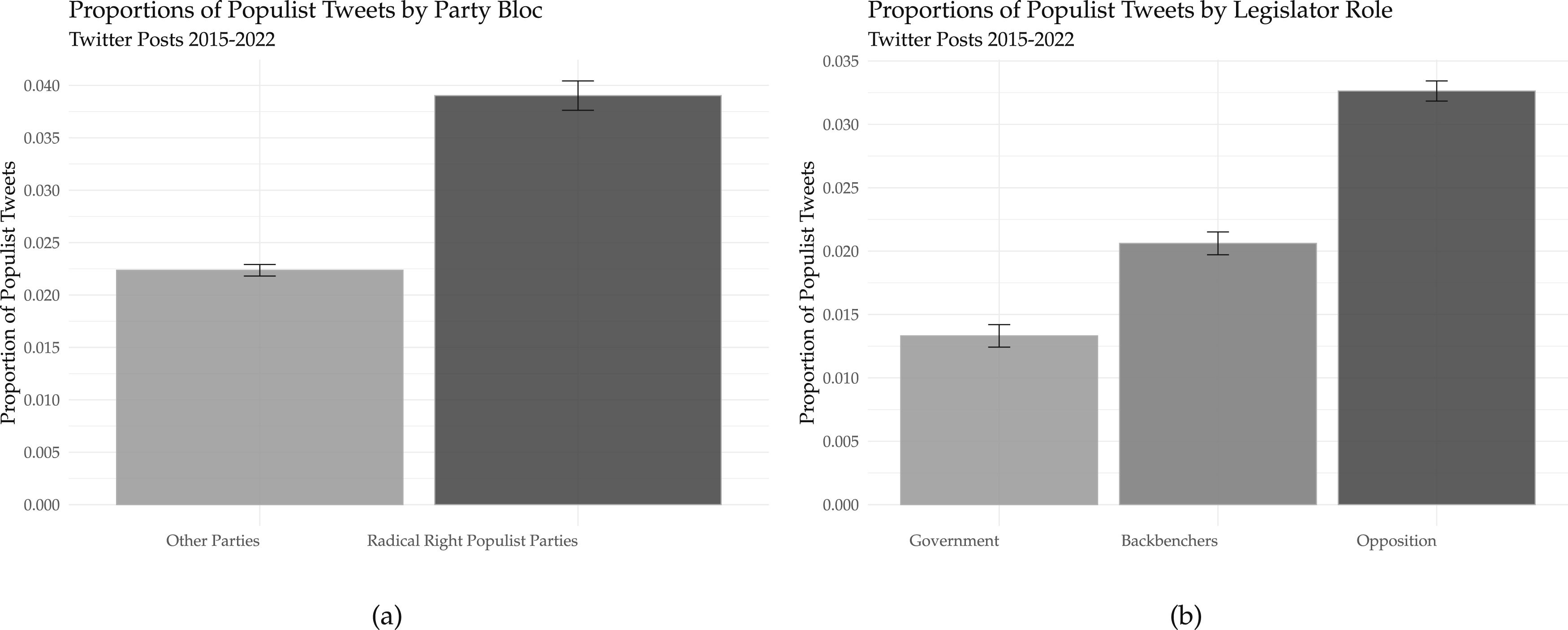
Variables and analysis
The dependent variable captures whether the tweet posted by the parliamentarian is populist or not, over the 2015-2022 period. In Figure 2, we plot the trajectory of overall populist communication in the posts of Israeli legislators by aggregating the proportions of tweets coded as populist at the monthly level. The figure demonstrates that the propensity of legislators to post populist tweets has dramatically increased over the past decade. In 2015, less than 1% of tweets were coded as populist. The proportion of populist tweets rose to approximately 3% during the governability crisis of 2019-2020, a period marked by criminal charges against the Prime Minister and a political deadlock that resulted in three fiercely contested elections within just 1 year. In 2022, during the brief reign and subsequent fall of the anti-Netanyahu so-called “Change” coalition, this figure rose to between 4% and 5%. Tweet data was augmented with legislators’ individual information. Monthly proportions of populist tweets. Vertical lines represent elections.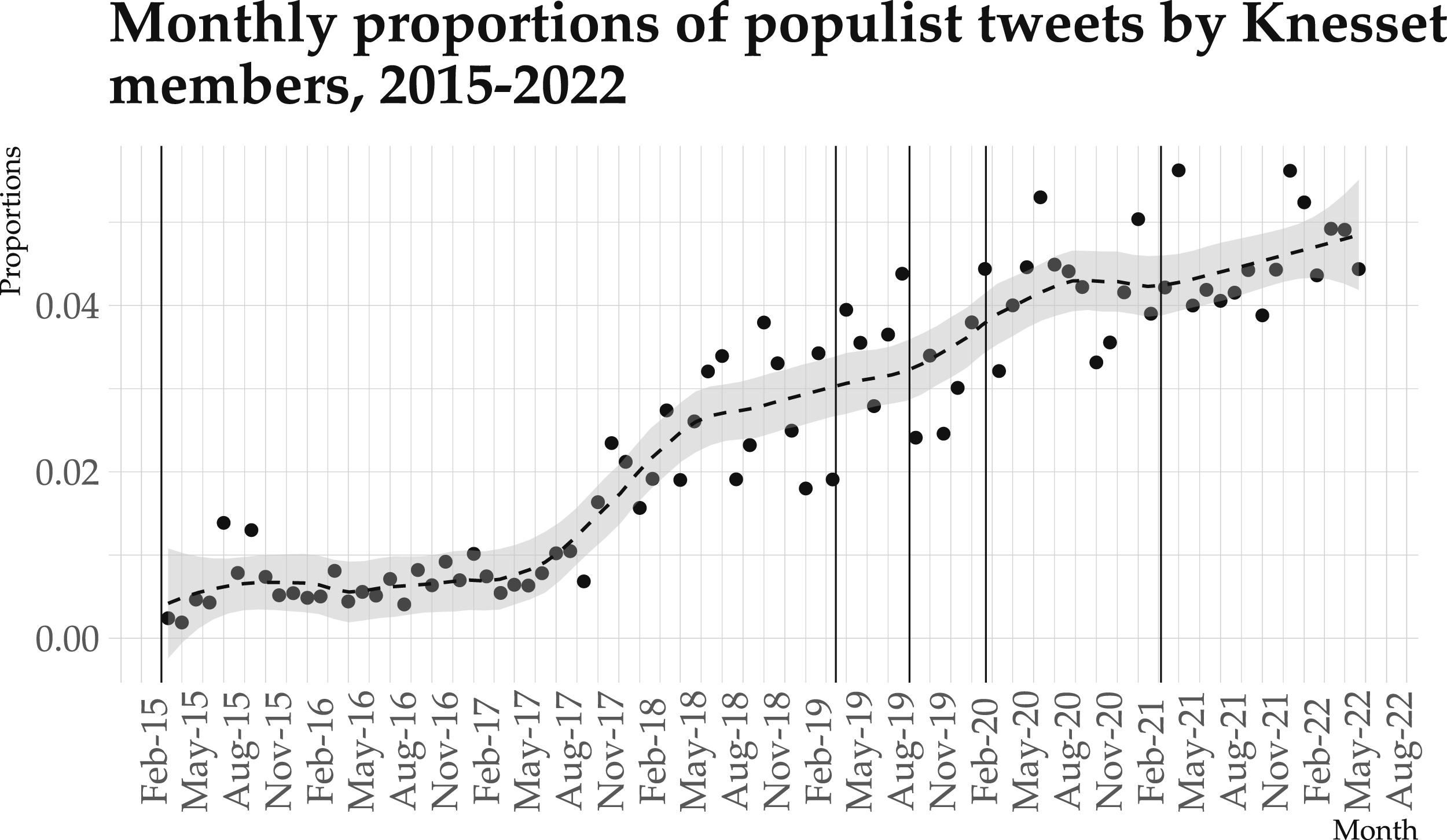
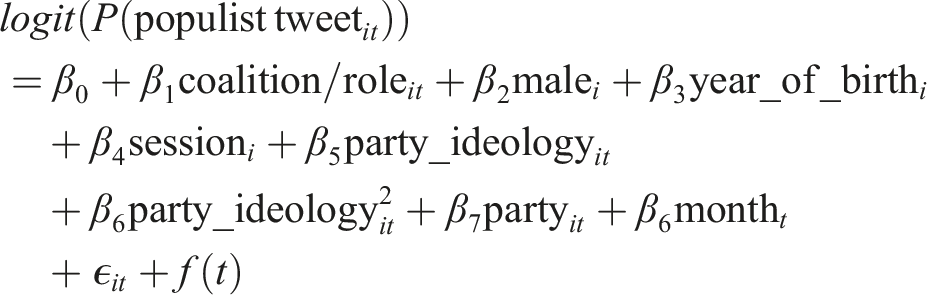
To test the hypotheses, we estimate logistic regression models, where populist tweet is an indicator variable that equals one if the tweet posted was populist and zero otherwise. In the models below, our main variables of interest are either coalition: an indicator variable capturing whether at time t, the legislator was a member of the coalition, or role, capturing whether the member was a member of the opposition, a backbench coalition member, or a minister. Male and year of birth capture legislators’ individual-level characteristics. We adjust for the estimated ideology of legislators’ parties by including a Left-right position variable and its squared term.
6
We also include a session variable, which captures cohort effects. We further include a month and party fixed effects. Our fully specified models, presented below, also include a flexible cubic polynomial form of the time trend f(t).
7
Logistic regression models: coefficients are odds ratios with 95% confidence intervals based on clustered standard errors in parentheses.
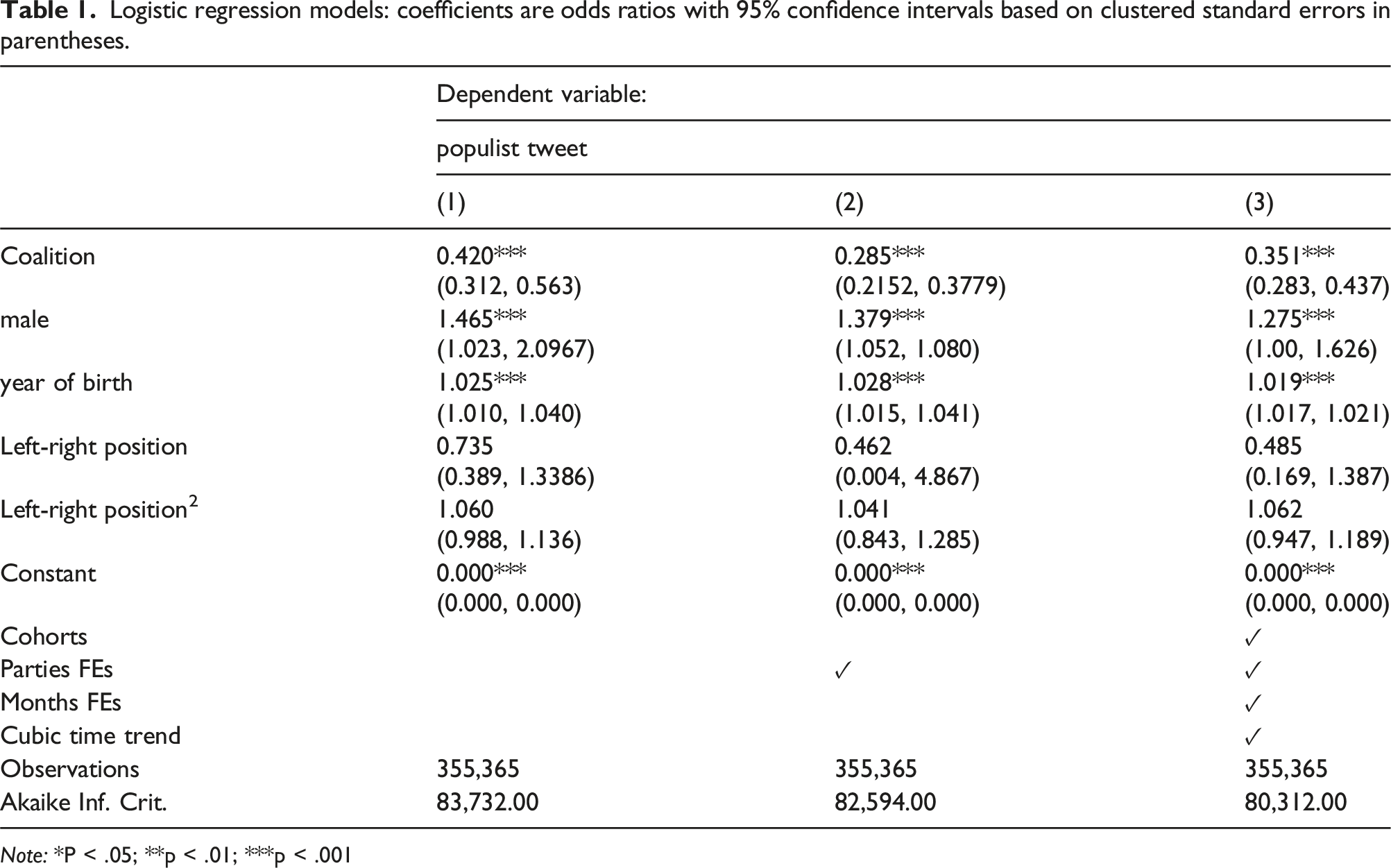
Note: *P < .05; **p < .01; ***p < .001
We now turn to examining the differential impact of political roles in the coalition across all parties, as well as specifically for PRRPs. In the role-based moderation hypothesis, we outlined our expectation that ministers will exhibit the highest degree of populist moderation relative to opposition legislators, while backbenchers will moderate their communication, albeit to a lesser extent. In the role-based populist moderation hypothesis, we suggested that while we expect moderation from populist ministers, we do not expect it from their backbench peers. To test these hypotheses, we construct the role variable, which is a nominal variable that captures whether, at time t, a legislator was a member of the opposition, a backbench coalition member, or a government minister. We then re-estimate the logistic regression models predicting populist communication in tweets, replacing the coalition indicator variable, with the role of the legislator. The results are presented in Table 2.
Logistic regression models: coefficients are odds. The minister and opposition coefficients present odds relative to coalition backbenchers. 95% confidence intervals bases on clustered standard errors in parentheses.
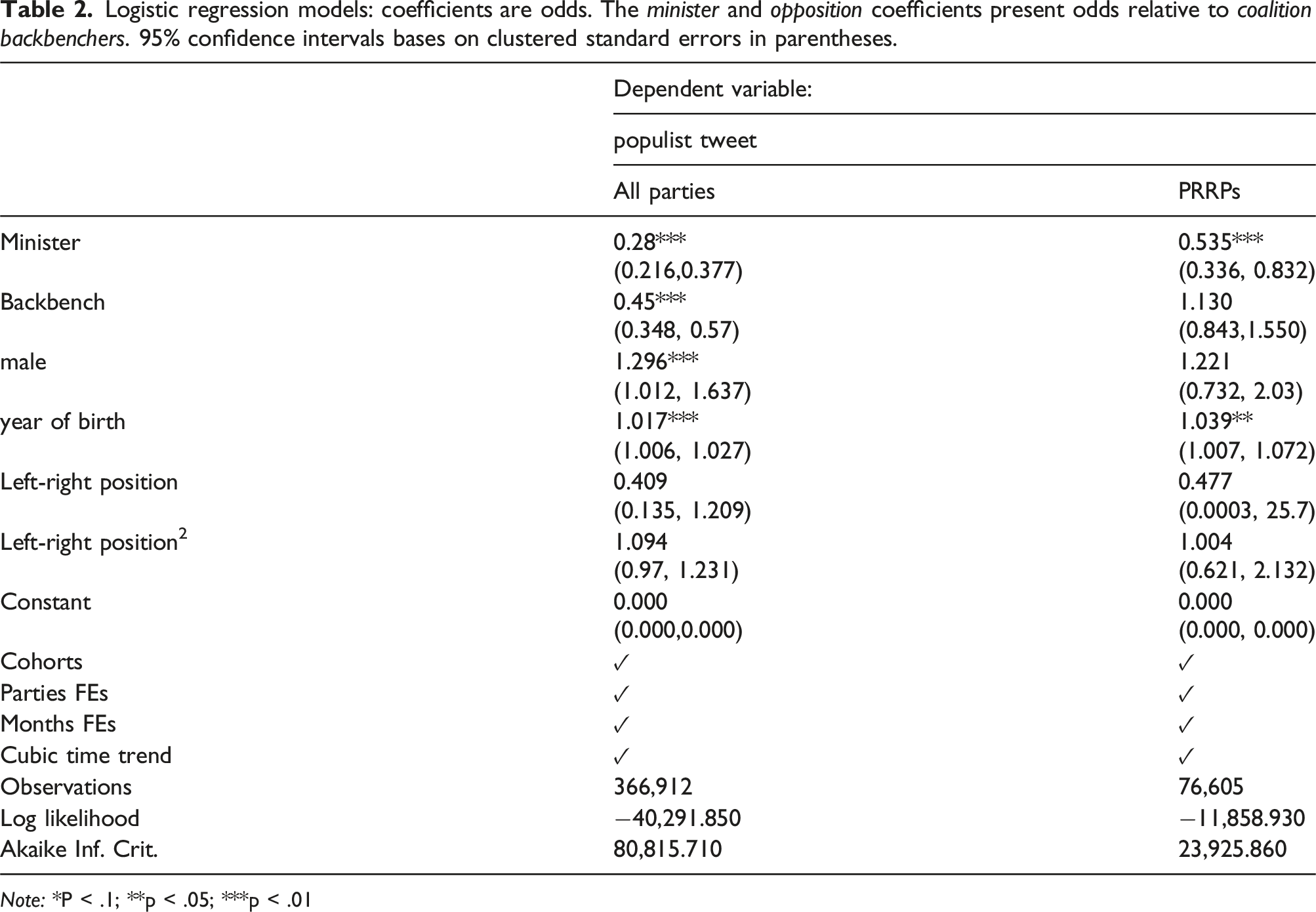
Note: *P < .1; **p < .05; ***p < .01
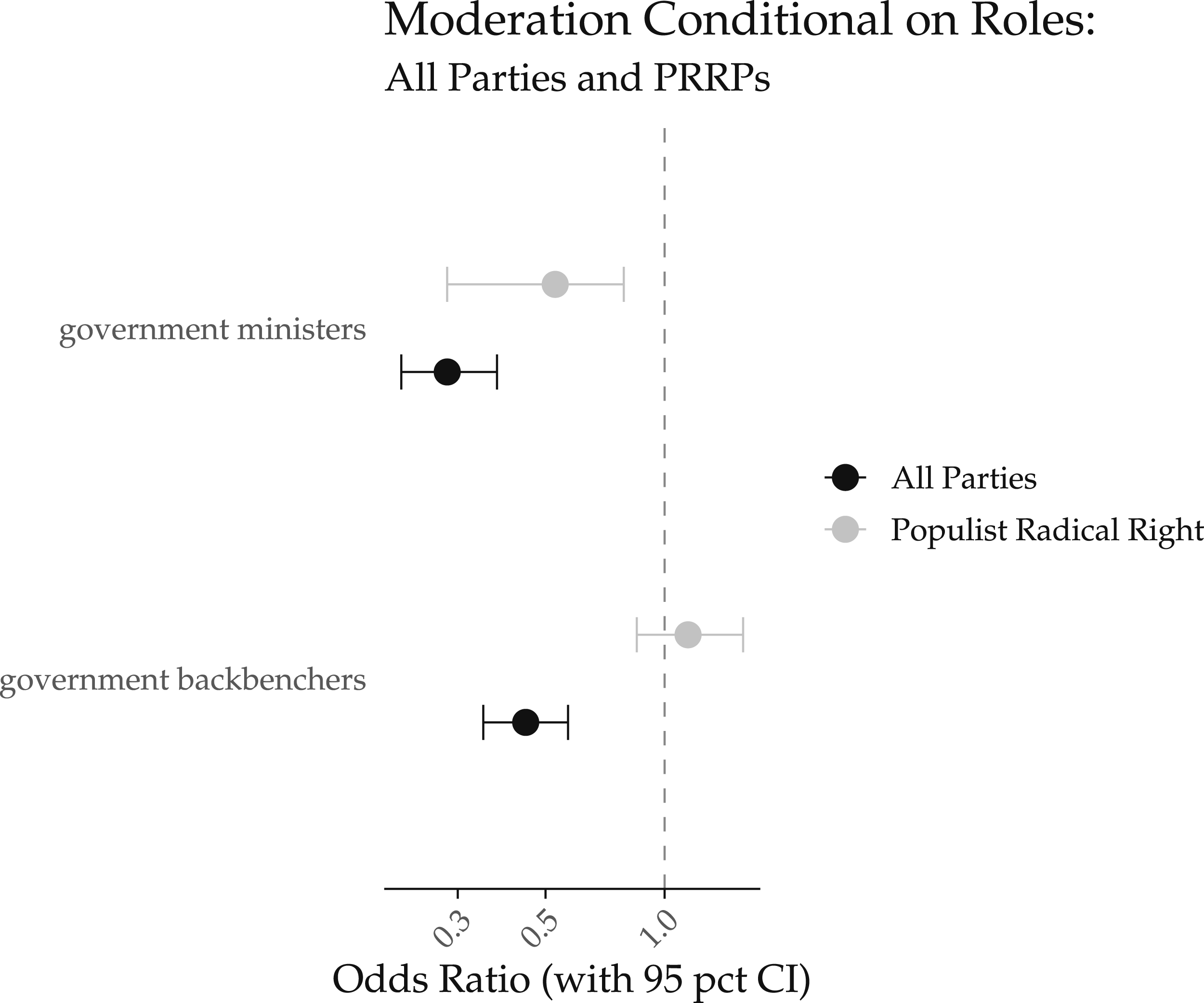
Odds-ratios of posting populist tweets for ministers and backbench legislators, for all parties (black circles), and PRRPs (white triangles). Baseline category (at x = 1) are backbench legislators.
Discussion and conclusion
Previous research has shown that populist and anti-establishment communications are used more by political outsiders: opposition and challenger parties who seek to “shake the boat” and gain electoral momentum (Licht et al., 2025). Our findings are new: they show that populist ideas are not uniformly spread by party politicians but that they are related to the roles individual legislators take. The results also speak to prior findings on moderation of parliamentary speeches in the German and Austrian parliaments (Breyer, 2023). We show that moderation of populist communications is not limited to legislatures; inclusion of parties in coalition predicts moderation also on Twitter. When we focused our attention on parties’ whose identity revolves around populist ideals, the results pointed to a limited degree of moderation. While the results partially conflict findings by (Schwörer, 2022), our approach is different: we examine variation in populist communication across party legislators, rather than official parties’ posts on social media.
We focused on office-related incentives as motivating moderation, arguing that the necessity for ministers to professionalize, cooperate with other elites, and deliver—at least to some extent— ‘normal’ policy outcomes yields the highest degree of moderation, while coalition backbenchers are less constrained by such conditions. Furthermore, we highlighted the governing dilemma faced by parties, especially populist ones: because these parties rely on vilification of elites and amplification of crises, we expected their backbenchers to remain loyal to their populist credentials and show the weakest tendency to moderate in coalition, an expectation supported by the data. In other words, populist legislators do not moderate their behavior once they move from the opposition to the back benches of the coalition.
Our explanation focuses on cracks within populist parties. But there might be an alternative explanation. In their work on the Lega Nord, Daniele Albertazzi and Duncan McDonnell (2010) articulated the development and institutionalization of the League in power. The party had evolved over time: from its first and turbulent stint in Berlusconi’s 1994 government, moving to learn to accept gradual policy concessions in the 2001–2005 government, and finally, during the 2008–2010 period, developing its leadership’s ability to communicate and ‘sell’ policy achievements to the party’s rank-and-file. These developments, combined with its ability to play the role of an outsider by picking fights with establishment politicians—a tactic used by the party later on as well (Schwörer, 2022)—point to a “one foot in, one foot out” strategy that suggests party cohesion rather than fissures and crisis. In this light, the lack of moderation among populist backbenchers can be viewed as a well-crafted tactic: while populist ministers hunker down and deliver policy achievements, the role of backbenchers is to keep beating the drums of war.
We believe that such intra-party coordination does not capture the dynamics in populist parties that have yet to institutionalize, such as in the Israeli case. Over the last decade, during which Israel held seven elections, the Israeli PRRP camp has become fractured (Lazar and Cohen, 2022), and it is unlikely that such haphazardly formed parties, would be able to effectively use a “one foot in, one foot out” strategy à la the League. Tensions over leadership and high ideological fragmentation become evident when we examine the communications of backbencher Betzalel Smotrich, who, in 2018, tweeted, criticizing the government for its reluctance to evacuate a Palestinian village: “Enough…This is a capitulation to the hypocritical and deceitful pressures of Germany and the European Union that harms our sovereignty, and our national dignity.” As a party split and elections became apparent, he criticized the outgoing party leader for his disloyalty to the ideals of the right-wing camp and of Israel: “I want as many people as possible to vote for the ‘real right’ …unfortunately Bennett [the former party leader] sees them [the Palestinian Authority] as partners…We are the only ones still raising the flag of a complete Land of Israel.” Considering also the defections of lawmakers, the picture that emerges is of under-institutionalization and lack of communication cohesion in the PRRP camp (De Lange and Art, 2011).
Our findings show a differentiated inclusion moderating effect. Overall, the more embedded individual politicians are within government, the less populist their communications become. Importantly, PRRP backbenchers do not moderate; and, even though populist legislators moderate upon being appointed as ministers, our findings should not be interpreted as an endorsement of inclusion as a panacea for the challenges posed by populist radical right parties to liberal democracy. The examination of the Israeli case shows that PRRPs’ inclusion and implosions has led, over time, to further radicalization within these parties. Indeed, as we observe current Israeli affairs we see populist politicians— previously either pariahs or coalition backbenchers—taking on ministerial roles in a government that is actively engaging in attacks on liberal-democratic norms. More generally, the findings suggest that increased presence of radical-right populists in governing coalitions can lead to a systemic shift towards radical-right populism. These dynamics might actually nullify all need for moderation, as government ministers themselves increasingly devote time to spreading populist ideas and to a populist systemic takeover, rather than to professional governance.
Supplemental material
Supplemental Material - Populists in power: The limits of inclusion
Supplemental Material for Populists in power: The limits of inclusion by Eitan Tzelgov, Steven Lloyd in Party Politics
Footnotes
Declaration of conflicting interests
The authors declared no potential conflicts of interest with respect to the research, authorship, and/or publication of this article.
Funding
The authors received no financial support for the research, authorship, and/or publication of this article.

Supplemental material
Supplemental material for this article is available online.