




Abstract
The article examines the impact of the recent crises – the Eurozone crisis, the refugee crisis, Brexit, COVID-19, and the war in Ukraine – on the structuration of party competition in six Northwestern European countries. Situating the multiple crises in a long-term perspective on the transformation of party systems, we emphasize their reinforcing effect on the structuring capacity of the new cultural divide. In some countries, this divide and its main driving forces have become so powerful in transforming the political space that we observe an emerging multi-polar pattern of party configurations. This pattern is characterized by a green new left opposed to the populist radical right on the new cultural dimension. In contrast, the center-left and the center-right, despite converging, still oppose each other on the economic dimension. Empirically, the article examines election campaigns in Austria, Britain, France, Germany, the Netherlands, and Switzerland, drawing on the original PolDem relational content analysis of mass media coverage published before national elections from the 1970s up to 2022.
Introduction
From our perspective, the structuring of party systems results from a combination of long-term trends, short-term developments – such as economic and political crises –, institutional context conditions, and more contingent factors, including incumbency, party strategies, and political events. Among these, the long-term trends are the most important factors because they provide the overall framework for the structuring of the party systems, and we argue that they have been particularly important in the case of the party systems in Northwestern Europe (NWE). Given the solid institutionalization of the party systems in this part of Europe, they are rather resistant to change and their restructuring is a long-drawn-out process. More specifically, the long-term trends refer to the development of the cleavage structure, which is, we argue, characterized by the rise of a new cultural divide that has emerged since the 1970s as the result of the successive mobilization of new social conflicts by the New Left (the Greens) and the New Right (the populist radical right) (see Hooghe and Marks, 2018; Kitschelt, 1994; Kitschelt and McGann, 1995; Kriesi et al., 2008, 2012). The rise of these new cultural conflicts has transformed the configuration of the main competitors in the party system. In the process, the latter has become more fragmented and multi-polar, with a split left, divided between the center-left, the Greens, and (possibly) the old radical left, and a split right, divided between the center-right and the populist radical right.
More recently, a series of crises has intervened in the EU countries: the Eurozone crisis (or the Great Recession), which has haunted Europe from the fall of 2008 until 2015 (culminating in the Greek referendum), followed by the refugee crisis (2015-2016, with an extension up to 2020), the Brexit crisis, the COVID-19 crisis (2020-2022), the war in Ukraine (2022-), and accompanied all along by the climate crisis. Our key research question is to what extent these crises have shaped the long-term trends in the restructuring of party competition. As we show, the Eurozone crisis had only a limited impact on these long-term trends in NWE. In contrast, these trends were considerably enhanced since the refugee crisis in 2015/16. Across these crises, the long-term trends are imposing themselves in NWE. However, the way they manifest themselves is influenced not only by the intervening crises but also by the country-specific institutional contexts, as well as by more contingent actor- and event-based factors that speed them up or delay their effects.
We study the restructuration of party systems during national election campaigns in six Northwestern European countries – Austria, France, Germany, the Netherlands, Switzerland, and the UK – from the 1970s to 2022. Studying these countries allows us to put the impact of the short-term developments linked to the series of crises into a historical and comparative perspective. Four of these countries – France, Germany, Austria, and the Netherlands – are members of the Eurozone and part of the so-called ‘creditor’ countries, which saw the accentuation of domestic conflict over rescue measures for the ‘debtor’ countries and institutional reforms of the Eurozone. The UK (then outside of the Eurozone) and the non-EU member Switzerland also had to cope with the fallout of the economic crisis. More importantly, both experienced growing international tensions over the fundamentals of their relations with the EU. In the case of the UK, they exploded into Brexit. During the 2015-16 refugee crisis, Germany, Austria, and Switzerland recorded some of the highest per capita numbers of asylum applications, while France, the Netherlands, and the UK stood apart, receiving much fewer applications. The COVID-19 pandemic and the Ukraine crisis, as well as the “slow-burning” climate crisis, affected all six countries similarly, except that Germany, once again, was most involved in the Ukraine crisis – in terms of the number of refugees it had to accommodate, energy shortages, sanctioning of Russia and military support for Ukraine.
To assess the impact of these different factors on the structuration of party competition in the national electoral arena, we proceed in four steps. First, we restate our view on the long-term developments of party competition in the six countries. Next, we formulate expectations about the impact of the sequence of crises on long-term trends. Then, we introduce the data. As we are interested in public contestation during national election campaigns, we opt for a relational content analysis of newspaper coverage published before national elections. In this article, we rely on an updated version of the election campaign data from the Observatory for Political Conflict and Democracy (PolDem), covering campaigns from the 1970s to 2022 (see Gessler and Hutter, 2026; Kriesi et al., 2024, this special issue). In the fourth step, we present the findings. Overall, our results highlight the reinforced structuring capacity of the new cultural divide in the latest crisis elections, and they point to an emerging new type of tri- or multi-polar party configuration in the countries under scrutiny, a configuration characterized by a shifting focus from the economic to the new cultural dimension.
The rise of a “new” cultural divide: Long-term trends
We suggest that since the 1970s two waves of political mobilizations articulated new social conflicts and brought to the fore political issues that were to become crucial for the structuration of the party systems in NWE. The first wave (the wave of the New Left) was an expression of transformations that were endogenous to the European nation-states. Processes of deindustrialization, expansion of tertiary education, feminization of the workforce, and occupational upgrading have been characteristic of this transformation to knowledge-based societies (Hall, 2022, 2024; Iversen and Soskice, 2019). This transformation brought about a value change in Western Europe (Inglehart, 1977), which was driven by the expanding new middle class or, more precisely, by its socio-cultural segment. It gave rise to ‘new politics,’ which mainly transformed the political left (e.g., Müller-Rommel, 1989). The so-called new social movements stood at the origin of the rise of Green parties and the transformation of the social-democratic parties, which, in the process, have become middle-class parties in almost all West European countries (e.g., Gingrich and Häusermann, 2015; Kitschelt, 1994). The new political conflicts focused on individual autonomy, the free choice of lifestyles, and other universalistic values, what we summarize under the label ‘cultural liberalism,’ as well as environmental issues.
The second wave (the wave of the New Right) started in the early eighties with the rise of the Front National (FN) in France and continues to the present day. Arguably, this wave was driven by a cultural backlash against the rise of the New Left and against the shifting values it propagated among people who felt threatened by this development (Bornschier, 2010; Ignazi, 2003; Norris and Inglehart, 2019). Subsequently, the cultural backlash turned, above all, against immigration. Thus, Mudde and Kaltwasser (2018: 10) define the ‘cultural backlash’ more narrowly as a reaction to immigration and multiculturalism, to globalization and the opening up of national borders in economic, political, and cultural terms (see also Kriesi et al., 2008, 2012). Economically, certain segments of the workforce (especially low-skilled workers) have become squeezed by both competition from abroad (in the form of offshoring of their jobs) and at home (in the form of competition from immigrants) (e.g., Dancygier and Stefanie, 2015). Politically, the processes of economic internationalization and European integration, in particular, have increasingly undermined the sovereignty of the nation-states. Culturally, immigration has led to an increasingly multicultural composition of West European societies, which contributed to the spread of perceived threats to the ‘national identity’ (e.g., Hainmueller and Hiscox, 2007). These processes created a heterogeneous set of ‘losers of globalization’ who have been most successfully mobilized by the populist radical right. In this process, these parties of the New Right have become the party of the working class in many West European countries (e.g., Oesch, 2013). Regarding key issues, opposition to immigration and European integration has become central to the populist right’s programmatic offer and for explaining the vote of its electorate (e.g., Häusermann and Kriesi, 2015; Ivarsflaten, 2007).
The two waves of mobilization have in common that they are concerned, above all, with cultural issues. That is, similarly to the transformative power of cultural liberalism and ecology, which drove the rise of the Greens, European integration and immigration transformed the programmatic components of the second (originally religious) dimension of the traditionally two-dimensional partisan space. Bornschier et al. (2024) conceive the conflict characterizing the new cleavage more generally as opposing universalistic and particularistic values, as well as their corresponding conceptions of community. Their adoption of these labels reflects the gradual broadening of the issues and struggles associated with the new cleavage. Originally conceived as an antagonism between materialism and post-materialism or “new” and “old” political issues and styles, or between authoritarian and libertarian values (Kitschelt, 1994), the conflict has subsequently been enlarged to include the opposition between a (national) demarcation or (international) integration position (Kriesi et al., 2006), cosmopolitanism and communitarianism (De Wilde et al., 2019), or an encompassing conflict between GAL (green-alternative-libertarian) and TAN (traditional-authoritarian-nationalist) positions (Hooghe et al., 2002).
Even if the new conflicts also involve economic aspects, the cultural dimension proves to be more important for the structuration of political conflict in Europe than the economic one. Thus, national debates on European integration have been dominated by constitutive rather than economic policy issues (Hutter et al., 2016). Similarly, immigration debates are primarily framed in cultural terms, even if economic frames also play a role (Margalit, 2019). At the individual level, immigration attitudes have consistently been shown to be shaped by socio-tropic concerns about their cultural impacts and not by personal economic circumstances (Hainmueller and Hopkins, 2014).
The two waves of mobilization tend to split the left and the right on the new cultural dimension. On the left, the Greens are divided from the social democrats and the traditional radical left on the universalistic (culturally liberal and cosmopolitan) side of the cultural spectrum; the right typically splits between a culturally and economically liberal center-right and the New Right. The latter originally adopted Kitschelt’s and McGann (1995) famous ‘winning formula’ (combining economically liberal with culturally nationalistic appeals), but later on, it became more welfare chauvinist on the economic dimension (Careja and Harris, 2022). As a result of this double split, the partisan configuration on the supply side typically became tri- or multi-polar (Kriesi et al., 2008, 2012), with the Greens and the New Right each adding a pole to the traditional bipolar competition between the center-left and the center-right. In their analysis of the voting behavior of different classes in Western Europe, Oesch and Rennwald (2018) similarly identify a tripolar structure among the voters.
Finally, with the articulation of these potentials, new cultural issues have become more important for electoral competition. This does not necessarily imply a declining importance of economic issues. To be sure, the decline of the traditional class cleavage has been accompanied by a convergence of mainstream parties on the economic dimension: the Third-Way left has been moving to the right, and equally importantly, the mainstream right has been moving to the left (e.g., Ward et al., 2015). However, despite decreasing polarization among the main protagonists, this dimension has remained salient for party competition during election campaigns. As parties converged on economic issues during the period under study, these issues became ‘valence issues.’ Yet, parties are still seeking to differentiate themselves in terms of competence (i.e., the means proposed to achieve the shared goals) (Stokes, 1963). For valence issues, issue ownership (the reputation to be a credible and competent defender of the common goal) and performance (evaluated retrospectively for incumbents and prospectively for both incumbents and their opponents) become decisive for a party’s success. As issue ownership has proven to be more fluid and contested than initially assumed (Bélanger and Meguid, 2008), competition on valence issues may remain intense.
To summarize: we expect that the new cultural dimension is increasingly structuring the party competition (H1) and that the focus of party configuration shifts from the economic to the new cultural dimension (H2).
The impact of the crises on long-term trends and the conditioning role of institutional and contingent factors
Before we turn to the impact of the more recent crisis and the conditioning by institutional and contingent factors, let us point out that the long-term trends are facilitated or constrained by country-specific legacies regarding political conflicts. Thus, the legacy of the Nazi regime, together with internal structural weaknesses, has constrained the rise of the New Right in Germany for a long time (Ignazi, 2003: 62-82), while Austria’s clientelism and politicized bureaucracy facilitated the originally anti-statist appeal of its New Right (Kitschelt and McGann, 1995: 163) and the Swiss New Right benefited from the legacy of neutrality, which allowed its Euroscepticism to resonate with broad segments of society (Bernhard et al., 2015).
The impact of the crises
To what extent have the Eurozone crisis and the subsequent series of crises in Europe modified these long-term trends in the public contestation among parties in the Northwest of Europe? Regarding the Eurozone crisis, three points are important: First, while initially heavily hit by the financial crisis, the six NWE countries under scrutiny rather quickly recovered from this economic shock. Given the limited character of the Eurozone crisis in these countries, it is unlikely to have catalyzed the modification of the long-term trends. This differs from the situation in southern Europe, which has been hit much harder by the economic crisis and where this crisis has triggered a massive political crisis linked to corruption and bad governance more generally (Hutter and Kriesi, 2019). Second, we also need to consider that, after a short period of ‘emergency Keynesianism’ (Hall, 2013), the governments of all these countries reverted to austerity measures, which became the only game in town. The Eurozone crisis reduced the already limited macro-economic maneuvering space of the mainstream parties once more. In comparing the effect of economic crises on the party systems of Latin America and Southern Europe, Roberts (2017) has highlighted the uniquely destabilizing systemic effects of crisis-induced reforms that programmatically de-align party competition. Indeed, the Eurozone crisis has exacerbated the trend to longer-term programmatic convergence on the economic dimension. This also occurred in NWE (Bremer, 2023). Finally, we should consider that the management of the Eurozone crisis provided an opportunity for the reinforcement of long-term trends by pitting creditor countries against debtor countries, i.e., by reinforcing conflicts between nation-states. Importantly, four of the six countries we study (Austria, France, Germany, and the Netherlands) became part of the northern European creditor countries of the Eurozone, which jointly imposed austerity measures on the southern European debtor countries and whose parties and public opinion became highly critical of transforming the Eurozone into a ‘transfer union’ (Bremer, 2023).
Taking into account the limited scope of the economic crisis, the constraints it imposed on the politicization of economic conflicts, and the opportunities provided by the European crisis management for the politicization of cultural conflicts, we expect that the great economic crisis hardly modified the long-term trends at all: it may have temporarily dampened the new cultural conflicts to some extent, but it is unlikely to have reversed the long-term trends we sketched above. 1 In spite of these considerations, the Eurozone crisis may still have contributed to the re-politicization of economic conflicts by providing the left with the opportunity to renew its defense of the welfare state against the neoliberal attempts of retrenchment. While Northwestern European Social Democrats generally accepted the shift to austerity, labor market and social policies, which the left has traditionally owned, still offered more leeway than macro-economic policies (Bremer, 2023). Moreover, the radical left may have contributed to the resurgence of economic conflicts by politicizing the failures of neoliberalism and promoting solidarity with the victims of the crisis at home and abroad (Keith and March, 2016). At the same time, the New Right may have continued its shift to the left in economic terms during the economic crisis, a shift which it had already undertaken before the crisis.
By contrast, the refugee and the Brexit crises, which followed on the heels of the Eurozone crisis, are likely to have fueled the long-term trends once more by increasing the salience of the core issues of the populist radical right and by contributing to the polarization between New Left and New Right (Kriesi et al., 2024). The refugee crisis provided a golden opportunity for the radical right to intensify its mobilization against immigration, its preferred terrain. In addition, strategic moves of the moderate right may have contributed to the polarization of these issues, too. Thus, the electoral success of the radical right parties has prompted mainstream parties to engage in strategic responses to fend off this electoral threat, often by shifting their own programmatic position towards a more restrictive stance on immigration (Abou-Chadi et al., 2021; Abou-Chadi and Werner, 2018). In sum, in the refugee crisis and the Brexit crisis which overlapped in time, the general trend is likely to have been reinforced. In Germany and the UK, the refugee crisis belatedly led to the rise of new populist radical right parties, while in Austria, France, the Netherlands, and Switzerland, it reinforced well-established populist radical right parties.
During the COVID-19 crisis, the existential public health threat, which affected all members of society, did not easily lend itself to partisan mobilization (Truchlewski et al., 2025). To the extent that parties politicized the crisis in later waves of the crisis, they largely framed it in traditional economic terms: the right prioritized the opening up of the economy and the self-reliance of the citizens, while the left defended tighter lockdown measures (Rovny et al., 2022). In general, however, political parties had a hard time exploiting this crisis for their political gains, leaving space for stronger extra-parliamentary opposition. Instead, anti-containment protests, driven by distrust and concerns over individual freedom restrictions, became a key site of contestation (e.g., Della Porta, 2023; Hunger et al., 2023). For the Ukraine crisis, Hooghe et al. (2024) show that party support for Ukraine has been mainly determined by the parties’ ideology, with populist rhetoric and Euroscepticism constituting the key determinants, even when controlling for the parties’ positioning on the two dimensions of the political space. Once these ideological factors are accounted for, the effect of GAL-TAN positioning on Ukraine support becomes insignificant. However, Euroscepticism is part and parcel of the new cultural divide, understood as the opposition between universalism and particularism. Thus, the mobilization of the EU in support of Ukraine strengthens supranationalism while challenging national sovereignty and national identity. In sum, we expect that neither the COVID-19 crisis nor the war in Ukraine significantly disrupted the long-term trends in the structuration of the party system in NWE. Meanwhile, the climate crisis has further reinforced these trends by fuelling the electoral success of the Greens and by intensifying conflicts over climate policy between the Greens and their radical right competitors (Dickson and Hobolt, 2024).
Taken together, our main expectation is that the long-term trends have not been interrupted by the Eurozone crisis but have been strongly reinforced since the onset of the refugee crisis in 2015-16 (H3).
The impact of the institutional context and contingent conditions
Whatever the impact of the series of crises, the general trend of party system structuration also depends on the institutional context and contingent conditions. Accordingly, we expect the structure of party competition to vary between NWE countries as a result of the electoral systems in particular (Kriesi et al., 2008). Thus, the British first-past-the-post system enhances the bi-polarization of party competition. The French two-round majoritarian system also tends to reinforce bipolarism, but it still allows for the coexistence of more than one contender in each camp. By contrast, proportional electoral systems such as those of Austria, Germany, the Netherlands, and Switzerland tend to fragment party systems and facilitate the emergence of multipolar structures (Kriesi et al., 2012).
In majoritarian systems, the convergence of mainstream parties on the economic dimension is enhanced by their competition for the median voter (Downs, 1957). In proportional systems, such a convergence is also facilitated, but in this case, by the fragmentation of the party system that leads to the need for mainstream parties to form grand coalitions and/or technocratic governments, both of which dilute political conflicts by making it difficult for voters to attribute political responsibility to individual parties. Given this argument, it is important to note that four of the six countries included in the present study were governed by grand coalitions during most of the time since the initiation of the Eurozone crisis (i.e., since fall 2008): Austria from 2008 to 2017 (under a social-democratic Prime Minister), Switzerland from 2007 to 2025 (under rotating Presidents), the Netherlands from 2007 to 2010 and again from 2012 to 2017 (under a center-right Prime Minister) and Germany from 2005 to 2009 and from 2013 to 2021 (under a center-right Prime Minister).
Many other contingent factors influence long-term trends. We would like to point out only one more, which refers to the programmatic differentiation on the left. After 1989, with the demise of international communism, the European radical left underwent a process of profound deradicalization (Keith and March, 2016). But it may still have successfully positioned itself clearly to the left of the social-democrats on the economic dimension. Such a strategy is all the more successful in cases where the social democrats’ Third Way strategy has removed them a great deal from their original positions in social and labor market policy. In other words, we do not exclude the possibility of a reinforced differentiation of the left due to a strengthening of the New Left, the radical left, and/or the radical fraction within center-left parties as a result of the series of crises. Such a differentiation may result from both a resurgence of economic conflicts and the rise of new cultural conflicts. It may articulate a growing Euroscepticism from the left but also a renewal of culturally liberal claims and of claims for democratic reform, which have traditionally been associated with but not necessarily perceived as being still adequately defended by the center-left.
Data and methods
To analyze the public contestation among parties, we rely on a relational content analysis of newspaper articles. Specifically, we rely on an updated version of the PolDem election campaign data used in this special issue (for a detailed presentation of the data and cross-validation with the Manifesto data, see Gessler and Hutter, 2026, this issue). Thus, our results are based on the coding of two newspapers per country: one quality newspaper and one tabloid. More specifically, the selected newspapers are Die Presse and Die Kronenzeitung (Austria), Le Monde and Le Parisien (France), Süddeutsche Zeitung and Bild (Germany), NRC and Algemeen Dagblad (Netherlands), NZZ and Blick (Switzerland) as well as Times and Sun (UK). From these newspapers, all articles were selected that were published within 2 months before the relevant National Election Day and reported on the electoral contest and national politics more generally. The coding was done by means of core sentence analysis (CSA) (for details, see Kleinnijenhuis et al., 1997; Kriesi et al., 2008, 2012). Each grammatical sentence is reduced to its most basic ‘core sentence(s),’ which contain(s) only the subject, the object, and the direction of the relationship between the two. For this article, we are only interested in relations between political actors (subject) and issues (objects) (i.e., so-called actor-issue sentences). The direction between actors and issues is quantified using a scale ranging from −1 to +1, with three intermediary positions.
The following analyses are based on an original dataset of around 73′100 actor-issue sentences from 54 election campaigns in the six countries: a benchmark election from the seventies 2 and all elections since the 1990s (including the French elections of 1988). The actors were grouped according to their party affiliation. The issues were coded in great detail (with more than 200 coded categories per campaign, including issues not relating to economic or new cultural issues). We aggregated the coded issues into 18 broader issue categories, covering any kind of issues, not only those directly related to the economic or new cultural dimension (e.g., infrastructure or democratic reform). The full set of issue categories is listed in Table A1 in the Appendix. Note that all categories cover statements in favor and against the respective proposals.
To test our expectations, we are most interested in subset of these issue categories. The first three – welfare (including education), economic liberalism, and economic reform – refer to the traditional opposition between the state and the market. Conflicts over these issues have usually structured the economic dimension of the two-dimensional political space. By contrast, five issues – cultural liberalism, Europe, immigration, the environment and COVID-19 related issues – are labeled as new cultural issues because, as we have argued before, they have emerged since the 1970s and have predominantly restructured the second, non-economic dimension of the political space. We include the environment among these issues since it has become increasingly associated with the second dimension of the political space. The remaining categories refer to democratic reforms (including corruption), defense (including peace), domestic security (law and order), infrastructure, and campaign-related issues. In this article, we do not report on them.
In our analysis, we present measures for the politicization of these economic and new cultural issues. We conceptualize politicization as the multiplication of salience and polarization. By doing so, we treat both components of party competition as equally important and, ultimately, get a measure that indicates the structuring capacity of an issue domain in the political space. Put differently, conflicts related to a given issue can only have a strong impact on the structure of the partisan space if political parties refer often too them and if they take opposing stances. If an issue is not both salient and polarized, it can hardly structure the partisan space. By emphasizing these two components, we follow previous studies measuring the politicization of a given issue in public debate (e.g., De Wilde, 2011; De Wilde et al., 2016; Hutter and Grande, 2014; Van der Brug et al., 2015). Given our focus on parties’ statements as reported in the press, and our interest in spatial configurations and the capacity of certain issues to structure that configuration, we deliberately exclude a third component often emphasized in the scholarly debate about politicization (i.e., the expansion of actors and audiences engaged in publicly contesting an issue) and prefer a multiplicative rather than an additive index construction.
We operationalize the two components of politicization as follows: salience of an issue in a given election is measured by the share of core sentences on an issue category as a percentage of all sentences related to any issue. The indicator for the polarization of party positions is based on Taylor and Hermann’s (1971) index, which was originally designed to measure the degree of left-right polarisation in a party system. The polarization of party positions on a particular issue category in a given election is computed as follows:
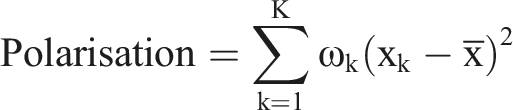
For the analysis of party configurations, we shall also focus on the distinction between economic and new cultural issues and situate the parties in the two-dimensional space defined by these two issue categories based on each party’s issue-specific positions in a given electoral campaign, weighted by the issue’s salience for its campaign. As in the above indicator for polarization, the respective weights are measured by the number of core sentences corresponding to a given party-issue relationship, expressed as a proportion of the total number of core sentences for the party in question.
Results
The structuring capacity of economic and new cultural issues
The long-term trends suggest rising levels of politicization of the new cultural issues, while the politicization of economic issues is expected to remain stable or decline (H1). Figure 1 presents the average development of the structuring capacity of economic and new cultural issues from the 1970s up to the 2019-2022 elections across the six countries. The vertical dashed line indicates the beginning of the financial crisis and the Eurozone crisis. The presentation is based on three-yearly moving averages. Since we take averages across countries, we cannot expect a smooth trend even for such smoothed data, since the election years vary from country to country, and contingent factors play a role as well. The benchmark of the 1970s indicates that, in those days, new cultural issues were not politicized in electoral campaigns at all. Back then, these campaigns in the six countries were dominated by economic issues. It is important to note again that we do not have data for the 1980s. Politicization of new cultural and economic issues over time (3-year moving averages).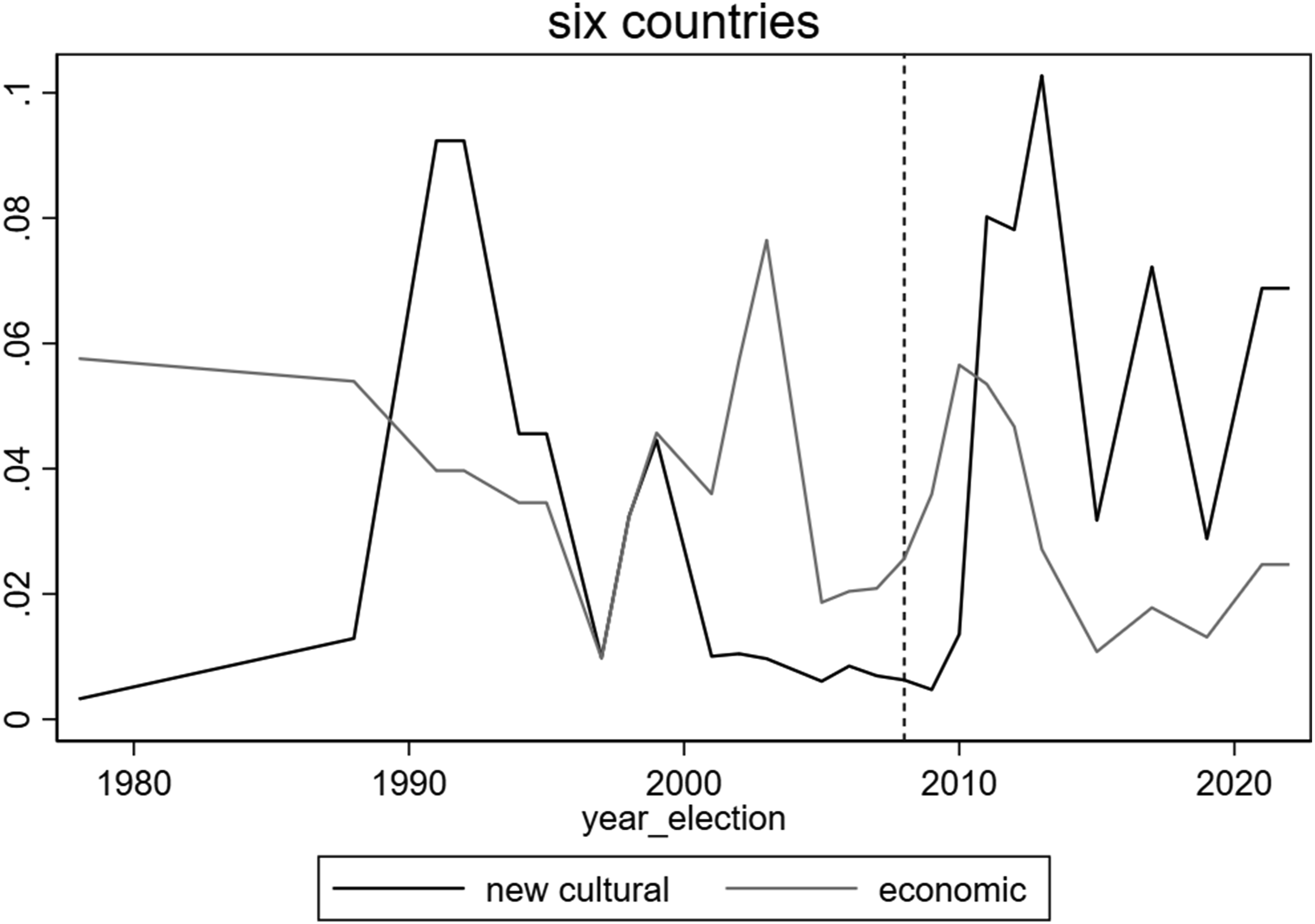
The pattern emerging from the 1990s onwards does not quite fit the expected trend of a long-term rise in the politicization of new cultural issues and a corresponding decline of the politicization of economic issues (see H1). As it turns out, new cultural issues were already heavily politicized by the 1990s, accompanied by a decline in the politicization of economic issues. This trend did, however, not continue. By the late 1990s/early 2000s, the roles of economic and new cultural issues in electoral campaigns reversed: the politicization of new cultural issues declined and remained subdued until the crisis period, while the politicization of economic issues increased, subsided temporarily, and then increased once again with the onset of the Eurozone crisis. However, in line with expectations (H3), the refugee crisis marked a turning point, after which new cultural issues have definitely become more politicized than economic issues. A more detailed analysis reveals that this surge is primarily driven by the immigration issue, which is responsible for the massive increase in politicization of new cultural issues in the crisis period (see Figure A1 in the Appendix).
The overall trend of politicization presented in Figure 1 obscures, however, the contrasting development of its two components, salience and polarization. As shown in Figure 2, the salience component develops more in line with the expectations of a long-term trend. Thus, the salience of economic issues follows a declining trend throughout the period under study, a trend that was only temporarily halted during the Eurozone crisis. In contrast, the salience of new cultural issues shows a continuous upward trajectory, briefly interrupted during the Eurozone crisis. Most important, the salience of new cultural issues has caught up with that of economic issues most recently. It is the polarization component that drives the more pronounced fluctuations in politicization. Unlike salience, polarization does not follow a steady trend but appears to fluctuate more in response to context- and period-specific events and mobilization attempts. Notably, the latest crisis period has been marked by a sharp increase in the polarization of new cultural issues, whereas the polarization of economic issues remains comparatively low following a brief spike at the onset of the Eurozone crisis. Salience and polarization of new cultural and economic issues over time (3-year moving averages).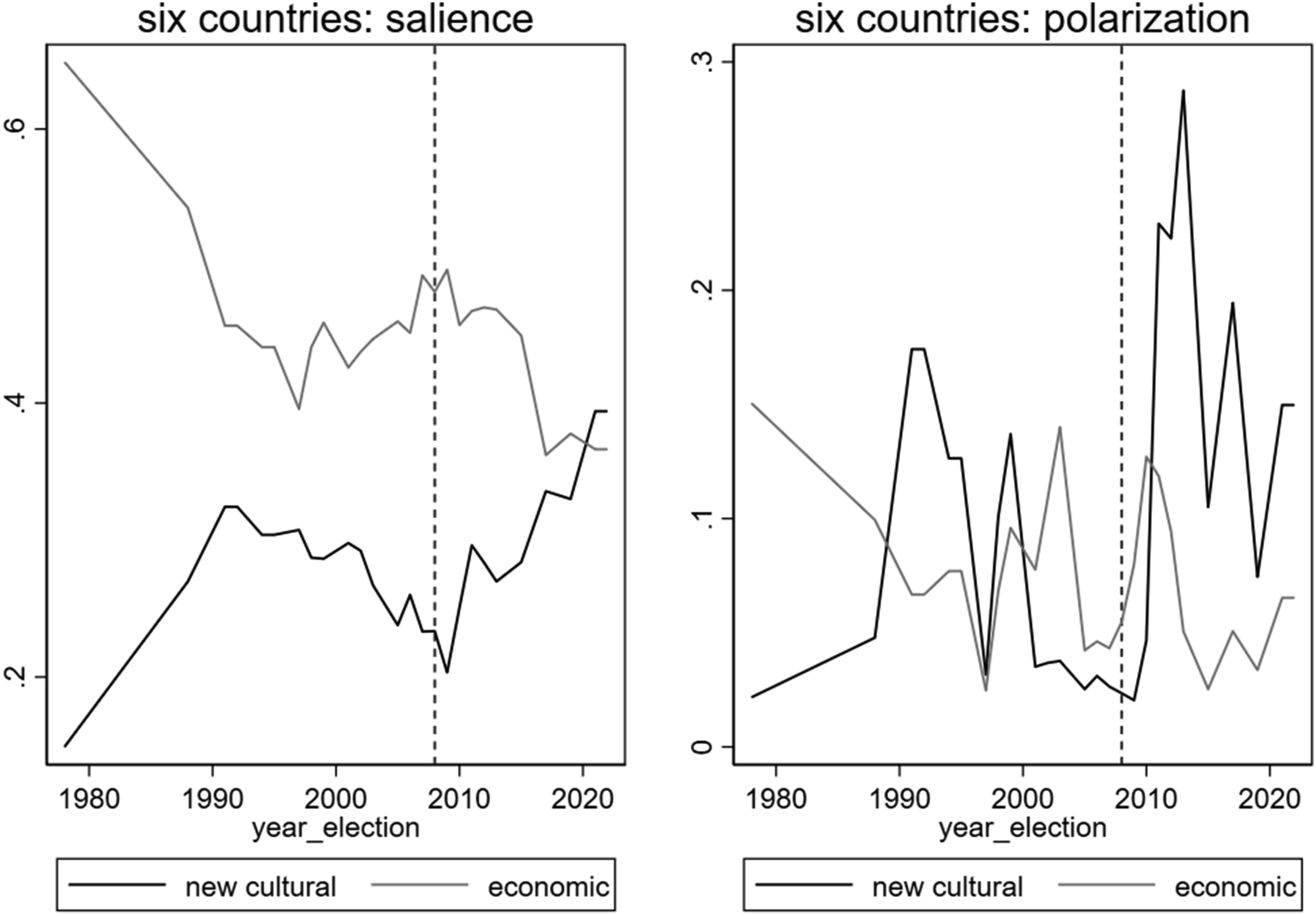
While the overall trends in politicization provide important insights, they mask significant cross-national differences. This section examines how these dynamics vary across countries, beginning with an analysis of the overall salience of political issues. We then explore the evolving politicization of new cultural and economic issues. Finally, we take a closer look at immigration, examining both its salience and the extent to which it has become a polarized issue in different national contexts. We find substantial cross-national differences, which are likely related to institutional and contingent factors. Our analysis of the impact of such factors is at this point purely descriptive. A more systematic analysis in terms of these factors is, however, beyond the scope of this article.
Issue categories per country, only attributable, substantive issues: percentages (overall).

Figure 3 presents the development of politicization of the new cultural and economic issues in the six countries. Considering the development of the politicization of economic issues first, the figure shows that the development of the structuring capacity of economic issues more or less followed a pattern of linear decline in France and, to some extent, also in Austria and the UK. In the UK, the decline was more abrupt with Labour’s Third Left turn in 1997, and in Austria, there was a resurgence of economic issues during the Eurozone crisis. The Netherlands follows a similar pattern, except that the re-politicization of economic issues was not temporary but more sustained. It is Germany and Switzerland, which are responsible for the pre-crisis bump in the politicization of economic issues in Figure 1. In the early 2000s, Germany was the sick man of Europe and required economic reforms (which were forthcoming as a series of four Hartz reforms). In the Swiss case, the old age pension reform and the introduction of the Schuldenbremse (debt break) took place in the run-up to the 2003 elections, which is why economic issues loom so large in the campaign of these elections. Politicization of new cultural and economic issues over time and by country.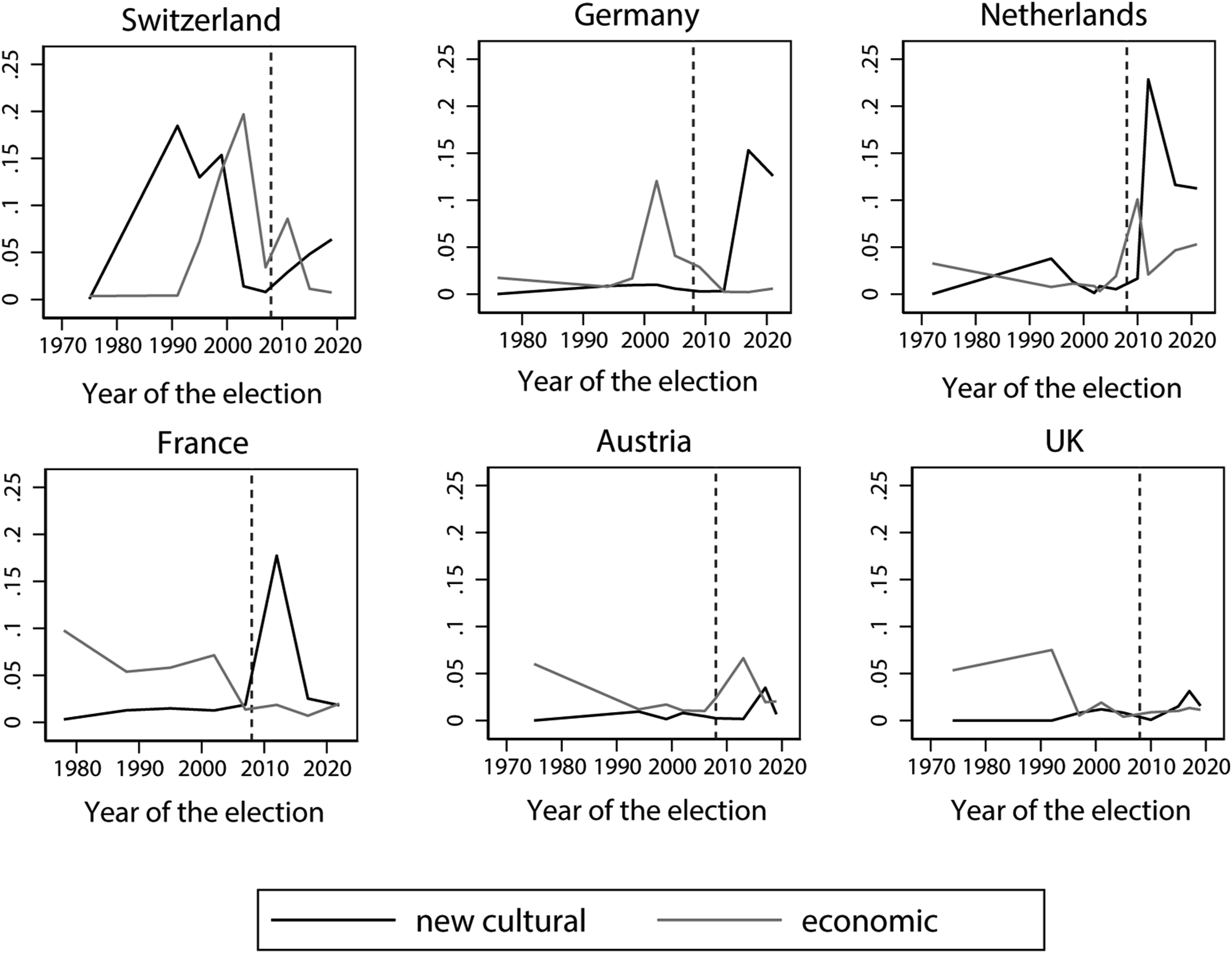
Turning to new cultural issues, Switzerland stands out as the country where they were most heavily politicized before the crisis period. It is Switzerland, which is responsible for the early peak regarding new cultural issues in Figure 1. In the aftermath of the dramatic 1992 referendum when the Swiss voters narrowly rejected the country’s entry into the European Ecnomic Area (EEA), the Swiss People’s Party (SVP) first mobilized on European integration in 1995 and then on immigration in 1999, as a result of which it rose to become the largest party in the country (Kriesi et al., 2005). In Germany, the Netherlands, and France, the radical right succeeded in politicizing the immigration issue in the crisis period, which accounts for the respective peaks in the politicization of new cultural issues in these countries – as well as in Switzerland (see Figure A2 for more details). In contrast, Austria and the UK saw a more muted development in the politicization of new cultural issues. Figure 4 shows that while the salience of immigration increased in both countries, it never reached the extreme levels observed in Switzerland. Moreover, immigration did not become as deeply polarized as in Germany, the Netherlands, and France in some specific elections. In a comparative perspective, the Brexit elections in the UK do not stand out as particularly politicizing immigration or new cultural issues more generally. This finding reflects our focus on electoral campaigns, where intra-party divisions within the main British parties dampened visible polarization, and where party elites strategically deemphasized Brexit-related issues in 2015 and 2017 (Green and Prosser, 2016; Prosser, 2018). Salience and polarization of the immigration issue over time and by country.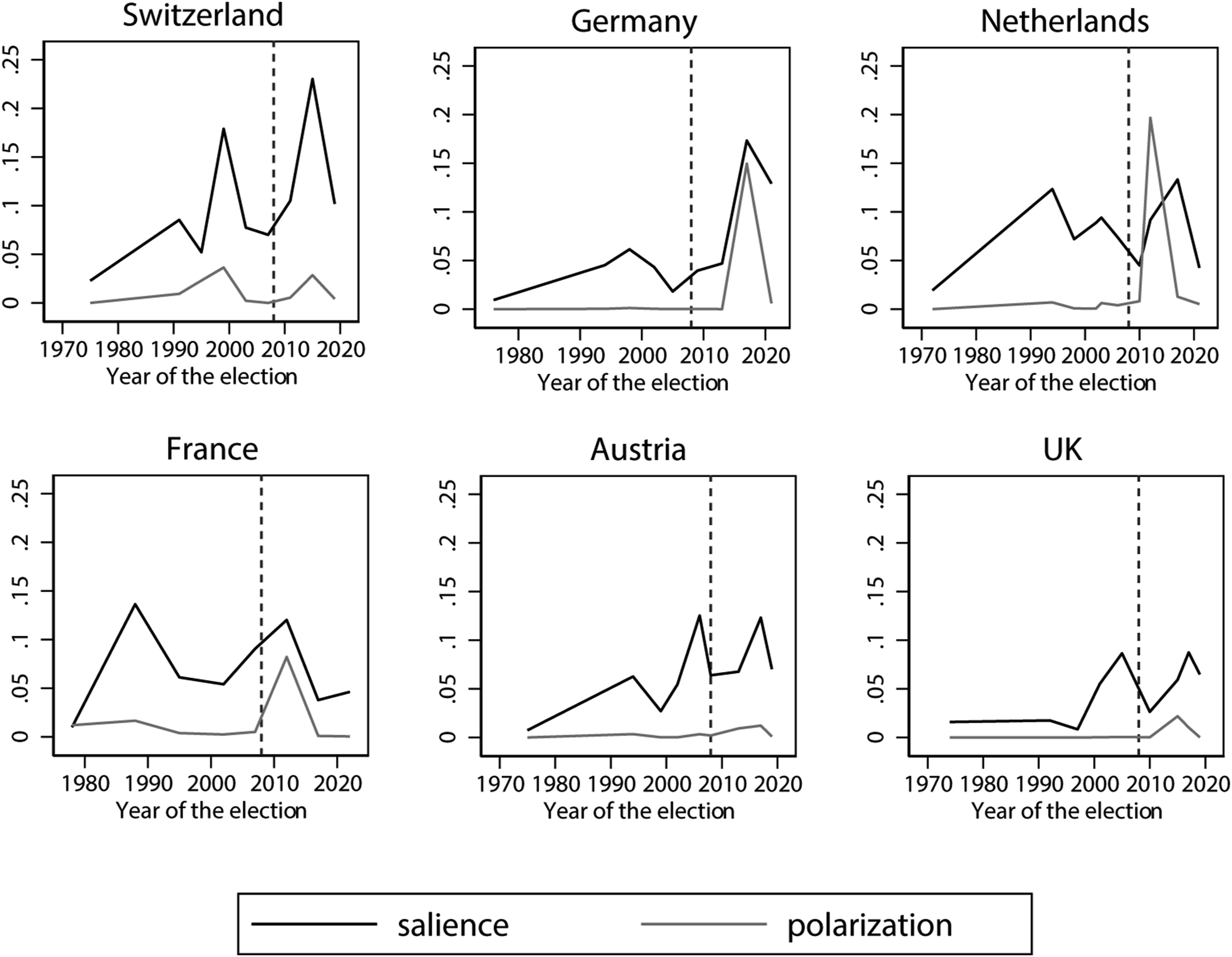
The shifting overall configuration
Next, we test H2 about the shifting party system configurations. We present these shifting configurations by country for four different periods – the benchmark period of the 1970s, the pre-crisis period (1990-2007), the period of the Eurocrisis (2008-2014), and the final period from the refugee crisis (2015/16) up to the last elections included (2019-22). For each country, we present simple two-dimensional graphs covering the configurations during the four periods. The horizontal dimension in these graphs corresponds to the economic issues, and the vertical dimension to the new cultural issues. We situate the parties in the two-dimensional space based on the extent to which they politicize the issue in given election, i.e., based on their issue-specific positions in a given period, weighted by the issue’s salience for each party in the respective period. As indicated above, the respective weights are measured by the number of core sentences corresponding to a given party-issue relationship, expressed as a proportion of the total number of core sentences for the party and period in question. On the economic dimension, positive values indicate pro-market, negative values pro-state positions; on the cultural dimension, positive values refer to cosmopolitan or GAL positions, negative values to nationalist or TAN positions. Figure 5 presents the shifting configurations by country. The period-specific party positions are indicated by period-specific markers, which are joined to indicate the period-specific configurations as differently shaded areas in the two-dimensional space. For each dimension, we use the same scale across all country-specific subgraphs. Shifting configurations by country.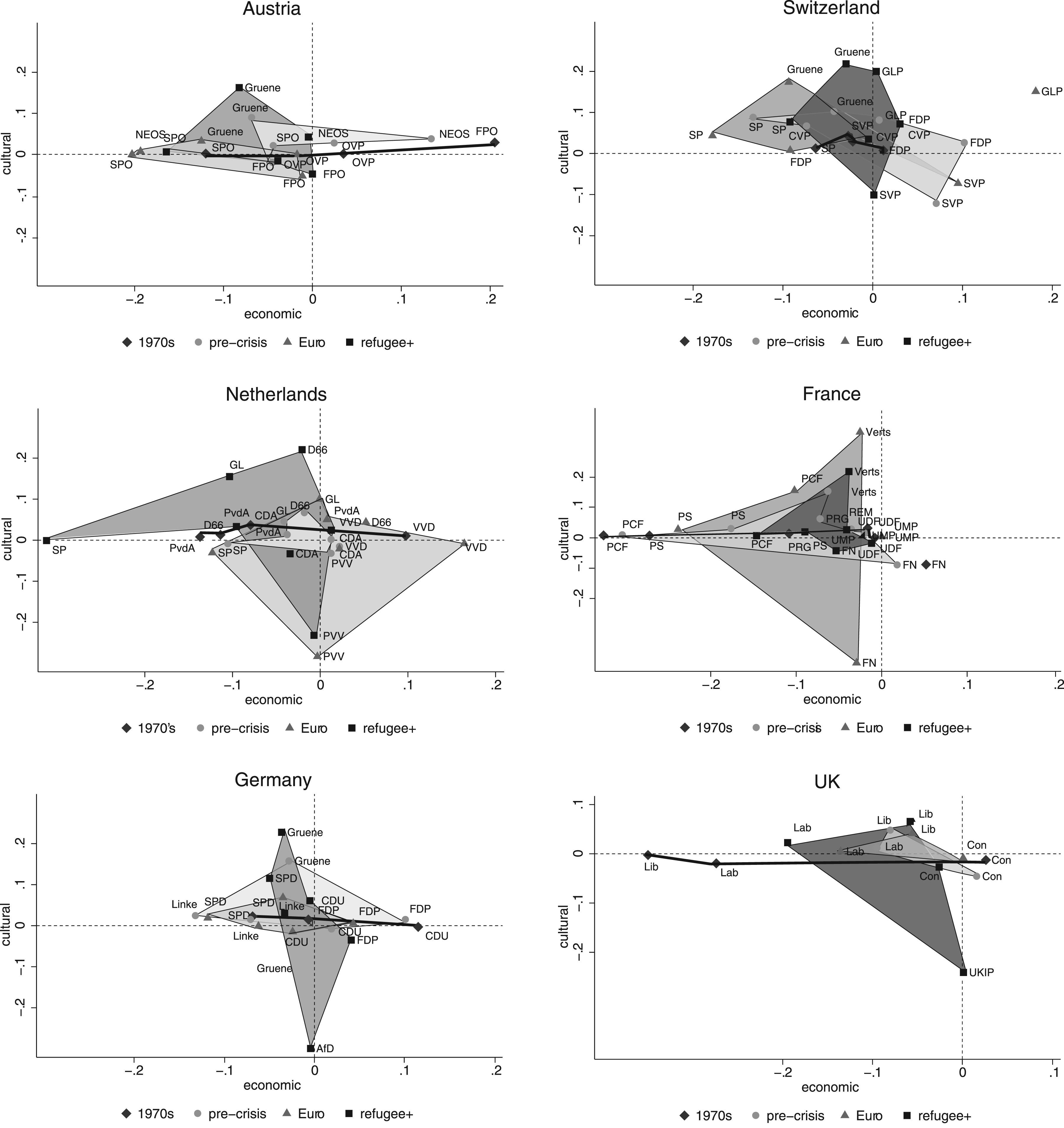
The development of the party system configurations varies significantly across countries, yet some general characteristics align with our expectations. First of all, in the benchmark of the 1970s, all countries show a one-dimensional contrast on the economic dimension, with the center-left (social-democratic) and, where present, radical left parties on one side, and center-right parties on the other.
Second, we observe the expected shift of the party configuration from a horizontal to a vertical orientation in all six countries (H2), starting with the rise of the Greens in the 1980s and coming to its completion with the rise of the populist radical right at different country-specific moments. Favored by the institutional conditions, the configurations started to shift first in the three smaller countries with proportional electoral systems – Switzerland, Austria, and the Netherlands. The Greens emerged in all the countries at more or less the same time, but they faced high thresholds in the UK because of the majoritarian electoral system. For the same reasons, it was also hard for the radical right to establish itself in the UK. UKIP rose belatedly in the context of the 2016 Brexit referendum. Similarly, the majoritarian electoral system made life difficult for the new challengers in France. In Germany, a combination of institutional barriers coupled with the fascist legacy hindered the ascent of radical right challengers (Bremer and Schulte-Cloos, 2019: 283).
Third, we also find that the shifting of the configuration goes hand in hand with a convergence of the mainstream parties from the center-left and the center-right on the economic dimension. Moreover, as expected, the mainstream parties generally take intermediary positions on the new cultural dimension, further reinforcing the emerging political conflict structure.
Turning to the individual countries, we start with Austria. Although new cultural issues were not highly politicized in Austria at that time, the configuration of its party system started to shift early on, already in the pre-crisis period as indicated by the spread of the lightest gray area 3 . The originally conservative-liberal FPÖ transformed itself into a populist radical right party in 1986 when Jörg Haider successfully contested its leadership (Luther, 2015: 141). After its transformation, the FPÖ started its steady rise, reaching a first peak with 26.9% of the vote in 1999, but then declined due to scandals and splits to a low of 10.0% (Heinisch, 2004). It resumed its rise and peaked again in 2017 at 26.0%. Then it once more shrank as a result of a big scandal. The Austrian Greens also started their slower and more continuous ascent in the 1980s and reached a peak of 12.4% in 2013. Then they equally suffered from a split but rose again to 13.9% in 2019. As show in the first sub-graph of Figure 5, the Greens and the FPÖ opposed each other on the vertical axis in the pre-crisis period, with the center-left (social-democrats-SPÖ) and the center-right (Conservatives-ÖVP) taking intermediate positions on this axis and converging on the economic dimension. During the Eurozone crisis, when the politicization of economic issues intensified again (see Figure 3), the configuration temporarily reverted to a more horizontal orientation with the SPÖ and the ÖVP moving further apart. Since the beginning of the refugee crisis, however, the vertical contrast between the Greens and the FPÖ has become the defining feature of the Austrian party configuration, as indicated by the darkest gray area. But note the comparatively moderate position of the FPÖ on both dimensions. The center-left, the center-right, and the new liberal contender NEOS continue to occupy intermediary positions, closer to the FPÖ than to the Greens.
The Swiss trajectory is quite similar, with the party configuration already shifting in a vertical direction during the pre-crisis period. Like the Austrian FPÖ, the SVP, an originally center-right farmers’ party, started to transform itself into a radical right party in the 1980s when Christoph Blocher took over its leadership. Its rise began in the 1995 elections when it benefited from its successful opposition to the Swiss participation in the EEA in the 1992 referendum vote and its subsequent opposition to immigration in the 1999 elections (Kriesi et al., 2005). In 1999, it became the largest party with 22.6% and continued its rise until 2015, when it obtained almost 30% of the vote. As in Austria, the Swiss party configuration already shifted in a vertical direction during the pre-crisis period but, contrary to Austria, it did not return to a more horizontal orientation in the Eurozone crisis 4 . As in Austria, however, it became fully vertical in the aftermath of the refugee crisis. Finally, in Switzerland, too, the center-left (social democrats) and the center-right (Conservatives and Liberals) take intermediary positions on the vertical dimension and have considerably converged on the economic dimension. The Swiss case is distinct insofar as it saw the development of two comparatively strong Green parties, the Greens and the Green Liberals, the result of a split in 2007. The two are similarly located on the new cultural dimension, but the Green Liberals take a more economically liberal position. Together, the two parties peaked in the 2019 elections, securing 13.2 and 7.8% of the vote, respectively.
The Netherlands is the third case where the configuration already started to shift before the crisis period. However, unlike Austria and Switzerland, the Netherlands saw the emergence of two radical populist parties – one on the left (SP) and one on the right (Lijst Pim Fortuyn, LFP, followed by PVV) (Van Kessel, 2015). 5 The radical right made its first major breakthrough in 2002 when the LPF won 17.0% of the vote. The party was immediately co-opted into government, but rapidly disintegrated and was replaced by the PVV (Freedom Party) of Geert Wilders. This new challenger grew to 15.5% in 2010, then stabilized at around 10% until the elections in 2023, when it became the largest party with 23.5%. After the Eurozone crisis, the Dutch party system underwent a dramatic transformation, marked by the collapse of the Social Democrats, whose voters largely shifted to the social-liberal D′66 and the Greens. Their destruction went hand in hand with an extraordinary fragmentation of the Dutch party system, with the effective number of parties increasing from an already high 5.7 (2012) to a record of 8.1. As illustrated in Figure 5, the resulting multipolar Dutch system is characterized by polarization on both the economic dimension – opposing the radical left SP to the neoliberal VVD – and on the cultural dimension – opposing the New Right PVV to the New Left (Greens and D′66). In the pre-crisis elections, the two radical parties from the left and the right – the SP and the PVV – had been rather closely situated to the other parties in the partisan space. As they moved farther apart during the Eurozone crisis, the Dutch configuration polarized on both dimensions. However, with the decline of the SP and the re-centering of the VVD on the economic dimension, the vertical shift imposed itself in the Netherlands during the last period, too.
France resembles the Dutch case in that its party system has included a double populist opposition from the radical left (the Communist Party (PCF) and Trotskyite Parties) and the radical right (FN-RN). The radical left accounted for about 10% of the vote (in the first round of the legislative elections) until the end of the 1990s, when the Communist Party started its inexorable decline. In 2016, La France Insoumise replaced it as the main force on the radical left, obtaining once again 11.7% of the vote. The Front National, the party on the radical right, was one of the first in Western Europe to have success. Already in the 1980s, it obtained almost 10%. In the pre-crisis period, it rose to roughly 15%, which it more or less kept during the Eurozone crisis. Only more recently, it achieved greater success, peaking at 18.7% in 2022 and at 29.3% in 2024. The Greens remained rather weak and divided in France, always hovering around 5% of the vote. As a result of the double radical opposition, like in the Dutch case, the horizontal axis remained dominant throughout the pre-crisis period, although the configuration of the party system started to become tripolar (Gougou and Simon, 2013; Tiberj, 2013). In the Eurozone crisis, the tripolar configuration became more accentuated, i.e., highly polarized on both dimensions. Finally, with the emergence of Macron’s centrist party (REM), the destruction of the PS, and the increasing impact of the RN’s normalization strategy (Betz, 2015) during the last period, the parties moved closer together in a multi-polar configuration. The REM is situated close to the Conservatives (UMP), who have consistently taken a centrist position on both dimensions throughout all four periods 6 . Importantly, within the two-dimensional space, all the parties are far removed from economic liberalism. As in previous periods, the major French parties converge on economic issues and distinguish themselves primarily on the new cultural dimension, even if they are situated far less apart than during the Eurozone crisis period.
In Germany, we also see a double challenge from the radical left and the radical right. The radical left became a stable but weak element of the party configuration after reunification. The Left Party (Linke, former PDS) had its breakthrough in the pre-crisis period, when it peaked at 12.7% in 2009, together with the Greens (Gruene), who obtained 10.7%. The Greens had risen early in Germany, crossing the five-percent threshold for the first time already in the 1983 elections. In the absence of a significant radical right party, the party configuration remained tripolar in the pre-crisis period, with a decidedly horizontal orientation. During the Eurozone crisis, national election campaigns in Germany were relatively depoliticized, focusing instead on coalition negotiations (2009) or candidate performance (2013) (Faas, 2015). This period saw a temporary contraction of party competition. As a result of the SPD’s renewed left-wing agenda and the CDU’s ‘trespassing’ strategy, the party system as a whole moved to the left. The new populist radical right appeared for the first time at the end of the Eurozone crisis, with the AfD opposing the repeated bailouts for Europe’s crisis-ridden debtor countries. Even though it was only founded 7 months ahead of the 2013 election, the newcomer party won 4.7% of the vote and barely missed the 5% threshold to enter the Bundestag. As it was hardly covered in the media, it does not appear in the respective configuration. However, the AfD soon reoriented its strategy toward anti-immigration, gaining momentum in state and European elections before securing Bundestag representation with 12.7% in 2017 (Bremer and Schulte-Cloos, 2019). As a result of the AfD’s rise and the concomitant convergence of the center-left and center-right on the economic dimension, the German configuration decidedly shifted in a vertical direction, assuming a multi-polar shape with strong polarization on the new cultural dimension.
In the UK, finally, the party space remained dominated by the three traditional parties throughout the pre-crisis period. In the absence of a Green party of any weight, the Liberals stood in for the Green position in the tripolar structure. Under the impact of Labour’s turn to the Third Way, the tripolar configuration shrank considerably in the pre-crisis period. Not much changed during the Eurozone crisis. It was the rise of the British radical right, UKIP, which brought about the decisive vertical shift in this case. UKIP rose to become a major contender in the context of the Brexit referendum – a case of a nationalistic backlash against European integration. But the Brexit process, aided by the electoral system, ended up reinforcing the Conservatives, which succeeded in outcompeting UKIP on the Brexit issue. The Brexit vote was motivated by cultural grievances in line with the long-term trend we observe across Northwestern Europe, even if this cultural backlash was (partly) rooted in long-term inequalities between regions benefiting from economic change and regions experiencing long-term economic decline (Carreras et al., 2019).
Conclusion
This article has examined how a series of crises – from the Eurozone crisis to the war in Ukraine – has shaped the structuration of party systems in Northwestern Europe. Based on our analysis of public debates during election campaigns in six countries (Austria, Germany, the Netherlands, Switzerland, and the UK), we have found that the structuring capacity of the long-term trends linked to the rise of new cultural issues has, indeed, been increasing. While the great economic crisis – the Eurozone crisis or Great Recession – temporarily dampened the effect of these long-term trends on the structuring of Northwestern European party systems, they regained and reinforced their structuring capacity during the more recent crises, particularly since the 2015/16 refugee crisis. These crises directly tapped into the structural potentials underlying the new cultural divide. In line with these trends, we have found an increasing politicization of the new cultural issues.
Yet, it is important to underline that there were additional institutional (electoral systems, grand coalitions, and legacies of a split left) and contingent (e.g., scandals, splits, or the rise of centrist challengers) factors that modified the long-term trends in country-specific ways. As a result, the structuring capacity of the new cultural issues did not develop linearly. Setbacks followed early breakthroughs of green and radical right challenger parties expressing these issues. In other cases, the rise of these challengers was generally constrained, and they only got their chance in the changed opportunity structure in the period after the Eurozone crisis. Given the importance of such contingent factors, it is easy to get distracted by election-specific outcomes that obfuscate the long-term trends.
Theoretically, our findings are best interpreted in light of cleavage theory. We do not regard the recent crises as a new critical juncture, but rather as a series of events that intensified the contestation of transnational issues already linked to the globalization cleavage (Hooghe and Marks, 2018; Kriesi et al., 2008, 2012). The Eurozone, refugee, COVID-19, and Ukraine crises did not open up new lines of conflict, but they reinforced existing ones by drawing political attention to the vulnerabilities of interdependence. In this sense, crises have acted as catalysts that transformed latent potentials into manifest patterns of partisan conflict, thereby strengthening the structuring capacity of the new cultural divide.
In line with the long-term rise of the structuring capacity of the new cultural dimension, we have also found a general shift in the party configurations in our six countries from a bipolar configuration focused on the economic dimension to a tri- or multi-polar configuration focused on the new cultural dimension. The traditional opposition between the center-left (plus the radical left in countries with a split left) and the center-right on the economic dimension has been increasingly complemented by a second opposition between the Greens and the radical right on the new cultural dimension. The vertical expansion of the competitive space went hand in hand with a contraction of the space on the economic dimension. The multi-polar expansion of the competitive space also implied an increasing fragmentation of the party systems and the decline of the traditional center-left and center-right parties. At the same time, our analysis is necessarily time-bounded. Future technological transformations (e.g., AI-induced labor market disruptions) or new forms of statist–authoritarian redistributive politics may re-politicize economic issues and challenge the current predominance of the cultural divide (e.g., Gallego and Kurer, 2022). 7
The long-term restructuring trend we put into evidence in this article is, of course, not the whole story when interpreting the development of Northwestern European party systems. Thus, we have paid only scant attention to the renewal in the center (e.g., REM in France, the NSC (New Social Contract) in the Netherlands; NEOS in Austria), and to the strategies of the mainstream parties to recover some of the ground they have lost by making accommodating steps in the direction of the challengers. However, overall, our data do not show much of the latter movements.
Our analysis is limited by its focus on six Northwestern European countries and by the time period covered, which refers to both our focus on election campaigns (not capturing the dynamics of politicization outside electoral periods, e.g. during referendum campaigns; Hutter, 2025) and to the fact that our data do not go beyond 2022. But we already know the outcome of the subsequent elections in all six countries. On the right, the long-term trends are generally confirmed as the radical right progressed in all of them, at the cost of the center-right. It obtained record scores in the 2024 French elections (29.3%), the 2024 Austrian elections (28.8%), the 2023 Dutch elections (23.5%, to which one might want to add the 4.7% obtained by the Farmer-citizen movement), the 2025 German elections (20.8%), and close to record scores in the 2023 Swiss elections (27.9%) and 2024 UK elections (14.3%). On the opposite side, the Greens generally tended to lose ground as the climate crisis lost some of its public salience. What we observe on the left in two of our six countries is the formation of grand electoral coalitions. Thus, in the Netherlands, the Greens joined forces with the Social Democrats, an alliance that paid off, leading to an increase in their joint vote share by almost 50%. Similarly, in France, all three components of the left formed an electoral coalition in the 2022 and 2024 elections, which did not substantially enlarge its vote share but did not reduce it either. These coalition formations reduce the fragmentation of the party system and may reduce the multi-polar configuration to a tri-polar configuration if they stabilize.
Supplemental material
Supplemental Material - Restructuring party systems in Northwestern Europe: A comparative analysis of six countries
Supplemental Material for Restructuring party systems in Northwestern Europe: A comparative analysis of six countries by Hanspeter Kriesi, Swen Hutter in Party Politics.
Footnotes
Acknowledgements

Declaration of conflicting interests
The authors declared no potential conflicts of interest with respect to the research, authorship, and/or publication of this article.
Funding
The authors disclosed receipt of the following financial support for the research, authorship, and/or publication of this article: This work was supported by the European Research Council; ERC-SOLID project, Grant 810356 – ERC-2018-SyG.
Supplemental material
Supplemental material for this article is available online.