




Abstract
Indigenous politics is different from “normal” politics. It is about power within the state and against the state in which fragmentation is commonly seen as fragility. Political party competition is therefore extremely rare, and interests’ representation is generally not organized through political parties. In this article, we analyze a unique and deviant case – Norway – where Indigenous system-building develops thorough party politics based on internal cleavages. Using unique survey data on Sámi voters (N = 1134) we show how voters for the Sámi parties are divided on the question of Sámi self-determination and that this has transformed the party system from a “one-party dominant system” towards a two-party system based on an internal cleavage concerning the degree and type of self-determination. This transformation has been made possible by changes in the electoral system, a substantial increase in the Sámi electoral roll and major advancements in Indigenous rights in Norway.
Introduction
This article is about Indigenous institution building for self-determination through the development of party systems. In Indigenous politics, the right to self-determination is crucial. How this right is expressed both by Indigenous peoples themselves and in their interaction with the state they are part of has been studied only to a limited extent. Nevertheless, there is reason to believe that such a universal right for Indigenous peoples result in various forms of institutionalization depending on the historical and state context in which they form part. Federal states versus unitary states provide vastly different structural conditions for this.
In federal liberal democracies, Indigenous self-determination is often expressed through understandings of non-interference for smaller communities (called nations) due to an essential right to sovereignty and territorial control from pre-colonial times. The primary form of self-determination here is therefore treaties between the state and many ethnically homogeneous small communities (Nadasdy, 2017; Papillon and Rodon, 2024). In this form of self-determination internal political competition and fragmentation are understood as expressions of fragility.
In the Nordic unitary states, where interaction between the Sámi and the majority population has always existed and where the Sámi are strongly integrated into the national political system and the welfare state, a different form of Indigenous institutionalization has emerged. International law and upscaled internal institutionalization are the key political resources. Separate elected parliaments without territorial autonomy represent Sámi interests across the country, bridging distances and cultural variations (Falch and Selle, 2022b). This Nordic model emphasizes non-domination by the state. It features internal political competition through elections where each vote is counted approximately equally to a representative parliament that integrates the Sámi’s into their own political community within the nation-state (Falch, 2022).
The article focuses on Norway, home to the largest Sámi population. The Sámi Parliament of Norway has the largest budget, most decision-making power, and includes national party participation (Buck et al., 2018; Falch and Selle, 2018). In Sweden, only Sámi parties participate, and in Finland, voting is personal. The Norwegian case is the most significant within the Nordic model from a party politics perspective.
Indigenous politics has become an important part of Norwegian politics since the establishment of the Sámi Parliament in Norway in 1989, which marked a crucial step for Sámi self-determination (Broderstad, 2014; Stepien et al., 2015). Representatives have been elected from party lists since its inceptions. The Norwegian Sámi Association (NSR) has been the dominant party, shaping the Indigenous ideational agenda, though not always part of the Governing Council (Falch et al., 2025; Falch and Selle, 2023a). The Labour Party has traditionally been the main opposition and increasingly within the same ideational frames as NSR. This changed with the breakthrough of the new entrepreneurial populist party: The People of the North (NKF), becoming the second largest party in the 2021 election (Falch and Selle, 2023b).
An Indigenous parliament built on numerical representation, where there is also room for developing a party system, presupposes and makes visible that there are internal political conflicts and competition over political direction and ideas. Therefore, we analyze how the party system has developed, what political cleavages they organize around and whether these are changing. How do voters position themselves within the evolving conflict structures and what impact does this have for the shaping of Indigenous Sámi party building and politics? Through our analysis, we aim to say something about to what extent the Nordic Indigenous model, with numerical representativity (one person, one vote), can provide valuable lessons for other Indigenous peoples striving for self-determination institutions. Additionally, the significance of and reactions to the legalization inherent in Indigenous politics can give broader insight into why populist parties are growing in constitutional democracies.
In the next section we will elaborate on the theory of party systems and Indigenous policies. Following that, in part three, we delve into the empirical case: the Sámi Parliament of Norway and analyze the evolution of the party system and the political transformations the 2021 election represent. To throw further light on the deep-seated changes of Sámi politics we will in part four present and discuss the significant findings of a unique survey among Sámi voters (N = 1134) in the 2021 Sámi Parliament election. Finally, in part five, we draw our conclusions, emphasizing expectations about long term consequences of the deep-seated changes for the position of the Sámi within the Norwegian unitary state. We also draw some conclusions concerning how far the Nordic Indigenous model can be applied to other Indigenous contexts, how dependent Indigenous self-determination is on being part of constitutional democracies, and consequently, how vulnerable Indigenous policies are to populist backlash. In this way, our analyses will shed a general light on the foundations of populism’s content and growth.
Party system and indigenous politics
Shaping of party systems
Building on social structures Lipset and Rokkan (1967) develop their cleavage theory by examining how structural cleavages had been incorporated into the political system through political parties.
Bartolini and Mair (1990) define cleavages as socio-structural phenomena with tangible conflicts, political awareness of distinct group identities, and the extent to which they are organized through associations and parties. The organizational criterion is salient for understanding how political parties incorporate societal differences and cleavages to mobilize electoral support. This reciprocal interaction between political parties, voters and societal groups is key to understanding changes in the political system, how political parties gain and lose electoral support, and how the relationship between political parties shapes coalition (Riker, 1962; Strøm, 2022; Strøm and Leipart, 1993).
Over the last decades new cleavages have changed European politics and many established parties have experienced a decline in electoral support (Benedetto et al., 2020; Ford and Jennings, 2020). New political parties can arrive as political entrepreneurs. Like disruptive entrepreneurs, challenger parties offer new policies and defy the dominance of established party brands (De Vries and Hobolt, 2020). This challenger role also sometimes takes the form of populism, which is based on a fundamental critique of the elite representing the liberal institutionalized and rule of law system that opposes the will of the unified genuine people (De Vries and Hobolt, 2020; Mudde, 2004; Pinelli, 2011). In the face of these challenges and a more volatile electorate, mainstream parties are losing their grip on power.
Electoral systems play a crucial role in shaping party systems, influencing the number of parties, their type, and their success (Monroe and Rose, 2002). The basic relationship is that the number of parties and hence party system fragmentation increase with district magnitude - the number of representatives elected per district (Lijphart, 1994; Rae, 1971; Taagepera, 2007). The design of electoral systems is a key choice in building political democracy, with significant impacts on representation, party system fractionalization, voter behavior, and government stability.
Historically, much of the literature on parties and party systems has concentrated on parliaments in Western European nation-states (Lijphart, 1994; Lipset and Rokkan, 1967; Rokkan and Urwin, 1983). There is limited literature on party systems in nation-states outside this context (Kitschelt et al., 1999; Levitsky, 2001; Panebianco, 1988; Rice, 2011; Rice and Van Cott, 2006), and not surprisingly almost nothing at all when it comes to Indigenous politics since they in most cases don’t exist. Some work that may be of relevance also for the Indigenous field has been done on distinct party systems in sub-level self-governing regions where the interplay between the center-periphery and left-right dimensions is crucial for party competition and party’s policy identity (Massetti and Schakel, 2015; Wright, 2022). What constitute the secondary or subsumed dimension will typically differ between regional and national parties, but also how the party’s changing positions along this dimensions affect the party identity in a positive or negative way among the voters (Adler-Nissen and Gad, 2014; Hoff and West, 2008).
Usually, the left-right dimension represents the secondary or subsumed dimension for regional parties with a positioning dependent on the region’s economic strength (Massetti and Schakel, 2015). For national parties most often the center-periphery dimension will be secondary. However, the center-periphery dimension does obviously not completely coincide with the self-determination dimension for the Indigenous Sámi people as it appears in the Nordic countries, where territoriality is linked to private collective land rights to groups within the Indigenous Sámi people, and not to autonomy or sovereignty for the Sámi people as such. Therefore, regional parties may very well be simultaneously strongly in favor of regional autonomy and opposed to Indigenous self-determination. There is also reason to believe that national parties, which have the left-right dimension as their primary one, position themselves moderately along with their subsuming (and for them perhaps divisive) center-periphery and self-determination dimensions. The Sámi parties have traditionally chosen not to compete in national elections, but Sámi-related lists with links to Sámi parties have run in regional and local elections in Norway. In 2023 both The People of The North Party and “The Sámi List” with close ties to NSR ran in the regional elections in the Northernmost County of Norway, Finnmark, where the concentration of Sámi are highest (Stein and Solvang, 2025).
In general, the literature on the formation of party systems is highly relevant in understanding the development of Indigenous party systems not the least since the demand for Indigenous self-determination shares similarities with the demand for regional self-government. In both cases political parties are mobilizing upon autonomy and not being dominated from central authorities (Rokkan and Urwin, 1983). However, the differences between the demand for regional autonomy and Indigenous self-determination, that are not necessarily regional, have consequences for how a party system within the Sámi Indigenous parliament looks and evolves. Therefore, we must underscore what characterizes Indigenous politics in general before we go into Sámi politics in Norway specifically.
Indigenous politics
The rise of Indigenous politics is a relatively new phenomenon on the global stage (Lightfoot, 2016), and most studies have focused on Indigenous movements, land rights, history, identity and law and not on internal composition, competition and conflict. Indigenous politics concerns self-determination and power within the state, often mobilizing against the state one is fully dependent on, legally and financially.
Indigenous peoples’ right to self-determination is anchored in human rights (Anaya, 2009; Åhrén, 2016). In some contexts, self-determination and sovereignty are seen as more or less the same phenomenon (Nilsson, 2021). There is, however, a distinction in international law regarding self-determination which rests with people, and sovereignty which rests with the states and partly for regions with territorial autonomy stated in constitutions, laws, or agreements. 1
The right to self-determination implies that government must be exercised and controlled by the people, which means the necessity of representativeness. In addition to the accompanying democratic dimension in the human rights-based right to self-determination, it also follows that Indigenous peoples are bound by other human rights such as the right to elections and representation (democracy), as well as legal constraints on what public authorities can do to citizens (rule of law). Choosing to use internationalization and legalization as a political resource to achieve self-determination, therefore, has implications in that it transforms ethnic minority groups into Indigenous political communities, expressed through representative self-determination institutions. This has in the Norwegian context facilitated space for the development of Indigenous peoples’ own party systems.
Indigenous political communities are, however, often small. Therefore, there is a comprehensive literature arguing that Indigenous self-determination only can be secured by resurging traditional small-scale communities. Indigenous peoples must turn inward and backward to evade the co-optation and assimilation forces of the nation-state structures (Alfred, 2009; Corntassel, 2012). In the resurgence literature, Indigenous self-determination is not understood as something that has come about through human rights, but as an inherent right due to the group’s essential sovereignty and territorial control from pre-colonial times (Alfred, 2009; Kuokkanen, 2019). In fact, from this “cult of smallness” perspective human rights reproduces the co-optation and assimilation of Indigenous peoples into the nation-state (Corntassel, 2012).
Indigenous self-determination, understood as an historically inherent right for small communities, does not facilitate democratic representativeness through up-scaled institutions with a party system where various interests are expressed. In a large country like Canada with many Indigenous peoples and distinct groups and tribes, there has been a loose connection between claims for self-determination and international law, resulting in limited interest and trajectory in building a common Indigenous political community through representative institutions that span distances and bind together local groups with cultural variations (Papillon and Rodon, 2024).
Parties are therefore often strongly contested and non-existent in Indigenous politics. Only in Norway and Sweden do we find Indigenous system-building with political parties (Falch and Selle, 2018, 2022b). There are important similarities between the Nordic Sámi systems, which have been studied in some comparative studies (Mörkenstam et al., 2017; Saglie et al., 2020; Stepien et al., 2015). The advantage of a closer case study of the Norwegian Sámi Party system is the opportunity to explore in greater depth an advanced case of Indigenous party politics, which shares significant similarities with party systems in Western democracies.
The Sámi Parliament
The electoral roll
To vote in the Sámi Parliament election, you must register in the electoral roll. The criteria for enrolment are a self-identification as Sámi (not asking what else you may understand yourself as) and that either yourself or one of your ancestors back to great-grandparents has spoken Sámi as the home language during upbringing. Additionally, children of those who are registered in the electoral roll may demand to be included (Selle et al., 2020). 2 The criteria are relatively loose in general and even looser than in Sweden and Finland, where the language connection cannot go further back than the grandparents’ generation. 3 The combination of relatively loose criteria and the progress of promotion of Sámi culture and heritage, accompanied by an increased acceptance of an individual oriented Sámi identity has led to a rapid growth of the electoral roll (Pettersen and Saglie, 2021). The electoral roll has quadrupled since the establishment of the Sámi Parliament in 1989 from around 5500 voters in 1989 to 20 500 in 2021. Not only has the total number of voters increased substantially, but where the voters are based has changed dramatically, especially since 2017. In 1989 much of the electorate lived in rural core Sámi areas in Finnmark. The expansion of the electoral roll since 1989 has primarily occurred within urban areas but also within rural and coastal areas outside the core Sámi areas (Nyseth and Pedersen, 2014). There is reason to expect that accelerating change of the electoral demography will influence the content and form of politics over time since demographic size, composition, and geographic distribution are shaped by and shaping politics (McNamee, 2023). The electoral roll itself has become a significant marker for expressing Sáminess. In other words, there is a shift in whom the Sámi Parliament represents, a shift that paves the way for changes in the internal political conflict structure.
The political and electoral system
The Sámi parliamentary election is held every four years concurrently with the National parliamentary election. 39 representatives are elected to the Sámi Parliament’s plenary and the plenary elect the Sámi Parliaments Governing Council, which has the daily executive authority. The Governing Council consists of the president and at least four council members. It is therefore a positive parliamentary system that mostly results in majority councils. The Sámi Parliament’s budget for 2025 is 756 million Norwegian kroner (66 Mill €/ 68 Mill $), and the Sámi Parliament’s administration has approximately150 employees with its main office located in Karasjok in Finnmark. In Karasjok the Sámi are in majority. The parliament also has smaller decentralized offices in several other municipalities.
The electoral system, resembling that of the national parliamentary elections, is based on proportional representation favoring the largest parties with “extra” seats (Sainte-Laguës method). It’s a modern electoral system based on liberal political principles of numerical representativeness (one person, one vote).
In 2009, the electoral system was changed from 13 electoral districts with three mandates each to 7 electoral districts where the mandates were allocated based on the size of the electorate in the district. The change was made to ensure a better numerical representativeness (Falch and Selle, 2022a). This change increased the proportion of urban voters, as well as made it easier to organizationally construct and develop political parties. It also made the threshold for getting a candidate elected from an electoral district much lower.
The design of the Sámi parliamentary election with proportional representation in large electoral districts with multiple mandates, along with being a parliamentary institution, ensures a high degree of numerical representativeness. This system supports institutionalization of parties across electoral districts. These are characteristics which expresses attempts to build an Indigenous political community across distances and cultural variations (Falch and Selle, 2022a), and with it a party system that facilitates Indigenous “catch all” parties like NSR as well as participation from national parties like Labour.
The voter turnout for the Sámi Parliament has remained relatively stable at around 70%, not particularly high in a system of individual registration. That is lower than in the National parliamentary elections but higher than in county and municipal elections. There is a relatively low threshold for parties to participate in the election. There has also been a significant presence of local lists (Berg-Nordlie and Saglie, 2021). However, this plethora of lists has dwindled as we can see in Figure 1. Parties/lists in sámi parliament 2001-2021.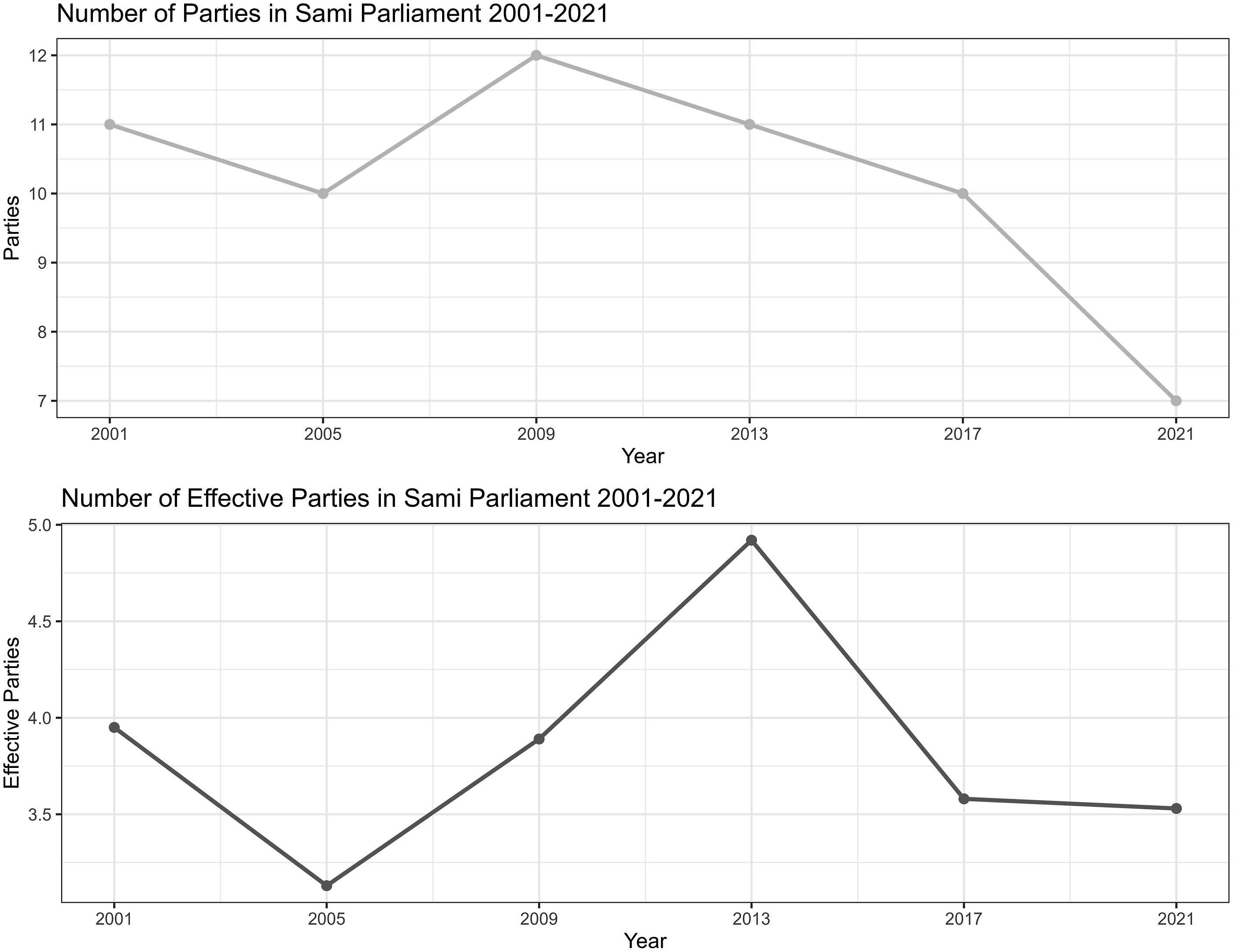
Figure 1 shows the number of parties and lists in the Sámi Parliament from 2001 to 2021. From having over 10 lists/parties among the MPs, it is reduced to only seven in 2021. However, the effective number of parliamentary parties (Laakso and Taagepera, 1979) is not that dramatically changed. This indicates that the smaller local lists that have disappeared did not have such a significant impact on the Sámi Parliament. In 2005 it was even lower than in 2021. Even though some of the smaller parties had one or two MPs, the NSR and to a lesser extent the Labour Party, dominated the parliament.
The evolvement of the party system
Since its establishment in 1989, the Sámi Parliament has been dominated by NSR. Labour has been a main challenger (Buck et al., 2018; Gaup, 2022), but along with several smaller local Sámi parties, it has largely had to adhere to the political direction set by the NSR. Other Norwegian parties, such as the Conservative Party and the Centre Party, have also had periods of some success, but they too have followed the ideational direction outlined by the NSR. The radical left-wing parties have not even participated in elections, as the NSR has taken care of their positions (see Figures 2 and 3). The only party that has ideologically stood for something completely different has been the Progress Party. With NKF’s success in the 2021 election, it looks like a two-party system is starting to form, offering two very different paths for Sámi politics in the Sámi Parliament. Two dimensions of Sámi political parties. Party preference in Norwegian parliamentary elections among Sámi voters.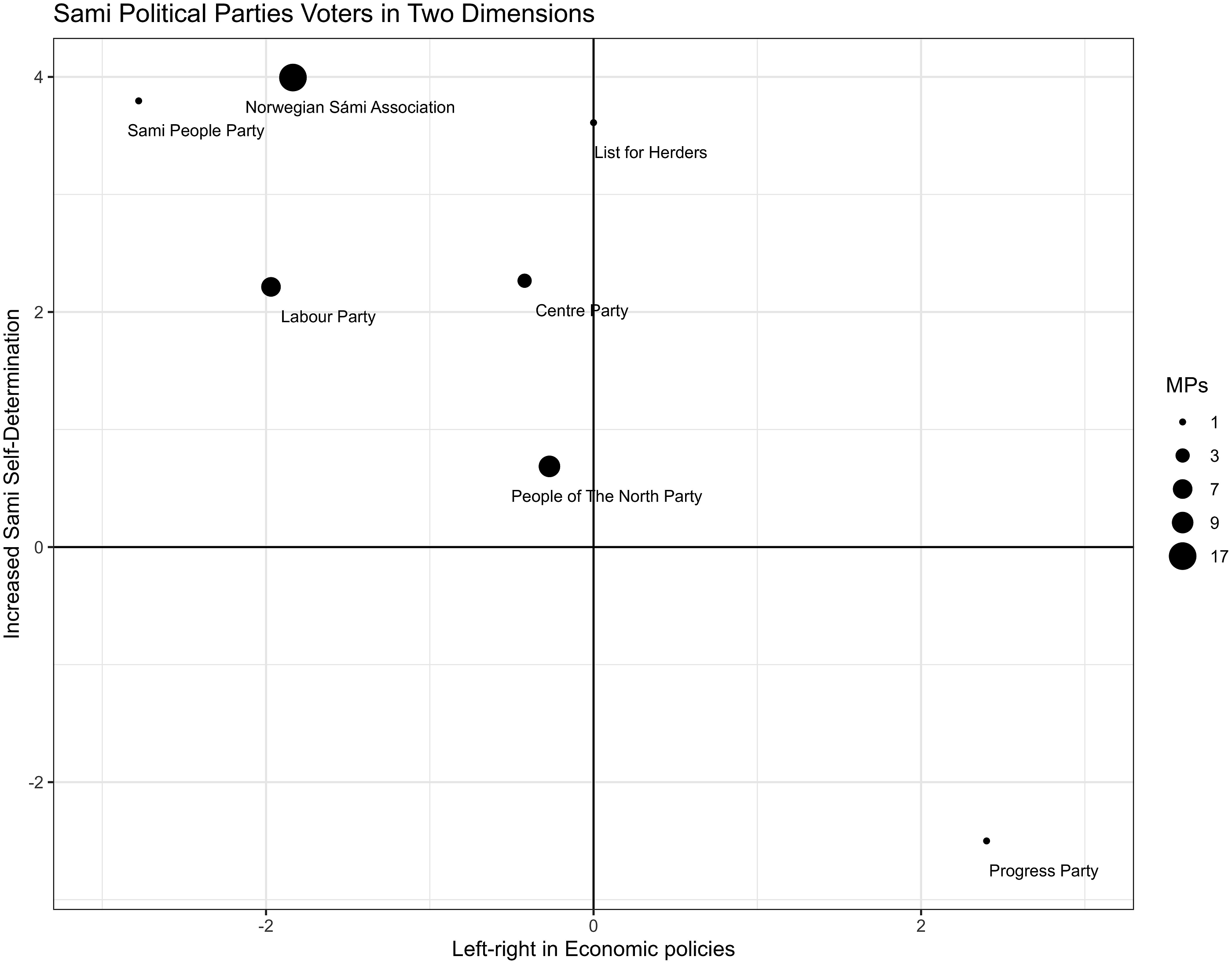
Number of MPs for three major parties 2005-2021 and percentage of total vote share in parenthesis.

NSR has been the dominant party in the Sámi Parliament since the beginning. NSR has been the party with the most representatives except for the election in 2005 and 2009, they have mostly been the main actor in the formation of the Governing Councils, and they have shaped an internationalized Indigenous ideational political agenda that other parties and actors have had to respond to (Falch and Selle, 2023a). These are central characteristics of one-party dominance in a multi-party system (Sartori, 1975).
NSR was the main actor in the Sámi social movement that, from the late 1960s, worked for strengthened Sámi rights, strongly emphasizing international efforts (Falch and Selle, 2018). When the Sámi Parliament became the main response to the critical juncture of the Alta hydroelectric development plan in the years 1979-1981, and the human rights revolution from the end of the 1970s, NSR emerged as the historical winner. This provided low start-up costs for transitioning into also being a political party that ran for election to the new Sámi Parliament. NSR was best organized with international contacts and legitimacy and a strong presence in Sámi communities.
Even though NSR today only commands around 1/3 of the votes, both the proportional electoral system and the parliamentary form of governance enable them, as by far the largest party, to constantly hold a strategic advantage by forming alliances, negotiating Governing Council positions, and securing access to economic resources. This, in turn, results in policies that reinforce, at least until the 2021 election, NSR's ideological position and the possibility of continued dominance (Falch and Selle, 2023a).
NSR has represented an ideology related to the development of international Indigenous rights, with the right to land and self-determination being central. The focus has consistently been to assign decision-making power to the Sámi Parliament in key areas such as support to culture and industry, and in the management of languages, education, and cultural heritage (self-government). Additionally, it has been crucial to achieve recognition of land-, fishing- and reindeer herding rights in national legislation. This has largely been accomplished through consultations as a result of an agreement established between the Sámi Parliament and the National government in 2005 and legislated in 2021 (Falch and Selle, 2022b). NSR has therefore consistently been the main driver for the development of Sámi self-determination. Since the core Sámi areas are characterized by a low degree of a diversified economy, NSR has also positioned itself clearly to the left along the left-right dimension.
Labour, as Norway’s largest national party in national elections since the 1920s, chose to run in the Sámi Parliament elections from the beginning and became NSR's main opponent. The Sámi part of Labour included individuals who had been active in NSR during the 1970s and 80s (Falch and Selle, 2018). They were actively involved in the development of a separate Sámi political system, and therefore constituted a kind of loyal opposition, ideologically adopting a less judicial and more pragmatic and practical approach to Indigenous rights in its efforts to strengthen the situation of Sámi culture and economy (Mellingen, 2004). In this way, the Sámi part of the Labour party served as a link to the National Parliament, which contributed to greater national attention to the development of Indigenous and Sámi policies as compared to Sweden and Finland (Sundberg and Ackrén, 2019). However, there has always been a certain ambivalence as to whether loyalty went to the regional and nation-wide party and the core state or to the Sámi political system, and NSR has always questioned this and mobilized around it.
When Labour was in power in the Governing Council during the years 2007-2013, we see the power of institutionalization playing itself out. Like NSR they ended up arguing legally with an emphasis on the right to self-determination. For Labour, it was difficult to break away from the Indigenous Sámi political direction, emphasizing the internationally legally justified right to self-determination and land rights, which the establishment of the Sámi Parliament entailed. Because of this, tension developed within Labour. The party’s regional and national levels believed that the “Sámi Labour” was disloyal and had gone too far in making self-determination their primary political dimension and adopting NSR’s positions, and thereby relinquishing the opportunity to appear as a real political alternative (Gaup, 2022; Olli, 2014). To get into position and govern with partners in the Sámi Parliament, the Sámi part of Labour changed their policy identity. In a way, we can say that Labour in the Sámi Parliament has changed its policy identity from a left-oriented party that is moderate on the issue of self-determination to a policy identity being left-oriented and very positive about self-determination. This is a change to an identity that in many ways resembles NSR, and which opens a political space for new actors who are more critical of Sámi self-determination and globalized Indigenous politics. 4
The People of the North Party (NKF) capitalized on Labour's decline, achieving a breakthrough in the 2021 election with 18.3% of the vote and 9 seats across six out of seven districts. Running since 2005, NKF emerged as the main challenger to NSR, presenting a more pointed opposition than Labour. Unlike Labour, NKF has no ties to national parties and rejects the foundational understanding of Indigenous Sámi policy based on international law.
The institutional structures that push towards a co-optation into the Indigenous and NSR dominant Sámi political system is therefore barely present for NKF. They are too different. With NKF, we have seen a rupture in the core of Indigenous Sámi politics. For the first time since the establishment of the Sámi Parliament, there is a major party that will take an entirely new political direction largely detached from international law and much of Indigenous thinking.
NKF is relatively moderate in economic policy, but on the questions of regional autonomy and self-determination they differ from all other parties. NKF want strong regional autonomy, but no Indigenous self-determination. NKF rejects the legalization of the right to self-determination for the Sámi as an Indigenous people. They advocate that the people in the north are one people, a mix of different cultures, and that the Sámi identity is therefore fluid and primarily personal affiliations. The core differences are not between ethnic groups in the north, but between ordinary people in the peripheral north and the NSR elite in collusion with the central authorities in the south. The cleavage on which they base their policies largely follow the classic center-periphery dimension which does not coincide with Indigenous Sámi self-determination guaranteed through the rule of law and with the whole country as its playing ground. In the context of Indigenous politics, where internationalization and legalization are crucial for binding majority democracy to Indigenous rights, NKFs positions show classic populist traits (Falch and Selle, 2023b), which play on an opposition against legal and institutional constraints and the established political elites (Mudde, 2004; Pinelli, 2011). NKF resembles situations where Indigenous collective self-determination, guaranteed through the rule of law, is challenged by individual demands for democratic equality, and typically resolved in courts or the majority’s assemblies (Spitzer, 2022). Uniquely, NKF relies on the Sámi Parliament to displace it from an international Indigenous self-determination institution to one focused on regional autonomy within the state (Mahoney and Thelen, 2010). We can also see similarities between NKF and populist parties in Western Democracies that aim to amplify the voters’ will, often at the expense of institutional and legal frameworks that constrain the majority’s power in material, organizational, and procedural ways (Ignatieff, 2022).
We see that a party system has developed now with two larger Sámi parties that have completely different views on the right to self-determination and the direction of the Sámi politics and that no national party is now at the core. The question is not any longer primarily about “more or less” self-determination, but “either or”. This development has weakened the space for other Sámi parties. The national parties, such as Labour, the Centre Party, and the Conservative Party, position themselves as expected somewhat differently along the left-right axis but are all generally positive towards Sámi self-determination even if the understanding of what it implies may vary. With the breakthrough of NKF, there has been little political space for alternative policies, especially for Labour, the historically main opponent to NSR. Labour is conflicted about its policy identity and is now squeezed between NSR and NKF.
Based on this analysis of the development of the party system in the Sámi Parliament, we will now look at how voters position their parties in the 2021 election and to what extent they agree on the overall political position of the parties they vote for.
Change and cleavages
Methods and data
To analyze voters in the Sámi Parliament, we have used unique data from the Sámi Election Survey 2021 (for more details on the sampling see Appendix A.3). A random sample of 1134 voters was drawn from the total electoral roll of 20 545 providing a representative sample for generalization. We have used the same items as in previous studies on Sámi self-determination (Bergh and Saglie, 2021; Mörkenstam et al., 2017; Saglie et al., 2020). In these previous studies, the authors utilized six distinct indicators to construct an index variable on self-determination. However, since the 2021 survey only encompassed three of these indicators, we have derived an index from them.
5
In aggregate, this index serves as a measure of how voters perceive Sámi self-determination (with a Cronbach’s alpha of 0.8). “Increased Sámi self-determination” is an index variable ranging from 0 to 10, composed of respondents’ answers to three questions on a 1-5 Likert scale,
6
where 1 indicates complete agreement with the statement and 5 indicates complete disagreement. All questions are equally weighted in the construction of the index, such that
Afterwards the result is transformed from a 1-5 scale to a 0-10 scale to get the same scale as the left-right dimension where the respondents have been asked to Rate yourself on a scale from 0 to 10, placing yourself where 0 represents the left side and 10 represents the right side. The average for all parties is calculated by their voter’s placement on these two variables. For the two-dimensional presentation, the variables are transformed from a 0 to 10 scale to a −5 to 5 scale.
Results
Figure 2 shows all the seven parties represented in the Sámi Parliament 2021-2025 in a two-dimensional plot with the size of the dot indicating the number of MPs (for all parties running see Appendix B). The main finding is that the dominant party NSR is the party that has the most positive voters to increased Sámi self-determination being clearly a left-wing party on the left-right scale. The other Sámi parties (Sámi People’s Party, the local List for reindeer herders and Árja who did not get a MP in 2021) are also very positive about increased Sámi self-determination. Three out of the four national parties (Labour, Centre Party and The Conservative Party) have voters who are positive about increased self-determination, indicating that they are incorporated in the larger movement for increased Sámi self-determination (see Appendix B). They have divided themselves somewhat from left to right in economic policy.
NKF’s voters are on average slightly positive to increased Sámi self-determination. This deviates from the party’s program and rhetoric and must be explained by the fact that one of the three questions that determine the level of support for Sámi self-determination is whether the Sámi Parliament should be abolished. For NKF, whose entrepreneurial party-building has occurred through the Sámi Parliament, it is therefore not surprising that their voters, unlike The Progress Party voters do not believe it should happen. NKF also advocates for a policy of regional identity-based autonomy through a displaced Sámi Parliament that represents everyone in the north. The voters’ understanding of a regional autonomy may partly overlap with understandings of Sámi self-determination so as becoming more “positive” than the question is trying to tap.
Finally, the national Progress Party is clearly isolated compared to the other political parties in the Sámi Parliament, which is confirming previous studies (Bergh and Saglie, 2021; Saglie et al., 2020). The party has advocated the closure of the Sámi Parliament for every election since they started running in 2005, which is a radical stance both in Norwegian and Sámi politics.
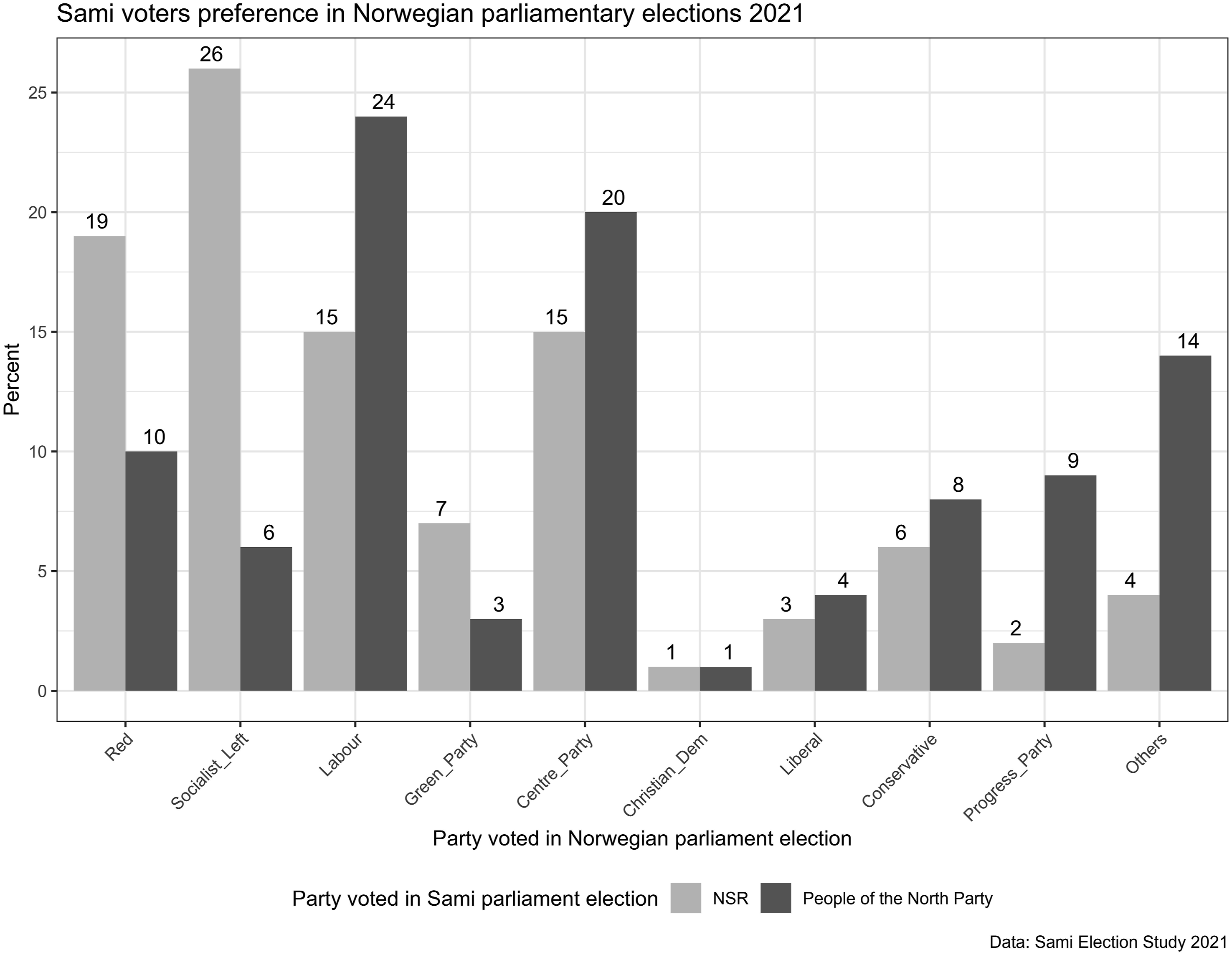
We have mentioned that no national radical left parties take part in Sámi elections and that there are overlap between their position concerning Indigenous politics and that of NSR. Furthermore, the Sámi are strongly integrated in Norwegian society and participate in Norwegian politics to the same extent as others (Selle et al., 2014). Therefore, it is of great interest also to show how Sámi voters voted in the Norwegian national election. In Figure 3 we see how the voters of the two largest parties in Sámi politics voted in the Norwegian parliamentary election (taking place on the same date). The radical left parties (Red and Socialist Left) as well as The Greens are overrepresented among the voters of NSR. At the Norwegian parliamentary election, the three parties had a combined 16% and have 52% among the voters of NSR. This is a significant difference and illustrates that the general electorate of Sámi voters and NSR-supporters are much more left-leaning than the general electorate. It also indicates that NSR-voters have an identity political position close to these national radical left-wing or green parties. These identity-political positions largely align with what is found in the green, alternative, liberal (GAL) spectrum, as opposed to the traditional, authoritarian, nationalist (TAN) spectrum on the GAL-TAN axis (Stein, 2023). Socialist Left Party, Red Party and The Green Party therefore do not participate in the Sámi parliamentary elections, since NSR largely represent their political views along both the self-determination and the left-right dimension. The center-right parties have minimal support among NSR voters who are mostly far-left. NKF is close to the national average and slightly left leaning. 7 At the same time, we know that NKF, in its policies, is very critical of identity politics, which focuses on tolerance and recognition of various individual and group identities, and which has largely been associated with the radical left.
When we look at what the Labor voters in the general election voted for in the Sámi parliamentary election, interesting enough we see that only 1/3 of them voted for Labour (see Table C.1 in Appendix C). Half of Labour’s voters in the general election are split between NSR and NKF in the Sámi parliamentary election, something that more than confirms the impression that Sámi Labour has developed a negative party identity, where the party's primary dimension has shifted from left-right to self-determination, something voters find difficult to identify with. For voters who agree with this, they might as well vote NSR, those who strongly disagree would rather go to a NKF that position itself close to “normal” regional or national politics. This clearly underscores the difficult position Labour in the Sámi Parliament has found itself in squeezed as it is between NSR and NKF.
Discussion
Within the Sámi Parliament, a distinct party system has developed, even though it is not a parliament with territorial autonomy or direct financial and legislative authority, and despite the participation of national parties. This situation strongly contributes to shaping a Sámi political community, as well as the state’s Indigenous politics. The Sámi Parliament with its party system brings more Sámi people into a Sámi political community. This implies growth of the electorate roll and comes with a change in the electorate’s demographic distribution, composition and competition (Falch and Selle, 2024).
The Sámi Parliament’s party system was long dominated by NSR, with Labour as the main opponent. Labour had successful elections in 2005 and 2009, leading to their governance from 2007-2013. During this time, Labour became more involved in internationalized Indigenous politics, especially through consultations on fishing rights and mineral activities. The party system was therefore marked by relatively broad agreement on strengthening internal Sámi self-government and developing self-determination through consultations with the National government.
At the same time, as the dynamic between NSR and Labour in the Sámi Parliament changed character, with the two becoming more similar in their Indigenous political direction, the political influence and power of the Sámi Parliament increased. Attitudes in the majority society were also changing, with decreasing stigma against Sámi, as well as urbanization among them. This results in more Sámi people wanting to express their Sámi identity and ancestry by registering in the electoral roll (Falch and Selle, 2024).
The change in what is perceived as a decisive expression of Sáminess opens for mobilization among those who have a “thinner” and fluid understanding of Sámi ethnicity and who desire a different type of politics that does not emphasize Indigenous peoples’ right to self-determination with its close connection to internationalization and legalization (Falch and Selle, 2022a). The confluence of increased political power for the Sámi Parliament, broad recognition of Sámi culture, and a more individualized Sámi identity enabled the rise of an entrepreneurial populist party like NKF, leading to its breakthrough in the 2021 election.
The development of the sharp cleavage in Sámi politics between NSR and NKF on the issue of self-determination is leaving less space for other parties, Labour included. The emergence of the NKF marks a new turn in Indigenous Sámi politics. The entrepreneurial success of the NKF is that they have identified that there is a substantial electoral space between NSR and Labour on the one side and the far-right Progress Party on the other, being against self-determination and moderate on the left-right dimension. As we can see in Figure 3 their voters are spread relatively even around when it comes to their preferences for Norwegian parliamentary politics.
Politics is increasingly centered around a dominant and widening internal cleavage within Sámi politics, the role of self-determination, which is also increasingly associated with left-wing identity politics. The party system has thus changed to include two bigger Sámi parties, NSR and NKF, with a clear cleavage in views on the right to self-determination. Labour has found itself in an internally political identity-conflicted and squeezed position. The party is not appearing as a clear alternative to NSR and unable to distance itself from the internationalized and legalized Indigenous politics that the national Labour and the core state also fundamentally supports, but NKF oppose. This has resulted in a significant decline for Labour in the Sámi Parliament losing as shown many of their voters to the NKF on one side and NSR on the other side (see Table C.1 in Appendix C). What we see in Norway is also found in in Sweden. In Sweden too, the parties in the Sámi Parliament are divided along the cleavage on self-determination. (Mörkenstam et al., 2020). The findings in Sweden indicate that social integration within Sámi society influences both party choice and views on Sámi self-determination. Our data also shows that NKF voters feel less connected to Sámi society and are less proficient in Sámi language (see Tables D.1 and D.2 in Appendix D). This is not surprising, as NKF’s main support comes from coastal areas, where Norwegianization policies were most strongly enforced, and Sámi institutions are lacking.
The changing cleavages and increased emphasis on issues beyond the traditional left-right axis are evident in many established political systems in Europe (Benedetto et al., 2020; Ford and Jennings, 2020; Stein, 2023). The rule-of-law dimension is considered essential in established liberal democratic states, and its serving as the cornerstone for securing Indigenous rights and their political communities. The emergence of political cleavages related to the constraints imposed by rule-of-law principles on the popular will is observed in many Western democracies, often accompanied by populism driving bifurcation or polarization (Ignatieff, 2022; Mudde and Kaltwasser, 2017). In Europe, this frequently manifests as resistance to judicialized EU integration (Hooghe et al., 2024; Hooghe and Marks, 2018). In Sámi Indigenous politics, this is expressed as resistance to judicialization that ensures diversity with its own political communities while maintaining economic and political integration within the state (Falch and Selle, 2023a).
In the short term, the new challenges and deep-seated conflict in Sámi politics might lead to a further re-alignment of voters and lists. The restructuring of Sámi politics around the question of self-determination might lead smaller lists supporting self-determination to cooperate or merge with NSR. This development is also encouraged by the electoral system which favors parties that are well organized with a presence in several electoral districts (Lijphart, 1994; Rae, 1971). Larger electoral districts make it more difficult for a small local list to gain support on local interests and family network and connections, while larger political parties that are better organized and mobilizing on ideology and political cleavages can harvest support more easily. This can be seen as a significant institutional change that facilitates the stabilization of parties. Older and smaller electoral lists have gradually disappeared, leading to an all-time low in the number of parties currently represented (see Figure 1).
In the longer term, a Sámi Parliament restructured around a sharp and widening cleavage of self-determination might change even further the political landscape. Self-determination has always been important, but it has been a question on how and “more or less”, a competition Labour was an important part of. With NKF there is now a political party with substantial electoral support advocating less power to the Sámi Parliament as an Indigenous Parliament. The competition has gone from “more or less” to “either or” self-determination. The increased focus on self-determination might be mobilizing for both the NSR and for NKF and correspondingly being increasingly alienating for Labour. The question is what will Labour do? Even though they have experienced a significant decline over the last elections (Gaup, 2022), they are most likely still in a position to gain political support that could bring them in a potential powerful position on the road forwards for Sámi politics.
Conclusion
The strong significance of international law, along with the associated national legalization to achieve self-determination, simultaneously means that the Sámi Parliament is not only a representative democratic institution but equally a rule of law institution within the Nordic constitutional democracies. It is this kind of legalization that controls the government, that many react against and that populist parties often grow on, because it constrains the genuine will of the people (Pinelli, 2011).
The increased power of the Sámi Parliament through institutionalization and legalization, and the relatively open access to register in the Sámi Parliament electoral roll, has resulted in a populist backlash and thus the development of a widening party-political cleavage on the very foundation of a Sámi Indigenous political system. These are developments we also recognize in the rise of populist parties in constitutional democracies. Here too, political cleavage has emerged regarding how much laws and courts should constrain the will of the people (Ignatieff, 2022).
The Sámi populist mobilization against self-determination underscores a potential breakdown of the political system more strongly than similar movements in constitutional democracies, because institutional and legal constraints on the majority are the very foundation for Indigenous self-determination within the state. Therefore, the success of the party system in Indigenous institution- and community-building may paradoxically become its greatest threat. The development of the party system and political cleavages within the Norwegian Sámi political system is therefore not only of interest for the evolvement of Indigenous system-building and self-determination. It could also help us understand how constitutional democracies with significant path-dependent legalization can lead to reactions in the form of populist parties that contribute to changing the party system.
It is, however, by no means certain that a sharpened cleavage over self-determination will undermine the Sámi indigenous political community. That would imply that a party with prospects for positions and power would want to dismantle the very foundation it stands on. There may also be some signs that NKF is undergoing an ideational gliding towards more traditional Indigenous politics to gain positions and power through cooperation with other parties in the Sámi Parliament.
The construction of Sámi institutions for self-determination has particularly in the Norwegian case occurred through the development of a party system. On a general level, this has contributed to the integration of different Sámi local communities, geographical areas, industries, and interests into a transformed and upscaled institutionalized Indigenous political community, with considerable political power. The party system has been crucial in building this political community within the nation-state. In Norway, in contrast to Sweden and especially Finland, this organization of Indigenous peoples can therefore be said to have achieved a certain level of success, which can also serve as inspiration and learning for other Indigenous peoples striving for self-determination. However, as historical institutionalism theory has shown, the significance of the interplay between context, timing, and agency is crucial for institutional development (Berntzen, 2020; Collier and Munck, 2022; Pierson, 2004), and the Nordic model is shaped by unique structural conditions that additionally have operated differently in the Nordic countries.
It is a model that is based on high political integration within the unitary and welfare state. It evolved within a corporative political system where civil society organizations were organized according to a cross-level model with relatively autonomous local branches that nevertheless was part of national organizations in close cooperation with the public sector. Therefore, the Sámi Parliament does not primarily represent local Sámi communities, but various Sámi interests through parties. This is shaping an Indigenous political community built on international human rights and national legalization, as the key political resources rather than colonial history like in the settler states,. Therefore, there is reason to believe that the Nordic model’s applicability to other Indigenous contexts is limited. However, this does not mean that there are no lessons or inspiration to be drawn for other Indigenous peoples’ efforts to secure their right to self-determination. The political community-building effects of the party system and the dependency on the rule of law for Indigenous institutional development are core features that we believe are significant in other contexts as well.
Supplemental Material
Supplemental Material - Internal cleavages and changing party system in indigenous politics – The Sámi Parliament of Norway
Supplemental Material for Internal cleavages and changing party system in indigenous politics – The Sámi Parliament of Norway by Torvald Falch, Per Selle, Jonas Stein in Party Politics
Footnotes
Declaration of conflicting interests
The author(s) declared the following potential conflicts of interest with respect to the research, authorship, and/or publication of this article: Dr Torvald Falch works in a administrative position at the Sámi Parliament, but his research is carried out independently.
Funding
The author(s) disclosed receipt of the following financial support for the research, authorship, and/or publication of this article: The survey data used in this article was financed by grant for the “Sámi Parliament Elections Study 2021” financed by the Sámi Parliament.

Supplemental Material
Supplemental material for this article is available online.
Notes
Author biographies
References
Supplementary Material
Please find the following supplemental material available below.
For Open Access articles published under a Creative Commons License, all supplemental material carries the same license as the article it is associated with.
For non-Open Access articles published, all supplemental material carries a non-exclusive license, and permission requests for re-use of supplemental material or any part of supplemental material shall be sent directly to the copyright owner as specified in the copyright notice associated with the article.
