




Abstract
Are incumbent cabinets favored when a new government forms in parliamentary democracies? This article develops and evaluates a new hypothesis on the so-called incumbency advantage in government formation which stresses the role of interpersonal relations in coalition bargaining. We propose that the Prime Minister (PM) plays a particularly important role in bargaining and suggest that when the PM is replaced, the incumbency advantage will be weakened because the familiarity and trust between the bargaining actors is reduced. We evaluate this argument by studying 127 government formation processes in the German States between 1990 and 2023. The findings support our theoretical argument. Governments that form in the German states are more likely to be incumbent cabinets, in particular when there was no PM replacement. Bargaining duration is also significantly shorter when the negotiating parties are the incumbent parties, but this effect is significantly weakened when there was a PM replacement.
Introduction
Are incumbent cabinets favored when a new government forms in parliamentary democracies? In their comprehensive empirical study of post-war Western European national governments, Martin and Stevenson (2010) show that coalitions, in general, are more likely to form if the parties comprising them have worked together in the recent past. Focusing on how incumbency influences the length of the government formation process, Ecker and Meyer (2020) show, by analyzing data on formation attempts in 19 European countries, that bargaining duration is shorter when incumbent parties negotiate. Hence, an important empirical finding in the literature is that incumbency matters – parties that have governed together before are more likely to be successful in forming a new cabinet, and they are more likely to be able to do so in a swift manner.
A proposed explanation to why incumbent governments are favored in coalition negotiations presents a familiarity mechanism, drawing on the work by Franklin and Mackie (1983) who suggest that cabinets that have formed before are more likely to form again because parties with an experience of governing together are familiar with each other. This type of familiarity may lead to an increase in trust between political leaders involved in bargaining and may reduce transaction costs since uncertainty about other actors’ preferences is reduced (e.g., Bäck, 2003).
We contribute to this literature by developing and evaluating a new hypothesis which focuses on the role of individual politicians in coalition bargaining and stresses the importance of interpersonal relations in government formation. We propose that the Prime Minister (PM) plays a particularly important role in bargaining when a new government forms, leading such negotiations between the parties. We suggest that when the PM is replaced, the incumbency advantage will be weakened because the familiarity between the actors involved in coalition bargaining is reduced, which may result in a lower level of trust among the actors and an increase in transaction costs. More specifically, we expect that PM replacements will influence the types of governments that form, but also how long it takes to form them. We hypothesize that potential governments are more likely to form if they consist of the parties forming the incumbent cabinet, and that negotiations between incumbent parties will be concluded more swiftly, but only if there was no replacement of the PM during the previous period of office.
We evaluate our hypotheses by studying 127 government formation processes in the German States during the time period from 1990 until 2023, using original data which includes, amongst other variables, information on the ideological positions of state parties drawn from manifesto data, information on changes in the office of the Prime Minister, the partisan composition of governments formed, and the duration it took to form them. The focus on the 16 German States minimizes potential confounding effects that could emerge from the variation in the institutional structure of political systems in studies that adopt a cross-country research design.
The findings support our hypotheses, showing that the incumbency advantage in government formation is significantly weakened when there has been a PM replacement in the legislative period before the government formation opportunity. Governments that form in the German States are more likely to be incumbent cabinets, in particular when there was no replacement of the Prime Minister. State-level government formation processes are also significantly shorter when the negotiating parties are incumbents, but this effect is weakened when there was a replacement of the PM during the previous legislative period. Hence our results suggest that familiarity and trust between actors involved in bargaining are important for how successfully negotiations are concluded, supporting the idea that interpersonal relations matter in government formation.
A main contribution of this paper is therefore that it provides an explanation as to why familiarity influences government formation. Our expectation is that interpersonal trust will develop between individuals who have collaborated in the past. When there is a replacement of some individuals involved in bargaining, such interpersonal trust is less likely to be present in the negotiations. Since a lack of trust between negotiating individuals may cause problems in bargaining, we are likely to see extended bargaining processes and a lower likelihood of coalitions forming when such replacements have occurred. The continuation or replacement of key individuals like the Prime Minister can hence be seen as a proxy for the degree of trust among potential coalition partners.
Theoretical framework
Research on incumbency advantages in government formation
Several accounts can be found in the coalition literature for why we should expect a positive incumbency effect. The hypothesis originates from a reversion point idea that can be drawn from bargaining theory. Strøm et al. (1994: 311) argue that incumbent cabinets are favored in coalition negotiations since they represent “the reversion point in the event the other parties fail to agree on an alternative.” The idea is that “the coalition that will come to power (or remain in place) in the event of a breakdown of coalition bargaining should be able to bias the outcome of the negotiations in its favor” (Martin and Stevenson, 2001: 36; see also De Winter, 2002 for an interpretation). Some authors have questioned this hypothesized mechanism. Martin and Stevenson (2001: 46) refer to the reversion point idea as a “bit strained,” since it ignores that many administrations end because “one of the governing parties is unhappy with the current coalition,” and since incumbent administrations might not be the relevant reversion outcome. They therefore stress the need for theorists to “tighten up the reversion point argument or to seek other arguments that would explain” a positive incumbency effect.
There exist several other potential explanations in the coalition literature for why incumbent cabinets are more likely to form. The main alternative proposal focuses on the role of familiarity and draws on the work by Franklin and Mackie (1983) 1 who argue that potential governments that have formed before are more likely to form again because parties have an experience of governing together, which makes coalition partners familiar with each other. The authors impart this idea with the phrase “better the devil you know than the devil you don’t.” In line with this type of argument, Warwick (Warwick, 1996: 474) introduces an idea of bargaining costs to explain why government experience is beneficial. He argues that keeping the same partners may be rational since reaching agreements is costly. Drawing on this work, Bäck (2003) argues that it should be more costly to safeguard a deal when parties change partners, since parties which have joined in a coalition once may already have reached some agreement, and since these parties are likely to have information and be more certain about each other’s preferences.
To develop this argument, we can draw on the concept of transaction costs, as introduced in the coalition literature by Lupia and Strøm (2008). They argue that transaction costs are high when future eventualities are hard to predict during bargaining. They make it more costly to uphold a deal and may lead to that partners discount the likelihood that they will benefit from coalition decisions. Certainty about partners’ preferences should make it easier to foresee future contingencies and should thus reduce transaction costs. Parties which have joined in a coalition once are also more likely to have created procedures for communicating and for cooperating. Hence, it may be costly to establish such a relationship with a new coalition partner, explaining why incumbent cabinets are likely to re-form (Bäck, 2003).
The most comprehensive empirical evaluation of the incumbency advantage in government formation is a study performed by Martin and Stevenson (2010). In this study, the authors analyze government formations in Western Europe during the post-war period and show that coalitions are more likely to form if the parties comprising them have worked together in the recent past. They also find support for their original hypothesis suggesting that how incumbent governments have ended should matter for future success, showing that incumbent coalitions are only more likely to re-form if partners have not experienced a severe public conflict while in office together. Hence, the incumbency advantage disappears if partners have experienced serious conflict. 2
Research on incumbency, familiarity and bargaining delays
Besides influencing which parties decide to form a government, there may also be other consequences of parties having collaborated before in government – such historical partnerships may clearly also influence how smoothly the negotiations go when a new cabinet forms. Here, we can draw on some empirical studies focusing on the duration of government formation processes that have focused on the role of familiarity.
In the literature on bargaining delays, several scholars have argued that certainty about other actors’ preferences are highly important during negotiations. When uncertainty is high, there will be bargaining delays in government formation in parliamentary democracies (see e.g., Martin and Vanberg, 2003). Drawing on such work, Ecker and Meyer (2020: 266) argue that uncertainty decreases if actors involved in bargaining are more familiar with each other. In line with the literature presented above, they argue that familiarity “fosters mutual trust, knowledge about each other’s preferences and an understanding of the constraints parties face.” According to Ecker and Meyer (2020), previous time in office has allowed parties to screen each other, thereby reducing information uncertainty and perceived commitment problems. Drawing on such arguments, the authors argue that formation attempts among parties of the outgoing government should be swifter than those between parties without an incumbency advantage. In an empirical analysis of formation attempts in 19 countries, they find support for this hypothesis, showing that incumbency significantly and substantially affects the duration of government formation.
Ecker and Meyer (2020: 266) also propose an alternative conceptualization of familiarity, focusing on familiarity between party elites as individuals, which, the authors argue, is something that has often been “left in the dark.” They propose that changes in party leadership increases the uncertainty in the bargaining situation, which may also lead to bargaining delays. The argument is that leaders of potential coalition partners are less familiar with new party leaders and that less is known about their “preferences, strategies and willingness to compromise.” Ecker and Meyer (2020) evaluate this hypothesis by including party leadership tenure as a variable in their analysis. Their analysis shows that formation attempts between leaders with longer tenure are concluded significantly faster than those including inexperienced party leaders, in line with their hypothesis.
Praprotnik et al. (2024) demonstrate that familiarity and inertia matter for the government formation duration in multi-level settings. Focusing on the German states, the authors argue government formation processes are expected to be faster if parties currently govern together (inertia) or have previous experience in governing together (familiarity) not only on the different levels of a polity. The authors show that the process of government formation in the German states in the time period from 1949 until 2020 takes less time if there is inertia at the regional or national level and if there is familiarity between the parties on the national level (see also Bäck et al., 2024a, who argue that an increasing share of seats for pariah parties from the far-right and far-left increases the government formation duration).
Bäck et al. (2024b) focus more specifically on the role of familiarity in bargaining duration. Creating a time-weighted measure of familiarity, drawing on the work of Martin and Stevenson (2010) and analyzing comparative data on formation processes in Western Europe between 1945 and 2019, the authors find that familiarity speeds up government formation processes. In the case study of the Swedish government formation process after the 2018 election – the by far longest ever government formation process in Swedish history, taking over 130 days – the authors also find support for the idea that familiarity matters. After several failed formation attempts, the Centre party and the Liberals reached a policy agreement with the Social Democrats and the Greens. Interviews with the involved party leaders show that there were clear issues with trust and uncertainty about preferences in this new collaboration crossing the traditional bloc divide, which prolonged the bargaining process (Bäck et al., 2024b).
Incumbency advantages, PM replacements and government formation
When specifying our theoretical expectations, we draw on the previous literature which has stressed that there is an incumbency advantage in government formation (e.g., Martin and Stevenson, 2010). A basic assumption that is made in this literature is that party leaders are rational actors who want to maximize their expected utility, and this expected utility is derived from fulfilling either office-seeking, policy-seeking, or vote-seeking goals, or several of these goals. Parties seek the payoffs that come with being in office, they seek to influence policy outcomes, and they seek to perform well in future elections (e.g., Müller and Strøm, 1999).
A basic assumption about rational actors driven by specific party goals does not rule out that factors such as familiarity and trust matter in bargaining. We argue that interpersonal relationships can clearly be incorporated into a theory about coalition bargaining if we consider how uncertainty and trust may influence transaction costs. In line with Ecker and Meyer (2020), we argue that familiarity between individuals is highly important for the success of the negotiations since previous experience of collaborating is likely to decrease the degree of uncertainty about the other actors’ preferences and may increase the degree of trust between these individuals.
In the literature on negotiations, the role of trust has been stressed as being highly important in facilitating more satisfactory bargaining outcomes (see Kramer and Carnevale, 2003 for an overview). We draw on this type of literature to define trust, following McAllister (1995: 25), who defines interpersonal trust as “an individual’s belief in and willingness to act on the basis of the words, actions, and decisions of another.” Related to the idea of familiarity, scholars in this field have stressed that trust may be a consequence of interpersonal interaction, such as previous negotiations. For example, Butler (1991) shows, in a negotiation setting, that “the higher the level of information sharing and pursuit-of-partner interests in this first time period, the higher the level of trust at the second data collection point” (Lewicki and Stevenson, 1997: 102). Hence, trust between negotiating actors may develop during previous interactions and may clearly influence the success of bargaining, suggesting that it should be important in government formation.
The role of trust has also been stressed in the literature on coalition bargaining. More specifically, Bäck et al. (2023: 9) focus on the potential positive consequences of parties spending a long time during the government formation process to negotiate a coalition deal. The authors suggest that longer bargaining time may result in higher reform productivity when a government is in office, arguing that negotiation processes may create the trust between actors that is “essential for successful cooperation under a coalition contract.” Hence, long bargaining time is not necessarily a “waste of time,” since coalition partners learn about each other, getting to know each other’s sensitivities, and building interpersonal trust. Similarly, governing together with the same individuals could clearly lead to a higher level of familiarity between partners and a high level of interpersonal trust between these individuals.
The flip side of the coin is of course that if there is a replacement of some party leaders, the familiarity and degree of interpersonal trust is likely to decrease. In line with the argument made by Ecker and Meyer (2020), we thus expect that a replacement of some of the individuals involved in coalition bargaining or in an established cooperation between parties will lead to an increase of uncertainty in the bargaining situation, which may make it more difficult to reach an agreement in a swift and efficient manner. Thus, replacements could influence both bargaining duration and the outcome of bargaining, that is, whether the incumbent government re-forms or not.
Here we focus specifically on the role of the Prime Minister (PM) who clearly plays an important role as the leader of a government and should not only be able to influence the bargaining process and its outcome in a specific manner but should also be important for the interpersonal relations between the coalition partners. Several constitutional settings in modern democracies attach agenda-setting power to the PM. The principal agent model—which plays a prominent role in analyzing the “chain of delegation” between voters, parties, parliaments and governments in modern democracies (Carey, 2009; Müller, 2000; Strøm, 2000) – provides strong theoretical grounds for focusing on the Prime Minister when studying government formation and negotiation duration. While the constitutionally provided powers of the head of the cabinet vary across modern democracies, quantitative indices developed by Strøm et al. (2008) and O’Malley (2007) show that PMs in the UK and Germany have strong agenda-setting and cabinet decision-making powers, in contrast to weaker Prime Ministers in Austria, Belgium and the Netherlands. These findings are consistent with qualitative analyses of cabinet decision making (e.g., Andeweg et al., 2011; Blondel and Müller-Rommel, 1993).
Drawing on previous research on the role of familiarity and trust in negotiations, we argue that a replacement of the PM during the previous period of office should be particularly important for the success of the future government formation processes. PM replacements can happen for a plethora of reasons, ranging from switching to another office, to scandals, to retirement, or even death. While these situations might have vastly different consequences in many regards, we expect that the described mechanism should apply to all of them as the familiarity within the government should decrease if the PM is replaced, no matter what the reason for the replacement is. Our overarching expectation is thus that the incumbency advantage in government formation is weaker when the PM was replaced during the previous period of office. More specifically, we propose the following two conditional hypotheses about the role of incumbency and PM replacements:
Potential governments are more likely to form when they consist of the parties forming the previous government, in particular when there has not been a replacement of the PM in the previous legislative period.
Government formation processes are shorter when the parties involved in bargaining formed the previous cabinet, in particular when there has not been a replacement of the PM in the previous legislative period.
Methods and data
We evaluate our hypotheses using an original data set on the duration of coalition bargaining in the German Federal States between 1990 and 2023. Our data includes 127 attempts of government formation, 125 of which were successful. The dataset on party competition in the German Federal States (Bräuninger et al., 2020) along with the data on government formation duration in the German states by Bäck et al. (2024a) provide the basis for testing our expectations, including information on the pre-electoral commitments of parties and numerous features of the potential coalitions and governments formed in each state. It also covers information on the programmatic profile of state parties, measured on the basis of a Wordscores analysis (Laver et al., 2003) of the full text of state parties’ election manifestos (see Bräuninger et al., 2020 for a detailed description). Furthermore, we collected information on the number of changes in the office of the Prime Minister during the legislative period before the next government formation process and combined this information with the incumbency status of a potential government. In 34 of the 127 cases under study, the person in charge of the PM office changed during the legislative period.
Focusing on the regional level has significant advantages (Jeffery and Wincott, 2010; Snyder, 2001). The institutional context and the basic structure of party competition and coalition formation are – despite some differences in the number and strength of parties represented in parliament, in particular between West and East Germany – relatively similar across the Länder and have followed similar trends over time (see Bowler et al., 2016; Bräuninger et al., 2020; Gross et al., 2023). The institutional structure is thus to some extent held constant, thereby reducing potential confounding effects that are likely to arise from a cross-country comparative analysis where the institutional context varies significantly more across countries and time (e.g., Ecker and Meyer, 2020; Golder, 2010). Moreover, the Prime Minister is the key actor and agenda-setter in the cabinets in the German states, and the top candidates for the PM's office play an important role in the state election campaigns (e.g., Lewandowsky, 2013). At the same time, none of our arguments are particular to the German states, and we would expect to find the same effects in other, national and sub-national, contexts.
The two phenomena – government formation and bargaining duration – which are the focus of H1 and H2, respectively, are analyzed in separate models. We apply a different type of two-stage model in each case. First, we conduct a two-stage residual inclusion (2SRI) model (e.g., Terza et al., 2008) to test which factors affect government formation in the German States. We apply a multinomial conditional logit model (McFadden, 1974). 3 Each formation attempt in our data represents one case and consists of observations for each potential government that could form. 4 The dependent variable indicates if the respective potential government started negotiations and elected a new cabinet (1) or not (0). The dependent variable in this analysis describes the actors’ choice for the next coalition and is a variable indicating the outcome in each formation opportunity.
The main independent variables are both indicator variables: incumbency (no replacement), taking a value of 1 if the potential government consists of the exact same parties that formed the previous government and if the PM has not been replaced during the previous period; and incumbency (with replacement), taking a value of 1 if the party composition is exactly the same as in the previous government but with the PM was replaced.
In line with existing studies on the analysis of coalition politics in the German states (e.g., Bräuninger and Debus, 2008; Bräuninger et al., 2020; Gross et al., 2023; Pappi et al., 2005), we include several additional explanatory variables related to the number, size and policy preferences of parties included in the government formation process. In so doing, we control for whether the potential government is a minority government, a minimal winning coalition, or whether it includes the lowest number of parties necessary for a majority in the respective bargaining situation (‘bargaining proposition’). We also include a variable on whether the potential government is not congruent with the partisan composition of the national government at that point in time (‘cross-cutting coalition’) and two variables on the heterogeneity of the potential government, both on the economic and the sociocultural dimension.
Finally, we control for whether there was a pre-electoral alliance between the parties in the potential government or whether there was an explicit pre-electoral rejection of that specific potential government by any of the parties in it by any of the parties involved. We, however, assume that such alliances or rejections depend on the same factors as coalition formation itself. The 2SRI model allows for tackling this challenge. We first run two separate logistic regression models, using pre-electoral alliance and -rejection as dependent variables and the same independent variables as in the main model and excluding potential single party governments. 5 We then use the residuals from these models rather than the raw coefficients in the conditional logit model to account for endogeneity (see Bräuninger and Debus, 2008; Bueno de Mesquita et al., 2003 for similar approaches).
For the analysis of bargaining duration, we take the government formation process into account as well. The formation attempts we observe emerge from a non-random selection process and not considering factors that might influence both which parties engage in a formation attempt and its duration might lead to biased estimates (cf. Chiba et al., 2015). Therefore, similar to Ecker and Meyer (2020) and Bäck et al. (2024a), we apply the copula approach developed by Chiba et al. (2015) to the study of bargaining duration and model government formation attempts as a two-stage process linked via a joint likelihood function. Here, the first (selection) stage is modeled using a conditional logit model, 6 whereas we model the second (duration) stage as a Weibull accelerated failure time competing risks model. Our independent variable is the number of days between election day and the (successful or failed) election of the PM; or, if it is not the first attempt after an election, the time between the unsuccessful election of the PM to the next PM vote.
The two incumbency variables serve once again as our main independent variables. Following a previous study on the government formation duration in the German states by Bäck et al. (2024a), we control for the seat share of parties from the far left and far right, the parliamentary presence of a pariah party, the degree of ideological polarization in the state parliament, the effective number of parliamentary parties, and for the situation that one single party controls a majority of seats in the parliament. The latter should result in a shorter government formation process than in case of negotiations between two or more parties. Furthermore, we include a dummy variable for whether the respective state was previously part of the German Democratic Republic (since the party systems in these states were significantly different from the ones in Western Germany in the period under study), as well as decade fixed effects as control variables.
Empirical analyses
Determinants of government formation
Out of the 127 formation attempts analyzed here, 79 (62.2%) were not formed between the same parties that form the incumbent government. The remaining 48 attempts to form a new government (37.8%) were conducted between the parties from the incumbent government, in 40 cases (31.5%) of which the PM had not been replaced during the previous legislative period and in 8 cases (6.3%) of which they had replaced the head of the incumbent cabinet. As Figure 1 shows, there is considerable variation between the states. While the incumbent government starting another formation attempt is the rule in Bavaria, where this happened six out of eight times in our observation period, it is the rare exception in Hamburg, where it only happened one out of nine times. Incumbency and government formation attempts in the German states, 1990–2023. Comment: States are ordered based on the share of formation attempts that were between incumbent governments, ordered from high to low.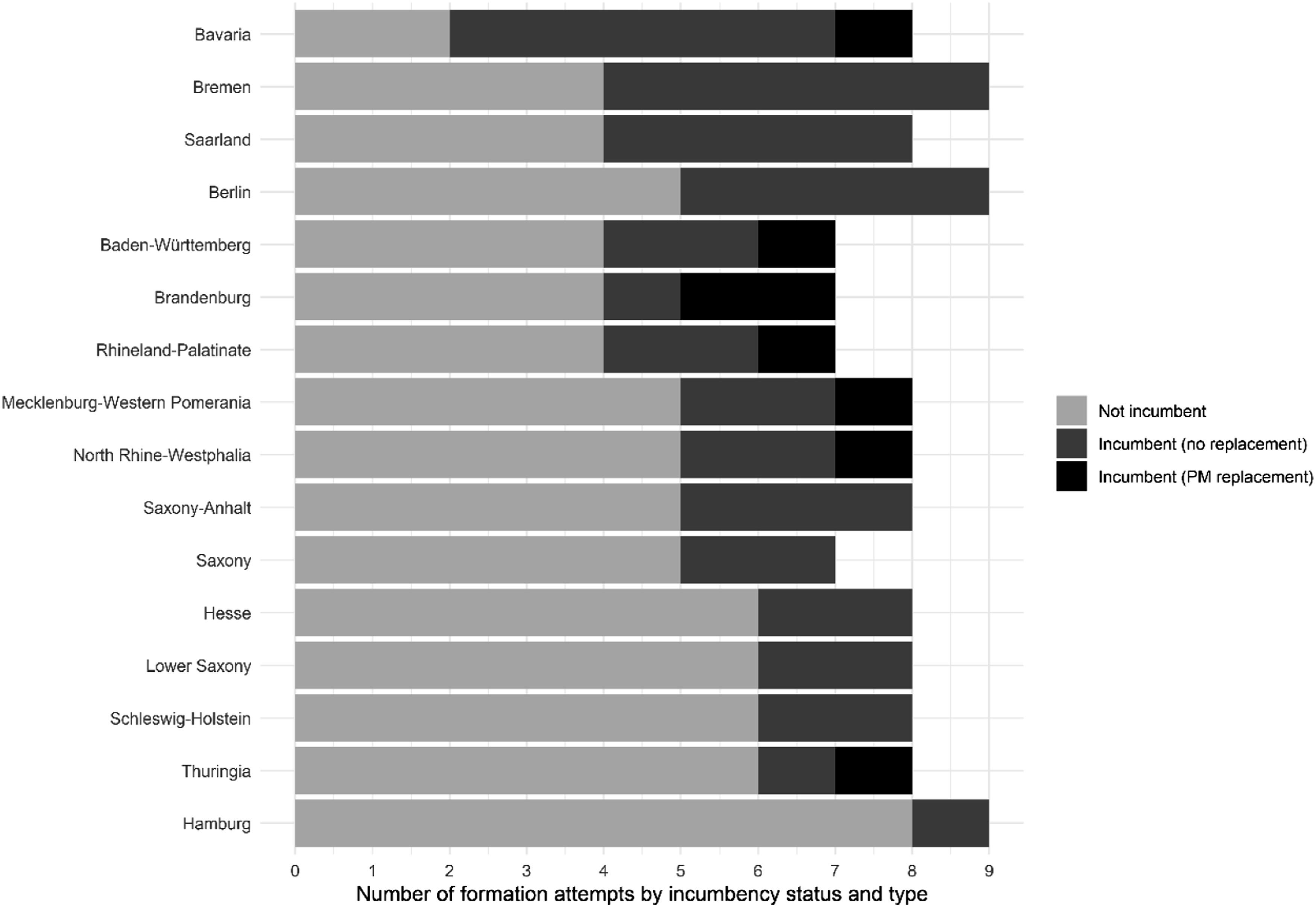
Determinants of government formation in the German States, 1990–2023.
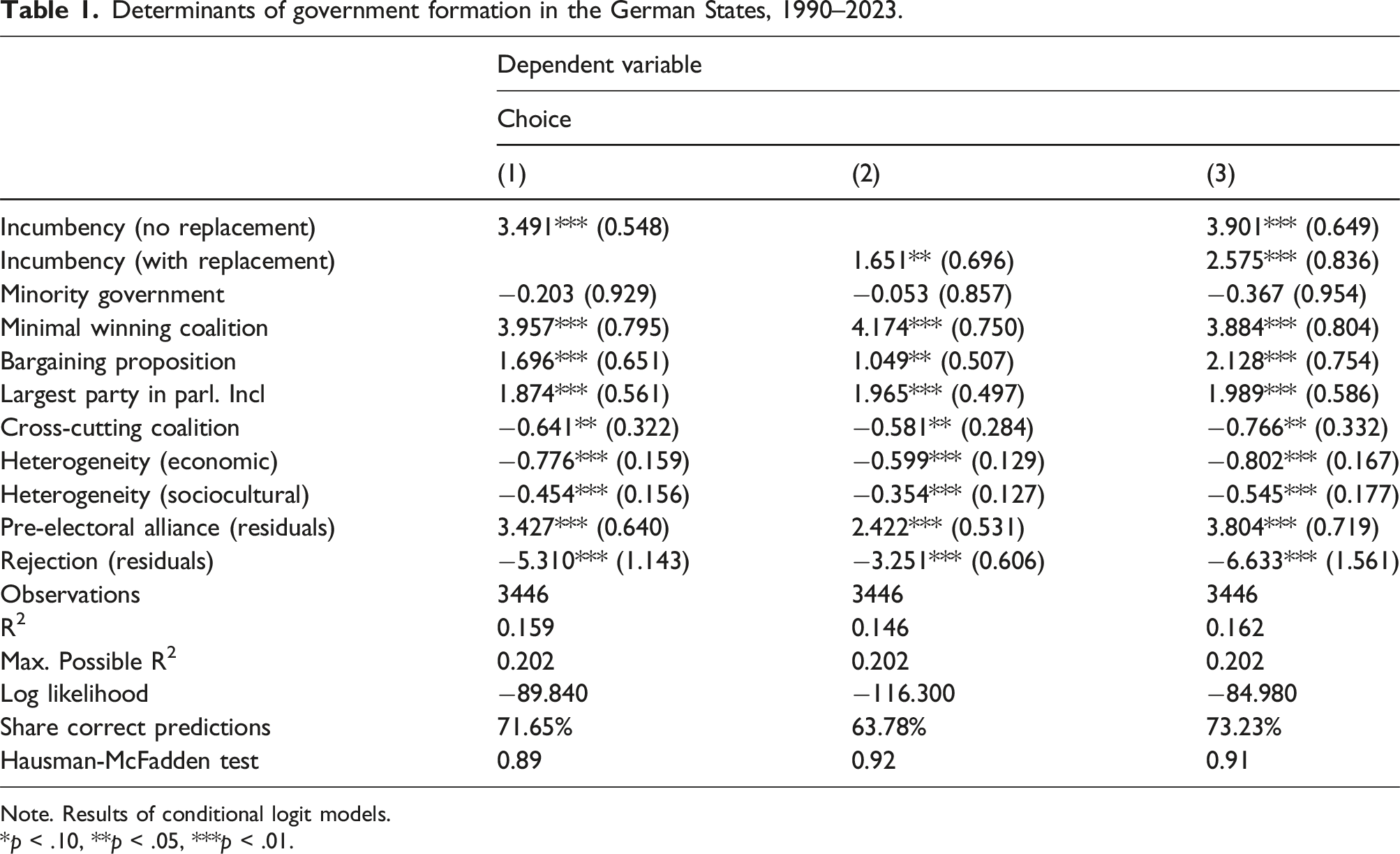
Note. Results of conditional logit models.
*p < .10, **p < .05, ***p < .01.
Most parameter estimates have the expected sign and are significantly different from zero at a 95 percent confidence level. More specifically, a party combination is more likely to form the next government if it is a minimal winning coalition, includes the largest party, and if the parties already favored the coalition during the election campaign. In contrast, coalitions are less likely to form if at least one party rejected one of the other coalition parties. They also become less likely the more programmatically heterogeneous a party combination is on the economic and the societal policy dimension (see also Bräuninger et al., 2020: 215–27). Furthermore, coalitions which do not control a majority in the parliament have a lower likelihood of forming the next government. Finally, coalitions that are cross-cutting (that is, coalitions that are not in line with the patterns of government and opposition in the Bundestag or Bundesrat) are less likely to form.
Our main interest is in the effect of the incumbency variable and whether its effect changes once we consider that a change in the office of the Prime Minister of the incumbent government happened during the previous legislative period. Table 1 thus presents the results of three conditional logit models with a variable describing whether the respective potential government started negotiations or not as the outcome variable. Models 1 and 2 only include one of the main independent variables (incumbency with or without replacement of the PM during the legislative period, respectively), and model 3 includes both of these variables.
The first model integrates the incumbency variable based on the consideration that a potential government consists of the same parties that formed the previous government, and that the PM has not been replaced during the previous, that is, outgoing legislative period. The estimated effect is, as expected, statistically significant and positive, indicating that a (coalition) government is more likely to form if not only the same parties, but also the same Prime Minister are included in the outgoing and incoming cabinet. In model 2, we include the incumbency variable in a modified way and code incumbent governments with a value of 1 if the party composition is the same as in the previous government but if the PM was replaced.
The estimated coefficient also indicates a statistically significant and positive effect of this variable. However, the size of the coefficient is smaller and the explanatory power of the second model lower, as the R2- and log likelihood scores indicate. In contrast to the first model, the share of correctly predicted outcomes of the government formation process in the German state is clearly lower (63.8%) when identifying governments as incumbents even if there was a change in the position of the Prime Minister in the outgoing legislative period. When thinking of incumbent governments as those that have the same Prime Minister, the share of correctly predicted outcomes of the government formation process increases to 71.7%.
When including both versions of the incumbency variable in the analysis (model 3), we again find a stronger effect on the outcome of the coalition formation process when the incumbent government did not replace its Prime Minister in the outgoing term. These findings indicate that the replacement of a Prime Minister during the previous legislative period lowers the advantage of the incumbent (coalition) government to form the next cabinet again. However, there is still an advantage for the incumbent coalition if they chose a new head of cabinet during the last term; yet, this effect is smaller and less powerful in helping to explain the outcome of the government formation process than in the case of the ‘complete’ incumbency variable with not only the same parties, but also with the same Prime Minister. 7
Determinants of government formation duration
Determinants of the bargaining duration in the German States, 1990–2023.
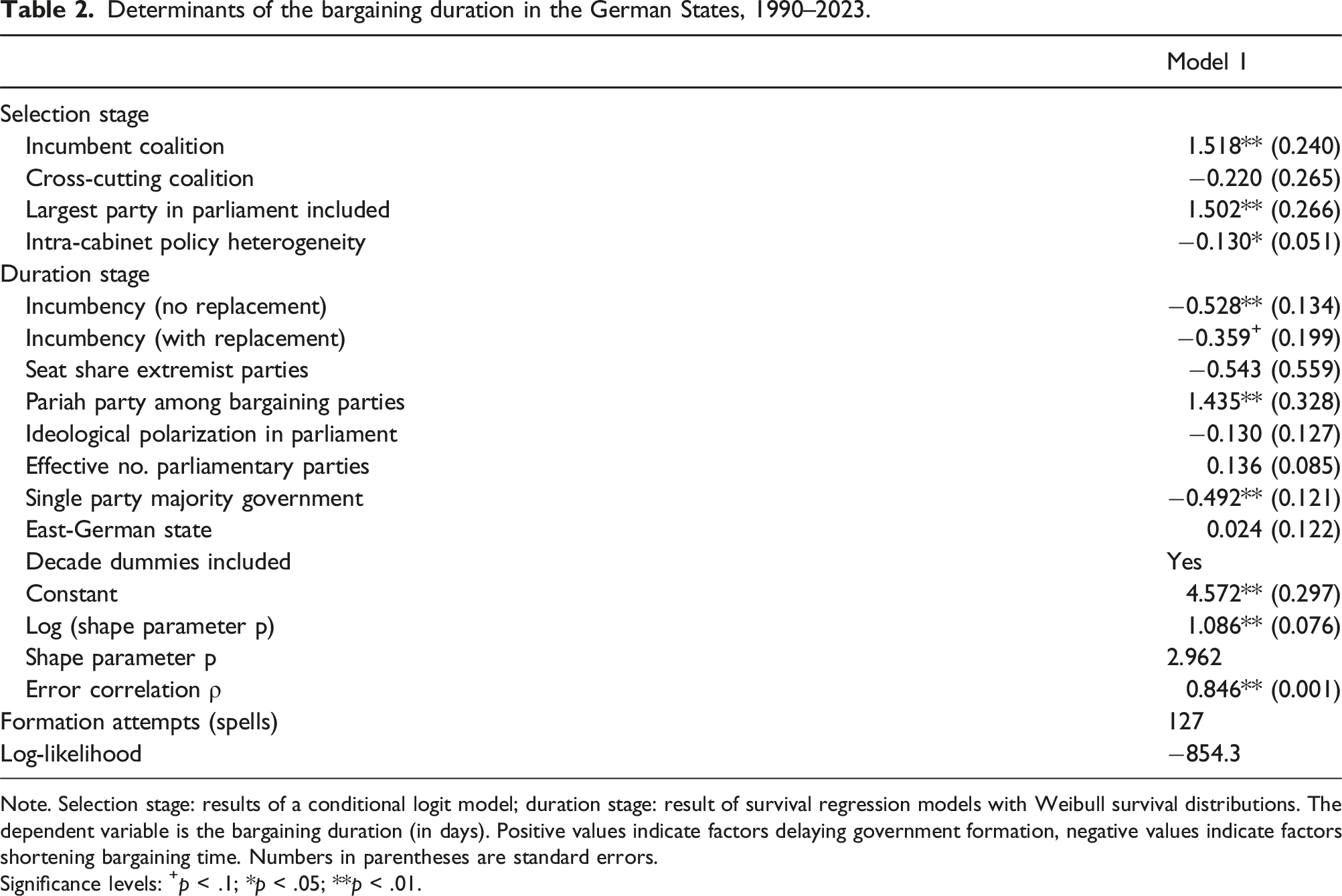
Note. Selection stage: results of a conditional logit model; duration stage: result of survival regression models with Weibull survival distributions. The dependent variable is the bargaining duration (in days). Positive values indicate factors delaying government formation, negative values indicate factors shortening bargaining time. Numbers in parentheses are standard errors.
Significance levels: +p < .1; *p < .05; **p < .01.
Figure 2 shows the substantive effect of the incumbency variables, reflecting the mechanisms outlined in hypothesis 2. Keeping other factors constant, government formation takes significantly less time if the bargaining parties have already governed together in the outgoing legislative period. This effect is particularly pronounced when there was no change in the prime ministerial office during the legislative period. While bargaining takes more than 100 days only very rarely – in 5% of the cases – when the parties governed together in the outgoing coalition and the PM did not change, a lengthy process of government formation duration is much more frequent (15% of the cases) when the PM did change and, particularly, when the parties did not govern together, which happens in the majority of cases (53%). This finding supports hypothesis 2: if the person who is charge of the PM's office – and, thus, of the most important cabinet post which sets the political agenda – was replaced during the outgoing legislative period, then the representatives of the incumbent government parties need more time to negotiate a new coalition agreement. The effect of the incumbency on government bargaining duration (in days). Comment: Estimates are based on the regression model presented in Table 2.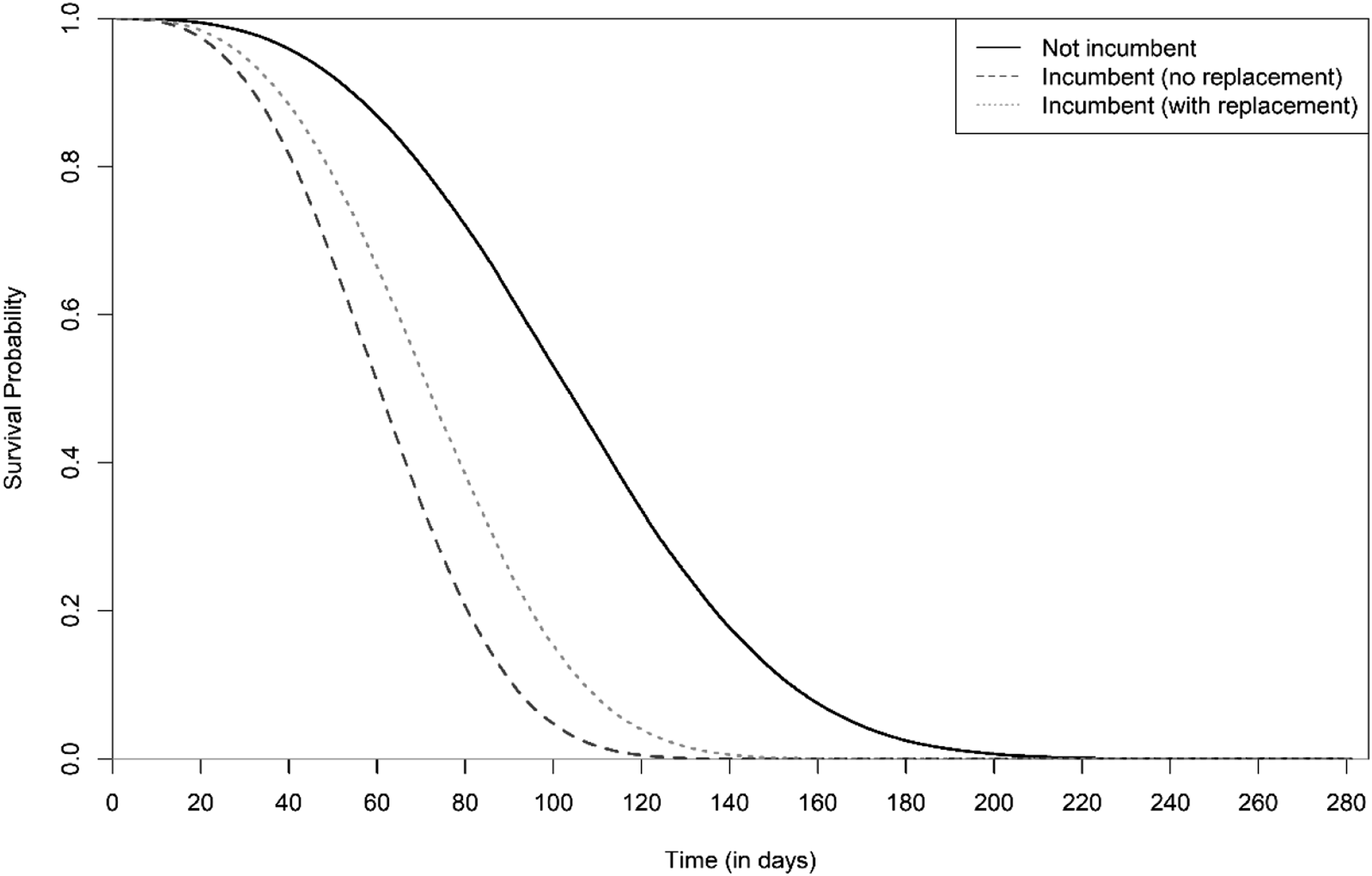
We cannot, of course, say with certainty that the increased bargaining duration is a direct cause of the changed personal composition of key political actors. However, existing studies on coalition bargaining duration (Ecker and Meyer, 2020) point into that direction: the less the involved politicians know each other, the more time it takes to learn about each other’s office and policy preferences and about their tolerance for accepting compromises, which should in the end result in a longer process of government formation.
Conclusions
The aim of this paper was to answer the question if a personnel change in the most important office of a cabinet – the position of the Prime Minister – affects the impact of incumbency on the outcome of the government formation process and on the duration of the government formation talks. Theoretically, we argued that personnel changes in the outgoing coalition government make the negotiation process of the incumbent coalition parties’ representatives more uncertain, lowering familiarity and trust among the negotiating partners. The findings, which we derived from original data that allows for analyzing party competition, government formation, and the duration of the government formation process, provided support for our expectations. Potential governments are more likely to form if they consist not only of the parties that formed the previous cabinet, but also if the Prime Minister is the same as in the previous cabinet. The latter also reduces the amount of time until parties agree on a new coalition government.
Despite the comparative nature of this approach, where we covered the government formation process of the 16 German states over a time span of 33 years, a broader comparative perspective that also allows for studying differences in the institutional structure of a political system would be worthwhile, for example by analyzing all European democracies (e.g., Ecker and Meyer, 2020). Such endeavors would benefit from the collection of more detailed data that go beyond changes in the office of the Prime Minister in the previous cabinets. As Ecker and Meyer (2020) point out, uncertainty in policy and coalition preferences are likely to emerge from changes in the leadership of the respective coalition parties.
Furthermore, it seems important to integrate information on the interpersonal relationships between the individual politicians – if they worked together in previous cabinets, including ones from different levels of the political system, it should be more likely that the politicians know each other’s preferences, which should help to speed up the government formation process, in particular if the preferences over policies and coalitions overlap to a decisive degree. Such features are, however, hard to get valid measures of, but new data and methods might allow for measuring the politician’s preferences on future policies and the political process in more detail (see e.g., Schwalbach and Proksch, 2025).
Along these lines, future research could focus on the personal composition of the negotiating party delegations and argue that with an increasing overlap between the incumbent cabinet and the negotiators for the next government the chances for the incumbent government to become the next government should increase and it should take less time until the new government gets into office. Yet, data on the personal composition of party delegations that negotiate the coalition agreement are hard to obtain in case of regional government formation processes, in particular when dealing with cases from the 1990s.
Finally, while our analyses focus on the effects of previously governing together, they do not account for how well these governments functioned and particularly how they ended – factors that are relevant for future government formations (e.g., Tavits, 2008). Future research could investigate whether early government terminations moderate or even negate the effect of incumbency and PM replacements.
All in all, our results suggest that familiarity and trust between important actors involved in bargaining matter for how successful coalition negotiations are. This also stresses the importance of analyzing situations where interpersonal trust is weakened, which may for example occur when there is a high degree of hostility between political elites, or when so called affective polarization is high (see e.g., Bäck et al., 2024a). Such features may also interact with incumbency and PM replacements – in situations of a high degree of polarization, incumbency status and stability among negotiating personnel within the parties may become even more important for the swift conclusion of coalition negotiations in parliamentary democracies.
Footnotes
Acknowledgements
An earlier version of this paper was presented at the ECPR General Conference, Dublin, Ireland, 12–15 August 2024. We thank the ECPR panel participants and two anonymous reviewers for their valuable comments and suggestions.
Declaration of conflicting interests
The author(s) declared no potential conflicts of interest with respect to the research, authorship, and/or publication of this article.
Funding
The author(s) received no financial support for the research, authorship, and/or publication of this article.
Ethical statement

Data Availability Statement
Data are available at https://doi.org/10.7910/DVN/CJIVXC (Bäck et al., 2025).
Notes
Appendix
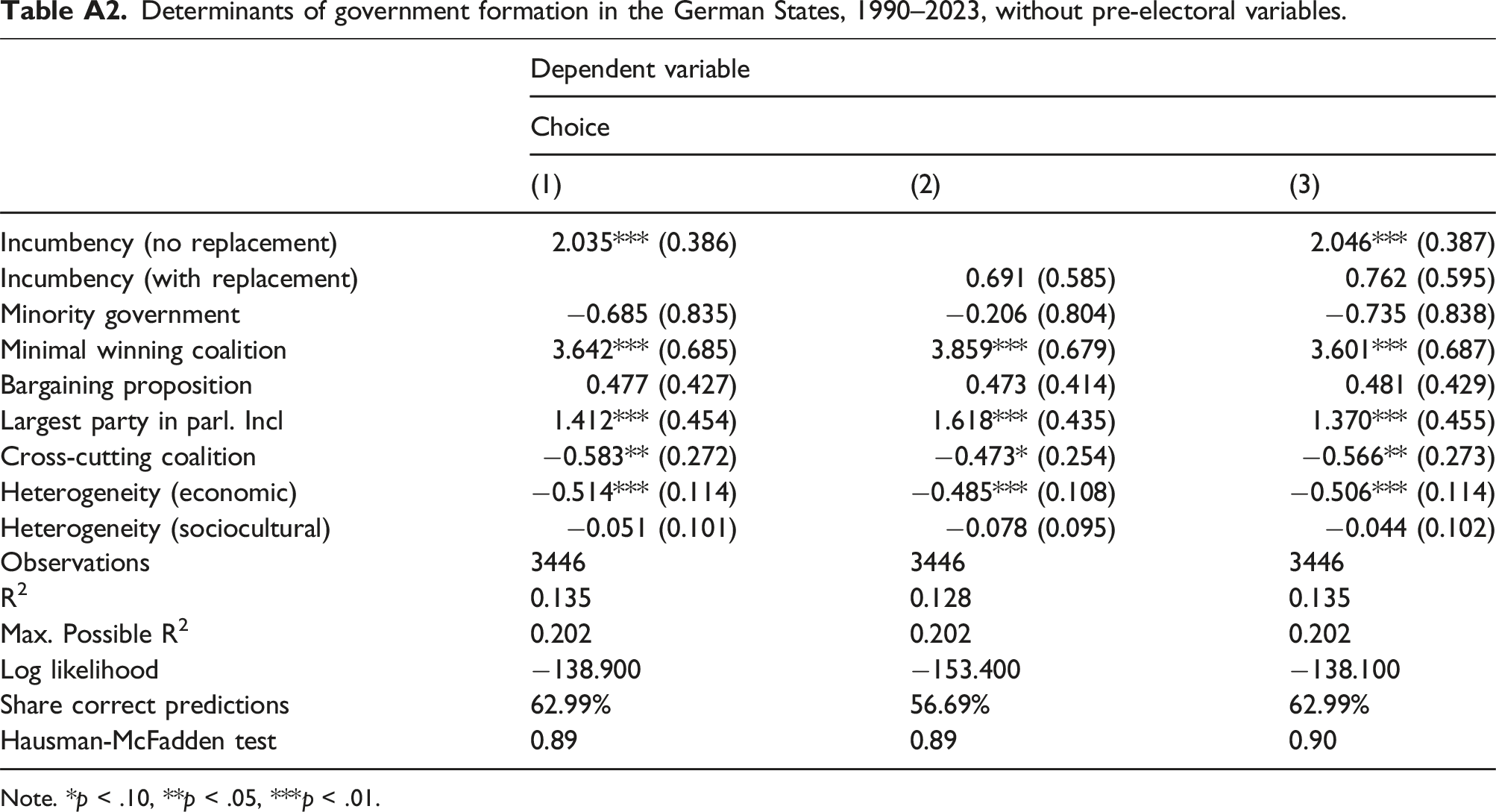
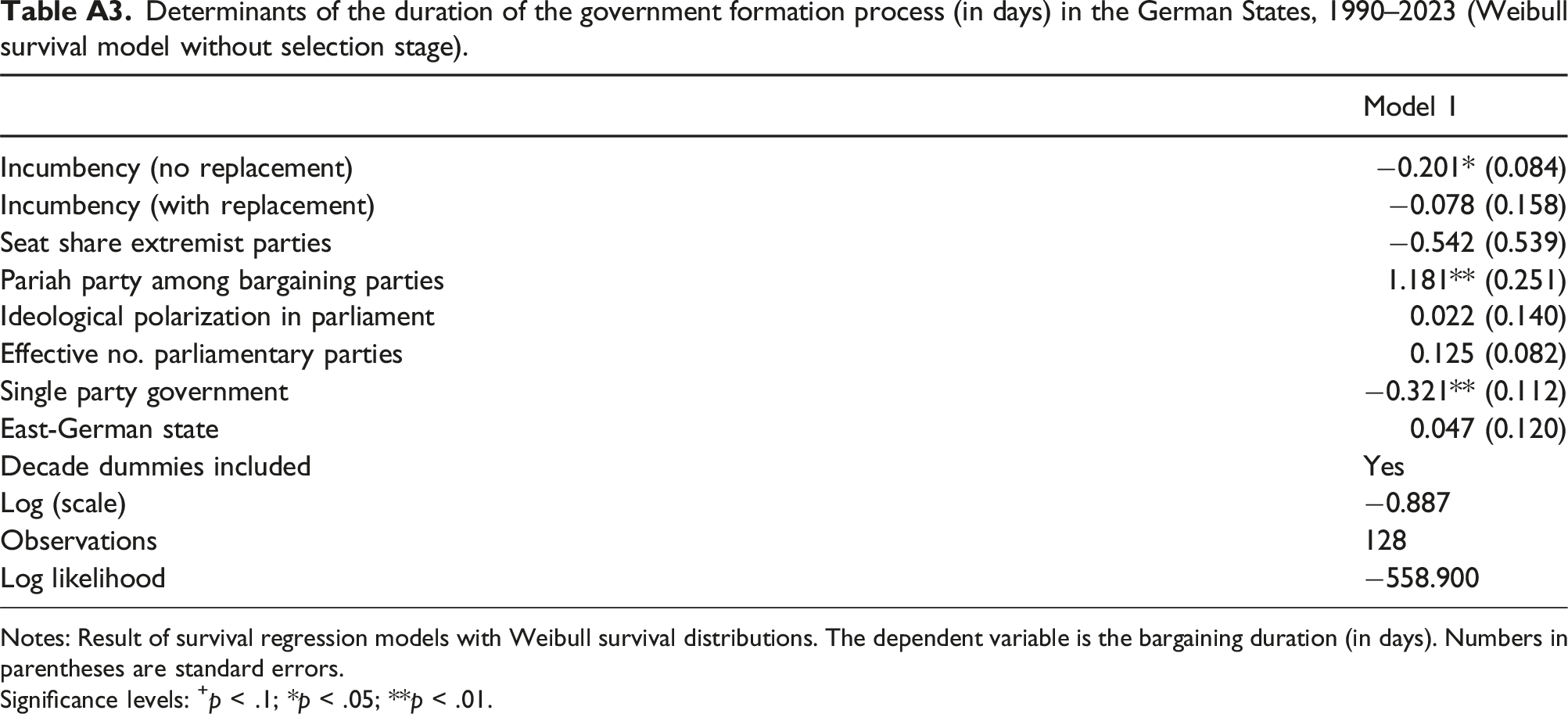
Results of first stage of the 2SRI model presented in Table 1. Note. *p < .10, **p < .05, ***p < .01. Determinants of government formation in the German States, 1990–2023, without pre-electoral variables. Note. *p < .10, **p < .05, ***p < .01. Determinants of the duration of the government formation process (in days) in the German States, 1990–2023 (Weibull survival model without selection stage). Notes: Result of survival regression models with Weibull survival distributions. The dependent variable is the bargaining duration (in days). Numbers in parentheses are standard errors. Significance levels: +p < .1; *p < .05; **p < .01.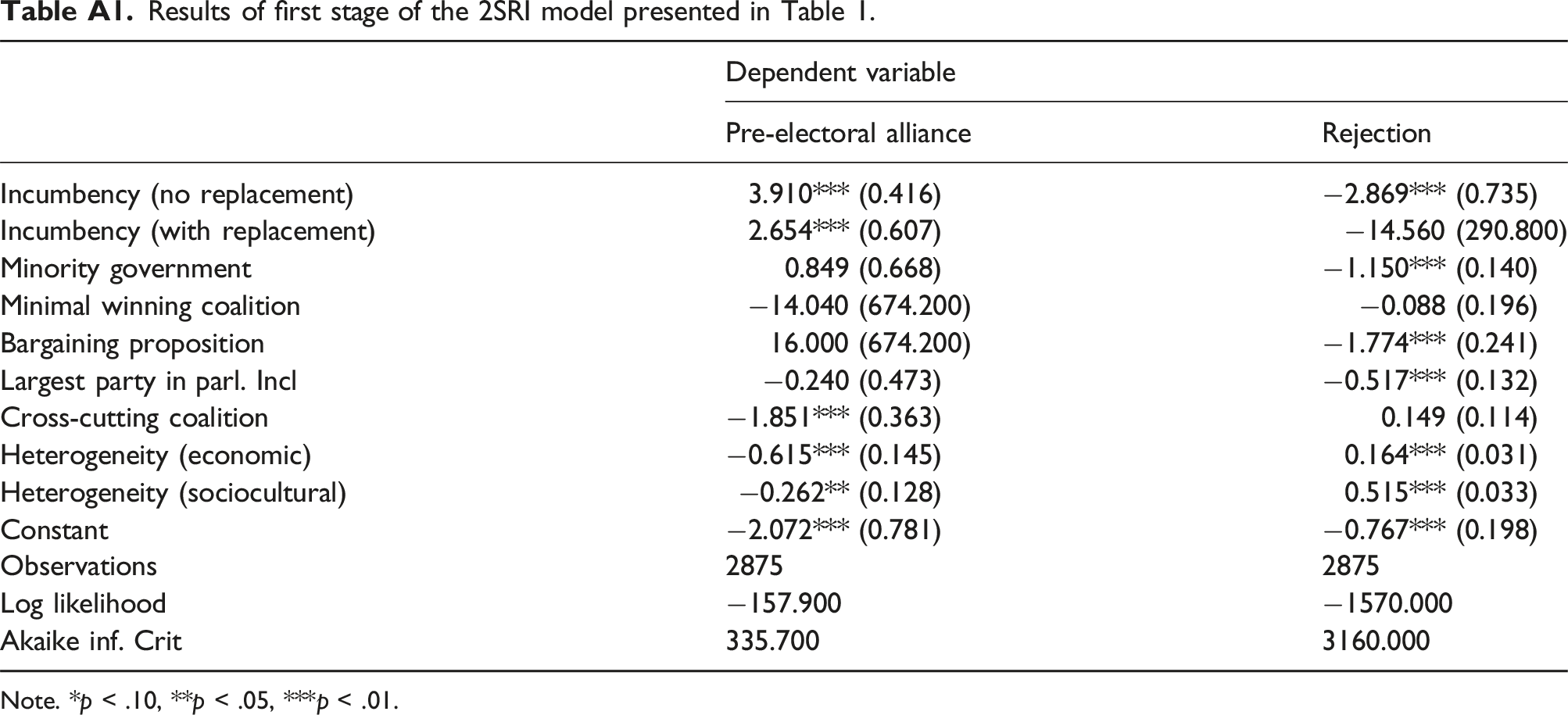
Dependent variable
Pre-electoral alliance
Rejection
Incumbency (no replacement)
3.910*** (0.416)
−2.869*** (0.735)
Incumbency (with replacement)
2.654*** (0.607)
−14.560 (290.800)
Minority government
0.849 (0.668)
−1.150*** (0.140)
Minimal winning coalition
−14.040 (674.200)
−0.088 (0.196)
Bargaining proposition
16.000 (674.200)
−1.774*** (0.241)
Largest party in parl. Incl
−0.240 (0.473)
−0.517*** (0.132)
Cross-cutting coalition
−1.851*** (0.363)
0.149 (0.114)
Heterogeneity (economic)
−0.615*** (0.145)
0.164*** (0.031)
Heterogeneity (sociocultural)
−0.262** (0.128)
0.515*** (0.033)
Constant
−2.072*** (0.781)
−0.767*** (0.198)
Observations
2875
2875
Log likelihood
−157.900
−1570.000
Akaike inf. Crit
335.700
3160.000
Dependent variable
Choice
(1)
(2)
(3)
Incumbency (no replacement)
2.035*** (0.386)
2.046*** (0.387)
Incumbency (with replacement)
0.691 (0.585)
0.762 (0.595)
Minority government
−0.685 (0.835)
−0.206 (0.804)
−0.735 (0.838)
Minimal winning coalition
3.642*** (0.685)
3.859*** (0.679)
3.601*** (0.687)
Bargaining proposition
0.477 (0.427)
0.473 (0.414)
0.481 (0.429)
Largest party in parl. Incl
1.412*** (0.454)
1.618*** (0.435)
1.370*** (0.455)
Cross-cutting coalition
−0.583** (0.272)
−0.473* (0.254)
−0.566** (0.273)
Heterogeneity (economic)
−0.514*** (0.114)
−0.485*** (0.108)
−0.506*** (0.114)
Heterogeneity (sociocultural)
−0.051 (0.101)
−0.078 (0.095)
−0.044 (0.102)
Observations
3446
3446
3446
R2
0.135
0.128
0.135
Max. Possible R2
0.202
0.202
0.202
Log likelihood
−138.900
−153.400
−138.100
Share correct predictions
62.99%
56.69%
62.99%
Hausman-McFadden test
0.89
0.89
0.90
Model 1
Incumbency (no replacement)
−0.201* (0.084)
Incumbency (with replacement)
−0.078 (0.158)
Seat share extremist parties
−0.542 (0.539)
Pariah party among bargaining parties
1.181** (0.251)
Ideological polarization in parliament
0.022 (0.140)
Effective no. parliamentary parties
0.125 (0.082)
Single party government
−0.321** (0.112)
East-German state
0.047 (0.120)
Decade dummies included
Yes
Log (scale)
−0.887
Observations
128
Log likelihood
−558.900