




Abstract
In this article, we examine how voters make decisions about electoral candidates in an under-institutionalized party system. In such a context, parties are expected to be less rooted in society, with fewer programmatic linkages to particular groups. Thus, voters are considered less likely to vote for candidates based on their policy positions and are expected to have less consistent policy preferences. Instead, it is assumed that individual candidate characteristics are more important. Using a conjoint survey experiment conducted in South Korea, a crucial case of a weak party system in a relatively new but consolidated democracy, we examine how voters are motivated by individual candidate characters and domestic policy and foreign policy positions. Our results show that individual characteristics matter, but we also find strong evidence of consistent policy preferences, especially in the foreign policy domain. We demonstrate high levels of programmatic partisanship – voters who are partisans informed about and primarily motivated by policy positions.
Introduction
How do voters choose representatives in under-institutionalized party systems? Much of the existing research on party institutionalization focuses on the definition and extent of party institutional power and the characteristics of party systems. This literature is both voluminous and informative. It provides a conceptual basis for measuring relative levels of institutionalization and determining whether a country’s party system is under-institutionalized. It also suggests that voters in under-institutionalized party systems either decide upon candidates for pecuniary reasons (clientelism) or else due to candidates’ personal characteristics (Müller, 2007).
Institutionalization is the degree to which a party system is stable, and the major parties associated with it have durable organizations. One source of such stability is the degree to which parties are embedded and enmeshed within society through linkages between the party’s ideological or programmatic positions and voters. Another is the degree to which parties have an identity and organizational power distinct from individual party leaders (Mainwaring, 2016). In countries with unstable parties and party systems, personalities and networks based on regions or other sectional ties may dominate without durable party institutions and clear ideological or programmatic linkages between politicians and their voters. Under such circumstances, parties can be highly personalistic, serving primarily as vehicles for powerful individuals rather than having a strong, separate identity as an institution (Reed, 1994; Moser and Scheiner, 2005). In such systems, voters choose candidates on the basis of their personalist appeals or the financial benefits they provide.
In this paper, we draw upon the party institutionalization literature to test theoretical expectations about voter behavior in a weakly institutionalized party system setting. We use the South Korean case, a relatively new democracy with under-institutionalized parties (Hellmann, 2014) and a weakly institutionalized party system (Wong, 2014). South Korean political parties, despite their weak organizations, are no longer plagued by clientelism (Hellmann, 2014; Han JH, 2021). But the weakness of party organizations implies that programmatic linkages between party and voter are weak or absent. At the same time, political elites are increasingly polarized (S. Han, 2022; Cheong and Haggard, 2023), which has given rise to some negative affective polarization among partisan voters (J. M. Lee, 2015; Jo, 2022). This is highly evident from the polarized nature of elite debate surrounding the recent impeachment of the country’s president following alleged acts of insurrection.
However, as newer literature on party institutionalization has shown, party institutional strength and the strength of party systems overall do not have to be directly linked to the stability of policy and ideological programs. Borbáth (2020) demonstrates that while party organizations may lack stability, the electoral strategies and policy programs they pursue often align with specific ideologies and can remain consistent over time. Such a party system is thus characterized by “ephemeral parties”. In many regards, with its unstable parties but highly ideologically polarized elites, South Korea is a textbook case of an ephemeral party system. Thus, we suggest that even in the absence of strong party institutions, elite polarization may still give rise to voters’ preferences that generally track those of their chosen party or ideological camp (Gonthier and Guerra, 2023; Levendusky, 2010). There is, however, a lack of work examining whether elite partisanship amidst weak parties can give rise to programmatically coherent preferences among voters.
We fielded a fully randomized choice-based conjoint experiment in the month preceding South Korea’s, 2024 General Election, in which respondents evaluated hypothetical National Assembly candidates who varied across personal attributes and positions on five policy dimensions: labor, housing, social policy, general foreign policy, and nuclear weapons. The experiment is designed to test whether voters prioritize programmatic alignment over candidate-specific characteristics when making electoral choices. Accordingly, we advance two propositions. First, even in the absence of explicit party labels, voters will systematically favor candidates whose issue positions are congruent with their own ideological identification. Second, partisan voters will place greater weight on policy alignment than on personal traits in their evaluations.
To evaluate these expectations, we removed party labels from the profiles to determine whether individuals who identify as conservative or progressive select candidates based on programmatic positions. Voters routinely use party labels as heuristics, but research on institutionalized systems shows they can match candidates to policies even without such cues (Heit and Nicholson, 2016). In systems with consistent party competition, this type of policy-based reasoning is more easily activated. This makes the exclusion of party labels in our design a meaningful test of whether Korea’s unstable party system, despite institutional weakness, still fosters issue-based partisan choice. Further, to complement the conjoint experiment, we conducted two manipulation checks, including an open-text analysis using Latent Dirichlet Allocation (LDA) and a test of partisan identification accuracy, which together provide additional context and validation for the quantitative findings.
Our findings indicate that voter preferences in South Korea’s weakly institutionalized party system are shaped both by policy stances and the personal characteristics of candidates. Voters demonstrate strong tendencies to support candidates whose policy positions align with their own partisan identities, especially regarding foreign and defense policy, and specific areas of domestic policy. This suggests a significant level of policy congruence between voters and their preferred candidates, even in a context where parties lack strong institutional foundations. Notably, our results highlight that voter-level programmatic partisanship – driven by ideological alignment rather than clientelism or candidate personality alone – can manifest in environments with weak party institutions. This finding challenges the assumption that voter behavior in such contexts is primarily driven by personalist appeals and instead underscores the potential for stable voter-policy linkages even amid institutional instability. By focusing on South Korea as a case study, this research contributes to bridging the gap between studies on party institutionalization and electoral behavior, demonstrating that elite partisanship can foster coherent voter preferences in under-institutionalized settings.
Literature review and case selection
Party institutionalization
According to Mainwaring and Torcal (2005), the generally accepted definition of party institutionalization is the degree to which parties are stable, have deep roots in society with voters from particular social groups having strong attachments to them via policy programs and ideological linkages. Strong parties generally have a high degree of legitimacy among political actors, and the personal power of leaders over parties is limited.
Stronger parties usually sustain strong links with voters. Parties act as channels for social cleavages, but drawing on their organizational capacities and social legitimacy, parties can also shape and change the preferences of voters (Torcal and Mainwaring, 2003, 57–59). One would expect that voters in institutionalized democracies vote in line with their policy preferences and for parties that represent those preferences (e.g., Heith and Nicholson, 2016). But where strong party institutions are not present, an alternative form of linkage between politicians and voters is the so-called ‘personal vote’. This is when voters choose politicians on the basis of their ascriptive characteristics or personal conduct (Renwick et al., 2016; Zittel, 2017).
Generally, clear partisan divides and elite polarization give rise to strong party brands and strong parties in many contexts with clear voter preferences (Hetherington, 2001; Levendusky, 2010; Mainwaring, 2016; Moral and Best, 2023; Zingher and Flynn, 2018). However, the relationship between parties’ organizational stability and programmatic linkages is more complex than some have previously assumed. As newer literature has shown, parties may be unstable while party programs and political competition based upon them can become and remain stable. In other words, systems can be characterized by both unstable parties and stable programs, otherwise termed an “ephemeral party” system (Borbáth, 2020).
However, as yet, it is unclear how voters in party systems with unstable parties but strong partisan divides behave. We would expect two potential, contradictory phenomena. On the one hand, the relative instability of the party system may give rise to non-programatically driven voter behavior (i.e., voting on the basis of personal or clientelistic appeals). On the other, relative programmatic coherence – similar policy platforms and ideological coherence in spite of party instability – could give rise to programmatic voting, or “programmatic partisanship” as we discuss further below.
Korea and ephemeral parties
We choose to focus on South Korea’s voters here because the country is a clear example of a consolidated democracy with weak parties. The party system remains unstable, but clientelism between voters and party organizations has disappeared (Hellmann, 2014; Han JH, 2021). At the elite level, parties remain heavily factionalized, personalistic and unstable (Moon, 2023). On the left, parties are weak and dominated by society (Croissant and Völkel, 2012; Lee, 2022). The progressive camp is characterized by strong social movements and civic organizations that significantly influence elite partisanship and policy, while the political right demonstrates different patterns of engagement and mobilization (Kim, 2021). The right is less dependent on grassroots social movements for policy formulation and electoral mobilization. Instead, right-wing parties emphasize institutional continuity, economic progress, and national security concerns, appealing to constituencies through governance achievements and ideological narratives centered around anti-communism, market liberalization, and national defense. The conservative parties in South Korea have historically relied more on institutional mechanisms and formal political channels to connect with voters, contrasting with the civil society-oriented connections that characterize the left (Lee, 2022). This does not imply that the right lacks a societal base or that civic organizations aligned with conservative values are absent (Lee, 2024). Nonetheless, parties of the right have perennially been dominated by personalities and prone to instability, like those on the left.
Partisanship and polarization are features of the South Korean political system, as they are elsewhere in the democratic world. South Korean political elites are especially polarized around foreign and security policy issues (Jaung, 2019; Kang et al., 2021). This polarization has meant that a modicum of programmatic stability on both the left and right has developed in spite of the instability of the country’s political parties (Han, 2021; Lee, 2022). However, it is unclear whether partisanship and elite polarization ensure that popular policy positions of voters are aligned with the parties they choose in the absence of strong party-voter linkages.
There is evidence of partisan sorting in the electorate, with partisan voting being far more likely now than in the past (Kim, 2023). Partisan sorting in South Korea is also associated with a greater affinity for political elites of one’s own side (Kim, 2024). Existing research also points to the existence of expressive partisanship among many voters that does not necessarily align with particular policy preferences so much as voters’ identities and negative attitudes to the opposing side of the political spectrum (Jang and Ha, 2022). Region-based affective polarization, a partial consequence of historical patterns of economic development (Mobrand, 2019), is evident in how conservative and progressive partisans discriminate against candidates from different parts of the country (Kang and Cho, 2024).
Nonetheless, some research also points to at least some programmatic alignment between voters and parties especially on foreign policy issues and to some extent on social policy (Kim, 2017). What is more, a body of literature on regionalism points to an issues-based or ideological component to the regional divides in the country – some grounded in historical memories of the benefits or exclusion from the industrialization, and other literature grounded in more short-term of voters seeking policies they consider beneficial to their communities. In the former perspective, people from more socio-economically deprived regions that have benefitted less from South Korea’s industrialization are far more inclined to support progressive policies and politicians because they redistribute resources toward their region. Conversely, those from regions that have benefited more from the era of developmental dictatorship are more inclined to support more conservative candidates. In the latter perspective, voters in deprived regions support parties that redistribution while those in more prosperous ones support parties that cut taxes (for a review of this literature, see Moon, 2017).
That said, there are also signs of personalistic voting. Historically, regions produced partisan-ideological voting patterns that were also associated with ‘favourite sons’ from those regions (Mobrand, 2019). More recently, somewhat less regionally bound personalism has also emerged. This phenomenon is evident with the personal vote associated with political outsiders like Ahn Cheol-soo, particularly in the 2017 Presidential Election. The more recent case of Cho Kuk, a former Minister of Justice whose nomination and subsequent resignation in 2019 sparked significant public and political controversy, further highlights the polarization and personalistic nature of South Korean politics. 1
Overall, it is fair to say that the existing picture is rather contradictory, and this may be a consequence of the existing measurement methods or else the fact that existing literature has not paid sufficient attention to potential personalistic, non-programmatic voting patterns. Further, existing methods (generally based on polling data and direct questions rather than survey experiments) mean that it is difficult to deduce the extent to which voter behavior is driven by affect toward personalities relative to issue-based partisanship and negative affect toward the other side of the political spectrum.
Data and methodology
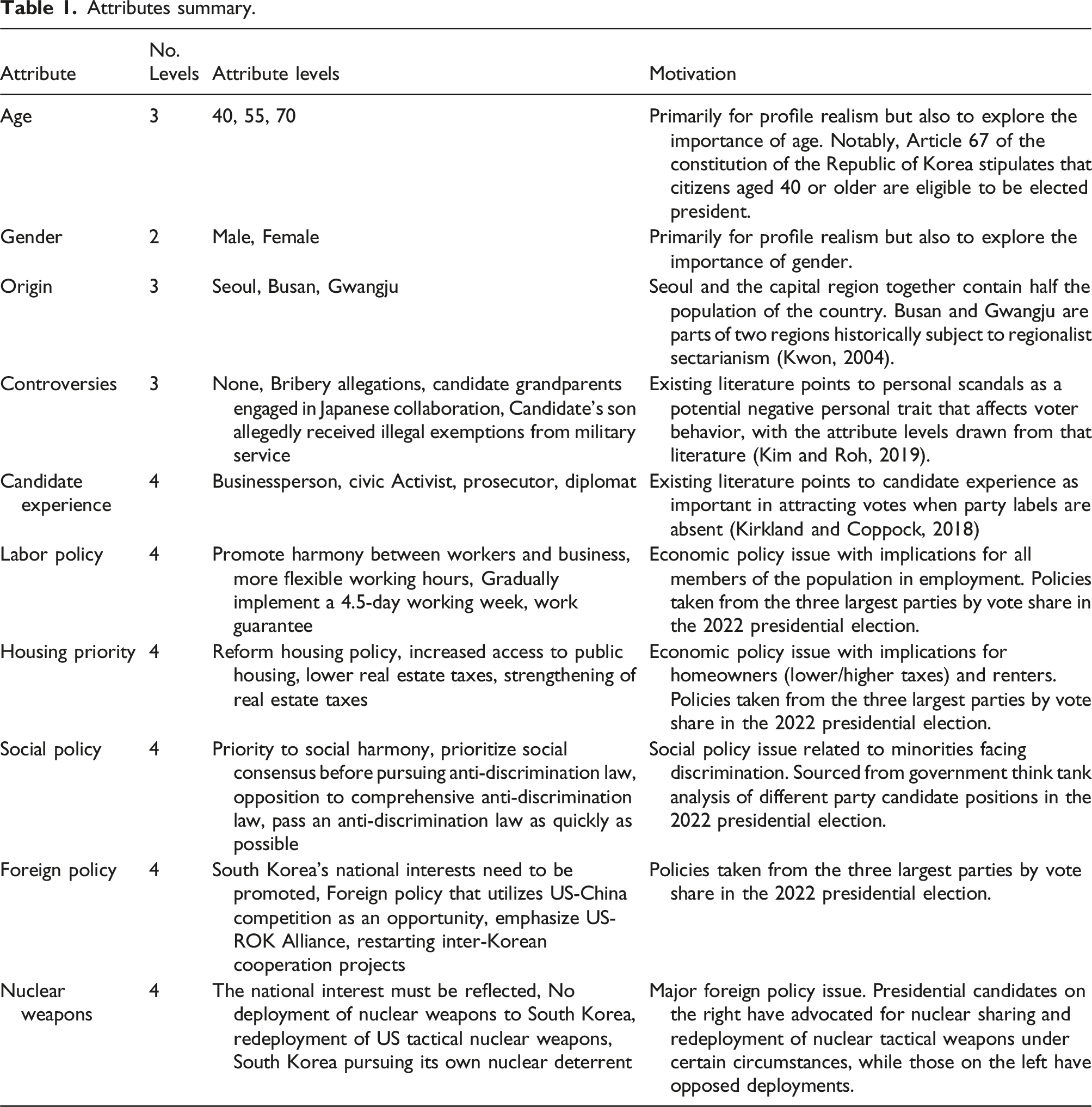
We use a choice-based conjoint design to measure the relative importance of policy positions and personal candidate characteristics in voter decision-making. Conjoint experiments are a widely used survey method in the social sciences (Hainmueller et al., 2014). This approach allows for multidimensional designs, enabling researchers to examine how various attributes influence preferences simultaneously. Conjoint experiments facilitate analysis of voter decision-making by quantifying the influence of candidates’ policy positions and personal characteristics on voting choices, and are particularly ideal when party labels are withheld (Kirkland and Coppock, 2018). In this study, we are interested in the extent to which candidate personal attributes influence voter decision-making relative to policy positions and, secondly, to the extent that they matter, which policy positions are supported and by whom.
In the run-up to South Korea’s 2024 General Election, we conducted the survey using a nationally representative online panel administered by the survey firm Qualtrics (n = 2005). The sample approximates national distributions along key demographics: 49% of respondents were female, and 81% held a university-level qualification. Age was evenly distributed across cohorts, with 12% under 25, 17% aged 26–35, 20% aged 36–45, 22% aged 46–55, and 29% over 55. The geographic distribution includes representation from all major administrative regions, with the largest shares from Seoul (43%) and Gyeonggi Province (26%). Appendix A in the Supplementary Information (SI) provides more information on the sample.
Attributes summary.
Comparison of policy positions by political orientation.
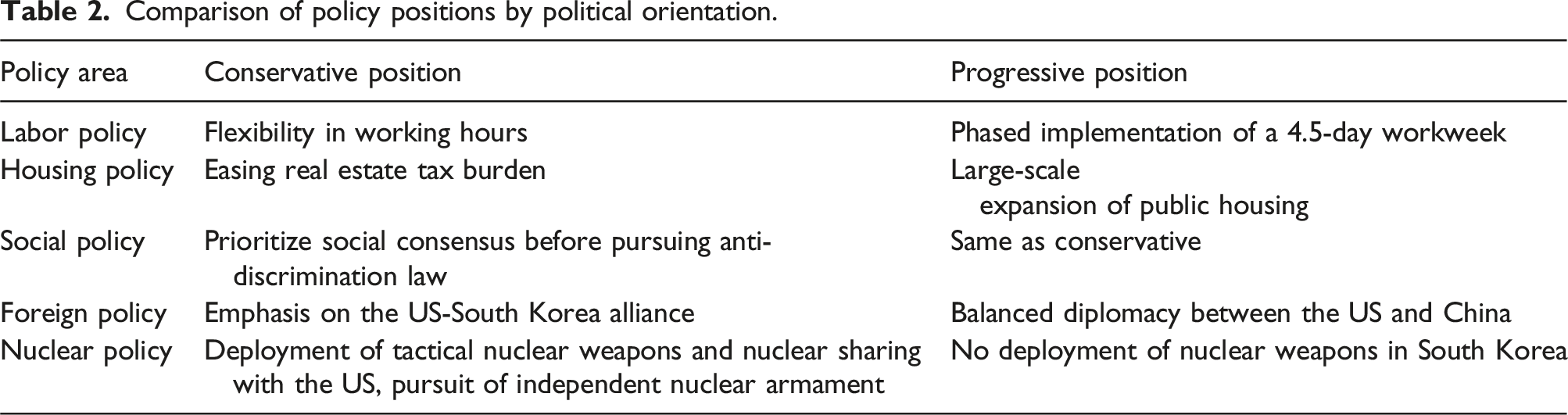
As noted above, we do not include party labels in order to test whether partisan voters make decisions on the basis of policy preferences and whether their preferences cohere with their stated party preference. We include a range of personal attributes that are informed by the literature on Korean politics and recent Korean political history, including on the gender of candidates (Kwon and Hwang, 2018), the literature related to corruption and candidate preferences and family history (Kim and Roh, 2019; Kim-Leffingwell, 2023), the literature on regionalism in Korean politics (e.g., Mobrand, 2019), and role of civil society activists as candidates on the progressive side and prosecutors (not least the recently impeached president) on the conservative side. 2 The use of a conjoint design in this way is novel for the study of Korean electoral behavior, but the levels are built from well-known findings in the literature.
While the conjoint experiment is an appropriate survey instrument for understanding voter decision-making, it is important to acknowledge its limitations. Hypothetical candidate profiles may not fully capture the complexities of real-world decision-making. In actual voting contexts, party labels, campaign dynamics, and external influences such as media framing often shape voter preferences more strongly than isolated candidate attributes. What is more, the reliance on forced-choice tasks introduces potential biases. Respondents may simplify their decision-making or engage in satisficing behavior, especially when tasked with evaluating multiple profiles across numerous attributes. Although randomizing the order of attributes mitigates some concerns, the cumulative cognitive burden can still lead to fatigue or artificial evaluations. These factors should be considered when interpreting results. Finally, as noted above, the exclusion of party labels might overemphasize the weight of policy positions and personal characteristics (Campbell et al., 2019). Future research could compare responses with and without party labels to test the robustness of findings in contexts with varying levels of party institutionalization.
Despite these limitations, the conjoint design provides a unique advantage in disaggregating the effects of multiple candidate attributes, allowing us to estimate the relative importance of policy stances and personal characteristics in voter preferences. By manipulating attribute levels independently, this method offers insights into multidimensional decision-making processes that would be difficult to achieve with other survey methods.
In the survey experiment introduction, respondents are told they will evaluate hypothetical candidates for a general or presidential election. Then, they are provided with two profiles and asked to choose which among them they support the most. They evaluate ten profiles in total, which yields a total effective sample size of 40,120 (2000 respondents * 2 profiles per task * 10 tasks in total). Figure 1 shows an example of the experimental design. For ease of navigating profiles, all personalist attributes (age, gender,
3
origin, occupation), besides the suspicion of scandal, are presented together. The order within the personal characteristics and all other attributes and values are randomly assigned without constraints. The experimental design.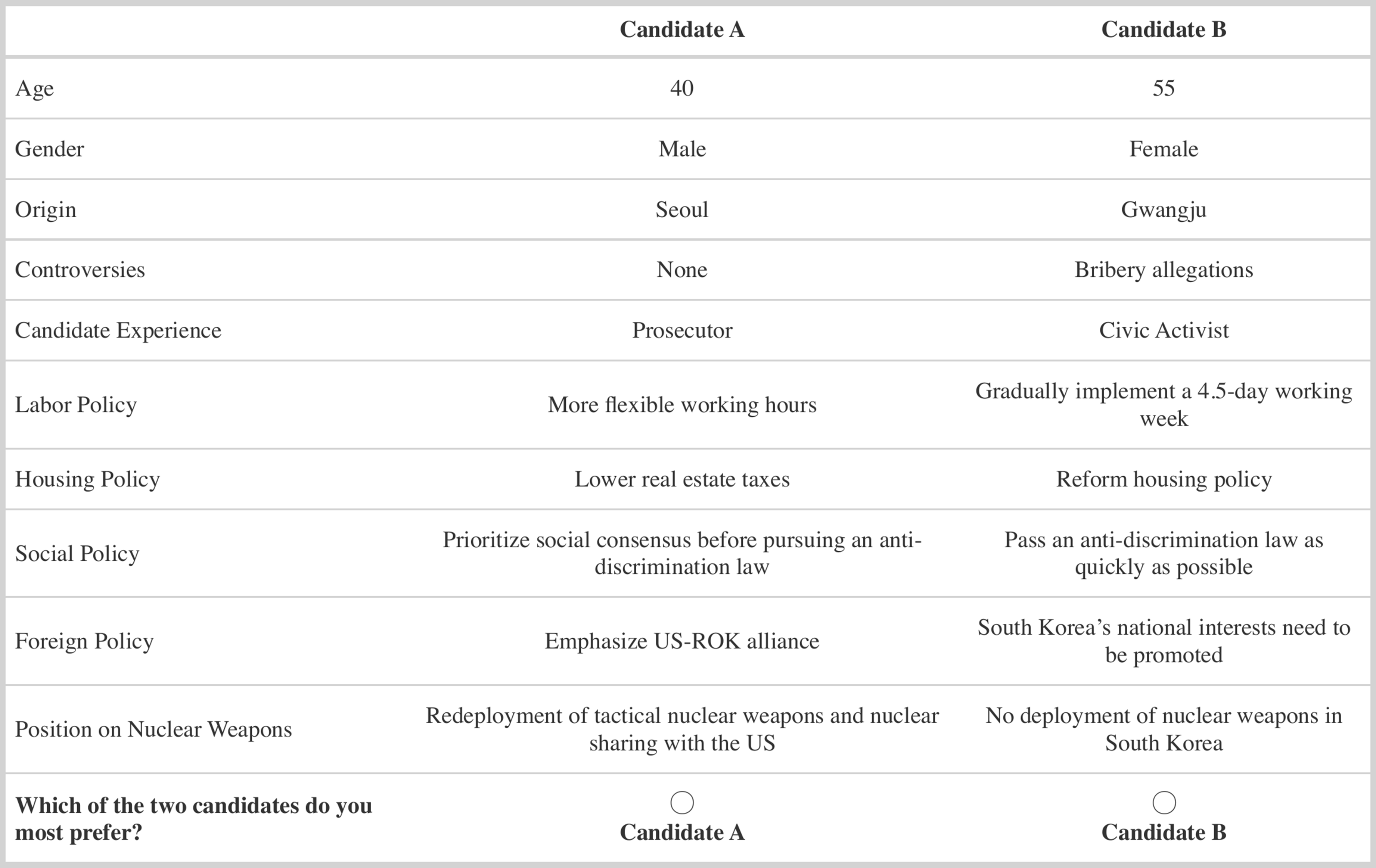
Our analysis calculates marginal means to examine the outcome data from the forced-choice responses. This method determines the average effect of each attribute level on the outcome variable (i.e., choosing the candidate), averaging across the other levels. Given our research interest, we want to assess subgroup preferences overall and the difference in marginal means for each level by partisan subgroups (progressives, conservatives). This way, we can empirically determine what each subgroup prefers and whether they have partisan differences consistent with our expectations for party-voter linkages. 4
In addition to the main tasks in the conjoint design, we also include two manipulation checks. After the first task, respondents are prompted, on a separate page, to indicate to which party the candidate they chose belongs (the conservative People’s Power Party, progressive Democratic Party, or 'another party'). This question is meant as a hard test of whether the preferred candidates’ policy positions motivate support. 5
After the second task, respondents were prompted with an open-text question asking them to explain their candidate choice. This qualitative data provided additional insight into voter preferences and served as an attention check. We applied Latent Dirichlet Allocation (LDA), a widely used machine-learning method for uncovering thematic structures in text, to analyze these responses (Blei et al., 2003; Roberts et al., 2013). LDA identifies co-occurring terms in text data and assigns them to latent topics, allowing us to explore patterns in voter reasoning using open-text responses. 6
We identified progressive and conservative subgroups using a combination of self-reported political ideology and stated party support to capture both formal identifiers and ideological leaners. Relying on party support alone risks overestimating centrism, as ideologically consistent individuals may avoid explicit affiliation (Klar and Krupnikov, 2016). To address this, we assigned respondents who self-identified as progressive or conservative directly to those subgroups. For those who identified as centrist, we relied on their party preference: Democratic supporters were classified as progressives, and People’s Power Party supporters as conservatives. Respondents with neither a clear ideological stance nor major party support were classified as true centrists. This dual-method approach improves subgroup classification accuracy and boosts statistical power in subgroup-level analysis (Levendusky, 2010). 7
Findings
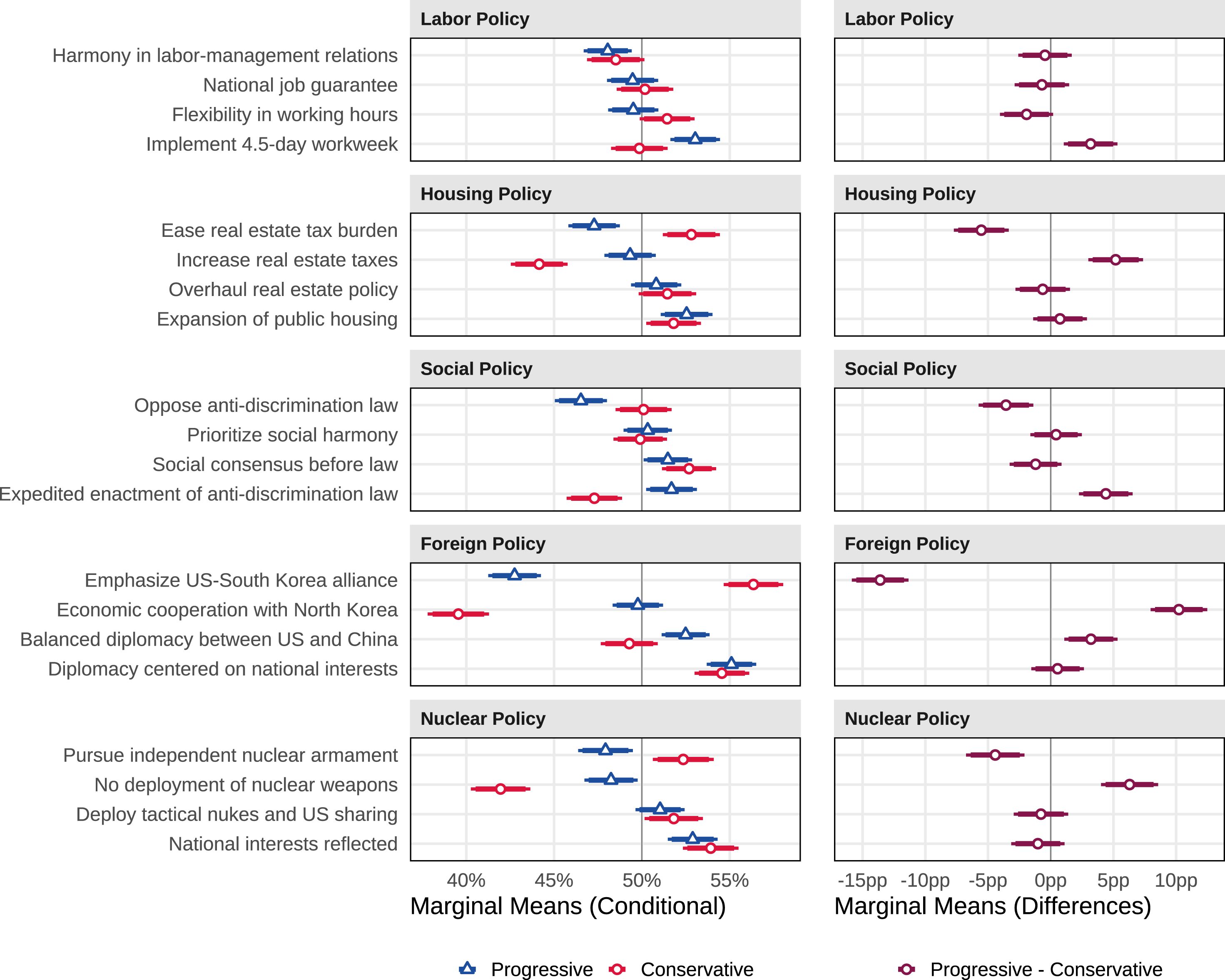
We do not find significant enough differences between general and presidential election scenarios to warrant reporting them separately (see Appendix C for more information). Taking candidate preferences for both voting scenarios, Figures 2 and 3 show our main findings. For clarity, we divide the figures into personalist and policy attributes. Conditional marginal means are presented as percentages, as any given marginal mean of an attribute level represents the probability that the profile was chosen. With two profiles, any mean above .5 (or 50%) indicates attribute-level favorability; the profile is more likely than not to be chosen. Then, we present the marginal means between the subgroups expressed as percentage point (pp) differences. Marginal means of the policy attributes for subgroups (left) and subgroup differences (right) for personal characteristics. Marginal means of the policy attributes for subgroups (left) and subgroup differences (right) for policy positions.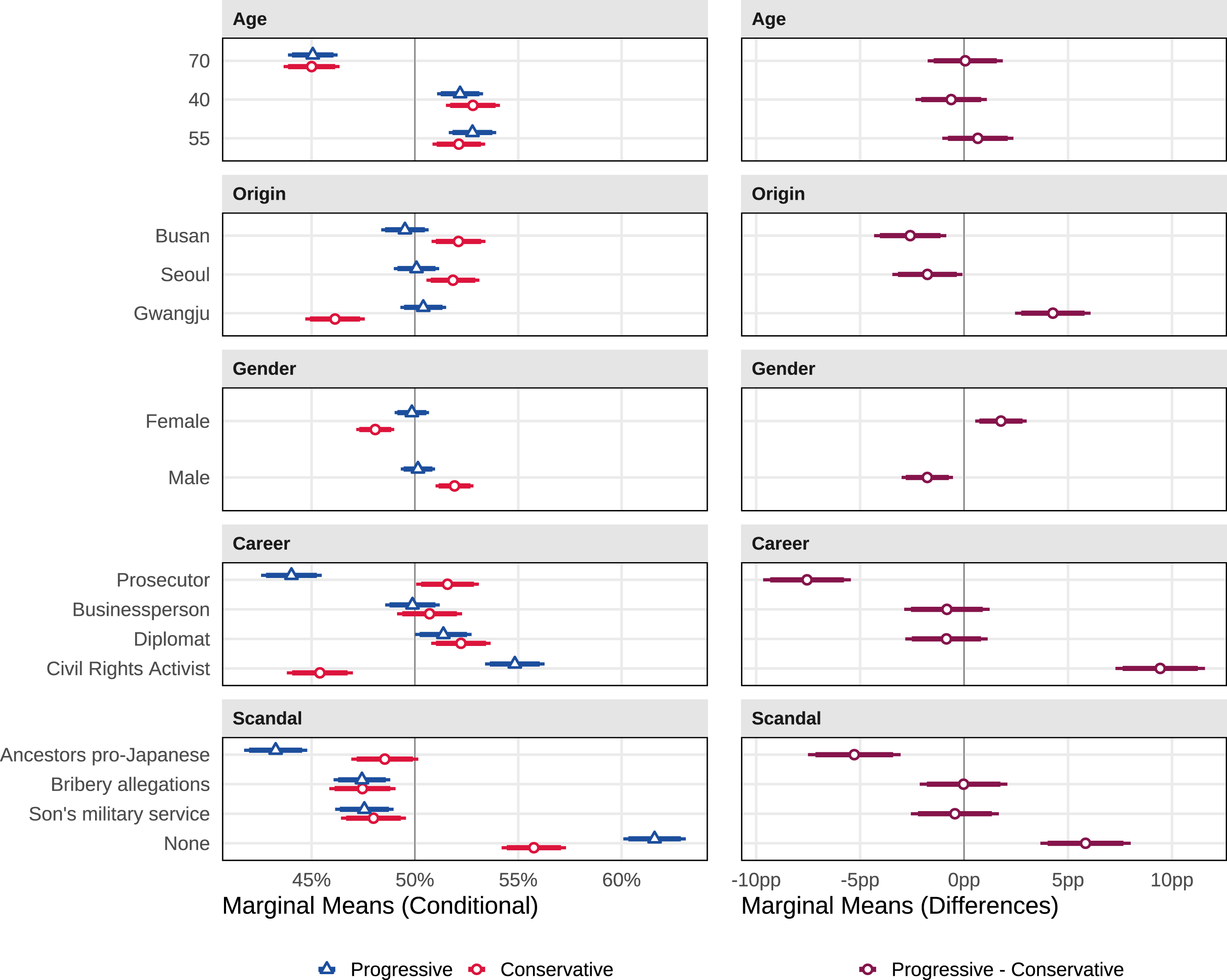
Overall, we see that both the hypothetical candidates’ personal and policy positions matter for progressive and conservative partisans, but generally in different ways. Regarding personalist characteristics (Figure 2), the candidate’s age does not matter much unless they are considerably older; then, there is a notable penalty. Only 45% of profiles with an older candidate were preferred. This holds consistently for progressives and conservatives. Other personalist attributes matter, too, and with notable partisan divides.
First, we see that the candidate’s occupational background matters. Progressives strongly prefer a candidate with a career in civil society activism. Overall, 55% of all profiles with such a candidate were chosen, whereas for conservatives, such an attribute level disincentivized support. The sum difference is nine percentage points (pp). Civil society activist backgrounds are commonly associated with progressive bulwarks (e.g., the previous president at the time of the survey, Moon Jae-in, a progressive), so this is not a surprising finding. Conservatives, on the other hand, slightly prefer a prosecutor or diplomat, although the subgroup difference is only notable for the prosecutor career background. This finding is more likely evidence of personalism rather than a merit-based evaluation of a candidate’s career background, given that it is the career background of the then-current South Korean president, Yoon Suk-yeol, a conservative.
We observe additional subgroup differences for gender, with conservatives preferring male over female candidates (notably, a female candidate disincentivizes conservative candidate choice). Conservatives also favor candidates from Busan and are against those from Gwangju, whereas origin matters less for progressives. This finding aligns with the deep-seated regionalism within South Korea, where historical, economic, and political divisions have fostered strong regional identities and voting patterns. Busan’s conservative leanings contrast sharply with Gwangju’s history as a progressive stronghold, making a candidate’s origin a potent signal of their political and ideological affiliations in the eyes of voters.
Scandal suspicion yields subgroup differences, as well. While both progressives and conservatives prefer scandal-free candidates, this matters more to progressives, as evidenced by the 6pp difference in marginal means. Furthermore, if a candidate’s ancestors are accused of Japanese collaboration during the colonial era, it results in a considerable penalty among progressive voters (43% of profiles chosen), whereas, for conservatives, it is less penalized (49%). Progressive voters’ stronger aversion to historical collaboration with Japan reflects this demographic’s deep historical consciousness and particular ethical expectations, underscoring the impact of historical events and national identity on voting behavior. However, bribery matters seemingly equally to partisans from both sides (c.f., Kim-Leffingwell, 2023).
Turning to policy positions (Figure 3), we find evidence of consistent partisan preferences regarding domestic and foreign policies, but especially regarding the latter. Housing policy reveals some partisan differences consistent with the stated positions of party representatives. The key differences regarding housing policy between the two major parties concern taxes, which is what one would expect under some form of conventional left-right cleavages. Conservatives favor easing the real estate tax burden and oppose increasing real estate taxes (the conservative PPP’s position). Progressives oppose easing the real estate tax burden, and while they are not motivated to support a position of increasing real estate taxes, there is an approximately 5pp subgroup difference; progressives do not really either support or strongly oppose the measure. Notably, both sides show some support for large-scale public housing, a position advocated by the progressive Democratic Party. While with labor market policies, progressives prefer a 4.5-day workweek (the Democratic Party position), and conservatives favor flexibility in working hours (the PPP’s position), although neither position shows particularly strong effects on candidate preference.
Socially, we see that candidates declaring their support for an expedited enactment of an anti-discrimination law motivate opposition from conservatives (47% marginal mean) and some support among progressives (52%). If candidates outright oppose the passage of such a bill, this triggers opposition from progressives, but it does not affect conservatives’ preferences much – in favor, if anything. These positions are ideologically consistent with progressive and conservative party positions. Although the Democratic Party has not prioritized the passage of the bill, it is understood they are more partial to its eventual implementation. Strictly speaking, the position of both parties is to seek “social consensus” first, which is a roundabout way of avoiding the issue altogether.
The most notable partisan differences and the policy positions that strongly motivate support or opposition are in foreign policy. Here we see that both sides of the political aisle are moved to seek policies ‘centered on the national interests’ (55% marginal mean for both). Relative to this vague, non-partisan position, we see evidence of what this might mean in more substantive terms. For progressives, it is more balanced diplomacy between Washington and Beijing (52% marginal mean) and opposition to emphasis on the ROK-US bilateral alliance (43%).
Conservatives, on the other hand, are strongly supportive of a foreign policy revolving around the country’s relationship with the United States (56%) and, consistent with this position, are strongly opposed to candidates who favor economic engagement with North Korea (40%). We observe opposing views on these two attribute values, as evidenced by the marginal mean differences. Contrary to the notion that “politics stops at the water’s shores”, as has often been said about partisan differences in the United States, we can say with confidence that politics most likely begins, or at least intensifies, at the water’s shores in South Korea – or the North-South Demilitarized Zone. We discuss the deeper meaning and implications of this finding in the conclusion.
Lastly, but of no less significance, we observe some partisan differences regarding nuclear weapons policy, which is also a matter of foreign policy. The two most noted, though not official conservative positions are the pursuit of an independent arsenal or the sharing of redeployed tactical weapons on South Korean soil. While both issues have ostensibly been resolved following a bilateral meeting between South Korean and US officials, 8 we see that conservative voters remain relatively inclined to support the pursuit of an independent option. They are significantly moved to oppose candidates who outright disavow nuclear weapons deployment in South Korea, the issue around which we see a notable marginal means difference (∼6pp). While progressives are not of a completely different view, they somewhat oppose an indigenous program option and are less opposed to the no-deployment option (the status quo). These differences in opinion likely reflect the positions of voters who all favor having ‘national interests reflected in nuclear weapons policy'.
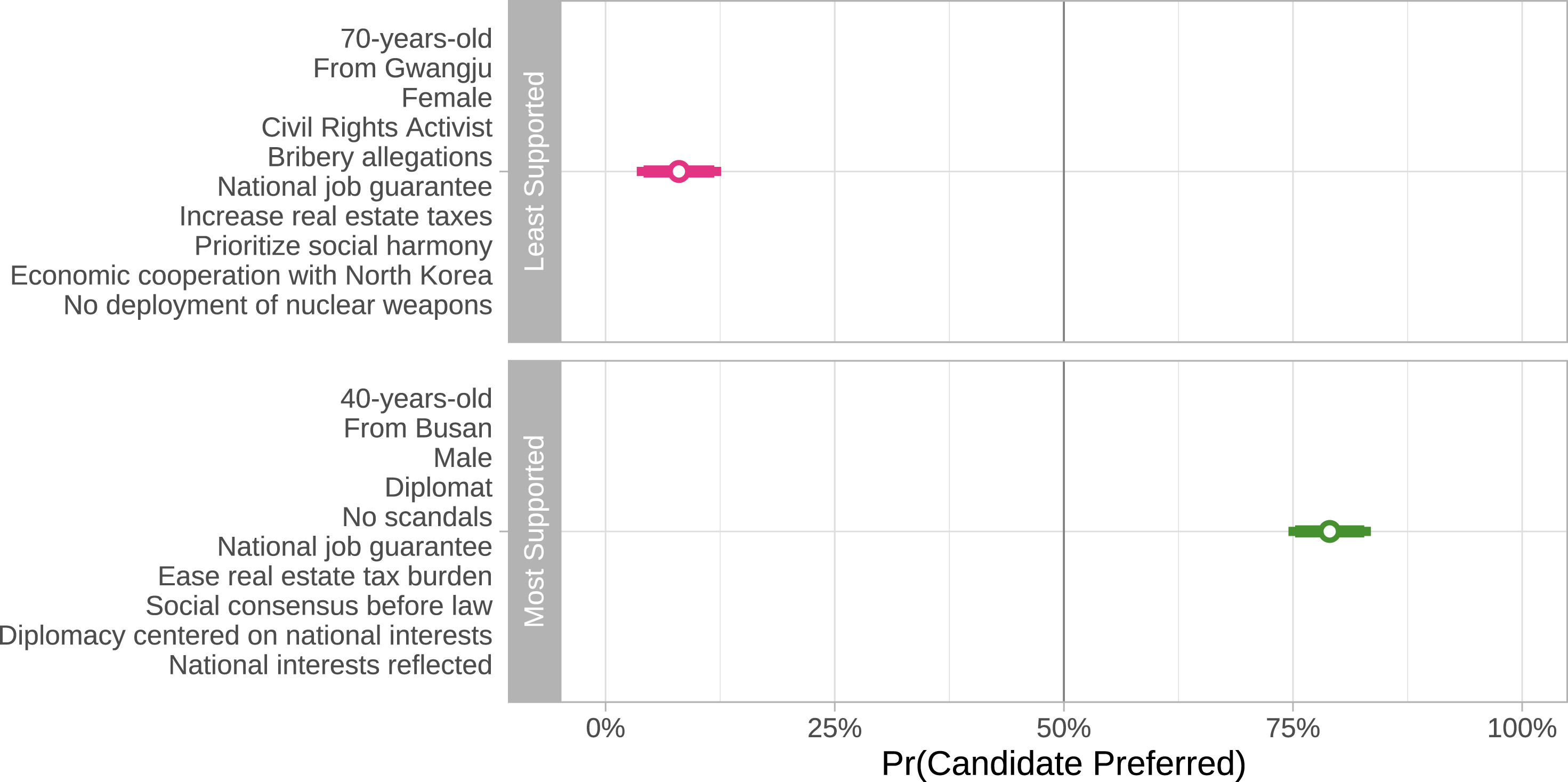
To present the findings more substantively and intuitively, we calculated the estimated probabilities of hypothetical candidates being preferred at the minimum and maximum points of the distributions. Figures 4 and 5 show the least and most likely candidate profiles to be preferred by progressive and conservative partisans, respectively. Reading what each side strongly prefers and opposes is telling. Least and most preferred candidate for Least and most preferred candidate for conservatives.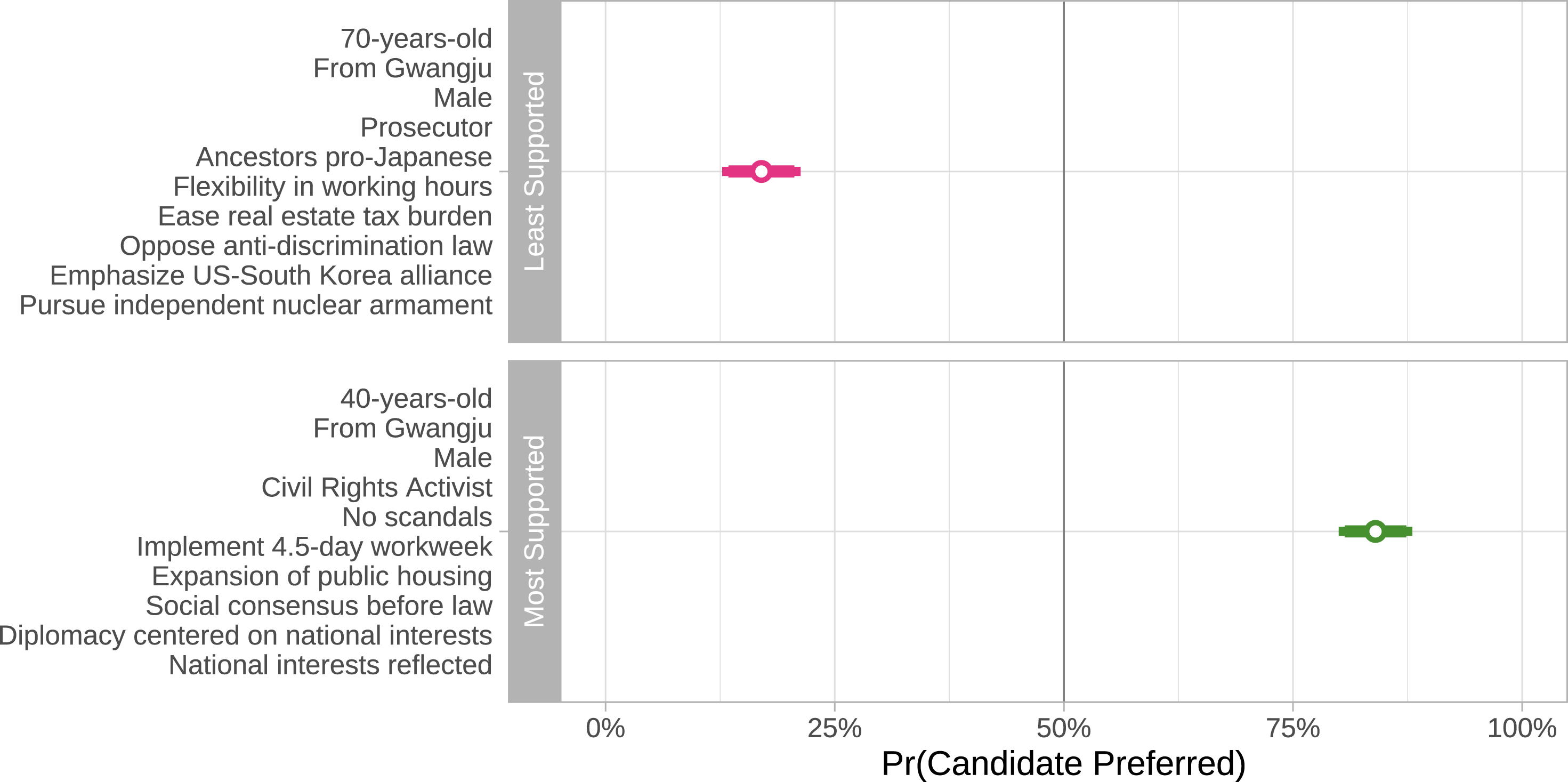
The least supported candidate among progressives is a 70-year-old prosecutor whose ancestors are accused of collaborating with the Japanese during the occupation of Korea. This candidate supports easing the real estate tax burden, opposes the passage of an anti-discrimination law, prioritizes the US–South Korea alliance in foreign policy, and favors pursuing independent nuclear armament. The most supported candidate is only 40 years old, has a civil rights activist background, supports the large-scale expansion of public housing, and wishes to prioritize social consensus before pursuing an anti-discrimination law. Their foreign policy and nuclear policy preferences are vague, but they are scandal-free politicians. That the most and least supported candidates are of the same gender (‘male’) and origin (‘Gwangju’) indicates these attributes are not decisive for progressives.
The most and least supported candidates significantly differ for conservatives. A middle-aged man from Busan with no scandals who opposes the passage of an anti-discrimination law, wants to cut real estate taxes, and thinks foreign policy should be centered on the national interest. 9 Policy related to nuclear weapons would also reflect the national interest. By contrast, a female elder from Gwangju with a background in civil rights activism, who supports economic engagement with North Korea, opposes nuclear weapons deployment, favors expedited passage of an anti-discrimination law, and advocates tax increases, is highly unlikely to be chosen by a conservative. That she faces bribery allegations does not help.
Appendices D and E of the SI review several robustness checks and provide additional analysis to support our findings. We replicate and corroborate our main result concerning partisan divides using alternative operationalizations of the policy outcome variables. Additionally, we analyze open-text responses from our two manipulation checks to further validate our findings. The first check involved a test of partisanship by asking respondents to identify candidates whose policy positions fully aligned with either a conservative or progressive profile. Respondents accurately identified co-partisan candidates, supporting the claim that the partisan cues were cognitively salient and correctly interpreted.
The second manipulation check employed Latent Dirichlet Allocation (LDA) to model open-ended justifications as mixtures of latent topics. The resulting topic structures and their distribution across progressive and conservative subgroups show that respondents invoke distinct thematic frames when articulating their preferences, particularly around values, foreign policy, and economic fairness. While we treat this analysis as supplementary, it reinforces our broader conclusion that voter reasoning in South Korea is programmatically structured and aligned with partisan identities, even in a weakly institutionalized party system.
Discussion and broader implications
Discussion
In this article, we examined how voters in under-institutionalized party systems choose candidates for office. We show that even in weakly institutionalized party systems like South Korea, voters may still exhibit programmatically coherent policy preferences, especially in polarized issue areas like foreign policy, demonstrating the emergence of programmatic partisanship despite unstable party organizations.
Conventionally, politicians in weak parties are expected to rely on their personal appeals to voters and clientelist networks. South Korea is a country with weak parties but has successfully overcome clientelism (Han, 2021; Hellmann, 2014). Regionalist networks and personalist candidates have been an important feature of politics in the country long before democratization (Mobrand, 2019). Further, as can be seen in the most recent presidential election, major parties are vulnerable to being captured by individuals from outside politics with personal appeal (charisma, talent) like now-President Yoon Seok-yul (Kim, 2021). Yet, as our findings show, the weakness of party organizations and their shallow roots in society has not prevented the emergence of policy-informed partisanship among voters.
Using a choice-based conjoint to disaggregate the relative importance of hypothetical candidates’ personal characteristics and policy positions across a range of salient policy topics, the evidence suggests that despite the absence of strong parties, partisan South Korean voters are not merely swayed by the personal characteristics of candidates alone. That said, personal characteristics of candidates do exercise some influence on voters. Region-based affective polarization, a partial consequence of historical patterns of economic development (Mobrand, 2019), is evident in the way conservative and progressive partisans discriminate against candidates from different parts of the country (see Kang and Cho, 2024 on region-based affective polarization). Some discrimination toward women by conservative partisans may be a consequence of views regarding traditional gender roles. We also saw distinct evidence that specific career experiences associated with progressive elites (civil society activism) and conservative elites (working as a prosecutor) made partisans more likely to pick particular candidate profiles.
However, partisan respondents also exhibit discernible policy preferences that reflect the ideological underpinnings and policy proposals of the political parties they support, though to varying extents in different policy areas. This points to an engaged and informed electorate, possibly facilitated by the polarized nature of political elites, the influence of partisan media, and other modern channels of political communication. We also leveraged the timing of the General Election in South Korea to conduct our survey at a time when voters would likely be especially engaged and interested in candidate positions.
A striking degree of partisan consistency in foreign policy and some areas of domestic policy points to what Sniderman and Stiglitz (2012, 77) call “programmatic partisanship”. Foreign policy functions as a major source of partisan conflict, affecting not only political elites but also the voting public. Domestic policy preferences, such as those relating to real estate taxes and labor policy, show that voters are not passive recipients of political rhetoric but actively endorse policies that align with their partisan identities consistent with conventional left-right cleavages to varying extents.
In other words, even in systems with weak parties, consistent policy preferences among partisans can emerge in areas where elite political opinion and policy views are polarized, as polarization has been shown to do in other countries (Hetherington, 2001; Levendusky, 2010; Moral and Best, 2023; Zingher and Flynn, 2018). This can occur even when polarization has not led to the formation of strong parties (cf. Mainwaring, 2016). South Korea exemplifies an ephemeral party system, where parties are unstable, but elite polarization and programmatic differences remain relatively stable (Borbáth, 2020; Lee, 2022; Han, 2021). The South Korean case illustrates that stable and clear voter preferences can develop in such systems, despite weak linkages between politicians and voters.
The distinction in voter preferences among partisans is especially notable in the foreign policy realm, where we find significant partisan divides. Much of the general literature on social cleavages and issue-based polarization focuses on domestic policy concerns like redistribution. Thus it is striking and notable that foreign policy would be a source of particularly strong polarization among partisan voters (e.g., Cornellas and Torcal, 2023). Indeed, conservatives demonstrate a strong preference for the US-South Korea alliance, while progressives advocate for a balanced approach to diplomacy, particularly in relation to US-China relations. This divergence in preferences underscores the importance of international relations in South Korean domestic politics, reflecting an electorate that places considerable weight on the country’s geopolitical stance toward inter-Korean relations, China, and the ROK–US alliance. Preferences regarding nuclear weapons underscore the securitized nature of policy preferences among South Korean voters, with conservatives in favor of the candidates pursuing an independent nuclear armament, consistent with their party’s position on the matter. While progressives do not support candidates who advocate complete nuclear non-deployment, conservatives express substantially stronger opposition to such positions. These preferences match high levels of polarization demonstrated amongst South Korean political elites especially in the area of foreign policy (Jaung, 2019; Kang et al., 2020). One of the reasons for such polarization at the popular level is the country’s distinct and long history of elite polarization surrounding the North Korea issue and the alliance with the United States.
Broader implications
The domestic and foreign policy preferences of voters in South Korea substantiate the idea of a programmatic partisan electorate capable of overcoming the limitations of weak party institutions to make informed and ideologically coherent policy choices. Why might this be? While this paper was not intended to answer this question, it remains a notable consideration. The lack of strong party-voter linkages appears to have been substituted for by elite polarization, partisan media, and possibly other forms of communication with voters that ensure they are well informed about the ideological and policy positions of their political camp, even as parties regularly rebrand and reconstitute themselves. Future research should direct its attention to these possible explanations.
The findings presented here should not be read as suggesting that partisans are not motivated by candidate personalities or other non-programmatic factors. As noted above, the experience and background of hypothetical candidates still matter, and, unsurprisingly, corruption is not popular. Particularly in South Korea, issues regarding transitional justice and the colonial past also make voters less likely to support candidates – the degree to which the latter matters is also a partisan issue in its own right, as noted elsewhere (Shaw, 2022). Similarly, progressive disapproval of prosecutors and conservative dislike for civic activists are a product of the partisan identification of these two fields within the conservative and progressive camps, respectively. Some degree of regionalism has also survived, especially among conservative partisans, and age and gender matter to some extent, as well.
Going forward, it would be beneficial to further disaggregate the impact of policy positions on the preferences of partisan voters in weak party systems. We would expect to see similar results in countries that have weak parties but low levels of programmatic instability and high levels of party replacement, these include places like Latvia and Italy in Europe (Borbáth, 2020), but such expectations need to be tested. Experimental designs should also consider including positions that, while not necessarily partisan-coded, could still influence voter preferences, such as support for local “pork barrel” spending. Additionally, future research could explore the effects of direct partisan cues by varying whether survey respondents are shown candidates’ party affiliations. Finally, conducting transnational comparisons among countries with varying strengths of party systems – such as those with and without clientelism and those with strong or weak programmatic coherence – would provide further insight into voter behavior in weak party systems.
Supplemental Material
Supplemental Material - Partisan voters in party systems with ephemeral parties: Evidence from South Korea
Supplemental Material for Partisan voters in party systems with ephemeral parties: Evidence from South Korea by Peter Ward and Steven Denney in Party Politics
Footnotes
Declaration of conflicting interests
The author(s) declared no potential conflicts of interest with respect to the research, authorship, and/or publication of this article.
Funding
The author(s) disclosed receipt of the following financial support for the research, authorship, and/or publication of this article: This work was supported by the Academy of Korean Studies under Grant AKS-2023-R-018.

Data availability statement
Replication data for this study are publicly available via the Harvard Dataverse: Denney, Steven. 2025. “Replication Data for: Partisan Voters in Party Systems with Ephemeral Parties: Evidence from South Korea.” Harvard Dataverse. https://doi.org/10.7910/DVN/3N4UFF (Denney, 2025).
Supplemental Material
Supplemental material for this article is available online.
Notes
Author biographies
References
Supplementary Material
Please find the following supplemental material available below.
For Open Access articles published under a Creative Commons License, all supplemental material carries the same license as the article it is associated with.
For non-Open Access articles published, all supplemental material carries a non-exclusive license, and permission requests for re-use of supplemental material or any part of supplemental material shall be sent directly to the copyright owner as specified in the copyright notice associated with the article.
