




Abstract
Scholars have shown that activists use the Internet for political purposes more often than passive rank-and-file members. Previous research indicates activists engage in different types of activities and with various levels of intensity. However, it is unclear to what extent such modes of party activism are linked to different uses of digital resources. Our paper contributes to the existing research by explaining what drives party website usage as an informational tool among different groups of party activists. Building on survey data from delegates attending party conferences between 2008 and 2017 in Spain, we test three main organisational drivers of party website use: the modes of internal activism, holding party offices, and ideological congruence. Our results confirm that those activists engaging in a wider range of activities, holding a party office, and being more ideologically congruent with their parties are more likely to use the party website frequently than the rest.
Introduction
The diffusion of Information and Communication Technologies (ICTs) among political parties has substantially transformed, in a short time span, the way these organisations engage and communicate with their members and voters (Barberà et al., 2021; Lilleker et al., 2011). One of the main questions analysed by previous scholars refers to the effects the digital environment has on member involvement in the party life (Pedersen and Saglie, 2005). While cyber-optimistic scholars expected new ICTs to invigorate the relationship with passive rank-and-file members by providing less costly opportunities to participate (Margetts, 2006), a prevailing cyber-pessimistic perspective has shown passive members are still less likely to engage online (Norris, 2001; Pedersen and Saglie, 2005). This seems even the case in highly digitalised parties such as Podemos, the M5S or the Pirates (Gerbaudo, 2021; Jääsaari and Šárovec, 2021; Vittori, 2020).
This trend of low digital engagement is also observed in the use of party websites by party members. Previous research shows people visit party websites mainly for informational purposes instead of for boosting their engagement with the party (Følstad et al., 2014; Hooghe and Vissers, 2009). As Scarrow highlighted, party websites perform different functions for both political parties and their party members (Scarrow, 2014). Party websites provide a direct channel of communication between party elites and their members and followers (Pedersen and Saglie, 2005). Internally, party websites can facilitate the recruitment of would-be party members, be used to disseminate internal party matters to party members, and to foster internal debates and other kinds of internal participation (referenda, candidate, and leadership selection, etc.) (Gerbaudo, 2019; Kalnes, 2009; Norris, 2003). Externally, political parties can use their websites to communicate relevant information that party members and activists should spread when acting as party ambassadors and discussing politics with non-members. As such, party websites are useful to share the party’s political agenda, how the party organisation frames relevant political issues, and for political campaigning. This matters because engaging in external socialisation and connecting with people outside their organisations is one of the core functions activists still perform nowadays (Demker et al., 2020; Martin and Cowley, 1999).
That said, in countries like Spain, the use of party websites to be informed about electoral campaigns has doubled and the use of social media tripled in less than ten years 1 .The party website is the third source of information most used among Spanish citizens during elections, even among the elderly. Hence, the growing use of party websites as an information tool makes them very relevant to understand both online party communication strategies and how party members use them. In this regard, a recent study of the German greens showed a similar informational purpose in the usage of social media among party delegates (Datts and Gerl, 2024). The same research also pointed out age differences, with younger delegates using it much more intensively than the rest. Overall, these findings suggest the use of new technologies, such as party websites, even for informational purposes, might vary among party activists.
The dissemination of party messages through the party website often reflects top-down structures, formulated and addressed by the party leadership for the grassroots (Norris, 2003). However, not all party members might have the same incentives to rely on and be informed through the party website. In fact, their involvement in the party life most likely will shape their need and use of the information offered by party channels such as the websites. Some will use it to identify and learn relevant information to promote themselves within the party organisation. Others will be interested in being informed through like-minded channels and disseminating political ideas and thoughts to their friends and social networks outside the party. We know there is not uniformity in the degree of activism or the mode of involvement of those more active in political parties (Correa et al., 2021; Demker et al., 2020; Heidar, 1994; Rodríguez-Teruel et al., 2021). But we still do not know if such diversity is also reproduced in the use of ICTs within political parties. Our article aims to test how these modes of activism relate to the use of party websites.
Unlike other previous contributions that dealt with both the supply and demand sides of party website use (e.g., Norris, 2001, 2003; Vaccari, 2013), our research focuses exclusively on party activists use of the party websites to be informed about politics. Using a novel and original dataset covering several surveys on Spanish party activists we aim to answer this research question: what drives party website usage as informational tool among party activists? Our results show that different modes of party involvement indeed shape the use of party websites to be informed about politics. Concretely, those less engaged in the internal party life, without party responsibilities and with lower ideological congruence with the party are less likely to use the website. We further find that holding party offices positively influences the use of party websites as informational tool.
Next, we outline our arguments behind the main drivers of party website usage among party activists. After, we introduce our research design including information on the data and the statistical methods employed. Finally, we present the empirical results and our main conclusions.
Party activists and the use of party websites to be informed about politics
In her seminal contribution on Internet and politics, Norris (2001) suggested that the inequalities resulting from the use of new technologies by citizens constituted a new democratic divide. Using data from several European countries, Norris explored the drivers of Internet use (more particularly, party websites) for political purposes by the general population. Norris found that the key drivers were several demographic factors (age, gender, education) as well as political attitudes, the use of other media and the location of the country (Norris, 2003). Subsequent research raised similar conclusions and pointed out how the opportunities offered by the party websites mostly attracted people who were already politically active (Boogers and Voerman, 2003; Vaccari 2013). Academics from the US explored the relevance of the civic voluntarism model to explain digital political participation in the general population, reinforcing the impact of the socioeconomic status although age seemed to play a relevant role too (Schlozman, et al., 2010, 2018). Previous research on the use of party websites by party members indicates that younger individuals, those more interested in politics, more knowledgeable about politics and from higher socioeconomic status are more likely to use the party website more often (Gibson et al., 2003; Hooghe and Vissers 2009; Lusoli and Ward, 2004). Recent research on the use of social media by party delegates also points towards ages differences (Datts and Gerl 2024).
The literature shows that party members tend to be an heterogeneous group of people (Heidar, 2006; Scarrow, 2014) while party activists are quite the opposite, being more homogeneous and characterized as predominantly middle-aged males with higher socioeconomic status (Dommett et al., 2021; Power and Dommett, 2020; Van Haute and Gauja, 2015). Excluding the age factor, party activists represent a similar group in sociodemographic terms to those more likely to use Internet for political purposes. Nevertheless, recent research indicates they might not be as homogenous as one would think in their interactions with their political parties (Correa et al., 2021; Demker et al., 2020). Indeed, previous research highlights how party activism can be multiform and how some activists will engage with different intensity and different priorities in all sorts of party activities.
One of the ways party websites can be a useful source of information to party members is when they play an ambassadorial role and share their political views to non-members either during canvassing activities or during informal discussions within their social networks. However, according to Correa et al. (2021), not all types of party activists act as party ambassadors to the community. In their study, Correa et al. (2021) identify four different types of party activists that engage with different intensity in activities linked to: the organisational (attending party meetings and events), the electoral (engaging in canvassing activities like distributing leaflets or attending party rallies) and the societal (discussing politics with members and non-members) dimensions of the party life. Their research also highlights two traditional modes of party involvement (the mass party activist, and the committed activist), and two newer modes (the canvasser activist, and the cheering activist). Mass party activists are those most highly involved in all types of activities organised for and by the party and actively engaging in external socialisation. Committed activists, who share with the mass party activist similar levels of engagement in organisational and electoral activities, prefer to socialise internally. They discuss politics and party matters with party members. Among the newer modes, the canvasser activists focus predominantly on electoral activities and, while they might engage in some organisational activities, they generally do not mingle in social activities. Both the committed and the canvasser activists mostly act as party ambassadors when canvassing. Lastly, they identify the cheering activists that mainly attend electoral rallies and barely engage in external or internal social events.
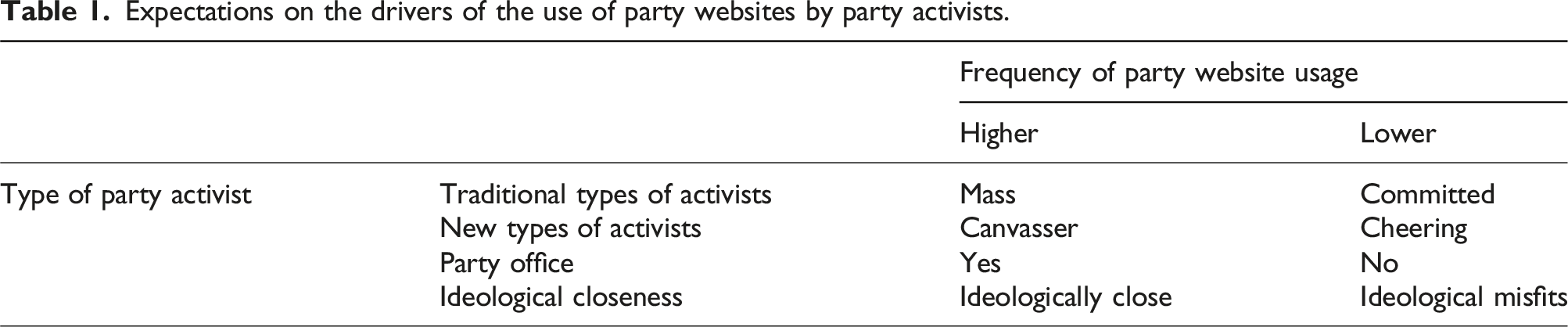
We can expect traditional modes of activism engaging in ambassadorial roles either through electoral activities and/or external socialisation to be the most likely ones to use their party websites. For them, party websites are indeed a valuable source of information that also offers direct access to electoral material, facilitating the diffusion of the party message. Therefore, mass party and committed activists should have higher chances of using the party website than the newer modes (e.g., canvasser and cheering activists). Similarly, the more involved types of activists should prevail over the less intensive: the mass party activists will use the party websites more than the committed, and the canvassers more than the cheering activists. Overall, we expect that the mode of involvement in electoral activities and external socialisation will be key drivers of party websites usage. In empirical terms, this leads to our first hypothesis:
H1. Mass party activists will be the ones using the party website most frequently followed by committed, canvasser and, finally, by cheering activists, in this order. Party websites offer the party leadership a chance to spread their messages directly without being distorted by journalists (Pedersen and Saglie, 2005). Previous literature indicates how network-mediated news (the party website) are seen as more credible by the network members (party members) because information has previously been filtered and validated by a community they trust (Vissers and Stolle, 2014). Using the party website also reduces information costs. We can expect that those party activists embedded deeper in the party organisation, such as those holding party offices (i.e., occupying positions in decision-making bodies), to trust more the internal channels of information and use more the party website to be informed about politics. In contrast, activists without organisational responsibilities might be less inclined to trust the filters applied by the political party and might opt to be informed through external channels.
H2. Activists holding party offices will use more often the party website than activists without organisational responsibilities. Ideology might also contribute to explain several divergences in party website use within the party, as it might reflect patterns of agreement or dissent between activists and the party line. In this respect, Van Haute and Carty (2012) studied the presence of a distinct type of party member linked to their ideological position and highlighted their relevance to assess intra-party dynamics. They did so by distinguishing between the so-called ideological misfits, members that significantly deviate from the basic ideological features of the party, from the rest of the membership (Van Haute and Carty, 2012). Building on this, we expect party activists ideologically closer to the ideology of their party to be more inclined to use the information filtered by the party leadership and hence, to use the website as one of their core sources of political information. Indeed, previous research shows individuals are more likely to expose themselves to content congruent with their views and opinions and do not use the Internet to find opposing or challenging views (Hooghe and Vissers 2009; Norris 2001). On the other hand, following the minimal effects theories of political communication (Bennett and Iyengar, 2008), ideological misfits will be less likely than the rest of party activists to regularly use the party website. They will be more inclined to challenge the quality or validity of the information shared by the party and, instead, opt for other sources or media outlets ideologically closer to their own views. Accordingly, we present our third hypothesis:
H3. The lower the activists’ ideological congruence regarding their party, the less they will use the party website. While our focus is on the individual characteristics of party activists shaping the use of party websites, it is worth pointing out that the literature has identified other meso and macro factors. In this regard, factors linked to the supply side and the country’s digital transformation path are also relevant to understand the use of party websites (see for instance, Norris 2001, 2003; Scarrow 2014; Schlozman et al., 2010; Scholozman et al., 2018). Table 1 summarizes our hypotheses:
Expectations on the drivers of the use of party websites by party activists.
Data and methods
To test our hypotheses, we use a large dataset gathered among party delegates attending party conferences in Spain. The dataset contains information from 21 surveys conducted to 13 different parties with representation either at the national or regional level from 2008 to 2017. The surveys included questions on the main features, attitudes, and opinions of the party members. We have a total of 8,464 cases (see Table A1 in Online Appendix for more details). In some parties, such as the mainstream PP and PSOE, we have conducted more than one survey, gathering additional data also from regional-branch conferences.
Dependent variables
The dependent variable is the frequency an individual uses the party website to gather political information. We asked party activists how often they employed the party website to be informed about politics. The question includes three options to measure the frequency: daily, weekly, and sporadically. Almost 80% of the pool responded to that question: 17.4% used the website almost every day, while 25.2% consulted it on a weekly basis, and 36.9% only did it sporadically. The difference between a daily and a weekly use might not be very important content-wise, but there is a clear difference regarding its sporadic use, which suggests the party website is not the main preference as information tool. Hence, we transformed our variable into a dichotomous indicator distinguishing those with higher frequency (daily or weekly), 42.6% of the total respondents, from those with lower use (sporadically).
Independent variables
According to our theoretical framework, we employ three main explanatory variables: modes of internal activism, holding a party office, and ideological congruence. See Table B1 in the Online Appendix for the main descriptive statistics for all the variables used in our models.
The mode of internal activism is defined by the nature of the party involvement. To capture these modes, we have conducted a cluster analysis based on seven indicators of participation, to classify the cases according to their patterns of involvement: (a) attending local meetings; (b) participating in other party events; (c) attending electoral meetings; (d) meeting with other party members to discuss about politics; (e) meeting with other party members to do other things non-necessarily related to politics; (f) meeting with non-party members to discuss about politics; (g) canvassing during elections. The cluster analysis seeks to segregate individuals according to their prevalent patterns of activism, as it has been used by Gomez and Ramiro (2019), or Bale and colleagues (2020) for ideological types.
For the purpose of our research, we were particularly interested in detecting relevant subsets of activists. The cluster analysis employs the Euclidean distances between individuals, which allows us to identify homogenous groups of activists with mutually exclusive categories (see Figures B1–B3 and Table B2 in the Online Appendix B for details on the cluster analysis). Following previous research (Correa et al., 2021:6), individuals have been clustered according to the combination of the types of activities and their specific intensity in each task. One individual may show intense participation in one type of activity but lower in other types. Hence, the clusters do not segregate individuals on their degree of intensity of party work overall, but on the specific combination of activities and intensity deployed. We selected four clusters, as including more clusters would have only marginally improved the classification and dropping one of those clusters would reduce the diversity captured by the typology. The outcome was three closer small clusters of activists, and a fourth more distinctive one.
In our cluster analysis, we have labelled the more different cluster as the cheering activist (17.7% of our sample), which is defined by a less intensive and fluctuating mode of participation in every item, compared to the other clusters. The opposite one is the mass party activist (23.3%), which we use as reference category in our analysis, and it indicates not only an intensive mode of participation, but also the performance of a wide range of activities. This type of delegate tends to spend much more time in attending the main party events and campaigning, and they also keep strong links with members and non-members to discuss about politics and issues different from politics. The other two types fall in between these two modes of involvement. The committed activist (22%) is mainly focused on the activities linked to the party machinery: campaigns, meetings, fundraising, etc., while they disregard internal or external socialisation. Contrary to the traditional mass party activist, they are more selective in the activities they engage in. Finally, the canvasser (37%) lies between the committed and the cheering activists, although it indicates a different type of delegate completely devoted to campaigns, meetings, and events, dismissing the other internal activities.
To test H2, we use the variable holding a party office. To measure it, we have asked party activists if they hold a party office (responsibility within the party organisation). This is a dummy variable with the value 1 if they hold a party office, and 0 otherwise. According to our data, 55.7% of party activists hold a party office, most of them corresponding to one of the more involved types of internal activism.
Finally, to test H3 on misfits we use a variable measuring the ideological congruence between activists and their party. We capture how ideologically close activists are from their parties with a proxy measuring the differences between the individuals’ position in the left-right axis and their perception of the party’s position in the same scale (Van Haute and Carty, 2012). Activists’ ideological congruence is a continuous variable measuring the distance between those two ideological positions. It ranges from 0 (perfect congruence between activists and parties) to 9. Interestingly, only 51,4 % of the respondents can be considered as non-misfits, i.e. delegates with perfect congruence, while around 40% of the delegates placed themselves 1 or 2 positions far from their own parties and 7.6 % have an ideological distance higher than 2 (for party differences see Table B3 in the Online Appendix).
Additionally, our model controls the effect of other socioeconomic, attitudinal and organisational factors considered as relevant in previous literature (e.g., Boogers and Voerman, 2003; Norris, 2001; Vaccari, 2013). To control for socioeconomic factors we include gender, age, level of education, and the professional status of the party activists. All these variables are based on survey questions asking socio-demographic features of the party activists. The model also accounts for the effect of ideology, measured in terms of left and right (1 to 10). We define this variable in three categories: left (1 to 4), centre (5 to 6), and right (7 to 10). The centre position will be taken as the category of reference. In addition, we also control for the frequency of use of other sources for political information, like TV, radio, or press. Although all of them are considered as competitive sources to Internet, they have similar effects on political participation (Gil De Zúñiga, Puig-I-Abril and Rojas, 2009). Therefore, we could expect that the more individuals use other sources for political information, the more likely they will also visit the party website.
Many authors have referred to the digital divide as the gap between individuals, groups or communities with different degree of access to digital tools (Norris, 2001). Although the effect of this phenomenon in the model is already controlled by the socioeconomic factors, we further add a new control accounting for this, the seniority of party activists. Hence, those activists with older engagement in the party organisation and, as such, more embedded in the party ideas and organisational culture might feel less willing to adopt the new digital tools to get information, blurring the expected influence of our main drivers. We measure the seniority of party activists as the number of years between their enrolment and the year of the party conference. This indicator is a proxy to observe differences between old and new members raised in recent times. Finally, we also account for the evolution of the importance of the party website. Their function and design have substantially evolved during these years (Følstad et al., 2014), which could have strengthened their role as a source of information for party activists. Hence, we test the effect of this evolution in the spread of the use of ICTs within the party, measured by survey year, the year when the survey was made.
Estimation techniques
Our hypotheses test the fixed effect of the several predictors on our dichotomous dependent variable, which are nested within groups (party conferences, i.e., political parties per year). Hence, we may assume that party features can mediate the impact produced by the individual predictors on the activists’ use of the party website. Some parties may have invested more time and resources in their digital tools or may have different strategies to employ the website as a device in the functioning of the organisation. We also assume that time is important for our purpose, individuals surveyed around the same year approximately are more similar to individuals surveyed in another time-span (Schmidt-Catran and Fairbrother, 2016). This is crucial here, since digital technologies have evolved incredibly over time, so that individuals in the first waves could behave differently compared to individuals surveyed afterwards. Therefore, controlling the random variance just at the party level (rather than party per survey) will not suffice and might bias the results. To mitigate this potential bias, we apply a multilevel mixed-effects logistic regression with two levels, individuals nested within surveys (capturing the party and time variance) (Albright and Marinova, 2010). As the slope of the selectorate may vary by surveys (i.e., parties per year), we introduce this party-level random variance in the model. Since we have surveyed some parties twice in different years, we could expect some differences in the evolution of the party website across time. Hence, we will control the random variance by the survey group instead of the party group 2 .
Since the original dataset contains different surveys, with different response rate and different sizes, all our models are weighted by representativeness of each party and survey to avoid the potential bias produced by small parties with high response rate compared to lower rates of bigger parties. We use the total population of party delegates attending the party conferences surveyed by the research team as the main criterion for weighting the data.
Explaining party website use in Spain
Descriptive analysis
We start this section with a brief descriptive analysis of the use of the party website among party activists. Our results show that party activists use different sources of information to learn about politics. As Figure 1 shows, not only party activists are informed about politics on a daily basis, but they also use a wide range of sources: TV, radio, press, Internet, and the party website. Unsurprisingly, if we compare the level of information about politics in different types of media between party activists and citizens, party activists are informed about politics in a much higher frequency than the average citizen. Spanish public opinion studies indicate that most Spanish citizens opt for traditional media such as the TV or the radio to be informed about politics, but they resort to Internet to a much lesser extent
3
. Sources of political information used by party activists. Source: own dataset on party delegates.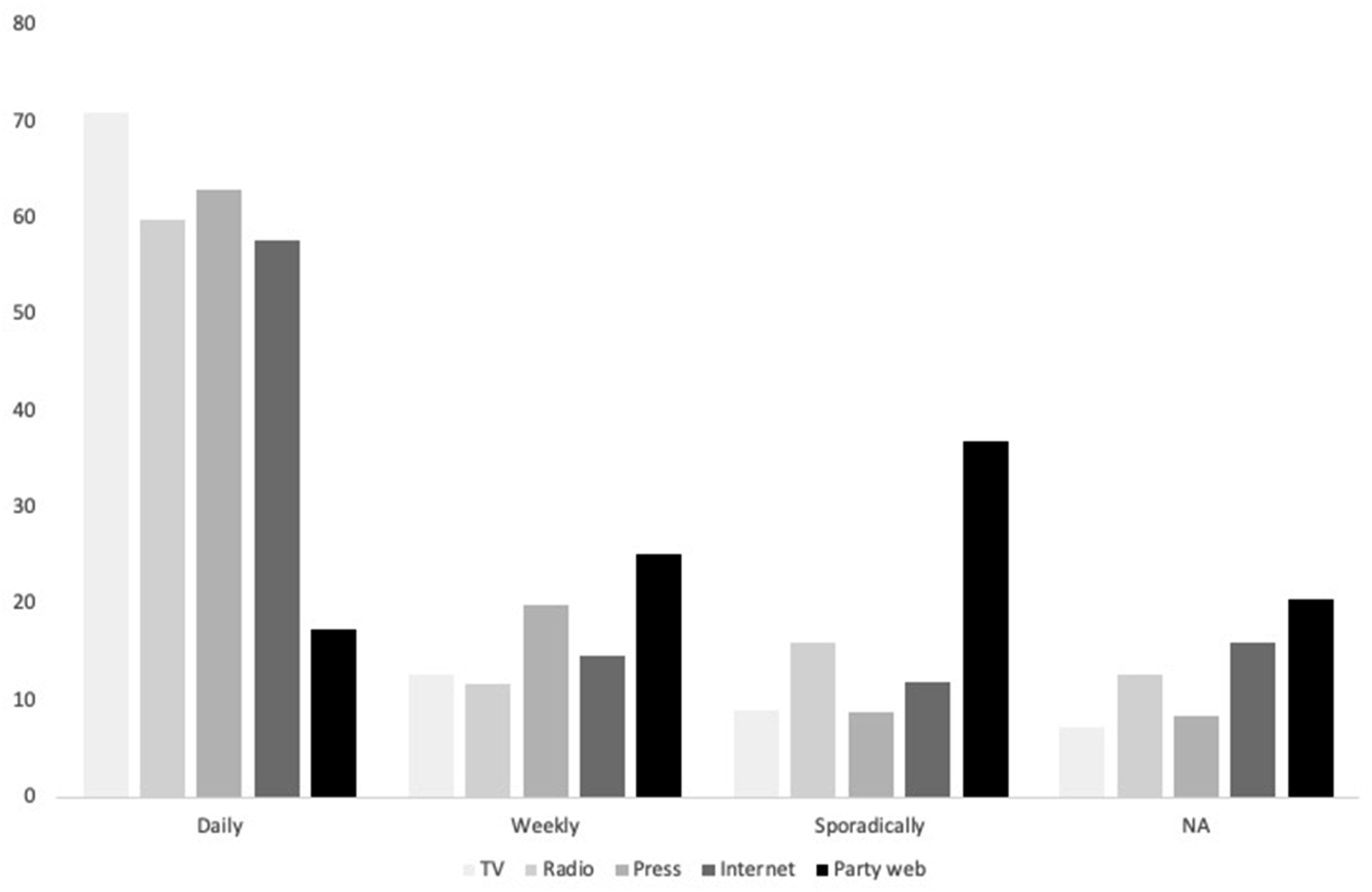
In comparison to traditional media or general Internet, party activists use the party website less frequently. Concretely, 42.3% use the party website on a weekly or daily basis and 40% use it sporadically. Since party websites were less developed at the time we conducted our surveys, we could expect a higher frequency nowadays due the increased level of sophistication of party websites, which are also more frequently updated and used as main references in social media activity. Our data shows different results when assessing the use of the party website in each of the different parties surveyed (Figure 2). Interestingly, most of the parties surveyed in the first years already had an important proportion of delegates reporting a weekly use of party websites. Moreover, different types of political parties differ in the use of their websites. For instance, state-wide party activists tend to use more frequently the party website than those activists from their regional branches. Overall, there seem to be important divergences in how party activists use their party websites to be informed about politics, so the question is who are those that use the website on a daily or weekly basis? Activists use of party website for political information. Source: own dataset on party delegates.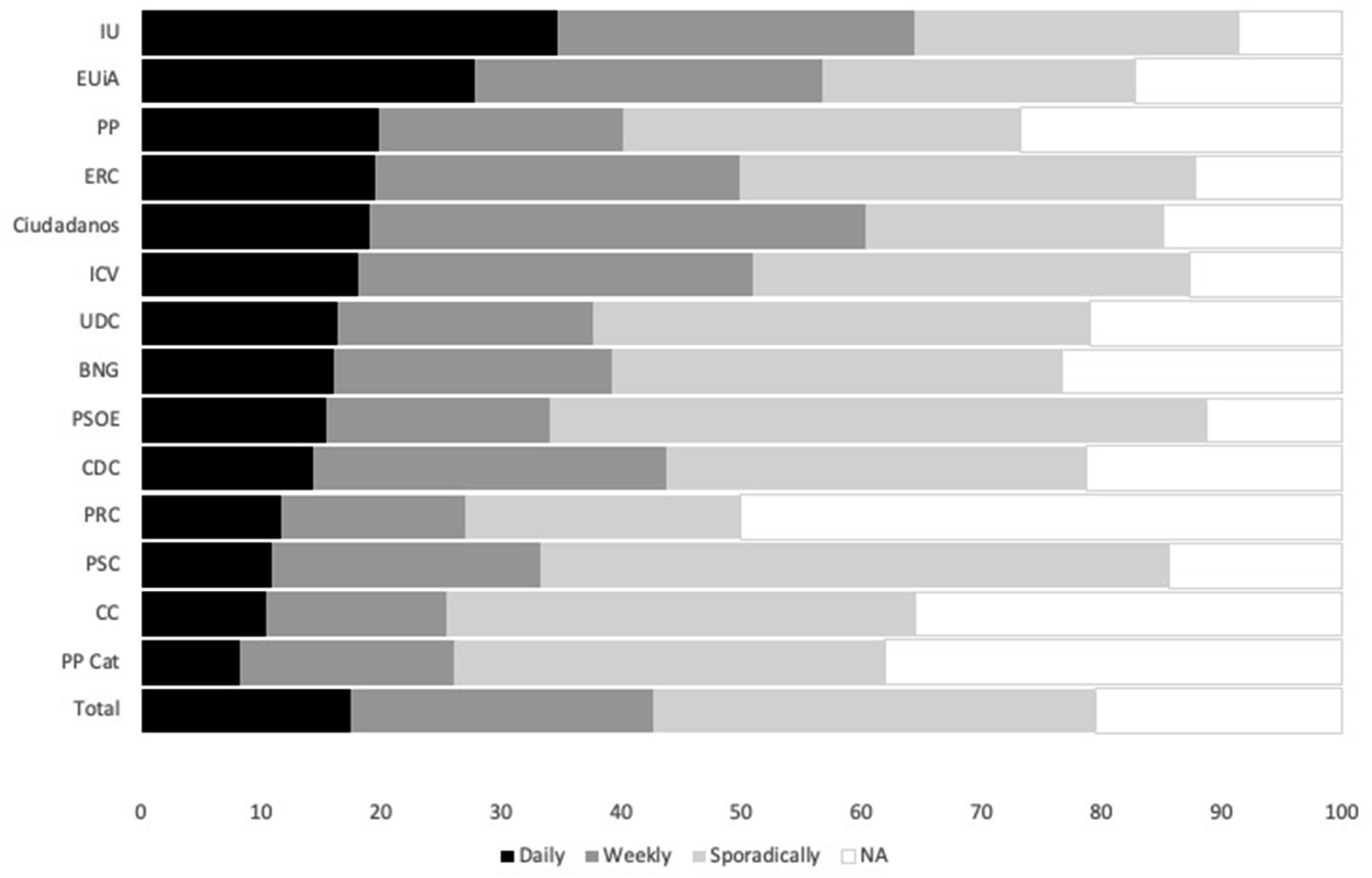
Explanatory analysis
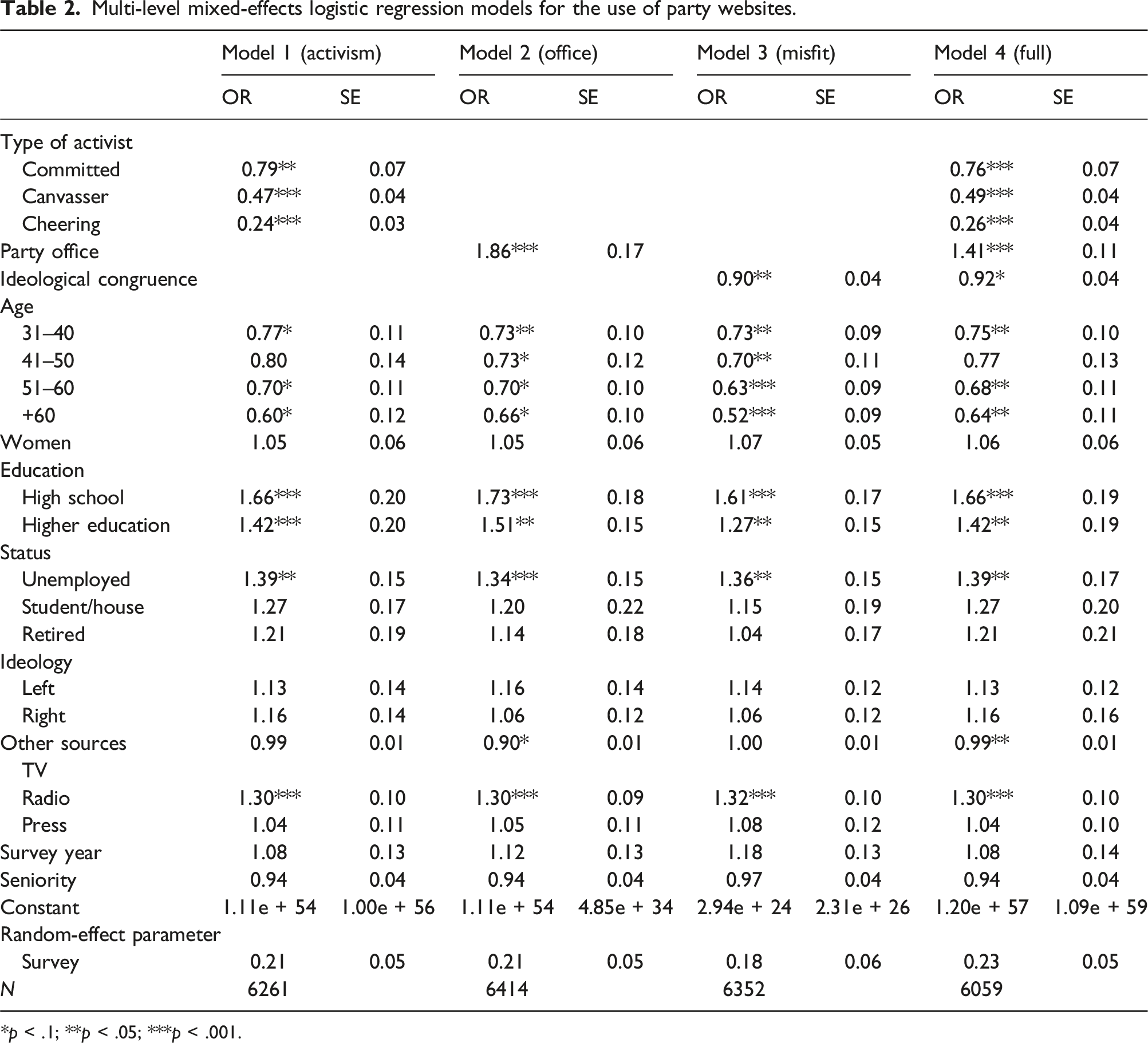
Multi-level mixed-effects logistic regression models for the use of party websites.
*p < .1; **p < .05; ***p < .001.
Firstly, our model 1 accounts for the effects produced by the modes of activism (H1). As explained in the methods section, we distinguish among four types of activists: the mass party, the committed, the canvasser and the cheering activist. They differ not only in the frequency of engagement but, more importantly, in the kind of activities they engage in. As expected, the estimates indicate that mass party activists are more likely to frequently use the party website. Compared to them, all the others are less likely to use them frequently: committed activists reduced their chances by 24%, canvassers by 51%, and cheering by 74% (according to the full model). Hence, activists with a less intensive and more fluctuant mode of participation (the cheering activist) are the ones less likely to use the party website. Besides, canvassers activists, which are mainly interested in activities linked to the electoral cycle, find the party website less useful for their purposes out of the election period than the committed activists. Overall, a more ambassadorial-style (e.g., the willingness to discuss politics with non-members) seems to foster a higher use of the website than those roles mostly oriented to fluctuant participation. These results are robust independently whether they are estimated through the mixed-effects hierarchical technique or with logistic regression controlling for each party survey (see Table C1, Online Appendix).
Additionally, as a robustness check on the relevance of party involvement to explain the use of party websites, we have run two alternative models. In both we have replaced the modes of activism with party variables measuring the intensity of participation using the time dedicated to party activities and an index of activism based in different items of internal activities (see Tables C3 and C4, Online Appendix). Both models measuring the intensity of participation show a positive relationship between activism and the use of the party website. Concretely, individuals spending a higher number of hours or engaging in a wider range of activities more frequently are more likely to use frequently the party website than those less active. This highlights the relevance of the website as an information tool for party activists, which the party organisation can use to disseminate its messages and policies. Additionally, the party website could also be used to steer party activism towards those activities or goals the party needs the most since those more active in the organisation are the ones using it more frequently.
Secondly, we test the position of the activists within the party organisation in model 2. In line with Pedersen and Saglie’s (2005) findings for rank-and-file members, our results for party activists indicate a positive relationship between holding a party office and using the party website more frequently (H2), thus enhancing the reinforcement of the party traditional power structure. As we argued, those holding party offices are expected to have a higher degree of trust on the information provided by the party and be more likely to check the party website, increasing the odds of using the party website often by 59 %, as seen in Figure 3. To check the robustness of this explanation, we have also run an alternative model in which we replaced ‘party office’ by ‘public office’ to observe if the potential expected effect comes just from having any kind of office (party or public) or, instead, it is related to holding responsibilities within the party structure (see Table C5, Online Appendix). Our results show a negative and non-significant relationship between public office and use of the party website. This suggests they might use other channels to be informed about politics. Therefore, it is the responsibility held within the organisation, and the extent of internal involvement of those activists, rather than just having any kind of office, what increases the frequency of using the party website. In line with other studies highlighting the importance of network-mediated news, it seems party officers value more and might find more useful the political information filtered by their party (Vissers and Stolle, 2014). Average marginal effects for specific factors.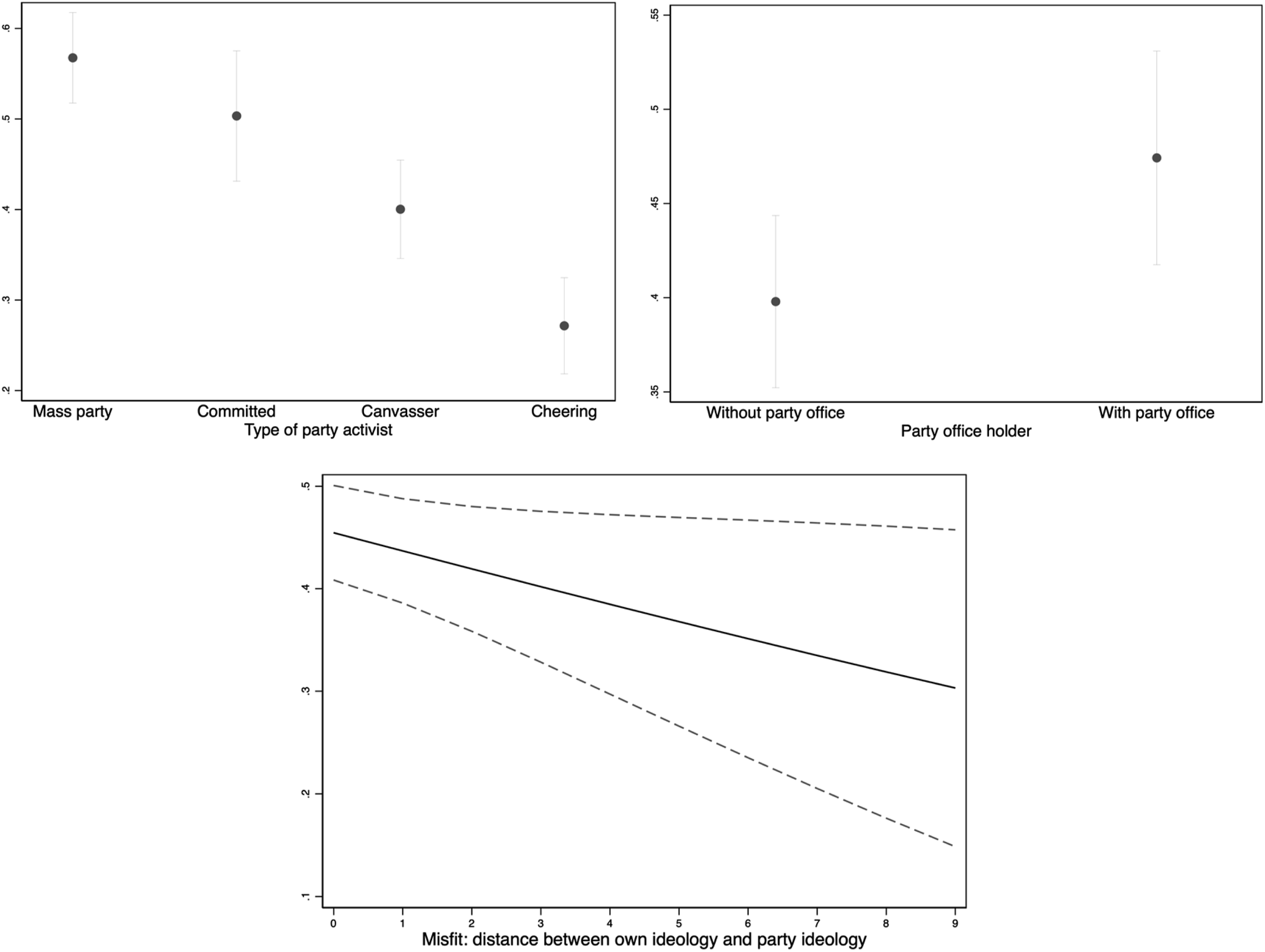
Thirdly, our Model 3 considers the effect of the ideological alignment with the party. Indeed, our results show that the less ideological closeness between the party and the activist -those we consider as misfits- the lower chances for them to use the party website, supporting our hypothesis 3. Each point misfit activists further distance themselves from the party ideological position, they are 8 % less likely to use the party website, as seen in Figure 3. This effect holds in our full model when accounting for the other explanatory factors. Hence, party websites seem to operate as an instrument to enhance the ideological coherence between the party and their members. If those less ideologically close to the party barely use the party website, the chances of the website becoming a source of internal pluralism are reduced, challenging Norris (2003) more cyber-optimistic views on this matter.
The full model includes the three main explanatory variables without losing power of prediction. These results highlight the relevance of considering the organisational dimension when assessing the use of the party websites by their activists. Additionally, other control variables show interesting results such as the level of seniority, which shows a slightly negative significant relationship with the frequency of use of the party website. Those activists with older membership tend to use the website less frequently than more recent members because of their long socialisation, their potential access to relevant information through other channels and an ageing effect. Importantly, the effects of the main predictors are constant over time. Furthermore, we also control for time, which is not significant in any specification of the models. This suggests there are not important effects associated with time variance across surveys and individuals. Our additional robustness check with different timespans also supports this finding (see Table C6, Online Appendix). On the other hand, we do find that activists from some parties are more likely to use the party website more frequently than others (see Table C2, Online Appendix). For instance, activists in radical left-wing parties like IU or EUIA have higher propensity to use the party website. This also applies to Ciudadanos in 2011. On the contrary, social democratic activists from PSOE and PSC are clearly less enthusiastic about using their party website than other parties. Nonetheless, it is important to stress that we cannot easily identify a pattern emerging from this, implying not clear factors such as newness, institutional access (for resources) or ideology seem to matter.
Finally, the results of the socioeconomic control variables are in line with previous studies. For instance, one key factor is the age of the party activists. The results show that young activists, under age 30, are more likely to use the party website than those older and the effect holds across models. In line with previous findings, we also observe a predominant use of Internet among young and well-educated individuals (e.g., Norris, 2001, 2003). On the other hand, the professional status of the party activists is poorly related to their use of the party website, in contrast with previous studies (Ward et al., 2003). We find unemployed activists are more likely to use the website frequently. This might be because they have more free time to use it to be informed about politics. The difference among employed versus unemployed could be due to time restrictions that do not apply to the general population for whom the interest in politics is much lower. Overall, the relevance of socioeconomic factors to explain the use of the party website among party activists directly speaks to the debate on the democratic divide ICTs might bring to participation.
Conclusions
This article aimed to assess the use of party websites for political information by party activists accounting for their level of involvement in the party organisation. Focusing on those more active members, we have observed how different types of activists use the party website to be informed about politics differently. Our analysis supports our three hypotheses, showing that modes of internal activism, party offices, and ideological congruence (between individuals and the party) shape activists’ use of the party website and as such, influence patterns of political information in political parties. The effect of these drivers remains stable over time.
Our results highlight the relevance of considering party organisational factors to understand the use of party websites by party activists. Indeed, although we still find that some socioeconomic factors remain significant, attitudinal factors lose relevance when accounting for the organisational dimension. This suggests that while a wide range of activists might access the party website, its use is not equally relevant for all of them. Concretely, our findings show that those activists that hold a party office, spend more time, and are engaged in a wider range of activities are more likely to use the party website more frequently than the rest. Importantly, our findings also show that activists that engage in less-intensive activities and do it in a more fluctuant way are less likely to use frequently the party website to be informed about politics.
These findings have implications for those studying party organisation and activism in the digital era. So far, the vast part of the literature has focused on exploring the existence of inequalities in the access and use of ICTs, while in party politics research, factors linked to the organisational linkage between the activists and the party have been overlooked. This is relevant because, for the wider population, inequalities in terms of use and access are linked to individual properties. Instead, our research shows that in political parties (and possibly in other voluntary based organisations) they will be determined by the position, level and type of engagement activists have in the party. The more relevant role of the organisational dimension suggests the digital democratic divide could be mitigated by boosting party activism, which puts the party and the party leadership at the centre of the solution.
In that sense, if parties want to boost the level of usage of their websites, they need to be more strategic with the content provided so they can target different types of activists at the same time. For instance, they should provide relevant information that cannot be accessed otherwise, making it more appealing to those relying on alternative channels of information or with less time to consult the website. These promotion campaigns could also aim to enhance the level of trust towards political information generated by the political party and make the party the preferred network-mediated source of information. Additionally, campaigns could also be developed to spread strategic messages for active party members, in line with the party goals at a given time, since they will be the ones accessing the website in the first place. Overall, the party website offers a new channel for the party to communicate directly to their members while being totally in control of the message disseminated. At times of widespread misinformation and fake news all over the Internet and social media, the party website could still become a key channel of communication for political parties.
Future research may address some of the limitations of our analysis. For instance, we do not know what concrete type of political information activist do consult in the party website or how do they use that information later. Future research should focus, for instance, on studying whether there are differences between those who use the website to know the position of the leader and those who do it to be informed about concrete policies and what use do they make of that information afterwards. Similarly, it could also be studied how these differences in uses change across different modes of party activists and what could parties do to mitigate those differences, if any.
Supplemental Material
Supplemental Material - The use of party websites for political information among Spanish party activists
Supplemental Material for The use of party websites for political information among Spanish party activists by Patricia Correa, Juan Rodríguez-Teruel and Oscar Barberà in Party Politics.
Footnotes
Acknowledgements
This research was supported by the following projects: CIAICO-2020-202 (2020-2021), CIAICO/2022/164 (2023-25) and AORG-2019-017 all funded by the Valencian Regional Government; as well as UV-INV_AE-2631662 (2023-2024) funded by the University of Valencia. This support is gratefully acknowledged. We also thank the attendants of the 2019 ECPR General conference who commented on a previous version of this paper as well as the editors of this special issue.
Declaration of conflicting interests
The author(s) declared no potential conflicts of interest with respect to the research, authorship, and/or publication of this article.
Funding
The author(s) disclosed receipt of the following financial support for the research, authorship, and/or publication of this article: this research was supported by the following projects: CIAICO-2020-202 (2020-2021), CIAICO/2022/164 (2023-25) and AORG-2019-017 all funded by the Valencian Regional Government; as well as UV-INV_AE-2631662 (2023-2024) funded by the University of Valencia.

Supplemental Material
Supplemental material for this article is available online.
Notes
Author biographies
References
Supplementary Material
Please find the following supplemental material available below.
For Open Access articles published under a Creative Commons License, all supplemental material carries the same license as the article it is associated with.
For non-Open Access articles published, all supplemental material carries a non-exclusive license, and permission requests for re-use of supplemental material or any part of supplemental material shall be sent directly to the copyright owner as specified in the copyright notice associated with the article.
