




Abstract
The multidimensionality of the Israeli political system is expected given Israel’s electoral system and cleavage structure. We introduce a new dataset and measurement of party positions in Israel and provide evidence that Israel’s party system is comparable to other multiparty systems in Europe (CHES-EU) and Latin America (CHES-LA). We argue and provide evidence that the most important dimension in the Israeli party system, similar to other multiparty systems, is the general Left-Right continuum, which combines both economic and cultural policy issues. Yet, unlike other established democracies, parties’ positions on the Left-Right continuum are closely related to their positions on policies related to the Arab-Israeli conflict. We also discuss Israeli-specific issues which structure the Israeli party competition. The contribution of this paper is two-fold. First, it allows scholars of party competition to include Israel as a comparative case in their research. Second, it is the first study that provides valid and reliable measurement of Israeli parties’ positions across multiple issues.
The multidimensionality of the Israeli political system is well documented (e.g., Doron, 2005; Hazan, 2021), which is expected due to its electoral institutions (Shugart, 2021) and cleavage structure (Arian and Shamir, 2008). By multidimensional, we mean that parties’ agendas (e.g., Arian and Shamir, 2001; Cavari et al., 2022) and voters’ preferences (e.g., Shamir and Arian, 1999) focus on multiple policy issues and ideological dimensions. Based on the Chapel Hill Expert Survey (CHES) conducted to measure Israeli parties’ policy positions (CHES-Israel), we provide evidence that with several important caveats, the multidimensionality of Israel’s party system is comparable to other multiparty systems in Europe (CHES-EU) and Latin America (CHES-LA). Below we compare the Israeli party system to West European party systems, and discuss the Israeli-specific issues which structure party competition in Israel.
First, we introduce this new source of data on Israeli political parties and show that experts’ placements of Israeli parties are valid and reliable. We start by comparing parties' perceived Left-Right positions from two public opinion datasets (the Israel National Election Study and the Israeli Polarization Panel) to our experts’ placements of the parties. The correlation between the Israeli public’s and experts' perception of parties’ positions is over 0.95 for both the general Left-Right ideology and the Israeli-Palestinian conflict.
Second, we argue and provide evidence that the most important dimension in the Israeli party system, similar to other multiparty systems, is the general Left-Right continuum, which combines both economic and cultural policy issues. Yet, unlike other established democracies, the Left-Right dimension is overwhelmed by parties’ positions on policies related to the Arab-Israeli conflict. Thus, on the one hand, Israel is similar to European party systems in that its Left-Right continuum is an over-arching dimension of several issues and that it has three ideological dimensions (general Left-Right, socio-cultural, and economic). On the other hand, Israel’s party system is different in that the Left-Right continuum encompasses conflict-related issues, in addition to the issues encompassed by the European Left-Right dimension.
This difference between Israel and other multiparty systems is well-documented at the voter level (Arian and Shamir, 1983; Shamir and Shamir, 2007; Yakter and Tessler, 2022; Yakter and Harsgor, 2022) and parties’ agenda-setting mechanisms (Cavari et al., 2022), but parties’ positions on these issues have not been documented before. We then demonstrate that, similar to other multiparty systems, Israel’s parties can be placed on two additional dimensions – a Left-Right economic dimension and a socio-cultural dimension. We show that these findings are consistent between our two waves (2021 and 2022), but that the relative importance of the socio-cultural dimension increased substantively in the second wave.
We discuss issues specific to the temporality of our data by comparing party positions in 2021 and 2022. We fielded our first expert survey during Spring 2022, almost a year after the March 2021 election to the Israeli Knesset and roughly 8 months after the formation of the 36th government (the first non-Netanyahu government since 2009). We fielded a second survey in January 2023, 2 months after the November 2022 election and shortly after the formation of the 37th government (Netanyahu’s return to power). The timing of the data collection is important because it reveals parties’ positions during a long-lasting political crisis that includes five elections between April 2019 and November 2022, two failed government formations, and two governments that lasted less than a year each. Much of this crisis is associated with increased personalization of the Israeli party system (e.g., Amitai et al., 2023; Rahat, 2022), and specifically parties’ stands on Prime Minister Benjamin Netanyahu’s fit for office. Netanyahu was indicted on charges of breach of trust, bribery and fraud in November 2019 (between the 22nd and 23rd Knesset elections) and his trial began in May 2020 (shortly after he was re-sworn as a Prime Minister and 9 months before the collapse of his last government before his temporary replacement as PM).
The issue of pro-versus anti-Netanyahu politics is clearly observed in our parties’ corruption salience indicator, which measures how important fighting government corruption is for a given party. This ranges from 0, not at all important, to 10, extremely important. In 2021, the corruption salience for the four parties loyal to Netanyahu (Likud, Shas, UTJ, and the Religious Zionist party) ranges between 0.9 and 1.8, while for the clear opposition to Netanyahu among the Jewish parties, excluding Yisrael Beiteinu (Blue and White, Labor, Meretz, New Hope, and Yesh Atid) the range is between 7.9 and 8.8. A similar pattern is observed in the 2022 data, where the pro-Netanyahu parties’ corruption salience ranges between 0.75 and 1.5, while the anti-Netanyahu Jewish parties’ corruption salience ranges between 7.2 and 8, with higher values representing greater salience of anti-corruption efforts.
The Chapel Hill Expert Survey-Israel: Reliability and validity
The Chapel Hill Expert Survey (CHES) is a long-running survey that asks experts (i.e., scholars of party politics in the focal country) to place political parties on a variety of policy issues and dimensions. Each issue or dimension is measured on a 0–10 scale, and where appropriate lower values mean left-leaning positions and high values are associated with right-wing positions. The data have been widely used in comparative party politics and have been demonstrated to be valid and reliable measures of party positions. 1 While the survey has focused primarily on Europe over the past 20 years, recently the CHES surveys have expanded in geographic scope, to include North and South America, Australia, and now Israel.
Building on recent works that study the comparability of party systems across contexts (e.g., Bakker et al., 2022; Martínez-Gallardo et al., 2022), we argue that the Israeli party system is comparable to party systems in Europe and Latin America. To do so, we introduce two waves of the Chapel Hill Expert Survey–Israel, collected after the 2021 and 2022 elections in Israel. In these surveys, experts 2 placed 16 party lists that were represented in the post-election Knesset on a variety of ideological and policy issues. That is, we include parties that run in the election as a joint list as if they were a single party. For example, United Torah Judaism (UTJ) was considered a single party despite being a joint list of two parties (Agudat Yisrael and Degel HaTorah). The positions of nine parties were estimated in both elections, 3 four additional parties in 2021, 4 and three other parties in 2022. 5
These data are essential to the study of Israeli politics in comparative perspective because other methods of data collection are not available for Israel. First, in recent years many Israeli parties have stopped publishing official manifestos, and therefore are not coded into the comparative manifesto dataset (e.g., Volkens et al., 2017). Second, to the best of our knowledge, no comparative dataset of parties’ positions has included Israel in their data. 6 Third, while the Israel National Election Studies asks voters to place parties on the Left-Right dimension, voters are not asked to place parties on any other dimension or policy issue. Therefore, the Left-Right dimension is the only measure of the Israeli parties’ perceived positions.
When using experts to measure subjective placements, there is also the potential concern of bias in terms of expert perceptions (see Little and Meng, 2023). This potential bias is more of a concern when there are fewer expert responses, as the larger the set of responses, the more such potential biases will cancel each other out. Related, with more responses, the impact of any one or two outliers diminishes. Given that we have over 20 responses in each wave of the survey, such concerns are minimal. There is, however, still a potential for ideological bias, with left (right) wing experts placing parties they do not align with further to the right (left). We find no evidence of such bias (see Appendix Table A5 for more details).
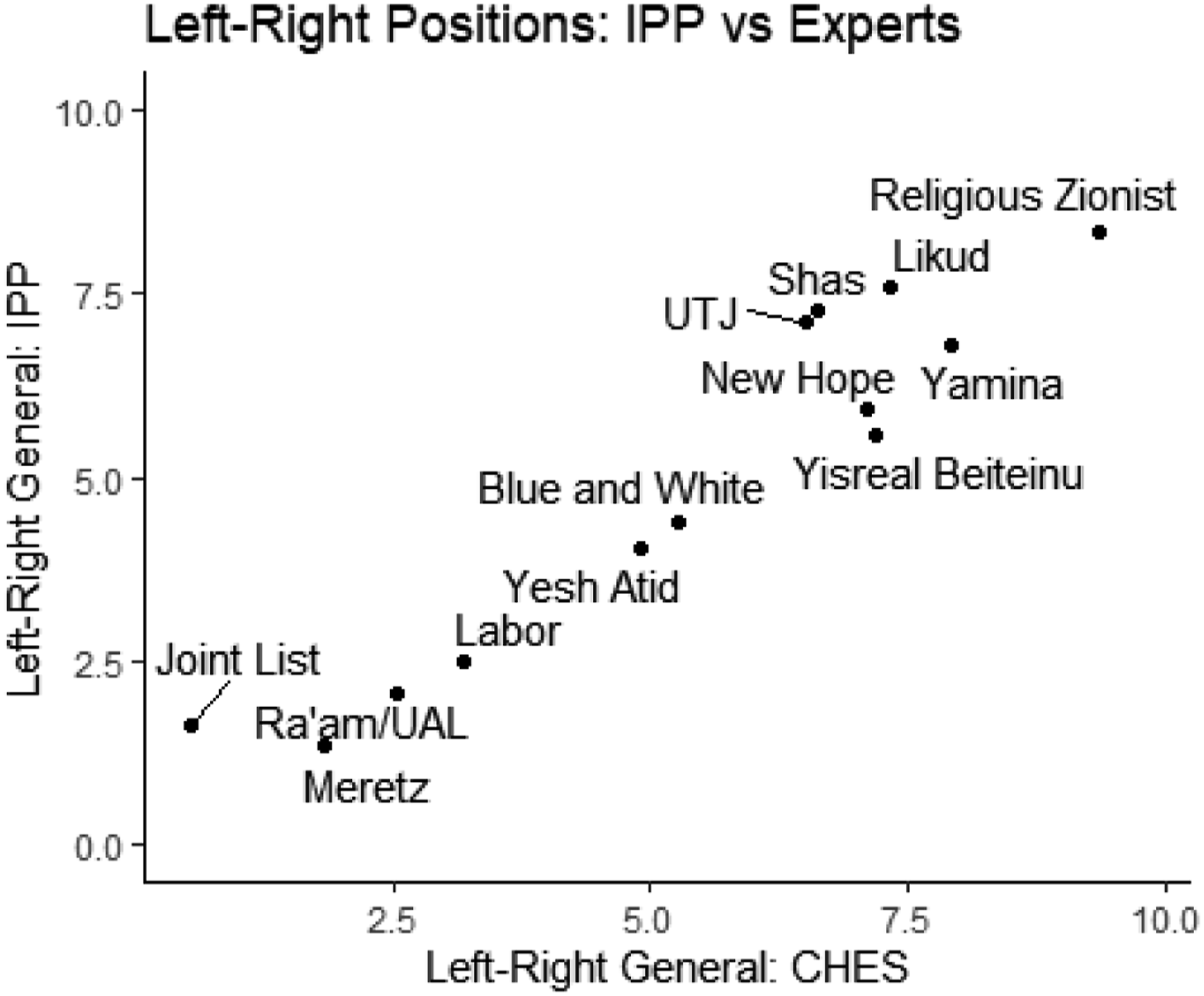
To test the validity of our measurement of party positions we show that in both 2021 and 2022 there is an exceptionally high correlation between parties' perceived Left-Right positions in the Israel National Election Study (INES) and the General Left-Right party placements in our data (0.96 in 2021 and 0.98 in 2022). The correlation is even stronger when comparing the experts’ placements of parties’ positions on the Israeli-Palestinian conflict dimension and the perceived positions of the parties in the INES (0.98 in both years). We show the parties’ positions on the general Left-Right dimension on the x-axis of Figure 1 and the parties’ perceived Left-Right positions from the 2021 INES post-election survey on the y-axis. In Figure 2, we show a similarly strong correlation with a second measure of public perception of parties’ positions. Parties perceived Left-Right positions in the 10th wave of the Israel Polarization Panel Dataset, 2019–2021 (Gidron et al., 2022) are strongly associated with the experts’ placements of parties’ position on the Israeli-Palestinian conflict dimension and General Left-Right in 2021
7
(0.95 in both waves). These results validate our measure of parties’ Left-Right positions and support our argument below that parties’ Left-Right positions (in the eyes of voters and experts) are based primarily on the parties’ announced positions with respect to the Israeli-Palestinian conflict. As Figure 1 and Figure 2 illustrate, there is a great deal of agreement between public and expert perceptions of party placements. These simple analyses, although limited by data availability, increase our confidence that the expert placements are valid placements of party positions. General left-right positions, Israel National Election Study and Chapel Hill Expert Survey 2021 & 2022. Note: Figure 1 shows parties' Left-Right placements from CHES Israel 2021; 2022 on the x-axis, and the mean respondent Left-Right placement of the parties in the respective Israel National Election Study. General left-right positions, Israel Polarization Panel and Chapel Hill Expert Survey 2021. Note: Figure 2 shows parties' Left-Right placements from CHES Israel 2021 on the x-axis, and the mean respondent Left-Right placement of the parties in wave 10 of the Israel Polarization Panel dataset.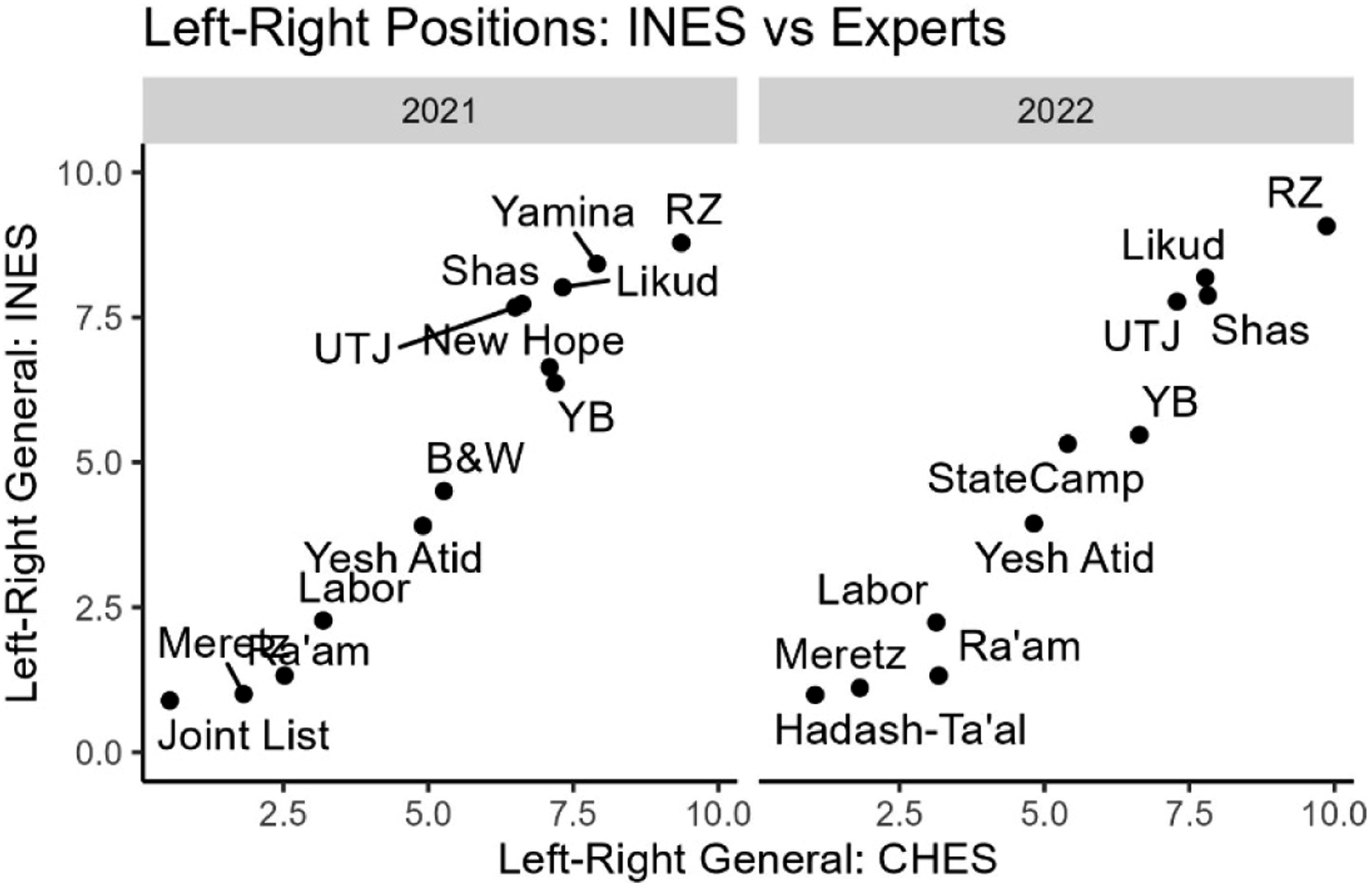
Having demonstrated that the data are valid, the next step is to assess the reliability of the expert placements of Israeli parties. By reliability, we are referring to the extent to which the experts agree with one another in terms of party positions on CHES survey items. In order to operationalize a measure of reliability, we compute the standard deviations of each party’s positions on a given survey item. Reliability measures are somewhat counter-intuitive. If the experts were to disagree with one another on where parties fall on certain survey items, this would yield larger estimates of reliability, whereas if they are in agreement with one another, our measure of reliability would be smaller. For example, if all experts were to place all parties at precisely the same scale points, our estimate of reliability would equal 0. That is, low values of our reliability measure suggest that the Israeli experts are in high agreement about the Israeli parties’ positions. Put simply, low values are better than high values.
In Figures 3–5, we plot the distribution of reliability scores for the three main dimensions of electoral competition: the left-right general, left-right economic, and socio-cultural dimensions for the 2021 and 2022 waves of the survey. We compare the distribution of reliability scores from CHES-Israel to the same measures computed for CHES-EU and CHES-LA (Latin America) as well as to two EU countries with similar party fractionalization as Israel (Belgium and the Netherlands). The resulting density plots display the degree to which experts agree (or disagree) with one another in terms of where each party in the data falls on each of the dimensions. Reliability scores - Israel and Europe. Reliability scores - Israel and Latin America. Reliability scores - Israel and Belgium/Netherlands.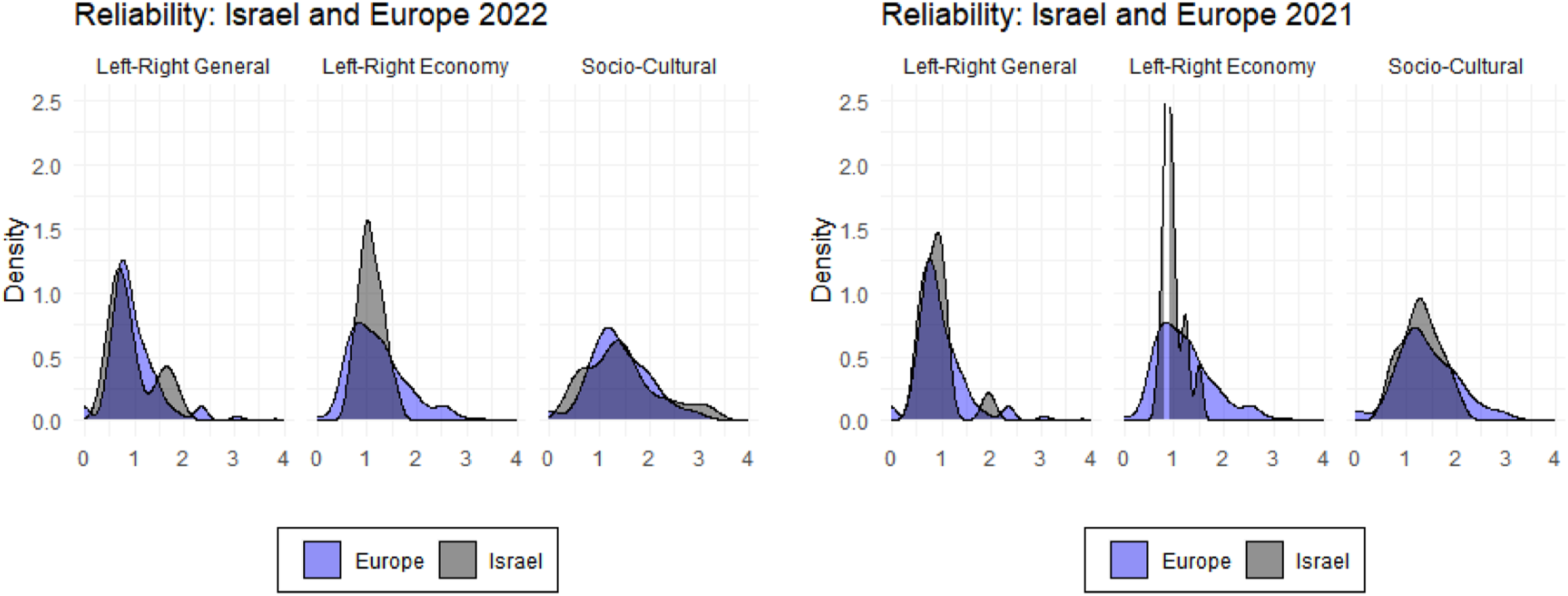
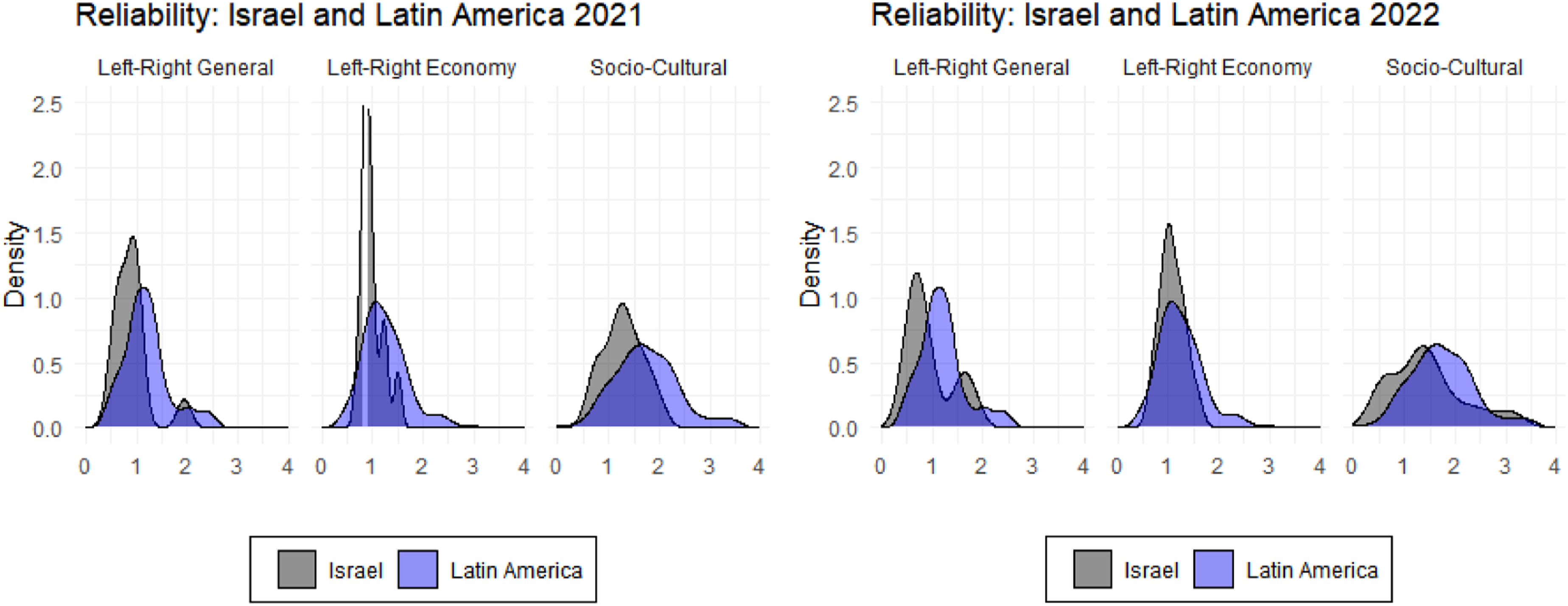
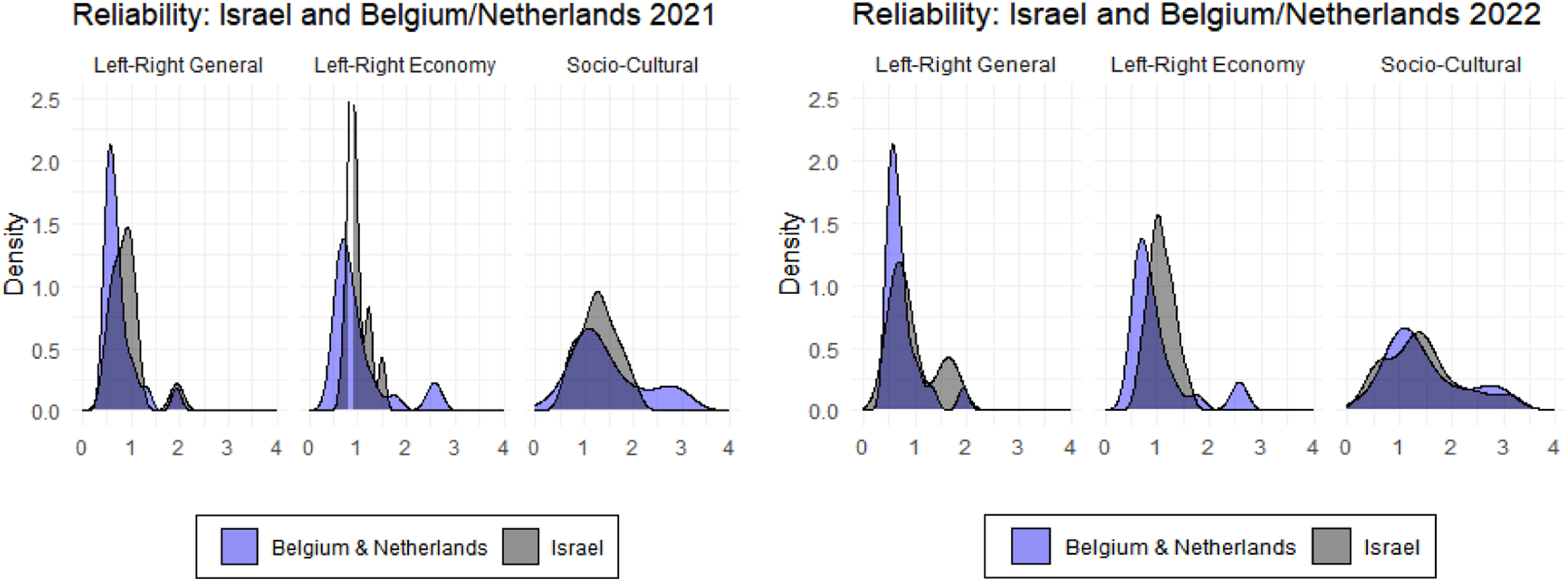
Figure 3 displays a comparison between the EU (blue) and Israel (gray) reliability scores across the three main dimensions in 2021 and 2022. The graph illustrates that Israeli experts are largely in agreement with one another in terms of where the parties should be placed, with the highest reliability evidenced in the left-right economic dimension, followed by the left-right general, and then the socio-cultural dimension.
Figure 4 illustrates the same information as Figure 3 for the comparison between Israel and Latin America and Figure 5 does so for the comparison between Israel and two EU nations with similar party systems to Israel, Belgium and the Netherlands.
The graphs all clearly illustrate that Israeli experts are largely in agreement with one another in terms of where parties should be placed on these three dimensions in ways similar to experts from other regions. It is not surprising that Israeli experts tend to be more reliable than their EU and Latin American counterparts as the latter combine expert placements across several countries. Figure 5 focuses on comparing only two countries to Israel and we see that Israeli experts tend to agree with one another regarding where parties fall on these dimensions in a similar manner as Belgian and Dutch party experts.
We note here that experts of Israeli politics, similar to experts of other political systems, disagree more on the socio-cultural positions of parties than on economic positions. We speculate that the weaker (higher values) reliability estimations on the socio-cultural dimension are due to the fact that policies related to economic issues are more concrete while socio-cultural policies are more abstract. Yet, Israeli experts show consistently high levels of reliability on all issues. Taking together with the validity of the data discussed above, we can conclude that the CHES-Israel is a valuable source of information for scholars who are interested in including the Israeli case in their comparative research of party politics, as well as those who are interested in studying the multidimensionality of Israeli politics.
The structure of the Israeli party system in comparative perspective
The structure of European party systems typically includes three dimensions – a general Left-Right ideology that includes parties’ positions on both economic and cultural issues, socio-cultural, and economic dimensions (Jolly et al., 2022) as well as an EU dimension, capturing how much parties support/oppose European integration. In Latin America, a single overlapping dimension captures both economic and socio-cultural issues (Martínez-Gallardo et al., 2022), with economic issues dominating the main axis of electoral competition.
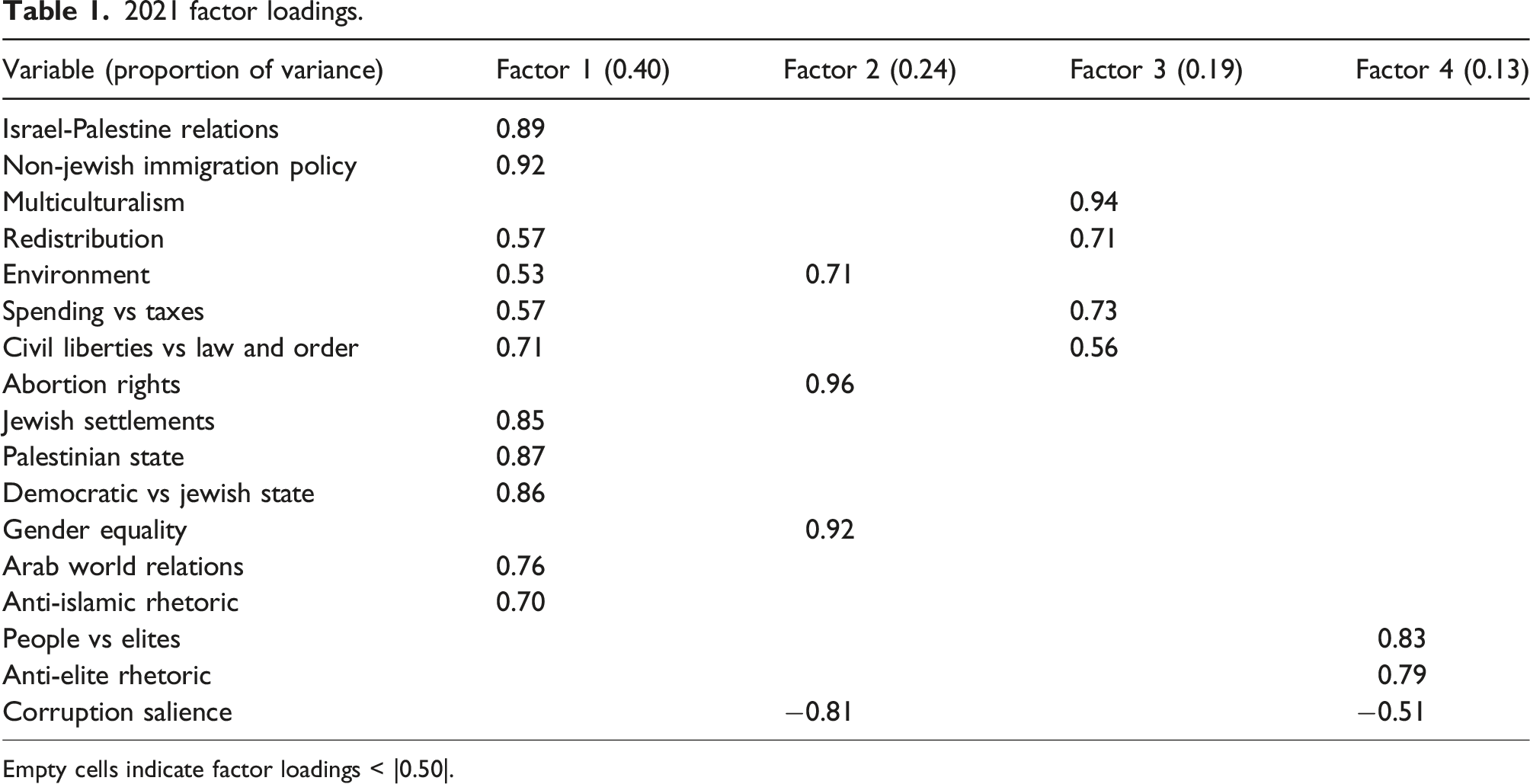
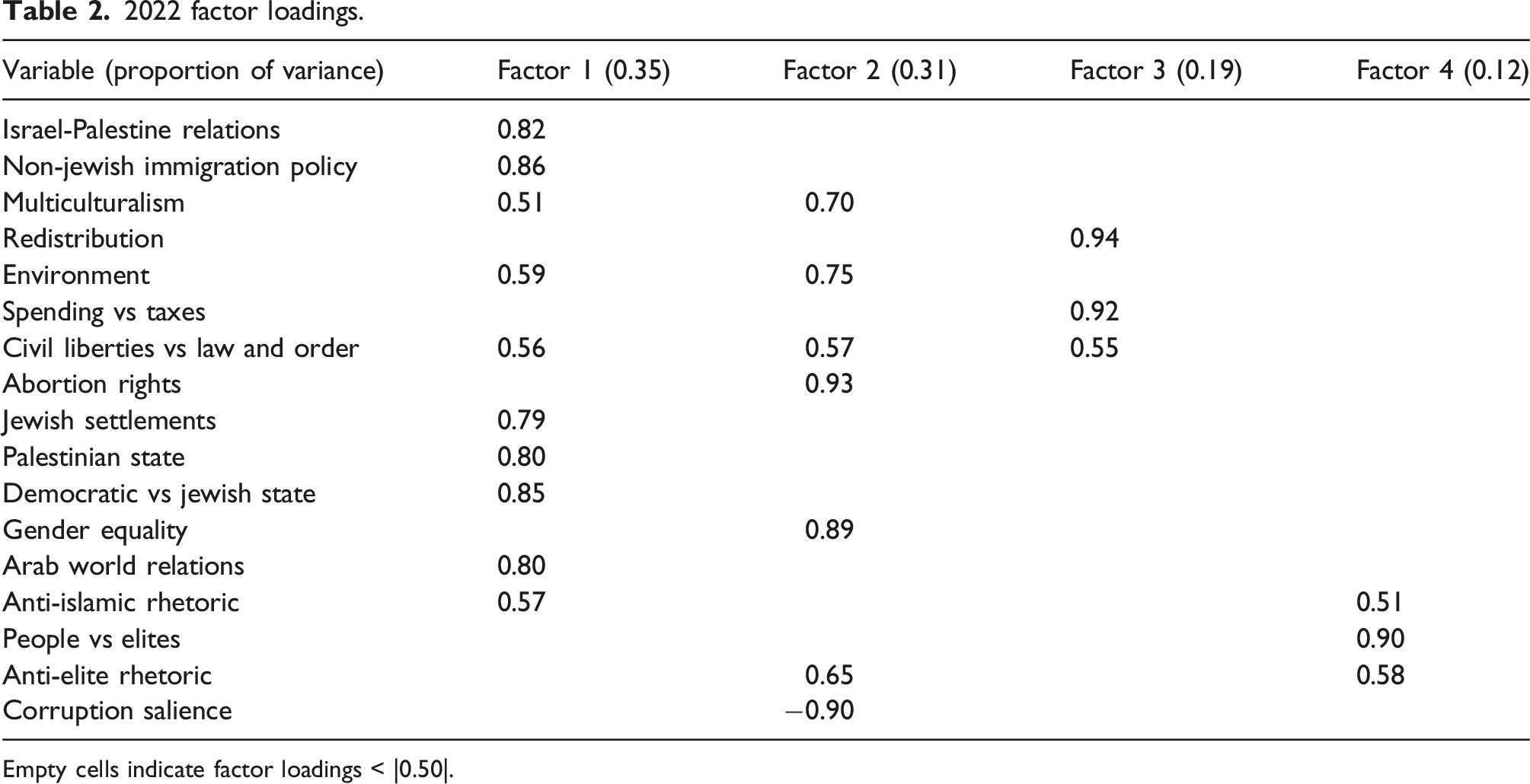
In order to explore the dimensionality of the Israeli party system, we use exploratory factor analysis (EFA) on a set of 17 survey items in the 2021 and 2022 8 survey waves. EFA is a useful tool for this purpose in that it produces a set of latent variables (factors) that best explain the variation in party positions across the 17 survey items without any a priori theoretical expectations informing the result. As such, we can see which survey items ‘hang together’ and can be treated as being observable indicators of latent dimensions as well as illustrating how many latent dimensions are necessary to capture the same information contained in the 17 items. We use the eigenvalue criteria to determine how many latent dimensions are needed to represent the 17 items, keeping factors with eigenvalues greater than 1. 9 In both 2021 and 2022, the results indicate that we should retain four factors, lending support to the belief that Israeli party politics are best described as multidimensional.
2021 factor loadings.
Empty cells indicate factor loadings < |0.50|.
2022 factor loadings.
Empty cells indicate factor loadings < |0.50|.
Along with the loadings, we also report what percentage of the variation in placements across the 17 items is explained by each factor. In 2021, we see that the first factor explains 40% of the variance in party placements, with factors 2, three and four explaining 24%, 19% and 13% of the variation, and 35%, 31%, 19%, and 12% in 2022.
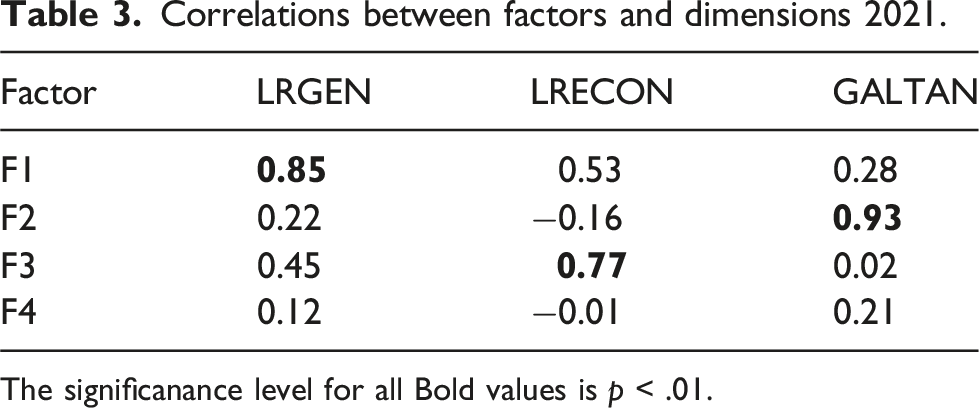
For the 2021 results, the 1st factor seems to capture the general left-right (LRGEN) dimension, which is largely associated with issues pertaining to relations between Israel and Palestine and the Arab world. The 2nd factor appears to capture party positions toward the socio-cultural dimension and is most closely related to issues such as abortion rights, gender equality, environmental protection, and political corruption. The 3rd factor captures party positions toward economic policies, such as redistribution of wealth and government tax and spending policies, whereas the 4th factor is related to issues of populism (defined as the average of people vs elite and anti-elite salience) and corruption salience.
In the 2022 data, we see a similar result to the 2021 output, with the 1st factor capturing the general left-right dimension and the 2nd factor capturing the socio-cultural dimension. Similarly, the 3rd factor is again the classic left-right economic dimension, and the 4th is again associated with anti-elite positions. The biggest change between 2021 and 2022 is that a party’s position toward multiculturalism was associated with economic positions in 2021 but was more closely associated with the general left-right and socio-cultural dimensions in 2022.
What is most striking here is the increase in the explanatory power of the socio-cultural dimension in terms of structuring Israeli party competition. Between the two survey waves, this factor’s explanatory power increased from explaining 24% of the variance in party positions in 2021 to 31% in 2022, whereas the explanatory power of the left-right general dimension decreased from 40% to 35%. We speculate that this change in the relative importance of the two factors is due to the structural change in the system due to the formation of the ‘change’ coalition. After the 2021 election, the governing coalition was the most ideologically diverse in Israel’s history. It included, for the first time, the Islamist party Ra’am, two left-wing parties (Meretz and Labor), two centrist parties (Yesh Atid and Blue & White), and three right-wing parties (Yamina, New Hope, and Yisrael Beiteinu).
Correlations between factors and dimensions 2021.
The significanance level for all Bold values is p < .01.
Correlations between factors and dimensions 2022.
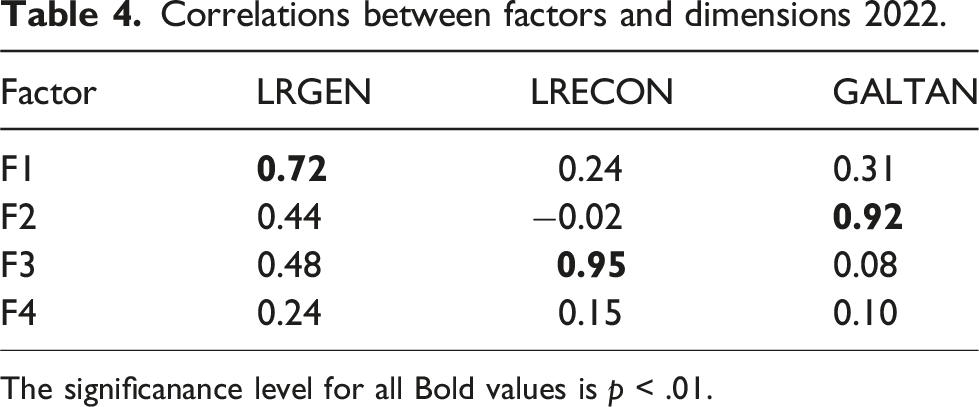
The significanance level for all Bold values is p < .01.
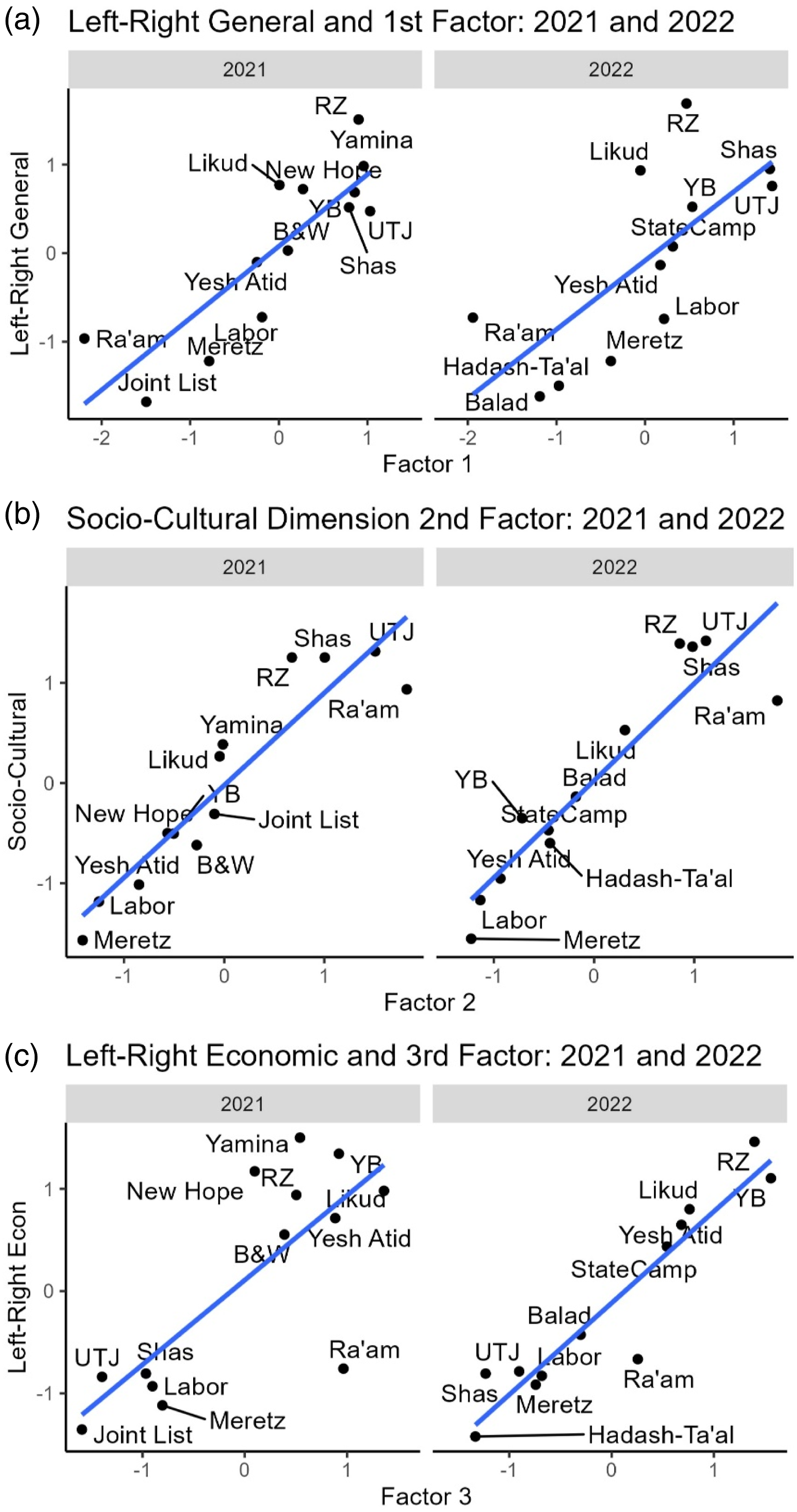
(a) Factor 1 and LR general dimension. Note: Figure 6(a) shows the factor scores from the first factor on the x-axis and the experts’ mean General Left-Right placements of parties on the y-axis. (b) Factor 2 and socio-cultural dimension. Note: Figure 6(b) shows the factor scores from the second factor on the x-axis and the experts’ mean Socio-Cultural placements of parties on the y-axis. (c) Factor 3 and left-right economic dimension. Note: Figure 6(c) shows the factor scores from the third factor on the x-axis and the experts’ mean Economic Left-Right placements of parties on the y-axis.
The uniqueness of the Israeli party system
While we have provided evidence that the Israeli party system is comparable to other established democracies around the world, it has some unique features. Unlike other party systems, the Left-Right continuum is dominated by parties' positions on issues related to the Arab-Israeli conflict. In their seminal work, Shamir and Arian (1999) argue theoretically and demonstrate empirically the importance of both external identity (defined as issues related to the conflict) and Jewish-internal identity (defined as issues related to cultural issues). They show that for the most part, citizens’ external identity is the most important predictor of their vote choice, their internal identity is also a strong predictor of voting, and both are stronger predictors of voting than citizens' socioeconomic issues. Harsgor et al. (2023) demonstrate that the arguments by Shamir and Arian (1999) still play a significant part in Israeli politics by showing that voting decisions of Israeli citizens are strongly predicted by their attitudes about the Israeli-Palestinian conflict. Other works on Israeli public opinion have shown that the Israeli voters' preferences are strongly related to the conflict and beliefs about future peace between Israel and Palestine (e.g., Yakter and Tessler, 2022; Yakter and Harsgor, 2022). Getmansky and Weiss demonstrate that Israeli citizens are less likely to support incumbent parties and leaders after unsuccessful wars (2023a), and this finding is especially strong among citizens who are old enough to participate in the war (2023b). Additionally, the conflict shapes voters’ perception of parties (Arian and Shamir, 1983; Shamir and Shamir, 2007) and parties’ policy agendas (Cavari et al., 2022) mostly based on issues revolving around the conflict, peace negotiation, and the future of the West Bank.
We show that the experts’ perception of the parties is also based on issues related to the conflict. We have asked our experts to place the parties on four issues related to the Arab-Israeli conflict: (1) a general question regarding the party’s position toward the conflict (Left-Right), (2) evacuate versus increase and support Jewish settlements, (3) favors or oppose a Palestinian state, and (4) position toward the Arab world. As can be seen above in Tables 1 and 2, all four questions fall into and are most closely associated with the general left-right dimension. This means that when experts place parties on the general left-right dimension, they take into account the parties’ positions with respect to the conflict. Moreover, the correlation between the parties' positions on the general left-right and each of the first three questions (Israel-Palestine, Jewish settlements, and Palestinian state) is over 0.98, and the correlation between the general left-right and the Arab world question is 0.84. These findings are in line with our knowledge about the structure of the electoral arena in Israel and individual-level preferences. Similar to the works discussed above, we find that Israeli parties’ positions are structured firstly around the conflict, then around cultural issues, and only then around economic issues. It is also important to note that the issue of non-Jewish immigration falls into the general Left-Right, i.e., the conflict dimension, and not the socio-cultural dimension as most European countries.
Comparing Israel to similarly fragmented countries such as Belgium and the Netherlands emphasizes the uniqueness of the Israeli party system. In Belgium and the Netherlands, similar to most other European countries, there is an extremely high correlation between parties’ positions on the economic and general Left-Right dimension (0.86 and 0.94 respectively). In Israel, however, this correlation is significantly lower at 0.77 in 2021 and 0.65 in 2022. This difference is mainly due to the religious parties, Shas and UTJ, which advocate a combination of right-wing positions on the Israeli-Palestinian conflict and left-wing economic positions. To some degree, the Religious Zionist party’s much more extreme right-wing positions on conflict-related issues than on economic issues also contribute to this lower correlation between economic and general Left-Right experts’ placements. We illustrate this point in Figure 7, where we plot parties’ Left-Right positions on the x-axis and economic positions on the y-axis. In this figure, the Israeli parties’ positions come from the 2021 wave in our data and the parties’ positions in Belgium and the Netherlands come from the 2019 CHES-Europe data. General left-right versus economic positions. Note: Figure 7 shows experts’ mean General Left-Right placements of the parties on the x-axis and economic Left-Right on the y-axis. Data from CHES Israel 2021; CHES EU 2019.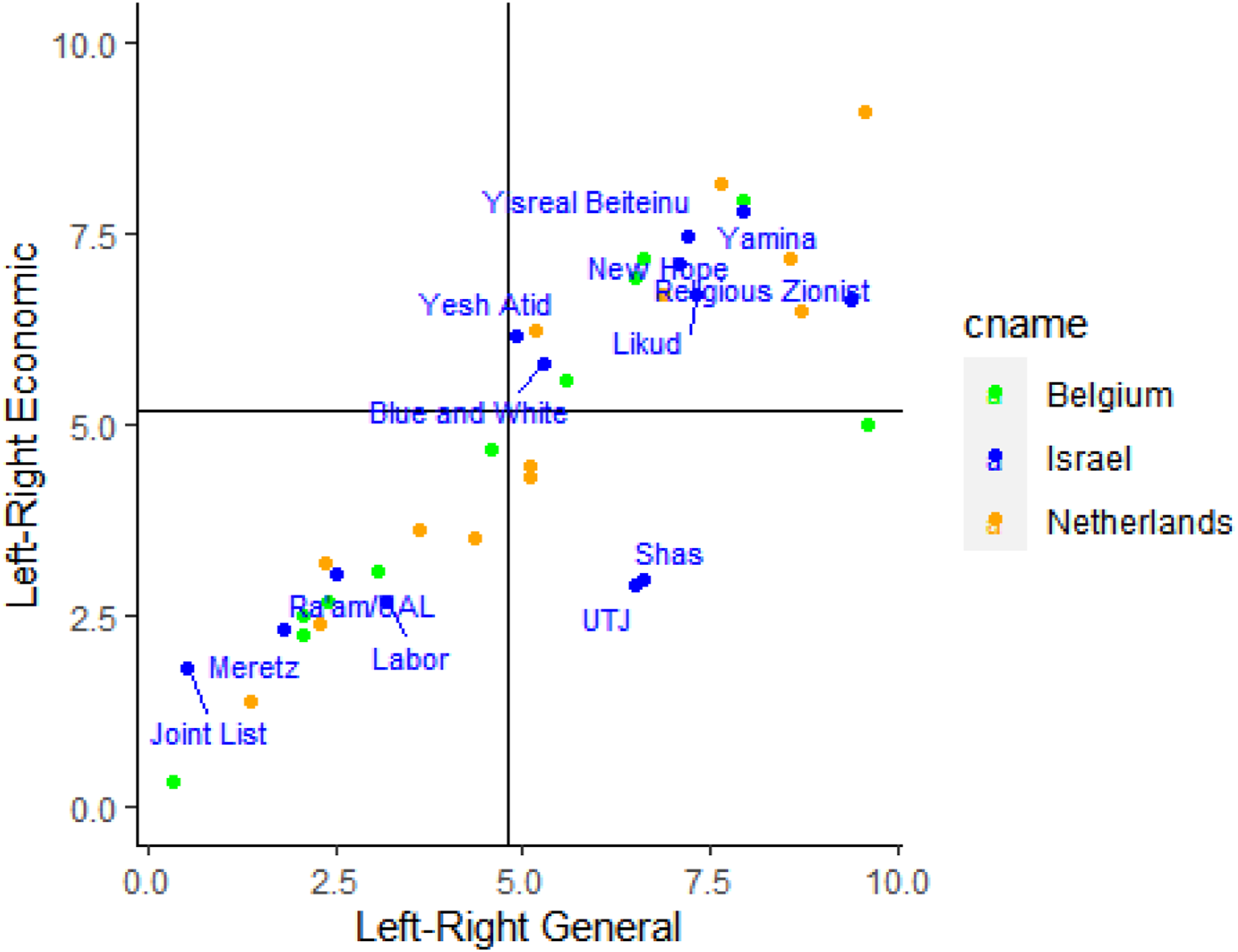
Before concluding this paper, we draw the readers’ attention to the increasing importance of polarization and populism in the Israeli political sphere. Since 2019 Israel has been going through a continuing political crisis that started after the collapse of Israel’s 34th government (Netanyahu’s 4th term), which included five elections between April 2019 and November 2022, two government formation failures and two governments that survived less than 18 months. This crisis is ongoing as the current government (Netanyahu’s 6th) is the most far-right in Israel’s history and is leading the country towards a constitutional crisis and democratic backsliding process (Gidron, 2023). During these crisis-infused years, Israel has suffered from increased levels of both ideological and affective polarization (Amitai et al., 2023). While these two types of polarization are related (see for example Algara and Zur, 2023), Bassan-Nygate and Weiss (2022) demonstrate that both time distance from the election and elite cooperation (in terms of grand or unity government) are associated with lower levels of affective polarization.
This vast political crisis is associated with parties’ positions that fall into the 1st and the 4th factors we presented above. Since the beginning of the crisis, Netanyahu was able to unify his own party, Likud, and cooperate with Shas, UTJ, and the Religious Zionist party. All four parties take a (far-)right stand on the Israel-Palestine variable (7 or more on the 0–10 scale). Yet, these are not the only right-wing parties in Israel. Yisrael Beiteinu, New Hope, and Yemina, all took similar positions on both the general left-right and the Israel-Palestine variable. What differentiates Netanyahu’s coalition partners and his opposition is the parties’ positions on issues related to populism and the salience of corruption. This is evident in Figure 8, where Netanyahu’s four coalition parties are visibly distinguished from the other parties in the system as they take far-right positions on left-right and do not pay attention to issues of corruption. Moreover, comparing the 2021 to the 2022 wave, we indicate increased polarization of the parties, where the coalition parties took an even further to the right positions on left-right and ignored corruption more. Israel-Palestine versus the Salience of Corruption. Note: The x-axis of Figure 8 represents the experts’ mean placements of the Israel-Palestine item. The y-axis represents the experts’ mean placements of the corruption salience, where high values mean the party pay more attention to issues related to political corruption, and low values mean the party does not pay attention to political corruption.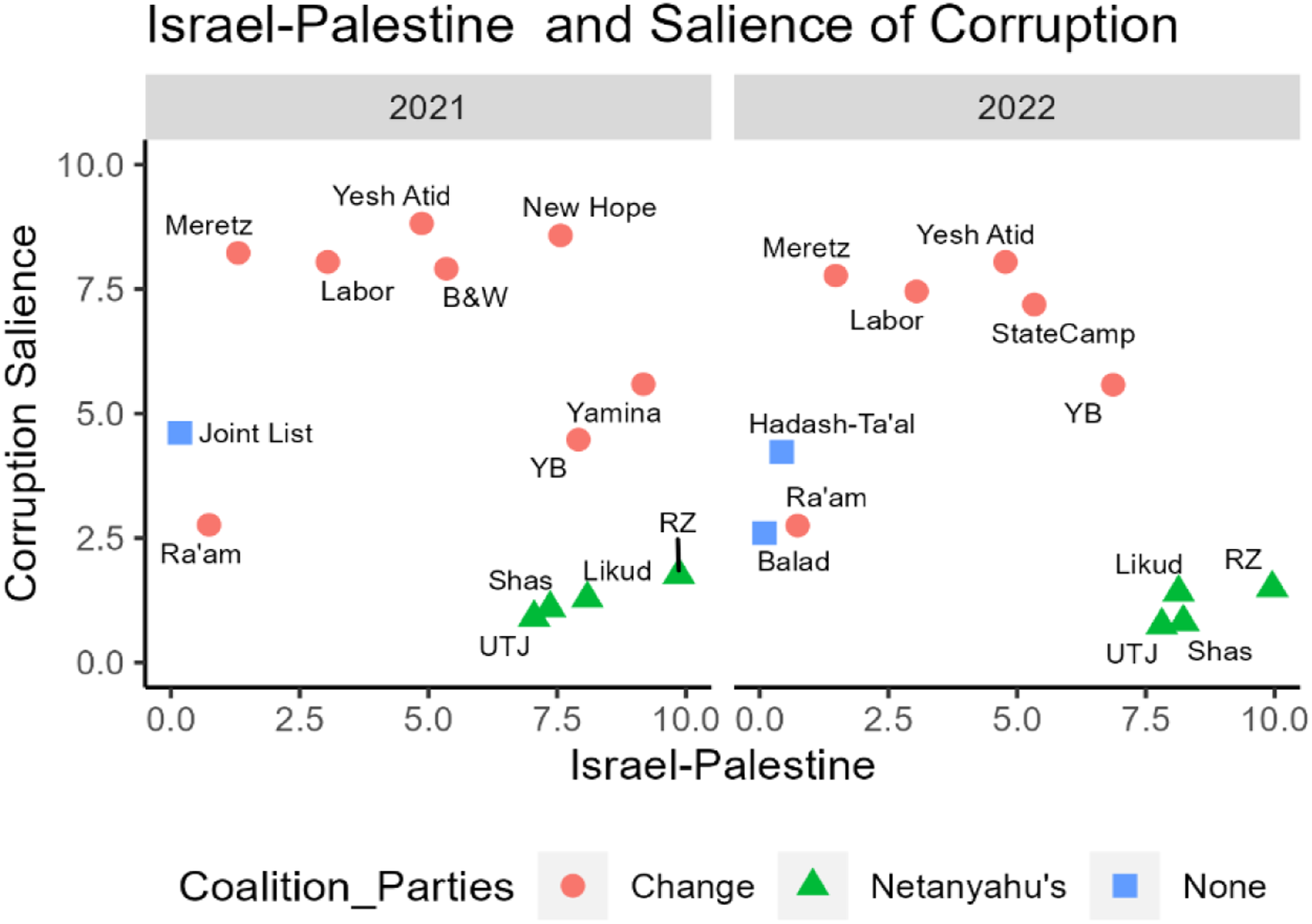
Similar levels of polarization between Netanyahu’s coalition and all the other parties can be seen (although to a lesser degree) when we plot parties’ left-right positions against their level of populism in Figure 9. We define populism as the average of two items in our survey – their stand on the people versus elite question and the salience of their anti-elite rhetoric. The increasing levels of populist rhetoric and tactics among Netanyahu and his supporters is by no means new, but has been increasing in recent years. For example, anti-elite rhetoric on social media increased dramatically among Likud members since the beginning of Netanyahu’s trial (Tzelgov, 2023), and Panievsky (e.g., 2022) discusses the increased attracts on the media by Netanyahu and his partners. Importantly, Lavi and Agmon (2021) introduce the concept of security-driven populism as a specific type of rhetoric aimed at excluding the Israeli left from the “real people”. Our experts’ placements of the Israeli parties capture a similar division between Netanyahu’s supporters and the opposition parties. Both Likud and Religious Zionist are on the far right and populist edge of the scale, while UTJ takes less populist positions. Yet, there is a clear distinction between the coalition and to opposition parties in 2022. Importantly, our data shows, similar to claims made by Gidron (2023), that Likud is “closer to the far-right parties of Europe than to the mainstream right” (p. 34). Israel-Palestine versus Populism. Note: The x-axis of Figure 9 represents the experts’ mean placements of the Israel-Palestine item. The y-axis represents the experts’ mean placements of two items – people versus elite and anti-elite salience. High values on this measure mean the party is considered more populist and low values mean the party is less populist.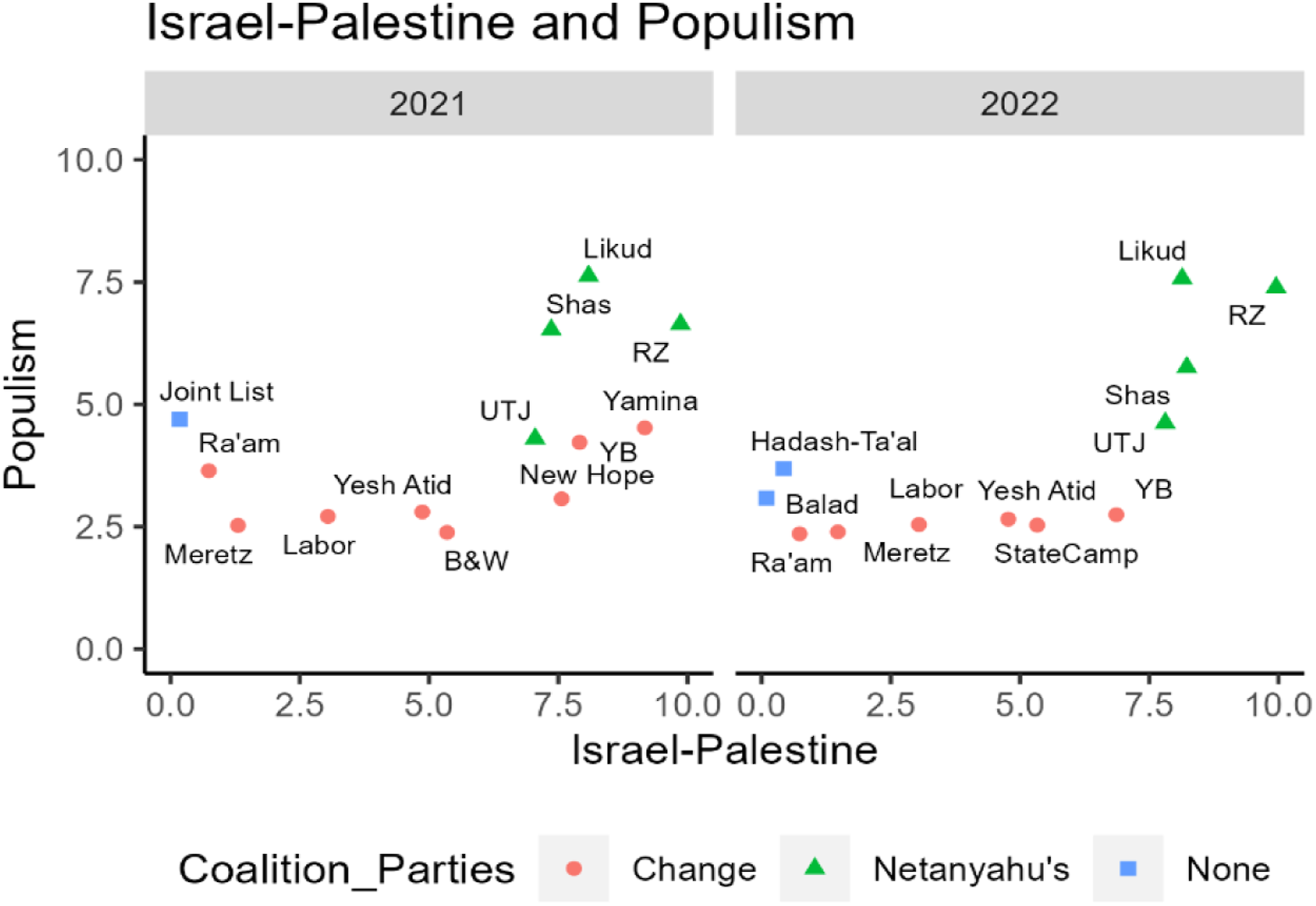
Conclusions
Despite being an OECD country, an established democracy, and a competitive party system, Israel is often ignored in the study of comparative party politics, often due to the lack of comparative data. In this paper, we introduce two waves of the Chapel Hill Expert Survey – Israel. These data are comparable with other CHES datasets such as CHES-EU, CHES-LA, and CHES-USA and can be a valuable source for studying Israeli politics in comparative perspective. Using public opinion data from the Israel National Election Studies and the Israeli Polarization Panel, we demonstrate the validity of the CHES-Israel data. Comparing variations in experts’ placements of parties' positions in Israel, Europe and Latin America, we show that the Israeli experts’ placements are as reliable as the European and Latin American. We then focus on countries with a similar level of party system fragmentation to show that experts' placements of parties’ positions have similar levels of reliability in Israel, Belgium and the Netherlands.
We uncover the structure of the Israeli party system using exploratory factor analysis (EFA) on a set of 17 survey items in the 2021 and 2022 survey waves. This analysis shows that Israeli parties can be pleased on four latent dimensions (i.e., we found four factors with eigenvalues greater than 1) corresponding to general Left-Right ideology, socio-cultural issues, economic policies, and populism. Similar to other established democracies, general Left-Right ideology and socio-cultural issues are the two most salient dimensions in structuring party competition, with the latter dimension’s salience increasing over time. The other two dimensions, economic policies and populism, are important for understanding Israeli politics (albeit to a lesser degree).
When comparing the Israeli party system to other countries, it is important to note at least one unique quality. While the general Left-Right ideological dimension is comparable with other countries, it is important to note that the underlying issues that structure this dimension are different. In Latin American countries this dimension tends to correspond with economic issues (Martínez-Gallardo et al., 2022) and in European countries with both economic and socio-cultural issues (Jolly et al., 2022). In Israel, on the other hand, the general Left-Right dimension corresponds mainly to issues related to Israel’s relations with the Arab world, and the Israeli-Palestinian conflict more specifically. Economic issues, unlike in other countries, seem to independently explain the structure of the party system.
Supplemental Material
Supplemental Material - The Israeli parties' positions in comparative perspective
Supplemental Material for The Israeli parties' positions in comparative perspective by Roi Zur and Ryan Bakker in Party Politics
Footnotes
Acknowledgements
We thank the editor of Party Politics, the three anonymous reviewers, Lior Sheffer and the participants of the Israeli Political Science Association annual 2023 meeting for their helpful comments. Our greatest gratitude goes to the experts who completed the survey and made these data available. The codebook and data are available at  .
.
Declaration of conflicting interests
The author(s) declared no potential conflicts of interest with respect to the research, authorship, and/or publication of this article.
Funding
The author(s) received no financial support for the research, authorship, and/or publication of this article.
Supplemental Material
Supplemental material for this article is available online.
Notes
Author biographies
References
Supplementary Material
Please find the following supplemental material available below.
For Open Access articles published under a Creative Commons License, all supplemental material carries the same license as the article it is associated with.
For non-Open Access articles published, all supplemental material carries a non-exclusive license, and permission requests for re-use of supplemental material or any part of supplemental material shall be sent directly to the copyright owner as specified in the copyright notice associated with the article.
