



Abstract
Europhilism has traditionally been associated with centre-left and centre-right parties, those parties that contributed to the development of the EU. However, centrist parties vary in their support of European integration. Yet, we know comparatively little about the extent to which these parties support European integration. Should they be classified as Eurosceptic, or do they continue to support European integration? A comparative analysis of national and European manifestos of centre-left and centre-right parties in Austria, Germany and the UK between 1990 and 2019 shows that pro-European attitudes can be split into three patterns: enthusiast, equivocal and critical Europhiles. These patterns are combined with Vasilopoulou’s patterns of Euroscepticism to create a continuum from support for to opposition to European integration, thereby recognising that centre-left and centre-right party attitudes can change across time. These findings have implications for research on centre-left and centre-right parties’ EU attitudes by identifying the nuances of the pro-European position.
Introduction
The relationship between left-right placement and support for European integration shows that centrist parties are the most in favour of European integration (Bakker et al., 2015; Hooghe, 2002). Centrist parties have been fundamental to the development of the European integration project, but two aspects have changed. Firstly, centrist parties have been challenged by Eurosceptic parties on European integration, an issue which they would rather ignore, and secondly, the EU as a whole has fundamentally changed since it was formed in 1992
The goal of this article is to unpack what is meant by a pro-European position and explore the variation of centre-left and centre-right pro-European positions on European integration. More specifically, the analysis seeks to find out how we can conceptualise the nature of centrist party positions on the EU and how they change their position on European integration over time.
The White Paper on the Future of Europe detailed five broad scenarios ranging from disintegration to more collective EU action (European Commission, 2017a). The White Paper was an attempt to shape a debate about the EU’s future, which culminated in the Rome Declaration on the 25th March 2017 whereby 27 member states agreed that they would ‘act together, at different paces and intensity where necessary, while moving in the same direction’ (European Commission, 2017b). Thus, the Rome Declaration embodied scenario 3 as outlined in the White Paper ‘those who want more, do more’ (European Commission, 2017a). The Rome Declaration further highlights the varying degree of support for further integration. While the majority of research has focused on studying Euroscepticism, there have been several attempts to understand positive party positions on European integration (e.g. Hertner and Keith, 2017; Kopecký and Mudde, 2002; Flood, 2002). Therefore, there is some recognition that centrist parties vary in their support for European integration.
Empirically, the article focuses on the positions on European integration made by three centre-left and four centre-right parties that exhibit varying levels of critical attitudes towards the EU in Austria, Germany and the United Kingdom (UK) (Jolly et al., 2022; Volkens et al., 2021; Ash, 2020; Schmidt, 2016). Centrist parties are defined as those belonging to the Christian Democrat, Conservative or Social Democrat/Socialist party families (Spoon and Klüver, 2020), whose electoral appeal is based on a ‘moderate ideological platform’. The article compares the centre-left and centre-right party positions on European integration across these countries.
Results from a qualitative analysis of party positions in their national and European manifestos between 1990 and 2019 suggest that a pro-European position can be categorised by three patterns: enthusiast, equivocal and critical. This novel typology is a useful tool that helps us to understand party EU positions in dynamic terms, both their domestic party positions and policy outcomes at the EU level. Its application in this study will show that centrist parties changed their position over time and that a pro-European position includes ambivalence and/or criticism of European integration. Therefore, this methodology combined with Vasilopoulou’s patterns of Euroscepticism can be applied across the left-right spectrum to better understand party positions on European integration.
Defining pro-European attitudes towards European integration
In the past two decades, there has been a growth of research into party-based Euroscepticism, partly as a result of the perceived decline of the ‘permissive consensus’, the idea that there was an agreement between the public and national governments to proceed with integration (Christiansen et al.,2012; Hooghe and Marks, 2009; Szczerbiak and Taggart, 2008). While Euroscepticism is used to analyse degrees of EU opposition, the literature on Euroscepticism can help us to categorise positive party positions on European integration because it identifies a distinction between diffuse support (for the general ideas of European integration) and specific support (for the general practice of European integration) (Kopecký and Mudde, 2002).
The literature on party-based Euroscepticism draws heavily on the work of Taggart and Szczerbiak (2001). Opposition to the EU can be distinguished between ‘hard Euroscepticism which refers to ‘outright rejection of the entire European project and opposition to their country joining or remaining members of the EU’, and soft Euroscepticism which involves ‘contingent or qualified opposition to European integration’ (Taggart and Szczerbiak, 2001:10). The differentiation between hard and soft Euroscepticism offers a useful tool to distinguish between an objection to the EU as a whole and opposition to certain parts of the EU. However, this typology is difficult to apply to centrist parties, given that there is a ‘relative absence of parties from government that are hard or soft Eurosceptic’ (Szczerbiak and Taggart, 2008:10).
Kopecký and Mudde (2002) proposed an alternative categorisation, differentiating between ‘diffuse’ support which includes support for the general ideas of European integration’, and specific support which denotes ‘support for the general practice of European integration; that is, the EU as it is and as it is developing’ (Kopecký and Mudde, 2002:300). These two dimensions lead to further refinement of possible party positions structured along the Europhobe/Europhile and EU-optimist/pessimist axes. While Kopecký and Mudde recognised that political parties can express different levels of support, the four types deduced from two dimensions are not entirely relevant to centrist parties. Both the Euroenthusiast and Eurosceptic categories can be theoretically and empirically applied to centrist parties. However, the Euroreject and Europragmatist categories are not empirically observable, at least until the UK referendum, given that centrist parties accept the general idea of integration. Thus, Kopecký and Mudde’s typology does not sufficiently capture the pro-European positions of centrist parties.
Drawing on the positions outlined by Szczerbiak and Taggart, Kopecky and Mudde, and Flood and Usherwood (2005), Flood and Soborski (2017) devise a set of categories from support to opposition: maximalist, reformist, gradualist, neutral, minimalist, revisionist, and rejectionist. The benefit of Flood and Soborski’s thin typology is that the categories can be used singly or in combination which allows for some recognition that a party’s overall position may be different from its position on a specific policy. However, Flood and Soborski (2017) emphasised that these categories are ‘not intended to convey any suggestion of specific content to the positions described, beyond basic stances towards EU integration’ (p. 41). Therefore, the broad categories and the lack of specific criteria, further highlight the difficulties in categorising parties that are treated as pro-European.
Drawing upon the categorisation of hard and soft Euroscepticism by Taggart and Szczerbiak, Hertner and Keith (2017) distinguish between ‘hard’ Europhilia which ‘can be understood as very strong unconditional support for the EU integration project in general, for the EU’s core policies and institutions, and for further transfer of powers to the EU’, while soft Europhilia can be understood as ‘strong support for the EU integration project in general’ but they call for different, or reformed, EU institutions or policies (Hertner and Keith, 2017:66). While Hertner and Keith acknowledge that centrist parties support for the EU varies, the distinction between the two categories focuses on the call for ‘different, or reformed, EU institutions and policies’, which suggests that these parties are less committed to the EU. However, advocating change or reform does not have to mean that centrist parties are less committed to the EU.
In summary, while the conceptualisation of party attitudes towards European integration fits imperfectly to centrist parties, the research on Euroscepticism is useful because it emphasises a distinction between opposition to the EU as a whole and opposition to certain aspects of the EU. However, scholars have not directly touched upon the conceptualisation of pro-European attitudes
Case selection and data
The empirical analysis focuses on three centre-left parties and four centre-right parties from Austria, Germany and the UK. These are the Social Democratic Party (SPÖ) and the People’s Party (ÖVP) in Austria, the Social Democratic Party (SPD), Christian Democratic Union (CDU) and Christian Social Union (CSU) in Germany and the Conservative and Labour Parties in the UK. These parties have been selected because they have either been in government or the main opposition party during the period 1990-2019 and are all traditionally regarded as ‘pro-European’, with the exception of the Conservative Party after 2016.
Furthermore, the environment in which these parties operate also varies. Firstly, the country’s attitudes towards EU membership are different. Euroscepticism was an ‘engrained feature of the British party system’ (Baker, 2008: 115). The environment in Austria is somewhat similar to Britain in the sense that Austria was a ‘latecomer to the EU’ (Kriesi, 2007: 89) and the Austrian public was less Europhile than other EU member states’ including Germany (Fallend, 2008). Unlike the UK and Austria, Germany was a founding member of the EU and has enjoyed a ‘stable elite consensus around the European project’ (Lees, 2008:16). By studying these parties this research presents a nuanced analysis of party positions on the EU, even in countries which are perceived as being either strongly supportive or somewhat opposed to the EU. By recognising the range of positions that centrist parties hold on European integration
The article does not include Eastern European parties because they tend to be more open about their criticisms of the EU, in contrast to those in the West which hide behind a ‘pro-European’ position. However, the typology produced in this research could also be applied to parties in Eastern Europe and beyond.
In order to analyse the party positions on the EU, I conducted a qualitative analysis of European and national manifestos from 1990 to 2019. During this period, the EU underwent momentous change including treaty change, enlargements, the introduction of the Euro and Britain leaving the EU. I identified 100 manifestos of varying length. National manifestos contain a section devoted to Europe, whereas European Parliament (EP) manifestos are devoted more broadly to the EU issue, so to narrow the focus, policy areas were chosen that were common to the centre-left and centre-right: economic policy, foreign and security policy, enlargement and the principle of subsidiarity. In relation to enlargement policy, a particular issue was the parties’ positions on Turkish membership. While some parties may argue that they oppose Turkish membership because they support a ‘deeper’ culturally similar Europe, when negotiations with Turkey began in 2005, it was clearly defined as ‘European’, only in later years did this changed with the move away from democracy and also in relation to its Islamic culture. Furthermore, while the salience of Turkish negotiations fluctuated it was a consistent theme in both national (which is not focused solely on the EU) and European manifestos, Turkey was explicitly mentioned, unlike some other candidate states. These particular aspects of European policy were also selected because they are defined within the founding Treaty on European Union (TEU) (European Union, 2012).
Conceptualising centrist party attitudes on European integration
Before developing a typology of party pro-European positions, it must first be established that centrist party positions on the question of Europe vary.
The Chapel Hill Expert Survey (CHES) provides an initial insight into the positions of political parties on European integration, with experts asked to estimate the ‘overall position of the party leadership towards European integration’ (Jolly et al., 2022; Polk et al., 2017). By using the CHES data collected between 1999 and 2019, it suggests that while most centrist parties are classified in the upper half of the scale ranging from one (strongly oppose) to seven (strongly in favour), there was significant variation across countries and parties (Jolly et al., 2022; Polk et al.,2017).
Figure 1 shows that the centre-left SPD, and SPÖ, as well as the centre-right CDU, and ÖVP scored the highest. The opposite is the case for the UK’s centre-left Labour Party and centre-right Conservative Party which scored the lowest. Between 2014 and 2019 there was a decline in support in the case of the centre-right ÖVP and Conservative Party, as well as the centre-left Labour Party which coincided with the refugee crisis and particularly resonant within the UK, the Brexit referendum. Despite this variation and change of position, all of these parties are treated as ‘pro-European’ (Jolly et al., 2022; Polk et al., 2017). Figure 1 demonstrates that not only has there been development in the positions of centrist parties but also that there is nuance between the parties’ positions. However, expert surveys such as CHES face several criticisms including that experts can be ‘conservative’ in their evaluations, which tend not to change dramatically over time. Furthermore, the assessment criteria for evaluating a party’s position on European integration is ambiguous (Whitefield et al.,2007) and the CHES data rely on quantitative analysis which is not able to capture the nuance of centrist party positions. Position of centre-left and centre-right parties towards European integration.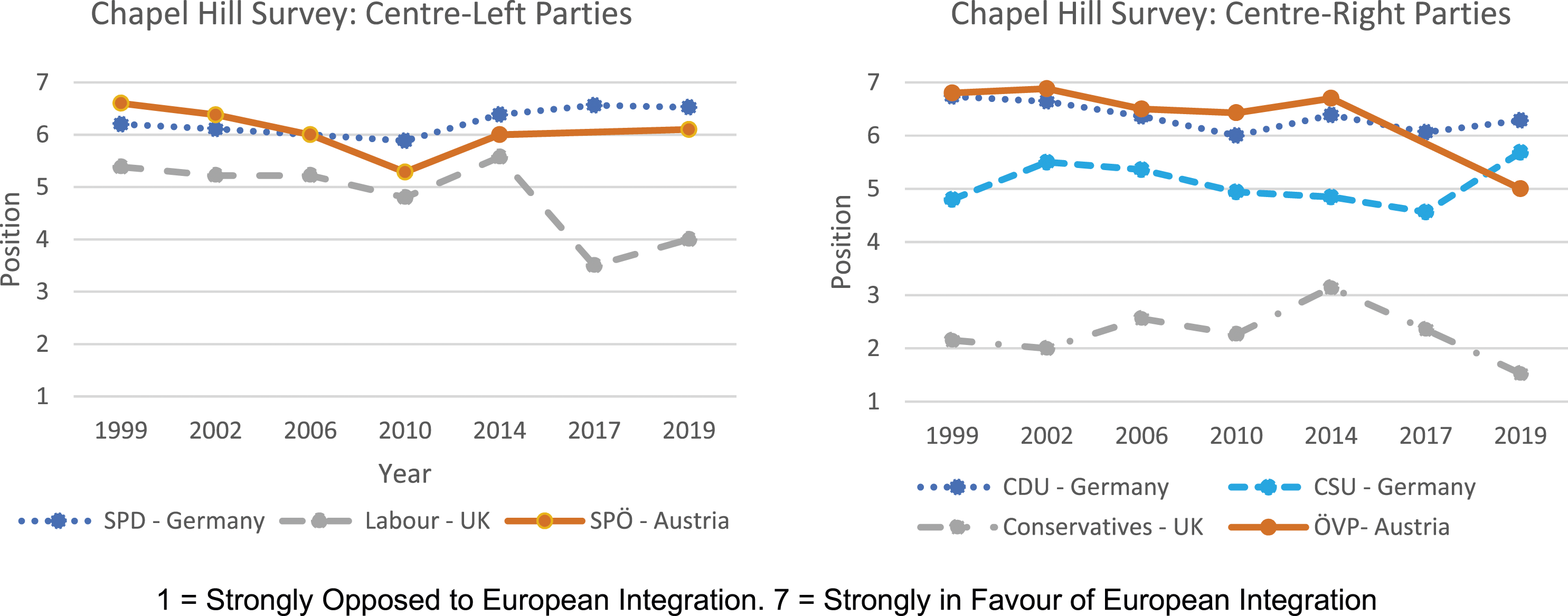
The criteria and typology
To develop the conceptualisation of centrist party attitudes towards the EU and capture the nuance of centrist party pro-European positions, this section puts forward the categorisation of their supportive positions into enthusiast, equivocal and critical patterns. These three categories are drawn from the current literature on Euroscepticism. Vasilopoulou (2011) distinguishes between opposition to the EU as a whole and opposition to certain aspects of the EU and identifies three aspects of European integration: the principle for cooperation, the current EU policy and the future of the EU polity. These three aspects of European integration are utilised and adapted to centrist parties to provide the basis for which the three patterns of Europhilism are identified.
Conceptualising European integration.

Based on the criteria of the principle, policy and future of integration, three types of party-based Europhilism are identified and Vasilopoulou’s (2011) patterns of Euroscepticism are incorporated to form a continuum from positions that support to those that oppose European integration. This allows this methodology to be applied to parties across the political spectrum. In Vasilopoulou’s (2011) original typology, the compromising Eurosceptic pattern is included, but as there is some overlap with the critical Europhile category, critical Europhile has replaced the compromising Eurosceptic pattern given that centrist parties are treated as pro-European. These positions are (also see Table 2): 1. 2. 3. 4. 5. Typology of attitudes towards European integration.
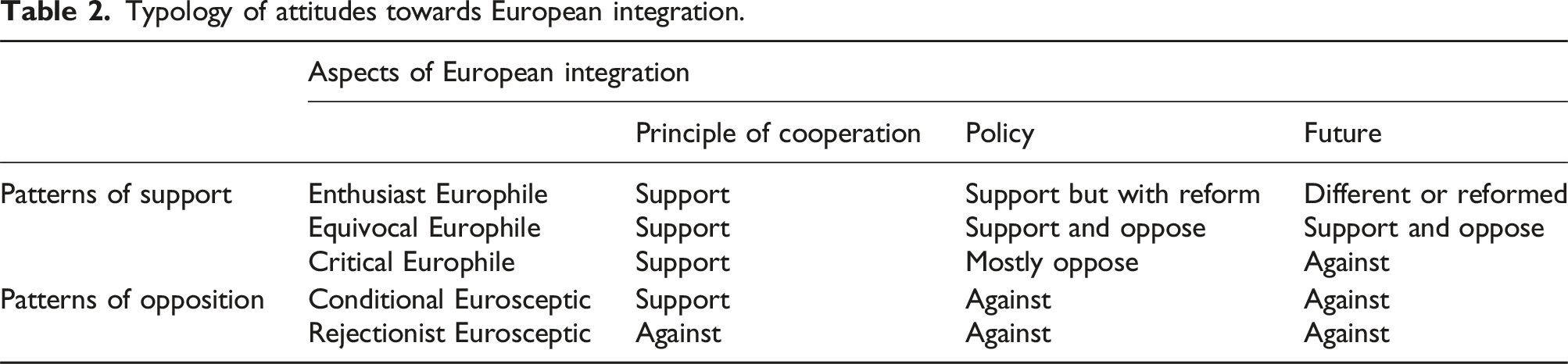
Table 2 shows the principle of cooperation as points of agreement among the different positions on European integration, with the exception of ‘rejectionist Eurosceptics’. The following section will apply the typology to seven centrist parties from Austria, Germany and the UK.
Changing attitudes on the question of Europe: Empirical overview
Centre-left parties
SPD: Enthusiast Europhile
The main centre-left party in Germany, the SPD can be classified as Enthusiast Europhile throughout the period from the 1990s to 2019. It advocated more cooperation between member states, and its support for the EU was justified on the basis that it promoted EU values (SPD, 2017; 2002; 1998). Throughout the SPD’s manifestos, there was clear support for the strengthening of European democracy (SPD, 2013) and encouraging further cooperation to increase ‘the EU’s ability to act’ (SPD, 2014) including in the area of economic and financial policy (SPD, 2019) in which it wanted to create an economic government (SPD, 2017; 2013), and in foreign and security policy in which the SPD wanted a European army and a defence union (SPD, 2017; 2014). The SPD also wanted to expand the competencies of the EP, wanting to transfer full participation in economic and monetary union (SPD, 2017). The SPD continued to support the Euro, and wanted to create a common financial budget, particularly with countries who share the common currency (2017).
The promotion of EU values was used as a justification for supporting the enlargement of the EU. However, it was also used to oppose Turkey’s EU membership because the actions of the Turkish government were against the EU’s shared values (SPD, 2017). While the SPD has not opposed Turkey’s EU membership outright, it indicated that neither Turkey nor the EU was ready for accession in the foreseeable future (SPD, 2019). Therefore, highlighting that a party can support an EU policy in general but opposed to specific aspects of it.
The position of the SPD on the question of Europe was summed up in its 2019 EP manifesto, ‘the goal remains the further development of the Euro zone into a social, economic and political union’ (SPD, 2019:42). 2 While the SPD (2014; 2013) opposed the centralisation and over bureaucratisation of Europe, the main focus was on developing greater cooperation. Despite support for EU enlargement becoming more subdued, the SPD continued to advocate greater cooperation and reform of EU institutions throughout the period. Therefore, the SPD supported the principle, policy and future aspects of European integration, advocating reform of the latter.
SPÖ: Equivocal Europhile
The SPÖ in Austria held similar beliefs to the SPD on the principle of European integration, stressing the importance of EU values (SPÖ, 2014) which justified its support for enlargement because it would ensure peace and stability (SPÖ, 2002). However, unlike the SPD, the SPÖ’s position was characterised by both elements of support and opposition to the EU throughout the period from 1990s to 2019.
The SPÖ increasingly became more reluctant to the enlargement of the EU, prioritising consolidation over future enlargements (SPÖ, 2004). The SPÖ’s justified its reluctance for further enlargement at least in the immediate future on the basis that it wanted a strong Europe that was able to act (SPÖ, 2006). Unlike the SPD, the SPÖ was opposed to Turkey’s EU membership because it believed that Turkey would ‘overwhelm’ the EU’s economic, social and political capacities (SPÖ, 2009; 2008). However, despite the SPÖ’s (2014, 2008) reluctance to further enlargement it continued to support enlargement of the EU to include the Western Balkans.
Regarding other EU’s competences, the SPÖ supported the principle of subsidiarity, supporting cooperation at the European level where needed, but everything else should be regulated at the national or regional level (SPÖ, 2014). As a result, cooperation and further development of the EU was encouraged in the areas of foreign and security policy (SPÖ, 2008; 2006; 2002), as well as strengthening the European social model (SPÖ, 2006; 2002). More broadly, the SPÖ was particularly convinced of the economic reason for Austria’s EU membership as it formed the basis of its economic success and prosperity (SPÖ, 2013). The SPÖ (2017) strongly supported the completion of the economic and monetary union.
The position of the SPÖ on the future of European integration differed from that of the SPD, while the SPÖ supported improving the EU and its institutions, it emphasised that the EU was not perfect and ‘if it were up to me, the EU would look very different’ (SPÖ, 2019:97). 3 While, the SPÖ continued to support the EU, it oscillated between support and opposition to certain EU polices.
The Labour Party: Equivocal Europhile to Rejectionist Eurosceptic
The UK Labour Party shared similar values to the SPD and SPÖ on the principle of European integration, expressing support for enlargement because it would promote EU values including ‘stability, peace and prosperity’ (Labour Party, 2015:75). On enlargement, the Labour Party was not as sceptical as the SPD or SPÖ, instead suggesting that while Turkey’s membership was a key test of Europe’s ‘potential to bridge between religions and regions; there must be continued progress on its application to join the EU’ (Labour Party, 2010:104). Unlike both the SPD and SPÖ, the Labour Party did not openly express reluctance to further enlargement of the EU, but importantly this attitude was a result of its support for limited European integration.
This support of limited integration was evident in both policy and future aspects of European integration. While the Labour Party supported economic integration, it fluctuated between expressing support and opposition to joining the Euro. Labour continued to promise that there would be no membership of the Single Currency without the consent of the British people (Labour Party, 2010; 2005; 2001). However, by 2015 Labour’s position changed stating that Britain ‘will not join the Euro’ (2015:77).
More broadly, Labour’s idea of limited integration envisioned Europe as an ‘alliance of independent nations choosing to co-operate to achieve the goals they cannot achieve alone’ (Labour, 1997: no page number). Furthermore, Labour’s support for EU legislation was based on the notion of whether it allowed for integration only in a limited number of areas. The Labour Party supported the Constitutional Treaty because it allowed Britain to retain control of key national interests (Labour Party, 2005).
By 2015, the Labour Party became a ‘Critical Europhile’. While it continued to support Britain’s EU membership as benefitting the economy and security, it guaranteed that ‘no transfer of powers from Britain to the European Union’ without an in/out referendum (Labour Party, 2015:77). Following the result of the 2016 Brexit referendum, Labour’s positioned changed to wanting a ‘close and cooperative relationship with the European Union’ which would deliver Brexit (Labour Party, 2019:4). Despite, remaining supportive of the single market, the Labour Party’s decision to accept the result effectively aligned itself to the hard Eurosceptic position (i.e. supporting UK withdrawal from the EU). Therefore, the Labour Party changed its position from an Equivocal Europhile to a Rejectionist Eurosceptic.
Centre-right parties
In comparison to the centre-left parties whose positions remained relatively stable during the period from 1990 to 2019, the centre-right parties changed position to become less supportive of European integration.
CDU: From Enthusiast to Equivocal Europhile and CSU: Equivocal Europhile
As the two centre-right parties in Germany campaign on a joint election platform in the federal elections, the CDU and CSU’s positions are difficult to separate with the exception of the EP elections where they run on separate campaigns. The EP manifestos highlighted that the CDU was initially more supportive of the EU compared with the CSU, but the CSU’s position was toned down when it ran on a joint manifesto with the CDU in federal elections. Therefore, the CDU’s position from the 1990s until 2018 can be classified as a ‘Enthusiast Europhile’. From 2019, the CDU/CSU’s joint manifesto in the EP elections appeared to include more similarities with the CSU’s position and therefore, the CDU’s position changed to an Equivocal Europhile. The CDU’s change from an Enthusiast to an Equivocal Europhile moved towards the position that the CSU already held throughout the period, which was characterised by oscillating between support and opposition to the EU.
Regarding the EU’s policy competences and similar to the centre-left parties, the CDU and CSU agreed on the importance of EU values as European unification was seen as a way to secure peace and freedom in the long term (CDU/CSU, 2002). After the enlargement of the EU by 12 member states and later Croatia, both parties became increasingly hesitant about the prospect of future enlargement. The CDU (2004) emphasised that Europe must ‘not grow indefinitely’, while the CSU (2004) wanted a consolidation phase which involved further deepening of the community. While a consolidation phase was not mentioned by the CDU in its own EP manifesto, it later appeared within their joint national manifesto with the CSU (CDU/CSU, 2009). Opposition to Turkey’s membership was expressed by both the CDU and CSU, but they both gave different justifications prior to 2019. The CSU opposed Turkey’s accession because Turkey does not share ‘common cultural and historical roots’ with EU member states (CSU, 2009). While the CDU (2014) rejected Turkey’s EU membership because it did not meet the requirements, the CSU (2014) was against Turkey’s full membership because it would overburden the EU.
Furthermore, both parties stressed the importance of the principle of subsidiarity. In the 2005 federal election, the CDU/CSU (2005) emphasised that ‘not every problem in Europe is a task for Europe’. A phrase which has been reiterated by centre-left parties that were previously discussed. However, on separate platforms the CSU (2009) stood for ‘a Europe that knows its limits - in terms of its competences, financially and geographically’ (p.1). 4 ‘We do not want a European superstate’ (CSU:2009:3). 5
In terms of the future of Europe, the CDU/CSU (2002) wanted to advance European integration by reforming the EU. Both parties wanted to strengthen European democracy, reform the Euro by establishing a monetary fund and establish a European army (CDU/CSU, 2013). Despite the similarities between the CDU and CSU, the CSU’s position focused on wanting ‘a better Europe, instead of always more Europe’ (CSU, 2014: 6) 6 which meant a Europe that was less-centralised and less bureaucratic (CSU, 2014).
In 2019, the CDU and CSU ran on a joint platform for the first time in the EP elections which highlighted that while the CSU’s position remained an Equivocal Europhile, the CDU had changed from an Enthusiast to an Equivocal Europhile. For example in relation to Turkey’s membership, the CDU and CSU emphasised that there would be no full membership of Turkey in the EU because ‘our Europe also knows its borders’ (CDU/CSU, 2019:22). 7 The CDU’s justification for opposition to Turkish membership had changed to incorporate the argument that the CSU had made in 2009 that it stood for a ‘Europe that knows its borders’ (CSU, 2009:1). Furthermore in relation to the future of Europe, the CDU/CSU’s (2019) position emphasised that their version of Europe is guided by the principle of subsidiarity. The balance of support and reluctance that embodied the CDU and CSU’s enlargement policy, also characterised their EU support more widely.
ÖVP: Equivocal Europhile to Critical Europhile
Similar to the centre-left SPÖ and centre-right CSU, the ÖVP was initially an Equivocal Europhile but from around 2006 it gradually developed and by 2017 it became a Critical Europhile. Despite the movement towards a more critical position on the question of Europe, EU values was an important justification for the ÖVP’s (2019) support for EU membership because it ensured peace, freedom, stability and prosperity’.
While the ÖVP (1999) initially supported enlargement as a peace project, the more countries that the EU enlarged to, the more hesitant the ÖVP became. After the enlargement in 2004, the ÖVP stated that the EU needs a ‘phase of consolidation’ (ÖVP, 2004). The notion of consolidation was repeated by the SPÖ and CSU, two parties which also held an Equivocal Europhile position. While Turkey’s membership was not openly opposed, the ÖVP emphasised that Turkey’s accession was not ‘a done deal’ and questioned whether the EU could cope with enlargement to Turkey (ÖVP, 2004). In 2006, the ÖVP (2006) went further by emphasising that EU negotiations would have an ‘open outcome’, and the accession of Turkey will not happen in the ‘foreseeable future’ (ÖVP, 2008). While the ÖVP (2017; 2013) became increasingly reluctant in regard to Turkey’s membership prospects, it continued to support the accession of the Western Balkans.
Throughout the period, similar to the centre-left and centre-right parties already discussed, the ÖVP wanted competences which cannot be dealt with by member states to be located at the European level (ÖVP, 2019; 2014; 2013; 2006, 2004; 2002). Therefore, regarding EU competences, the ÖVP stressed the importance of the economic aspects of European integration and strongly opposed leaving the Euro or the EU because it would undermine Austria’s economic strength and competitiveness. The ÖVP also wanted the European Stability Mechanism (ESM) to be further developed into a European Monetary Fund (EMF) (ÖVP, 2014). Beyond economic integration, the ÖVP (2017) also wanted the EU to be strengthened in the area of foreign, security and defence policy.
From 2006, the position of the ÖVP started to change to become a Critical Europhile. The ÖVP (2006) made sure to emphasise that as a European party it did not endorse all of the developments in Europe. While the ÖVP (2008) stated that ‘anyone who questions European integration is damaging Austria’, it goes on to say that ‘we want to be part of the EU so that we can say no to developments in Europe that we do not want’ (ÖVP, 2008:21). 8 While, the ÖVP (2013) had a clear aim to deepen integration, particularly with regard to the economy, on the future of Europe it stated that ‘we do not have to rebuild Europe but make it better’ (ÖVP, 2014:6). 9 The emphasis on the economic aspects of the EU was also evident in 2017 when the ÖVP (2017) stated that the EU must refocus on its core competences, with common trade at the centre. By 2019, the ÖVP (2019) supported a Europe which ‘lead by example with a lean structure’ (p. 6) 10 and argued for a strengthening of subsidiarity because ‘common sense must rule in Europe again’ (no page number). Therefore, the ÖVP placed much greater focus on the economic rather than political aspects of the EU.
The Conservative Party: Critical Europhile to Rejectionist Eurosceptic
The Conservative Party can also be characterised as a Critical Europhile up until after the 2016 Brexit referendum after which it became a Rejectionist Eurosceptic party. Similar to the position of the ÖVP, EU values was an important aspect to justify Britain’s EU membership (Conservative Party, 1997: no page number) and enlargement was specifically supported because it offered an ‘opportunity to advance the principles for which Europe should stand: free trade, free markets, deregulation and co-operation’ (Conservative Party, 1999: no page number). It wanted to make Europe ‘more diverse by working to bring in more nations, including Turkey’ (Conservative Party, 2009; 2005:26).
However, the Conservative Party expressed opposition to most aspects of the EU. Unlike the ÖVP, the Conservative Party changed position, from adopting the Euro if the British people gave their consent (Conservative Party, 1997), to opposing joining the Euro after 1997 (Conservative Party, 2010, 2005, 2001). Furthermore, it also opposed ‘participation in Eurozone bailouts or notions like the European army’ (Conservative Party, 2015: 72; 2014: 15). A position which strongly differed to the parties already discussed. The Conservative Party had long been opposed to the European army claiming that either the EU does not need its own army (Conservative Party, 1999) or that there should be ‘no European army outside of NATO’ (Conservative Party, 2001:28).
The opposition to different EU polices relates to the Conservative Party’s general attitude towards the EU, which had consistently wanted to ‘be in Europe but not run by Europe’ (Conservative Party, 2001:29; 1999; 1997). In the early stages of the EU’s development, the Conservative Party (1999) believed that European integration was close to its limits. The ‘Conservative vision is for a Europe which does less, but does it better’ (Conservative Party, 1999: no page number). A statement which echoes that of the ÖVP. The Conservative Party wanted no further transfer of powers from the UK to the EU without the British people’s consent (Conservative Party, 2010). It opposed an ‘ever closer union’ and emphasised that it would say ‘no to a constant flow of power to Brussels’ (Conservative Party, 2015: 72; 2014:15). Therefore, prior to 2016, the Conservative Party adopted a Critical Europhile position supporting the EU in general and a few limited policies but remained opposed to the EU’s current or future trajectory.
Centre left and centre-right party positions change on European integration.

Conclusion
Should centrist parties be classified as Eurosceptic or do they continue to support European integration on the whole?
By conducting a qualitative analysis of European and national manifestos of seven centrist parties in Austria, Germany and Britain between 1990 and 2019, this article shows that not only do they vary in the degree of support for European integration, their positions can also change across time. While criticism of European integration has become a central characteristic of centrist party positions, they broadly remain supportive of European integration. The exception are the British Labour and Conservative Parties who as a result of Brexit committed to following through with the UK’s withdrawal.
The novel typology outlined in this article which categorises party positions from Enthusiast Europhile to Rejectionist Eurosceptic creates a greater understanding of party positions on European integration across the political spectrum and is widely applicable to other party families, as well as to Eastern European parties. It reveals that centrist parties show three different patterns of support which captures the nuances of their position. Importantly, it acknowledges that centrist parties’ positions can change over time.
These results go beyond the existing literature which suggests that for ideological reasons, centrist parties are unwilling to move to a more Eurosceptical position (Green-Pedersen, 2012). However, this study suggests that the ideological positioning of a party does not necessarily mean that it will display the same levels of support for the EU. While the main focus of this research is on understanding centrist party positions on European integration, the idea that parties are willing to change policy position for electoral purposes is supported by considerable evidence (e.g. Adams and Somer-Topcu, 2009). However, why they change position is beyond the scope of this research. The typology that this research has outlined allows us to go beyond the binary typology Eurosceptic-Europhile and provides a clearer understanding of domestic party positions and policy outcomes at the EU level.
Footnotes
Declaration of conflicting interests
The author(s) declared no potential conflicts of interest with respect to the research, authorship, and/or publication of this article.
Funding
The author(s) received no financial support for the research, authorship, and/or publication of this article.
