




Abstract
We know that political parties play a crucial role in the electoral processes of established democracies. However, we know much less about how this role fades away. In this paper, we study the case of Chile, a country that, until a few years ago, was cited as an example of a stable and institutionalized party system. We study how the phenomenon of independent candidates has shaken the national party system. We use two separate strategies to study this phenomenon. First, we measure the marginal effect of the independent label, compared to other party labels, using a conjoint experiment. Our findings show that candidates who are presented as independents have a significant increase in their probability of being chosen. Second, we measure whether this electoral effect relates to party identification. We find that respondents show low animosity towards independent candidates and high animosity towards traditional parties. Furthermore, a majority of the studied population can be classified as negative partisans. These findings suggest that the recent emergence of independent candidates is a result of negative views on parties.
Independent candidates, understood as those not affiliated to political parties, have resurfaced as a topic of interest around the world. In 2013, a report from the European Parliament (Ehin et al., 2013) studied the rules and institutional arrangements around independent candidates in the European Union. Their findings show that, although the number of independent candidates has been on the rise, their electoral success has been quite limited, even after considering the different electoral rules. However, most of the research conducted on this topic, as the European Parliament report, has focused on the so-called supply side: the political offer of candidates. In this article, we evaluate a sometimes under-researched topic in the functioning of party systems: the relevance of citizens’ preference for independent candidates in electoral competition.
We implement this study in Chile, an especially suitable context for the study of independent identity. Anti-party sentiment has been a relevant force in Chilean politics since the return of democracy in 1989 (Avendaño and Escudero, 2022). More recently, over the last decade, positive partisan identity has fallen dramatically in Chile (Bargsted and Maldonado, 2018), making anti-party discourse more effective. Furthermore, Chile presents a unique context where independent candidates were given a platform to compete in equal conditions to party candidates: the 2020 election to the constitutional assembly. This election followed the same rules as those for the lower chamber of congress, with a few noticeable exceptions, such as gender and first nation quotas. The main difference of interest was that independent candidates were allowed to compete in lists, much like party candidates. In terms of the electoral mechanism, the only difference between party lists and “independent lists” was the name given to each. Under these conditions, 40% of the constitutional organ was elected from these independent lists. 1 Furthermore, two thirds of the elected members were not affiliated to a political party, even if they competed under the umbrella of one of them.
Independents are still a minority in both chambers of Congress, which is not surprising given that, in regular elections, they either compete alone against party lists, or request to be accepted within party lists. Even if we consider that a majority of the current members of Congress did run within the electoral list of a political party, many of them are not members of any party at all and market themselves as “independent”. Furthermore, recent electoral contests have seen important electoral victories for independents. For example, the member of the higher chamber with the highest number of votes in the country’s 2021 legislative elections is independent and, in the 2020 local elections, almost a quarter of Chileans ended up under the rule of independent mayors (who are elected in a first-past-the-post system). Hence, we consider Chile to be a crucial case because of its unique combination of increasing levels of negative party identification and the surge of different electoral rules that have allowed voters to experience the possibility of electing independent candidates for different public offices.
From the instrumental perspective of party identification (Downs, 1957), independent identity has been sometimes seen as the counterpart of the falling partisan vote and its substitution for voting based on policy preferences and candidates’ characteristics, the so-called ‘de-alignment’ theory (Dalton, 2016). If this is true, then independents do not possess any advantage because of their non-affiliated status and voters that choose such candidates do so because of other characteristics that these candidates hold. This would mean that any systematic difference in the electoral success of independent candidates derives from these candidates having positions or characteristics that distinguish them from party candidates, a supply-side explanation. This hypothesis is coherent with the idea of independents as “outsiders” who may bring with them attributes and positions that are less common in party candidates.
On the other hand, from the identity/affective view of party identification (Campbell et al., 1960) and its social identity theoretical development, it is possible to envision independent identity as equivalent to party identification (Greene, 2004). In this sense, independent candidates can benefit directly from the “independent” label which is meaningful for a section of the electorate. Finally, a variation on the affective explanation of preferences for independent candidates rests on the negative identity felt towards parties. It is possible to explain the preference for independent candidates as an expression of negative partisanship, that is, voting against party candidates as described by Rose and Mishler (1998). In this case, voters choose independent candidates not because they feel a particular attachment to this label, but rather as an expression of the rejection of party labels. Some have considered this behaviour as a manifestation of protest voting, but we side with the view that this phenomenon does not fit traditional notions of protest voting (Alvarez et al., 2018). In both versions of the affective explanation for the independent vote, this would imply a demand-side explanation for any systematic advantage of independent candidates. To clarify, we are not claiming that the independent label can be compared to traditional ideological affinities (e.g., left or right), but rather that in the context of low levels of party identification (and high levels of negative identification), the independent brand can become a useful strategy to signal to the electorate.
We test the relative importance of these three explanations with two different strategies. First, we run an online conjoint experiment, in which we make independent candidates compete with candidates from several other parties, while controlling for different policy positions and attributes of candidates and respondents. This allows us to measure the preference of voters towards independent candidates beyond policy preferences and candidate characteristics, 2 and, therefore, if there is an effect of the “independent” label that cannot be explained through a supply-side perspective.
Second, we measure both negative and positive party identification, by combining feeling thermometers and vote dispositions, including “independence” as a political label. This allows us to disentangle the relative importance of negative and positive identity in the preference for independent candidates.
We find that the negative identity that is felt towards parties is the main position of our studied population, and is largely behind the advantage independents have in electoral competition. At the same time, we find a significant section of respondents that identify positively with independents. In line with these findings, a large majority of respondents chose the independent candidate in our experiment, although we find that policy positions and some of the candidates’ attributes remain significant. This suggests that, while positive and negative identities might play a relevant role in the country’s electoral landscape, these identities do not trivialise other elements such as policy preferences and candidates’ attributes, such as localism. In other words, we find evidence that demand-side factors are driving the preference for independents, but it is also possible for supply-side factors to further improve the chances of independents winning elections.
The two sides of party identity
Party identity has a long and established tradition in the analysis of democratic performance, dating back to the Michigan model, based on a sociological-psychological perspective which was popularized in several studies of US presidential elections (Campbell et al., 1954; Campbell et al., 1960). Campbell’s main conceptual development in the studies of electoral choice was the construct of “party identity”. This construct is an affective attachment to the party, which becomes inscribed in the person’s identity and determines, to a large extent, their electoral behaviour, as well as the way the person interprets new political information. This element of the person’s identity would stem from the social groups in which that person was socialized. As Clarke et al. (2004) explain, this model would imply “tribal” voting, in the sense that who the voter is determines how they vote.
Negative partisanship, an opposite relationship to positive partisanship in which dislike of a group becomes part of one’s identity (Elsbach and Bhattacharya, 2001), has been a fundamental complement to the concept of positive party identity from its very origins, although typically understudied (Caruana et al., 2015). This concept was pivotal for Rose and Mishler (1998) research in post-Communist regimes, and combined with positive party identity, allowed them to explain relevant attitudes in democratic contexts. These authors devised a typology for party identification which rests on the combination of positive and negative partisanship. • Closed partisans are citizens that exhibit positive partisanship towards a party and negative partisanship towards another party. • Open partisans possess a positive partisanship towards one party, without presenting negative partisanship to any other party. • Negative partisans only exhibit negative partisanship towards parties. • Finally, apathetic partisans possess no positive or negative identification with any party.
Importantly, unlike the case of two-party systems, in multi-party systems the direction of negative partisan identity is less straightforward: “A multi-party system makes it impossible to deduce which party one should dislike based solely on one’s positive partisan attachment” (Michael McGregor et al., 2015: 303). In this sense, measuring negative party identity might provide unexpected insights into the relationships between partisans and parties of a party system (e.g., Garry, 2007). Furthermore, negative identification is not merely the complement of positive identification. As several studies show, negative evaluations have an autonomous influence on electoral and political behaviour, as well as self-identification (e.g., Elsbach and Bhattacharya, 2001; Medeiros and Noël, 2014). Furthermore, Haime and Cantú (2022) show that, in Latin America, negative partisanship helps voters without an attachment to a party to distinguish themselves from non-partisans, and is independent of positive partisanship, and different from a general distrust of the democratic system. In fact, in Meléndez and Rovira Kaltwasser (2021) show that negative identification can bring democratic resilience when it is directed towards populist radical right parties, as those who dislike the populist radical right are strong supporters of the liberal democratic regime.
Independent identity and the ‘dealignment’ theory
Abramowitz and Webster (2016) have noted how, somewhat paradoxically, electoral competition in the US has been characterized by an increasingly partisan behaviour, while the number of self-declared independents in the electorate has risen to levels seldom seen before. These authors explain the combination of these two trends through the consolidation of negative partisanship or as they put it: “A growing proportion of Americans dislike the opposing party more than they like their own party” (p. 21).
In the US, party identifiers started to decline in the late 1960s (Dalton, 2013a, 2013b, 2016). The decrease in the proportion of citizens identifying as Republican or Democrat was accompanied by a significant increase in survey respondents that identified as “independents”. From approximately 25% in the late 1960s, the percentage that described themselves as independent jumped to about 40% in 2016. Similar patterns have been observed in other established democracies in Europe, North America, and the Pacific Rim (Dalton, 2016).
More generally, several studies on party identity in affluent democracies have shown a shrinking number of citizens who describe themselves as being identified with any party and who increasingly describe themselves as ‘independent’ (e.g., Dalton, 2013b; Fiorina and Morris, 2002; Klar and Krupnikov, 2016). Some have interpreted this shift in political identification as an expression of the ‘de-alignment’ of voters, where party labels become less relevant and voters become more sensitive to the personal qualities of candidates (e.g., Garzia et al., 2022). This has been interpreted by some as implying “the potential to increase the number of voters who more closely follow the theoretical model of an informed, rational voter” (Dalton, 2016).
However, the assumption that independent identity equals lesser affective attachment or social identity, and therefore a stronger alignment with policy preferences, is debatable. In fact, some researchers have argued that attitudes toward parties and attitudes toward political independence are distinct dimensions that need not be mutually exclusive (Alvarez, 1990; Dennis, 1988; Kamieniecki, 1988). As Greene (2004) has noted “…it may be that either in addition to, or in place of, a social identification with a political party, some citizens may also socially identify with other political independents” (p. 4), and, therefore, it is plausible to “conceive of independents as just another political group” (p. 4).
The inclusion of the “independent” label into the identity framework raises theoretically suggestive questions regarding Rose and Mishler (1998) classification of party identifiers. Are independent identifiers negative partisans? Are they apathetic? Is it possible that some independent identifiers are closed (negatively identify with some party) and some are open (do not negatively identify with any party)? These questions point to the gap in the literature on independents which we cover in this research.
The literature on independent candidates’ electoral success is mostly focused on the institutional characteristics that foster or hinder such candidacies (e.g., Brancati, 2008; Ehin et al., 2013). These studies find that electoral systems influence the electoral strength of independent candidates. However, there is little said on the reasons why, even in disadvantageous contexts, independents sometimes win. One exception is Weeks (2011) study of supporters of independent candidates in Ireland. In this research he finds that localism, personalism and protest are significant factors driving vote for independent candidates, and that voting for independent candidates is “more of an expression of apathy towards parties rather than a specific antipathy” (p. 19). This contradicts previous research by Marsh and Sinnott (1999) which found anti-party sentiment to play a relevant role in the preference for independent candidates.
While it is likely that the motivation behind the vote for independent candidates differs across varying contexts, the fact that these previous studies on the demand for independent candidates relied on observational data meant that it was not possible to disentangle the marginal effect of an “independent” label, as this label would correlate with other attributes (e.g., localism). The present study allows us to better comprehend the relationship between voters’ general perception of parties and the preference for independent candidates, controlling for the other characteristics of these candidates.
Chile and the relevance of independent identity
Given the tendency for Latin American party systems to be less institutionalized, rather than de-alignment, some have preferred the term “partisan fluidity” to refer to the rapid rise and fall of partisan attachment in the countries of the region (e.g., Meléndez, 2022). Furthermore, according to Meléndez (2022), “[p]olitical parties with proportionally small sets of followers tend to produce larger sets of anti-partisans - in most cases more than half of the population” (p. 24).
Chile has been typically described as an exception in Latin America and an example of a stable political system with important levels of programmatic representation (e.g., Kitschelt et al., 2010; Levitsky and Roberts, 2011; Mainwaring, 2018). The country recovered its democratic rule when Augusto Pinochet’s dictatorship ended in 1990. Beginning with the 1989 presidential elections, Chile’s politics were dominated, for almost 30 years, by the electoral competition between two main coalitions: a centre-left coalition (Concertación/Nueva Mayoría) and a centre-right coalition (Alianza por Chile/Chile Vamos). However, the relative institutional stability of this electoral competition camouflaged a strongly and increasingly uprooted party landscape. This is partly a result of the party system having been increasingly structured around negative identity polarization (anti-centre left coalition/anti-centre right coalition), which created the illusion of loyal followers, but, in fact, citizens were “viscerally polarized against their rival” (Meléndez, 2022: 66). This might explain why, while support for the democratic regime has been relatively stable, satisfaction with democracy has systematically declined (PNUD, 2014: 54–55).
Anti-party sentiment has been a relevant force in Chilean politics since the return of democracy (Avendaño and Escudero, 2022). However, over the last decade, positive partisan identity has fallen dramatically (Bargsted and Maldonado, 2018), making anti-party discourse more effective. The proportion of people who identify with any party fell from around 52% in 2006 to only 19% in 2019 (CEP, 2006, 2019). Chile is the second lowest Latin American country (after Guatemala) with the smallest proportion of citizens identified with any political party (Lupu, 2015). This massive decline has had major implications for the political system. Low levels of party loyalty, together with an electoral reform implemented in 2017, has meant the emergence of several new parties and a process of party fragmentation (Alemán et al., 2021). According to recent polling, only 4% of the population expresses any measure of trust in the political parties (CEP, 2022). Several waves of social unrest have manifested a discontent towards political parties, which seem no longer able to channel demands adequately (Donoso and Von Bülow, 2017). This explains why recent studies have described the Chilean party system as suffering a crisis of democratic representation (e.g., Castiglioni and Rovira Kaltwasser, 2016; Luna, 2016). The falling levels of support for establishment parties and the two main coalitions has not translated into identification with new parties and has rather meant an increase in the anti-establishment identifiers that are “highly politicized but opposed to the moderate and convergent coalitions” (Meléndez, 2022: 44). This also means that, unlike the US case, Chile shows that support for independent candidates is somewhat detached from a traditional left-right axis, but more settled in an anti-party plattform.
Anti-establishment sentiment, as described by Meléndez (2022), can bring fragmentation and motivate vote for outsider candidates and new parties. This has been the case in recent Chilean elections, with important levels of turn-over in congress (Alemán et al., 2021). However, another possibility is that, instead of being channelled towards new parties, anti-party sentiment is translated into voting for independent candidates.
Following Chilean law, we call “independent candidates” to those that are not registered as members of any political party. As in many other countries (e.g., Brancati, 2008; Ehin et al., 2013), independence comes at an important structural cost for candidates. Under the Chilean semi-proportional electoral system for the legislative, while parties run in lists aggregating their vote, independent candidates compete without the possibility of forming their own lists. Independents can join party lists, but in this case the parties hold gate-keeping power over them, and they appear in the ballot as associated with specific parties. 3 Given this structural disadvantage, it would seem unlikely that any candidate would prefer to run as an independent, without being part of a list that aggregates votes, yet in recent electoral contests independents have had important electoral victories. For example, the member of the higher chamber with the highest number of votes in the country’s 2021 legislative elections is independent.
What would happen in Chilean legislative elections if independent candidates did not have a structural disadvantage? In mid-2021, Chileans elected members of a constitutional assembly. This election followed the same rules as those for the lower chamber of congress, with a few noticeable exceptions, such as gender and first nation quotas. Arguably the main difference was that independent candidates were allowed to compete in lists, much like party candidates. In terms of electoral rule, there were no differences between party lists and “independent lists”, and they were not required to show a minimum of ideoogical agreement between the independent candidates within the list. Under these conditions, 40% of the constitutional organ was elected from these independent lists. The impact of this election was so significant that there were even discussions in congress about replicating the electoral system of the constitutional assembly in regular legislative elections, but then discarded. 4
This electoral success could be the result of independent candidates having certain characteristics or policy positions that differentiate them from party candidates. The other possibility is that voters prefer candidates with an “independent” label, driven by an anti-establishment sentiment (Meléndez, 2022) or independent identity (Greene, 2004), regardless of the characteristics of each candidate. When controlling for candidates’ attributes, a residual impact of the independent label –if such a residual exists– would imply that independence is seen as a meaningful brand for voters. To investigate the existence of such a “brand effect” one would have to test the electoral success of independent candidates controlling for their attributes and positions, which is what we study in this research.
We place significant attention to the case of the Chilean Constitutional Convention election of 2021 because it provides useful insight as to how electoral institutions can affect behaviour. Although we implement our study within the context of a congressional election, using traditional institutional blocks for independents, voters had just experienced the constitutional election of 2021. Our argument is that, when allowed, voters could prefer independent over partisan candidates.
Data and methods
The first part of the study will analyse the way different forms of partisanship might be present in the population. This will include the existence of negative and positive partisanship, applied for parties and independents. Out of this analysis four main groups will emerge: negative party partisans, positive party partisans, positive independent partisans, and apathetic citizens.
The second part of the study will analyse the existence of an “independent” bonus. That is, the existence of a general preference for candidates classified as independents. The reason a conjoint experiment is used is that without making explicit other aspects of the candidates, such as their political background, descriptive characteristics, and policy positions, there is a risk that respondents would infer these aspects through the partisanship label or, in other words, that “party” and “independent” labels are masking (Bansak et al., 2021) other aspects relevant for voting choice. While it is always possible to imagine other characteristics and policy positions that respondents might associate with party and independent labels, the included characteristics broadly cover aspects discussed in the literature in terms of descriptive representation (e.g., Childs and Cowley, 2011; Gay, 2002; Krupnikov and Spencer, 2015; Kirkland and Alexander, 2018; Pitkin and Hanna, 1967; Pantoja and Segura, 2003; Rosenthal, 1995) and policies reflecting the main economic and social value scales (Lipset, 1959; Surridge, 2020).
The survey sample was obtained through Datavoz, a Chilean polling company, between November 16 and December 2 of 2021. The targeted population was Chilean residents, over 18 and the sampling frame consisted of a large email data set gathered by the polling company (respondents were contacted via their email addresses). 1998 respondents answered the survey, corresponding to a 7.07% response rate. All analyses include weights provided by the polling company to make the sample representative, on traditional demographics, of Chilean population (over 18 years old). These demographics include age and gender. 5
After the five reiterations of this conjoint experiment, additional information was gathered on each respondent, including demographic information and broad policy preferences (the same policies the hypothetical candidate held).
Measurement of party and independent identity
Feeling Thermometer (FT) ratings have been extensively used to measure the negative affect towards out-parties (Abramowitz and Webster, 2016; Iyengar et al., 2012; Lelkes and Westwood, 2017; Mason, 2015; Rogowski and Sutherland, 2016). However, negative affect is not a sufficient condition for negative identity. As Bankert (2020) has argued, voters can hold strong negative affect towards parties without negatively identifying with them. Some researchers have tried to measure negative party identity in a more explicit way by directly asking for vote intention (Medeiros and Noël, 2014; Meléndez and Rovira Kaltwasser, 2019; Rose and Mishler, 1998). However, these measurement strategies run the risk of confounding strategic considerations, such as not voting for a party because of its low chances of winning. Michael McGregor et al. (2015) address these difficulties by combining the two previous methods.
In this article, we build on Michael McGregor et al. (2015) measurement strategy for negative partisanship. We include both an FT towards parties, and a question on disposition to vote. The feeling thermometer avoids purely strategic considerations, while the voting disposition avoids general affect measurements that do not translate to meaningful political attitudes. Using the same threshold as Michael McGregor et al. (2015), we define the presence of negative party identity when three criteria hold: 1. The party is characterized as one for which the individual “absolutely would not vote for”. 2. The party has the lowest level for that individual on the feeling thermometer. 3. That evaluation on the feeling thermometer is lower than 50.
Because the Chilean electoral system uses unlocked lists, meaning voters choose candidates within party lists, we slightly modify the wording of the question on voting disposition and the feelings thermometer, asking about disposition to vote for and feelings towards a candidate from a party, rather than for a party.
To maintain symmetry between negative and positive partisanship, we will not use the traditional measurement strategy of party identification, asking directly for it, and instead use a measure following our operationalization of negative partisan identity. The criterion for determining whether an individual has positive part identity will be as follows: 4. The party is characterized as one for which the individual “absolutely would vote for”. 5. The party has the highest level for that individual on the feeling thermometer. 6. That evaluation on the feeling thermometer is higher than 50.
This will allow us to clearly compare the two modes of identification as they will reflect positions on the same two-dimensional scale.
Following Rose and Mishler (1998), a close partisan will be defined as an individual that shows positive identity towards one party and negative identity to another. An open partisan will be one that only exhibits positive identity. A negative partisan will be one that only exhibits negative partisanship. Finally, apathetic citizens or “apartisans” will be defined as individuals that present no negative or positive identity for any party.
We broaden these definitions to include independent identity in a straightforward way, by including the existence of a candidate labelled “independent”. In other words, we included a feeling thermometer index for independent candidates and voting disposition for an independent candidate.
The prompt we use (in Spanish) for voting disposition reads as follows: “Assume there is currently an election in Chile. Would you vote for a candidate to the Lower Chamber of Congress from the following parties”. The answer is in Likert format, with five levels ranging from “absolutely no” to “absolutely yes”. As for the feelings thermometer, the prompt we use (in Spanish) reads as follows: “We would like you to qualify your feelings towards the following candidates in a thermometer from 0 to 100. The higher the number, the more favourable the feelings towards the candidate, the lower the number, the more unfavourable they are”. An example of the original prompts (in Spanish) can be seen in Figure 7.2 in the appendix.
Measurement of preferences for independent candidates
Conjoint experiments are especially useful for disentangling the relative importance of different factors in discrete choices such as voting choice (e.g., Bansak et al., 2020a, 2020b). In particular, we run an online survey experiment in which respondents are asked to choose between two hypothetical candidates to the lower chamber of congress. Each respondent repeated the conjoint experiment task five times. 6
We describe the two candidates in terms of four broad policy positions (a state’s role for income redistribution, a state’s role in intervening in the economy, the need for harsher punishment for people who break the law, and positions on immigration). These four policy positions cover the two value axes, economically left/right and authoritarian/libertarian, that are typically seen as dividing the political landscape (e.g., Surridge, 2020). Additionally, personal descriptive characteristics such as age, occupation, education, and political experience were included. These characteristics have been described as markers of “mainstream” politicians in Chile (PNUD, 2014). Specifically, politicians in congress have tended to be older, more educated, and have prestigious occupations, such as law and medicine. Similarly, by definition, professional politicians are characterized by having political experience. Given Weeks (2011) findings that independent candidates advantage was due to their “localism”, whether the candidates are local was also included as an attribute.
Finally, one of the candidates is described as independent, while the other is randomly assigned a party affiliation broadly reflecting the country’s traditional left-right spectrum: Communist Party (PC), and Socialist party (PS) on the traditional left and centre-left, Christian Democratic Party (DC) on the centre, Renovación Nacional (RN) and Unión Demócrata Independiente (UDI) on the right and centre-right. We also included a non-traditional party with representatives in the lower chamber of congress at the time of the data collection, November 2021. Specifically, we chose the newly formed leftist party Revolución Democrática (RD), the non-traditional party with the highest number of members in Congress (10 members in the lower chamber).7,8
Figure 1 shows the prompt with an example pair of profiles translated into English. In the appendix, Figure 8 shows the same prompt in the original Spanish version. Example prompt of conjoint experiment translated to English.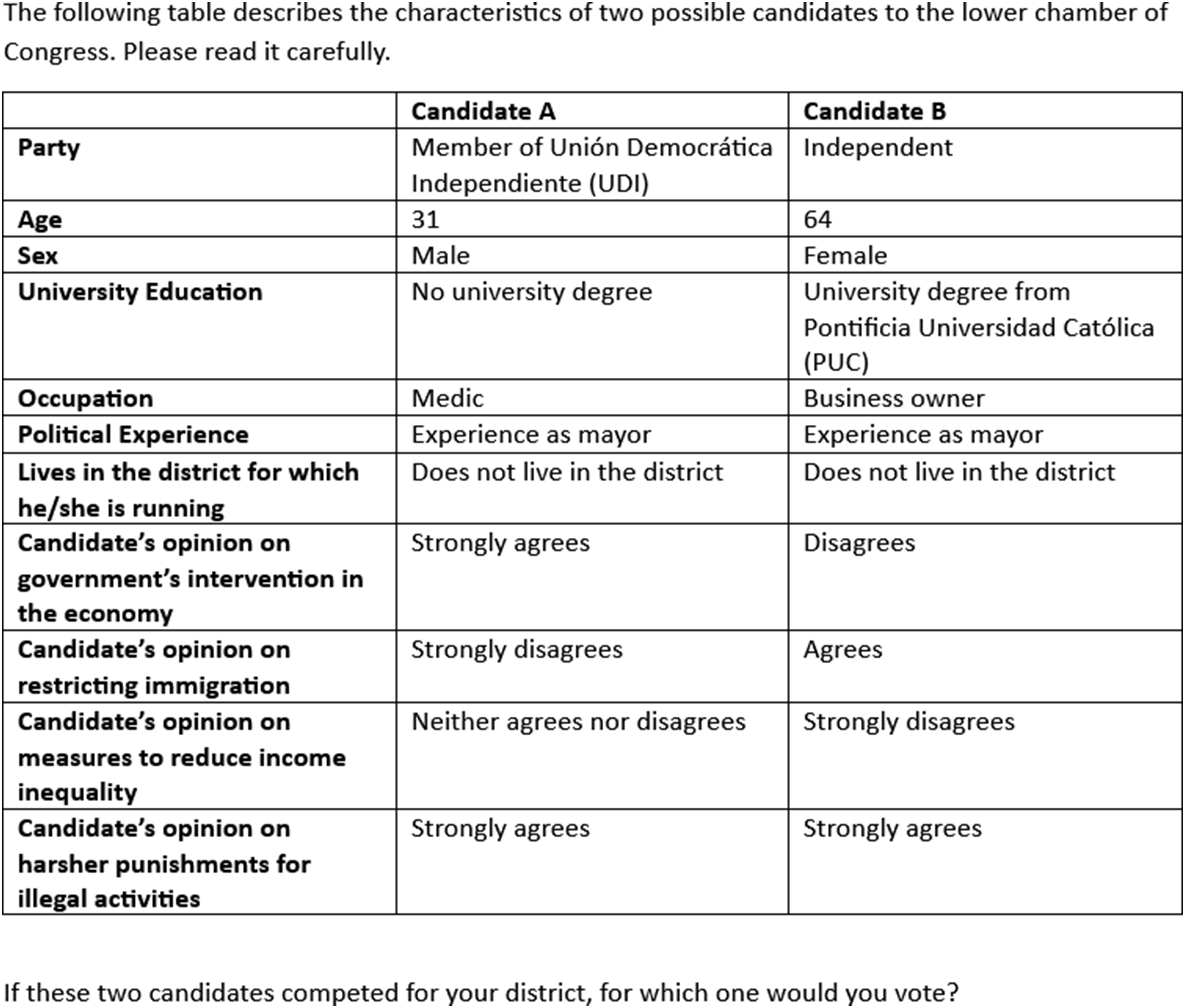
The levels of each attribute are randomly and independently randomized with equal probability for each level. The only exception is the party affiliation of candidate B, which is always “Independent”.
The Average Marginal Component Estimator (AMCE) is the typical value of interest in conjoint experiments (Bansak et al., 2020a, 2020b). Because the randomization of each attribute is independent, comparing simple means allows an unbiased estimation of this estimator. This value is an estimation of the effect of an attribute of the candidate being of a given level, averaged over the entire distribution of the attributes in both profiles. To assess the effect of the “independent” label, we simply compare the proportion of respondents that chose the independent candidate versus the party candidate. This allows us to measure the preference for independent candidates controlling for the policy preferences and candidates’ attributes preference.
For further analyses, we predict the chosen candidate with the relative closeness of respondents to the policy positions of each candidate. For this, the information on the respondents’ policy preference is combined with that of the candidates presented to them and their choices. The analysis seeks to assess the probability of a respondent choosing one candidate if that profile is closer to the respondent on a given issue, compared to the other alternative profile.
To perform this analysis, two variables,
The choice of the respondent for task
As for the independent candidates’ attributes, including “outsider” and local characterization, we predict the chosen candidates, in a logistic regression, with the attributes of the independent candidate as explanatory variables. This assumes that the effect of candidates’ attributes is relatively homogeneous (unlike policy positions, where we control for the respondents’ positions).
Concretely, our first hypothesis is:
Controlling for attributes and policy positions, independent candidates are preferred to party candidates. While this hypothesis implies on its own the existence of a demand-side explanation for independent candidates’ vote, the following subsidiary hypotheses further weaken the supply-side explanation of independents’ electoral success, through their outsider and localist attributes:
Independent candidates that hold similar attributes to traditional party candidates are equally preferred to those that hold non-traditional characteristics.
Independent candidates that are local are equally preferred to those that are not. Additionally, we investigate the way independent candidates’ advantages interact with different forms of party or independent identification. Concretely we test three hypotheses:
Respondents with positive identification with the independent label prefer independent candidates, regardless of their other attributes.
Apathetic or apartisan respondents prefer independent candidates, regardless of their other attributes.
Negative partisan respondents prefer independent candidates, regardless of their other attributes.
Findings
The party/independent identities in the population
Figure 2 presents the proportion of the population that identifies positively and negatively with any party label and with the independent label. There are substantially more individuals that identify negatively. Specifically, 84% have a negative identity towards one of the labels, and 34.5% have a positive identity (some individuals have both kinds of identification). Negative and positive identification with parties and with independents.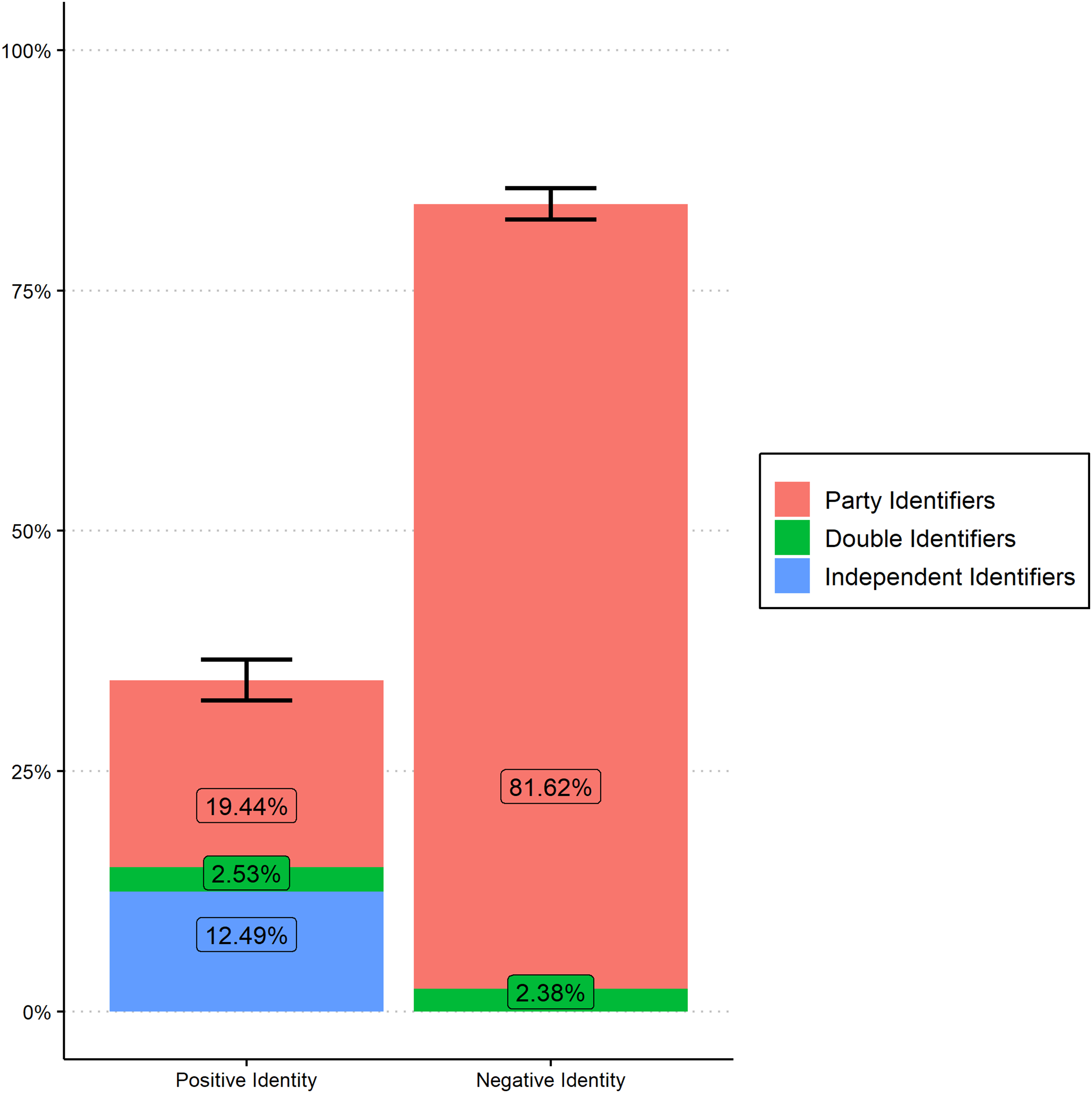
The few citizens with negative identities toward independent candidates also have negative identity towards some party labels (2.4%). 19.4% have positive identity towards any party and 2.5% have it towards both independents and party members. 9 12.5% present a positive identity towards independent candidates.
This first analysis suggests that an important section of respondents present a positive identification with independent candidates. This might support hypothesis 2, whereas independent candidates enjoy the support of voters that identify with the “independent” label in much the same way as candidates with party labels and this identity is at least as prevalent as traditional party identification. On the other hand, this analysis also shows that independent candidates might be electorally attractive in comparison to party candidates, because they generate little negative identity. This latter result is more in line with hypothesis 4, whereas independent candidates’ advantage arises from negative identification with parties.
The four groups of partisanship
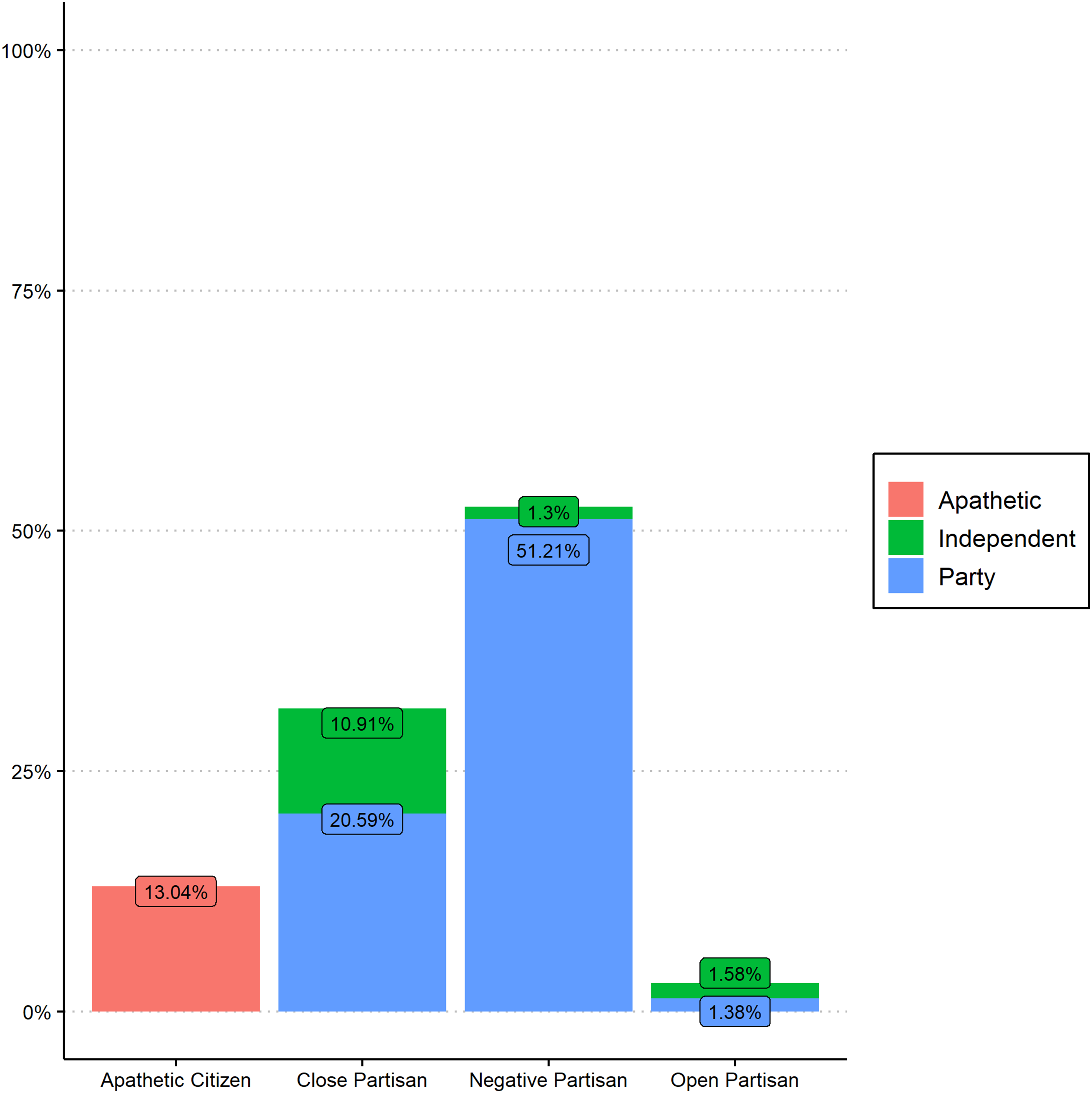
Figure 3 shows the proportions of different types of partisans, as defined by Rose and Mishler (1998), for both party and independent labels. There are noticeably few open partisans, as well as negative independent partisans. This leaves four main types of partisans: • Party close partisans with 20.6% • Independent close partisans with 10.9% • Party negative partisans with 51.2% • Apathetic citizens with 13%
Negative, open, close, and apathetic partisanship for parties and independents.
In other words, 20.6% identify positively with at least one party and negatively with at least one party. 10.9% identify positively with independents and negatively with at least one party. 51.2% only identify with at least one party. Finally, 13% do not identify positively or negatively with any party or independents. 10 With a little more than half of the population categorized as party negative partisans, this result would suggest that the main influence of party labels might come from their negative perception, as well as any potential advantage of independent candidates, that is, hypothesis 4. This is relevant for the interpretation of the results in the conjoint experiment in the next section.
The independent electoral bonus
The conjoint experiment consisted in presenting respondents with two hypothetical candidates for the Chilean lower chamber in congress. Both candidates are described by their age, gender, education, occupation, and political experience. Additionally, the candidates are characterized by their positions in four broad policy issues encompassing elements of both economic and social aspects. The economic issues are positions on government intervention in the economy and redistribution of income. The social issues are increasing the severity of punishments for illegal activities and immigration.
Given that all of these characteristics for both hypothetical candidates and the party affiliation of the non-independent candidate are assigned randomly, the expectation is that, on average, if there was no preference for independents, then the two candidates should be chosen in around the same proportion. In other words, to measure the existence of an independent electoral bonus, we simply observe the proportion of respondents that chose “candidate b” across the different hypothetical electoral matches.
Figure 4 shows the existence of a clear preference for independent candidates. We estimate 63.3% of the studied population would prefer an independent candidate in this electoral match. This finding supports the notion that the recent success of independent candidates in Chile is, at least partly, the result of voters having a preference for candidates that present themselves under the “independent” label, regardless of other attributes and policy positions. In other words, we find evidence supporting hypothesis 1 of an electoral bonus for independents that is not explained by their characteristics and, therefore, is not due to a supply-side effect. This implies that, to a significant degree, independent candidates are preferred, regardless of their positions and characteristics, simply because of the “independent” label.
11
Effect of independent label against all party labels.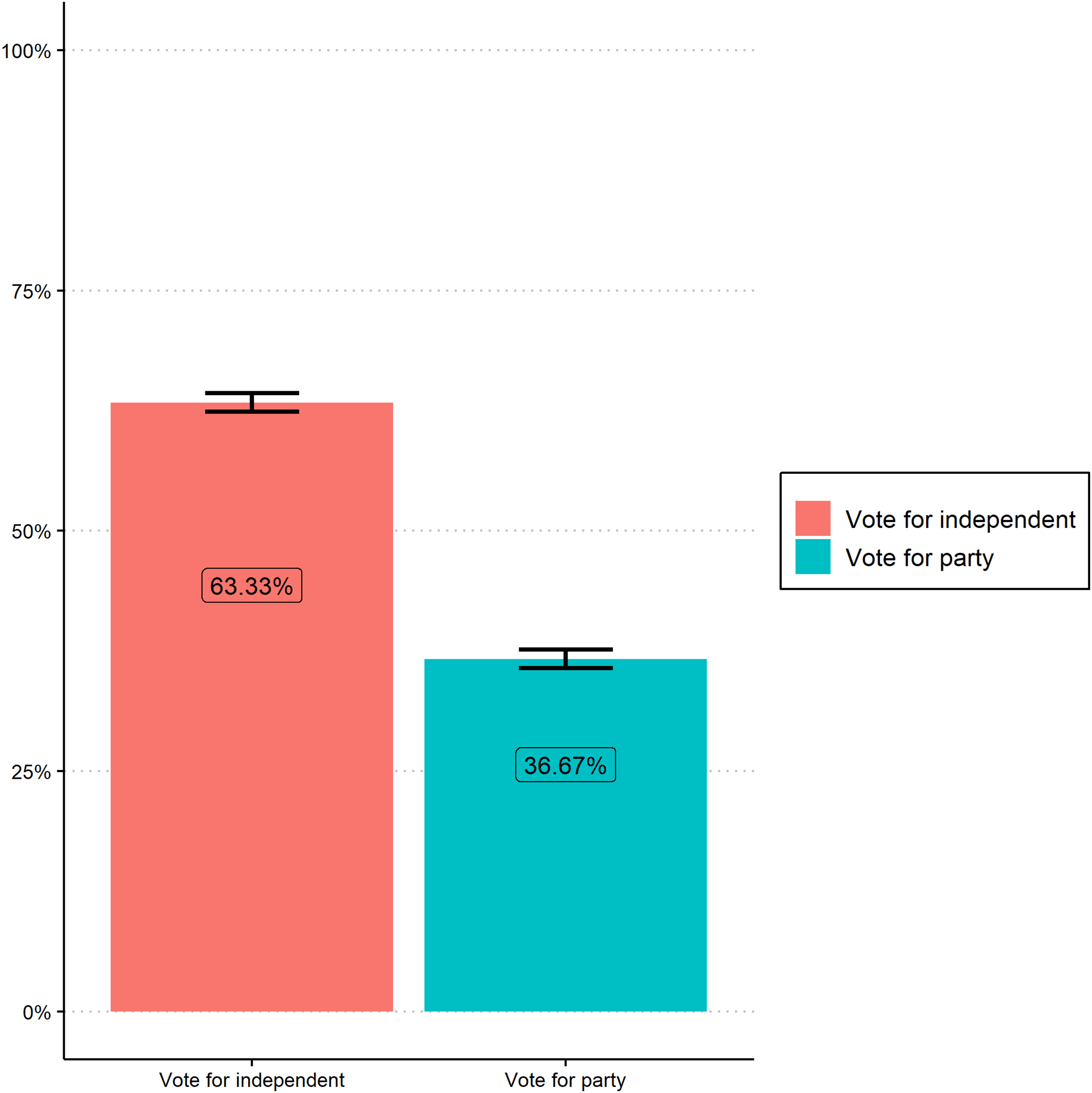
On its own, this result might have three, not mutually exclusive, driving forces. The first explanation is that respondents identify with a political party absent in the choice presented by the experiment (respondents have to choose between a candidate from a random party or an independent one). In that case, the independent candidate would simply be a “second best” choice in the absence of their party. It is the least interesting explanation because in real electoral matches, voters will most likely find candidates from all parties competing for their district. Figure 5 shows that, indeed, for this group, independent candidates are preferred in the experiment, but much less than for other groups such as independent identifiers and negative party identifiers. Vote choice in the conjoint experiment by partisanship group.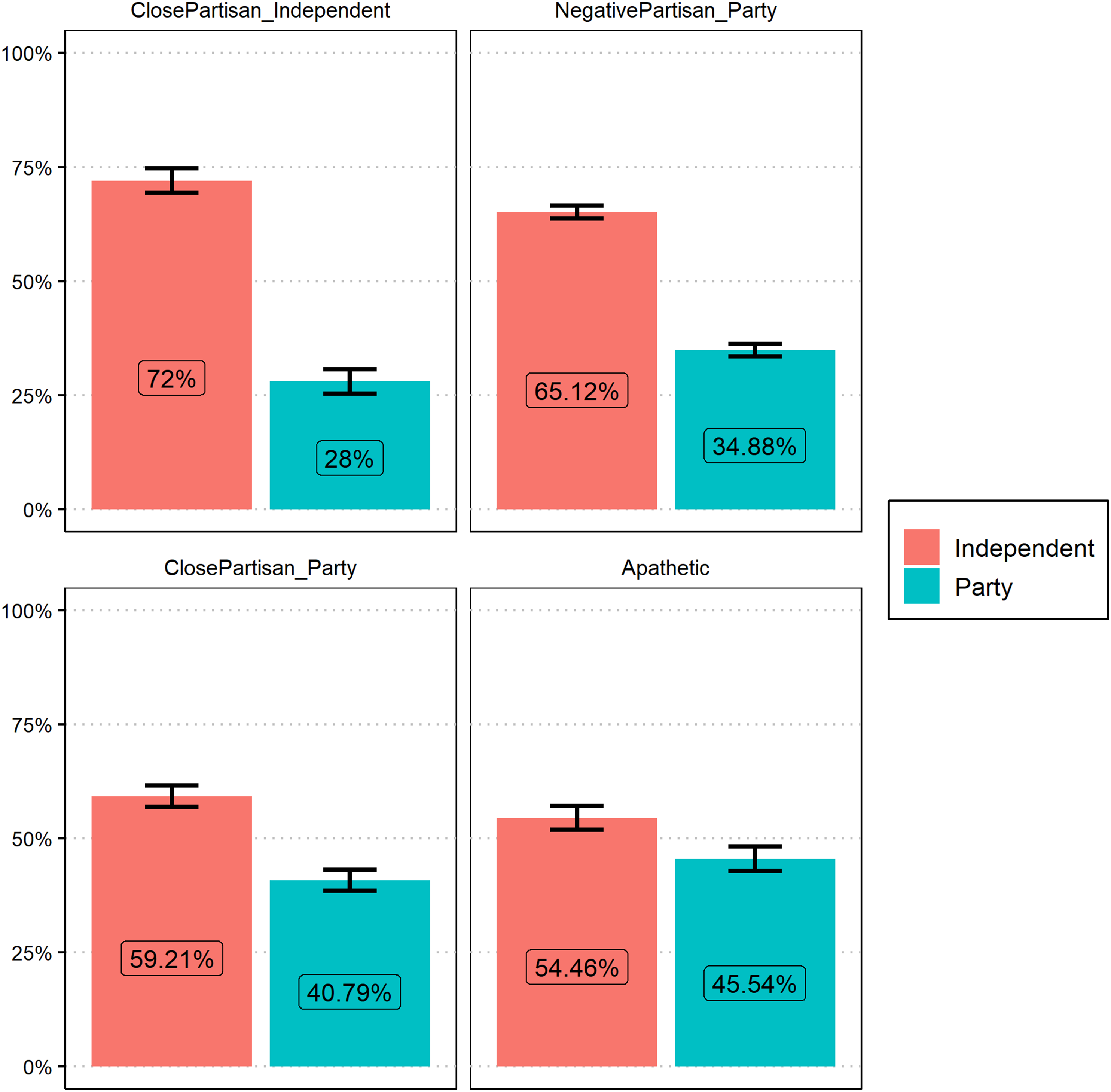
The second one is that respondents identify with the independent affiliation (or lack of affiliation) of candidates and prefer a candidate with this label, whatever the party affiliation of the other candidates. Not surprisingly, Figure 5 shows that this is the groups where preference for independent candidates is the strongest, with almost two thirds of respondents in this category having chosen the independent candidate. This supports hypothesis 2.
Finally, the third possible driving force for independents’ electoral advantage comes from negative partisans, who prefer an independent candidate as a result of their rejection of party candidates. This is the largest group and shows a preference for independent candidates somewhere between party partisans and independent partisans. This supports hypothesis 4.
Figure 5 shows that the support for independent candidates is, not surprisingly, concentrated among citizens that are closed partisans of independence. The fact that a majority of closed partisans of parties still tended to vote independent suggests that when faced with party candidates different from their own, most of them preferred the independent option. Finally, it is apathetic citizens that most closely tend to the 50% tie between the two candidates, suggesting indifference between independent and party candidates. This evidence contradicts hypothesis 3. We do not find evidence that apathetic respondents prefer independent candidates, when controlling for these candidates’ attributes and policies. One way to reconcile this finding with that of Weeks (2011) is that in the observational setting of this previous study, apathetic citizens preferred independent candidates because of the characteristics associated with them (such as localism).
The distinction between an independent identifier and an apathetic citizen that is indifferent to party labels speaks directly to the discussion on the nature of self-identified “independents”. While apathetic independent voters might act in the dealigned manner predicted by Dalton (2013b) (ignoring labels and focusing on candidates’ characteristics and policy positions), citizens who describe themselves as independents because of this label having an identity value to them are not dealigned, but have rather aligned themselves with this identity.
The experiment shows a very clear advantage for independent candidates. We can use the conjoint experiment, together with the information we have on respondents’ preferences, to see how much of the independent candidates’ advantage might be reinforced through policy competition and the characteristics of candidates. For this we analyse the preference for a candidate in our conjoint experiment explained by the relative closeness between the position of the respondent and the two candidates. Figure 6 shows that the presence of party labels does not make policy positions irrelevant. This means that although party signalling is relevant, it by no means eliminates the importance of policy. This is in line with previous findings that party competition does not suppress the impact of candidates’ positions (e.g., Fowler, 2020). In other words, our findings suggest that while the independent label implies some advantages, policy closeness can still make a significant difference in electoral competitions and, if independent candidates hold more popular policy positions, this too can drive their electoral success. Preference for independent candidate by party and preference for any candidate by relative policy closeness to both candidates.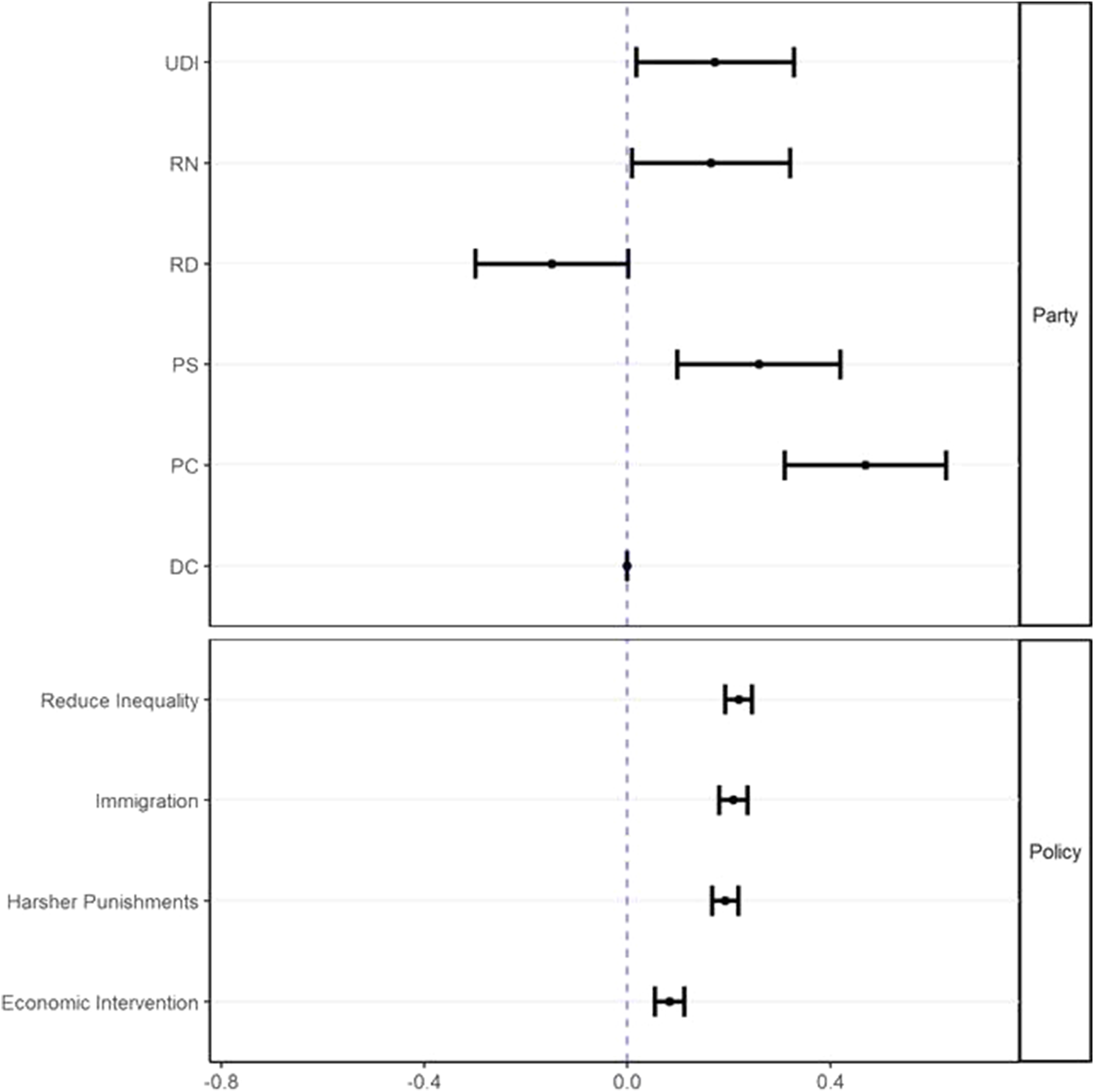
Additionally, we use the conjoint results to determine if independent candidates can improve their chances of being preferred depending on their attributes. As Figure 7 shows, respondents were more likely to prefer an independent candidate when this candidate was a resident of the district they competed for, and when they held a university degree (especially from Universidad de Chile). There was also some advantage for candidates that were professionals (especially lawyers) and not business owners nor unqualified workers (bus drivers). Noticeably, there was no advantage for independent candidates that competed without political experience. Preference for independent candidate by party of the other candidate and independent candidate’s attributes.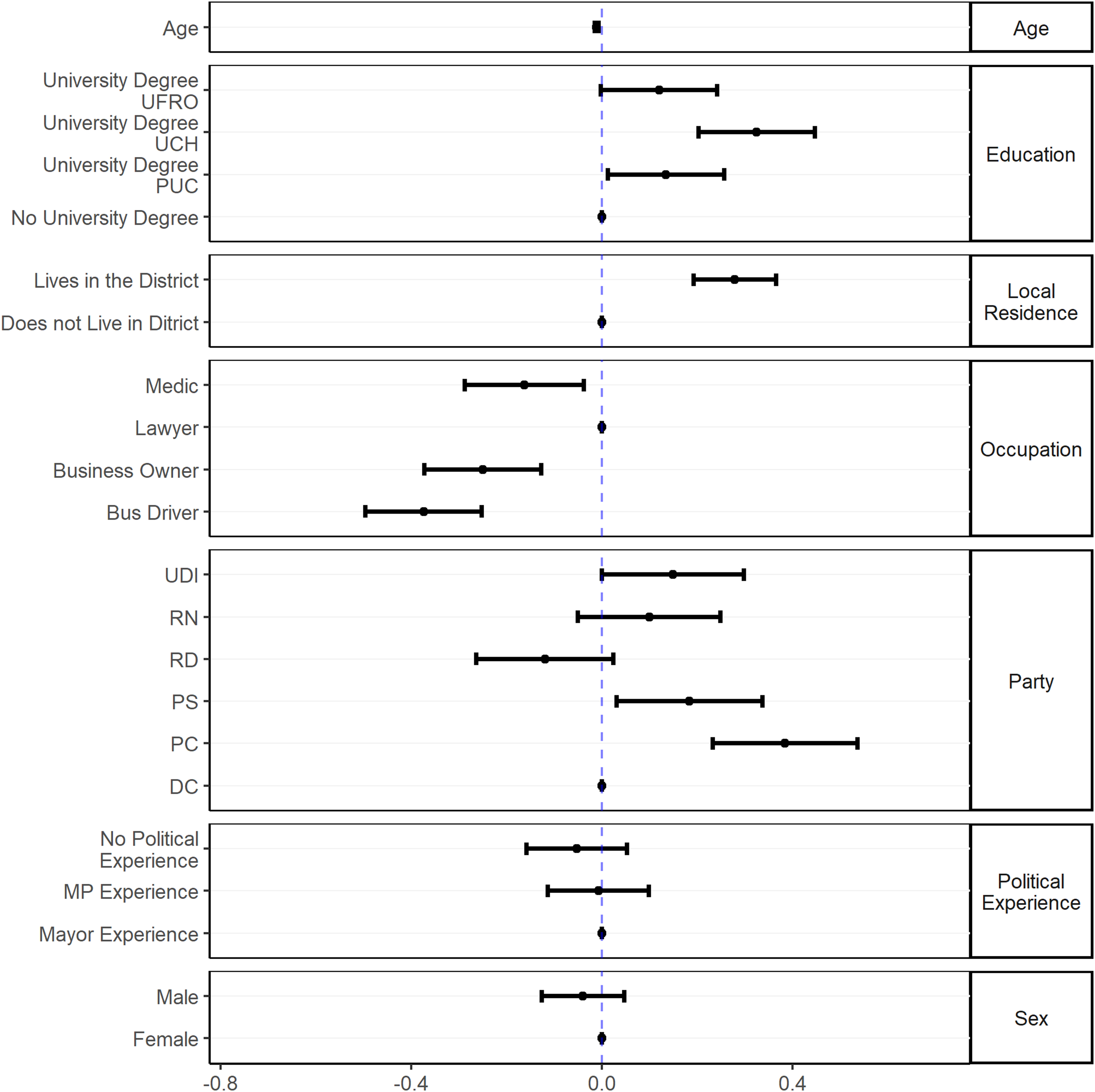
Overall, there seems to be some evidence that respondents’ ideal candidate combines the independent label with more “establishment” attributes, such as holding a university degree and having a professional background. In fact, the most common profession in Chilean established professions is law (PNUD, 2017). This evidence supports hypothesis 1a, as independent candidates with mainstream attributes and political experience are just as competitive as those that hold outsider characteristics. This implies that a supply-side explanation for the success of independents does not seem to arrive from independents’ outsider status. However, there is a very noticeable preference for local candidates, which contradicts hypothesis 1b. A supply-side explanation for the electoral success of independents appears feasible if these candidates tend to be more local than establishment candidates, otherwise the attributes that made independents more competitive made them more similar to establishment candidates.
Conclusion and discussion
Our article provides a more sophisticated picture of the relevance of independent candidates and voters’ preferences towards them. We find that independent candidates in Chile have an electoral advantage over candidates with party affiliation. We find this advantage is mainly the result of a combination of two factors. First, a large section of the population holds negative partisan identities, voting against parties and without identifying with any one of them. Second, We observe the presence of a relevant segment of our sample that identifies with the “independent” label, much in the same way as they would do with party identity. Both of these findings show a “demand-side” explanation for independent candidates’ electoral advantage. Conversely, we find little evidence for a third possible explanation for independents’ success, which relies on a process of de-alignment of the electorate, i.e., less relevance for candidates’ labels, combined with a supply-side explanation, where independent candidates hold some “outsider” characteristics that align with voters’ preferences. Nevertheless, we do find evidence of an advantage for local candidates.
While the findings suggest an “anti-establishment” (Meléndez, 2022) dimension to the vote for independent candidates, we find that, in fact, attributes that make independent candidates more similar to “establishment” politicians, such as holding a university degree and having a conventional occupation, increase their chances of being chosen. But we also do not find that independent candidates without political experience fare any better than those with experience. While this does not rule out the possibility of supply-side explanations, it does suggest that the main driving forces might be on the demand-side. In other words, while the evidence supports demand-side explanations of the recent success of independent candidates, it is also possible that supply-side factors might come into play.
For example, it is possible that independent candidates may increase their electability because they have the characteristics that are found to make them more competitive, such as residing in the district which they are competing for or holding policy positions closer to their constituents. One avenue for further research is to study the characteristics of independent candidates in Chile and the eventual differences in these relevant attributes with party candidates, to account for these supply side factors. Additionally, the findings of this study raise questions concerning political and campaign-related implications.
Under Chilean rule, independent candidates can run alone, with an important structural disadvantage in the legislative list-based elections, or as members of party lists. Our experiment does not measure how these different ways of competing as an independent affect voters’ preference and if these “independents” inside party lists maintain their electoral advantage. More importantly, candidates can choose to emphasize or de-emphasize their attributes, including party affiliation. In other words, candidates can present themselves as representatives of a collective political project or as individuals. Future research could further explore the way preference for independent candidates interacts with campaign strategies, especially independent candidates in party lists that could, in theory, choose whether to emphasize their independence or not.
In a much wider perspective, our results raise several questions about the long-term stability and survival of the traditional model of party identification. The rise of an independent identity among the voters forces us to consider that political emotional attachments are not as constrained as we thought. Moreover, we attach particular electoral outcomes to this identity, which are similar to those attributed to party identification, insofar as they serve as a heuristic for vote choice. However, independent candidates do not coordinate or aggregate preferences outside elections, political parties do. Voters that show higher affinity with the independent label are, as well, political orphans. Some would argue that they choose to stay away from traditional parties, while others would argue that the political parties do not provide them with a reasonable choice. Either way, party survival requires committed voters and activists, which are becoming scarce.
Supplemental Material
Supplemental Material - Why vote for an independent? The relevance of negative identity, independent identity, and dealignment in a pro-independent political environment
Supplemental Material for Why vote for an independent? The relevance of negative identity, independent identity, and dealignment in a pro-independent political environment by Noam Titelman and Javier Sajuria in Party Politics
Footnotes
Declaration of conflicting interests
The author(s) declared no potential conflicts of interest with respect to the research, authorship, and/or publication of this article.
Funding
The author(s) disclosed receipt of the following financial support for the research, authorship, and/or publication of this article: British Academy (Small Research Grant / SRG1920\101059) and LSE's Methodology Department, through an internal fund for MPhil PhD students 2020/2021.

Supplemental Material
Supplemental material for this article is available online.
Notes
Author biographies
References
Supplementary Material
Please find the following supplemental material available below.
For Open Access articles published under a Creative Commons License, all supplemental material carries the same license as the article it is associated with.
For non-Open Access articles published, all supplemental material carries a non-exclusive license, and permission requests for re-use of supplemental material or any part of supplemental material shall be sent directly to the copyright owner as specified in the copyright notice associated with the article.
