



Abstract
Parties and their actions almost always shape the preferences, attitudes, and behaviour of their voters. However, does partisan influence over public opinion apply to all policy proposals regardless of their initial popularity and to all voters regardless of their degree of partisan attachment? This question is addressed in the real-world context of Finland, where the government enacted two reforms at the same time: an initially popular reform extending the age of compulsory education, and an initially unpopular removal of the ‘retirement tube’ for older laid-off workers. An original panel survey asked respondents about their attitudes before and after the government actions, finding that while voters of government parties increasingly tended to support the enacted policies, the magnitude of opinion change depended on voters’ initial policy preferences and party attachment. Strong party attachment led to government voters increasing their support for a reform that they initially opposed. In contrast, those with weaker partisan attachments tended to alter their preferences for an initially popular reform. These findings are relevant for understanding partisan influence over public opinion in a broader political context.
Introduction
The ability of parties to shape public opinion has found strong and consistent empirical support across various social, institutional and political contexts (see Bachner and Hill, 2014; Barber and Pope, 2019; Broockman and Butler, 2017; Guntermann and Quinlan, 2022; Slothuus, 2010; Slothuus and Bisgaard, 2021a). Yet, some topics remain unresolved, such as those regarding the size of effects (see Slothuus and Bisgaard, 2021a), the influence of moderating factors on the individual level (Chong and Mullinix, 2019; Mummolo et al., 2021; Petersen et al., 2013; Peterson, 2019; Slothuus and Bisgaard, 2021b), and the contextual conditions by which parties are more capable of influencing the preferences of their electorates (Brader et al., 2012; Ciuk and Yost, 2016; Robison, 2022; Schonfeld and Winter-Levy, 2021).
While the impact of party attachment on the effect of partisan cues has already been recognised (Campbell et al., 1960; Mummolo et al., 2021; Peterson, 2019; Satherley et al., 2018), our research demonstrates that this relationship is further moderated by initial policy preferences. When parties in the government enact a reform that is unpopular with their voters, it is primarily those strongly attached to the party who turn to favour the reform. These voters are the ones most embedded in the partisan perceptual bias (Jerit and Barabas, 2012), and hence they are more likely to engage in motivated reasoning (Petersen et al., 2013). Consequently, those who strongly support a certain political party adjust their policy stances to match the party line to a larger degree. By contrast, when government parties enact an initially popular reform, its effect is more pronounced among those with weaker political attachments to a government party, who were supposedly less aware of the party’s position before the government’s decision (Green et al., 2002; Jerit and Barabas, 2012). Moreover, voters less attached to a specific party initially have moderate policy positions before the reform is enacted (Ray, 2003), which leaves more space for a positive shift in their opinion (Grossmann, 2014).
A strong divide in the effect of party cues among committed and less committed voters is empirically supported by the results of a panel survey in which respondents were asked about their attitudes before (in September 2020) and after (in February 2021) the Finnish government decided to enact the two policies in December 2020. The first reform abolished the so-called ‘retirement tube,’ which safeguarded income-related unemployment benefits for older workers laid off shortly before reaching the age of retirement. In line with the centre-left political orientation of government supporters, such welfare retrenchment proved largely unpopular. The second reform, enacted at the same time, extended the compulsory schooling age from 16 to 18 years of age, while providing requisite school supplies free of charge. This expansion of the services provided by the Finnish welfare state was naturally more popular among centre-left voters.
The two reforms, which enjoyed distinctly different levels of popularity among government supporters, made it possible to contrast voter responses to them, thereby contributing to the most reliable research designs examining the effect of party cues in the real world (see Slothuus and Bisgaard, 2021a). Even though policy popularity (e.g., Chong and Mullinix, 2019; Ciuk and Yost, 2016; Grossmann, 2014; Mullinix, 2016; Peterson, 2019) and party attachment (e.g., Barber and Pope, 2019; Leeper and Slothuus, 2014; Petersen et al., 2013) have received some attention in the empirical research, the studies designs to date have mostly conducted survey-embedded experiments randomising the exposure of their respondents to a carefully crafted mock-up scenario. Despite providing undeniably relevant findings, the results may have overestimated the effect sizes by eliminating other competing stimuli typical of a real-world context (Slothuus and Bisgaard, 2021a).
In contrast, our design uses a quasi-experimental setup in which a representative sample of the Finnish population was exposed to a naturally occurring “treatment effect” constituted by the somewhat unexpected decision by the Finnish government to enact the above-outlined reforms. Thanks to the two measurements of the same group of individuals before and after the government’s decision, we could examine within-individual differences over time just as they appeared in response to a genuine political development in the country. The findings of this research study thus more fully capture the authentic influence of parties on people’s policy preferences.
Parties’ preference-shaping potential in policy domain
The questions of whether, how and to what extent parties can shape voters’ political preferences has puzzled scholars for decades. After more than half a century of research, there is a growing consensus that parties play a key role in shaping public opinion (e.g., Barber and Pope, 2019; Broockman and Butler, 2017; Slothuus, 2010). Early interest in this topic was triggered by the seminal conclusion in the American Voter in which Campbell et al. (1960: 133) argue that “identification with a party raises a perceptual screen through which the individual tends to see what is favourable to his partisan orientation.” In such recognition, party identification is perceived as an integral component of voters’ social identities and as a psychological predisposition directing preference formation and political behaviour (Greene, 1999).
Importantly, the central role of partisan attachment as a political predisposition brings elasticity to voters’ issue preferences: it is considerably easier to adjust opinion on a single policy issue in line with the cue newly released by a preferred party, rather than to replace a compound and often habitual party attachment with a similarly complex connection to a competing party (Petersen et al., 2013). Therefore, when party leaders change their policy stances, party followers are likely to change their preferences accordingly to match the party line (Bisgaard and Slothuus, 2018; Guntermann and Quinlan, 2022; Slothuus, 2010). This effect of partisanship is found to be somewhat stronger for the parties that are more established, are in the opposition, or have developed a more consistent ideological image (Brader et al., 2012).
Two main theoretical mechanisms explain this tendency. First, politics is a multi-faceted and information-rich environment. In order to cope with such complexity, most voters eagerly respond to the party cues that guide them through the complicated political space instead of engaging in the cognitively demanding activity of understanding the policy implications on their own (Carmines and Kuklinski, 1990; Lupia, 2006; Nemčok et al., 2019; Sniderman and Stiglitz, 2012). Second, a shift in policy preference is often the result of motivated reasoning, meaning that party supporters are predisposed to change their opinion to stay in line with the party that forms an intrinsic part of their social identity (Campbell et al., 1960; Green et al., 2002; Kunda, 1990; Leeper and Slothuus, 2014; Slothuus and De Vreese, 2010).
A vast body of empirical research has assessed the potential of political parties to shape public opinion and the readiness of voters to adjust. These studies can be divided into four “generations” based on the research design they employed (see Slothuus and Bisgaard, 2021a). The first generation includes seminal works examining cross-sectional correlations between the policy preferences of the parties and their voters (e.g., Campbell et al., 1960; Jacoby, 1988; Kriesi, 2005). Given the constraints typical in cross-sectional studies, the leverage of these designs to identify causal connections reliably is modest. The second generation consists of panel studies which sought to overcome this limitation by analysing whether initial party identification can predict the issue position exposed later in time (Carsey and Layman, 2006; Highton and Kam, 2011; Steenbergen et al., 2007). While being an important step forward, these studies remain limited in their ability to isolate the effect of a specific change in party position, making it difficult to pinpoint the exact cause(s) of the opinion shifts observed in the public. The third generation of studies have used survey-embedded experiments exposing respondents to information about party leaders’ positions (Barber and Pope, 2019; Bolsen et al., 2014; Bullock, 2011; Ciuk and Yost, 2016; Kam, 2005; Levendusky, 2010; Mullinix, 2016; Nicholson, 2012; Peterson, 2019; Slothuus and De Vreese, 2010). Despite providing undeniably relevant insights, these research designs may tend to overestimate the true effect size because the framing used as a treatment effectively reduces the “noise” of competing cues which are almost always present in the real world situations (Slothuus and Bisgaard, 2021a).
Finally, the most recent fourth generation of studies seeks to overcome the aforementioned limitations by employing quasi-experimental designs using real world changes in party positions to examine voters’ responses at the individual level (Guntermann and Quinlan, 2022; Nordø, 2021; Satherley et al., 2018; Schonfeld and Winter-Levy, 2021; Slothuus, 2010; Slothuus and Bisgaard, 2021a). These studies analyse the same respondents before and after a political party or a group of parties changes their position on a given policy, and investigate whether and how these changes affect the within-respondent policy preferences and/or political attitudes. Our contribution advances this recent generation of research on parties’ preference shaping power via an exceptionally stringent test which identifies clear opinion shifts among voters who follow their parties and adjust their preferences to support the policy they initially opposed.
Moderating effect of part attachment and policy popularity: theoretical expectations
Politics is an overwhelmingly complex environment. To cope with such complexity, most voters respond to signals released by familiar and reliable subjects – such as political parties – choosing to follow their lead and adopt consistent opinions (Bisgaard and Slothuus, 2018; Sniderman and Stiglitz, 2012). The other strategy would involve an in-depth study of all topics in the political discourse before forming opinions. Therefore, citizens who strongly support a certain party tend to adjust their various preferences after the party releases a new and unambiguous cue on how to vote (Leeper and Slothuus, 2014; Slothuus and De Vreese, 2010).
However, not all cues are in line with voters’ initial preferences. In cases where opinions diverge, partisans are likely to engage in motivated reasoning to justify their party’s action(s) and use similar reasoning to defend their own opinion shift in choosing to follow the party line (Leeper and Slothuus, 2014; Ray, 2003). Since partisanship constitutes an intrinsic part of people’s social identity (Green et al., 2002), it is considerably easier to adjust one’s opinion on a single topic than to replace a compound and habitual party attachment with a comparably complex connection to another party (Petersen et al., 2013).
The strength of partisan attachment varies among voters, though, which imposes some limits on partisan loyalty (Mummolo et al., 2021). While accepting a reform that diverges from one’s preferences is not easy for anyone (Peterson, 2019), individuals with a strong party attachment are more embedded in the partisan perceptual bias (Jerit and Barabas, 2012) and their motivated reasoning makes it easier for them to seek and adopt justifications for their party’s actions (Petersen et al., 2013; Ray, 2003). Hence, we expect strongly attached partisans to shift their opinions more dramatically when their party releases a cue diverging from their initial preferences:
However, this effect will not occur if a party cue relates to an initially popular reform. Under such circumstances, strong partisans prove more attentive to the party argumentation (Jerit and Barabas, 2012), and hence, they are more likely to support the reform from the beginning (Carsey and Layman, 2006; Grossmann, 2014). The cue comes as no surprise to them because they have adjusted their opinions in the past as well. By contrast, less attached supporters pay less attention to the party positions (Green et al., 2002; Jerit and Barabas, 2012). Hence, it takes a more pronounced cue, such as a policy enactment, to attract their attention and stimulate them to follow the party line and take a more supportive or opposing stance (Chong and Mullinix, 2019; Mummolo et al., 2021; Peterson, 2019). Moreover, initial policy support among weakly attached party supporters is arguably more moderate (Ray, 2003), leaving a larger space for a potential shift in a positive direction (Grossmann, 2014). Therefore, a government’s decision to enact a reform provides an essential piece of information for weakly attached supporters, which stimulates a larger positive shift in their evaluation of the proposed policy.
Empirical context: Data collection, research design, and measures
The economic turmoil during the COVID-19 pandemic in Finland exposed the need for structural changes to facilitate a quicker economic recovery. The Finnish government, constituted by five centre-left parties, decided to enact two welfare reforms that had been discussed in the public discourse for quite some time.
The first reform abolished the so-called ‘retirement tube’ from 2023 onwards. Consequently, older people (those over 55 years of age) will no longer receive an additional earnings-related unemployment allowance if they are laid off shortly before reaching the age of retirement. The ‘retirement tube’ has been in use for four decades with a few (relatively minor) adjustments implemented throughout the years. Considering the centre-left ideological profile of the government, cutting social spending enjoyed low levels of support among voters from those parties – as we will demonstrate below. This low level of support among voters also reflects the party leaders’ positions prior to the government’s decision to enact the reform. In debates held prior the 2019 elections, leaders of almost all parliamentary parties promised not to proceed with the removal of the ‘retirement tube’ (Yleisradio, 2020; Savon Sanomat, 2019). Neither was the decision to abolish it mentioned in the coalition platform agreed to after the 2019 elections. Thus, the decision to enact the reform in December 2020 marked a change in the cues provided by most of the government parties, many of which were still unwilling or hesitant to support it at the time of the first survey round in September 2020. 1 When it comes to the opposition, the National Coalition Party (right-wing) supported the reform, while the Finns Party (right-wing populist) opposed it. 2
The second policy enacted extended compulsory schooling from 16 to 18 years of age, while providing requisite school supplies free of charge to improve employment opportunities for young people. In contrast to the first reform, voters from the centre-left government parties generally favoured extending welfare spending to improve education services. The reform had long been advocated especially by the left-wing parties, and all government parties in the government platform in 2019 agreed on it, well before our first survey wave was conducted. All opposition parties opposed the reform and also voted against it. Thus, the reform enactment did not mark a shift in government parties’ positions on this issue. However, as we argue, the decision made party cues more visible to less-attached voters of the government parties, while strongly attached voters, who are assumed to closely monitor party leaders’ positions, were cued well before the decision. Such differing levels of initial support for the two reforms among different groups of voters provide a good means for testing our hypotheses.
Although the aim of both reforms was to achieve the same goal – improve the employment rate in Finland which is perceived as central to the long-term sustainability of Finland’s public finances (Stenborg et al., 2021: 21–39) – the means by which to achieve such a goal are markedly different. By reducing existing social protections, the pension reform aims to remove any incentive for an early labour market exit. In contrast, the aim of the education reform was to strengthen the knowledge and skills of young people when entering the labour market to minimise the chance of them failing to find a job. As such, its objective was widely shared among different parties and the disagreement mainly concerned the practical arrangements. One of the more significant differences dealt with the cost of the reform extending compulsory education. Right-wing opponents argued that resources should be better targeted to those in need, lowering the pressure on public finances. However, left-wing supporters emphasised its contribution to equality – mainly that young people would have acquired more equal educational training when entering the labour market.
Introducing welfare reforms in a multi-party system differs systematically from the majoritarian contexts in which it is straightforward to hold the ruling party accountable for the governance that is executed. In a consensual system such as Finland’s, which prevails among contemporary democracies, governments are formed through open negotiations and often result in large multiparty coalitions (Casal Bértoa and Enyedi, 2016: 268). The decisions about the two policy reforms under scrutiny in this study is an illustrative example of a consensual decision-making model in multi-party governments (see Wass et al., 2021). Compromise-driven decision-making responses to the momentary economic situation can open opportunities for enactment of long-prepared yet difficult reforms resulting in cuts in social services. Unlike in majoritarian systems, parties in multiparty coalitions may abandon some of their pledges and adopt much-needed reforms hoping that the accountability will be shared, at the very least, and it will not turn out to be detrimental to their political survival (Plescia et al., 2022). Under such conditions, even a leading government party may choose to enact policy reform known to be controversial among its electorate (Plescia and Kritzinger, 2022).
Data
A couple of weeks before the government enacted the reforms – when nothing indicated that the government would proceed with such actions – we conducted a representative survey of public opinion related to a wide array of policy measures intended to improve the labour market, restructure social security, tackle climate change, and facilitate the post-COVID-19 recovery. The data collection process was completed in the first half of September 2020. Since we did not foresee that the government would soon decide to enact both reforms, our original intention was a single-round inquiry.
However, a little more than two months after collecting the data, the Finnish government unanimously decided to enact two policy reforms discussed in our survey. Therefore, we approached the survey agency with a request to reach the same participants regarding their policy preferences. Our request was agreed to, and the additional second round of inquiries was conducted in February 2021, that is, less than two months after the policies had been enacted.
The study's participants were drawn from a Taloustutkimus Oy-managed internet panel of 40,000 members at our request. We used stratified sampling to form the sample based on gender, age group, and area of residence (NUTS 2). As a result, we obtained a nationally representative sample of the Finnish population based on these criteria. Of the initial 2106 respondents, 1701 participated in the second round of the survey, indicating a remarkably high return rate of 80.8%.
To ensure high-quality and representative responses, Taloustutkimus Oy employed a combination of offline and online recruitment methods to form the panel. The agency actively manages the panel to maintain the quality and representativeness, which includes monitoring the quality of responses, utilisation rates, panellist activity, and recruitment process metrics. Passive panellists are removed from the panel.
Participants were provided with no additional financial or other compensation for taking part in this particular survey. Given that the members of the online panel are frequently surveyed, they are unlikely to remember being asked about the enacted reforms twice in six months. Hence, the consistency bias constituting one of the main concerns in panel designs using repeated measurements on the individual level was less pronounced in this study.
Operationalisations
During both survey rounds, participants were asked for their policy preferences regarding “the possibility of older people receiving earnings-related unemployment benefits up to retirement age” (i.e., the ‘retirement tube’) and “extending the compulsory schooling age to 18.” Both questions were included in a battery with the following introduction: “The COVID-19 pandemic has driven societies into crisis and made it more difficult to find solutions to many already prevailing social problems. In this survey, we studied citizens’ support for different policy solutions aimed at enhancing economy and employment.” In the first round, the survey asked: “What do you think about the following policy proposals?” In the second round, the introduction added that the Finnish Parliament had recently approved the respective reforms 3 , and then continued with a question: “What do you think about this decision?” In both rounds the participants were provided with the same four-point response scale: strongly agree, agree, disagree, and strongly disagree.
At the same time, both rounds of the survey asked respondents about their current party preferences “if the parliamentary elections were held now.” Participants chose between the nine Finnish political parties relevant at the time of research and a residual “other” category. However, the Finnish government acted as a unitary body when enacting the reform. Therefore, the analysis splits participants into government and opposition voters, which is well in line with the way in which voters tend to view parties in multiparty systems (Plescia and Kritzinger, 2022). Government voters include respondents that would vote for the Social Democrats, the Centre Party, the Left Alliance, the Greens, and the Swedish People’s Party. The group of opposition voters include those participants who would vote for the National Coalition, the Finns Party, the Christian Democrats, Movement Now and any other minor party. 4
To ensure the consistency of our analysis, we limited our sample to individuals whose party preference remained unchanged in both survey rounds (n = 634 government supporters and n = 518 opposition voters). We excluded individuals who self-identified as non-voters (n = 34), those whose party preference changed between the two rounds (n = 122), and those who did not provide their party preference in at least one round (n = 393).
After initially asking participants about party preference, the second round added a measure regarding degree of party attachment: “How close do you feel to that party?” The four-point scale was recoded into a binary variable. If a respondent chose “very close” or “somewhat close,” they were coded as strongly attached partisans. If they answered “not very close” or “not at all close,” then the party attachment was coded as weak (see section A of the Supplementary online appendix). The fact that partisan attachment was only measured in the second wave of data collection raises a concern about potential post-treatment bias. This bias occurs when partisans adjust the strength of their attachment based on whether they approve of their party's policy changes. Unfortunately, the data do not allow us to address this issue directly. However, a cruder measure of partisanship, party preference, was measured in both waves, and only 289 respondents (17%) changed their party preference or did not report their vote intention in the second wave. Considering that 68% of respondents (n = 1152) held consistent vote intentions, the dataset suggests that partisan attitudes are relatively stable over time. Therefore, while we cannot rule out the possibility of post-treatment bias, the small number of inconsistencies in party preferences limits the potential for this bias to affect our results to large degree.
Analytical strategy
Our originally conducted two-wave panel survey includes measurements at two time points available for each respondent participating in the second wave. That meant we could base the analysis on differences in the respondents’ policy preferences before and after the reforms were decided on by the Finnish government. 5 The general assumption is that within-individual differences in policy preferences, especially among the government voters, can mostly be attributed to the actions of political parties – i.e., the reform enactment. These actions serve as the party cues.
The analysis proceeds in three steps. First, a descriptive analysis compares sizes of the groups supporting and opposing the reforms and how they change over time. This comparison was conducted separately for government and opposition voters. Second, we estimated a set of fixed effects models to examine how individuals’ policy preferences changed once the decisions to enact the reforms were made. Inclusion of individual-level fixed effects in the analysis of panel data allowed us to rule out time-invariant confounders and base the analysis on within-individual attitudinal shifts that can be attributed to the reform enactment. That is why individual-level fixed effects models constitute a more reliable causal identification strategy. The models are specified to generate zero coefficients for both groups in the first wave to enable a clear comparison of the average “treatment” effects among government and opposition voters while ruling out time-invariant confounders. 6 Third, we added an interaction between the time variables and strength of party attachment to examine the effect heterogeneity – i.e., whether the effect of reform enactment influence strongly and weakly attached party supporters differently.
Since the repeated observations are clearly not independent of each other, standard errors in all regression models are clustered at the individual level. This is to make the inferences robust to serial correlation in the error terms.
Analysis: Initial popularity of the reforms and the changes over time
The point of departure for this analysis is a descriptive examination of the initial policy preferences before the reforms were enacted. As mentioned above, the choice to remove the ‘retirement tube’ was an unpopular reform at the time (given its welfare retrenchment characteristics), whereas the choice to extend the compulsory schooling age constituted a popular reform (given its welfare expansion features). Such an assumption about the initial policy preferences of voters is based on the centre-left ideological profile of the government supporting voters. Data collected during the first round of the survey (i.e., before the reforms were enacted and gained visibility in the public discourse) confirmed such a point of view. Figure 1 shows the distribution of responses to the questions about policy preferences based on voter group. Among government voters – our main group of interest – more than 70% of respondents disagreed (and strongly disagreed) with abolishing the ‘retirement tube’, whereas more than 75% agreed (and strongly agreed) with extending the compulsory schooling age. Hence, there is a contrasting gap between the popularity perceptions of the two policy reforms among voters in this group. The percentages were more consistent among opposition voters regarding their preferences: both reforms were supported by roughly 40% of voters in the group.
7
Popularity of the two policy reforms among government and opposition voters.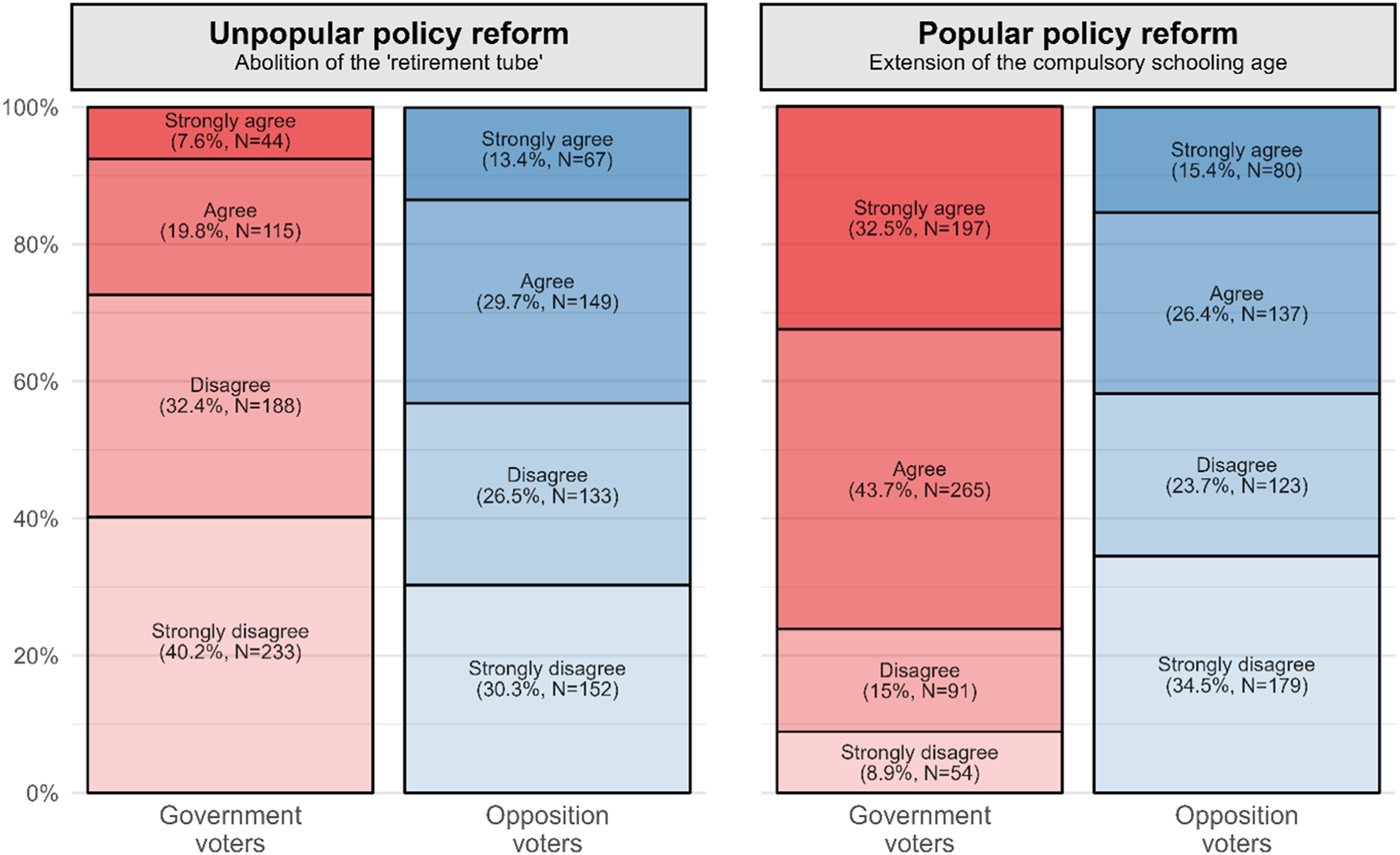
Figure 2 presents alluvial diagrams highlighting how these initial policy preferences have changed after the reforms were enacted. Even though the survey offered respondents four answers ranging from strongly disagree to strongly agree, the analysis splits the groups into agreeing and disagreeing to simplify the patterns. Changes in the policy preferences among government and opposition voters regarding the two reforms.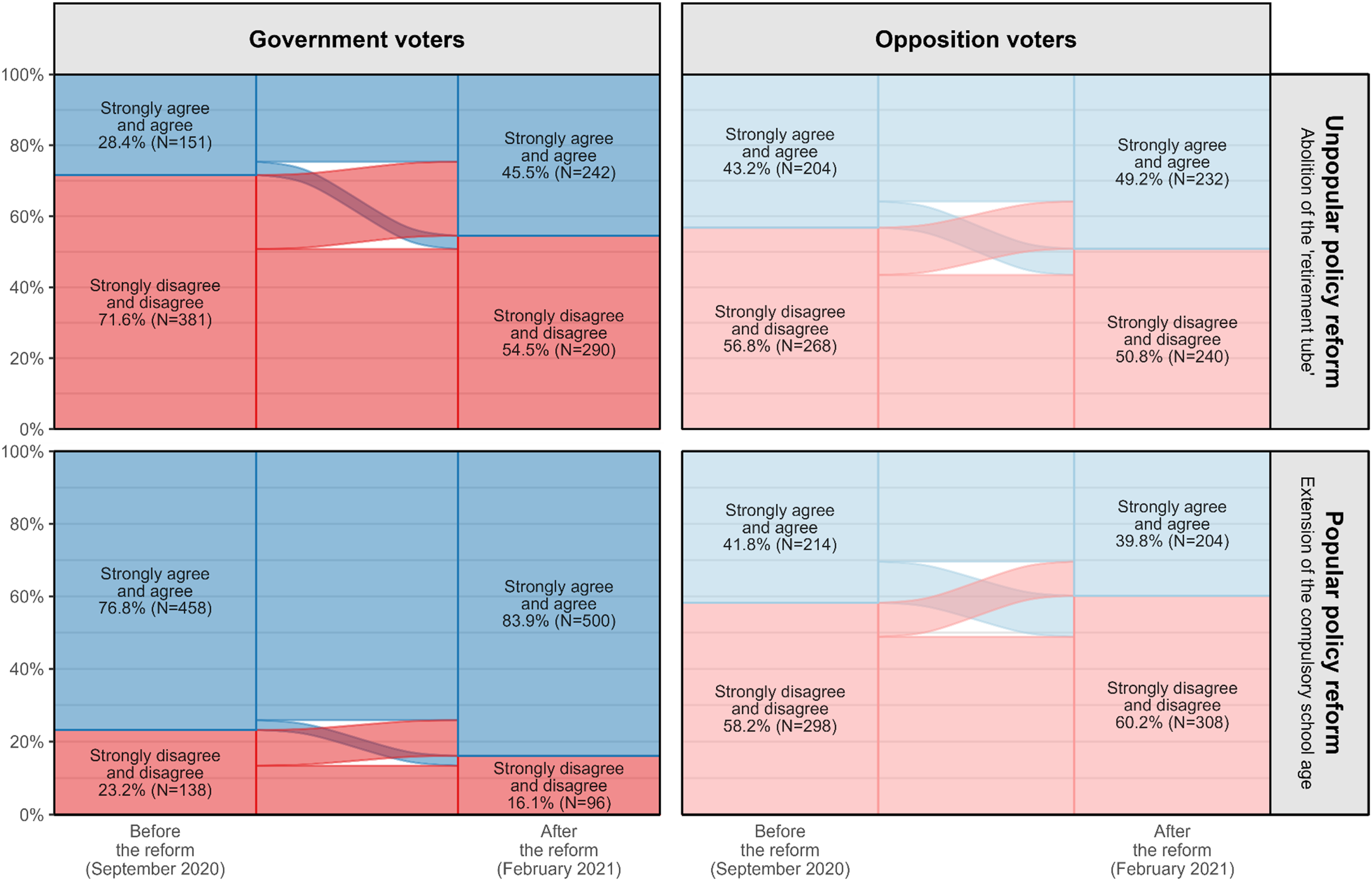
The most pronounced difference between the government and opposition voters is that the number of disagreeing (and strongly disagreeing) government voters who shifted their policy preference into agreement is always larger than the group shifting their opinion in the opposite direction (see left side of Figure 2). In the case of unpopular policy, 20.8% (n = 111) of government voters who initially opposed the reform became supportive once coalition parties decided to enact it. This represents almost one third of the government voters who initially opposed the reform. Only 3.8% (n = 20) of the government voters change their opinion in the opposite direction from being supportive to opposing the reform. The opinion shift in the positive direction appears to be smaller in the case of popular reform where 9.7% (n = 58) of government voters change their opinion from agreement to disagreement. However, the group of government voters initially disagreeing with the extension of the compulsory schooling age was much smaller (compared to the abolition of the ‘retirement tube’) including only about one third of the government voters. Therefore, it means that 42% of this group followed the party cue and changed their opinion which represents a substantive shift in the policy preferences of this subgroup. Again, only a few initially supportive government voters (2.7%, n = 16) changed their mind in the opposite direction. As can be seen, in both cases the group of initially disapproving government voters who shifted their policy preference in positive direction is considerably larger than the group of voters who changed their opinion in the opposite direction.
The adjustments of policy preferences take place also in the group of opposition voters (see right side of Figure 2). However, the group sizes moving their opinions in the opposite directions are more similar to each other and a smaller share of the group holding the initial opinion shifts their policy preference. In the case of unpopular reform, 13.3% (n = 63) of initially disapproving opposition voters (i.e., 23.5% of this subgroup) becomes more supportive. However, 7.4% (n = 35) of initially agreeing opposition voters turn against the reform. These opinion shifts in the opposite directions act against each other and effectively lower the overall opinion shift that we can observe among the opposition voters. The groups are even more balanced in the case of popular reform. 11.3% (n = 58) of the opposition voters initially supporting the education reform changed their mind, whereas 9.4% (n = 48) of the initially disapproving opposition voters moved towards agreement. Thus, the overall shares of supporters and opponents of the popular policy among opposition voters change only marginally before and after the reform enactment.
To conclude, government as well as opposition voters reveal changes in their policy preferences over time. However, the main difference is that a larger share of government voters initially opposing the reforms tend to improve their opinion. Moreover, there are only a few government voters moving their policy preference in the opposite direction. Among the opposition voters, the share of voters revealing an opinion shift is smaller when initial group sizes are taken into account. At the same time, the two possible opinion changes are more equally represented which means that they mostly cancel each other out and we can observe only minor differences in the average opinions regarding both policies among the opposition voters.
The overall effect of party cues: Within-individual shifts in policy preferences
Panel data enable us to estimate individual-level fixed effects models and thus leverage an improved causal identification strategy due to the elimination of time-invariant heterogeneity between the respondents. 8 The resulting estimates represent the average group shifts in policy preferences attributable to the reform.
Fixed effects models: Within-individual policy opinion shifts among government and opposition supporters.
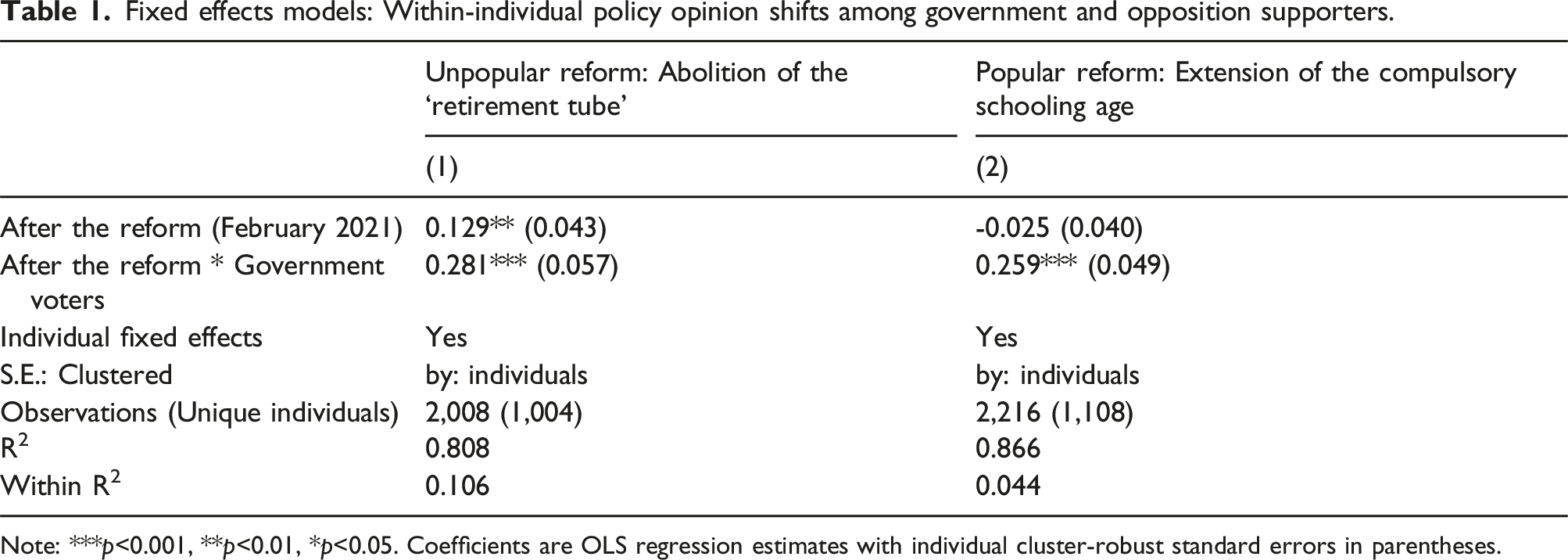
Note: ***p<0.001, **p<0.01, *p<0.05. Coefficients are OLS regression estimates with individual cluster-robust standard errors in parentheses.
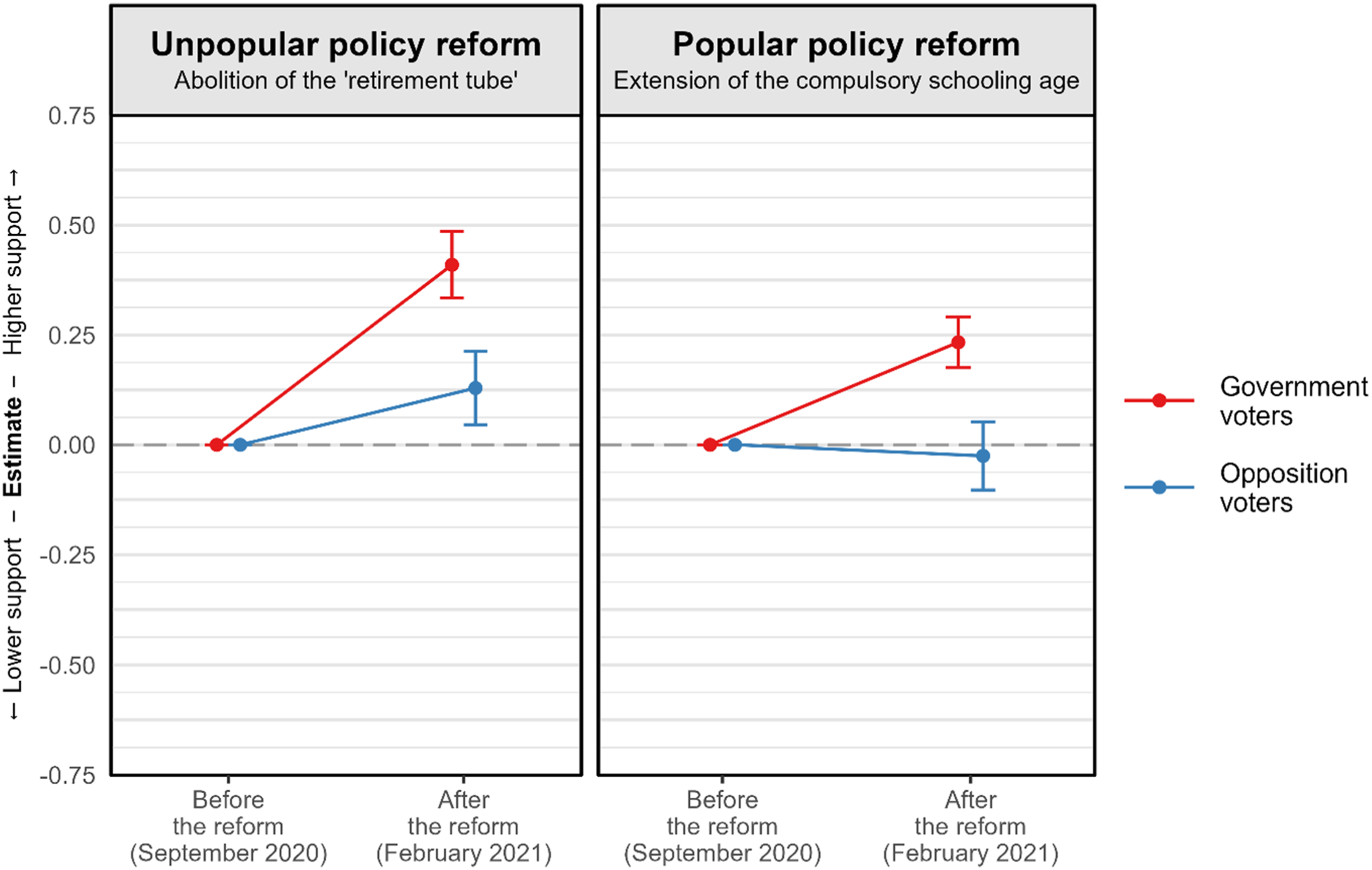
Within-individual policy preference shifts: Visualised are coefficients from models 1 and 2 in Table 1. Vertical lines represent 95% confidence intervals.
The shift observed among opposition voters regarding the unpopular policy constitutes only a third of the effect revealed by government supporters. In the case of popular policy, opposition voter preferences remain stable. Hence, despite a comparatively smaller shift among the opposition voters on one reform, their opinion is less affected by the government actions.
In terms of the attitudinal difference between government and opposition voters, both reforms seem to improve policy preferences to a comparable degree despite adjusting the social protection in Finland in the opposite direction. Compared to opposition voters, government supporters increased their support for the unpopular policy by some quarter of a point, a comparable effect magnitude being observed in the case of popular policy as well. All these empirical findings consistently supply empirical evidence suggesting that partisan cues influence voters to larger degree even if they lead voters to adopt ideologically inconsistent policy positions.
Policy preference shifts: Conditional influence of party attachment
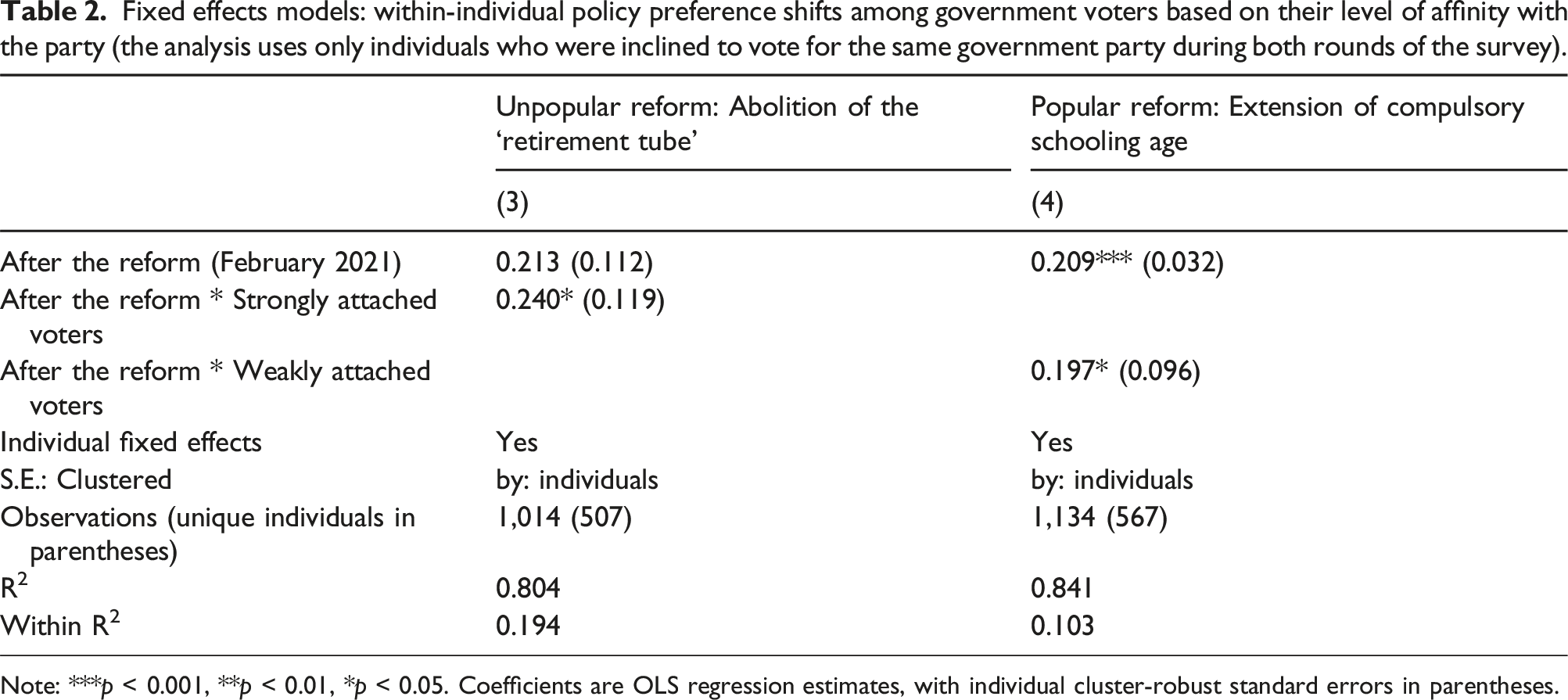
Fixed effects models: within-individual policy preference shifts among government voters based on their level of affinity with the party (the analysis uses only individuals who were inclined to vote for the same government party during both rounds of the survey).
Note: ***p < 0.001, **p < 0.01, *p < 0.05. Coefficients are OLS regression estimates, with individual cluster-robust standard errors in parentheses.
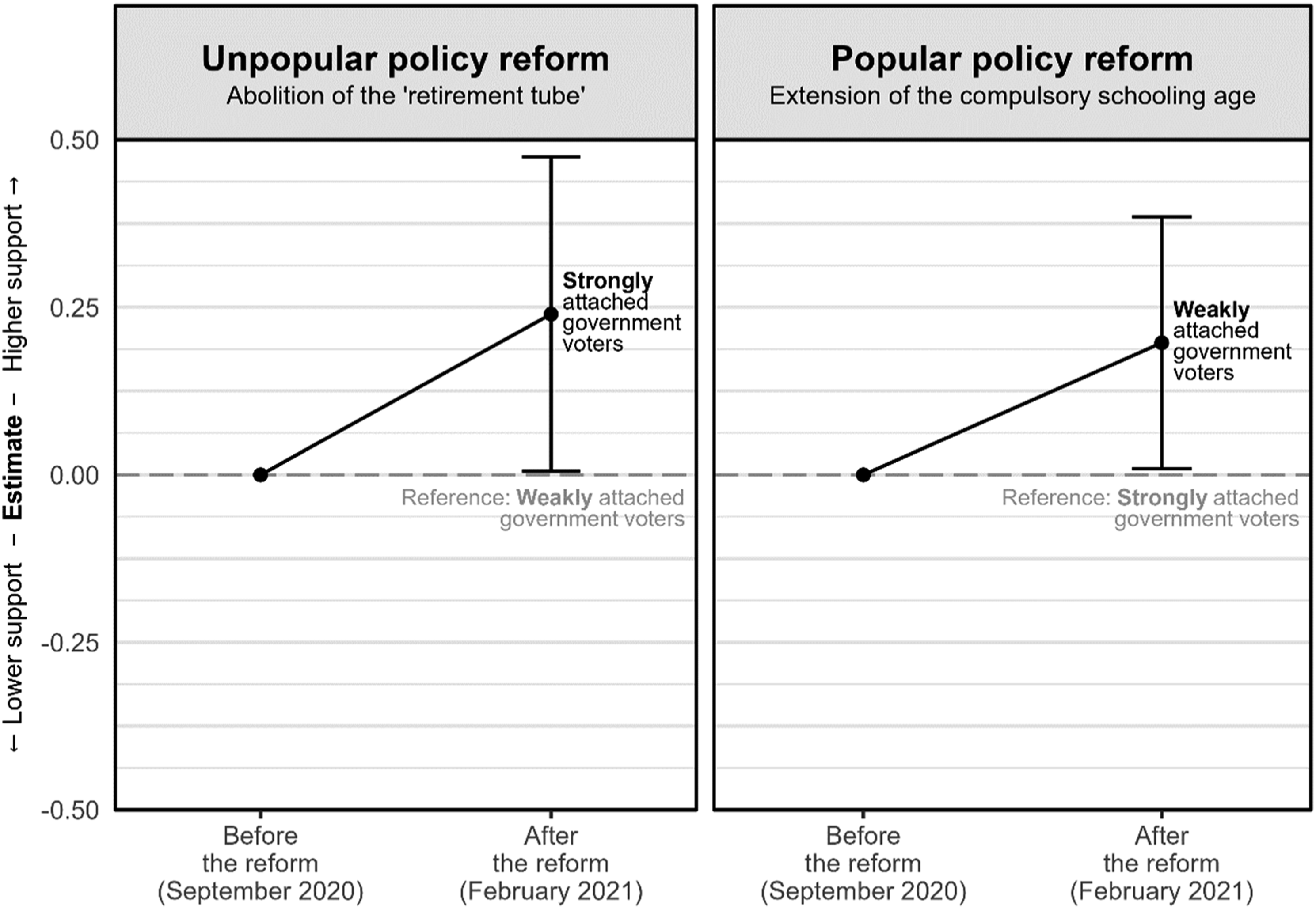
The effect of party cues depending on party attachment among government voters: within-individual policy opinion shifts based on fixed-effects models (coefficients from Table 2 are shown here; vertical lines represent 95% confidence intervals).
Focusing first on government voters and the unpopular abolition of the ‘retirement rube’ practice, those who express strong support for a government party tended to support the reform measure most strongly, by roughly 0.24 points (p < 0.05; representing some nine percent on the four-point scale) compared to their weakly attached partisans – see left panel in Figure 4. Considering that the opinion shift among weakly attached partisans was already around 0.21 point, as suggested by the time variable in model 3 Table 2, and the above-mentioned increase by 0.24 point comes on the top of this, the increased strength of party attachment appears to double the effect of party cues, and this difference is statistically significant at p < 0.05.
With respect to the more popular education reform, the largest positive attitudinal shift was due to a preference adjustment among voters with weaker attachments to the parties in power. The observed policy preference shift was roughly 0.20 points (p < 0.05; representing some seven percent on the four-point scale) – see right panel in Figure 4. Considering that the effect among strongly attached voters was roughly 0.21 points, see the coefficient for time variable in model 4 Table 2, and the effect among weakly attached partisans comes on the top of that. Also, in this case we observe that the combination of policy popularity and weak party attachment doubles the effect of party cues, and this difference is statistically significant at p < 0.05.
The discrepancy in these findings lends support to our initial expectation that the moderating effect of party attachment varies depending on the initial policy preferences of the relevant electorate. Abolishing the ‘retirement tube’ practice was supported much less by government voters than extending the compulsory schooling age (see Figure 1). The unpopular reform triggered a more pronounced response primarily among government voters with strong party attachments, who adjusted their policy stances to align more closely with the official party line. In contrast, the popular education reform revealed that voters with weaker party attachments shifted their opinions to a larger degree. These trends lend empirical support to both our hypotheses.
This analysis was conducted solely on government voters, as their parties either enacted policy reforms or changed their stances on the issues, providing powerful cues to their supporters. In contrast, opposition parties did not release cues as strong as those of the government parties, indicating that the policy preferences of their voters should remain stable over time. That enables us to test the robustness of the findings: if the policy stances among opposition voters remained stable over time, it is likely that it was the activity of the government parties which led the government voters to follow their parties and shift their policy preferences. The results are presented in section E of the online appendix. We used the same fixed effects models as above but only examined the potential opinion shifts among opposition supporters. The findings show that the policy preferences of opposition voters remained stable throughout both rounds of our panel survey, regardless of whether they were strongly or weakly attached to their parties. This implies that the partisan cues issued by the government parties did not influence the opposition voters in the same way, and that the effect solely applies to government supporters. This additional evidence strengthens our overall findings.
Conclusions
There is growing consensus about the strong role that political parties play in shaping public opinion (see, e.g., Bachner and Hill, 2014; Barber and Pope, 2019; Broockman and Butler, 2017; Chong and Mullinix, 2019; Guntermann and Quinlan, 2022; Mummolo et al., 2021; Petersen et al., 2013; Peterson, 2019; Slothuus, 2010; Slothuus and Bisgaard, 2021a). However, some topics regarding the contextual conditions under which partisan influence thrives and withers still need to be studied in more detail. We have contributed to existing scholarship by assessing policy popularity and strength of party attachment via an original panel survey conducted before and after the Finnish government decided to enact two policy reforms that initially enjoyed differing levels of popular support – an unpopular pension reform abolishing the ‘retirement tube’ and a more popular extension of the compulsory schooling age.
In both cases, government party voters were found to adjust their policy preference substantively to be in line with the governments’ decisions. This result was consistently found when the opinion shift among government voters is compared against their opposition counterparts, a similar effect is found for welfare retrenchment and welfare expansion reform, and the findings are robust from an array of analytical approaches. Hence, the findings provide strong empirical support in line with the tradition stressing the role of parties in shaping their voters’ opinions in the real-world setup (Guntermann and Quinlan, 2022; Slothuus, 2010; Slothuus and Bisgaard, 2021a, 2021b). We demonstrated that these behavioural patterns apply even in the instances when governments have to proceed with an unpopular decision and implement cuts in social protection. As the results of our research imply, even in such least-likely cases, voters tend to follow the actions of their preferred parties and adjust their policy preferences accordingly.
Moreover, our findings reveal that partisan attachment moderates the effect of party cues with respect to how voters adjust their policy preferences but that such attachments are manifested through the ways in which voters interact with and show initial support for a given policy. If the initial level of support for a policy is low, it is mostly those with strong party affiliations who follow the party line and alter their policy stance accordingly. However, if a proposed reform is popular with party supporters, then voters with weaker party attachments tend to shift their opinion from more middle-ground evaluations towards a more positive stance (aligning them more with strongly affiliated voters).
Supplemental Material
Supplemental Material - Putting partisan influence into political context: How initial policy popularity and party attachment shape the effect of party cues
Supplemental Material for Putting partisan influence into political context: How initial policy popularity and party attachment shape the effect of party cues by Miroslav Nemčok, Hanna Wass, and Juho Vesa in Party Politics
Supplemental Material
Supplemental Material - Putting partisan influence into political context: How initial policy popularity and party attachment shape the effect of party cues
Supplemental Material for Putting partisan influence into political context: How initial policy popularity and party attachment shape the effect of party cues by Miroslav Nemčok, Hanna Wass, and Juho Vesa in Party Politics
Footnotes
Declaration of conflicting interests
The author(s) declared no potential conflicts of interest with respect to the research, authorship, and/or publication of this article.
Funding
The author(s) disclosed receipt of the following financial support for the research, authorship, and/or publication of this article: Academy of Finland; Grant 312710: “Tackling Biases and Bubbles in Participation - BIBU” and The Research Council of Norway; Grant 301443: “Welfare State Support and Political Trust: Integrating Economic, Cultural, and Policy Explanations - WELTRUST”.
Supplemental Material
Notes
Author biographies
 .
.
References
Supplementary Material
Please find the following supplemental material available below.
For Open Access articles published under a Creative Commons License, all supplemental material carries the same license as the article it is associated with.
For non-Open Access articles published, all supplemental material carries a non-exclusive license, and permission requests for re-use of supplemental material or any part of supplemental material shall be sent directly to the copyright owner as specified in the copyright notice associated with the article.
