




Abstract
This paper examines strategic voting at Scottish Parliamentary elections since 1999. The emergence of the pro-independence Scottish National Party as the dominant party in Scotland has forced unionist voters to carefully consider their options. Analysing differences between the simultaneous pluralist constituency ballot and proportional list ballot of Scotland’s Additional Member System provides a unique insight into how voter behaviour has changed in response to Scotland’s changing political reality. This paper finds that many unionist voters have put aside left-right rivalries to support fellow unionist candidates on the constituency ballot. This examination finds that Labour and Conservative voters are willing to work together, in some circumstances, to defeat a significant number of pro-independence candidates. I find that intra-unionist strategic voting helped prevent the separatist majorities in parliament in both 2016 and 2021.
Introduction
The pro-independence Scottish National Party (SNP) are the dominant party in Scotland and have finished no lower than second in every constituency since 2011. The SNP’s rise culminated in an unsuccessful independence referendum in 2014, but the party has maintained its high level of support (Johns, 2021). This paper tracks the history of strategic voting since devolution in 1999 and examines if strategic minded voters see the constitutional question as paramount.
This paper seeks to understand how Scottish voters are interpreting their dual ballot system in the context of discussions around independence; this is particularly important as Scottish elections are unusually close, with many marginal seats and the SNP often finishing within just a few seats of majority (Johnston et al., 2018). A small number of strategic voters could make an outsized impact on results, including potentially denying an SNP majority. As a result I focus specifically on how unionist voters act when faced with a choice between the Scottish National Party (SNP) which campaigns for independence from the UK, and a strategic vote for a more competitive unionist party.
In 2023 the leader of the Scottish Conservatives encouraged his party’s supporters to vote strategically for “the strongest candidate to beat the SNP,” whether they be Conservative, Labour or Liberal Democrat (Diver and Leather, 2023). I find that this unionist unity thinking has long been in place amongst voters.
For voters of the centrist, Liberal Democrat party, it is expected that supporting either of their fellow unionists in Labour or the Conservatives is not a large ideological jump (Herrmann et al., 2016). However for rightwing Conservatives to support left-wing Labour candidates, or vice versa, is likely to require more of a push. This may stem from growing salience of independence as the SNP expanded, as well as from traditional indicators of strategic voting, such as how marginal the race in their constituency is expected to be and how far their true preference is from being competitive (Blais and Bodet, 2006).
This paper adds to the literature of strategic voting in the UK at large and to Additional Member System (AMS) studies more generally. This examination is especially fruitful as an unusually high number of Scottish constituencies are won by small margins in general elections, meaning that Scottish strategic voting is more likely to be consequential (Johnston et al. 2018). In the general election of 2017, 17 of Scotland’s 59 seats were won with less than 40% of the vote, an outcome that occurred only 5 times across England’s 572 seats (Johnston et al. 2018: 32). This study found that strategic voters were reacting to this; up to 40% of Labour supporters voted Liberal Democrat if the Liberals stood the best chance of defeating the SNP (2018: 34). Conservative - Liberal Democrats support was similar, although Labour - Conservative strategic behaviour was less common. This paper investigates if these patterns are replicated at the devolved level.
This paper begins by discussing the electoral system before moving into how voters in other AMS settings interpret the system. It then examines if Scottish voters are acting in a similar vein, and how the constitutional question factors into this. Regression analysis examines if strategic voting is a factor in Scottish regional elections. Finally, a count of which parties benefit the most from strategic voting concludes this paper. I find that the SNP have lost dozens of seats from leading positions due to unionist voters acting strategically.
Strategic voting at a new Scottish parliament
Historically, elections in the UK functioned under First Past the Post (FPTP). FPTP allows voters to cast one vote for one candidate in a single seat constituency, whoever gets the most votes wins that seat. This simple system heavily incentivises voting for large parties as small parties have great difficulty winning seats (Duverger, 1967). AMS differs by allowing voters to cast two separate ballots simultaneously; one ballot for a local constituency representative under FPTP, and another for a party list in a wider region with multiple seats allocated proportionally. The list irons out some, but not all, of the disproportional results stemming from the constituency seats.
In 1999 the new Scottish Parliament opened at Holyrood (Scully and Wyn Jones, 2006). The parliament was founded by the incoming Labour government in London, a party which had long been the dominant force in Scotland. It was agreed, jointly by Labour and the Liberal Democrats, to pick the system which offered ‘Labour the prospect of almost permanent power’ (Curtice, 1996: 122).
It was chosen on the assumption that AMS would be proportional enough to guarantee that Labour could still form a coalition even if the SNP and/or the Conservatives improved their performance (Curtice, 1996). The exact variety of AMS that they selected was to be a slightly less proportional version of the one that has long been used in Germany (Farrell, 1997). This leads to a parliament that generally reflects the views of voters but still gives an advantage if a party dominates on the constituency level. Thus, AMS remains open to strategic voting (Plescia, 2017).
In the first devolved election of 1999 there was a change in the fortunes for the SNP (Curtice, 2006: 302). The party came second, having varied between third to fourth for decades (Scottish Parliament, 2021a). A big part of this initial surge came not from a change in support, but because of the greater proportionality of AMS. The SNP had already finished second in vote share at the 1997 general election but came third in seats (Curtice, 2006). Just two election cycles later and the SNP were first, overtaking Labour in 2007 with 47 seats.
I borrow the definition of a strategic voter given by Fisher as: ‘someone who votes for a party they believe is more likely to win than their preferred party, to best influence who wins in the constituency’ (2004: 157). Studies have found that voters use cues such as previous results and polling data to build expectations and decide strategies so their actions should be reasonably predictable and observable in terms of both time and place (Blais and Bodet, 2006; Fey, 1997: 136).
The motivation for strategic voting at the constituency ballot of AMS is lower than under pure FPTP as the losing party can make up some losses on the list, thus reducing the jeopardy. However, it remains rational for voters to attempt to influence local results. Voters may prefer their constituency representative to be someone they know and trust, rather than whichever ‘faceless’ list candidates are elected (Herrmann and Pappi, 2008: 2; Plescia, 2017: 20). Additionally, a candidate who missed out in a constituency ballot may not be included on their party’s regional list, so there is an opportunity for strategic voters to prevent a disliked candidate from entering parliament as an MSP (Scottish Parliament, 2021b).
First Past the Post encourages a voter to back one of the two largest parties in that constituency to avoid ‘wasting their vote’ (Fey, 1997: 146). The same rationalist principles do not apply - or apply much less strongly - on the regional ballot, meaning that voters can act honestly as even quite small parties can win seats (Abramson et al., 2010). The result of such different incentives is that some voters have strong incentives to vote differently on the two ballots.
Indeed, research has found that 17%–28% of all voters in Scottish Parliamentary elections cast their constituency and list ballots for different parties (Curtice, 2006: 309). It cannot be ruled out that voters act differently on each ballot for other reasons also, such as perceived importance of each ballot, candidate specific voting, or simply out of confusion. However, those votes should be spread randomly across Scotland rather than concentrated in certain constituencies or weighted towards specific parties (Karp et al., 2002: 2).
It has been argued that lower tier elections are too impacted by ‘second order’ effects to draw meaningful conclusions from. Such elections are defined by low turnout and increased support for non-governing parties, particularly those of more radical positions. As a result it can be difficult to claim that many voters are putting active strategic thought into their decisions. However this does not appear to have a strong confounding effect in Scottish parliamentary elections (McEwen, 2013). Figure 1 demonstrates that whilst turnout is higher at General elections, the difference is not large. Further the SNP won their first regional majority in 2011 and emerged as the largest party in Scotland at the subsequent general election of 2015, suggesting that their increased support regionally was not a mere protest vote (Curtice, 2018). Scottish turnout rates at UK-wide general elections and turnout at Scottish regional elections.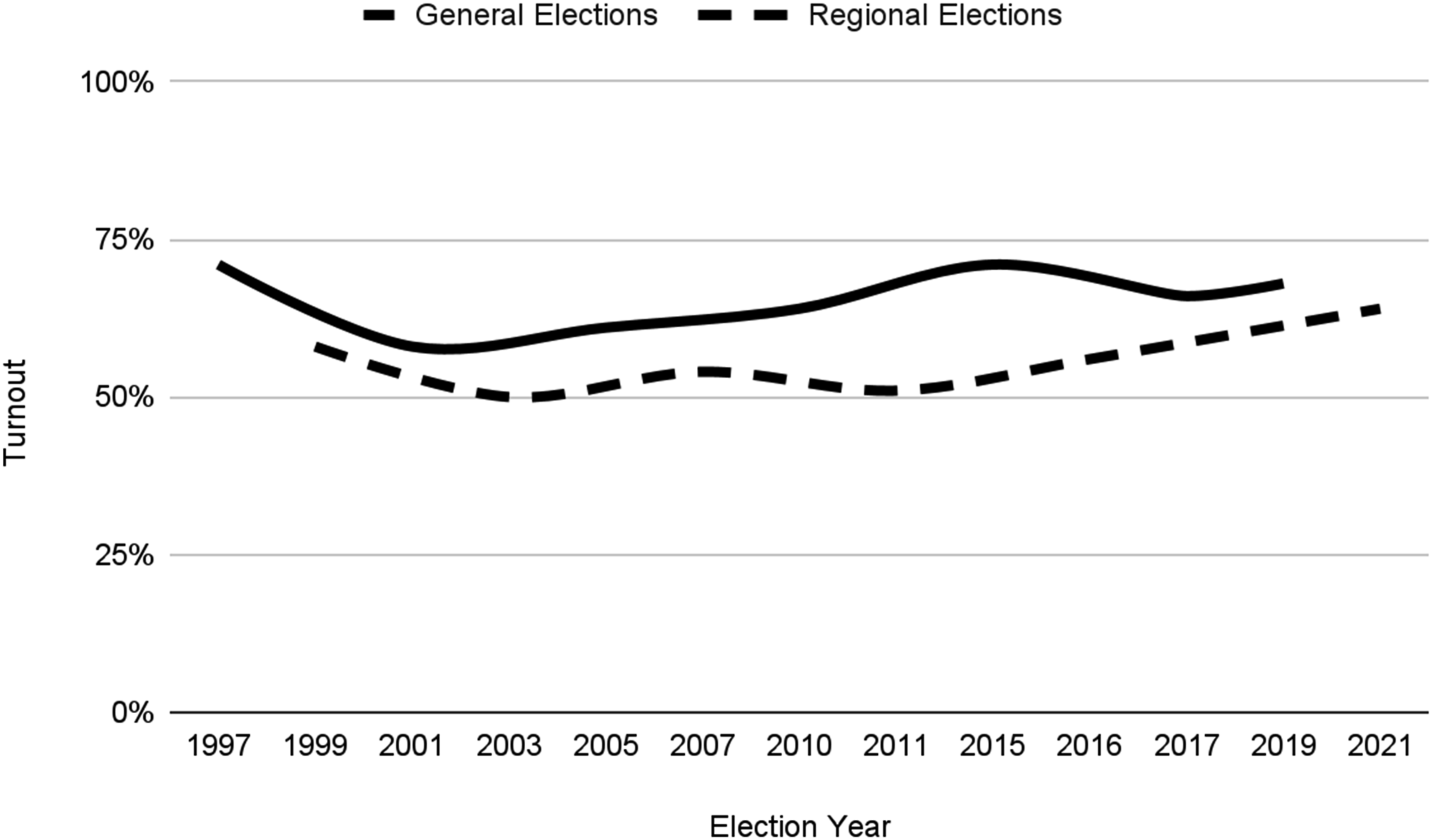
Scottish party positions
In examinations of similar AMS systems, voters have been found to loan their constituency vote to larger like-minded parties before returning to their true preference on the regional ballot. Much study has focused on Green voters in Germany, many of whom back the larger Social Democrat party on the constituency ballot (Herrmann and Pappi, 2008: 3). In Scotland similar left-wing cooperation would see SNP and Labour voters strategically supporting each other against the Conservatives, however the existence of a Unionist - Nationalist cleavage may present an uncrossable canyon.
Scottish party positions in two dimensions.

If the left-right ideological divide takes precedence we would anticipate that Labour voters, and some Liberal Democrats, would lend their support to the SNP to defeat Conservatives. Indeed Johns found that such behaviour was not unusual in the early years of devolution (2021: 498). Independence is expected to have increased in salience in concert with the SNP’s expansion. Of course beliefs over independence and economics are not mutually exclusive, the SNP argue that they are pro-independence because they are left-wing (Massetti and Schakel, 2015). The party has argued that the Scottish Government lacks powers to pursue left-wing policies (Scottish National Party, 2021).
The Greens are anticipated to have a wide split in second preferences. The left-wing party officially endorses independence but did not emphasise its pro-independence position until 2021 (Scottish Greens, 2016; Scottish Greens, 2021).
Supporters of each party are not monoliths which act the same way at the same time. Each individual will make a judgement based on how they perceive their options. Analysis of Northern Irish transfers under the Single Transferable Vote (STV), in which voters rank candidates by preference, shows that voters of the same party can differ widely in their second preferences (Mitchell, 2014), although general patterns are observable. Northern Irish unionist voters tend to transfer mainly to other unionists while nationalists generally transfer to nationalists, regardless of economic position.
In recent general elections, Johnston et al. uncovered significant intra-unionist strategic voting in Scotland (2018: 34). They posit that the SNP’s rise to power increased the salience of independence as an issue. Which may be leading to the ‘Northern Irishification’ of Scottish politics.
The possibility of strategic voting has been noticed in other quarters too. In recent elections some organisations have produced constituency specific guides to help voters maximise their vote. In preparation for the 2021 election, Election Polling (2021) provided a full range of strategic voting options, whilst Scotland in Union (2021) offered strategic advice specifically for unionists. The existence of such sites demonstrates that strategic behaviour was being considered by at least some voters, although their impact is under researched.
Strategic voting on the list ballot is possible and can also take on a unionist or nationalist shape. Voters may decide to support a smaller party on the regional list to help them cross the electoral threshold, and possibly join one’s preferred party in a coalition, using strategies known as ‘threshold insurance voting’ or ‘coalition voting’ (Plescia, 2017: 21). However, research has struggled to find substantial threshold insurance voting, accounting for less than 5% of votes cast in Germany, Japan and New Zealand (Plescia, 2017: 24). The 2021 Scottish election witnessed twin attempts to draw out constitutionally driven threshold insurance voters; Alba (nationalist) won 1.7% and returned zero MSPs, while All for Unity (unionist) won 0.9% and zero MSPs (Johns, 2021: 493; Scottish Parliament, 2021a).
Expectations
To begin, this paper examines if Scottish voters are acting strategically on the constituency ballot I adopt similar tests to those used in Germany and elsewhere (Plescia, 2017). This initial test, H1, does not consider party ideology or any other factors, it merely seeks to understand if strategic voting exists in Scottish Parliamentary elections. The details of each measure are discussedbelow.
H1
A measurable number of supporters of (locally) small parties act strategically on the constituency ballot by supporting parties which had previously finished first or second in that constituency.
We then move on to examine the crux of this paper, H2, investigating if strategic voters are prioritising their constitutional position rather than their ideological preferences.
H2
Supporters of small parties, locally, will strategically vote for parties which share the same constitutional position as their first-choice party regardless of that party’s economic position.
Strategic voting measures will be tested alongside party affiliation to examine H2. After discussion of data and methodology, alongside a real-world example to demonstrate how the theory is expected to work.
Strategic voting methodology
Examinations of strategic voting in the United Kingdom have been conducted using different methodologies. Most have focused on the national sphere which employs FPTP and have employed complex methods and polling data to extrapolate voters’ true preferences and contrast these hypothetical figures with observed voting behaviour (Fey, 1997; Johnston et al., 2018). However, constituency-level polling is rare in Scotland.
This paper strikes a different path by directly comparing voting patterns in the two separate ballots of the AMS in a similar way to studies of elections in Germany and New Zealand (e.g. Karp et al., 2002; Shikano et al., 2009). By examining Scotland in this way we can estimate how many Scottish voters are willing to vote strategically on their constituency vote. Often such studies have relied on an ideological variable denoting if the party is of the left, centre or right to gauge to interpret strategic movement; which is included here. An additional binary variable indicating if each party is unionist or separatist is added (Herrmann and Pappi, 2008; Plescia, 2017: 26). No limitation is placed on which party a voter can support strategically. If, for example, a large number of SNP voters were seen to back the Conservatives I would consider those voters to be acting strategically, even if the rationale behind such behaviour is not immediately apparent.
Adapting methodologies from other AMS states provides advantages over traditional strategic voting measures of UK elections. Firstly, list and constituency ballots were cast simultaneously which removes the possibility that voters changed their mind between casting their ballots. Further, all the required data for this examination comes from election results rather than polls which removes margins of error (Herrmann et al., 2016: 284). Additionally, studies have demonstrated that parties campaign differently in different regions which can limit national studies, choosing one region and one electoral level means results are directly comparable (Pogorelis et al., 2005: 994).
Ideally we would test H2 on both nationalist and unionist voters, however the pro-independence Green party stands very infrequently on the constituency ballot. Additionally, the SNP have been in the top two in every constituency since 2011 and were often competitive before then (Scottish Parliament, 2021a). As a result there are just a handful of constituencies in which nationalists can vote strategically for fellow nationalists in the manner examined in this paper. This is not to say that the SNP are excluded from the regression analysis below. Including the SNP allows us to understand the extent of strategic voting more broadly, and to see if more traditional economic ideological considerations are still in play.
Surveys of Green voters would be the ideal form of understanding how their supporters act. Even then, though, Green voters are usually forced to vote for a different party on the constituency ballot due to the party not standing, which falls outside the definition of strategic voting used here (Fisher, 2004: 154). As a direct result of the complexity of determining the strategic behaviour of Scottish nationalists, this paper focuses on unionist voters. Unionists always had at least three unionist options to select from, Labour, the Conservatives and the Liberal Democrats (Scottish Parliament, 2021a).
As demonstrated by Blais and Bodet (2006), strategic voters use previous elections as cues for the present by looking at who finished first and second last time, and voting for whichever of those two they prefer - or at least whoever they dislike the least, thus increasing the combined vote share of the top two parties. Some voters may have seen incorrect information from other sources; however evidence suggests that most act as if they have accurate data (Blais and Bodet, 2006). The closer the previous result, the greater the incentive for voters to act strategically, as they are more likely to make a difference. This will ultimately lead to the establishment of two dominant parties in each constituency (Duverger, 1967).
There are some caveats to this assertion. Some constituencies have multiple competitive parties making it difficult to determine an effective strategy, an unusually common occurrence in Scotland (Johnston et al., 2018: 35). This will be measured by examining how far the third placed party finished from the second party, or their ‘distance from contention’ (DfC) (Niemi et al., 1992: 233). Other constituencies have one party with a comfortable majority which no strategy could defeat, they will be coded as such if a party won over 55% at the previous election.
H1 will be tested using these measures alone. A linear regression will be used to examine percentage point changes to the combined top two vote share. This will allow us to know if strategic voting is a factor in Scottish Parliamentary elections.
Data
This dataset includes every election to the Scottish parliament since its creation in 1999. It tracks the constituency results of all major parties as well as their list results, broken down by each constituency. There have been six elections to the Scottish Parliament with 73 constituencies contested in each election. As each election is compared to the previous one, the 1999 election cannot be tested under this methodology.
I use list votes of AMS to create a constituency specific baseline estimate of true preferences which is directly comparable with constituency ballot results. Turnout is almost identical between the two ballots, although a small number of voters appear to spoilt one or other ballot.
In 2010 the Boundary Commission for Scotland overhauled Scotland’s constituencies, effectively wiping the slate clean for many strategic voters before the 2011 election. Not every constituency was changed, and not all changes were substantial. The boundaries of Shetland and Orkney are defined in law (Boundary Commission for Scotland, 2010: 13) and some were simply renamed (Western Isles to Nah h-Eilanan an Iar).
A BBC report BBC (2010) ranked changes along an ‘index of change.’ To compare constituencies accurately I use 5% change as my cut off point, any constituency which changed more than this is considered new. A high bar has been used because so many Scottish constituencies are decided by narrow margins that even a 10% shift in population can be sufficient to distort expectations (Johnston et al., 2018). Just 15 of 73 Scottish constituencies had sufficiently small changes to meet this criterion. In each case their 2011 results have been treated in the same way as results in other years, the other 58 constituencies start from scratch. This gives us an n of 307 constituency elections.
An important caveat is that no party is obliged to stand on both the regional ballot and constituency ballot. Across the AMS world small parties have focused their efforts on the more proportional list ballot (Plescia, 2017). Only four parties contested every constituency and region at every election: the Conservatives, Labour, Liberal Democrats, and SNP (Scottish Parliament, 2021a).
Dumbarton: A prime example
In the 2016 election Dumbarton was the scene of a close battle between Labour and the SNP. Labour took the seat by just 109 votes while the Conservative party were a distant third (Scottish Parliament, 2021a). Strategic minded voters could take that result into consideration in the next election in 2021 and support whichever of the largest two parties they prefer on the constituency ballot. A strategic voter would not need to know the exact figures, all they would need is a general idea that this is a Labour/SNP marginal with no other realistic choices (Blais and Bodet, 2006; Downs, 1957). The same person can then vote honestly on the list as it is a separate issue (Farrell, 1997).
2021 Scottish Parliamentary results in Dumbarton constituency (Scottish Parliament, 2021a).
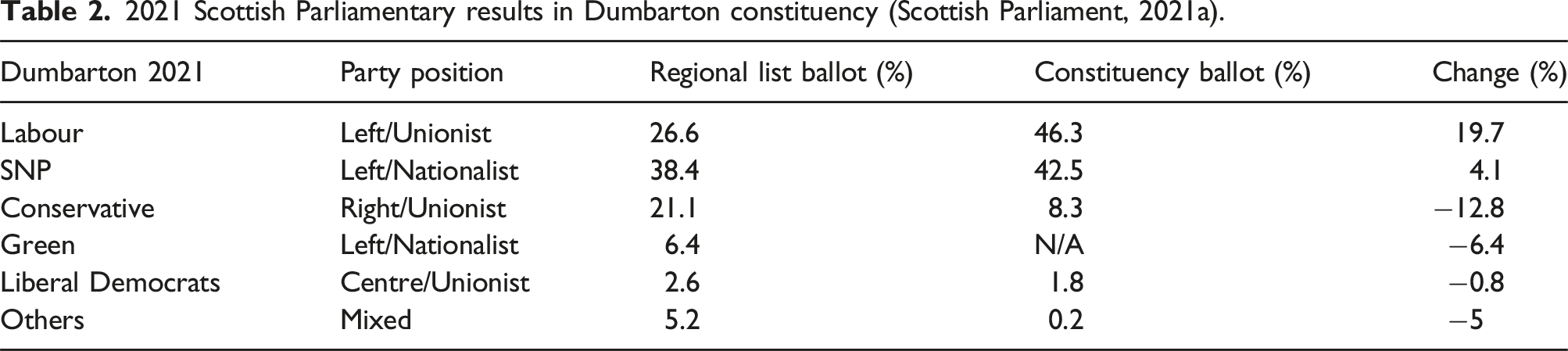
The results indicate substantial strategic voting with unionist voters rallying behind Labour on the constituency ballot (Johns, 2021: 496). The SNP received 11.8% more votes than Labour on the regional ballot, making them the most popular party on the ballot which does not encourage strategic action (Plescia, 2017: 24). However, up to 12.8% percent of voters split their tickets between the Conservatives on the list and Labour’s constituency candidate.
59% of Conservative list voters appear to have adopted this strategy, which matches estimates from Germany where 50%–58% of voters who had strong incentives to vote strategically actually did so (Herrmann and Pappi, 2008: 14). The Conservatives and Liberal Democrats combined vote share declined by 13.6%, Labour’s increased by 19.7%. I suspect that a substantial number of Greens, perhaps up to half, along with voters from smaller parties, also supported Labour on the constituency ballot.
The results are particularly noteworthy as we would expect every party which stood candidates on both regional and constituency ballots to win more votes on the constituency ballot as five parties were competing rather than 19. However, only Labour and the SNP increased their vote shares. The surge in support for Labour, and uptick in support for SNP, contribute to the top two parties winning 88.8% of the constituency vote up from 65% on the list, a common side effect of strategic voting (Duverger, 1967).
Results from just one constituency at one election do not, of course, confirm strategic voting. I expand this research to encompass every Scottish constituency since 1999 through regression analysis. I track how many times instances like that in Dumbarton occurred, as well as which parties benefited and suffered.
To extrapolate from examinations over time, I deploy regressions to predict how much each major party’s vote share changed between the list and regional ballot depending on whether or not they finished in the top two at the constituency ballot at the previous election. Parties are coded one if they finished either first or second in that constituency at the previous Scottish Parliamentary election, and 0 if they finished third or lower. Established strategic voting predictors and controls are included to add weight to the findings (Blais and Bodet, 2006).
These indicators are; • The percentage point margin of victory between the first and second placed parties. • Total cumulative vote share of the top two parties. • Turnout. • A binary variable indicating if the largest party won a clear majority of over 55% of the vote in that constituency. • The percentage distance between the second and third placed parties, known as Distance from Contention. • The change in votes share between list and constituency ballots of every major party.
This is replicated for each major party to examine how each party’s members acted. I then explore how many results were changed by successful strategic voting attempts. In tight races relatively few voters may alter the outcome, whilst in other circumstances big strategic movements may not be as successful. To account for this I explore if such changes benefitted or hampered any party in particular. This will give us an insight into which voters were coordinating and which ideological position they were prioritising.
Summary statistics and initial tests
We begin with some summary statistics. When we consider the rank order of each party at the previous election, in each constituency, a clear pattern emerges. Those finishing first or second receive more votes on the constituency ballot than on the list ballot (Figure 2). This suggests that voters are taking previous competitiveness into account when casting their constituency vote (Blais and Bodet, 2006). Constituency vote share minus regional list vote share, by party rank at previous election.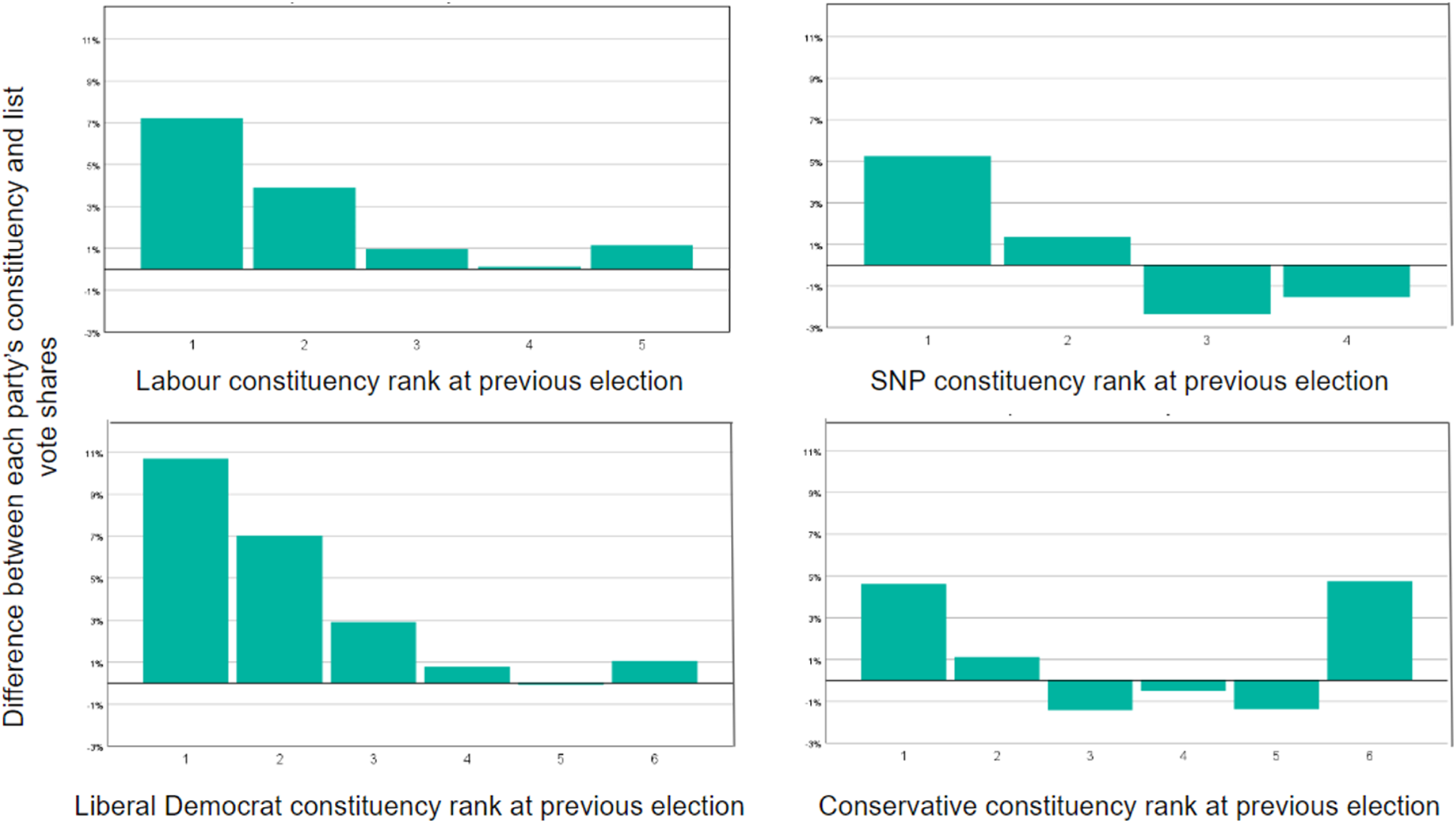
The extent to which they gain varies, the Liberal Democrats, as the middle ground option, benefit the most. They receive an average boost of almost 11 percentage points compared to their simultaneous list share if they are the incumbent party, and seven percentage points if they are the main challenger (Plescia, 2017: 21).
The SNP and Conservative results mirror each other, possibly because both parties are on the extremes of the two ideological spectra. Both gained most if they were first, less if they were second, and lose votes if they were below this. The Conservative party finished sixth just once which facilitated their unusual uptick. The SNP have never finished lower than fourth nor Labour lower than fifth.
There are a notably higher number of clear majorities on the constituency ballot than the regional list ballot; only 1.4% of list ballot are won with more than 55% on the regional ballot; the equivalent figure on the constituency ballot was over 12%.
Voter responses to strategic incentives
Tally of occasions in which each party finished in the top two at the constituency level.

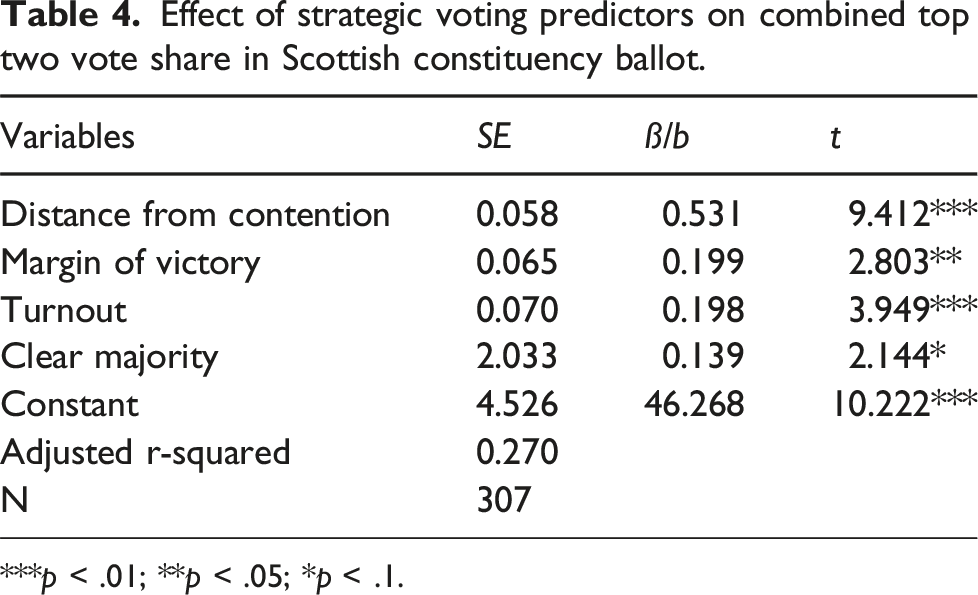
We start by conducting a simple test of whether strategic voting is occurring at the constituency level in Scottish Parliamentary elections. To do this a linear regression examines the effect of common measures which track how strongly strategic voting is incentivised in each constituency affects the combined vote share of the top two parties. The margin of victory in the prior race is strongly significant, as is the Distance from Contention. This suggests that if voters expect a close two horse race they are more likely to support one of the two largest parties. Indeedall predictive indicators included are significant, but a party having a clear majority only appears to have a small effect.
Effect of strategic voting predictors on combined top two vote share in Scottish constituency ballot.
***p < .01; **p < .05; *p < .1.
Unionist unity or left unity?
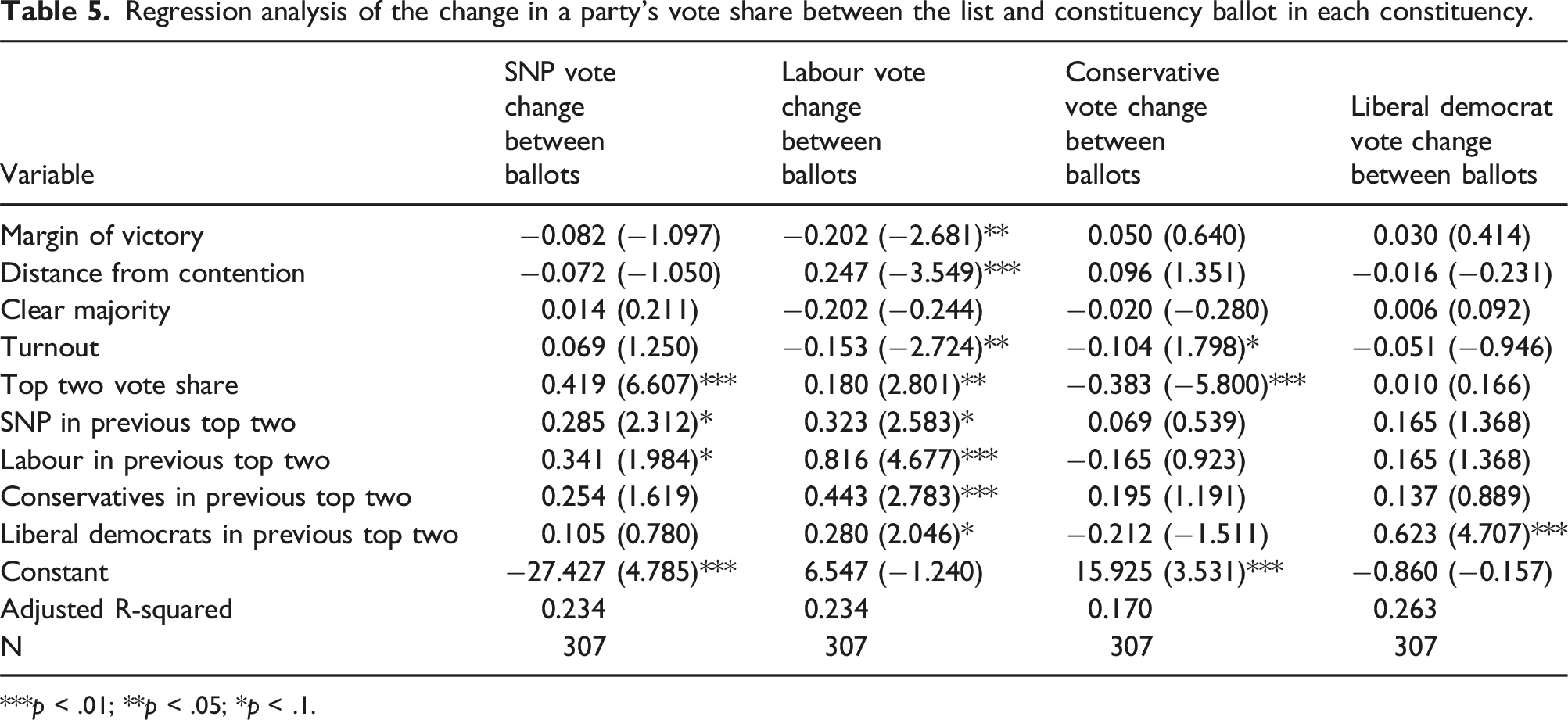
Regression analysis of the change in a party’s vote share between the list and constituency ballot in each constituency.
***p < .01; **p < .05; *p < .1.
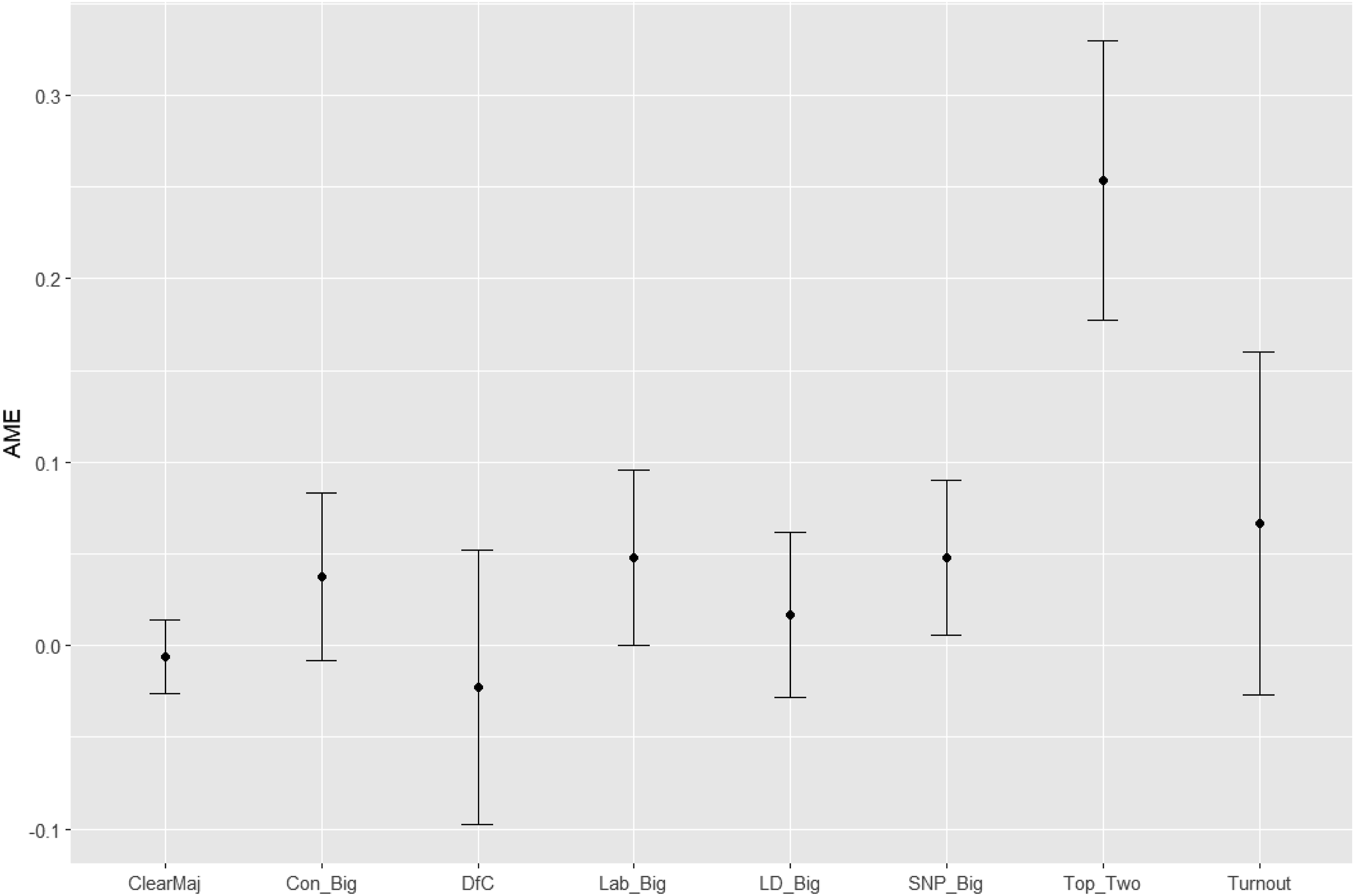
Average Marginal Effects (AME), of the difference between simultaneous constituency and list vote share for the SNP each constituency at the previous constituency election. ***p < .01; **p < .05; *p < .1.
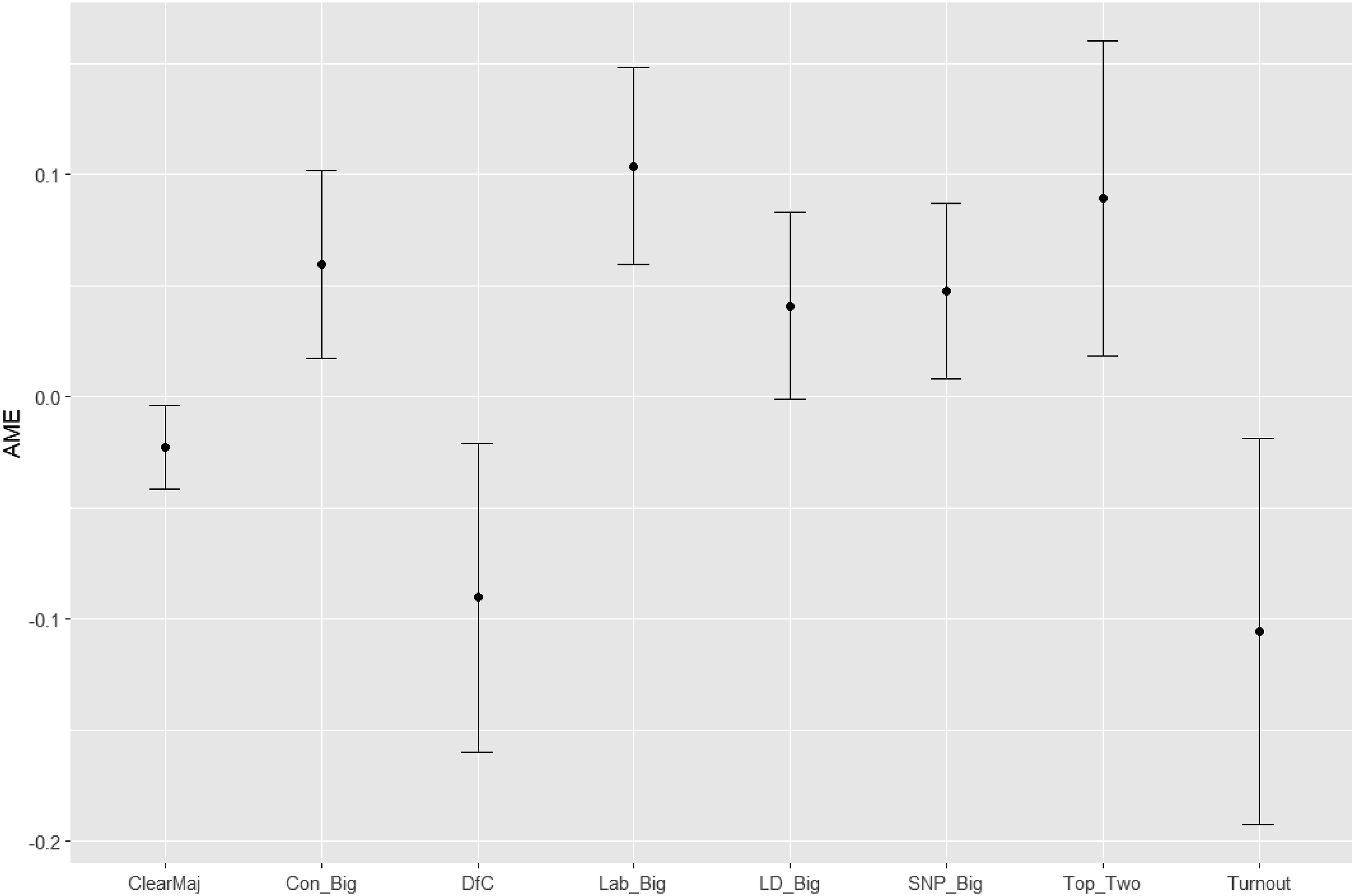
AME of the difference between simultaneous constituency and list vote share for Labour each constituency at the previous constituency election. ***p < .01; **p < .05; *p < .1.
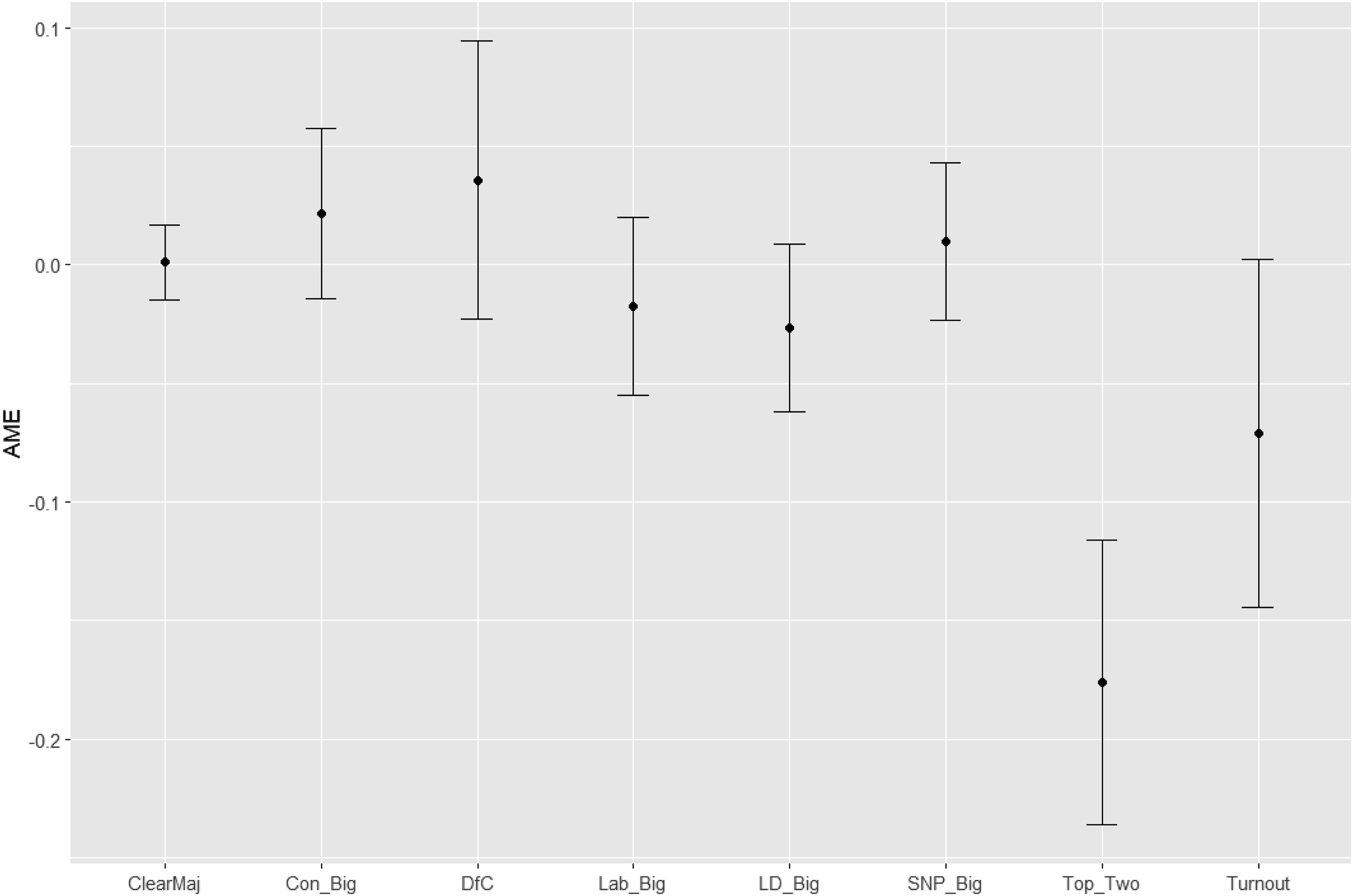
AME of the difference between simultaneous constituency and list vote share for the Conservatives each constituency at the previous constituency election. ***p < .01; **p < .05; *p < .1.
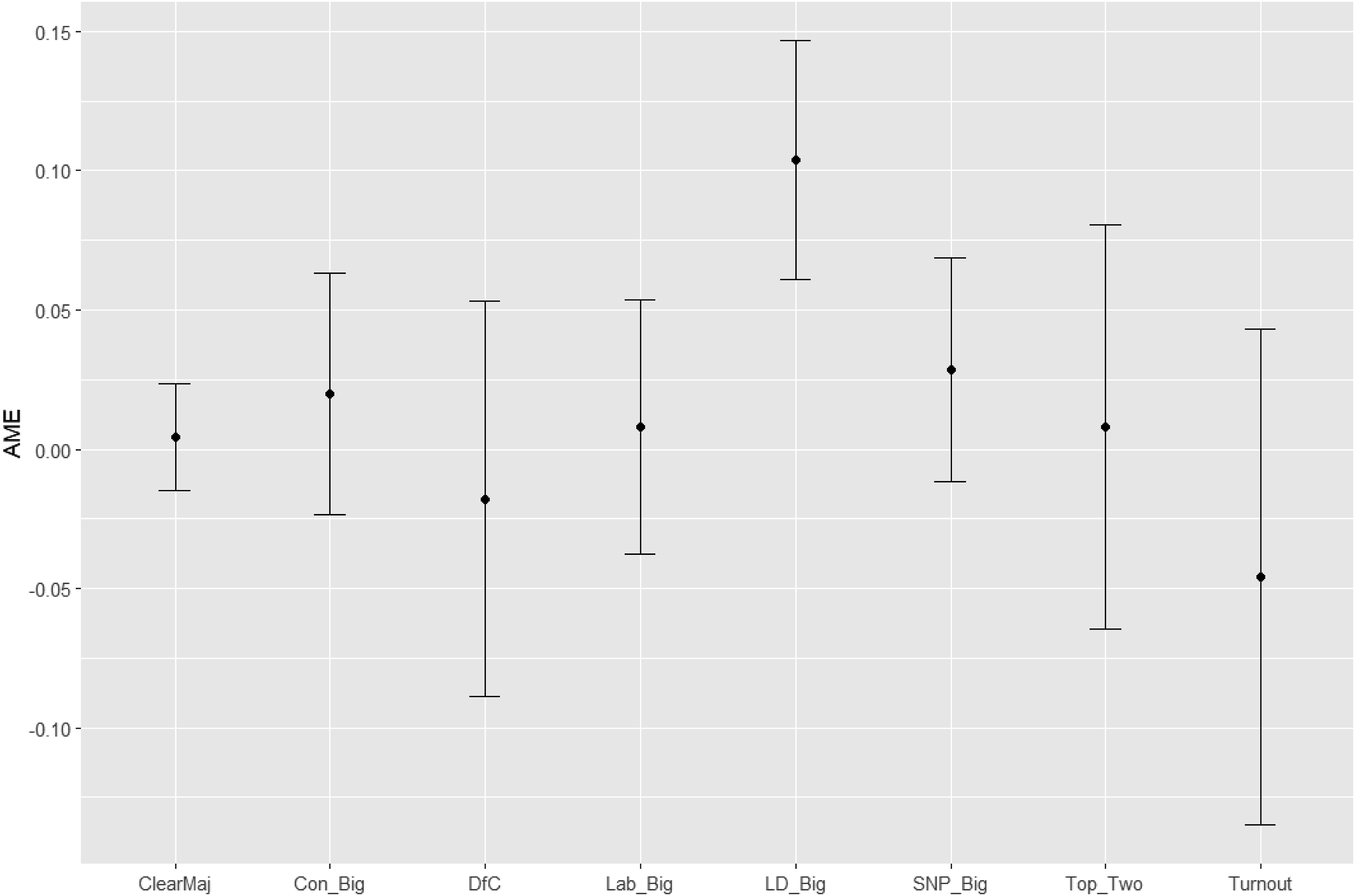
AME of the difference between simultaneous constituency and list vote share for the Liberal Democrats each constituency at the previous constituency election. ***p < .01; **p < .05; *p < 0.1.
I begin with the SNP before moving on to the unionist parties. The SNP are the sole nationalist party involved in this research, due to the reluctance of the Greens to contest Scottish constituencies. The party were one of the the top two parties more often than any other and have always been in the top two since 2011. As a result the SNP are not especially beneficial to this study, however conclusions can still be drawn. The SNP statistically significant increases on the constituency ballot compared to the simultaneous list ballot ballot when they are in the top two, so does the Labour party who were the SNP’s most common opponents. Almost inevitably, the growth of those two parties appears to drive up the combined vote share of the top two candidates.
Labour’s constituency vote share increases compared to the party’s list vote regardless of who is in Top Two, a finding which is statistically significant for every party. More research is needed to untangle this fully, but this appears to suggest that they are seen as the go-to compromise by many strategic voters and they experience a bigger rise when previously inside the top two than any other party. Labour are rarely outside of the top two (Table 3), so there may be an element of a small n at play.
Both Labour and the SNP tend to win fewer constituency votes as compared to list votes when the margin of victory increases. This suggests that strategic-minded voters are considering the likelihood of their vote winning a race for the party and acting accordingly.
The Conservatives are very unusual. The party doesn’t even gain statistically significant number of votes when they were already in the top two, although the movement in their direction is positive. The lack of significance across predictors suggests an unwillingness to back the party. The only significant factor for the Conservatives is that they win substantially fewer votes on the constituency ballot compared to the list ballot as the combined top two share increases. This is suggestive of Conservative voters switching their vote to a more competitive party, but more research is needed to uncover which party this is.
The growth of Liberal Democrat constituency vote as compared to their list vote is strongly significant when they were in the top two in a constituency, but other predictor variables are insignificant. This suggests voters need little incentive to support Liberal Democrats if they are seen as a viable option.
These results demonstrate that unionist voters are willing to vote for fellow unionist parties, under certain conditions. This supports this paper’s second hypothesis, that; supporters of small parties, locally, will strategically vote for parties which share the same constitutional position as their first-choice party regardless of that party’s economic position. We can now conduct a constituency-by-constituency investigation to allow us to examine how successful strategies were in the real world.
Impact and outcomes
Scotland’s unusually close constituencies mean that seats can change hands with relatively low amounts of strategic voting (Johnston et al., 2018). Additionally, the SNP finished within just a few seats of a majority in both 2016 and 2021, so strategic action on Scotland’s closest constituency seats could make a substantive difference as the regional list ballot cannot fully compensate for losses (Johns, 2021; McEwen, 2013).
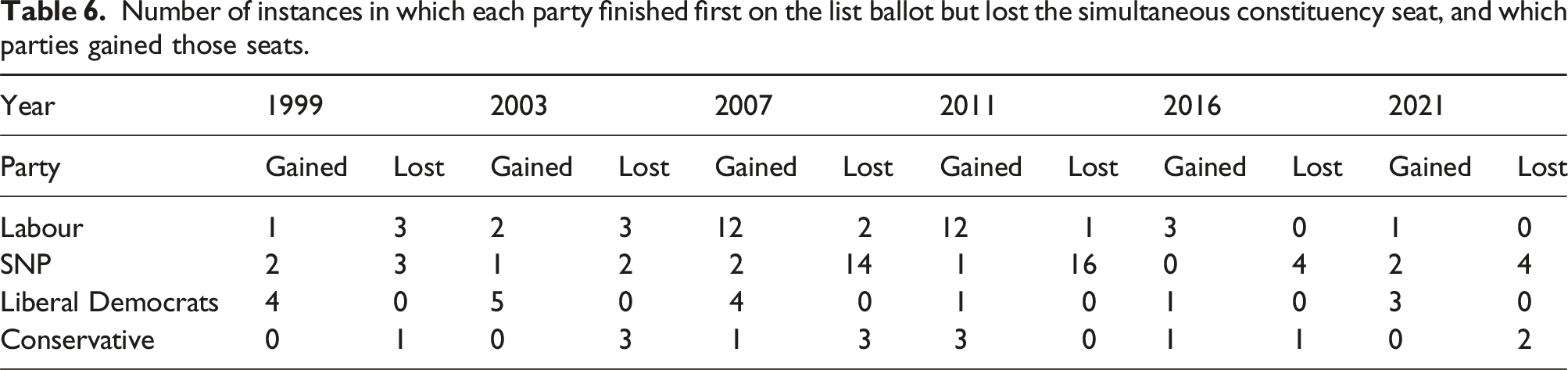
Number of instances in which each party finished first on the list ballot but lost the simultaneous constituency seat, and which parties gained those seats.
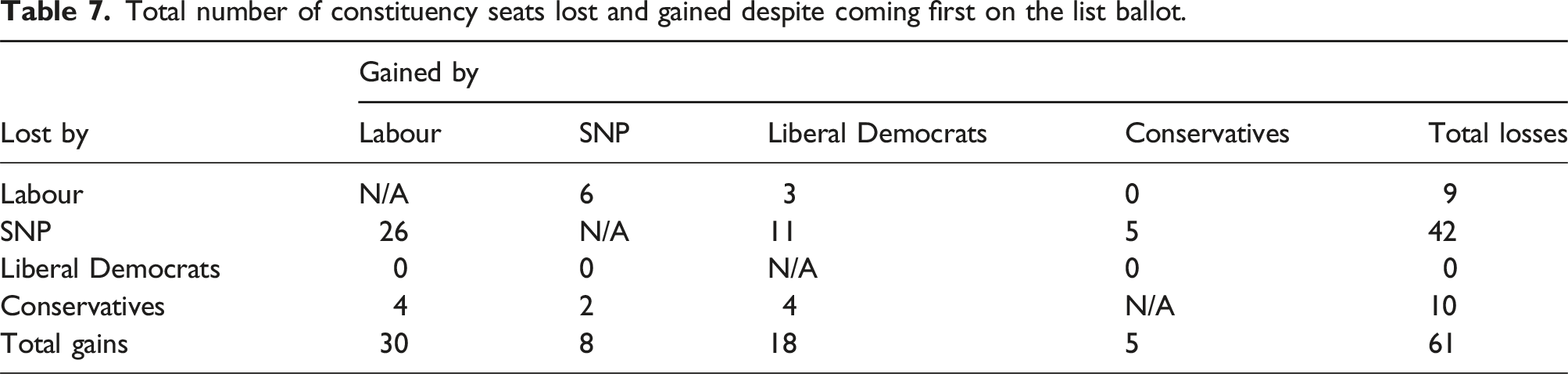
Total number of constituency seats lost and gained despite coming first on the list ballot.
As Table 6 demonstrates, there was little consistency in which parties gained or lost in 1999. This was the first experience voters had with AMS so they lacked prior knowledge of the system, this likely contributes to the lack of a pattern - aside from the Liberal Democrats being big beneficiaries (Fey, 1997: 136). By 2003 the most common victim of strategic action were the Conservatives who lost three seats in which they led the regional ballot to the Liberal Democrats (two) and Labour (one). The centrist Liberal Democrats were again the biggest winners. This pattern was not to last.
By 2007, voters had isolated a new target: the SNP. The SNP lost 30 constituency seats despite winning the concurrent list vote between 2007 and 2011. The Conservatives, previously the biggest victims, became net benefactors when they picked up four seats against the SNP over the two elections. The three Conservative gains of 2011 are even more important as they were the only three constituency seats won by the party that year and included the seat of leader Ruth Davidson whose personal popularity may have helped the party win over some left-wing unionists (Anderson, 2016: 560). In the same year Labour topped the regional poll in just four constituencies, they lost one of those to Green list voters backing the SNP on the constituency ballot, but drew enough unionist support to overturn 12 SNP leads and finish with 15 constituency seats. Unionist strategic voting in 2007 and 2011 appears to have prevented a near wipe out of the traditional unionist parties in the constituency seats.
From the 2016 election onwards, the Labour vote declined whilst the SNP stayed steady (Johns, 2021). Over this time the distance between the SNP and their closest rivals had become too large in many constituencies for ad hoc strategic voting coalitions to overcome. The SNP still suffered the most defeats of any party but a divided opposition meant catching them was just too difficult in many locations (Johns, 2021: 498). Nationalists can rally behind each other too, and in 2021 the SNP was able to overturn two Conservative regional ballot leads with support from Green voters.
The Liberal Democrats have never lost a single constituency in which they also led the simultaneous regional ballot and picked up 18 seats from their rivals (Table 7). Their centre ground position appears to put them in a sweet spot of being both an acceptable strategic option, and sufficiently unobjectionable for other party’s voters to rally against. Similarly, Labour have never lost a seat to the Conservatives if they were the largest party on the list ballot.
The SNP lost 42 seats in which they topped the list poll, over two thirds of all defeats. The Conservatives (10) are a distant second. The SNP have managed to make eight gains over the years, mainly from Labour. The Conservatives have made the fewest gains and have never overcome a list deficit against a unionist party.
In the 50/50 version AMS system used elsewhere, such as in Germany, the impact of defeating the SNP in seats would be cancelled out by SNP gains on the list ballot, however this is not the case in Scotland (Plescia, 2017). As there are more constituency seats than list seats, localised defeats can reduce the number of seats a party wins overall, although not by too many (McEwen, 2013). However in 2021 this slight variation was enough to cost the SNP an overall majority in parliament (Curtice, 2021). The same occurred in 2016, largely due to intra-unionist strategic voting in the Lothian region (Scottish Parliament, 2021a). SNP supporters voting for the Green party on the list as threshold insurance voters may have reduced the impact of unionist unity by helping their fellow nationalists win seats on some regional lists, further research is needed to determine the extent of this.
In both 2016 and 2021 the SNP formed coalitions with the Greens to make up the required numbers, but this may not have been necessary if unionist voters had not behaved strategically.
These findings show there is a well-targeted and successful strategic awareness within Scotland. We see a substantial degree of intra-unionist voting with voters with quite different beliefs prepared to support competitive unionist candidates. Labour benefitted the most from this strategy by virtue of being viable so often, as well as being both left-wing and unionist. The consistency of this movement is striking and appears to exceed the expectations that we would have drawn purely through regression analysis, this is largely due to the small margins that tipped the scales in many close Scottish constituencies.
Conclusion
This study finds that voters in Scottish Parliamentary elections adapted to their new system very quickly, with voters interpreting the two ballots correctly and making consistent strategic choices, the first election excluded. This paper demonstrates that voters are responding to well-established cues for strategic behaviour, such as understanding which parties are competitive locally and how close races are (Blais and Bodet, 2006). Further, we see party specific effects that fit with our expectations and the existing literature, including that the centrist Liberal Democrats receive the biggest constituency vote share increase when they are competitive (Herrmann et al., 2016).
This paper finds that unionist voters became a more cohesive strategic bloc after 2007. This is contemporaneous with surging support for the SNP so is likely a reaction to that growth. Regression analysis finds statistically significant intra-unionist voting to defeat the SNP. This intra-unionist voting appears to have been extremely successful, denying them consecutive majorities in both 2016 and 2021 and preventing dozens of SNP candidates from winning constituency seats.
Further research into the strategic behaviour of Scottish voters since devolution is needed to fully identify a shift in strategy. In particular it may be fruitful to examine Westminster elections alongside those to the Scottish Parliament as this would provide a wider set of data which is not impacted by the more proportional nature of AMS, using proportional change across the two ballots rather than raw percentage change may facilitate this research by allowing for more accurate analysis of small parties. However the findings presented here demonstrate that sophisticated and successful strategic voting attempts were carried out across Scotland for a number of election cycles, with the goal of upholding the union being a driving factor.
Footnotes
Declaration of conflicting interests
The author(s) declared no potential conflicts of interest with respect to the research, authorship, and/or publication of this article.
Funding
The author(s) disclosed receipt of the following financial support for the research, authorship, and/or publication of this article: This work was supported by the Universties Ireland.
