




Abstract
Partisan dealignment in Western Europe has gone hand in hand with the decline of electoral participation and active membership in political parties. Yet political participation and activism are not necessarily a thing of the past, and scholars have for instance observed these characteristics in several contemporary populist radical right parties (PRRPs). Drawing on the analysis of 124 interviews with party representatives from four European PRRPs (the League, the Finns Party, Flemish Interest and the Swiss People’s Party), we ask what motivates PRRP elites to foster the creation of tight communities of activists. Three reasons appear to stand out: campaigning prowess (to gain public support); legitimising the party; and organisational survival. The final section offers reflections on the wider implications of our study and suggests avenues for future research, questioning the assumption that parties are necessarily and uniformly shifting away from activism and societal rootedness.
Introduction
Established centre-left and centre-right parties in Europe experience a moment of great uncertainty, facing falling memberships and shrinking electoral support (Van Biezen et al., 2012; Mair, 2013; Albertazzi and Vampa, 2021). In this context of supposed party decline, our study investigates the resilience of activism and political participation among key challengers to the “political establishment”: populist radical right parties (PRRPs) that have made significant electoral inroads with their nativist and authoritarian politics, and appeal to unrestrained popular sovereignty (Mudde, 2007). Previous studies have emphasised the importance of party organisation and activists to PRRPs’ success (Carter, 2005; Art, 2011), putting into doubt the assumption that PRRPs mainly rely on ‘charismatic leadership’ to survive and thrive (see Eatwell, 2018). Several PRRPs have even committed themselves to maintaining large, costly and complex mass organisations, characterised by communities of loyal partisan activists (Heinisch and Mazzoleni, 2016). This sets them apart from PRRPs, like the Dutch Freedom Party, that have adopted lean and ‘personal’ (Calise, 2015; McDonnell, 2013) types of party organisation. Based on original research, including interviews with 124 party representatives across four parties, we ask what it is that motivates certain PRRPs to invest valuable resources in fostering activism, when it is ostensibly more cost-effective to manage a small and agile party machine, which also minimises the risk of internal dissent.
Indeed, we accept that parties have fewer incentives to rely on activist members than in the early and mid-20th century. In an age of mass communication and new forms of media, through which voters can be reached effectively and at no cost, it is unsurprising to find a general trend towards disengagement from activists and the adoption of ‘lighter’ models of party organisation (Dalton and Wattenberg, 2000; Mair, 2013; Webb et al., 2003). In light of the observed trend away from reliance on members for electoral success, our study asks “what’s in it” for parties that, going against the trend, still invest heavily in maintaining organisations characterised by rootedness on the ground and reliance on activism. While our empirical study focuses on the motivations of a specific type of party (PRRPs) – precisely because certain PRRPs appear to be successful in going against the grain – our study offers implications for the study of party organisations in general.
More specifically, we seek to make three key contributions. First, our focus on PRRPs allows us to reveal the ideological aspect of organisational choices. For these parties, the creation and fostering of closed communities of political activists can lend credence to their populist claim that they are of, and for, ordinary people, and able to understand their needs and speak on their behalf. In this respect, organisational choices can themselves be revealed to be “ideological products” (Scarrow, 2015: 20-21), a finding that opens avenues for the study of party organisation more generally.
Second, we provide the missing link concerning the motivations of party elites to foster involvement and participation within their organisations. So far there have been studies of what motivates party members to join and remain active within political parties (van Haute and Gauja, eds. 2015; Bale et al., 2019), including PRRPs (Albertazzi, 2016; Ammassari, 2023), but the matter has not been looked at from the perspective of party elites. We provide an explanation as to why these parties invest in having an activist base.
Third, and related, we add to the more general literature on the evolution of political parties, bearing in mind that there are still ‘very few comparative empirical studies to date with a specific focus on party organization’ (Borz and Janda, 2020: 4). Our study challenges the idea that there is some sort of one-way, ‘one-size-fits-all’ teleological movement towards light and leader-centred organisational models, in which activists are basically seen as a hindrance (Young, 2013) as they can limit the autonomy of party elites to set strategy, choose candidates, maintain organisational stability etc. On the contrary, we may be witnessing a process whereby different party types, with different relationships between party leaders and members, survive, adapt and coexist alongside each other (Katz and Mair, 1995: 19; Poguntke et al., 2017).
Our analysis is based on the study of four PRRPs across Europe: the League in Italy, the Finns Party, Flemish Interest in Belgium, and the Swiss People’s Party. This sample represents well-established PRRPs operating across a variety of institutional and political contexts. Given that we are interested in explaining the phenomenon of PRRPs that heavily rely on complex organisations of activist members, we have only chosen parties that fulfil these criteria (Favero, 2021; Hatakka, 2021; Sijstermans, 2021; and Zulianello, 2021).
The next section proceeds by specifying our conceptual and theoretical starting points. Afterwards, we explain and justify our methodology. We then proceed with the analysis of our interview data, answering our main research question: what motivates PRRP elites to foster activism and participation? Our findings reveal that three reasons stand out: campaigning prowess (to gain public support); legitimising the party; and organisational survival (in times of crisis). The final section offers reflections on the wider implications of our study and suggests avenues for future research.
The populist radical right and activism
The literature exploring the nature of membership and activism of European PRRPs has continued to expand. This includes comparative analyses (Albertazzi and Van Kessel, 2021; Art, 2011; Heinisch and Mazzoleni, 2016) and single-country case studies (Albertazzi, 2016; Albertazzi and Vampa, 2021; Favero, 2021; Hatakka, 2021; Sijstermans, 2021; Zulianello, 2021). This literature has pointed out that the presence of a “strong leader” able to centralise power in few hands does not in itself preclude constructing and fostering a party of activists. As we now know, many PRRPs are characterised by constant interaction between party elites, members and sympathisers, a clear division of power and procedures to enforce party discipline, as well as control of partisan channels of communication, through which they mobilise their base.
Indeed, by maintaining large, costly and complex organisations that contain communities of loyal partisan activists, many PRRPs essentially show features of the “mass party” model (Van Kessel and Albertazzi, 2021), which finds its historical origin in the early to mid-20th century (e.g. Duverger, 1954; Panebianco, 1988). It has been widely acknowledged that, since then, parties have continued to evolve, adapting to a new age of mass media and partisan dealignment, and moving away from socially-rooted politics (e.g. Katz and Mair ,1995). From a normative point of view, this trend can be lamented: the mass party was celebrated for its links with local communities and its willingness to give voice to specific, previously excluded, constituencies. Even though it is important not to romanticise a presumed “golden age” of the mass party, and while the linkage of this organisational model with specific constituencies can no longer be replicated in Europe today, the potential endurance of (specific features of) the mass party warrants scholarly attention. Our study specifically focuses on the motives of PRRP elites to invest in building close communities of member activists, as one key aspect of the mass party.
Two clarifications are needed at this stage. First, we do not treat absolute membership numbers as a proxy for burgeoning party activism. Clearly, parties that foster (and rely on) activism must have enough members for them to be able to organise activities both internally – to shape their members’ views – and externally – to reach out to the public. However, actual membership size obviously depends on many factors, including political culture and varying levels of party penetration within society. What we instead aim to investigate is how party elites see the grassroots, and what contribution they feel activists make to their party. Second, we also reject the idea that there must be a link between strengthening internal democracy and valuing the contribution offered by activists. As Daniele Albertazzi and Davide Vampa (2021) have argued with reference to the Italian Lega Nord, we should not presume that members’ participation in political activities necessarily allows them to wield actual power and influence party strategy, define policies or select candidates for public office. Indeed, the evidence shows that PRRPs are perfectly able to offer one (participation) without the other (power) (Heinisch and Mazzoleni, 2016; Van Kessel and Albertazzi, 2021).
This is not to say that party member involvement is trivial, as it can offer various benefits to a party that may counterbalance the costs we mentioned earlier (Katz, 2005; Scarrow, 2015). Party elites socialise members to politics and, in turn, can rely on them to effectively support the party when needed. From the perspective of the party leadership, membership can be an essential source of candidates for local, regional, national, and supranational institutions. Party membership is also essential for carrying out in-person canvassing and campaigning (Bale et al., 2019). Last but not least, building a member-based organisation can offer a way for a party to circumvent opponents’ attempts to marginalise them. Being rooted in the local community and able to rely on committed activists can allow parties to break their isolation and gain visibility and legitimacy.
The latter motive is likely to be important to PRRPs in particular, as they are liable to being ostracised by their political opponents. This is due to their radical ideology which, following Cas Mudde (2007), combines nativism, authoritarianism and populism. Nativism is the PRR’s core element, and in our conception entails (a) the portrayal of “non-natives” as threatening; (b) the prioritisation of “natives” in terms of the distribution of material and non-material resources; and (c) a (symbolic) defence of national culture and identity (see Betz, 2019). While “authoritarianism” can be defined as “the belief in a strictly ordered society, in which infringements of authority are to be punished severely” (Mudde, 2007: 23), populism can be interpreted as set of ideas revolving around the normative distinction between “the people” and “the elites”. That is, populists claim to side with “the people” and defend the principle of popular sovereignty, are critical of what they see as the unnecessary complex and slow procedures of liberal democracy, and criticise political, economic and cultural “elites” for their alleged unresponsiveness and/or corruption. Taking inspiration from Susan Scarrow (2015: 20-21), who notes that organisational choices can be “ideological products”, we expect that relying on publicly visible activists may be particularly attractive to PRRPs because it lends credence to their populist message of being “close to the people”.
Another observation in the work of Scarrow (2015, Figure 2.2: 34) is that the nature of party membership and support has become more fluid in practice. That is, membership is no longer an “either/or” (formal member vs outsider) matter. In particular, social media have provided an opportunity to people to actively support the work of their chosen organisation at no cost to themselves and without needing to formally join. At the same time, there are formal members that never get involved in the life of the party in the first place. Pippa Norris’ definition of “activism” as: “the ways that citizens participate, the processes that lead them to do so, and the consequences of these acts” (cited in Nolas et al., 2017: 2) is particularly useful in this context, as it acknowledges that ways of participating in fact vary. In our interviews we have asked respondents to focus on the contribution of “active participants” (Klandermans and Mayer, 2006: 3) in the life of the party, i.e. those who are actually involved in organised activities. In what follows, we shall consider what party representatives say about the contribution activists make to their organisations, and why it is valuable. First, however, we will justify our methodology and case selection.
Case selection and methodology
The parties selected for investigation are all well-established within their party systems: the Lega for Salvini Premier, formerly Lega Nord (LSP – League for Salvini Premier), the Vlaams Belang (VB – Flemish Interest), Perussuomalaiset (PS – the Finns party) and the Schweizerische Volkspartei/Union démocratique du centre (SVP/UDC – Swiss People’s Party/Democratic Union of the Centre). The selected cases are unmistakably PRR and characterised by the adoption of complex and socially-rooted organisations (Favero, 2021; Heinisch and Mazzoleni, 2016; Hatakka, 2021; Sijstermans, 2021; and Zulianello, 2021). This makes them suitable for our analysis, given that the aim of our study is not to explain variation in terms of PRRP organisation, but rather to investigate the motivations of PRRP elites that do foster activism and participation. At the same time, the selection offers considerable variation in terms of, for instance, parties’ national setting (federal vs unitary systems, based in EU countries vs non-EU), and executive experience (all parties except VB). This warrants the representativeness of our sample, and the ability to draw generalisable conclusions, while the small-N research design also allows for in-depth qualitative investigation, and the gathering of rich, valid data.
Geographical areas covered for each party.

Semi-structured elite interviews (EIs) were conducted with representatives from each party between October 2019 and July 2021, despite various setbacks due to the Covid-19 pandemic. Some were held face-to-face and others via Zoom. We strove for equal representation of national representatives (MPs, national leaders, etc.), regional representatives (e.g. regional councillors), and local representatives (council representatives, Mayors etc.). Approximately 2/3 of respondents are men versus 1/3 women, reflecting the actual gender distribution within these organisations. Elite interviews are the ideal method to let ‘parties speak for themselves’ (Bale et al., 2019: 166). They have been deployed widely by those studying extreme and radical right organisations, alongside interviews and focus groups with ordinary party members (e.g. Art, 2011; Ammassari, 2023; Damhuis, 2020; Klandermans and Mayer, 2006; Whiteley et al., 2021). Interviews with party elites can be deployed when seeking to generate knowledge that is difficult to attain through different forms of data (Mosley, 2013: 5), which is appliable in our study into party elite perceptions and motivations.
After having conducted pilot interviews, we have deployed a thematically common interview schedule through which interviewers have elicited accounts of organisational practice and modes of activism. Although based on an original set of questions devised for this project, the questionnaire (see online Appendix 2) was inspired by previous scholarly work, in particular Scarrow’s (2015: 102) conceptualisation of the roles members fulfil inside and outside party organisations, and Katz’s (2005: 108) list of parties’ incentives to retain a large membership. The interview data collected have been explored using structured queries via NVivo, allowing us to identify and interpret similarities and differences between the parties under investigation. The coding scheme (see online Appendix 3) was similarly inspired by previous scholarly work (deductively), but also based on a holistic appraisal of a sample of interviews (inductively), taking into considerations answers that recurred frequently. We devised the following main categories pertaining to the questions about perceived advantages of activism and participation, whereby the first two categories relate mainly to the public image of the party, and categories 3-5 more to the party’s internal operations:
Our interviewees were also asked to reflect on possible disadvantages of activism and participation. While various existing accounts already describe the core organisational features of our four cases (e.g. Heinisch and Mazzoleni, 2016; Albertazzi and Van Kessel, 2021), by means of our approach we offer a unique party-elite perspective on what motivates PRRPs to foster activism and participation within their organisations.
Findings: Reasons for fostering activism in the 21st century
Perceived advantages of a party model based on membership and activism.
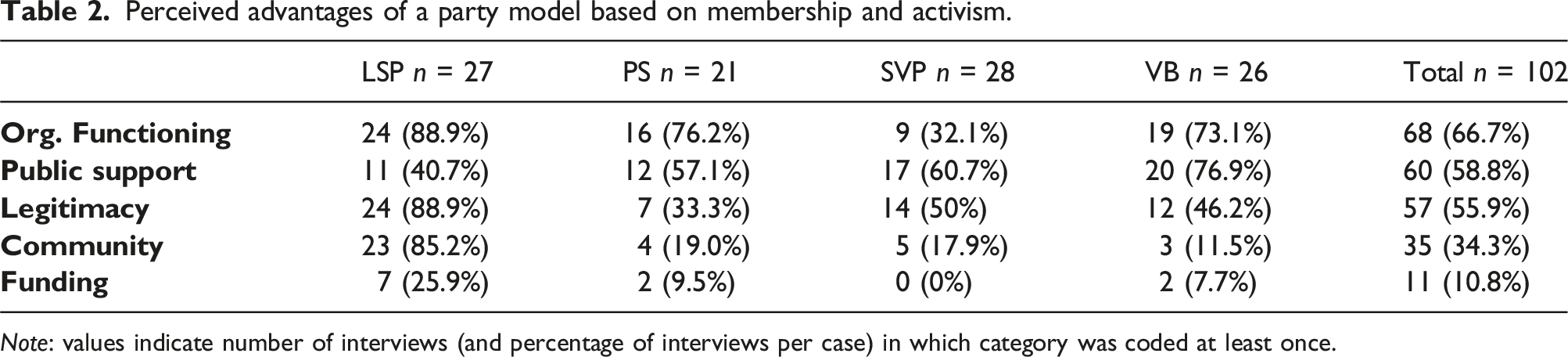
Note: values indicate number of interviews (and percentage of interviews per case) in which category was coded at least once.
Organisation, public support and legitimacy
What motivates party elites to invest valuable resources into organising such activities? Table 2 provides an indication of the relative weight of each of the categories we introduced above, with three standing out: organisational functioning, public support and legitimacy. In line with Emily van Haute’s and Anika Gauja’s claim that a well-functioning party organisation “contributes to the systemic functionality of political parties” (2015: 2), we found that party representatives frequently describe the community in very practical terms: as one that serves the needs and electoral goals of the party. Interviewees typically describe their members as “unsung heroes” who volunteer for the party without reaping any concrete benefits from it. In their own words:
There are militants who have perhaps been operating street stands for thirty years and have never even managed to get into a municipal council, but they are the first to get up in the morning, to mount the street stand at 7 a.m. on Saturdays and Sundays, and maybe they even arrive before me (LSP, Interview 10)
We have a lot of people who are not especially striving for any position of power, they just want to be involved. They are probably the most excellent people, who are willing to take part in the hard work of organizing events and setting up the tent and so forth. So we are trying to remember these folks. (PS, Interview 17)
In my opinion, the benefits [of having active members] are very big. [It’s] the only way the SVP can function. That distinguishes us [from other parties]. We can mobilise, we have a high level of mobilisation. We have a pool of helpers that we can access for action. (SVP/UDC, Interview 11)
These party officials in Flanders and Italy go one step further in describing the existential importance of activists:
It needs to be a pyramid from the top to the foundations. And the foundations must be as broad as possible and have a large carrying capacity. Because otherwise the party leaders can’t hold on. If that foundation isn’t strong enough, then the whole system can fall down (VB, Interview 10).
What keeps the whole thing on its feet is the grassroots […] If you have members who put an effort and participate the movement remains alive (LSP, Interview 20).
Activists are thus described by party officials as vital to the party organisation’s functioning and survival. Support in seemingly mundane party activities is perceived as crucial, given that these activities are key to generating legitimacy and public support through public-faced activities (indicating how perceived advantages of the party model are interlinked). A party official in Finland describes the rationale for an activist-based party as follows:
It allows to give a face to the Finns Party for people to see: like, when we are in the marketplace, “look, here are the people from the Finns Party, this is what we look like and this is who we are”. So people have the possibility to get to know us. So it creates the impression of being ordinary, as many people can have a very distant and black-and-white image of us. (PS, Interview 8)
Consistent with the populist nature of these parties, many representatives emphasise that being present on the ground is a way to show the party is close to, cares for and takes seriously the concerns of “ordinary people”:
It shows that we care about the grievances of the public from the borough […] we try to take grievances seriously that are shared by parts of the population and talk about them in order to demonstrate that there is someone who cares about these issues and brings them into parliament with a motion. (SVP/UDC, Interview 03)
Several party officials note that in order to convey the image of a party that represents ordinary people, and which is not “extreme”, it helps to have activists that fit this picture and are visibly diverse:
If we have a teacher in our party (…) we think that’s really important because we know that a lot of young people are brainwashed by left wing teachers with left wing nonsense. (…) Or a police officer, or a nurse, or a taxi driver, people who spend every day in the real world of our society, we want to make members of them (VB, Interview 27).
[It] makes a difference in terms of public perception: if you add up all the Giovannis [ordinary and relatable LSP campaigners] out there, people will say: ‘Well, those of the League are not Nazis… they are Giovanni’ (LSP, Interview 29).
If you have people who are in primary, tertiary, secondary [education], and who are of foreign origin (…) that's great for us. Because the UDC has an image of a racist party. So, if we have people with names that sound foreign, that's fine. (SVP/UDC, Interview 18).
Clearly, conveying the image of being an “ordinary people’s” party is not an end in itself for vote- and/or office-seeking parties. Most representatives mention how presence and visibility on the ground translate into increased popularity and electoral support. Activists engaging in traditional canvassing activities or communicating online are therefore also considered means through which to gain and maintain support:
It’s peculiar that always before elections our support increases (…) and it’s because of the people on the ground. Primarily, or actually, fully. They’ve had the energy to work hard and to defend this movement and to advance its cause. (PS, Interview 18)
We are still always a political party, so the purpose is still to get a lot of votes at the elections. If you have an active group, then those are your people who recruit…and who ensure that as many people vote for you as possible (VB, Interview 9).
They can mobilise the population. The more active the members, the more they can engage non-members…within their circle of friends. You can put up big advertisements…but it is more important if the statements and reasons come from family and friends. And active party of a certain size has more power and can achieve more (…) and that is why active members are important. (SVP/UDC, Interview 5)
There is widespread agreement among party representatives that having a developed rooted organisation has helped their parties not only to secure popularity and growth, but also to survive during periods of crisis and electoral decline. Interestingly, this is consistent with published research on the topic (e.g. Heinisch and Mazzoleni 2016). As was pointed out to us in interviews:
Such a member structure is incredibly important because it’s the backbone. In your party, your membership structures, your branches, your party organisational members, are those you can fall back on when things are going wrong or when you lose an election. (VB, Interview 15)
We are definitely reliant on active local activity; this was key in 2017 when the parliamentary group split. The party was able to quickly rebound as the party leadership went immediately on tour to meet the members. I think this is one of the essential factors in our survival and new rise. (PS, Interview 17)
The League dropped to only 2.5% of the vote in the past [in reality: around 4% in 2006 and 2013]. We took off again because of the grassroots. The electorate was gone, the leader was gone [i.e. when the founder of the party, Umberto Bossi, stood down], there was nothing. We took off again because the grassroots were there. (LSP, Interview 20)
Party community
Across our cases, the activist body was also frequently described as a social and loyal community, not seldom invoking the term ‘family’. One common theme across interviews is also the observation that the community’s cohesion is strengthened as a result of the parties’ pariah status. Unsurprisingly, given the cordon sanitaire that is erected around the party, VB representatives in particular emphasised the bond that is created through the party’s ostracisation by political opponents:
I think that there is a mentality of ‘everyone versus one person’. You see that often when we organise activities and also in the discussions. You see that they say: ‘the world is against us or the media are against us or the political parties are against us’. Togetherness is strengthened by that. (VB, Interview 9)
Interestingly, similar observations were made by representatives in Switzerland and Finland, where no cordons sanitaires exist, indicating that an outsider image can also be discursively cultivated by the parties themselves:
They [the media] wrongfully put us in a corner where we don’t belong. I often say the SVP is not populist, they make us look like populists. (SVP/UDC, Interview 30)
We probably have a good common enemy. We have a strong will to act according to the interest of ordinary people, and when you have a lot of factors that are against the Finns Party, for example when the media often write nonsense about us or write falsehoods or accuse us of something, that unites us. (PS, Interview 14)
What we can observe in Table 2 is that, compared with other categories, the creation of a community tends to be coded less frequently. This reflects the finding that a party community is not necessarily sought for its own sake, but rather perceived as a means through which to serve the organisational and electoral needs of the party:
Having a closely-knit identity is very important. It is the power, the power of the sense of “us”, that propels us forward. And it will carry us also in times when things are going badly and the polls are going down. So it helps to have faith in the movement, it is the base of everything, that we do things together. (PS, Interview 18)
A political party should not be seen as something that ends up with a victory in an election, or as something that will make me achieve an important personal result. It has to go beyond all that. You have to get results for the others, for everyone, and to be able to do that you have to create a group, because if you don't have a group of people who support you and who support your idea, you can't get anything. (LSP, Interview 12).
For some interviewees, however, the party community is described as something that has genuine intrinsic value – and this sentiment is particularly strong in the League:
The feeling that you had and that you have when you go to certain demonstrations, is to be all part of a single family, so you see people that you meet for the first time as your brothers. (LSP, Interview 12)
Being a community also brings you friendships, the pleasure of being together with people who maybe don't necessarily share everything, but with whom at least you share some battles (LSP, Interview 10).
I see an increasingly sad and lonely society and, therefore, if people also see the League as an opportunity to be together to find new people, who share the same passions and, above all, to belong to a group (…) one is even more motivated (LSP, Interview 17).
The literature on the creation of the League by its founder and long-time leader, Umberto Bossi, has repeatedly stressed how, at the beginning, Bossi was entirely focused on displacing the pre-exiting left-wing and Catholic cultures, once dominant in northern Italy (Diamanti 1993, 1996). In areas in which the League grew strong, these cultures were replaced by a brand new political sub-culture inspired by the party’s values: leghismo. Bossi did so by setting up a mass organization from scratch throughout the 1980s and 1990s that strived to build communities infused with the party’s values, in ways reminiscent of those parties of the left that he was attempting to displace (the Italian Communists and Socialists) (Albertazzi, 2016). This focus on the importance of “community” has stayed with the League to these days, and it still inspires the actions of its representatives.
Of course, a notable development that sets apart the current age from the era that saw the birth of mass party organisations in the 20th century is the emergence of the internet and online communities. Representatives from the selected parties generally believe that social media and new communication technologies have an important role to play in shaping the views of party members and sympathisers. Many representatives are nevertheless wary of online ‘slacktivism’, and stress how vital it is for members to keep meeting face-to-face despite social media being so crucial. Indeed, participating in person is described as something that requires much more commitment. In other words, in-person meetings remain key: through their online strategies, the parties seek ultimately to facilitate face-to-face contact, which is still seen as a crucial form of interpersonal engagement, indispensable to build loyalty to the brand. This conviction is widely shared by respondents from all parties:
The face-to-face meeting is absolutely fundamental, for the simple reason that even just the fact of doing something together, as a group, increases the feeling of complicity. Because in the end writing only on WhatsApp, even just looking at each other via a webcam,
While representatives often speak of activist communities that are not only ideologically cohesive, but also socially integrated, a minority of respondents are open about the differences, or rivalries, that – inevitably in their view – sometimes emerge between people within their organisations:
I always say that in political parties it is no different to any football club. You get along well or very well with 20%, you talk less to another 20%, and with 60% you have no problem but are not very close. (SVP/UDC, Interview 1)
The group is cohesive, a bit like all parties, as long as we are talking about ideas, programmes, and not candidatures… When the race to become a candidate kicks off, there is also a bit of internal competition, of course, as the fact that people may get along with each other or otherwise, and their different strategies, all come to the fore. (LSP, Interview 11)
With reference to party activities, some representatives also discuss the challenge of turning members into activists:
Especially in a big city [keeping members engaged] isn't easy. Because we often don't see those members, a lot of members also don't come to the activities. They just want to support the party or actually show that they are in agreement with the programme but... actually of our members, it's usually the same group that we see come everywhere to activities and such (VB, Interview 17).
These examples show party representatives freely admitting that not all party members are genuinely active within the party community, and that unity and a sense of common purpose are harder to maintain whenever the interests of individual members diverge. In general, however, we saw that the party community is depicted in very positive terms, with representatives emphasising the commitment of party activists and the close bonds between them. The identified advantages of being a party that invests in fostering activism typically relate to the value of activist members in terms of visibility, legitimation and helping the party increase its support. The functioning and sustainability of the party as an organisation, particularly in times of crisis, are also highlighted. These objectives are fulfilled by creating an efficient party machine, and building channels of communication with voters, as expressed by this official in Finland: [Without activists, the party] would lack in credibility, and it would lack in messengers who relay information both ways. The party would lack these small worker ants, the workers in the field who keep the party from collapsing. That’s how it works, the party would have a really hard time to operate without the people on the ground who keep in touch with the party, with the voters, with people in the municipalities […] and also with other stakeholders. (PS, Interview 14)
Disadvantages of membership and activism
While interviewees’ answers often refer to ways in which activists help the party reach its goals, there are few references to the need to secure party funding from members (see Table 2). In fact, the costs associated with the administration of complex party organisations are sporadically mentioned as disadvantages of having a party with active members. Particularly in areas where the party relies on less support, a small minority of the interviewed party elites express some doubts about whether investing in activism and public events is really worth it:
I’ve been thinking a lot about whether we did work in vain, using up all of our free time before the municipal elections to organise events, marketplace events, tent events, and to be available to the public in meetings. Because, after all, in the municipal elections only a few people appeared to attract a significant number of votes, while many other candidates, who had been available at these events, got very few votes, and were not even close to going through. (PS, Interview 23)
Other perceived drawbacks that are frequently mentioned include the risks of factionalism or attracting unwanted individuals, such as those using party membership purely to further their own political ambitions:
And in a party that grew so much within the last 20 years, you can’t avoid having opportunists. (SVP/UDC, Interview 18)
[…] there are a lot of people who now see us as strong and want just to gain something and pursue a career (LSP, Interview 10)
Unsurprisingly given the ideological nature of the parties, interviewees also regularly refer to the challenge of keeping out individuals with overtly extremist opinions, who can weaken the reputations of PRRPs. This is a problem openly discussed by respondents from all four parties, who invariably claim that the party does not want, or need, such unruly individuals. The following are typical answers on the topic:
And that is actually the disadvantage with active members, if they don't think twice before they post something on Facebook, that could maybe be racist or something. Then it's picked up right away by the press. That's a bit of a disadvantage. (VB, Interview 24)
[…] we have accepted members who utter things that cause controversy, and we haven’t properly investigated people’s background and we have also given candidacies to people who shouldn’t be allowed to be candidates. Especially during the era of Timo Soini’s party leadership, member applications were accepted way too negligently in my opinion. (PS, Interview 23)
Representatives thus realise that their parties have an image problem and are frank about the drawbacks of relying heavily on activism. They admit that what activists do and say cannot ultimately be strictly policed. Yet they generally see this as an acceptable price to pay in exchange for the advantages activists offer in terms of support. The dominant view across our interviews, therefore, is that fostering activism and creating close-knit communities bring considerable advantages in terms of campaigning efficiency and reaching out to voters, legitimisation, and survival in times of crisis.
Conclusions
Aware of the importance of ideology and agency in determining organisational choices (Scarrow, 2015: 20-21), we have listened to the voice of PRRP representatives explaining what grassroots activism means to them and their organisations. Having chosen to study four PRRPs with complex organisations and activist memberships, we explored how party communities were created and member identities shaped. We analysed what advantages (and disadvantages) party elites saw in this type of organisation. Representatives frequently described the dedication of active members who contributed to campaigning and other activities, and spoke about the importance of friendships and support networks that exist among activists.
Yet political parties are not social clubs; they typically have the ambition to win elections and gain power. From this perspective, building a socially-rooted organisation with activist members is not necessarily a logical choice. Running complex organisations requires considerable time, effort and resources. Furthermore, involving activists may have a destabilising effect, for instance due to interpersonal rivalries and conflicts, or when unruly or extremist activists taint the party’s image. In our interviews respondents certainly highlighted these drawbacks, but more often emphasised the benefits of maintaining a complex structure and local activists “on the ground”. In an age when new technologies are widely available and members do not appear to provide essential financial support to parties anymore, our key aim was to address what we regard as a very interesting puzzle: why are some party elites still willing to invest in activism and presence on the ground, rather than relying on “lighter” and more easy-to-manage models instead?
From our data, we concluded that fostering activism was considered especially beneficial in terms of: a) campaigning prowess. Activists were considered key to informing the public about the party’s ideology and helping it shape the views of voters. This was said to translate into broadening the party’s appeal and electoral support, as well as fostering further membership growth; b) the legitimation that comes from having ordinary people representing the party down to the local level, also outside of election periods. This adds much weight to these parties’ claims to be “ordinary” parties “of the people”. In other words, the organisational choice to foster activism is very consistent with the ideological image these populist parties wish to convey (Scarrow, 2015: 20-21), and important especially to PRRPs that seek to rid themselves of an extremist stigma. c) organisational strength and longevity, by means of creating an efficient party machine and a tight community that people value. This allows parties to survive in times of crisis, for instance when leaders are changed or forcibly removed – not a rare occurrence among PRRPs.
All this is not to say that our selected parties are fully returning to old-fashioned ways of organising and campaigning, or functionally identical to the mass parties of the early and mid-20th century. The elites running PRRPs are not Luddites, and have in fact embraced new technologies and social media as a way to socialise their members and shape their views about current political developments. Importantly, however, there is widespread agreement among our interviewees that new technologies should be seen as complementary, rather than an alternative, to more traditional in-person interactions, such as meetings, rallies and events. In-person activities are seen as crucial not only to reach out to potential voters but also to facilitate initiatives deployed by activists on the ground, and to turn sympathisers into activists.
The constant focus on party activities that closely involve grassroots members clearly attests that the four parties in our study depart from the supposed trend of disengagement from activism that scholars have identified as a feature of their mainstream competitors (Dalton and Wattenberg, 2000; Webb et al., 2003; Mair, 2013). Hence, based on our findings, we can challenge ideas suggesting some sort of one-way, “one size fits all” movement from the mass party towards allegedly more contemporary models of party organisation – such as the “cartel party” model described by Richard Katz and Peter Mair (1995) for traditionally dominant parties, and “electoral-professional” (Panebianco, 1988) types of organisation for newer parties. Ultimately, the study of how different models in fact co-exist side by side allows us to recognise the uneven and contradictory nature of party-organisational development in the second half of the 20th century, and the beginning of the 21st.
While we have focused on PRRPs, we see scope for further research investigating the importance of activism and rootedness on the ground in organisations within other party families. Relevant questions are why we see considerable variation in organisational choices between parties, and whether such variety is partly a function of ideological differences. In addition, scholars should not only consider the motivations and views of party elites, but also of grassroots members. Given that party elites do not necessarily offer them a great say over ideological choices and internal policies (Heinisch and Mazzoleni eds., 2016), we need to look closer at ordinary members’ motivations to be actively involved in an era of partisan dealignment.
Supplemental Material
Supplemental Material - Why do party elites incentivise activism? The case of the populist radical right
Supplemental Material for Why do party elites incentivise activism? The case of the populist radical right by Daniele Albertazzi, and Stijn van Kessel in Party Politics
Footnotes
Acknowledgements
We would like to thank the editor and reviewers for providing constructive comments on a previous version of this article. We previously received helpful suggestions from colleagues including Daphne Halikiopoulou and Manès Weisskircher. We also express our gratitude to our former research fellows involved in this project: Adrian Favero; Niko Hatakka; Judith Sijstermans and Mattia Zulianello. Finally, we wish to thank the party representatives of the selected parties for agreeing to talk to us.
Declaration of conflicting interests
The author(s) declared no potential conflicts of interest with respect to the research, authorship, and/or publication of this article.
Funding
The author(s) disclosed receipt of the following financial support for the research, authorship, and/or publication of this article: This research is supported by the Economic and Social Research Council (ESRC), Grant Ref: ES/R011540/1, 'The survival of the mass party: Evaluating activism and participation among populist radical right parties (PRRPs) in Europe'.

Supplemental Material
Supplemental material for this article is available online.
Author biographies
References
Supplementary Material
Please find the following supplemental material available below.
For Open Access articles published under a Creative Commons License, all supplemental material carries the same license as the article it is associated with.
For non-Open Access articles published, all supplemental material carries a non-exclusive license, and permission requests for re-use of supplemental material or any part of supplemental material shall be sent directly to the copyright owner as specified in the copyright notice associated with the article.
