



Abstract
Social media has become central to how political parties plan, organize, and coordinate electoral campaigns in Africa, with WhatsApp increasingly the preferred medium. How, we ask, have African political parties made use of WhatsApp to organize internally during elections, and what explains the approaches they have taken? We argue that pre-existing party institutionalization is the main factor influencing how parties use WhatsApp to organize and coordinate campaign events, and reach voters. Comparing Ghana and Nigeria, we show that more institutionalized parties create formal, hierarchical online structures, with in-group policing of message content. Conversely, less institutionalized parties rely on informal, personality-based online structures with unclear hierarchies and where there is little message discipline. This matters both for the spread of mis/disinformation and inflammatory content online, and for parties’ future organizational strength. In both instances, “digital clientelism” ensures that existing patrimonial structures are replicated online, restricting the empowerment of new political actors.
Introduction
The impact of Africa’s digital transformation on its politics is an emerging field of study with far-reaching implications for the distribution of power, the quality of democracy, and the exercise of authority on the continent (Srinivasan and Diepeveen, 2019). With rising internet penetration and growing availability of affordable smartphones, African citizens have increasingly taken to social media to stay informed about – and debate – politics and elections, and to connect with politicians and elected officials (Diepeveen, 2021; Srinivasan and Diepeveen, 2019; Srinivasan et al., 2019). And while internet access is highly uneven both within and across African countries, information from social media quickly crosses into offline spaces via vibrant traditional media and a rich culture of “pavement radio”: discussions at marketplaces, places of worship, bus stops and the like, as well as songs, sermons, and graffiti. Thus, social, traditional, and pavement media form a deeply inter-connected media eco-system, which blurs the distinction between the “connected” and the “disconnected” (Gadjanova, et al., 2022).
Political parties and their candidates have also adopted social media to organize internally, to coordinate events, and to reach out to voters (Cheeseman et al., 2020; Dwyer and Molony, 2019). In this article, we consider the impact of this digital shift on party management in Africa, focusing in particular on the context of election campaigns. How, we ask, have African political parties made use of social media to organize internally during elections, and what explains the approach (es) they have taken in this regard?
These questions, and the answers to them, are significant for a number of reasons. First, because – particularly in the wake of the Arab Spring – it has often been assumed that social media has the potential to disrupt and (potentially) fundamentally transform electoral power dynamics, mostly through widening opportunities for participation in the political process, including party management itself (Cheeseman et al., 2020: 145-146). There is limited testing of this assumption through empirical, comparative study, however, particularly in Africa. Second, how parties use social media in the context of elections has implications for longer-term party institutionalization, a process often argued to be central to strengthening democracy and inclusive governance. In Africa, weak or fragmented parties have often been presented as impediments to the realization of both agendas (Arriola, 2013; Randall and Svåsand, 2002). Third, and finally, mis/disinformation spread through social media has been identified as a major concern in African elections, as it has in polls across the globe (Dwyer and Molony, 2019; Kofi Annan Commission on Elections and Democracy in the Digital Age, 2020; Mare et al., 2019). Examining how African political parties use social media during election campaigns enables us to better understand the institutional circumstances under which party actors promote, censure, or overlook mis/disinformation being shared from within their own ranks.
This article contributes to two distinct literatures. First, it speaks to the literature on party organization in Africa, which is in its infancy (Lockwood et al., 2022: 203). We take this literature in a new direction by studying the types of structures parties establish on social media and their implications for party management, and message discipline. Second, we contribute to a growing number of studies on the impact of social media on politics in Africa. Our research sheds new light on the ways in which Africa’s digital transformation plays out in its politics.
To do this, we analyze how social media has been used by the main political parties in election campaigns in Nigeria and Ghana. In particular, we look at the role of WhatsApp – the default mode of telecommunication and the principal platform employed by political parties across the continent to organize across recent electoral cycles (Dahir, 2018; Olasoji, 2021). The Ghana-Nigeria comparison is instructive since while both have arguably similar postcolonial political histories prior to the 1990s, the advent of democratization has seen the emergence of two quite different party systems. Ghana is a two-party system with two strongly-institutionalized, well-financed, and evenly-matched political parties with frequent turn-over of power. Nigerian political parties, on the other hand, exhibit lower levels of institutionalization and significantly higher levels of political fragmentation. In particular, political parties have often been used as vehicles for prominent politicians to seek the presidency, and moving between parties has been commonplace (Owen and Usman, 2015).
It is important to note, of course, that there are differences between these parties within their national contexts – for example, in the availability of resources to parties in government versus opposition parties. We also observed some variation between political parties in local party approaches to managing political messaging. We are confident, though, that our central findings and arguments hold across the two case study countries. The same is true of our broader description of political party characteristics within each of the two countries. Ultimately, in Ghana, major political actors struggle to secure political power outside of party structures, whereas this is not the case in Nigeria.
Our analysis reveals two distinctive approaches to party and message management during elections in our respective case study countries. These approaches, we suggest, derive to a significant extent from pre-existing party characteristics, including levels of party institutionalization. In Ghana, major parties established formal, hierarchical online structures where campaign messaging could be policed and mis/disinformation culled. In Nigeria, parties established more informal, personalized structures with limited control or sanctioning of messages and information. In both cases, however, we find that the rise of social media has not fundamentally disrupted established power dynamics within the parties themselves. While new space has been opened, for example, for younger, digitally-savvy political “entrepreneurs”, ultimately, we find, this group’s wider political reach continues to be filtered through existing patrimonial structures. Indeed, in many respects, the impact of social media in general, and WhatsApp in particular, in both contexts appears to be intensifying pre-existing patterns of party politics.
In developing this analysis, the article is structured as follows: after a brief outline of our data and research methods, we present our conceptual framework and clarify how we use the term “institutionalization” in the context of political parties. Next, we provide a brief overview of the role of social media in politics in Nigeria and Ghana, and proceed to compare how parties in both states used WhatsApp internally during the lead-up to the 2019 and 2020 elections respectively. On the basis of this comparison, section 5 derives two broad patterns of parties’ WhatsApp use in Sub-Saharan Africa which help to determine how WhatsApp is employed – informal/free-for-all and formal/hierarchical.
Data, methods, and the ethics of researching WhatsApp
The paper draws on 113 interviews and 15 focus group discussions (FGDs) with political candidates, their campaign teams and advisers, and party activists in both countries. The focus of this research in both case studies was principally on the presidential races, since these are commonly viewed both domestically and internationally as the most significant poll during a general election. The presidential races were also the main area of interest for most of our respondents, even if some also discussed other electoral contests. Our findings, therefore, speak to the presidential elections, though we hypothesise in the Conclusion on how other races in both countries are likely to see similar dynamics with regard to the use of WhatsApp by campaigns and their associates.
72 Interviews and 10 FGDs in Ghana were carried out between March and July 2019 with candidates and party operatives from the National Democratic Congress (NDC – 42 interviews and 6 focus groups) and New Patriotic Party (NPP – 30 interviews and 4 focus groups) in the capital city Accra and in Ghana’s Northern region (the regional capital Tamale and neighbouring rural areas).
In Nigeria, 41 interviews and 5 FGDs were carried out between February and April 2019 with candidates and party operatives from the All Progressives Congress (APC) and People’s Democratic Party (PDP) in the capital city Abuja and in the second and third largest Nigerian cities, Kano and Ibadan. This allowed us to compare and contrast views and practices with major cities in three of Nigeria’s six geopolitical “zones”. The research team also visited and met with staff at the Buhari Media Centre in Abuja (see Section 4 below), where the digital side of the ruling party’s presidential campaign was led from. 16 of these interviews were undertaken with candidates, advisers, or campaign staff who clearly and consistently identified as APC (8) or PDP (9). As outlined in the rest of this article, however, a defining feature of Nigerian party politics – both overall and in relation to the 2019 election – is the frequent movement of actors at all levels between parties. Among our other 25 interviewees and FGD participants, for example, were candidates and operatives who had defected from PDP to APC, and could therefore shed light on the use of WhatsApp by both parties. We even spoke to one campaign digital media aide who had worked for three parties (including PDP and APC) during the same electoral cycle. 1
Overall, we cannot claim that the research is nationally-representative in a strict sense. In the case of Ghana, the research focused on the Northern region and the capital city Accra. In the case of Nigeria, the country is huge both in terms of population and geography and our data does not speak directly to dynamics in the east of the country in particular. A number of our interviewees (in capital cities, in particular), however, were describing national patterns and citing examples from other regions so we can be reasonably confident our theory applies beyond our fieldwork sites. We also did not detect significant differences between parties’ use of WhatsApp between respondents in different research sites – beyond, as would be expected, the local framing of messages and policy.
Interviews and FGDs were carried out by at least one of the core members of the research teams, often supported by research assistants. Analyzing WhatsApp – and other closed platforms – nonetheless comes with its own distinctive methodological challenges (Moon Sehat and Kaminski, 2020), which were navigated in a number of ways. First, while some interviewees voluntarily showed us their main WhatsApp display (e.g. to demonstrate the large number of groups they were in or messages they receive), we did not request that respondents do so. Second, no team members joined or sought to join any of the political groups analysed in this study. Ascertaining examples of the type of content that was shared during the presidential election campaign on WhatsApp was, therefore, necessarily second-hand. Seeking to join these groups for research purposes would have required either deception or gaining the consent of every group member to do so on a rolling basis. The latter would not only have been logistically impractical, it would also have changed how group members interacted with (/in) the group itself, rendering the entire exercise analytically moot.
Finally, it is worth underscoring that our findings speak principally to the use of WhatsApp. This focus is, as noted, because of the platform’s popularity and widespread use in both countries in general, and because it is the principal means by which parties organize and coordinate activities digitally. WhatsApp’s functionality (especially its groups) and end-to-end encryption make it much more attractive and accessible in this regard compared to apps with more restricted messaging functions (e.g. Instagram or Twitter) or where much content is (at least partially) public (e.g. TikTok or Facebook). While we can speculate that platforms with similar characteristics to WhatsApp – for example, Telegram or Signal – may (come to) be used in similar ways by parties elsewhere, or in the future. Explaining the relative popularity of different platforms, however, requires significantly more research, as well as a keen appreciation for the influence of local context.
Political parties, institutionalization and “Big Man”-ism in Africa
Limited scholarship exists on the organization and functioning of African political parties in the era of social media, and still less has been produced on how these parties use social media, both in general and during elections. Of the literature that does exist, historically there have been two major trends. On the one hand, African parties have traditionally been presented as lacking structures and substance (Weghorst and Bernhard, 2014). On the other hand, the role of gatekeepers – or ‘big men’ – as filters of influence and power has frequently been emphasized. Usually identified as older, wealthy, politically-connected and (often) male, it is argued, these actors dominate through leveraging clientelist ties to elements of the electorate (Van de Walle, 2007; Wantchekon, 2003). Taken together, then, parties have often been analyzed as organizationally and structurally weak and sitting on top of a larger, personalized patronage system.
As a range of scholars have demonstrated, however, there is, in fact, significant variation in the extent, strength, and autonomy of party structures across the continent. 2 Recent literature has also pushed back on some of the paradoxes at the heart of some past academic theory-building in this regard; as Krönke et al. note, African political parties have often been presented as simultaneously weak for the purposes of mobilization and strong with regard to the effective distribution of patronage resources (Krönke et al., 2022).
Ghana and Nigeria are good examples of African political systems where this variety is evidenced. As noted, Ghana’s political parties generally display a greater degree of institutionalization than those in Nigeria. “Institutionalization”, of course, is a challenging concept to define, and an even more challenging one to measure. In the case of the institutionalization of African political parties, Kwayu, points to two key elements: stability (of party organization, procedures and processes) and “system-ness” – emerging as autonomous organizations with their own structures and practices (Kwayu, 2022). In the same vein, Basedau and Stroh highlight higher levels of internal organization and institutional autonomy. They also stress party officials’ willingness to “safeguard and sanction” a party’s autonomy from external influences and to “subordinate private interests for the sake of a party’s performance” (Basedau and Stroh, 2008:10). The wider literature on party institutionalization also emphasizes the presence of national and permanent local branches of the organization, as well as the nature of linkages between officials and their constituents, notably the extent to which the latter is principally based around clientelist or programmatic ties (Bizarro et al., 2017: 7). More recent work seeks to understand and measure party presence through also examining attendance at party rallies and meetings (Krönke et al., 2022).
Drawing on this literature, we therefore understand party institutionalization to consist of two key elements: internal organizational structure and internal cohesion. Following some of the scholarship cited above, we view these elements as mutually-reinforcing. It is possible, for example, to have parties with sophisticated organizational structures but a lack of internal cohesion around, for example, the party platform or key campaign messages. 3 In the context of parties’ use of WhatsApp, extensive digital structures may exist to connect campaigns, activists, and candidates, and to enable them to share and discuss strategy, content, and messaging. Without internal party cohesion – including mechanisms to, or norms encouraging loyalty to the party and its messages themselves over (in some cases) those of individual candidates – these structures may fail to operate in the party’s interests.
A party’s “brand” is important in this regard. The broader academic literature on partisanship and its effects shows that party brands are an important element of both aspects of party institutionalization identified above and that they influence party elites’ and operatives’ incentives to create and maintain strong internal structures in two distinct ways. First, these actors may feel a non-material attachment and loyalty to a party with a strong brand and thus seek to preserve it for reasons of intrinsic value; and second, strong party brands are electorally useful as they command and stabilize voter loyalty so elites in particular might also seek to protect and preserve existing brands for instrumental reasons: to win future elections (Bolleyer and Ruth 2018; Lupu 2012; Nielsen 2017). In the context of parties’ use of WhatsApp, therefore, we can expect to see tighter digital coordination and more (attempts at) internal policing of messages by parties with stronger pre-existing brands.
In this study, we focus principally on the internal dynamics of institutionalization described above. In particular, we examine the digital coordination structures which have been developed, their relationships to the wider party organization and to particular candidates and regional campaign networks. We analyse how key campaign messages and themes are debated, challenged, and negotiated via these structures, and the degree to which this process exhibits an appreciation for or deference to the party platform and wider brand. On the latter, we also reflect on some of the incentives our respondents claimed their actions to be motivated by, as a means to better understand some of the differences in WhatsApp use by Ghanaian and Nigerian parties respectively.
Much of our data draws on analysis of “closed” discussions within party structures – ie. of WhatsApp groups composed just of party strategists and activists – and respondents’ reflections on message discipline in WhatsApp interactions with voters. This includes, in the case of Nigeria especially, in WhatsApp groups established by party operatives and others with the sometimes indirect support of the party itself (see below). This is partly for conceptual reasons – internal cohesion in this context is evidenced by both internal and external message discipline – and partly for empirical reasons. The more informal character of the Nigerian parties’ organizational structures means that distinguishing “internal” and “official” from “external” requires a more flexible approach.
Finally, while our analysis focuses on a brief period in time, we also accept that, as Kwayu notes, institutionalization is an on-going process and “includes the extent to which the party is able to coordinate different practices in emerging situations where formal procedures may be incapable of dealing with the situation” (Kwayu, 2022: 2). The rapid rise and significance of social media in general, and WhatsApp in particular, in electoral politics represents, we suggest, just such an “emerging situation”. It has the potential to unsettle established structures, since those with the technical knowledge to shape and manage digital campaigns and electioneering are often not traditional party elites but, in many cases, younger people of far more modest economic and political standing. In examining how Ghanaian and Nigerian political parties use WhatsApp during elections, we therefore also examine the extent to which existing party power dynamics have been recalibrated in the digital age.
To do so, and to answer our main question, we focus our empirical analysis on two main areas, reflecting the discussion of institutionalization above. First, we examine the establishment, development, and safeguarding of organizational structures linking senior party strategists and campaign headquarters to regional and local campaigns through WhatsApp. Second, and because party institutionalization influences campaign communication and approaches to citizen outreach (Ponce and Scarrow 2022), we analyze the use of WhatsApp to maintain message discipline during campaigns – both in terms of key policy messages, and attacks on/responses to opponents. The former speaks principally to parties’ internal organizational structure and the latter to their internal cohesion. Before doing so, however, we briefly introduce the two case study countries and the political parties this study analyses.
Politics and social media in Ghana and Nigeria
Superficially, Ghana and Nigeria have similar postcolonial political histories. Both former British colonies, their first post-independence – civilian – governments were overthrown by the military in 1966. Subsequently, power alternated between short-lived civilian governments and military dictatorship until the 1990s, when both experienced a transition to multi-party politics managed by the military-heavy political class.
These respective transitions nonetheless led to the emergence of different political realities. In Ghana’s case, a strong, two-party system materialized and became institutionalized swiftly, centred around the NDC, founded by military head of state-turned-elected-president Jerry Rawlings in 1992, and the NPP, its principal rival. In Nigeria, a single party – the PDP – dominated until 2015, with its main competitor – the APC - created in 2013 after a merger between the three largest opposition parties and a disaffected faction of the PDP (Levan, 2019: 63; Owen and Usman, 2015: 458-459). 4
There are several explanations for these diverging trajectories. First, the nature of the transitions themselves. In Nigeria, the stage-managed introduction of multi-party politics centred around a form of elite “pact” whereby different regional, political and military interests were contained within a single party (Levan, 2019: Chapter 2). In Ghana, a more substantive form of political competition was institutionalized (Lynch et al., 2020: 60-61). Ghana’s “new” political parties also, however, draw on a rich ideological and institutional tradition which predates independence (Lynch et al., 2020: 0.61-74). In Nigeria, however, the PDP – which, aptly, took an umbrella as its symbol – focused on accommodating different elite and regional interests rather than developing ideological coherence. This has had implications for the PDP’s institutionalization. Referred to by Katsina as ideological “stretching”, different party elites and patrons were also accommodated at different levels for the sake of ‘political expediency’ (Katsina, 2016: 4-5). It has not been possible, however, to contain these often diverse and competing interests.
These differences in terms of internal cohesion are borne out by comparative data from the V-Party Dataset, which defines this concept as the extent to which party “elites…display disagreement over party strategies”. In 2016, the most recent date included, Ghana’s NDC and NPP scored 3.3 and 3.2 (out of 4.0) respectively in this category, while (in 2019), Nigeria’s PDP and APC scored only 1.37 and 1.0 respectively (Coppedge, 2023). Interestingly, the parties have similar scores for local organizational strength – defined as the degree to which “party activists and personnel [are] permanently active in local communities” – PDP 3.6, NPP, 3.6, NDC 3.6, and PDP 3.5. This underscores our point above (Section 3) concerning the ability of parties to have potentially strong internal organization but lack internal cohesion and reflects, we would suggest, the “umbrella” character of Nigeria’s major parties. It also highlights the similar degrees of institutionalization – using these two categories – exhibited by the two pairings in Ghana and Nigeria respectively (NDC/NPP and APC/PDP). This reflects our own research findings which did not include significant within-country differences with regard to parties’ use of WhatsApp.
Figure 1 below places Nigerian and Ghanaian political parties’ internal cohesion (in red) and local organizational strength in comparative African perspective, again using the V-Party Dataset. In both cases, political parties are assessed as having comparatively high levels of local organizational strength. The internal cohesion of Nigerian political parties, by contrast, is among the lowest in the continent, while Ghana ranks significantly above average. Mean party internal cohesion and local organisational strength by country in Africa.* Source: V- Party (https://www.v-dem.net/data/v-party-dataset). Values displayed are the latest measures available for each country.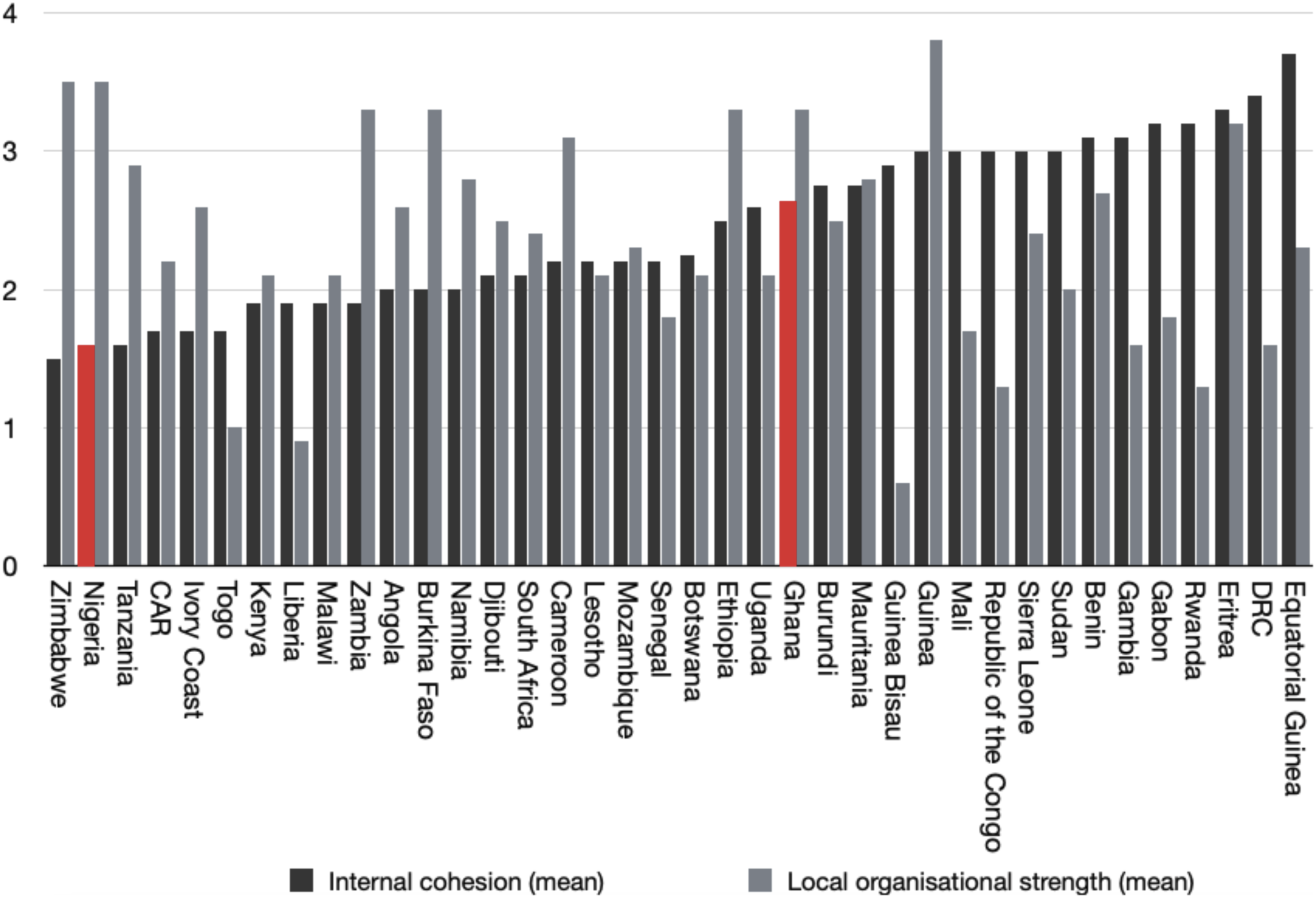
With regard to the scope of our comparison, there are, of course, other pertinent differences between Ghana and Nigeria beyond degree of political party institutionalization. These include the relative size of the two countries, and the fact that Nigeria has a federal political structure while Ghana has a unitary one. Our study does not, therefore, claim to adopt a comprehensive “most similar systems” research design. Moreover, we do not elaborate a bounded set of independent and dependent variables in setting up our comparison since many of the relationships we explore are self-reinforcing. Our methodological approach draws on the “most likely case study” design by selecting two cases where our theory is likely to apply (Eckstein 1975). This approach has benefits for process tracing – or the process of tracing the link between our two factors of interest: party institutionalization and WhatsApp use (Bennet and Elman 2010) - while remaining sensitive to alternative explanations and recognizing the non-linear character of many of the dynamics under study.
Before turning to our analysis, it is important to briefly underline the significance of social media within both countries’ political landscapes. DataReportal estimates that there were 8.8 million Ghanaians with direct access to social media in January 2022 (equivalent to 27.4% of the population) and 32.9 million in Nigeria (15.4% of the population). 5 Afrobarometer survey data from 2019 to 2021 suggests a significantly higher percentage of those with access to the internet – 42% in Ghana and 40% in Nigeria. It is also critical to underline that the indirect impact of content shared on messenger services means that it continues to influence significantly beyond its immediate user base. Phone-sharing, or gathering round one individual’s phone, is common in many towns and cities across West Africa and online messages quickly diffuse offline and reach remote spaces, as previous research has found (Cheeseman et al., 2020; Gadjanova et al., 2022). Furthermore, social media users are often influential individuals in the wider community. While a mix of social media platforms were used by political campaigns during Nigeria’s 2015 elections, WhatsApp emerged as the preferred platform by the time of the 2019 polls. Likewise, WhatsApp has rapidly become the preferred social media platform of party operatives and individual politicians in Ghana (Gadjanova et al. 2019).
Organisation and message discipline on WhatsApp in Ghana and Nigeria
This section analyzes how, and to what extent, major parties in Nigeria and Ghana used WhatsApp to organize internally and to negotiate and ensure message discipline in the lead-up to those two countries’ 2019 and 2020 presidential elections. It also reflects on how far the incorporation of new political entrants into these digital structures altered internal party power dynamics. We find that while all parties established online structures, these were more formalized in the case of Ghana, where there was also a higher degree of internal coherence – demonstrated through much tighter control of messaging and strategy. In Nigeria, organizational structures were more informal and internal coherence much less in evidence, with campaign messaging focused more on the fortunes of individual candidates. This reflects, we suggest, the more nascent institutionalization of the Nigerian parties overall. In both cases, these digital spaces allowed new sets of actors to enter the political/campaigning arena but these actors tended to be incorporated into existing structures of power rather than disrupting the whole system. In other words, WhatsApp does not appear to have challenged pre-existing power dynamics within the parties concerned, instead mirroring offline structures and forms of organizing online.
Ghana
Internal organizational structure
Ghana’s two main political parties have developed a complex and hierarchical social media communications structure and have integrated WhatsApp within this in order to connect national-level executives with office-holders and candidates at the regional, constituency, and ward levels. Notably, this structure extends to the most remote and rural parts of the country (Gadjanova et al., 2019). The NDC had initially been slow to recognise the potential of social media for politics and lacked a centralized and coordinated social media team prior to the 2016 election campaign. This created internal competition and disagreements between factions, which alienated voters and was widely seen as contributing to the party’s election loss (Gadjanova et al., 2019). In response, the party established social media coordination teams within its structures, centralized their operations, and recruited a large number of social media communicators in order to match the NPP. Thus, the adoption of hierarchical and tightly controlled WhatsApp structures by Ghana’s two main political parties was less a question of a general societal or political culture, and more of (pre-existing) organizational capacity and political expediency.
Incumbent and aspiring MPs have also established local-level and often informal information networks, but, importantly, these informal networks mostly serve to reinforce broader party structures. WhatsApp structures in turn facilitate the quick and efficient transmission of information from national executives to the local levels and vice-versa in ways that allow for both top-down and bottom-up input. The level of vertical integration of WhatsApp within hierarchical intra-party communication sets Ghana apart from a range of other countries, such as Nigeria, Liberia, or Sierra Leone – with the latter having established far less centralized and more personalized social media communication networks (Dwyer et al., 2019).
By late 2019, the NPP and NDC had appointed communications officers at every level of the party structure who were connected to each other on WhatsApp. As one NPP communicator explained, national communication directors were tasked with circulating information to regional communication directors, who in turn channelled it to the district and constituency levels. 6 Per our interviewees, this structure was adopted for three reasons: first, it ensured message discipline and protected parties from outsiders seeking to piggy-back on established party brands for their own political purposes, second it allowed for the efficient transmission of information and third, it supported the “honing” of campaign strategy and formulating more targeted campaign messages.
Internal party cohesion
In Ghana’s 2020 election, these WhatsApp structures were used to share information, but also to monitor and discuss campaign strategies. The channelling of information from the grassroots was recognized as important as it helped to ensure that officials and candidates were aware of pertinent talking points that would resonate with different communities.
7
Intra-party feedback over WhatsApp was encouraged by party leaders and strategists, and could be almost instantaneous: Most of [the party leaders], they usually give us ‘oh tomorrow by this time I will be on radio station. This are the topics that we will be going through’. We will also bring our ideas, and on the groups so that we also share it … as the panel are seated … we also sometimes give them ideas by WhatsApp. The host may throw up some question whereby … you will have a better idea of it than the panellist, then you also just WhatsApp him the answer.
8
Even more striking was the amount of discussion within intra-party and candidate groups, across both parties, about the campaign line. WhatsApp groups were set up where party members could have internal political discussions before ‘engaging in political debate with our political opponents’. 9 In the Ghanaian case, this is possible because of strong partisanship, which allows party members to recognize and vouch for each other and draws on a long tradition of informal offline forums for political contestation in the form of “party sheds” (Bob-Milliar, 2019).
Moreover, we found that intra-party messaging over WhatsApp was carefully monitored by group administrators and party activists in order to ensure adherence to the party line. This has discouraged the worst attempts at disinformation – messages that could easily be debunked or that could offend existing and likely supporters, such as those inciting violence or increasing social divisions. There was a widespread belief that ‘when you are found posting [misinformation], people [voters] become disinterested in your post’. 10 WhatsApp group administrators were tasked with directing members ‘what to do and what not to do’. 11
This oversight was impressive both in its efficiency and reach. NPP communicators recounted in detail how individual posts were monitored and revised by constituency, regional, and national communications directors. 12 Likewise, an NDC organiser confirmed communication directors would censor posts considered to be “overboard”. 13 Both parties also sought to use this oversight to encourage creative messaging that was more likely to resonate with particular groups. 14 This approach encouraged both creativity and authenticity – from ensuring that critiques appeared to come from ordinary citizens 15 to discussions about the pictures most likely to give a story “more traction”, 16 and use of different formats (texts, memes, recorded voice notes) and language.
Further, sanctions were imposed on those who transgressed the rules or shared information deemed to be damaging to the party or candidate’s efforts. Sanctions included being warned by both individual group members and group administrators and ultimately being “exited” from the groups. 17 Sanctions were also used against those who were regarded as insufficiently loyal, or as a potential ‘spy’ for another political party or candidate. Once again, this oversight extended into the more rural and remote areas of the country. 18
This level of organization and oversight is significant in and of itself, but it also meant that campaign messaging by party officials, social media “armies”, and ordinary supporters were more controlled than they might at first appear, with important implications for the type of messaging that was both encouraged and sanctioned. Messaging that was discouraged and sanctioned included outright lies that could be relatively easily debunked by ‘people who care to check, [and] when they check and see inaccurate, they will expose you badly!’. 19
Thus, the strength of the opposing party’s “social media army” acted as a deterrent to disseminating outright lies. This also extended to messaging that could be easily presented by opponents as ethnically divisive and destabilizing. In Ghana’s north, this was most evident when it came to chieftaincy disputes, which have long been associated with significant tension and periodic bouts of violence; with discussion of the same widely acknowledged as capable of bringing “unnecessary tension”.
20
Given a widespread fear of violence, popular commitment to peace, cross-ethnic campaigns, and close races in the region, this common analysis ensured that playing politics with such issues was generally frowned upon and often sanctioned by both local and national figures. As an NPP participant in an inter-party FGD noted: …some of the platforms are dominated by some particular ethnic [groups] based on the geographic location of the constituency. For example, in Northern Region here Dagombas are the majority, so if you have the tendency to do chieftaincy politics on the platform, or if you want to do ethnic politics, we may remove you.
21
He was supported by an NDC communicator who added that this was “because you may offend the minority”. 22 Participants in a separate FGD further confirmed that a lot of people were “kicked out during our chieftaincy funerals for trying to politicise chieftaincy issues”. 23 This intra-party moderation of WhatsApp’s more divisive and polarizing tendencies was also evident from the scarcity of explicitly ethnic messaging in recent elections with aspirants and activists “quick to denounce any aspect of their rival’s presidential campaign that suggests a party will favour a particular area – such as [President John] Mahama’s comments in 2012 that voters in northern Ghana should support him as a fellow northerner” (Lynch et al., 2020: 242).
However, the fact that certain messages might be off-putting to many ordinary voters did not mean that politicians always desisted from using them, but that, when they did, they made sure to distance themselves from such messaging. 24 The strategy here was simple: an opponent was to be attacked without certain types of more divisive and polarizing messaging being directly traceable to the candidate or party.
New entrants and party power dynamics
Ghana’s two main parties have established hierarchical and tightly-controlled WhatsApp communication structures. This can be attributed to several factors. First, the level of institutionalization parties enjoyed prior to the advent of social media provided ready-made structures, which could be “doubled-up” or replicated on WhatsApp. Second, pre-existing party institutionalization translated into strong party brands, which had to be protected. Loosely-affiliated groups of social media “volunteers” or newcomers attempting to insert themselves within existing party structures by purporting to speak on behalf of parties on social media had come to be viewed as an electoral threat. 25 Thus, parties created WhatsApp structures and adopted sanctions to ensure message discipline both on- and offline. Related to this, a concern that overly negative messages and dirty tactics could backfire reinforced the need for the self-sanctioning of inflammatory content or easy to debunk fake news.
Once established, these hierarchical and tightly-controlled WhatsApp groups in turn served to further reinforce parties’ institutionalization in Ghana in at least two ways. First, the concern with message discipline and with ensuring informal networks also tow the party line means that outsiders and tech-savvy political entrepreneurs are incorporated within, rather than allowed to disrupt, pre-existing party structures. Securing a permanent position within the party was cited as a primary motivation by young tech-savvy men who had volunteered to create social media content for local politicians prior to the 2020 election. Examples of those who had managed to obtain positions as party communicators were discussed in focus groups with a mixture of envy and admiration. 26 This reinforces pre-existing clientelistic networks and the gate-keeping power of established politicians. Second, by encouraging bottom-up input into campaign strategy, WhatsApp groups may be making parties more responsive to electoral demands and improving their ability to formulate resonant campaign messages and aggregate political demands. This is particularly important in highly ethnically-diverse states where communities can have very different political preferences (Gadjanova, 2021).
And while Ghana’s “big two” political parties were able to reap the benefits of their prior institutionalization for harnessing the potential of WhatsApp for organizing, fundraising, and connecting to voters, the smaller parties struggled in that regard. Our interviewees from two of Ghana’s smaller political parties (the Convention People’s Party and People’s National Convention) described falling victim to online scams and impersonations, being subject to organised and coordinated disinformation campaigns, having members defect to the NDC and NPP but remain in WhatsApp groups as “spies”, and having their messages “drowned out” by the social media armies of the big parties. 27 The CPP and PNC lacked the extensive organisational structures that could be doubled up on WhatsApp, the capacity to monitor online communication, and the resources to recruit and retain digital communicators. This underscores the importance of parties’ pre-existing organizational strength and institutional capacity for differences in how they utilize WhatsApp and demonstrates how social media is accelerating ongoing processes of parties’ development and decline.
Nigeria
With 36 states and the federal capital territory, 774 local government areas (LGAs) and, at the time of our research, more than 80 million registered voters, running a presidential election campaign in Nigeria is a significant and costly logistical undertaking. Whilst having a strong “ground game” remains a fundamental component of any successful presidential bid, social media applications have increasingly provided a key outlet to organize operations and mobilize voters.
Internal organizational structure
Unlike in the Ghanaian case, the organizational and communications structures established by Nigeria’s major political parties on WhatsApp have tended to lack coherence and stability, both in terms of messaging and personnel. Rather than centring around the key messages and strategies of the party as a whole, they have instead tended to reflect and build on the continued power of individuals and ‘godfathers’ in Nigerian politics and the prominence of informality in political structures. The 2019 presidential race pitted incumbent president Muhammadu Buhari of the APC against former vice-president Atiku Abubakar of the PDP. Atiku’s personal, and ongoing, quest for the presidency offers a clear illustration of Nigeria’s fluid political party dynamics: having failed to secure the PDP nomination in 2011, he was then a founding member of the APC and contested (unsuccessfully) against Buhari in the 2015 primaries, before he returned to the PDP in 2017 where he was selected as the 2019 flagbearer.
WhatsApp structures were mobilized behind these two ageing grandees of Nigerian politics under the guise of the Buhari Media Centre (BMC) and the Atikulated Youth Force (AYF). WhatsApp was a feature of Nigeria’s 2015 election, which saw the incumbent defeated for the first time since the return to democracy in 1999, but it was not as well-rooted or influential as Nigeria’s organized labour movement (Mustapha, 2017). Yet in the four-year span between polls, significant work, particularly by the better-funded BMC, was put in to building more robust digital structures for online organization and the distribution of messages.
These entities were never officially part of the party-political structure even though some members were party members and they provided valuable support to the wider political operation. This non-formal designation was deliberate as it established a distance which could be used to formally disassociate the “party” from online rumours and attacks circulated by “supporters”. As one AYF national coordinator explained, “I have access to the official campaign team, but we are separate from it...sometimes there is overlap and we work together but there is not a joint approach”. 28
By 2018, when its well-equipped Abuja headquarters was opened, the BMC had put in place structures that could potentially reach over 200,000 individuals directly through a series of predominantly open WhatsApp groups. Beneath an invite-only BMC National Committee group, which was limited to a core group of known activists and acted as “the central command that sits and monitors what is going on,” 29 were 36 state-level and 774 LGA WhatsApp groups. These were open to individuals interested in signing-up through links that were shared online, until the groups reached the WhatsApp threshold of 256 members. There was, however, very limited vetting of individuals who joined, and it was accepted that in these more public groups “opposition spies” were likely present. But they presented a network through which political actors could reach Nigerians all over the country almost instantaneously with a similar message.
Internal party cohesion
Unlike in Ghana, however, these structures were not used, in the main, to ensure message discipline or to protect the party brand. A degree of monitoring was provided by group administrators, with LGA group focal persons feeding into their state level counterparts who in turn reported to the national convening group. But this was less about controlling the message, or aligning with a particular party line, and more about positioning the candidate positively with voters. In fact, group members were encouraged not only to share content circulating in these groups but to generate their own material, providing it advanced the cause of their respective candidate. In the words of one AYF member, “for the most part we are left to our own devices but when there is a critical issue, we do occasionally receive a directive from above that we are encouraged to follow.” 30
Unlike in Ghana, a premium on the accuracy and credibility of the information was not a feature of much of the content created within LGA or state-level groups, nor was there any effort to sanction those responsible for sharing falsehoods. There was also little evidence to suggest that messages were targeted at particular demographics, though the bulk of AYF and BMC members were youth. These “political groups tend to be very ill-disciplined” argued one social media expert, “people share all kinds of things knowing that WhatsApp is the fastest mechanism to get things to go out”. 31 But the WhatsApp structures, in replicating offline connections online, were able to enhance the credibility of the message among recipients. Even though messages were often simply forwarded from elsewhere, the fact that many individuals outside of the BMC or AYF groups received the content directly from a trusted source – a friend, relative or community leader – was important in establishing its credibility, even if it was completely false.
In 2019, there was also less focus on convincing prospective voters to switch sides and more on getting them to register to vote. At the same time, these online influence operations discouraged supporters of opponents to do the same by issuing sustained attacks on political opponents. Attacks, predominantly directed at the personal credibility of the individual rather than their policies or promises, were an integral part of digital campaigning, and not just at the presidential level. Although some interviewees actively involved in this creation and spreading of falsehoods sought to use the language of “fact-checking their opponents” 32 others were more open in describing the need for “propaganda secretaries”. 33
New entrants and party power dynamics
These individuals, operating either within larger structures supportive of individual presidential aspirants or as part of a smaller team working to boost a sub-national level candidature, “use their creativity to create the kind of news, which is implicitly endorsed by the party or individual but not openly as they never share the content from official handles” 34 Reflecting the more informal character of Nigerian political party WhatsApp dynamics, these social media influencers were often not political party members. Instead, they worked effectively as freelancers to enhance a candidate’s campaign either through personal connections they had to leading political actors or through a more transactional exchange in which their audience – some were members of over 600 WhatsApp groups and had followings in the tens of thousands on Facebook and Twitter – was “bought”. Prominent social media activists even switched sides during the election campaign to work for the highest bidder, an indication of this transactional environment and weak partisanship overall.
This does not mean, however, that “propaganda secretaries” – party members or otherwise – were motivated solely by short-term, financial incentives, though these were important for many of our respondents in this category. As with the Ghanaian case, a number of our interviewees and FGD participants explained their motivations – or those of tech-savvy friends, family members or associates engaged in digital campaign work – in terms of securing future positions in candidates’ offices or administrations. Reflecting the wider institutional dynamics of Nigerian parties which we have described, however, this discourse largely focused on particular individuals rather than parties, with some respondents having moved with a candidate between parties during the election cycle. As one PDP campaign operative in Ibadan, who later intimated that he had been promised a role in the Oyo State Government if the PDP won the governorship, explained “we are loyal to the person rather than the PDP.” 35
Parties’ reliance on, and their giving of “creative freedom” to individuals paid to generate content can partly explain why the content being produced was more regional than national in scope. According to one respondent, when he was working to push the PDP agenda at state and federal levels in 2019, “the key to creating fake news is to make sure it resonates with local audiences [here he cited the importance of using Hausa language and non-text messages in Kano] or reinforces pre-existing biases and/or beliefs”. 36 He further argued that “at national level it is more complicated as there is no one single message that will resonate across the country - what works in south-south may not penetrate at all in north-west.” 37
Despite the ability that a platform like WhatsApp gives political parties to mobilize and organize nationwide, structures largely remain centred around individuals. But this merely illustrates the way in which online campaigning is embedded within, rather than necessarily transforming existing political operations and structures in Nigeria. It follows that WhatsApp campaigning in Nigeria is driven and shaped by individuals, with loose direction and control of party officials, rather than a more coherent and institutionalized party structure, as seen in Ghana. Thus, while there was a shared concern about message resonance, two very different dynamics drove the customization of campaign messages to regional audiences in Ghana and Nigeria: in Ghana, targeted messages were created by regional WhatsApp structures in close coordination with national ones, while in Nigeria regional organisations created and spread messages with very little interference or control from national-level structures.
Discussion: Patterns in parties’ WhatsApp use in Africa
Our study of party organizing and message management on WhatsApp in Ghana and Nigeria leads us to identify two distinct patterns of parties’ WhatsApp use during election campaigns, which we explore below: (1) the formal/hierarchical and (2) the informal/”free-for-all”. These patterns, we argue, derive from, and reflect, pre-existing levels of party institutionalization in the two countries, particularly with regard to internal cohesion. In turn, we suggest, these online practices reinforce and intensify party institutionalization (or lack of institutionalization) dynamics. This is evident, we argue, from the ways in which fundraising has been incorporated into digital structures in the case of Ghana’s two main parties. It is also apparent in the ways in which new political entrants – principally tech-savvy, younger people – have been slotted into existing internal power structures.
Returning to this article’s introduction, and the transformative potential of social media, we find that the rise of WhatsApp has not led to substantive change in internal party power dynamics in either state. This is in spite of the fact that the manner of these actors’ incorporation into party hierarchies has reinforced opposing trends in terms of internal cohesion. More generally, and moving onto the broader implications of our research, the two patterns of WhatsApp use we delineate not only impact on message discipline itself but also on the dissemination of mis/disinformation by party operatives – a major challenge to electoral integrity across the world (Kofi Annan Commission on Elections and Democracy in the Digital Age, 2020).
Formal/Hierarchical model
Well-institutionalized parties – those with well-established organizational structures and high levels of internal cohesion - such as Ghana’s NDC and NPP, establish formal, hierarchical online structures. These online structures largely mirror offline ones and include means of online group message policing, which in turn contributes to strong message discipline online. As a result, some of the most blatant or harmful disinformation is filtered out or sanctioned. In northern Ghana, this included messages related to chieftaincy disputes, which were seen as inflammatory, offensive, and able to hurt parties with younger and unaligned voters and hence strongly discouraged.
In addition, well-institutionalized parties make it harder for newcomers to enter their political structures by having in place formal party selection criteria that privilege party loyalty, pre-existing networks, and (often) seniority. Our interviewees in Ghana often spoke about the need to “prove themselves” over time in order to secure permanent party positions as online communicators. Thus, by maintaining pre-existing barriers to entry into politics, parties of this kind ensure that digital entrepreneurs – mostly young men looking to capitalize on their digital skills by creating and disseminating content for politicians – are actively incorporated in, rather than loosely affiliated with, party structures. Consequently, there is less scope for political newcomers to disrupt existing party structures and patron-client relations.
Well-institutionalized parties, by virtue of having a well-defined and loyal base of supporters, are also in a better position to harness the potential of WhatsApp for fundraising. For example, Ghana’s NDC established an “e-payment” platform in 2019 including an application interface to collect party membership dues and fundraise for the 2020 election, and popularized it using both internal WhatsApp groups and broader social media groups (GhanaToday, 2019). The NPP used social media to launch an “adopt a polling station” drive as part of its 2020 fundraising campaign, which sought to provide resources to polling agents to safeguard the party’s vote down to the smallest and most local voting unit throughout the country: the individual polling station. (B&FT Online, 2020). Thus, WhatsApp, and social media more generally, are likely to accelerate ongoing processes of party consolidation where parties were relatively well-established prior to its onset.
Informal/Free-for-all model
Conversely, parties which lack internal cohesion like Nigeria’s APC and PDP establish largely informal and highly individualized and personality-based online structures with limited hierarchy, uneven in-group policing, and little control or sanctioning of message content. This contributes to low message discipline and creates an environment, in which misinformation easily proliferates. A number of our respondents, including campaign aides and social media advisers, openly acknowledged ad hoc “cooking” of disinformation as being part of their role. One APC social media aide, for example, explained that “we use WhatsApp for creating campaigns of calumny and character assassination”, while another, who had worked for multiple parties, noted that he had deliberately spread rumours on a rival gubernatorial candidate “to get people aroused”. 38
Further, in a “digital free-for-all” with low barriers to political entry, various political entrepreneurs can insert themselves within party structures and exacerbate these dynamics. Individual patrons with access to resources can capitalize on the digital marketplace and recruit a large number of talented digital entrepreneurs in the service of their political ambitions. In some cases, these actors were “for hire” and willing to decamp to rival campaigns if a better offer is made to them. One interviewee – a PDP social media strategist – for example, raised the case of a colleague who had defected from the APC to the PDP because he “did not feel valued”, only to be “bought back” by the ruling party “with an upgraded car and – so the rumour goes – a cash payment of USD25,000.” 39 More often, though, as we note above, these new political entrants were seeking roles or favour in the office or team of their candidate should they win/retain office. Focus group discussants in Kano, for example, explained that “for the winning party, success also trickles down to social media entrepreneurs with jobs or contracts awarded to them. Social media assistant to a governor is perhaps the top prize.” 40
While this re-enforces pre-existing patron-client relations, it does so in a way that increases inequality within parties by serving only certain politicians and not others. For some interviewees, this favoured candidates of the APC in the sense that the ruling party’s greater resources enabled it to “outbid” rival campaigns for the most skilful social media advisers. This also meant, however, that those who remained with opposition parties were likely to be more dedicated to their particular candidate. A PDP social media strategist in Kano, for example, noted that “the APC pays much better than the PDP but PDP social media strategists are more loyal than APC people, who will switch sides if they stop getting paid [sufficiently] by APC and PDP offers more.” 41 In this context, income raised on social media is also likely to accrue disproportionately to individuals and not be invested in formal party structures, and our Nigeria research did not uncover digital fundraising platforms for parties akin to those described above in Ghana. Thus, in informal/free for all systems, the increased reliance on social media has a pronounced centripetal effect.
Conclusion
This study argues that the ways in which African political parties use WhatsApp during elections is determined, to a significant degree, by pre-existing levels of party institutionalisation, particularly levels of internal cohesion. Drawing on the comparison of Ghana and Nigeria – two countries where parties had different levels of institutionalization prior to the advent of social media – we identify two broad patterns of WhatsApp use – the formal/hierarchical and the informal/free-for-all. Formal/hierarchical groups of the kind seen in Ghana, are likely to maintain party unity and message discipline, maintain or increase the power of existing party structures and gatekeepers, and limit the influence of outsiders. Informal/free-for-all groups of the kind seen in Nigeria are, however, more likely to see poor message discipline, and further contribute to the personalisation of politics. These patterns, we suggest, reinforce existing institutionalization dynamics and, therefore, over time, we are likely to see increased divergence between these countries’ levels of party institutionalization as a result of the shift to social media.
In other words, in the context of election campaigns, the dominant social media platform has not come to disrupt or recalibrate the fundamentals of party management and organization. This is evidenced most starkly in the ways in which ‘propaganda secretaries’ and ‘social media armies’ in Nigeria and Ghana respectively have – albeit in quite different ways – been absorbed into existing party structures, formal and/or informal. The rise of social media has certainly led to the creation of new campaign structures in both countries, and has introduced a new set of young, tech-savvy actors into the equation. In neither case, though, do we find that the former has created space for the latter to challenge the status quo, or to secure significant influence in what is often a party system dominated by party barons (Ghana) and political ‘godfathers’ and their coteries (Nigeria).
Our research also suggests that patterns of WhatsApp use appear to influence the extent, to which the platform is used by party associates to disseminate mis/disinformation. Where levels of intra-group oversight are low and outsiders are given ‘creative freedom’ to formulate messages on behalf of politicians, both mis/disinformation and dirty campaign tactics proliferate. Conversely, when WhatsApp groups are tightly controlled and messages are policed, the worst types of provocations and outright lies are limited. Thus, our research, which aligns with evidence from other contexts (Kramon, 2019; Wang and Kolev, 2019), provides one avenue for battling the spread of political mis/disinformation on WhatsApp: create clear group hierarchies with group moderators tasked with monitoring messages and limit the reliance on “volunteers” loosely affiliated to individual politicians.
While we study the relationship between party institutionalization and WhatsApp use in two anglophone, West African cases, we expect the patterns we identify to apply more broadly across the African continent. Studies of politicians’ use of social media in Sierra Leone, and Uganda, both of which have high levels of internal cohesion (see Figure 1 above), show similarities to the Ghanaian case (Bertrand et al., 2021; Dwyer et al., 2019). We cannot fully discount the influence of other factors, such as electoral systems, federal/unitary states, ethnolinguistic diversity, levels of democracy, or economic development on parties’ WhatsApp use and a full test is beyond the scope of this article. However, our process tracing approach has allowed us to identify a clear link between (prior) party institutionalization and parties’ WhatsApp use by probing party members’ incentives and motivations. In addition, existing studies have linked each of the above background factors to party (system) institutionalization in new democracies (Arriola 2013; Bielasiak 2002; Johnson 2002; Madrid 2005; Riker 1982) so it is likely that these factors influence parties’ WhatsApp use via party institutionalization rather than independently from it.
Finally, we have focused on the presidential races in our two case studies because, like elsewhere in Africa, these are widely seen as the most consequential political contests with the highest stakes. Similar dynamics are likely to play out in lower level races particularly where elections are concurrent because of concerns about coattail effects damaging party brands. Further research can ascertain the extent, to which similar patterns and dynamics are visible elsewhere in Africa and beyond.
Footnotes
Acknowledgements
Previous versions of this article were presented at the Political Parties in Africa Virtual Conference (10 March, 2022) and at the 2022 American Political Science Association Meeting in Montreal. The authors are very grateful to the organisers of and participants in these conference panels for valuable feedback. They would like to particularly thank Eloïse Bertrand, Rachel Beatty Riedl, and Michael Wahman for their helpful and encouraging discussant comments, as well as Gabrielle Lynch for useful feedback on earlier versions of this article. The authors are also grateful to Paul Webb and to two anonymous Party Politics reviewers for very helpful feedback, which we feel has really strengthened the manuscript. Finally, the authors would like to acknowledge valuable research assistance provided during this research by Joshua Akintayo, Mukhtar Bello, Hadiza Hassan, Mumin Mutaro, Emeka Njoku, and Ghadafi Saibu, as well as to the IPSOS-Ghana team in Tamale and the Centre for Democracy and Development (CDD) (Abuja). Fieldwork for this article was supported by funding under the Global Challenges Research Fund and through the WhatsApp Research Awards for Social Science and Misinformation scheme. The authors would like to underline that WhatsApp/Facebook/Meta did not have any role in the research beyond the provision of funding.
Declaration of conflicting interests
The author(s) declared no potential conflicts of interest with respect to the research, authorship, and/or publication of this article.
Funding
The author(s) disclosed receipt of the following financial support for the research, authorship, and/or publication of this article: This study is supported by Global Challenges Research Fund, WhatsApp (Misinformation and Social Science Research Award) and University of Exeter.
