




Abstract
This article introduces the concept of bundle as a new powerful tool in the study of party reforms. The intensive and intricate nature of the engineering political parties undertake to preserve the status quo amidst a challenging environment tends to be obscured by the focus on their so-called ‘conservative nature’. Applied to the process tracing of a large sequence of reforms implemented by the Belgian French-speaking liberal party (MR) between 2019 and 2022, the bundle concept provides the opportunity to go beyond the narrow vision of party reforms only defined and empirically studied so far through their type, size and success. I triangulate a variety of sources to uncover mechanisms through which a handful of key party actors - as powerful steering agents - perceive and translate environmental factors into specific reforms. The bundle analysis brings notably to light a key sequencing mechanism – a snowball effect – explaining how the sequence actually unfolded and fed on itself, challenging our hitherto accepted understanding of party engineering. This study also offers a transferable conceptual framework with valuable insights for wider use in the field, providing an avenue for theory building through causal analysis.
Introduction
Political parties are commonly perceived as conservative, resisting change unless their survival is threatened (Harmel and Janda, 1994; Panebianco, 1988). This common assumption results from decades-old literature focusing almost exclusively on those peculiar ‘rebounds’ or ‘(over)reactions’ to particularly salient drivers of change (Bale, 2012; Chiru et al., 2015). The question of what role internal and external factors play in explaining those reforms has already been strongly scrutinized (e.g., Bale, 2012; Gauja, 2012, 2017; Luypaert and Legein, 2022; Wauters, 2014), just as many organizational and/or psychological barriers to reform – such as bureaucratic entrenchment, safeguarding of prerogatives or selective perception – were already put forward by party scholars to justify parties’ inertia over time (Butler, 2021; Gauja, 2017; Norris and Lovenduski, 2004).
Yet, the phenomena those studies investigate are, most of the time, the major, disruptive and successful reforms that are the most easily detectable and tend to focus on one type of reform at a time in the name of analytical feasibility (Gauja, 2017). The result is that the frequency of party reform is more than probably overlooked (Legein, 2022), leading to the impression that political parties remarkably lean toward the status quo.
But by moving the usual focus away from changes to stability, one may argue that the apparent continuity of political structures as we know them is, in fact, the result of constant engineering on the part of political elites able to alter their environment (Mair, 1997). As Bedock (2017) summarizes: ‘In a changing environment, a great deal has to change in order for things to remain the same’ (p. 1). In line with this, Legein (2022) already showed that party reforms, regardless of their type, are in fact very common and, most of the time, multidimensional when aggregated at the legislature level. Such observation opens up the idea that reform processes often lead to a sum of intertwined reforms of different types and are, in fact, the result of greater causal complexity than the literature has considered so far (Bell, 2011; Küppers, 2022). Some have already advocated for adopting a configurational approach to the causes of party reform (Aylott and Bolin, 2023; Bale, 2012; Küppers, 2022; Luypaert and Legein, 2022), while still failing to take full account of key causal mechanisms linked to their multidimensional nature. The literature is still too impervious to substantial insights from other fields, such as the importance of chaining effects (e.g., through mechanisms of snowball or spillover effects) in explaining institutional reforms (e.g., Sobel and Coyne, 2011). The most notable exception to that is probably Panebianco’s (1988) observation that a change in the conformation of the dominant coalition can sometimes generate even more instability, calling itself for further adaptations. Yet, why wouldn’t the instability created by any type of reform call for other reforms of any type in its wake?
Besides, most of the literature adopts a predominantly rational-institutionalist approach without actually investigating the politics of party reform (Gauja, 2017) even though this is ‘crucial to a full understanding of reform outcomes: we cannot just identify antecedent conditions and predict the end result’ (Renwick, 2010: 83). Reforms result from complex bargaining processes between party actors whose ideas, (pre-)beliefs and values matter (Gauja, 2017). The empirical strategy privileged so far in the literature de facto limits our understanding of how (often) reform processes effectively unfold and may, eventually, result in frequent multidimensional adaptations of parties’ political products.
This article intends to introduce a new analytical tool providing the opportunity to go beyond the current narrow vision of party reforms only defined and empirically studied so far through their size, type and success: the bundle of party reforms. Understood as a sequence, this concept sheds light on the engineering political parties constantly perform to adapt to their environment by putting party actors at the centre of attention. The diachronic interpretation of the bundle concept allows for the analysis of temporal sequences covering a great diversity of reforms while emphasizing their causal complexity.
This article asks the general question of what can be learned about the mechanisms of party reforms when they are studied in bundles. I propose, in particular, a first demonstration of the usefulness of this new theoretical and empirical tool by conducting a process tracing (Beach and Pedersen, 2013) applied to the broad sequence of reforms implemented by the Belgian French-speaking liberal party (MR) between 2019 and 2022. By showcasing a new method of analysis, this article also contributes to our understanding of how party elites perceive and translate environmental shocks into specific reforms.
I start by returning to the definitions of party reform before defining the bundle concept, building on the literature on institutional reforms. The second part of the article presents the empirical strategy followed to demonstrate the concept's usefulness in the study of party reforms. I then present and discuss the results before delineating the main lessons from this first empirical application of a bundle analysis.
Theory
Defining party reform
Previous studies already showed that parties could prove to be extremely resilient by responding to the internal and external challenges they experience, such as electoral defeat (e.g., Janda, 1990), membership decline (e.g., Kölln, 2014), change of party leader or dominant faction (Hayton, 2022) or change of governmental status (e.g., Wauters, 2014). The strategies used by the parties to counteract these shocks are multiple: programmatic reforms (e.g., Walgrave and Nuytemans, 2009), leadership turnover (e.g., Pedersen and Schumacher, 2015) or (democratic) organizational reforms (e.g., Ignazi, 2020). Yet the literature largely continues to view political parties as seeking to maintain the status quo. It would be evidenced by the rarity of detected reforms they undertake over time (e.g., Chiru et al., 2015).
The main reason is a conceptual limitation reflecting the pervasive confusion between party change and party reform. Such confusion automatically restricts the empirical strategies available to us to understand reform dynamics. Harmel and Janda (1994) defined party change as ‘any variation, alteration or modification in how parties are organized, what human and material resources they can draw upon, what they stand for and what they do’ (p. 275). While their arguments remain very influential, a working consensus emerged that their definition was empirically impractical given the expectations their very broad conceptualization of party change raises (Bale, 2012; Gauja, 2017; Legein, 2022).
Building on their premises, though, Gauja (2017) notably undertook to conceptually distinguish party change from party reform based on their genesis (intentional or unintended?), substance (major or minor?), speed (abrupt or incremental?), and subject (on informal practices or formal rules?). Party reform, which she defines as ‘intentional and publicized changes that are made to a party’s structures or practices in order to improve them’ (Gauja, 2017: 19), is a subset of party change. Interestingly, she decided to restrict her definition to organizational reforms, although she acknowledges the ‘inherent inter-relationship between the organization of a party, its policies, tactics, and philosophies’ (Gauja, 2017: 16).
Relying on the heuristic of the political product (Speed et al., 2015), Legein (2022) nevertheless proposed to return to a more inclusive and fully operable definition of party reform emphasizing the multiplicity of subjects that it may concern: ‘an intentionally publicized process of change, with clearly identifiable starting and ending points in time, that is made to one component of a party’s political product’ 1 (Legein, 2022: 7). He argues that the literature on the causes and consequences of party reforms generally tends to confine itself to the comparative study of successful and publicized reforms of the same type, with the exception of a few notable case studies (e.g., Bale, 2012; Hayton, 2022). This self-restriction in the name of empirical practicability (Bale, 2012; Gauja, 2017) results in studies looking at reforms in very segmented ways without distinguishing their causes (Legein, 2022; Luypaert and Legein, 2022).
Considering political parties as entrepreneurs competing for political dominance in the market allows for challenging this traditional approach to party reform. The fundamental characteristic of the political product they sell on the market to attract members and supporters is precisely the interrelation of its components (i.e., ideology, persons and organization). The indivisibility of the political product makes it unique compared to classic commercial brands because a particularly complex trade-off of costs and benefits can arise from its management: ‘In the case of tension between the party and the person, voters who are party members may be faced with a party leader or local candidate in whom they have no confidence. Or, voters may be supportive of the policy and ideas of a particular leader or candidate but also be a loyal supporter of an opposing party. The choice, then, is a single offer but with possible internal conflicts.’ (Speed et al., 2015: 133)
Toward a conceptualization of party reforms as bundles
Interestingly, a parallel can be drawn with the literature on institutional reforms. Bedock (2017) conceptualizes institutional reforms not as isolated events but as parts of broader processes. Those would be carried out on various aspects of the institutional architecture and involve the creation of complex compromises between key stakeholders. Her premise is that political institutions are naturally clustered and should be studied as such. Bundles of reforms can take two forms: a single multidimensional reform adopted as a package deal or several reforms enacted alongside each other in a sequence during which ‘the adoption of one institutional reform leads actors to reflect on other dimensions of the institutional system, and potentially to reform other aspects’ (Bedock, 2017: 32). Her rationale is that adapting a given dimension of the institutional structure should induce strategic adaptations on the part of the political actors and to further changes in the institutional architecture (see. also Lijphart and Grofman, 2007). Understanding sequential bundles, she notes, naturally calls for the use of qualitative methods designed to focus on the development of the sequence in itself, starting from the outcome and going back to its origins through the events that have shaped it. Using quantitative approaches would be inoperable, in that it would not allow the required detection of stakeholders’ motivations and strategies this conception of bundles calls for.
Translating Bedock’s (2017) reasoning to Belgian mainstream parties, Legein (2022) previously demonstrated that party reforms do not appear as rare but rather as irregular when observed in isolation. Yet, reform processes appear continuous and multidimensional when observed by legislative terms, regardless of their type. In most cases, parties end up reforming more than two components of their political product when they initiate any adaptation process. Like Bedock (2017), I argue that isolated party reforms, regardless of their type, are part of a broader picture and must be analyzed in more encompassing analyses emphasizing the multidimensional nature of the parties’ political product.
The case study I develop in this article aims at demonstrating what can be learned from the use of the bundle concept understood as a sequence, i.e., party reforms relating to one or several components of a party’s political product, belonging to a broader sequence beginning or finishing beyond the moment of adoption and discussion of a given reform. I also empirically show how the concept bundle can help answer how party elites perceive and translate environmental shocks into specific (sequences of) reforms.
In line with Bedock (2017), I favour the use of an Explaining-Outcome process tracing (EO-PT; Beach and Pedersen, 2013) investigating the types of interactions between the main agents and structures (intra-party organs and rules) involved in the process. The analysis focuses on the mechanisms through which environmental stimuli (x) are perceived by an agent or structure (y) and produce an effect on another agent or structure (outcome; z) (Beach and Pedersen, 2013). The analysis deals more specifically with the role of key steering agents in the sequence, i.e., ‘subject-led, intentional, and goal-directed attempts to influence social processes’ (Beyer, 2019) since those can be considered as perceiving, interpreting and reacting in very different ways to their environment which, in turn, can weigh considerably on the reform processes they are involved in.
Methodology
Case selection and description
The case study under investigation is the broad sequence of reforms implemented by the Belgian French-speaking liberal party (Mouvement Réformateur—MR) between 2019 and 2022. Focusing on the MR gave me the possibility to observe the building of a multidimensional bundle in real time while covering different reform types, sizes and outcomes (successful or not). It allows for avoiding self-restriction in the reforms considered while providing a conceptual framework easily transferable to other cases. The interpersonal dynamics resulting from the MR specificities contributed to its targeting as it greatly reduced the challenges traditionally encountered in observing intra-party dynamics. It is not rare to see internal power struggles in the party being largely publicised in the media, thereby increasing the possibility of triangulating sources during the analysis.
The MR is one of Belgium’s six historical major parties and regularly ranks second in the French-speaking party system, except for 2007, when it ranked first (Delwit, 2021). The party’s low level of institutionalization compared to other Belgian parties makes it an outlier, even though its organizational backbone closely resembles its competitors (Legein and van Haute, 2021, 2022). Its statutes, adopted in 2002 and reformed in 2021, remain particularly short and leave room for interpretation.
The party leadership (embodied by the Party Council) is highly centralized around the leader and a small group of party elites holding power. Informality plays a great role in decision-making, but, like in many other Western European liberal parties (Close and Legein, 2023), it results in complex and highly competitive power dynamics. Two dominant factions notably oppose each other: a camp associated with the party’s right-wing opposed to a faction historically leaning towards a more social liberal positioning.
Organisationally, the distribution of power is guaranteed by a day-to-day leadership carried out by two people at a time when the party is in government: the party leader and the governmental leader. The most prominent person in the government is automatically given the role of governmental leader, generally the party’s vice-Prime Minister (Delwit, 2021). This position was initially created to accommodate the party’s two main factions. Each would hold the reins of one of these key party positions.
Data collection and method
The bundle seen as a sequence methodologically advocates for a process-tracing ‘with the outcome as a starting point, working backwards towards strategies and motivations’ (Bedock, 2017: 34) of the party actors at the core of these processes. I consequently favoured an abductive approach building on the combination of a great variety of sources to trace back the chain of events under investigation.
I first systematically reviewed the references to party reforms in the main media outlets in French-speaking Belgium: the two main newspapers, La Libre and Le Soir, and the two main TV channels, RTBF and RTL-TVI (see. Appendix 1) to trace back the sequence. It provided initial factual information contextualizing the reforms while allowing me to verify some of the information given by interviewees. Second, I gathered internal party documents (party statutes, leadership election rules, party website, etc.) to identify the main party structures and actors involved in the process.
List of interviews.
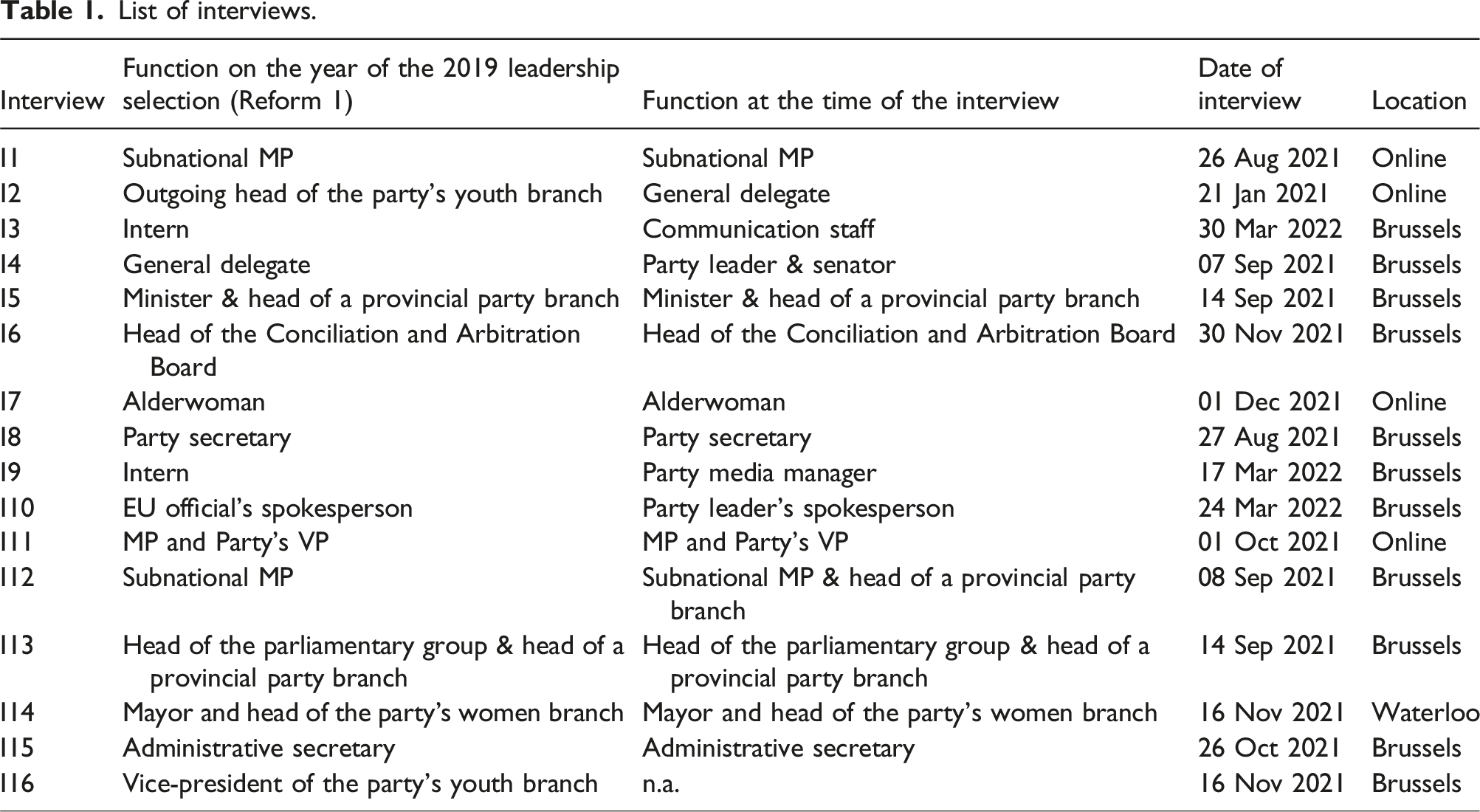
Each interviewees were at first asked to describe the leadership selection process that was initially targeted as the starting point of the sequence, before resuming the party's chronological journey up to the day of the interview. They were then given the chance to specify whether any significant events had taken place between the two time points and to consider what might explain their timing, form and content. I then asked them about the power struggles at play and the role played by ‘who they would identify as the key actors’ of each event. This strategy provided me with an increasingly accurate vision of the sequence under investigation, revealing for example the highly informal yet substantial transformation of the party’s communication unit.
I did not have any strong expectations about the mechanisms to be detected since I adopted an abductive approach. Based on the literature though, I could at least expect that common party shocks such as a change in governmental status, like the one experienced by the MR, would be perceived as either constraining or liberating depending on the nature of the change by the party leadership (Legein, 2022; Luypaert and Legein, 2022; Walgrave and Nuytemans, 2009; Wauters, 2014), and that other factors such as factionalism or party values would be depicted as barriers to party reform (Gauja, 2017).
Similarly, the mechanisms of persuasion and adaptation are undoubtedly very common mechanisms of reform processes since those require building a shared definition of the party's identity, sometimes at the cost of individual and organisational resistance (Harmel and Janda, 1994; Norris and Lovenduski, 2004).
The interviews are rich in information regarding the power dynamics, interpersonal relationships, and informal actions taken by important party figures. Interviewees’ openness to discuss these matters can be attributed to several factors: trust-building between the researcher and the party, little consideration regarding the eventual outcomes of the interviews, and the liberal party culture that lead most interviewees to put their ego above the party as a collective. None of them requested anonymity, even though they were explicitly offered the opportunity to do so.
Finally, two non-participant observation sessions two non-participant observation sessions during local meetings organized during the party statutes reform (MR, 2021a) and the Statutory Congress (MR, 2021b) that formally approved the final text in 2021 supplemented these data.
The bundle as a sequence
Sequential reforms implemented by the MR, 2019–2022.
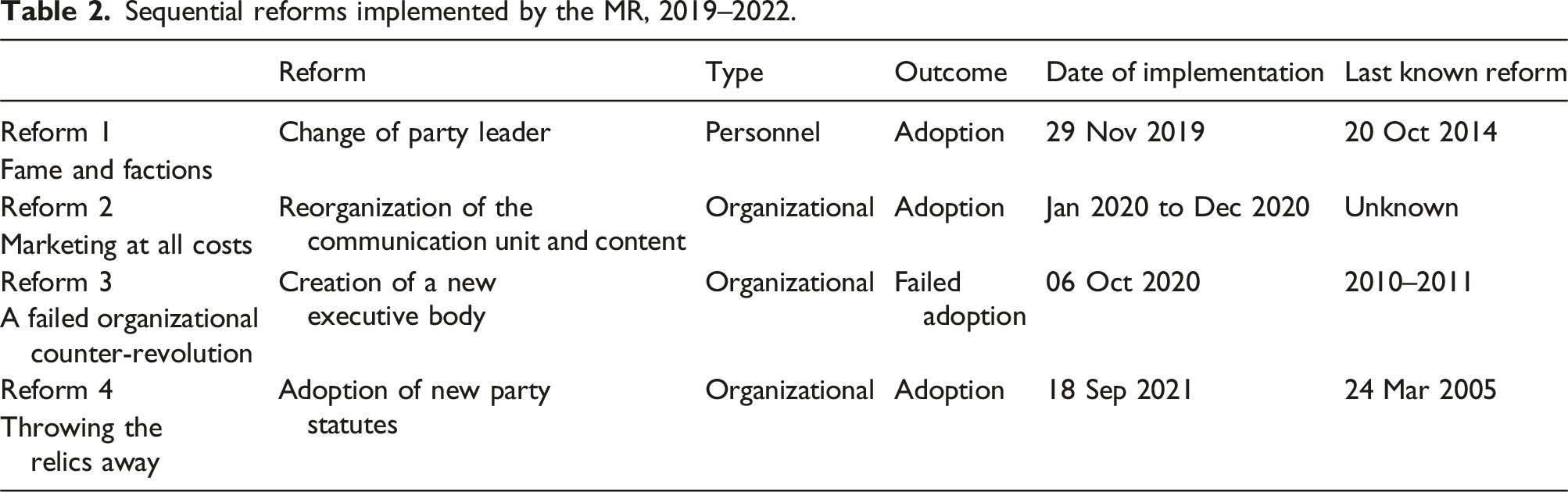
Sequencing the bundle of party reforms
The presentation of the results closely follows the sequencing of the bundle, providing a rich qualitative account of the events linked to each sequential reform composing the bundle. The key elements brought to light by the triangulation of the data collected are highlighted while articulated around the mechanisms detected during the analysis.
Reform 1 – Fame and factions
The regional, federal and European elections of May 2019 marked the beginning of an important renewal of the MR dominant coalition with the joint departure of Charles Michel, Didier Reynders (both heads of the opposing factions) and the incumbent party leader for positions at the EU level (La Libre, 26 August 2019). It only worsened the delicate political context in which the party found itself. The party lost ground during the 2019 elections, and the next governmental negotiations were expected to be particularly complicated.
In a powerful informal pre-selection phase, Michel and Reynders initially negotiated the coronation of a consensual party figure close to the Michel faction (I1, I13, I14, I16) to provide the party with stability and prevent the danger of factional conflicts being reactivated. The anticipation of the governmental negotiations combined with the departure of key figures set the conditions for the ‘transition to another internal party sequence’ (I15).
Yet, the favourable development of the negotiations to form the regional governments reshuffled the cards in late August, making the initial plan obsolete. The designated candidate quickly confirmed his willingness to take on the role of liberal leader of the Walloon government (I5, I8). In the wake of his announcement, future holders of ministerial portfolios were told they had to explicitly renounce cumulation with the function of the party leader to be endorsed by the party (I6). Some interviewees point out the party’s willingness to avoid one person concentrating all the power in his/her hands, referring to a past experience deemed negative (I4 confirmed by I8) and suggesting a path dependency effect. But it can also be seen as Michel’s attempt to sort out the candidates who might run and maintain a certain level of control over the election outcome.
Mechanisms at play during Reform 1 as it eventually unfolded.
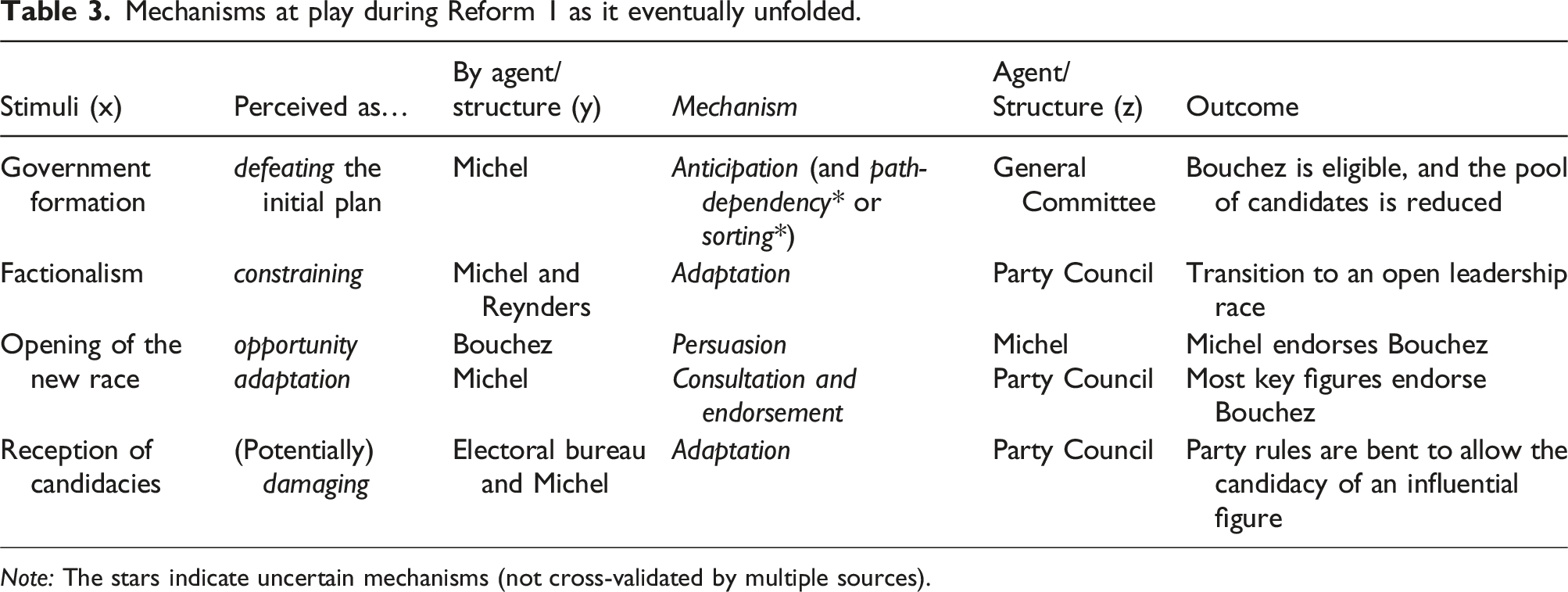
Note: The stars indicate uncertain mechanisms (not cross-validated by multiple sources).
They were eventually constrained to organize a regular contest, as prescribed in the party’s rules (MR, 2005, 2019). Anticipating the failure of his first plan, Michel managed to co-opt Georges-Louis Bouchez as a senator (Le Soir, 08 July 2019), making him eligible for the leadership race on the same occasion (MR, 2019). The opening of the second race was a unique opportunity for Bouchez. He quickly positioned himself as a serious contender by securing the informal endorsement of Charles Michel, playing the role of steering agent after various consultations (I4, I11).
On September 27, a candidate from the right-wing faction declared himself despite his declining influence within the party (La Libre, 13 September 2019). Bouchez quickly reacted by announcing his candidacy on October 3 (Le Soir, 3 October 2019) with Michel’s and the party apparatus’ support, opposed to the other candidacy (I5, I11, I13, I14, I16): ‘It should not be a secret because when you want to make a big machine work, it is also the responsibility of someone who assumed the role of party leader not to leave the house in a mess (…)’ (I12, confirmed by I5, I7 and I13).
In the following days, three second-tier figures of the party and two rank-and-file members also announced that they would run. The Conciliation and Arbitration Council rejected the two candidacies from rank-and-file members who were not members of the General Committee (i.e., eligibility criteria; I5, I14), making an exception for one of the second-tier figures due to her status (I12, and confirmed by the head of the Conciliation and Arbitration Council): ‘Everyone thought it was absurd to prevent [her] from being a candidate. It would have done more harm than good’ (I6, confirmed by I5, I12, I14).
The competition was seen as particularly democratic within the party compared to previous ones (I5, I12, I13, I16). Naïvely, an interviewee notes: ‘We played the game, you know. (…) there are always key figures who steer things a bit. (…) there is still a protégé (…) who has some support from the apparatus. But (…) we had a real, real election with serious candidates who competed. (…) people realized that it was a real election, that everyone had a chance (…).’ (I5)
But behind the scenes, the party leadership closely monitored the elections. Interviewees confirm that informality peaked at this stage of the contest (I8, I11). From the moment Bouchez secured Michel’s support, key party figures from the dominant faction endorsed him by coordinating their press release. On 3 November, the newspaper Le Soir confirmed the consensus among the party’s dominant coalition by announcing that six out of the 14 federal MPs and almost all the incumbent ministers explicitly support Bouchez.
On 12 November, the president of the Conciliation and Arbitration Council announced the final scores of the first round of the election: 1. Georges-Louis Bouchez: 6044 votes (44.6%). 2. Denis Ducarme: 3405 votes (25.1%) (candidate from the right wing faction). 3. Christine Defraigne: 1899 votes (14.0%) (candidate covered by the exception). 4. Philippe Goffin: 1521 votes (11.2%). 5. Clémentine Barzin: 685 votes (5.1%).
After a particularly tense inter-round campaign between the two second-round contestants (I13, I14), the party announced Bouchez as the newly elected leader (62% of the votes) on 29 November.
On the day of his election, the newly elected party leader announced his plan for the party (Le Soir, 12 January 2020), summarized in one statement: ‘to get back on its feet’, the party needs to: (1) bring back the pride of being a liberal and (2) modernize the party structures (I4, confirmed by I9, I10).
Reform 2 – Marketing at all costs
For most of the interviewees, Bouchez’s election was seen as a rejuvenating event for the party, closing a decades-long clan war that had traumatized the French-speaking liberals and reshaping the interpersonal dynamics at work: ‘We were and still are a little bit traumatized by the so-called clan war. (…). With the years, (…) the two [Reynders and Michel] have each gone to the EU, so ... Fortunately, this conflictual relationship has been diluted. (I12)’ ‘(…) there was a whole window of opportunity that was also opening for a renewal of the party.’ (I11)
Mechanisms at play during Reform 2.
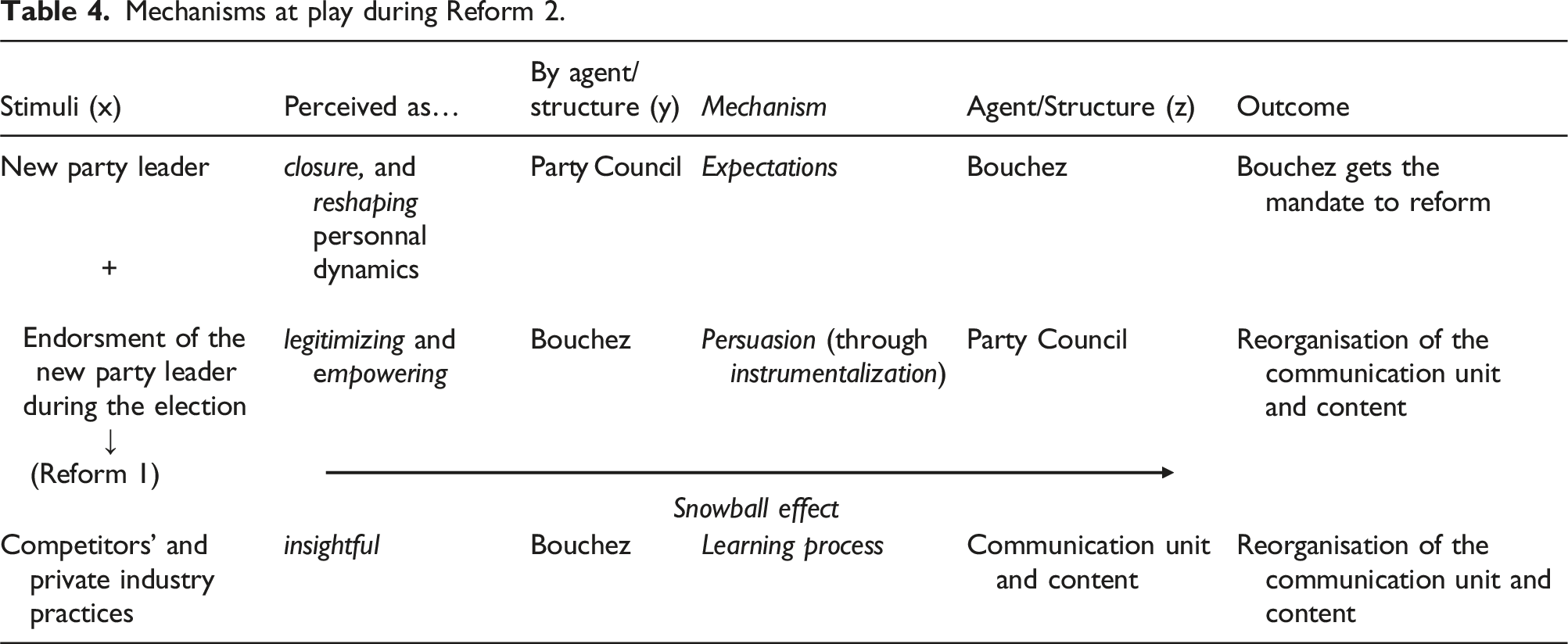
Tactically, Bouchez instrumentalized two factors affecting the primary functions of the party to persuade the dominant coalition to endorse his reform project(s). On the one hand, he critically looked at the party’s recent electoral scores. He consequently advocated for creating party media in three different formats (radio, TV, and print) to reach people ‘from the popular strata of society’ and ‘young people’ again (I4, I10). Bouchez further argued that the message to members and public opinion needed a change in content, framing the party defeat as pressuring the party to reaffirm its commitment to liberal ideas (Le Soir, 12 January 2020): ‘Our supporters are walking headlong. (…). For years, (…) we did not use the word “liberal” because bad things were said about liberals. (…). I said: “No! We will say that we are liberals and that it is great to be a liberal”. Influences work like that. The more you repeat it loudly, [the more it works].’ (I4, confirmed by I3 and I10)
According to his spokesperson, the mix of a renewed commitment to liberal ideas and aggressive, repetitive and non-equivocal communication on a carefully selected range of issues is a fruitful strategy ‘to make sure that people get a good idea of [the] party (…).’ (I10).
On the other hand, the party has also set itself a clear goal based on studies conducted by internal advisors and known to all the collaborators: ‘to reach around 30,000 – 35,000 members in order to achieve a 30% electoral score [in 2024]’ which would guarantee the first place among the French-speaking parties (I4, confirmed by I3). Bouchez consequently created a new position in the communication unit to handle the communication with, and internal animation of, the members as well as the close monitoring of (dis)affiliations ‘which was non-existent before’ (I3). She is explicitly responsible for creating more interactions between the members and the central organization, personified by Bouchez, and making the latter available to the local branches (I3, confirmed by I10).
In the months following Bouchez’s election, four of the five employees from the communication unit left (I3 and I9). The party hired eight new collaborators between March 2021 and October 2021. The most decisive point of Bouchez’s takeover of the party’s communication was on 19 August 2021, when the communication director left his post due to a disagreement with the party leader (I9). Since then, Bouchez cumulates the two jobs and was very clear on the fact that ‘in view of the [next federal in 2024] elections (…) no, nobody will replace [the departing director of the communication]’ (confirmed by I9, backed by I3 and I10).
Bouchez also expressed his willingness to bring the members back in by giving them new incentives to join: ‘I recreated an internal magazine to promote members and highlight political actions. (…). We also have a new welcome package for our activists. So we brought in material and recreated an e-shop. (…) We have specific campaigns; we do real marketing.’ (I4)
The manager of the party media confirmed that the party has developed a deliberate marketing strategy for that purpose (I9, backed by I10), illustrated by the launch of a new e-shop. The internal communication manager was specifically asked to emphasize products exclusively using two hashtags and deliberately erase any direct reference to the MR label: #fierd’êtrelibéral and #fierd’êtrebelge (I3, I4) (#proudtobeliberal and #proudtobebelgian in English). A few months later, the new party media was officially launched on 15 December 2020 (Le Soir, 17 December 2020).
Interestingly, Bouchez highlighted on various occasions how he was inspired by the marketing strategies used in the sports industry, but also by Sarkozy’s campaign in 2007 and – to a lesser extent – Macron’s communication (also confirmed by I9 and 10): ‘My source of inspiration (…) is Sarkozy. (…) Macron is also quite interesting, even if there are things I do not agree with (…). But my main sources of inspiration are Formula 1 teams, Lewis Hamilton, football clubs, etc. I am much more into sports inspiration, in fact, or even artists. (…) politics, in general, is old-fashioned.’ (I4)
The manager of the party media confirms a learning process of the party based on a comparison with what Belgian and foreign parties do in terms of communication: ‘(…) to be very clear, we did a benchmark. We looked at what all the Belgian political parties and elsewhere were doing. And (…) we also went to look at what was being done in Canada and France in particular’ (I9 confirmed by I3).
Reform 3 – A failed organizational counter-revolution
Mechanisms at play during Reform 3.
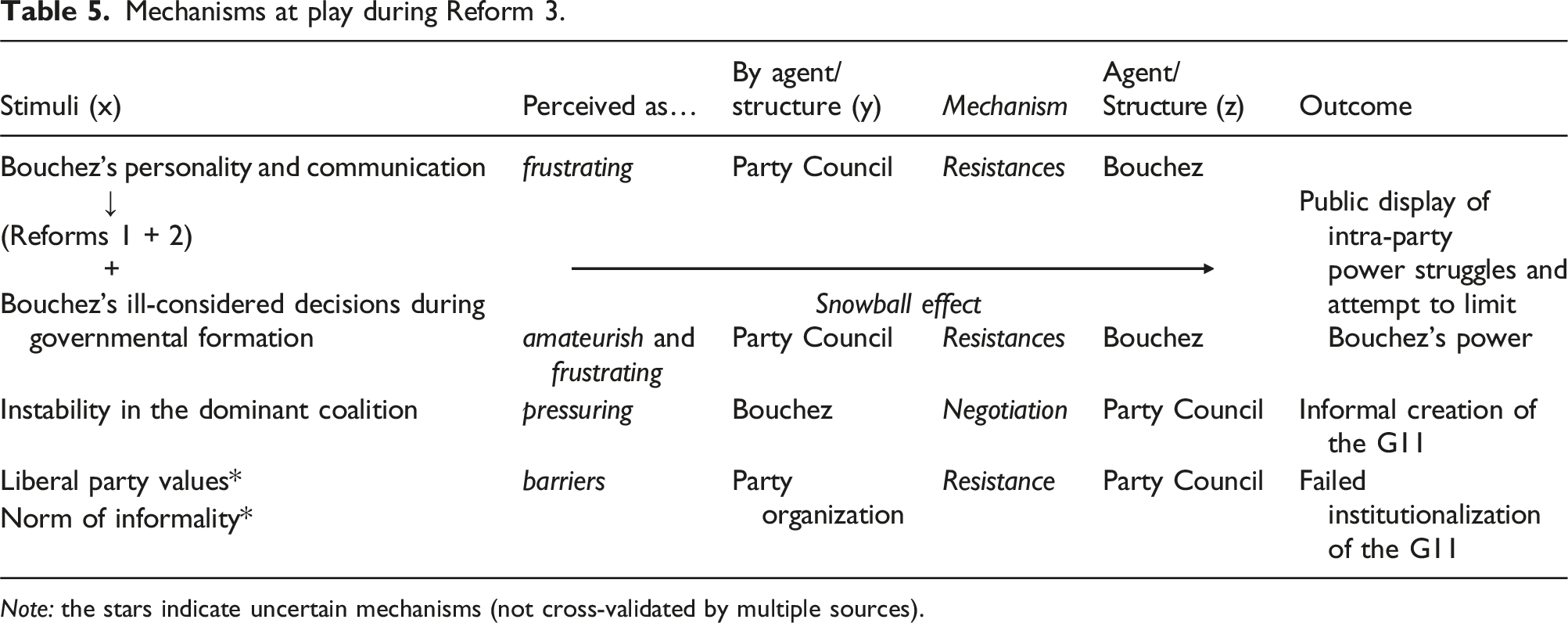
Note: the stars indicate uncertain mechanisms (not cross-validated by multiple sources).
On 01 October, the new government was installed 494 days after the legislative elections. As expected, government negotiations were particularly long and complicated. Bouchez’s attitude as the main party representative episodically irritated the negotiating partners in the preceding months. The negotiations imploded on 20 September 2020 (RTBF, 22 September 2020), and other parties designated Bouchez as the scapegoat. His aggressive communication towards the people he was negotiating with and his lack of knowledge about the issues discussed during the meetings were especially singled out (RTBF, 22 September 2020): ‘At the time, our president was criticized for being uncontrollable, a free electron, for not understanding Dutch, for not mastering the issues discussed, for being unmanageable’ (I10), ‘All those who first supported Bouchez (…) can only blame themselves. (…) he has the disadvantage of his advantage, which is that his youth means that he has a certain way of working things out.’ (I13)
Reform 2 illustrates where Bouchez’s energies are directed. The irritation of the coalition partners in the final stages of the government negotiations was felt even in the MR. With the party on the verge of being ejected from the negotiation table, key figures called for a review of the party’s functioning, highlighting Bouchez’s isolation in decision-making and communication (Le Soir, 27 September 2020). For them, it was essential at the time that Bouchez get better guidance. On Sunday, 20, the then MR Prime Minister of the caretaker government was asked to join the negotiations with her party leader.
A coalition agreement, including the liberals, was eventually signed on the night of 30 September (Le Soir, 30 September 2020). But Bouchez had to apologize and came out weakened in the eyes of his future coalition partners as well as in his ranks. The MR ended up with three portfolios, four positions fewer than in the outgoing government, and the departing ministers had to be relocated elsewhere. On 1 October 2020, Bouchez designated the party’s three new federal ministers, including Charles Michel’s younger brother, while he announced that his former rival during the leadership election would replace one of the female MR serving ministers in the Walloon government.
This announcement immediately created turmoil (La Libre, 2 October 2020). The new casting left the Regional government with illegality due to the non-respect of gender quota (La Libre, 2 October 2020). Bouchez had not anticipated this, which was viewed as amateurism by public opinion and his party. Voices were also raised about the nomination of Michel’s younger brother (unknown to the public so far), perceived as a gift to the latter’s faction following Michel’s informal support during the 2019 leadership election (La Libre, 1 October 2020; I2). Bouchez’s decisions were seen as ill-considered, poorly executed, and very frustrating, especially since his attitude and propensity to make decisions on his own had already nearly cost the MR its place in the federal government.
On 5 October 2020, the tensions were high, and several key figures did not hide their frustration, as did the MR President of the Belgian Senate and another influential figure who left the party a few months later: ‘I cannot stand despots, nepotism and what looks like a mafia clan anymore’ (La Libre, 5 October 2020), ‘The solutions cannot be peanuts. (…). We are not in an autocracy where decisions are taken because we dreamed them up at night.’ (La Libre, 5 October 2020).
Those statements illustrate that the problem is not only the way Bouchez communicates. They also translate a frustration with the party’s history of factionalism that was thought to be over with the election of Bouchez: ‘Some wounds were not necessarily closed and were reopened. (…). The appointment of Charles Michel’s brother revived the old clan war between the [two historical factions of the party] (…). [It] was like a drop of water that made the vase overflow. (…) the resentments coalesced, and the tensions coalesced.’ (I2)
A few hours before a crucial party leadership meeting, Bouchez suggested the creation of a collegial body (the G11) – wanted by and composed of the party’s key figures. The initiative aimed to counterbalance Bouchez’s power to calm down the tensions. After a long meeting, the Parliamentary Intergroup, a deliberative body bringing together MPs from all parliamentary groups (MR, 2005), supported the creation of the G11 (on the Council’s proposition) while deciding not to challenge Bouchez’s leadership (RTBF, 6 October 2020).
The sequence was rough (I9; I13) and depicted as ‘a catharsis’ (I2) for the party. Key party figures took the freedom to speak out publicly against their party leader, following the party’s tradition of informality. Yet the G11 did not prove dangerous for Bouchez’s freedom as party leader, as it has never been convened so far (I2, I10). It was acknowledged from the beginning that the G11 would never get institutional recognition given the party’s liberal values and resistance to institutionalization: ‘Liberals are a bit more individualistic. We do not have the socialist tradition of working as a mass, as a united group. We are more like liberals, (…) we tend to fight more’ (I5, confirmed by I11).
Reform 4 – Throwing the relics away
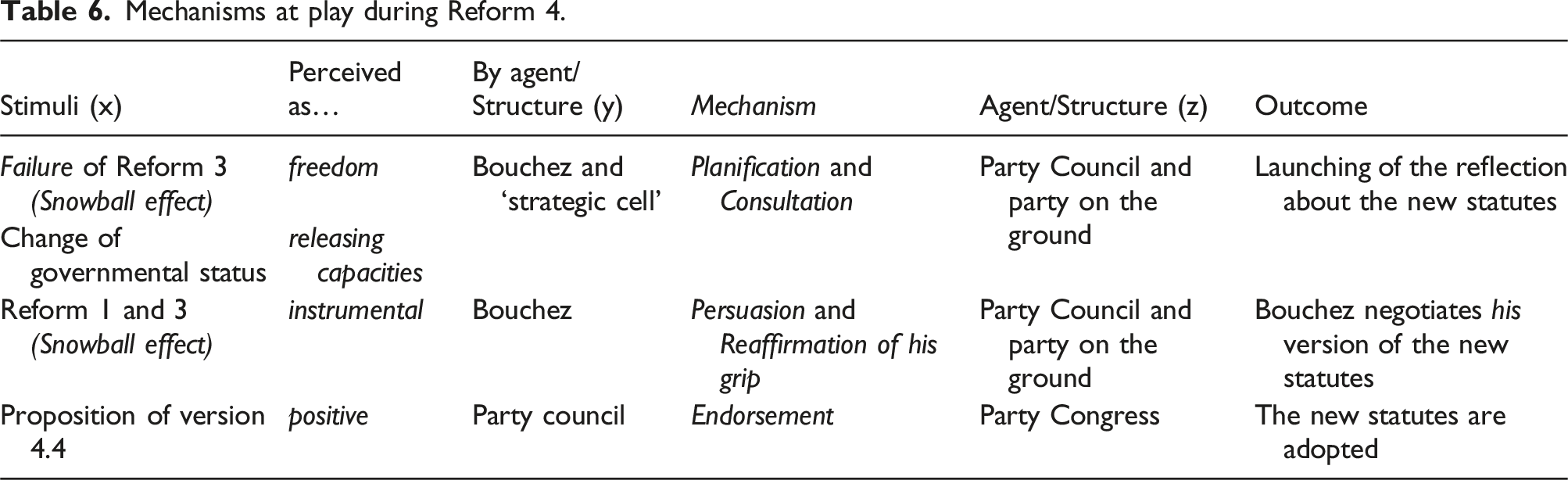
Mechanisms at play during Reform 4.
‘The party that has the Prime Minister is always handicapped. Today, the MR is no longer the leader. We can assert ourselves. (…) And internally, the allocation of resources and advisers, instead of everything being phagocyted by the [Prime Minister office] (…), well, we have a more balanced distribution of resources. We have a party again.’ (I5)
After identifying the ‘old and obsolete relics’ in the old statutes (I15), the Party Secretary set up a calendar while heavily mobilising the party in central office to coordinate the process. He took advantage of the loosening of covid measures to launch a Statutory Tour (i.e., ‘Restarting on good foundations’), consisting of 14 meetings with provincial branches (MR, 2021a) and intended to ‘feed the reflection (I4, confirmed by I8). Between the meetings, the Party Secretary proposed new versions of the statutes to the Party Council in coordination with Bouchez’s Chief of staff (I15). As confirmed by the interviews, the writing of the text was monitored by a closed ‘strategic cell’ (I3, I10) composed of Bouchez, his Chief of staff and the two party secretaries.
The revision of the statutes, launched in 2020, is a personal project carried out by Bouchez himself (as confirmed by I13, I14 and I16). During his campaign, Bouchez advocated for the ‘modernization of the party’ and ‘put an end to the old anti-democratic drifts that had undermined [his] party’ so far (I4, confirmed by I15 and during the observations). This argument was central to the narrative he developed to justify the reform when meeting the party members during his tour of the local branches.
Once again, Bouchez instrumentalized two key factors to persuade the party leadership and the members to adopt his reform of the statutes. He kept pointing toward the need to attract members again. For Bouchez, bringing members and sympathizers back should be the priority for the party, whereas members were described in the past as mere labour only used during election campaigns by party officials (backed by I3, I4, I9 and I10). Accordingly, he advocated for four priorities: (1) the clean-up of the old text; (2) good governance; (3) the place of members in the party structures and in decision-making processes; and (4) the opening to sympathizers (MR, 2021a, 2021b).
But, most notably, Bouchez implicitly took advantage of the circumstances of Reform 1 and the failed attempt of Reform 3 that he depicted as perfect examples of the norm of informality governing the party. He instrumentalized these examples by framing them as pressuring factors but that could be ‘turned into incentives to move forward’ (MR, 2021a, MR, 2021b), allowing him to reaffirm his grip on the party leadership by the same occasion.
Interviewees identified the controversy about Reform 1 (see. also Legein and van Haute, 2022) as the starting point for a common awareness that the statutes were outdated. It was depicted as a temporary adaptation of the leadership election rules that should never have taken place but did because of the vestigial rules (I2, confirmed by I8). Bouchez repeatedly pointed out the obsolescence of the old statutes during the Statutory Tour and called for abolishing bodies that no longer existed in practice in the name of greater efficiency. He framed his reform project as moving towards more democracy, fighting ‘potentates’ and ‘the gains of a few people taking advantage of the grey areas left in the rules' (MR, 2021a).
He confirmed that no new bodies would be added because attention should be paid to ‘the sometimes necessary gap between the written rules and the actual functioning of a party’, which should not be burdened by a multiplication of structures that would not be used at the end of the day (MR, 2021a). In the background, one can read the refusal to formally create a G11 aimed at limiting the powers of the party leader.
Interestingly, Bouchez explicitly referred, in what appears to be a learning process, to the OpenVLD’s (i.e., the Belgian Dutch-speaking liberal party) attempt to open up some of its bodies to supporters not affiliated with the party during the 1990s as an inspiration (MR, 2021a, 2021b). He also urged the dominant coalition and members to accept this new affiliation status as it would allow for the creation of a new database providing the party with information it could exploit later, like ‘business companies have been doing for a long time’ (MR, 2021a).
The party Council adopted version 4.4 of the statutes on 06 September 2021. On 18 September, a Statutory Congress approved the text proposed by the Council (MR, 2021c).
Discussion and interpretation
The analysis highlights that three key steering agents/structures mattered particularly during the process. The close examination of each sequential reform and the identification of the key mechanisms at play give valuable insights into how party elites perceived peculiar stimuli in their environment and translated them into specific reforms.
Charles Michel was the key agent at work at the beginning of the sequence. He deployed a series of mechanisms to remain in control even after the failure of his initial plan. He first planned the coronation of a consensual party candidate as a new party leader to provide stability to the party leadership in the face of a delicate political context (see. Legein and van Haute, 2022 for a detailed account of the race). But the formation of the regional governments in September 2019 reshuffled the cards. He then had to use anticipation, adaptation and consultation to navigate the constraints imposed by the factionalization of the party and still be able to shape the outcome of Reform 1. An interviewee gives a glimpse of how informality peaked to shape the Reform 1 process: ‘Once the apparatus has decided, (…) once the barons come out every day to support Bouchez, … So, under the guise of an election with five candidates, [the outcome of the election] was very locked. It was bound to happen’ (I7).
Georges-Louis Bouchez appeared to be the only player in the game in the second part of the sequence. He first secured Michel’s endorsement and created an inter-factional consensus around him through consultation to be elected. His elections ‘opened a new chapter’ (I15) by marking what was perceived as the end of the clan war in the party. Helped by a change of governmental status releasing strategic resources and the failure of Reform 3, he fully seized the legitimacy conferred by his election, the ‘most democratic’ the party had seen in a long time (I13), to implement his reform agenda.
At the core of his persuasion strategy, he instrumentalized factors linked to the party’s primary functions (i.e., electoral defeat and declining membership) and the circumstances of Reforms 1 and 3 to turn them into persuasive arguments to negotiate his version of the statutes. He also proved particularly alert to his environment by explicitly drawing on the best practices of the party’s competitors and the private industry to shape ‘his rocket’ through a learning process.
Interestingly, the dominant coalition, embodied by the Party Council, appears to have had little influence throughout the process, even though it is formally the sovereign body between two Congresses (MR, 2005). Taking advantage of the party’s norm of informality, some members of the party executive did try to carry out an organizational counter-reform resulting from frictions caused by the behaviour of their party leader. The fear of seeing factional dynamics re-emerge reinforced the desire to discipline the new leader. But Reform 3 failed for reasons that remain unclear even though some interviewees explain it by the traditional ‘liberal’ aversion to too much intra-party institutionalization (I5, I11). The party barons were mainly the objects of the power mechanisms put in place by the other two steering agents mentioned for the rest of the sequence.
But my main interest was also to provide first insights into what can be learned about the mechanisms of party reforms when they are studied in bundles. The main take-home lesson is that bundle analysis brings to light a key sequencing mechanism that allows a better understanding of how the sequence unfolded and fed on itself. From the implementation of Reform 1, each sequential reform was triggered and shaped in one way or another by one of the previous reforms through a snowball effect, a causal mechanism largely underestimated in the literature so far. And it does not seem possible to develop a full understanding of the mechanics involved in the sequence without taking into account this chaining effect.
The circumstances and outcome of Reform 1 had major implications for the party by installing Georges-Louis Bouchez in office. Once formally endorsed, he enjoyed considerable freedom to implement Reform 2, without any other substantial environmental stimuli justifying it. Some interviewees contrasted Bouchez’s election to what would have happened if his main rival had been elected: ‘Would we have changed the statutes? I do not think so. [The rival] is more in the old politics and Georges-Louis [Bouchez] is in the renewal.’ (I16, confirmed by I14). ‘[The rival] was more in line with what was already being done. He was more traditional [than Bouchez].’ (I13 confirmed by I12).
In turn, the hyper-centralization of the party’s communication in Bouchez’s hands (Reform 2) created turmoil on its own, reinforced by complex governmental negotiations and Bouchez’s ill-considered choices. Yet, he was able to rely on the support gained during his election (Reform 1) to continue implementing his program. He also instrumentalized the flagrant deviations from the formal rules witnessed during Reform 1 and 3 processes to persuade further the party of the need to adopt his version of the new statutes (Reform 4): ‘I believe that [Bouchez] manoeuvred rather well. (…) it is his role to trigger the debate between the formal bodies in charge of [the adaptation of the rules]. But there is also a whole work of informal consultation upstream. On the telephone, during individual meetings, etc. There is calibration to be done, and that is his role.’ (I12).
The bundle analysis also highlights how the election of a new party leader can shape a bundle of party reforms to the point of generating so much friction that the party leader can become him/herself the target of party reform. The findings largely coincide with Panebianco’s (1988) argument giving ‘the [change in the] conformation of the dominant coalition’ central importance in driving party change (see also Hayton, 2022). A leadership change can create instability in parties’ ‘vertical and horizontal power relations’ (Panebianco, 1988: 243), which, in turn, will likely lead to further adaptations. However, this first bundle analysis shows that this assumption can undoubtedly be extended to other types of reforms when considered in sequence.
If the main goal of the article is achieved, the findings relating to the agents versus structure dynamics should nevertheless be considered in light of the MR's low level of institutionalization, which strengthens the dominance of key actors (the successive leaders) over structures. Concentration of power in the hands of the MR party leader is one of the party’s core features, but it also reflects a broader trend seen in Belgian mainstream parties which are paradigmatic cases of the presidentialization and personalization of party politics (Pilet and Cross, 2015). It is hence likely that similar mechanisms could be detected in other democratic systems sharing consociational characteristics with Belgium. Such a democratic system indeed requires strong political elites whose domination is built on mass apathy and a high concentration of negotiating and decision-making powers in their hands (Legein, 2022; Wauters, 2014). Generalizing my results beyond such democratic system would be, hence, highly speculative.
Conclusion
This article sought to introduce a new theoretical and empirical tool into the literature on the causes of party reforms. The case study developed to demonstrate its relevance also addresses how the agents perceive specific environmental stimuli at the heart of reform processes and translate them into particular outcomes. I focused on the broad sequence of reforms implemented by the French-speaking Belgian liberal party (MR) between 2019 and 2022 as it gave me a unique opportunity to observe, in real time, a reform process whose dynamics and related interpersonnal friction were particularly visible. The sequence was also particularly insightful since the party implemented four (un)successful reforms of two types (personnel and organizational).
I triangulated a variety of sources to cross-check sub-sequences, actors, and roles in the process. It allowed me to open the black box of the process under study by identifying how key actors deploy a wide range of mechanisms to shape each outcome of the sequence. The bundle analysis shows that a handful of powerful steering agents – the successive party leaders in this case – demonstrated a high capacity to adapt to causal factors that may occur in their environment. They were then able to influence the party structures to adapt and stay in control, regardless of the type of reform undertaken. But above all, the results highlight the existence of a sequencing mechanism that has been underestimated in the literature on party reform so far – the snowball effect – even though it allows explaining how a sequence of reforms can unfold and feed itself.
The introduction of the concept of the bundle of party reforms challenges our common understanding of party engineering up until now.
It also highlights how an isolated party reform can contribute to initiating and nourishing a wider multidimensional sequence of reforms through a snowball effect not detectable in more classical analyses like the ones favoured in the literature so far. This first empirical application of the concept offers valuable insights encouraging its wider use in the field. Besides, the focus on mechanisms it calls for goes beyond existing comparative works generally confined to the description of actors and their roles. By allowing reforms of different types, sizes and successes to be investigated within the same analytical framework, such a study opens an avenue of exploration for causal analysis conducive to theory building. It now remains to be seen whether, when transferred to other cases in different contexts, the bundle concept can confirm or reveal the existence of similar causal and sequencing mechanisms.
Supplemental Material
Supplemental Material - Understanding how bundles of party reforms are shaped: A snowballing sequence in the French-speaking Belgian liberal party (MR)
Supplemental Material for Understanding how bundles of party reforms are shaped: A snowballing sequence in the French-speaking Belgian liberal party (MR) by Thomas Legein in Party Politics
Footnotes
Declaration of conflicting interests
The author(s) declared no potential conflicts of interest with respect to the research, authorship, and/or publication of this article.
Funding
The author(s) disclosed receipt of the following financial support for the research, authorship, and/or publication of this article: This work was supported by FWO-FNRS (ID: 30431006).

Supplemental Material
Supplemental material for this article is available online.
Note
Author Biography
References
Supplementary Material
Please find the following supplemental material available below.
For Open Access articles published under a Creative Commons License, all supplemental material carries the same license as the article it is associated with.
For non-Open Access articles published, all supplemental material carries a non-exclusive license, and permission requests for re-use of supplemental material or any part of supplemental material shall be sent directly to the copyright owner as specified in the copyright notice associated with the article.
