




Abstract
Politicians compete with each other for votes, political positions and popularity in an attempt to translate their ideological ideas into policy. Due to a lack of face-to-face interactions, voters base their vote mainly on what they see in the media. To measure the influence of media on political success during routine periods, this paper links popularity polls to media coverage of individual politicians. Using automated content analysis on longitudinal newspaper data (2003–2019), the visibility of individual politicians and the used tone was analyzed. We find that media visibility has an impact on popularity. This media effect is especially important for MPs seeing that the function of higher-ranking politicians already affects their popularity without media visibility. A significant effect is also found for tone on popularity scores. We find a negativity bias in which negative news affects the popularity of politicians, whereas positive news does not make a difference.
Introduction
Politics is in essence a constant competition. Politicians compete with each other for votes, political positions and popularity in an attempt to translate their ideas into policy. Although a large part of this competition takes place in the political arena, much of it also partakes in the media. Due to a lack of face-to-face interactions voters have relatively little access to information about politicians. Therefore, they base their vote mainly on what they see in the media. It is therefore not surprising that researchers have often studied the influence of media on the political success of politicians. Initially, studies have investigated which politicians get into the media. The one characteristic that proved to guarantee a place in the news spotlight, in different countries, times and contexts, is a high political position (e.g. (prime) minister or party leader; for an overview see Vos 2014). Studies have, apart from who gets into the media, also focused on the effects of this media coverage, especially on the vote choice of citizens (e.g., Hopmann et al. 2010). Occurring in the news is generally found to have a positive effect on electoral success. In addition to their mere appearance in the media, the portrayal of political actors in the news has also been studied extensively. A positive portrayal in the media can have an important effect on political success. Many researchers have therefore studied the media’s tone towards the political actors and its effect on how people actually vote. Different studies found that the tone of news coverage indeed influences the vote choice of citizens (Hopmann et al. 2010; Semetko and Schoenbach 1994; Schmitt-Beck 1996). Positive news coverage motivates citizens to vote for a certain party/politician, while negative news coverage discourages citizens to vote for that party/politician.
In these studies, political success is mostly interpreted as electoral success and the focus thus heavily lies on election periods. Very few studies focus on longer periods and/or the periods between elections. This is somewhat surprising as we can expect citizens to not only form their idea about politicians in the period just before an election but also in the years between elections. Different political experts have described how the difference between routine periods and election periods have become blurred and some have gone as far as talking about ‘the permanent campaign’ (e.g. Sparrow and Turner, 2001; Koliastasis, 2020). The idea behind the permanent campaign theory is that politicians take active decisions (be it in government or in the opposition) with constantly considering to their impact on voter approval, visibility and popularity. Limiting research only to the month(s) before election day gives an incomplete picture of the impact of media coverage on popularity. Political opinion polls are the prime tool to study this, considering that, apart from voting, they are one of the few sources that offer an insight in public opinion. Public opinion polls are, however, not just passive measuring tools. Extensive research in public opinion polls has shown that these polls, or more precisely the reporting of success or failure of political actors based on those polls, in turn affect public opinion (Moy and Rinke 2012; Strömbäck 2012). People turn to the media to learn what other people think, which they in turn might take into account when forming their own opinion. People can base their view on how media outlets rate the success or failure of certain politicians or parties and popularity polls thus lend themselves perfectly for this. Being polled as very popular, and appearing in the media as such, might lead to even more popularity. Studying these popularity polls in conjunction with media coverage provides important insights into how the media influence popularity.
In order to study this, first, our paper studies the effect of media on the odds of being included in public opinion polls. In Belgium, the case under study, bi-annual popularity polls are held which receive a great deal of media attention. Not all politicians are, however, included in this popularity poll. 30 politicians are ‘short-listed’ every 6 months. To be included in the popularity polls, political standing can be expected to play a defining role but not all high-position politicians are included. As a preliminary question, we first analyse whether media coverage (visibility and tone) has an influence on who is included in the popularity poll. Then we focus on our main research question: “how are popularity scores affected by media coverage (visibility and tone)?”. We study this by analysing all newspaper articles (N = 1 241 867) from three main Belgian newspapers for 17 years (2003–2019) and linking them to the results of bi-annual public opinion polls for the same period.
Public opinion polls
Since the invention of scientific polling in the 1930s, opinion polls have become an important part of politics and the way media covers politics (Frankovic 1998; Strömbäck 2012). Mass media, public opinion and opinion polls are closely linked. Evidence of this is the fact that different media outlets conduct or sponsor their own polls (Brettschneider 2008) and by doing so de facto create exclusive news. This way, polls are a newsgathering tool over which journalists have full control. Journalists cover and interpret the results, compare them with previous polls and cast predictions about what the results exactly mean for certain topics/parties/politicians. News coverage on successes and failures of political actors is in this way justified by reporting on the polls (Olof et al. 2006; Larsen and Fazekas, 2020). An extra bonus is that opinion polls, and especially popularity polls, bring along quite some dramatic value. Journalists can go all the way in using horse-race coverage in which terms as winner, loser, exceeding expectations, etc. Can be freely used. This makes politics, an otherwise heavy topic, understandable and more appealing to politically uninterested readers (Iyengar et al. 2004).
Noticing how opinion polls are ubiquitous in media coverage of politics, many researchers have studied the effects of reporting about opinion polls, especially on electoral behavior. Empirical evidence of the existence of these effects is however rather scarce and studies that look into direct attitudinal and behavioural changes often find mixed results (e.g. Moy and Rinke, 2012; Ansolabehere and Iyengar 1994; Schmitt-Beck 1996; Faas et al. 2008). In line with Mutz’s impersonal influence-hypothesis (1998), it is believed that changes in judgements are caused by a more indirect effect of news coverage and that polls thus primarily affect audiences’ perceptions of what others in their population think about an issue or in this case a political actor (Sonck and Loosveldt 2010). Polls thus do not simply depict the public opinion but also play an active role in shaping public opinion, or like Frankovic (1998) stated: ‘They not only sample public opinion, they define it’ (Mutz 1998: 150). Designing an opinion poll is a process in which every step is defined by selectivity. The questions asked and the way they are formulated already influences how respondents think about politics and how they respond to the questions posed. An opinion poll, de facto, constructs a new reality based on some selected snippets of society. This constructed reality is then amplified once the poll and the polling results appear in the media, again influencing the broader public (Mutz 1998). This effect of polls is especially interesting in the case study at hand i.e. Belgium. Every 6 months (one in spring (March/April) and one in fall (October/November)), an opinion poll issued by the public broadcaster and an elite newspaper is conducted. One of the components is a popularity poll in which respondents are asked to select the name(s) of a politician they could see themselves vote for. Respondents get a list of 30 politicians from which they can select one or multiple politicians. Interestingly enough, this hotlist of 30 politicians is composed quite arbitrarily by a selectorate consisting out of journalists from the organizing news outlets (quality newspaper De Standaard and public broadcaster VRT) and experts, political science researchers, who designed the opinion poll. The only formal rule they follow is that at least one politician of every party in parliament has to be included. The results of this popularity poll always receive a lot of media attention and the most popular politician is repeatedly announced in a multitude of articles in every important media outlet. The horse-race narrative is freely used in these articles, denoting winners and losers accompanied with speculations to explain these results.
Visibility
The media serves as an important source of information on daily issues for most citizens (Zoizner et al., 2017). Consequently, the effect of media visibility on public opinion has been very often studied and found to be multifaceted. First, media visibility positively influences the electoral success of political actors. Citizens are likely to vote for candidates they are familiar with and have sufficient information about. Appearing in the media allows political actors to develop a (policy) reputation among the public (Sheafer, 2001). Media visibility also allows political actors to engage with citizens. Public’s interactions with political actors are almost always mediated and news appearances are thus an important communication channel between representatives and the public. Through the media, politicians can inform the public about their decisions and positions and promote their goals and plans (Strömbäck, 2008). Third, media also facilitates politicians to influence other political actors. News appearances can in this way be used to set the agenda by drawing attention to a certain issue. This way political actors can steer the policymaking process and obtain cooperation and eventually legislative success (Sellers, 2000).
Media visibility thus influences the public opinion and plays an important role in political success and by extension the popularity of politicians (Davis, 2007). Media attention is however not evenly divided between different actors and some have easier access than others based on journalistic selection criteria (Hopmann et al., 2010; Vos 2014). Political power (or thus holding an influential political position) is found to be one of the most important criteria (Vos, 2014). This is closely related to the incumbency bonus which refers to the fact that governing actors are more visible (Hopmann et al., 2010). Party affiliation and geographical factors (like being from a highly populated districts) can also positively influence media visibility (Waismel-Manor and Tsfati, 2011).
The influence of media visibility on political success has been extensively studied. Especially in the U.S., studies have focused on how the media affects presidential approval ratings and candidate assessments (e.g., Althaus and Kim 2006). Also in studies that focus on West-European countries, a significant influence of media visibility on party or preferential votes is observed. Semetko and Schoenbach (1994) proved that even a slight change in the visibility of political actors in television news and newspaper coverage could explain changes in party evaluations. Hopmann et al. (2010) studied eight parties during one election campaign and found that the visibility in television news and newspaper coverage of a political party increases the number of citizens that would vote for a party. A more recent study, conducted by Geiß and Schäfer (2017), also found that visibility of the two major German parties and their candidates in television news was a good predictor for the vote intention of citizens in an election campaign, and that a higher visibility successfully increased their electoral success. Very similar results are found in a study by Oegema and Kleinnijenhuis (2000) on the Dutch national elections of 1998, where greater visibility of party leaders on television news increased the likelihood of people voting for that politician or their party. Moreover, more recent work that looked at the effect of party leaders appearing in the news, found that media visibility of these politicians is likely to affect voters’ vote decision (Bos, 2012; Aaldering et al., 2018). Van Aelst, Maddens, et al. (2008) also confirmed the effect of visibility on political success but found a difference per outlet. Appearances on television news were found to have a substantial impact on political success, while newspapers in particular proved to have a significant effect on the less well-known candidates (Maddens et al. (2006).
Most of these studies however focus on the months before an election and thus on campaign periods. This while multiple studies have shown that campaign periods change the dynamic between media and politics compared to routine periods. Media outlets prepare for elections months beforehand and everything is more structured and planned compared to routine periods. There is less room for new issues (Walgrave and Van Aelst 2006) and little space for unexpected news (Jungherr 2014). This naturally also impacts which actors are featured in the news during campaign time. Some researchers found that political news coverage becomes more balanced during elections and that a larger variety of politicians gain news attention (e.g., De Swert and Van Aelst 2009). Others, however, expect there to be limited room for lesser-known politicians during election times and that these ordinary political actors can potentially be more visible during routine times (Jungherr 2014). In any case, it seems that election periods create exceptional circumstances and it can be assumed that many opinions and ideas of citizens are formed during the periods between elections (Jungherr 2014). Van Erkel et al. (2020) found a different effect for media visibility related to time: visibility benefits top candidates during the long campaign (1 year before the elections) while media attention during the short campaign (1 month before the elections) matters more for ordinary candidates (Van Erkel et al., 2020). This study demonstrates that media effects on political (electoral) success should not be considered as homogenous. Both different time periods as political functions might influence the effect of media on the popularity of political actors.
Being included and receiving a high score in popularity polls, can be a significant asset for the political success of a politician. For the Belgian case, the ‘hotlist’ of 30 polled politicians seems to be composed based on the newsworthiness of different politicians. Not only (junior) ministers, party leaders and caucus leaders are included. Over the years, quite some regular MPs managed to be included (for an overview of politicians in the popularity polls, see See supplementary file (Table A1). Because political power makes it more likely to be included in the poll, we differentiate between political function in our study. We expect media visibility to matter more for regular MPs, both when it comes to being included in the poll, as well as for their popularity among citizens. Because they have a lower political function and are thus less familiar to most citizens, media visibility will be a prerequisite to be considered, both for inclusion in the poll, as well as for being a viable option in terms of voting. This leads us to formulate the following hypotheses:
Media visibility has a positive effect on the popularity of politicians.
Media visibility increases the odds of being ranked in a popularity poll.
Media visibility has a positive effect on the popularity score of politicians.
Media visibility has a larger positive effect on the popularity of ordinary politicians (MPs) compared to higher ranking politicians (party leaders, ministers).
Tone
Apart from mere visibility, the tone of news coverage in relation to vote intention of citizens has also been extensively studied. Negative information is often considered to have more weight than neutral or positive information. Early research in social psychology found that negative trait-descriptions are more influential than comparable positive trait-descriptions (e.g. Anderson 1965; Koenigs 1974) and that negative first impressions are more resistant to change than positive first impressions (Beigel 1973; Richey et al. 1967). From this literature, negativity seems to have two main effects. First, negative information is more important than positive information when forming an idea about someone. Second, the consequences of negative evaluations are bigger than the consequences of positive evaluations (Lau 1982).
However, when we look at previous media effect studies, this negativity bias is not always confirmed. Norris et al. (1999) conducted an experiment and discovered that a positive tone towards certain political actors prompts citizens to feel more positive towards those actors. Interestingly, negative news content was found to be unimportant. Zaller (1992) found that the tone of a news message can, under certain circumstances, affect how citizens feel about political actors and their voting behavior. Similar results were reported in a study by Kleinnijenhuis et al. (2007). Moreover, a long-term German study covering both election and routine periods found that the tone of evaluations in the media influenced the public contentment or discontentment with party leaders (Brettschneider 2002). Aaldering et al. (2018) discovered that positive coverage of political leaders increases support for the leader’s party, while negative news coverage decreases this support.
Based on the above mentioned research, we expect that the tone of news coverage influences the popularity score of politicians. Politicians that are negatively covered in the news, will be perceived more negative which naturally influences their popularity score. Based on previous research, we expect that positive tone will have a positive influence on popularity scores of politicians. The influence of tone on being included in popularity polls is less straightforward and due to the specific nature of the Belgian popularity polls we have no previous research that can guide us. On the one hand, the group of journalists and experts that select the 30 politicians that will be included in the popularity poll, might just want to include the most visible politicians, irrespective of how they were covered. It could thus very well be that controversial politicians who are mainly covered in a negative way, are considered as visible (and thus prominent) politicians. On the other hand, we can also expect that the journalists and experts try to make an assessment of who should be in there based on an estimation of their popularity and thus consider politicians who are mainly covered negative as not popular enough to be included. Based on previous research that looked at the overall effect of tone we hypothesize that negative tone will have a negative effect while positive tone will have a positive effect. Consequently, we propose the following hypotheses:
Media tone has a positive effect on the popularity of politicians.
The more positive a politician is covered, the more likely (s)he will be included in a popularity poll.
The more positive a politician is covered, the more popular (s)he will be among citizens.
Method
Case
In this paper we study the case of Belgium, more specifically of Flemish politicians originating from the Northern, Dutch speaking part of the country. The Belgian political system is known to be a strong multiparty system with a semi-closed list system where voters can only vote for candidates within one party and can either cast a list vote (in which they implicitly give their approval for the list order as is) or cast a preference vote (or multiple within the same list). The Belgian system moreover uses multiple voting districts with separate candidates. During elections voters cannot vote for all candidates while in popularity polls, every voter gets the same 30 politicians and can vote for multiple politicians from different parties. This creates a different context than during elections where electoral rules influence electoral behaviour and enables us to more directly measure the influence of media on the popularity of individual politicians. Belgium has a federal state structure with a federal government and different regional governments. Politicians active on the Flemish level are generally equally well-known than federal politicians and are often included in the popularity polls. In our research we therefor look at politicians active in both the federal and Flemish government and parliament. As a result, there are (in some periods where the federal prime minister was Flemish and not Walloon) two prime ministers (a federal one and a Flemish one) in our dataset.
Data
To measure news coverage of politicians, we study newspapers. We selected a representative sample of three of the most relevant and most often read newspapers. Two broadsheet papers, one being left-wing (De Morgen, readership in 2020: 735.800), another being more to the center (De Standaard, readership in 2020: 1.086.000) and one popular newspaper (Het Laatste Nieuws, readership in 2020: 2.317.900). These newspapers represent the two biggest media houses in Belgium (CIM 2020). The choice for newspapers was made because it allowed us to gather a dataset over 17 years consisting out of all news articles published from 2003 until 2019. News articles were collected by scraping Gopress (www.gopress.be), the official repository of all Belgian newspaper publishers, using Python.
Although social media nowadays play and important role in connecting voters with politicians, we decided to not include social media data in this paper. The first pragmatic reason being that social media did not play a (significant) role in the first 10 years of our studied period. Seeing that our research design is highly focused on the longitudinal effect of visibility, the choice was made to not include social media. This decision was strengthened by findings of previous research that showed that media coverage in traditional media and social media was linked (Van Aelst et al. 2017) and that traditional media coverage of individual politicians significantly affects the extent to which these politicians receive attention on social media (Kruikemeier et al. 2018). Another study found that social media coverage of parties reinforces news effects of classic media, especially news about party successes and failures (Kleinnijenhuis et al. 2019). Even if a politician thus manages to get a lot of traction on social media first, traditional media outlets will pick up on this and also feature this politician more. We therefor believe that newspaper coverage is the most comprehensive way to study the effect of media on popularity.
Procedure
A first step in processing the data was filtering out ‘junk’ articles that are not relevant from a political perspective. All articles about sports, weather forecasts, recipes and horoscopes were discarded. By removing these articles we minimize the possibility of false positives. This was done by training student coders to manually code a sample of articles as ‘junk’ or ‘not junk’. When an acceptable reliability was reached (Krippendorff’s alpha >= 0.85), the manually labelled articles were used to train a random forest classification model using a TF-IDF (term frequency and inverse document frequency) vector as features. This model then automatically filtered out all junk articles. After this automatic selection, we were left with 1,164,252 articles. The distribution between the newspapers is: 350,602 articles for De Morgen, 415,624 articles for De Standaard and 398,026 articles for Het Laatste Nieuws. Of these 1,164,252 articles, 264,141 articles mention a member of parliament, minister, party leader or prime minister that was active in our studied period (2003–2019) at least one time.
To study the popularity of politicians, results of popularity polls were collected. The biannual popularity polls for the whole studied period were made available by Kantar TNS, the market research company that conducted the polls on behalf of the public broadcaster VRT and quality newspaper De Standaard. The question that is relevant for this paper asked participants: ‘If these politicians were to stand in the next election and you had the opportunity to vote for each of them, which of the following politicians could you imagine voting for?’. The names of the different politicians were always placed in a random order, the parties were not mentioned and participants could select multiple names. As stated above, journalists and experts of Kantar TNS, VRT and De Standaard make a ‘hotlist’ of 30 politicians themselves from which participants can pick their favorite politician. Politicians who are included in this top 30 list are thus already sufficiently well-known to be considered by the experts and journalists. The popularity score is represented by the percentage of participants that selected the respective politician.
The two independent variables we are interested in, media visibility and tone, were constructed by analyzing the collected newspaper articles. To calculate media visibility the articles were queried for the presence of national political actors. These actors include all individual politicians that were active as either prime minister, party leader, (junior) minister and/or MP. Every individual politician was assigned a unique actorID and the coded politicians were subsequently linked to an actor database containing career data and information on their visibility and tone, we constructed. The average age of the politicians in our database is 46.93 and 36% are female. Visibility was calculated by simply counting the articles in which a certain politician is mentioned at least one time. The average visibility of the politicians on a monthly base is 8.0. But there are big differences between politicians with different functions. The Prime minister appears on average on a monthly base by far most in the media (M = 115.05, SD = 62.37). Ministers (M = 36.10, SD = 24.85) and party leaders (M = 32.33, SD = 35.85) appear on average in the media a similar number of times on a monthly base and MPs (M = 3.02, SD = 5.35) are mentioned, on average, 3 times a month in the media.
Although our career dataset consists out of more than 1000 politicians active on the federal and Flemish level, only 92 unique politicians were featured in our studied period in the popularity polls. We know from previous research that it are mostly powerful politicians that are most visible in the media (Vos, 2014) and thus most well-known among voters. In line with this, it can be expected that it are these powerful politicians that are also most present in the popularity polls. This is confirmed seeing that in the Belgian popularity polls it are overall ministers, party leaders and the prime minister that are most present. MPs were, in general, featured more in the beginning of the researched period than in more recent years (see Figure 1). Distribution of politicians in popularity polls (2003–2019).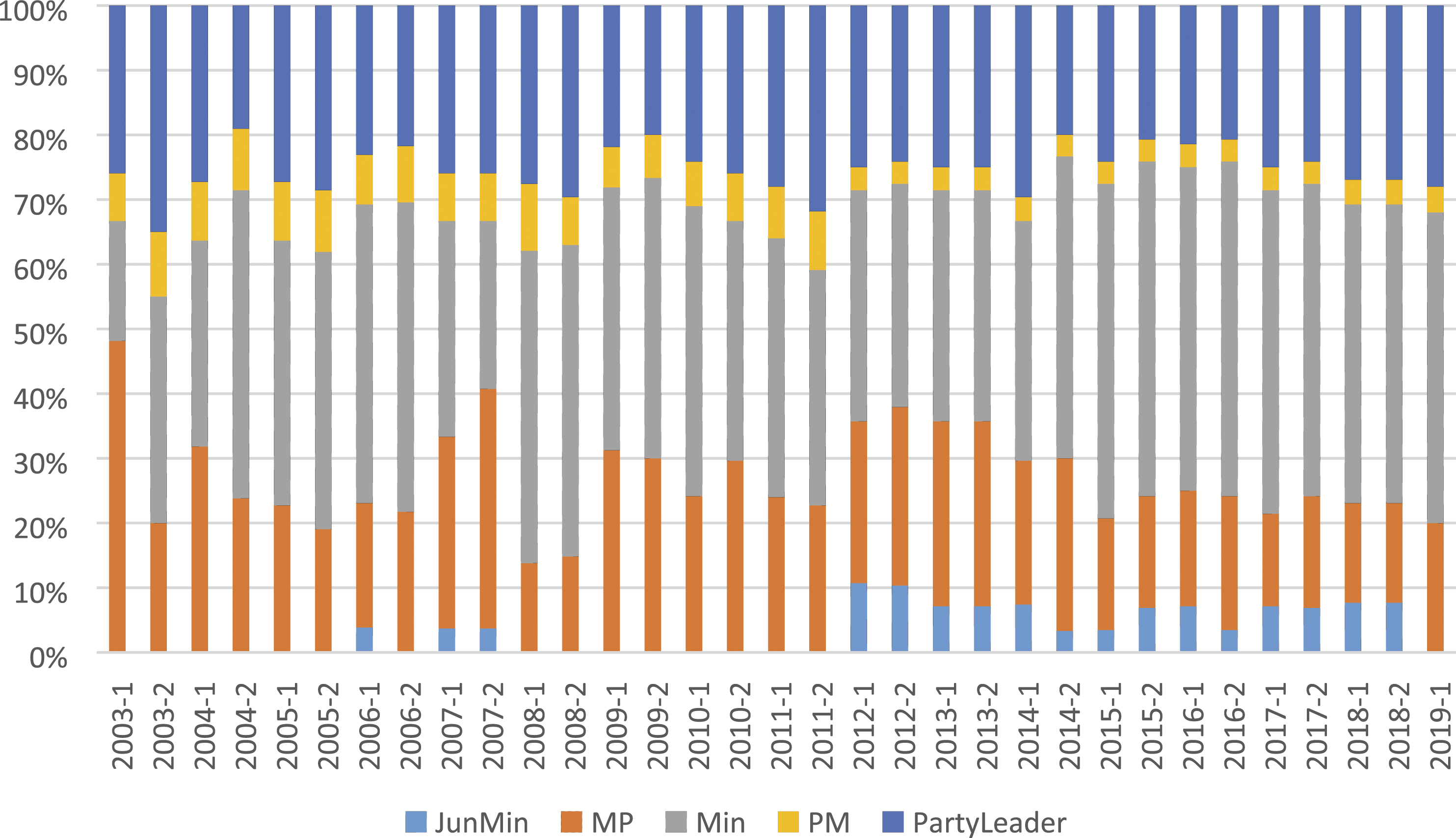
It is, however, striking that over 17 years (and in more than 30 popularity polls), only 92 unique politicians appear. Most of these 92 politicians were included in multiple popularity polls which is not really surprising seeing that most politicians stay active for quite some years. Although small changes occur in the composition of the popularity polls, throughout one legislature it are often the same politicians that are featured. Figure 2 gives an insight in the proportion of politicians also in the prior popularity poll (consecutive), the proportion of completely new politicians, and the proportion of politicians recurring in the popularity poll after having been absent in the prior half year. Here we see that the proportion of new politicians is very limited. Especially in the later years almost no new politicians are added to the top 30. There is also no noticeable effect of an influx of new politicians in the period after elections (May 2003, June 2004, June 2007, June 2009, June 2010, May 2014 and May 2019). When we take a more detailed look we find that the new politicians are mainly ministers (see supplementary file, Figure A1). Proportion of new, consecutive and recurring politicians in popularity polls (2003–2019).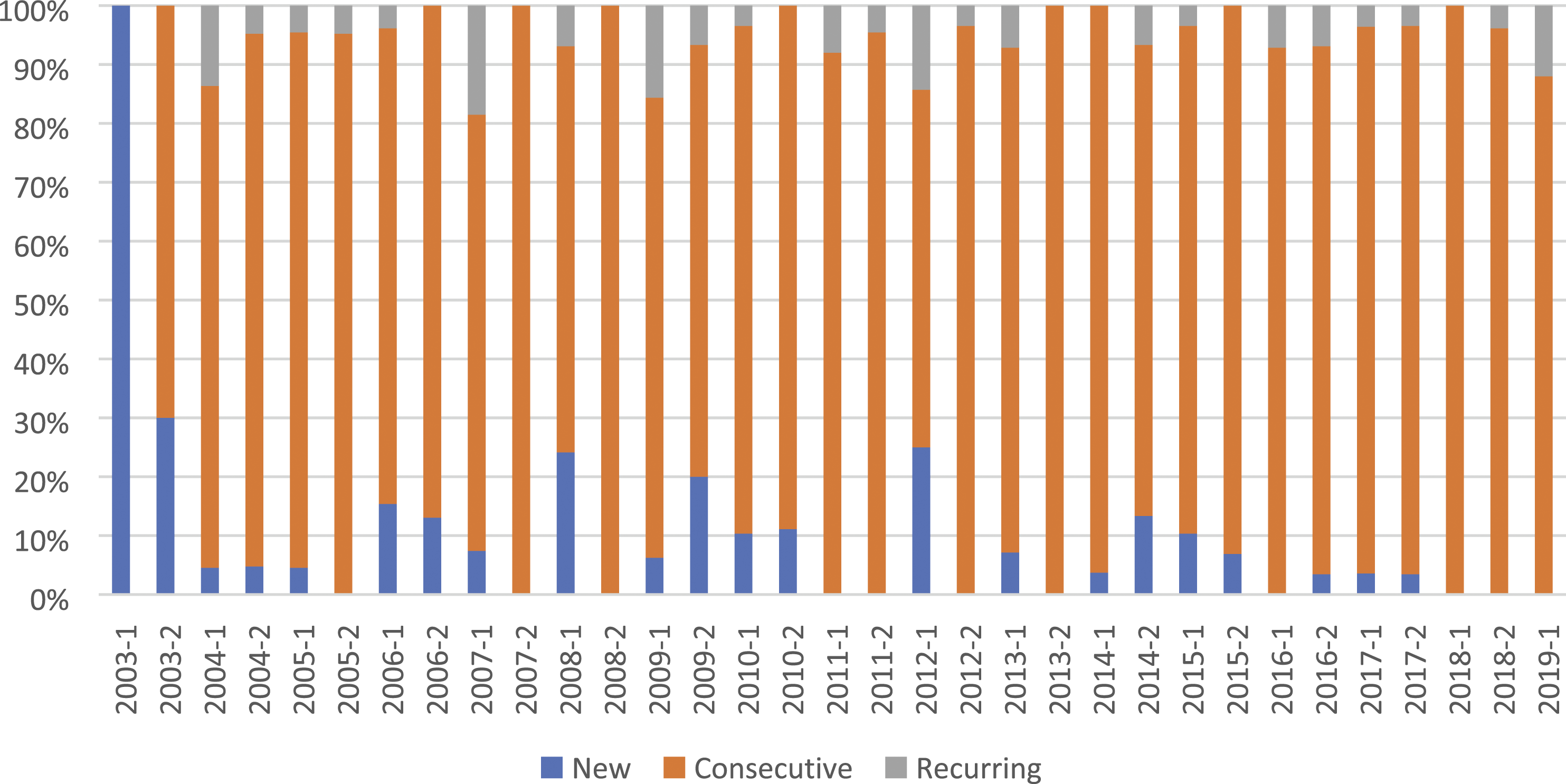
Automated content analysis
One of the challenges of automatically analyzing tone related to actors is that there are often multiple politicians mentioned within one sentence or article. Identifying the source, target or topic of the tone is currently infeasible with automated tone analysis systems. We therefore decided to work with a proximity-based method. The tone of the news articles was calculated by first manually coding the overall tone of a set of sentences as positive, neutral or negative. An intensive training was held prior to the actual coding and when an acceptable reliability was reached (Krippendorff’s alpha >= 0.9), a set of 2000 sentences was manually coded. Next, a tone dictionary was built using a word embedding model and a seed dictionary (the seed dictionary proposed by Rheault et al. (2016) was largely replicated). The final tone dictionary is constructed by comparing the words of the corpus with the seed words based on their co-occurrence with other words. The summed cosine similarity of a corpus word with all seed words indicates its relative proximity to the group of positive/negative seed words. The words with the highest scores, positive or negative, are included in the final dictionary. As such, the tone dictionary is specific to the context of the corpus. Finally, this dictionary is further optimized by leveraging information from the manually coded sentences. Sentence-level tone is then calculated by adding the scores of the words in the sentence that are included in the tone dictionary and dividing it by the total number of words in the sentence. Then, actor-level tone is computed per politician occurring in an article, which entails the average tone of all sentences linked to the respective politician. For this paper, the average tone for every politician is calculated for each month by computing the mean actor tone of all articles in each respective month. In our model, this tone score is averaged over 6 months. Tone scores vary between -1 and 1. A score of 0 means that the tone is neutral, -1 indicates a very negative tone and 1 indicates a very positive tone.
The performance of the automated tone analysis system was evaluated on the manually coded training set, using 5-fold cross-validation, and reached acceptable levels. Hereto, tone scores were discretized into ordinal (-1 for negative, 0 for neutral and 1 for positive) scores. The balanced accuracy is 0.64, precision is 0.63, recall is 0.65 and F1 is 0.64.
Model
Our dataset has a pooled time series structure, with semesters (popularity polls) (t) nested in individual politicians (N). Specification of this type of models is not self-evident, as issues such as autocorrelation and heterogeneity can hamper correct estimations (Wilson and Butler 2007). To account for these issues, we estimate our main effects model using three alternative specifications: (1) fixed effects with a lagged dependent variable; (2) fixed effects without a lagged dependent variable; (3) random effects with a lagged dependent variable.
The lagged dependent variable accounts for autocorrelation, while fixed effects remove inter-politician variation and yield models that focus on temporal variation. As the use of both fixed effects and a lagged dependent variable in a single equation can yield inefficient estimations (Baltagi, 2008), in particular with a small number of t observations, we report our model with and without the lagged dependent variable. As fixed effects models do not allow to assess inter-individual variation in media effects, we report random effects models that control for politicians’ background characteristics and allow to assess the differential impact of media across different groups of politicians. Additionally, as an additional robustness check, we conduct separate fixed effects models with a lagged dependent variable for each type of politician. For the analyses that focus on the popularity of politicians, we additionally consider the interaction between visibility and tone – it might be that these two reinforce each other, though previous research provides mixed evidence in this regard - Hopmann et al. (2010) do not find such an effect on vote choice, while Van Remoortere et al. (2023) do. Furthermore, we control for age and gender.
As politicians are also part of political parties, we run the main analyses also as three level multilevel models with polls being nested in politicians that on their turn nested in parties as an additional robustness check.
Results
Thus, to study the influence of media visibility and tone on the popularity of politicians, we look at popularity polls in two steps. First, we assess how important visibility and tone of news coverage in the 6 months before the poll are to be included in the popularity poll. Next, we study how media visibility and tone influence the actual popularity score of politicians.
Explaining inclusion in popularity poll.
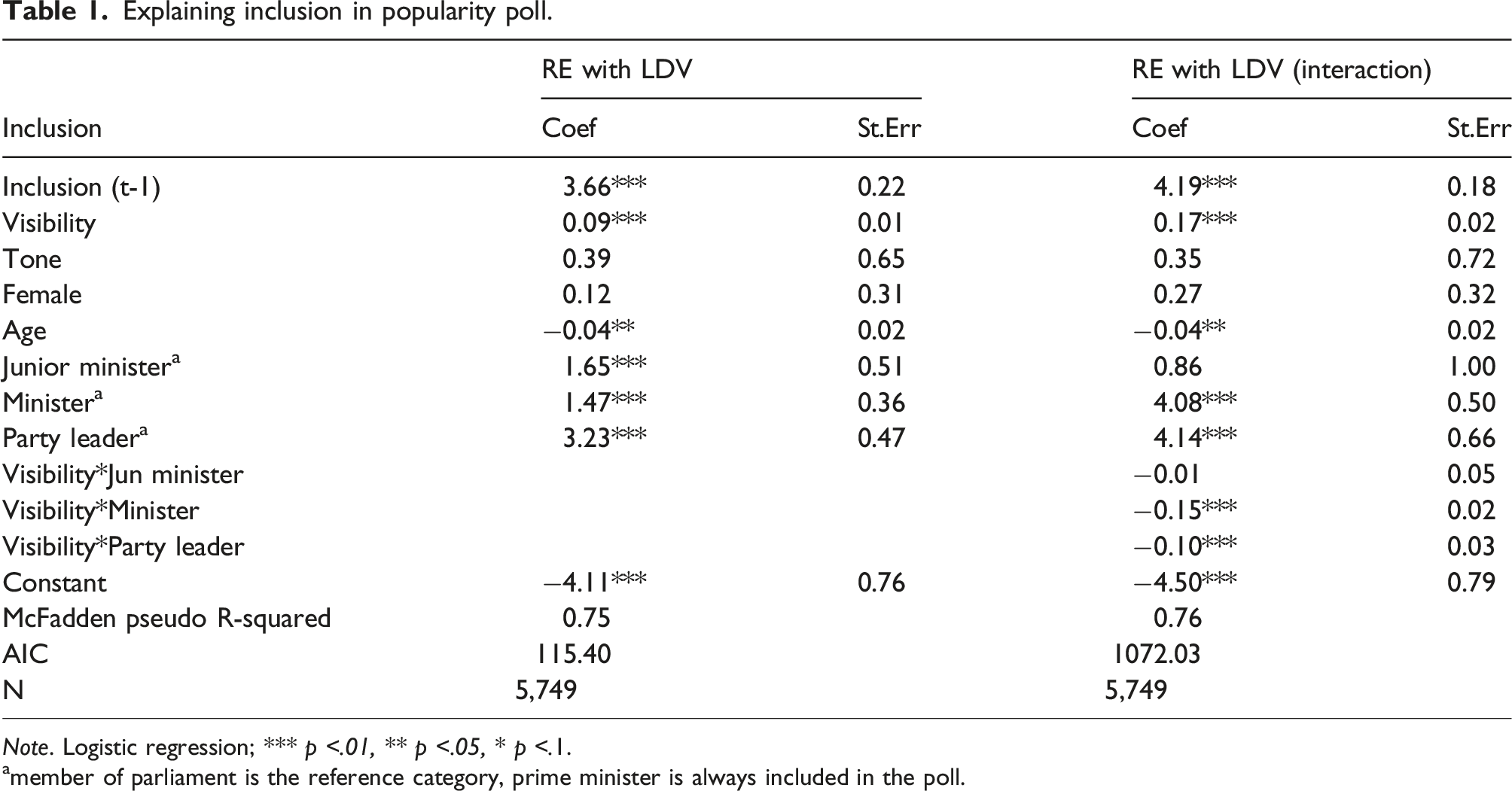
Note. Logistic regression; *** p <.01, ** p <.05, * p <.1.
amember of parliament is the reference category, prime minister is always included in the poll.
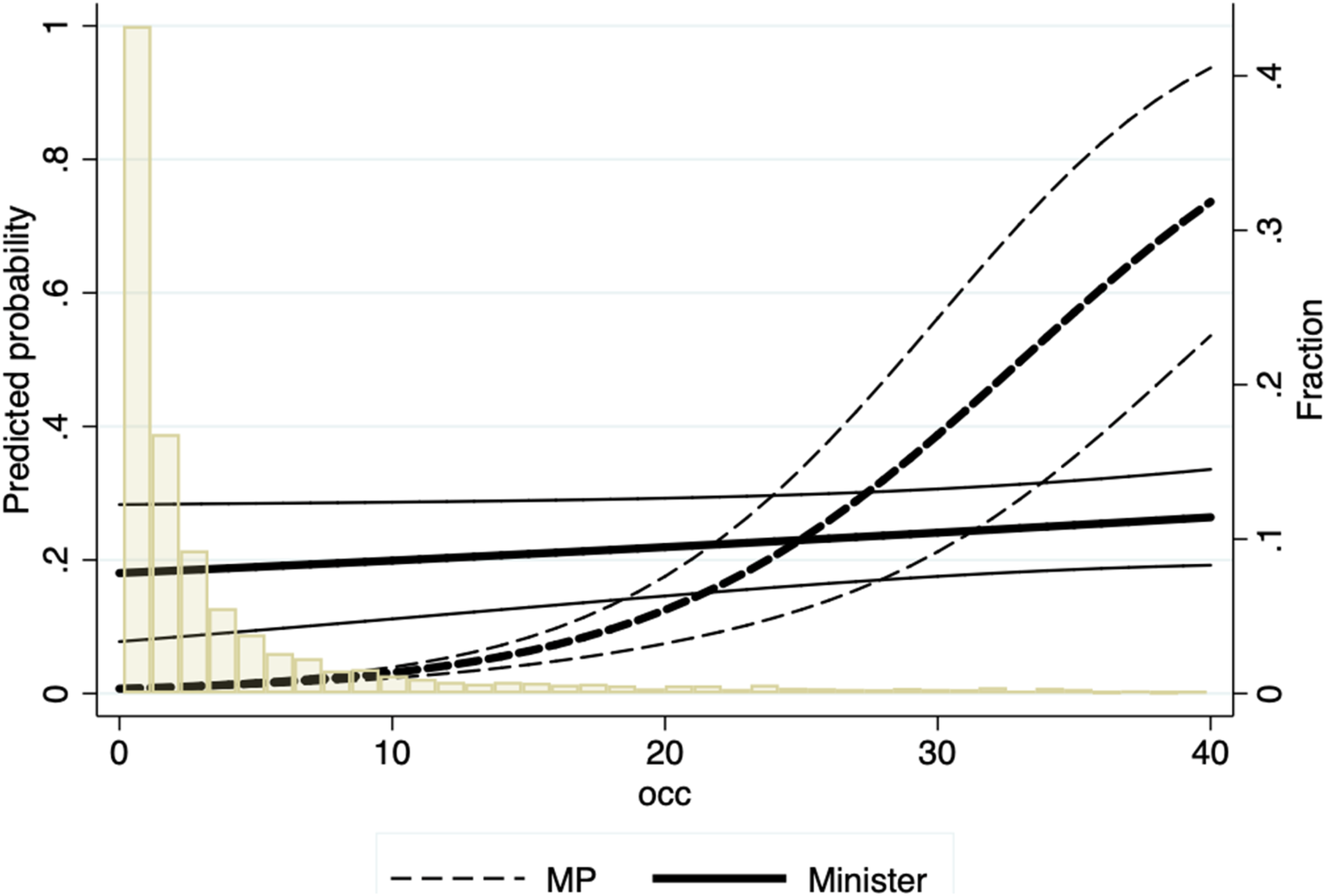
Differential impact of media visibility on predicted probability to be included in popularity poll. Note. Predicted probability of inclusion with distribution. Other variables on their means and 95% confidence intervals.
Explaining popularity in popularity poll.
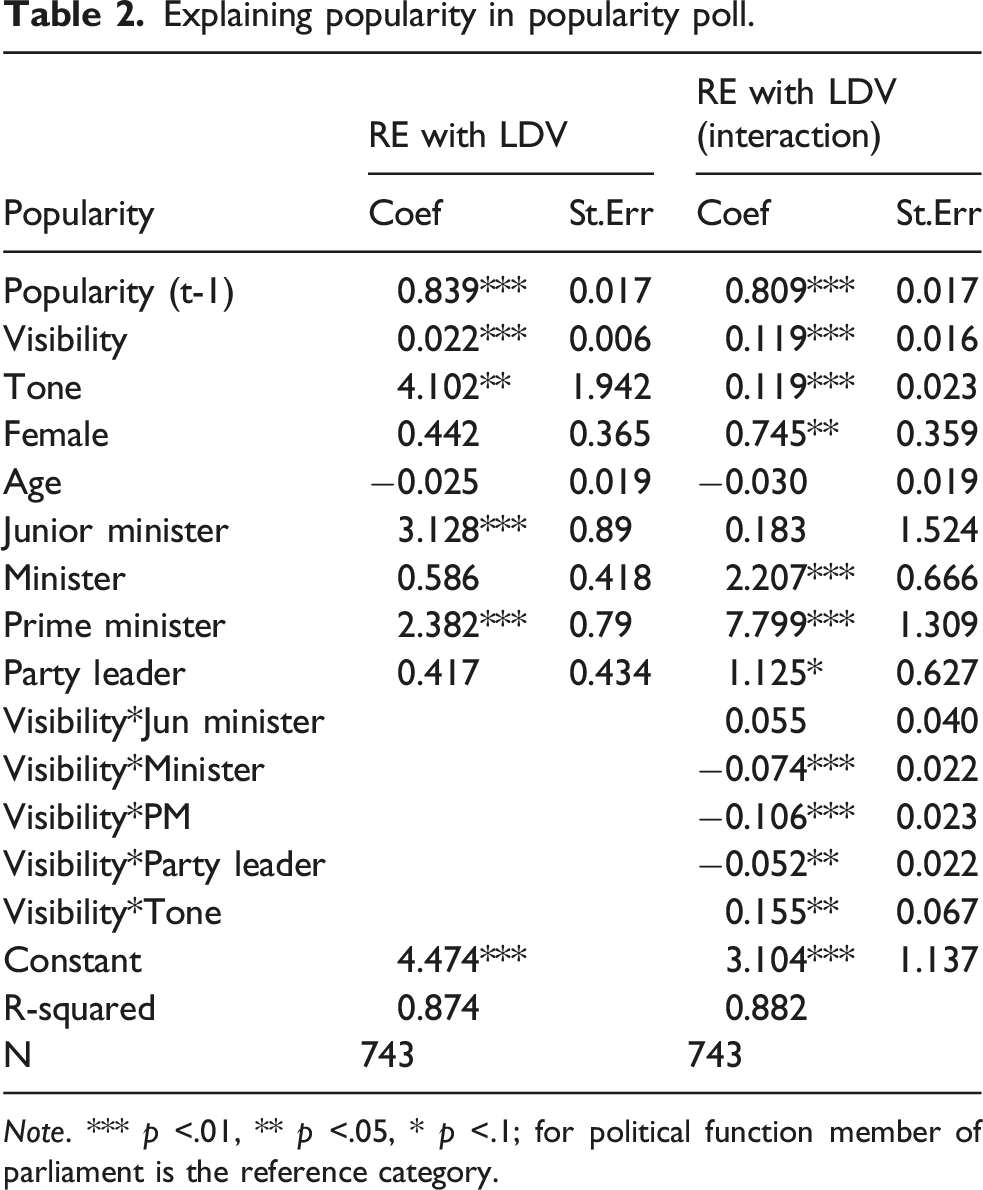
Note. *** p <.01, ** p <.05, * p <.1; for political function member of parliament is the reference category.
Furthermore, we assess to what degree visibility effects depend on the position of the politician. Again, and in line with hypothesis 2, we see that effects are in particular prevalent for regular MPs, that need media visibility to gain a favorable public attitude. Ministers and party leaders, very prominent political positions, profit less from media attention, probably because they are already well-known and people have more stable attitudes towards them. These findings are also confirmed by the fixed effects analysis per function (see Table B4 in the supplementary file). Figure 4 plots the difference in media visibility for MPs and ministers. To score high in a popularity poll, visibility again matters clearly more for MPs than for ministers – who have lower popularity levels but profit from increasing media visibility. Differential impact of media visibility on popularity. Note. Predicted popularity and distribution. Other variables on their means and 95% confidence intervals.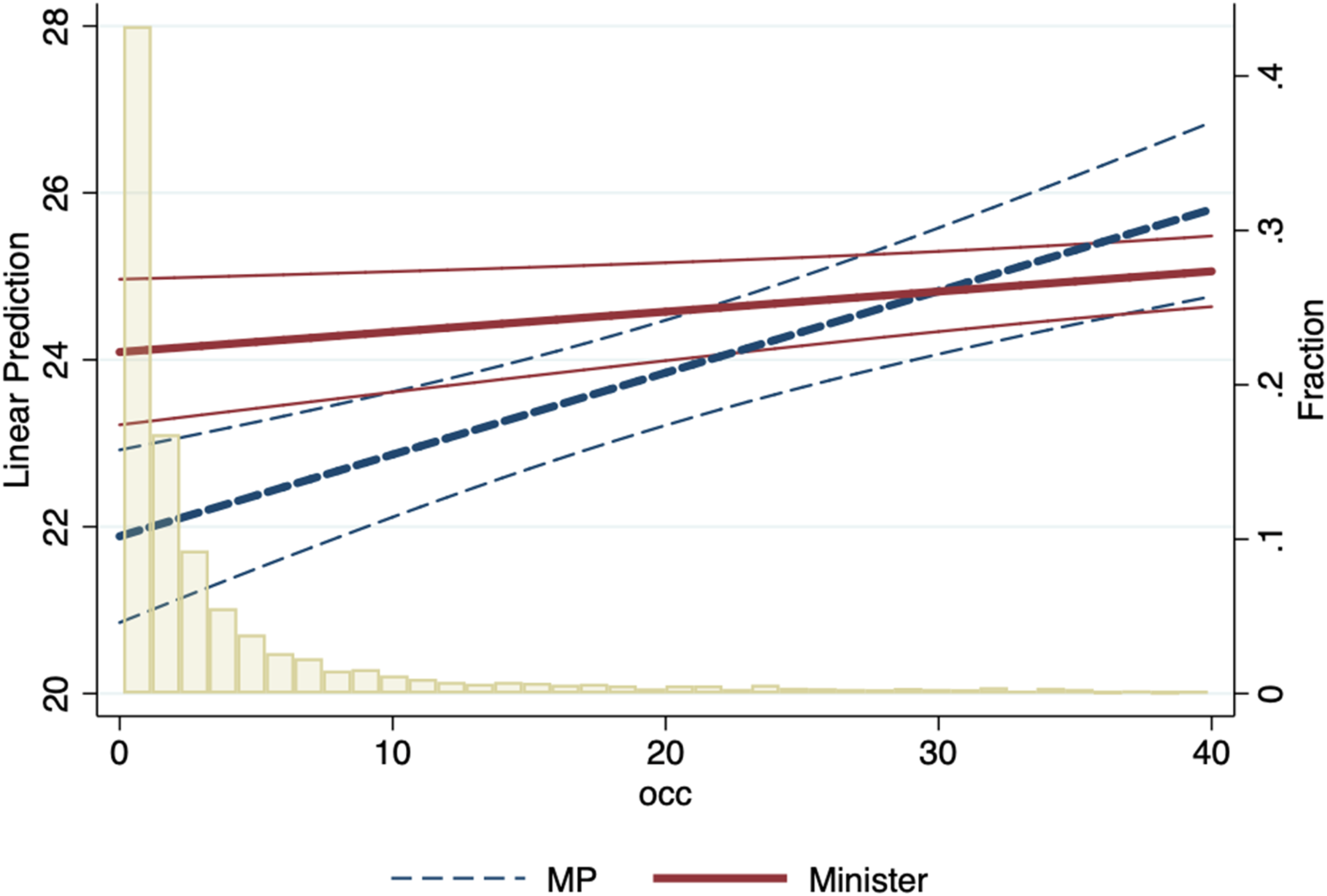
Finally, we find that visibility and tone indeed reinforce each other – thus, the impact of visibility is larger when the tone is more positive. More specifically, we see that the lowest values of negativity present in our dataset (−0.45) the impact of visibility is negligible, while becoming increasingly positive when the tone becomes more positive.
Table C1 and C2 present the results from multilevel models that serve as an additional robustness check. We find that results are comparable to those from the pooled time-series models. This confirms the robustness of our findings.
Conclusion and discussion
Previous research found that media visibility significantly influences the electoral success of politicians. Due to a lack of face-to-face interactions voters have relatively little access to information about politicians. Therefore, they base their vote mainly on what they see in the media. This study builds on this previous research but looks at political success in a broader way by studying how popularity of politicians is influenced by appearing in the media and the tone in this media coverage. Using a longitudinal approach (2003–2019), across routine and election periods, we measure political success by studying public opinion polls, and more specifically popularity polls of individual politicians. In Belgium these popularity polls receive a great deal of media attention and being polled as popular might thus affect political success. Not all politicians are, however, included in the popularity polls, only 30 politicians are ‘short-listed’. As a first step, we studied how media visibility and tone impacts being included in the poll. Next, we focus on our main research question: how are popularity scores affected by media coverage (visibility and tone)?
We find that media visibility has a positive impact on getting into popularity polls. No significant effect was found for negative or positive tone, but we did find that the type of political function has an effect on being included in popularity polls. Ministers and party leaders have a much higher chance of being included compared to lower ranking politicians, but media visibility does not really play a role here. Having a higher political function is generally sufficient to be included in the polls. Media visibility thus especially matters for MPs. We, however, find that MPs need to be, on average, featured in the news more than 20 times per month, because from that point on the possibility of being included increases rapidly. An average MP thus needs to be quite visible to be considered for inclusion in a popularity poll. For the actual popularity score we also find a positive impact of media visibility. Again, having a higher function (party leader/minister) affects the popularity score. We also find a significant effect for tone on popularity scores but only for negativity. This indicates a negativity bias in which negative news impacts the popularity of politicians, whereas positive news does not make a difference. Again, we find that media visibility especially influences the popularity score of lower ranking politicians. Ministers and party leaders, very prominent political positions, profit less from media attention, probably because they are already well-known and people have more stable attitudes towards them. We also find that effects of attention become stronger if the tone of coverage is more positive.
Overall, media visibility can thus have an impact on popularity, both for being included as for the actual popularity score. This media effect is specifically important for MPs seeing that the function of higher ranking politicians (ministers/party leaders) already affects their popularity without media visibility. The media visibility of lower ranking politicians needs to be, in addition, rather high to experience an impact of visibility. This finding exposes a paradoxical situation in which MPs need media attention in order to become popular but are the ones that receive very little attention. Our data showed that MPs appear on average only 3 times a month in the media which is 10 times less than for example party leaders or ministers. How can MPs break this vicious circle of having little power and as a result low media attention? Should they, under the guise of any kind of attention is good attention, try to get into the media by stirring up controversy? Our findings considering the tone of news coverage, but also the interaction between visibility and tone, indicate that this is not the solution. Generating negative attention in order to gain more visibility might not be a good idea given that we find a negativity bias. Positive news coverage does not affect popularity, while negative news coverage significantly harms popularity. Due to the longitudinal quantitative nature of this study, we were not able to go into detail about when and why certain MPs did get included in the popularity polls. Based on descriptive statistics about the composition of the popularity polls (Figure A1) it became clear that there is no clear influx of new MPs in the popularity polls after elections, which might point to the fact that selection is more issue-based. Further research can build on the findings of our study and focus further on when and why MPs can break the ‘low power/low media attention-cycle’.
We believe that this study is an important step in broadening the understanding of how media attention (both visibility and tone) impact the popularity of politicians. Previous research focused mainly on elections and the longitudinal design of this research confirms partly what we knew from previous research while also giving new insight. Our research design measures real life outcomes of political power on news coverage and compares Flemish MPs with ministers. Further research is however needed to elaborate on our findings and gain insight in the generalizability of the results to other contexts. Our study is however not without its limitations. First, this paper attempts to study a very complex process and popularity is influenced by multiple variables, including more detailed media content features. The choice to focus solely on visibility and tone means that we ignore other very important media variables that have proven to play a role in how media influences political success. Future research can combine the findings of our research with more data on for example news on issue positions of parties and specific types of news, such as on successes and failures, or support and criticism (Kleinnijenhuis et al., 2019). Additionally, we were not able to include all possible control variables. Other criteria like seniority and experience might influence the popularity of a politician but our study does not cover this. One way to further explore the direct effect of news coverage on the popularity of a politician is conducting an experiment in which citizens are directly exposed to (negative/neutral/positive) news coverage about individual politicians. This way a more direct effect of visibility and tone could be established. Another limitation is that we only look at media occurrence in newspapers and do not consider television news or social media. This methodological choice was made because television coverage is more narrowly focused on top candidates, which makes television news less suitable. Adding television news would, in our opinion, not significantly change our results. The politicians that appear more often in newspapers are also more likely to appear in television news. Nevertheless, a future study should include television news considering that it is often seen as the main driving force behind mediatization and personalization of politics.
Using an automated content analysis has different advantages but naturally also some drawbacks. Automated methods have often been used to measure visibility and together with the many precautions we took and the data pre-processing we performed, we are confident that this measure is accurate and reliable. Measuring tone has proven to be more challenging. Positivity or negativity are more subjective than visibility and previous research has often struggled with this. Our method is not perfect but samples were manually coded after an extensive training stage in which a very high intercoder reliability was reached. Moreover, the performance of the tone classification model was rather high compared to previous studies that used automated tone coding. It is however a limitation that we are not able to measure tone directly related to politicians but only in proximity to them. Future research should take extra measures to (partly) solve this problem (see Fogel-Dror et al. (2019) for possible solutions).
Although the studied case is quite particular in the sense that popularity polls work with a shortlist of 30 politicians, we do believe that our findings have a generic quality. Media visibility can be expected to positively influence the popularity of individual politicians in other contexts. Research on election coverage also found an effect for visibility in different countries, so we have no reason to believe that our findings would not hold in other countries with a similar political and media system. This might however not be true for countries with a complete different type of political system. Here, the mechanism might work differently. In very polarized systems like the U.S., the influence of media coverage on political success can be expected to work in different ways. In Belgium the media system is not very partisan and most media outlets are quite nuanced in their political coverage. In systems with a polarized media system, the effect of media visibility and the used tone that we find in this study might not be present there. Our results clearly beg for more research. Further studies should include more countries and a wider selection of media, to test the generalization of our findings.
The role of social media on the popularity of politicians is another interesting avenue for future research. Due to the longitudinal nature of our study, we decided to not take social media into account. In the beginning of our studied period social media was not yet of importance and from a practical point of view it would have been difficult to gather longitudinal social media data. We however firmly believe that follow-up research should take social media into account. It could be expected that a big following or much activity on social media also impact the chance of being included in popularity polls. Popularity on social media might be one of the avenues MPs can use to break the ‘low power/low media attention-cycle’. Traditional media do not stand alone. They influence but are also influenced by social media. Things that happen on social media create attention in traditional media outlets and politicians that become visible in traditional media will also feel this effect on their social media. The interplay between the two has become very important in the last 10 years, so further research on the role of media on politicians' popularity should start from this interaction. Traditional media does not operate in a vacuum and we think it would be a very interesting research avenue to study at how social media supports or nuances the results from this study.
Supplemental Material
Supplemental Material - The influence of mass media on the popularity of politicians
Supplemental Material for The influence of mass media on the popularity of politicians by Annelien Van Remoortere and Rens Vliegenthart in Party Politics.
Footnotes
Acknowledgements
This research did not receive any specific grant from funding agencies in the public, commercial, or not-for-profit sectors.
Declaration of conflicting interests
The author(s) declared no potential conflicts of interest with respect to the research, authorship, and/or publication of this article.
Funding
The author(s) received no financial support for the research, authorship, and/or publication of this article.

Supplemental Material
Supplemental material for this article is available online.
Note
Author biographies
References
Supplementary Material
Please find the following supplemental material available below.
For Open Access articles published under a Creative Commons License, all supplemental material carries the same license as the article it is associated with.
For non-Open Access articles published, all supplemental material carries a non-exclusive license, and permission requests for re-use of supplemental material or any part of supplemental material shall be sent directly to the copyright owner as specified in the copyright notice associated with the article.
