



Abstract
In this article, I argue that voters not only rely on characteristics of candidates, such as age and gender, but also on procedural cues to evaluate candidates, particularly on how candidates were selected. I argue that selection via primaries, which has become popular in Western Europe, is an important cue to voters. Drawing on procedural fairness theory, I develop contradicting arguments about how primaries affect voters’ evaluations of candidate quality, such that either the logic of procedural fairness improves voters’ evaluations of candidates’ quality, or the violation thereof through clientelism and vote-buying leads to worse evaluations of candidates. I employ a conjoint experiment, implemented in Spain, and analyze responses to an open-ended question to investigate underlying mechanisms. The findings indicate that voters perceive candidates resulting out of primaries as outsiders, who are less corrupt but also less experienced and less competent.
Introduction
A large body of research has investigated on what cues voters rely on when they evaluate candidates and make their voting decision, identifying i.a., partisanship, gender, age, race and ideological position as key heuristics that voters employ (Doherty et al. 2019; Enelow and Hinich, 1982; Huddy and Terkildsen, 1993; Kirkland and Coppock, 2018; Ono and Burden, 2019). Most of these heuristics are based on characteristics of candidates that are easily observable for voters. In this article, I argue that voters do not only rely on the characteristics of candidates but also on the process through which they were selected. Namely, I argue that voters employ whether a candidate was selected via primaries or not as a heuristic to make judgements about the quality of candidates.
Primaries, the selection of candidates by all voters or members of a party, have become increasingly popular in Western Europe in the past two decades, especially on the subnational level (Astudillo and Detterbeck, 2020; Debus and Navarrete, 2018; Sandri and Seddone, 2015). Research investigating the effect of variation in candidate selection has largely focused on how these changes affect parties, such as the competitiveness of intraparty contests (Kenig 2009), ideological coherence (Debus and Navarrete, 2018; Faas, 2003), representativeness (Cordero et al., 2016; Sandri and Venturino, 2016), as well as their electoral performance (Astudillo and Lago, 2021; Carey and Polga-Hecimovich, 2006; Ramiro, 2016). However, little is known about how voters react to changes in selection procedures. While recent literature has started to look at outcomes beyond the party, such as trust in parties (Wauters and Kern, 2021), citizens’ satisfaction with democracy (Shomer et al., 2016), and institutional corruption perceptions (Charron and Schwenk, 2022), it remains unclear whether voters evaluate candidates differently based on how they were selected.
Evaluations of candidates’ quality matter for turnout (Lo Prete and Revelli, 2017), and voters’ ability to deselect candidates that are involved in misconduct such as corruption (Agerberg, 2019). High corruption perceptions in turn, affect life satisfaction (Helliwell and Huang, 2006), trust in institutions (Morris and Klesner, 2010) and the likelihood to engage in solving collective action problems (Persson et al., 2013), motivating the investigation of the effects of candidate selection on quality evaluations.
In this article, I take a first step at investigating how voters evaluate candidates resulting out of primaries by developing theoretical arguments about how primaries affect the evaluation of quality based on procedural fairness theory. On the one hand, I argue that the logic of procedural fairness in primaries in which different candidates compete in an open and transparent process, should lead to voters believing the process to be fairer and the candidates to be of higher quality. On the other hand, I argue that primaries could violate the idea of a fair process, if voters perceive primaries to be dominated by leaders and rigged by vote-buying (Ascencio, 2021; Scherlis, 2008).
I test these arguments in a conjoint experiment implemented in Spain. Given the variation across and within parties in candidate selection method on the regional level (Charron and Schwenk, 2022; Debus and Navarrete, 2018), and the high participation rates in primaries, it is likely that voters have formed opinions about candidate selection methods.
The findings suggest that voters do change their evaluations of the quality of candidates based on their selection, such that voters consider candidates resulting out of primaries as less corrupt, competent and experienced, supporting neither theoretical argument conclusively. To resolve this puzzling finding, responses to an open-ended question on why respondents would prefer their party to hold primaries are analyzed. The results indicate that respondents believe primaries to result more often in outsider candidates, which are less likely to have the experience and competence of political insiders, while not being embedded in potentially corrupt networks, explaining the contradictory findings. Further, respondents highlight the process of primaries to follow the logic of procedural fairness.
This study contributes to several fields. By building up theoretical arguments about voters’ evaluation of candidates’ quality based on primaries, it adds a procedural dimension to characteristics that have been found to affect evaluations of candidates. Second, this article contributes to the literature on the effect of candidate selection by studying an outcome that lies beyond the party itself, as opposed to previous research on e.g., competitiveness and representativeness of parties in the wake of primaries. Third, by avoiding conflating the effect of candidate selection with partisanship, this study contributes to the understanding of voters’ preferences in the absence of partisanship cues (Kirkland and Coppock, 2018).
This paper starts out by reviewing existing literature on factors that drive evaluations of candidates, before arguing that primaries are an additional heuristic that help voters evaluate politicians. I then present the conjoint experiment and analyze its results before turning to an investigation of the open-ended question.
Literature review
It is widely acknowledged that voters tend to know little about political candidates and their policy positions (Converse, 1964; Delli Carpini and Keeter, 1996; Popkin, 1994). To make inferences about politicians, voters instead rely on a number of shortcuts and heuristics to make decisions, such as partisanship, gender, race 1 , and experience (Kirkland and Coppock, 2018).
Partisanship has largely been identified as the main factor driving voters’ evaluation of candidates (Bauer, 2018; Gooch et al., 2021; Kirkland and Coppock, 2018; Rahn, 1993), Research suggests that partisanship acts as an “insurance” for voters, such that even if a candidate’s socio-demographic profile does not correspond to the respondents’ preference, a respondent will vote for a co-partisan over a candidate from another party. Research on corruption voting shows that partisanship leads voters to vote for a corrupt candidate and to dismiss accounts of corruption, although voters generally prefer honest candidates (Agerberg, 2019; Curini, 2018; Pavão, 2018), an effect that increases with the strength of partisanship (Klašnja, 2017).
While partisanship is the easiest to obtain cue and the one that voters most rely on, other characteristics of candidates are also shown to affect evaluations of and preferences for candidates, especially in non-partisan races. Gender is an easy-to-obtain cue for voters, identifiable based on names, pronouns, or images. Research shows that voters and elites rely on gender to evaluate candidates (Ono and Burden, 2019; Sanbonmatsu, 2002), and that voters’ evaluations of political experience and education are gendered (Franceschet and Piscopo, 2014; Teele et al., 2018; Verge and Claveria, 2018). Gender also affects how voters stereotype politicians, such that women get stereotyped as more honest and trustworthy (Barnes and Beaulieu, 2019; Huddy and Terkildsen, 1993; Thomas and Petrow, 2021).
Regarding harder to obtain cues, voters value candidates’ political and professional experience (Doherty et al., 2019; Kirkland and Coppock, 2018; Ono and Burden, 2019), as political and professional experience signals that politicians are “fit for the job” (Lim and Snyder, 2015; Schaffner et al., 2001). While voters often conflate political experience with gender, such that women are perceived as less competent (Franceschet and Piscopo, 2014; Teele et al., 2018), clear independent effects of political experience are reported (Doherty et al., 2019; Rehmert, 2020).
Thus, previous research shows that several characteristics matters to voters in evaluating candidates. Hereafter, I argue that voters also rely on institutional cues, namely the process through which a candidate was selected, to evaluate candidates’ quality. Primaries, as a more inclusive form of candidate selection, have become increasingly popular in Western European democracies, allowing party members or party supporters to have a say in the selection of candidates and potentially affecting evaluations of candidates.
While research investigated the electoral benefits of primaries, results are mixed on whether primaries lead to higher vote-shares in elections. While Carey and Polga-Hecimovich (2006) and Ramiro (2016) find that primaries result in higher vote-shares in Latin America and Spain respectively, Pedersen and Schumacher (2015) do not find such an effect in a panel-study of 111 parties. Other studies have argued for a “contingency-approach”, such that the openness of primaries (Kaufmann et al., 2003), their competitiveness (Lengle et al., 1995), participation rates (De Luca and Venturino, 2017), and timing (Ramiro, 2016) moderate the effect of primaries on electoral results. Adding to this contingency approach, Astudillo and Lago (2021) argued that primaries are not electorally rewarded, but rather that voters punish the absence of primaries if another party uses them.
While this research has produced interesting results, the focus on party-level electoral results allows only limited conclusions about individual-level motivations and evaluations of primaries, and neglects that vote-choice is unlikely to be determined by candidate selection methods. Voters might vote for a party based on their party ideology even if they preferred an alternative selection mechanism, conflating the effect of primaries on electoral benefits.
Literature aimed more directly at primaries’ effect on voters’ preferences is sparse, with little research conducted outside the U.S. context (Astudillo and Lago, 2021). Previous research investigated citizens’ satisfaction with democracy (Shomer et al., 2016) and trust in parties (Wauters and Kern, 2021), as well as voters’ institutional corruption perceptions (Charron and Schwenk, 2022). However, little is known about how voters’ evaluation of candidates is affected by selection.
Theory
A politician being selected via primaries, defined here as the selection of a candidate by all party members, should be an easy-to-obtain cue for voters. The competition and campaigning in primaries and the media coverage that goes along with it should allow voters to learn if a politician competed in a primary 2 . Second, if politicians have reason to believe that voters prefer politicians that were selected via primaries, they will refer to winning such a contest. If, however, primaries are perceived by politicians to be harmful, opponents have a reason to highlight them in political campaigns. While the discussion of whether primaries are beneficial or harmful for politicians will follow, this elucidates that voters should know about primaries and that primaries are a heuristic that voters can easily employ.
Similar to Wauters and Kern (2021), the theoretical argument builds on procedural fairness theory, assuming that citizens evaluate the outcomes of political decision-making processes based on how they perceive the process that led to it (Grimes, 2006; Tyler, 1990, 2003).
If voters believe a process of decision-making (here, the selection of the candidate) to be fair, they will find the outcome (in this case the candidate) more acceptable, and less acceptable if they believe the decision-making process to be unfair. Procedural fairness theory also highlights the importance of participation in the decision-making process, such that more opportunities to participate result in higher levels of acceptance and trust (Grimes, 2006; Pateman, 1970).
Applying these arguments to primaries and evaluations of candidates, it becomes apparent that primaries should fulfill the idea of procedural fairness. Primaries offer voters opportunities to participate in the decision-making process that results in the nomination of candidates. To illustrate, in Spain almost all parties allow their party members to participate in primaries 3 . Thus, hurdles to participate in a primary and decision-making are low. Further, given the (assumed) transparency and clear decision-making process through the “one-member-one-vote” logic that parties employ, the idea of a fair process should also be fulfilled. Primaries are also commonly argued to signal a party’s willingness to commit to transparency and honesty, and voters and party members have been cited to reward the transparency of selection processes as opposed to the traditional “smoke-filled backroom” selection by elites (Carey and Polga-Hecimovich, 2006; Ramiro, 2016; Young and Cross, 2002), underpinning the preference for fair and transparent procedures.
Finally, primaries have also been argued to result in objectively higher quality candidates, as primaries act as a character “pre-test” through intensive screening of candidates (Adams and Merrill, 2013) and increase information available about candidates to voters, which would lead to unsuited candidates being exposed and deselected (Serra, 2011).
Thus, either through perceptions of procedural fairness or objective increases in candidate quality, voters may perceive candidates that result out of primaries to be of higher quality:
H1a: Primaries have a positive effect on the evaluation of politicians’ quality.
That being said, research on primaries did not only argue for the transparency and fairness of the primary process. Primaries outside the U.S. context have been cited to be dominated by party elites, with leaders establishing control over primaries by restricting competition (Hassell, 2016; Hazan and Rahaṭ, 2010), offsetting the potential positive effect of information gain of primaries. Open domination by the leadership of what should be a fair and democratic process also negates the idea of procedural fairness and the “one-member-one-vote” logic. Primaries outside the USA have also been argued to be rigged by vote-buying and mass-registration of primary voters (Ascencio, 2021; Carty and Cross, 2006; Scherlis, 2008), as parties lack resources and incentives to control the election process and prevent electoral violence in primary elections (Kenig and Pruysers, 2018). This has led to arguments that primaries reduce voters’ trust in institutions (Rosenbluth and Shapiro, 2018) and lead to higher corruption perceptions among party supporters (Charron and Schwenk, 2022). Such misconduct violates the idea of procedural fairness in primaries, or rather, inverses the effect of it: If voters perceive the process of primaries to be unfair and illegitimate, this could result in voters perceiving candidates as of lower quality. Additionally, voters could reasonably assume that any candidate resulting out of primaries had engaged in illicit means to win the nomination, which should also negatively affect their candidate assessment. Overall, this results in a second, competing hypothesis:
H1b: Primaries have a negative effect on the evaluation of politicians’ quality.
While it is possible that candidate selection also moderates the effects of other characteristics of candidates, such as e.g., the effect of gender or experience, the aim here is to investigate whether voters employ candidate selection as a heuristic in itself, rather than as a moderating factor for other cues.
The case of Spain
Spain is an ideal case to investigate these hypotheses, as primaries are widespread in subnational elections in Spain. While primaries were first introduced in the early 2000s by the Spanish Socialist Workers’ Party (PSOE) after a series of electoral defeats (Astudillo and Lago, 2021), primaries became more frequently used after the foundation of the leftwing-party Podemos in 2014, which highlighted intraparty democracy as a key pillar of its party identity (Cordero et al., 2016; Debus and Navarrete, 2018) (c.f. Figure 1). While primaries have become more common, there is still considerable variation across parties and regions in the implementation of primaries (c.f. Figure 2 in the Appendix). This interesting variation and the fact that nearly all parties used primaries in the past decade (except for the radical-right party VOX that never used primaries to select a regional candidate) also makes it likely that voters have formed opinions about the use of primaries, especially on the subnational level. Frequency of primaries between 2010 and 2021 in Spanish regions.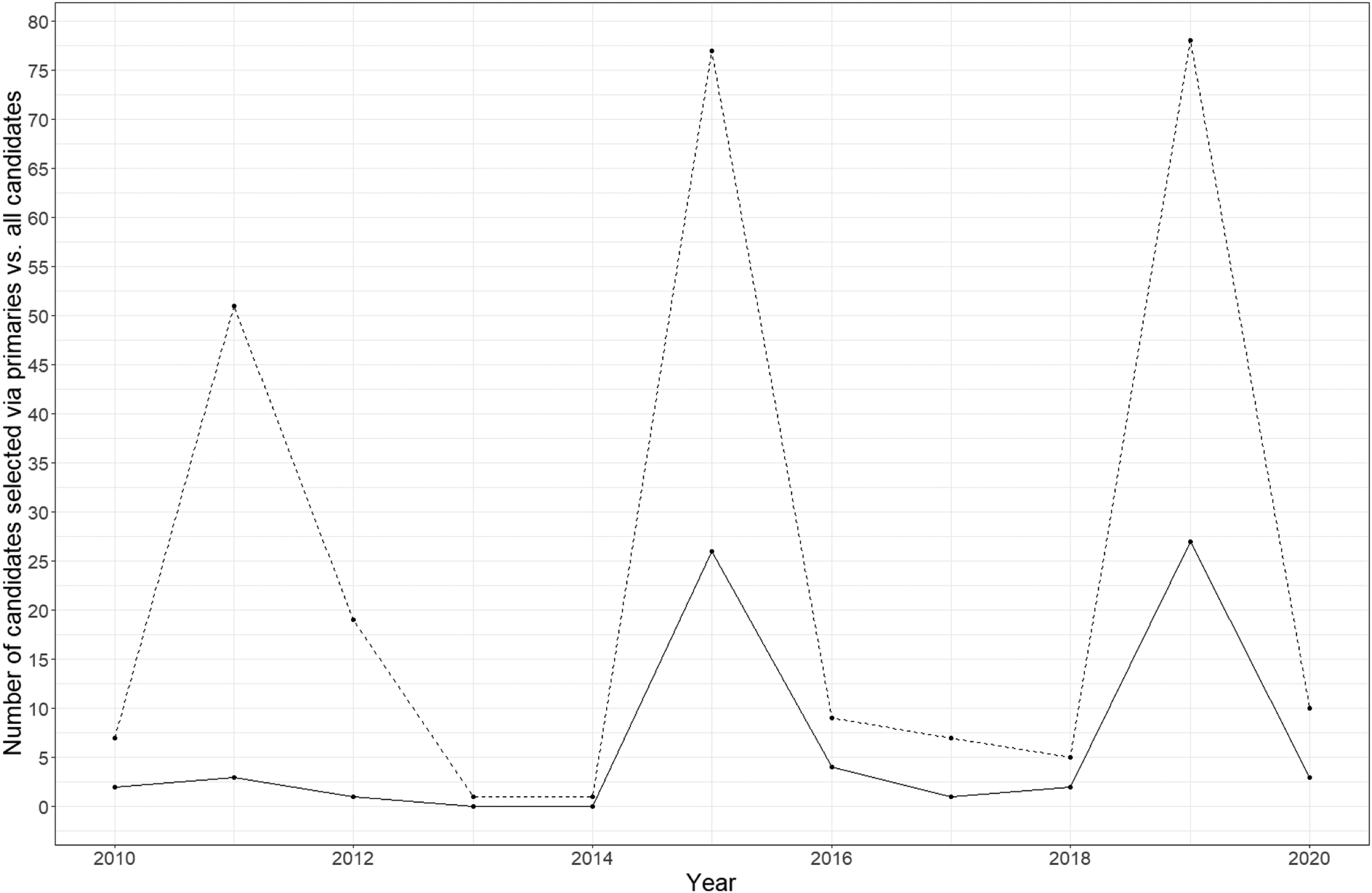
While participation rates in primaries have rarely been systematically investigated, Sandri and Venturino (2016, 70), suggest that participation rates in Spanish regional primaries vary between 29 and 81% with an average across all parties of 49.8% of registered supporters, similarly reported in Charron and Schwenk (2022)’s collection effort on Spanish regions (average participation rate of 54.6%).
The widespread use of primaries, the strong variation in the usage of primaries, especially on the subnational level and the anticipated awareness of voters make Spain a great case to test the above-outlined hypotheses.
Data and methods
To test the hypotheses, I rely on a conjoint experiment that was implemented with 1500 respondents 4 in Spain in October 2022. 5
Conjoint experiments come with two main benefits that make them suitable for this study: First, they simulate a real-life situation, as respondents are presented with information on several relevant dimensions that would be available to them in the real world (e.g. gender, age, education, political experience, and ideological position), increasing external validity (Hainmueller and Hopkins, 2015) and mimicking information in a party brochure. Second, by including and varying these attributes, it is possible to compare the magnitude of the effect of interest to established factors that affect evaluations of candidates. The largest advantage of using a conjoint experiment thus lies in both the external validity and in the comparability of effect magnitudes, which would not have been possible by relying on e.g., a vignette without increasing complexity. The presentation of multiple factors also reduces potential issues of social desirability. This has made conjoint experiments particularly popular in studies investigating voters’ and elites’ preferences in candidate profiles (Berz and Jankowski, 2022; Crowder-Meyer et al., 2020; Ono and Burden, 2019).
In the experiment, participants were presented with seven tasks, in which they were asked to make a forced choice between two profiles of potential candidates of their party that are discussed to lead a project by the regional parliament. As partisanship is one of the strongest predictors of voters’ evaluations of candidates and might conflate effects of candidate selection, it is not varied in the experiment. Voters’ evaluations of candidates are thus tested in the absence of partisanship cues (Kirkland and Coppock, 2018). The choice not to vary partisanship is also relevant in light of research demonstrating that partisanship even outweighs evidence that a candidate is corrupt (Anduiza et al., 2013; Fernández-Vázquez et al., 2016). Presenting respondents with candidates for a project is fitting, as it relates to the everyday work of politicians – executing decision-making and acting in line with voters’ preferences, rather than their ability to win elections which would be more suited for a study of voting preferences. 6
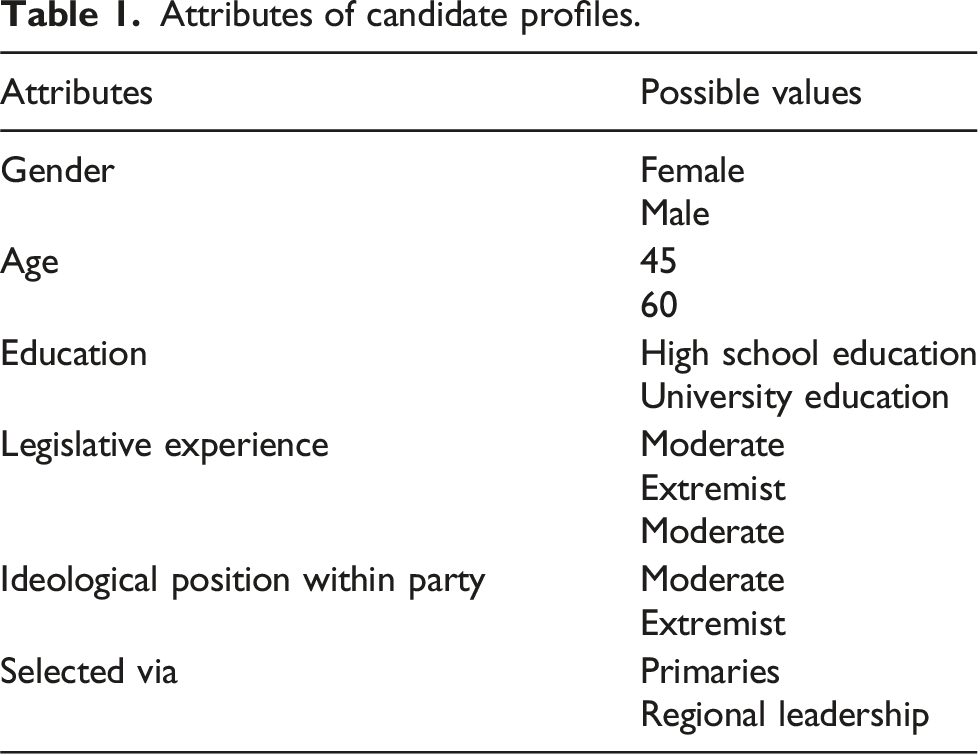
Respondents are presented with six attributes in each profile, the order of attributes is randomized to avoid ordering effects (Kirkland and Coppock, 2018). The main attribute of interest, candidate selection takes two values: Primaries and selection by regional leadership. Regional leadership was chosen as the contrasting selection to primaries as many parties continue to select candidates via their regional party leadership. 7 While there is variation in the type of primaries employed (e.g. two-round primaries vs. one-round primaries, and in few cases primaries that are open to all voters), and leaderships sometimes have the power over the formal nomination of a candidate, I assume that voters are not familiar with the detailed processes of selection but rather perceive the dominant mode of selection (Astudillo and Paneque, 2022; Kenig et al., 2015). In addition to the main attribute of interest, respondents are presented with attributes that are assumed to be rather easy-to-obtain for voters and that have been shown to affect evaluations of politicians in previous research: Gender, education, political experience, 8 age, and ideological position within the party. Including these attributes not only increases external validity of the experiment, but also helps to avoid respondents making inferences about the candidate, e.g. that primary candidates are more ideologically extreme (Meinke et al., 2006; Serra, 2011).
Attributes of candidate profiles.
In the post-experiment survey, respondents were asked to give a short statement on why they would (not) like their party to hold more primaries. 10 Thus, first, I estimate the average marginal component effect to investigate the effects of candidate selection on evaluations based on the experimental data. In a second step, I systematically investigate and analyze the answers to the open-ended question to better understand the underlying mechanisms.
Results
Do voters employ candidate selection as a heuristic to evaluate candidates? To answer this question, I first analyze the average marginal component effect of attributes on respondents’ candidate evaluations. The average marginal component effect (AMCE) is the marginal effect of one level of an attribute, averaged over the joint distribution of all other attributes (Hainmueller et al., 2014: 10), such that the estimates are the average change in probability that a profile gets chosen based on an attribute level. Figure 2 displays the AMCEs of each level of attributes with 95% confidence intervals for perceived corruptibility (Panel A), competence (Panel B) and experience (Panel C). All standard errors are adjusted for clustering on the respondent level. Average marginal component effects.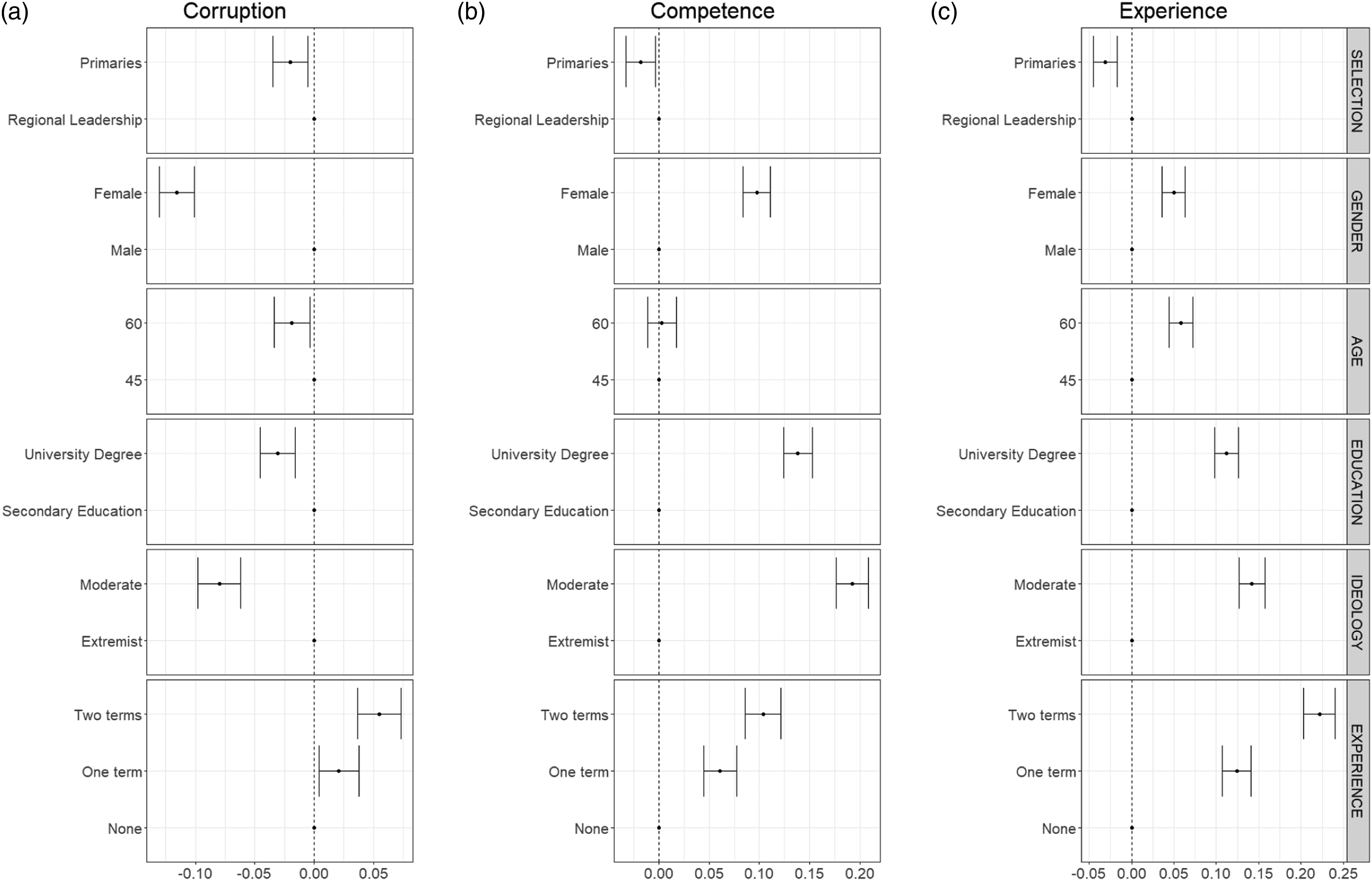
Briefly stated, for all three outcomes, primaries have a negative and significant effect, thus, candidates that are selected via primaries are on average perceived to be less corrupt, less competent and less experienced.
The results in Panel A in Figure 2 suggest that respondents perceived candidates that were selected via primaries to be less corrupt, compared to candidates selected via regional leadership, supporting H 1a that candidates resulting out of primaries are perceived to be of higher quality, indicating that primaries are perceived as positive. The effect is comparable in magnitude to the effects of age and political experience.
As for the other attributes, as expected based on previous research, women are perceived to be less corrupt than male candidates, with gender having the largest effect on corruptibility evaluations (Barnes and Beaulieu, 2019; Thomas and Petrow, 2021). Older candidates are also perceived to be less corrupt, as are candidates with a higher level of education. For factors associated with the candidate’s political profile, more experienced candidates are perceived as more corrupt, indicating that longer times in public office result in politicians being perceived to be enmeshed in corrupt networks. Moderate candidates are perceived to be less corrupt, compared to extreme candidates.
The effects for competence in Panel B indicate that primaries lead to lower evaluations of competence, contradicting the argument that primaries result in better evaluations of candidates formulated in H 1a and the findings in Panel A on corruptibility. However, given that the results for corruptibility indicate that candidates selected via primaries are perceived as less corrupt, it is unlikely that the perception of candidates as less competent is based on candidates employing illicit means to win the nomination, or that elites dominate primaries, as argued in the theoretical arguments underlying H 1b . The results for experience in Panel C mirror the findings for competence, such that candidates selected via primaries are perceived as less experienced.
All other attributes again perform in line with expectations, except possibly gender, as women are perceived as more competent and experienced than men. One explanation could be that voters perceive that women competing for public offices tend to be higher educated and more experienced than male candidates (Franceschet and Piscopo, 2014; Verge and Claveria, 2018).
Overall, the results of this experiments support both hypotheses H 1a of a positive effect of primaries on evaluations of candidates and H 1b of a negative effect of primaries on evaluations to a certain extent - while candidates resulting out of primaries are perceived less corrupt, they are also perceived to be less competent and experienced. As for the strength of the effects, while candidate selection does not reach the magnitude of characteristics such as gender, ideology or experience, selection compares in magnitude to the effect of age, with effect sizes ranging between −0.018 and −0.03.
To test the robustness of results, I first run a series of subgroup tests based on gender, age, and education, of the respondent, as well as party preference, strength of attachment to this party, trust in parties and corruption perceptions. Following Leeper et al., (2020), I calculate the subgroup estimations based on marginal means. The results of the subgroup analysis can be found in Figures 4–6 in the Appendix. The results show some heterogeneity across subgroups, namely such that the effect of corruption is mostly present for male respondents and voters of centre-left parties, while the effect of competence is mostly present for female respondents and centre-right voters. Experience however is not affected by either of these factors. Given the low number of respondents by subgroup, and that the effects at least go in the expected direction although not reaching statistical significance across all subgroups, the results should be interpreted with caution, as statistical power is likely not given. Rather, the results suggest that the effects are unlikely to be driven by other factors such as respondents’ gender.
In a next step, I exclude respondents from regions that have held elections or will hold elections soon to test for potential effects of real primaries (Madrid, 2023; Andalucía and Castilla y León 2022). The results of this test can be found in Figures 7 and 8 in the Appendix. While the estimate for candidate selection on corruptibility seems sensitive to the exclusion of Andalucía and Castilla y León, with the estimate no longer reaching statistical significance, all other estimates are robust to the exclusion of the regions. Further robustness tests, concerned with respondents’ attention decrease can be found in Figures 9–11 in the Appendix.
Finally, candidate selection might not only have a direct effect on quality, but also exacerbates other factors’ effects. Therefore, Figures 13–15 in the Appendix includes interaction effects between selection and each attribute for all outcomes. While selection does not moderate other attributes effects on competence and corruption, primaries do affect other attributes’ effects on experience. As one might expect, primaries exacerbate other attribute levels’ effects that signal being inexperienced, such that younger, less educated, and more extreme candidates are perceived as less experienced if selected via primaries, and effects of their complementary are weakened.
To conclude this section, the results from the experiment provide mixed support for hypothesis H 1a , that primaries increase evaluations of candidate quality – while primaries decrease the likelihood of a candidate being perceived as corrupt, primaries also reduce the perception of candidates being competent and experienced, thus supporting hypothesis H 1b . The findings are robust to a series of tests. Given that candidates resulting out of primaries are seen as less corrupt, it is unlikely that the theorized mechanisms underlying hypothesis H 1b of clientelism and leadership dominance are driving the negative effect, as these would most likely lead to higher evaluations of corruptibility rather than lower competence and experience. More evidence speaks in favor of the idea that primaries are perceived as a positive procedure, as 72.6% of respondents indicate that they would prefer their party to hold more primaries. This is in line with Shomer et al. (2016)’s assessment that voters value inclusive candidate selection. However, a deeper investigation of the underlying mechanisms is necessary.
Open question results
To explore the underlying mechanisms of the evaluation of primary candidates, I coded 1004 answers to the post-experiment question asking respondents to explain why they would prefer their party to hold more primaries. 11 I follow Singer (2009) and Stiers (2022)’ approach in coding the answers inductively. Answers are coded as statements, such that one answer may be coded as several units, resulting in 1227 statements. 12
As illustrated in Figure 3, statements either referred to the process of primaries (allowing to investigate whether voters perceive procedural fairness) or the outcome of primaries (e.g. higher quality candidates). Distribution of statements referring to process and outcome.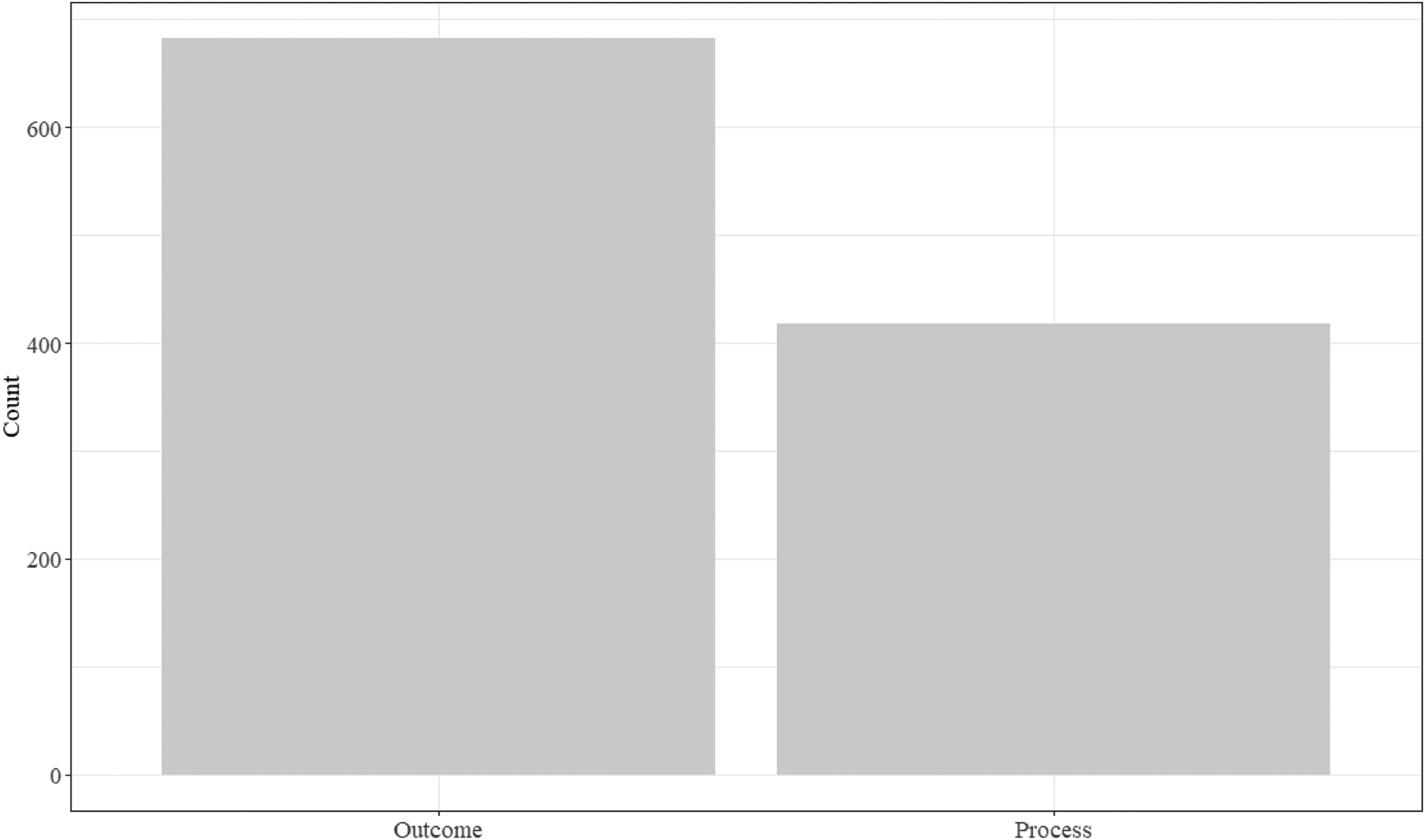
Taking a closer look at the process category, Figure 4 shows that voters perceive primaries to be in line with the theoretical arguments about procedural fairness. Voters believe primaries to be more democratic procedures than “handpicking” of candidates, and refer to the fairness and the transparency of the process, highlighting voters’ perception of procedural fairness in primaries. Respondents also indicate that primaries increase the potential to screen candidates before selection, such that primaries can act as a character test (Adams and Merrill, 2013; Serra, 2011). Thus, in terms of the primary process, respondents highlight mechanisms that are in line with the theoretical expectations that are outlined in the theory section of this paper, arguing that procedural fairness dominates voters’ perception of primaries. Subcategories of process category.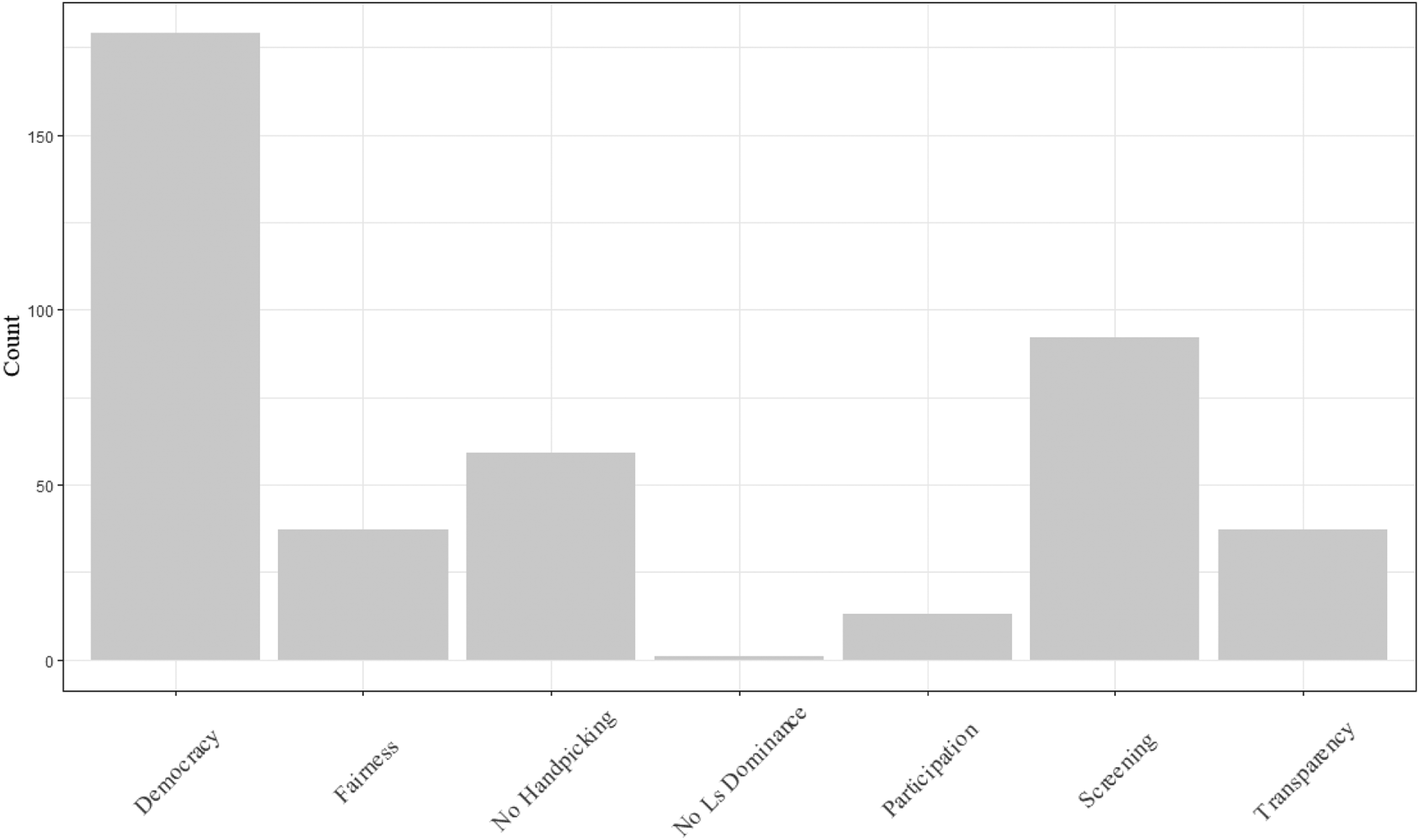
However, the findings of candidates being perceived as less competent and experienced are not explained by this. Turning to “outcomes” in Figure 5, the majority of statements refers to the “quality” of candidates, with the themes of accountability and renewal following. Subcategories of outcome category.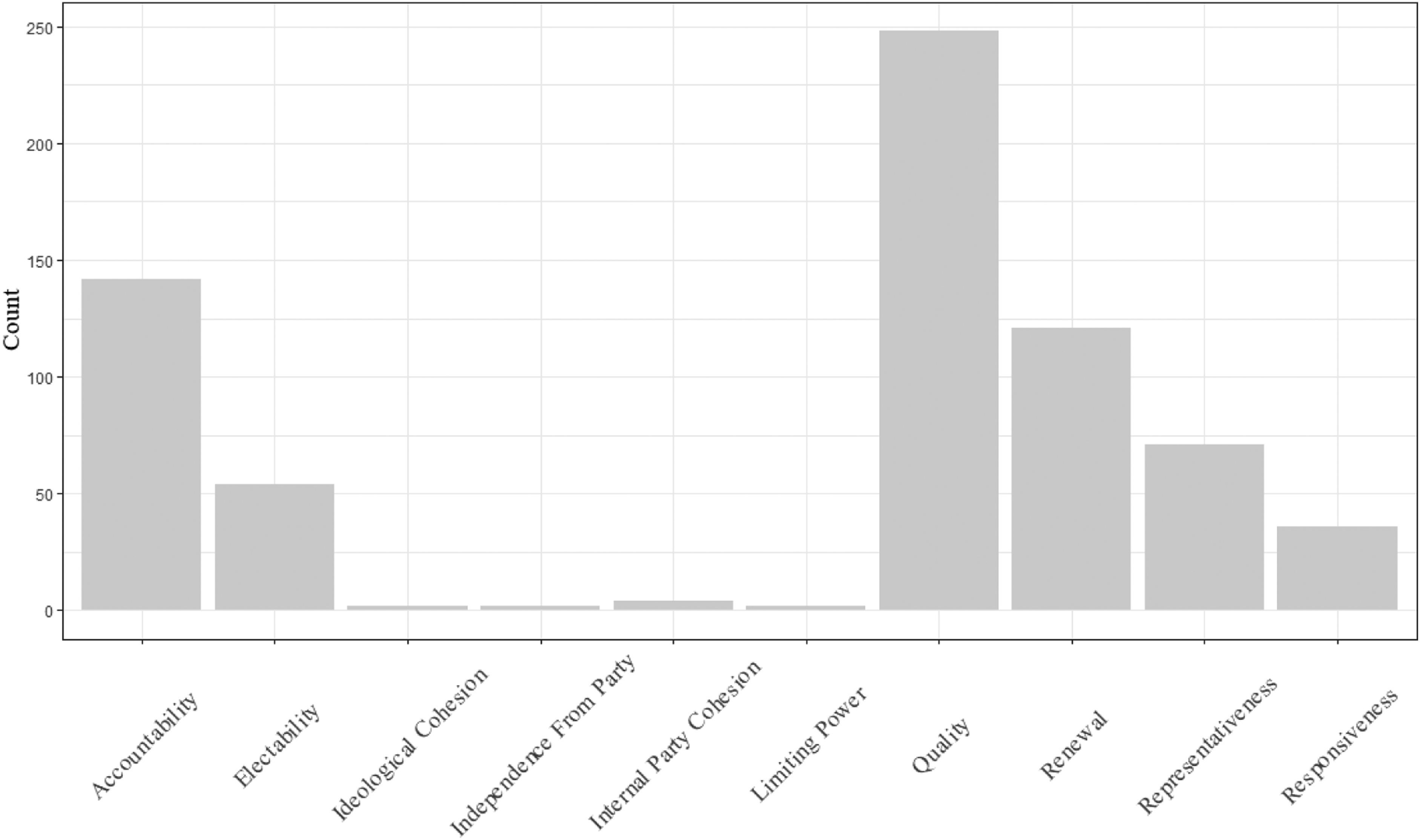
Renewal and the “absence of handpicking” refer to the idea that candidates resulting out of primaries are outsiders to the political elite. Statements such as “it is more democratic and allows people who are separated from the apparatus” as well as “regenerate the system, they are not attached to the position and to the one who put them in” clearly reference that primary candidates are perceived as political outsiders. This might explain the surprising experimental findings, the outsider status of primary candidates means they are not perceived to be part of corrupt networks, but also do not benefit from networks that would make them more experienced and competent.
This idea is further underlined when looking at statements that refer more directly to corruption, respondents indicated e.g., that “The ideal is that the candidates are chosen in primaries and not by handpicking or by bribery. Otherwise, the spoils of the predecessors and friends are inherited.” thus, respondents see candidates resulting out of primaries as outsiders to networks and thereby as less corrupt. Respondents also highlighted other qualities that can be related to corruption, such as honesty and absence of nepotism (c.f. Figure 12 in the Appendix), that are related to the idea that primary candidates are political outsiders.
Concluding, primaries are used by voters as a heuristic to evaluate candidates and are seen as a transparent and democratic process that leads to less corrupt candidates, but also to candidates that are, because of their outsider status, less experienced and competent.
Concluding remarks
This paper aimed to investigate how changes in candidate selection, more specifically, changes towards primaries compared to leadership selection, affect voters’ evaluations of candidates. Based on procedural fairness theory, I argue that the transparent and inclusive process of primaries should lead to voters perceiving primaries as a character test for candidates and that voters perceive politicians that result out of primaries as of higher quality. However, as research reports primaries to be rigged by leadership domination and vote-buying, the perception of procedural fairness might be inverted and voters might believe primary candidates had to have engage in such means to win the primary, instead of relying on their merit, effectively resulting in worse evaluations of candidates. The theoretical arguments were tested in a conjoint experiment in Spain.
The results of the experiment indicate that voters do employ primaries as a heuristic to evaluate candidates, similar to other characteristics of candidates, but in an unforeseen manner: Candidates that were selected via primaries are perceived as less corrupt but also as less competent and less experienced. The results of the experiment were further explored in the analysis of answers to an open-ended question, in which respondents largely indicated that they believe that primaries result in outsider candidates being selected. This outsider status becomes a blessing and a curse for candidates, as they are perceived to be less corrupt based on their outsider status, but the lack of political networks also results in being perceived as less competent and experienced.
The findings of this paper provide interesting insights into voters’ perceptions of primaries. Given the increase of primary election in Western Europe and the lack of research on voters’ perceptions of these changes, this paper makes an important contribution in assessing how voters evaluate candidates based on how they were selected, and adds to a growing literature studying effects of variation on outcomes that lay beyond the party, compared to previous studies on representativeness, competitiveness, responsiveness, and participation (Hazan and Rahaṭ, 2010). It also adds interesting insights to the findings by Charron and Schwenk (2022), that primaries increase institutional corruption perceptions when first introduced, but that the effect decreases over time. The findings here could hint at a further institutionalization of primaries, reversing the initial negative effect of primaries on corruption perceptions. These findings are especially interesting given the salience of corruption in Spain. In the absence of party clues, primaries reduce corruptibility evaluations, indicating that primaries might be a mean for parties to reinstate trust of voters.
While this study addresses an important gap in the literature, it also has several shortcomings. First, given the single-country nature of this study, the issue of generalizability needs to be addressed. While the results for experience and competence are likely to easily travel to other contexts in which primary candidates might be perceived as outsiders, the results for corruption are only likely to be applicable to countries with similar corruption salience and implementation of primaries (such as e.g., Italy), while less likely to be applicable to countries in which primaries are also used but corruption is less salient (e.g., the Netherlands). Further, while this study was conducted for executive candidates on the regional level, it is reasonable to believe that the results would also travel to other levels of government (municipal/regional) and potentially even to other offices (legislative or party office). However, all claims of generalizability should be put to a test by future research. Second, while experimental studies can provide important insights, they often suffer from problems with external validity. While this study addresses such concerns by presenting respondents with several features simultaneously, it cannot be ruled out that outside the experimental setting effects would differ, especially given that voters do not incur any costs at gaining access to the information about candidates in the experiment. Furthermore, as this experiment only included “primaries” as a cue, rather than differentiating between types of primaries or considering potential contingency effects discussed in the literature, it is possible that the number of candidates competing, or the timing of primaries additionally affect evaluations of candidates.
Despite these shortcomings, this paper contributes to several strands of literature. First, given the lack of arguments and empirical research on how candidate selection affects voters’ evaluations of candidates, this study contributes to both, the literature on voters’ preferences and candidate selection more generally. This paper makes important theoretical and empirical contributions, by investigating the effects of variation in candidate selection on the individual-level, moving away from the effect that changes have electorally for parties and investigating the effect more directly on the candidate- and voter-level. Finally, given the finding that voters evaluate primaries as positive but only evaluate candidates’ corruptibility better based on it, not their experience or competence, this study opens for interesting discussions about the importance of intraparty democracy for parties and how voters reward it.
Supplemental Material
Supplemental Material - The effect of primaries on voters’ evaluation of candidates’ quality–experimental evidence
Supplemental Material for The effect of primaries on voters’ evaluation of candidates’ quality–experimental evidence by Jana Schwenk in Party Politics
Footnotes
Acknowledgements
I would like to thank the three anonymous reviewers for their helpful comments on this article. I also express my gratitude to Jacob Nyrup, Georgios Xezonakis, and Nicholas Charron for their comments on previous versions of this manuscript. I thank Josefine Magnusson, Sofia Axelsson, Natalia Alvarado Pachon and Hayden Buker for their help with the implementation of this experiment.
Declaration of conflicting interests
The author(s) declared no potential conflicts of interest with respect to the research, authorship, and/or publication of this article.
Funding
The author(s) disclosed receipt of the following financial support for the research, authorship, and/or publication of this article: This work was supported by the Stiftelserna Wilhelm och Martina Lundgrens (2022-3958) and Helge Ax:son Johnsons Stiftelse (F22-0005).

Supplemental Material
Supplemental material for this article is available online.
Notes
Author biography
References
Supplementary Material
Please find the following supplemental material available below.
For Open Access articles published under a Creative Commons License, all supplemental material carries the same license as the article it is associated with.
For non-Open Access articles published, all supplemental material carries a non-exclusive license, and permission requests for re-use of supplemental material or any part of supplemental material shall be sent directly to the copyright owner as specified in the copyright notice associated with the article.
