




Abstract
Districted proportional systems give an edge to right-wing parties that are more popular in rural areas where district magnitude is small and large parties are mechanically advantaged. In this paper, we explore the role played by voters in this bias by looking at how ideology correlates with strategic voting. We analyze survey data from 44 elections in Western Europe and find that left-wing voters are more likely to support a party that is not viable (p < 0.01), but once in this position they seem less likely to desert this party for one that is viable (p < 0.1). Further, we find that this pattern is likely driven by the intensity of partisan preferences as left-wing voters are on average more attached to their favorite party and thus more reluctant to desert it (p < 0.01). Our study thus demonstrates that the psychological effect of districted proportional systems amplifies the mechanical one in advanced industrial democracies.
Keywords
Introduction
In a well-functioning democracy, the rules organizing elections must be neutral in the sense that they must not give an advantage to some parties over others. The partisan neutrality of political institutions is often seen as a necessary condition for citizens’ trust in representative democracy (Anderson et al., 2005) and sometimes included in indicators of democratic quality (Norris 2014). Districted proportional representation, the most used electoral system in the world (Bormann and Golder 2022), tends to create such partisan bias. In advanced industrial democracies at least, the combination of varying district magnitudes and the idiosyncratic geographic distribution of political preferences between urban and rural districts lead to a mechanical over-representation of right-wing parties at the national level (Kedar et al., 2016; Monroe and Rose 2002). In this paper, we explore the role that voters play in this bias and whether they amplify or attenuate the mechanical partisan effect of districted electoral systems by voting strategically or not. 1 By doing so, we hope to contribute to the literature on electoral systems by exploring a little-known effect (i.e., partisan effect) and to the one on strategic voting by looking at a novel determinant (i.e., ideology).
To achieve these goals, we analyze survey data from the Comparative Study of Electoral Systems (CSES) project covering 44 elections under districted proportional representation in Western Europe between 1996 and 2019 (N = 62,030 respondents). We find that left-wing voters are more likely to support a party that is not viable in their district (p < 0.01), which means that they are more often in a situation to cast a strategic vote. We also find that once in this position, left-wing voters seem to be less likely to eventually cast a strategic vote than right-wing voters (p < 0.1), especially in countries in which there is a large imbalance between districts in terms of size (p < 0.05). Finally, we show that the association between ideology and strategic voting is mediated by partisan attachment, which suggests the mechanism behind it is likely to be found in left-wing voters’ attachment to their favorite party and their reluctance to desert it for strategic reasons (p < 0.01). This in turn means that left-wing voters slightly amplify the partisan bias of districted proportional systems as they do not make their vote count as much as right-wing voters, which harms the representation of their preferences in the parliaments of advanced industrial democracies.
Literature and hypotheses
The partisan bias of districted proportional systems
The scientific study of electoral systems and their consequences is one of the most mature subfields of political science (Shugart 2005). Thanks to the numerous studies on the topic, we have a precise idea of how the rules that organize elections affect the defining elements of party systems such as the number of parties in parliament and government (Duverger 1954; Lijphart 1994; Powell 2000), or the ideological positioning of these parties (Bol et al., 2019; Calvo and Hellwig 2011; Cox 1990). In this paper, we focus on another little-known finding of this literature: the partisan bias of districted proportional systems in advanced industrial democracies (Kedar et al., 2016; Monroe and Rose 2002).
Under districted proportional systems, the country is split into electoral districts, which usually correspond to administrative units like regions or provinces. In each of these districts, multiple seats are allocated to parties, proportionally to their vote shares. However, these districts vary in size and population, and thus also in the number of seats available to parties. In Portugal for example, district magnitudes vary between 2 (Portalegre) and 48 seats (Lisbon). This variation has important consequences for the translation of votes into seats. Whereas in Lisbon each party can get a share of seats that is roughly proportional to their share of votes, proportionality cannot be achieved in Portalegre. In such a small district, a party needs to reach a high share of votes to receive even a single seat, simply because there are not a lot of seats available. In the 2019 national election for example, the center-right conservative party PSD did not get any seat despite receiving more than 20% of the vote. By contrast, the far-right party CHEGA receives one seat in Lisbon with only 2% of the vote. In fact, small districts advantage large parties such that, for a given vote share, the share of seats received is larger than what they would have received in a large district, given that small parties are mechanically eliminated from the seat distribution (Taagepera and Shugart 1989).
The co-existence of small and large electoral districts within a country would not be a problem for political representation if district magnitude was not correlated with political and partisan preferences. However, the history of economic development in advanced industrial democracies created an urban-rural ideological divide. In cities where industries and low-skilled workers used to be concentrated and electoral districts tend to be large, voters lean to the left of the ideological spectrum, whereas voters who live in the countryside where districts tend to be small are more likely to lean right (Rodden 2010). This means that, in these countries, there tend to be more left-wing voters in districts in which the seat share of parties is roughly proportional to their vote share, whereas there tend to be more right-wing voters in districts in which large parties are mechanically advantaged by the translation of votes into seats. Put together, this creates a bias in favor of right-wing parties (and against left-wing parties), i.e., for a given vote share at the national level, right-wing parties have a larger seat share than left-wing parties because their supporters tend to live in smaller districts. This is the partisan bias of districted proportional systems (Monroe and Rose 2002). Interestingly, in many instances, this bias was in fact intentional. Most districted proportional systems were designed at the beginning of the 20th century by right-wing governments that were pressured to liberalize voting rights by major social movements demanding universal (male) suffrage. Facing the competition of socialist parties, these right-wing governments decided to replace the existing majority system by a districted proportional system to maximize their chances to stay in power despite the circumstances (Walter and Emmenegger 2019).
Although the conditions of the urban-rural ideological divide have largely disappeared with the transformation of economic structures and the decline of industries, this divide persists today due to path dependency and inter-generational value transmission (Van Ditmars, 2022). There are still more left-wing voters in cities (with large districts) and more right-wing voters in the countryside (with small districts). In fact, this pattern has reinforced itself over time due to ideological sorting, a phenomenon according to which people tend to move to places where others share their political opinion (Gallego et al., 2016; Maxwell 2019). As a result, the partisan effect of districted proportional systems is still a relevant issue in advanced industrial democracies. Right-wing parties are mechanically advantaged by the translation of votes as they have more supporters in small districts than they do in large districts (Kedar et al., 2016).
Strategic voting and voters’ adaptation to the electoral system
Facing an electoral system, voters need not remain passive. They have in fact an incentive to anticipate the mechanical effect of electoral systems, as well as the behavior of other voters, and adapt their voting behavior accordingly to make their vote count (Cox 1997). The literature sometimes uses the expressions ‘tactical voting’ (e.g., Niemi et al., 1992) or ‘avoidance of a wasted vote’ (Lago and Martínez i Coma 2012) to refer to this behavior. We use in this paper the expression ‘strategic voting’ which we define as the action of not voting for one’s favorite party with the hope of influencing the final electoral outcome (Blais et al., 2001). In sum, strategic voting forms the ‘psychological effect’ of electoral systems that often amplifies the mechanical one (Duverger 1954).
Strategic voting can, in principle, take many different forms (for an overview, see Bol and Verthé 2021). The most common one is strategic desertion. In every election and in every district, there are some small parties who stand no chance of winning a single seat; these are usually referred to as ‘non-viable parties’ (Cox 1997). Supporters of non-viable parties have an incentive to vote for their second or third preferred party if that party has a good chance of winning, especially compared to their favorite party. By doing so, they maximize their chance of influencing the outcome of the election, in the sense that they help prevent a party that they strongly dislike from being elected. Many empirical studies document the existence of strategic desertion in countries using single-member plurality systems, such as the United Kingdom (Alvarez et al., 2006; Eggers and Vivyan 2020; Fischer 2004; Niemi et al., 1992; Tromborg 2022), Canada (Blais et al., 2001; Daoust and Bol 2020; Eggers et al., 2022; Merolla and Stephenson 2007), and India (Choi, 2009; Heath and Zeigled, 2022; Rozenas and Sadanandan, 2018; Zhirnov, 2019). This behavior is particularly prevalent in those countries as, by definition, there is only one winner in each district and many parties who do not stand a chance to win.
In this paper, we focus on districted proportional systems. Most of the literature that studies these systems focuses on how the presence of frequent governing coalitions create incentives to cast a strategic vote (Bargsted and Kedar 2009; Duch et al., 2010; Kedar 2005; Indridason 2011; Meffert and Gschwend 2011). Their findings however tend to be quite specific to the partisan configuration of the countries covered. For example, Gschwend et al. 2016 find that, in Germany, when the junior partner of the right-wing coalition (FDP) is likely to fall below the 5% vote threshold for parliamentary representation, supporters of the senior coalition partner (CDU) use their second vote to save it. This type of strategic voting is obviously confined to some specific political systems and situations.
The studies of strategic voting under districted proportional representation however all assume that voters need to first make their vote count at the district level in order to affect the bargaining power between parties at the government level. A vote for a party that is not viable at the district level does not affect its seat share and has limited effect on the partisan balance of power. Hence, even in proportional representation systems, voters have some incentive to strategically desert the (very) small parties that stand no chance of winning in their district (Abramson et al., 2010). The literature documents the existence of such behavior in countries like Belgium (Verthé et al., 2017), Portugal (Gschwend 2007), and Spain (Lago 2012). This is the form of strategic voting on which we focus in this paper, as it allows us to talk to the literature on the partisan bias of districted proportional systems that also concentrates on electoral dynamics at the district level.
In districted proportional systems, the magnitude of the district is a crucial parameter explaining varying levels in the prevalence of strategic voting. Given the mechanics of the translation of votes into seats, the number of non-viable parties, and thus the proportion of strategic voters, decreases with the number of seats available in the district. For example, in the district of Portalegre in the 2019 Portuguese election, a supporter of the green-left party CDU has an incentive to vote for the center-left party PS. With little over 8% of the vote, the CDU has virtually no chance of getting a seat in this district where only two seats are available, whereas, with more than 40% of the votes, the PS could prevent the center-right conservative party PSD to get any seat. In Lisbon where 48 seats are available, CDU supporters had no incentive to vote for another party. With 8% of the vote, the party received four seats in this district.
Hypotheses
In this paper, we study strategic desertion in districted proportional systems, and how this behavior correlates with the left-right ideology of individual voters in advanced industrial democracies. From the two strands of the literature discussed above, we derive two testable hypotheses. The first hypothesis is about potential strategic voters, i.e., those whose favorite party is not viable in their district and who have an incentive to vote for a viable party (although they might not ultimately do it). In large districts, most parties, from the left to the right, are mechanically viable. By contrast, in small districts, there are more non-viable parties and thus more potential strategic voters. Given that right-wing parties are more popular in those small districts, there should be more right-wing parties among those which are viable, and more left-wing parties among those which are non-viable. Assuming that the main parties, i.e., those that are represented in parliament, compete in all districts including those in which they are not viable (which is not an unreasonable assumption given the empirical studies on party entry in advanced industrial democracies, see Ferrara and Herron 2015; Guinjoan 2014), this leads to our first hypothesis that can be seen as a direct test of one of the conditions of the partisan bias of districted proportional systems:
Left-wing voters are more likely to be potential strategic voters, i.e., to prefer a party that is not viable in their district, than right-wing voters The second hypothesis is about actual strategic voters, i.e., potential strategic voters who decide to vote for a viable party instead of their favorite party. Some studies find that some socio-demographic groups are more likely to cast a strategic vote, such as older voters and those with a high income (Eggers et al., 2022; Eggers and Vivyan 2020). Although these findings do not contribute to our understanding of strategic voting per se in the sense that they do not explain why some people vote strategically whereas others do not (or only indirectly), they are nonetheless normatively important. Indeed, if some groups of voters are less likely to vote strategically than others, their votes will count more towards the final electoral outcome and their preferences will thus be better represented in the decision-making process, at least in the short run. This is the approach that we adopt in this paper by looking at whether left-right ideology correlates with strategic voting, which is a normatively important question. This leads to our second hypothesis:
Among potential strategic voters, left-wing voters are less likely to vote strategically than right-wing voters We postulate that left-wing ideology is associated with a lower probability to cast a strategic vote because of a difference in the intensity with which left-wing voters like their favorite party, compared to right-wing voters. Intensity of partisan preferences is a classic determinant of strategic voting in the literature (Blais 2002; Daoust and Bol 2020; Lanoue and Bowler 1992; Niemi et al., 1992). A strong partisan is reluctant to vote for another party, even when their favorite party has no chance of winning. The reason is that, for partisans, voting for their favorite party is a part of their identity, and they want to feel that they belong to the community of supporters. There is thus a psychological cost of voting for another party that they like less (Bol et al., 2018; Eggers and Vivyan 2020; Tromborg 2022). We believe that left-wing voters are more likely to have strong partisan preferences, and thus less likely to be strategic voters, as social-democratic parties have historically been more effective in mobilizing their support base (Hutter 2014; Kitschelt 1990). For this reason, we postulate that the center-left voters drive this relationship between ideology and strategic voting postulated in H2. In the analysis and results section, we provide some tests of this potential mechanism that could explain the correlation between left-right ideology and strategic voting.
2
Note finally that another key determinant of strategic voting in the literature is the amount (and accuracy) of information that voters have about the behavior of other voters and thus the chances of winning associated with each of the parties competing in their district (Blais, 2002; Heath and Zeigled, 2022). The more accurate information a voter has, the more likely they are to cast a strategic vote. This variable is sometimes proxied by education level, as voters who are highly educated bear a lower cost of acquiring information about elections (Merolla and Stephenson 2007; Niemi et al., 1992). Left-wing voters traditionally come from a lower socio-economic background than right-wing voters (Benedetto et al., 2020; Kitschelt 1990). This could then constitute a potential mechanism behind the correlation between left-right ideology and strategic voting. However, the education level of left-wing voters in Western Europe has increased substantially in recent decades (Gethin et al., 2022), which makes this mechanism unlikely. Furthermore, in the results section below, we show that education level is a poor predictor of strategic voting and that the correlation between left-right ideology is not affected by the inclusion of education as a control variable.
Data and variables
For this study, we analyze data from the CSES project, which has conducted post-election surveys in more than 50 countries since 1996. These data are particularly useful for us as the survey questionnaires include questions about partisan preferences, past vote choice, and left-right ideology. It also contains variables at the electoral-district level such as the vote and seat share that each party got at the latest national election.
Given the focus of this paper on left-right ideology, we restrict our sample to countries in which political competition (mainly) revolves around a left-right ideological divide. In line with the literature on the partisan bias of districted electoral systems (Kedar et al., 2016; Monroe and Rose 2002), we focus on countries that use this electoral system and on those that can be considered as advanced industrial democracies in the sense that the political lines of contention are inherited from the industrial revolution and the social cleavage between the working class and the owners of the means of production (Hutter 2014; Lispet and Rokkan, 1967; Warwick 2002), and where ideological position of citizens tend to correlate with urbanity (Rodden 2010). We include all the countries that fit these criteria in the CSES dataset. Given the data accessible, our final sample contains 62,030 respondents from 10 countries and 44 national elections in Western Europe between 1996 and 2019. 3
To conduct our analysis, we need to identify potential and actual strategic voters. In a first step, we identify respondents whose favorite party is not viable and who are thus potential strategic voters. Following standard practices in survey studies that analyze strategic voting (Blais et al., 2001; Bol and Verthé 2021), we rely on responses to the survey question “How much do you like each party on a scale from 0 to 10” to identify partisan preferences. We then calculate the favorite party of each respondent as the one that receives the highest score on this question. It is entirely possible however that a respondent scores two or more parties equally high on the liking scale. In this situation, we consider that all the tied parties are the favorite parties of the respondent. 4
We then calculate the viability of each party included in the survey. To do so, several studies of strategic voting rely on direct questions asked to voters in a pre-election survey wave (Bol and Verthé 2021). However, CSES surveys do not include such questions (to our knowledge, no large comparative survey does). Hence, we rely on electoral results at the district level to approximate voters’ perception of the ex-ante chances of winning at least one seat of each party in each district. This approach assumes that voters can accurately anticipate the viability of parties for example by looking at past electoral results and opinion polls published during the campaign. This assumption is not unrealistic: several empirical studies show that voters are indeed good at forecasting district-level results, even in proportional representation elections (Blais and Bodet 2006; Guinjoan et al., 2014). 5
Concretely, we estimate the following logistic regression
6

A key advantage of this strategy is that it gives an indicator of viability that is comparable across district magnitude. Another advantage of this strategy is that this indicator ranges from 0 to 1. It is thus more fine-grained than a crude binary variable capturing whether a party has a seat or not in the district and allows us to differentiate parties that are almost (non)viable from those that are clearly (non)viable. In the main analysis below, we set the threshold separating viable and non-viable parties to 0.25, hence three times as many chances of losing than winning. All voters whose favorite party has a predicted probability of receiving at least one seat below 0.25 is considered a potential strategic voter. We show in a robustness test below that our results are robust to a more restrictive threshold.
In a second step, we need to identify actual strategic voters among potential strategic voters. Once again, we follow the literature and use the vote choice recall question that asks the respondent the party for which they voted at the latest national election (Bol and Verthé 2021). If a respondent was identified as a potential strategic voter because their favorite party was not viable and as such, voted for a viable party instead, we consider that they are a strategic voter. If they still vote for their favorite party, we consider them as not.
Figure 1 reports the respective proportions of potential and actual strategic voters in the elections covered in our analysis. The left panel shows that about 5% of our sample are potential strategic voters. This low proportion is not surprising given that non-viable parties are, by definition, the favorite parties of a (small) minority of voters, especially in proportional systems where many parties are viable. However, given the number of elections included in the data, this proportion still means the sub-sample of potential strategic voters still consists of more than 2000 survey respondents, which is enough to perform statistical analysis. Interestingly, we observe some important variations between countries and elections. Countries with districts of small magnitudes like Austria or those with a high degree of party fragmentation like Greece tend to have a greater proportion of potential strategic voters compared to others (more than 20%). However, it is important to acknowledge that these differences are also due to the number of parties included in the questionnaires given that many small parties are included in some countries and much fewer in others. We account for this heterogeneity driven by practical survey characteristics by including election fixed effects in the analysis below. Proportion of potential and actual strategic voters in survey data. Note: Bars are proportions. AUT: Austria; BEL: Belgium; DNK: Denmark; ESP: Spain; FIN: Finland; GRC: Greece; ISL: Iceland; NOR: Norway; PRT: Portugal; SWE – Sweden. Two elections in Greece in 2015: one in January (J) and another in September (S).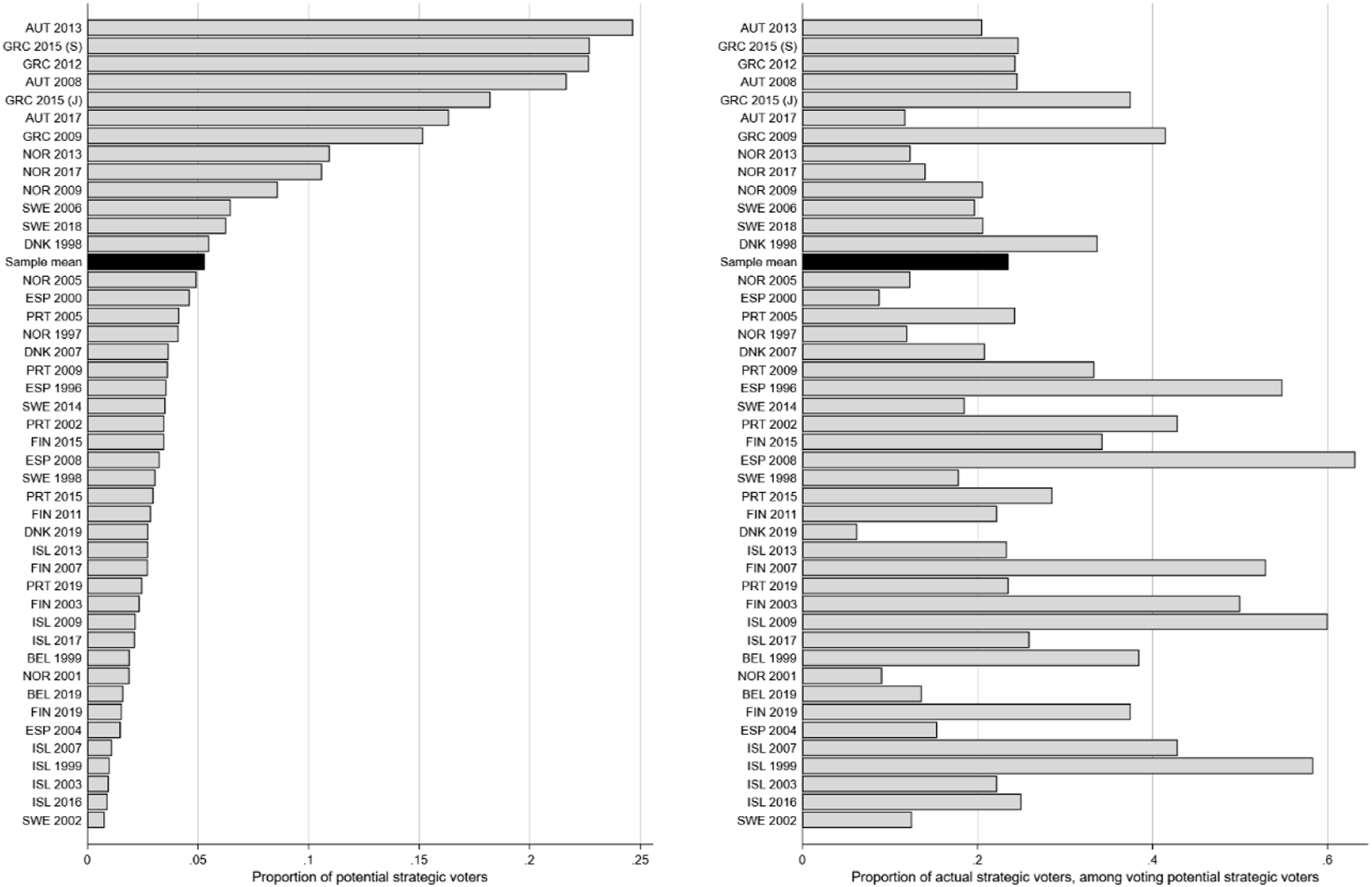
The right panel of Figure 1 reports the proportion of strategic voters among potential strategic voters. About 25% of potential strategic voters end up voting for a party that is viable in their district. Although we also observe some variations between countries here as well, they are smaller than in the case of potential strategic voters. Explaining the differences between countries falls beyond the scope of this paper that focuses on individual-level differences. However the election fixed effects also account for election-level differences that could influence strategic voting, like the number of competing parties on the left or right or possible pre-electoral alliances between them.
Finally, the independent variable in our analysis is left-right ideology. We use the traditional survey question on left-right self-placement (“In politics people sometimes talk of left and right. Where would you place yourself on this scale? Where 0 means left and 10 means right”). We first use a continuous version of this variable as it is the one that best captures the left-right bias in strategic voting that is at the core of our paper. However, we also use a categorical transformation of the very same variable to explore whether the relationship between ideology and strategic voting is linear. To avoid setting an arbitrary threshold that defines ideological groups (far-left, center-left, center…), we use the original 11 response categories of the survey question. In other words, each point on the 0-10 left-right scale is a separate category. In this scale, the categories that correspond to a center-left ideology (i.e., around three and four on the 0-10 scale) are particularly important given that we expect the center-left voters to drive the relationship between ideology and strategic voting. We also include respondents who answer ‘don’t know’ to the ideological self-placement question in this regression specification. The descriptive statistics of all the variables used in the regressions can be found in Appendix B.
Analysis and results
Main analysis
To test our hypotheses, we estimate the following linear probability OLS regression
7

Figure 2 reports the predicted probabilities derived from the OLS regression testing H1. The full regression table, including the results without control variables, can be found in Appendix C. The left panel in Figure 2 shows the results when the left-right ideology variable is treated as a continuous variable. It reveals that, as expected, going from extreme left (=0) to extreme right (=10) is associated to a decrease in the probability of being a potential strategic voter by 6% points (p < 0.01, with and without control variables). Left-wing voters are thus more likely to prefer a party that is not viable. This association is substantive as it is higher than the sample mean of the variable (on average 5% of respondents are potential strategic voters). The right panel in Figure 2 shows the results when left-right ideology is treated as a categorical variable. It reveals that the relationship is mostly linear: far-left voters (0–three on the 0-10 scale) are more likely to be in a situation to cast a strategic vote than other left-wing voters, just as far-right voters (10 on the 0-10 scale) are more likely to be in this situation than other right-wing voters. The regression table in Appendix C reveals that center-left voters (4 on the 0-10 scale) are more likely to be in a position of strategic voting than all other categories of right-wing voters from 1 to 3% points (p < 0.05). H1 is thus confirmed. Left-right ideology and potential strategic voting, test of H1. Note: Dots are predicted probabilities derived from OLS regressions predicting the probability of being a potential strategic voter (with control variables). Left panel: left-right self-placement treated as a continuous variable. Right panel: left-right self-placement treated a categorical variable. Vertical bars are 95% confidence-intervals. Full regressions results are available in Appendix C.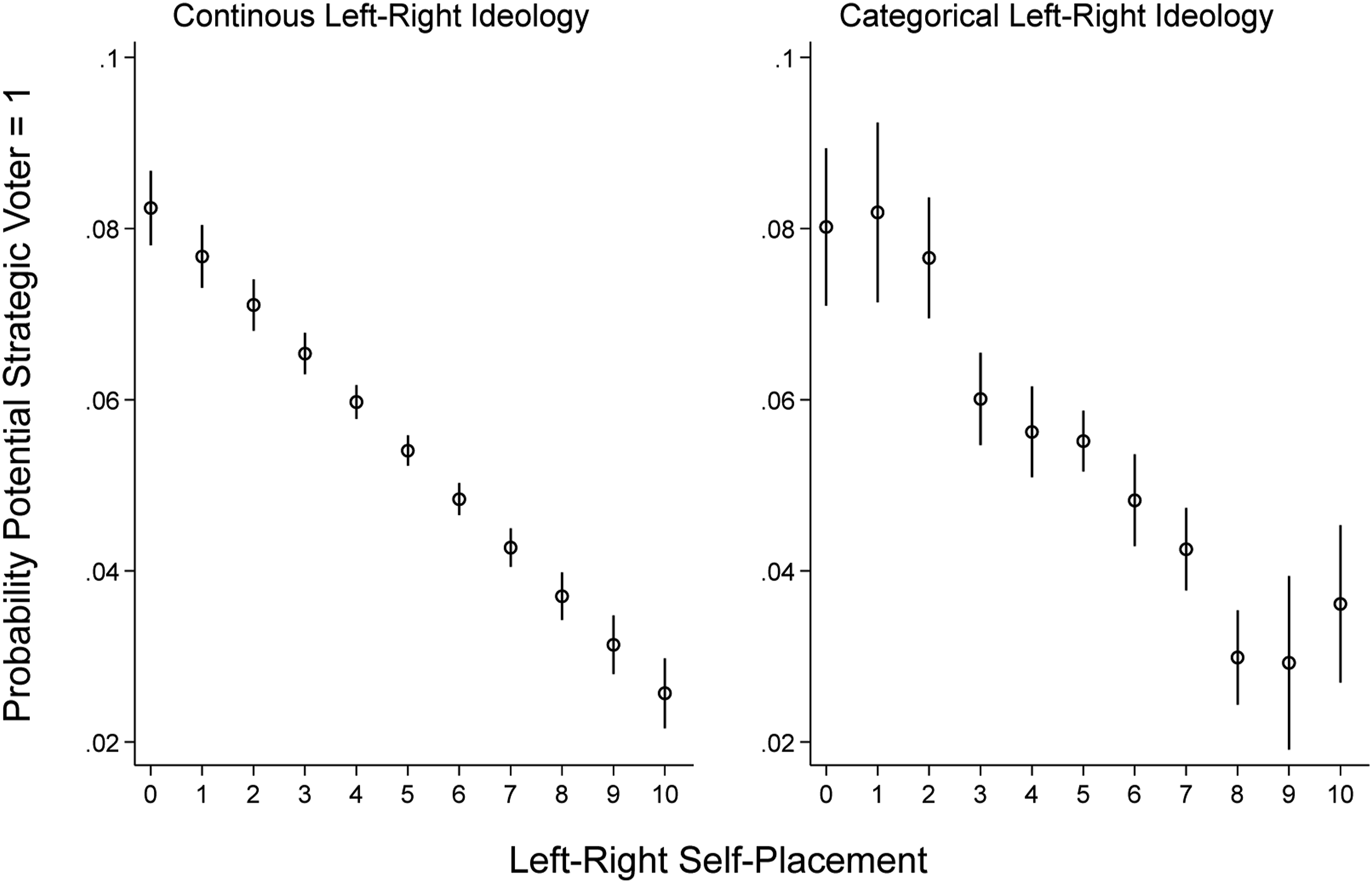
Note: Dots are predicted probabilities derived from OLS regressions predicting the probability of being a potential strategic voter (with control variables). Left panel: left-right self-placement treated as a continuous variable. Right panel: left-right self-placement treated a categorical variable. Vertical bars are 95% confidence-intervals. Full regressions results are available in Appendix C.
Figure 3 reports the predicted probabilities derived from the OLS regression testing H2 (see Appendix C for full results). The left panel shows that going from extreme left (=0) to extreme right (=10) is associated with an increase in the probability of being a strategic voter (among those who like a party that is not viable) by about 5–6% points (p < 0.10). This association is substantive, as it corresponds to around 30% of the mean proportion of strategic voters among potential strategic voters. The right panel shows that the effect is in fact not linear: far-left voters (0 on the 0-10 scale) and far-right voters (10 on the 0-10 scale) are those who are the least likely to be strategic voters, which suggests that there is something about ideological extremism that makes voters more reluctant to desert their favorite party. However, the right panel also shows that center-left voters (interestingly only those at four on the 0-10 scale, not 3) are the third category that is the least likely to cast a strategic vote. In fact, with the exception of the far-right category (10 on the 0-10 scale), center-left voters are less likely to be strategic voters than all other right-wing categories by 3–8% points. However, none of these differences are statistically significant and should thus be interpreted with caution. H2 is thus only mildly confirmed. Left-right ideology and strategic voting, test of H2. Note: Dots are predicted probabilities derived from OLS regressions predicting the probability of being a strategic voter among potential strategic voters (with control variables). Left panel: left-right self-placement treated as a continuous variable. Right panel: left-right self-placement treated a categorical variable. Vertical bars are 95% confidence-intervals. Full regressions results are available in Appendix C.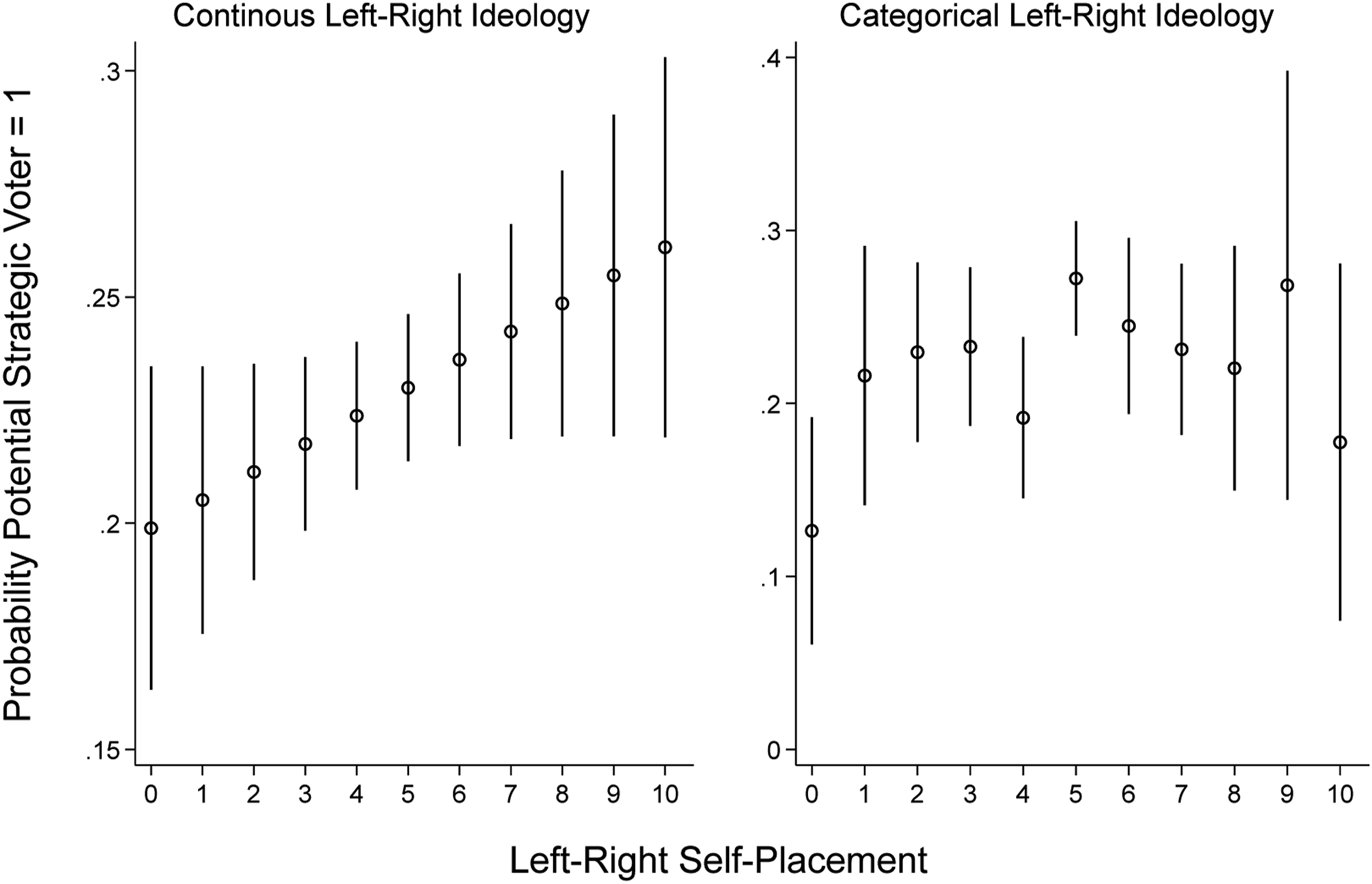
Finally, we would like to make two side remarks about the results of the main analysis. First, it is interesting to note that although centrist voters (5 on the 0-10 scale) are not necessarily more likely to support a party that is not viable (Figure 2), when they are, they are more likely than other voters to cast a strategic vote (Figure 3). Second, the same seems to apply to those who answer ‘Don’t know’ to the ideological self-placement survey question. These results suggest that ideological ambivalence is associated with the probability of casting a strategic vote, which echoes the findings of Daoust and Bol (2020) that shows that ideological polarization increases the probability to cast a strategic vote.
Additional tests
To complete the analysis, we conduct a series of additional tests. First, we evaluate the robustness of the findings of the main analysis for both H1 and H2. In Appendix D, we reproduce it using logit instead of OLS regressions. In Appendix E, we reproduce it in restricting the sample to surveys conducted within weeks of the election. Although most surveys were conducted within 2 weeks (75% within 13 days), two surveys (Austria, 2008 and Greece, 2012) were conducted more than 6 months after the election. Given this long period between the election and the survey, the partisan preferences of the respondents could have changed. In Appendix F, we vary the threshold that we use to separate viable and non-viable parties. In the main analysis, we set this threshold at 0.25 probability of winning at least one seat in the district. We reproduce the main analysis with a more conservative threshold, i.e., 0.10. In Appendix G, we reproduce the main analysis with alternative ways of dealing with missing values. In the main analysis, we use all the observations for which there is no missing value to maximize statistical power. Consequently, the number of observations
Is different in the regressions with and without control variables (because each control variable contains some missing values). To make these regressions comparable, we use two alternative approaches. On the one hand, we re-estimate the regressions without control variables while also removing the observations that have a missing value in one of those control variables (listwise deletion approach). On the other hand, we re-estimate the regressions with control variables but using the ‘multiple imputation’ technique (King et al., 2001) to impute the missing values for control variables.
Figure 4 shows a summary of these robustness tests. It reveals that the findings are robust to these different specifications, samples, and measurement choices in the sense that the coefficients of interest remain relatively constant across regression specifications. However, in the case of H2, they lack statistical significance. Summary of additional tests. Note: Dots are coefficient estimates derived from various regressions specifications predicting the probability of being a potential strategic voter (left panel) or the probability of being a strategic voter among potential strategic voters (right panel). Horizontal bars are 95% confidence-intervals. Full regressions results are available in Appendices D-G.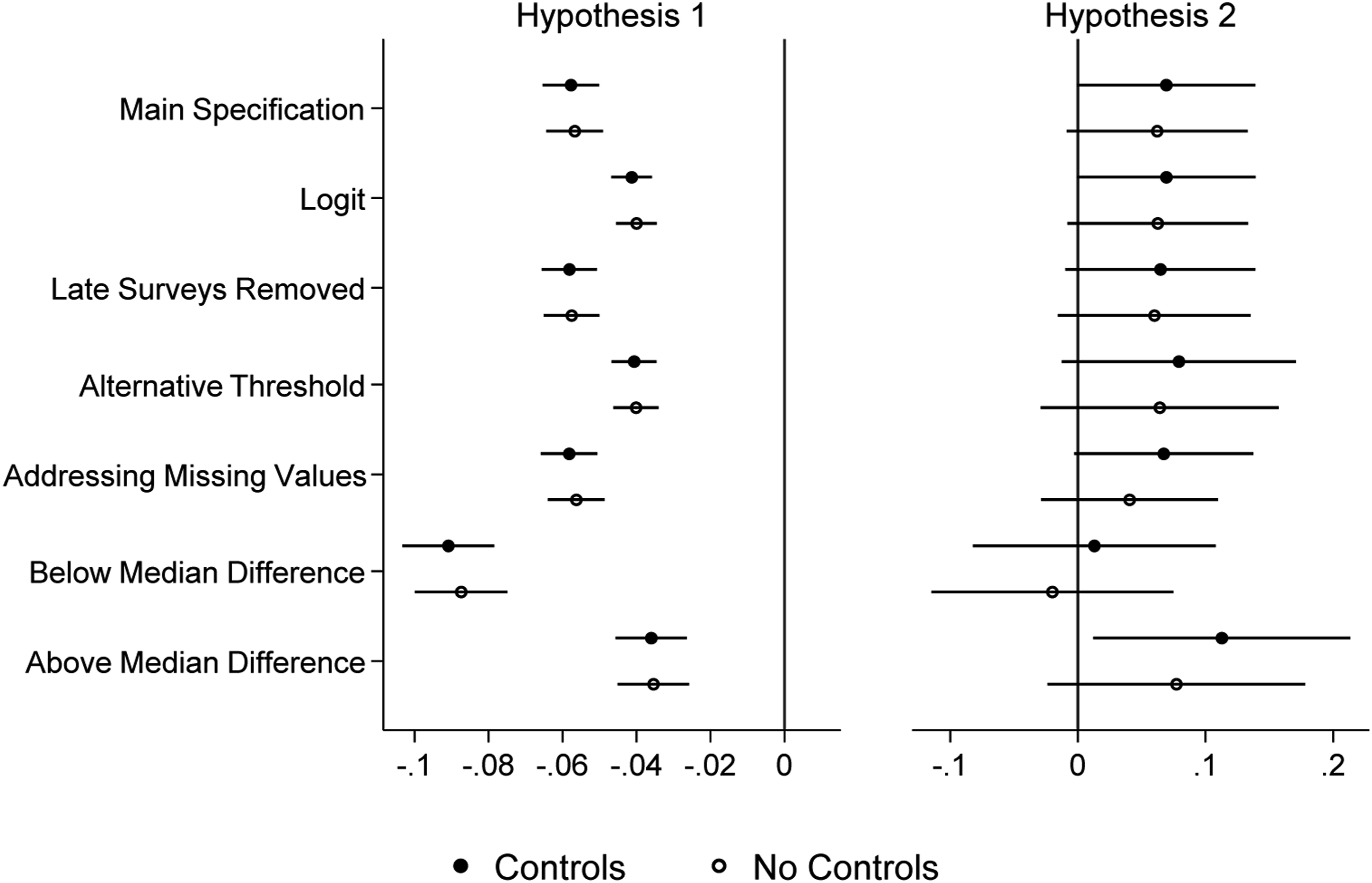
Second, we evaluate the external validity of the finding by evaluating whether the relationship between left-right ideology and strategic voting varies across groups of countries. In particular, we envision the possibility that the patterns observed in the main analysis are exacerbated in countries (or elections) in which there is a large difference between the largest and smallest district in terms of district magnitude. Although there is a mixture of larger and smaller districts in each of the elections of our sample, the difference between the largest and smallest district varies quite strikingly, from one in Iceland (2003) to 46 in Portugal (2009, 2019) (median = 20). Given the centrality of this difference in district size for our argument, we reproduce the main analysis by dividing the sample in two: elections in which the difference between the largest and smallest district is smaller than the median difference, and elections in which this difference is larger or equal than the median difference. Figure 4 reveals that the relationship between left-right ideology and strategic voting is indeed exacerbated and most of the time statistically significant (p < 0.05) in elections where there is a large difference in district size, even for H2. This suggests that the lack of statistical significance observed in the main analysis for this hypothesis is likely due to the inclusion of elections and countries in which there is not much difference between the smallest and largest districts, which creates noise in the estimates.
Third, we test the mechanism behind H2 and by estimating a structural equation model regression on potential strategic voters, in which strategic voting is the dependent variable, and intensity of partisan preferences and left-right ideology are the independent variables (with age, gender, and education as controls). The intensity of partisan preferences is the difference between how much a respondent likes their favorite non-viable party and how much they like their favorite viable party. It captures the ‘cost’ for voters of deserting their favorite party for one that they like less but is nevertheless viable (Daoust and Bol 2020). This variable ranges from one when the respondent has only a small preference for their favorite party and 10 when this preference is maximal (see Appendix B for descriptive statistics). Our structural equation model then assumes that intensity of partisan preference mediates the effect of left-right ideology.
Test of mechanism: structural equation model regression.
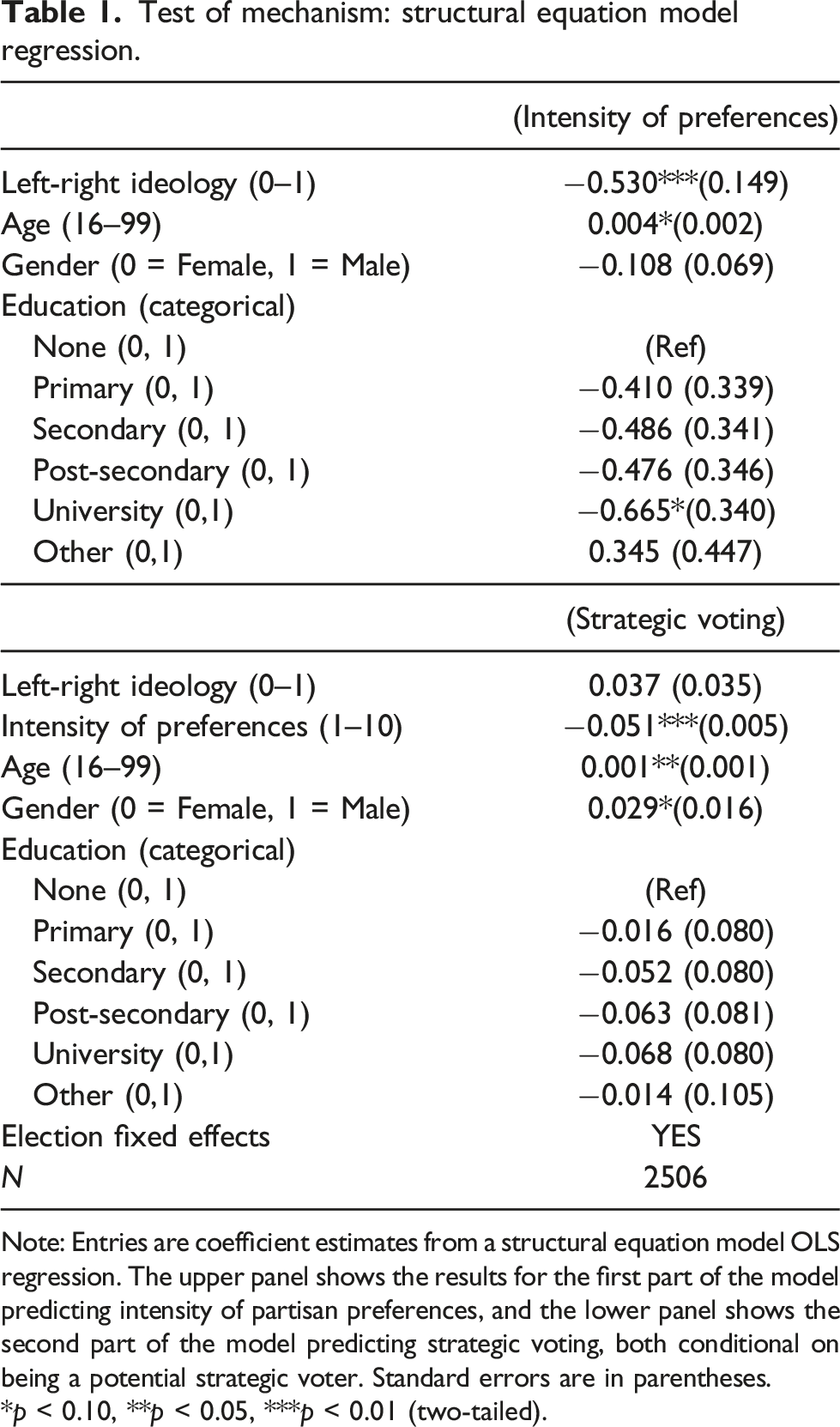
Note: Entries are coefficient estimates from a structural equation model OLS regression. The upper panel shows the results for the first part of the model predicting intensity of partisan preferences, and the lower panel shows the second part of the model predicting strategic voting, both conditional on being a potential strategic voter. Standard errors are in parentheses.
*p < 0.10, **p < 0.05, ***p < 0.01 (two-tailed).
Finally, in Appendix I, we reproduce this test of the mediating effect of partisan preferences by using the categorical version of the left-right ideology variable. It shows that the category four is associated to a higher level of intensity of preferences compared to the categories 6, 7, and 8, although these differences are not statistically significant. Here again, the intensity of partisan preferences mediates a substantial part of the effect of centre-right ideology, which is directly negatively related to strategic voting. Note however that the extreme categories (0, 1, 9 and 10) are those with the highest intensity of preferences, which confirms the findings of Figure 3 about extremist voters from the left and right to be less likely to cast a strategic vote.
Conclusion
In this paper, we investigate whether voters exacerbate or attenuate the partisan bias of districted proportional systems in advanced industrial democracies, according to which right-wing parties are advantaged by being more popular in small districts where the mechanics of the system favor large parties. Analyzing CSES survey data from 44 elections in Western Europe between 1996 and 2019, we find that voters amplify this bias. Respondents who self-identify as left-wing are more likely to support a party that is not viable in their district when compared to right-wing respondents (p < 0.01), they seem to be less likely to end up voting strategically by deserting this party for one that is viable (p < 0.1). This is especially true in countries with large differences between the smallest and largest districts (p < 0.05). Note however that on both sides of the ideology spectrum, the most extreme left-wing and right-wing voters are those that are the least likely to cast a strategic vote (not significant). We further investigate the mechanism behind the association between left-right ideology and strategic voting. We find that it is largely captured by the intensity of partisan preferences (p < 0.01). This suggests that left-wing voters seem more reluctant to desert their favorite party because they feel more attached to it than right-wing voters.
Our findings contribute to the literature on electoral systems by showing ideological patterns in strategic voting seem to reinforce the partisan bias of districted proportional systems in advanced industrial democracies. Right-wing voters seem to be more likely to make their vote count by avoiding parties that are unlikely to win a seat in their district. By doing so, they seem to adopt a strategy to maximize their chances to influence the electoral outcome in the short term. By contrast, left-wing voters seem to be more likely to waste their vote by supporting parties that have little chance of winning a seat in their district. Note however that this loyalty vote might have some positive spillover effects in the future, for example by signalling to other parties or the electorate at large that their favorite party has supporters in the district. Yet, it is also true that the reluctance to vote strategically does not contribute to the representation of their political preference in parliament in the short term.
Supplemental Material
Supplemental Material - The psychological partisan effect of electoral systems: How ideology correlates with strategic voting
Supplemental Material for The psychological partisan effect of electoral systems: How ideology correlates with strategic voting by Damien Bol, Andrew Hunter and Gabriela Aguirre Fernandez in Party Politics
Footnotes
Acknowledgements
We presented previous versions of this paper at the Centre for Institutions and Political Behaviour of Durham University, the 2022 EPSA Annual Meeting in Prague, and the 2022 EPOP Annual Meeting in Newcastle. We would like to thank the participants to these meetings and seminars for their helpful comments and feedback. We would also like to give a special thank you to André Blais for his careful reading of this paper and his pertinent suggestions.
Declaration of conflicting interests
The author(s) declared no potential conflicts of interest with respect to the research, authorship, and/or publication of this article.
Funding
The author(s) received no financial support for the research, authorship, and/or publication of this article.

Supplemental Material
Supplemental material for this article is available online.
Notes
Author biographies
References
Supplementary Material
Please find the following supplemental material available below.
For Open Access articles published under a Creative Commons License, all supplemental material carries the same license as the article it is associated with.
For non-Open Access articles published, all supplemental material carries a non-exclusive license, and permission requests for re-use of supplemental material or any part of supplemental material shall be sent directly to the copyright owner as specified in the copyright notice associated with the article.
