



Abstract
As some of the most experienced political actors, party leaders usually have extensive careers spanning multiple decades, competencies, and institutions. The literature on party leaders, however, has not yet incorporated the wealth of information that these careers have. Therefore, this article introduces career capital as a new continuous measure of political experience and hypothesizes that more career capital leads to longer tenure. In contrast to findings from previous studies, I show that career capital does contribute to party leaders’ survival in office in several analyses of party leader duration in Canada, Germany, the Netherlands and Switzerland in the postwar period (1945–2023). In addition, because career capital is accumulated in three separate institutions, I examine the differences between these descriptively and show in the analysis that especially previous experience in legislative office is conducive for party leaders to remain longer in office. Lastly, the results indicate that the relationship between career capital and party leader duration is non-linear and subject to the effect of attrition, signifying that political experience acquired shortly before entering party leader office is more important for political survival.
Introduction
On the 7th of December 2018, Angela Merkel stepped down as the party leader of the CDU. She announced her resignation in October of that year after the CDU/CSU had lost regional elections in Hesse and Bavaria. Serving as chancellor of Germany for 16 years and serving as party leader of the CDU for 18 years, she is arguably one of the most successful politicians of the European postwar era. Her Dutch counterpart, prime minister Mark Rutte, has also spent considerable time as leader of both his party (since 2006) and his country (since 2010), and has become the longest-serving prime minister in Dutch history. One aspect that both leaders have in common is extensive political experience, both within their party and in national executive positions. While Merkel entered the Bundestag in 1990, after German reunification, Mark Rutte was the leader of the VVD’s youth wing between 1988 and 1991 and served in the party executive for a few years in the 90s. The success of both party leaders is related to their ability to accumulate political experience within political parties that are well-established and have had abundant access to executive offices.
These two leaders are prominent examples of career politicians with significant political experience, which raises the question: To what extent does political experience matter for party leadership duration?
The literature on party leaders has so far concentrated on the kind of leaders that are selected, how they are chosen, and what factors aid their survival. However, whether their political career prior to holding their leadership position in the party matters for leadership survival remains underexplored (Pilet and Cross 2014, 6; Musella 2018, 1). In other words, ‘systematic research on political career patterns of top politicians is necessary’ (Müller-Rommel et al., 2020, 230) and the political career literature and the party leader literature leave clear room for a comparative study as existing studies are mostly case studies. Lastly, whereas previous studies on party leader survival do incorporate binary variables measuring political experience, survival models benefit from including a more fine-grained measure that better captures the entirety of previous career experience.
Thus, I introduce career capital as a systematized concept of political experience signifying the amount of human, social and cultural capital a party leader has. Theoretically, I provide a novel connection between career capital and leadership survival through the mechanisms of accumulation, attrition and diminishing returns (McFadyen and Cannella Jr 2004; Noel and Finocchio 2022). Empirically, career capital is operationalized in a more fine-grained manner by providing a continuous measure of the sum of career sequences in the executive, the legislature, and the party, and functions as an explanatory factor in survival analyses of party leader duration across four democracies in the postwar period (1945–2023). The results show that career capital is an important explanatory factor for party leader survival.
This paper is structured in six sections. First, I survey existing research on party leader succession and survival, political careers, leadership capital, and personalization, and show that the literature does not yet convincingly address how political experience matters for party leader exit. Second, I argue that the theories of human, social and cultural capital are insightful for understanding the relevance of accumulating political experience in the form of career capital. Third, I formulate the hypothesis that having more career capital is conducive to staying in office longer. Fourth, I provide a sequential operationalization of political careers to create a continuous measure of career capital that retains much more information on political experience than previously used measures. To that aim, in a fifth step, I display the cross-country and cross-party variation of this measure in the descriptive results section and calculate proportional hazard models in the analysis to investigate its effects on leadership duration. Lastly, I reflect back on the research question and propose avenues for further research.
Careers, party leaders and leadership survival
When examining the relationship between party leaders’ political experience prior to them becoming leaders and their survival as party leaders, I first look at literature on the dependent variable of leadership survival, then focus on previous work related to the explanatory variable of career capital, and lastly, discuss the relevance of the party leader focus in the context of the presidentialization/personalization thesis.
Party leader survival models studies overview.
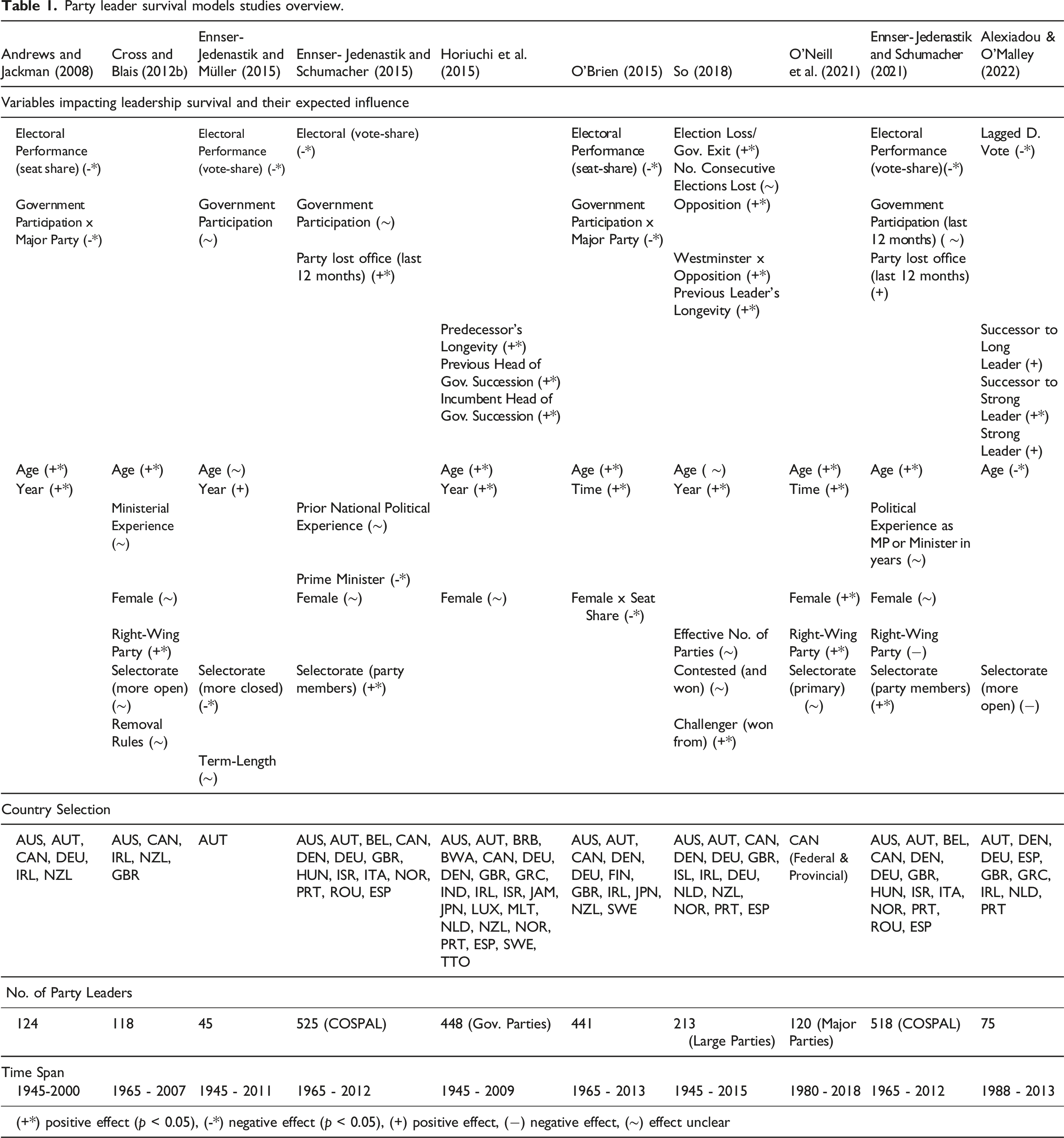
Second, the party leader survival literature focuses on ’the factors that determine the political and professional fates of individuals’ and their life expectancy’ (Hart and Uhr 2011, 13) and consists of two traditions, first the more in-depth case studies on leadership transitions and successions (Jackson 1975; Bille 1997, t Hart 2007; Bynander and Hart 2008; Mazzoleni and Rossini 2016), and second, the studies that explicitly include hazard models (see Table 1). 1 Importantly, four different factors that influence survival warrant consideration: institutional (Cross and Blais 2012b), situational (Andrews and Jackman 2008; Ennser-Jedenastik and Schumacher 2015, 2021), perceptual (Horiuchi et al., 2015; So 2018; Alexiadou and O’Malley 2022) and individual factors (O’Brien 2015; O’Neill et al., 2021). Institutionally, party leaders might be political leaders in Japan, a country with traditionally weaker leaders, that want to hold political power (Burrett 2016); situationally, party leaders might fullfil party goals, i.e. perform well and therefore stay longer (Ennser-Jedenastik and Schumacher 2021); perceptually, party leaders might have a long lasting predessor that makes it harder to succeed (Hart and Uhr 2011; Horiuchi et al., 2015; So 2018), or they might face a strong challenger that forces them out of office, which happened for instance to Jean Chrétien (Cross and Blais 2012b, 89). Individually, they might be ’technopols’, i.e. highly educated politicians with a lot of political resources and therefore a high level of security in leadership (Joignant 2011). Among all these factors, the career capital concept could be included as an individual level explanation.
Second, looking at how career capital as new measure can be added to the leadership survival literature, it is insightful to conceptualize careers-as-sequences (Gauthier et al., 2010; MacKenzie, 2009; Turner-Zwinkels, 2020). In this approach, careers are viewed holistically, as a succession of jobs that can be quantified to provide a measure that can be used in empirical analyses. What type of career positions politicians have held is relevant, as it has significant implications for their legislative behavior while in office (MacKenzie and Kousser 2014, 7). For instance, for German parliamentarians and Dutch ministers, extensive political career experience in the party increases their chances of career progression to higher party group offices, or to the cabinet (Ohmura et al., 2018; Turner-Zwinkels and Mills 2020). In contrast, being a political outsider with a rather short career reduces politicians’ chances of climbing the party ranks (Bailer et al., 2013). In Canada, parliamentarians with more diverse careers are more likely to be promoted to cabinet (Kerby and Snagovsky 2021). Such previous findings demonstrate that conceptualizing careers-as-sequences better captures the complexity of political experience than a simple political tenure measure (for instance, time as a member of parliament in years).
Moreover, to grasp the usefulness of careers-as-sequences conceptualization in aiding our understanding of party leaders’ previous political experience, it is pertinent to examine how earlier party leader studies have examined party leaders’ backgrounds. Existing party leader literature distinguishes party leaders mostly in several binary or qualitative ways 2 (Costantini and Craik 1972; Ceron 2012; Schumacher et al., 2013; Schlieben 2014; O’Brien 2015; Garzia 2017; Somer-Topcu 2017; Ceron 2019; Fernandez-Vazquez and Somer-Topcu 2019; Gherghina 2019). Moreover, a few articles hint at the importance of considering party leaders’ political experience. For instance, several case studies demonstrate that party leaders often have considerable political experience before they reach the highest party office (Strøm 1993; Katsourides 2012; Quinn 2012; Barber 2014) (for more detail, see appendix section 1). Although these authors all point to the importance of political experience, they do not necessarily highlight it among other factors and nor do they operationalize it as the result of an extensive political career spanning multiple years and covering multiple positions.
Lastly, previous research on personalization and presidentialization asserts that party leaders have become more prominent in three main dimensions: the party, the legislature and the executive (McAllister 2007; Poguntke and Webb 2007; Garzia 2011; Webb et al., 2012; Musella 2015). Taken together with other trends, such as increasing party fragmentation, partisan dealignment (Garzia et al., 2022; Musella 2022) and the rise of populism and populist parties (Inglehart and Norris 2016; Muis and Immerzeel 2017; Rooduijn et al., 2019), this literature points to the relevance of studying political leadership generally, and party leaders in particular. Here, several factors are important: the increasing use of direct party leader elections (Cross et al., 2016; Ignazi 2020); the influence of party leaders in the capacity of prime minister (Marland 2020; Musella 2022); the potential influence of party leaders over their parties’ policies, candidate selection and party organization (Marino et al., 2021); the media-related focus on leaders (Takens et al., 2015; Aaldering et al., 2018); and the extent to which voters base their electoral decisions on leadership evaluations (Garzia 2017; Ferreira da Silva et al., 2021). While empirically the importance of these trends and factors greatly depend on party and electoral context (Garzia 2019; Marino et al., 2021; Quinlan and McAllister 2022), they nevertheless point to the pertinence of studying party leadership.
The research contribution of this paper is threefold: (1) a new comparative investigation of career capital with a focus on party leaders as the population; (2) a conceptualization of political experience as career capital; and (3) an incorporation of career capital as a fine-grained measure in leadership survival models. The result is a dissection of party leaders’ political careers and an analysis that answers the question to what extent career capital aids survival. The following section provides the theoretical framework, in which I define career capital and discuss mechanisms and hypotheses.
Theoretical framework
Career capital can be seen as a systematized concept of political experience (Adcock and Collier 2001). While it can be said to consist of many features (Sutherland et al., 2015), here, I first discuss the three main theoretical attributes of this concept for party leaders to show what aspects of it can be theoretically accumulated before I turn to the empirical mechanisms that indicate to what extent career capital is linearly related leadership survival. The three attributes are: human capital, social capital and cultural capital (see Figure 1), which all potentially add to party leaders’ capacity to produce political value or credit (Turner-Zwinkels and Mills 2020, 7). In other words, career capital implies that there is a possibility to systematically accumulate skills, relations and reputation (Bennister et al., 2015, 2017) and has its origin in the concept of political capital (Bourdieu 1991).
The first attribute is human capital (Judge et al., 1995; Kwon 2009; Ng and Feldman 2010). It signifies that successful individuals possess certain skills and knowledge, obtained through educational or career experience and on-the-job training. While education indicates more general human capital, prior experience in jobs with similar requirements are an indication of holding task-specific human capital, which, subsequently, is closely linked to job performance (Hirano and Snyder, 2019: 90, 188). Examples of task-specific human capital in the political domain are leadership skills garnered as a minister, and electioneering abilities achieved through political campaigns. 3
Social capital is concerned with the relations between people (Coleman 1988, 100; Dasgupta and Serageldin 2000; Bennister et al., 2015; Burrett 2016, 39). Politically, this consists of trustworthiness, obligations, and information access (Coleman 1988). More political experience in the various party, legislative and/or executive offices, therefore, increases the likelihood that one is considered more trustworthy, builds favorable relations through trading favors with other politicians, and therefore also has access to important political information channels. In other words, more social capital entails that a party leader has accumulated more intra-party support throughout their political career that helps maintain their legitimacy and credibility while in a leadership role.
A third, more indirect attribute of career capital is cultural capital (Erikson and Josefsson 2019). This is defined as ‘the set of ideas, practices, beliefs, traditions, and values which serve to identify and bind together a given group of people’ (Throsby 1999, 7). Arguably, a core component of almost any political job is that it encompasses representing a larger group of people and embodying their values and practices. Within the context of national politics, cultural capital should be mainly understood as ‘affinity with elite culture’ (Noordzij et al., 2019, 440). Essentially, having more career capital, especially on the national level, implies that a politician better understands elite culture and how to maintain a good reputation (Bennister et al., 2017). This in turn means that they are better able to manoevre in the national political arena because a more extensive political career functions as a more thorough political socialization process through which one more strongly identifies with national traditions, practices, and beliefs. Conceptual Framework (Adcock and Collier 2001; Goertz 2012).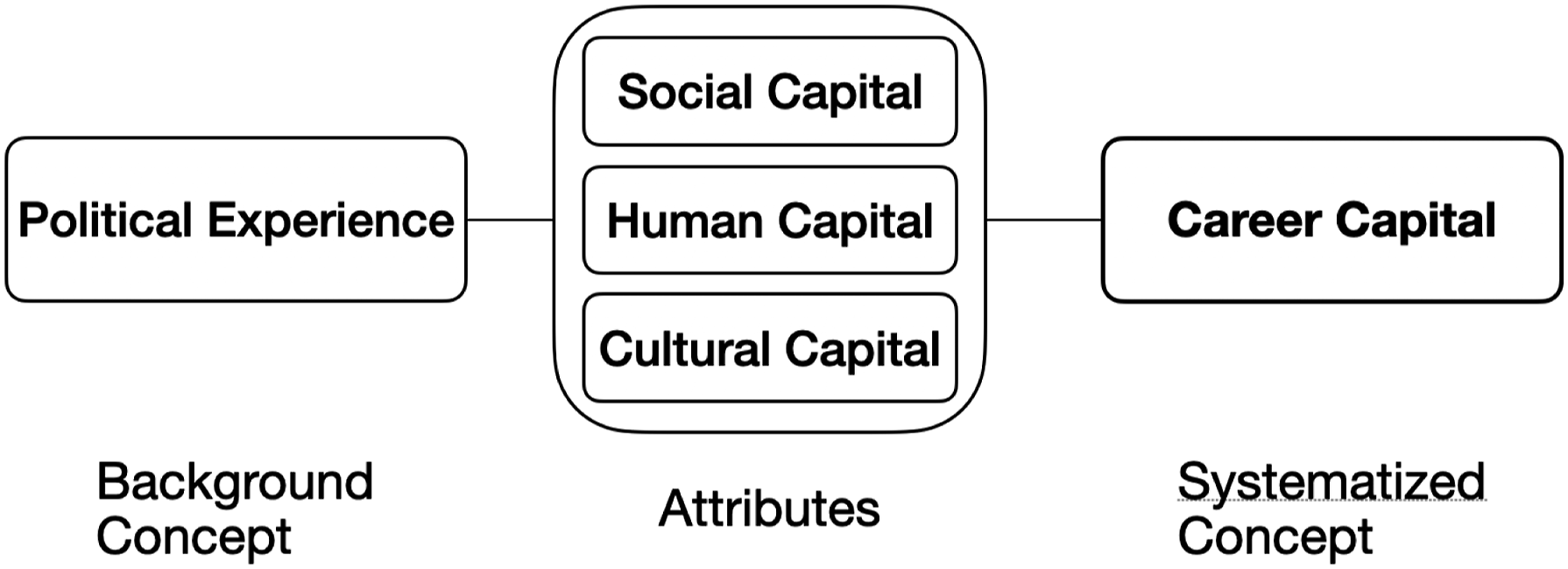
Mechanisms and hypotheses
Party leaders that enter their leadership stint with more human, social and cultural capital thus have a greater probability to further accumulate skills, networks, and reputation and subsequently maintain the support needed to effectively lead their party and remain in office. As an important side note, even if parties do not always elect leaders that have greater career capital - though Hirano and Snyder (2019) find evidence that at least in primaries, they do more often than not -, the general expectation still remains:
The greater party leaders’ career capital, the longer they will stay on as a party leader
Moreover, the relationship between career capital and party leader survival might not be linear. Indeed, previous research (Shephard and Färe 1974; McFadyen and Cannella Jr 2004; Noel and Finocchio 2022) indicates that accumulated capital might be prone to the effect of attrition or diminishing returns for which I formulate two additional hypotheses (see Figure 2). First, the career capital a party leader accumulates early in their career might be less relevant for their survival than the career capital they obtained right before they became a party leader. For instance, having been a minister ten years ago is probably less relevant for a party leader’s networks than having been a minister one year ago. In this regard, Ohmura et al. (2018: 170) point to the importance of networks within the party, as ‘well-established party contacts can also help parliamentarians to be elected into attractive party group positions’. In other words, it is important to draw a distinction between recent and older networks when looking at the benefits of career capital for the time spent in office. To test this, I formulate a second hypothesis that concerns capital attrition:
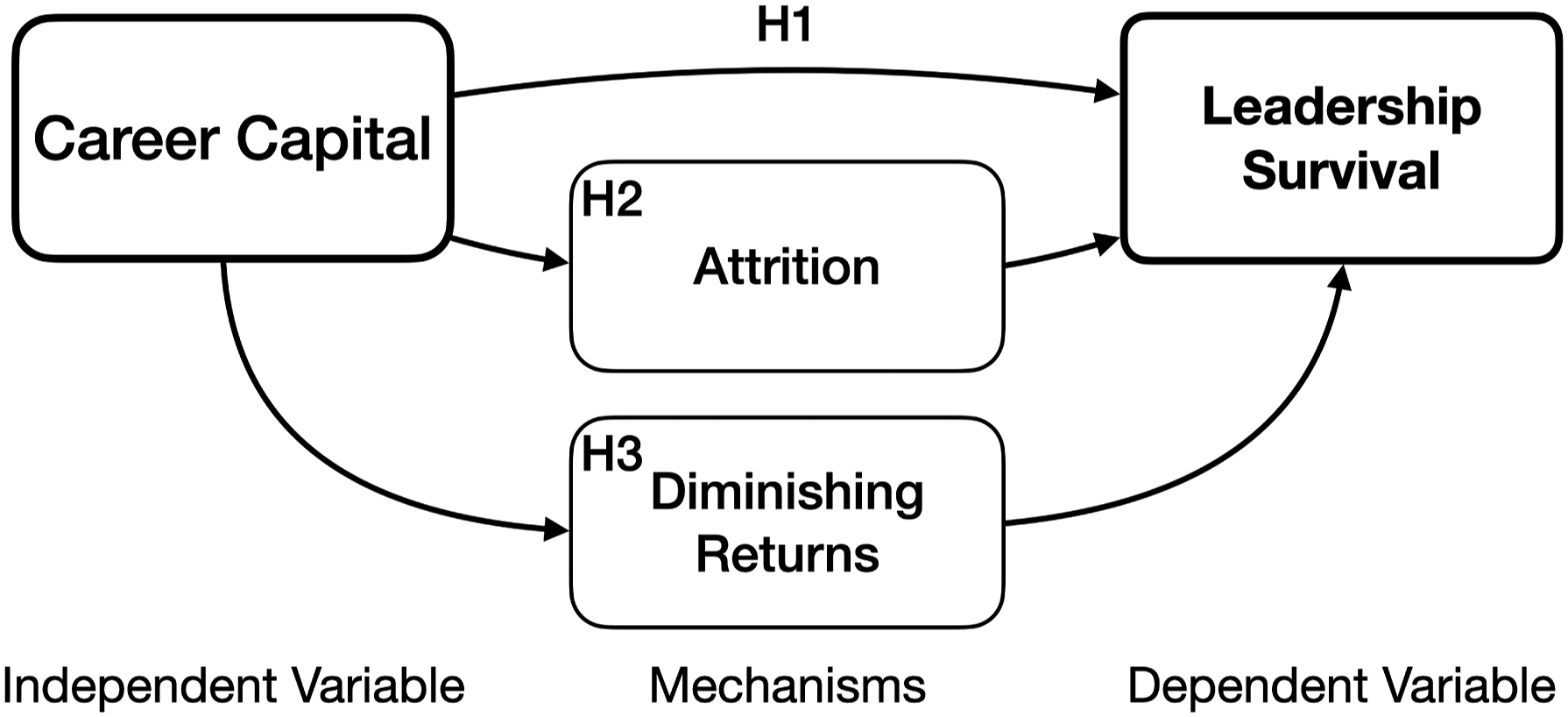
Mechanisms and Leadership Survival.
Career capital has a larger effect on party leader survival if acquired more recently
Second, after gaining a certain amount of political experience, a party leader might not necessarily benefit much from more experience. For example, after two terms experience as a cabinet minister, a third term might not provide much more benefit for the accumulation of human, social and cultural capital. This effect of diminishing returns is well-documented in the literature with regards to monetary capital (Knight 1944; Shephard and Färe 1974; McFadyen and Cannella Jr 2004). This leads to the third hypothesis:
The effect of career capital on party leader survival is subject to diminishing returns
In addition, following Hirano and Snyder (2019: 93) who distinguish between broader relevant political experience and specific relevant experience, I will differentiate in the operationalization between broader overall career capital and experience within specific institutions (the executive, the legislature and the party) to further examine the empirical components of career capital.
Case selection
The case selection includes party leaders from parties that hold seats in the following four parliaments: the Canadian House of Commons, the Dutch Tweede Kamer, the German Bundestag, and the Swiss Nationalrat. These four cases ensure variation in electoral systems and federal structures in the study (Lijphart 2012). In addition, they provide a balanced variation in terms of population size (approx. 9 (CH), 17 (NL), 38 (CA), and 84 (DE) million; see Worldometer 2022). This variation increases comparability and generalizability across different parliamentary systems (Müller-Rommel et al., 2020, 242).
The dataset is inspired by the PCC (2021) database, which contains information on political careers in Germany, Switzerland, and the Netherlands. It contains 387 party leaders and 2721 career positions that were held within the political executive, the legislature, or the political party in the above-mentioned four parliamentary democracies for the post-war period (1945–2023).
While it is relatively easy to define other party elites, such as party group leaders and (vice)-prime ministers, previous research cautions that identifying the party leader is not always straightforward (Strøm 1993, 322; Pilet and Cross 2014, 224-5). I coded the following positions as being the party leader: (CA) party leader, (CH) party president, (DE) party chairman, (NL) party leader (see appendix Table 4). All party leaders can be found in appendix Table 5, with missing cases in appendix Table 6.
Methods and operationalization
The main dependent variable of interest is party leaders’ tenure, or time in office (Andrews and Jackman 2008). It is sensible use this variable as it is ‘the simplest criterion’ of success (Rhodes and Hart 2014, 13), and an indicator of leadership capital (Bennister et al., 2017). Therefore, I use leadership duration as a way to improve our understanding of the relationship between party leaders’ career capital prior to obtaining office and their achievements while in office.
Methodologically, I opt for Cox proportional hazard regression (Cox 1972; Mills 2010) with maximum likelihood estimation (MLE), which is in line with previous studies conducted on party leader survival (see Table 1). There are three main benefits to this approach: it utilizes time as a dependent variable, it does not make assumptions about a functional form, and it presents results that are relatively straightforward to interpret.
Career capital
Career capital is empirically defined as the quantified and standardized sum of individual political experience within the party, the legislature and the executive. This is, in other words, the succession of jobs within each institutional dimension aggregated by individual. Here, following the Parliamentary Careers in Comparison Project (PCC, 2021), I separate political positions in the legislative, executive and party dimensions as the most relevant dimensions along which to delineate the political experience of party leaders.
To measure career capital, I use a classification scheme (see Table 3 in the appendix), which combines positions along two axes: the domain and competency axes. The domain-specific axis orders career positions by territorial level (local, regional, national or international) and by institutional dimension (the political executive, the legislature and the political party), while the competency-specific axis is about the type of position held (see appendix section 2 for more detail).
I determine the hierarchy between positions within each institutional dimension by the average age at which party leaders start the position. This average age is used to sharpen the measurements used in two ways: its first function is to determine which career position should be coded if multiple positions within the same institutional dimension were held at the same time, and its second function is to weigh the positions in the aggregated measure of career capital, which I turn to now.
Aggregation and hypothesis testing
In order to measure these multidimensional careers per party leader, I opt for a supervised approach. The aggregation formula is as follows:
Wdim,i = a positive standardized weight based on average age at which party leaders start career position i in institutional dimension dim.
t i = time in career position i for party leader j.
The above-mentioned weight (Wdim,i) is based on the average age at which party leaders obtain the specific political position (see classification Table 3). In addition, this measure is split up into career capital acquired within the last five years before entering office and career capital acquired prior to that to account for possible attrition (hypothesis 2). Furthermore, it is split up into quintiles to examine whether having more career capital is subject to diminishing returns (hypothesis 3). In other words, career capital might mostly be relevant up to a certain point, but the benefits of additional career capital when one already has accumulated much of it might decline.
Aside from these measures of overall career capital, I also include the separate institutional dimensions in the empirical analysis. These are the political executive, the legislative, and the party dimension. Arguably, experience in the executive, legislature, and political party could be more or less relevant for survival in office. Therefore, as components of overall career capital, these variables might give an indication as to what specific dimension of career capital is most relevant for party leader survival.
Overview of variables
The dependent variable is coded as days in office, with party leaders that are still in office included and right-censored in the sample. Other party leaders that are right-censored due to a party’s merger, illness or promotion into the Swiss Bundesrat can be found in the overview of cases in appendix Table 5. If concrete entry and/or exit dates are not available, I use years to approximate days in office. Furthermore, as possible confounders, I include variables that have been shown to potentially impact leadership survival (for a variable overview, see appendix Table 7).
There are four types of factors mentioned in the literature review that have been found to influence leadership survival: institutional, situational, perceptual and individual-level factors (see Table 1). To increase comparability across parties and countries, several of these factors are incorporated in my own analysis. While the literature agrees on many accounts, they remain very context-dependent across the board. For instance, for institutional factors, in many Westminster democracies, having a more open party leader selectorate does not influence party leaders’ tenure (Cross and Blais 2012b), while in continental parliaments, having more open contests has a negative influence on time spent in office (Ennser-Jedenastik and Müller 2015; Ennser-Jedenastik and Schumacher 2015, 2021). Moreover, candidate selection might also be considerably influenced by other factors, such as the party law in Germany (see, for instance, paragraph 9 of the German party law 4 ) or the rotation principle in the German Green party in the 1980s.
As for situational performance, government participation matters for survival, but only for major parties (Andrews and Jackman 2008; O’Brien 2015). In addition, situational performance might also be driven by highly contextual exogenous factors. For instance, electoral performance could be high due to unpopularity of the incumbent and the weakness of the economy, not because of a party leader’s well-run election campaign. In essence, expectations from a party leader’s selectorate are relative and hard to measure. A minor loss could still be seen as a win if polls were particularly bad or the party partakes in a coalition after the elections. It is therefore important to control for both electoral performance and government participation. These latter two measures are related to other perceptual factors that have been found to influence leadership survival, such as a predecessor’s longevity. As for individual factors, female party leaders often arrive in office under more difficult circumstances, but at the same time, if they perform well, they generally stay longer than male party leaders (O’Brien 2015; O’Neill et al., 2021).
The control variables included here are: on the individual level, prime minister (yes, while in party leader office/no), gender (1 = female) (O’Brien 2015; Müller-Rommel et al., 2020, 233; O’Neill et al., 2021) and age at entry (Turner-Zwinkels and Mills 2020). As for situational confounders, I add variables that are collected per party at the monthly level (Ennser-Jedenastik and Schumacher 2021): 5 government participation (categorical), election outcome (categorical), grace period (yes/no) and seat share (categorical). In addition, I also collect variables that are practically constant per party: party leader removal body (yes/no) (Cross and Blais 2012a), and party family (categorical). To account for possible trends, I add time period (in years). In order to account for further institutional differences (O’Brien 2015), I also add country fixed effects (CA, CH, DE, NL). See appendix Table 7 for the summary statistics. Before moving on to the survival analysis, I first present a descriptive overview of party leaders´ career capital.
Descriptive analysis
In the plots displayed in Figure 3, party leaders’ career capital is displayed across parties and countries, so that the different political arenas are clearly visible. The plots show entropy
6
on the y-axis, i.e, the diversity of positions held, and age in years on the x-axis (Gabadinho et al., 2011).
7
Overall, there are 66 party leaders in Canada, 86 in Germany, 121 in the Netherlands and 109 in Switzerland. Career Capital of Party Leaders in Thirty-Five Parties, Four Countries and Three Dimensions with .95 Confidence Bounds in the Party Plots and Entropy plots from the ggseqplot package (Raab 2022). Based on Gabadinho et al., (2011) (67): The entropy is 0 when all party leaders hold the same position in a given year and is 1 when the same proportion of party leaders are holding each possible career position (see equation 2
6
).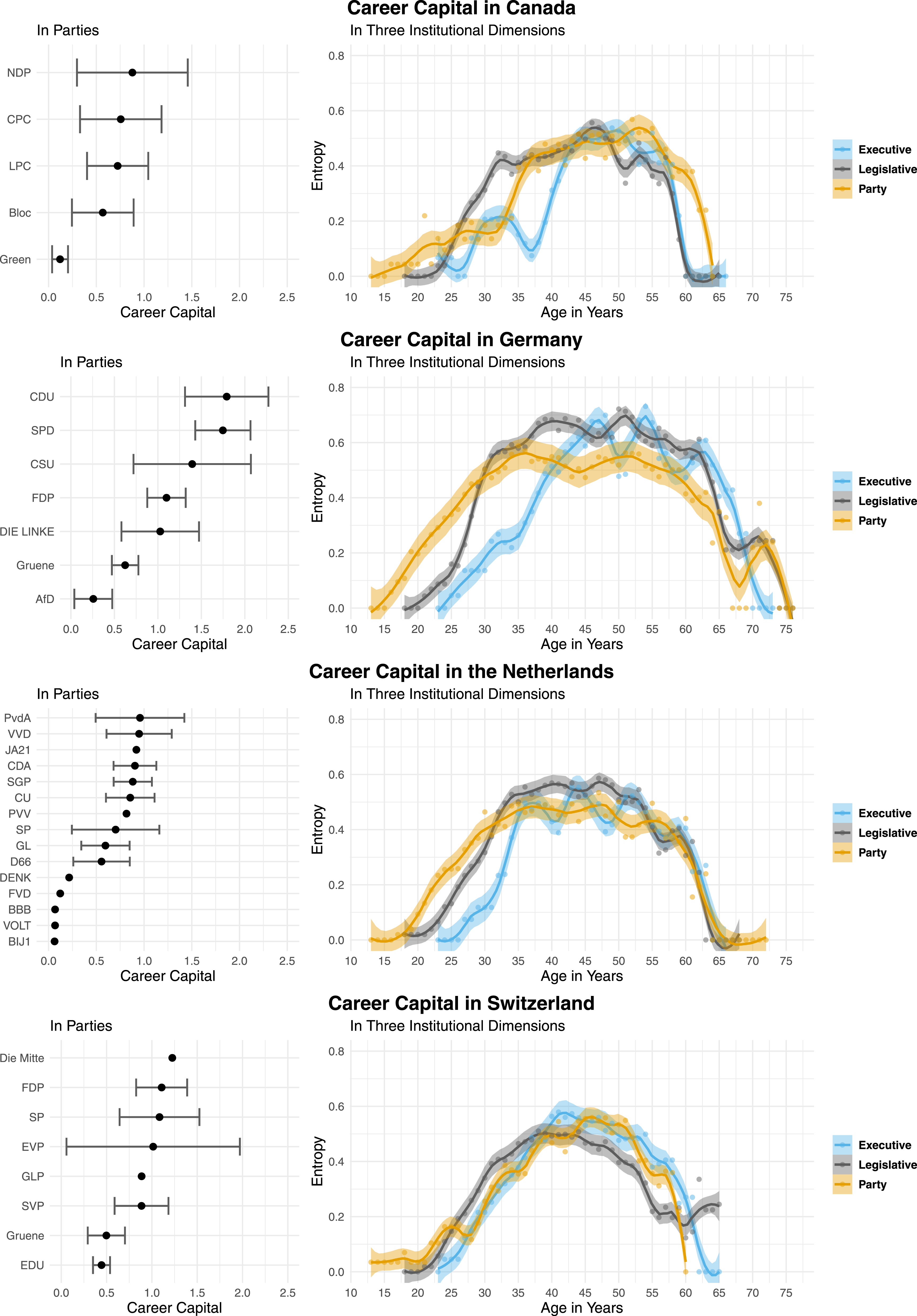
This overview reveals some clear patterns. In terms of entropy, party leaders in Germany have the most diverse careers over the longest time span. In addition, they also hold the most career capital, with especially the large traditional government parties - the CDU/CSU and the SPD - possessing party leaders with the most political experience. In Switzerland, in comparison, party leaders have the least diverse careers and also over the shortest time span. This is probably in part due to the Swiss militia system (Bundi et al., 2017). In Canada, there is little variation between parties, with the provincial level playing a significant role for party leaders’ career capital in this federal system. Interestingly, there is a small increase between the age of 30 and 35 for executive functions, but the general pattern of first party positions, then legislative positions and lastly executive positions becoming more dominant in party leaders’ careers also holds in Canada. In general, political executive careers are usually shorter and less diverse compared to careers in the legislative and party dimensions. Another general trend is the relative lack of career capital in newly established parties in all countries, showing a lack of political experience of most political entrepreneurs. This latter finding especially plays a role in the Netherlands, as the increased fragmentation of the party landscape and electoral volatility entail having party leaders with less political experience. Overall, Figure 3 shows that party leaders start their political careers around the age of 36 (ci: 16–55), usually in the party, and enter party leader office around 49 (ci: 31–67).
In order to examine whether more recent party leaders hold less or more career capital, Figure 4 displays the distribution of career capital over time. This figure shows that there is no general trend, with the variation of career capital being the highest in the decades between 1950 and 1970, and between 1990 and 2020. Interestingly, party leaders who started around 1980 generally have the lowest amount of career capital. Furthermore, with an increasing amount of nationally active political parties in all countries, the number of party leaders has also gone up significantly over time with about 50 per cent of all party leaders entering office after 1989. Other patterns are in part country-driven.
8
With this descriptive overview of political careers in mind, I now turn to the application of career capital in the survival analysis. Career Capital Time Distribution.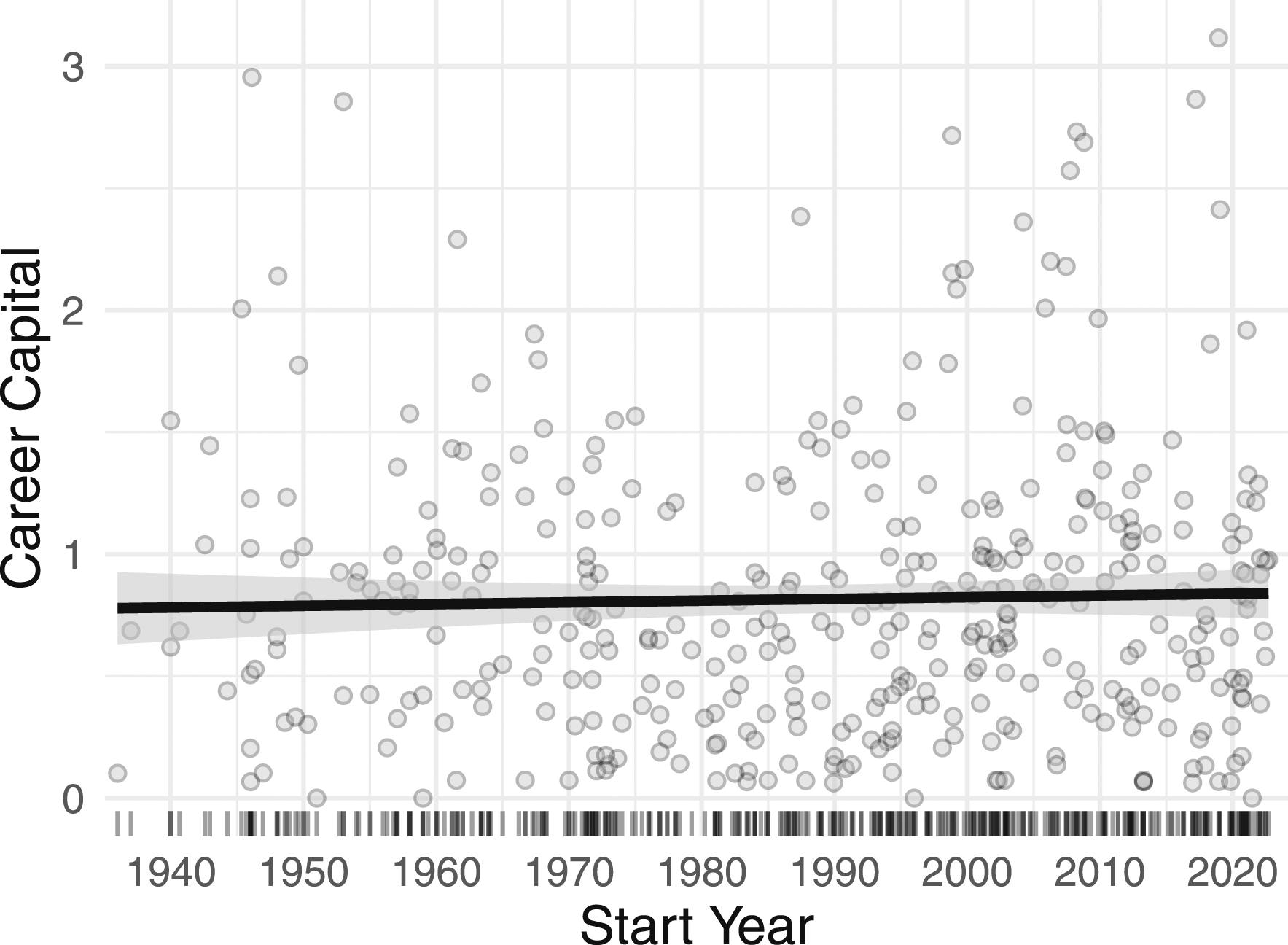
Survival analysis
Cox regressions of party leader survival.
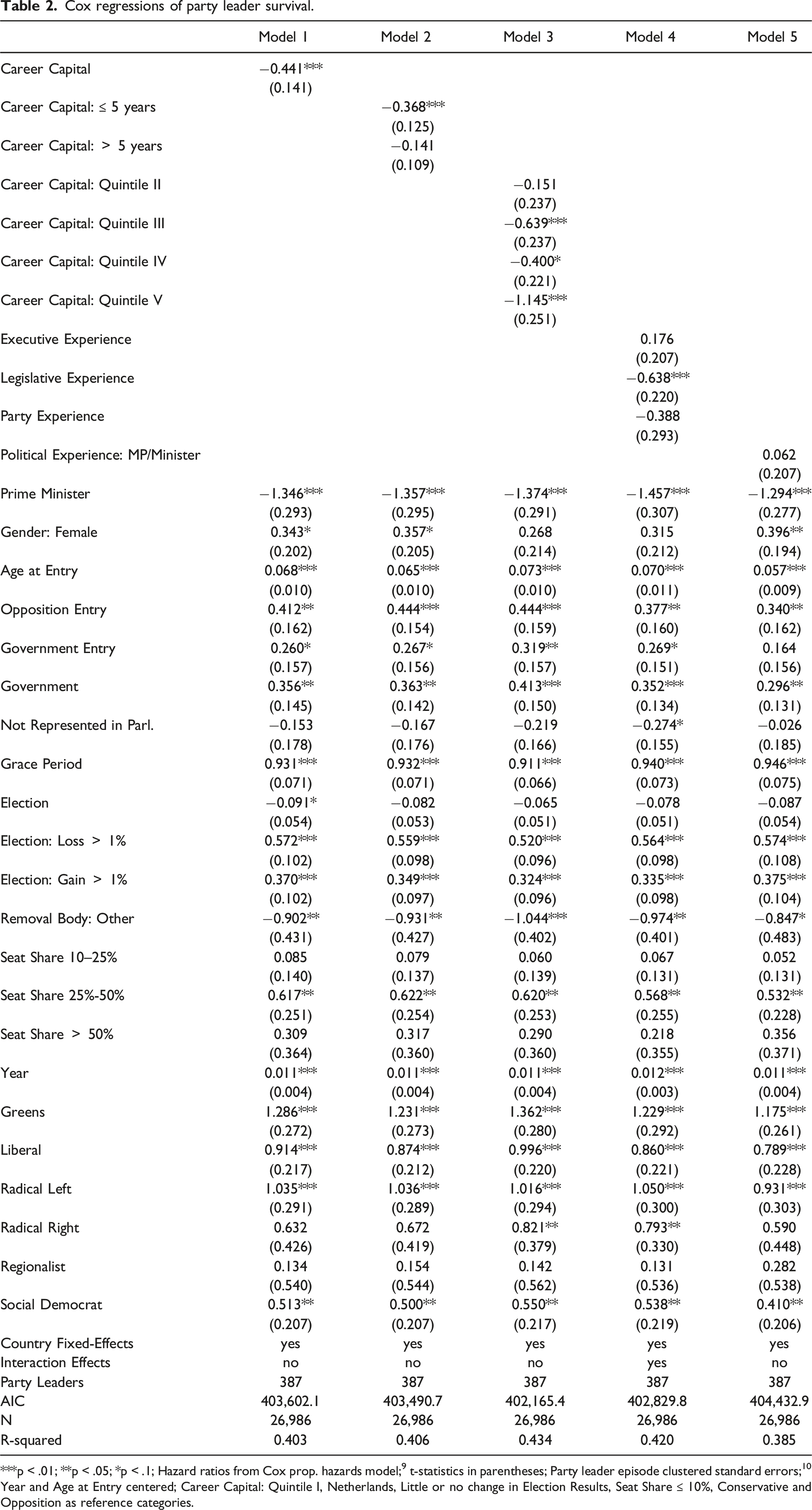
***p < .01; **p < .05; *p < .1; Hazard ratios from Cox prop. hazards model; 9 t-statistics in parentheses; Party leader episode clustered standard errors; 10 Year and Age at Entry centered; Career Capital: Quintile I, Netherlands, Little or no change in Election Results, Seat Share ≤ 10%, Conservative and Opposition as reference categories.
Model 1 shows that career capital significantly influences party leader survival, therefore providing evidence for hypothesis 1. The hazard ratio of 0.64 (ci: 0.49-0.85, p
Model 2, which accounts for attrition, seems to indicate that the relationship between career capital party leader duration is largely driven by career capital acquired in the five years before entering office, therefore supporting hypothesis 2. For recent career capital (≤ 5 years, model 2), the hazard ratio of 0.69 (ci: 0.54-0.88, p
Importantly, model 3 provides no evidence for hypothesis 3 concerning diminishing returns. In contrast, having more career capital seems to disproportionately pay off as the effect of having career capital in the fifth quin-tile is significantly stronger than in any of the other quin-tiles. Model 3 does show, however, that the benefits of career capital are non-linear and its lower AIC and slightly larger R-squared seem to indicate that separating career capital into quin-tiles makes for a better model fit.
When the separate institutional components of career capital are included, both legislative experience and party experience have negative signs, but only legislative experience is significant. Holding all else equal, a standard deviation increase in legislative experience compared to having no such experience equates to a 29 per cent decrease in the probability of party leadership exit (hazard ratio 0.53, ci: 0.34-0.81, p
Taken together, these results provide evidence for hypothesis 1: political experience in the form of career capital is beneficial for party leader survival. In addition, this seems to be especially the case for party leaders that have accumulated this political experience recently and for those that have accumulated a lot of it, therefore demonstrating that career capital is subject to attrition, but not to diminishing returns (see Table 2). Furthermore, the effect of career capital seems to be mostly driven by one of its components: experience in the legislature. To highlight the main finding, the effect of career capital from model 1 is displayed as survival curves in Figure 5. This plot depicts the probability of party leader survival by having had more or less career capital with all other variables held at their mean or mode. This figure clearly reveals the significance of career capital in party leaders’ careers. Holding all else equal, having less than a standard deviation career capital away from 0 corresponds to a survival curve that falls below the 0.5 rate about 3.5 years earlier compared to the curve for having at least two standard deviations career capital away from 0. Thus, pre-leadership political experience matters for party leaders. In other words, possessing career capital, measured by taking both career length and seniority of positions into account, improves the chances of an individual staying in party leadership office longer. Survival Curves grouped by Career Capital. Holding all else equal, having less than a standard deviation career capital away from 0 corresponds to a survival curve that falls below the 0.5 rate about 3.5 years earlier compared to the curve for having at least two standard deviations career capital away from 0.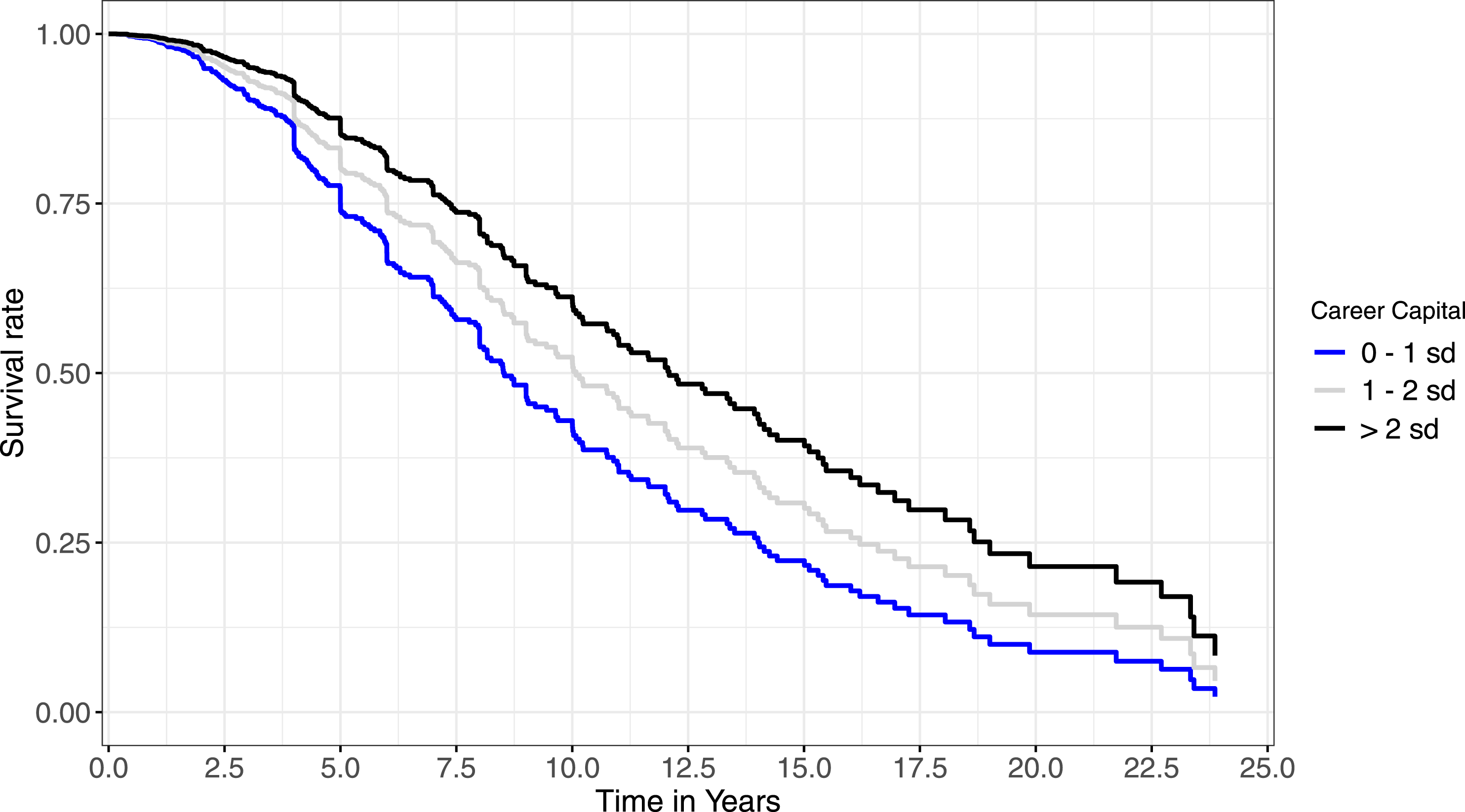
Notably, the previously used measure of political experience (as MP or Minister) is not significant, which represents a finding that is in line with existing studies (see Table 1). As about 76.7 per cent of party leaders in the countries studied have such experience (see Table 7), perhaps this experience is not distinctive enough to have implications for party leader survival.
Discussion
The presidentialization and personalization of politics signify the importance of party leaders across liberal democracies (Poguntke and Webb 2007; Garzia 2019; Marino et al., 2021; Quinlan and McAllister 2022). As the face of their party, they are held responsible for reaching the party goals of realizing policy, holding office, and gaining votes (Müller et al., 1999). But what factors make a long-lasting party leader? The goal of this article is to introduce career capital as a systematized concept of political experience, to provide a more extensive and comprehensive operationalization, and to situate it within party leadership survival research.
Drawing on the careers-as-sequences literature, this study coded and examined the political careers of all party leaders in Canada, Germany, the Netherlands, and Switzerland for the postwar period (1945–2023). To that end, I argue that career capital, as a systematized concept of political experience, is a measure of how much human, social, and/or cultural capital politicians accumulate. The party leader survival literature points to an empirical application of this measure. This article contributes to that literature by including career capital as an independent variable at the individual level in party leader survival models as it is an indicator that party leaders have more social capital in the form of intra-party support, more cultural capital in the form of affinity with elite culture, and greater human capital in the form of job-specific expertise. The main expectation (hyp 1) is that more career capital is related to spending more time in office. I adapt this linear expectation with two specific non-linear mechanisms: attrition, i.e. recently acquired capital is more valuable, and diminishing returns, i.e. as capital increases, the rate of return decreases. In its operationalization, the career capital variable captures both the career duration and the variation of positions a given party leader has held in their political career. Most importantly, the survival analysis employed here shows that political experience matters for the time a party leader stays in office. In other words, party leaders that have more career capital hold on to power longer. Strikingly, the accumulation of career capital is subject to the effect of attrition, but not to the effect of diminishing returns. This attrition effect implies that positions held earlier in a party leaders’ career are less relevant than positions held closer to the start of the party leadership stint, whereas the negative finding considering diminishing returns implies that as career capital increases, the added benefit for party leader survival remains, and might even become larger. Lastly, when dividing the career capital measure into its components, the findings suggest that especially experience in the legislature helps a party leader stay longer in office.
There remain, however, many open questions: to what extent is longevity linked to actual leadership performance indicators? And, are there any specific career positions that warrant closer inspection? Does the glass ceiling effect (O’Neill et al., 2021) extend to career capital, in that female party leaders need more of it to get elected? And, to what extent do youth party positions matter, as there might be a specific benefit to starting out young? In addition, future research is needed to examine how career capital benefits party leaders. What does the finding from Figure 4, for instance, that party leaders starting around 1980 had relatively little career capital imply for the leaders that started during that time? In addition, another important angle could be the qualitative examination of the mechanisms or legislative experience component for party leaders through interviews, which would seek to determine to what extent these aspects aid the ability to obtain valuable work experience, build relevant social relations and improve reputation, similar to research by Sutherland et al. (2015).
As such, future research could focus on specific aspects of certain positions, for instance, executive positions as a means of networking and the development of leadership skills or political campaigning positions as a means to develop electioneering abilities and rhetorical skills. In addition, one could incorporate a larger target population. For example, by comparing the political experience of all candidates in party leader elections similar to the work of Hirano and Snyder (2019) on U.S. primaries, one could potentially ascertain to what extent career-related factors also contribute to the selection of party leaders in parliamentary systems in the first place.
Supplemental Material
Supplemental Material - Accruing career capital: How party leaders with more political experience survive longer
Supplemental Material for Accruing career capital: How party leaders with more political experience survive longer by Clint Claessen in Party Politics
Footnotes
Acknowledgments
The author wishes to thank the two anonymous reviewers, Gregor Zons, Kiwi Ting, Elizabeth McCallion, Jens Wäckerle, Maxime Walder, Oliver Huwyler, Ulrich Sieberer, Tomas Turner-Zwinkels, my supervisors, Stefanie Bailer and Denise Traber, and all the participants from the internal colloquium at the University of Basel, the EPSIP colloquium at Humboldt University, the 2021 Conference on Political Careers, and from panels at GraPa 2021, ECPR SGoP 2021, CPSA 2021, EPSA 2022 and APSA 2022.
Declaration of conflicting interests
The author(s) declared no potential conflicts of interest with respect to the research, authorship, and/or publication of this article.
Funding
The author(s) disclosed receipt of the following financial support for the research, authorship, and/or publication of this article: This work was supported by the Swiss National Science Foundation (SNSF) Number: P1BSP1_200150.

Supplemental Material
Supplemental material for this article is available online.
Notes
Author biography
References
Supplementary Material
Please find the following supplemental material available below.
For Open Access articles published under a Creative Commons License, all supplemental material carries the same license as the article it is associated with.
For non-Open Access articles published, all supplemental material carries a non-exclusive license, and permission requests for re-use of supplemental material or any part of supplemental material shall be sent directly to the copyright owner as specified in the copyright notice associated with the article.
