




Abstract
The question of the democratic character of the European Union (EU) has been a center-point of decades of political research. An important critique suggests that the development of the European political arena is still incomplete, with European parliamentarians primarily orienting themselves to national issues and politicians, implying a problematic mismatch between the political arena and their policy jurisdiction. Research has however been limited by methodological difficulties of capturing the level of Europeanization of the political arena. This paper contributes a novel method for measuring Europeanization by studying interactions between the European Parliament to their national parliamentarians on Twitter in 15 EU countries. Contrary to expectations in the literature, we find substantial Europeanization of the political arena. The level of Europeanization furthermore varies greatly across countries and political groups. This has important implications on the debate on EU’s democratic deficit, as communication across different levels of parliament indicates democratic debate.
Introduction
The European Union (EU) has long been criticized for lacking democratic legitimacy. A cornerstone of this perceived lack of legitimacy has been that the EU does not appear to constitute a complete political electoral arena in its own right (Reif and Schmitt, 1980; Schmitt, 2005). A European political arena would require parties competing for votes on European-level issues, in competition with other European parties, and voters choosing a party based on these positions and past performances on the supra-national level. However, a large strand of research has suggested that voters and candidates are primarily oriented towards national politics, positioning themselves in relation to national allies, competitors and issues (Braun and Schmitt, 2020; Coman, 2009; Hix, 1999; Hix et al., 2007; Hix and Noury, 2009; Hobolt and Tilley, 2014; Mcelroy and Benoit, 2010; Mühlböck, 2012). The effect of this is a problematic disconnect between politics and policy, as European politicians are elected on the basis of their position on issues over which they have limited influence, while the issues over which they do have influence are left un-debated.
However, there are several reasons to believe the process of Europeanization of political parties has advanced in recent years. First, a number of transnational issues have become salient such as the debt crisis, the refugee crisis, the climate crisis, and the Brexit. Second, a system in which the voters choose the President of the European Commission – the “Spitzenkandidaten” system – was introduced with the home of increasing public awareness and interest in the EU election (Schmitt et al., 2015). Third, scholars have suggested that the advent of innately transnational digital media, such as Facebook and Twitter, may contribute to the Europeanization of the public sphere, which may in turn enable the Europeanization of the political arena (Bossetta et al., 2017; Hänska and Bauchowitz, 2019).
The question of the Europeanization of political parties has thus been at the center of academic attention in recent years. Research has examined the level of Europeanization of the parties primarily in two ways: (1) by focusing on the extent to which their party manifestos mention European-level issues (Braun and Schmitt, 2020; Gabel and Hix, 2002; Spoon, 2012), and (2) whether the parties tend to vote more in line with their national parties or their European political group (e.g., Hix, 2002; Mühlböck, 2012).
In this paper, we contribute to the research on the Europeanization of the political arena by analyzing the level of Europeanization of political parties through an alternative approach. While previous studies on MEPs use of Twitter have focused on Twitter as a form of public sphere, we use the interactions of the MEPs to provide a relational view into what they see as their primary political arena. Existing studies focus either on the presence of a European public sphere, or on parties’ political positions – but rarely on the intersection between the two. The intersection is arguably where the political arena is most directly expressed, that is, in the way that politicians engage with one another within the public sphere (De Vreese et al., 2006). This paper fills this important research lacuna by examining the interactions of European parliamentarians on Twitter. Parliamentarian interactions can be used to ascertain whom parliamentarians engage with on similar issues, – whom they see as their allies and whom they view as their competitors (Esteve Del Valle et al., 2021; Van Vliet et al., 2020). These interactions form relational structures at the intersection of parliamentarian communication and campaigning, providing an invaluable resource for examining within which political arena the parliamentarians see themselves as being primarily situated. While Twitter is only one of the arenas in which parliamentarians may interact, it constitutes a lens to the everyday relations and engagements of MEPs and as such provides an additional and thus far understudied dimension to the larger debate on Europeanization.
Our relational perspective on the formation of a political arena allows for systematic comparison between electoral levels by creating indicators for the level of Europeanization of political parties. As politicians often use social media in a deliberate way, such as for signaling their constituents (i.e., Jungherr 2016), studying the emphasis of MEP interactions functions as a powerful way of capturing politicians’ orientation – whether their focus lies more on the national or European political arena. Crucially, this method also enables comparison of the level of Europeanization across parties and across political groups. This is an important addition, as there are significant differences between countries and political groups in terms of the perceived legitimacy of the EU, and the centrality of European politics (Schmidt, 2015).
In this paper, we present two indicators that capture MEPs’ primary political arena. The first indicator measures whether members are more likely to endorse (through retweets) members of their European level political group or their national party. The second indicator measures whether MEPs are more likely to engage with debate (through retweets and mentions) on the European level or with politicians within their national parliament. We compute these indicators for political groups and countries to capture cross-country and cross-group variations. We apply this method on a database of tweets over 17 months, across 15 countries in the European Union. Using these indicators, we ask: to what extent are MEPs oriented towards the European political arena?
The nature of EU politics
Since its founding, the EU has been the subject of critique regarding its democratic character. This critique primarily stems from two issues. First, unlike politics at the national level, the European Parliament does not have control over the executive body; the parliament cannot hire and fire the members of the European Commission, and policies adopted at the European level thus do not reflect a program chosen by the European people (Follesdal and Hix, 2006; Mair and Thomassen, 2010). Defenders of the institution however argue that a representative mandate is not a precondition for democratic legitimacy. For instance, it is argued that the institution should be legitimized by its performance (Beetham and Lord, 1998), and politicized via the national states (Schimmelfennig et al., 2015). Second, the European Parliament (EP) is intended to represent the European people, but appears to fail in doing so, as manifested by the lack of citizen interest in EU politics (Franklin and Hobolt, 2011). While the 2019 EP election saw an increase in the voter turn-out, the historical average is below 50% (Marquart et al., 2020). The lack of voter engagement with EU politics suggests that the process of Europeanization of political parties and the electorate is, at best, incomplete.
The academic literature has described the EP as a second-order election (herein referred to as the second-order hypothesis), suggesting that voters and candidates are primarily oriented towards national politics, positioning themselves in relation to national parties and issues (Reif and Schmitt, 1980; Schmitt, 2005). While the EP elections are transnational, they are in many ways organized by national institutions, which pushes the electoral dispute onto the national level, spearheaded by two institutional areas of concern. First, theoretical work has suggested that a transnational public sphere is an essential prerequisite for the formation of a European political arena, as they help create a demos, enable debate and bring European-level issues to the public attention (Habermas, 2012; Koopmans and Erbe, 2004; Statham and Trenz, 2015). According to empirical research, however, broadcast media in Europe are largely organized along national lines, meaning that the associated public discourse is similarly nationally oriented (for an overview, see Bärenreuter et al., 2009; Brüggemann and Kleinen-von Königslöw, 2007; De Vreese, 2017; De Vreese et al., 2006). This means that the associated public discourse tends to be bound by national borders, limiting the possibilities for transnational debate. The weak development of transnational public sphere is seen as a key hindrance in the formation of a European political arena (Habermas, 2012; Koopmans and Erbe, 2004; Statham and Trenz, 2015). Second, since MEPs are nominated by their national party for election to the European Parliament, they must sustain their ties to their national parties if they want to be re-elected or return to their national arena. However, their European parliament group can control a range of benefits such as group positions, chairmanships and speaking time (Kreppel, 2002). These areas of concern have been a focus of research examining the institutional dimensions of Europeanization of political parties, which finds that over time, political groups build stronger institutional frameworks. The strengthening of these frameworks may create pressures on MEPs to conform to their transnational political group, rather than their national party (Dietz, 2000). These factors are thus competing when the MEP choose between showing their allegiance with their national party or with their EP political group (Hix et al., 2007).
The second-order hypothesis has received significant empirical support through various approaches to assessing the presence of a Europeans political arena. Studies on party manifestos have shown that European parties compete primarily over national issues, as the manifestos focus on policies adopted at the national level (Braun and Schmitt, 2020; Hix, 1999). This creates a problematic disconnect between politics and policy, as the MEPs are elected on the basis of issues over which they have limited policy influence, while the issues that do have influence over are subject to limited debate. This risks creating the image of the EP as an undemocratic and redundant institution, as voters’ choice and the effect of this choice are decoupled. For the EP to be considered a more democratic institution, parties would compete for votes on European level issues, and voters choose parties based on these issue positions (Jurado and Navarrete, 2021).
Engagement with questions regarding European integration in national politics tends to be dominated by the debate among Eurosceptic left and right-wing political parties and radical right social movements (De Vries, 2007; De Vries and Edwards, 2009; Hooghe and Marks, 2009; Hutter and Kriesi, 2019; Kriesi, 2009; Steenbergen and Scott, 2004). Those Eurosceptic groups tend to be more nationally oriented than their pro-EU counterparts, as their politicization of the European integration is often based on national rather than transnational concerns (Brack, 2018). Hence, the ideology of the political group may be a crucial component when examining who MEPs consider to be their political arena. Additionally, voters learn about European candidates from parties’ performance and communication at the national level, thus EPs are not held accountable for their performance on the European parliament (Hobolt and Tilley, 2014). This national-oriented evaluation may impact the coherence and coordination of parties at the European level. While parties choose their political group on the basis of policy congruence (Hix and Noury, 2009; Mcelroy and Benoit, 2010), studies show that MEPs follow national directives in case of a divergence between the national and the transnational party (Coman, 2009; Hix et al., 2007; Mühlböck, 2012; Rasmussen, 2008).
This conclusion is further supported by research within political communication, which shows that despite an increase in visibility of EU election coverage in mass media over time, this ascent is not followed by an increase in the Europeanization of news, as EU elections coverage is mainly focused on national actors (Boomgaarden et al., 2013). Therefore, MEPs are reported and judged by media and constituents on a national, rather than European level. In short, current empirical research supports the second-order hypothesis. However, there are reasons to believe Europeanization of the political arena has progressed in recent years. First, a number of transnational issues have risen on the political agenda as a result of crises such as the debt crisis, the refugee crisis, the climate crisis, and the Brexit crisis. This has made the EU more salient in national political debates, with mainstream parties from the left and right promoting pro-European discourse (Hutter and Kriesi, 2019). Second, a system in which the voters are able to choose the President of the European Commission – the “Spitzenkandidaten” system – was introduced with the home of increasing public awareness and interest in the EU election (Schmitt et al., 2015). Third, scholars have theorized that the emergence of digital media – such as Facebook and Twitter – as a central arena for political debate, may contribute to the Europeanization of the public sphere as they are inherently transnational in scope (Bossetta et al., 2017; Froio and Ganesh, 2019; Hänska and Bauchowitz, 2019). Such a “European Twittersphere” (Hänska and Bauchowitz, 2019) could provide the foundation for a European political arena, by enabling voters to learn about and debate European-wide issues, as well as the parties’ positions, in order to make an informed voting decision (Koopmans and Statham, 2010).
Recent empirical research has focused on whether political debates within the public sphere are indeed transnational in scope. The findings have thus far been ambiguous. Some recent studies provide empirical support for the notion that these media are relatively cross-national in nature, indicating that they may contribute to growing Europeanization of the public sphere (Bossetta et al., 2017; Hänska and Bauchowitz, 2019). Others conclude that political debates on Twitter are still predominantly national. Fazekas et al. (2021) find that MEP candidates on Twitter showed limited engagement with the public on European issues in the 2014 EU campaign, and when examining the audiences of far-right parties and movements on Twitter, Froio and Ganesh (2019) show that only a small set of issues actually draw a transnational audience. Critics have furthermore argued that only a small fraction of constituents are active in political debates on these platforms, implying that the platforms give a poorly representative view of the overall public sphere (see e.g., Stier et al., 2020).
We contribute to the research on the Europeanization of the political arena by analyzing the level of Europeanization of political parties through a novel lens. Instead of viewing Twitter as a form of public sphere, we use interactions between MEPs as a relational lens to examine what they view as their primary political arena – hence focusing on the consolidation of the political arena, rather than the Europeanization of political debate. The methods employed to examine the level of Europeanization of the political parties have so far examined party manifestos and media reporting, yet studies of quotidian interactions of MEPs on social media platforms are lacking, despite the fact that social media like Twitter have become the go-to tool for politicians and the media elite (see e.g., Hänska and Bauchowitz, 2019; Hemsley et al., 2018; Jungherr, 2016). We thus propose to examine interactions of MEPs on Twitter to gauge whether they are more oriented to the national or to the European political arena in their everyday political communication.
Twitter provides affordances for politicians to engage with one another in debate, by mentioning or retweeting each other. These actions are made publicly, and thus represent a way for politicians to enact and signal allegiances and conflicts, in relation to both issue positions and other politicians (Esteve Del Valle et al., 2021; Van Vliet et al., 2021). Consequently, politicians use Twitter to position themselves in their political space. We can thus think of retweets and mentions as one way in which politicians navigate the boundaries of what constitutes their political arena (e.g., Cherepnalkoski et al., 2016; Conover et al., 2011; Esteve Del Valle et al., 2021; Van Vliet et al., 2020). Interactions of retweets and mentions can therefore function as powerful means of identifying what MEPs view as their primarily political arena, by indicating with whom they align themselves, and whom they view as their opposition. Our approach is hence similar to Stier et al. (2020), who also look at the Twitter interactions of MEPs to examine the level of transnational communication in electoral campaigns – finding that MEPs communicate chiefly with fellow nationals. However, Stier et al. (2020) focus on communication between MEPs, and thus examines only the level of cross-national communication within the transnational political arena, rather than comparing the centrality of the national and the European political arenas – and their results hence do not directly speak to the level of Europeanization of political parties. For instance, if an MEP predominantly mentions and retweets members of their national parliament, this implies that they are debating with domestic opposition and showing allegiance to their domestic party, i.e., that they are treating domestic politics as their primarily political arena. Conversely, if an MEP predominately debates with other MEPs, and shows allegiance to their EP political group, this implies that they are operating primarily within the transnational political arena.
We furthermore argue that the interaction of MEPs on Twitter furthermore speaks to how MEPs think of their voters as engaging with European politics. If MEPs understand voters as being engaged with and voting on EU politics on primarily the European level, then MEPs would be incentivized to act, discuss and campaign primarily on this level, implying that the MEPs would make use of Twitter to campaign and engage in the European political arena. If, however, the MEPs believe that voters are engaging with European politics through national politics, as the second-order hypothesis suggests, then the MEPs should primarily engage and position themselves in relation to national politics.
While analysis of Twitter data provides a powerful way of examining what parliamentarians view as their political arena, studies on the Twitter interactions of MEPs are relatively sparse, and are mainly related to election campaigning (e.g., Fazekas et al., 2021; Meganck et al., 2019; Stier et al., 2020) and public outreach (e.g., Daniel et al., 2019). Existing studies thus leave unanswered whether MEPs are interacting primarily with the national or European political arena in their everyday political communication on Twitter. We draw two hypotheses from the literature discussed, capturing two aspects of the political arena. First, the literature suggests that MEPs will primarily be situated within their national party, as MEPs are tied in various ways institutionally to their national party. For instance, they are nominated by their national party for (re)election to the European Parliament. This suggests that the primary focus of MEPs would be to emphasize allegiance to their national party over their EP political group.
Second, the literature suggests that MEPs prefer to debate over national politics than European issues, wherein they engage with the opposition and mark their position. This is due to being judged and mentioned in the media on a national level.
Method and data
We use a large pre-existing database of tweets from incumbent parliamentarians from the European Parliament and national parliaments – the Twitter Parliamentarian Database (Van Vliet et al., 2020). We capture the level of Europeanization of political parties by comparing the level of interaction between MEPs, with interactions between MEPs and NPs. In bicameral systems, we focus on politicians in the lower houses of parliament, to enable cross-country comparison. For our analysis, we selected countries that are members of the European Union, and excluded those where less than 45% of parliamentarians had a Twitter account, in order to focus on countries whose parliamentarians significantly rely on the platform for communication.
We choose the date range from 1 January 2018 until 26 May 2019 – from the beginning of the database’s data collection to the end of the parliamentary period. We choose to focus on one parliamentary period (the eighth official period), as there may be changes in members, relationships, parties, political groups and so forth if more than one parliamentary period is included. For the same reason, if a country had an election in 2018 or 2019, we took the parliamentary period that was the longest sitting. For example, if there was a national election on 16 January 2019, we use the previous parliamentary period, rather than the newest. If there was a national election during the period of the EP, we also removed the corresponding MEP tweets from the excluded period of the national parliament. As such, we are controlling for elections, as these periods may instigate different ways of using Twitter by parliamentarians (Jungherr, 2016). As we are focusing on a limited period, our results should be understood as a snapshot of the level of Europeanization.
The data we are concerned with are the retweets and mentions (combined referred to as interactions) between NPs and MEPs. It should be noted that the Twitter API treats replies and quote-retweets as mentions, which are thus included in the data as mentions. We filtered the data for interactions from MEPs from Belgium, Denmark, Finland, France, Germany, Greece, Ireland, Italy, Malta, Netherlands, Poland, Slovenia, Spain, Sweden, and United Kingdom (N = 15). This includes 489 MEPs, with 298,015 interactions between themselves and 1621 national parliamentarians. This translates to an average of 585 interactions per day, or 1.2 interactions per MEP per day. A full table with the number of MEPs and NPs per country can be found in Table A1 in the Appendix.
The literature on Twitter suggests that retweets tend to function as endorsements (Kim and Yoo, 2012; Metaxas et al., 2015), thus capturing what individuals and parties the parliamentarians show most allegiance to (Van Vliet et al., 2021). Mentions can be suggestive of positive or negative interaction, but are indicative of discussion amongst parliamentarians at different levels (c.f., Hemsley et al., 2018; Sanders and Van Den Bosch, 2013). While the data used provide relational information, we do not employ the data through a standard social network analysis lens, as we are here focusing on comparing the amount of engagement between two different types of nodes. This means that common social network analysis measures, such as density, homophily, or eigenvector centrality, are inappropriate to employ for this analysis. Instead, we develop custom measures. We thus employ these to formulate two indicators that operationalize our hypotheses.
(1) Indicator 1: Europeanization of party allegiance
This indicator measures how strongly an MEP shows allegiance to their EU political group as compared to their national party. This indicator is defined by comparing the number of retweets from an MEP to their EU political group, with the number of retweets to parliamentarians from their national party. Rather than using fractions, we normalize
1
the fractions to a value between 1 and -1, where positive values indicate a primarily European orientation of allegiance, and negative values primarily national allegiance (similar to the E-I index, see Crossley et al., 2017) and is defined as follows

(2) Indicator 2: Europeanization of political debate
The second indicator captures the extent to which MEPs are engaging in transnational and national debate. |This indicator compares the number of interactions between an MEP and their EP colleagues and the number of interactions with colleagues from their national parliament. The shows what the MEPs are treating as their arena of political debate. We again normalize this value to go between −1 and 1, with positive values indicating a primarily European political debate arena, and negative values a primarily national political arena. It is therefore defined as

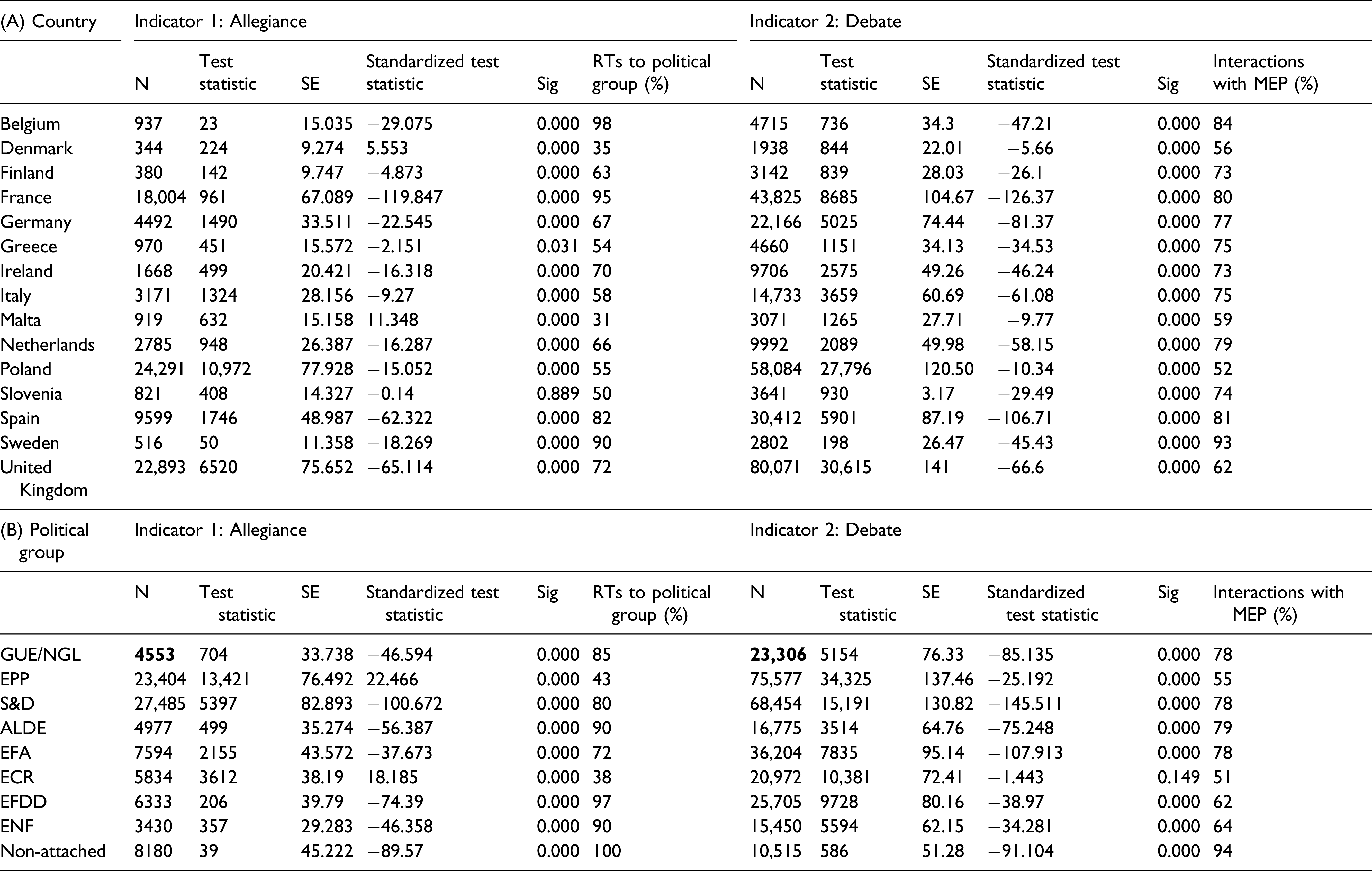
It should be noted that while the propensity to use Twitter varies across individuals, countries and contexts, the indicators are not sensitive to such variations, as they will equally affect the numerators and denominators. These indicators are measured on the overall level, that is, including all parliamentarians in the database, but we also calculate separate indicators for each country and political group, to examine variation between these. To ensure that the values of the indicators are not the result of limited data, we furthermore verify the significance of these indicators by using a one-sample binomial test. We treat each interaction as a Bernoulli trial, and verify that the resulting outcome is different from a Bernoulli probability of 0.5, which corresponds to the indicators being equal to zero. This provides a means of examining that the result is indeed significantly different from equal levels of European and national interaction.
Results
Before we discuss results for our two indicators, we first provide a visual overview of the structure of interaction among MEPs, seen in Figure 1. As the figure shows, the majority of interactions from MEPs target other MEPs of the same political group. While all political groups appear to have this propensity, it is more pronounced for S&D, ALDE and EFA, and less so in the other groups. Although we might expect that MEPs of smaller political groups are less likely to engage with their fellow group members (simply because there are fewer of them), this does not seem to be the case – the small ALDE and ENF engage as much with fellow political group MEPs as members of the larger S&D group. Interestingly, we see that when interacting with national parliamentarians, the proportion of interactions towards the same national party is roughly the same as interactions with those from other parties. This alluvial diagram shows the classifications of interactions from the different political groups in European parliament (on the left). It shows the proportion of interactions that were directed towards the same political group or national party.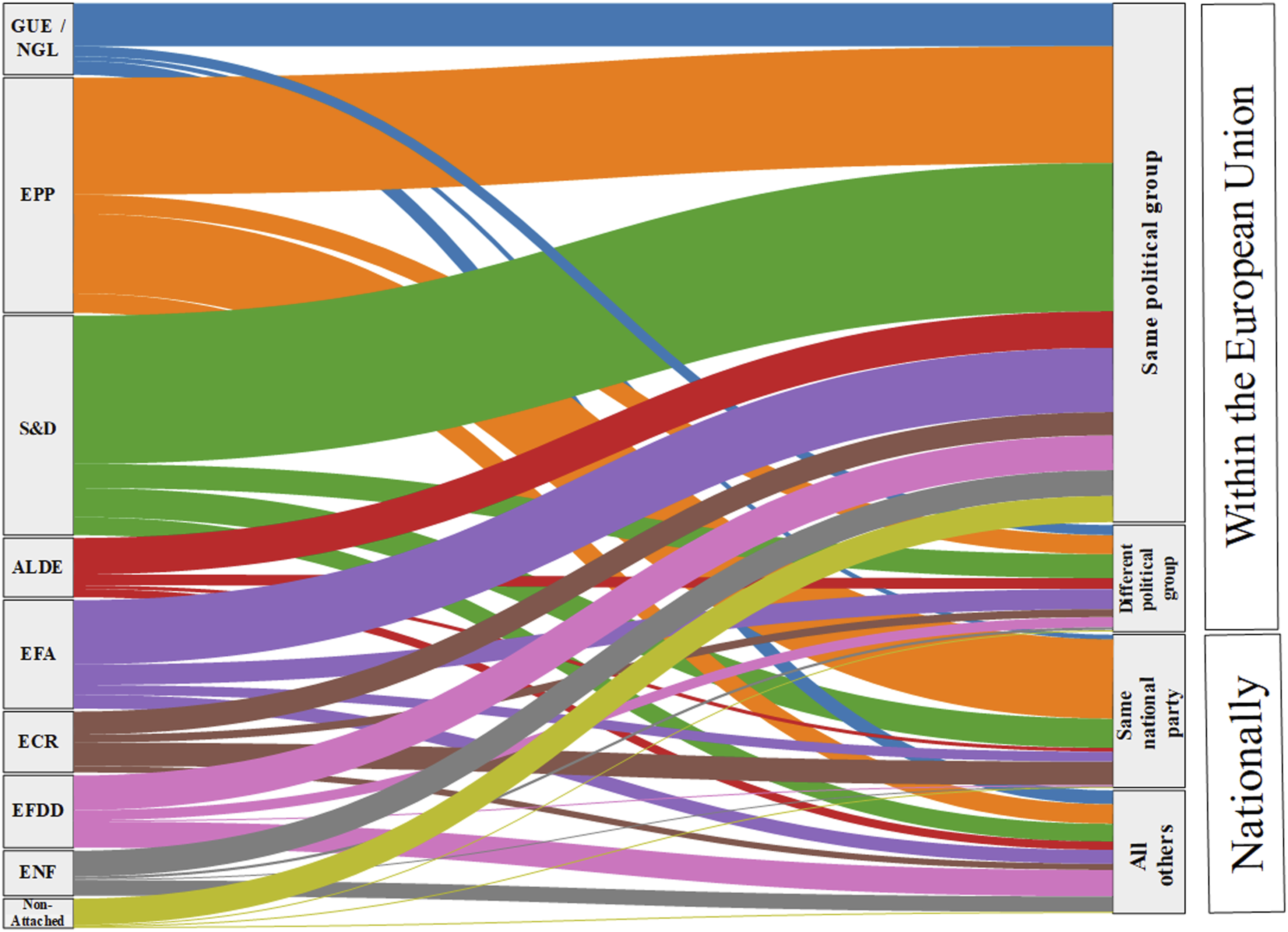
We now turn to look at indicator 1. A positive value implies that the MEPs primarily show allegiance toward their European political group, while a negative value implies predominately national allegiance. Following H0, we expect the indicator to be negative. We find that
Turning to indicator 2, a positive value implies that the MEPs predominately debate in the European political arena, while a negative value implies predominately national debate. Following H1, we expect the indicator to be negative. We find that
Following the results of the indicators, we find that the politicians are treating their political group in the European parliament as their primary political entity, and other MEPs as the primary group with whom they engage in debates. The allegiance to the European political group indicates in particular that the groups are institutionalized enough to create pressures on MEPs to show allegiance, despite that their national parties have powers to control their future assignments. That the debate is taking place on the European level indicates that the parliamentarians are engaging with EU level issues, and that they view MEPs as their primary opponents.
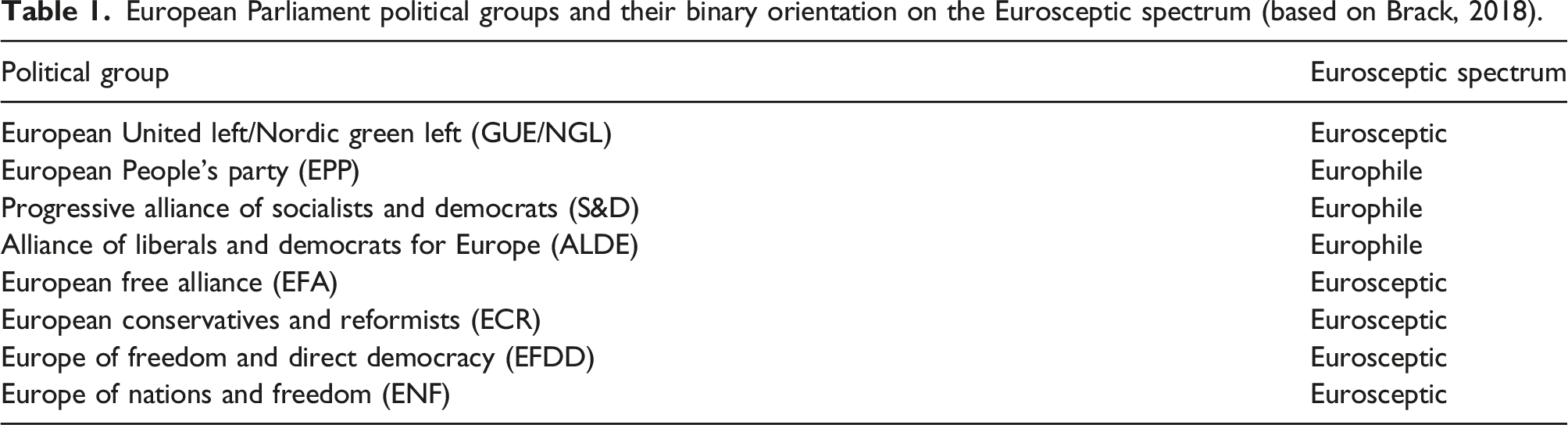
European Parliament political groups and their binary orientation on the Eurosceptic spectrum (based on Brack, 2018).
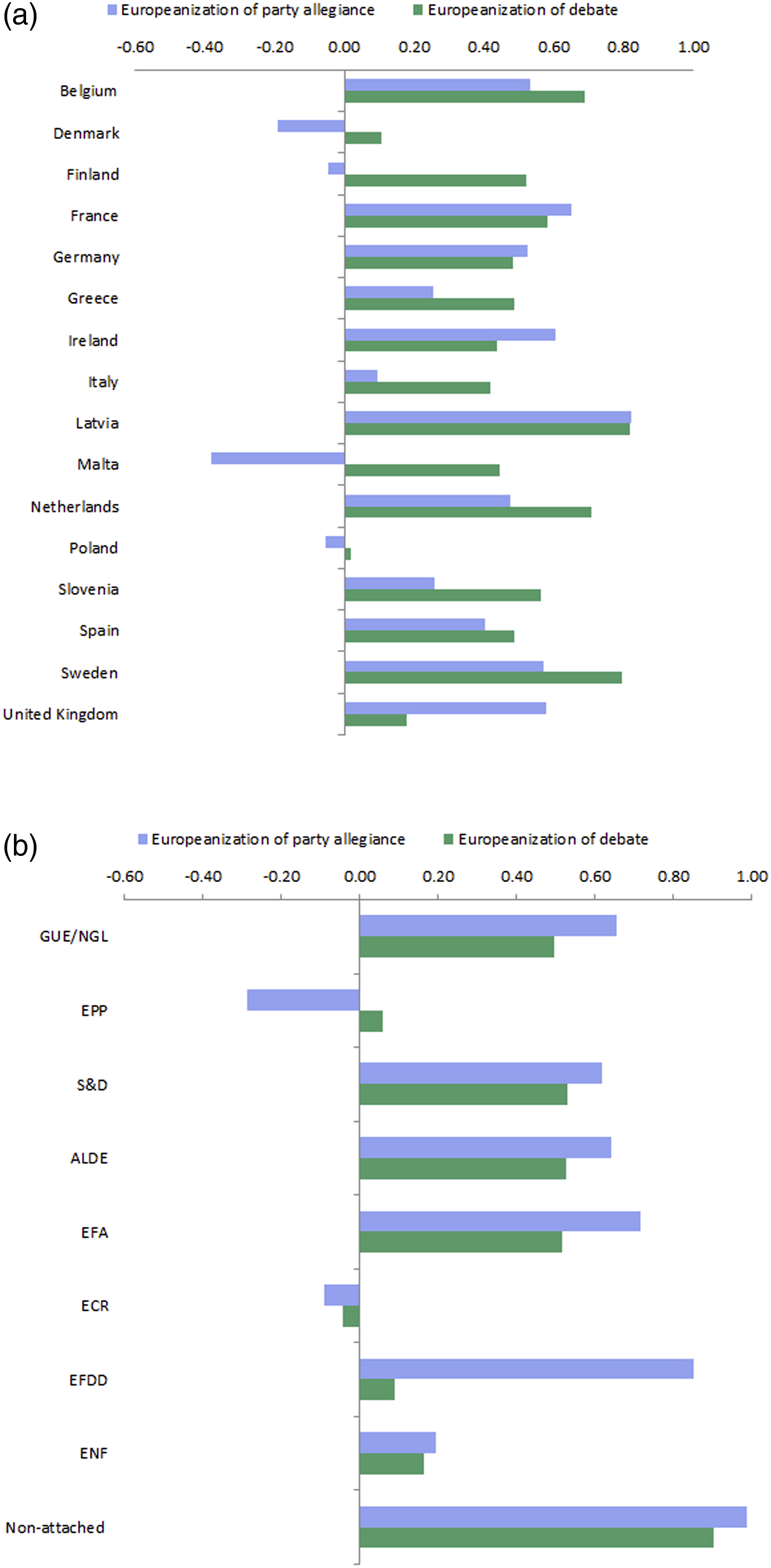
(a and b): These figures show the results of the indicators of allegiance and debate are aggregated by country (a) and political group (b).
The outcome for the indicators of allegianece and debate and are aggregated by country (a) and political group (b). The stars indicate the outcome of the Bionmial test, and whether the Bernoulli probability is different from 0.5. ** p-value <0.01. *p < 0.05.
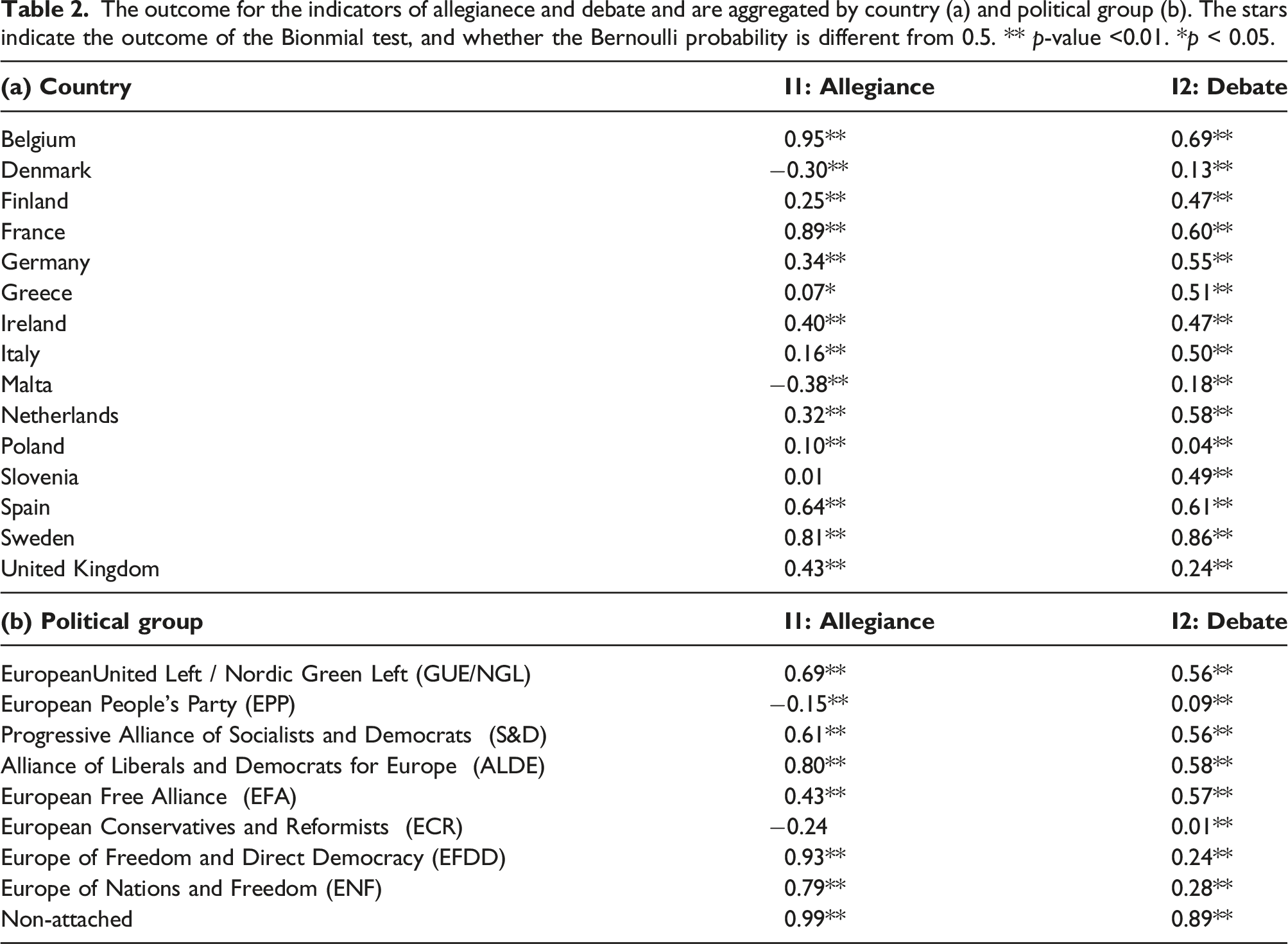
Looking at the variance between the indicators across political groups, we find that they partially follow what the literature expects. For instance, Eurosceptic and newer groups tend to be more nationally oriented than pro-EU groups. This can be seen in the Europe of Nations and Freedom (ENF), the Europe of Freedom and Direct Democracy (EFDD) and the European Conservatives and Reformists (ECR) – all whom are among the lowest in indicators of debate. While the positive results of the indicator I2 suggest that a transnational populism is emerging on the European level (McDonnell and Werner, 2020), the low figures imply that this is very far from being a coherent international group. The findings are thus more in line with Brack’s (2018) suggestion that Eurosceptic parties tend to emphasize their national arena.
Eurosceptic groups also tend to score lower in I1, showing more allegiance with their national party over their political group. ENF and EFDD are however exceptions. While these political groups have more nationally oriented debates than the average, they show greater allegiance with their political groups over national parties. This may be due to the parties that are part of these groups, such as the largest party of the EFDD group – the British “Brexit Party”, having a larger presence in the European parliament than they do in their national parliaments.
The non-attached members almost exclusively orient themselves toward the transnational arena both in terms of debate and allegiance. A more nationally oriented group - the European People’s party (EPP) 2 - is one of the oldest groups in parliament, yet they are especially nationally oriented in terms of the allegiance indicator. This is surprising, as they are an old and well-established political group, and the literature suggests that, together with the Socialists and Liberals, they are the most transnational in institutional terms (Dietz, 2000). It is also somewhat unexpected to see that the EFA – the Greens – is among the most transnational groups, as they are a relatively new group with limited institutionalization. These findings call for further research.
For countries, we find that Belgium, France, Germany, Ireland, Netherlands, and Sweden are the countries whose indicators show strongest orientation toward the European political arena, while Denmark, Malta, and Greece are the most nationally oriented countries. We see that for newer members of the European Union, such as Malta, Poland and Slovenia, indicator I1 is around zero or below, indicating that the Europeanization of the party allegiance is a process that takes time. Malta and Denmark have allegiance scores (indicator 1) that are more nationally oriented, while they are debating in primarily the transnational arena (as shown by scores above 0 on indicator 2). Such discrepant scores between the two indicators may suggest that the MEPs primarily engage with colleagues in their daily interactions, while more overtly supporting and helping spread messages from their national parliamentarians through retweets.
Generally speaking, the results thus largely follow expectations from the literature, as countries that are Eurosceptic or recent additions to the union tend to be more oriented towards national politics, while the more pro-EU countries are more transnationally oriented. Denmark, however, stands out as having nationally oriented political arena, despite being a relatively old EU member. This may be the result of the EU skeptic Danish People Party winning the largest vote share in the 2014 Danish EU election. The United Kingdom, which had at the period covered by this study already voted to leave the union, has among the lowest values for the indicator of Europeanization of debate, but are relatively nationally oriented in terms of allegiance. This can be explained by the large difference between the representation of parties in the UK national parliament compared to in the EP – in part due to the low turnout in the British 2014 EU election, with only 35% of eligible voters. UKIP, for instance, was the largest British party in the EU election with 26.6% of the votes, winning them 24 seats in the EP – while having only one seat in the national House of Commons.
Discussion & conclusion
A central research focus within European political science has been the question of the democratic legitimacy of the EU. Criticism has in particular focused on the suggestion that the EU is treated as a second-order election, with voters and candidates being primarily oriented towards national politics, parties and issues (Reif and Schmitt, 1980; Schmitt, 2005). Significant empirical research has suggested the presence of a problematic disconnect between the political arena through which voters engage with politics and select their parties, and the policy influence of these parties, implying that the politicians are elected on the basis of issues over which they have no or limited policy influence, while the issues that they then have influence over are left largely un-debated. This risks creating the image of the EU as an undemocratic and redundant institution, as voter choice and the effect of this choice become decoupled.
A number of recent developments have put this question back on the agenda: the Spitzenkandidaten-system has been introduced with the hope of increasing voters’ sense of political influence, a number of transnational crises have increased the salience of EU political issues, and the advent of new digital media platforms has been suggested to potentially enable the emergence of a European public sphere. Twitter, in particular, has become the go-to platform for debate among the political elite. However, Twitter does not only potentially contribute to a transnational public sphere, but also gives researchers new ways of examining the Europeanization of political parties. These digital data provide new ways of addressing the methodological challenges involved in involved in capturing the locus of the political arena, as previous studies have primarily focused on whether political communication and party manifestos are focused on European or national level issues. Twitter allows seeing with whom parliamentarians show allegiance and with whom they are engaging in political debate, thus creating a direct way of capturing the structure of the political arena. We have made use of this data to address the extent that MEPs are oriented towards the European political arena in their daily interactions.
This paper has employed digital methods to examine 298,015 Twitter interactions – among 489 MEPs, or between these MEPs and 1621 NPs, in the period from January 2018 until the EP elections on 23 May 2019. This has allowed us to revisit and throw new light on level of Europeanization of the political parties, in terms of MEPs’ daily social media interactions. Based on the second-order hypothesis, we expected that MEPs have more allegiance with their national party than their EU political group. We further hypothesized that the political arena primarily remains the national one, where MEPs interact more with national parliamentarians.
Surprisingly, we found that when examining the everyday interactions of parliamentarians on Twitter, MEPs are more likely to endorse members of their political group than they are to endorse members of their national party. Similarly, they are more likely to engage in debate with colleagues in the European political arena than they are to engage with those in the national arena. Contrary to the literature, our findings suggest that MEPs view their European colleagues as their main allies and sparring partners – their most central relationships in their everyday political lives. These results are not in line with the second-order hypothesis, and may be suggestive of the incentives under which the MEPs view themselves as operating: if MEPs can be assumed to be acting strategically, the engagement on the European level indicates that they may be assuming that their electorate are engaging and voting on the basis of European level politics. This striking finding contradicts the findings of much of the previous literature, and may be suggestive of a shift towards Europeanization of politics. It also speaks to previous research suggesting that Twitter is contributing to the emergence of a European public sphere, which is seen as a necessary precondition for a political arena. While it should be stressed that our findings merely contribute a piece to a larger puzzle, they are indicative that, Europe may be in the process of transitioning towards a more European-oriented politics, in which the European political arena is no longer second-order.
While MEPs overall tend to be oriented towards the European political arena, we also found significant variance across countries and political groups. With some exceptions, pro-EU countries who are long-term EU members tend to be more Europeanized – in line with the expectations from the literature. Similarly, older and more pro-EU political groups were found to be more oriented toward the European political arena than newer and Eurosceptic groups – with EFDD and EPP constituting exceptions to the rule. The indicators thus fit much of the expectations from the literature, while at the same time showing some surprising results that call for further investigation. For instance, what is the relationship between the arena of interaction and the topic of conversation? Is there more national or European orientation for certain topics than other? Is there a constructive debate over policy issues taking place in these conversations, or something else? These questions in particular speak to the important point that while Twitter enables engagement in a European-level political arena, this does not necessarily imply that this will lead to further support for European integration, as previous literature suggests that Twitter is also an arena for the contestation of the EU. This suggests further research exploring the content of debate in the European political arena.
Some limitations should be noted with regards to these findings. While examining the interactions of parliamentarians provide a relational perspective on the question of the Europeanization of political parties, it should not be understood as definitive evidence but as a piece of a larger puzzle. Additional research is necessary, for instance, to examine the content of this communication. Moreover, for a complete assessment of the consolidation of a European political arena, it is necessary to also examine the demand side, studying whether the everyday engagement of parliamentarians reflects how voters engage with European politics, and how politicians and voters engage in social media. Additionally, the study did not include all nations in the European Union, as some countries had limited use of Twitter among their national parliamentarians. For the countries that are not included, this may indicate that they are more likely to employ traditional national-oriented broadcasting media, but they may also employ other transnational social media, such as Facebook. This requires additional study including other forms of digital media. We furthermore cannot say whether the countries or the political groups are driving the observed variance. For this, a model would be needed in order to look at interaction effects. The analysis is focused on a limited time span during one electoral period, meaning that additional analysis is necessary to map the historical evolution of the European political arena and verify if these results also hold beyond the selected electoral period, and also during electoral campaigns. While such limitations and open questions need to be addressed, the kind of Twitter data we used here offers great and largely underused opportunities for studying European and national politics as well as interactions between them.
Footnotes
Declaration of Conflicting Interests
The author(s) declared no potential conflicts of interest with respect to the research, authorship, and/or publication of this article.
Funding
The author(s) disclosed receipt of the following financial support for the research, authorship, and/or publication of this article: This work was supported by the European Commission H2020 FETPROACT-2016 Action ODYCCEUS (732942).

Notes
Appendix
The N and % of MEPs and NPs on Twitter, as well as the interactions between them. Binomial one-sample test results for indicators of allegiance and debate per country (A) and political group (b).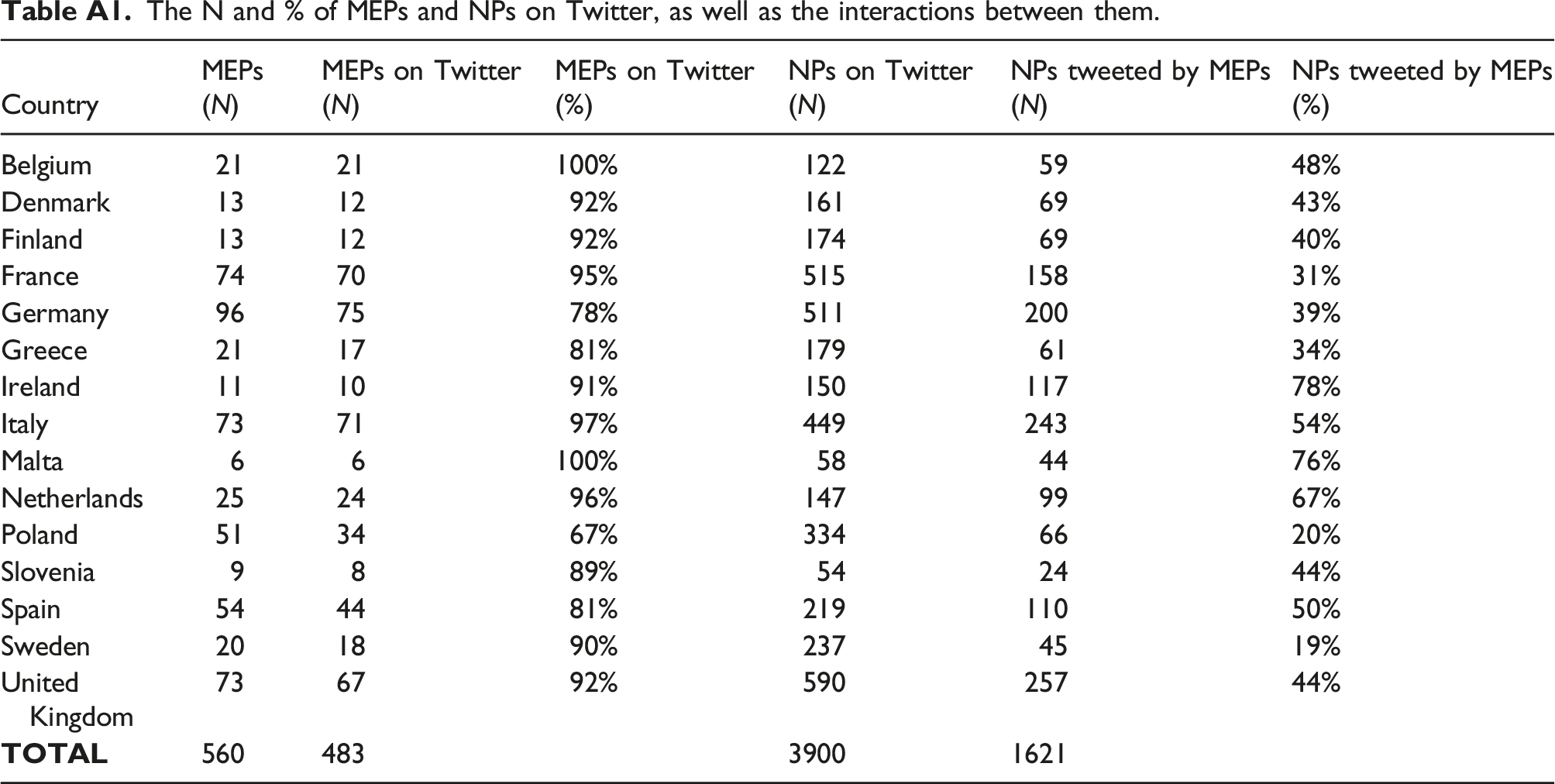
Country
MEPs (N)
MEPs on Twitter (N)
MEPs on Twitter (%)
NPs on Twitter (N)
NPs tweeted by MEPs (N)
NPs tweeted by MEPs (%)
Belgium
21
21
100%
122
59
48%
Denmark
13
12
92%
161
69
43%
Finland
13
12
92%
174
69
40%
France
74
70
95%
515
158
31%
Germany
96
75
78%
511
200
39%
Greece
21
17
81%
179
61
34%
Ireland
11
10
91%
150
117
78%
Italy
73
71
97%
449
243
54%
Malta
6
6
100%
58
44
76%
Netherlands
25
24
96%
147
99
67%
Poland
51
34
67%
334
66
20%
Slovenia
9
8
89%
54
24
44%
Spain
54
44
81%
219
110
50%
Sweden
20
18
90%
237
45
19%
United Kingdom
73
67
92%
590
257
44%
560
483
3900
1621
(A) Country
Indicator 1: Allegiance
Indicator 2: Debate
N
Test statistic
SE
Standardized test statistic
Sig
RTs to political group (%)
N
Test statistic
SE
Standardized test statistic
Sig
Interactions with MEP (%)
Belgium
937
23
15.035
−29.075
0.000
98
4715
736
34.3
−47.21
0.000
84
Denmark
344
224
9.274
5.553
0.000
35
1938
844
22.01
−5.66
0.000
56
Finland
380
142
9.747
−4.873
0.000
63
3142
839
28.03
−26.1
0.000
73
France
18,004
961
67.089
−119.847
0.000
95
43,825
8685
104.67
−126.37
0.000
80
Germany
4492
1490
33.511
−22.545
0.000
67
22,166
5025
74.44
−81.37
0.000
77
Greece
970
451
15.572
−2.151
0.031
54
4660
1151
34.13
−34.53
0.000
75
Ireland
1668
499
20.421
−16.318
0.000
70
9706
2575
49.26
−46.24
0.000
73
Italy
3171
1324
28.156
−9.27
0.000
58
14,733
3659
60.69
−61.08
0.000
75
Malta
919
632
15.158
11.348
0.000
31
3071
1265
27.71
−9.77
0.000
59
Netherlands
2785
948
26.387
−16.287
0.000
66
9992
2089
49.98
−58.15
0.000
79
Poland
24,291
10,972
77.928
−15.052
0.000
55
58,084
27,796
120.50
−10.34
0.000
52
Slovenia
821
408
14.327
−0.14
0.889
50
3641
930
3.17
−29.49
0.000
74
Spain
9599
1746
48.987
−62.322
0.000
82
30,412
5901
87.19
−106.71
0.000
81
Sweden
516
50
11.358
−18.269
0.000
90
2802
198
26.47
−45.43
0.000
93
United Kingdom
22,893
6520
75.652
−65.114
0.000
72
80,071
30,615
141
−66.6
0.000
62
(B) Political group
Indicator 1: Allegiance
Indicator 2: Debate
N
Test statistic
SE
Standardized test statistic
Sig
RTs to political group (%)
N
Test statistic
SE
Standardized test statistic
Sig
Interactions with MEP (%)
GUE/NGL
704
33.738
−46.594
0.000
85
5154
76.33
−85.135
0.000
78
EPP
23,404
13,421
76.492
22.466
0.000
43
75,577
34,325
137.46
−25.192
0.000
55
S&D
27,485
5397
82.893
−100.672
0.000
80
68,454
15,191
130.82
−145.511
0.000
78
ALDE
4977
499
35.274
−56.387
0.000
90
16,775
3514
64.76
−75.248
0.000
79
EFA
7594
2155
43.572
−37.673
0.000
72
36,204
7835
95.14
−107.913
0.000
78
ECR
5834
3612
38.19
18.185
0.000
38
20,972
10,381
72.41
−1.443
0.149
51
EFDD
6333
206
39.79
−74.39
0.000
97
25,705
9728
80.16
−38.97
0.000
62
ENF
3430
357
29.283
−46.358
0.000
90
15,450
5594
62.15
−34.281
0.000
64
Non-attached
8180
39
45.222
−89.57
0.000
100
10,515
586
51.28
−91.104
0.000
94