




Abstract
Turkey plunges headlong into democratic backsliding under Erdoğan’s presidency. The country was a forerunner in the decline of democratic standards in a decade from 2010 to 2020. In the first part of the article, we investigate how this democratic erosion suspends Turkey’s long-standing traditional party cleavage between religious conservatism and secularism. By tracing individuals who follow the members of the Turkish parliament on Twitter, we attach the deputies to their followers with the help of correspondence analysis. We illustrate that, as the ethnic identity divide remains significant, democracy-authoritarianism cleavage becomes the main party split that brings the supporters of an ideologically diverse group of opposition parties closer. In the second part, we conceptualize the democracy-authoritarianism divide as the main cleavage in Turkish party politics after 2017 to shed light on how the AKP’s different tactics of capturing traditional media generated a partisan media landscape.
Introduction
After the transition from its parliamentary democracy to a presidential system of government via a referendum held in April 2017, Turkey’s path toward a new phase of deepening illiberalism weakens democratic institutions (Selçuk, 2016; Sözen, 2020), fosters polarization (Somer, 2019; Laebens and Öztürk, 2021; Orhan, 2022), drives existential insecurity (Akkoyunlu and Öktem, 2016) and offers very limited institutional checks and balances (Esen and Gumuscu, 2018). Not only does the new presidential system lower democratic well-being by transferring power away from the Turkish parliament to the president, but it also reshapes the country’s longstanding party divides. The replacement of the parliamentary democratic system with an executive presidential order recently transformed old party structures and political alignments.
The first part of our article investigates to what extent following party officials on social media explains this new party divide in Turkey. We demonstrate that the main traditional social cleavage between religious conservatism and secularism seems to become less and less deterministic in evaluating the relative proximity between political parties. Democratic backsliding, personalization of state apparatus, and monopolization of executive power at the president’s hands render authoritarianism a dividing line between major political parties of Turkey. To better understand political party distances in multidimensional space, we use the dynamic strategy that estimates party positions by tracing Twitter users who follow at least three members of parliament from the Grand National Assembly of Turkey. With the help of correspondence analysis (CA), we assign political scores in two-dimensional axes to members of parliament (MPs) and their followers. Identifying political groups in multidimensional coordinates enables us to compare the pattern of following different political parties on social media with survey data.
The second part of the article deals with how traditional media outlets serve the authoritarian side of this new party cleavage. Uninterrupted circulation of information by credible sources is one of the keys to sustainable democracy. In pursuance of healthy public discussion, media organizations are expected to serve this task. In competitive authoritarian regimes, however, the media becomes one of the four main arenas of contestation “through which opposition forces may periodically challenge, weaken, and […] even defeat autocratic incumbents” (Levitsky and Way, 2002: p. 54). To preserve tight control over the media and to maintain strong support for the president and the system, Turkey’s old media, mainly TV channels and newspapers, are effectively used in the emergence of the new democracy-authoritarianism divide. We investigate (1) how polarized the audience of state-funded and foreign-funded news sources is, (2) how intensely media sources operated under large multi-industry business groups shared by pro-Erdoğan supporters, and (3) whether tactics of buying media outlets by conglomerates for the sake of financial interests of business people change media consumption patterns. We aim to present wide-scale empirical evidence about the polarization of news consumption in the context of Turkey’s new political party ecosystem.
Party cleavages under democratic backsliding
Party cleavages, to some extent, mirror the existing social cleavages of societies, which influence various aspects of a party system. The prior academic research studying cleavage structures explained stable patterns of political cleavages with historically determined societal divisions. Lipset and Rokkan’s seminal ‘frozen party systems’ model traced the Western European party structures as the products of the national and industrial revolutions that generated four fundamental party splits: center-periphery, state-church, urban-rural, and owner-worker (Lipset and Rokkan, 1967). Lipset and Rokkan’s approach had a profound influence in academia and dominated theorizing about party system formation in Western Europe for a long time. Succeeding generations of cleavage researchers extended our understanding of party cleavages by introducing new cases from wider geographical areas, new methods, and new conceptual understandings for the term ‘cleavage’ (see. Deegan-Krause, 2007). They incorporated other systematic conflicts such as secularism, ethnicity, and the support for democratic values. Yet, subsequent studies showed that party cleavages do not necessarily follow social cleavages as they are mostly dynamic and very responsive to emerging conflicts. The degrees of ‘competition’ (Sartori, 2005; Schumpeter, 1942) and ‘contestation’ (Dahl, 1971; Przeworski et al., 2000) in political system often initiate cleavage activation. Major party splits evolve as new challenges dominate the electoral discussions and as they replace previous contestations. Shifting value priorities to post-material concerns (Inglehart, 1977), immigration-related debates (Cole, 2005), protectionism versus global integration (Kriesi, 1998) were among those recent trends transforming party alliances.
The studies on the cases outside Western Europe, particularly in Latin America and post-Soviet Republics, revealed that the democracy itself sometimes becomes entirely deterministic about political party split, notably for relatively new democracies. Even though some countries successfully implemented a transition to democracy after experiencing full-fledged authoritarianism, issues related to key democratic values and institutions remained significant topics in designing electoral competition between parties (Klingemann, 2005). In Political Cleavages in the 1990s: Issues, Parties, and the Consolidation of Democracy, Alejandro Moreno argues that the divide between authoritarian and democratic ideologies became the primary determinant for party cleavage in many countries during the 90s. He presented substantial empirical support for the significance of the ‘democracy-authoritarianism’ divide in several countries. Although he acknowledges the trend that most democracy-related divides were replaced by cultural questions such as abortion, nationalism, or religiosity (Moreno, 2019), survey results from post-communist European countries reinforced the arguments about the persistence of a divide between authoritarian and democratic orientation (Berglund, 2013). Similarly, the Chilean experience bears a resemblance to most other post-authoritarian cases in the sense that robust democratic/authoritarian cleavage continued after the transition to multi-party democracy (Torcal and Mainwaring, 2003).
This kind of democracy-authoritarianism divide is about the very existence of democratic institutions rather than the strength of the commitment to liberal values. Contrary to the post-materialist/authoritarian divide in Western Europe that captures issues related to lifestyles and moral guidelines, what we mean by the democracy-authoritarianism divide here tackles the threats against the institutions and fundamental features of democracy. Democracy-authoritarianism divide, therefore, captures to what extent parties are making a commitment to protecting and maintaining democracy and democratic institutions.
The other strand of academic literature addresses the role of radical changes as well as exogenous and endogenous shocks in party cleavages. Rapid social transformations, traumatic events, or acute crises make political parties break off ties with their preexisting political stances. Although parties mostly have conservative organizational structures and they mostly resist to change (Harmel and Janda, 1994), external or internal shocks – such as changing the organizational system with a constitutional referendum in the Turkish context can make fundamental changes in political party alignments. In the cases of Peru and Venezuela, Jason Seawright explains party system collapse with the impacts of devastating economic crises, the rise of the informal economy, and the rising political charisma of Fujimori and Chavez on voters (Seawright, 2020). Sometimes, as was the case for the Peronist Partido Justicialista in Argentina during the late 80s and early 90s, political parties can increase their adaptive capacity to configure organizational features in response to economic crises and adjustment processes (Levitsky, 1998).
We argue that democratic erosion causes a significant shock in party cleavage, like the abovementioned examples. In response to the process of democratic backsliding in which the democratic playing field, and therefore party competition become uneven, political elites of opposition parties are motivated to seek alternative discourse, if not potential collaborations, converged around the theme of protecting fundamental democratic values. When democracy itself is at stake, political parties blot out stronger antagonisms no matter if the parties’ principal concern is vote-maximization or policy-orientation (Harmel and Janda, 1994).
The literature on opposition coordination and the emergence of coalitions against the ruling party at the local and national levels under competitive authoritarianism offers rich qualitative evidence. In India, where Indian National Congress ruled for a long time after independence, opposition coordination played a pivotal role in defeating the single-party dominance (Ziegfeld and Tudor, 2017). Using Poland and Hungary as case studies under democratic backsliding, O’Dwyer and Stenberg found mixed results about the role of strategic coordination for opposition success against a dominant authoritarian party (O’Dwyer and Stenberg, 2021). And recently, Orçun Selçuk and Dilara Hekimci argued that opposition parties from left and right in Turkey built various forms of coordination in both local and national elections as “the democracy-authoritarianism cleavage overshadowed existing religious and ethnic cleavages” (2020, p. 14). Our central hypothesis aligns with this argument. The only difference we attempt to make here is that we are skeptical of how weak the traditional social cleavages are in party politics. We argue that the relevance of religion and ethnicity, as well as the ‘gradations’ in between (Türkmen, 2018) are still active and shape identity formation and boundary-making between political parties even though the emerging democracy-authoritarianism divide outstripped them.
Party alignments in Turkey after 2017 constitutional referendum
In a decade from 2010 to 2020, the democracy indicators of Turkey declined at such a breakneck speed that the country became one of the top three countries, the democracy of which backslid at the fastest pace globally. Turkey’s democracy standards fell under an emerging trend what some scholars call ‘the third wave of autocratization’ (Lührmann et al., 2018; Lührmann and Lindberg, 2019). In this period, Freedom House changed Turkey’s status from ’partially free’ to ’not free’ in 2018 (Schenkkan and Repucci, 2019). As Figure 1 demonstrates, Turkey’s various democracy indices hit rock bottom in 2016, especially after the bloody military coup attempt in July of the same year and the widespread purge afterward. Having already initiated the process of democratic backsliding during the AKP’s third term in office (2011–2015), the new presidential regime intensified the systematic violation of civil liberties against the opposition. The fast-speed democratic backsliding transformed the hybrid regime into a competitive authoritarian system (Esen and Gumuscu, 2016). The evolution of Turkey’s scores in Varieties of Democracy (V-Dem) and Freedom House (FH) indices under AKP leadership.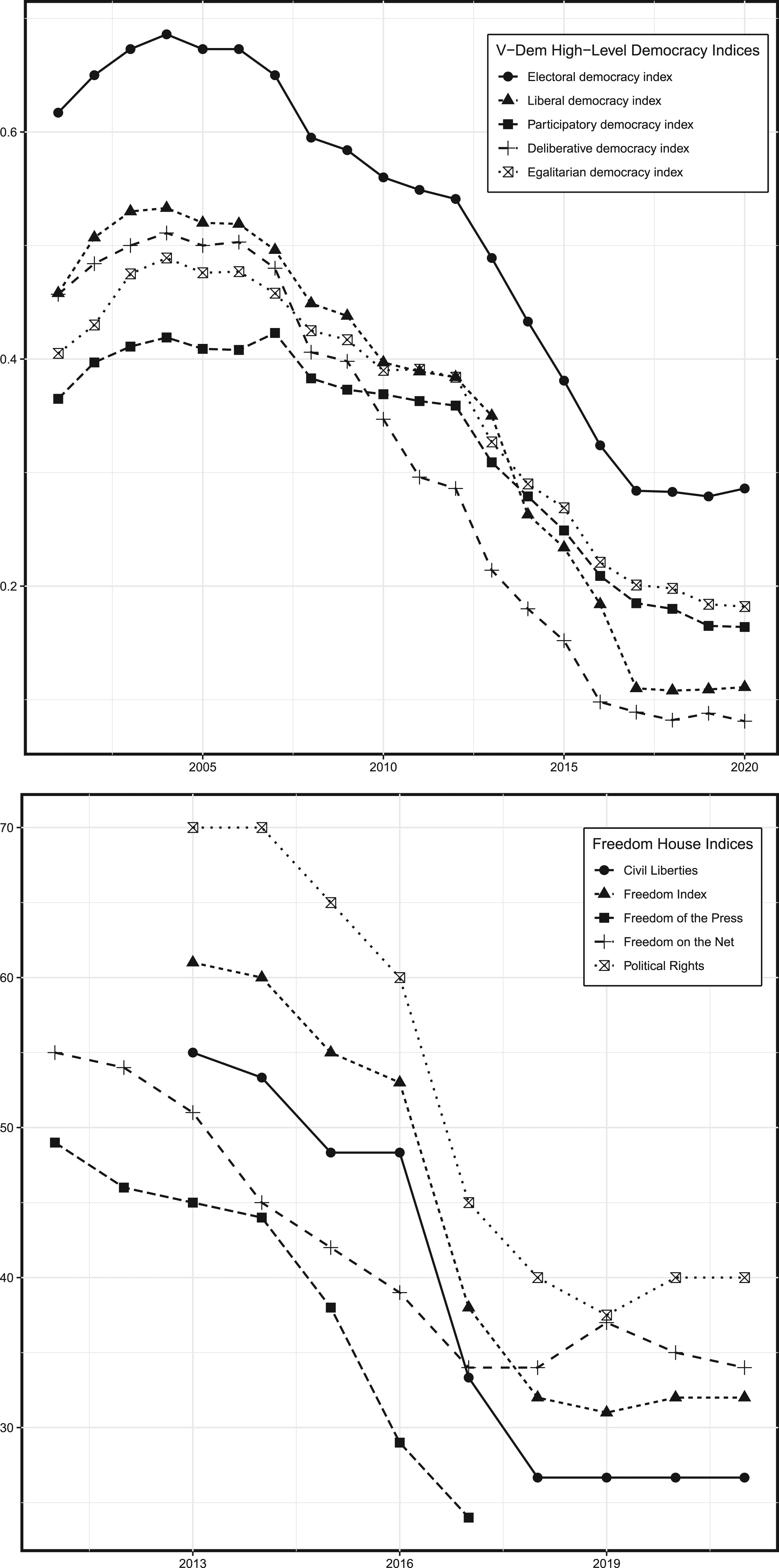
We argue that this dreadful and endogenous shock in the country’s democratic standards divided political parties in Turkey between those supporting parliamentarian democracy and civil liberties, and others endorsing executive presidentialism and state security at the expense of violating civil rights. Although there had been strong signals beforehand, we believe that the turning point for the transition from the old party structure to the new democracy-authoritarian divide was the 2017 constitutional referendum. On 16 April 2017, the Justice and Development Party (Adalet ve Kalkınma Partisi [AKP] 1 ) with the support of the Nationalist Movement Party (Milliyetçi Hareket Partisi [MHP]) brought forward the package of 18 proposed constitutional amendments proposing to replace the existing parliamentary system of government with a presidential system and executive presidency. The referendum took place under a state of emergency declared after July 2016 failed coup attempt. The extraordinary circumstances constrained the total amount of time to discuss a groundbreaking constitutional change affecting its 72 articles that grant the president sweeping political powers, including more direct appointments to the high-level judiciary (Bilgin and Erdoğan, 2018).
The transition from parliamentarism to presidentialism in 2017 was a major turning point in party cleavage shift for several reasons. First, the referendum took the parliaments’ key oversight executive functions and transferred them to the presidential office. The constitutional change was presented to the other parties as a fait accompli, without proper consultation or public discussion. This eventually caused several complexities about the limits of presidential authority. For example, on March 2021, a presidential decree was announced to pull Turkey out of Istanbul Convention, human rights treaty about preventing violence against women, without approval from the parliament, even though the right to ratify the withdrawal from international agreements only belonged to the parliament in the previous parliamentary system (Aksoy, 2021).
The second role of the 2017 referendum on the party cleavage shift was the referendum campaigning process, which intensified the coordination between the opposition. As a response to the potential loss of parliamentary democracy, ‘No campaign’ before the referendum was carried out largely by the main opposition Republican People’s Party (Cumhuriyet Halk Partisi [CHP]) and pro-minority leftist Peoples’ Democratic Party (Halkların Demokratik Partisi [HDP]). A group of politicians from MHP, who will later establish the Good Party (Iyi Parti [IYIP]), contradicted their parties’ stance and made public speeches asking citizens to vote for ‘No’. After a long time, the 2017 constitutional referendum marked a moment where a diverse group of opposition parties from left and right formed a strong coalition against AKP rule for the same purpose. Despite this backlash, official results declared a 51.4%–48.6% lead for the ‘Yes’ vote. The margin of less than 2% reconfigured the entire executive system and abolished the parliamentary government.
And third, the 2017 referendum introduced new election laws, which affected parties’ election strategies. According to new electoral law, political parties entering the election as a part of the electoral alliance could be exempt from the 10% electoral threshold. This new system lowered the cost of forming a coalition for especially diverse small opposition parties. Thus, this constitutional change gave birth to two major party alliances in the snap presidential and parliamentary elections on 24 June 2018. As a result of the political and legislative partnership between AKP and MHP, People’s Alliance (Cumhur İttifakı) was established for the electoral campaign. However, the fragmented opposition swiftly mobilized, and four parties got together under the Nation Alliance (Millet İttifakı) “to remove the barriers in the way of democracy”. 2 CHP, IYIP, ultraconservative Felicity Party (Saadet Partisi [SP]), and center-right Democrat Party (Demokrat Parti [DP]) decided to form an electoral alliance against the backdrop of the 2018 parliamentary and presidential election. After 2018 elections, two newly-established political parties –Democracy and Progress Party (Demokrasi ve Atılım Partisi [DEVA]) and Future Party (Gelecek Partisi [Gelecek])– joined to this alliance. These two parties were established by Ali Babacan and Ahmet Davutoğlu, two ministers of previous AKP governments. Their electoral alliance with AKP’s major competitors also reflects the strategic effect of systemic change in the 2017 referendum.
In the wake of the 2018 elections, eight parties entered the parliament and obtained seats in the Turkish parliament. Peoples’ Alliance which incorporated AKP, MHP, and Great Unity Party (Büyük Birlik Partisi [BBP]), achieved 56% of parliamentary seats as well as 53.5% of the valid votes. The alliance obtained an absolute majority, but it also had Erdoğan elected as the first president in the newly established presidential system. On the opposite side, the Nation Alliance received 34% of the total votes and 189 seats in June 2018.
Research design
Data collection and methodology
We first aimed at visualizing the existing alignments and inter-party distances between major political parties in two-dimensional axes. The initial step was to identify the existing Twitter accounts of the members of the Turkish Parliament who were elected in the June 2018 elections. In his original paper, Pablo Barberá and Gonzalo Rivero used a set of actors from party politics, including elected representatives at the national level, the Twitter accounts of political parties, and the major political news media (2015). We only consider the Twitter accounts of the members of the Turkish Parliament and their followers. In the wake of a snap general election held on 24 June 2018, six hundred parliamentarians were elected. Although eight political parties were initially represented by at least one MP, the number of parties eventually increased due to the resignation of existing MPs from their parties, and their participation in non-parliamentary or newly established political parties. For methodological simplicity and possible measurement biases, we ruled out the MPs who changed their political party or left the Parliament by September 2021. 3 After June 2018 election, 18 MPs resigned from their parties, 11 MPs either did not have a Twitter account or made their account private, and 17 of them left their seats due to death or execution of judicial punishment. Therefore, we limited our sample to 554 MPs from eight political parties. In the first part of our data collection, we collected the id names of Twitter users following at least three MPs from the Turkish Parliament. Setting a three MPs threshold increases the likelihood that the users potentially endorse the political parties of politicians whom they follow on Twitter (Barberá, 2015).
In conforming to this standard, we obtained 3,73 million unique IDs with Minet package (Plique et al., 2021). This bipartisan network was then reduced to a network consisting of 1,348,162 Twitter users following at least three elected MPs. Then we computed a two-dimensional cross-tabulation that records MPs and their followers. To analyze this binary contingency table, we used Correspondence Analysis (CA) (Greenacre, 2017) from the Prince package of Python. We aimed to unfold the relationship between MPs and their Twitter followers by using simple CA so that we can “discover a low-dimensional explanation” (Izenman, 2008: p. 628).
The CA spatialization in Twitter preserves homophily by accepting the following two assumptions (Barberá et al., 2015): (1) the distance between an MP and a user becomes inversely proportional to the probability of the user following that MP, and (2) two closely-positioned users have a higher probability of following the same MPs. The degree to which each dimension contributes to explaining the observed choice data is captured by the value of its inertia. The higher the inertia of a dimension, the more the positions along it explain the observed data through homophily. Figure 2 demonstrates the rates of relative inertia and the cumulative percentage of the inertia that each principal component contributes. Our first and second dimensions with the highest inertia represent –each one– more than 2% of the observed variance. The prior academic works on CA spatialization of networks between MPs and followers on Twitter reveal that dimensions with the highest inertia contain information revealing the main party divides in national party politics –see examples in Germany (Sältzer, 2022), Spain (Theocharis et al., 2015), France (Cointet et al., 2021; Ramaciotti Morales and Cointet, 2021), and the US (Barberá, 2015; Jachim et al., 2021). The scree plot displaying a graphical representation of the relationship between the percentages of relative inertia (y-axis) and PC bands (x-axis).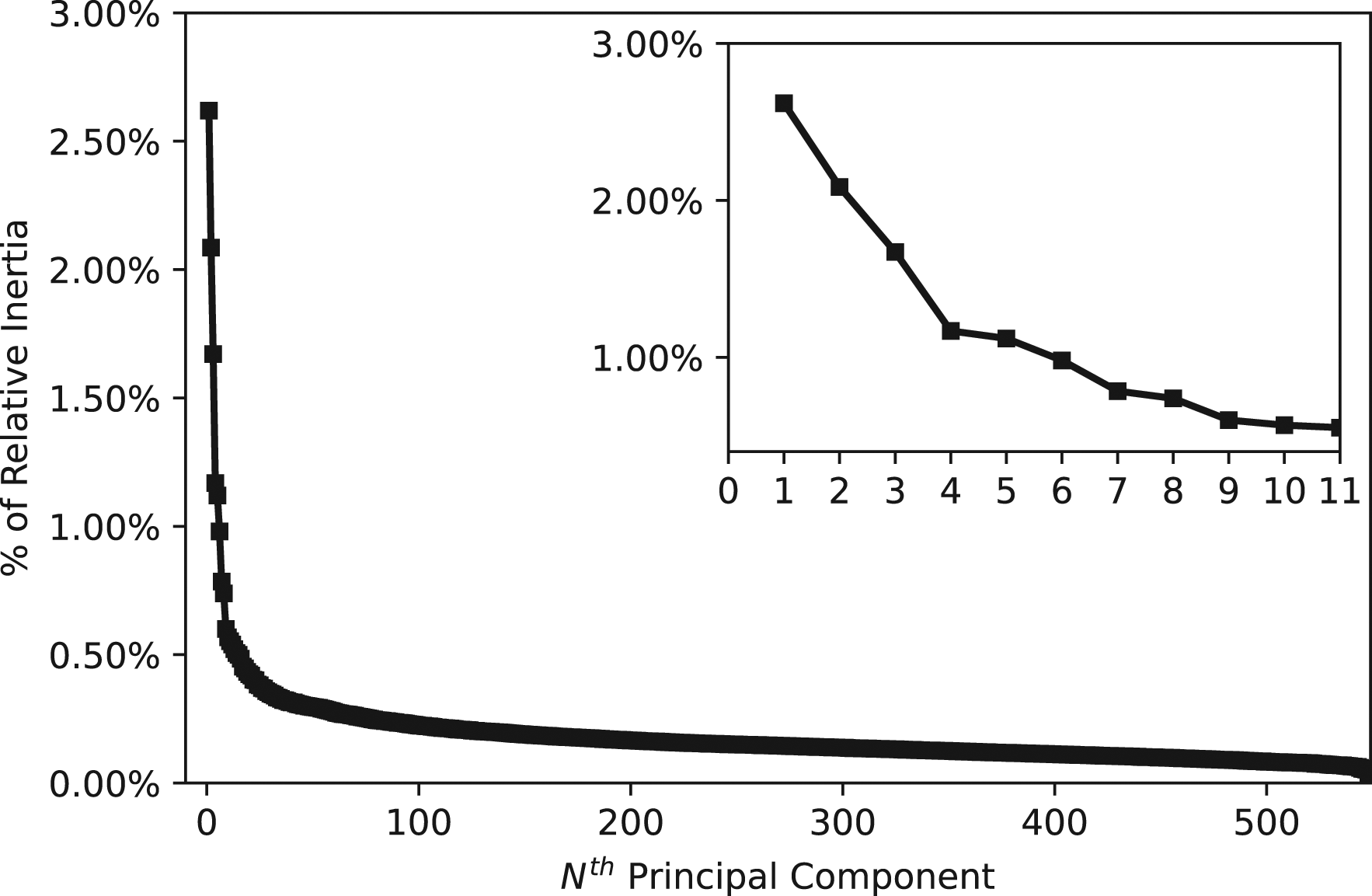
Political embedding of twitter networks
Lazarsfeld and Merton’s theory of homophily was one of the earliest research that distinguishes ‘homophily of values’ (Lazarsfeld and Merton, 1954). The homophily principle (McPherson et al., 2001) addresses how choices and actions of micro-level actors can be observed at the macro level. According to this principle, a tendency to form a friendship between like-minded people gets higher. Following homophily principle, previous studies asserted that online social media users tend to polarize their opinions and form partisan political communities (Conover et al., 2011). Socio-political systems are complex due to multi-part, multi-dimensional, non-trivial relationship patterns. Yet, first-order approximations such as homophily, which can be retrievable via CA, allow discovering important and recognizable patterns of political party networks. CA has been proven to equate to scaling of latent spatial models (Lowe, 2008) and used to infer the political tendencies of users in many countries (Ramaciotti Morales et al., 2021; Sältzer, 2022; Barberá and Rivero, 2015; Theocharis et al., 2015; Ramaciotti Morales and Zolotoochin, 2022; Barberá, 2015).
Figure 3 demonstrates our two primary axes and estimated positions of Twitter accounts for each member of parliament that are represented by cross signs. The colors of each cross were set in accordance with the MPs’ political party affiliations. The created principal coordinates are plotted for both MPs and their followers. The hexagonal grid map at the back surface of the plot scatters the number of Twitter users following MPs for the specific location. Therefore, we gave political scores to not only MPs but also their Twitter followers. Each cross sign (+) on the plot represents the spatial position of one member of parliament on Twitter. The darkness of hexagonal grid at the back surface stands for the number of Twitter followers for the specific location. Political party names are located at the mean score of party MPs.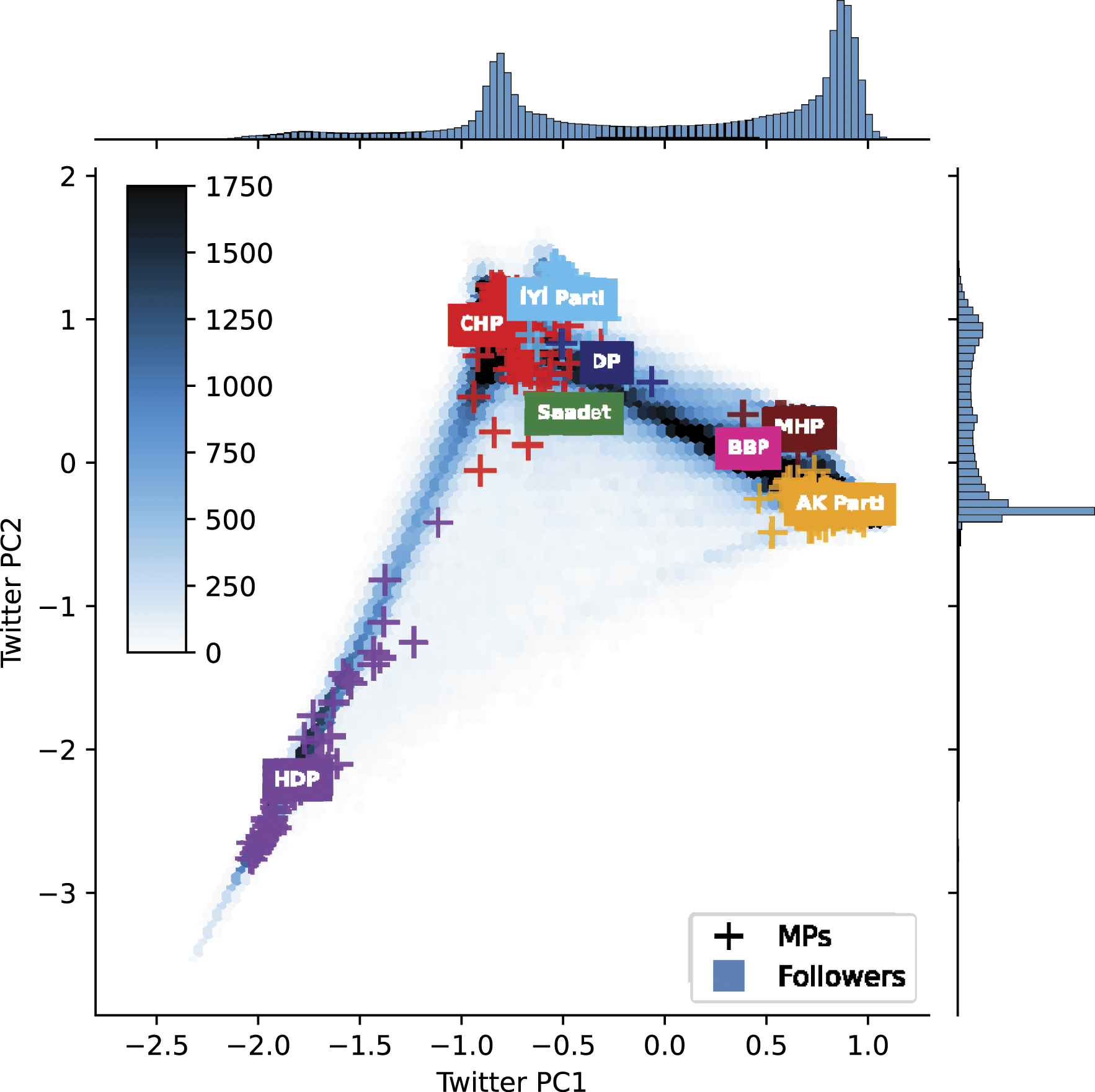
Our primary observation is the close proximity of political parties under the same electoral alliances. MPs from the same alliances were located in close proximity. The majority of Twitter users are located around the party MPs from two major alliances (Peoples’ Alliance and Nation Alliance), and the space between them. Another key feature of the plot is the segregated position of HDP, a pro-minority leftist party that has been facing mounting pressure from the state since September 2016. The isolated location of HDP is hardly surprising for several reasons. The intimidation and arrests that the HDP members have been facing due to alleged organic ties to the outlawed Kurdistan Workers Party (PKK), widely damaged the party’s public legitimacy. Before June 2018 elections, the parliament had already revoked the MP status of seven HDP representatives in the previous parliamentary term. Six additional MPs, including the party’s former co-chairs, were kept under arrest. This large-scale oppression continued as the Turkish state kept appointing state trustees to HDP municipalities. 65 HDP candidates were elected as mayors in the 2019 municipal elections. As of December 2021, the Ministry of Interior sacked 54 of them due to ongoing terror investigations. 4
Democracy-authoritarianism divide in Turkish politics
Interpreting dimensions using survey results
How should we interpret the generated ideological scaling of Twitter users and what does it tell us about the new party cleavage in Turkish politics? What should be the titles of Principal Component-1 (PC1) and Principal Component-2 (PC2)? To answer this, we used two recently-administered surveys reflecting the stances of Turkish political parties and their supporters toward policy-related, identity-related, and events-related questions. Figure 4 and Figure 5 are the summary results displaying how strongly the parties’ general positions on Chapell Hill Expert Survey (CHES) and KONDA4 surveys correlate with the average PC1 and PC2 scores of the political parties at the two-dimensional representation. The CHES estimates the party positioning of political parties in Europe on a wide range of issues by using responses from political scientists specialized in the party politics of European countries (Bakker et al., 2015). The most recent CHES wave that we accessed was from 2019, and it includes the scores for five political parties that entered the Turkish parliament after the 2018 parliamentary elections.
5
Because we have five parties, we rely on the exact expressions for the Pearson correlation value for small samples (Bertrand and Maumy, 2008), and we will validate our results through a second method relying on text analysis in the next section. Two bar plots given above show Pearson correlation coefficient results between the mean score of each political party that we estimated in two axes and parties’ mean scores for each question in Chapel Hill Expert Survey (CHES). The 2019 survey contains five political parties from the Turkish parliament. The bars having p-value less than 0.1 are shaded dark blue (’*’ = 90%, ‘**’ = 95% and ‘***’ = 99% confidence intervals). Two bar plots above show Pearson correlation coefficient results between the mean score of each political party that we estimated in two axes and the percentages of party supporters who agreed with the given statement in KONDA public surveys conducted from 2017 to 2020. KONDA’s results were obtained from their reports, and they were hand-coded in a separate data frame. The bars having p-value less than 0.1 are shaded dark green (’*’ = 90%, ‘**’ = 95% and ‘***’ = 99% confidence intervals).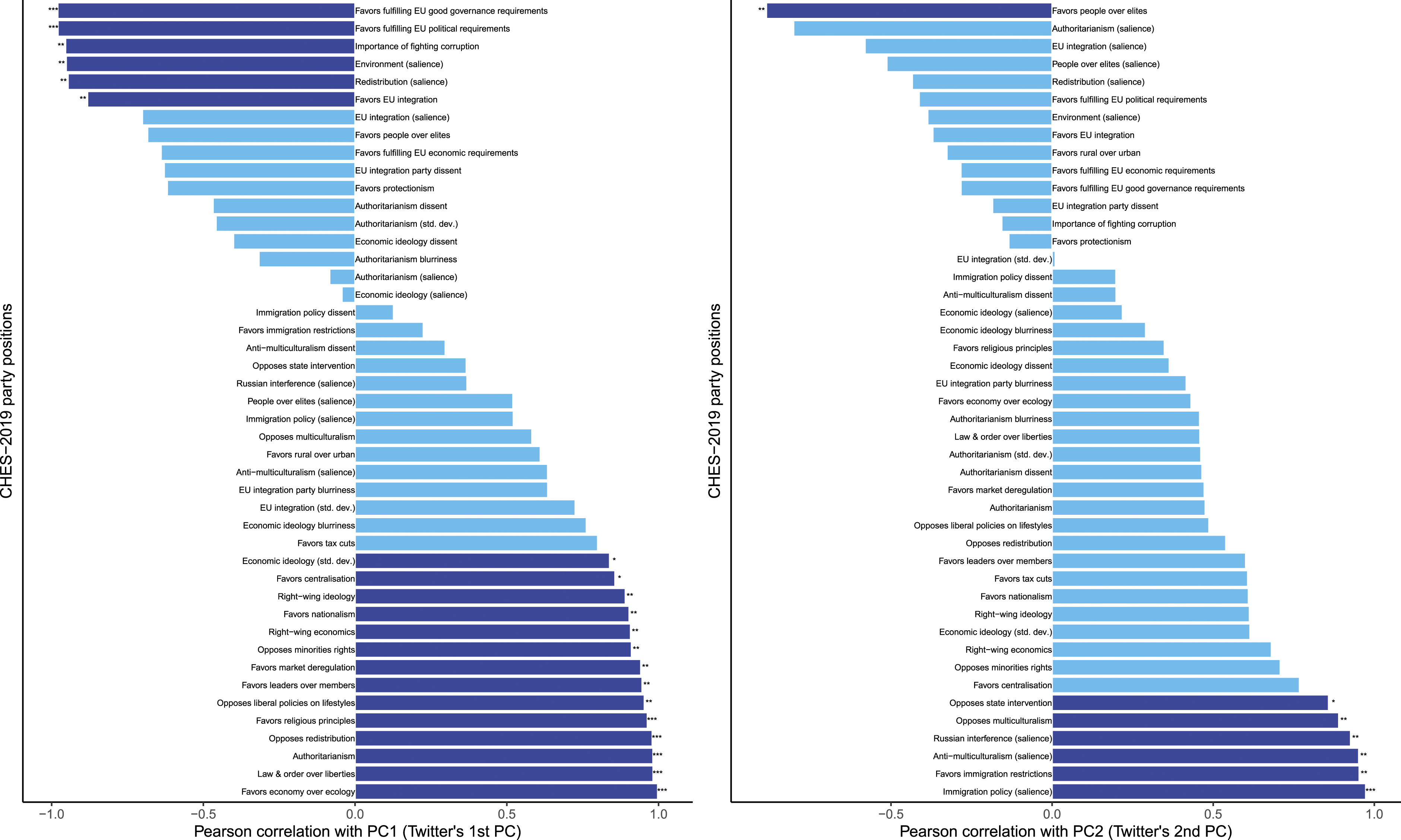
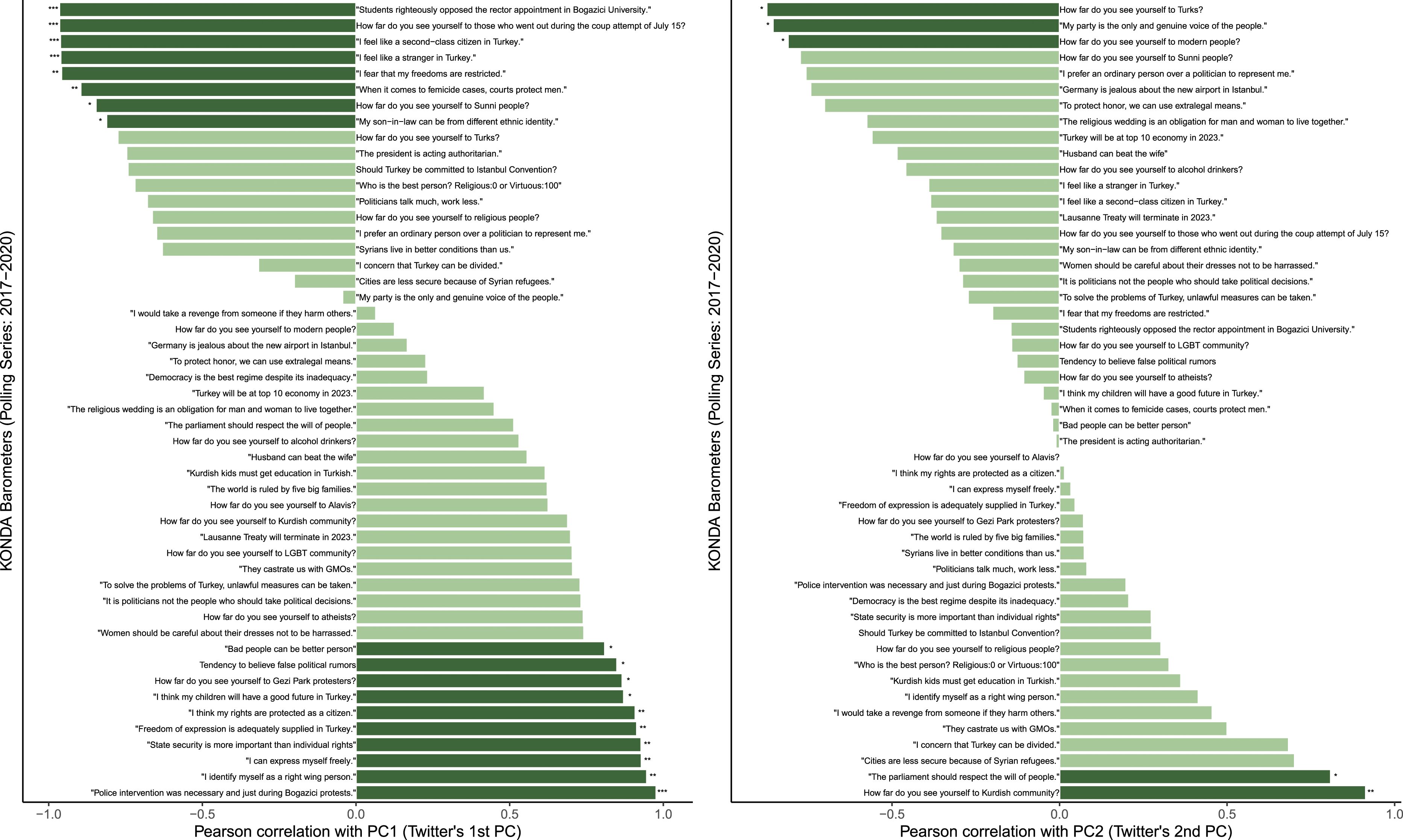
The Pearson correlation result between survey questions and the mean score of each political party at PC1 supports that the main party divide in Turkish politics converged the core debates about democracy and authoritarianism. In Figure 4, the 80% of significant questions correlated positively and negatively with PC1 can be interpreted under three broad issues: good governance, authoritarianism, and economic left/right (for detailed explanations of the abbreviations, see Appendix One Table A1). The topics related to commitment to EU good governance requirements are the top negatively correlated questions. Accordingly, favoring good governance practices decreases as we move from negative to positive at PC1. By contrast, the leaning to discard environmental protection to boost economic growth, and authoritarian stance toward social and cultural issues increase.
PC1 correlation results at Figure 5 give us a wider picture of what PC1 could stand for. The key questions dividing parties from left to the right are not concerning religious identity, modernity, or the importance of being religious anymore. As we can notice, in contrast to GAL/TAN measurement, post-materialistic or libertarian demands such as women’s rights, LGBT rights, or minority issues fail to explain our primary axis adequately. Instead, new party cleavage can be interpreted with the questions about the support for the protests, the overall happiness of citizens about the treatment of Turkish state, or the concerns about the freedom of expression. This implies that anxieties over essential democratic standards became the main divide between party supporters. Following the indicators from Figure 4 and Figure 5, the first axis of our two-dimensional representation is demonstrated to be a ‘democracy-authoritarianism’ cleavage.
Compared to the first dimension, the interpretation of the second axis is more clear-cut and converged around three distinct but interrelated issues: ethnic identity (Turkish-Kurdish), immigration, and populism. The scale of the y-axis bears a resemblance to the Turkish/Kurdish voting share of political parties. HDP, located at the bottom of the y-axis, receives votes overwhelmingly from Kurdish people, whereas only the minority of Kurdish voters prefer CHP, IYI Party, or MHP. The only exception is AKP due to its religious discourse attracting pious Kurdish voters. This axis is also a visual representation of the ’ethnicity question’ in Turkish politics that prevents opposition parties from a united coalition under one block. Two-party dominance between HDP and AKP in the south-eastern provinces of Turkey kept other opposition from entering the competition in those Kurdish-dominated cities.
Validating axes using self-descriptive keywords from twitter biographies
Self-descriptions on Twitter user pages are the pieces of information that contain rich content about the profile identities. Twitter users primarily utilize the biography sections on their profile pages to convey key information to others about who they are or what kind of message they want to express. Given the large number of Twitter users in our dataset, biographical self-description constitutes a good source of information to validate our two-dimensional interpretation. We believe that Twitter bios reflect individual self-interests. Keywords, sentences, or private names that the users put on their biographies tend to follow patterns across the members of different political and social groups. Our user sample consists of accounts following the MPs, and therefore we assume that this increases the likelihood of high interest in politics among them. Investigating whether there is any pattern of using particular keywords between different political parties located at the PC1 and PC2 would also reflect the relative importance of specific word groups for party cleavage.
We began our investigation by collecting textual data from the user biographies. We accessed the bio-information of accessible Twitter users
6
that were selected from our dataset. Figure 6 shows six groups of chosen keywords and how likely it is that users use these keywords in their biography. As it can be noticed, the correlation coefficient values of democracy-related keywords and the ones concerning religion are the same. However, the correlation strength for the keywords related to secularism is one-third of these two. We argue that this result is significant in such a way that the expression of the word ‘democracy’ and ‘freedom’ gets as equally important as religious identity expression for the main party divide. This reinforces the argument that the democracy-authoritarianism divide did not terminate the existence of traditional social cleavages in party politics, but it is only surpassing them. For PC2, the keywords related to ethnic identity expressions for two major ethnic groups of Turkey (Turkish or Kurdish) support our assumption that ethnicity is the primary determinant for the distribution of parties at PC2.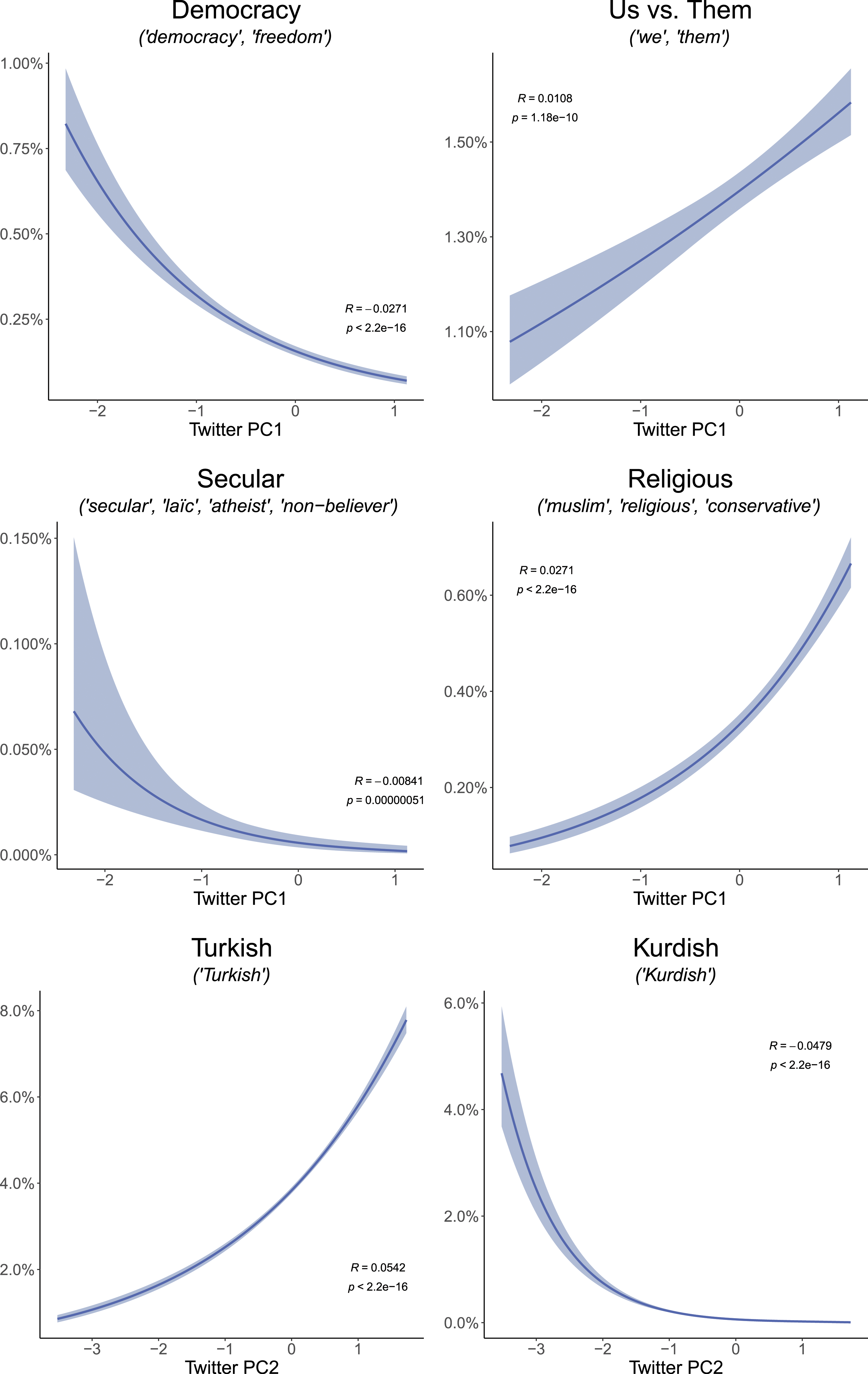
Keeping voters divided: understanding the role of media under new party cleavage
By identifying the value homophily of Twitter users in a two-dimensional latent space, the previous chapter introduced the representation of a triad of party politics in Turkey. Accordingly, three electoral blocs - People’s Alliance, Nation Alliance, and HDP - form the nodes of this triad. We believe that our two-dimensional representation is functional in tracing the government’s authoritarian practices.
One of the key drivers of the AKP’s electoral success was its propaganda power. The decline of media diversity in Turkey exacerbates the country’s deterioration in the World Press Freedom Index, compiled annually by Reporters Without Borders. Since 2013, Turkey’s highest position in the index was 149th out of 180 countries, although it received scores around the world average until 2007. Autocratization, drastic decline in democratic standards and, eventually, the emergence of the democracy-authoritarianism divide cannot be separated from the various tactics of government to capture the Turkish media outlets. The closure of opposition media, the seizure of mainstream news organizations by major holdings, mass firings, imprisonment of journalists, intimidation and legal pressures have been long-standing government disciplinary mechanisms. The AKP employs various means to prevent news access to citizens and streamline government propaganda. How effectively do these tactics influence citizens’ news consumption behavior? Do traditional and mainstream media promote political polarization in the interest of the incumbent camp of democracy-authoritarianism cleavage? To answer these questions, this chapter assesses the government’s success in restricting the visibility of opposition views.
To this end, we introduce a novel method to capture the news consumption patterns of Twitter users. As explained in the methodology section, the Correspondence Analysis assigns political scores to MPs and their followers based on the ‘who follows whom’ approach. At this point, we assign a political score to each media URL that corresponds to the political score of the Twitter user who shared it. For example, suppose that a Twitter user @user1234 was assigned a political score of (0.5, -0.5) in our PC1 and PC2 axes. It is very likely that this user mainly follows AKP and the Republican Alliance MPs. At the same time, @user1234 frequently shares news from a specific Web site: ‘randomnewsagency.com’. Then, we assign ‘randomnewsagency.com’ the same political score as @user1234, namely (0.5, -0.5). As different Twitter users with different political scores also share links from the same Web site, we can locate the average political score of the news organization and thus determine whether the news outlet’s audience is more likely to support the government or the opposition. We collected 120 million tweets from 100 thousand randomly selected Twitter users following at least three MPs to understand media consumption patterns in Turkey. Data collection occurred from early December 2021 to mid-January 2022 using the Gazouilloire package (Ooghe-Tabanou et al., 2017). We kept only tweets sent after 2017, the year in which the IYI party, the most recent political party in our data, was founded. In our estimation of political positions of media outlets using tweeting activity after 2017, we use the position of users computed from their follower networks (how they follow MPs) as described in the previous sections. This is justified by the assumption that interaction networks on Twitter are much less homophilic and more politically dynamic than affiliation networks (Roth et al., 2021).
State-owned media versus foreign media
To observe direct government interference with the partisanship of the media, we first reveal the news consumption patterns of state-owned media organizations. In particular, we examine the Turkish Radio and Television (TRT) station, the state-owned media asset controlled by the government. Since 1968, TRT has been Turkey’s national public television and radio station network. It is subject to the constitutional obligation of being an impartial public legal entity, which means TRT’s broadcasting activities are operated with public funds. Although Law No. 2954 requires TRT to “adhere to the principles of impartiality, accuracy, and promptness in […] publishing news,” TRT has been heavily criticized by opposition parties for its biased and disproportionate political coverage. According to İsmet Demirdöğen, a member of Radio and Television Supreme Council (Radyo ve Televizyon Üst Kurulu [RTUK]), the People’s Alliance was covered for 53 h in TRT broadcasts during the 2018 parliamentary elections. In contrast, the Nation Alliance was broadcast for only 14 h, and HDP could not find any appearances. 7 Contrary to its constitutional obligation, the state-funded media only partially covered opposition parties during this period.
At the same time, the number of foreign-funded broadcasters operating in Turkey or reporting in Turkish increased over the past decade. Turkish-language services of foreign media have increased their bureaus and diversified their reporting in the Turkish language. Four major international media organizations (Deutsche Welle, BBC, Voice of America, and France 24) even established the +90 Youtube Channel together on 29 April 2019, to “promote dialogues and empathy between different social groups”. 8 With different motivations, the increasing number of journalists who used to work in mainstream media outlets are opting for foreign media.
Figure 7 illustrates the sharp contrast for the media consumption patterns between state-run media and foreign media organizations. We selected four media outlets in each category that are most frequently cited in our data. The tiny dots on the graphs represent the average political scores of a URL link from the media websites. They were calculated by measuring the average political scores of Twitter users who shared the same link. The large yellow dots are the average PC1 and PC2 scores for each media.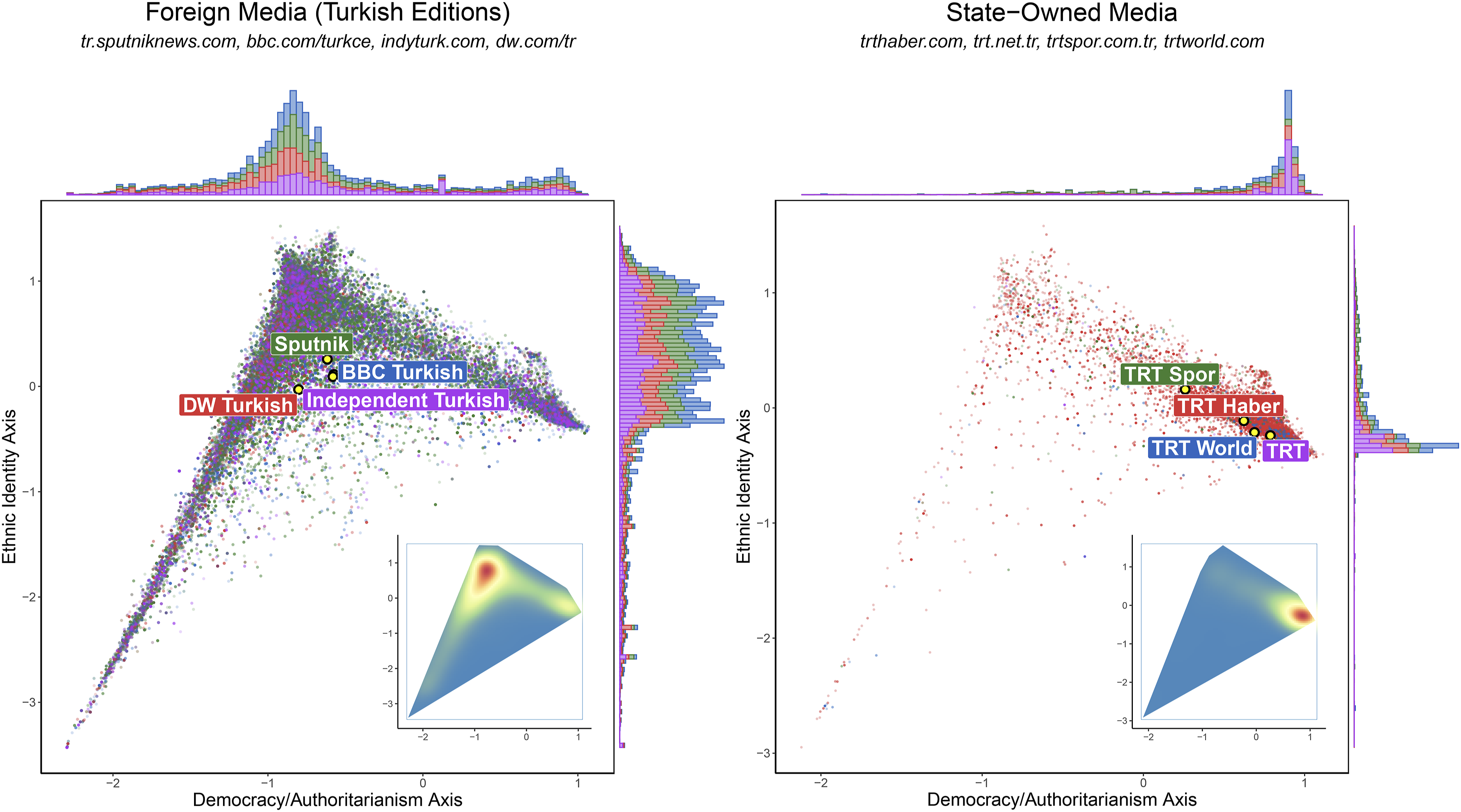
The results are striking. The news reported by the state-funded media is not shared by the opposition but only by government supporters. On the other side, the foreign media were mainly consumed overwhelmingly by a diverse opposition, although they are not as polarized as TRT’s media outlets. The case of Sputnik Turkish is worth drawing particular attention to. Although the outlet was widely considered a propaganda tool for the Russian government (Watanabe, 2018; Baade, 2018), Sputnik’s branch in Turkey turned into a magnet for the growing number of unemployed Turkish journalists. Since its foundation in 2014, the company has hired some of the country’s most talented and popular journalists who were previously working at mainstream media outlets. 9 This made the news coverage of Sputnik Turkish overwhelmingly pro-opposition.
Change of media ownership
The second tactic AKP has been following to control the media is rather indirect and related to the media industry’s transformation. Since the early 1990s, the nature of media funding in Turkey has drastically changed. A series of deregulations in the media market led to a shift in media ownership from family-owned companies to large conglomerates.
Over this period, corporate clientelism fed the existing concentration of ownership. The owners of large conglomerates, primarily concerned with their survival in a competitive environment, sought to build stronger ties to political authority by establishing proponent media companies in return for higher profits in their ‘non-media’ businesses. The strength of clientelistic ties in politics have accelerated this trend. The AKP actively encouraged pro-AKP business people to funnel their investments into the media sector by using various legally controversial channels. State-owned banks provided cheap financial loans to these business groups so that they could take over mainstream media outlets and transform them into partisan ones. 10 During the first decade of AKP governments, about 30% of Turkey’s newspaper circulation changed hands (Çarkoğlu et al., 2014). At the same time, state-owned companies disproportionately channel public money to pro-government media outlets via advertisement expenditures to keep partisan media financially sustainable. 11
The most striking recent example of an attempted media seizure was the massive takeover of the media assets from Doğan Media Company to Demirören Holding. Doğan Media, owned by businessman Aydın Doğan, had been under pressure since 2008 when its media organizations began to raise their voice against the AKP government. At the time, Aydın Doğan, who was associated with secular elites, was controlling around 75% of the total newspaper circulation in Turkey, including Hürriyet, the country’s best-selling newspaper. As a result of the dispute between Aydın Doğan and then-Prime Minister Erdoğan, the Ministry of Finance imposed a $2.6 billion tax penalty on the Doğan Group. To escape the tax penalty, Aydın Doğan sold two of his prominent newspapers - Milliyet and Vatan - to a pro-government Demirören Group in April 2011. As political pressure mounted, the Doğan Group was forced to sell its remaining media assets, including flagship newspaper Hürriyet as well as TV outlets, Kanal D and CNN Türk, to Demirören Group for $1.2 billion. This swap eliminated the Doğan Group from the media industry and made Demirören Holding Turkey’s largest media conglomerate.
Did this tactic work? Are the newspapers, TV channels, and news agencies that switched from Doğan Holding to the Demirören Group producing more pro-government news coverage? Figure 8 gives an answer. It shows how the audiences of four media outlets changed after the transition from the Doğan Group to the Demirören Group. Over the four consecutive years, the transferred media outlets were consumed more and more by the supporters of the AKP government and Nation Alliance. The given average political scores for every single year provide statistical evidence that the tactics of media takeover resulted in substantial changes in media audience. The figure demonstrates how Turkey’s top media outlets, in terms of audience shares, became more and more partisan and pro-government after they were bought by Turkey’s one of the largest business conglomerates. Given that Hürriyet and Posta are the second and the fifth most circulated newspapers in 2021, the extent to which this shift affected public opinion and news consumption can be grasped better.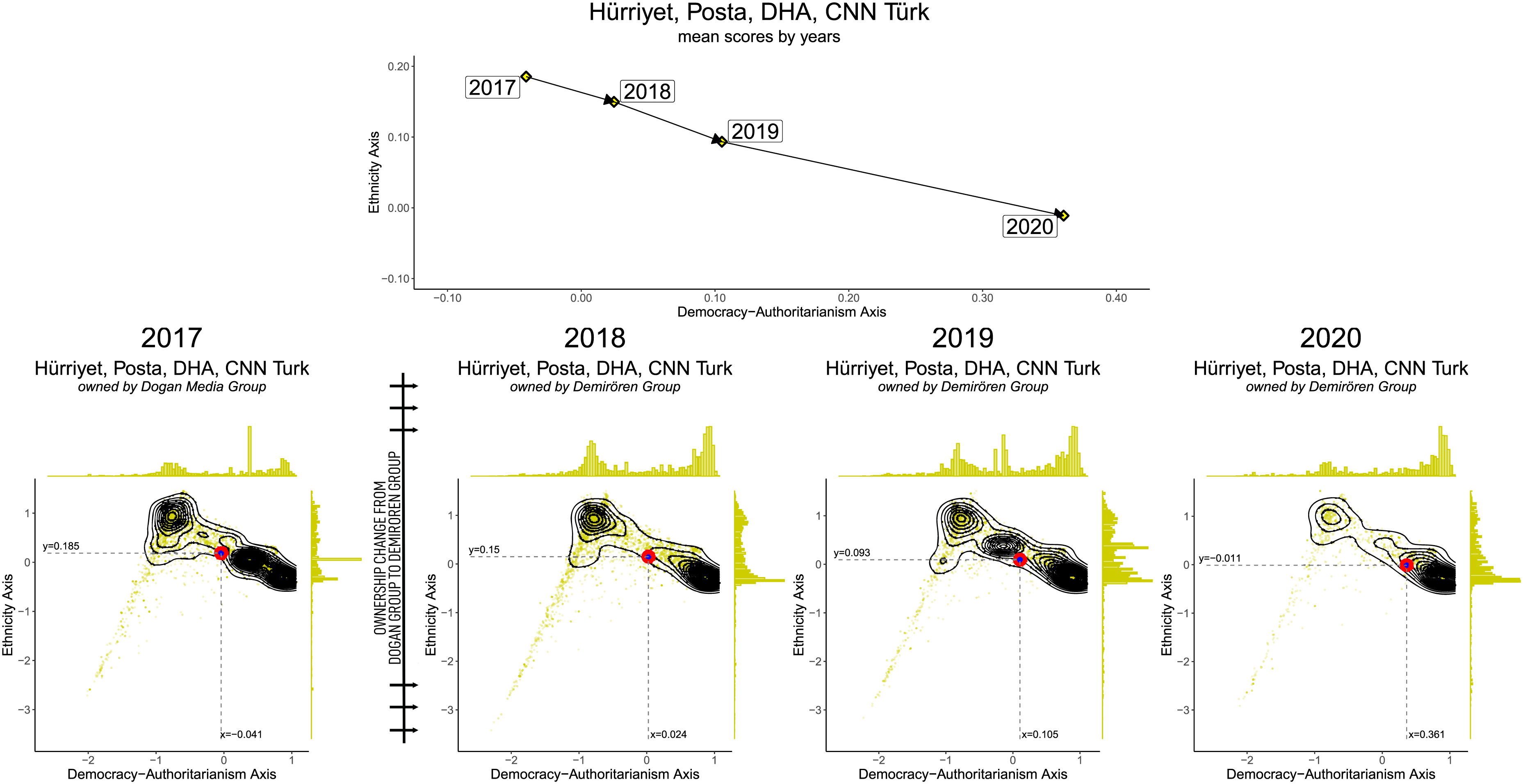
Concentration of media ownership under conglomerates
Diversity in the ownership of media is as important as the diversity of newspapers and television networks (Cagé, 2016). Mounting political and economic pressures on the media industry makes the sector vulnerable to media-ownership-related problems (see. Barnouw E and Aufderheide, 1997). Ownership of media by big conglomerates as a way to create a political influence brings concerns about the quality and independence of journalism. The narrow financial interests of these large corporations do not mostly meet the needs and concerns of heterogeneous societies about democratic dialogue (Cooper, 2003). Under conglomerations, commercial mass media accelerates hyper-commercialization and impairs access to diverse and antagonistic media sources. In Turkey, the consolidation of media ownership has been an ongoing trend since the 1980s, exacerbating two significant problems. First, the dismantlement of journalists’ and media workers’ unions was accelerated. The ‘de-unionization’ process started during the 1990s after Turkey’s two most prominent newspapers, Hürriyet and Milliyet, decided to resign from the union (Christensen, 2007). In 2021, only 8.5% of all journalists in Turkey were members of the Journalist’s Union of Turkey (TGS). 12 Second, media bosses who control large media networks and who have strong relations with political power restrict critical reporting by various means. In 2019, a few years after media outlets owned by Aydın Doğan were sold to Demirören Group, 45 journalists were dismissed in a single day without stating any explanation and providing financial compensation. 13
To test the impact of media ownership on media consumption patterns across party supporters, we investigated the URL shares from the websites of newspapers and TV channels by political party followers on Twitter. We are interested in revealing the extent to which the media outlets owned by Turkey’s big conglomerates are shared by pro-government supporters. American Management Association’s Dictionary of Business and Management defines conglomeration as “diverse and disparate group of companies under a common holding company [under which] the individual companies have unrelated businesses” (Law, 2016: p. 62). In conformity with this definition, we identified seven media groups in Turkey that operated under big holdings. Detailed descriptions of these media groups are given in Appendix Two. According to Media Ownership Monitor Report published by Bianet and Reporters Without Borders in 2020, 40% of media ownership in Turkey is concentrated under these seven media groups (MoM, 2016).
Kernel density estimates (KDE) in Figure 9 demonstrate the categorization of selected newspapers and TV channels with the consumption pattern by political party followers along the democracy-authoritarianism axis. Our analysis includes all national newspapers and TV channels. We also discarded the websites of media outlets that were not cited among the top one thousand media websites in our data. The distribution of the population on the x-axis shows the frequency of shared URL links from given media by Twitter users. In order to protect media organizations and journalists working there, we decided not to give the exact location of newspapers, and we have obfuscated the names of media outlets on the plot. Instead, we classified these outlets into three categories: opposition media, media with mixed audiences, and pro-government media Table 1. Categorization of media outlets by party-supporter consumption. Media outlets with one star (*) are owned by business conglomerates and media outlets with two stars (**) are owned by the state. 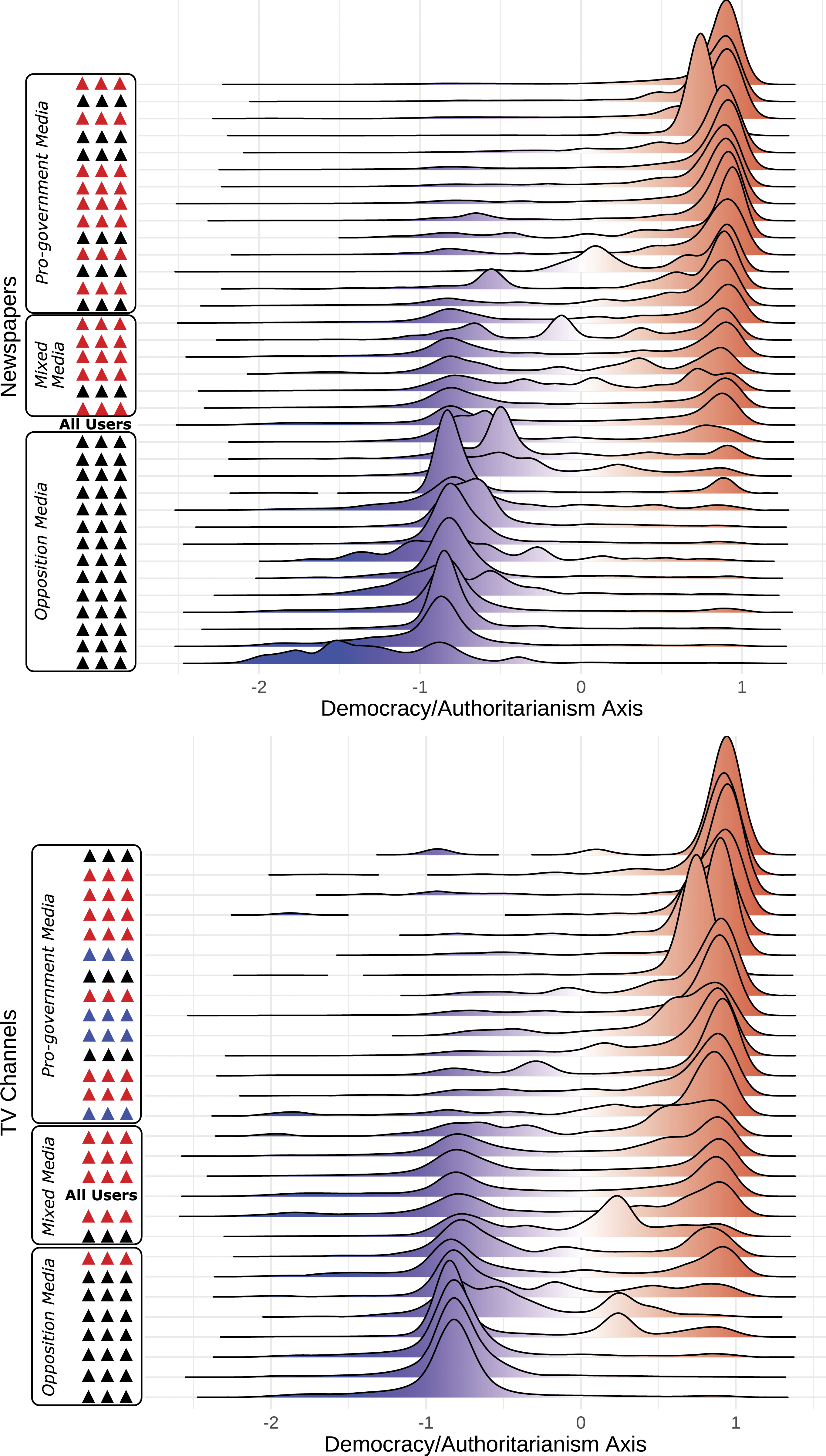
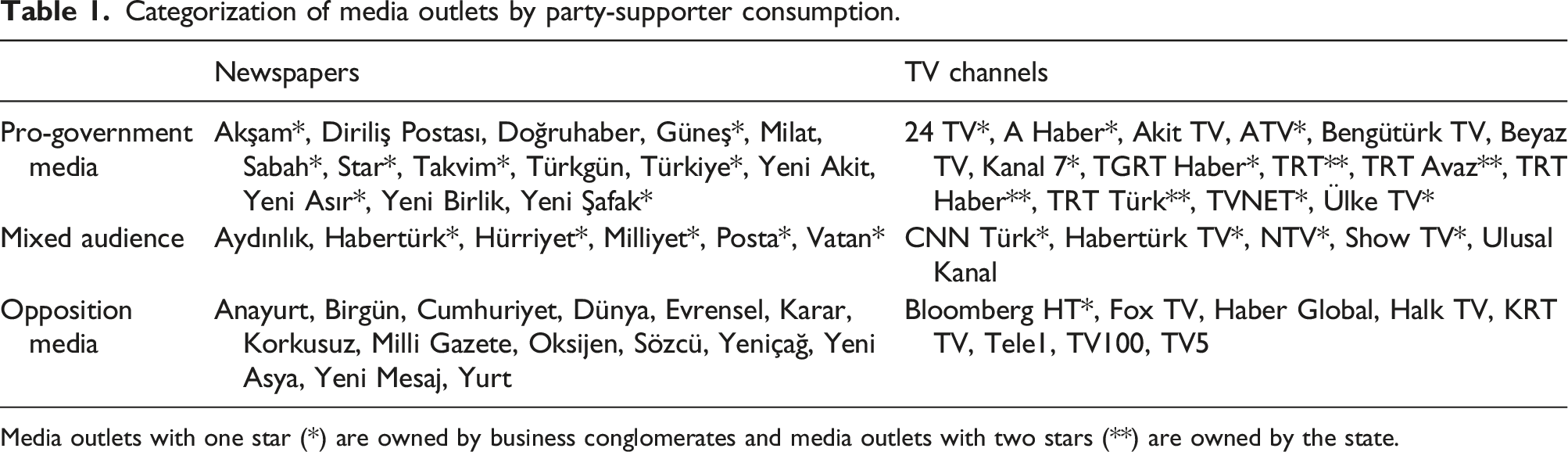
The names of media outlets under these three categories were given in Table 1 in alphabetical order. The KDE plot in Figure 9 shows that the majority of media outlets shared by pro-government supporters on Twitter are run by conglomerates. The very limited number of ‘mixed’ media websites that all political party supporters proportionately share also show the erosion and disappearance of mainstream media that aims to attract politically homogeneous groups of audiences. We believe that the driving factor behind this outcome on the demand side is the rampant political polarization in Turkish society on the grounds of affective distances between political camps (Şaşmaz et al., 2022; Aytaç et al., 2017). Previous studies documented that Turkey became a country with extremely high levels of affective polarization. The mounting pressure on opposition groups makes the country one of the most polarized nations in the world in different measurements (Lauka et al., 2018; Orhan, 2022; Wagner, 2021). Investigating the three main pillars of affective polarization (social distance, moral superiority, and political intolerance) in Turkey, Erdogan (2018) found that the inter-group affective distance is not asymmetrical: it is “not driven by the supporters of a specific political party but can be observed among the supporters of all political parties.” In a study after the 2018 elections, Laebens and Öztürk (2021) showed that it is threat perceptions against economic well-being and political freedoms that shape partisan political identities for opposition and incumbent party supporters. Political conflicts and fast-speed democratic erosion strengthened the perception that one’s political freedoms and prospective economic welfare depend on who is in power. Our empirical results support that this polarization is also fueled by political power through media capturing. AKP rule, through direct and indirect means, eliminated the number of mainstream media outlets that appeal to opposition groups and AKP supporters at the same time.
Conclusion
Turkey took an authoritarian turn under AKP leadership. This article provided quantitative evidence about the contemporary party divide in Turkey using Twitter following choice data. Prior academic works already documented the mobilization of opposition parties amid fast-declining democratic standards in Turkey (Selçuk and Hekimci, 2020; Sayarı, 2016; Esen and Gumuscu, 2019; Somer et al., 2021; Selçuk et al., 2019). They detailed the opposition-coordination practices, including nominating joint candidates, supporting strategic voting, and conducting unified campaigns until the 2017 constitutional referendum. After the drastic constitutional change in 2017, these practices continued to take on new dimensions by forming an electoral alliance, nominating the candidates from smaller parties under the larger party’s lists, or signing joint manifestos with “table for six” meetings in a bid to end the 20-years rule of AKP government.
The collection of the parties’ followers data further showed that the followers of MPs on Twitter display a tendency to follow other MPs of the same electoral alliance. Our interpretation of comparing two-dimensional CA representation with two wide-scale survey results can also be critically discussed as we only focus on quantitative measurement. We selected to name the main party divide as ‘democracy-authoritarianism’ cleavage but some scholars preferred using “populist cleavage” (Sözen, 2020; Çelik and Balta, 2020; Aytaç and Elçi, 2019), “pro-Erdogan/anti-Erdogan divide” (Somer, 2019), or “affective camps” (Orhan, 2022; Laebens and Öztürk, 2021). Although the recent academic literature and our empirical data encouraged us to name PC1 as a democracy-authoritarianism divide, it was not an objective of this article to evaluate the strength, durability, and flexibility of this new divide. This emerging cleavage in Turkish politics can be strategic or temporary and may not cause a fundamental shift in party politics once the incumbent changes in the next election. At the same time, the other methodological challenge this article encounters is the low political representation in Turkey. 10% electoral threshold to gain representation in the parliament raises the questions of the representativeness of the parliamentary parties.
Our analysis of the ‘democracy-authoritarianism’ cleavage does not make assumptions about the party’s commitment to liberal democratic values. Opposition parties’ unity about the reestablishment of parliamentary democracy with independent and autonomous political institutions does not draw us a comprehensive picture of individual party stances on liberal policy issues. We argue that the main element that designs party distances in contemporary Turkish politics is the discussions around the nature of the political system. The emergence of this new party divide is a relatively new phenomenon, and this can be a purely strategic political choice for opposition parties. We rather leave this discussion to future academic research using elite surveys and interviews.
We argue that media polarization and political party distances cannot be separated from each other as journalists and media workers set the frameworks on key political issues. Various tactics of the AKP government impaired the mainstream media’s democratic role of monitoring the malpractices of political power. Financial and political threats against opposition media undermine its democratic function, while media owners and journalists are intimidated. The government carries out direct or indirect methods to control media establishments. We demonstrated that the relationship between the fast decline in democratic standards and the country’s media ecosystem is reciprocal: while business owners are buying media outlets to spread government propaganda in return for stronger relations with the president, the traditional media outlets owned by pro-government business circles further polarize the newly established democracy-authoritarianism divide. This article does not aim to give clear and alternative answers to how this cycle can be broken. We narrowly investigated whether online broadcasts and publications of foreign media open alternative channels for politically diverse media audiences. To better understand the media’s role in the authoritarian path followed by AKP, we believe that further qualitative and quantitative research studying media-politics interaction is needed.
Supplemental Material
Supplemental Material - Tweeting apart: Democratic backsliding, new party cleavage and changing media ownership in Turkey
Supplemental Material for Tweeting apart: Democratic backsliding, new party cleavage and changing media ownership in Turkey by Omer Faruk Metin and Pedro Ramaciotti Morales in Party Politics
Footnotes
Acknowledgments
Authors are grateful to Dilara Hekimci, Orçun Selçuk, Emre Erdoğan, Selim Erdem Aytaç, Jean Philippe Cointet, Kevin Arcenaux, Romain Lachat, and other colleagues who participated the seminars organized by CIVICA, Sciences Po médialab and CEVIPOF for their useful feedbacks.
Declaration of conflicting interests
The author(s) declared no potential conflicts of interest with respect to the research, authorship, and/or publication of this article.
Funding
The author(s) disclosed receipt of the following financial support for the research, authorship, and/or publication of this article: This work was supported by the Agence Nationale de la Recherche; ANR-18-IDEX-0001, Agence Nationale de la Recherche; ANR-19-CE38-0006, CIVICA Consortium; European Polarisation Observatory (EPO).

Supplemental Material
Supplemental material for this article is available online.
Notes
Author Biographies
References
Supplementary Material
Please find the following supplemental material available below.
For Open Access articles published under a Creative Commons License, all supplemental material carries the same license as the article it is associated with.
For non-Open Access articles published, all supplemental material carries a non-exclusive license, and permission requests for re-use of supplemental material or any part of supplemental material shall be sent directly to the copyright owner as specified in the copyright notice associated with the article.
