




Abstract
Research has suggested that fragmented political systems, incohesive parties, and weak programmatic links between voters and legislators can undermine the effectiveness of ideological legislative representation. Using Brazil's national and state assemblies, we examine the potential for voter-elite congruence in a legislative environment considered weak in programmatic representation and highly fragmented by a decentralized political structure. Focusing on 2005–2014, we use mass and elite survey data from the National Congress and 12 state assemblies to estimate deputies' and respondents' ideal points on a common left-right scale. Despite many potential barriers to ideological representation, we find an aggregate pattern of congruence between voters' and politicians' ideological positions during this period, with stronger voter-deputy correspondence for state deputies on average. These patterns are confirmed by a dyadic analysis of deputy and voter characteristics. However, we also find weaknesses in party-level ideological congruence for the major parties—for voters on the left and party supporters on the right. The findings suggest that, while the party system did not prevent overall ideological representation, it may have hindered important aspects of party representation.
Introduction
Whether political elites are successful as representative agents in aggregating voter preferences is central to the functioning of democratic representation (Dalton and Anderson, 2011; Huber and Powell, 1994; Powell, 2000, 2019). A core question is how ideologically close politicians are to their voters (Miller and Stokes, 1963)—that is, how well mass preferences correspond to elite preferences (Powell, 2004). Research on advanced democracies has shown that the absence of mass-elite congruence leads to decreases in democratic satisfaction (Ezrow and Xezonakis, 2011), reduced support for the political regime (Muller, 1970), lower trust in the government (Miller, 1974), and increased support for populist anti-system movements (Kriesi, 2014).
The ideological congruence of voters and elites can be distorted or disrupted by various individual, party, and system factors. This discrepancy may be due to voters themselves lacking information or an ideological framework to align with like-minded politicians (Jessee, 2010; Kroh, 2009; Lachat, 2008; Zechmeister and Corral, 2012), or may be due to politicians failing to represent these voters (Canes-Wrone et al., 2002; Klingemann et al., 2017; Rogers, 2017). Political contexts, including institutional settings, regulate the ability of voters to identify their representatives’ political positions (Carroll and Kubo, 2018) and the institutional incentives for politicians to represent them (Ferland, 2018; Huber and Powell, 1994; Powell, 2013). For example, Thorlakson (2007) finds that federalism impedes mass elite congruence, while Carroll and Kubo (2018) find that voters in federal nations identify party positions less consistently. Others have identified important variation within countries—for example, that elites are more aligned with higher income voters (Gilens, 2009).
In many third-wave democracies, ideological congruence is believed to be undermined by clientelistic, particularistic, and charismatic linkages (Kitschelt and Freeze, 2010). In such contexts, “volatile party systems, limited party identification, and non-programmatic mass-elite linkages can inhibit congruence along party lines” (Boas and Smith, 2014). However, while voters in new democracies are often less ideologically connected to party labels (Mainwaring, 1999; Webb and White, 2007), scholars have found some evidence of ideological congruence in such contexts (Kitschelt et al., 2010; Saiegh, 2015; Zechmeister and Corral, 2012), particularly among the more consolidated party systems (Luna and Zechmeister, 2005).
In this paper, we examine the potential for ideological congruence in a legislative party system lacking the features thought to facilitate programmatic representation, using the case of Brazil. In the literature on party systems, Brazil has been especially associated with non-programmatic party linkages (Boas and Smith, 2014; Desposato, 2006; Epstein, 2009), extensive particularism (Ames, 2002), and geographically fragmented political tendencies (Samuels, 2003). For most of Brazil’s democratic period, the party system has been characterized as an inchoate party system with weak ideological representation (Mainwaring and Scully, 1995; Mainwaring, 1991, 1999). Brazilian parties often lack clear ideological agendas with which voters can form a basis for ideological voting, instead focusing more on particularism (Frey, 2019; Gingerich, 2014; Novaes, 2018; Zucco, 2009). However, at the same time, a period of left-wing governments led by the Workers’ Party (PT) is sometimes associated with increased importance for programmatic national politics (Hagopian et al., 2009). Brazil’s party system was sometimes seen as moving towards greater consolidation and more stable competition (Mainwaring et al., 2018; Melo and Câmara, 2012). However, the party system proved fragile with the recent decline of established parties and the rise of a populist outsider presidential candidacy (Borges, 2021).
The lack of ideological representation in Brazil has also been attributed to the interaction between the party system and subnational politics, in which state governments play a central role in the distribution of resources (Ames, 1995a; Desposato and Scheiner, 2008) and, consequently, in political careers (Desposato, 2006; Samuels, 2006). Despite this, there has been less systematic accounting for the role subnational politics plays in ideological representation, with the important exception of some recent work on the US (e.g., Tausanovitch and Warshaw, 2013). The decentralized nature of politics is often cited in accounts of the ideological weakness of Brazilian parties (Mainwaring, 1991, 1999; Samuels, 2003), suggesting that federalism is likely to exacerbate the problems of ideological representation. The independence of actors in state political systems undermines the coherence of the national party system by encouraging distinct subnational factions of parties that are more attached to their governors than to their parties (Desposato, 2004; Mainwaring, 1999). The pursuit of resources in state politics in Brazil is believed to undermine the development of ideologically coherent parties, even at the state level (Desposato and Scheiner, 2008; Samuels, 2003). Thus, an important question is whether subnational politics detracts from the ideological representation of the mass electorate.
The empirical study below focuses on examining the presence of ideological representation—left-right mass-elite congruence—in the Brazilian legislative national and subnational legislative environments. Most research on ideological congruence focuses on expert or public perceptions of parties, or manifestos (Boonen et al., 2017; Carlin et al., 2015; Dalton et al., 2011; Klingemann, 2009; Klingemann et al., 2017; Thomassen, 2005). Some important exceptions have used elite surveys to link politicians’ views to those of voters to establish whether legislators individually and collectively represent their voters (Belchior, 2013; Belchior et al., 2016; Saiegh, 2015). We take a similar approach, using survey data from individual legislators to measure elite representation. This approach is particularly useful in weaker party systems and presidential regimes where individual deputies shape the ideological impact of parties (Mainwaring and Shugart, 1997).
Second, to measure congruence, politicians at various levels must be located on a common scale along with voters. Joint scaling—obtaining latent properties of measures from several different surveys’ data—is a typical way to obtain measures for the linkage of politicians and voters (e.g., Clinton, 2006; Gerber and Lewis, 2004; Lewis and Tausanovitch, 2015; Saiegh, 2015). We follow this approach by unifying mass survey data with elite survey data at the national and state level. Although survey data present a unique opportunity to compare preferences across diverse sources, this requires addressing methodological limitations in interpreting left-right response data.
Scholars studying mass-elite congruence often must assume that ideological positions based on “left” and “right” placements can be directly compared between respondents. However, this is hampered by differential item functioning (DIF) bias in the perception of each respondent regarding the concept of the “left-right” scale (Brady, 1985, 1989). This results from perceptual differences between respondents within a given survey, but is especially problematic when, as in this study, there are likely to be large differences between respondent perceptions across multiple surveys. To address biases in the perception of left-right placements and facilitate “bridging” between surveys, we use the Aldrich-McKelvey Scaling (Aldrich and McKelvey, 1977; Hare et al., 2015). This method allows us to adjust for bias in left-right placements by using a set of common items rated by all types of respondents (mass, national, and state elites), including presidential candidates and national parties. We use Hare et al. (2015) ’s Bayesian Aldrich-McKelvey approach, which handles the missing data necessarily created by the sparse matrices inherent in joint scaling of data from multiple surveys.
With these comparable ideological measures, we apply two approaches to measuring left-right congruence. First, we examine the general “overlap” between the distribution of ideological preferences of elites and masses to assess the presence of bias. Second, we generate dyadic data that allow us to explore the correlates of incongruence with more precision.
We apply these measures to study how well Brazil’s elites at the state and national level have ideologically represented the mass electorate and identify the source of some possible distortions, using several voter and deputy characteristics. Overall, we find very high general congruence between the left-right positions of legislative elites and the mass electorate but substantial exceptions with regard to the ideological congruence between individual parties and voters or supporters. Most notably, supporters of the major center-right and right-wing Brazilian parties – Social Democracy Party (PSDB) and Democrats (DEM) – are located to the right of those parties’ deputies during this time. Through both aggregated and individual methods, we also find that state-level deputies are slightly more aligned with citizens overall.
We argue that this approach contributes to our understanding of the ideological congruence of party systems in new and developing democracies. First, we establish that patterns consistent with overall ideological representation are present among legislative representatives. The results show that even a weak party system rooted in non-programmatic linkages can produce aggregate ideological representation in legislative assemblies. Second, we show that state-level legislative representation contributed to improving the overall congruence of ideological representation. Finally, we identify patterns in deputy representation at the party level during this era pertinent to the evolution of the party system prior to its rapid changes. We find that, although center-left deputies were less aligned with voters, the deputies from center-right parties were notably disconnected from their more rightist party identifiers, potentially contributing to a representation vacuum prior to the rise of right-wing populist President Jair Bolsonaro.
Mass-elite ideological congruence
Since the classic work of Miller and Stokes (1963) on constituency-legislator representation, many studies have empirically examined how parties and politicians represent voters’ preferences, focusing on the context of congruence between politicians and voters. In European democracies, a large literature deals with individual party-voter linkages and assesses the congruence between parties and their voters on a left-right spectrum (Boonen et al., 2017; Carlin et al., 2015; Dalton et al., 2011; Klingemann, 2009; Klingemann et al., 2017; Thomassen, 2005). Meanwhile, much recent work is interested in the related question of preference gaps between types of voters and elites in policy making (Gilens, 2009; Gilens et al., 2011; Page et al., 2013).
Much less work on legislative congruence has focused on developing countries and the presidential systems of Latin America. Several key exceptions contribute to our point of departure in this study. Saiegh (2015) uses elite and mass survey data to examine the congruence between voters and national elites in a variety of Latin American countries, finding high levels of congruence in most cases and that legislative elites are more leftist than voters in countries such as Mexico and Peru. Boas and Smith (2014) examine descriptive representation at the national level in Brazil using various demographics, such as race and religion, to conclude that congruence is higher for legislative elites and voters from the same underrepresented groups and that PT’s electoral reliance on more centrist voters during its years in government may have increased incongruence between these voters and their leftist deputies. Finally, Lupu and Warner (2017) provide evidence of ideological representation at the national level in Argentina.
In this paper, we examine congruence in several ways. First, we evaluate the overall left-right congruence at the system level. While most work on the topic focuses on the ideological distance between representatives and the majority of citizens, Golder and Stramski (2010) notes that proximity–the distance between means of mass and elite groups–fails to capture the overall degree of representation of interests within mass electorate or subgroups. We make use of an approach suggested by Golder and Stramski (2010) and Andeweg (2011) of a “many-to-many” congruence, based on comparing the mass and elite distributions of the responses, that better captures the spirit of congruence envisioned by Miller and Stokes (1963).
Second, we are interested in establishing the degree to which parties and their supporters align (Costello et al., 2021; Giger and Lefkofridi, 2014; Hölting, 2016). Thus, we consider the degree of partisan congruence between parties’ state and federal delegations and their supporters or voters by comparing the distributions of ideal points within these subsets. Existing literature on congruence finds that party identifiers tend to have more ideological congruence with their parties (Boonen et al., 2017) and thus lead us to expect that party supporters, who constitute a relatively small segment of the Brazilian electorate (particularly outside the PT), would be more likely to align with their party’s deputies.
Finally, while comparing aggregate distributions provides a useful general impression of bias in representation, the concept behind this can also be generalized to a statistical analysis using a dyadic approach, including distances between all individual mass and elite respondent pairs, an approach used by Boas and Smith (2014). This allows us to simultaneously consider voter and elite characteristics as possible sources of bias in representation.
Electoral linkages in Brazil
Brazil’s party system has much in common with other third-wave democracies in Latin America. Although many countries in the region are believed to lack party systems suited to ideological representation, Brazil constitutes an extreme case on several variables that could hinder ideological congruence. As Chapman-Osterkatz (2012) notes, “there is broad agreement that Brazilian political and electoral institutions—presidentialism, bicameral federalism, open list proportional representation, and pooled electoral coalitions for legislative elections—have hindered the development of programmatic political parties.” Similarly, Ames and Power (2007) suggest that “authoritarianism, federalism, presidentialism, statism, corporatism, personalism and clientelism” have resulted in a party system that is “highly fragmented, highly competitive, highly volatile, and weakly institutionalized.”
Existing literature suggests that the ideological congruence between politicians and voters in Brazil would be weak for several reasons. One of these is that the federal system in Brazil gives considerable powers to subnational governments and is marked by substantial socioeconomic inequalities between regions, especially between wealthier states in the Southeast and less developed states in the North and Northeast (Epstein, 2009). For this reason, Brazil allows us to examine the ideological congruence between representatives and voters in a party system where fully nationalized ideological competition has not been considered the norm. The influence of state governments on the distribution of resources and in political careers (Ames, 1995a; Desposato, 2006; Desposato and Scheiner, 2008; Samuels, 2006) has resulted in fragmented politics that is often seen to weaken the ideological foundations of Brazilian parties (Mainwaring, 1991, 1999; Samuels, 2003), suggesting that federalism is likely to exacerbate the problems of ideological representation. The independence of actors in state political systems undermines the coherence of the national party system by encouraging distinct subnational factions of parties that are more attached to their governors than to their parties (Desposato, 2004; Mainwaring, 1999). As Borges (2018) notes, “the incentives and opportunities provided by multi-level elections in the context of autonomous subnational party branches and highly permissive electoral rules allow for the survival and growth of poorly integrated office-seeking party organizations organized around gubernatorial races” (p. 176).
Politics in Brazil is also highly candidate centered, in part because of an open-list proportional system to elect both national and state deputies. This system is widely argued to encourage individual competition among copartisan candidates (Ames, 1995b; Carey and Shugart, 1995). In this system, seats are allocated to electoral lists but distributed among the candidates with the highest votes. In this way, large numbers of candidates on the same party list compete with each other (Ames, 1995b). Candidates organize their campaigns independently, and many do not rely on their parties for electoral resources. Thus, since parties arguably lack control over candidate success, ideology is thought to play a weaker role to voters in legislative elections in Brazil relative to candidates’ behavior, characteristics, or reputation. The personalization of politics may further vary due to the severe malapportionment of the Chamber of Deputies (Samuels and Snyder, 2001). For these reasons and others, the electoral system may hinder assemblies’ tendency to reflect the preferences of their voters in some states while facilitating the election of legislators representing particular groups in others.
In addition to being incohesive, Brazilian parties have often been characterized as lacking in programmatic characteristics. Parties have been shown to lack a core of ideological supporters, and party identification is generally weak (Ames, 2002; Mainwaring, 1999; Samuels, 2006; Samuels and Zucco, 2018). Consistent with this view, legislative candidates at both the national and state levels often employ non-programmatic electoral strategies to win votes, ranging from recruiting local brokers to offering employment and resources to individuals and groups of voters (Nichter, 2021; Novaes, 2018). Furthermore, party switching is common in Brazil and is often seen as a strategy to pursue resources for reelection (Desposato, 2006; Novaes, 2018). Overall, these well-established patterns suggest a strong potential for parties to be composed of members with little ideological connection to their electorates. Often cited as an exception to this characterization is the Brazilian Workers Party (PT), the main left-wing party that held the presidency from 2003 to 2016 (Samuels, 2004), yet this party was “susceptible to institutional incentives to build electoral and political support…that induce parties to weaken their programmatic positions, forge opportunistic alliances, and resort to patronage and even corruption” (Hunter, 2007). The most important center-right party, the Brazilian Social Democracy Party (PSDB), meanwhile, “never deliberately sought to cultivate a coherent collective public image beyond technocratic effectiveness” (Samuels and Zucco, 2014b).
Despite the consensus in the literature on the weak potential of political parties as vehicles for ideological representation, Samuels and Zucco (2014b, 2018) have noted that the stable competition PT and PSDB provided sufficient information to voters, such that they can at least position themselves in relation to these two major parties. The presidential competition between these two parties had the potential to give “structure and stability to the system, including in programmatic terms” (Mainwaring et al., 2018). However, this was primarily anchored by opposition to the PT — negative partisanship known as “antipetismo” (Borges and Vidigal, 2018), which later evolved into antipartisanship (Fuks et al., 2020), and thus may not have facilitated ideological representation within the national and subnational legislatures. Although some work has found evidence of programmatic tendencies among deputies (Hagopian et al., 2009), other work has suggested little overall growth in ideological content among parties (Lucas and Samuels, 2010).
In summary, the literature suggests that individual competition between candidates, party fragmentation, and widespread non-programmatic linkages may prevent voters from electing legislative representatives with ideological views similar to theirs, particularly in the state assemblies. Given the litany of challenges to ideological representation identified in the literature, Brazil is an extreme case of this phenomenon (Seawright and Gerring, 2008), useful for investigating the extent to which a weak party system can produce congruence between legislators and voters overall and between parties and supporters. With the federal structure cited as a factor that weakens the party system, it is important to consider representation by deputies in state assemblies in investigating this question.
Measuring mass-elite ideological congruence in Brazil
Data
To measure the ideological congruence between politicians and voters in Brazil, we make use of data that combines information from several surveys of national and state legislators and voters between 2006 and 2014. The legislative surveys were conducted face-to-face by the Center for Legislative Studies (CEL) at Federal University of Minas Gerais (UFMG) on representative samples of state deputies in 12 Brazilian states, as well as national deputies elected in 2002, 2006, and 2010. The 12 state legislative surveys cover all regions and vary in demographic and economic backgrounds: Bahia, Ceará, and Pernambuco (Northeast); Tocantins and Pará (North); Goiás and Mato Grosso (Central-west); Rio de Janeiro, São Paulo, and Minas Gerais (Southeast); Santa Catarina and Rio Grande do Sul (South). The samples in each state were also drawn to be representative of the chambers as a whole. That is, interviews are based on subsets but designed so that the final samples would reflect as close as possible random samples of national deputies and deputies from the states in which the surveys were carried out (Nunes, 2012).
Information on voters is based on three waves of Brazil’s Comparative Study of Electoral Systems (CSES). In this case, the surveys were conducted just after national and state elections in 2006, 2010, and 2014 and are representative of the Brazilian voting eligible population. This is useful because it contains questions asking voters to position themselves, parties, and political figures on a common left-right scale ranging from 0 to 10. A similar question, including common questions on parties and figures, is also available in each legislative survey that we employ. We exploit this feature in order to compare politicians’ and voters’ ideological positions.
Description of the surveys.
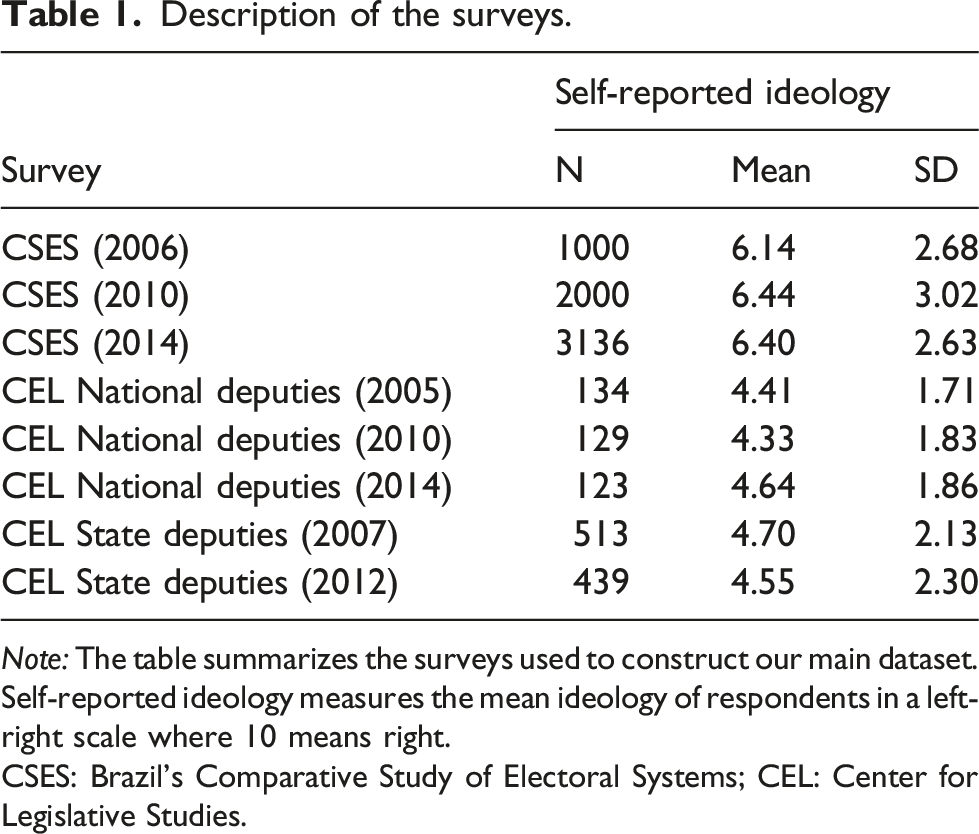
Note: The table summarizes the surveys used to construct our main dataset. Self-reported ideology measures the mean ideology of respondents in a left-right scale where 10 means right.
CSES: Brazil’s Comparative Study of Electoral Systems; CEL: Center for Legislative Studies.
Measurement strategy
A challenge in comparing the preferences of the masses and elites requires obtaining estimates of the policies of voters and politicians on a common scale (Lewis and Tausanovitch, 2015; Tausanovitch and Warshaw, 2013). A significant problem is the phenomenon of respondents within and between surveys interpreting ideological scales differently, distorting distances between stimuli. A typical example of this problem, known as Differential Item Functioning (DIF), occurs when respondents with radical ideological views classify themselves as moderates and moderates as extremists, pushing stimuli to the endpoints of the scale (Hare et al., 2015). In the presence of this problem, comparing the raw self-reported ideology of politicians and voters or among groups of voters may lead to measurement error.
Our measurement strategy to deal with DIF problems consists of using common stimuli among respondents as “bridges” to correct their distortion and bias parameters and obtain bias-corrected estimates of their ideal points. All questionnaires include questions on the position of the main Brazilian parties and some other political figures, such as presidential candidates and former presidents, which we use to implement Bayesian Aldrich-McKelvey scaling. Assuming that the respondent i placement of the stimuli (parties and political figures) j is a linear combination of the true position of j and the bias and distortion parameters, we can recover the true stimuli positions with the following model

We estimate the model using the Bayesian approach described by Hare et al. (2015). This approach can handle the missing data inherent in combining surveys, unlike the traditional Aldrich-McKelvey scaling implementation (Aldrich and McKelvey, 1977; Poole et al., 2016). For stimuli positions, normal priors are assumed (i.e., δ j ∼ N (0, 1)). We also use uninformative priors for the individual distortion parameters. 2
Identification is achieved by constraining the position of two stimuli in the left and right extremes of the scale. In particular, we constrained the position of the leftist PT stimulus to lie between −1.1 and −0.9, and Brazilian Democrats (DEM), usually known to be the farthest right large party, to lie between 0.9 and −1.1. To estimate the model, we use MCMC simulations. 3
The Bayesian Aldrich-McKelvey application estimates the location of the stimuli used as anchors to place elites and voters in a common space. The respondents provided rating information for a large number of stimuli that the surveys include as relevant ideological reference points, including prominent political figures in Brazil and some outside. This wide range of stimuli contributes to the quality of the scaling output by adding information on the definitions of “left” and “right” used by the sample of respondents. A plot of the stimuli locations and their 95% confidence intervals can be found in the Supplementary Appendix in Figure 5. 4
We use these bias-corrected self-placements of mass and elite respondents in our analysis of the ideological congruence between politicians and voters in Brazil. 5
Results
The congruence between politicians and voters
We begin by analyzing the extent to which deputies in Brazilian assemblies represent voters’ ideological preferences in general. Figure 1 plots the density distribution of corrected ideal points of national and state deputies together in black and voters in gray. In general, the pattern suggests that politicians and voters have similar ideological distributions overall. However, we also find that even with the bias-corrected data, deputies remain located somewhat to the left of voters. We also note that voters’ ideal points’ somewhat bimodal distribution suggests an underlying ideological polarization. Ideological congruence between deputies and voters in Brazil.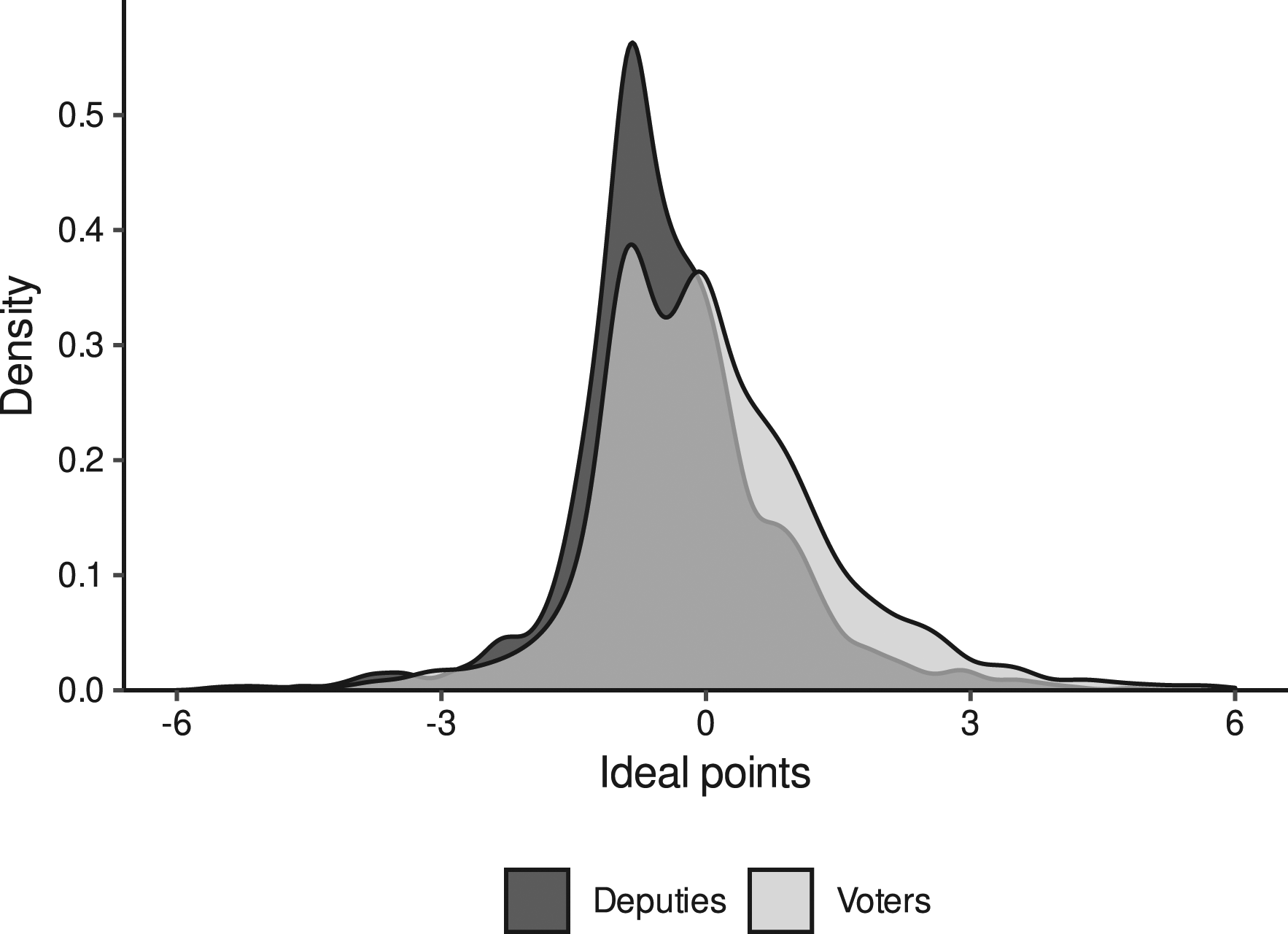

Description of the surveys.
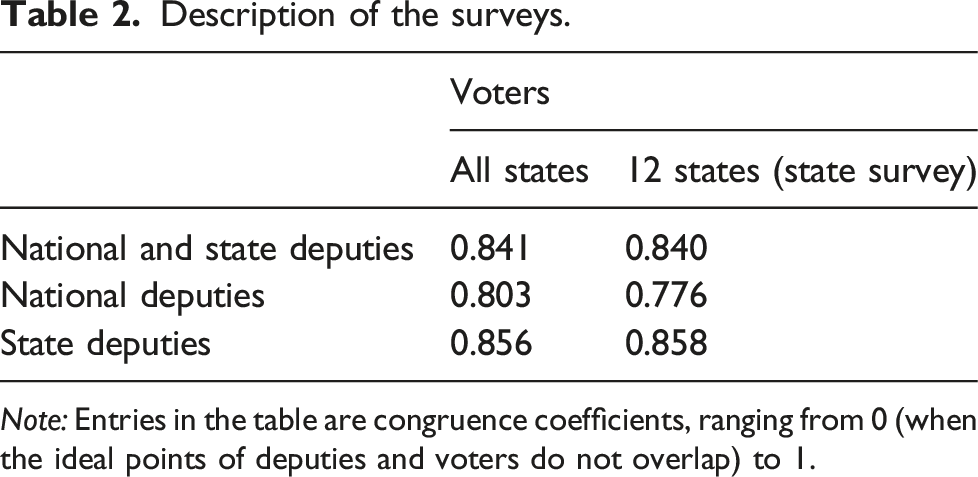
Note: Entries in the table are congruence coefficients, ranging from 0 (when the ideal points of deputies and voters do not overlap) to 1.
Ideological congruence by party
So far, we have analyzed the aggregate ideological congruence between deputies and voters in Brazil. In this section, we investigate in more detail the five largest parties in Brazil: the Workers Party (PT), the largest on the center-left, also considered the most programmatic in the country; the PMDB, a centrist party that took part in every government coalition since re-democratization; DEM and PP, both right-wing parties rooted in Brazil’s Northeast and South, respectively; and the PSDB, the PT’s national contender on the center-right between 1994 and 2014. PT and PSDB politicians also held the presidency between 1994 and 2016, with the support of the PMDB.
In Figure 2, we plot the density distributions of ideal points of deputies from each of those parties, as well as their party supporters (i.e., voters that declared feeling close to them) and non-supporters. Ideological congruence across levels in Brazil, by party.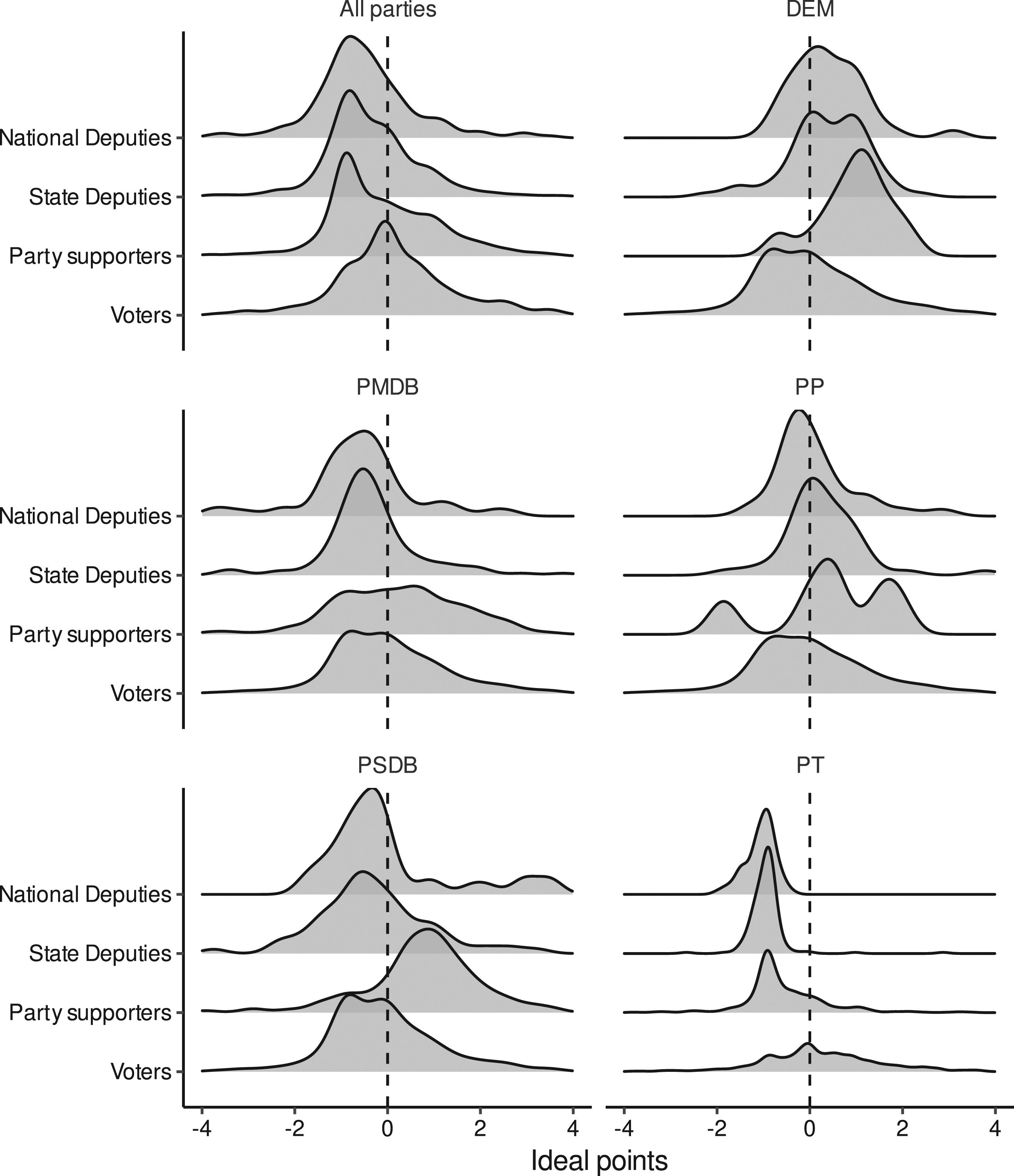
For both state and federal deputies, we see that the center-left PT represents its identifiers well, but it is much less congruent with its voters, who are dispersed and, on average, more centrist, a result consistent with the findings of Saiegh (2015), who also noted that legislators in Brazil, irrespective of party, tend to be more leftist than the median voter. Although both PT deputies and identifiers are known to be among the most ideologically consistent (Samuels and Zucco, 2014a, 2018), PT’s expansion of its vote share during its period in government was associated with appeals to voters with less programmatic connection to the party (Alves and Hunter, 2017; Boas and Smith, 2014).
Meanwhile, the center-right PSDB and right-wing DEM show an opposite pattern, representing its overall voter base but highly incongruent with its much more right-wing group of self-identifiers. Despite that the PSDB was the largest party opposed to the PT, neither its voters nor deputies are consistently more to the right of those of the PT, whose deputies are also much more dispersed. However, PSBD voters are largely aligned with deputies from the party. However, the PSDB identifiers are clearly to the right of their deputies, meaning that PT and PSDB identifiers were polarized from each other but that the PDSB identifiers are poorly represented by their deputies, which are substantially to the left of the former. To a lesser extent, the PMDB—the party with the least ideological reputation—also differs more from its highly dispersed and relatively conservative supporters than from its voters. The patterns for these three major parties are further supported by additional statistical analysis shown in the Supplementary Appendix.
Ideological overlap between deputies and voters for major parties, 2006–2014.
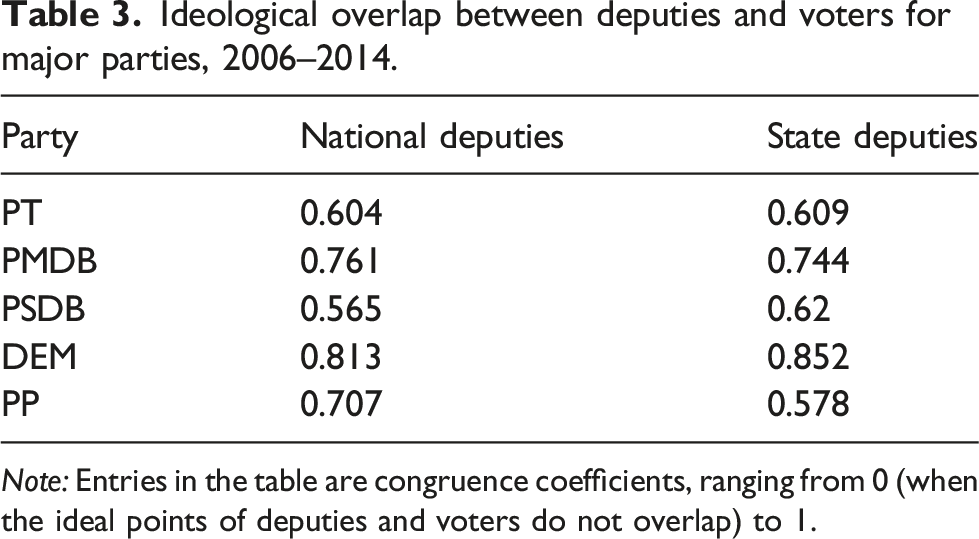
Note: Entries in the table are congruence coefficients, ranging from 0 (when the ideal points of deputies and voters do not overlap) to 1.
Dyadic analysis
While providing a useful overview of patterns in the data, the approach taken above has two major limitations. First, it does not provide any estimates of uncertainty by which we can distinguish key factors, and second, it does not allow us to compare subgroups of deputies and voters. To address these limitations, we follow Lupu and Warner (2017) and Boas and Smith (2014) and adopt a more flexible approach to study elite-voter congruence: dyadic analysis. This method compares all possible pairs of observations in our sample, in this case, all deputy-voter dyads. This approach mimics the “many-to-many” congruence comparison used above and in previous studies, but has the advantage of evaluating the role of both mass and elite respondent characteristics and common characteristics between the two. Note that this approach only captures overall deviations and does not distinguish between left and right divergence.
We estimate dyadic models using random effects. We first create a new data set with all unique pairs between deputies and voters in our sample. Then, we calculate a measure of the ideological distance between them that is equal to the absolute distance between their ideal points. To ease the interpretation of results, we rescaled this variable to the unit interval, thus making its interpretation straightforward: values close to 0 indicate a deputy-voter pair in which the two are on opposite extremes of the left-right ideological space, where values close to 1 indicate the deputy-voter have nearly identical ideal points. In practice, the observed mean distance is only about 0.06. With this dependent variable, we estimate the following equations



Figure 3 plots the results of a model, including all the data and several covariates relating to deputies, voters, and pairs. Since the dependent variable is a distance, positive values indicate less congruence, and negative values indicate greater congruence. For voters, we investigate the effects of income, a measure that indicates whether a given voter was in the first quartile of income distribution in Brazil; gender; race/color; union membership; unemployment; education a dummy indicating whether a given voter had a college degree; a dummy indicating if voters lived in a major city (urban) or in the countryside; another dummy indicating whether the respondent identifies as a party supporter for the party of the elite respondent (i.e., feels close to the party); and dummies indicating whether deputies and voters are Catholic or evangelical – as evangelicals are important electoral constituencies for right-wing politicians (Borges, 2021). For deputies, we also estimate the effects of education, income, and office (i.e., whether she is a national or state deputy). Finally, we include three dyad-level variables, Same state, Same Gender, and Same Religion indicating that both deputy j and voter i share the same state, gender, or religion. Estimates of the ideological distance between deputies and voters in Brazil, 2006–2014. Note: Points are random-effect dyadic model estimates of voter-deputy ideological congruence. Negative coefficients indicate less distance between pairs.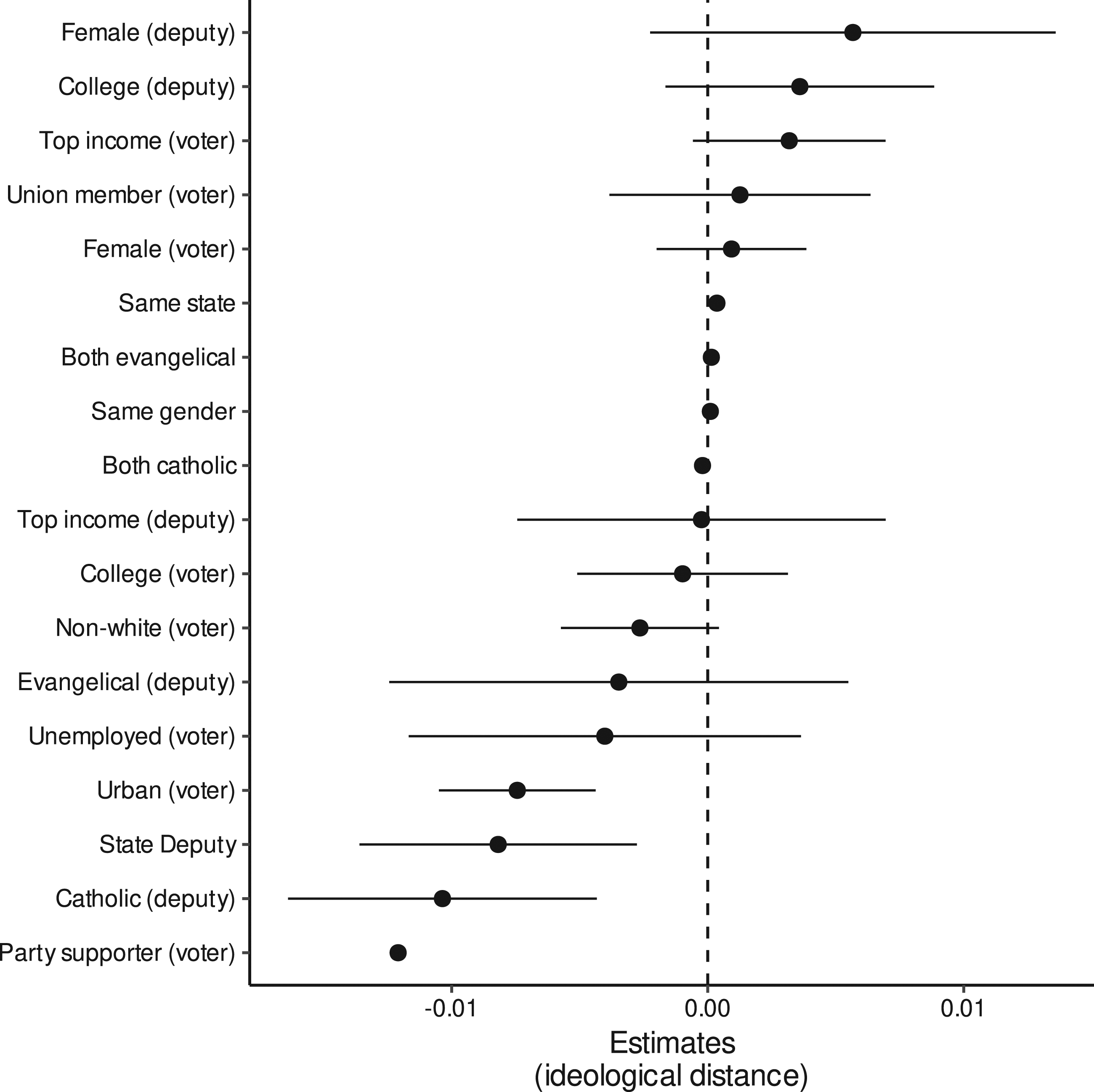
Unsurprisingly, the results first show that legislators generally have more similar preferences to their party supporters (i.e., voters that declared feeling close to the party of the deputy j) than non-supporters. More interesting is the corroboration of the general pattern noted above that state deputies are, on average, more congruent with voters’ ideological preferences than national deputies. This finding suggests that the state level may be a greater locus of ideological representation and responsiveness than is typically suggested by the literature. Somewhat surprisingly, however, this tendency is not higher in dyads where the deputy is within the same state. Thus, while state deputies overall have an ideological distribution more congruent with voters, the results do not suggest there are distinct ideological linkages between deputies and citizens within states.
Several aspects of voters’ characteristics have clear effects, with urban voters being consistently better represented by legislators. Concerning deputy characteristics, university degree, female gender, and income have the largest coefficients in the direction of being less representative of voters; however, these effects are not statistically significant. Interestingly, Catholic deputies appear more congruent with voters than other deputies, on average, yet deputy-voter pairs of the same religion are not better aligned, a result that contrasts with those of Boas and Smith (2014).
It is also possible to incorporate partisan elements into this dyadic approach by adding party affiliations for voters and deputies. However, some simplification is needed due to the nature of the computational complexity introduced when considering these variables separated by party. For this reason, we are limited to examining only some of the more influential variables from the model above, and we focus just on the two major parties of the period, PT and PSDB. The results from this model are displayed in Figure 4. Ideological predictors of congruence for Brazilian Worker’s Party (PT) and Brazilian Social Democracy Party (PSDB). Note: Points are random-effect dyadic model estimates of voter-deputy ideological congruence. Negative coefficients indicate less distance between pairs.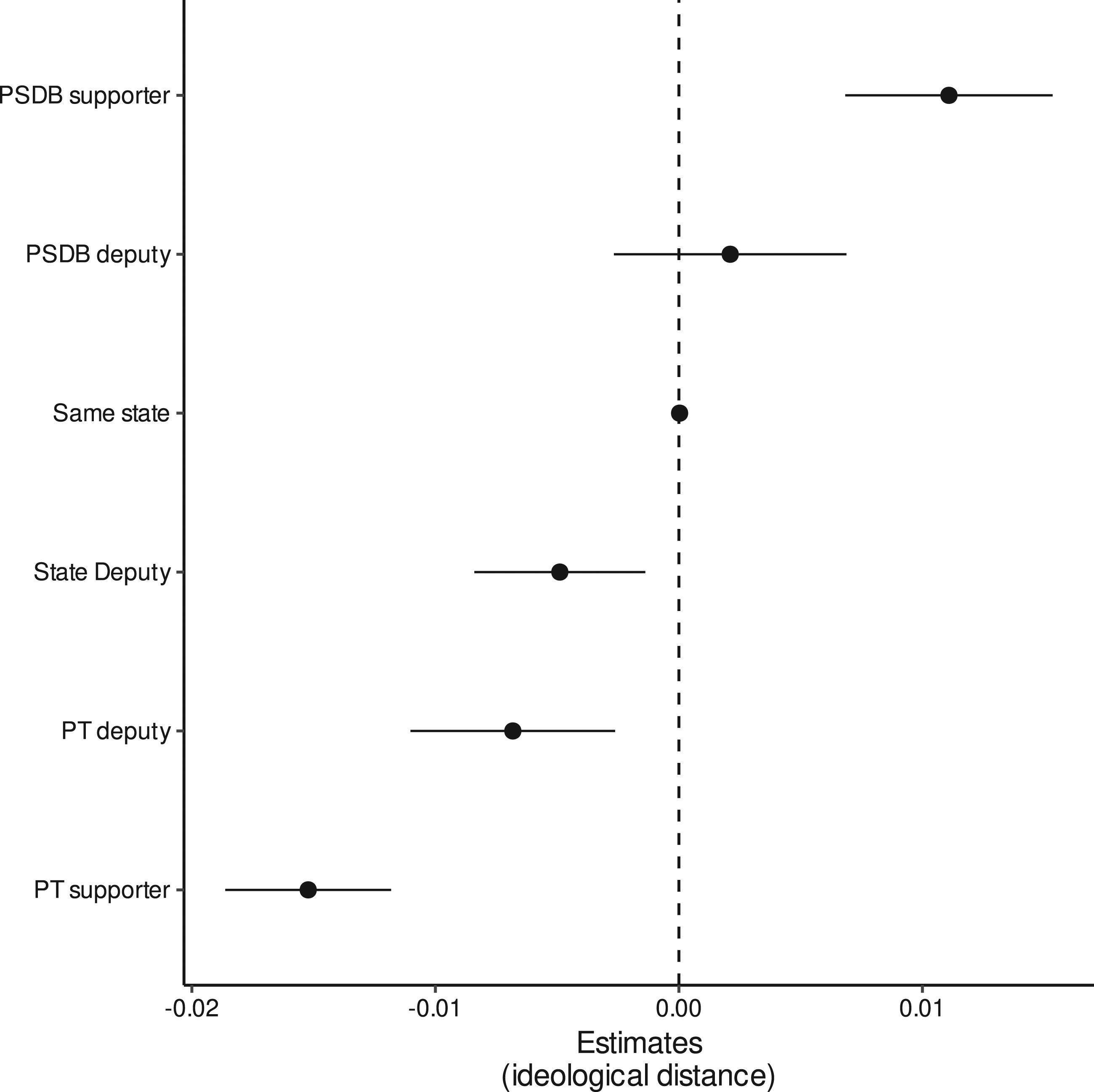
The results verify that the identified supporters of PT have much greater left-right congruence with their party’s deputies than those of PSDB in general, further confirming the finding shown in Figure 2. Interestingly, these results show that this is driven mainly by the voter side for PSDB. That is, PSDB deputies were not incongruent with voters in general, but their own supporters lacked congruent representation. For PT, in contrast, there was a higher degree of congruence both for dyads with PT deputies (relative to other parties) and for dyads with PT supporters (relative to other voters).
Discussion and conclusions
In this paper, we examined the extent of ideological congruence in legislative representation without institutionalized programmatic parties and whether multi-level structure weakens or strengthens this type of representation. Using an approach that allows us to compare voter and deputy preferences across multiple levels of government, we are able to examine the overall degree of mass-elite congruence and the alignment of parties with their voters and supporters.
To answer these questions, we examine voter-elite congruence in the multi-level context of Brazil’s federal party system, which has been seen as lacking programmatic representation. We extend recent work on congruence by including elite survey data from 12 Brazilian states into a unified study of voter-elite relationships. Exploiting the fact that these surveys include questions asking respondents to place major Brazilian parties and an array of figures and themselves on a left-right ideological scale, we can obtain estimates of deputies and respondents’ ideal points on a common scale that accounts for variance across individuals in the understanding of the concepts of ‘left’ and ‘right’ in Brazil.
We show that even in a fragmented and weakly institutionalized party system such as Brazil’s, voters’ and politicians’ ideological positions were largely congruent overall and state deputies were especially aligned with voters in the aggregate. This finding is important because federalism is sometimes seen as an impediment to overall programmatic representation. In Brazil, in particular, the state assemblies are often seen as sources of the non-ideological linkages and fragmentation of the party system. Although this study is limited to 12 states, the findings represent an important insight into the subnational dimension of ideological representation.
Despite the picture of overall congruence in Brazil, there are discrepancies in congruence when this is examined in terms of collective representation via parties. On the one hand, those who identify with a party were better represented on average, indicating that the party system enhanced representation for these more attached voters on average. On the other hand, when we examine parties individually, we find that the major party deputies were not well aligned with some of their associated mass groups. While the left-wing PT that governed during this period represented well its self-identified supporters, it was much less congruent with its voters overall, who were dispersed and more centrist. Meanwhile, the center-right PSDB and far-right DEM each showed an opposite pattern with regard to supporters and voters. The right-of-center parties represented their overall voter bases, suggesting a degree of legislative partisan representation. However, these parties’ deputies were substantially to the left of their right-wing self-identified supporters.
In our dyadic analysis, we offer some insight into some determinants of the deviations from congruence. We again verify that state deputies are less distant from voters and that those who identify as party supporters are better represented on average. In addition, while Catholic deputies are more congruent with voters, our results do not support the thesis that voters and deputies belonging to the same religion are more congruent than average. Finally, we also find that urban voters are the best represented. The dyadic analysis also further confirms that PSDB’s self-identified supporters stood out as systematically unrepresented in terms of ideology.
Taken together, we find that Brazil’s legislative elites were representative overall during the period under study, at both the state and national levels and that subnational representation was a contributor to improving ideological representation. However, there were substantial deviations from mass-elite ideological alignment in the context of party representation. On the one hand, the results within the major right-of-center parties support the suggestion that, even with weak party labels, these voters were represented in ideological terms. In the case of PSDB, this may support expectations that the role of opposition to PT would facilitate such alignment. On the other hand, parties exhibited a substantial leftward bias relative to other mass groups in the time under study. In particular, this appears to have been driven by two patterns: those who voted for (but did not identify as) PT and those who identified with the largest right-wing parties were each systematically to the right of the associated party deputies.
Our findings contribute to the understanding of the ideological congruence of party systems, particularly in new and developing democracies. Our results show that a party system characterized as inchoate and non-programmatic can be consistent with an overall ideological representation among deputies—and that subnational representation can enhance this alignment—even if the parties are not the primary vehicles of representation. Indeed, such overall congruence can still coexist with a lack of ideological alignment between parties and their supporters or voters. This lack of party congruence with key groups in the electorate may relate more directly to concerns about the perceived quality of representation and the legitimacy and stability of the party system.
Finally, we note that our study focuses on a period that represented the end of a relatively stable era of party competition. Our findings identify weaknesses in deputy representation at a time that preceded major changes in the party system. These party-level patterns of mass-elite disconnection may have contributed to the conditions enabling this instability and the rise of populism in the following years.
Supplemental Material
Supplemental Material - Multi-level legislative representation in an inchoate party system: Mass-elite ideological congruence in Brazil
Supplementary Material for Multi-level legislative representation in an inchoate party system: Mass-elite ideological congruence in Brazil by Royce Carroll and Fernando Meireles in Party Politics.
Footnotes
Acknowledgements
The authors thank Wendy Hunter, Allyson Benton, Glauco Peres, and participants in seminars at Externado University and City University London for helpful comments on earlier versions of this manuscript.
Declaration of conflicting interests
The author(s) declared no potential conflicts of interest with respect to the research, authorship, and/or publication of this article.
Funding
The author(s) disclosed receipt of the following financial support for the research, authorship, and/or publication of this article: This study is supported by the sponsorship of the State of São Paulo Foundation for Support of Research (FAPESP) through a postdoctoral fellowship, Grant 2021/01393-2, during the preparation of the manuscript.

Supplemental Material
Supplemental material for this article is available online.
Notes
Author Biographies
References
Supplementary Material
Please find the following supplemental material available below.
For Open Access articles published under a Creative Commons License, all supplemental material carries the same license as the article it is associated with.
For non-Open Access articles published, all supplemental material carries a non-exclusive license, and permission requests for re-use of supplemental material or any part of supplemental material shall be sent directly to the copyright owner as specified in the copyright notice associated with the article.
