




Abstract
It is often claimed that parties on the left and right have different preferences for scholarly knowledge. However, little research has addressed whether partisanship actually matters for science advice preferences, particularly in the European setting. Drawing on original data on governmental appointments of academic scholars to more than 1400 public advisory commissions in Norway between 1969 and 2020, this article examines whether the left–right divide matters for cabinets’ consultation of economists and social scientists. The findings reveal that left-wing governments in Norway have consulted scholars of social science—such as sociologists and political scientists—more frequently than right-wing governments. In contrast, partisanship seem to matter less for the consultation of economic scholars, as economists have been extensively used as advisors by both blocs in the period studied. Overall, the article contributes theoretical and empirical knowledge to the politics of science advice.
Introduction
The relationship between science and politics is a longstanding topic of interest in the social sciences. While politicians’ close reliance on scientific expertise has been seen as a virtue of modern politics (Giddens, 1990), the democratic pitfalls of a close relationship between science and politics have also been vividly stressed (Weber and Parsons, 1947). One much-discussed peril is that science and academic knowledge can become politicised when commissioned and employed by politicians. In public debate, a common argument is, for example, that right-wing and conservative parties have a preference for economic scholarly knowledge that enables austerity measures and cost–benefit analysis and that ‘economise’ policy questions (e.g. Earle et al., 2016). Likewise, left-leaning parties have been accused of being more attentive to a ‘leftist’ social scientist community of e.g. sociology, anthropology and political science (e.g. Kimball, 1990; Mooney, 2005).
However, little empirical research has been conducted on partisanship and scientific preferences. In the American literature, it is well established that Democrats are likelier than Republicans to rely on and trust scientific research in general and social scientific research in particular (e.g. Gauchat, 2012). We know less, however, about the state of affairs in European countries. Although the left–right ideology is one of the most researched features of party competition and policy outcomes (e.g. Potrafke, 2017), the literature on party politics and partisanship has not studied science advice. Furthermore, relevant studies on policy advice and knowledge utilisation have not addressed the question either (Weiss, 1979). While we know that politicians often act strategically to substantiate policies or legitimise political goals or as levers to reach predefined policy stances (Boswell, 2008), little has been said about the partisan drivers of this political use of expertise.
This research gap is important to fill for several reasons. Most importantly, policymakers’ reliance on experts, technocrats and academics is a prominent feature of modern representative democracies (e.g. Caramani, 2017). Scientific knowledge is entrenched in the way politicians approach political, social and economic issues on a day-to-day basis, and have a major influence on some of the most pressing policy challenges of our times, such as climate change policy, financial crisis and—more recently—pandemics. This dependency raises a number of normative and democratic questions that should be informed by empirical research. Further, it is unclear whether the findings from the American context travel well to European parliamentarian systems, where politics is more consensual and less polarised and where the relationship between the state and the scientific community is organised differently. As politics and science are becoming ever more entangled, it is a pertinent scholarly task to come to grips with how conventional political dynamics—such as ideology—affect governments’ use of science in policymaking.
This article sets out to examine the issue through a case study of public advisory commissions in Norway. Using original data on commission members, it presents a large-N, descriptive analysis of whether and how left-wing and right-wing governments differ in their consultation of academics in general and economists and other social scientists (such as sociologists, political scientists and anthropologists) in particular. Drawing on partisan theory (e.g. Baumgartner and Jones, 2005; Strøm, 1990) and perspectives from the literature on expertise and science advice (e.g. Boswell, 2008), the article also theorises about the mechanisms that may underpin partisan biases.
The article’s aim is twofold. Theoretically, it discusses different mechanisms for why partisan differences could be observed, which have to do with ideological, epistemic and topical ‘fits’ between disciplines and parties. First, if political elites are guided by strategic rationales, they should prefer advice from academics that they perceive as ideologically close to them (i.e. an ideological fit). Second, parties might be inclined to value or favour academic expertise, knowledge and analyses that match their political platforms (i.e. an epistemic fit). Third, one could also expect that political parties consult academics based on their issue focus (i.e. topical fits). Together, this leads to the expectation that left-wing parties are oriented towards social scientists, while the right should consult economists that specialise in analysis of economic consequences and cost–benefit analyses of policy.
Empirically, the article uses novel quantitative data on academic participation in public inquiry commissions in Norway (Hesstvedt and Christensen, 2022) to investigate partisan differences in science advice. The data cover a period of 50 years and include the full population of scholars who participated in Norwegian commissions in the period between 1969 and 2020. This amounts to the appointment of more than 1400 commissions, 12,000 commission members and 1600 scholars. In the analysis, I show how the appointments of academics, social scientists and economists have differed between left-wing and right-wing governments, both longitudinally and across different policy areas. Appointment of other disciplines (such as the humanities and natural scientists) as well as other member types (such as interest groups and civil servants) are not the focus of the article, but the numbers are shown for reference.
The findings show the following. First, there are no differences between the left and right’s appointment of academics in general. In the 50-year period, there has been a profound increase in the number of academic members on Norwegian policy advisory commissions, and this trend has been driven jointly by governments regardless of colour. Second, the analyses reveal that left-wing governments have been likelier to consult social scientists than the centre-right. Disaggregating the data by policy areas, the analysis shows that conservative governments have appointed fewer social scientists to commissions that deal with economic and financial policy, education and health. Lastly, the partisan differences are more moderate when it comes to the consultation of economists. Both blocs have made extensive use of economic expertise throughout the period, which underpins the economic discipline’s role as a ‘governing science’ in Norway (e.g. Slagstad, 2004). However, the centre-right’s likeliness to consult economists more often than other disciplines have grown since the early 2000s. This has partly to do with the fact that Conservative governments appoint a higher number of commissions on financial-economic policy issues than their left-leaning counterparts. In the past two decades, right-leaning governments have consulted an increasingly higher number of economists relative to other disciplines. They have also appointed more commissions to financial-economic issues relative to other issues.
Overall, the article has several implications. First, it makes an empirical contribution by presenting original data and empirical analysis of governmental science advice consultation in a European country. Second, by discussing some of the mechanisms underpinning political preferences for disciplinary knowledge, the article bridges the literature on party politics with expertise and science advice.
The article is structured as follows. The next sections review existing literature on scientific expert advice, partisanship and policymaking, where it is argued that the link between governments and science advice has not been studied through the lens of party politics and partisanship. The third section presents the article’s theoretical propositions. In the following sections, the empirical context and the research design are presented. The empirical results are then presented, and the implications and limitations of the findings are discussed in the conclusion.
Previous research: Partisanship and research use
The left–right divide plays a pivotal role in structuring party competition and voting behaviour in Europe. Often called the economic or traditional left–right divide or the economic left–right scale, the dimension have been applied to understanding political competition and voting behaviour in most advanced liberal democracies for decades. Although party politics have grown more multidimensional (e.g. Kriesi et al., 2006), the distinction between left and right continues to dominate party competition and voter perceptions (Bakker et al., 2015). Political parties in most countries identify as left-wing (like socialist left parties or labour parties), right-wing or bourgeois (i.e. conservative parties), or somewhere in between (like some agrarian parties or new green parties).
The left–right divide has also proved decisive for public policy. As one of the most researched features of modern party politics (for an overview, see Imbau et al., 2001), a vast research strand has found that governments’ left–right positions matter for policymaking and policy outcomes on a range of issues. For example, left-wing governments pursue more expansionary policies than right-wing governments (Potrafke, 2017). Parties on the left and on the right also differ with respect to their policy agendas and issue attention (Petrocik et al., 2003), in their policy preferences and designs (Blais et al., 1993; Boyne et al., 2011), and in public spending (Hicks and Swank, 1992). Recent research has also shown that partisanship matters for recruitment to the civil service (Dahlström and Holmgren, 2017) and for delegation to technocratic institutions, such as central banks and independent regulatory agencies (e.g. Ennser-Jedenastik, 2014, 2015; Hallerberg and Wehner, 2018).
The question is: does partisanship matter to political parties’ preferences for scientific expertise? In the United States, partisanship and science has been a topic of interest for decades. In popular debates, a perception has been that academia in general, and the social sciences in specific, have a left-leaning bias that contributes to a politicised use and trust in scientific results (e.g. Kimball, 1990). Concerns have also been raised about the latest Republican presidencies, i.e. the Bush and Trump administrations, which have been claimed to dismiss research-based policymaking (Mooney, 2005; Reed et al., 2018). In the scholarly literature, a long-standing strand of research has been committed to mapping academic political orientations and policy views (e.g. Klein and Stern, 2008; Lipset, 1970), as well as how partisanship affects policymakers and citizens’ trust in scientific evidence. For example, it is well documented that Democratic politicians have higher trust and a higher propensity to draw on science in policymaking processes than Republicans (Bolsen et al., 2015), who are more distrustful of science (Gauchat, 2012). This division has furthermore grown starker in recent years due to the climate change debate (e.g. McRight and Dunlap, 2011). In American academia, there are also clear partisan divisions: scholars are, in general, likelier to vote for Democrats than the average American voter, while social scientists are likelier to be leftist than natural scientists (Klein and Stern, 2008).
However, it is not straightforward whether and how insights from the American literature on the politics–science nexus are informative for European knowledge regimes (Campbell and Pedersen, 2014). To date, we know little about the role partisan preferences play in politicians’ choices of experts in the European setting. Not only is this a blind spot in the literature that deals with expertise use and policy advice; it is also a lacuna in the party literature.
First, from knowledge utilisation research, we know that politicians use expert knowledge for strategic and political reasons: politicians request scientific advice to substantiate policy, can dismiss expert advice if it is too far from their policy preferences and cherry-pick information that resonates with their worldviews (Boswell, 2008; Schrefler, 2010). Additionally, research on decision making and motivated reasoning shows that politicians are inclined to interpret new information in light of previous beliefs and opinions (Bolsen and Palm, 2019). Experimental studies, for example, find that politicians are often biased by partisan convictions when confronted with contradicting evidence (Baekgaard et al., 2019; Hjort et al., 2021; Lee, 2021) and that political positions can even be reinforced as a response to science (e.g. Heikkila et al., 2020). However, this research focuses first and foremost on the use of expert advice and/or cognition. In addition, the unit of analysis is often bureaucratic organisations, bureaucrats and policymakers, and not political parties or political elites.
Second, and despite the extensive literature on ideology and policy outcomes, there are some important missing pieces here, too. As mentioned, we know that partisanship affects the recruitment of experts to technocratic and bureaucratic institutions more generally. In the wake of the Covid-19 pandemic, some studies have also shown that ideology mattered to political parties’ science use during the pandemic: parties on the cultural left (or the Green-Alternative-Liberal “GAL” parties) were significantly likelier to rely on science than the parties on the cultural right in tackling the crisis (Rovny et al., 2022: p. 6-7). The aim of this article is to contribute by studying how partisanship affects the consultation of scientific, and not merely bureaucratic, experts over a longer time span. The next section presents the article’s theoretical argument and expectations.
Ideological, epistemic and topical fits: Theoretical framework
Generally, from a party-politics perspective, government ideology matters to policy because political parties gratify the needs of their constituencies, pursue office and care about policy impact (Strøm, 1990). Scientific policy advice involves gathering knowledge and information and establishing an understanding of what the policy problem is, how to solve it and what its consequences are. Expert input may have major consequences for how a policy is designed. As with other policy choices, there are thus reasons to expect partisan differences in science advice preferences.
In the following, the article elaborates on some of these reasons. To be clear, the empirical analysis that follows will not be able to test these theoretical claims empirically, as this would require a different (and causal) research design. Rather, the following theoretical framework sketches a set of possible explanations that may help the interpretation of the empirical trends. Due to scope limitations, the expectations are limited by two additional considerations. The social sciences are divided into two groups: economics versus the ‘other’ social sciences, such as sociology, political science and anthropology. I focus on the social sciences due to their central positions in many European countries’ policy advisory systems, and especially in Norway (Fourcade, 2006; Christensen, 2017). The section will not discuss other disciplines, like the humanities or natural science.
There are several reasons to suspect differences in partisan preferences for economists and social scientists. A first reason may concern ideological fits between disciplines and parties. Political parties can favour experts that they perceive as ideologically close to them, as this lowers the risk of receiving policy advice that is at odds with the party platform and/or the interests of their constituencies. In general, social scientists, like sociologists, anthropologists and political scientists, are likelier to vote for radical left or social democratic parties than the average voter (Berggren et al., 2009; van de Werfhorst, 2019). Economic scholars, by contrast, are likelier to vote for parties to the right and express more economically liberal and market-oriented policy views (e.g. Fischer et al., 2017; Fourcade, 2006). Accordingly, if political parties strategically appoint academics to commissions based on perceptions of their ideological orientation, one would expect partisan differences to prevail.
A second congruence concerns epistemic fits. This entails that politicians favour scientific evidence that matches their ideological or normative agenda. According to Gunnar Myrdal’s thesis of the ‘value impregnation’ of economics ([1930] 1953), many theoretical approaches tacitly favour certain value options over others. These normative assumptions, although not necessarily made explicit, may make politicians more or less inclined to listen to certain scientific arguments (see also Holst and Molander, 2019). For example, neoclassical economics has been criticised for framing problems in a way that favours market solutions. The disciplinary turn from Keynesian to neoliberal theories has also been said to reflect the agendas of conservative governments (e.g. Fourcade and Babb, 2002). Left-leaning parties, on the other hand, could be more inclined towards research that rests upon Marxist or critical theory, or scholarship that concerns the drivers of social inequality or social mobility (see e.g. Holmwood, 2007).
Lastly, political preferences may be based on topical fits. From the policy agenda and issue ownership literature, we know that parties on the left and right emphasise different aspects of policy issues (Baumgartner and Jones, 2005). While centre-right parties place economic policy high on their agendas and value responsible economic governance, balanced state budgets, and modernisation of public services, left-leaning parties benefit from being perceived as attentive to social and structural equality, redistribution and social welfare services (Petrocik et al., 2003). These issues coincide with the topical knowledge of disciplines. Thus, if parties tend to consult certain disciplines more than others, it may have to do with the fact that parties spend more resources on inquiring about and developing policy on certain topics. Right-leaning parties may be more inclined to make use of economic scholarly experts who are trained in cost–benefit analysis and that address the economic consequences of policy proposals. By contrast, left-leaning parties could be more oriented towards social sciences, such as sociology and political science, as their scholarly expertise relates to the socio-structural aspects of policies.
Overall, based on these views, we could expect centre-right governments to be likelier to appoint economists as science advisers than left-leaning governments, while left-leaning governments should be likelier to appoint social scientists. The question will be examined in the analyses that follow, after a brief case description.
Research setting: Norwegian policy advisory commissions
This article examines partisanship and science advice preferences in a study of policy advisory commissions in Norway. Norway makes a suitable case for a study of this kind for several reasons.
Most importantly, the party system is clearly structured by the left–right dimension. Parties form part of either the left or the right bloc in parliament, and government alternatives and coalitions are based either on either the left or the right side of the political spectrum. The only exception is a centre cabinet that governed between 1997 and 2000 (Bondevik I), which consisted of the Christian Democratic Party, the Liberal Party, and the agrarian Centre Party. In the analysis, this government is excluded from the analysis and the results can be reviewed separately (see the next section on the data and research design).
Furthermore, Norway has a strong tradition of emphasising knowledge-based policymaking. The public advisory commission system is at the core of this system (Christensen and Holst, 2017). In other countries, public advisory commissions go under names such as public inquiry commissions, Royal Commissions (e.g. the U.K. and Canada) or expert groups (e.g. the European Commission). In essence, the task of a Norwegian official public commission (Norges offentlige utredninger) is to conduct analysis and prepare policy on behalf of the sitting Cabinet, including policy reforms, law propositions and white papers. A commission is appointed on an ad-hoc basis and usually consists of about 8–10 members, who can be representatives of interest groups, academics, civil servants or citizens. The member composition, secretariat, terms of reference, budget and resources are decided by the incumbent minister and government party in cooperation with the ministerial bureaucrats. After the commission has been officially appointed, it works autonomously for its designated amount of time, usually a year or more, before submitting an advisory report with policy recommendations to the incumbent government. It is then dissolved (Hesstvedt and Christensen, 2021). Importantly, the commission system also offers a rare possibility of tracing a government’s consultation of academic experts in policymaking processes over time. Any government can initiate a commission at its own discretion and without the involvement of opposition parties, as appointments do not have to pass parliaments. Important for this study, this means that it is up to the cabinet lalone to decide the member composition, and any political differences therein can hence be traced back to the incumbent parties (Hesstvedt and Christiansen, 2021).
Data and research design
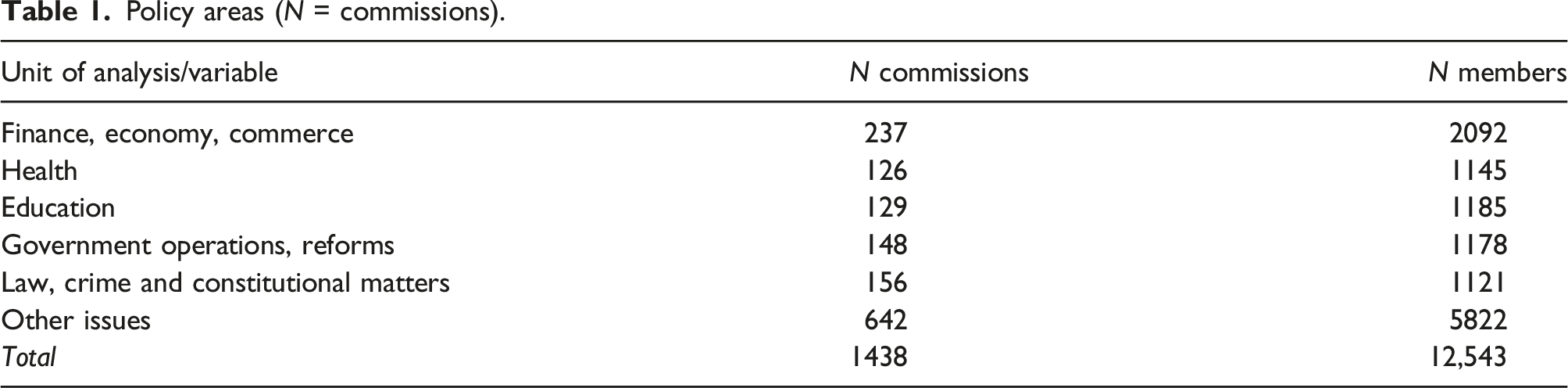
Policy areas (N = commissions).
Government terms in Norway, 1969–2017.
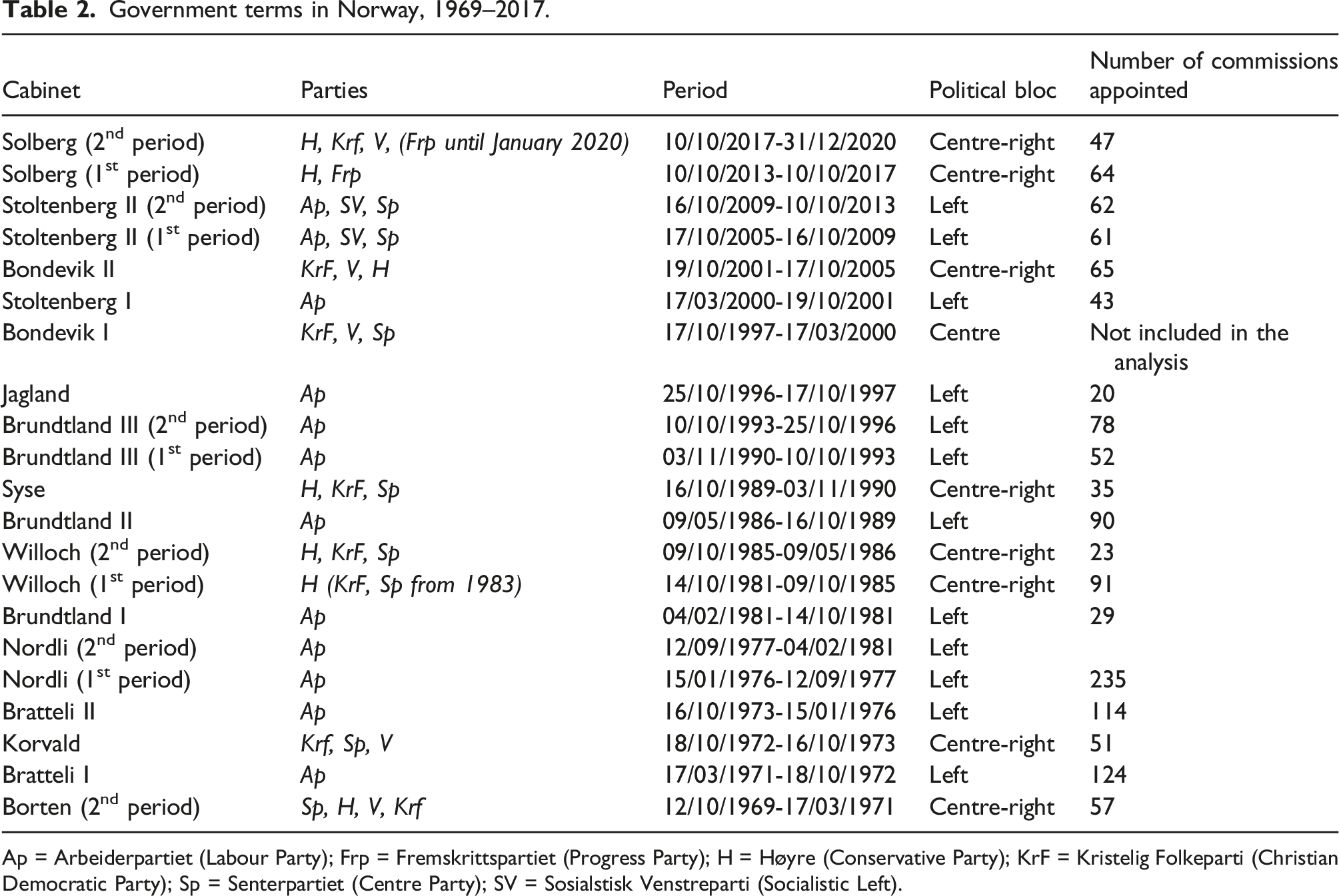
Ap = Arbeiderpartiet (Labour Party); Frp = Fremskrittspartiet (Progress Party); H = Høyre (Conservative Party); KrF = Kristelig Folkeparti (Christian Democratic Party); Sp = Senterpartiet (Centre Party); SV = Sosialstisk Venstreparti (Socialistic Left).
The research design is descriptive, and the analysis consists of figures of trends over time. As mentioned, the article’s aim is not to make causal claims and uncover causal relationships, but to discern patterns and discuss them in light of the theoretical framework. In the figures, I show the appointment of academics, economists and social scientists per government bloc and across policy areas over time. Some of the figures show trend lines per decade for the left and the right bloc. Other figures show averages per cabinet term, starting with the Borten government in 1969 and ending with the Solberg government in 2020.
Table 1 describes the Norwegian governments included in the analysis, including which political bloc they belong to and the number of commissions they appointed. The starting point of the analysis is 1969, the year the Agrarian party prime minister Per Borten was re-elected to office for his second term. This was also the year when some of the first Norwegian Public Inquiry Commissions were registered and archived. This article’s data collection ended on 31.12.2020, when Erna Solberg’s centre-right coalition government was in office. As the table shows, all but one cabinet has identified as either right-wing or left-wing since 1969. This leaves the centre government of Bondevik I (1997–2000). As this cabinet cannot be placed in either of the blocs, it has been excluded from the present analysis. Interested readers may obtain the member composition and results upon request to the author.
In addition to analysing patterns across time, the analysis breaks down the data and shows trends by policy areas. To do so, commissions were manually coded according to the policy area classification of the Comparative Agendas Project (see, for example, Green-Pedersen and Mortensen, 2010). Five policy areas are displayed: (1) Economic, financial and commerce/business policy, (2) Health, (3) Education, (4) Government operations and reforms (for example, related to the public sector) and (5) Law, crime and constitutional matters. Table 2 shows the descriptive statistics per policy area.
As for the operationalisation of variables, the figures below either report (1) the share of commissions that include an academic, economist or social scientist, averaged per year of appointment, or (2) the share of members that have an academic affiliation, averaged per year of appointment. As shown in Table A1 in the Supplemental Appendix, the unit of analysis is therefore either commissions in general (N = 1438) and commissions that include at least one academic (N = 843), or the total number of members (N = 12,543) and academic members (N = 1861). While most of the in-text analyses show developments using the commission data, the Supplemental Appendix reports additional figures using member shares.
Turning to definitions, academics are defined as persons employed at academic research institutions (e.g. universities, university colleges, independent/non-partisan research institutes) in academic positions (e.g. Ph.Ds, assistant professors, professors, researchers). Economists are defined as persons who were employed in a scientific position in economics or business economics at an academic institution (a university, research institute, business school, or university college). The social scientist category hence excludes economists and is defined as a person with an academic position within sociology, political science, psychology, education science, anthropology or other social sciences.
Although the article has no specific expectations of the relationship between left/right governments and other disciplines and types of members, some numbers are displayed for reasons of comparison. The analysis shows the presence of natural scientists, or academics from mathematics, physics, chemistry, engineering and technology studies, the humanities (philosophy, history, linguistics and other humanistic subjects, plus theology and arts), as well as law scholars. Some of the figures also compare the development in the number of academics to interest groups, politicians and civil servants. Politicians are defined as national, local or regional elected politicians, and not employees or advisors of political parties. Civil servants are defined as civil servants employed in ministries. Interest group representatives include representatives from interest groups and voluntary organisations.
Analysis and results
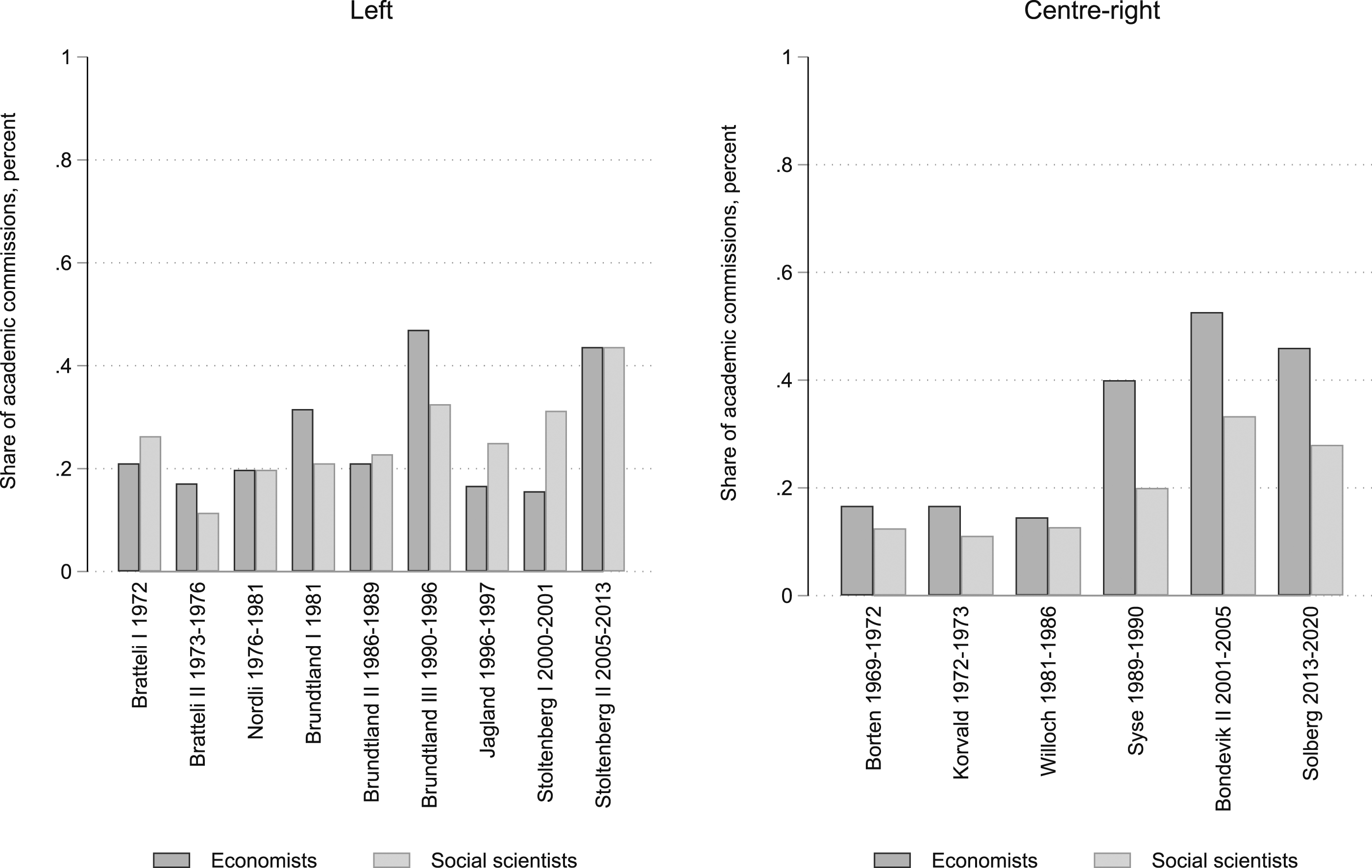
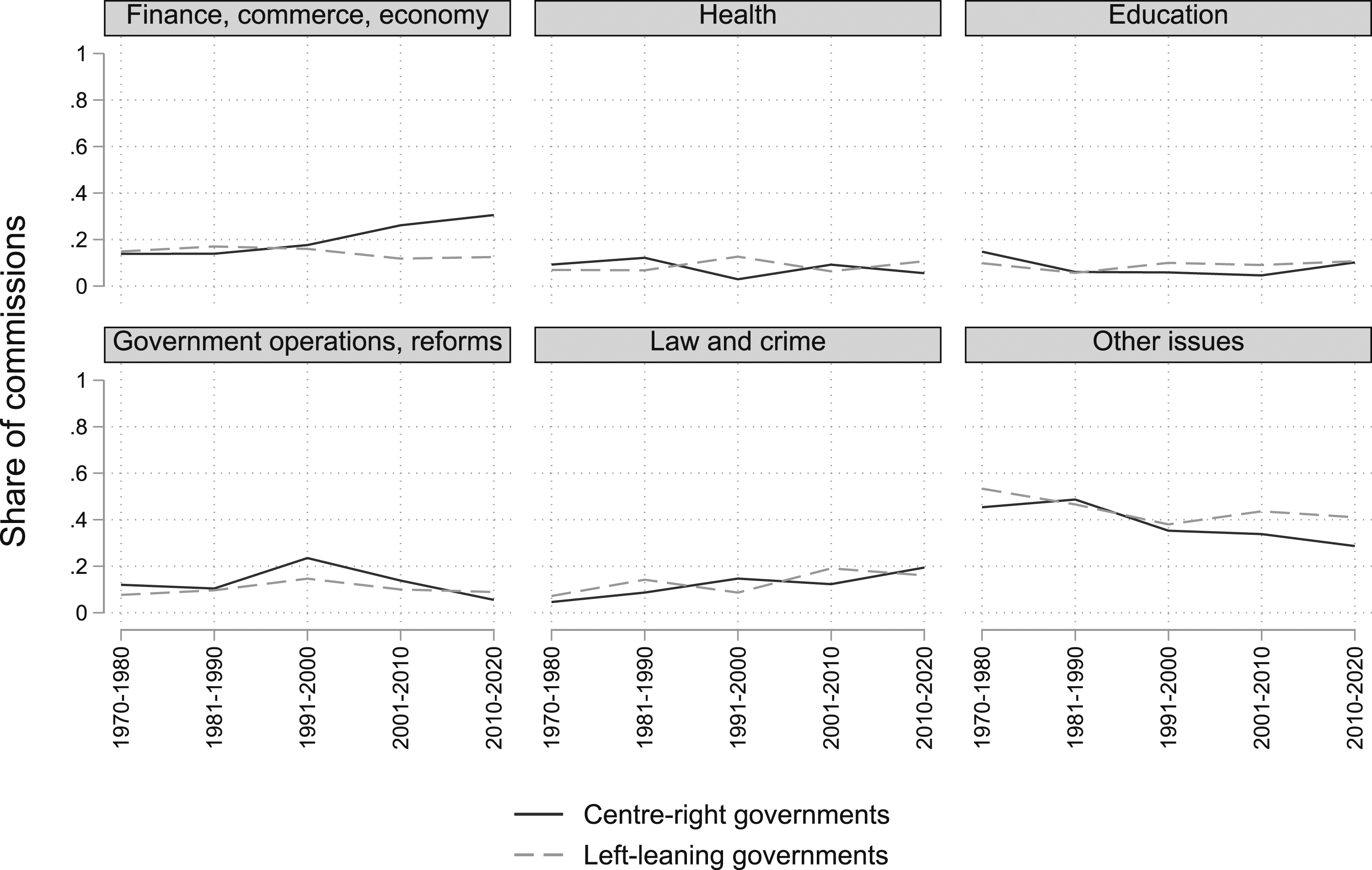
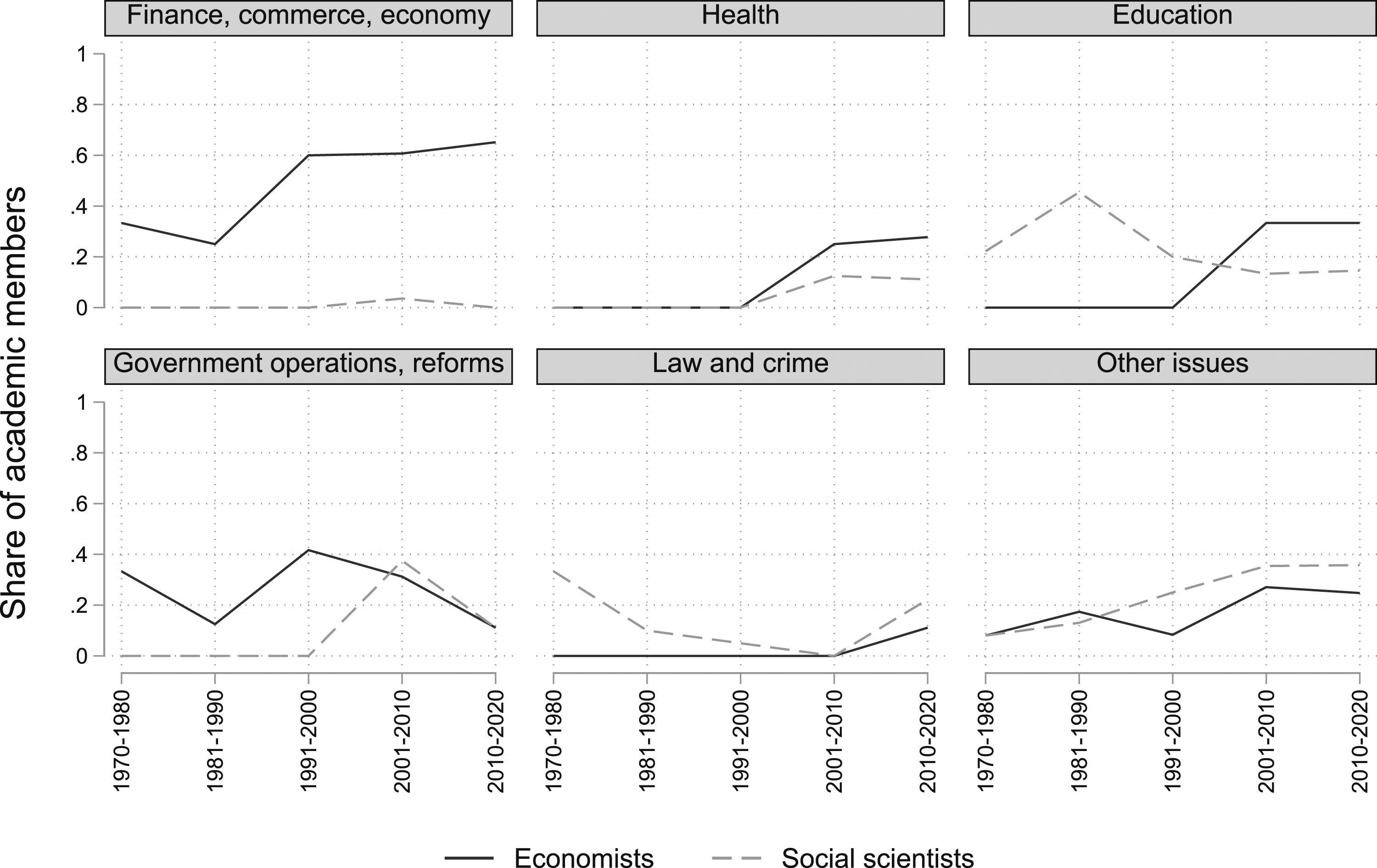
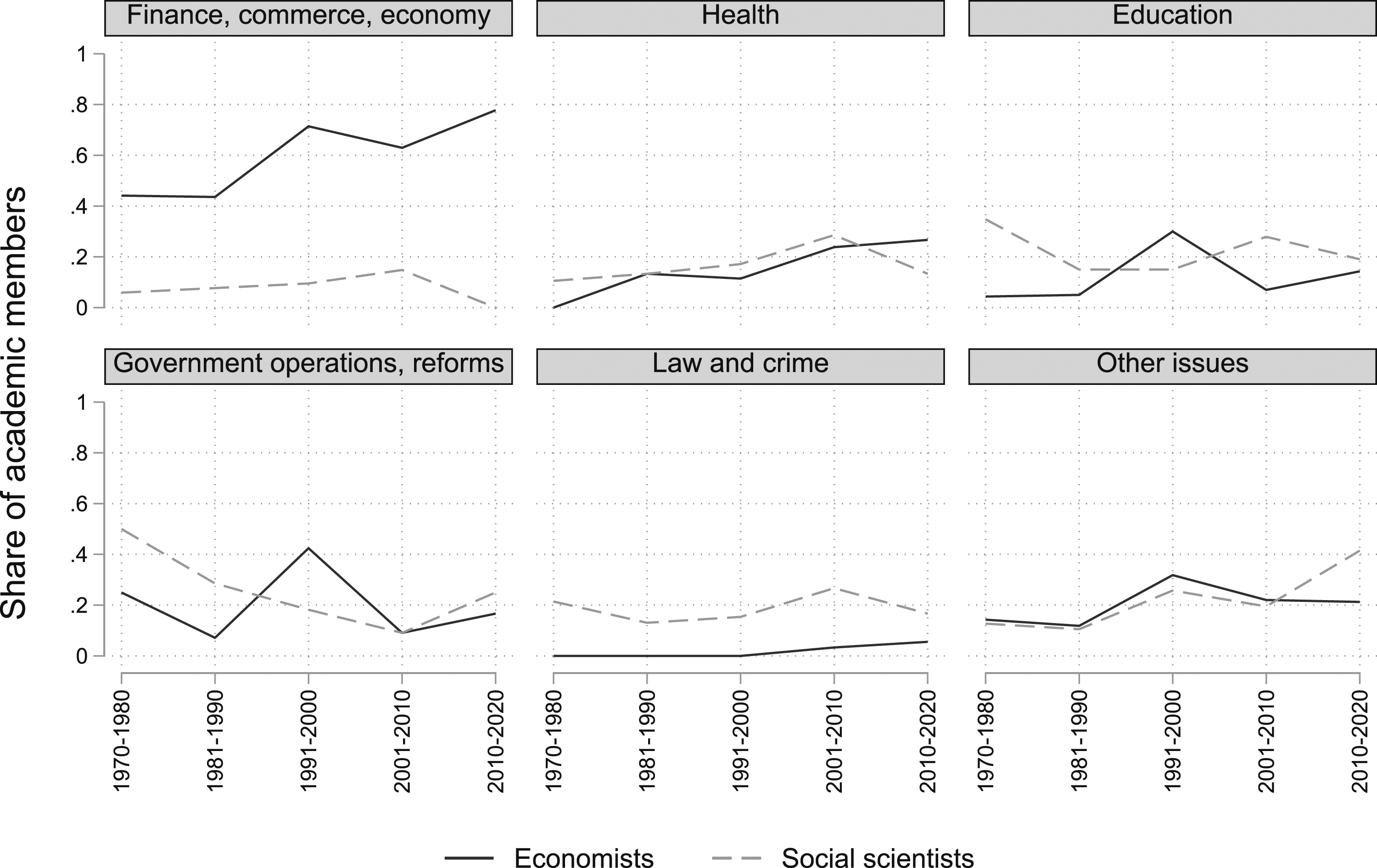
The empirical analysis is structured in three parts: Figure 1 shows the general appointment of commissions with academics, social scientists and economists regardless of the sitting government’s colour; Figures 2–4 breaks the figures down by government; and Figures 5–7 report numbers per policy area. Academics and disciplines appointed to commissions. Trend lines showing averages per decade Left panel: Share of commissions that include an academic compared to other member categories (N = 1438). Right panel: Types of academics. Share of academic commissions that include economists, social scientists, natural scientists, humanities and law scholars (N = 843). Academics by appointing government (parties on the left vs. centre-right parties). Share of commissions that include an academic, interest group representative, politician and civil servant. Means per government term. N = 1438. Disciplines by appointing cabinet: Share of commissions with academic participation that include an economist and social scientist. Means per government term. Disciplines by appointing government (left vs. centre-right): Share of commissions with academic participation that include an economist, social scientist, etc. Means per decade and government bloc trend lines show moving averages (lowess). N = 843. Advisory commission by policy area. Share of commissions appointed to the policy area. Means per decade and government bloc. N = 1438. Right-wing governments: Share of academic members: Economists versus social scientists. Averages per decade and per policy area. N = 611. Left-wing governments: Share of academic members: Economists versus social scientists. Averages per decade and per policy area. N = 1077.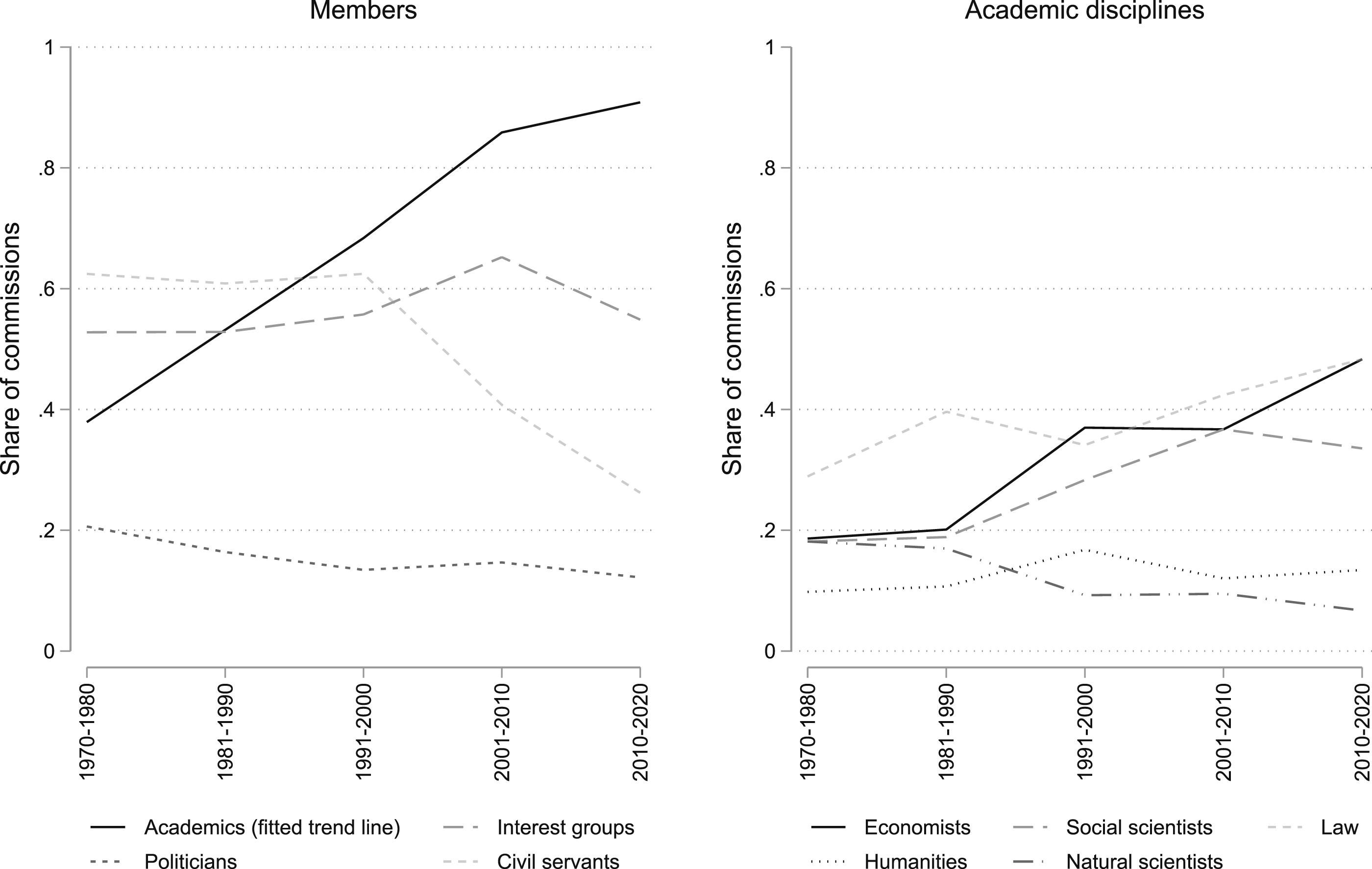
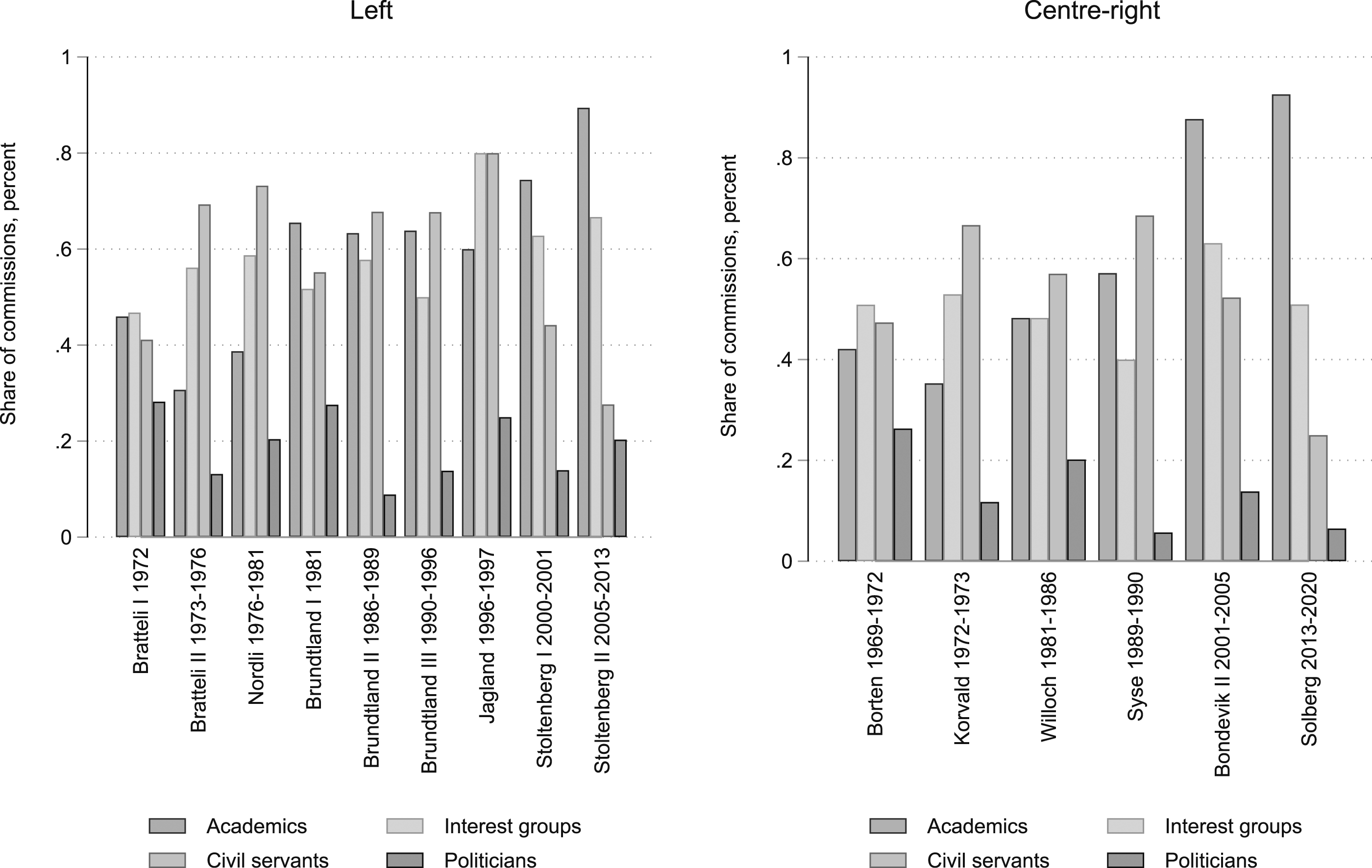
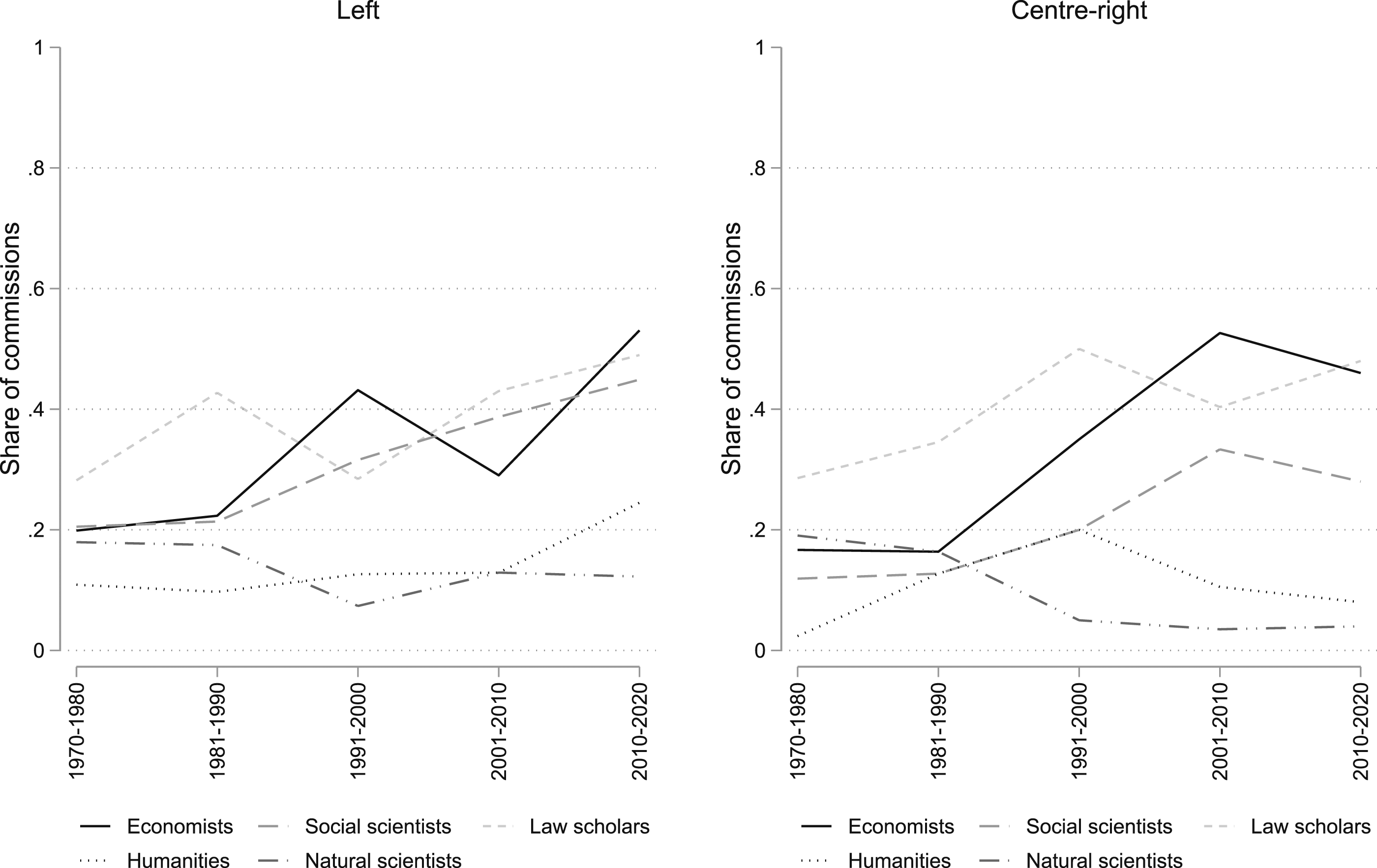
Since the public commission system was introduced in the 1970s, there has been a sharp increase in the number of academics on inquiry commissions in Norway. Figure 1 illustrates these changes by showing the member composition of commissions in general (in the left panel) and by academic discipline (right panel). After 2010, almost 90% of all advisory commissions contained an academic employed at a university or in a research institute. In raw numbers, this amounts to more than 455 out of 1646 members, or almost one-third of all commission members (see the Supplemental Appendix for these figures). Academics are thus more frequently used than other experts and stakeholders, such as interest groups and ministerial civil servants. The panel to the right zooms in on commissions with academic participation. The participation rates of law scholars, social scientists and economists show a steep increase: in the 1970s, economists and social scientists participated in approximately one-fifth of the academic commissions, and around 2010, this number is nearly 50% for economists. The share of social scientists dropped markedly after 2010. As we will see below, this has to do with the Conservative government taking office in 2013. In contrast, scholars within the natural sciences and humanities have had a much lower and declining participatory rate in advisory commissions.
Figures 2–4 show developments by government blocs. Figures 2 and 3 andplots the member composition and disciplines over time per cabinet term, starting with the Borten government (1969-1971) and ending with the Solberg government (2013-2020). Figure 4 displays disciplinary trend lines per decade and by government bloc.
Three patterns stand out. First, Figure 2 shows that cabinets on the left and the right have jointly contributed to the sharp increase in the consultation of academics. There is not much difference between cabinets on the left and the centre-right in their propensity to appoint scholars to commissions, and the trend is strikingly similar over time. In contrast, centre-right governments have consulted interest groups and politicians to a somewhat lesser extent than left-leaning governments. For example, while the latest socialist government, Stoltenberg II (2005-2013), appointed interest group representatives to almost 70% of its commissions, about half of the commissions of the Conservative government of Solberg (2013-2020) contained interest group representation. For both governments, the share of academic commissions is about 90%.
Turning to the economics scholars, we see that there is a moderate, yet increasing difference between the left and the right. On the one hand, the centre-right has appointed a considerably higher share of economists than social scientists compared to the left (see Figure 3 and 4). Without exception, economists have dominated the right’s commissions: Not a single right-wing cabinet has appointed more social scientists than economists since 1969. The pattern has grown more evident over time: In 2018, for example, 13 out of 20 commissions appointed by the Solberg government (65%) contained an economist, which is the highest annual number recorded in the history of the commission system.
On the other hand, Figure 3 also shows that the left have made extensive use of economists. In a longitudinal perspective, socialist governments have a strong and long track record of consulting economic scholars, starting with the government of Trygve Bratteli in the 1970s. The consultation of economists remained high during the socialist governments of the 1980s and 1990s; a period in which a range of important welfare state reforms were implemented, like the liberalization of tax policy in the 1980s, the privatization of state-owned companies in the 1990s, and the deregulation of the telecom and energy markets in the 1980s. An all-time high was reached during the Brundtland II government (1990-96), which included economists in more than half of the academic commissions (56%). While left governments in the late 1990s and 2000s were less inclined to appoint economists–the share went down to less than twenty percent–the numbers increased again when the social democratic coalition government of Stoltenberg II entered office in 2005. The Prime Minister Jens Stoltenberg, being trained as an economist himself, appointed 48 commissions with the representation of an economic scholar (out of 123 commissions; a 40% share). In other words, consulting economists is by no means a right-wing phenomenon.
Third, the figures suggest the unfolding of a ‘social science gap’ over time (see also Figure 4). While the gap between the share of economists and social scientists grows over time for the conservative bloc, the opposite is true for left. For example, while the left included social scientists in more than 40% of academic commissions between 2009 and 2013, the Conservative government that took office in 2013 appointed social scientist in about 28% of the instances. Prior to 2005, the social science gap was more moderate, but still pronounced. In general, the left seem to distribute the seats among a more diverse set scholars than the right, which can be exemplified with reference to the composition of Stoltenberg II commissions. Out of 397 academic members, 100 members were social scientists (25%), 94 members were economists (24%), 84 were law scholars (21%) and 119 belonged to other disciplines like the natural sciences and humanities (30%). Among the social scientists, sociologist and political scientists made up the largest groups (about 70%). In contrast, 40% of the academic members during Solberg were an economist, 20% were social scientists, 17% were lawyers and 23% belonged to other discplines.
How does the patterns look if we disaggregate the numbers by policy area? Figures 5–7 show development across five policy areas: (1) finance, commerce and economic policy, (2) health, (3) education policy, (4) government operations and reforms, (5) law, crime and constitutional matters. The sixth box reports the numbers for other issues. Please note that the trend line shows averages per decade, and not year, and that some of the figures report numbers based on member shares, and not commissions. This is to retain a sufficient number of units per policy area when discussing overtime patterns.
Figure 5 displays the relative number of commissions appointed across policy areas. The solid line shows that centre-right governments have, to an increasing extent, prioritised appointing commissions on economic policy, commerce and finance. After 2010, about one-third of all commissions appointed by the right (33 of 103 in total) were set to enquire into economic policy. By contrast, this concerns about 10% of the commissions of the left. As discussed in the theoretical section above, it thus seems that the right—to a larger extent than the left—have an issue bias for economic policy.
Can the economic issue bias of the right explain the ‘social science gap’? Figures 6 and 7 give an indication and show the share of economists and social scientists appointed to commissions by the right (Figure 6) and the left (Figure 7). Combined, the figures reveal two things. First, right-wing governments have, over time, come to consult a considerably higher number of economists than social scientists in the policy areas of finance/commerce/economy, health and education. Left-wing governments, in contrast, include a considerably higher number of social scientists to these policy areas. Second, we see that social scientists have almost never been appointed to the right’s commissions on economy, finance and commerce. Except for the 2000s, social scientists have not been invited to participate in these commissions.
Discussion and conclusion
To what extent do partisanship matter to the governmental consultation of economists and social scientists? This article have answered the question through a quantitative, descriptive study of advisory commissions in Norway. Three main findings were revealed: that Norwegian governments, regardless of ideology, have had an increasing inclination to consult academics over time; that left governments appoint social scientists relatively more often than the right; and that the partisan differences are more moderate with regards to economists. In the remainder of the article, the three main results, their implications and their limitations are discussed in turn.
First, the analysis showed that the left and the right have appointed an increasingly high amount of academics to commissions in general. As already discussed, it is important to say that Norwegian governments have a long track record of emphasising knowledge-based and scientifically founded policy preparation. Norway has a knowledge-intensive policymaking tradition in which policy preparation relies on a merit bureaucracy as well as external and scholarly expertise (Campbell and Pedersen, 2014). The level of politicisation of the bureaucracy, for example, is low in comparative terms. As such, the finding reflects that reliance on academic knowledge in policymaking is a cross-partisan strategy in Norway and has been so for decades. The extent to which the finding can be generalised to other contexts with more politicised policymaking traditions naturally remains an open question.
Second, we saw that economists have been consulted extensively since the 1970s by both the left and the right (but there are fluctuations, see above). In many respects, this finding is perhaps not surprising. Economic expertise is inevitable to any policymaker that operates within the realms of an advanced capitalist state, and policymaking trends such as New Public Management reforms have contributed to amplifying the need for economic expertise in policymaking processes (Hallerberg and Wehner, 2018). Indeed, across a diverse set of contexts, spanning from Latin America to Scandinavia, professionally trained economists have entered state apparatuses as policy advisors, ministers and heads of governments (Markoff and Montecinos, 1993). Combined with the financial challenges facing many welfare states today related to demographic changes and repercussions from financial crises, economic efficiency will not become less important to parties on the left or the right in the future.
The cross-partisan use of economists may also be explained with reference to the Norwegian context. In Norway, economists play a central role in government and central administration, and economics is often perceived as one of the most influential professions in the Norwegian knowledge regime (Christensen, 2017). The alliance between the Labour Party and economists has long historical roots, beginning right after the Second World War, when economists were seen as vital to the construction and expansion of the welfare state. The Labour Party—in power for almost 20 consecutive years between 1945 and 1961—introduced Keynesian economics as the major ‘science of governance’ (Slagstad, 2004). Scholarly trained economists were recruited to various positions in the bureaucracy, as well as top positions in government, the central bank and party organisation. The findings of this article thus illustrate the continued, and even strengthened, demand for economic analyses and regulatory knowledge in one of the world’s largest welfare states and oil-producing countries.
Third, in the most recent decades, the analysis suggested that left-leaning parties consult social scientists more relative to the centre-right. As discussed in the theoretical section, there may be multiple reasons for this finding. Social scientists may simply be preferred due to their specialised expertise about topics and policy that overlap with the vote-seeking or policy-impact-seeking strategies of the left. We have also seen that some have argued that it has to do with the social sciences’ left-leaning vote choice (e.g. Kimball, 1990) or implicit normative orientation towards the left (e.g. Holmwood, 2007). Nonetheless, and here too, the national context may be taken into account. In Norway, the social sciences, such as sociology and political science, hold a central place in policymaking: the government both commissions and funds research from a large independent social science research institute sector, and a substantial share of in-house bureaucrats hold a degree in the social sciences.
To sum up, these findings, and the limitations that come with them, call for more and cross-national research. For one, the potential drivers of political preferences for science advice should be subject to further investigations. In addition to the mechanisms discussed in this article, politicians may also cherry-pick academic experts based on personal acquaintance and/or their sympathies with the sitting government. In this sense, research that empirically examines the individual party-political preferences of academics could be a fruitful way forward for research. For another, this article has also treated economics and the social sciences as homogenous groups. To understand what drives partisan preferences, one should apply more fine-grained data at the disciplinary level. Lastly, more studies could be conducted in European countries with other administrative traditions, political cultures and party competition dynamics. In times when politics is increasingly dependent on science and party landscapes are changing fast, theoretical and empirical research on the science–politics nexus is called for.
Supplemental Material
Supplemental Material - Partisanship and science advice: Do the right prefer economists and the left social scientists?
Supplemental Material for Partisanship and science advice: Do the right prefer economists and the left social scientists?
Footnotes
Declaration of conflicting interests
The author(s) declared no potential conflicts of interest with respect to the research, authorship, and/or publication of this article.
Funding
The author(s) disclosed receipt of the following financial support for the research, authorship, and/or publication of this article: This article was supported by Norges Forskningsråd.

Supplemental material
Supplemental material for this article is available online.
Note
Author Biography
References
Supplementary Material
Please find the following supplemental material available below.
For Open Access articles published under a Creative Commons License, all supplemental material carries the same license as the article it is associated with.
For non-Open Access articles published, all supplemental material carries a non-exclusive license, and permission requests for re-use of supplemental material or any part of supplemental material shall be sent directly to the copyright owner as specified in the copyright notice associated with the article.
