




Abstract
In parliaments with party-centred rules of speechmaking, like the German Bundestag, we observe an overrepresentation of loyal frontbenchers on the speakers’ list. Previous research shows that party-controlled access to the plenary floor limits opportunities to voice dissent, but we lack empirical investigation of the overall impact on the contestation in debates. This article presents a case study of Bundestag debates on the euro crisis, which estimates the discursive impact by comparing speeches with MPs’ written expressions, known as explanations of vote (EoVs), and introducing association rule mining in an innovative network analytical approach. The findings confirm that restrictive rules reduce the visibility of intra-party conflict and constrain the space for coherent narratives, backbench concerns and political alternatives at an aggregate level, raising questions about the democratic functions of parliamentary debates. In this case, MPs use EoVs as an alternative channel to promote transnational solidarity in a European crisis.
Introduction
Members of parliament (MPs) are elected as individuals and, as stated, for example, in the German Basic Law (Article 38, para. 1), ‘shall be representatives of the whole people, not bound by orders or instructions, and responsible only to their conscience’. Yet, parliamentary party groups (PPGs) are a political reality in most legislatures, and party politics play a crucial role in organising parliamentary business. A hierarchical division of labour and distribution of resources, such as floor time, within PPGs is necessary to manage the workload and enables MPs to specialise. PPGs are heterogeneous, hierarchical organisations with internal norms, rules and procedures. For scholars, ‘the world of legislative parties is one of considerable complexity, in which critical decisions are often unobservable or deliberately concealed’ (Saalfeld and Strøm, 2014: 372). A lot of parliamentary research has been dedicated to systematic analyses of how the behaviour of the individual MP and her interaction with the legislative party are shaped by the incentives created by the way politicians are selected as candidates and elected to parliament. Less attention has been paid to how rules of conduct impact legislative behaviour and speechmaking.
Only little systematic research (Bäck et al., 2014; Bhattacharya, 2020; Giannetti and Pedrazzani, 2016; Proksch and Slapin, 2012, 2015) exists describing and comparing rules governing plenary floor access. This scholarship has shown that patterns of floor participation differ depending on whether floor time is allocated to MPs on an individual basis or via PPGs. The latter reinforces a hierarchical distribution: controlling the speakers’ list is a powerful tool which party leaders use to maintain party unity in the chamber by restricting speaking time for MPs who are ideologically distant to the party leadership. Intriguingly, what is still lacking in this promising research area are analyses of the actual impact on the content and overall contestedness of plenary debates. This article seeks to estimate the discursive impact in an exploratory case study that draws on an underexplored data source and a novel mixed-method approach to political discourse. From the case of German Bundestag debates on the euro crisis, we can learn more about how intra-parliamentary rules and procedures, especially party-controlled floor access, affect the extent and channels through which a controversial issue becomes publicly contested. Based on the assumption that it matters who speaks for the party, we expect that the domination of loyal frontbenchers and exclusion of critical backbench voices (and in this case also less experienced legislators and women) has implications for parliamentary contestation and its public visibility. But how do we know what those MPs who do not get to speak might say? As we lack direct access to all MPs’ preferences, we need proxy measures to assess the disparity between preference homogeneity and party unity observed on the floor. While there have been studies using traditional and social media statements to measure intra-party conflict (Proksch and Slapin, 2015; Sältzer, 2020), utilising parliamentary resources has two advantages: historical parliament records stay available and parliamentary records of MPs’ contributions off the floor resemble the speech format more than (social) media statements in terms of length and language, which facilitates comparative discourse analysis. In the Bundestag, explanations of vote (EoVs) are a very useful and underexplored data source. EoVs are written expressions, which are attached to the official minutes and often published on MPs’ personal websites. Any MP can give an EoV with no or little party control, and in debates on the euro crisis, many German MPs made use of this communication channel. Therefore, a comparative analysis of the discourses and their contestedness in EoVs and plenary speeches allows us to demonstrate the discursive impact of party-controlled floor access.
We might think that it is quite rare for an issue to cause considerable intra-party dissent, while – contrary to conscience issues – demanding party discipline. As exemplified by internal debates on the EU Constitutional Treaty within the French Socialist Party or more recently on the Brexit referendum and negotiations among the British Conservatives, EU politics are prone to create intra-party divisions, and at the same time there is a strong incentive to appear united, especially so for government parties. In addition to revealing dynamics of parliamentary contestation and the domestic politicisation of EU affairs, this study increases our understanding of the role that party control and parliamentary rules play in the politics of legislative debate by providing a rich empirical analysis of how the disparity between preference heterogeneity and party unity on the floor plays out at the aggregate level of parliamentary discourse.
The next section addresses the theoretical question why institutional design and procedural rules are important for legislative speech and for balancing different democratic functions. In the third section, I review rules of speechmaking in the Bundestag and what previous research revealed about the usage of EoVs. As highlighted in section 4, the article introduces association rule learning, a machine-learning technique, to discourse analysis by integrating it into an innovative mixed method approach that combines network analysis with qualitative coding and interpretation. The results section reveals significant differences between plenary speeches and EoVs, which suggest that parliamentary contestation is inhibited by party-centred rules of floor participation. In this case, we find that particularly government backbench concerns over the Stability and Growth Pact, a more coherent anti-austerity narrative, solidarity with Greece and disputes on political alternatives to the aid programmes were made less visible. As emphasised in the conclusion, intra-parliamentary rules have distributional effects and therefore shape parliamentary discourse.
Intra-parliamentary rules and legislative speech
Palonen (2012: 14) highlights that procedural rules should be central to our understanding of parliamentary politics: ‘Parliamentary politics is not just politics that takes place in parliament, but politics conducted in a parliamentary manner, in accordance with the rules and practises of parliamentary procedure’. Parliamentary business is regulated by official rules of conduct as well as conventions or unwritten rules, and while the extent and detail of regulation vary between legislatures, ‘the truly important rules are usually formalized’ (Müller and Sieberer, 2014: 311). These internal rules, more so than constitutional provisions, shape individual-level behaviour by constraining MPs’ room of manoeuvre and the ways they can express their views (Leston-Bandeira, 2009: 699). Therefore, rules also impact how democratic functions, such as representation, accountability and deliberation, are fulfilled in legislatures. Debates in the plenary chamber are the most visible forum of parliamentary contestation and serve at least three functions: to inform citizens about pressing political issues, to communicate (i.e. represent) diverging viewpoints on issues the electorate cares about, and to hold the government accountable in public. To be enacted, legislative bills generally need to pass consideration and votes in the plenary, which creates a ‘plenary bottleneck’ since plenary time is limited (Cox, 2006). Scarcity of time has always been inherent to parliamentary politics. As pointed out by Palonen (2012), the question of how to distribute time fairly has occupied legislators for a long time, and the recognition that time management stands in tension with deliberative ideals is not new either: already in the 19th-century Westminster Parliament, ‘many time-saving measures were felt to be oppositional to the idea of Parliament as an exemplary deliberative assembly’ (ibid.: 22).
While we know that rules regarding the control over the plenary agenda and the government’s agenda-setting powers vary greatly between legislatures (Döring, 1995; Rasch and Tsebelis, 2011), there is only limited comparative research on rules of speechmaking. We can distinguish broadly between (a) open access to the plenary floor, whereby speaking time is allocated to individual legislators and (b) more restrictive rules, whereby PPGs receive a fixed amount of time according to their size and allocate that time among its members. Giannetti and Pedrazzani (2016) refer to the latter as ‘party-centred’ rules, since they tend to strengthen a hierarchical process whereby the PPG leaders select carefully who they place on the speakers’ list. Bäck et al. (2014: 509) discuss that also under formal open access rules, like in the Swedish Riksdag, PPG leaders can influence speechmaking, for instance, by setting up informal rules guiding speaker selection or through reward and punishment for floor behaviour. Particularly in countries where the electoral system creates strong incentives to maintain a united party brand, ‘party leaders must monitor their elected members and prevent them from undertaking activities that contradict the party’s primary message’ (Proksch and Slapin, 2012: 522). Therefore, PPG leaders should be reluctant to let MPs speak who do not toe the party line. In their comparison of six European parliaments, five of which have party-centred rules, Bäck et al. (2019) find that when elections are approaching party leaders restrict floor access to fewer MPs, but this effect is not stronger in the party’s core policy areas. These findings underline the important point made by Giannetti and Pedrazzani (2016: 775) that ‘party leaders are effective in disciplining legislators only when institutional arrangements enable them to do so’.
There is empirical evidence from Italy (Giannetti and Pedrazzani, 2016) and Germany (Bhattacharya, 2020; Proksch and Slapin, 2015) that restrictive rules are used to enforce party discipline by excluding critical backbenchers. The next logical step in this research area is to examine the link between the diversity of the speakers’ list and the quality of ‘discursive representation’ (Dryzek and Niemeyer, 2008). In this case study of Bundestag debates on the Greek bailout programmes between 2010 and 2015, I compare legislative speeches with legislators’ written expressions to analyse systematically what kind of arguments and viewpoints tend to get pushed from the centre stage to the less visible periphery.
Bundestag debates on the euro crisis and explanations of vote
In the German Bundestag, access to the plenary floor is controlled by PPG leaders, who distribute the time allocated to their group. The euro crisis and the ratification of bailout programmes for Greece have caused unusually high voting defection across all parties in the Bundestag, but party unity remained relatively high in plenary speeches, as PPG leaders used their power as ‘gatekeepers’ of the plenary floor to exclude critical voices (Bhattacharya, 2020). Restrictive or party-centred rules of speechmaking are thus an important resource for German party leaders to maintain unity when cohesion, that is, intra-party agreement or preference homogeneity, is low (Bailer, 2018). In this case, this was perceived as a problem by the Speaker of the house, who granted additional time to dissenting MPs from the government parties in some of the debates, a decision which was regarded as a breach of parliamentary rules and conventions by all PPG leaders (Denkler, 2011). A reform proposal that the Speaker can ‘in agreement with the parliamentary parties’ allocate 3 min of speaking time to individual MPs was dropped after increasing resistance among MPs and threats of a constitutional complaint (Bannas, 2012).
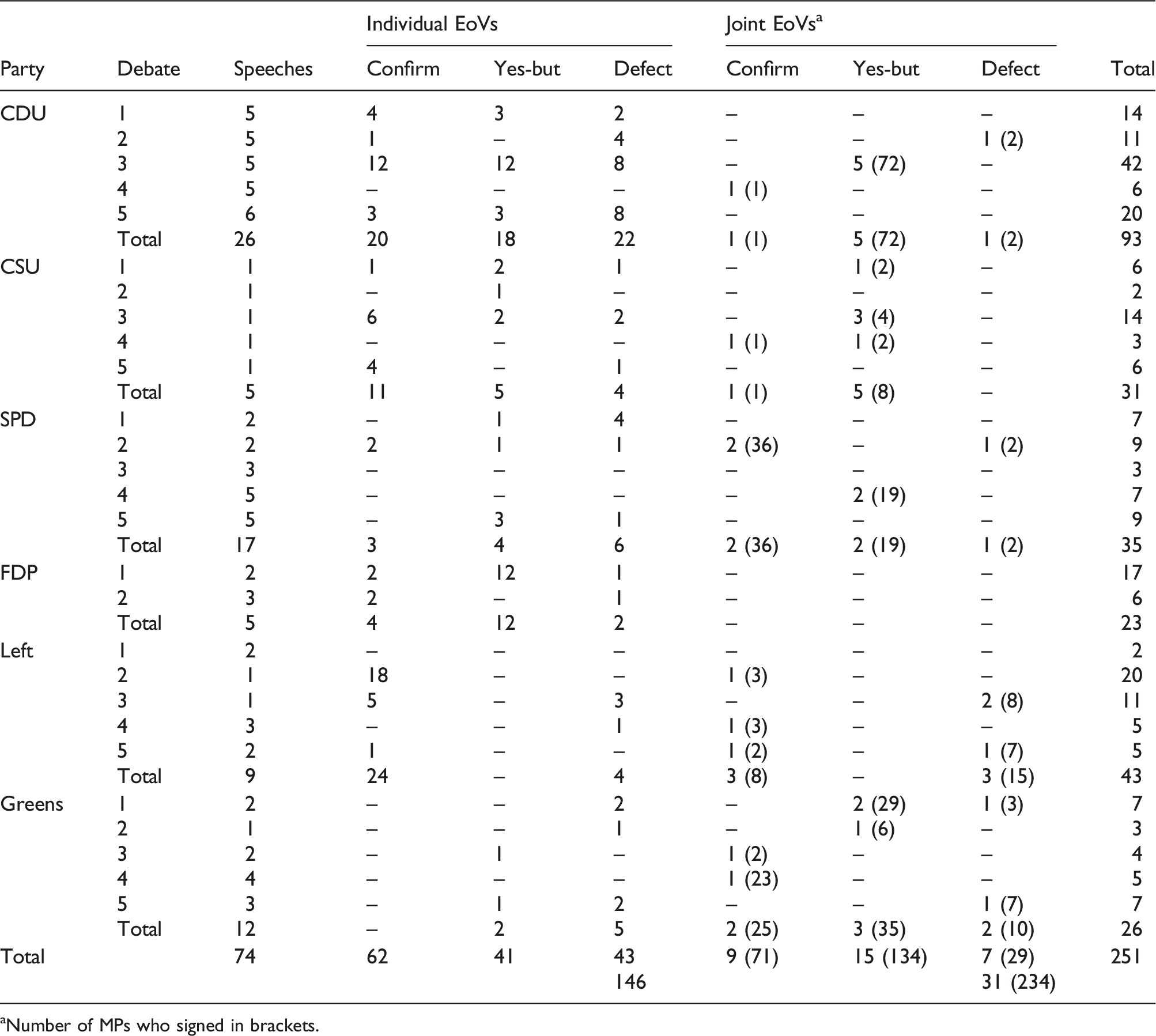
Proksch and Slapin (2015) show that in the Bundestag, the more importance PPG leaders attach to a debate, the more inclined they are to speak themselves and favour the most loyal colleagues over MPs who are ideologically distant from the party line – whereas the opposite is the case in the House of Commons, where speaking time is allocated on an individual basis by the Speaker. Bhattacharya and Papageorgiou (2019) confirm that frontbenchers, experienced legislators and male MPs were overrepresented in the plenary debates on the euro crisis. 1 Interestingly, it was precisely the underrepresented groups which displayed higher levels of activity in terms of issuing EoVs, which indicates that MPs, who care about an issue, cannot get floor time and feel that their viewpoints are not sufficiently represented, will invest their own and their staff’s scarce time to use other channels of communication. In that sense, EoVs are an indicator of mobilisation and a tool of individual accountability, also highlighted by the fact that MPs usually publish them on their websites. Despite the additional speaking time given to a couple of government dissenters, I thus expect the disputes and claims in EoVs to complement and/or challenge those in speeches.
Until 1951, EoVs were explicitly intended for voicing opinions which dissent from the majority view, and until 1970, they could only be issued for votes that are not roll-call votes (Schindler, 1999: 1788). But according to the current rules of procedure, MPs can issue an EoV for any vote and irrespective of their position. They can be given orally for a maximum of 5 min before the vote is taken. Conventionally, however, MPs choose to deliver these expressions in writing either individually or jointly with party colleagues to (a) demonstrate party loyalty and confirm the party line, (b) voice reservations despite voting with the party, or (c) explain why they defected in the vote (Becher and Sieberer, 2008; Sieberer, 2015). The usage of EoVs has gradually increased (Schindler, 1999: 1790–1791). In the legislative period between 2005 and 2009, MPs made use of this communication channel in 2.1% of possible occasions (Sieberer, 2015: 289). For roll-call votes on the euro crisis, Bhattacharya and Papageorgiou (2019) find much higher activity, as between 3.2 and 21.7% of German legislators issued an individual EoV or signed a joint one. Furthermore, they show that ‘EoVs are a first step towards deviant voting and can function as a “warning” mechanism for party leaderships’ (ibid.: 440) because MPs who issued an EoV were more likely to defect in the next vote on the same issue. For cases without any or a very small number of EoVs, we cannot necessarily infer that there is no intra-party dissent but that MPs do not consider the issue important enough to voice their disagreement and face potential sanctions.
In the absence of an experimental design where we can test how the debates would have panned out under more open-access rules or without the provision of EoVs, the study is based on the following considerations and assumptions: Giannetti and Pedrazzani’s (2016) study from Italy, where two sets of rules are in place for different types of debates, demonstrates that, given the opportunity, party leaders exclude ideologically distant backbenchers. The assumption made here is that party leaders restrict the speakers’ list to loyal MPs because it works, that is, shapes plenary discourse in a way they prefer. Open-access rules increase the heterogeneity of speakers (Giannetti and Pedrazzani, 2016; Proksch and Slapin, 2015), 2 which I expect to translate into parliamentary discourses. In the German case, party leaders are of course aware that MPs can use EoVs as a mode of expression, which might factor in their strategic calculations. 3 (Similar issues of strategic interdependencies are known for mixed electoral systems (e.g. Hainmueller and Kern, 2008: 213–214)). The two channels do not operate independently from each other, also because it is precisely the MPs who tend to be excluded from the floor who are more likely to use EoVs (Bhattacharya and Papageorgiou, 2019), which is why they provide valuable insights into intra-party preferences as a basis of comparison with discursive party unity observed on the floor. It is reasonable to suggest that many of those MPs who invest time into EoVs would give more visible speeches with a similar content if they had the chance. On these grounds, I argue that discursive differences between the two channels can be at least partially explained by different rule sets. I expect that EoVs broaden the political discourse and challenge claims made on the plenary floor, because the positions ‘filtered out’ by party leaders through selective speakers’ lists are not necessarily brought up by other parties. A detailed comparison of the most disputed claims, overall levels of contestedness and discourse structures in plenary speeches and EoVs provides a good starting point to investigate this aggregate effect.
Case study, data and methods
Between 2010 and 2015, the Bundestag held five roll-call votes on crisis measures for Greece, and these debates provide an excellent case study to examine the discursive effects of restrictive and party-centred rules of speechmaking for a complex and controversial topic. The euro crisis has caused considerable intra-party dissent, voting disunity and mobilisation in all parties, even though PPGs (except for the Greens in one vote) did not lift the party whip as they often do for conscience issues. In this sense, this is a fairly typical case of domestic politicisation of EU affairs. Existing studies on the debates and roll-call votes on the Eurozone crisis in the Bundestag have shown that while voting behaviour was fairly volatile, the government’s public discourse was very consistent over the course of the crisis (Oppermann, 2014; Wendler, 2014). Patterns in voting behaviour reveal the centrality of partisan dynamics. The Christian Democratic Union (CDU) and its Bavarian sister party, the Christian Social Union (CSU), have been in government under the leadership of Angela Merkel throughout the crisis, first in a coalition with the Free Democratic Party (FDP) and after the 2013 elections with the Social Democrats (SPD). Voting unity has been challenged in all parties but has declined most dramatically in the CDU and CSU (Bhattacharya and Papageorgiou, 2019). When still in opposition, the SPD and similarly the Greens were ‘forced into a role of “critical cooperation”’ (Wendler, 2014: 456), as they weighed up their critique of how the government and the Troika managed the crisis, on the one hand, and their commitment to European solidarity, on the other hand. The Left Party only voted with the government majority once, when the second Greek bailout programme was extended in February 2015 and the party wanted to demonstrate their transnational solidarity with Syriza who had just come to power. At the individual level, pro–/anti-EU positions were a stronger predictor for voting in support of financial aid than left–right positions (Degner and Leuffen, 2016).
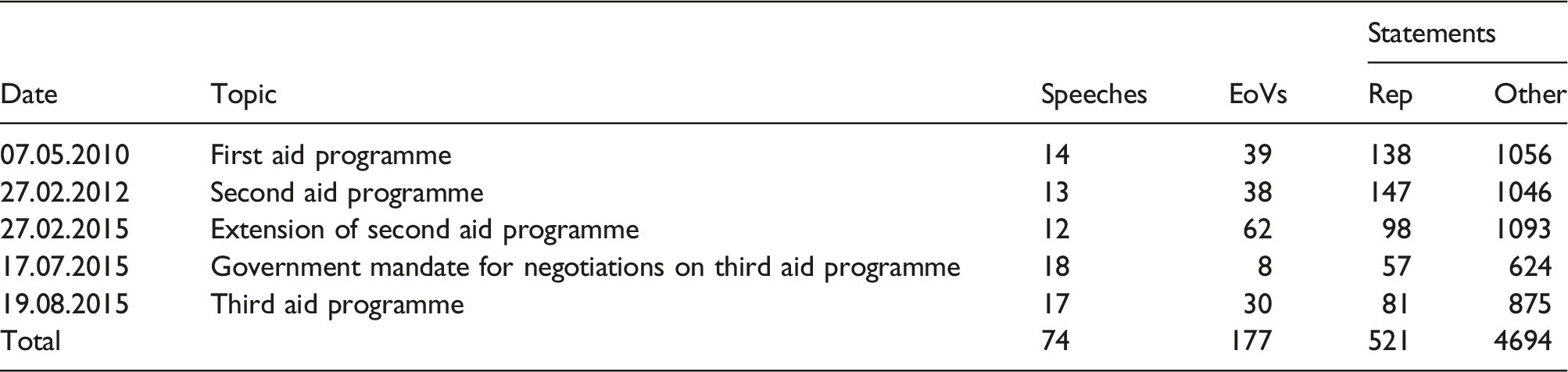
To assess whether the contestation we see in voting records also became visible in parliamentary discourse and was shaped by rules of speechmaking, this study compares disputes, contestedness and discourse structures in plenary speeches and EoVs. The dataset comprises of 74 plenary speeches and 177 EoVs containing a total of 5215 individual statements. 4 With the help of the Discourse Network Analyzer (Leifeld, 2019), I built an elaborate coding frame in an iterative process by hand-coding all documents at least twice. The data has then been exported for formalised analysis. As agreement with a claim has been coded as a binary variable, we can measure direct dispute by comparing how often claims have been mentioned positively and negatively. However, as shown below, the majority of claims were uncontested, but this does not necessarily mean that there has been a widespread consensus, as numerous competing claims make up opposing frames. To facilitate the identification of discursive clusters, each claim has been split into two, based on agreement and disagreement (e.g. ‘Aid_Conditionality+’ and ‘Aid_Conditionality–’). During the coding process, I identified 521 statements in which MPs reflect either on the meaning of representation (88 statements) or claim to represent a specific group of people by speaking on their behalf, raising their grievances or claiming to improve their lives. I extend the framing analysis to these representative claims (Saward, 2010), as this case concerns redistributive aspects of EU politics and therefore raises questions about the interplay between national, transnational and supranational representative claims (Kinski and Crum, 2020).
Network analysis and community detection techniques allow us to examine discourses from a structural perspective. In this article, I employ association rule mining for the first time in discourse analysis. Association rule mining (Agrawal et al., 1993; Agrawal and Srikant, 1994), which is most commonly applied in market basket analysis to identify items that are often purchased together, is a machine-learning method for discovering regularities, in the form of rules, in large relational databases containing transactions. This data mining technique uses quantifications of ‘interestingness’ (Piatetsky-Shapiro, 1991), but what is considered interesting depends on the particular application and can be determined by the researcher. The advantage in comparison to co-occurrence approaches like discourse network analysis (Leifeld, 2016) or frame mapping (Miller, 1997) is that association rule learning allows us to test whether the mentioning of one claim increases the likelihood of another claim, thereby advancing the detection of clusters by reducing the bias towards highly frequent claims and making the analysis more robust.
The most popular algorithm for association rule learning is the Apriori algorithm (Agrawal and Srikant, 1994), and I incorporated the Python implementation 5 into my code 6 to advance the discourse analysis in this study. The Apriori algorithm follows a two-step process: The first step is to find the claims that tend to be mentioned together, which is achieved by generating the frequent itemsets. The itemsets were then sorted by support, which is the proportion of transactions (i.e. speeches and EoVs) containing the itemset. The 200 most frequent itemsets in each dataset were then selected for association rule analysis, which is the second step. Association rules tell us how the items in the identified frequent itemset relate to each other. In this case, in addition to support, the ‘lift’ value was chosen as a measure of ‘interestingness’. A lift value greater than one indicates that the co-occurrence of claims is not by chance; a score of exactly one means that they are statistically independent; and if it is below one, the presence of one claim decreases the likelihood of the other claim(s).
To analyse whether the association rules fall into clusters, which can be interpreted as coexisting or competing frames, I generated undirected network graphs from association rules with a lift threshold of >1, in which nodes represent the claims from the most frequent itemsets, and the edge weight between two nodes designates how often they are part of an association rule. By studying the structure of these networks, we can identify and compare discursive frames in plenary speeches and EoVs. The Louvain algorithm (Blondel et al., 2008) detects communities by optimising modularity, that is, the degree to which a network contains separate clusters. The visualisations of discourse networks (Figures 4–8) have been created with Gephi using a force-directed layout, the ForceAtlas2 algorithm. The node colour and size indicate the different modularity classes (i.e. clusters) and degree (i.e. number of connected edges), respectively, and edge widths reflect the edge weights. For readability and interpretability, not all node labels are included in the graphs.
Analytical findings
Political contestation is a multi-faceted phenomenon, and to gain a full picture of the discursive contestation of the euro crisis in Bundestag debates and assess the impact of party-controlled access to legislative speechmaking, the analysis distinguishes between two dimensions: First, I identify and measure disputes, where MPs directly disagree with each other on particular claims. Second, instead of negating a frame and thereby potentially strengthening it (Lakoff, 2014: 1–2), opponents of an idea can shift the emphasis to other issues or present alternative problem interpretations and solutions. The analysis of discourse structures thus provides further insights into political contestation. Below I compare patterns of representative claim-making, contestedness and discourse structures in plenary speeches and MPs’ written EoVs.
Contestedness
In my previous work (Bhattacharya, 2020), I have introduced a contestedness score to identify the most disputed claims within legislative parties. Though the tool was first developed for the study of party unity, it can also be used to measure the intensity of direct confrontation over time and across communication channels. First, I compute the score for each claim, which reflects how often MPs agreed or disagreed on a claim and how salient the claim is in relation to other claims in the debate. Then I take the mean of all individual scores to get an aggregate score for each debate and document type to facilitate comparison of contestation levels.
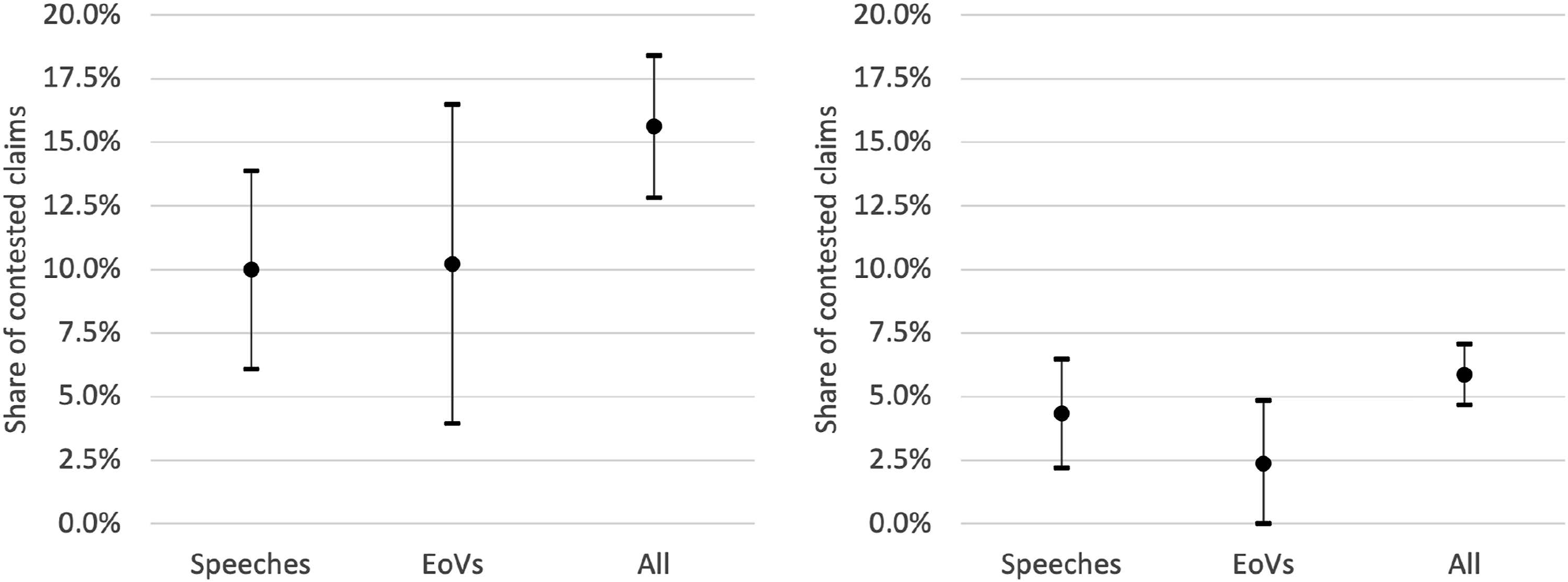
Direct disputes were fairly limited in Bundestag debates on the euro crisis. As illustrated in Figure 1, only around one-fourth of all claims were contested, meaning mentioned at least once positively and negatively. Despite more variation in EoVs, on average direct disputes feature more commonly in plenary speeches than EoVs, which is not surprising as public visibility is much higher and speeches are more interactive. Yet, if we combine speeches and EoVs the percentage of contested claims is higher, which indicates that some claims that remained undisputed on the plenary floor are challenged by MPs through EoVs and that MPs raise additional controversial issues in their written expressions. Supporting earlier findings (Bhattacharya, 2020), we also see that disagreement tended to be higher among government MPs than opposition MPs (see Figure 2). As confirmed by confidence intervals, for government MPs the combined contestedness is considerably higher (on average 15.6% contested claims compared to around 10% for speeches and EoVs individually), which tells us that for them in particular EoVs are an important outlet for communicating divergent views. Share of contested claims (left) and average contestedness score (right) for speeches, EoVs and all documents. Average share of contested claims for different document types by government MPs (left) and opposition MPs (right), with 95% confidence interval.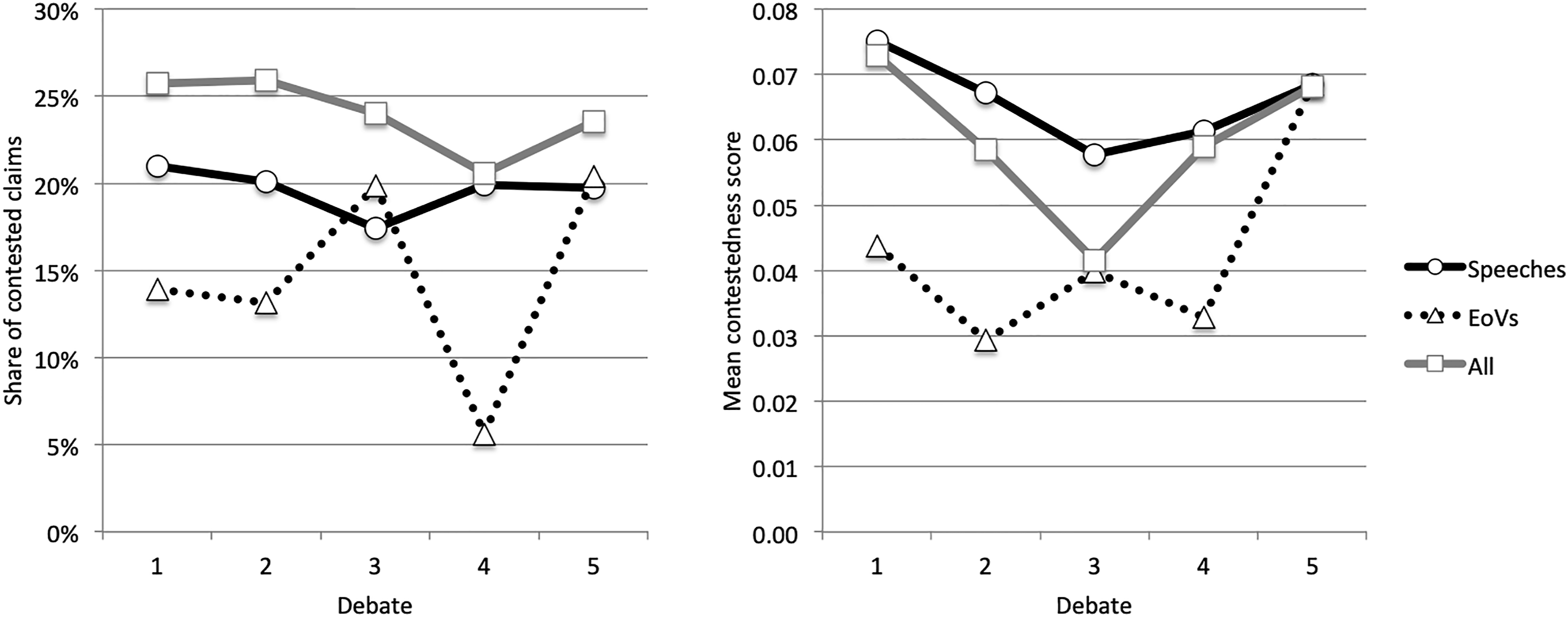
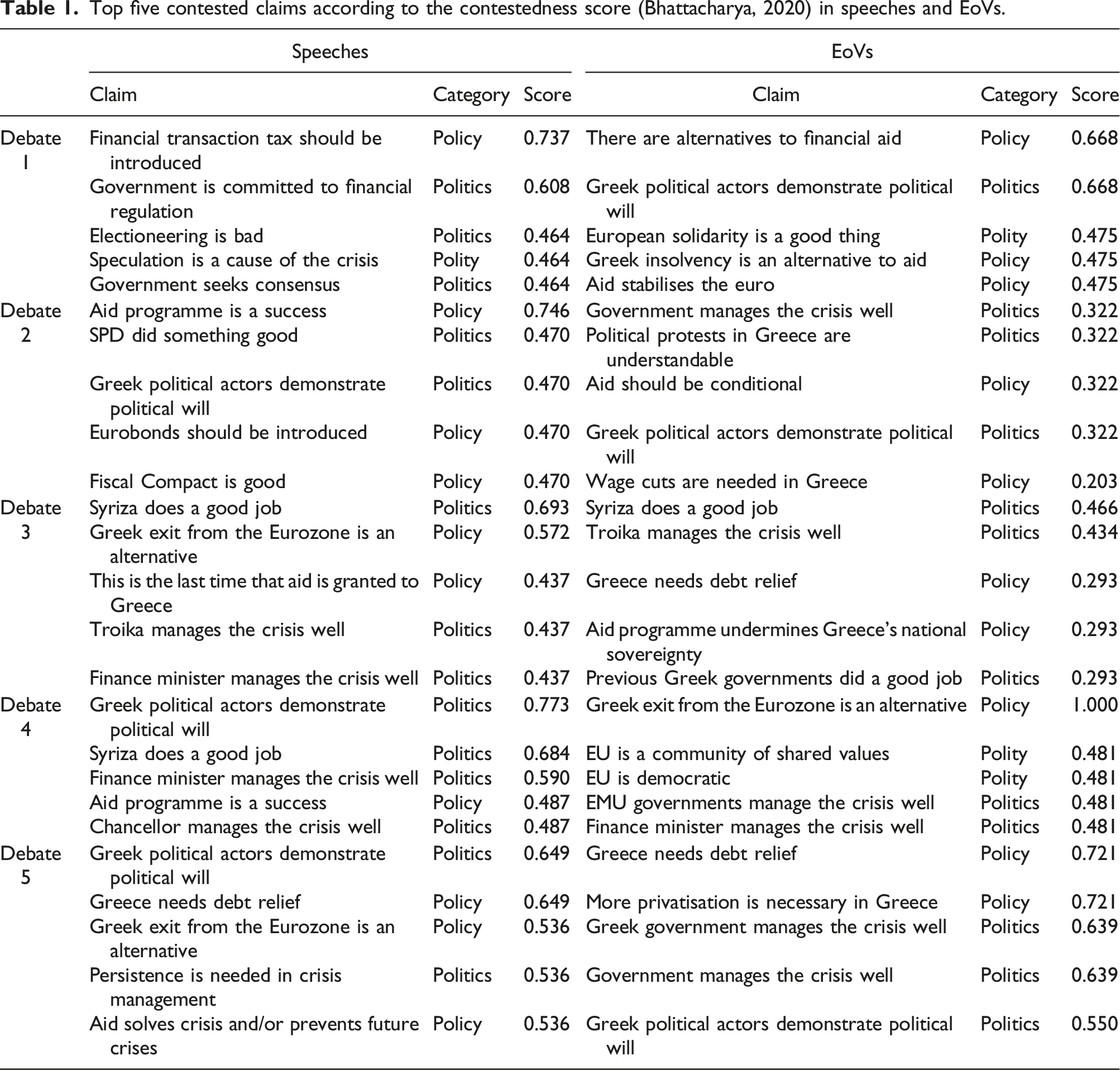
Top five contested claims according to the contestedness score (Bhattacharya, 2020) in speeches and EoVs.
By understanding and approaching discourses as networks of claims, we can use network analysis and visualisation to reveal the internal structures of discourses. We could assess the overall strength and coherence of the pro-government discourse versus the anti-austerity discourse for plenary speeches, since government and opposition party groups are given a fixed amount of floor time depending on their size. For EoVs, however, party mobilisation patterns have been inconsistent over time. Therefore, the purpose of this comparative analysis of discourse networks is to contrast the network structures and most central claims to identify similarities and differences in argumentative patterns, providing novel empirical insights into the impact of party control and procedural rules on legislative speech.
In terms of network structure, the graph density, that is, the number of links between nodes over the total number of possible ties, is higher for EoVs than speeches in all but the last debate (see Figure 3), indicating that MPs’ written expressions form a more interconnected discourse than plenary speeches. A more detailed interpretation of discourse networks is conducted below to determine whether this interconnectedness suggests higher cohesion and/or sophistication and depth in argumentation. Graph density of discourse networks for speeches, EoVs and all documents (left) and average graph density of discourse networks by document type, with 95% confidence interval (right).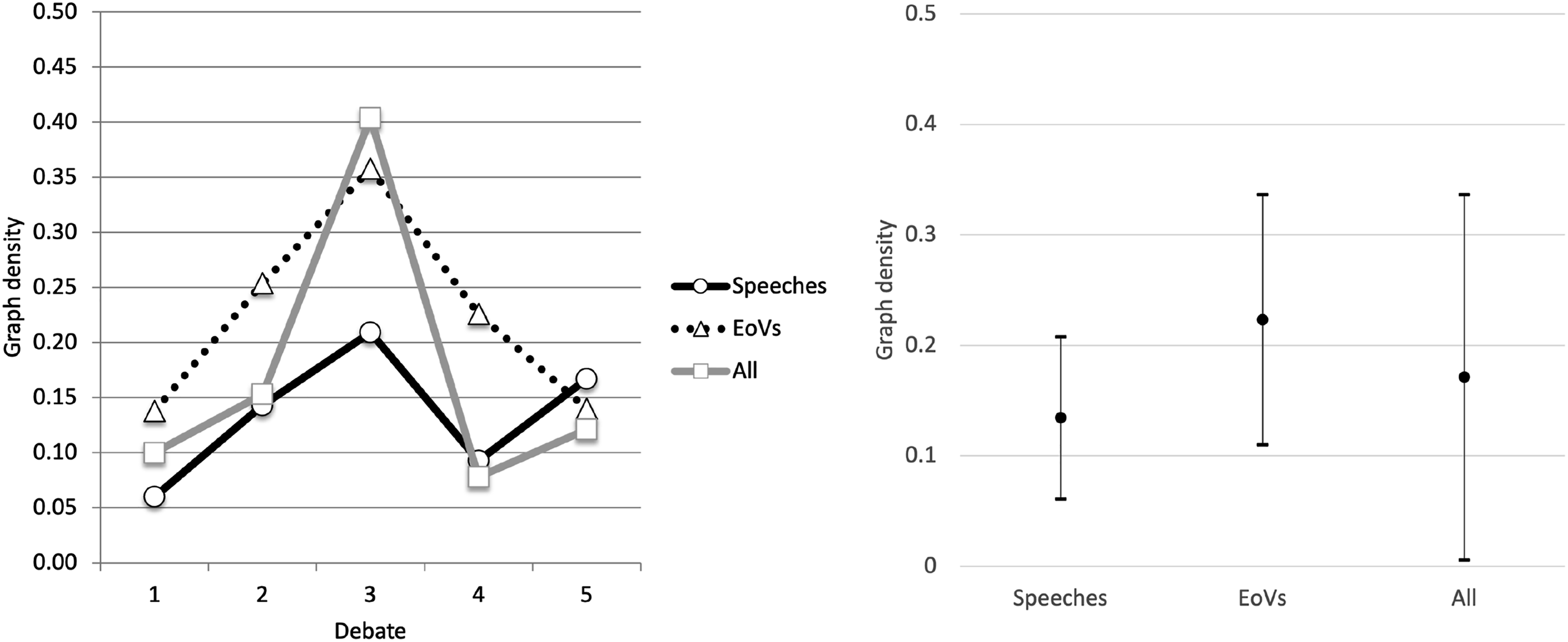
The comparison of discursive clusters in speeches and MPs’ written expressions (see Figure 4, Figure 5, Figure 6, Figure 7, Figure 8) reveals that while MPs who issue EoVs tend to echo the most central claims mentioned on the plenary floor, MPs also use them to raise more critical points and give more detailed accounts and coherent arguments. At the beginning of the crisis, we see more diagnostic analysis of the causes of the crisis in EoVs, which critical backbenchers saw primarily in Greek fiscal mismanagement and ‘living beyond their means’ as well as the lack of monitoring and enforcement of EU rules, allowing Greece to ‘cheat’. According to this rationale, EU-level sanctioning and monitoring are required to prevent the crisis from spreading, and the rescue package with strict conditions is a one-off deal. On the plenary floor, it was also stressed that Germany is merely acting as a guarantor and no payments will have to be made unless Greece fails to repay their loans. The opposition spotlighted financial speculation as a main cause, and therefore regarded financial regulation as crucial in solving the crisis. While there was a consensus to tighten financial regulation, there remained disagreement about regulatory instruments on the plenary floor, particularly the question of whether a financial transaction tax or bank levy would be more effective and feasible. Discourse networks of speeches (left) and EoVs (right) for the first debate. Discourse networks of speeches (left) and EoVs (right) for the second debate. Discourse networks of speeches (left) and EoVs (right) for the third debate. Discourse networks of speeches (left) and EoVs (right) for the fourth debate. Discourse networks of speeches (left) and EoVs (right) for the fifth debate.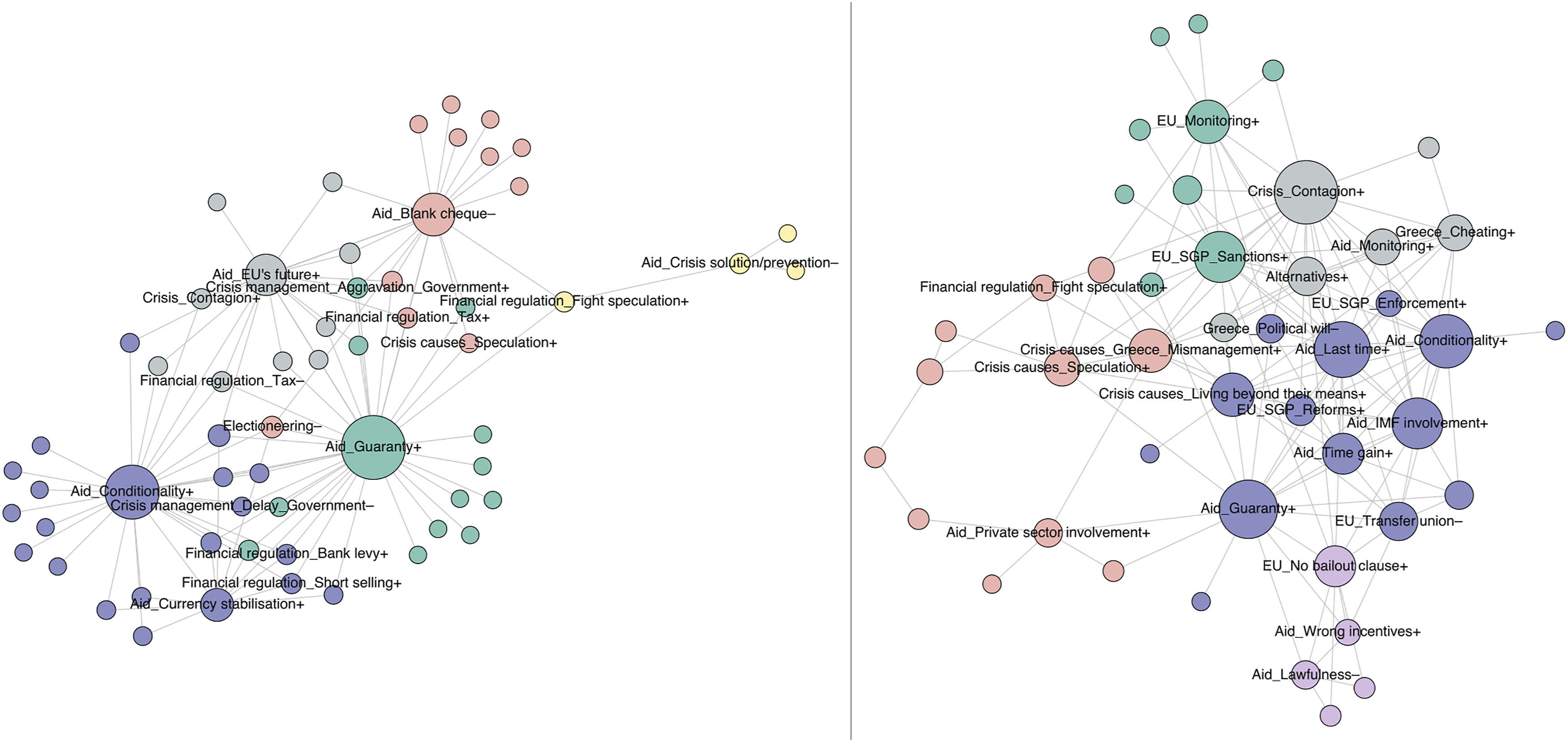
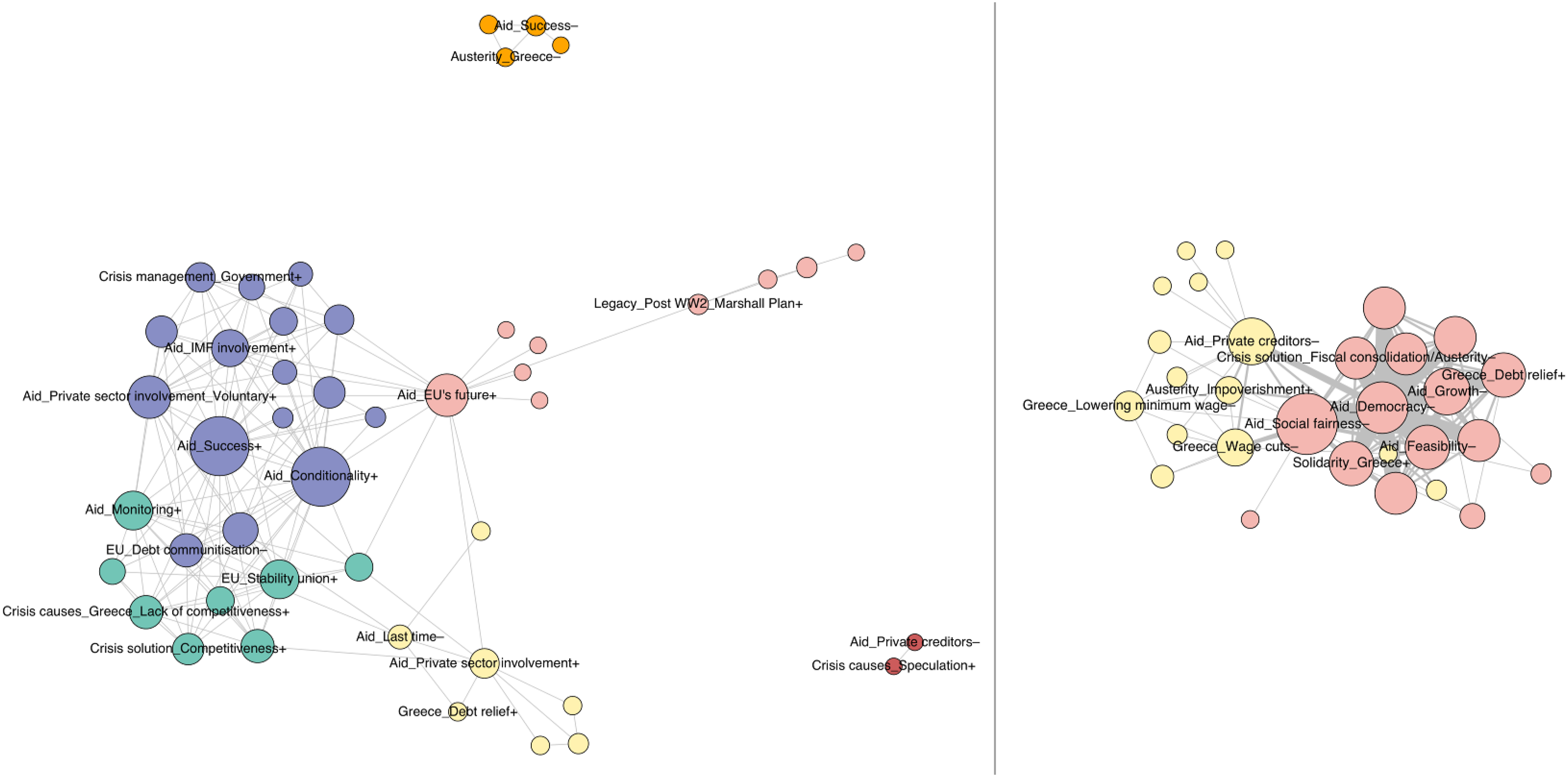
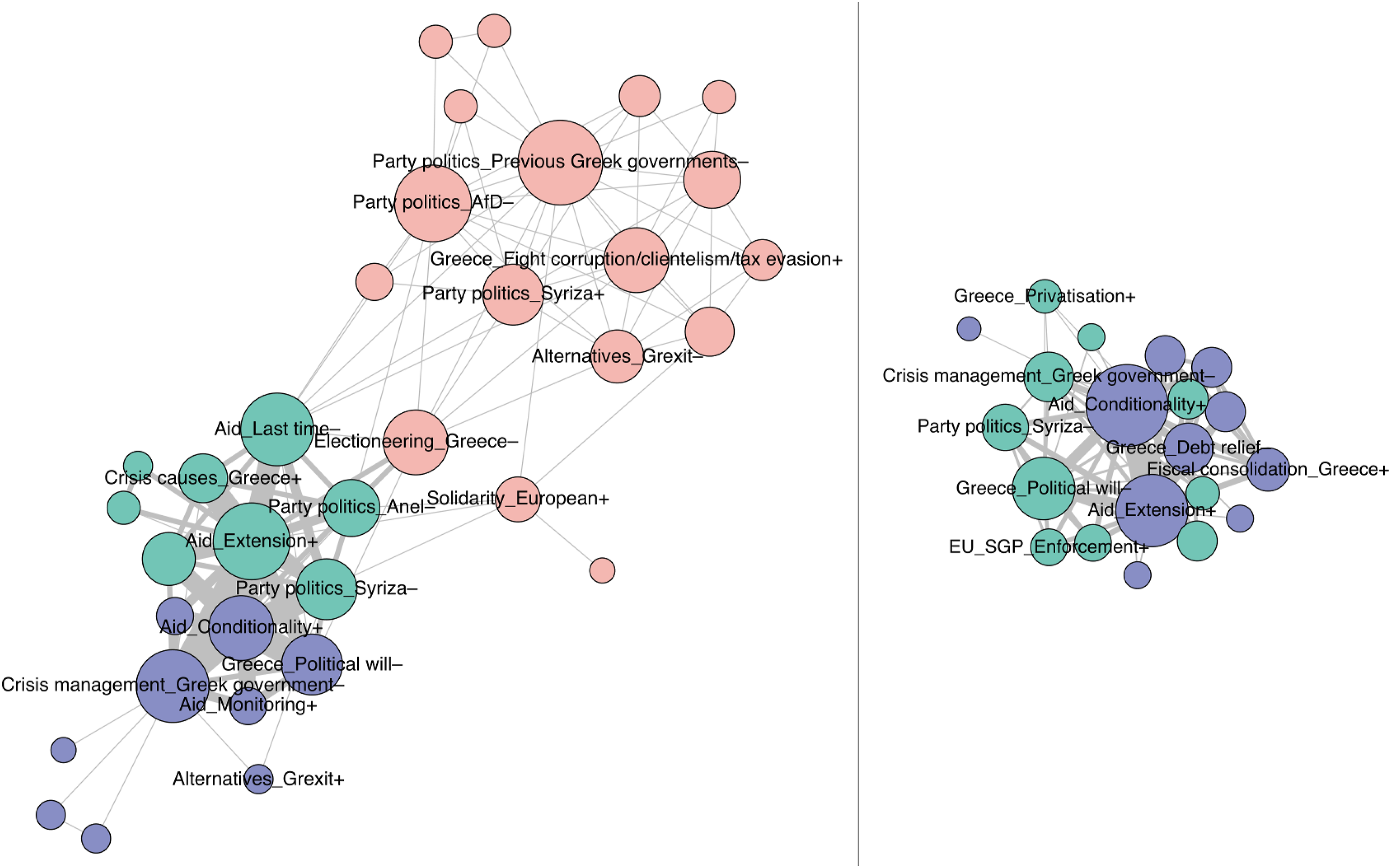
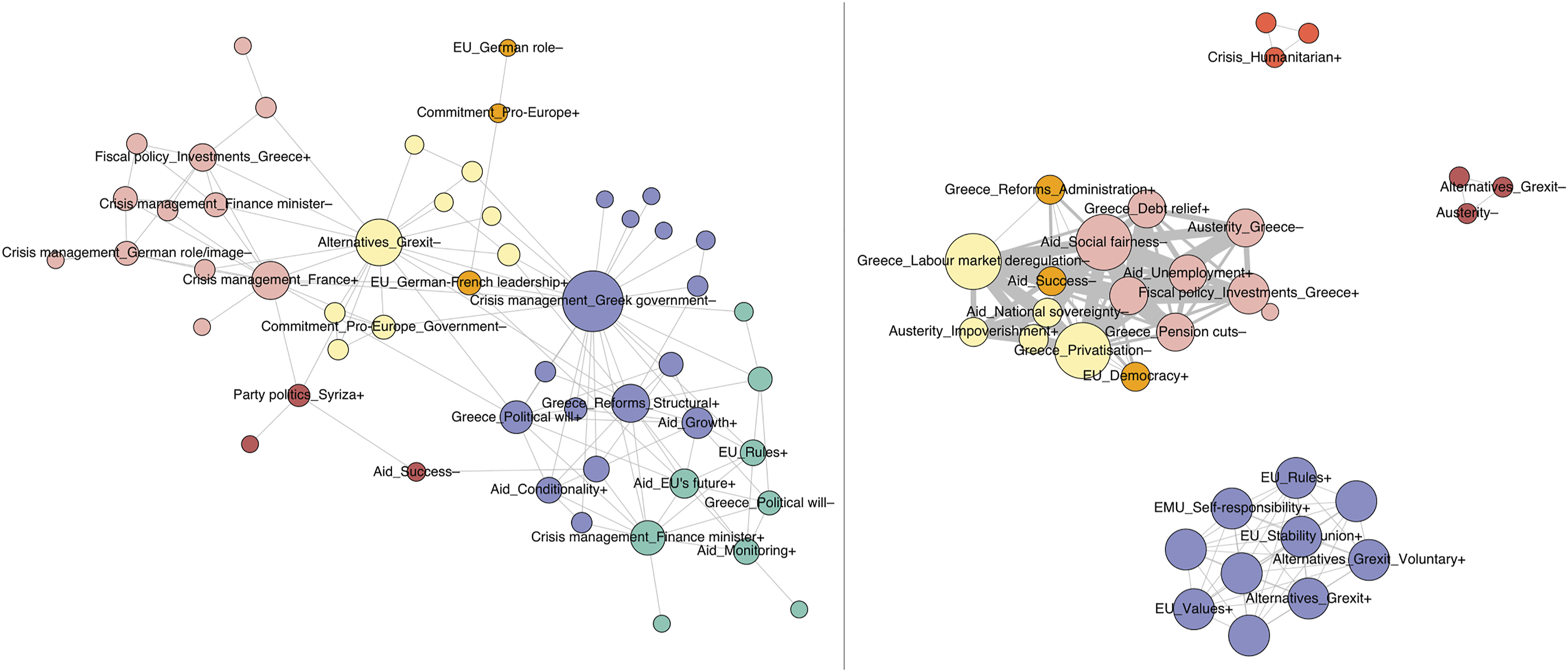
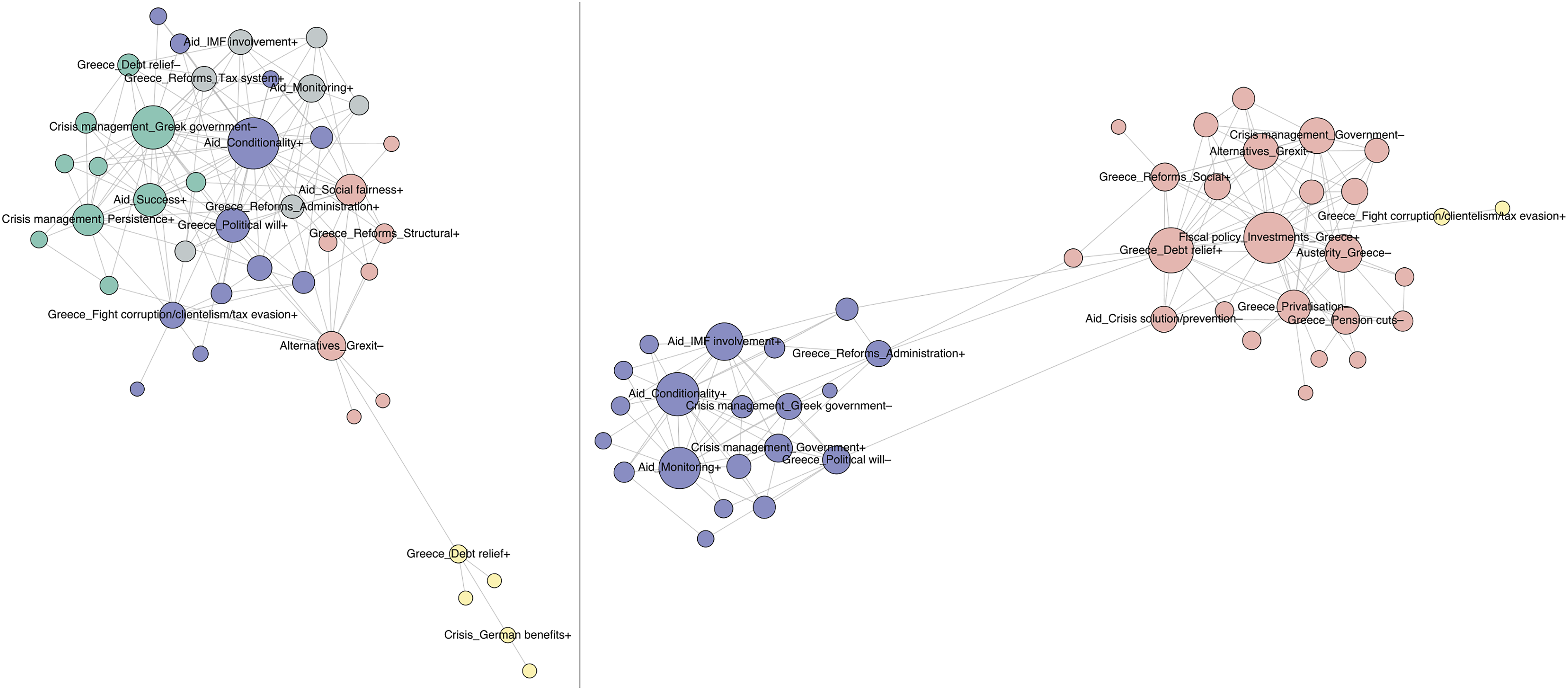
Every time a new package passed the chamber, there was a discussion whether this will be the last time Greece needed financial aid and conditionality remained a central theme. In plenary speeches, the Christian Democrats and Liberals kept insisting that aid must not be given as a blank cheque but only under strict conditions and, as the crisis carried on, the conditional approach was portrayed as the cornerstone of Greece’s successful recovery. After Syriza got into power, this argument was accompanied by negative assessments of the Greek government’s crisis management and a consideration of Greece’s exit from the Eurozone if Greek decision-makers do not demonstrate more political determination and urgency to implement the structural reforms deemed necessary to restore economic growth. Political decision-making and the management of the crisis featured much more in speeches than EoVs. To give an example, the fourth plenary debate was dominated by disputes about Finance Minister Wolfgang Schäuble. While supporters praised his persistence in the negotiations, the critics were very adamant that Grexit should never be an alternative, and Schäuble received a lot of criticism for threatening Greece with a temporary exit at the emergency Eurozone summit on 12–13 July 2015, which in their view damaged Germany’s pro-European reputation.
In their written expressions, MPs focussed less on decision-making and party-political quarrels and more on policy choices. For the third debate, we see that the most frequent claims in EoVs echoed the government discourse but also added claims in favour of privatisation in Greece and against debt relief. The success or failure of the rescue measures and the austerity approach became an increasingly contested topic. Even though the government’s story of the success of the aid programmes was also disputed on the plenary floor, this critique was reinforced and expanded in EoVs. The anti-austerity discourse was enriched with claims about the negative effects of austerity, privatisation and labour market deregulation, such as the cuts of pensions and wages, highlighting the grievances of the Greek population and linking this critique to the idea of solidarity. The programmes and austerity measures were criticised for undermining democracy and exacerbating social inequality by leading to rises in unemployment and poverty, thus not helping to resolve the crisis. Instead of being bailed out, private creditors should contribute to cutting Greece’s debt load. Public investment (in the form of an equivalent to the ‘Marshall Plan’) and debt relief were proposed as political alternatives.
The analysis reveals that EoVs also provided a crucial outlet for backbench concerns over the Stability and Growth Pact and the state of the union. Though we also find portrayals of the EU as a stability union, which does not allow for the communitisation of debt, on the plenary floor, particularly in the first and fourth debate, EoVs feature stronger claims that the aid programmes were too lenient, potentially unlawful and paving the way towards a ‘transfer union’. According to this reasoning, the observation of rules must be a central value in this ‘stability union’ and every member of the Eurozone is itself responsible for meeting the rules set out in the Stability and Growth Pact, and if they fail to do so, rules should be enforced with sanctions.
Representative claims
Top frequent itemsets for representative statements in speeches and EoVs.
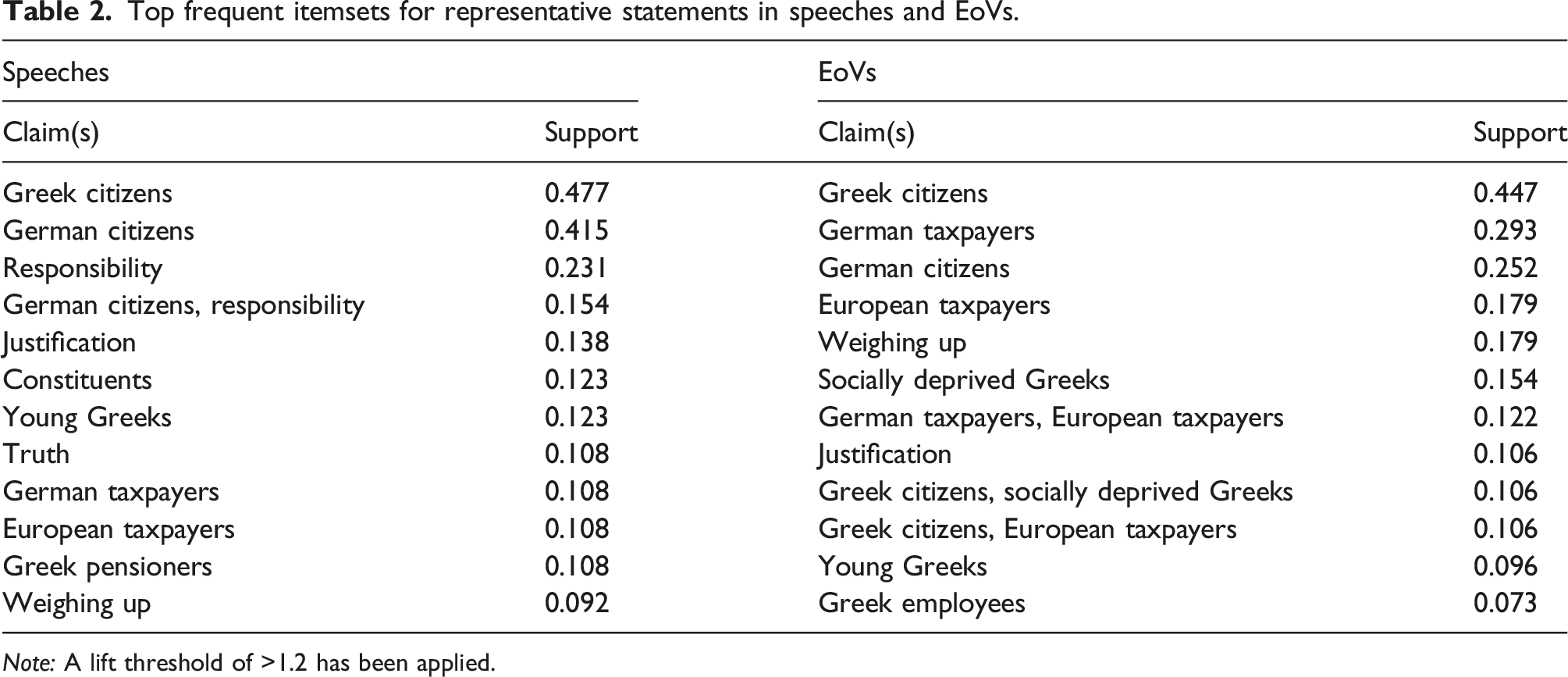
Note: A lift threshold of >1.2 has been applied.
In addition to the meaning of representation, MPs made 433 representative statements about 59 different groups, which can be classified into German, Greek, European and General claims. (The ‘General’ category includes all statements that did not specify whether the group, who MPs claim to represent, is confined to particular national boundaries). Confirming findings from the analysis of discursive frames, the comparison of representative claims in Table 2 and Figure 9 illustrates that EoVs were more focussed on policy consequences and thus the concerns of the Greek population. Nonetheless, the share of representative statements about Greek communities increased over the course of the crisis also in speeches, reaching 58% in the final debate, and in EoVs this was accompanied by a decline in German representative claim-making. Representative statements over time for speeches (left) and EoVs (right).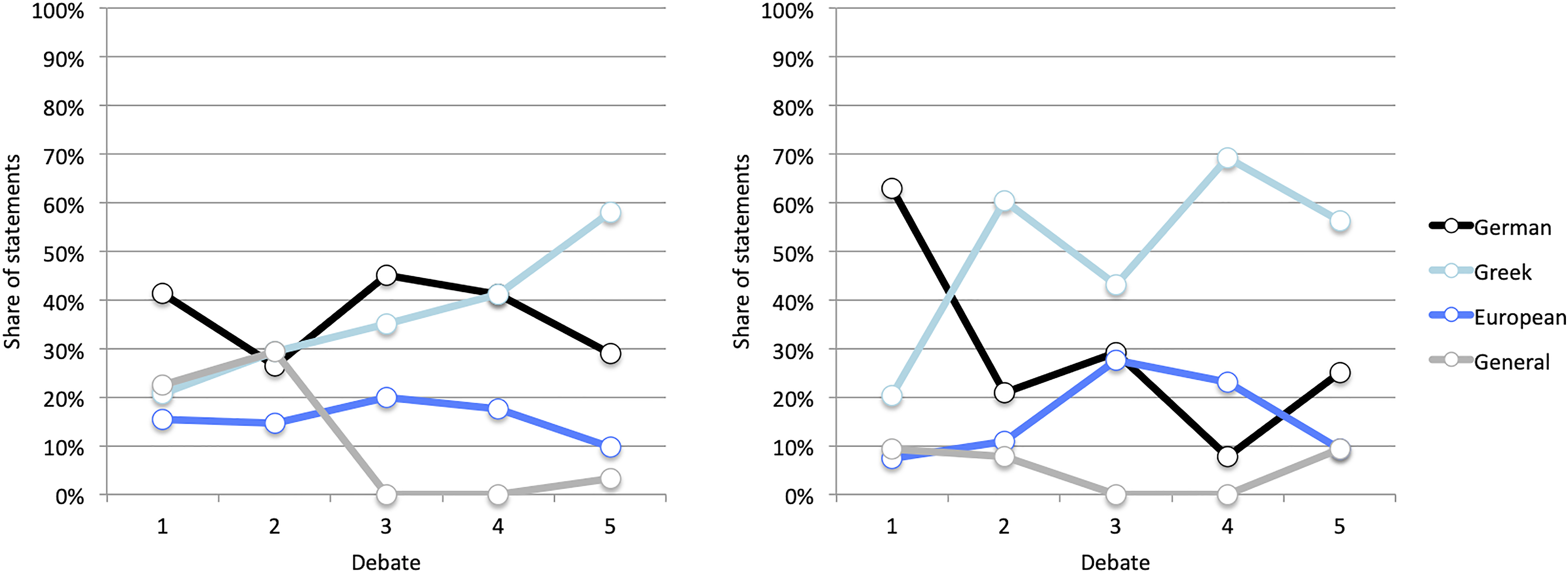
There are also considerable party-level differences (see Figure 10). As we would expect, the CSU, which was the most conservative party in the Bundestag, had the highest share of national representative claim-making overall, with two-thirds of statements being about Germans, which is significantly higher than the CDU’s percentage. The FDP is an intriguing case: with its pro-European history, the Liberals had the highest share of European claims on the plenary floor, but lowest share in EoVs, and they were the least concerned with the Greek population, while displaying strong consideration of the interests of German citizens and taxpayers in their EoVs. It is not surprising that the Greens and the Left were the most active in highlighting the perspectives and problems of Greeks, but for the Left Party there is a considerable discrepancy between speeches and EoVs: Left MPs highlighted the grievances of the poor, young people and students, employees and pensioners in Greece mostly in their written expressions. Representative statements by party for speeches (left) and EoVs (right). aNumber of MPs who signed in brackets.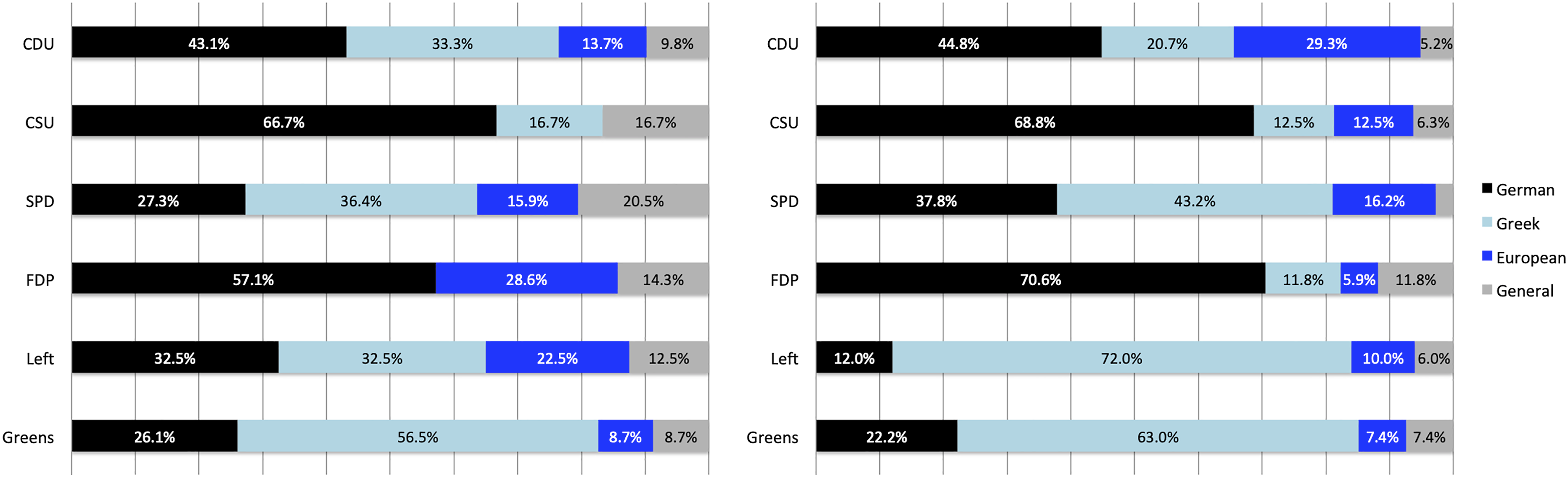
Discussion
The euro crisis has challengene 1mmd the voting unity of all parties in the Bundestag and mobilisation of German MPs not only became visible in their voting behaviour but also in their communication, as evidenced by the unusually high number of EoVs. A more detailed analysis shows that these written expressions complement the speeches delivered in the plenum by adding more substantial claims but also provide an outlet for more critical viewpoints that are excluded from the plenary floor. It is argued here that the differences between EoVs and speeches cannot be reduced merely to the format. Though the higher visibility of plenary debates explains why speeches are characterised by more party-political point-scoring, it has become evident that EoVs provide a channel to express views that are underrepresented in speeches, thus providing insights into what the plenary discourse might have been if the speakers’ list had been more diverse. Generally, plenary speeches displayed more direct disagreement between speakers, but in EoVs MPs dispute claims made on the plenary floor and raise additional controversial points, thereby increasing the overall level of political conflict. Especially government MPs can use EoVs to express views that diverge from the position of the executive and party leadership.
In EoVs, we observe more in-depth discussions on the policy ramifications for the Greek population and more and earlier contention of political alternatives to the negotiated bailout programmes, both on the right (bankruptcy and Greek exit from the Eurozone) and on the left (debt haircut and public investment). Anti-austerity sentiments from the opposition (and some Social Democrats also after they joined the government) were turned into a more coherent narrative with claims about how labour market deregulation, pension cuts, cutbacks in social services and privatisation impact and impoverish ‘ordinary people’ in Greece who are not to blame for the crisis, while private creditors, including German and Greek billionaires, benefitted from the crisis. Despite being mentioned fairly frequently (150 statements about 10 concepts such as ‘European solidarity’, ‘solidarity with Greece’ or ‘mutual solidarity’), solidarity did not stand out as a central or contested concept overall, but definitely emerged more prominently from MPs’ written expressions than speeches. The backbench rebellions in the CDU, CSU and FDP were driven by concerns that the EU as a ‘stability union’ would turn into a ‘transfer union’, and in this context solidarity was conceived of in terms of mutual responsibility to comply with the rules. However, the increasing usage of Greek representative claims and the strengthening and sophistication of the anti-austerity discourse in EoVs can be interpreted as evidence of transnational representation and solidarity, which contrasts the popular perception that Germany showed a lack of solidarity with Greece.
Conclusion
Parliaments are characterised by a ‘plenary bottleneck’, since most bills must pass through a vote and debate in the plenary chamber, and time is the scarcest resource in these institutions (Cox, 2006). Rules are important not only in governing agenda-setting, that is, which bills and topics are debated for how long, but also for regulating floor participation, that is, who gets to speak. In that way, rules ‘can have distributional consequences between parliament and cabinet, government and opposition, majority and minority, and between party groups and individual MPs even if all these actors accept the rules as legitimate’ (Müller and Sieberer, 2014: 315). Time-management rules and procedures also create a tension with deliberative ideals (Palonen, 2012). I argue in this article that intra-parliamentary rules are a decisive, often overlooked factor shaping legislative speechmaking, both enabling and constraining the exercise of representation, accountability and deliberation.
In previous studies, restrictive or party-centred rules of floor access have shown to be conducive to an exclusion of certain groups of MPs in salient debates, particularly of critical backbenchers, but we do not know how this affects parliamentary discourses. From the viewpoint of discursive representation, I seek to show that a diverse speakers’ list makes a difference. Normatively, this work is based on the reasoning that not all possible discourses should be represented but those discourses that are present within parliament. Therefore, the analysis sheds light on the ‘debate within the debate’ on the euro crisis in the Bundestag: On the plenary floor, discursive contestation remained limited. By comparing speeches with underexplored EoVs, this article demonstrates that party control of floor participation contributes to reducing the visibility of political conflict. The in-depth structural analysis of parliamentary discourses reveals that the coherence and sophistication of discursive frames and narratives around the euro crisis were restricted as well. Furthermore, EoVs offer insights into the dynamics and delays of political contention, as political alternatives were contented in EoVs before they appeared in plenary debates.
This is the first study which seeks to make visible the discursive impact of restrictive rules of speechmaking on legislative debate by utilising EoVs for comparison. To the best of my knowledge, EoVs are a particularity of the Bundestag, the Portuguese parliament (Leston-Bandeira, 2009: 702) and the European Parliament, but in other legislatures, individual-level communication found from MPs’ committee work, press interviews and releases, personal websites or social media (e.g. Sältzer, 2020) could be used. Some of the limitations of this case study have been addressed by building on key insights from the small number of related studies, reflecting on the interdependency between different communication channels and presenting confidence intervals to show that the observed discursive effects have been consistent over time. Yet, further comparative studies are needed to analyse and quantify more systematically how different rules and procedures are used by party leaders and impact political conflict, deliberation and discursive representation in parliamentary debates, also for cases which have drawn less media attention. The methodological approach introduced here will prove very useful in comparative discourse analysis to estimate the effect of party control – or in fact for a range of other research aims.
Footnotes
Acknowledgements
I am extremely grateful to the two anonymous reviewers and the editor for their comments that have helped me to improve the quality of this work and to Tero Erkkilä and Hanna Wass for commenting on several versions of this paper. I also thank Claire Bloquet, Sarah Childs, Marc Geddes, Stephen Holden Bates, Laura Nordström, Jack Sheldon, Diana Stirbu and Åsa von Schoultz for their valuable feedback and encouragement during discussions. I would like to extend my gratitude to Sourav Bhattacharya for technical advice.
Declaration of conflicting interests
The author(s) declared no potential conflicts of interest with respect to the research, authorship, and/or publication of this article.
Funding
The author(s) disclosed receipt of the following financial support for the research, authorship, and/or publication of this article: This research was funded by the Finnish Cultural Foundation and the Doctoral Programme in Political, Societal and Regional Change at the University of Helsinki.
