



Abstract
The left–right scale is widely used to measure ideological orientation. Relying on Freeden's approach to political ideology as a ‘conceptual morphology’, we argue that the meaning of ‘left’ and ‘right’ may change, but these changes are more likely for peripheral than core concepts. To test this argument, we analyze open-ended questions on the meaning of ‘left’ and ‘right’ included in two waves of surveys of German parliamentary candidates collected before and after the 2015 European migration crisis. The empirical results based on Structural Topic Models show that the candidates’ party affiliation colours the connotations of political concepts. In particular, we find that the core concepts ascribed to the meaning of left and right remained stable, while changes occurred with one peripheral concept in particular, namely, ‘Racism’, which is most often ascribed to the term ‘right’. We conclude that morphological analysis can help better understand the concurrency of change and stability in ideological orientations and provides a fruitful linkage between electoral research and political theory.
Keywords
Introduction
The terms ‘left’ and ‘right’ are widely used in politics, public debates and electoral research to describe ideological positions. While many sophisticated methods exist for extracting the ideological position of political actors and parties based on their stated preferences or behaviour – such as the scaling of survey items (e.g. Poole, 1998), roll-call voting (e.g. Poole and Rosenthal, 1991), party manifestos (e.g. Slapin and Proksch, 2006; Volkens et al., 2013) and parliamentary speeches (e.g. Lauderdale and Herzog, 2016) – still the most common approach in survey research is to ask respondents to locate parties, politicians or themselves on an ideological left–right scale (Caughey et al., 2019). This placement, however, hinges on the assumption that the respondents have a profound and stable understanding of the meaning ascribed to the terms ‘left’ and ‘right’. If the meaning of these terms vary across groups and over time, differential item functioning is at work, and in this case, empirical researchers relying on the left–right item run the risk of violating the assumption of measurement equivalence, which could render the results invalid (e.g. Davidov et al., 2014; Hare et al., 2015; King et al., 2004). While these challenges to measuring ideological orientation are well known, the consequences that follow for empirical research are disputed. Scholars mostly agree that the left–right scale approximates a more complex world of political ideology. Others emphasize that it makes no sense to describe a shift in ideological positions on a static left–right continuum since parties may actively alter the very meanings of ‘left’ and ‘right’ (Lewis, 2019).
Despite some notable exceptions (e.g. Bauer et al., 2017; Corbetta et al., 2009), the left–right scale is often treated as a black box, whereby the ideas and the structure of the ideas ascribed to the terms ‘left’ and ‘right’ remain hidden (Freeden, 1996: 47). The present study brings together electoral research, thinking about ideology in terms of positions on latent dimensions, and political theory to gain a deeper understanding of the meaning and stability of the terms ‘left’ and ‘right’ in a political context. Specifically, we rely on Freeden’s (2003) approach towards considering ideologies in terms of a ‘conceptual morphology’. We do this for two reasons: First, it highlights the importance of language and the interdependence of the meanings of political words (Freeden, 2003: 45). Here, political parties and candidates compete to enforce their preferred views dependent on ideological language. Further, to account for societal changes and unforeseen events, ideological language must be flexible and occasionally vague (Vincent, 2004: 113). Second, Freeden (2003: 62) offers a taxonomy to study political ideologies that focuses on political concepts as the building blocks of ideologies. Freeden (2003: 62) distinguishes between core concepts, providing stable meanings, and a range of adjacent and peripheral concepts that are more specific and fluent, for contextualizing the core concepts (Vincent, 2004: 113). Peripheral concepts are those situated on the perimeter of an ideology, somewhere between thought and action (Freeden, 2003: 62). Applied to the study of the stability of the meanings ascribed to the terms ‘left’ and ‘right’, changes in political concepts are more likely to occur with peripheral concepts, whereas core concepts hardly change.
Building on Freeden (1996, 2003, 2013), we study whether and how the European migration crisis in 2015 has altered the meanings that German parliamentary candidates ascribe to the terms ‘left’ and ‘right’. Germany is a particularly interesting case study for this research endeavour because the country was strongly affected by the migration crisis, leading to a substantial change in the issue salience between both elections (Mushaben, 2017). While economic policies were salient in the debates before the 2013 German federal election due to the European financial and economic crisis, the 2017 election was dominated by migration and asylum policies. In particular, the subsequent electoral successes of the right-wing populist Alternative for Germany (AfD) party shaped the political landscape after 2015 (Arzheimer, 2019; Siri, 2018). We test the stability of the meaning of the terms ‘left’ and ‘right’ by exploiting the occurrence of the European migration crisis between two waves of the German Comparative Candidate Survey (CCS) carried out in 2013 and 2017.
We contribute to the literature in three ways: First, previous endeavours to decompose the meaning of ‘left’ and ‘right’ draw on Bobbio (1996) historical genealogy of the two terms, which imposed a pre-focus on equality and different ways to justify inequality. This study argues that Freeden (1996, 2013) offers a more fruitful alternative framework to study the morphology of the political concepts ascribed to the terms ‘left’ and ‘right’. Freeden’s approach also seems to be particularly helpful for understanding recent political movements (e.g. protests over the COVID-19 policies in Germany) that seem to combine and merge political concepts that were thought to be mutually exclusive. Second, we directly investigate how the survey respondents interpreted ‘left’ and ‘right’ by analyzing open-ended responses using Structural Topic Models (STM; Roberts et al., 2014). The Structural Topic Model enabled us to unfold the multitude of political concepts that respondents ascribe to the terms ‘left’ and ‘right’ without predisposing any structure or relationships to those concepts. Third, we focus on analyzing the parliamentary candidates’ interpretation of left and right instead of the voters. This enables us to dig deeper into the linguistic subtleties of political language and electoral competition. A particular advantage of examining candidates is that they are more likely to be political experts who should very likely possess a consistent and persistent ‘belief system’ (Converse, 1964; Peffley and Rohrschneider, 2007). While lay citizens may be prone to relying on simple information shortcuts – such as politician or party names – for describing what ‘left’ or ‘right’ means, parliamentary candidates are more likely to address actual ideological concepts.
Next, we present Freedens’ ‘conceptual morphology’ and discuss its implications for studying changes in the interpretation of the terms ‘left’ and ‘right’. The empirical analysis proceeds in three steps: First, we apply the STM to open-response questions for interpreting the terms ‘left’ and ‘right’ in order to extract political concepts. Second, we explore whether the configuration of these concepts changed between 2013 and 2017. Finally, we test how the identified political concepts correspond to respondents’ placement on the static left–right scale.
Theoretical framework
‘Left’ and ‘right’ as ideological positions
The terms ‘left’ and ‘right’ have long served as basic coordinates for structuring the political sphere, both in public debates and political science. Scholars in the tradition of Hotelling (1929) and Downs (1957) introduced ‘left’ and ‘right’ as a modelling device to signify multiple policy positions on a single- or multi-dimensional ideological space. A survey-based research agenda accompanied this conceptualization of citizens’ ideological orientation. Many surveys have asked respondents to place themselves and parties or candidates on a static left–right scale (e.g. Bauer et al., 2017; Caughey et al., 2019; Kroh, 2007). Most respondents can locate their political position and those of parties and political actors along the left–right dimension relatively accurately (Dalton, 2006; Inglehart and Klingemann, 1976; Kitschelt, 1988). Despite ongoing debates about the dimensionality of the ideological space and the appropriate statistical techniques to extract such ideological dimensions (e.g. Dolezal, 2008; Evans et al., 1996; Heath et al., 1994; Kriesi, 2012), the left–right scale is still widely used (Caughey et al., 2019).
A popular approach to unfolding the meaning of the left–right scale is to explore the correlations between subjects’ self-placement and their political beliefs and attitudes towards policy issues (e.g. De Vries et al., 2013; Freire and Kivistik, 2013; Giebler et al., 2019). By looking at these correlations at several points in time, scholars have investigated the stability of content and understanding (Knutsen, 1995). Studies in this tradition indicate that the left–right dimension represents a ‘super-issue’ that is correlated with political attitudes on various issues, such as the economy, inequality, migration, religion and security (Sani and Sartori, 1983: 309–310). The bulk of studies from this stream of empirical research suggest that ‘left’ is associated with equality, solidarity and governmental intervention, but also emancipation, environmental protection and pacifism. In contrast, ‘right’ is associated with economic liberalism and conservative or authoritarian views. Mair (2007: 213) points out that the ‘[...] term “left” is easily associated with a specific class and with a broad set of political alternatives, the term “right” is far less clearly delineated’. In practice, the term ‘right’ covers everything beyond left, making it more susceptible to contextual influences.
A limited number of studies make use of open-ended survey questions for directly tapping the understanding of ‘left’ and ‘right’ (e.g. Bauer et al., 2017; Corbetta et al., 2009; Fuchs and Klingemann, 1990; Trüdinger and Bollow, 2011). Relying on open-response questions has the advantage of revealing what is on a respondent’s mind and thereby unfolding the beliefs and ideas ascribed to these terms. Moreover, exploring open-response questions is consistent with modern political theory, emphasizing ideologies as linguistic and semantic products (Freeden, 2003: 45). Studies from this stream of research, primarily relying on qualitative coding schemes, indicate that voters utilize ideological labels but tend to attribute different meanings to them. In particular, ‘left’ and ‘right’ are associated with three interrelated meanings: First, ‘left’ and ‘right’ are related to specific policy or issue positions, including the means and the ends (Conover and Feldman, 1981: 621; Fuchs and Klingemann 1990: 215). This interpretation is intertwined with general political values (Carmines and D’Amico, 2015). Second, respondents usually connect the terms with specific political parties (Conover and Feldman, 1981: 621; Fuchs and Klingemann, 1990: 215), interest groups and individual political actors (Zechmeister, 2006: 153–154). Third, respondents primarily use the terms to describe economic systems rather than issue dimensions beyond the class cleavage, for example, emancipation, environmentalism, political culture and civic values (Fuchs and Klingemann, 1990: 215; Trüdinger and Bollow, 2011: 412–414). Most importantly, however, these studies indicate that the interpretation of ‘left’ and ‘right’ varies across respondents and over time. If political elites and voters adjust their ideological language and their understanding of ‘left’ and ‘right’ in response to a changing societal context and if these adjustments vary between groups, this poses a challenge for the assumption in survey research that all respondents should have the same understanding of a question. In other words, the measurement equivalence assumption could be violated (e.g. Davidov et al., 2014; King et al., 2004), and describing shifts of party positions on the left–right scale would become highly problematic (e.g. see Lewis, 2019 on the Static Spectrum Fallacy).
‘Left’ and ‘right’ as political ideologies
Political ideologies as a subject of political theory are often explored as a historical set of narratives predominantly involving outstanding individual thinkers (Freeden, 2013: 1–2). Freeden’s (1996: 48) answer to ‘what is an ideology?’ was to identify and describe the relationship between political concepts, which are considered the building blocks of political ideologies. The approach focuses on the micro-structures of ideologies and their morphology as the compositions of the political concepts evolve. Political concepts are the central unit of investigation, and words are the outward forms of political concepts as they combine ideas and language (Freeden, 1996: 48). Although these concepts are not always immediately transparent, they are decipherable for the voters (Freeden, 2013: 2). Ideological language needs to be flexible and ambiguous as concepts must be easily accessible for ordinary voters. At the same time, a relatively stable core meaning must remain; otherwise, ideological labels would be rendered arbitrary and therefore useless (Freeden, 2003: 77–78).
Ideologies are clusters of political concepts. These clusters are internally complex and open to connections with other political concepts (Freeden, 1996: 60). Freeden’s (1996: 77) taxonomy of political ideology distinguishes between core, adjacent and peripheral concepts. Core concepts are indispensable for holding the ideology together and shape the ideology’s ideational content (Freeden, 2013: 10–11). Ideological cores contain several concepts with different weights that signal their long-term durability (Freeden, 2013: 10–11). Adjacent concepts are secondary in terms of the pervasiveness of the meanings they contribute to a political ideology (Freeden, 2013: 11). They may not appear in all their instances but are crucial in finessing the core and anchoring it culturally and temporarily into a more de-contested semantic field (Freeden, 2013: 11). Peripheral concepts are at the perimeter interface between the conceptual arrangement of an ideology and the social practices, events and contingencies that occur in its environment (Freeden, 1996: 78). Significant social and political events, like financial crises, terrorism, mass migration, climate change or oil discovery, are presumed to affect political ideologies and may be decoded and partially absorbed by peripheral concepts (Freeden, 2013: 12). Since the relative positioning of political concepts is not considered static, concepts may gravitate from a more central to a peripheral position, or vice versa (Freeden, 1996: 78).
Freeden’s (2013: 14) morphological approach profoundly challenges the notion of clear or fixed boundaries among ideologies. The conceptual permutations and consequent fluidity of political concepts are suggestive of neighbouring ideologies rather than a sharp differentiation (Freeden, 2013: 14). Nevertheless, the approach has several advantages over other theoretical attempts to infer the meaning of ‘left’ and ‘right’. Decomposing the meaning of ‘left’ and ‘right’ based on the work of Bobbio (1996), for example, emphasizes a single competing political concept, namely, equality and different ways to justify inequality (e.g. Jahn, 2011). The morphological approach, in contrast, expects multiple core concepts and is open towards the inclusion of adjacent and peripheral concepts. Corbetta et al. (2009: 631) borrowed the concept of ‘social representation’ from social psychology (Moscovici, 1984) to classify the semantic areas citizens’ attributed to the terms ‘left’ and ‘right’. The concept of ‘social representation’ presumes shared ideas, practices and semantic repertoires that enable communication among the members of a group. The morphological approach also acknowledges the semantic repertoires in ideological languages but does so not as ends but as a means to express political concepts.
Stability of ‘left’ and ‘right’: The 2015 ‘European migration crisis’ in Germany
Building on Freeden (1996, 2003, 2013), a central focus of this study is the temporal stability of the political concepts ascribed to the terms ‘left’ and ‘right’. In particular, in light of the upsurge of populist parties across Europe and elsewhere, the stability of the left–right scale has attracted scholarly attention (e.g. Hawkins and Rovira Kaltwasser, 2018; Rooduijn, 2019). The influx of refugees in to Europe in 2015, commonly labelled as the ‘European migration crisis’, was perhaps the most controversial salient issue in Europe before the 2020 COVID-19 pandemic and had a tremendous impact on politics in Europe. This holds particularly true for Germany, which went on to host more than one million refugees (Mushaben, 2017). In the wake of the events, the right-wing populist AfD exploited this issue in provocative campaigns stoking economic, cultural and security-related fears among segments of Germany’s population (Marx and Naumann, 2018; Patton, 2017), and with their successes in the 2017 elections, they made up the third-largest faction in the German parliament (Arzheimer, 2019; Siri, 2018). Unlike during the European financial and economic crisis from 2009 onwards, when economic, financial and welfare issues were the most salient, the migration crisis moved public attention to the cultural left–right dimension. Apart from the dominating immigration issue, this also encompasses gender roles, same-sex marriage, and LGBTQ+ rights, which remained on the AfD’s agenda (Arzheimer, 2019; Jäckle and König, 2017; Jankowski et al., 2019). More generally, the success of the right-wing populist parties corroborated a debate about whether the Western world is currently facing a ‘cultural backlash’ as a reaction to post-materialism and the implementation of progressive policies in many countries (Inglehart and Norris, 2017). There is no consensus on whether these events can truly be mapped as shifts on a static left–right scale or whether they actually defy the logic of a static left–right spectrum as populists are actively altering the very meaning of ‘left’ and ‘right’ (e.g. Lewis, 2019).
What can we expect from these events that happened between the elections in 2013 and 2017 in terms of how they affected the political concepts the candidates ascribe to the terms ‘left’ and ‘right’? Building on Freeden (1996, 2003, 2013) approach towards political ideology as a conceptual morphology enables us to derive some explorative expectations in this regard. First, we expect a stability of the core concepts. Core concepts stem from candidates' political affiliation and so we would expect that it is unlikely they would have changed in the aftermath of the migration crisis. Core concepts associated with the term ‘right’ could be, for example, liberalism and individuality (Freeden, 2013: 11), while some core concepts associated with the term ‘left’ are, for example, equality and solidarity. Second, peripheral concepts should be sensitive towards changing political contexts, for instance, when faced with the emergence and consequences of the European migration crisis. The migration crisis is presumed to represent an event that has the potential to alter the peripheral concepts ascribed to the terms ‘left’ and ‘right’. For the term ‘left’, peripheral concepts might include free entry for refugees into a country. For the term ‘right’, peripheral concepts might include the right to maintain and protect national autonomy. In addition, Freeden (1996) approach acknowledges that political ideologies are an odd mixture of beliefs, reasons and emotions. This is presumed to be reflected in the vocabulary candidates choose to express political concepts they ascribe to the terms ‘left’ and ‘right’. A right-leaning candidate could be expected to use more negative connotations and negatively charged vocabulary to describe concepts attributed to the term ‘left’ and positive connotations to describe concepts attributed to the term ‘right’. Likewise, left-leaning candidates are expected to do the same but vice versa.
Data and methodological approach
Political candidates are of particular interest as they are in a privileged position to influence the vocabulary of political language via multiple channels; for example, party manifestos, public speeches, social media channels, media appearances and campaign materials (Eder et al., 2017). Multiplied and transferred through these channels, candidates’ interpretations of ‘left’ and ‘right’ can be seen as ‘anchoring’ or ‘referencing’ the bundles of mutually defining political concepts attached to the terms ‘left’ and ‘right’ (Jost et al., 2009: 316). For our empirical analysis, we combine the German Comparative Candidate Surveys from 2013 (Rattinger et al., 2014) and 2017 (Roßteutscher et al., 2018). Both surveys were sent to candidates from all larger parties running for parliament in the respective election. 1 The surveys ended with two open-ended questions in which the respondents were asked what ‘left’ and ‘right’ mean to them. 2 The analysis of these open-ended questions was based on three steps, reflecting our interest in (1) how ‘left’ and ‘right’ are interpreted; (2) how the interpretation has changed between the two elections, and (3) how the interpretation affects the usage of the left–right scale.
To address the first question, we combine both datasets and then estimate the STM for extracting different interpretations of the respective terms. In a second step, we use regression models with the respective topic proportions as the dependent variable to analyze how stable the interpretations, that is, topics revealed by the STM, are. We use a dummy variable for separating the 2013 and 2017 elections, indicating whether the prevalence of a topic has decreased or increased between the two elections. In a third step, we use the estimated topic proportions in regression models to determine whether the interpretation affects the position on the left–right scale.
Structural Topic Models
Structural Topic Models have become a standard approach in social science for extracting latent topics from a corpus of documents (Lucas et al., 2015; Roberts et al., 2014). Similar to other topic modelling approaches (e.g. LDA, see Blei et al., 2003), the STM considers documents to be a mixture of topics, in which a topic is defined as a mixture of words in which each word has a probability of belonging to a topic. Structural Topic Models enable extracting a certain number of latent topics from a text corpus, and each text can be represented as a combination of these topics. Of course, the substantive meaning of the topics is unknown to the algorithm and has to be interpreted a posteriori based on the words that have a high probability of belonging to a topic. What sets the STM apart from other approaches is that it allows for the inclusion of meta-variables in the estimation process, which usually improves the model fit substantially. In our analysis, we include three covariates. Because the interpretation of the terms should be influenced by the ideological position of the respondents, we include the party a candidate was running for as well as their left–right self-placement as document-level covariates. Moreover, as the differences between the 2013 and 2017 elections are of central concern in this paper, we also include a dummy distinguishing between the two survey waves. 3
When estimating the STM, two important model parameters have to be chosen: the model initialization method and the number of topics (K). For model initialization, we use the spectral method as recommended by the developers of the STM (Roberts et al., 2016). This approach has the advantage of being deterministic and thus allows for an easy replication of the results without relying on an arbitrary seeding. Concerning the number of topics, the model diagnostics showed that six topics were a reasonable choice for ‘left’ and ‘right’, respectively. For further details, we refer readers to the appendix.
Regression analyses
For analysing how stable the interpretations, that is, topics revealed by the STM, are, we use regression models with the respective topic proportions as the dependent variable. It has to be taken into account that the topic proportions are not independent from each other and are restricted in the range from zero to one. We address this issue by not using OLS for estimating the results, but by using fractional multinomial regression analysis. Such models account for the boundedness of the dependent variable between zero and one and also account for the fact that higher topic proportions in one topic are correlated with lower topic proportions of other topics. 4 The most important independent variable is a dummy separating the 2013 and 2017 elections, which indicates whether the prevalence of a topic decreased or increased between the two elections and dummy variables for the party a candidate ran for in the election. 5 In order to test whether an increase between the elections was more prevalent for certain parties, we also include interaction terms between party membership and the election year dummy. To control for potential confounders, we also run additional models in which we include a set of control variables, such as age and gender.
To find out whether the interpretation of ‘left’ and ‘right’ affects how candidates use the left–right scale, we again draw on regression models to assess the effect of the topic proportions on their placement on the left–right scale. As the analysis is directly informed by the results of the STM, we discuss the details in the corresponding section. Moreover, we control for variables that might affect a candidate’s placement on the left–right scale as well as the interpretation of the terms. Obviously, this is the case for the party a candidate is running for. We also control for the election year and interact this variable with the party indicator. Moreover, we account for the ideological differences between parties by including two variables reflecting the position of a candidate in the two-dimensional policy space. These variables are obtained via black-box scaling (Poole, 1998) of a twelve-item issue-battery (for details on the computation, interpretation and validation of these positions, see Jankowski et al., 2017, 2019). Additionally, gender and age are included.
Results
How ‘left’ and ‘right’ are interpreted
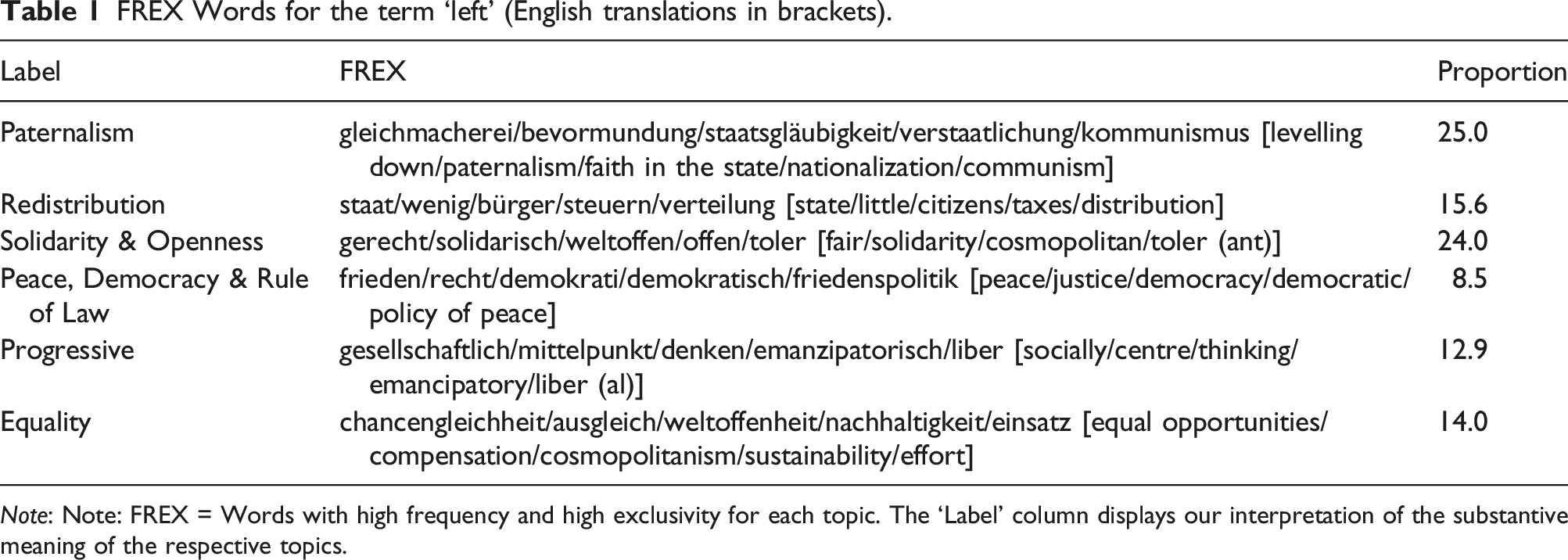
FREX Words for the term ‘left’ (English translations in brackets).
Note: Note: FREX = Words with high frequency and high exclusivity for each topic. The ‘Label’ column displays our interpretation of the substantive meaning of the respective topics.
From Table 1, it is clear that positive interpretations of ‘left’ seem to prevail since four of the six topics entail a rather positive connotation. These are the topics that we labelled as ‘Solidarity & Openness’, ‘Peace, Democracy & Rule of Law’, ‘Progressive’ and ‘Equality’. Given the FREX words, these labels capture the substantive meaning of the topics well (although slightly other labels are, of course, also reasonable). In contrast to these four positively connoted topics, the first topic has a negative connotation. This topic describes ‘left’ as trying to equalize all people and being associated with a low degree of individual freedom. Therefore, we labelled this topic as ‘Paternalism’. Finally, the second topic is neither positive nor negative as it deals with redistribution, which some interpret as positive and others as negative. Finally, Table 1 displays how prevalent each of the topics is in the answers. The topics denoted as ‘Solidarity’ and ‘Paternalism’ clearly dominate; each accounts for approximately 25% of all the text in the corpus. The other topics were contained at a level of about 15% in the documents, with the exception of ‘Peace, Democracy & Rule of Law’, which accounted for only about 8%. In sum, these results resonate with the notion that the term ‘left’ is generally well defined as it contains political concepts on the class cleavage and political concepts of a just society.
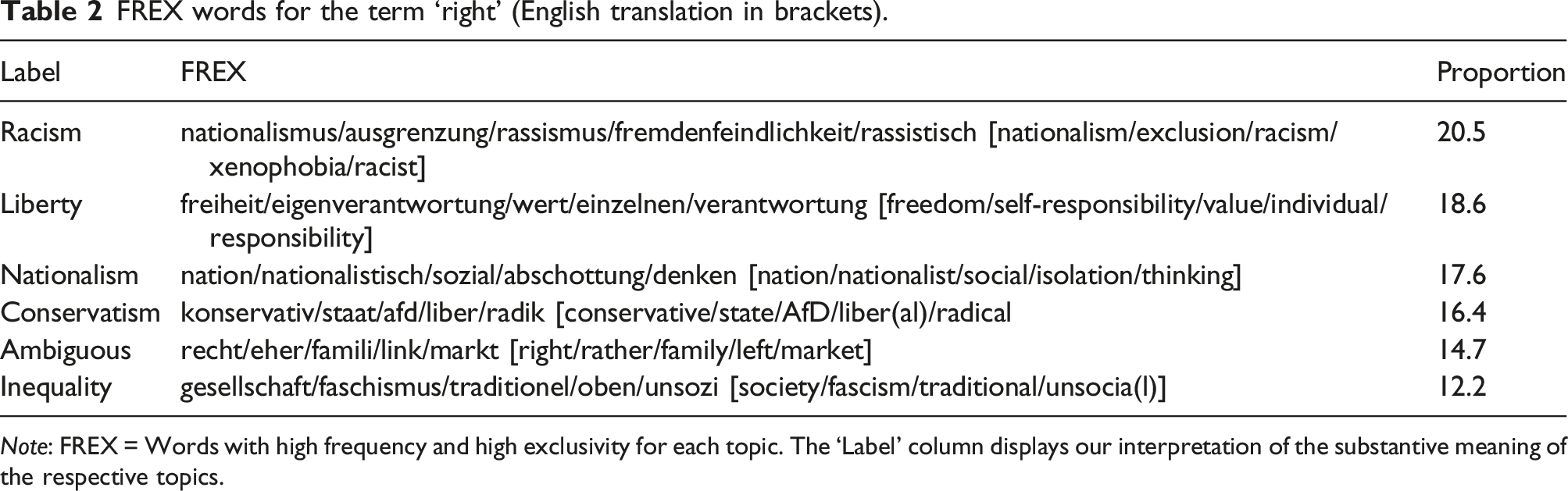
FREX words for the term ‘right’ (English translation in brackets).
Note: FREX = Words with high frequency and high exclusivity for each topic. The ‘Label’ column displays our interpretation of the substantive meaning of the respective topics.
Interpretations of ‘left’ and ‘right’: Stable or context driven?
We now turn to the question of how stable the political concepts (topics) extracted by the STM are. In Figure 1 and Figure 2, we display the distribution of the topic proportions for all parties and all topics between the two elections. What is immediately clear from Figure 1 is that the interpretation of ‘left’ is substantially different between parties. That is not necessarily surprising, but the pattern showing that topics with a positive connotation are almost exclusively addressed by left-wing parties while negative topics are almost exclusively addressed by right-wing parties is striking. This corroborates the validity of the identified topics. When looking at the change in topic prevalence between the two elections, there is no clear pattern of a substantial shift in the interpretation of ‘left’. The only consistent pattern found is that the topic ‘Equality’ was more prevalent and the topic ‘Progressive’ less prevalent in 2017. However, this applies only to the left-wing parties (SPD, Greens and Left Party), as the other parties did not address these topics in either of the two elections. Distribution of topics by parties and the two elections for the term ‘left’. Distribution of topics by parties and the two elections for the term ‘right’.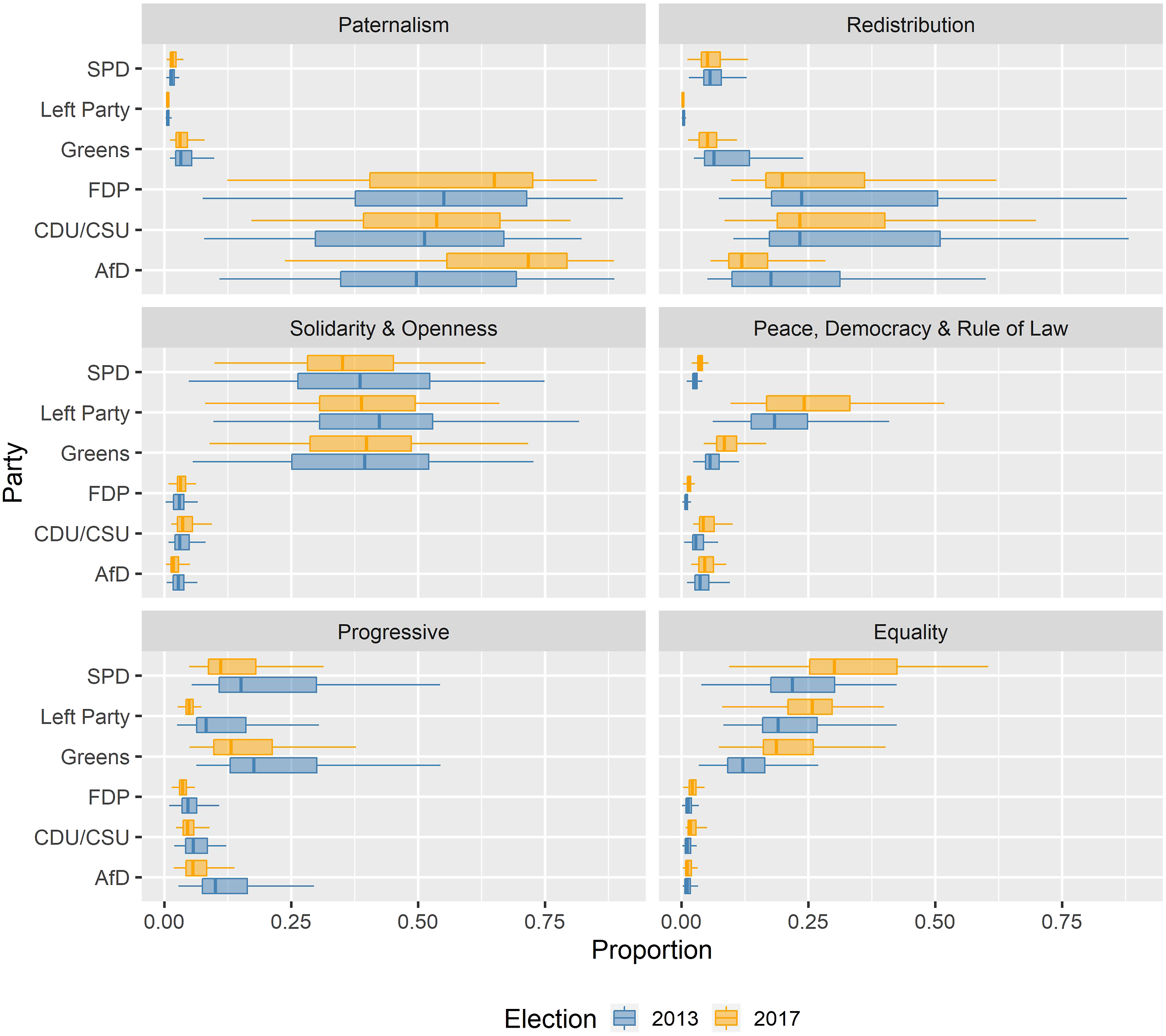
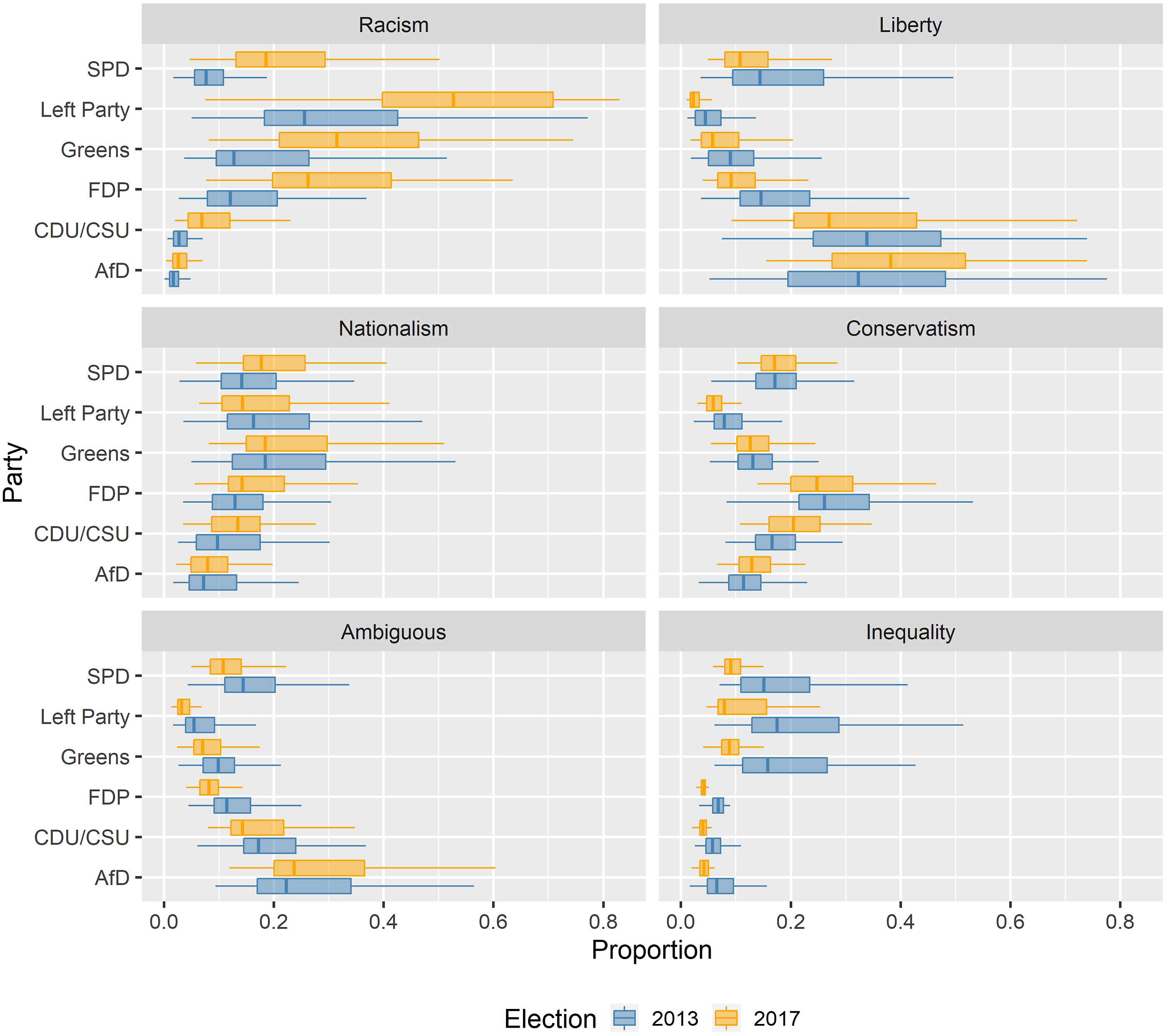
The differences between parties are not as clear-cut for ‘right’ as there was more agreement between the candidates of different parties on how the term ‘right’ can be interpreted. However, ‘Racism’ and ‘Inequality’ were addressed to a greater extent by left-wing party candidates. What also fits nicely into the broader picture is that candidates from the right-wing populist AfD most frequently addressed the topic ‘Ambiguous’. Remember that this topic describes responses that say that the term right has an ambiguous meaning, not that the interpretation of this topic is ambiguous. It is one of the main rhetorical strategies of populist parties to refuse the left–right scheme and instead claim that they represent ‘the people’ (Mudde, 2007).
Turning to the shifts in the interpretation between the two elections, it is evident that the prevalence of ‘Racism’ sharply increased in 2017. This shift could be observed for all parties except for the AfD, which did not address this topic in either of the two elections. However, among the other parties, the shift appeared to be particularly strong for the left-wing parties. The median topic proportion was around 0.25 for the Left Party in 2013 and increased to over 0.5 in 2017. Similarly, the prevalence increased for the SPD from below 0.1 to almost 0.2. For the Greens, the prevalence increased from slightly above 0.1 to over 0.3. These are pretty strong shifts in the median topic proportion. Noteworthily, a substantial shift could also be observed for the liberal FDP, in which the pattern resembles that observed for the Greens. This is noteworthy as the FDP has a special position in the German party system; whereby, although it is a neo-liberal party (i.e. the FDP is right-wing on the economic left–right dimension), the party is more left-wing when it comes to the cultural left–right dimension. There was also a shift found for candidates from the CDU/CSU. Although they still rarely addressed ‘Racism’ in 2017, there was still a clear increase compared to in the election of 2013, when this topic was virtually absent from their responses.
The strong increase in the prevalence of ‘Racism’ has to be compensated by decreasing other topic proportions. In the boxplots for ‘Inequality’, a stronger decrease could be observed. This topic was virtually absent in 2017 for the FDP, CDU/CSU and AfD. It was also far less prevalent in the responses of the SPD, Left Party and Greens. However, these shifts do not fully compensate for the increases in the ‘Racism’ topic. This implies that the other shifts are distributed over the remaining topics. For example, ‘Ambiguous’ decreased in 2017 for almost all parties, which implies that candidates might find it easier to take a clear stance regarding the terms ‘left’ and ‘right’ in a more polarized political environment.
The results from the regression analyses corroborate the descriptive findings. In Figure 3, we display the average marginal effects (AMEs) of the election year on the respective topic proportions. A positive AME indicates that this topic had become more prevalent for a party in the 2017 election compared to in the 2013 election. The upper panel shows the effects for the six ‘left’ topics, which were relatively small. ‘Solidarity’ and ‘Peace’ remained almost unchanged for every party. ‘Redistribution’ and ‘Progressive’ were slightly less prevalent in 2017. More substantial effects could be observed for ‘Equality’, which increased by roughly 10 percentage points for the three left-wing parties. ‘Paternalism’, in contrast, increased for the three right-wing parties, especially for the AfD. The latter is not surprising as the AfD party adopted more radical stances between 2013 and 2017 and transformed itself from a Eurosceptic conservative party to a fully fledged right-wing populist party (Arzheimer, 2019; Patton, 2017). Average marginal effects (AMEs) of the election year on the topic proportions. Note: See Supplemental Section F (Supplemental Tables F1 and Supplemental Tables F2) for the full regression results.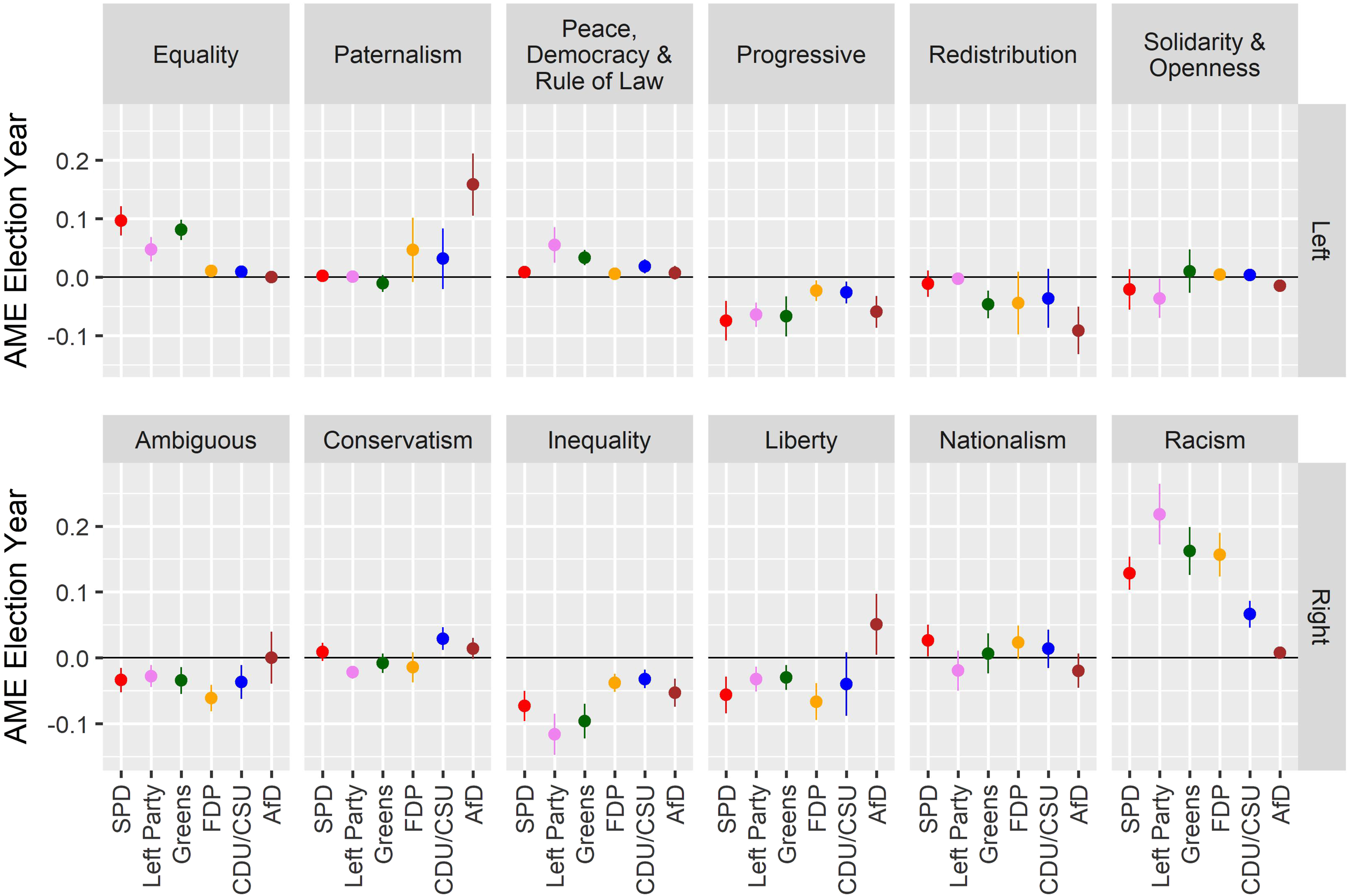
Compared to the term ‘left’, the changes in topic prevalence for ‘right’ were much more substantial. Of course, some topics remained stable. For example, the prevalence of ‘Conservatism’ and ‘Nationalism’ did not change. However, the increase in ‘Racism’ was striking: for the Left Party, the increase between the two elections was more than 20 percentage points, while for the SPD, FDP and Greens, the increase was more than 10 percentage points. Even for the AfD, a slight increase could be noticed. This substantial increase in topic prevalence for ‘Racism’ was accompanied by a substantial decrease in prevalence for ‘Inequality’, which decreased by approximately 10 percentage points for the three left-wing parties. In sum, these results confirm our conjectures that the core concepts attributed to the meaning of ‘left’ and ‘right’ remain mainly stable, while changes in changes occur in topics that are related to peripheral concepts.
Consequences for the left–right scale
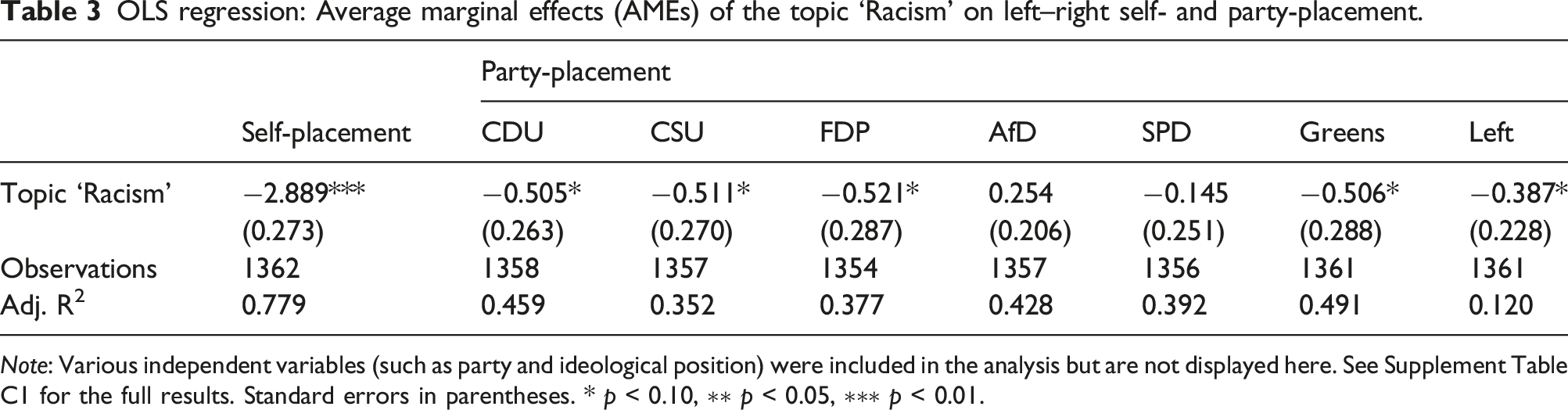
We have demonstrated that there is heterogeneity in how candidates of different parties interpret ‘left’ and ‘right’ and that the interpretations vary with changes in the societal context. Now we turn to the consequences of these findings for using the left–right scale in research, in particular in comparative research encompassing a heterogeneous political context. Our approach is similar to that of Bauer et al. (2017), that is, we analyze whether the placement of respondents on the left–right scale depends on their interpretations of ‘left’ and ‘right’. Our main independent variable was the proportion for ‘Racism’. This variable ranged between zero (for candidates who did not mention this topic at all) and one (for candidates who addressed this topic exclusively). If it is irrelevant how candidates interpret the term ‘right’, this variable should not correlate with the left–right placement; however, if this variable has a significant and substantially relevant coefficient, the left–right scale is influenced by how candidates interpret these terms. 6 We expect that the more ‘Racism’ is addressed, the more likely the respondent is to be placed on a more left-wing position, that is, we expect the regression coefficient of ‘Racism’ to be negative. While the placement on the left–right scale is our main dependent variable, we also investigated whether the interpretation of ‘left’ and ‘right’ is correlated with a candidate’s perception of the left–right position of the parties. For these analyses, we exploit the fact that candidates were asked to place themselves and all other major parties on the left–right scale. All the left–right placements were measured on an 11-point scale.
OLS regression: Average marginal effects (AMEs) of the topic ‘Racism’ on left–right self- and party-placement.
Note: Various independent variables (such as party and ideological position) were included in the analysis but are not displayed here. See Supplement Table C1 for the full results. Standard errors in parentheses. * p < 0.10, ∗∗ p < 0.05, ∗∗∗ p < 0.01.
Conclusion and discussion
This study investigated the stability of the meaning candidates running for the German parliament ascribed to the terms ‘left’ and ‘right’. Previous research compared the correlation between the left–right scale and survey items capturing issue positions at several points in time to explore the meaning and change of the left–right scale (e.g. De Vries et al., 2013; Freire and Kivistik, 2013; Knutsen, 1995), or presented snapshots of the meanings extracted from open-response questions on citizens’ interpretation of the terms ‘left’ and ‘right’ (Bauer et al., 2017; Corbetta et al., 2009). This study investigated the stability of the meaning ascribed to these terms in the wake of a massive external political event, namely, the European migration crisis. Drawing on Freeden (2003) approach to political ideology as a ‘conceptual morphology’, we expected stability among the core concepts and relative change among the peripheral concepts over time. We analyzed open-ended questions on the meaning of ‘left’ and ‘right’ included in two consecutive waves of the German Comparative Candidate Surveys carried out for federal elections to test this argument. The first wave of that survey was conducted before the European migration crisis and the second after the peak of the crisis. This unique design allowed us to explore whether the meaning parliamentary candidates ascribed to the terms ‘left’ and ‘right’ changed over time.
The findings from STMs and the subsequent regression analyses can be summarized in three points: First, the core concepts presented in the parliamentary candidates' interpretation of ‘left’ and ‘right’ remained primarily stable. Compared to ‘right’, the compositions of the core concepts appeared to be more consistent for ‘left’. Second, changes occurred with peripheral concepts closely related to the 2015 European migration crisis. For ‘right’, we found a substantial increase in the proportion of responses that connected ‘right’ to xenophobia and racism. Notably, we showed that the migration crisis was accompanied by a substantial change in how the term ‘right’ was understood in 2017, whereas the interpretation of ‘left’ remained nearly unaltered. Among the candidates of all parties in 2017, the term was more frequently interpreted as describing racism and xenophobia, except by those of the right-wing populist AfD. Third, the tone and connotation of the language and words the candidates used to present the political concepts they ascribed to ‘left’ and ‘right’ were intensely coloured by the party they were running for. The analyses also showed that the interpretation of ‘right’ was substantially correlated with the placement of oneself and the parties on the left–right scale, which corroborated previous research on voters (Bauer et al., 2017; Zuell and Scholz, 2019). In particular, the more a candidate addresses ‘Racism’, the more to the left their self-placement on the left–right scale. The same pattern was found for almost all other parties – the CDU, CSU, FDP, Green Party and Left Party were all placed on a more left-wing position the more a candidate addressed the ‘Racism’ topic. Only the placement of the SPD and AfD did not correlate with the ‘Racism’ topic.
Before turning towards the methodological and empirical implications, we need to address the potential limitations of this study. One of these limitations concerns the placement and the formulation of the open-response questions. First, the open-response items were placed at the very end of the survey, which might have contributed to the question being answered less carefully. Second, the question’s phrasing focused on what is meant by ‘left’ and ‘right’ nowadays. 'Nowadays' could have stimulated respondents to focus on changes, which might bias the results to new, current events. This framing might also explain why we hardly found any topics related to adjacent concepts. Adjacent concepts are supposed to flesh out the core by adding a cultural and historical context, thus restricting the interpretation of the core concepts (Freeden, 2003: 62). Such concepts could include class conflicts and the industrial revolution for the ‘left’ or religious cleavages and Christian humanism for the ‘right’. Future research might address these methodological concerns and test the robustness of the findings presented here by systematically altering the open-response question’s position and wording.
The implications that can be drawn from this study are twofold. In methodological terms, our study suggests that scholars would be well advised to employ multi-dimensional measurements of ideology, for instance, as proposed by Evans et al. (1996), Hare et al. (2015), Heath et al. (1994) and Poole (1998), whenever feasible to do so. Depending on the research question and the required in-depth knowledge of the respondents’ ideological orientation, the use of static left–right scale items still provides a valuable approximation of respondents’ ideological orientation, specifically concerning their ideological core. In theoretical terms, our study shows that the morphological approach towards political ideology moves away from the notion that ideologies are sound doctrines locked into an unyielding configuration (Freeden, 2013: 10). This feature could be beneficial for tracing current changes in the composition of political concepts across countries and for understanding the emergence of new protest ideologies that combine and mix political concepts in an unprecedented manner.
This study is located at the intersection of electoral research and political theory. Similarities and differences in the research interest and approach are perhaps best described by the analogies used by spatial modellers and in the morphological approach. Electoral researchers often think of political ideology as a cognitive map, which defines the political space and enables candidates and voters to navigate this space. Freeden (1996) uses the analogy of placing furniture in a room to describe how the composition and proximity of political concepts alter political ideologies, in the same way that the character of a room changes with the type of furniture (set of concepts) and furniture arrangement (proximity of concepts) in the room. Further research, thus, might take advantage of longitudinal open-response questions on the meaning of ‘left’ and ‘right’ and explore the changing relationship between political concepts, specifically, when and how adjacent and peripheral concepts move towards the centre of a political ideology to replace its core.
Supplemental Material
sj-pdf-1-ppq-10.1177_13540688211059800 – Supplemental Material for How stable are ‘left’ and ‘right’? A morphological analysis using open-ended survey responses of parliamentary candidates
Supplemental Material, sj-pdf-1-ppq-10.1177_13540688211059800 for How stable are ‘left’ and ‘right’? A morphological analysis using open-ended survey responses of parliamentary candidates by Michael Jankowski, Sebastian H Schneider, Markus Tepe, Sebastian H Schneider and Markus Tepe in Party Politics
Footnotes
Declaration of conflicting interests
The author(s) declared no potential conflicts of interest with respect to the research, authorship, and/or publication of this article.
Funding
The author(s) received no financial support for the research, authorship, and/or publication of this article.

Supplemental Material
Supplemental material for this article is available online.
Notes
Author Biographies
References
Supplementary Material
Please find the following supplemental material available below.
For Open Access articles published under a Creative Commons License, all supplemental material carries the same license as the article it is associated with.
For non-Open Access articles published, all supplemental material carries a non-exclusive license, and permission requests for re-use of supplemental material or any part of supplemental material shall be sent directly to the copyright owner as specified in the copyright notice associated with the article.
