



Abstract
Parliamentary elections often result in the formation of a coalition government. While the legislative process allows actors within a coalition government to monitor each other, little attention has focused on how opposition parties respond to coalition government. We argue that opposition parties have incentives to uncover and highlight differences and tensions within the governing coalition. A strategy by the opposition to use legislative tools to uncover policy conflicts and ministerial drift within the coalition increases intra-coalition tensions, potentially generating electoral costs for the governing parties, and potentially even hastening the coalition’s demise. To test our argument, we build and analyse a new dataset of parliamentary questions in the British House of Commons covering the 2010–15 coalition. As expected, the main opposition party appears to strategically focus questions towards policy areas that uncover intra-coalition tensions. This research highlights the importance of opposition parties in parliamentary democracies.
Parliamentary elections produce winners and losers, not least by helping to shape which party or parties go on to form the government. For understandable reasons, much of the research on parliamentary government has focused on the winners: the individual legislators who are elected and the party or parties who get to form the government. Particular attention has been paid to coalition governments – cabinets comprising more than one political party – including asking why particular coalitions form and how otherwise competitive political parties are able to govern together. Moving beyond a focus on the government formation stage, a growing body of research has highlighted the role of legislative institutions in helping parties in coalition government to keep tabs on each other – ensuring that ministers are not shirking from any policy compromises and positions agreed at the government formation stage (André et al., 2016; Höhmann and Sieberer 2020; Martin 2004; Martin and Whitaker 2019; Martin and Vanberg 2004, 2005, 2011; Zubek 2015). But this literature on legislatures and coalition monitoring assumes that it is legislators from parties within the coalition that are using legislative tools, such as parliamentary committees or parliamentary questions, to keep tabs on each other. In contrast, (typically earlier) work on executive-legislative relations has emphasized that it is the opposition – the party or parties represented in the legislature but not in the cabinet – that provides oversight of the government (Blondel 1973; King 1976; Polsby 1975; Punnett 1973).
Surprisingly little attention has focused on the possible strategic opportunities available to opposition parties in the context of coalition government. Our aim in this article is to explore whether or not opposition parties within the legislative arena respond strategically to the dynamics of coalition government. By dynamics of coalition government we mean the potential for intra-coalition policy conflict and in particular the potential for individual ministers to drift from implementing agreed coalition policy (Thies 2001). By strategic response we mean opposition behaviour targeted towards exposing or highlighting intra-coalition tensions given coalition dynamics, with the proximate aim of causing coalition instability and infighting and an electoral goal of undermining voters’ satisfaction with the coalition. 1 Opposition oversight activities that uncover or draw attention to policy conflicts within a coalition government may generate electoral costs for one or more of the governing parties at the next election or may even hasten the coalition’s demise (possibly allowing the opposition to enter government mid-term).
To test our argument, we build and analyse a dataset of parliamentary questions in the British House of Commons covering the 2010–15 coalition. We create a dyadic dataset that includes all combinations of opposition legislators (MPs) and government departments. We analyse this to assess how far intra-coalition differences on policy affect questions asked by opposition MPs. To anticipate, we find that opposition parties appear to strategically focus questions towards topics that are associated with intra-coalition tensions. Contrary to now-conventional perspectives, it is not just parties in coalition government that are keeping tabs on each other. For their own reasons, the opposition party has incentives to monitor the coalition agreement, albeit to undermine the coalition. Our findings thus lend support to the proposition that legislative institutions play a key role during periods of coalition government. And this is so even in a legislature such as the United Kingdom parliament that rarely experiences multiparty governments. Additionally, this article contributes to a small but growing literature that explores the role and behaviour of opposition parties in the legislative arena, suggesting that they play a more nuanced role in terms of executive oversight (and specifically coalition government) than previously considered [see, for example, Loxbo and Sjölin (2017) who argue against the ‘waning-of-opposition’ thesis].
The remainder of the article is organized as follows: Next we briefly review the literature on legislatures and coalition government. We then explore why we believe it is rational for opposition parties to seek to identify and publicize policy wedges (Van de Wardt et al., 2014) within the governing coalition. The next section introduces our case, followed by our data, results and analysis. We conclude with a review of the findings, discussion of wider implications and, given the current study’s limitations, suggestions for further research.
Monitoring needs and known mechanisms
Coalition governments are strange beasts. Parties compete at elections for votes, but some may then successfully bargain to form a coalition government, jointly taking the reins of government until the next general election (or until the coalition dissolves). Coalition government requires these otherwise competitive governing parties to cooperate over the production and implementation of public policy. At the same time, potential for conflict exists because parties in a coalition govern in the shadow of elections where they will typically compete directly against each other for votes (Fortunato 2019). Moreover, individual ministers and the parties to which they belong usually have their own policy preferences. Coalition government is only possible because parties are willing to compromise on these preferences in order to govern jointly. Ministers in a coalition government have a particular incentive to deviate from the agreed-upon policy positions exactly because different parties tend to prefer different policies.
In many countries, a formal coalition agreement sets out the compromise. But any such agreements need to be policed, lest ministers shirk and revert to their party’s policy preferences (Thies 2001; Saalfeld 2000; Müller and Strøm 2008). Recent studies have pointed to the importance of the legislative process as a means to police the coalition agreement. In a seminal contribution, Martin and Vanberg (2011) suggest that the legislative process serves as a structural solution to the keeping-tabs problem inherent to coalition government. Coalition cabinets introduce bills on which the coalition partners agree, early in the term and postpone more controversial bills (Martin 2004). Proposed legislation on which there is disagreement among the coalition partners faces greater scrutiny during the legislative process (Martin and Vanberg 2004). André, Depauw and Martin (2016) argue that coalition parties’ need to keep tabs on each other even shapes legislative organization, in particular, the committee system’s structures and powers. Where multiparty government is the norm, legislatures tend to develop strong committees. Zubek (2015) finds that reforms expanding committee power are most likely when ideological conflict within the coalition government is greatest. Martin and Whitaker (2019) look beyond committees, suggesting that parties in coalition government use parliamentary questions to keep tabs on each other.
As rich as the literature is on legislatures and coalition government, surprisingly little attention has focused on the possible role of opposition parties in the context of coalition government. 2 We respond to this gap by suggesting that it is rational for opposition parties to use oversight mechanisms available to them, which allow the opposition identify and publicize coalition tensions. 3
Strategic opposition and coalition governance
In this section, we explain why and how opposition parties can be expected to use legislative oversight tools to uncover intra-coalition conflict between parties in coalition government. We begin by setting out some general assumptions about the functions and motivations of opposition parties. While our perspective applies to any opposition party, for simplicity we will assume just one opposition party. 4
One role of the opposition is to use the legislative process to engage with and critically assess the government’s proposed legislation (Brazier, 1999; Norton, 2008; Potter, 1965). However, the government in parliamentary regimes is often said to dominate the law-making process, leaving little opportunity for opposition influence and leading to executive dominance of the legislature (Lijphart 2012: 129). On closer inspection, executive-legislative imbalance is arguably aligned with the power and procedural imbalance between the government and the opposition within the legislature (at least under parliamentarism). Under parliamentarism, the perception is that the executive does what it wants and gets the legislation it wants, particularly if it controls a majority of seats in the legislature (Mezey 1979: 3). Thus although, there is a de jure role of the legislature and opposition, neither the legislature as a whole nor the opposition in particular tend to play central de facto roles in law making in many parliamentary systems (De Giorgi and Ilonszki 2018).
But an opposition party has a second and arguably more influential role: to hold the government – and through the government, the wider system of public administration – to account. Kreppel (2014: 86) defines legislative accountability and oversight as ‘the monitoring of executive agencies tasked with the implementation of policy decisions, and regular engagement with the political executive to insure it is meeting its commitments to the public and adequately addressing the various policy needs of the country’. The key to oversight is information and the capacity to explore what the executive is, and is not, doing. An opposition party may have at its disposal a number of parliamentary devices to aid oversight of the government. These mechanisms provide a means for the opposition to hold to account the executive – either the political executive, the bureaucracy or the wider public sector. Specific tools to control the executive include parliamentary questions, committee investigations and hearings, and – arguably the ultimate form of oversight in a parliamentary regime – the power to dismiss the executive or individual members of the executive.
We should step back and ask what motivates an opposition party to engage in executive oversight. Having oversight as a role and function of a legislature is all well and good, but why would a party (and in particular an opposition party) invest in oversight activities? The reason, we suggest, is that an opposition party will pursue electoral and office goals, and these goals can be achieved through engaging in executive oversight. For Downs (1957) political parties exist, and thus formulate policy, to win elections. Elections are won by maximizing votes and political parties respond to voters’ preferences in order to accumulate as many votes as possible (see, for example, Bäck and Debus 2016; Ezrow et al., 2011; Scarrow et al., 2017; Strøm 1990). 5
An opposition party can maximize electoral support in part by pursuing activities that reduce the electoral support for incumbent governing parties. As Cheibub and Przeworski (1999, 225) note, electoral ‘accountability is a retrospective mechanism, in that sense that the actions of rulers are judged ex post by the effects they have’. One strategy to reduce governing parties’ electoral popularity is to maximize opposition oversight of the executive. Oversight exposes the governments’ policy weaknesses, with consequences for how voters perceive the incumbent government’s performance. 6
In situations of single-party government, or where the legislature has a majority and minority party, one strategy available to an opposition (minority) party is to seek to divide the governing party. Research on US politics demonstrates that an attractive strategy for the minority party in Congress is to concentrate its attention on policy issues about which the majority party in Congress is somehow divided (Carmines and Stimson 1989). This drives a wedge between legislators in the governing party thereby undermining the majority party’s platform and legislative party unity. Or, to cite Schattschneider (1960: 69–70), ‘the effort in all political struggles is to exploit cracks in [one’s] opposition while attempting to consolidate one’s own side’.
Applied to a parliamentary system, the wedge issue thesis suggests that an opposition party should focus attention on issues which divide the governing parties. We believe that this thesis can apply equally to multiparty governments, with the opposition specifically focused on policy differences between the parties, and more specifically, ministerial drift from the coalition agreement. 7
Our argument – and the core theoretical contribution of this article – is to suggest a more nuanced approach to understanding opposition oversight strategies in legislatures with a coalition government. Yes, we still expect the opposition to engage in oversight of the government, exactly for the reasons discussed above. But oversight of coalition governments in particular presents an opposition party with opportunities to, as we put it, divide and conquer the governing parties.
The divide and conquer strategy involves the opposition party uncovering, exposing and publicizing policy conflicts between the parties in the coalition government and in particular, in cases where ministers in the coalition are failing to implement agreed coalition policy in favour of their own party preference. Monitoring the coalition agreement in this way will allow the opposition to maximize tensions within the coalition. This may negatively impact voters’ perception of the incumbent government (with electoral costs for the governing parties and electoral rewards for the opposition party).
Indeed, if opposition oversight is effective at uncovering policy divergences between agreed coalition policy and ministerial activities, it may challenge the fundamental foundations and trust of the ruling coalition. If so, a divide and conquer strategy may have even more immediate office payoffs. This potential payoff to the opposition party comes in the form of an injured coalition party leaving the coalition. This may result in the downfall of the government and either the calling of a general election or the formation of a new government. Mid-term changes in the composition of a government are not uncommon and are often motivated by a disgruntled coalition party leaving the coalition. And an opposition party may be able to use this opportunity to move from the opposition to the government. Riker (1962) suggests that political parties care most about winning ministerial offices and that controlling government is the real prize (see also Bäck et al., 2011; Golder et al., 2012; Laver and Schofield 1998; Laver and Shepsle 1996). This can be actualized by an opposition party by either bringing down the existing coalition or by an early general election. Either way, the path for an opposition party to the goal of office is to divide and conquer. And, after all, as Eggers and Spirling (2018) note, the main opposition party is typically a government-in-waiting.
Thus, we expect an opposition party to be slightly more nuanced in its strategy of oversight in the presence of a coalition government, in order for the opposition party to maximize its electoral and office goals. This is a vote-maximizing strategy in the sense that the opposition is exposing or highlighting policy concerns that it believes, as a programmatic political party, will maximize its electoral support at the next election. An opposition party facing a single-party majority government has less potential to have the government voted out of office before a general election. 8
But how we do expect that uncovering issue wedges and ministerial drift will electorally advantage the opposition party at the next election. Uncovering and highlighting any evidence of ministerial drift will undermine trust within the government and lead to friction and ill will – phenomena which surely challenge the ability of parties to work in unison and produce effective public policy. The image here is of a cabinet fighting with itself, unable to effectively and efficiently produce public policy.
Of course, the illumination of policy differences between a party’s electoral promises (in the election manifesto, for example) and government policy can undermine support for the party among supporters in the electorate. For example, in the 2010 UK General Election campaign, the Liberal Democrats signed a pledge not to increase University tuition fees. In Government they compromised on this and by most accounts suffered great embarrassment and an undermining of their credibility with voters. This u-turn is often cited as a reason for the party’s vote collapse at the 2015 general election (Johnson and Middleton 2016). And as Fortunato and Stevenson (2013) find, even the choice of coalition partner impacts voters’ perception of a party’s ideology, often more so than a party’s electoral manifesto.
Voters will observe both ineffective government and parties not keeping their electoral promises and will retrospectively punish the government at the next election. Here we follow closely Fortunato’s (2019: 242) analysis of the fundamental nature of electoral politics in parliamentary systems with coalition politics: ‘Voters do not support a party so that it may accommodate its cabinet partners in an effort to smooth the process of governance or trade away its core policy positions in order to obtain a fancy office. Voters support a party with the understanding that it will pursue a certain set of policies, and, when they believe that the party has not rigorously fought for these policies, they are likely to abandon it, believing that its core positions have changed or that it is untrustworthy or incompetent’.
Finally, we should note that our argument is not that the opposition seeks to facilitate coalition government by keeping tabs on parties in coalition government. The goal of the opposition is not to minimize ministerial drift, thus allowing parties in coalition government to govern together. 9 Rather, the aim of opposition parties from our perspective is to expose ministerial drift and divisions within the coalition and to use this to sow further conflict and division within the government. This is done with the intention of negatively impacting governing parties’ electoral appeal while simultaneously maximizing the electoral attractiveness of the opposition, or even breaking apart the coalition. 10
But how does an opposition party engage in oversight to divide parties in a coalition government? As noted above, opposition parties have a number of tools at their disposal to help with oversight of the executive. These include parliamentary committees and investigations. However, committees may be dominated by the governing parties, providing less effective capacity for the opposition to scrutinize executive and ministerial activity. In this article, we focus on parliamentary questions (PQs) as a tool for opposition oversight of the coalition.
PQs are a procedure which permits parliamentarians to formally ask questions of, and receive answers from, members of the executive. PQs are one of the few tools which provide legislators with access to information on the actions and operation of the executive (Martin and Rozenberg 2014). Although the rules governing PQs vary widely, they come in two fundamental forms: oral or written. Oral questions are verbally asked and verbally answered on the floor of the chamber. Probably the best known example of oral PQs is Prime Minister’s Questions in the British House of Commons. Prime Minister’s Questions can provide for political theatre between the executive and opposition (or even the executive and co-partisan parliamentarians). Because oral PQs demand an on-the-spot answer, the respondent needs to have a full informational command of their area of responsibility. In contrast, written questions are tabled (in writing) by a member and the relevant part of the executive is given a specific period of time to research and furnish a reply – typically also in writing. We know that PQs are amongst the tools that can be used by parties in coalition government to keep tabs on each other (Höhmann and Sieberer 2020; Martin and Whitaker 2019). PQs are a favourite tool of the opposition (Christiansen and Damgaard 2010; Helms 2008; Otjes and Louwerse 2018; Proksch and Slapin 2011), including in the United Kingdom (Parry 1997).
Consider the following example. In October 2010, Labour MP Gavin Shuker tabled a question on tuition fees for university students. The question of whether tuition fees should be increased or not was an issue that had publicly divided the coalition partners as was clear from the coalition agreement (HM Government 2010: 31–32), which set out conditions under which the Liberal Democrats would be permitted to abstain from a vote on this topic, and from the level of Liberal Democrat rebellion in votes on this issue in the House of Commons in December 2010: Gavin Shuker (Luton South): To ask the Secretary of State for Business, Innovation and Skills what assessment he has made of the effects on higher education participation among the poorest students of increases in tuition fees.
11
The question illustrates the central claim of this article: intra-coalition monitoring is not just something undertaken by legislators from within the coalition. Opposition legislators can and do perform this role (and, rationally may be even more likely to want to perform this role).
But in general, does the opposition party use PQs as a tool to uncover and target intra-coalition divisions? To answer this, we conduct a study of PQ patterns during the 2010–15 coalition government in the UK. Based on our arguments above about the potential of PQs as a coalition monitoring tool, we expect the opposition party to target questions strategically where the policy divergence within the coalition is greatest. Specifically, we would expect Labour Party MPs (the Official Opposition party) to ask questions in greater numbers on topics where there are particularly high levels of ideological conflict between the coalition partners. At the same time, we still expect the Labour Party to be partly motivated by their own policy priorities. It makes sense not only to expose tensions within the governing coalition but also to draw attention to the opposition party’s own policy priorities as part of their electoral strategy. We therefore expect to see more PQs asked for areas of higher salience to the Labour Party, all else equal. The next section introduces our case.
The British Case
The United Kingdom is a parliamentary democracy, with the cabinet responsible to the directly elected House of Commons. The 2010 general election produced a hung parliament and following negotiations a coalition government was formed between the centre-right Conservative Party and centrist Liberal Democrats – the first formal coalition in post-war Britain. The coalition agreement set out a programme of policies to be enacted by the government (Hazell and Yong 2012; Quinn et al., 2011). Although an aberration in modern British politics, the coalition government operated remarkably similarly to governments in other coalition systems, with co-operation and unity punctuated occasionally by inter-party conflict over policies (Laws 2016). The Labour party formed the official opposition. As Eggers and Spirling (2018) note, the opposition party within the British House of Commons is procedurally very weak in terms of law-making scrutiny. However, the opposition does have a number of oversight tools, primarily among them the ability to table PQs. Any MP can ask a question to any member of the cabinet. A system of parliamentary questions is one means by which ministerial responsibility is put into effect (Franklin and Norton 1993). Prime Minister’s Questions (PMQs) are the highlight of the parliamentary week, and one of the most important means by which the opposition can challenge the government (Bevan and John 2016) and win political support (Bates et al., 2014). Written questions are asked in large numbers in the UK Parliament. 12
We will return to the generalizability of our argument in the conclusion, but for now it is worth noting that we do not think of the UK as a most likely case for finding evidence in favour of our divide and conquer thesis. Although the UK Parliament has a robust system of PQs, coalition governments are uncommon. In this sense, the case selection arguably acts to make finding a relationship between coalitions and opposition behaviour more difficult. 13
Data and analysis
We test our theory with a dataset of all written questions asked by Labour MPs in the 2010–15 Parliament. Our dependent variable is the number of questions asked by each Labour MP to each department of government. This variable ranges from 0 to 1834, has a mean of 20.5 and a standard deviation of 59.9. Our main independent variable concerns the policy gap between the coalition parties for each department of government. We measure parties’ policy positions using Lowe et al. (2011)’s transformation of the Manifesto Research on Political Representation (MARPOR) dataset (Volkens et al., 2016). These data are based on the proportions of manifestos taken up by particular policy areas. They allow for a much more fine-grained measure of policy than would be possible with expert judgement data (e.g. Bakker et al., 2015), which have far fewer categories of policy.
Cabinet portfolio distribution and gaps between the coalition parties and between Labour and parties holding ministries in the 2010–15 Conservative-Liberal Democrat coalition.
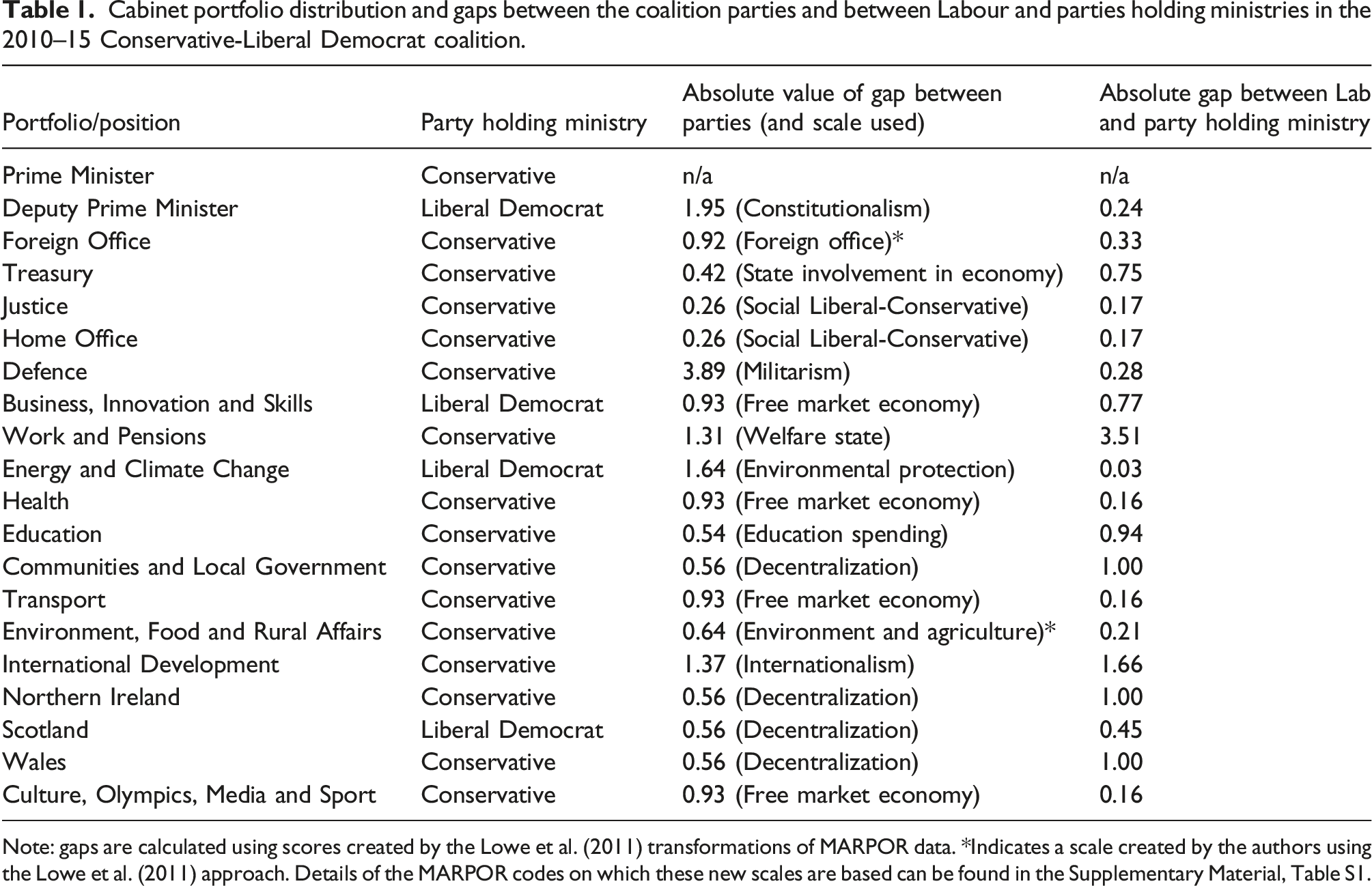
Note: gaps are calculated using scores created by the Lowe et al. (2011) transformations of MARPOR data. *Indicates a scale created by the authors using the Lowe et al. (2011) approach. Details of the MARPOR codes on which these new scales are based can be found in the Supplementary Material, Table S1.
We consider this latter variable because we expect that Labour will not only want to expose or exacerbate gaps between the coalition partners but may also want to draw attention to those policy areas in which it differs from the governing coalition, in an attempt to signal a distinctive position to its voters. Policy positions for Labour are measured using the same approach as for the Conservatives and Liberal Democrats. We then calculate the absolute value of the gap between Labour’s position and that of the party in charge of the relevant government department. We expect these incentives may vary by whether a Labour MP sits on the frontbench or not. Those holding shadow frontbench positions may be under more pressure from the party leadership than backbenchers to ask questions and particularly in areas where the coalition partners are further apart and areas where Labour is further from the party holding the ministry. This may be seen as part of the party leadership’s efforts to do all they can to improve their electoral prospects. Hence, we include a dummy variable which is given the value of 1 for Labour MPs who held a leadership position as a shadow cabinet member or shadow junior minister at some point in the 2010–15 Parliament, and 0 for other cases. We expect a positive coefficient here. Data on opposition posts are taken from the data.parliament.uk website.
We expect the salience of each policy area to affect patterns of questioning, that is, Labour MPs should ask more PQs in areas that are more important to the party, in an attempt to signal policy priorities to voters. Lowe et al. (2011) offer a measure of policy importance based on a similar approach to their measures of positions. We apply this to the same MARPOR codes as with the position measures. As a less party-specific measure of the importance of each department we control for the proportion of public spending that went to each department (HM Treasury, 2011: 27). 14 We anticipate a positive relationship between proportion of spending and numbers of questions asked.
We include several other control variables. MPs’ decisions about whether to ask questions of a particular department may be driven partly by their own policy interests. We use membership of departmental select committees as a proxy for this. We include a variable scoring 1 if an MP served, for at least some of the 2010–15 term, on a select committee that monitored the department of which they are asking questions, and zero otherwise. We expect a positive coefficient for this variable. Data on select committee membership were taken from Parliament’s website. We measure how long each MP had served in the Commons (in years by 2010) on the basis that longer serving members may feel more secure and therefore feel less pressure to ask PQs than those new to Parliament. Following Kellermann (2016), we test whether more electorally vulnerable MPs ask more PQs in order to signal effort to their constituents. This is measured by the difference in percentage points between the vote share achieved by the winner and the candidate in second place for each MP at the 2010 general election. 15 We control for differences between men and women, on the basis of research providing evidence of different views of representational roles among women (Taylor-Robinson 2017: 252–253). Descriptive statistics for all the variables used in our analysis can be found in Table S2 in the Supplementary Material.
Zero-inflated negative binomial regression of opposition parliamentary questions.
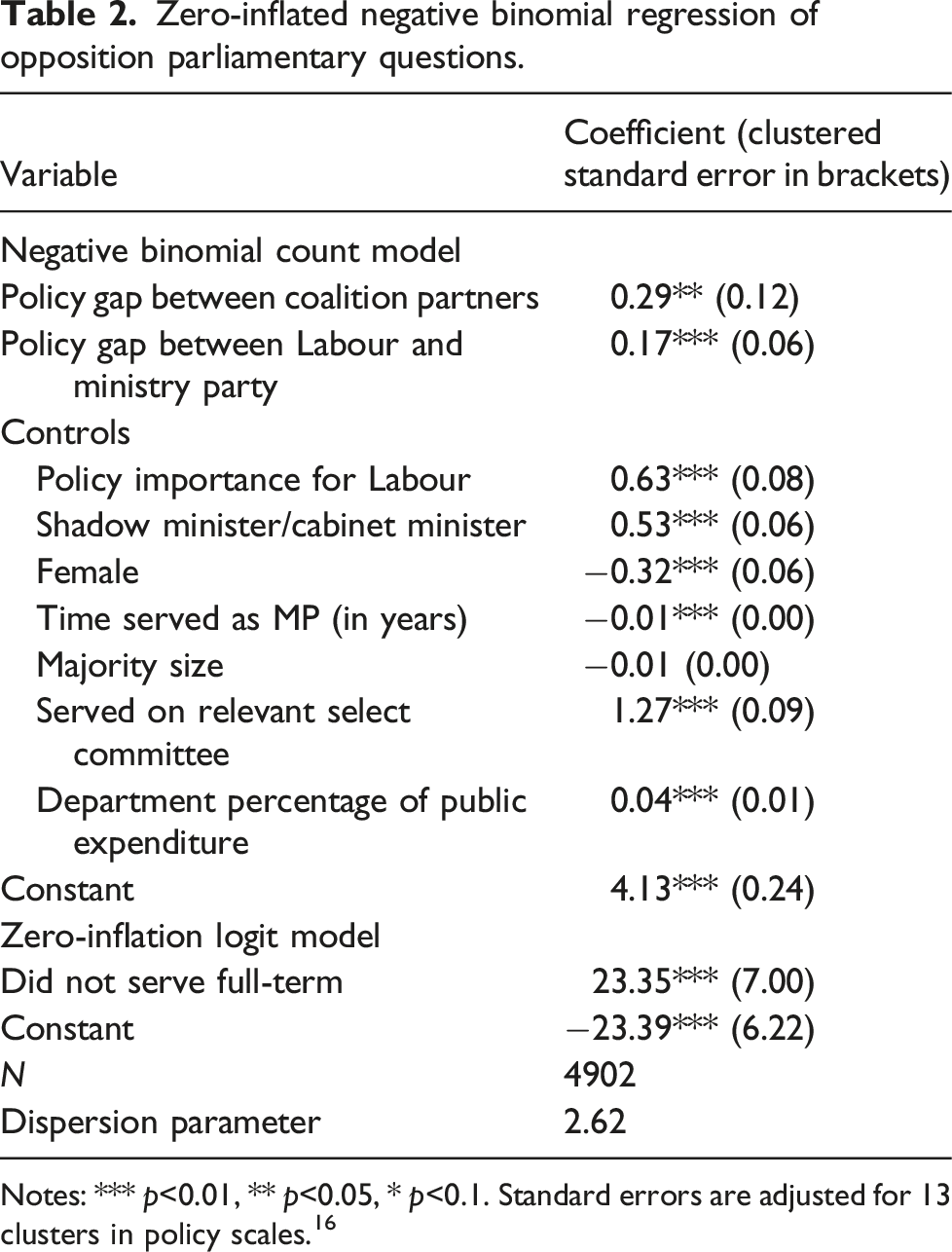
Notes: *** p<0.01, ** p<0.05, * p<0.1. Standard errors are adjusted for 13 clusters in policy scales. 16
Table 2 shows, as expected, a positive effect on the number of questions asked for the policy gap between the coalition partners. Our model predicts that – with other variables held at their mean or modal (for dummy variables) value – as we move from the smallest gap between the Conservative and Liberal Democrat parties observed in our data (0.262) to the largest (3.893), the number of questions asked by Labour MPs to a department rises almost three times, moving from 11 to 32 (rounding to the nearest whole number). This is consistent with our argument that an opposition party will use PQs strategically to push at gaps between the parties in a coalition government. Nevertheless, we find that Labour also use these questions to draw attention to areas where they are further from the party holding a particular ministry. This is shown by the positive coefficient for the ‘policy gap between Labour and ministry party’ variable in Model 1. Holding other variables at their mean or mode (for dummies), we find an increase from 13 to 23 questions asked as the gap between Labour and government departments rises from its minimum (0.03) to maximum (3.51) observed values. We were also interested to see how the number of questions asked changes at different values of the gap between Labour and the party holding a particular government department. Figures 1 and 2 show this relationship for a gap of zero (Figure 1) and the maximum observed gap (Figure 2) between Labour and the party running a ministry. Effect of policy gap between coalition partners on number of questions asked by Labour MPs when Labour’s policy gap to the government is zero. Effect of policy gap between coalition partners on number of questions asked by Labour MPs when Labour’s policy gap to the government is at its maximum value.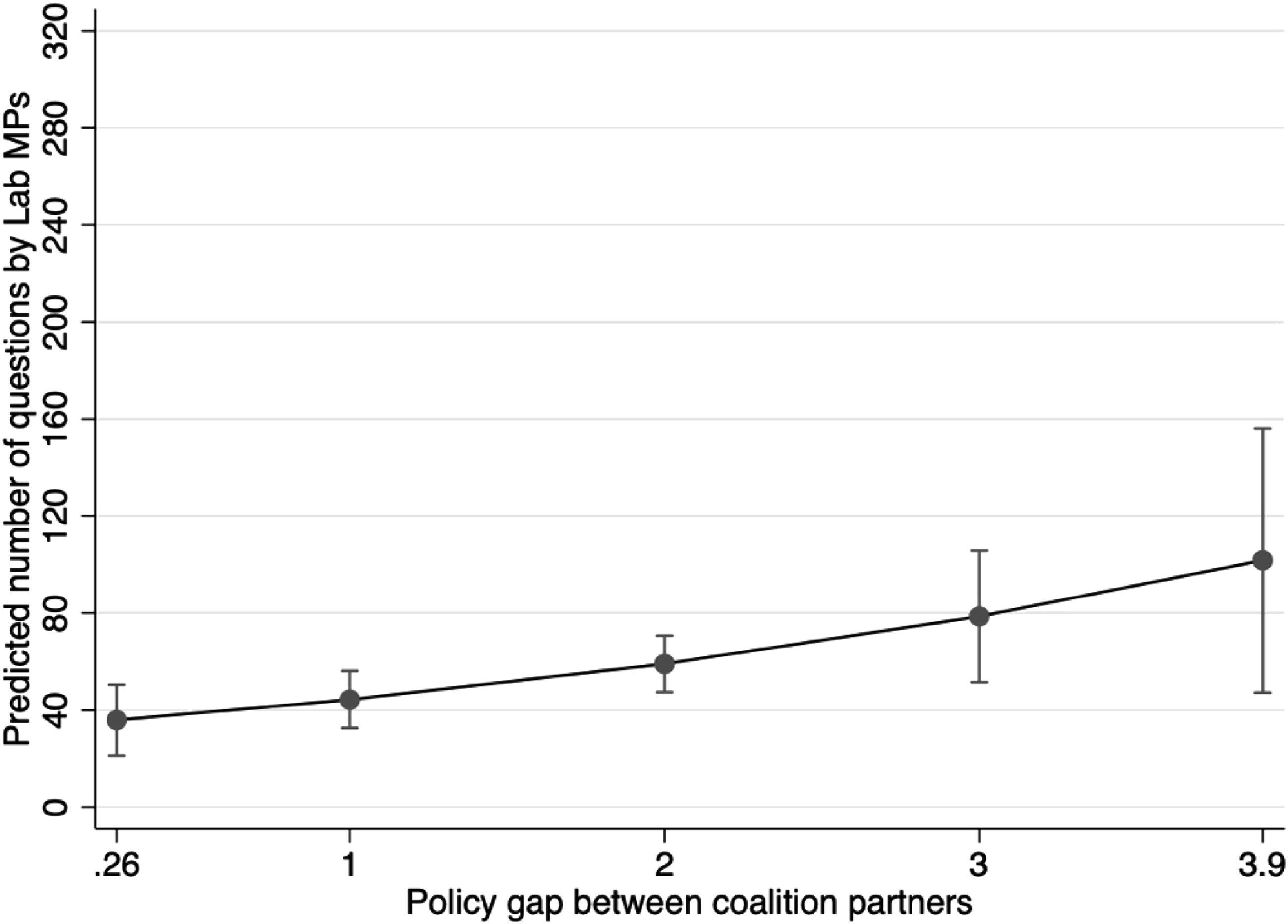
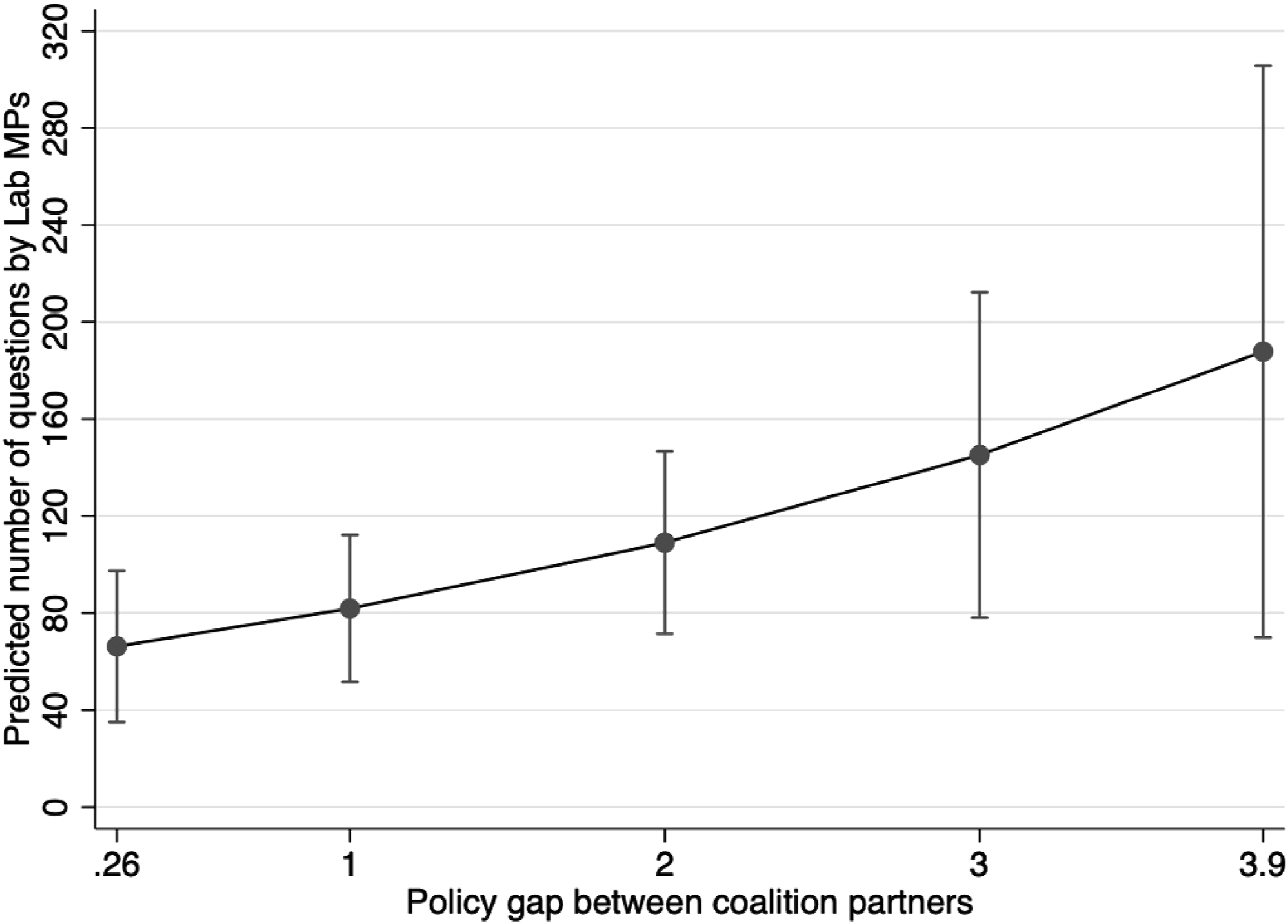
These two figures illustrate that while Labour ask more questions of departments where tensions are likely to be higher between the coalition parties, they do this to a greater extent when they are further away from the party holding the ministry. So they attempt to increase tensions between the coalition partners and they do this to a greater degree when they are further from the party holding the ministry.
Even when we take into account the effects of gaps between the coalition partners and of gaps between Labour and the coalition, we also find – as expected – that Labour ask more questions in policy areas that are of more importance to them. This effect is substantively important with a change in the predicted number of PQs from 3 at the lowest observed level of policy importance, to 43 at the highest level (with other variables at their mean or mode).
Our other control variables largely perform as expected. MPs who held a shadow government post at some point in the 2010–15 term ask more PQs than others do. MPs ask more questions of departments for which they sat on the relevant select committee for at least some of the 2010–15 term. This indicates that policy interests influence questioning patterns as expected. MPs with more experience in the House of Commons ask fewer PQs. We find that higher shares of public expenditure were associated with higher levels of questioning of government departments. Our variable measuring the size of MPs’ majorities is just short of conventional levels of statistical significance (p=0.109) indicating a somewhat uncertain negative relationship between numbers of questions asked and majority size. Our model shows female MPs asking very slightly fewer questions than male MPs (10 compared with 14) when we hold other variables at their mean (or mode for dummies). The part of our model that predicts the occurrence of zeros in the data suggests the failure to serve a full term is indeed strongly associated with the absence of questions as we expected.
Conclusion
Coalition government requires otherwise competitive governing parties to cooperate over the production and implementation of public policy. A growing body of research explores how political parties in government ‘keep tabs’ on each other. While it is now widely accepted that the legislative process allows actors within a coalition government to monitor each other, less attention has focused on whether or how opposition parties behave during periods of coalition government.
Building on the wedge-issue strategy, our suggestion in this article is that opposition parties have incentives, and the capacity, to focus on uncovering and highlighting policy differences and tensions within the coalition, including potential for ministerial drift from any coalition agreement. Our analysis of parliamentary questions during the 2010–15 coalition government in the UK House of Commons shows that it is not only coalition parties who may act strategically in light of differences between the members of a coalition. Opposition parties may exploit gaps between coalition partners in an attempt to divide and ultimately conquer the government. This happens alongside opposition attempts to show their own differences from the parties of government and to raise the profile of areas high on their own list of priorities. Those with shadow government posts (opposition spokespersons) are particularly likely to ask questions.
This research highlights the importance of opposition parties in parliamentary democracies. Future research should explore the conditions under which opposition parties target oversight of particular ministries and whether similar opposition strategies are employed in the presence of a single-party government but with strong party factions. Although our findings are based on a single case study, with arguably particular features, we expect that the core thesis is a generalizable one. If anything, the particular features – and in particular the lack of a tradition of coalition governance – arguably make the UK a relatively hard test of our expectations. Legislatures with a tradition of coalition governance are more likely to have opposition parties who know how to employ oversight tools to divide and conquer the coalition parties. Any multiparty legislature with a coalition government, opposition party and system of PQs should, we sense, provide the framework for coalition parties to act strategically during periods of coalition government.
Future research should explore the generalizability of our argument and the scope conditions. For example, in the context of Falcó-Gimeno’s (2014) important insights into how preference tangentiality shapes the need for intra-coalition monitoring, we would expect preference tangentiality among coalition parties to similarly reduce the gains to opposition parties for engaging in a ‘divide to conquer’ strategy. 17 We would only expect opposition parties to use parliamentary questions to cause conflict within the coalition when two or more of the coalition parties did not have tangential preferences. An opposition would derive little benefit from seeking to ‘divide and conquer’ coalition parties when the parties, in the words of Falcó-Gimeno (2014: 345) ‘care about a concrete group of policy areas and not much about those controlled by their partners’. As such, when studied comparatively, we would not expect to see opposition parties use PQs to divide and conquer the coalition when coalition parties have preference tangentiality.
Finally, the capacity of PQs to facilitate coalition monitoring by the opposition may depend on the strength of the questioning system – for example whether ministers must answer PQs, whether they must do so honestly, and whether the topics and volume of potential questions to ministers are unfettered. As recent events in the UK Parliament – including BREXIT and parliament’s role in shaping and overseeing policy responses to the Covid pandemic – remind us, much more needs to be done to uncover the real power and influence of parliaments and in particular opposition parties.
Supplemental Material
sj-pdf-1-ppq-10.1177_13540688211042859 – Supplemental Material for Divide to conquer? Strategic parliamentary opposition and coalition government
Supplemental Material, sj-pdf-1-ppq-10.1177_13540688211042859 for Divide to conquer? Strategic parliamentary opposition and coalition government by Richard Whitaker and Shane Martin in Party Politics
Footnotes
Declaration of conflicting interests
The author(s) declared no potential conflicts of interest with respect to the research, authorship, and/or publication of this article.
Funding
The author(s) received no financial support for the research, authorship, and/or publication of this article.

Supplemental Material
Supplemental material for this article is available online.
Notes
Author biographies
References
Supplementary Material
Please find the following supplemental material available below.
For Open Access articles published under a Creative Commons License, all supplemental material carries the same license as the article it is associated with.
For non-Open Access articles published, all supplemental material carries a non-exclusive license, and permission requests for re-use of supplemental material or any part of supplemental material shall be sent directly to the copyright owner as specified in the copyright notice associated with the article.
