



Abstract
Party membership seems to lose relevance for political careers in many established democracies. Increasing numbers of parties are recruiting non-members as candidates. Yet, what are the implications of a lack of long-term party membership for party cohesion? In this paper, I argue that pre-parliamentary party membership is in fact crucial for cohesion. Using data from the Comparative Candidate Survey and voting behavior of ca. 2,000 MPs of the German Bundestag on free votes from 1953 to 2013, I examine the effect of length of previous party membership and the age of joining the party on indicators of party cohesion. Examining free votes allows for credibly controlling alternative explanations of unified voting behavior. Results are in line with expectations generated from social identity theory and underscore the importance of party membership for party cohesion. The paper concludes with a discussion on the findings’ implications in light of recent developments in parties’ candidate recruitment.
Political dealignment is one of the most central and consequential trends in politics in the last few decades. We see the erosion of partisan identification (e.g., Dalton and Wattenberg, 2002), a decline in membership-based politics (e.g., van Biezen and Poguntke, 2014), and in an increasing number of countries the entry of political outsiders to the highest political offices, including such businessmen as Donald J. Trump in the United States, Emmanuel Macron in France, or Andrej Babiš in the Czech Republic. These trends, in conjunction with additional local factors, have led parties in Japan (e.g., Smith and Tsutsumi, 2014; Yu et al., 2014), France (e.g., Par et al., 2017; The Economist, 2017), Austria (e.g., Austria Presse Agentur, 2017), and Germany (e.g., Ripperger, 2016), to nominate candidates without prior party membership or political experience. Institutionally, this development is mirrored in parties’ constitutions and their formal candidate nomination criteria which have seen a reduction in the length of required membership spells in many parties over the last decades (e.g., Rehmert, 2020b). Membership in political parties, it appears, is losing in importance for political careers in many countries (see also Bailer et al., 2013).
What role, however, does party membership and especially long-term party membership play for (converging) political preferences, behavior of Members of Parliament (MPs), and eventually party cohesion in parliament? Kam (2009), for example, shows that the share of freshmen arriving in parliament is not related to the frequency of defections. Similarly, Crowe (1986) argues that there is no difference between parliamentary newcomers and veterans in the United Kingdom when assessing the most important factors underlying party loyalty: agreement and duty. These two findings suggest that loyalty inducing socialization processes are likely to take place before entering parliament and highlight the importance of party membership. At the same time, now, however we observe trends that indicate a decline in the importance of party membership for political careers that lead to Parliament (e.g., Bailer et al., 2013; Smith and Tsutsumi, 2014).
What do these recent developments of nominating non-party members in a growing number of countries imply for party unity and more crucially for the underpinnings of parliamentary democracy? Party unity is of the utmost importance for the functioning of parliamentary democracy and government parties constantly rely on their MPs to support their policy and budget proposals. Without stable party unity, governments break and parliamentary democracy cannot work. To better understand the link between party membership and party cohesion, this article explores in particular the role of pre-parliamentary party membership and the effects of socialization processes this entails for the preference homogeneity and norm internalization among parties’ candidates and MPs. I argue that joining a political party entails processes of socialization into and the internalization of the party’s values and norms, which in turn shape the attitudes and behavior of party members. While these processes also entail a homogenization of political attitudes, it more dicisively leads to the internalization of party unity for the sake of unity (see Crowe, 1983; Russel, 2014). While addressing questions related to pre-parliamentary party membership and the role of socialization within parties for party unity, this paper contributes to the literature on legislative behavior by providing individual-level explanations of party unity that do not rely on the commonly employed rational choice theory and by producing insights into the future workings of legislative institutions that are increasingly staffed by legislators lacking long-term party membership.
The literature on party unity builds on two major theoretical approaches; a rational choice approach and a sociological one. The rational choice approach assumes that individual legislators make their voting decision after pondering the potential sanctions and rewards of their actions. Rewards for following the party line could come in the form of career advancement, re-nomination or other perks, while sanctions may materialize as losing previous committee positions or, in the extreme case, denial of re-nomination. Rewards for voting against the party, on the other hand, could come in the form of valuable name recognition among the electorate in personalized electoral systems (e.g., Kam, 2009).
In contrast to this assertion stands the sociological approach. This approach itself can be further classified into a strand explaining unity by social cohesion, i.e., the preference homogeneity of MPs as a function of shared socio-economic and demographic backgrounds (e.g., Saalfeld, 1995), a strand arguing that party unity is the result of preference alignment of party members due to sorting processes of citizens with similar ideological proclivities into the same parties (e.g., Krehbiel, 1993; Willumsen, 2017), and a strand asserting that unity is a product of shared values and norms (e.g., Crowe, 1983). These three mechanisms, while mutually not exclusive focus on different temporal sequences that essentially refer to the same overarching process: the process of socialization into certain socio-economic segments or socio-cultural groups (see Searing, 1969).
Early empirical investigations of the sociological strand go as far back as the 1960s. This literature has focused on political socialization in the family during a future legislator’s childhood (e.g., Clarke and Price, 1977; Prewitt et al., 1966; more recently see also Fox and Lawless, 2005) or the impact of political events during their adolescence (Gruber, 2009; Herzog, 1975). Other studies have explored the socialization processes that take place once MPs have arrived in the legislature (e.g., Garand, 1988; Price and Bell, 1970). Again others have looked at the socializational role played by political parties (e.g., Clarke and Price, 1977; Dodson, 1990; Kornberg, 1966; Patzelt, 1999; Saalfeld, 1995). Out of these, only one study though has empirically linked socialization within the party, measured by holding party office, with party unity in parliamentary voting (see Saalfeld, 1995). This bivariate analysis, however, falls short in several aspects, such as ignoring subtle differences in MPs party history (e.g., at what age have they joined the party and how long before entering parliament have they been a member?), a lack of relevant control variables that could explain less socialization and a higher propensity to defect (e.g., electoral circumstances), and by attempting to examine the role of previous party office on loyal voting behavior on whipped votes.
The behavioral consequences of a lack of party membership has been investigated too. A methodologically innovative recent study by Bailer et al. (2013) explores different types of political careers that lead to the German Bundestag using sequence analysis. They find that political career-changers, so-called Seiteneinsteiger that lack long-term party activism, tend to be less successful in obtaining party or parliamentary offices, gather less in committees related to district interests, and tend to defect less often from the party line. A low number of these Seiteneinsteiger, however, precludes any conclusive inference. For the Japanese case, Smith and Tsutsumi (2014) report that candidates nominated in the wake of public calls for applications mostly lack prior party membership and political experience and that these candidates exhibit political attitudes more moderate when compared to their copartisans selected through more traditional channels. Rehmert (2020a), moreover, finds that Japanese MPs nominated through this open recruitment are less active in parliament.
Yet, today no comprehensive study exists that links socialization processes within the party to party cohesion, i.e., voting along party lines due to preference homogeneity and shared policy attitudes among MPs, and party unity, i.e., the observed cohesion of party members induced by the application of “sticks and carrots” to keep potential renegades in line. While there is empirical work on sorting into parties (e.g., Willumsen, 2017), socialization processes have hitherto been neglected in the literature. In the same vein, empirical records connecting socialization within the party to voting behavior in parliament is equally scarce. This, however, is not surprising, as the sheer majority of parliamentary votes are whipped, and attributing loyal voting behavior to either the fear of sanctions, the longing for rewards or merely to following own beliefs or internalized party norms is empirically impossible.
In this study, I will investigate the preference homogeneity and norm internalization of candidates and MPs as a function of their political socialization within their respective parties. Using data from the Comparative Candidate Survey, I show that candidates that have undergone socialization processes within the party are less likely to diverge from the majority opinion of their party and are more likely to follow the party’s position over their own opinion in case of conflict. Secondly, I take advantage of so-called “free votes”, i.e., unwhipped roll-call votes, in the German Bundestag from 1953 to 2013 to examine the implications of socialization processes for party cohesion in parliamentary voting. By looking at these free votes, I can more credibly control for “stick-and-carrot” explanations of uniform voting behavior and instead attribute party cohesion more plausibly to preference homogeneity and norm internalization. By examining the observational implications of party socialization using these two datasets, I find that by and large lengthy party membership results in less voting dissent and greater preference homogeneity among candidates as predicted by social identity theory. Finally, I show that effects are in fact driven by socialization and not by patterns of candidate selection.
Social identity theory and party membership
The extant empirical literature on party unity rarely relies on socio-psychological explanations, despite its apparent applicability. In an investigation of the British House of Lords, Russel (2014) finds empirical support for arguments in favor of social identity theory. Even in the absence of classical factors explaining party unity as, for instance, seeking re-nomination or credible threats from the party whips, members of the House of Lords tend to toe the party line out of feelings of loyalty, belonging and a fear of disrupting the unity of their group.
Group membership indeed has been empirically found to strongly affect the perception of its members beyond political parties (e.g., Yang and Dunham, 2019). Membership in groups helps individuals to define who they are, where they belong and how they should act. This effect is in fact so strong that even members aware of the randomness of group membership allocation show in-group bias (Yang and Dunham, 2019). The self-categorization as a group member in itself affects the identification with that groups and entails a reevaluation of own attitudes and behavior. This internalization of and adherence to group values and norms can result in homogeneous attitudes (Ashforth and Mael, 1989; Turner, 1991), unified behavior as seen in the case of the House of Lords, or in potentially disastrous group-think (Janis, 1982).
New members of groups are often put in a position of uncertainty about their roles and status, inducing them to learn the role expectations and behavioral norms of the group. This process of social identification takes place in interactions with other group members, helping new entrants to resolve their behavioral ambiguity. In fact, new entrants typically adopt the characteristics perceived by them as stereotypical of the group (Ashforth and Mael, 1989). Fresh entrant’s behavior becomes more and more oriented to their significant others, i.e., other group respective party members, from which they yearn to receive ingroup respect and social approval necessary to confirm their nascent identity as a group member (e.g., Rise et al., 2010; Pagliaro et al., 2011). Not before long, membership in the group and the group’s values become part of the new member’s (social) identity (e.g., Bettencourt and Hume, 1999) and membership in itself becomes a predictor of intention, motivation and action (see Bagozzi and Lee, 2002; Fielding et al., 2008).
Within parties, Dodson (1990) differentiates between two mechanisms, compliance and affiliative ties, that drive attitudinal and behavioral adaptation. Ambitious new entrants that may be less interested in policy but more so in career advancement eventually have to comply with behavioral and attitudinal role expectations by the party (leadership) to be considered for nominations. In the process, this new social identity becomes part of their personal identity and informs behavior and attitudes. Similarly, emotional attachment to the party or increasing personal ties and interactions with co-partisans integrates new members into the party’s communication networks and organization. This integration nudges new members to reevaluate their attitudes and behavior to avoid (social) sanctions by their new group of reference. An additional mechanism through which socialization may lead to party conform behavior is explored by Dickinson (2018), who argues that advice given by veteran members help newer entrants to follow party norms.
Survey studies have shown that members of the same party in parliament indeed exhibit highly congruent policy attitudes (Willumsen, 2017), congruent expectations about behavioral norms (Crowe, 1983) and that party leaders rely on long-running processes of socialization to maintain party unity in floor votes (e.g., Kam, 2009). In other words, the self-categorization as a member of party A generates the intrinsic expectation of this member to exhibit party A’s stereotypical attitudes and, in floor votes, to vote with the majority of party A (see Turner, 1987). Another straightforward expectation derived from this is that with greater exposure to the group’s values and norms, or the party’s for that matter, party members should vote in line with the majority of their party in parliament more often. To put it differently, the more the processes of socialization can unfold their impact on party members and MPs the more we should expect the internalization of the party’s norms and values (see Dodson, 1990). Hence, as an observational correlate of socialization, understood as the processes of preference homogenization and norm internalization, I expect candidates and MPs to exhibit attitudes and behavior more in line with their party’s position, the deeper their socialization into the party.
Research design and data
To empirically test this expectation, I rely on a number of attitudinal and behavioral implications as well as different measurements gauging the degree of socialization. To measure the implications of socialization and the internalization of the party’s norms, I take advantage of two data sources. First, I use policy-attitude questions from the Comparative Candidate Survey, extract latent dimensions and measure each candidates’ distance from their respective party’s mean position, next to other survey items indicating preference homogeneity and norm internalization. Secondly, I examine the voting behavior on a number of “free votes” in the German Bundestag from 1953 to 2013 in which party discipline has been lifted. Examining the voting behavior in these votes, compared to whipped votes, allows me to more credibly attribute uniform voting behavior to preference homogeneity and norm internalization.
In both applications, socialization and value internalization (or its degree) is measured in two ways. First, I measure the length of party membership in years before the first candidacy. Restricting the measurement to time spent in parties before the first candidacy avoids measuring cohesion-inducing experiences on previous campaign trails or legislative activities. Secondly, I determine the age (in years) at which candidates have joined the party for which they stood as candidate and were elected. These measurements are restricted to the main parties and not to parties’ youth wings, on which data is more difficult to obtain. While this misses a crucial sequence of socialization, measuring socialization from proper party membership onwards only is likely to underestimate the impact of socialization and therefore makes for a conservative estimate. I assume that the longer a candidate has been a member of the party, the more effective the process of socialization. Furthermore, socialization can unfold its effects more comprehensively at younger more formative years, when attitudes are still malleable. Members that have joined in a later stage of their live are likely to come with a more rigid set of attitudes and are less likely to be swayed by new arguments (see Roberts et al., 2006). Inglehart and Welzel (2005) argue similarly using survey data, that attitudes and values acquired early on tend to stick as one grows older.
Socialization and candidate attitudes
The Comparative Candidate Survey offers a number of opportunities to gauge the effect of within-party socialization on candidates’ attitudes. In the following analysis I measure attitudinal cohesion of candidates in three different ways. First, I extract two latent ideological dimensions from a range of Likert-scale survey items using Principal Component Analysis for each country in each election cycle 1 and calculate candidates’ euclidean distance from their party’s mean values. Secondly, I use candidates’ self-declared left-right positions by calculating their deviation from the mean left-right position of all other candidates of the same party. Lastly, I estimate whether socialization and norm internalization affect candidates’ tendency to follow the party position over their own opinion in case of conflict. 2 This last item is more closely linked to the internalization of the norm to toe the party line than the other two operationalizations as disagreement is assumed in this question.
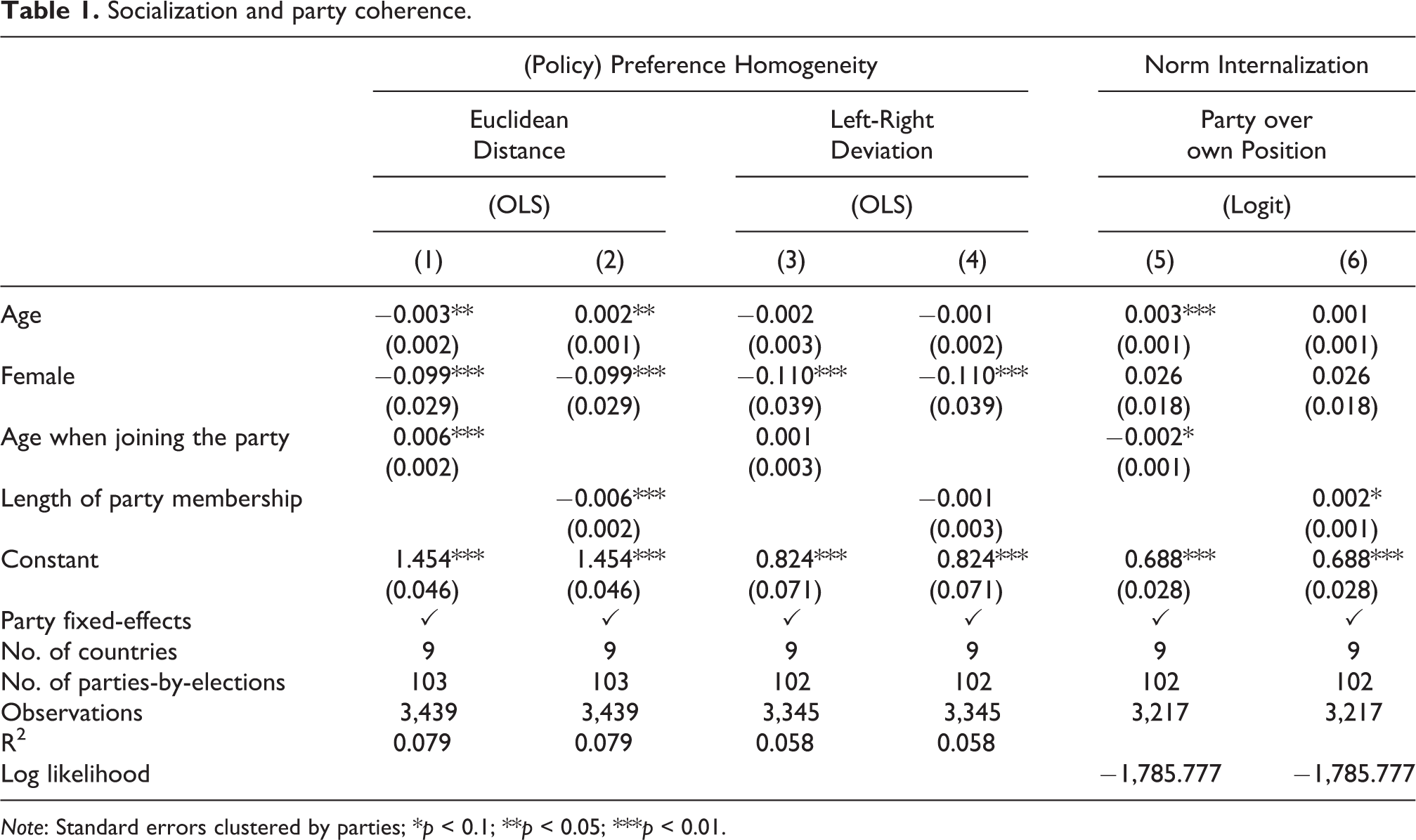
Table 1 presents results for the three indicators of party cohesion. Samples are restricted to first-time candidates, in order to disentangle party-internal socialization from socializational effects emanating from previous campaigns or legislative experiences. It further is limited to countries in which relevant questions are available. 3 Models include party-by-election fixed-effects to account for general ideological and organizational differences across parties that may be correlated with level differences among its candidates and, hence, to estimate within-party effects. Further included are gender and age, two variables available for first-time candidates in all countries and election waves, to account for possible gender differences and to differentiate between biological age and party membership spells. Results are presented with standard errors clustered by parties in elections.
Socialization and party coherence.
Note: Standard errors clustered by parties; *p < 0.1; **p < 0.05; ***p < 0.01.
The age at which candidates have joined their party and the length of their membership before their candidacy are both significantly related to candidates preference alignment with the party’s average. A standard deviation change in the age when joining the party (ca. 15 years) and the length of membership (ca. 10 years) account for a 1.7 % and 1.1 % in the range of the euclidean distance, respectively. No significant findings can be reported for candidates’ deviation from their party’s mean left-right position. However, on the item most closely measuring candidates’ internalization of the norm of party unity, we obtain expected results. For a standard deviation increase in the age of joining the party and the length of party membership, candidates become 0.74 %-points less or 0.5 %-points more likely to put their party first, respectively. These effects appear to be rather small in substantive terms but they have to be considered as a somewhat conservative estimate, as party years are only an imperfect empirical approximation of measuring the actual degree of socialization. Obviously, candidates can amass party years as passive members without much interaction with co-partisans and exposure to socialization-inducing factors.
These findings support my expectations that the length of party membership and the age of joining the party are associated with attitudinal homogeneity and greater loyalty toward the party’s positions. Although empirically not easily separable, the former more likely relates to the internalization of the party’s positions, while the latter pertains more to the internalization of norms, such as the norm of party unity for the sake of unity (e.g., Crowe, 1983)
Socialization and voting behavior
Do these attitudinal implications of candidate socialization ring true for behavior as well? The next section introduces the data for the second analysis on MPs’ voting behavior.
“Free votes” in the German bundestag
Germany provides an interesting case to test the behavioral implications of candidate socialization. The socio-economic backgrounds of German MPs are much more varied when compared to the United Kingdom or France, where a large share of MPs hail either from Oxford or Cambridge (e.g., Norris and Lovenduski, 1995) or the École normale supérieuer, elite institutions favoring only a small socio-economic segment of society. As socio-economic backgrounds are likely to influence political attitudes, this further suggests greater attitudinal variation among German MPs in a comparative perspective that may manifest in free votes. Moreover, the two traditional catch-all-parties (Volksparteien) are likely to have been assembling a diverse range of personnel at least until recently. Yet, on the other hand, German parties are also considered to be organizationally strong compared to parties in other countries which is expected to entail effective processes of socialization. The results of these processes are likely to find expression in the empirical data and will allow me to test my hypotheses.
For the period from 1949 to 2013, I rely on individual-level voting records of MPs in the German Bundestag collected by Bergmann et al. (2016). During this period, Ohmura (2014) identified 112 votes on which party discipline has been lifted. As no free votes have been identified in the 1st, 3rd, and 9th term in post-war Germany, my sample consists of all other legislative terms in which free votes have been identified until the 17th Bundestag. The unit of analysis will be the MPs’ decisions on each of these 112 free votes. The dependent variable, i.e., the vote choice, can take one of five categories: voting with the majority of the party, voting against the majority of the party, abstaining from voting, missing unexcused from voting and being excused from voting (e.g., traveling, on leave, sick, etc.).
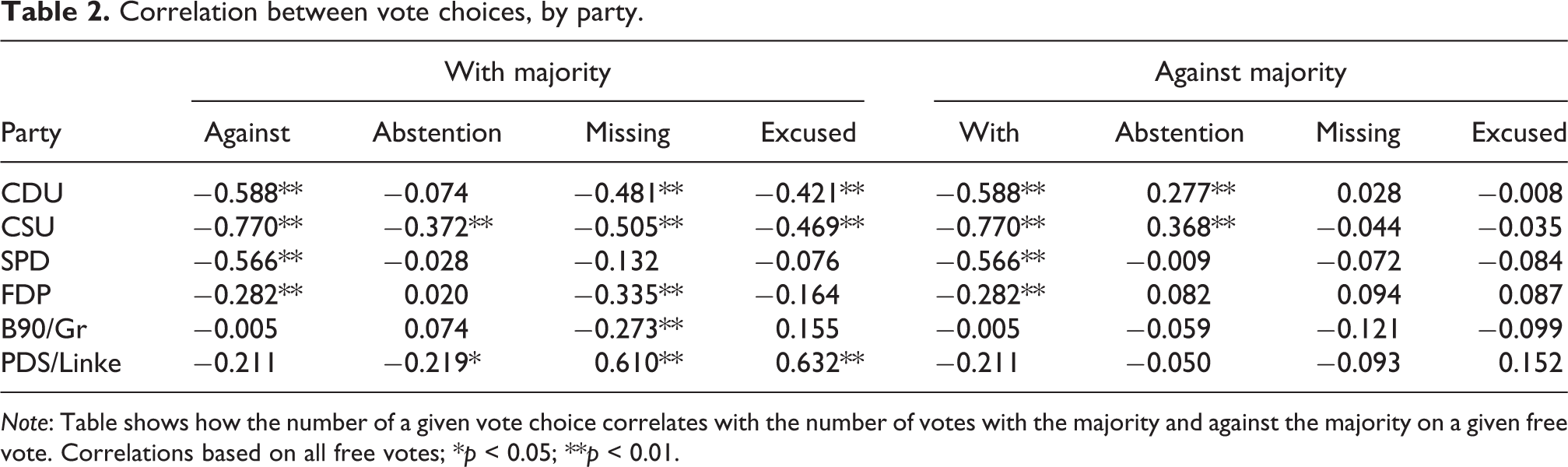
Although most votes in the German Bundestag are decided upon by vote plurality in contrast to a qualified majority, which makes abstaining from voting inconsequential for the vote outcome, abstaining in itself is generally seen as a breach of party unity, unless it is the official party line (see Crowe, 1983). As the more detailed analysis below differentiates between the five different voting outcomes, Table 2 shows that abstaining or missing from voting is likely to be indicative of preference divergence among MPs. The table reports separately for each of the current German main parties how vote choices on the 112 free votes correlate empirically with each other. 4 These correlations are based on the number of MPs of each party who voted with the majority, against the majority, the number of MPs that have abstained from voting, were missing or excused on each of the 112 free votes. Not surprisingly, the number of votes cast against the majority and the number of votes cast in line with the majority on a given vote correlate negatively—the more MPs of a party are voting with the party, the less are voting against the party’s majority. Abstentions, interestingly, correlate negatively with the number of votes for the majority line but only for the CSU and PDS/Linke. They are correlated positively with the number of votes against the majority for the CDU, implying the same conjunction that abstentions are another channel of voicing disagreement. For most parties missing unexcused from a roll-call vote is strongly negatively correlated with the number of votes in line with the majority choice, with the exception of the PDS/Linke. A similar but less significant pattern exist for excused absenteeism. These correlations suggest that disunity may express itself through more channels than outright defection. Being absent from the vote, be it excused or not, can imply the avoidance of taking a stance on an issue controversial in the eyes of co-partisans or constituents. Furthermore, it can be seen as a form of disagreement more evasive and softer than pure abstentions (e.g., Kam, 2001). 5
Correlation between vote choices, by party.
Note: Table shows how the number of a given vote choice correlates with the number of votes with the majority and against the majority on a given free vote. Correlations based on all free votes; *p < 0.05; **p < 0.01.
One caveat when exploring the socializing role of party membership using free votes, it could be argued, is the fact that the selection of votes on which in fact discipline has been lifted is not representative of all votes and mostly applies to votes on issues of conscience or morality. While it is certainly true that free votes are not representative of all votes, it does not necessarily invalidate any exploration of the role of party membership on voting behavior. First of all, Crowe (1983) reports from survey data on MPs from the United Kingdom that defections and abstentions are seen as heavy transgressions on group norms and that party unity in and for itself is a group’s goal and value to be held up irrespective of the matter of the vote. Empirically, most of these free votes fall into the categories of Law, Crime, and Family Issues (n=27), Healthcare (n=21), and Defense (n=8) from a total of 14 different categories. 6 Given the individual-level MP × vote-dyadic nature of the unit of analysis, I can account for the policy area of each vote by including corresponding fixed-effects (see Ohmura, 2014).
Analysis
How does pre-parliamentary socialization affect the voting behavior of MPs in parliamentary free votes? To disentangle pre-parliamentary from parliamentary socialization processes, I am restricting the analysis to parliamentary freshmen in their first term. Using multiple sources, 7 I could code for 89 % (n=2065) of these freshman MPs the age at which they have joined for the first time the party for which they have been elected 8 and their length of membership in years in this party before standing as candidate for the first time.
Given the nature of the dependent variables I will employ MP random-effects logit models estimated separately for each of the five vote choices to avoid setting one vote choice as the reference category as required by a multinomial model. 9 All models are estimated with party and vote policy-field fixed-effects.
An important control variable in this setting and to disentangle socializational effects from electoral circumstances of perhaps electorally more vulnerable first-time MPs I am controlling for the electoral safety of the individual MPs. Baumann et al. (2013) show how characteristics of the electoral district influence voting behavior of German MPs on controversial free votes related to the pre-implantation genetic diagnosis. As these district characteristics, in this case the religiosity of the constituents, are more likely to find their way into MPs’ decision calculus when they feel electorally insecure, I control for MPs re-election probabilities. MPs that electorally feel more secure may feel they can afford voting their conscience on controversial votes. Since the pressure to follow the party line is minimized in free votes, MPs may be more concerned about how their votes on perhaps morally charged matters are perceived by their constituency. Due to Germany’s mixed-member electoral system, I estimate two types of re-election probabilities. The first captures the probability of re-election in the electoral district, the second the probability of being re-elected on the party list under the assumption that list positions remain unchanged, following the estimation procedure proposed by Stoffel (2014). Both probabilities enter as separate variables. These two variables also account for the type of candidacy, i.e., district versus list candidates and candidates competing on both tiers. Throughout the time period of my sample, candidates of all parties are becoming more likely to be dual candidates formally (see Manow, 2015). The re-election probabilities however account for the de facto type of candidacy as most district candidacies of the smaller parties are futile anyhow.
To account for additional political confounders, I control for holding a party office such as the party or caucus leadership (Parteivorsitzende/r, (stellvertrentende/r) Fraktionsvorsitzende/r) as well as party whips (parlamentarische Geschäftsführer) and policy-field speakers (Arbeitskreissprecher/in), a legislative office such as committee (co-) chairs ((stellvertretende/r) Ausschussvorsitzende/r) or an executive office such as cabinet (Bundesminister/in) or junior minister (parlamentarischer Staatssekretär/in). These three variables are coded binary where a 1 indicates holding that office and 0 not holding that office. Although I only look at parliamentary freshmen it can happen that prominent party figures among these freshmen immediately assume a legislative or executive office in their first legislative term. Other demographic controls variables include the sex and age of MPs. Especially the latter is important in distilling the effects of length of party membership or the age at which a given MP has joined the party from potential effects of (non-) compliance emanating from biological age.
Examining the voting behavior of legislative freshmen on these free votes, while accounting for potentially confounding vote specifics as well as for electoral, political and demographic characteristics of the MPs, allows me to adjudicate on my hypothesis and to draw conclusions on the socializational effects of party membership prior to the legislative mandate.
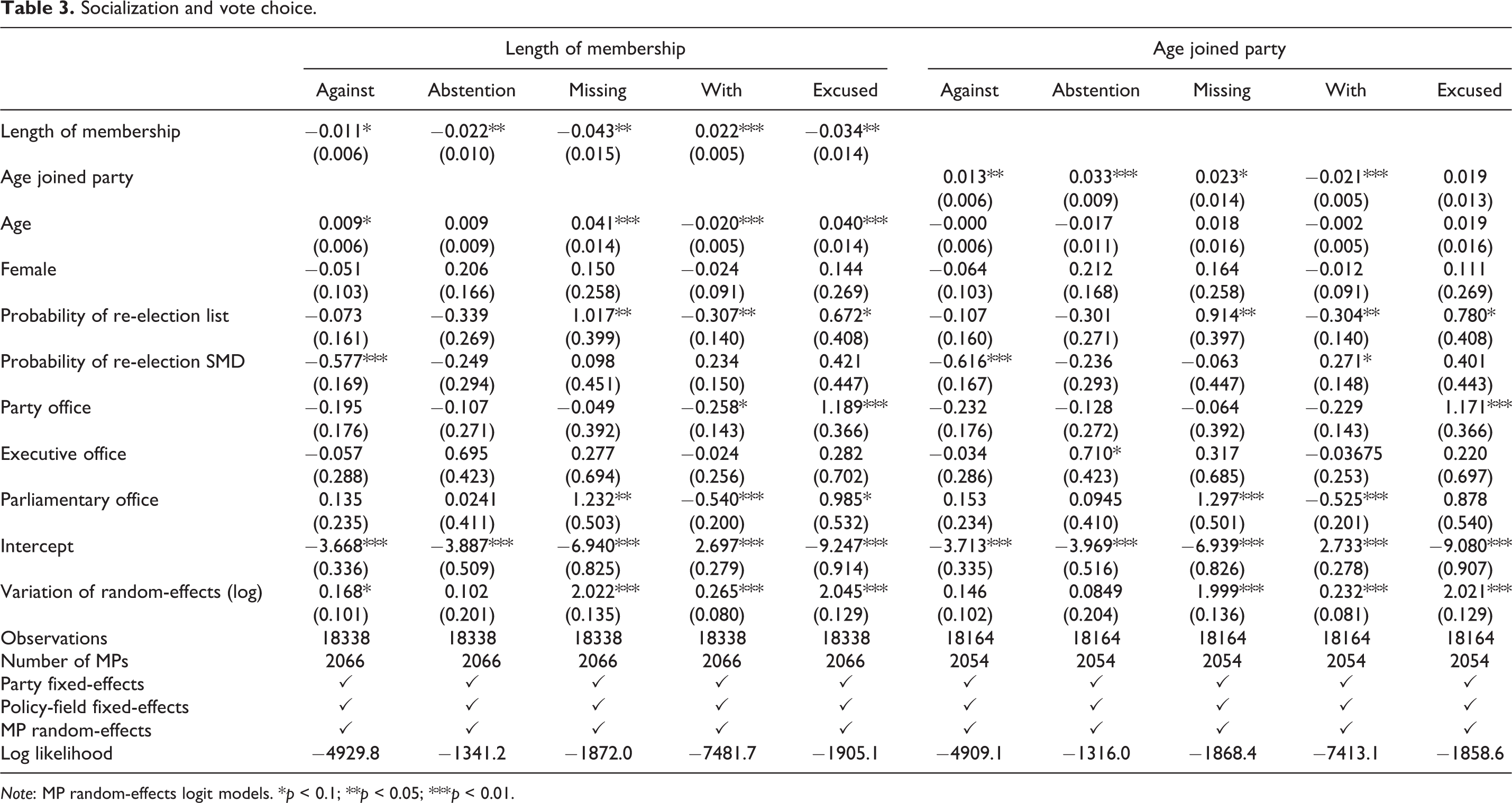
Table 3 presents the results from multiple MP random-effects logit models, each estimated with party and policy-field fixed-effects. The models show that the length of membership and the age at which MPs have joined their party are significantly associated with unified voting behavior as expected. The longer the spell in the party before campaigning for the first time, the more can the processes of socialization unfold its effects on the attitudes and behavior of MPs. Similarly, the older MPs were when they have joined their party, the less malleable their convictions and beliefs, and, hence, the less opportunity for socialization to turn them into dutiful members.
Socialization and vote choice.
Note: MP random-effects logit models. *p < 0.1; **p < 0.05; ***p < 0.01.
Figure 1 show the average marginal effects of a standard deviation change in the length of membership and the age at joining the party on the five individual vote choices. The figure shows the change in the predicted probability of vote choice when we add one standard deviation of the length of party membership respective the age when joining the party to MPs’ observed values of these variables, while covariates too are set to MPs’ observed values on these covariate. While we see a clear and significant pattern how the age when joining the party affects unified and disunified voting all in line with theoretical expectations, the effects for the length of membership prior to active involvement in mandate-seeking tend to be less significant but generally support expectations. The older MPs were when joining their party the less likely they are to vote with the majority of their party group on free votes and instead are more likely to vote against the majority, abstain from voting or miss or excuse themselves from the vote. On the other hand, the longer they have been in the party, the more likely to vote with the majority and the less likely to engage in avoiding taking a stance.
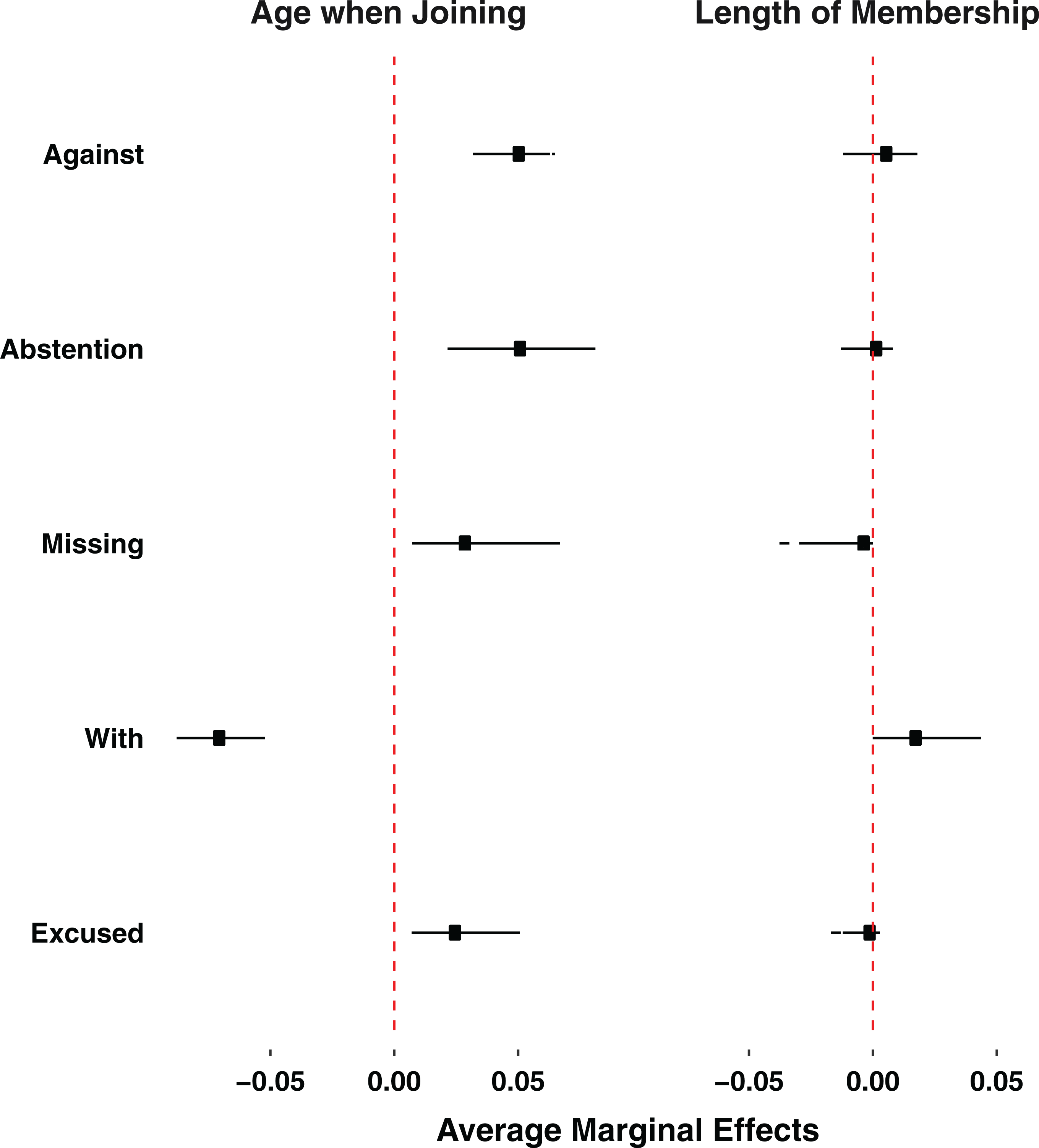
Socialization and voting behavior.
As for the results in the analysis of the survey data, effects appear to be rather small in substantive terms. Naturally, a certain underestimation of the effects of socialization as measured by membership-years can be assumed. Moreover, baseline expectations for non-uniform voting behavior of first-time MPs, i.e., voting against the majority, abstaining from voting or missing unexcused, are rather low as well—contributing to the estimated effects sizes. Only 8.7 % of MP × Vote-dyads are votes cast against the majority of the party. This number is even lower for abstentions (1.4 %), MPs missing from the vote (3.3 %) and MPs being excused from the vote (3.4 %).
Now, are these results driven by any given electoral period or any single party? After all, the number of (identified) free votes has been increasing over time. Until the 1990s, there were no more than single digit numbers of free votes per electoral period. Following the unification of Germany however the number of free votes started to increase and varies between 1 and 22 free votes per electoral period. To explore potential variability, jackknife cross-validation models for electoral periods (Table 8) and parties (Table 9) are reported in the Online Appendix. Following the same specification as the models reported in Table 3, these two tables report the results when leaving out one electoral period at a time respective leaving out one party at a time. Overall, the results stay the same with minor changes to the level of statistical significances, with no model reporting complete null findings with respect to the two variables approximating the degree of party socialization. Moreover, leaving out the 12th electoral period (1990–1994) accounts for the large number of new entrants from the Eastern states of Germany for whom party membership may systematically be lower than for their Western German pendants. As before, findings remain robust. Neither any single party nor any single electoral period is driving the results.
Robustness checks
Eventually, several questions concerning alternative empirical explanations for these results remain. First of all, are MPs voting with the majority because of their similar ideological proclivities or because of their socialization? Secondly, are the effects due to socialization or rather selection effects? And, finally, the question remains whether the decision of holding a free vote is endogenous to the preference homogeneity within the parliamentary party caucus.
First, ideological commonalities may drive similar voting behavior among MPs of the same party and not their degree of socialization into and the internalization of their party’s norms and values. To account for this possibility, models from Table 3 have been reestimated with an additional control for ideological positions of individual MPs. The measure of ideology is based on parliamentary speeches collected and provided by Rauh et al. (2017) for the period of 1990 to 2013, which after removal of punctuation, numbers and stopwords as well as the stemming of words have been scaled to a one-dimensional proxy for MPs political positions using wordfish (e.g., Slapin and Proksch, 2008). 10 Ideological deviation is calculated by the absolute difference between individual MPs and their party’s average score, expecting that MPs deviating more strongly from the party’s average to also express this deviation in their voting behavior. Table 10 in the Online Appendix reports results of the original models with ideological deviation as additional predictor, which, given the lesser coverage, results in a restricted sample. Both measures of socialization remain significant predictors of abstaining and voting with the majority of the party when controlling for ideological positions. These findings further point to the effect of socialization as independent from pure ideological sorting into parties and “pragmatic fidelity” as argued by Willumsen (2017). If it were only sorting or voting along party lines for reasons of career ambitions (which should already be minimized by the focus on free votes), variation in socialization measures should show no difference in voting behavior.
Secondly, my measures of socialization identify party activists who progress within the party through loyalty, yet they do not account for those progressing within the party through talent and competence—perhaps a short-cut in obtaining a nomination. Hence, if talent and competence is rewarded more quickly with nominations and is also associated with freer thinking, MPs of this background might show less unified voting behavior and have a weaker party membership background. In other words, the results reported in Table 3 could be driven by selection and not socialization effects. To rule out this alternative explanation I control for competence and talent using a proxy based on the occupational background. The Federal Returning Officer provides data on candidates occupation which using the International Socio-Economic Index of Occupational Status can be quantified into a measurement of socio-economic status based on international data on income and formal education associated with occupational categories (Ganzeboom et al., 1992). Although it does not directly capture talent or competence, it is the best approximation available. If the effects of my socialization measures disappear when controlling for competence, MPs’ voting patterns are more likely to be driven by selection than socialization effects. Table 11 in the Online Appendix reports results from the same model specifications as in Table 3 with competence as an additional covariate. Competence is indeed positively associated with a greater likelihood of abstentions, but my measures of socialization still exert their significant effect on unifying voting behavior. The effects are hence not driven by selection, but by socialization effects.
Finally, Tables 12 and 13 in the Online Appendix report results for subsamples of the original models restricted to votes and MPs of the very party that has initiated a free vote (Table 12) and to votes and all MPs of all parties that did not initiate those very free votes (Table 13). In other words, for the first sample votes could be considered endogenous, while for the second sample votes may be considered exogenous. As for the majority of free votes the initiator for holding a free vote is unknown, these models are heavily restricted and are based on only a fraction of the original sample—in fact, only for 28 of the 112 votes could the initiator be identified. On free votes initiated by their own party, MPs with greater degrees of socialization behave as expected and are more likely to vote with the majority and less likely to vote against the majority of their own party. On free votes initiated by other parties, MPs are less likely to be missing from the vote. Despite the comparable tiny sample, the endogeneity of free votes does not appear to confound the effects of individual processes of socialization.
Overall, neither ideology, nor competence, nor the endogeneity of holding a free vote in the first place can account for the effects found for the degree of socialization. In other words, pre-parliamentary party membership plays a significant role in molding politicians preference homogeneity with their party and in instilling norms of party unity.
Discussion
Is pre-parliamentary party membership important for party cohesion and party unity? As this question is growing more relevant as an increasing number of parties is nominating non-members as their candidates, this paper has examined how exposure to parties’ socializational role affects the attitudes and behavior of candidates and MPs. With increasing pre-parliamentary socialization processes, I find that (first-time) candidates express more homogeneous policy-related attitudes, exhibit the internalization of party norms of unity and that first-time MPs tend to vote more in line with the majority of their party on free votes. Robustness analyses corroborate that these results are not driven by ideology or candidate selection but in fact by intra-party socialization effects and that they hold up across different subsamples leaving out one party or any given legislative period at a time.
These results underscore the importance of intra-party socialization processes for the development of such group norms as loyalty and a shared duty for unity, as well as for development of homogeneous (policy) preferences. The overall empirical pattern resonates clearly with expectations set by social identity theory: belonging to a group nudges the individual to reevaluate its attitudes, norms and values in light of what they deem relevant and adjust their behavior in line of behavioral expectations set by significant others, i.e., other members of the group. To become a candidate, aspirants have to comply with the party’s internal rules in order to be considered for a candidacy in the first place and, in so doing internalize the party’s values and norms. Later on, they will expect the same behavior of the next cohort. The younger now the new entry into the party is the more formative will obeying to and complying with the rules to become a candidate be.
This study resonates with recent studies exploring the consequences of lacking proper party socialization including Rehmert (2020a) and Ohmura et al. (2018). Both studies show from different angles how the lack of long-term party membership affects MPs behavior and success in parliament. My findings add another layer to these studies that links the processes of pre-parliamentary socialization within parties to increased party unity or rather internalization of party norms. In this way, my findings contribute to our understanding of how socialization within political parties performs important functions for the effective rule of party government in representative democracies.
What do these findings imply for candidate selection? As a number of parties have started with expanding their supply of candidates by allowing non-members to seek party nominations, sometimes quite formally, as in the case of the German Green party which explicitly allows for this in its party constitution (Bündnis 90/Die Grünen, 1993), sometimes quite drastically, as the example of the French La Républic en marche! and the Japanese parties have shown (Par et al., 2017; Yu et al., 2014). While all these developments presumably have different causes—which may range from democratic ideals over the selection of technocrats and experts to desperately filling the pool of candidates with electorally promising figures—they stand to imperil the cohesion of these parties.
As this study had to remain oblivious to it, future research may delve more deeply into and explore what functions parties’ youth wings perform in preparing and grooming future candidates and legislators—and perhaps in weeding out personnel unfit for elected office or representative functions within the party. Such research could ask question regarding how official positions within the youth wing are handed out and whether networks started in youth wings survive into and affect behavior and careers once elected to parliament. Future research may moreover explore whether and if so how networks formed during pre-parliamentary party membership may affect politicians chances of obtaining executive positions. Finally, extreme homogenization through socialization in combination with strict selection mechanisms may in the worst case lead to a reduction of new ideas and ways of conducting politics. Future research may hence investigate whether and when parties may end up creating group-think issues within their party caucus.
Supplemental material
Supplemental Material, sj-pdf-1-ppq-10.1177_13540688211039088 - Party membership, pre-parliamentary socialization and party cohesion
Supplemental Material, sj-pdf-1-ppq-10.1177_13540688211039088 for Party membership, pre-parliamentary socialization and party cohesion by Jochen Rehmert in Party Politics
Footnotes
Declaration of conflicting interests
The author(s) declared no potential conflicts of interest with respect to the research, authorship, and/or publication of this article.
Funding
The author(s) received no financial support for the research, authorship, and/or publication of this article.

Supplemental material
Supplemental material for this article is available online.
Notes
References
Supplementary Material
Please find the following supplemental material available below.
For Open Access articles published under a Creative Commons License, all supplemental material carries the same license as the article it is associated with.
For non-Open Access articles published, all supplemental material carries a non-exclusive license, and permission requests for re-use of supplemental material or any part of supplemental material shall be sent directly to the copyright owner as specified in the copyright notice associated with the article.
