



Abstract
Political parties in Western democracies with large immigrant populations have become increasingly interested in nominating immigrant-origin candidates. This paper investigates how contextual factors explain parties’ effort of immigrant representation. I argue that nominations of immigrant-origin candidates are shaped by parties’ strategic calculations weighing out potential vote gains among immigrant-origin voters compared to a potential native backlash. I contend that alien enfranchisement and liberal naturalization policies provide decisive incentives to nominate immigrant-origin candidates. In contrast, economic insecurity implies potential material threat perceptions generating a native backlash against immigrants, reducing the nomination of immigrant-origin candidates. Using a novel dataset on candidates in Switzerland, the analysis reveals that the political and economic contexts indeed determine the number of immigrant-origin candidates and their ballot position, particularly those of non-Western origin. These findings have significant implications for our understanding of strategic behaviors of political parties and the promotion of immigrant representation.
Introduction
The growing size of immigrant-origin populations across European democracies makes the question of their political representation increasingly important. Even though many immigrants eventually become citizens, ethnic minority populations remain politically underrepresented (Bergh and Bjørklund, 2010; Bloemraad, 2013). This persistent underrepresentation prohibits immigrant political integration and underpins democratic legitimacy. However, recent developments suggest that parties have become more interested in immigrant communities. While left parties have historically been more likely to nominate immigrant-origin candidates, right-wing parties have also been shown to become increasingly interested in designating candidates of immigrant origin to run for office (Martin, 2016; Sanhueza Petrarca, 2015b). In this article, I investigate potential explanations for this recent turn by examining the conditions under which parties nominate immigrant-origin candidates.
Following rational choice theory that considers parties to be vote-seekers aiming at maximizing votes (Downs, 1957), I argue that in contexts of significant immigrant populations, the nomination of immigrant-origin candidates influences parties’ vote share maximization strategies. On the one hand, immigrant-origin candidates can boost the mobilization of immigrant-origin electorates (Bergh and Bjørklund, 2010; Teney et al., 2010). On the other hand, immigrant-origin candidates generate negative reactions from certain native voters (Besco, 2018; Portmann and Stojanović, 2018). Hence, parties face a trade-off when it comes to nominating immigrant-origin candidates. While previous research has already suggested such nomination trade-offs (Dancygier, 2017), we still know little about how they relate to contextual factors. Expanding this research, I argue that the nomination of immigrant-origin candidates is influenced by the local political and economic context. I contend that alien enfranchisement and liberal naturalization policies boost immigrant-origin candidacies by increasing the share of immigrant-origin voters, rendering ethnic voting more likely. However, parties abstain from immigrant-origin candidates in contexts of economic insecurity where they anticipate a stronger native backlash against such candidates due to heightened material threat perceptions. I expect that context constrains parties particularly regarding the nomination of candidates of non-Western origin to which both positive and negative reactions are assumed stronger compared to culturally more similar immigrant-origin candidates.
To test these hypotheses, I use a novel dataset on candidates in municipal elections in Switzerland. These data allow assessing nomination strategies on a party-municipality-level due to the decentralized electoral list system with preferential voting in Switzerland. Overcoming previous studies’ methodological pitfalls, the use of a comparative design within Switzerland allows controlling for possible other confounding factors like the electoral system. At the same time, it permits taking advantage of varying local alien enfranchisement and naturalization policies across Swiss cantons and municipalities. The analysis shows that alien enfranchisement and liberal naturalization policies indeed enhance parties’ designation of immigrant-origin candidates. Yet, these positive effects appear offset in contexts of economic insecurity, especially for parties to the center-right and non-Western candidates. Consequently, immigrant political representation is a product of an interaction between internal party nomination procedures, public policies concerning immigrant political rights and local economic conditions.
Explaining immigrant descriptive representation
The political underrepresentation of immigrants and ethnic minorities has received increasing attention in recent scholarship suggesting a variety of explanations therefor. From a
These findings join a growing scholarship that argues the limited presence of immigrant representatives to be mainly a result of a scant
However, in situations of electoral competition, the decision of party gatekeepers over the nomination of immigrant-origin candidates is also determined by
Theoretical framework
Nomination trade-offs
The theoretical framework of this paper draws on Dancygier (2017) who proposes immigrant representation to be a product of strategic calculations by parties facing a trade-off when nominating immigrant-origin candidates. On the one hand, parties can mobilize immigrant-origin voters by nominating immigrant-origin candidates. Parties often motivate their nomination of immigrant-origin candidates as a demonstration of commitment to the issue of immigrant representation and suggest that this effort is perceived there like by immigrant-origin voters (Burchianti and Zapata-Barrero, 2016). Indeed, immigrant-origin voters are more likely to support immigrant-origin candidates, most notably if these candidates share the same region of origin (Bergh and Bjørklund, 2010; Teney et al., 2010). Several possible mechanisms for such ethnic preference voting have been proposed. For instance, immigrant-origin voters exhibit higher levels of trust in candidates of similar background and perceive immigrant-origin candidates to be more likely to represent their interests. Ethnic networks of immigrant-origin candidates might also be better at mobilizing immigrants to vote (Teney et al., 2010; Zingher and Farrer, 2016).
From the perspective of natives, however, immigrant-origin candidates can have opposite effects. Native voters are found to discriminate against such candidates in electoral systems which allow negative preference votes against candidates by removing immigrant-origin candidates from voting lists (Besco, 2018; Portmann and Stojanović, 2018). Hence, parties might face a decline in native electoral support if they nominate more immigrant-origin candidates (Zingher and Farrer, 2016). The question of why voters may discriminate against immigrant-origin candidates is complex and a complete discussion thereof goes beyond the scope of this paper. For instance, native voters might be uneasy with immigrant-origin representatives due to anti-immigrant sentiments, most likely to be present among voters to the right. Native voters could also fear that immigrant-origin candidates represent immigrant-specific interests and therefore react negatively to such candidates. Evidence for attitudinal differences between natives and immigrants (Nadler, 2020) and significant differences between immigrant and native voters of the same party regarding self-placement on the left-right scale support such explanation (Bergh and Bjørklund, 2010).
Taking together these two opposing reactions, the nomination of immigrant-origin candidates is dependent on the expected net vote gain. Parties will nominate more immigrant-origin candidates if perceived vote gains from immigrant-origin voters exceed the loss of native voters in reaction to such representatives and vice versa.
Alien enfranchisement and naturalization policies
As a novel contribution to the debates on nomination trade-offs, here I advance that such party-calculations are altered by the political and economic contexts. First, I contend that the incentive for nominating immigrant-origin candidates to mobilize immigrant-origin voters is enhanced by two public policies affecting immigrants’ political rights—alien enfranchisement and naturalization policies.
Local
Besides alien enfranchisement, I argue that also
Economic insecurity
Immigrant-origin candidates can, however, reduce support from native voters who are averse to immigrant-origin representatives. Here, I argue that economic conditions influence parties’ perceptions of the extent of such backlash. A large body of research shows that negative attitudes toward immigrants are, among others, fueled by
Region of origin
I also argue that the link between contextual factors and nomination trade-offs varies according to the origin of the immigrant candidate, adding to previous research that mostly failed at differentiating candidates by their region of origin. I advance that contextual factors convey particularly important strategic incentives to parties when nominating immigrants of non-Western origin. The argument bases on substantive research showing that native voters are not equally receptive to all immigrants. Support for immigration depends on the reason of immigration (Wyszynski et al., 2020) and immigrants’ place of origin (Ford, 2011). In Switzerland, for instance, culturally more distinct immigrants are found to be more likely to generate negative immigration preferences and to heighten natives’ threat perceptions toward immigrants (Green et al., 2010). Similarly, natives are more favorable toward immigrants from Northern and Western Europe compared to Slavic and Turkish immigrants when granting them Swiss citizenship (Hainmueller and Hangartner, 2013). While evidence suggests that also culturally similar immigrants can provoke negative reactions among natives (Helbling, 2011), thus most studies advance a stronger negative bias toward immigrants of non-Western origin. Consequently, parties are warier to nominating immigrant candidates of non-Western origin to which they expect a stronger native backlash. Therefore, contextual factors provide parties especially important cues for the nomination of such candidates. Moreover, the region of origin of an immigrant candidate also matters for the mobilization strategy of immigrant-origin voters. Ethnic voting occurs particularly between an immigrant-origin candidate and an immigrant-origin voter of the same country/region of origin. This is due to shared experiences of political, economic and social integration which vary significantly across immigrants of different origin, i.e. in terms of labor market discrimination (Auer et al. 2019) or host community’s stereotyping (Binggeli et al., 2014). Moreover, co-ethnic voting is particularly strong for immigrants of non-Western origin, again suggesting that parties rely on contextual factors especially when nominating immigrant candidates of non-Western origin (Fisher et al., 2014, Martin, 2016). For instance, they especially consider naturalization rates of non-Western immigrants and the share of the non-Western immigrant population when nominating immigrant candidates of non-Western origin and vice versa. Hence, I contend that parties consider the nomination of non-Western immigrant-origin candidates more critically, thus parties rely stronger on contextual factors when nominating immigrant candidates of non-Western origin (
Ballot position
Finally, the nomination of an immigrant-origin candidate acts as a signal to mobilize immigrant-origin voters. Yet, parties can reach out to immigrant-origin voters not only by nominating immigrant-origin candidates but also through their list position. Indeed, the list position has a big impact on the chances to be elected, with candidates on top of the list being more visible and having greatest chances to be voted for (Lutz, 2010). Therefore, parties might manifest their effort of immigrant representation by putting immigrant-origin candidates on higher list positions. Importantly, they may consider contextual factors also when deciding upon list positions. For instance, research on the 2013 elections to the German Bundestag shows that immigrant-origin candidates received better list positions in constituencies with a large population of immigrant-origin citizens (Geese and Schacht, 2019). In contrast, parties in the United Kingdom place minority candidates in “unwinnable” seats in constituencies where anti-immigrant public opinion is more present (English 2019). Building upon these studies, I argue that the local context also reflects in the ballot positions, where alien enfranchisement and liberal naturalization policies result in relatively higher respectively high unemployment rates relatively lower list positions of immigrant-origin candidates (
Data and methodology
Case selection
This paper investigates how political and economic contexts are linked to parties’ strategies of immigrant representation in Switzerland. The Swiss case offers a great potential for this study because alien enfranchisement policies vary across cantons and municipalities, where some adopt passive or active non-citizen voting rights while others have not foreseen any political rights to non-Swiss citizens (Swiss Federal Statistical Office, 2020). Moreover, naturalization requirements with regard to residence, language and political knowledge, finances and fees, further differ both between and within cantons (Manatschal, 2011; Schmid et al., 2016). 1 Overcoming a methodological limitation in most previous comparative studies, the consistent use of a proportional electoral system across Swiss municipalities allows controlling for the potential influence of electoral systems on candidacies. Additionally, the federalist political system guarantees regional parties in Switzerland an important degree of autonomy in the selection process of their candidates (Ladner and Mathys, 2015). Such autonomy is critical for this study because only if the nomination takes place in a decentralized manner, parties can strategically consider local contextual factors in such processes. The Swiss electoral system is further characterized as a list system with preferential voting that permits the cumulation of two personal votes for one candidate, which provides an additional decentralizing effect on candidate selection. Since the Swiss system allows voters for casting both positive and negative preference votes for single candidates, it is a candidate-centered rather than party-centered system (Carey and Shugart, 1995). Therefore, in Switzerland one can assess both positive and negative reactions of voters to candidates suitable to test the theoretical framework of this paper. 2
Figure 1 illustrates the propensity of immigrant-origin candidates over time using the dataset constructed for this paper, distinguishing between left, center and right parties. A bar represents the average percentage of immigrant-origin candidates of all municipalities that hold elections in a given year. The figure displays that nomination is somewhat fluctuating over time. This fluctuation is mainly due to variation in nomination across municipalities that hold elections at different years, usually in a time interval of 4 years. A comparison of the bars in a 4-year interval generates a better picture of a municipality’s nomination pattern over time. Indeed, this suggests a general trend of increasing immigrant-origin candidacies. Like in other European democracies (Martin, 2016; Wüst, 2016), also in Switzerland right parties appear to increase their share of immigrant-origin candidates. Switzerland therefore constitutes a relevant case to study the factors underlying this increased interest in immigrant-origin candidates. Nonetheless, the theoretical framework is considered to apply on a broader perspective beyond Switzerland. The proposed mechanisms underpinning nomination trade-offs and the link between immigrant representation and contextual factors are relevant for advanced democracies with large immigrant populations generally.
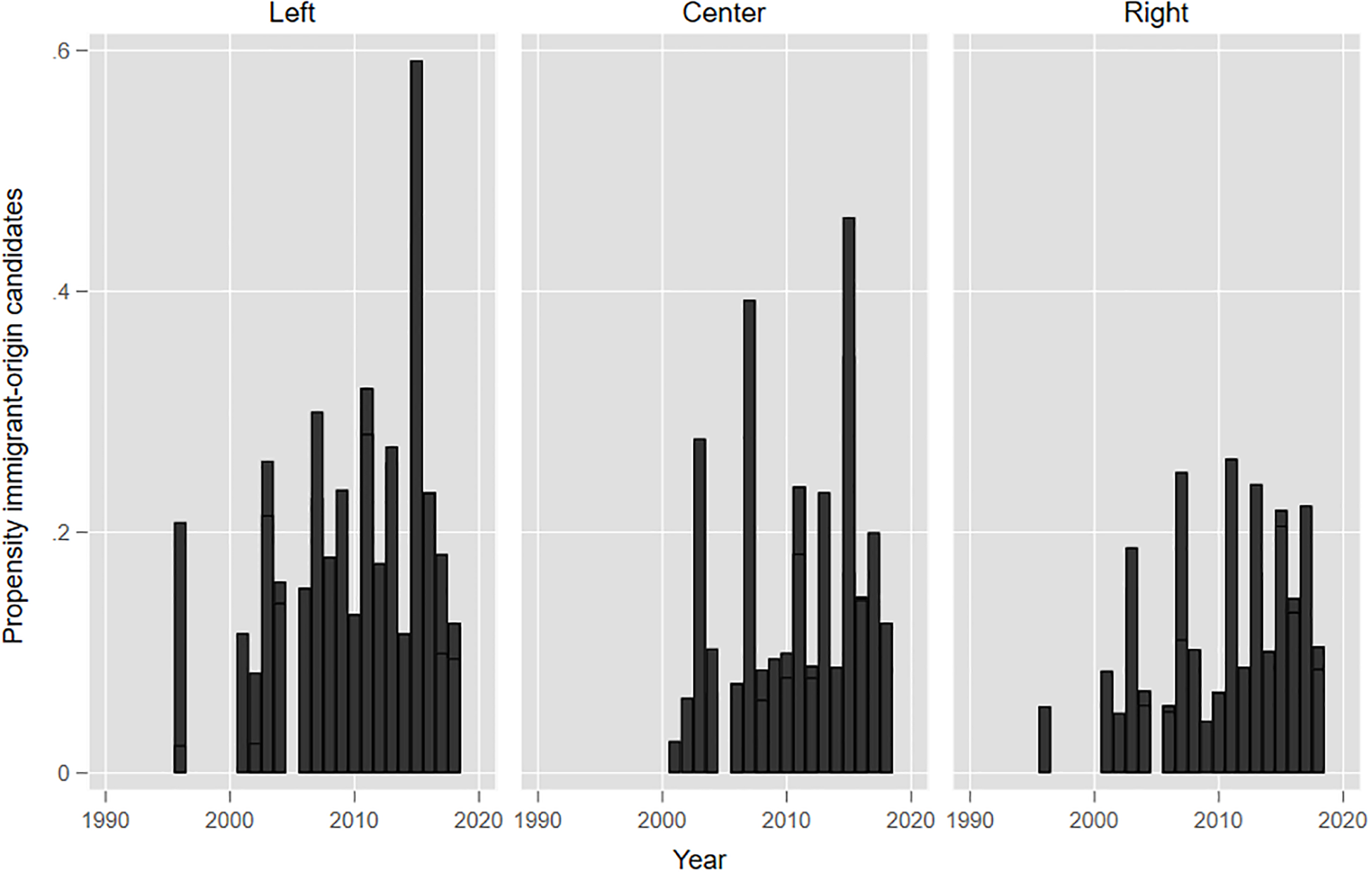
Predicted margins of foreign population by alien enfranchisement.
For the empirical analysis, I have constructed an original dataset encompassing municipal parliamentary voting lists of the seven main political parties 3 in Switzerland across 17 municipalities 4 between 1996 and 2018. Depending on data availability, the last three to six communal elections have been included. The municipalities have been chosen given their size—largest Swiss municipalities with communal parliament—and with their variation in alien enfranchisement and immigrant population size. 5 The inclusion of only the biggest municipalities with a communal parliament is important to ensure a certain comparability regarding what is at stake for the parties in terms of political power. It also adds a further control to rule out the possibility that cross-municipal variations in immigrant-origin candidates is explained by differences in the supply of potential candidates. Table 1 gives an overview of the municipalities in the dataset:
Municipalities.
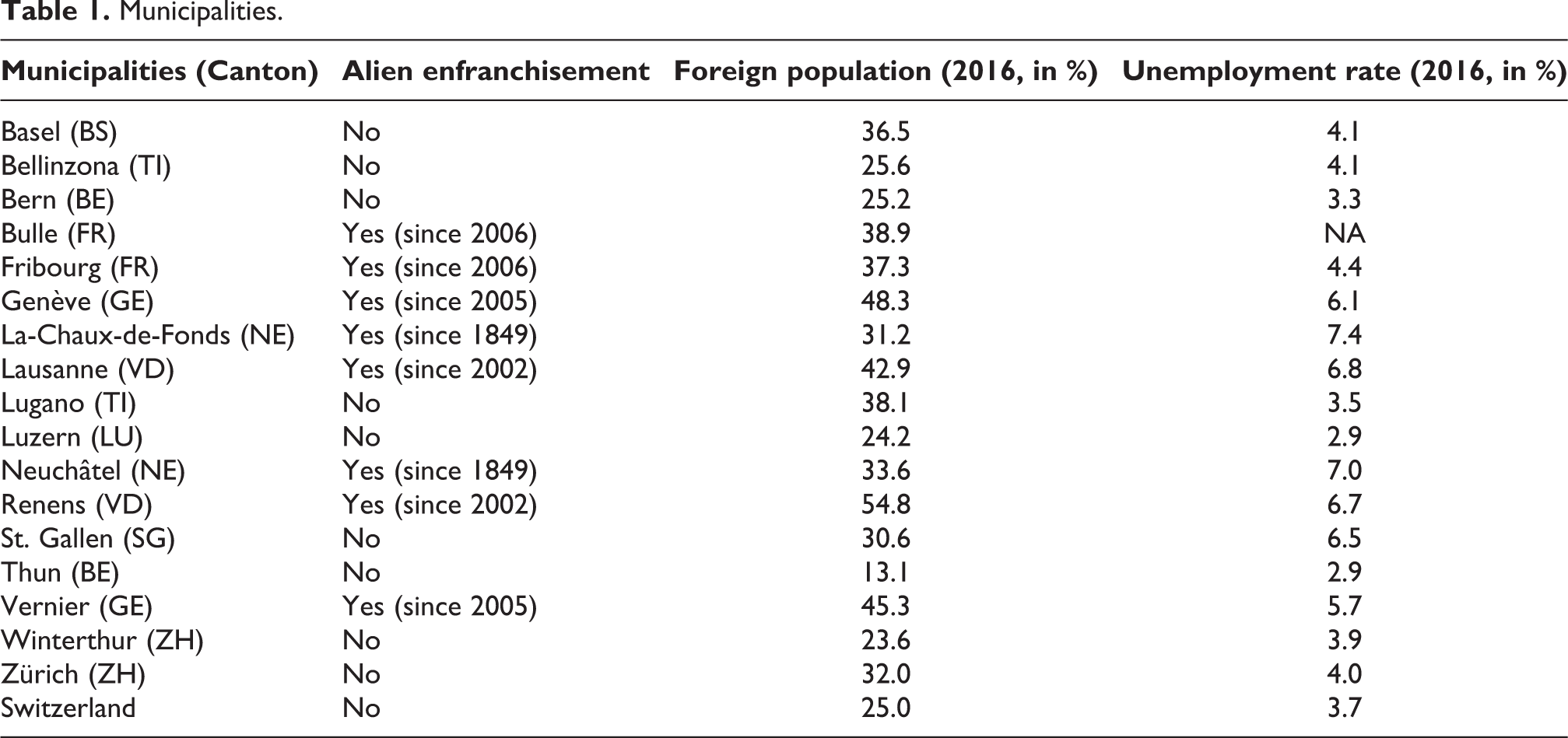
The municipalities cover all linguistic regions of Switzerland (German-, French- and Italian-speaking) to be as representative as possible. Nevertheless, it is worth noting that alien enfranchisement policies have been introduced only in French-speaking cantons (Neuchâtel, Jura, Vaud, Geneva, Fribourg), with the exception of Appenzell-Ausserrhoden and Graubünden that have adopted legislation allowing municipalities for passing alien enfranchisement. Since all municipalities with alien enfranchisement in Appenzell-Ausserrhoden and Graubünden do not have a parliament but operate under the system of a municipal assembly (“Gemeindeversammlung”), no municipality with local alien enfranchisement outside the French-speaking region of Switzerland could be added to the dataset. Yet, ensuring diversity among the selected cases, the dataset contains two municipalities for each canton with alien enfranchisement. Regarding the municipalities without alien enfranchisement, again the cases were selected to be illustrative of a variety of cantons, where only the two largest cantons (Bern, Zurich) are represented with two municipalities each. While the focus on 17 municipalities motivated by the above-mentioned reasons and a time-consuming coding strategy (see 4.2) might yield a smaller sample size (N = 573 lists), the adopted sampling strategy implies important and sufficient cross-municipal and temporal variations with regard to economic security, naturalization policies and immigrant population.
Identifying immigrant candidates
To distinguish between immigrant-origin and native candidates the paper makes use of an identification strategy established in existent work (Portmann and Stojanović, 2018). The coding methodology consists in matching data from the Historic Register of Swiss Surnames with the names of the candidates. The Historic Register contains all family names holding Swiss citizenship in at least one Swiss municipality up until 1962. Candidates were coded as immigrant-origin if their family name was absent on the register or the first record appears after 1940. Such method was applied by other scholars in similar studies despite certain drawbacks. For instance, female candidates often adopt the name of their husband upon marriage complicating the identification of origin. Moreover, given cultural and linguistic proximity, immigrant-origin candidates from neighboring countries often hold last names that are also inherent to Switzerland, therefore concealing immigrant background. This implies a potential bias of false negative coding, meaning that some candidates might be coded as Swiss given their non-immigrant sounding name despite them being of immigrant-origin. Nevertheless, this approach by name is appropriate. Since voters in Switzerland typically have very limited information regarding political candidates (first and last name, date of birth, profession, incumbency), a candidate’s name most likely provides an important heuristic shortcut that voters consider when casting their vote. Hence, even if party leaders were aware of a candidate’s immigration background, if their name does not convey such origin the expected effect (native backlash, ethnic voting among immigrant-origin voters) is unlikely, and should therefore not influence candidate nomination. For this reason, visible immigrant traits also play a minor role in the Swiss context. In addition, a consecutive study confirms that 85% of the immigrant-origin candidates identified with this strategy indeed self-indicated to have an immigration background (Portmann and Stojanović, 2021).
This strategy to identify immigrant-origin candidates doesn’t allow differentiating the extent of a candidate’s immigration experience, i.e. the definition of immigrant-origin candidates comprises of immigrants of first or second (and potentially more) generation. In some cantons, notably Fribourg, Neuchâtel, Vaud, and Jura (since 2014), non-citizens dispose of passive municipal voting rights. This implies that immigrant-origin candidates in these municipalities can but do not have to hold Swiss citizenship. In all other cases, immigrant-origin candidates are individuals of immigrant-origin with Swiss nationality.
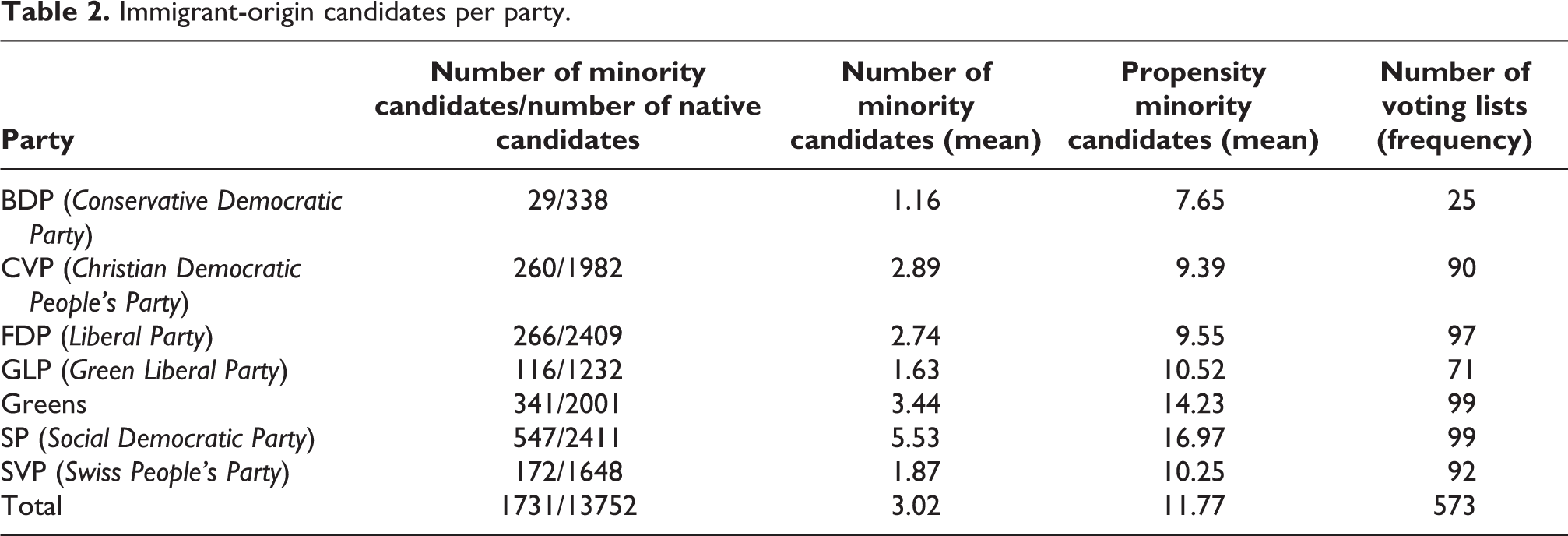
Using the name-coded party lists, I then constructed my dataset with voting list per party per year per municipality as unit of analysis. Table 2 shows that the dataset contains 1’731 minority and 13’752 native candidates on 573 voting lists. It is apparent that immigrant-origin candidates are distributed unevenly across parties: the left nominates statistically significantly more immigrant-origin candidates than center and right parties.
Immigrant-origin candidates per party.
I further refined the coding into region of origin for each immigrant-origin candidate using the online database “forebears” and cross-checking ambiguous cases on “worldnames,” again relying on the identification strategy by Portmann and Stojanovic (2018). The codes distinguish between the following regions of origin: Western European/Nordic/English, Southern European (e.g. Italian, Greek), Hispanic, Eastern European, Slavic (i.e., Slavic names from the former Yugoslavia) and Albanian, Arabic and Turkish, and other non-European (Indian, Eastern Asian, Central Asian, and non-Arab African). Figure A1 in the Appendix displays the distribution of immigrant-origin candidates by region of origin per party ideology. It is striking that center and right parties predominantly nominate Southern and Western European and Hispanic immigrants, whereas the left nominates candidates that are more diverse in terms of origin, including important numbers of candidates of Arab and other non-European origin.
Operationalization and empirical strategy
The empirical strategy involves different models where the share of immigrant-origin candidates is my main
Regarding the
The structure of the data would imply adopting a multilevel model, where parties are nested in municipalities and where we observe the same party-municipality units over time (Gelman and Hill, 2006; Portmann and Stojanović, 2018). Therefore, a three-level multilevel model would be appropriate. However, the sample had to be restricted to 17 municipalities due to the time-consuming data gathering. Hence, the number of observations on each level are too low for such multi-level design. Consequently, the models in this paper apply OLS regressions with municipality clustered standard error terms, further using year fixed effects to address the panel structure of the data. It is worth noting that this empirical strategy might lead to type-II errors and that I refrain from using municipality fixed effects due to the use of municipal-level independent variables (e.g. alien enfranchisement, naturalization rates).
Results
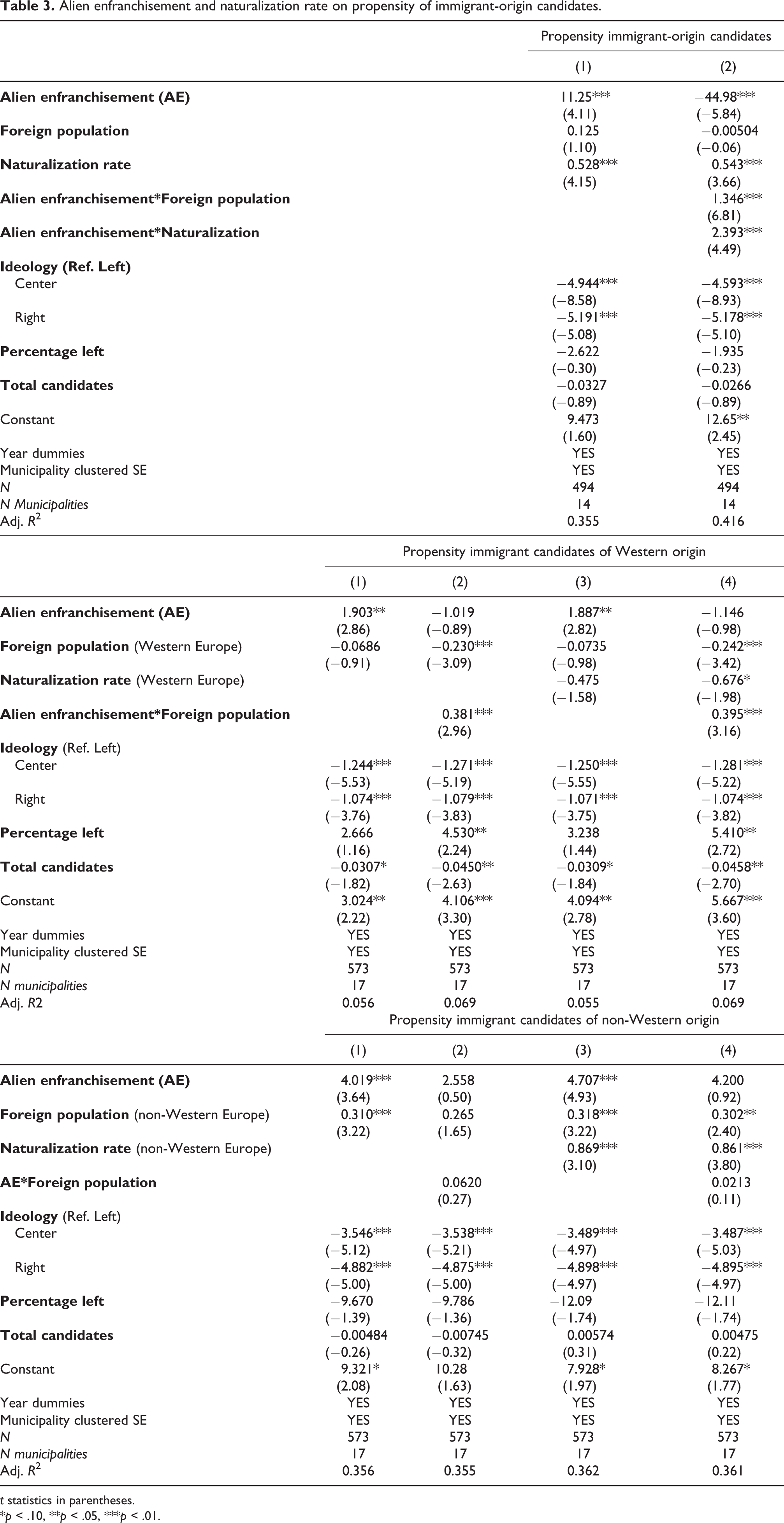
Alien enfranchisement and naturalization rate on propensity of immigrant-origin candidates.
t statistics in parentheses.
*p < .10, **p < .05, ***p < .01.
Table 3 shows the regression results of alien enfranchisement and naturalization policies on the share of immigrant-origin candidates. The analysis supports the hypothesis that parties strategically nominate immigrant-origin candidates in voting districts with
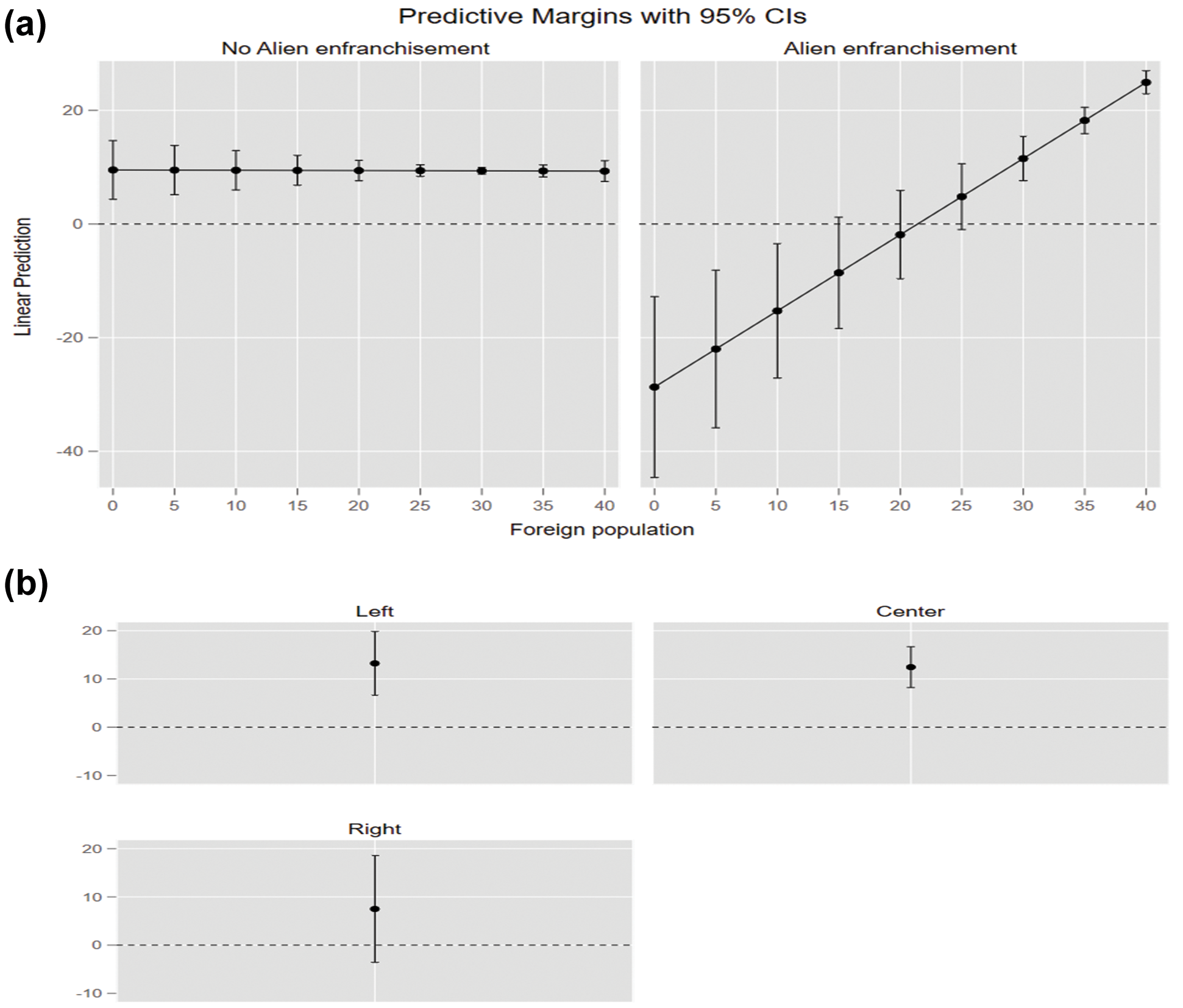
Average marginal effects alien enfranchisement by party ideology.
Figure 2(b) presents the average marginal effect (AME) of alien enfranchisement by political ideology. The findings suggest that the AME of alien enfranchisement on the share of immigrant-origin candidates are positive and strongly statistically significant for left and center parties, still positive but not significant at the 95%-level for the political right. I conclude that alien enfranchisement enhances parties’ nomination of immigrant-origin candidates independent of political ideology, yet with the right being somewhat less reactive.
Similar results are found regarding
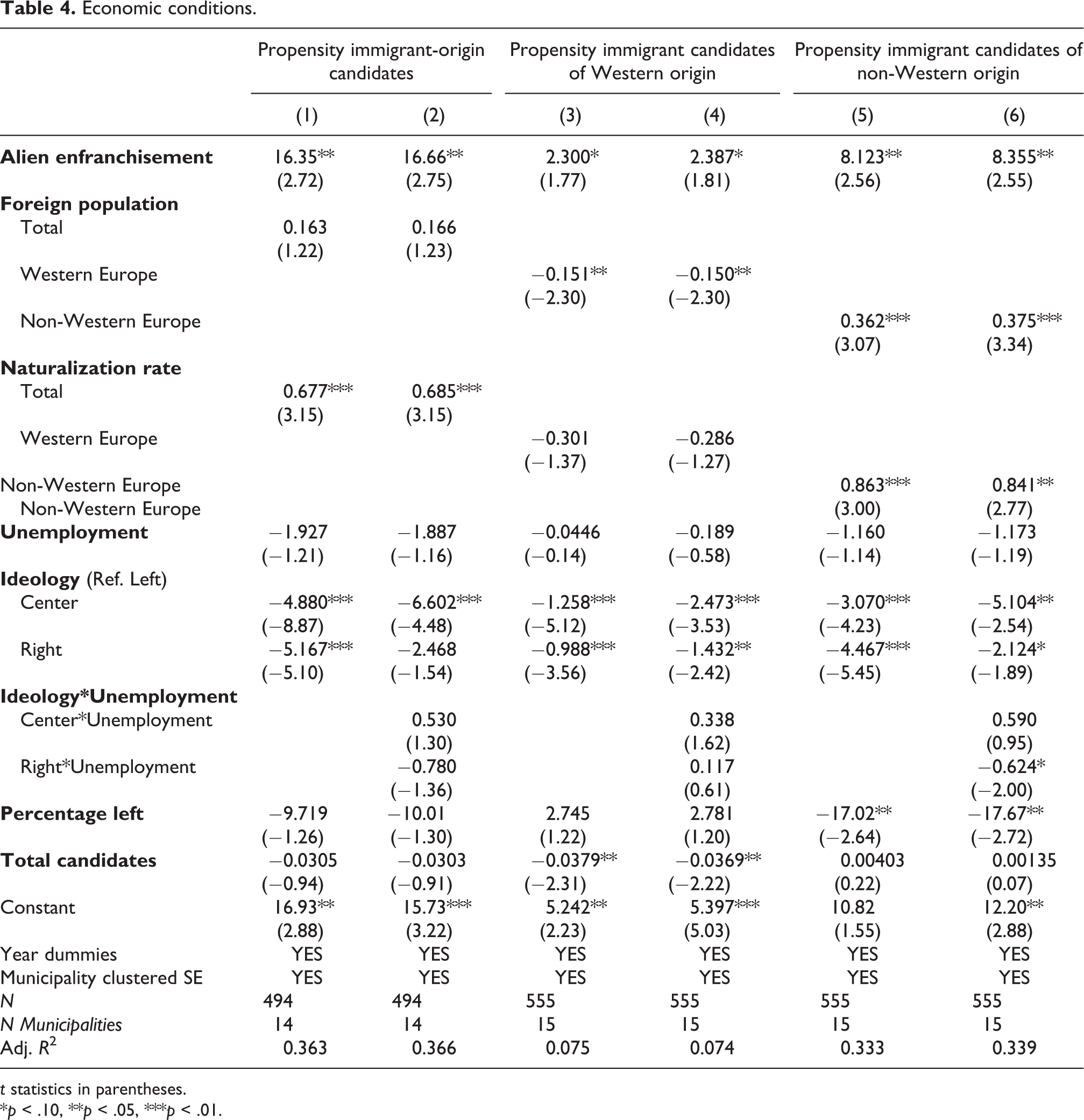
Economic conditions.
t statistics in parentheses.
*p < .10, **p < .05, ***p < .01.
Turning to
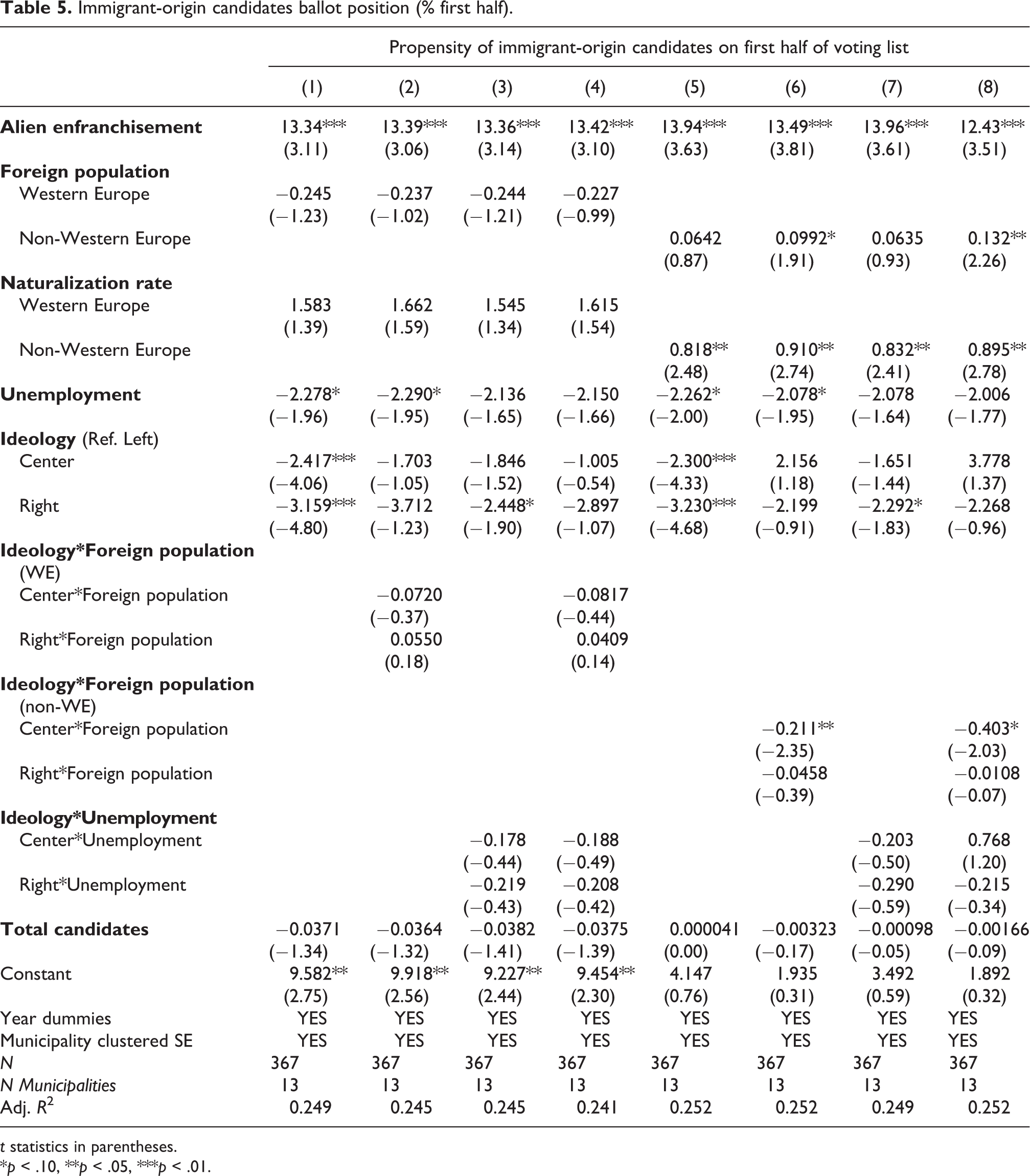
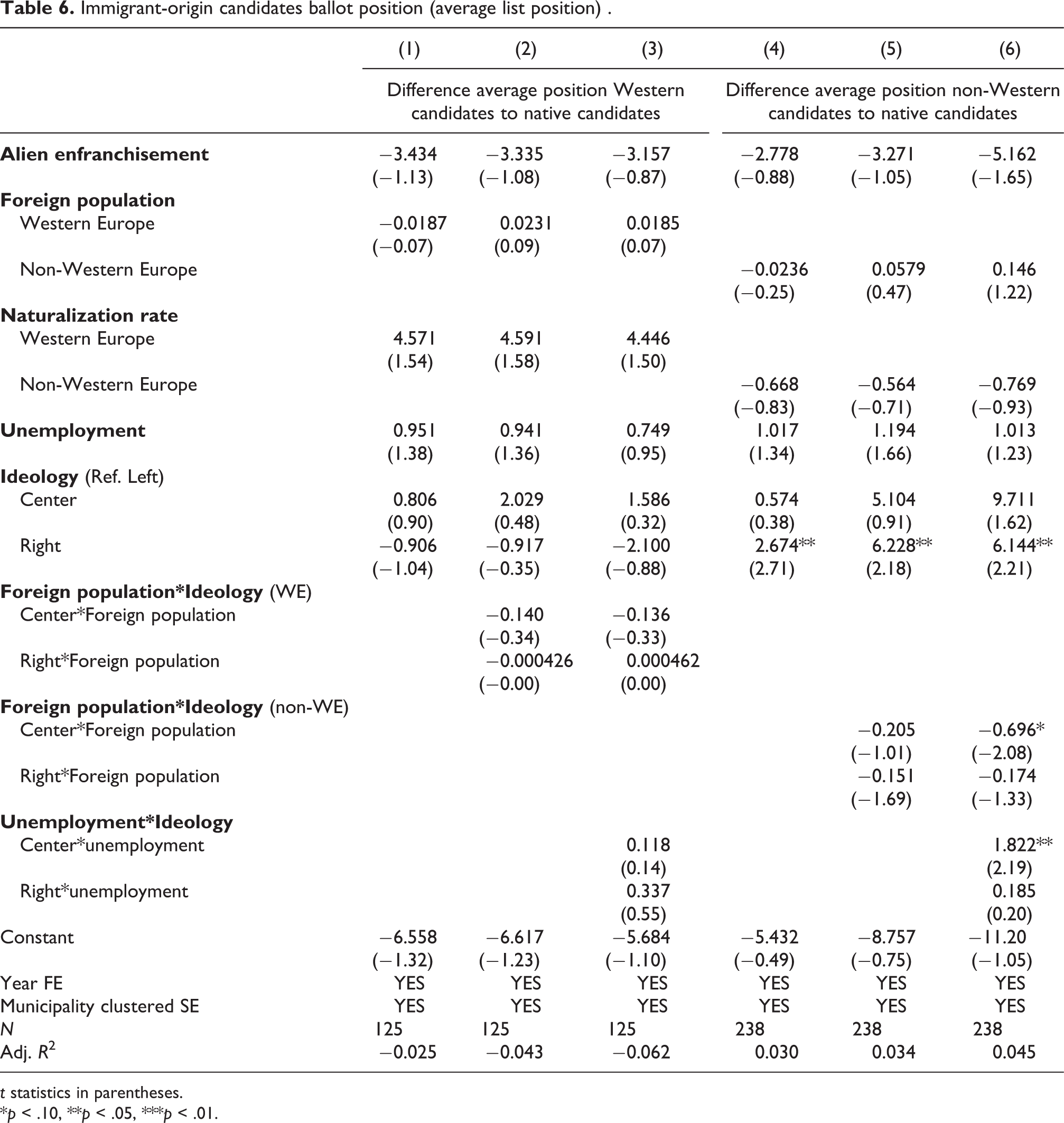
Turning now to the ballot position, Tables 5 and 6 display the results for this alternative dependent variable. It is worth noting that certain municipalities require candidates to be listed alphabetically on voting lists. Since these parties are not free to decide on candidates’ list position and can therefore not use ballot positioning as signal for support of an individual candidate, these municipalities have been excluded for these analyses.
Immigrant-origin candidates ballot position (% first half).
t statistics in parentheses.
*p < .10, **p < .05, ***p < .01.
Immigrant-origin candidates ballot position (average list position) .
t statistics in parentheses.
*p < .10, **p < .05, ***p < .01.
The results support the tendencies observed in the previous analysis, suggesting that parties engage in strategic list positioning of immigrant-origin candidates in reaction to contextual factors. Alien enfranchisement boosts the propensity of immigrant-origin candidates in the upper half of the voting list significantly across all specified models in Table 5 by roughly 13 percentage points or more. Moreover, higher naturalization rates correlate positively with the propensity of particularly non-Western origin immigrant candidates in the upper half of the ballot. However, an anticipated negative backlash in contexts of high unemployment makes parties move immigrant-origin candidates on lower, disadvantaged list positions. Similar tendencies are observed regarding the differences in average list position of immigrant-origin and native candidates in Table 6, again particularly for non-Western origin candidates. More unemployment tends to increase while alien enfranchisement and larger immigrant population seem to reduce differences in ballot position. Table A11 in the Appendix further shows that these trends become statistically significant when looking at overall naturalization rates and foreign population without differentiating region of origin. Hence, the results suggest that parties strategically place immigrant-origin candidates on higher ballot positions from which they are more likely to be elected (Lutz, 2010) when electoral policies facilitate political mobilization of immigrant-origin electorates and economic conditions limit a native backlash.
Conclusion
The purpose of this paper was to investigate how contextual factors shape parties’ immigrant political representation. I argued that the nomination of immigrant-origin candidates is a product of strategic calculations by parties how ethnic voting induced vote gains among immigrant voters compare to a potential native backlash against immigrant-origin candidates. Specifically, I conveyed that public policies which define immigrant political rights through alien enfranchisement and access to citizenship are important incentive mechanisms for parties to nominate immigrant-origin candidates. Likewise, I argued that economic insecurities bring in the potential of material threat perceptions and a native backlash against immigrant representatives consequently reducing immigrant-origin candidates. Using a new dataset on candidates to Swiss municipal elections from 1996 to 2018, the empirical analysis revealed that political parties’ strategies to nominate immigrant-origin candidates are indeed constrained by the political and economic context.
This paper makes several contributions to the literature on party politics, political representation, and migration studies. First, the findings here have significant implications for the understanding of strategic behaviors of political parties and for the promotion of minority representation. It provides a deeper insight into parties’ candidate nomination processes in immigrant-driven Western democracies. More precisely, the study complements recent work by providing a new theoretical framework that combines party level interest calculations with macro-level institutional factors to explain immigrant political integration and representation. I outline a more nuanced theory of how alien enfranchisement, naturalization policies, and economic conditions shape candidate nomination in ethnically diverse democracies. Second, this study expands previous research by focusing on how political actors and public policies are intertwined when it comes to political representation of immigrants and potentially other minorities. On a practical note, several European countries are currently debating over the adoption of alien enfranchisement and reevaluating their naturalization policies. I find that such policies can entail positive externalities in boosting immigrant representation, by incentivizing parties to actively mobilize immigrant-origin voters through the selection of candidates with whom they identify. Third, applying classic literature on candidate selection to the study of immigrant representation and in contrast to previous research, this paper suggests that parties not only use the nomination of immigrant-origin candidates per se as a signal of immigrant inclusion but also their list position. These findings are of political importance, given recent evidence advancing that advantageous list positions of immigrant-origin candidates improves immigrant political representation importantly (Van Trappen et al., 2021). Fourth, the construction and use of a new dataset on municipal elections in Switzerland empirically adds to the literature as it has enabled and provided first empirical evidence of these new theoretical contributions. The paper makes use of a within-case comparative approach that, unlike other studies (Dancygier, 2017), allows for controlling other potential confounding factors such as the electoral system. Additionally, the dataset is among the first to allow differentiating nomination strategies of immigrant candidates of various region of origin. Finally, the findings of this study lay the groundwork for future research agendas. A natural progression of this work would be to investigate the link between public policies and parties’ representation of other minorities. Moreover, future research could explore how the political and economic context relates to other aspects of immigrant representation. For instance, another study could investigate how alien enfranchisement and naturalization translate not only into immigrant-origin candidates but also immigrant representatives or focus on more qualitative evidence of parties’ consideration of immigrant candidacy.
Supplemental material
Supplemental Material, sj-pdf-1-ppq-10.1177_13540688211035025 - Nomination trade-offs: How context affects political parties’ strategies to nominate immigrant-origin candidates
Supplemental Material, sj-pdf-1-ppq-10.1177_13540688211035025 for Nomination trade-offs: How context affects political parties’ strategies to nominate immigrant-origin candidates by Anna-Lena Nadler in Party Politics
Footnotes
Acknowledgments
Earlier versions of this paper were presented at the EPSA Annual Conference (2020), the IMISCOE Annual Conference (2020), the “Unequal Democracies meets Welfarepriorities” Workshop (2019), and the NCCR-on-the-move Research Day (2020). I would like to thank all panel participants, especially Jonas Pontusson, Elif Kayran, and Nenad Stojanovic, for their comments and suggestions.
Declaration of conflicting interests
The author(s) declared no potential conflicts of interest with respect to the research, authorship, and/or publication of this article.
Funding
The author(s) received no financial support for the research, authorship, and/or publication of this article.

Supplemental material
Supplemental material for this article is available online.
Notes
References
Supplementary Material
Please find the following supplemental material available below.
For Open Access articles published under a Creative Commons License, all supplemental material carries the same license as the article it is associated with.
For non-Open Access articles published, all supplemental material carries a non-exclusive license, and permission requests for re-use of supplemental material or any part of supplemental material shall be sent directly to the copyright owner as specified in the copyright notice associated with the article.
