




Abstract
Party finance allows elucidating parties’ behaviour in differing political and institutional contexts, yet only a few studies investigate expenditure patterns. Given that campaign activities are central for parties to fulfil their core functions in representative democracy, this study seeks to explain why parties invest in electoral campaigns to different degrees. We argue that high party fragmentation reinforces parties’ focus on electoral races in election years, a mechanism we refer to as the ‘campaign concentration effect’. By contrast, in less fragmented systems, parties invest more in campaigning on a continuous basis. A subnational analysis of the German party system between 2009 and 2017 provides evidence for this effect. Our results imply that growing party fragmentation nurtures parties’ efforts to succeed in elections, which is likely to intensify parties’ orientation towards short yet capital-intensive campaigns.
Introduction
In representative democracies, parties are critical for mediating between the governed and governors (White, 2006: 5). Therefore, research into the relationship between parties and citizens has been a dominant angle in studies that, among others, examined party positions, manifestos, membership and participation (O’Grady and Abou-Chadi, 2019; Spoon and Klüver, 2014; Wagner, 2016). Within this rich body of research, however, studies investigating patterns in parties’ finances are scarce. While some studies have elucidated patterns of how party organisations finance themselves (von Arnim, 1993; Blumenberg et al., 2018; Fisher, 2011, 2018b; Jacob, 2021; McMenamin, 2013; Nassmacher, 2009; Pinto-Duschinsky, 2011), the question of how they spend money has received considerably less scholarly attention (cf. Blumenberg, 2013).
This study investigates the determinants of party expenses in dynamic, competitive environments in which parties operate, taking a hitherto overlooked perspective in previous research. Departing from Smulders and Maddens’ (2019a: 274) suggestion that ‘research […] needs to provide an in-depth assessment on how exactly parties spend their financial means’, we will address this need for inquiry by conducting a subnational analysis of German statewide parties’ branch campaign expenditures for the following reasons.
First, comparative research into party finance is plagued by unreliable and often incomparable data (Pinto-Duschinsky, 2005, 2011). While most democracies have introduced laws regulating party financing, including parties’ obligation to release financial statements to the public for transparency reasons, there are no uniform guidelines about what information parties must make public. However, the German Party Law, including provisions for financial statements, applies to all branches across regions. Campaign expenditure figures can thus be reasonably compared, allowing for substantive conclusions about spending patterns.
Second, while previous analyses have focused exclusively on national headquarters’ expenditures, the different party organisation types become evident when turning to party sublevels. In Germany, one of the few countries for which financial data are available at the subnational party level, diverging spending patterns come to the fore. Strikingly, as Figure 1 demonstrates, branches within the German statewide parties appear to deviate considerably in their expenditure patterns. 1 For instance, while the liberal FDP’s branch of Baden-Württemberg spends about 62% on day-to-day activities and 38% on campaigning, its Eastern counterpart in Brandenburg expenses slightly more than 76% on ongoing costs, and consequently less on campaigning. 2 Therefore, we conclude that parties’ spending patterns vary internally, thereby offering fertile ground for comparative empirical analyses.
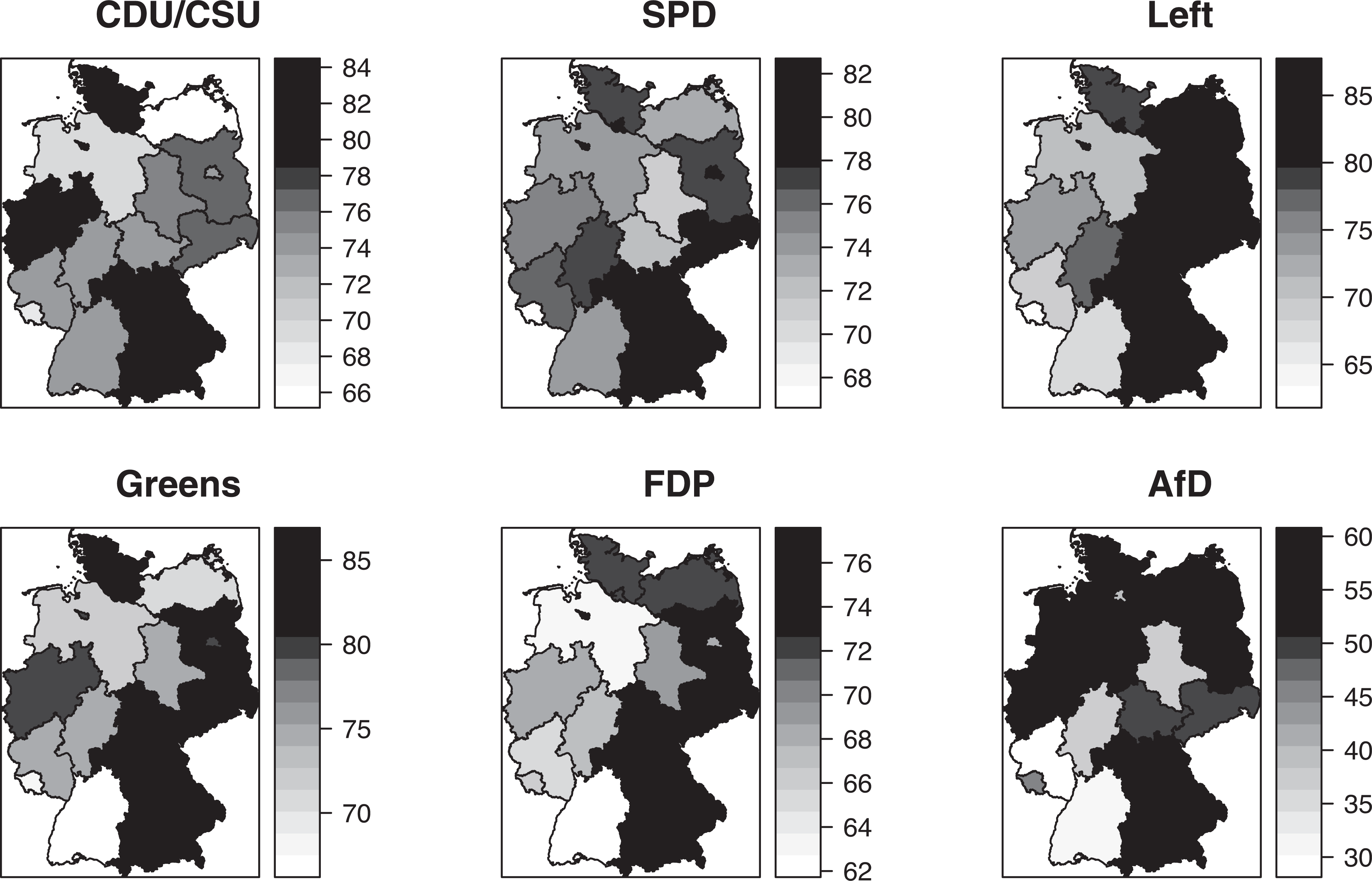
Percentage of day-to-day expenditure against campaign spending on average between 2009 and 2017 by German statewide party.
Third, as seen in Figure 1, there are remarkable differences between branches within statewide organisations, suggesting that the German party system consists of various subsystems and regional organisations (Bräuninger et al., 2020). This set, in turn, offers a promising environment for comparative inquiries. Most importantly, while the average spending levels deviate between branches, confounding contextual factors, such as the legal framework, institutions and political culture, can be held fairly constant. Furthermore, regional branches in Germany are mostly independent of federal party organisations (Lewandowsky and Jankowski, 2014). While our study is based on the German states (Länder), it also offers insights for party research more generally by providing mechanisms by which increasing fragmentation in party systems shapes parties’ campaign spending behaviour.
In this article, we argue and demonstrate empirically that branches in more fragmented party systems tend to concentrate their funds on campaigns in election years. In contrast, parties in less fragmented environments tend to distribute their resources between elections and non-election years. Based on this mechanism, the ‘campaign concentration effect’, we infer that party fragmentation nurtures parties’ focus on election years at the expense of long-term campaigning in non-election years. As most party systems in Europe become gradually more fragmented, parties’ strategic shift to short yet capital-intensive campaigns might thus further increase in the future.
In what follows, we first reflect upon parties’ functions in representative democracies. We argue that campaign spending enables us to study the extent to which parties seek to fulfil electioneering and other closely related functions in practice (Sartori, 2005). We then turn to the determinants of campaign spending levels, which mirror parties’ efforts to contribute to the functioning of representative democracy. Specifically, we evaluate the impact of party fragmentation and government participation on campaign spending and develop the ‘campaign concentration effect’. Methodologically, we leverage an original dataset on German party branches’ campaign expenditures between 2009 and 2017 and employ multilevel negative binomial regression models. Finally, this research design allows us to draw inferences about the dynamics of expenditure and, more generally, how parties operate in an ever fiercer competitive environment.
Party functions, competition and campaign expenditure
Core party functions and electoral campaigning
Most studies on party expenditure have been concerned with either scrutinising the often stated explosion of parties’ financial budgets (e.g. Nassmacher, 2009) or evaluating the relevance of spending limits in parties’ expenditure behaviour (Smulders and Maddens, 2019b). More generally, even though the broader party literature offers concepts to grasp the core components of party politics and the role of finances therein, these approaches have been mostly neglected in existing research into parties’ financial affairs. To specify the role of parties in making representative democracy work, Sartori (2005) proposed three core party functions, which he considers irreplaceable: participation, electioneering and expression. In turn, these functions are closely related to parties’ expenditure strategies, which provide a promising empirical indicator to determine whether parties fulfil their functions in practice.
In Sartori’s (2005) approach, participation refers to the overall idea of parties being a moderator between society and government. Apart from integrating members and supporters, this function also centres on parties’ task to participate in elections, thereby enabling citizens to decide between several parties and play an active role in decision-making. This function is tightly intertwined with electioneering, which captures the mobilisation of voters. Similarly relating to electioneering, expression refers to the idea that parties actively seek to communicate with society, giving voice to societal demands and aspirations. Parties have various means to satisfy these functions, for instance, by establishing communication channels such as meetings or digital events to interact with party members and (potential) voters.
Electoral campaigns are vital for party organisations to carry out their core functions within all of these three domains. Campaigns can boost the overall voter turnout or de-mobilise voters if poorly performed (Anduiza-Perea, 2005; Kahn and Kenney, 1999). A ‘lack of drama’ in election campaigns, unclear messaging or failure in reaching out to citizens by presenting ambiguous policy proposals may too have a detrimental effect on turnout (Trumm and Sudulich, 2018), as well as the quality of decision-making in the political process (e.g. Krewel et al., 2011). As a growing number of voters decides for whom to vote shortly before elections, parties’ communication strategies with citizens are essential for mobilising at polling day and offering policy proposals to voters. Moreover, contested political races require party personnel and resources to react spontaneously to developments such as attacks from political opponents (Wagner and Lichteblau, 2020). In the wake of increasing electoral volatility (Whitehead, 2005: 21), the role of campaigning is likely to stay if not to expand in the future.
Over the last decades, parties have steadily professionalised their campaign techniques, for instance, by specifying and targeting messages to increase support and turnout (Gibson and Römmele, 2009). In addition, party headquarters have been increasingly concerned with monitoring opinion polls and opponents’ behaviour (Farrell, 2006). Campaigning has also shifted from mainly communicating policy proposals to a more interactive engagement with supporters and citizens, which became more feasible with the rise of online platforms and social media (Gibson and Römmele, 2009; Michels and Borucki, 2021).
Naturally, campaigning is an expensive matter (Gibson and Römmele, 2009). As parties’ financial resources are limited, the extent to which parties invest in campaigns allows for drawing conclusions about party behaviour. In this sense, higher campaign expenditure indicates that parties commit to the importance of campaigning in representative democracy. By contrast, lower investments in campaigning suggest that parties are less willing, or less able due to financial constraints, to fulfil their core functions. With this study, we seek to shed light on the determinants of campaign spending, which we define as the amount of money parties spend in addition to maintaining their organisational structure to gain votes. In the next section, we derive several explanatory factors of campaign expenditure levels from the party literature and propose the ‘campaign concentration effect’, which we then put to the empirical test.
What affects parties’ campaign spending levels?
As we have argued, election campaigns are crucial for parties to carry out their core functions. At the same time, this argument begs the question about the determinants of parties’ efforts to fulfil these functions. Party expenditures provide a good proxy of the extent to which the organisation invests in participating in political competition. Previous scholarship has suggested two main factors influencing party expenditure, namely the form of political competition and governmental status (Smulders and Maddens, 2019a, 2019b).
One key characteristic of established democracies is the competition between political opponents, most notably, party organisations. In the wake of weakening long-term citizen-party ties, a process coined dealignment (Dalton et al., 2000), appealing to swing voters has increasingly been considered one of the main challenges that parties face in contemporary politics (Detterbeck and Renzsch, 2004). Since voters have become more inclined to vote for different parties from one election to the next, parties’ margins to influence the electoral outcome increased substantially.
Party finance research has mainly focused on first-past-the-post systems (FPTP), which are usually characterised by a race between two candidates seeking to gain as many votes as possible vis-à-vis their opponents. In the United Kingdom, where FPTP is employed, constituencies vary in their competitiveness in that some are highly contested between the two principal parties, while others are firmly held by one of the two. These varying degrees of competition allow for investigating the effects of campaign intensity in comparatively contested constituencies compared to those in which a capital-intensive electoral campaign is unlikely to change the candidates’ odds to win (Fieldhouse et al., 2019). Empirical evidence suggests that candidates standing in constituencies with marginal seats tend to receive more donations and thus have more means at their disposal to run a costly campaign, which may finally set them apart from their competitors (Johnston and Pattie, 2007).
Tailoring this mechanism to parties’ expenditure strategies, we would expect parties to invest more in campaigning when party competition is fierce. Political competition takes a different fashion in proportional representation (PR) electoral systems, commonly marked by multipolar party systems and larger electoral districts. In PR systems, the level of party fragmentation, defined as ‘the degree to which votes are scattered across minor parties’ (Coleman, 1995: 141), has been identified as a determinant of the nature of party competition; amongst others, fragmentation is considered as an indicator of social cleavages, and to influence government stability (Coleman, 1995). In theory, a fragmented environment should intensify parties’ ambitions to gain as many seats as possible. If these seats are contested among many parties who have gained approximately the same vote share, we would expect parties in such settings to spend more on political activities than those embedded in less fragmented party systems.
By contrast, a relatively low number of parties and substantive differences in vote shares between parties indicate a less fragmented system. In this set, the dominating party can be fairly sure to maintain its dominant role, whereby there is little reason to expand its investment in campaigns. Likewise, smaller parties lack a realistic chance to challenge the status quo, that is, to challenge the dominant party’s position in the party system by increasing its expenditure substantially. In short, in assuming parties and their leaders to behave strategically (Strom, 1990), we expect political fragmentation to nurture party expenditure:
Previous studies have provided ample evidence that parties’ finances are characterised by seasonal developments (Fisher, 2018b: 176; Hogan, 1999). Electoral cycles exert substantial effects on both income and expenditure patterns in that political activities, most importantly electoral campaigns, intensify as elections are approaching, reaching their peak in the weeks before the election. Hence, election years will increase parties’ level of campaign spending significantly. In the German context, party branches stand in elections on multiple levels, with those at the state and federal level being most critical to parties’ influence in the federal policy-making process. Therefore, we expect both federal and regional elections to boost campaign spending considerably.
However, we theorise that the effect of campaigns is conditioned on party fragmentation at the state (Länder) level. Borrowing from the assumption that marginal seats increase candidates’ and parties’ financial efforts to win the electoral race (Johnston and Pattie, 2007), party branches embedded in comparatively high party fragmentation at the state level may similarly intensify their campaign activities. Simultaneously, while most campaign funds are most likely used in election years when canvassing and other campaign activities reach their peak, parties may also invest in campaign events in non-election years. This form of electioneering is likely to foster long-term party-voter linkages yet may be less effective for appealing to volatile electorates.
As parties may run campaigns in either election years or regular periods or both, parties have different campaign finance strategies at their disposal. In theory, aiming to maximise support from undecided voters, parties could invest almost all campaign resources in the months before an upcoming election. Alternatively, other parties could seek to spread their campaign resources more between election years and in-between periods, intending to build up and maintain relatively long-term ties to voters.
We reason the level of party fragmentation to influence parties’ decision for either of these strategies. As previous research has shown, party fragmentation is determined by various factors, amongst others, institutional settings (Becher, 2016), volatile voting behaviour (van der Meer et al., 2015) and historical legacies (Grzymala-Busse, 2006). Acknowledging the multiple determinants of fragmentation, we argue that parties pursue an election-focused campaign strategy to target as many swing voters as possible shortly before the election in states with high party fragmentation. By contrast, we theorise that parties in states marked by comparatively little party fragmentation are more oriented towards establishing long-term ties to citizens, a strategy that is expected to pay off in election years because of partisan loyalty. Terming the interaction mechanism between the level of party fragmentation and parties’ focus on races in election years as ‘campaign concentration effect’, we derive the following hypotheses:
Moreover, parties’ governmental status may similarly affect spending levels. Research into electoral behaviour has found that compared with non-incumbents, incumbent parties and candidates benefit from their recognition in the public and media coverage (Egner and Stoiber, 2008; Green-Pedersen et al., 2017; Prior, 2006). Holding office might prove successful on polling day in that voters are more likely to support a politician they already know. Empirical analyses on federal elections and, more recently, in eastern German states suggest that this effect holds for party politics at the German federal and state levels (Reiser, 2013). Specifically, incumbent members of Länder parliaments (Landesparlamente) and the federal parliament tend to have a better chance of re-election than candidates running for the first time (Träger et al., 2020).
There is also evidence that government parties receive more donations than opposition parties (Fink, 2017; Lösche, 1993: 222). For one, similarly to the incumbency effect in elections, governing parties may be more salient in the political debate, whereby they might be more likely to attract citizens’ attention than political actors on the opposition benches. Moreover, business actors could support the governing party also financially because they seek to maintain ties to the government, combined with the expectation of having access to the policy-making process to facilitate conducive policies for the business sector (Fink, 2017).
By contrast, less is known about the potential incumbency effect on party expenditure. Previous research into campaign spending and incumbency effects points to somewhat different directions. On the one hand, challengers may seek to outspend incumbents to stand a better chance in elections (Jacobson, 2015). On the other hand, Smulders and Maddens (2019a) provide evidence that the duration of governmental participation tends to increase parties’ percentage expenses on payrolls in several European democracies. The question remains whether this holds for absolute expense figures too. It may be the case that incumbent parties spend less on electoral campaigning or other expenses, such as organising party events on the ground, increasing the percentage of staff expenditure vis-à-vis the other expenditure types.
Furthermore, participation in state governments is critical in the German federal system, where state governments are represented in the Federal Council (Bundesrat). Losing an election can change a parties’ political influence in Germany’s second chamber and its ability to impact federal policy-making. In this line of argument, government parties may have a strong interest in maintaining their incumbency status in state governments (e.g. Harle and Stecker, 2011). Moreover, elections in subnational states often have a highly symbolic relevance for statewide parties, especially with other elections approaching in other states and at the federal level (Olsen, 2012). Given the inconclusive evidence in previous research, we derive two competing expectations for our empirical analysis. Adapting Smulders and Maddens’ (2019a) findings to campaign spending, we hypothesise:
Alternatively, one may argue that opposition parties, seeking to perform better at the next election to take over government, may spend considerably more on campaign activities than governmental parties. In contrast to parties in government, an elaborated and capital-intensive campaign might become a suitable expenditure strategy for opposition parties who cannot benefit from the status of being part of the government. As a result, opposition parties may prefer more costly electoral campaigns while not being in government. We thus hypothesise an alternative relationship between governmental status and expenditure levels:
Research design
This section develops a research design for testing the derived hypotheses against financial data from German state branches. The German federal system provides a singular opportunity to investigate party expenditure patterns due to the numerous branches of statewide parties. Most importantly, the party organisations are ‘relatively decentralised’ (Saalfeld, 2000: 98), whereby the regional party branches in the states (Länder) enjoy considerable autonomy over their programmatic orientation and organisational structure. The relative independence also applies to party branches’ financial means, which Detterbeck (2012: 145) considers as ‘well developed’. At the same time, statewide parties vary in the extent to which they are (de-)centralised. While the CDU’s branches have gained financial strength over the last decades, the SPD’s and FDP’s national headquarters increased their party expenditure vis-à-vis the regional and local branches. By contrast, the Greens’ organisational structure, compared with the regional branches and national headquarters, is characterised by well-equipped local party units (Saalfeld, 2000: 98).
As already raised in the introduction, party finance research needs to consider diverging accounting systems between various polities. Crucially, in cross-country studies, regulations regarding parties’ account statements often vary, resulting in potentially incomparable revenue and expenditure figures. To account for these potential inaccuracies in financial data, we focus our empirical analysis on the German system while exploiting the relatively strong comparability of account statements between and within parties embedded in a polity with similar finance regulations (cf. Cordes, 2002). In this sense, compared with cross-country studies, Germany’s state level offers a ‘laboratory’ for comparative analyses. That is, multiple potential confounders, most notably the institutional environment, can be held constant while estimating the effects of varying variables of interest (Freitag and Vatter, 2008: 17; see also Giraudy et al., 2019).
Besides the shared institutional context in which branches operate, parties’ financial reports are mostly comparable. As the statewide parties’ headquarters are in charge of drafting the account statement and submitting the final statement for all regional branches to the President of the Bundestag (federal parliament), it is likely that accounting procedures resemble one another from one branch to another. Nonetheless, accounting inaccuracies cannot be fully remedied in empirical analyses but the overall patterns can be considered reasonably reliable.
The dependent variable, party branches’ campaign expenditures, 3 is taken from the annually released account statements published at the Bundestag’s webpage (Deutscher Bundestag, n.d.). Measured in euro per year, the variable encompasses all material expenses related to electoral campaigns at the regional and local level. Not included are everyday expenses such as on staff payrolls, ongoing material costs and political labour (e.g. events for party members). With this variable, we tap the extent to which branches are financially engaging in electoral campaigns, which Sartori (2005) considers a central function of party organisations. Given the seasonal patterns campaign expenditures follow, our original dataset covers the period between 2009 and 2017. 4 We study two complete electoral cycles at the federal level, including at least two elections in each of the states. Overall, the data consists of 791 branch observations nested in 6 statewide parties (CDU, SPD, Greens, FDP, The Left, AfD) and 16 states (Länder). As the AfD was established in 2013, the observations on that party’s branches only cover 5 years. 5 The CSU, a regional Bavarian party collaborating with the CDU, has been omitted from the analysis. Unlike the other statewide parties, this party does not run a national headquarters, whereby this regional party’s internal structure deviates substantially from other statewide organisations.
We operationalise the independent variables with the following measures. To gauge the degree of party fragmentation at the regional level, we calculated the effective number of electoral parties
In addition to these competition-related independent variables, we require control variables taking account of potentially confounding effects that cannot be traced back to our independent variables. Most crucially, party expenditures and campaign spending are likely to be affected by branches’ income levels (Fisher, 2018a). Investigating the various determinants of parties’ expenditure level, Smulders and Maddens (2019a) incorporate parties’ total income into the predictors of the expenditure outcome variable. We follow this approach by controlling for branches’ income, yet only for dues and donations; the sum of the other relevant income source, state funding, is not added to this variable, as public subsidies are redistributed via the national party organisation to a considerable extent (Detterbeck, 2012: 145). Nevertheless, as previous research has pointed to a large degree of independence of regional branches (Lewandowsky and Jankowski, 2014), we reason that branches’ income from fees, mandate holders’ contributions and donations approximate branches’ self-generated income.
To take account of the nested structure of the data, we employ multilevel negative binomial regression models. Since the outcome variable, campaign expenditure per annum in euro, is highly overdispersed, 6 negative binomial models (Hardin and Hilbe, 2007: 199–220) are feasible for estimating the effects on monetary count data (cf. McMenamin, 2020). Because the observations (branches’ annual campaign expenses) are nested within parties by states (Länder), we furthermore define random effects (i) for parties nested in states (N = 96), (ii) years (N = 9), and (iii) states (N = 16). In doing so, we account for potential exogenous biases due to idiosyncratic effects related to party branches, states and time. Lastly, we adjust our data to German inflation rates provided by the World Bank (2021).
Results
We begin our empirical analysis by investigating the ratio of campaign funds spent in state and federal election years, respectively, to those spent in non-election years. To scrutinise the campaign concentration hypothesis, we plot the ratios for each party branch against the average ENEP in Figure 2. The bivariate plots show a positive relationship between the average ENEP and the share of campaign funds spent in state election years. However, this pattern does not hold for federal election years, suggesting that party system fragmentation only affects the concentration of campaign funds on election years at the state level. Linear regression models with fixed effects for parties and states support these visual patterns (see Supplemental Material C): While the average ENEP turns out to be a significant predictor of a higher share of campaign funds spent in state election years, it is not associated with a higher ratio of money spent in federal election years.
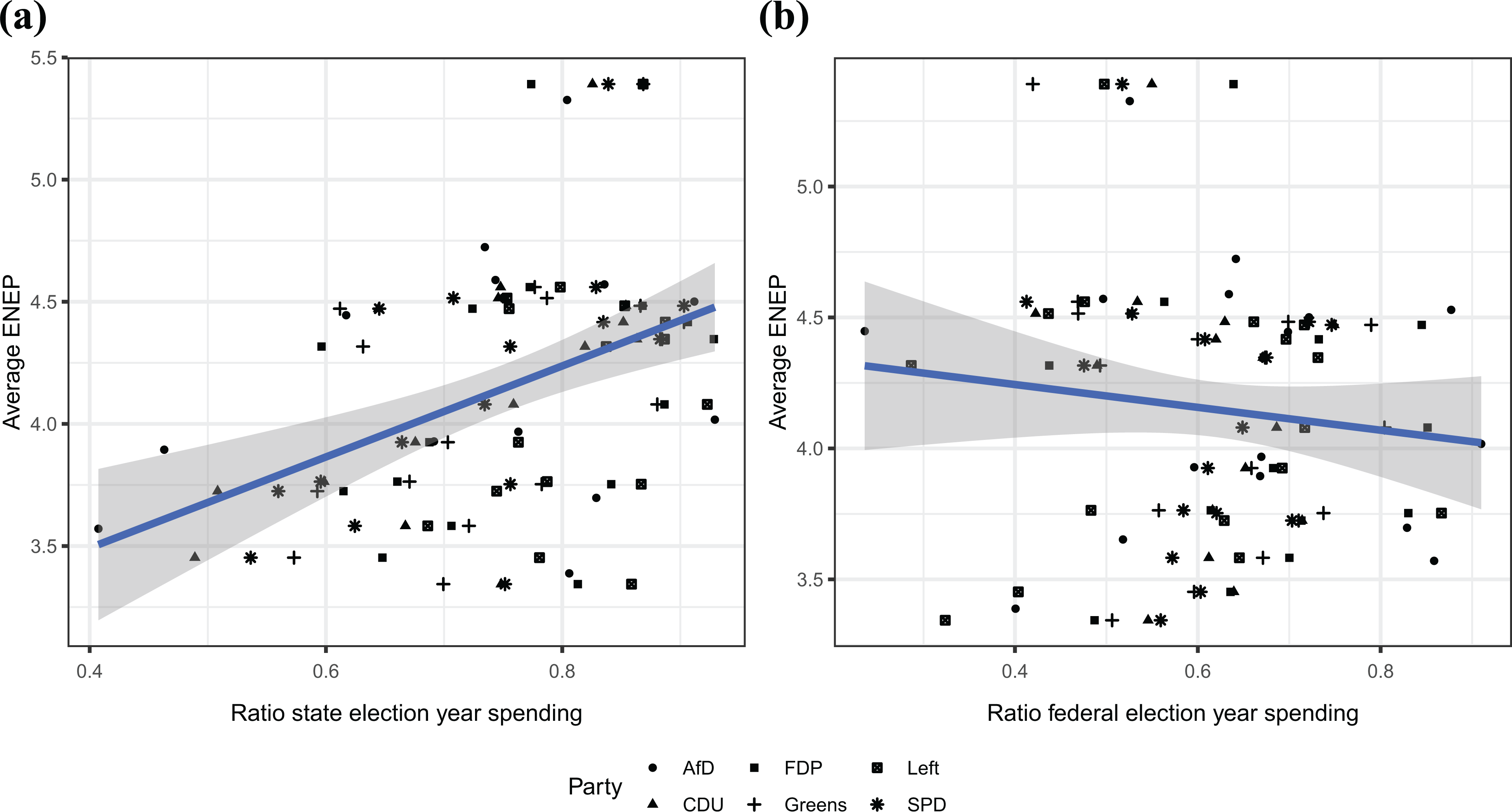
Ratio of campaign expenditure spent in (a) state and (b) federal election years against average state effective number of electoral parties (ENEP).
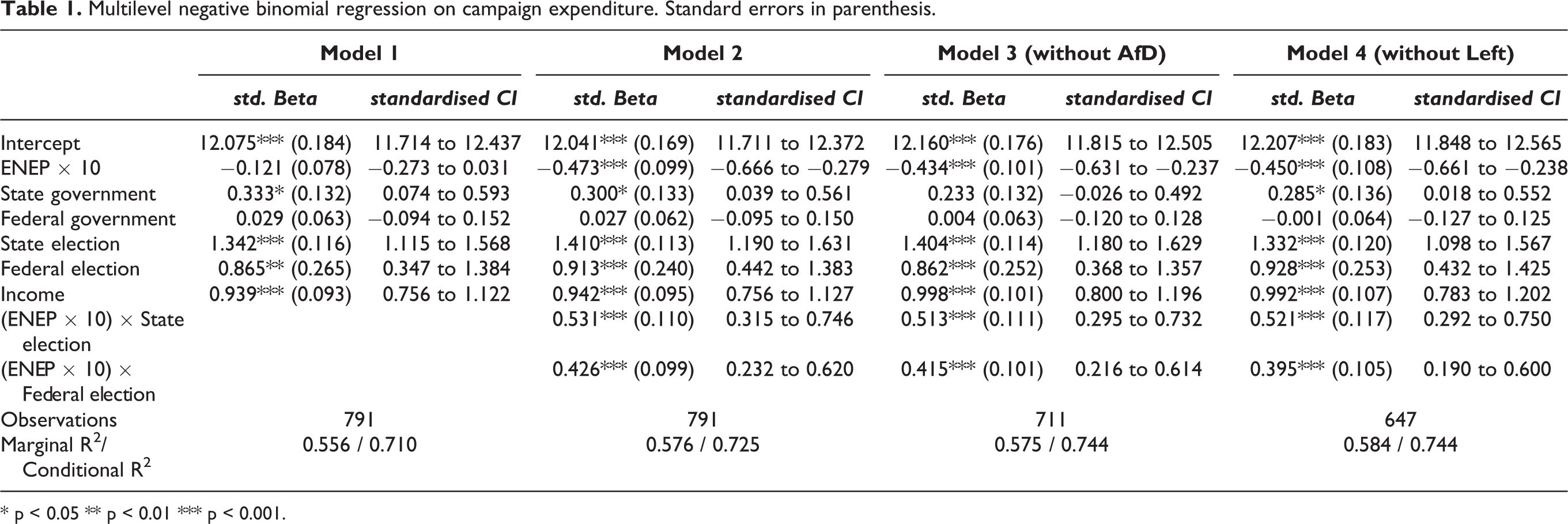
Turning to the multivariate analysis, Table 1 shows the results of the multilevel negative binomial models. In Model 1, we added all variables except the interaction terms to the regression equation. The standardised coefficients indicate that state elections exert the most substantial effect on campaign expenditures, followed by branches’ income and federal elections. Further, branches in state government appear to spend more on campaigns than opposition branches.
Multilevel negative binomial regression on campaign expenditure. Standard errors in parenthesis.
* p < 0.05 ** p < 0.01 *** p < 0.001.
Further, we added the interactions terms to the regression equation (Model 2). The effects for state election (β = 1.410), federal elections (β = 0.913), and income (β = 0.942) remain statistically significant, with the order of effect sizes remaining similar to Model 1. However, the interaction effects reveal other patterns in branches’ expenditure levels. First, the interaction effect between the effective number of electoral parties (ENEP) and state elections yields a significant coefficient (β = 0.531), suggesting that branches in fragmented party systems spend on average more on campaigning in election years than those in less fragmented environments. Second, similar to state elections, branches embedded in higher party fragmentation invest on average more in campaigning in federal election years than their counterparts in less fragmented systems (β = 0.426). To assess the substantive effects of the two interaction terms, Figure 3 shows the predicted counts of campaign expenditure while varying the fragmentation level measured by ENEP in state elections (a) and federal elections (b), respectively. The predicted counts reveal that from branches in states with the lowest ENEP to that with the highest, branches’ campaign expenditure converges from slightly less than 500,000 to less than 100,000 euro in non-election years. A similar decrease can be identified for federal elections.
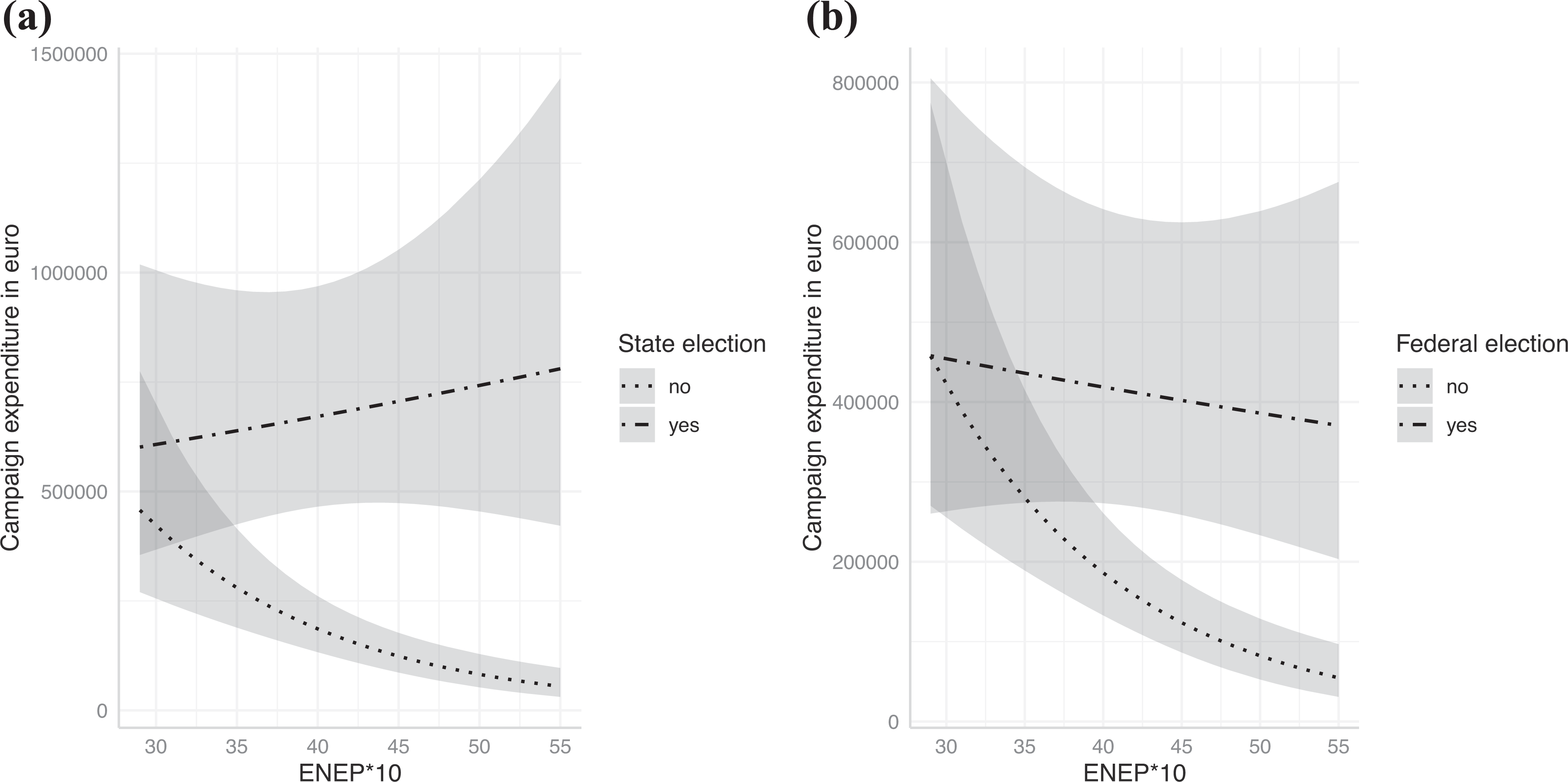
Predicted counts (campaign expenditure in euro) for interaction with the effective number of electoral parties (ENEP) and (a) state elections and (b) federal elections with 95% confidence intervals.
At the same time, the effect of ENEP on branch expenditure levels becomes significant (p < 0.001) and yields a negative coefficient (β = −0.473), indicating that, in general, branches in more fragmented party systems spend on average less on campaigning than those in less fragmented systems. Interpreting this effect in light of the interaction effects, it appears that branches operating in high state fragmentation on average invest less in electoral campaigning. By contrast, compared with parties in less fragmented environments, branches spend considerably more in election years than in non-election periods.
To further substantiate our findings, we ran models dropping observations of the AfD (Model 3) and The Left (Model 4) from the sample. As the AfD was established in 2013, and thereby considerably later than the other parties, the observations for AfD’s newly founded branches might bias the results found in the whole sample. However, the results without AfD branch observations yield similar patterns to Model 2, except for the state government effect, which becomes insignificant in the smaller sample.
In a similar vein, since The Left is considerably better organised in Eastern than in Western branches, we removed The Left branches in an additional model (Model 4). Similar to Model 3, the reduced sample does not change the results based on the total sample (Model 2), yet, unlike in the model without AfD branches (Model 3), the effect of state government participation turns out to stand the significance test.
Lastly, we tested the robustness of our findings by investigating the random effects, selecting alternative samples and using alternative control variables. First, examining the random intercepts of each party branch, we do not find any branch that, taking the fixed effects into account, deviates significantly from its counterparts (see Supplemental Material D). Second, in addition to Models 3 and 4, we systematically dropped all branches of each statewide party from the sample to estimate the extent to which our results hinge on the parties included in our analysis (see Supplemental Material E). The tests suggest that the effects identified based on the entire sample also hold for subsamples irrespective of which statewide party’s branches are excluded. Third, we used alternative variables other than party income as controls for contextual effects (see Supplemental Material F). Precisely, we alternatively control for states’ GDP and inhabitants. These models confirm the effects of both state and federal elections and the interaction terms with the ENEP. However, regarding government participation, the effect of state government does not hold when controlling for state inhabitants. Yet, federal government participation stands the significance test when controlling for state inhabitants and state GDP. We conclude that the effect of branches in state and federal government is not entirely consistent across alternative model specifications.
Discussion: Evidence for the ‘campaign concentration effect’
What do the empirical findings imply for our theoretical expectations derived from the literature? First, we assumed that the effective number of electoral parties, indicating intense or low party fragmentation, affects parties’ campaign spending (H1) (Smulders and Maddens, 2019b). In this line of argument, a higher ENEP should increase branches’ campaign expenditures. However, in contrast to our expectations (H1), our results suggest a negative effect of party fragmentation on campaign spending. Puzzling at first sight, this result implies that parties in less fragmented settings spend, on average, more on campaigning than their counterparts operating in more fragmented environments. This pattern might occur because branches in a fragmented party system, in which multiple organisations vie for citizen support, tend to generate less income. Consequently, branches in such environments are restricted in their financial latitude compared with less fragmented party systems, resulting in generally lower levels of campaign expenditure.
In line with our theoretical expectations, both state and federal elections increased parties’ campaign spending substantially. Considering the importance of elections for vote-, policy- and office-seeking (Pedersen, 2012), the substantive effect of elections does not come as a surprise. This finding points to the fact that parties do not permanently invest in campaign efforts but focus on electoral campaigns. Put in another way, party branches abstain from continuously reaching out to citizens through campaigning.
Second, party branches react to fragmented environments (i.e. high ENEP) when competing in elections. The higher fragmentation, the more organisations spend on electoral campaigning in election years compared with regular periods. Overall, this seems plausible since parties have to adapt to the higher number of competing parties. Fragmented environments appear to shape branches campaign strategies in that branches channel their funds into electoral races while tending to decrease campaign investment in periods between elections, most likely to save resources for the intense competition around state and federal elections. When comparing the interaction effects between ENEP and state and federal elections, respectively, our results suggest that the financial focus on campaigning of branches embedded in fragmented party systems is stronger for state election campaigns (H2a) than for the federal level (H2b).
We refer to this interaction between party fragmentation and campaign spending as the ‘campaign concentration effect’, meaning that a higher effective number of electoral parties leads to increased campaign expenses when standing in elections and a substantial decrease in campaign investment when not competing in elections. This empirical pattern can be explained from a rational choice perspective (Strom, 1990). As there is a fixed overall number of parliamentary seats, a higher number of competitors provides an incentive for parties to increase their financial efforts into campaigns to win seats in elections. Since parties operate under a condition of limited – most notably, financial – resources, they have to focus on what matters most: elections. Germany’s party finance system, in which state subsidies, along with revenues from fees and private donations, are allocated to parties based on the number of votes in elections (Saalfeld, 2000), is likely to reinforce the campaign concentration effect. Moreover, similarly pointing to the influence of the German party finance regime on branches’ behaviour, higher fragmentation as such does not increase campaign spending overall, as campaigning in non-election years is likely to have little effect on vote shares compared with a financial concentration on the political race in election years.
Furthermore, building on Blumenberg (2013) and Smulders and Maddens (2019b), we considered governmental status in our analysis. Our results indicate that being in government exerts slightly positive yet not statistically robust effects on campaign spending (H3a), while opposition status does not affect spending levels (H3b). Therefore, in the case of Germany, there is some evidence that branches in state governments invest more in campaigns compared with their competitors in the opposition. Taking a rational choice lens, even though incumbent branches find themselves already in an advantageous position as officeholders, they might seek to mobilise their supporters to (re-)gain votes. Furthermore, election outcomes are critical for coalition-building and government composition, for instance, when governmental parties favour continuing the existing governmental constellation after the upcoming election (Gross and Niendorf, 2017). In finding more empirical support for the governmental effect on campaign spending, we reject the competing hypothesis that parties in the opposition, to take over governmental office, seek to trump the incumbent party’s campaign spending.
Nevertheless, the analysis at hand also comes with some caveats. First, German statewide parties manage their revenues at the federal and state level in different ways. For instance, while the Left Party’s federal office is contingent on transfers from its regional branches due to electoral successes mostly in Eastern Germany, the Greens’ regional branches used to rely on financial support by the national party organisation (Cordes, 2002).
Second, German parties deviate in their income sources (Jacob, 2021), which might have implications for parties’ expenditure strategies. The SPD is involved in the publishing business, which makes up a significant portion of the party’s income. By contrast, CDU, CSU and FDP receive higher contributions from businesses, contributing to the parties’ financial latitude (Jacob, 2021). Similarly, donations from individuals, let alone illegal contributions to political parties, may affect how branches invest their funds. Branches’ campaigns may also be supported by third-party actors whose expenses are not reported in the official account statements.
Third, the case of Germany may only be generalisable to other party systems under certain circumstances. As there are no legal limits to the amount of money spent on electoral campaigns, it is questionable whether the campaign concentration effect also applies to systems with spending limits. Moreover, following Collignon’s (2020) call to view subnational elections in their own right, our analysis of party branches may not be fully transferable to party politics at the national level . In sum, future comparative studies could investigate whether patterns identified at the German state level also hold for other political systems.
Conclusions
This study aimed to shed light on the explanatory factors of parties’ campaign expenditure by leveraging the financial diversity within German statewide parties. Borrowing from Sartori’s (2005) seminal work on party functions, we argued that campaigning is a core function of parties, amongst others, to facilitate citizens’ interest in politics and participation (Anduiza-Perea, 2005). To examine the determinants of the extent to which parties engage in campaign activities, using an original dataset on German party branches’ expenditure from 2009 to 2017, we estimated the effect of party fragmentation, elections, and government participation on campaign spending. Since the analysis of parties’ income and expenditure patterns is plagued by various potential confounders, most notably the institutional environment, we conducted a subnational analysis of statewide parties. Surprisingly, statewide party branches exhibit a remarkable variation in their average shares in expenditure on everyday costs (e.g. staff payrolls) and campaigning.
Based on our empirical analysis, we provide evidence for the ‘campaign concentration effect’, by which we refer to the substantive influence that competitive party systems exert on branches’ focus on election years. Parties in less competitive environments, by contrast, tend to invest more in campaign efforts also in regular, non-election periods than those finding themselves in a fragmented party environment. We conclude that increasing fragmentation adds to the importance of elections, representing the peak phase of parties’ campaign activities. This finding points to the consequence of party system change for campaign dynamics. In times of emerging right-wing and green challenger parties, it can be assumed that parties will increasingly channel their resources into election years at the expense of building enduring ties to citizens also in non-election periods.
More generally, as we are not only witnessing a trend of growing party fragmentation in Germany but in many other representative democracies, parties may continue to increase their investment in campaign activities at the expense of long-term party labour aimed at engaging with party members. On the other hand, since participation may be partially facilitated through online channels, digitalisation might release resources that parties can use for more capital-intensive campaign activities. The potential trade-off between investing in campaigning and activities for party members hints at another promising avenue for future research. As we hope to have shown, party expenses provide an opportunity to study party behaviour empirically, thereby contributing to account for dynamics in increasingly contested party systems.
Supplemental material
Supplemental Material, sj-pdf-1-ppq-10.1177_13540688211016986 - Party fragmentation and campaign spending: A subnational analysis of the German party system
Supplemental Material, sj-pdf-1-ppq-10.1177_13540688211016986 for Party fragmentation and campaign spending: A subnational analysis of the German party system by Marc S Jacob and Jan Pollex in Party Politics
Footnotes
Acknowledgements
We would like to thank Sarah de Lange, Ugur Ozdemir, Greta Schenke, participants of the 2020 ECPR General Conference, and two anonymous reviewers for helpful comments on previous versions of the manuscript.
Declaration of conflicting interests
The author(s) declared no potential conflicts of interest with respect to the research, authorship, and/or publication of this article.
Funding
The author(s) received no financial support for the research, authorship, and/or publication of this article.

Supplemental material
Supplemental material for this article is available online.
Notes
References
Supplementary Material
Please find the following supplemental material available below.
For Open Access articles published under a Creative Commons License, all supplemental material carries the same license as the article it is associated with.
For non-Open Access articles published, all supplemental material carries a non-exclusive license, and permission requests for re-use of supplemental material or any part of supplemental material shall be sent directly to the copyright owner as specified in the copyright notice associated with the article.
