



Abstract
The article studies whether the party system characteristics fragmentation and ideological polarization increase the density of institutional regulation in parliaments. It introduces a comprehensive time-series-cross-sectional dataset of standing orders in 15 Western European parliaments that allows studying how densely various fields of legislative activity such as lawmaking, controlling the government, and creating publicity were regulated over a period of more than 60 years. Descriptively, the data show increased regulation in all areas but also some variation between countries. Dynamic panel regression analyses for non-stationary time series find no systematic effect of fragmentation or polarization on the density of regulation indicating that large parts of legislative organization change for reasons unrelated to party system dynamics. We identify changes in the environment of legislatures such as increasing complexity and professionalization of politics, technological change, and Europeanization as potential drivers of such Pareto-efficient reforms.
Introduction
The testimony of seasoned legislators and a host of political science research show that the institutional regulation of parliamentary business critically affects parliamentary processes and outputs (for a recent review see Müller and Sieberer, 2014). 1 Accordingly, rational legislators have incentives to shape legislative organization in order to reach favored substantive outcomes. Deliberate institutional design has been studied intensively in theoretical work (Diermeier and Krehbiel, 2003; Shepsle, 2006; Tsebelis, 1990) and in empirical studies of legislative organization in the U.S. Congress (Binder, 1996; Dion, 1997; Schickler, 2000; Wawro and Schickler, 2006). More recently, cross-national differences in legislative organization and specific reforms have gained attention in European legislatures as well (André et al., 2016; Goet, 2019; Goet et al., 2020; Sieberer et al., 2011, 2016, 2020; Sieberer and Müller, 2015; Taylor, 2006; Zubek, 2015). In line with rational choice institutionalist arguments, these studies find that parameters of political competition such as substantive conflict within the legislature, government format, and party system fragmentation provide explanations for when and how parliamentary rules are reformed.
However, the reach of these studies is limited in various ways. Some focus on cross-national differences at a single point in time (André et al., 2016; Taylor, 2006), others cover only one or few countries in a longitudinal analysis (Goet, 2019; Goet et al., 2020; Sieberer et al., 2011; Sieberer and Müller, 2015), and yet others are limited to small (albeit important!) aspects of legislative organization such as the committee system (André et al., 2016; Zubek, 2015), the allocation of “mega-seats” (Carroll et al., 2006), floor access for speeches (Proksch and Slapin, 2015), or rights of legislative minorities (Sieberer et al., 2020; Sieberer and Müller, 2015). A time-series-cross-sectional (TSCS) study of changes in legislative organization in general across European parliaments is currently not available despite some descriptive evidence of growing regulation over time (Sieberer et al., 2016).
In light of these gaps, this article pursues two goals. First, it provides nuanced measures of institutional regulation in 15 Western European parliaments 2 from 1945 to 2009 based on a novel time-series-cross-sectional dataset. This dataset contains content coding of all versions of parliamentary standing orders on a highly disaggregated level and thus allows a detailed mapping of the rules governing legislative organization across countries and over time. We use this data to describe the overall density (i.e. total amount) of institutional regulation in parliamentary standing orders as well as regulation of three core activities of parliaments—lawmaking, controlling the government, and creating publicity. As we argue in more detail below, higher regulatory density puts increasing constraints on actors and institutionalizes complex organizations thus making processes and outputs more predictable. We show that the density of regulation in these areas differs across countries and increases considerably over time.
Second, we analyze whether central parameters of political competition can explain this variation. We focus on the two most prominent party system characteristics—the number of relevant parties in parliament (fragmentation) and the ideological distance between parliamentary parties (polarization) (Sartori, 1976). Fragmentation and ideological polarization affect many variables that are often used to explain institutional reforms in parliament, such as the format and ideological composition of the government and patterns of government alternation. Thus, fragmentation and polarization of the party system may serve as root causes for legislative organization. Drawing on theoretical arguments in previous research, we expect that higher fragmentation and polarization lead to a higher density of institutional regulation in parliaments. Furthermore, we posit competing hypotheses on the speed with which institutional reforms occur in response to changes in the party systems drawing on the distinction between fast-moving and slow-moving institutions (Roland, 2004).
We test these expectations using dynamic panel models, more specifically a first difference model that captures short-term reactions to changes in the independent variables and an error correction model that can also detect a long-term equilibrium relationship between the dependent and independent variables. The models statistically account for non-stationarity and the high degree of autocorrelation in the dependent variables, the nested nature of the data, and cross-sectional differences between countries.
The empirical analyses do not find any significant short-term or long-term effects of either fragmentation or polarization on the density of institutional regulation. The error correction model finds that institutional regulation and fragmentation co-vary in the long run; however, the error correction parameter does not reach statistical significance indicating that the long-term relationship is spurious. These findings suggest that the overall institutional development of parliaments is largely independent of changes in core party system parameters and that reforms driven by actors’ competitive goals are confined to specific rules rather than affecting the entire organization of a legislature. In addition, our analysis detects strong path dependence and a secular time trend toward more regulation in all areas, which we discuss in more detail in the concluding section.
Party system characteristics and legislative organization
Party system characteristics such as ideological polarization and fragmentation are key explanatory factors of cross-sectional and temporal variation in legislative organization. Work on the U.S. Congress has identified policy conflict between the majority and minority party (i.e. ideological polarization) as contributing to a centralization of agenda control (Cox and McCubbins, 2005) and more generally a weakening of minority rights in parliament (Binder, 1996; Dion, 1997; Schickler, 2000; Wawro and Schickler, 2006). The latter effect is also found for the long-term development of rules on debate in the British House of Commons (Goet, 2019). Second, coalition governments (André et al., 2016; Martin and Vanberg, 2011; Zubek, 2015) and proportional electoral systems (Taylor, 2006) are associated with more powerful parliamentary committees. As both of these variables go hand in hand with more fragmented party systems (PR as a cause of and coalition governments as a consequence of fragmentation), these findings indicate an indirect effect of fragmentation on legislative organization.
While existing research suggests that party system characteristics affect legislative organization, the conclusions we can draw are limited in two ways. First, most research focused either on cross-sectional variation between parliaments (André et al., 2016; Taylor, 2006) or on temporal variation within a single or very small number of countries (the research on the U.S. Congress and the British House of Commons cited above and for three European democracies Sieberer et al., 2011). The only comparative TSCS studies on the topic cover eight Central and Eastern European democracies over a period of 20 years to explain variation in committee power (Zubek, 2015) and 13 Western European from 1945 to 2010 with regard to minority rights in parliament (Sieberer et al., 2020). Second, existing studies refer to specific areas of legislative organization such as agenda setting rules, debating rules, committee powers, or minority rights. Such a narrow focus allows us to formulate hypotheses based on clearly defined micro-level mechanisms; however, it leaves open the question whether findings generalize to other facets of legislative organization.
Such a generalization may well be problematic because agenda setting rights, committee powers, and minority rights are institutional rules with strong distributive consequences, i.e. they directly affect the balance of power between different actors. Most research on parliamentary rule changes refers to these (in the terminology of Tsebelis, 1990) “distributive reforms” (Binder, 1996; Carroll et al., 2006; Dion, 1997; Goet, 2019; Schickler, 2000; Sieberer et al., 2020; Sieberer and Müller, 2015). This focus is warranted if the research interest is to understand how political actors use institutional reforms as a competitive strategy to further their substantive interests. However, it neglects the many facets of legislative organization that are designed to ensure the effectiveness and working capacity of the legislature at large. Changes of such rules can be classified as Pareto-efficient reforms. While case study research often points out that changing context conditions—which may well include party system change—drive such reforms (Blumenthal and Bröchler, 2009; Flinders, 2007), we do not know of any comparative large-n study that includes efficient reforms.
Given these limitations, this article makes two distinct contributions to studying the relationship between party system properties and legislative organization. First, it takes a broad perspective on legislative organization and studies how densely parliamentary business is regulated in parliamentary standing orders, both overall and with regard to broad categories of legislative activities. This approach allows us to cover both efficient and distributive rules and to study whether the effect of party system characteristics varies between different areas of legislative organization. Second, our analysis provides much broader coverage than previous work by studying 15 Western European parliaments over a period of up to 65 years so that we can investigate variation between countries and within countries as well as time trends that affect all countries in similar ways, e.g. due to secular trends such as increasing specialization and professionalization of politics.
Theory and hypotheses: How party system change should affect legislative organization
In this section, we argue why regulatory density is an important concept to study and present a theoretical argument for how and why fragmentation and polarization should affect the density of institutional regulation in parliaments in the short run and the long run. Furthermore, we discuss why we might still observe a time trend toward more regulation even after controlling for party system change.
As outlined above, a large body of scholarship indicates that legislative rules affect the behavior of parliamentary actors by specifying what they must, can, and must not do (Müller and Sieberer, 2014). Most of this research studies specific rules such as agenda setting or committee powers on the micro level. By contrast, we look at the overall amount of institutional regulation in a legislature and the amount of regulation regarding broad areas of legislative activity.
High regulatory density implies that many aspects of legislative business are spelled out in detail. Accordingly, actors in a densely regulated parliament enjoy less leeway on how to behave (for a related argument regarding constraints on bureaucrats, see Huber and Shipan, 2002). On the systemic level, we can understand high levels of regulation as an element of institutionalization that induces uniform behavioral patterns largely independent of situational or personal factors (Polsby, 1968). Consequently, institutional variables are a more important factor in understanding legislative business in a densely regulated legislature compared to a legislature with few institutional rules.
On a very general level, we assume that legislative organization is a means to ensure that parliaments can (at least) fulfill the basic tasks assigned to them in the constitution (Müller and Sieberer, 2014). Theoretical arguments on a hypothetical “legislative state of nature” (Cox, 2006) and historical evidence (e.g. Döring, 2003; Jenny and Müller, 1995) suggest that institutionally unregulated parliaments soon get stuck in collective action dilemmas due to divergent interests of their members and an omnipresent scarcity of time. Thus, decisive groups within parliament design more or less stringent institutional rules to ensure the chamber’s capacity to act. Such rules can be distributive, e.g. by introducing hierarchies to overcome common pool problems (Cox, 2006), but can also include Pareto efficient rules, for example to foster specialization and separation of labor through committee systems or to expand parliamentary resources to deal with a high workload. Historically, many relevant rules start out as informal conventions that are subsequently formalized, especially if the rules have distributive consequences and/or their scope and meaning are disputed among the members (Müller and Sieberer, 2014). Over time, these processes result in an increasingly dense formal regulation of parliamentary business.
Thus, the question emerges under what circumstances parliamentary majorities decide to amend the rules and thus to increase the density of institutional regulation in the chamber. We argue that the actor constellation in parliament is a crucial explanatory factor and focus on two particular aspects: party system fragmentation and polarization. Higher levels of party system fragmentation should lead to increased regulatory density via three mechanisms. First, higher fragmentation is often associated with more parliamentary party groups that demand access to scarce resources such as plenary time, question rights, or attractive positions within parliament. As minorities in virtually all parliaments can use (or threaten to use) legislative procedures for obstructive purposes (Bell, 2018; Bücker, 1989), their concerns have to be accommodated to some extent, which can trigger denser institutional regulation of legislative processes, e.g. via a more detailed regulation of agenda setting or the creation of a more sophisticated committee system. Second, higher fragmentation increases the likelihood of coalition cabinets and the number of parties within these cabinets. Coalition cabinets have incentives to use the legislative arena for monitoring and controlling each other and thus design more elaborate legislative rules, especially with regard to the committee system (André et al., 2016; Martin and Vanberg, 2011; Zubek, 2015). Third, higher fragmentation often stems from new parties entering parliament that have not been socialized into informal conventions and often challenge established ways of doing business. Such challenges could give established parties incentives to formalize informal conventions and to close procedural loopholes that are exploited by new parties.
The argument for ideological polarization focuses on the effect of substantive policy conflict: Higher polarization in the parliamentary party system leads to more conflict and thus gives minority actors incentives to exploit parliamentary rules that allow them to obstruct business. The majority, in turn, uses institutional reforms to counter or even pre-empt such obstruction (Binder, 1996; Sieberer et al., 2020; Wawro and Schickler, 2006). Furthermore, higher polarization increases the likelihood that some minority actors challenge informal rules and exploit existing loopholes, which, according to the argument advanced above in the context of fragmentation, should also lead to higher regulatory density.
A crucial open question is the speed with which party system characteristics affect institutional regulation. Most recent work in the institutions-as-equilibrium perspective treats parliaments as “fast-moving institutions” (Roland, 2004) that adapt to changing exogenous conditions within a short period of time, often a year or a single legislative period (Binder, 1996; Goet et al., 2020; Schickler, 2000; Sieberer et al., 2020). This assumption is plausible for distributive reforms because parliamentary actors have incentives to react directly if changes in the party system create problems with minority obstruction.
However, we can also think of parliaments as “slow-moving institutions” (Roland, 2004) that do not react instantaneously to changes in exogenous parameters such as the party system (Greif and Laitin, 2004). If we take transaction costs of reforms (e.g. the costs of coordinating on new rules and the opportunity costs involved) into account, institutional change should occur over a prolonged period of time after equilibrium institutions have been upset (Greif and Laitin, 2004; North, 1990). A similar argument can be derived from the historical institutionalist work of path dependent institutional development (Mahoney and Thelen, 2010; Pierson, 2004). Such slow processes are particularly likely for reforms that react to long-term trends in the environment (e.g. changes in the relationship between voters and political parties or in the media system), are not very salient in everyday legislative business, and are handled in a non-partisan fashion rather than based on immediate competitive concerns.
Thus, theoretical work suggests two related but distinct sets of hypotheses on how party system characteristics affect regulatory density in parliaments: A strict institutions-as-equilibrium perspective expects instantaneous effects, i.e. changes in party system characteristics should directly translate into changes in legislative rules. Based on the arguments on the effects of fragmentation and polarization discussed above, this leads to the following hypotheses: H1a (short-term): If the fragmentation of the parliamentary party system increases (decreases), the regulatory density of parliamentary business will increase (decrease) immediately. H2a (short-term): If the ideological polarization of the parliamentary party system increases (decreases), the regulatory density of parliamentary business will increase (decrease) immediately.
If we take transaction costs and path dependent institutional development into account, we expect that party system characteristics affect legislative regulation only in the long run. Thus, the level of fragmentation and polarization rather than its short-term changes should be decisive for the degree of institutional regulation, which leads to the following hypotheses: H1b (long-term): Higher (lower) fragmentation of the parliamentary party system leads to higher (lower) levels of regulatory density in parliamentary business in the long run. H2b (long-term): Higher (lower) ideological polarization of the parliamentary party system leads to higher (lower) levels of regulatory density in parliamentary business in the long run.
Measuring regulatory density in Western European parliaments
The dearth of time-series-cross-sectional studies of legislative organization is due to the difficulty of assembling dynamic data on parliamentary institutions. While the development of specific rules has been traced meticulously for single countries, most notably the U.S. (Binder, 1996) and Great Britain (Goet et al., 2020), we lack even basic data for many parliaments. Furthermore, existing studies focus on specific aspects of legislative organization such as minority rights (Binder, 1996; Schickler, 2000; Sieberer et al., 2020), agenda control (Cox and McCubbins, 2005; Goet, 2019) or committee systems (Zubek, 2015) and thus leave out large areas of legislative organization.
Our analysis is based on the full standing orders of 15 Western European parliaments from 1945 (or the start of the current parliamentary regime) until the end of 2009. 3 While general aspects of legislative organization are sometimes regulated in constitutions, standing orders comprise the largest share of the relevant institutional rules in all countries under study. In contrast to previous research, our analysis pools rules with distributive consequences and efficient rules that are in the joint interest of all relevant actors. While we cannot provide precise numbers for the relative prevalence of these types of rules, a qualitative analysis of our raw data indicates that the largest share of standing orders is efficient, i.e. cover areas with little conflict between actors.
The data stem from a comprehensive database of all versions of the standing orders that were in force during the period of investigation. The texts were obtained or reconstructed from official sources such as law gazettes or directly from the respective parliaments. All texts were digitalized into plain text files and stripped of irrelevant formatting and enumerations (for details of the database see Sieberer et al., 2016).
All standing orders were content coded by human coders using an original coding scheme that comprises 79 substantive categories. The coding was done on the level of subparagraphs because extensive reading of different standing orders showed this to be the most basic structural unit that contains separate regulations. Each subparagraph was assigned to exactly one category. 4 With this detailed coding scheme, scholars can easily identify institutional rules on specific aspects of parliamentary business that are relevant for different research questions. A full list of the codes is provided in Online Appendix A.
For the subsequent analysis, we use four dependent variables: the total length of the standing orders and aggregate variables that contain all rules that we classify as relating to (1) lawmaking, (2) parliamentary control of the government, and (3) the creation of publicity, respectively. The codes that go into the different activities are listed in Online Appendix B.
To measure the density of institutional regulation in parliament, we use the word count of the pertinent parts of the standing orders as a proxy. Text length has been used successfully to capture the density of regulation in other domains (Huber and Shipan, 2002). We standardize all word counts to English-equivalents with a language correction score that measures the relative wordiness of the respective language compared to English. 5 We construct a panel dataset with yearly observations and measure the dependent and independent variables on January 1 of each year.
We use well-established indicators for our explanatory variables. We measure the fragmentation of the party system as the effective number of parliamentary parties (Laakso and Taagepera, 1979). For ideological polarization, we use an index proposed by Dalton that captures the distribution of parties and their respective sizes along the general left-right dimension (Dalton, 2008). 6
Given our aim to estimate the effect of the two party system characteristics on the density of regulation, we have to control for potential confounders, i.e. variables that affect both the dependent and the key explanatory variables. 7 Two potential confounders are the size of the legislature (operationalized as the total number of seats) and the disproportionality of the electoral system (measured with the Gallagher disproportionality index). Cross-sectional analysis shows that both variables affect legislative organization (Taylor, 2006). Furthermore, both are partial causes of the relevant party system properties. The size of the legislature affects the effective threshold for gaining parliamentary representation because, all else equal, small parties have better chances to be represented in larger assemblies (Taagepera and Shugart, 1989), which in turn increase fragmentation and possibly polarization because it facilitates the entry of ideologically extreme parties. The link between electoral systems disproportionality and party systems fragmentation is well established (e.g. Cox, 1997). As low disproportionality increases the chances of fringe parties, it should also lead to higher ideological polarization.
The data for all independent variables stem from the ParlGov Database (Döring and Manow, 2018, accessed April 25, 2018). Beyond these systematic factors, we control for a general time trend because regulatory density has increased considerably in all parliaments in our sample, which may be due to secular trends common to all countries, such as an increasing complexity and professionalization of politics.
The density of regulation in Western European parliaments
Figure 1 shows how the overall level of regulation developed over time in the 15 countries of our sample. In all countries, we see an increase in standing order length over time. On average across all countries, the most recent version in the dataset (the one in force on January 1, 2009) was 2.27 times as long as the first one. The largest increase occurred in Germany (3.80), the UK (3.41), and Belgium (3.15). By contrast, the growth factors were smallest for France (1.19), the Netherlands (1.29), and Norway (1.40).
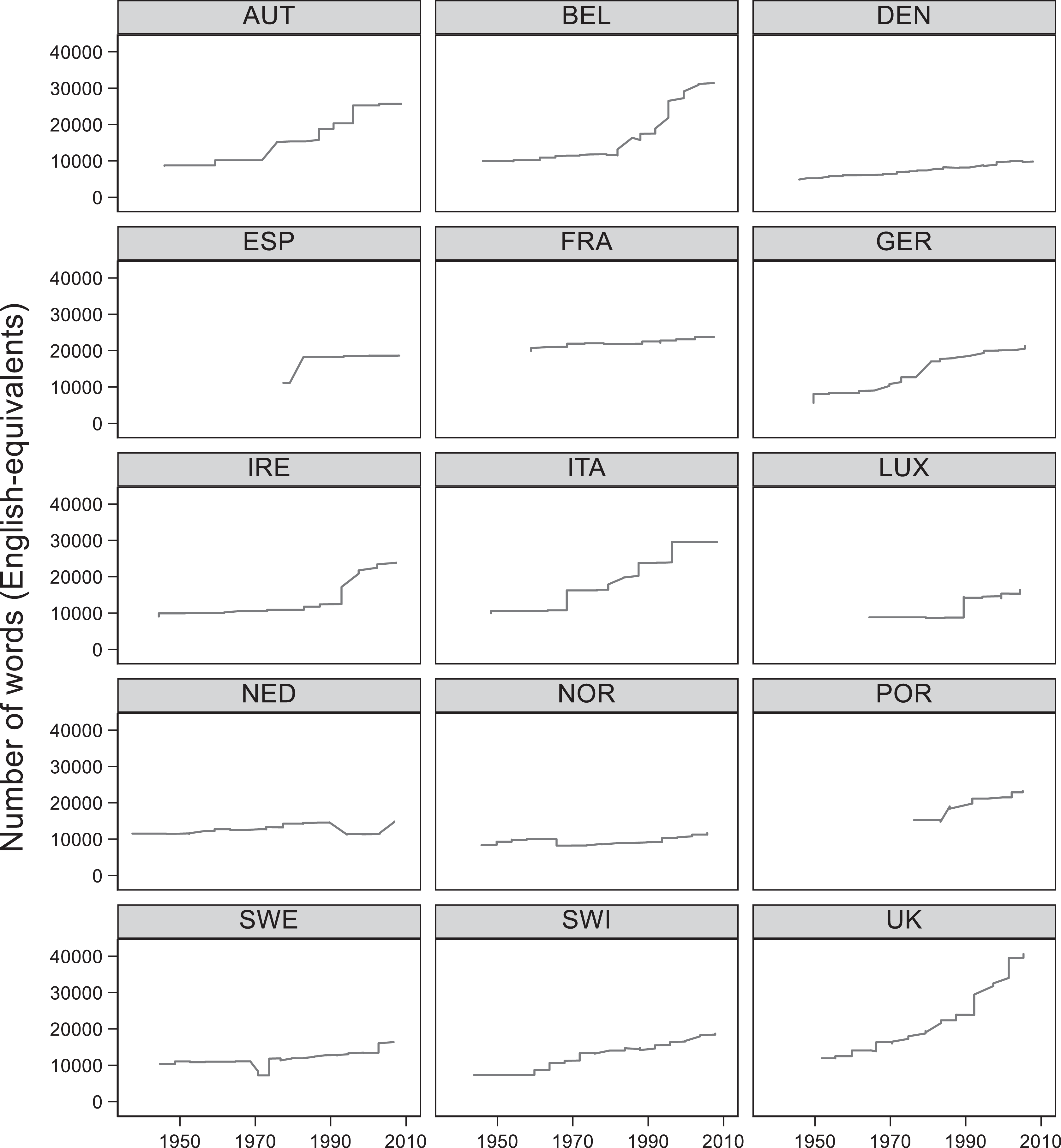
Overall density of regulation by country.
Figure 2 plots the development of regulation in the three main areas of parliamentary activity (lawmaking; controlling the government; creating publicity). 8 For all three activities, the density of regulation increases over time. This trend is most pronounced with regard to the control of government with an average growth factor of 3.75. In Sweden, Austria, and Belgium, we see the highest growth with factors of 13.76, 8.42, and 5.18, respectively, whereas the increases are most limited for France (factor 1.34), Portugal (1.60), and the UK (1.64). The other two activities experienced lower growth with average rates around two. Rules related to lawmaking were expanded most strongly in Belgium (3.07), Germany (2.60) and Italy (2.35), but remained at the same level in Luxembourg (1.00), the Netherlands (1.13), and Spain (1.14). The density of regulation regarding the creation of publicity increased most strongly in Sweden (3.08), Belgium (2.80), and Germany (2.74) and least in Switzerland (1.09), France (1.13), and the Netherlands (1.32).
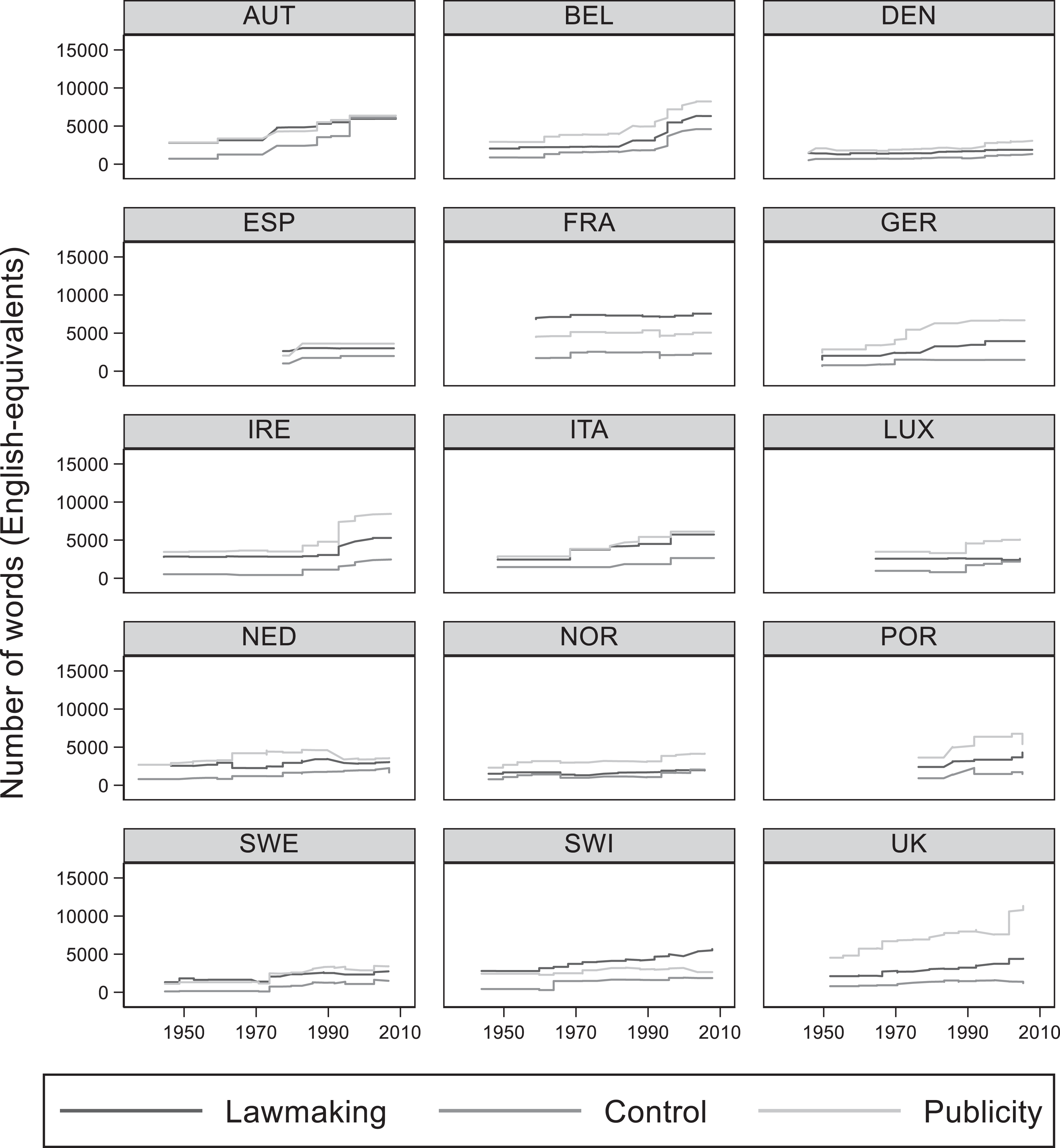
Density of regulation by activity and country.
Cross-country variation in our data is in line with established knowledge on different parliaments, which suggests face validity of our coding. For example, the French standing orders regulate lawmaking very densely in line with the many constraints put on parliament in the system of rationalized parliamentarism (Huber, 1996). Similarly, a large share of the standing orders in the UK and Ireland deal with creation of publicity, which highlights the importance of public debate in these prototypical arena parliaments.
Figure 3 plots the within-country variation in the four variables. Given the country fixed effects in the model, this variation will be the object of our explanatory analysis in the next section. We find considerable within-country variation both in overall text length and in the rules related to the three core activities.
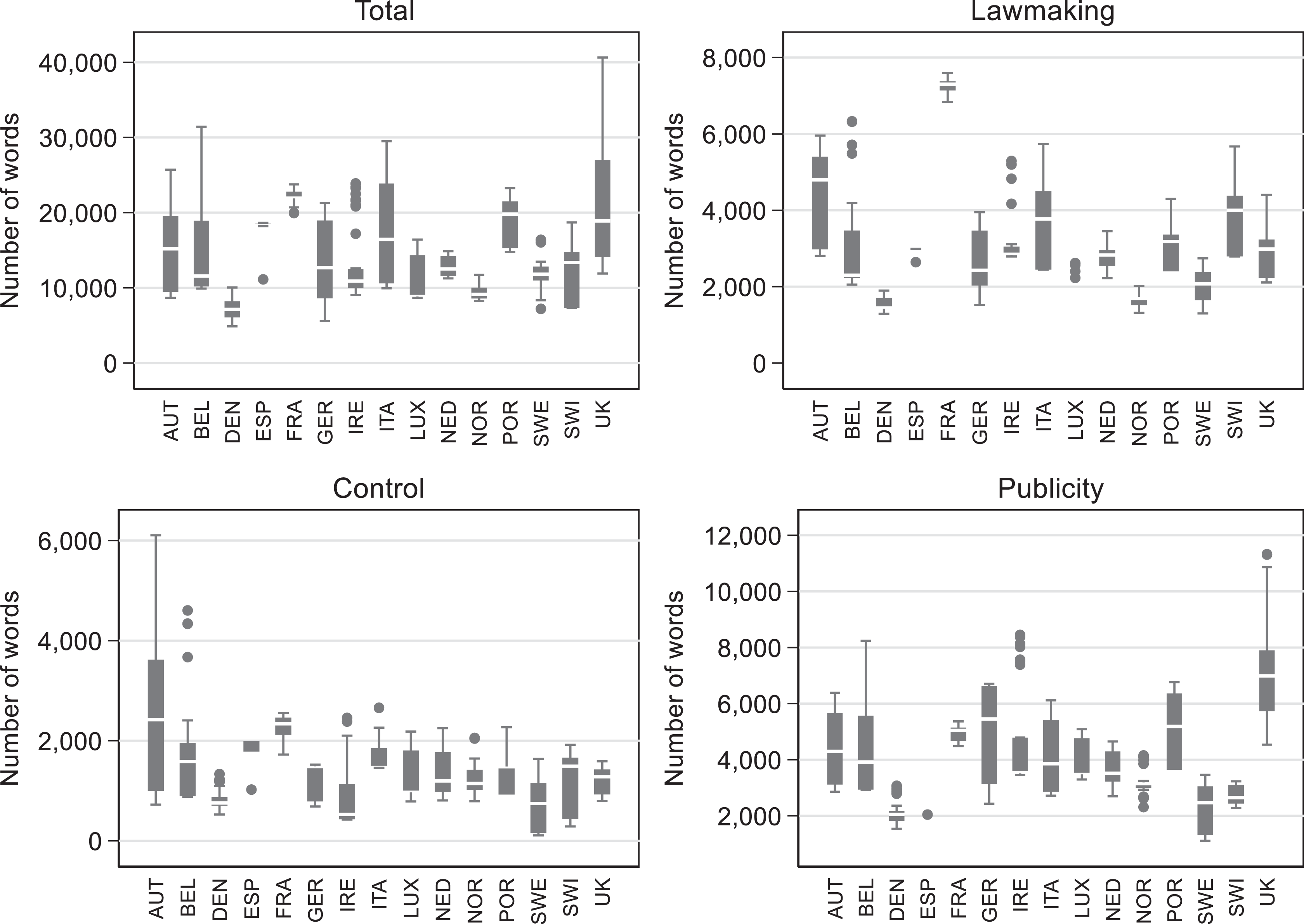
Within-country variation in the density of regulation by activity.
Modeling issues
The statistical test of our hypotheses has to account for several crucial characteristics of our data. Most importantly, the various measures of regulatory density (our dependent variables) are unit roots by construction, as the variable score equals its score at the previous point in time plus or minus a certain value in case a reform occurred in the following year. The descriptive graphs in the previous section show a near uniform growth over time. Thus, at least for our period of observation, the time series do not fluctuate around a fixed mean value but instead have a positive time trend. This non-stationarity is confirmed by the Im-Pesaran-Shin unit root test for panel data (Im et al., 2003). According to this test, we cannot reject the null hypothesis that all panels contain unit roots for any of our four measures of regulatory density. The same test indicates that both fragmentation and ideological polarization as our core explanatory variables are non-stationary as well.
With non-stationary time series, customary regression models are likely to yield wrong results, especially detect seemingly significant relationships that are spurious. There are two main ways to solve this problem: First, we can use the first difference of the time series (i.e. the change from t − 1 to t). This procedure eliminates autocorrelation and creates a stationary time series that can be analyzed with simple regression models. In our case, first-differencing makes all dependent as well as the two independent variables stationary as shown by the Im-Pesaran-Shin test. As a downside, this strategy eliminates the memory from the series so that the analysis can only pick up short-term effects between two subsequent periods.
Alternatively, we can use an error correction model (ECM) that models changes in the dependent variable as a function of the first differences in explanatory variables, their lagged levels, and a lagged dependent variable (Beck and Katz, 2011; De Boef and Keele, 2008). An ECM models a long-term equilibrium relationship between the dependent and independent variables (in our case institutional regulation and party system characteristics) that is disturbed by short-term changes in independent variables (in our case changes in fragmentation and polarization) and allows us to distinguish between short-term effects (Hypotheses H1a and H2a) and long-term effects (H1b and H2b). While ECMs have been used increasingly in political science work over the last decade, their appropriateness is debated controversially (De Boef and Keele, 2008; Grant and Lebo, 2016; Keele et al., 2016; Lebo and Kraft, 2017). One core issue is that the ECM is only valid if the time series of the dependent and all independent variables are co-integrated (i.e. their difference is itself stationary). Co-integration can be assessed directly from the ECM’s parameter estimates; however, the crucial parameter (the coefficient of the lagged dependent variable) does not follow a standard distribution but requires specific, more demanding critical values (Ericsson and MacKinnon, 2002). Many political science applications relying on standard tests thus falsely claim co-integration and use the ECM in inappropriate ways (Grant and Lebo, 2016).
We use both strategies to provide a thorough test of our hypotheses. The hypotheses on short-term effects can be tested in both models whereas the expected long-term effects are only analyzed in the ECM. All models include country fixed effects (implemented via dummy variables with Austria serving as model baseline) and panel robust standard errors (Beck and Katz, 1995) to capture persistent cross-sectional differences as well as heteroscedasticity and contemporaneous correlations in the errors between panels (i.e. countries). Furthermore, the models include size of the legislature and electoral disproportionality as control variables and a linear time trend that captures growing policy complexity that should increase the need for regulation irrespective any long-term equilibrium relationship between party system characteristics and institutional regulation. The independent variables are lagged by 1 year to account for the time necessary to pass institutional reforms and to ensure the correct causal ordering of variables in the model. 9
Formally, we estimate the following model specification for the first-difference model:

where

where in addition to the parameters discussed above, α is the estimated coefficient for the lagged dependent variable;
The effect of party system characteristics on institutional regulation
How do our theoretical expectations hold up to the empirical test? Table 1 shows the models in first differences for the four dependent variables, i.e. the overall length of the standing orders and the number of words dealing with lawmaking, controlling the government, and creating publicity. These models do not support the hypotheses expecting positive short-term effects of increasing fragmentation (H1a) and polarization (H2a). Most of the coefficients are negative and all except one fail to meet customary standards of statistical significance. The only significant finding is a negative effect of growing fragmentation on the regulation of government control, which directly contradicts our expectations. The models on the entire length of the standing orders and the regulation of lawmaking indicate a significant increase over time.
The short term effects of party system characteristics on institutional regulation (models in first differences).
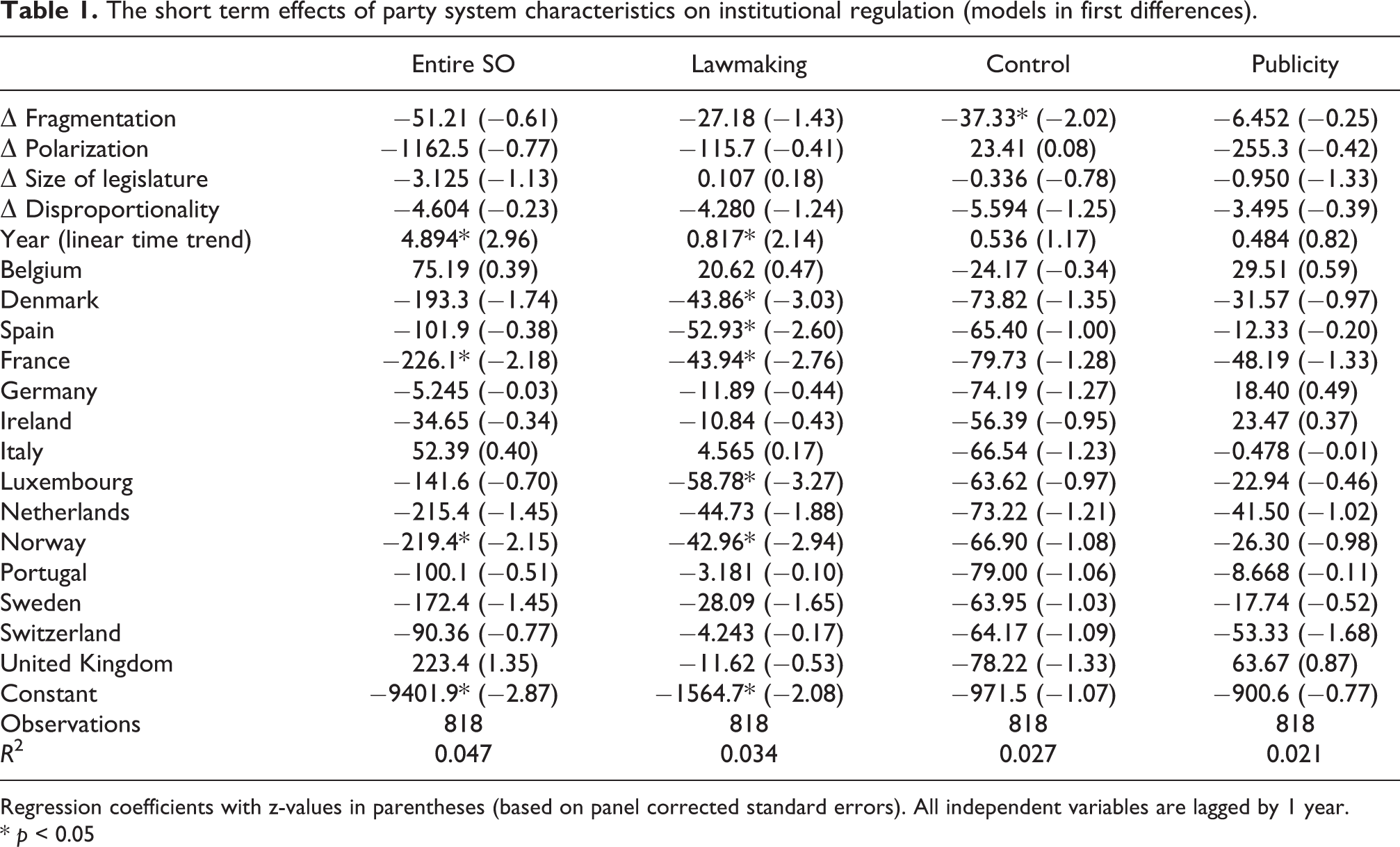
Regression coefficients with z-values in parentheses (based on panel corrected standard errors). All independent variables are lagged by 1 year.
* p < 0.05
While these models reject the short-term hypotheses that were derived from a strict institutions-as-equilibrium perspective, the question remains whether the density of regulation responds to party system characteristics in the long run as hypothesized by H1b and H2b. If this was the case, we should observe the time series of our dependent variables and the two core independent variables to move together over time. While short-term shocks could lead to a divergence, an error correction process should lead the series to approach a dynamic equilibrium again after some time. The error correction model allows us to assess these long term effects and the speed of error correction.
Table 2 shows the estimates of the error correction models for our four dependent variables. The crucial first step in interpreting these models is the error correction parameter, i.e. the coefficient of the lagged dependent variable, that serves as a co-integration test in the ECM (Ericsson and MacKinnon, 2002). As discussed above, this coefficient has to be statistically significantly different from zero for the ECM to be meaningful. As it is not distributed according to a standard t-distribution, the critical values for the parameter have to be determined based on the number of parameters in the model and the length of the time series, and these values are considerably more demanding than in a regular t-test. According to the Monte Carlo simulations by Ericsson and MacKinnon (2002), the critical value for statistical significance at the five percent level is −4.22 for our analysis. 11 Using this threshold, none of the error correction parameters is significantly different from zero. Thus, we conclude that the time series in the model are not co-integrated. Accordingly, there is no long-term equilibrium relationship between the dependent and independent variables, which directly rejects all hypotheses on the short-term and long-term effects of fragmentation and polarization. 12 The models for the entire length of standing order and for rules on lawmaking show statistically significant coefficients for the level of fragmentation, but in the absence of error correction, this relationship has to be considered spurious. 13 As in the first differences models above, we find a positive time trend in the data suggesting that the regulatory density in parliaments has increased over time. We discuss some possible interpretations of this time trend in the concluding section.
The short-term and long-term effects of party system characteristics (error correction models).
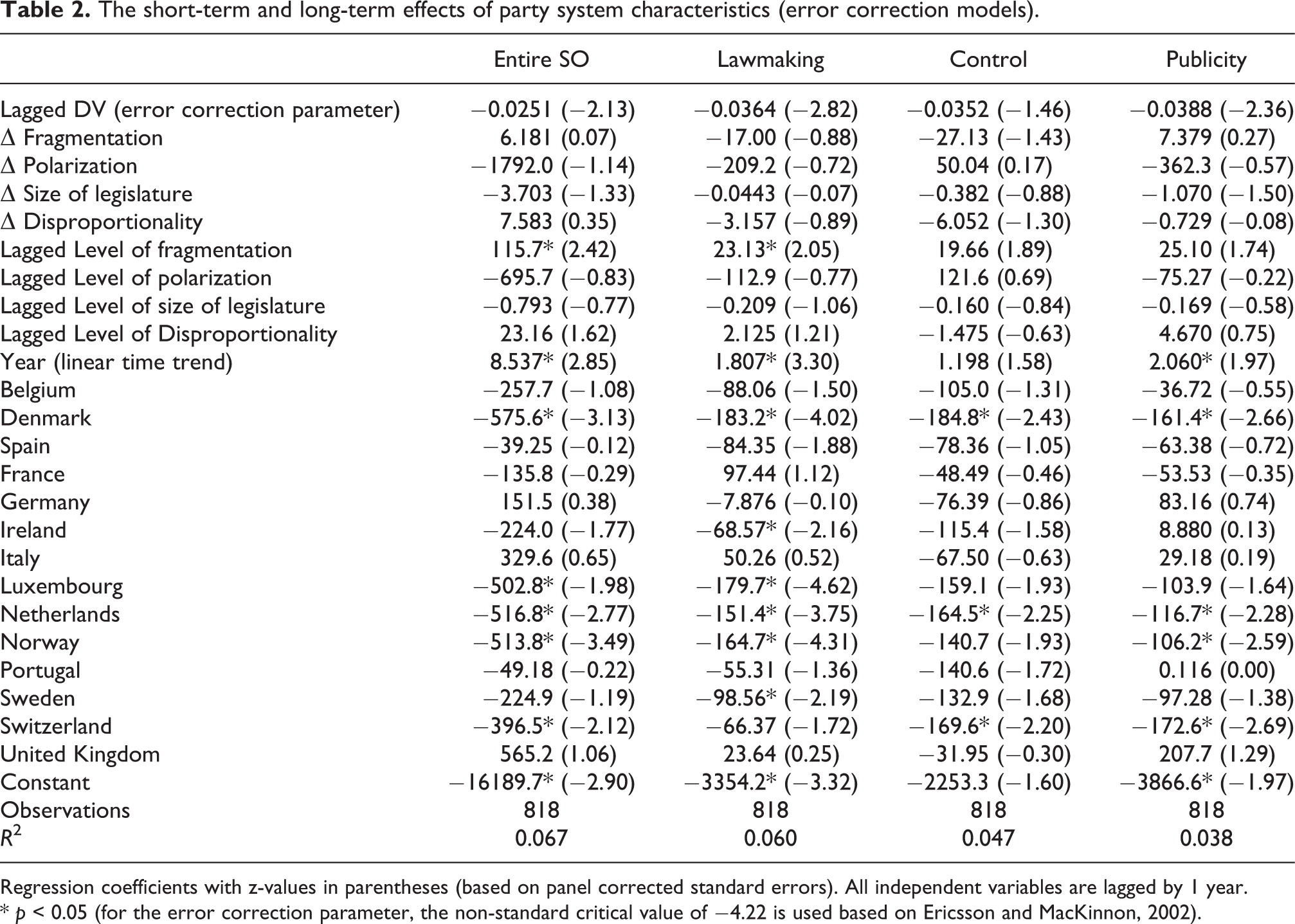
Regression coefficients with z-values in parentheses (based on panel corrected standard errors). All independent variables are lagged by 1 year.
* p < 0.05 (for the error correction parameter, the non-standard critical value of −4.22 is used based on Ericsson and MacKinnon, 2002).
These findings prove robust toward changes in key modeling decisions. The substantive findings stay the same if we (1) measure polarization via the ideological range between the left-most and the right-most party in parliament; (2) allow more flexible shapes of the time trend instead of assuming linearity; and (3) include additional lags of the dependent and independent variables. Detailed discussions of these robustness tests are available in Online Appendix D.
Discussion and conclusion
How did the density of institutional regulation develop over time in European parliaments and do party system characteristics help explain this density? Analyzing the standing orders of 15 Western European parliaments over a period of more than 60 years, this article demonstrates that the density of regulation has increased massively, both regarding the overall length of the standing orders and the regulation of the core parliamentary activities lawmaking, controlling the government, and creating publicity. However, explanatory analysis based on dynamic panel models does not support the hypothesis that this increase is driven by underlying characteristics of the party system, more specifically fragmentation and ideological polarization, as we fail to find evidence for either short-term or long-term effects of changes in these variables. 14 Instead, our models demonstrate that parliamentary standing orders change slowly and display high levels of path dependence as well as a linear growth trend over time.
These findings have two broader implications for our understanding of legislative organization. First, our analysis shows that the overall development of parliamentary standing orders follows different patterns than targeted reforms of specific rules. Even though parameters of political competition drive the change of specific rules with clear distributive consequences such as the power of the committee system, rules on debates, and the rights of parliamentary minorities, they do not have a systematic effect on the density of institutional regulation more generally.
While it is notoriously difficult to explain non-findings, we argue that this difference stems from the distinction of distributive and efficient institutions (Tsebelis, 1990: Ch. 4). Competition-based accounts of institutional change focus on distributive institutions that serve the interests of a subset of actors (often the governing majority) at the expense of others (often the minority) (e.g. André et al., 2016; Goet, 2019; Sieberer et al., 2020; Zubek, 2015). While such reforms clearly exist and are highly relevant for understanding legislative politics and competition, many aspects of legislative organization are efficient institutions that serve the interests of all actors (Sieberer et al., 2011). If such efficient institutions come under pressure due to changes in the environment of parliament, parliamentary actors have a common interest in reforming them to meet current challenges. Thus, institutional change in legislatures is also driven by factors not related to political competition such as technological developments, broad societal processes like value change, and political mega-trends such as a growing complexity and professionalization of politics, globalization, and Europeanization (Sieberer et al., 2011). Political actors may react to these developments in similar and consensual ways irrespective of party system characteristics. A qualitative look at our data on standing order change indicates that such efficient reforms make up the lion share of rule changes, which is also suggested by the fact that most standing order reforms are passed with broad support in the legislature (see also the qualitative analysis in Sieberer and Müller, 2015). Thus, in our aggregate analysis of legislative organization in general, a large number of efficient reforms that occur irrespective of party system characteristics may overpower the effect of party system parameters operating for a smaller subset of distributive reforms. Many institutional reforms in parliaments contain both efficient and redistributive elements (Sieberer and Müller, 2015; Tsebelis, 1990). Future work should look at the relationship between these types of reforms in more detail to assess what factors drive the balance between them and how majorities may try to obtain support for reform packages by combining efficient changes favored by opposition parties with redistributive elements.
Second, the descriptive data and the statistical models indicate that the density of institutional regulation increased over time irrespective of party system development. We briefly discuss four factors that may be responsible for this time trend, even though we cannot test them empirically within the confines of this article. First, the amount and complexity of policy-making has certainly increased since the 1950s due to technological developments and international interdependence. These higher demands prompted stronger reliance on separation of labor and specialization within parliaments, e.g. by strengthening committee systems and other structures for gathering information. Such reforms should show in denser institutional regulation. Second, parliamentary actors have become more professional and active over time and thus may be more willing and better able to employ parliamentary rules in pursuit of their substantive goals. This can increase the common pool problem of using time and other legislative resources and, in response, trigger regulation to avoid such problems. Third, parliamentary elites have become more heterogeneous with regard to their socioeconomic and cultural background, which may have supported the erosion of internal norms and may have triggered increased formal regulation of a previously informal consensus. Finally, the public environment, especially the media system, has changed massively over time heightening the importance of publicity-related aspects of parliamentary work. Over time, many legislatures have thus regulated their relationship to the public in considerable detail.
On a more general level, our findings call for a theoretical extension of the institutions-as-equilibrium framework that incorporates arguments on transaction costs and path dependence more prominently. While actors do reshape institutions if their underlying substantive preferences change, instantaneous institutional reforms tend to be restricted to specific rules, often those with direct consequences for the distribution of power between actors. Given the transaction and opportunity costs of reform, other rules, even though suboptimal from the perspective of actors, may stay in force for extended periods leading to strong patterns of path dependence, which both stabilizes existing rules and makes the effect of previous changes endure over time. This view is fully compatible with historical institutionalist arguments about gradual institutional change and, in a broader perspective, highlights the compatibility of rational choice institutionalist and historical institutionalist explanations of institutional change (Hall, 2010; North, 1990).
Supplemental material
Supplemental Material, sj-pdf-1-ppq-10.1177_13540688211002490 - Do party system parameters explain differences in legislative organization? Fragmentation, polarization, and the density of regulation in European parliaments, 1945–2009
Supplemental Material, sj-pdf-1-ppq-10.1177_13540688211002490 for Do party system parameters explain differences in legislative organization? Fragmentation, polarization, and the density of regulation in European parliaments, 1945–2009 by Ulrich Sieberer and Daniel Höhmann in Party Politics
Footnotes
Authors’ note
Earlier versions of this paper were presented at the Workshop “Evolution of Parliamentarism and its Political Consequences” in Rome in 2018 and the Conference of the ECPR Standing Group on Parliaments in Leiden 2019. We thank participants, especially Radoslaw Zubek, for valuable comments. We gratefully acknowledge the contributions of Julia F. Dutkowski, Maiko I. Heller, Peter Meißner and Wolfgang C. Müller to the project on which this article builds. Our special thanks goes to our army of student assistants who spent years coding parliamentary standing orders at the Universities of Mannheim and Konstanz. This project would not have been possible without you!
Declaration of conflicting interests
The author(s) declared no potential conflicts of interest with respect to the research, authorship, and/or publication of this article.
Funding
The author(s) disclosed receipt of the following financial support for the research, authorship, and/or publication of this article: This research was supported by the German Research Foundation (DFG, Grant Number SI 1470/2-1) and the Zukunftskolleg at the University of Konstanz.

Supplemental material
Supplemental material for this article is available online.
Notes
References
Supplementary Material
Please find the following supplemental material available below.
For Open Access articles published under a Creative Commons License, all supplemental material carries the same license as the article it is associated with.
For non-Open Access articles published, all supplemental material carries a non-exclusive license, and permission requests for re-use of supplemental material or any part of supplemental material shall be sent directly to the copyright owner as specified in the copyright notice associated with the article.
