




Abstract
This study examines the role of autocratic ruling party strength in democratic transitions. While the impact of ruling party strength on regime stability is extensively studied, we know much less about how ruling party strength influences prospects for democratization during regime transitions. Proceeding from recent studies that suggest autocratic incumbents often choose to democratize from a position of strength rather than weakness, I discuss how specific attributes strong ruling party organizations wield can provide autocratic incumbents with incentives and capabilities to lead democratization in the context of regime change. Using original data on organizational characteristics of 161 autocratic ruling parties between 1970 and 2015, I provide the first set of systematic empirical evidence supporting the argument that ruling party organizational features that promote regime durability can simultaneously facilitate the implementation of substantial democratizing reforms by regime elites in a top-down fashion to preempt political opposition.
Introduction
Extensive work argues that strong ruling party organizations promote autocratic regime durability by containing conflict among the members of the ruling coalition, co-opting opposition groups, and mobilizing the masses in support of the regime (Boix and Svolik, 2013; Brownlee, 2007; Geddes, 1999; Geddes et al., 2018; Greene, 2007; Levitsky and Way, 2010; Magaloni, 2006, 2008; Magaloni and Kricheli, 2010; Reuter, 2017; Slater, 2010; Smith, 2005; Svolik, 2012). Hence, there is a consensus in the literature that autocratic regimes that invest in ruling party organizations survive longer than those do not.
However, while regime stabilizing effects of ruling parties are extensively studied, we know much less about the role of ruling parties during regime transitions. Specifically, our understanding of how ruling party strength shapes transition outcomes comes mainly from qualitative work based on a limited number of cases (e.g. Riedl et al., 2020) or quantitative analyses that use proxy measures of party strength that are limited in their ability to capture key attributes of ruling party organizations (e.g. Brownlee, 2009; Miller, 2020; Wright and Escribà-Folch, 2012).
In this study, proceeding from existing insights that suggest autocratic incumbents often choose to democratize from a position of strength rather than weakness (e.g. Albertus and Menaldo, 2018; Riedl et al., 2020; Slater and Wong, 2013; Ziblatt, 2017), I contend that ruling party strength is both a regime-stabilizing force and a democratizing force. Although strong ruling parties generally stabilizes regimes, in the context of regime change they can function as catalysts for the implementation of substantial democratizing reforms by regime elites in a top-down fashion to preempt political opposition.
In particular, this study draws on recent explanations that suggest a ruling party’s perceived capacity to influence the distribution of political power in a subsequent democracy lessen incumbents’ imperative to sustain the autocratic rule given an increasing probability of regime change (Riedl et al., 2020; Slater and Wong, 2013; Wright and Escribà-Folch, 2012; Ziblatt, 2017). In this perspective, the incumbent elites strategically implement liberalizing reforms to avoid relatively more costly pathways to regime change (see also Acemoglu and Robinson, 2005), and when they can rely on a strong ruling party that can ensure their electoral dominance despite of increasingly democratic elections.
Although previous studies provide important insights, they overlook the mechanisms by which ruling parties ensure coordination and unity within the regime ranks when it comes to furthering liberalizing reforms. While the incumbent elites’ positive perceptions of the ruling party’s ability to alleviate threats from outsider opposition groups might compel them to enact political reforms, the prospects for this strategy also depends on the party’s capacity to facilitate coordination within the ruling coalition. Given that political liberalization can aggravate divisions among the regime elites, which can eventually hinder the transition process (O’Donnell and Schmitter, 1986; Przeworski, 1991), it is important to understand which sources of ruling party strength can facilitate elite coordination to implement liberalizing reforms. In this study, I relax the assumption that the ruling party elites hold homogeneous preferences toward democratization when the costs of sustaining the existing regime outweigh the costs associated with political reforms, and argue that the likelihood of regime elites to lead democratizing reforms is a function of ruling parties’ capacity to simultaneously solve challenges of elite and mass coordination during regime transitions.
Accordingly, I conceptualize ruling party strength in terms of three interrelated aspects of internal party characteristics: institutionalization, cohesion, and organizational extensiveness. Institutionalization—defined as the creation of rules and procedures that shape the distribution of power and resources among regime elites (Meng, 2019), and cohesion are particularly important for eliciting elite coordination whereas organizational extensiveness corresponding to the parties’ sub-national presence and affiliated social organizations are crucial for mass coordination. Together these features shape the regime elites’ capabilities and incentives to lead democratization without spiralling into internal struggle or acquiescing to outsider opposition groups.
In empirical analyses, using novel party-specific indicators of organizational characteristics of 161 autocratic ruling parties from 1970 to 2015, I develop a new measure of party strength that captures the degree to which a ruling party exhibits aforementioned three conceptual attributes over time. Drawing on new party-level indicators from Varieties of Party Identity and Organization Dataset (V-Party) (Lührmann et al., 2020), this study presents the first quantitative examination of how time-varying autocratic ruling party organizational attributes shape prospects for democratization. The results corroborate the expectation that ruling party strength generally stabilizes autocratic regimes but increases the likelihood of democratization led by incumbents given a regime change. I find robust evidence that strong ruling parties facilitate the implementation of democratizing reforms by incumbents in the context of regime change.
Background
A large literature examines the role of ruling parties in maintaining autocratic regime stability (Boix and Svolik, 2013; Brownlee, 2007; Geddes, 1999; Geddes et al., 2018; Levitsky and Way, 2010; Magaloni, 2008; Miller, 2020; Slater, 2010; Smith, 2005; Svolik, 2012; Wright and Escribà-Folch, 2012). Specifically, studies suggest that ruling parties provide institutional mechanisms that contain elite conflict, ensuring regime cohesiveness crucial for autocratic stability (Boix and Svolik, 2013; Brownlee, 2007; Magaloni, 2008; Reuter, 2017; Svolik, 2012). Moreover, ruling party organizations also distribute patronage to elites and social groups, monitor compliance, and mobilize the masses in support of the regime (Blaydes, 2010; Geddes et al., 2018; Greene, 2007; Levitsky and Way, 2010; Magaloni, 2006; Magaloni and Kricheli, 2010; Malesky and Schuler, 2010; Slater, 2010).
Beyond promoting autocratic survival, several studies suggest that ruling parties may paradoxically promote democratization (Riedl et al., 2020; Slater and Wong, 2013; Wright and Escribà-Folch, 2012; Ziblatt, 2017). In particular, these studies hold that strong ruling parties empower the incumbent elites to make democratic concessions to political opposition without risking their hold on power. Accordingly, when the costs of pursuing political liberalization are lower than the costs of not doing so, regime elites have incentives to implement liberalizing reforms. Most recently, Riedl et al. (2020) argue that ruling party strength is “the permissive condition” that compels regime elites to enact liberalizing reforms in the face of growing pressures for political liberalization. Central to their argument is the ruling party’s perceived ability to thwart electoral challenges and maintain its dominance despite of increasingly democratic elections. Similarly, Wright and Escribà-Folch (2012) contend that dominant parties’ capacity to mobilize voters ensures that regime elites can continue to influence the distribution of power in a democracy, which reduces regime elites’ incentives to cling onto autocracy during regime transitions. Indeed, many ruling parties have remained in power despite transitioning to democracy (Ishiyama and Quinn, 2006; Miller, 2019). Some concede electoral defeats and transform into highly competitive opposition as authoritarian successor parties, and given the organizational resources they inherit from the authoritarian era they are well-positioned to come back to power in subsequent rounds of democratic elections (Grzymala-Busse, 2020; Ishiyama, 1995; Langston, 2017; Orenstein, 1998; Waller, 1995). 1
This study is deeply grounded in this body of research, but it seeks to improve our understanding of when and why ruling party strength can facilitate democratization in several ways. First, existing studies implicitly assume that regime elites hold homogeneous preferences toward political liberalization during regime transitions. Consequently, the arguments primarily rest on the regime elites’ incentives to pursue political reforms as a function of the ruling party’s perceived capacity to thwart outsider challengers. As a result, it remains unclear how ruling parties enable regime elites to coordinate among themselves to lead liberalizing reforms. Given that various factions within the regime may see liberalization as threatening to their interests and consequently attempt to disrupt the process by removing the incumbent (O’Donnell and Schmitter, 1986; Przeworski, 1991), it is important to understand how ruling parties reduce internal obstacles to leading political liberalization. While external challenges can influence elite incentives to coordinate, how regime elites respond to such challenges is to a great extent a function of internal party characteristics that structure elite behavior. Indeed, Ishiyama (1995, 1997) demonstrates that ruling parties in which internal struggles were resolved in favor of reformist factions during the transition period were better able to adapt to changing competitive dynamics (see also Orenstein, 1998; Waller, 1995). 2 This study highlights specific party organizational features that help resolve intra-party struggles before they reach a level inimical to the regime elites’ ability to manage the transition process. In the following sections, I address the challenges of elite coordination by expanding the concept of ruling party strength to include elite-level institutionalization (see Meng, 2019). My argument complements existing explanations by highlighting the sources of ruling party strength that enable regime elites to lead liberalization without spiralling into internal struggle, while competing against political opposition.
Second, this study contributes to the literature by providing the first rigorous set of quantitative examinations of the association between ruling party strength and transitions to democracy. Previous research utilizes regime typologies to proxy ruling party strength (e.g. Wright and Escribà-Folch, 2012), which performs poorly in adequately capturing the relevant conceptual attributes of ruling party organizations (Meng, 2019). In this study, I develop the first time-varying measure of autocratic ruling party strength based on party-specific indicators, and simultaneously predict regime change and transitions to democracy using this new measure. This study is also the first to provide a direct quantitative evaluation of how ruling parties influence pathways to democracy by systematically distinguishing between democratization guided by the incumbent elites and transitions led by the political opposition.
Theoretical framework
Conceptualizing autocratic ruling party strength: Institutionalization, cohesion, and organizational extensiveness
I contend that strong ruling parties are those that develop a stable and formalized set of rules that guide the distribution of power among regime elites together with entrenched linkages to constituencies. Specifically, ruling party strength can be assessed in terms of three interrelated aspects of internal party characteristics. One crucial feature of strong ruling parties is elite-level institutionalization, which can be defined as the process by which decision-making structures increasingly follow a clear set of formalized rules and procedures (Meng, 2019). In highly institutionalized ruling parties, decisions are taken in accordance with established guidelines that regularize how power and resources are distributed among regime elites. The regularization of such processes raises the costs of deviating from established rules and constrains actor behavior, resulting in what Levitsky (1998) refers to as “behavioral routinization.” Institutionalization is especially important in autocracies because it prevents the predation of the party organization by constraining autocratic leaders (Meng, 2019). In ruling party organizations where elite-level institutionalization is low, the distribution of power and resources among regime elites typically follow unclear rules and procedures that often depend on temporary arrangements based on informal personalized networks. Under such circumstances, ruling parties rarely serve as inter-temporal commitment tools that enable elites to establish lasting credible power-sharing deals critical for organizational durability (Meng, 2019).
Another feature that contributes to ruling party strength is a high level of elite cohesion, which is related but distinct from institutionalization. Cohesion refers to the sense of solidarity and the extent of cooperation among regime elites (Levitsky and Way, 2010: 65). Where cohesion is low, ruling parties’ ability to rule is significantly reduced and regimes are prone to elite defections. All else equal, cohesion should be higher in ruling parties with a high degree of institutionalization, but sources of cohesion can vary. Levitsky and Way (2012), for instance, argue that norms and identities generated during periods of sustained, ideologically-driven violent conflict provide ruling parties with a robust source of cohesion. Nevertheless, ruling parties can be highly cohesive due to the personal charisma of the leader or primarily because of the continuous flow of patronage. Irrespective of its sources, however, elite cohesion is critical for the prevention of elite defections, and ultimately for the strength of ruling parties.
Finally, organizational extensiveness is another feature that contributes to ruling party strength. Organizationally extensive parties are those that have considerable sub-national presence and affiliated mass-mobilizing structures that support party operations with material resources and personnel. Absent these qualities, ruling parties often lack the ability to maintain credible linkages to constituents (Morse, 2018), and thus they are unlikely to become enduring organizations (Levitsky and Way, 2010).
How much ruling parties incorporate these attributes is a matter of degree, which varies over time and across parties. Three components are interrelated and at times they can reinforce each other. While a party’s weakness in one attribute can be partly compensated by its strength in another, the strongest ruling parties are ideally those that are highly institutionalized, cohesive and organizationally extensive. In the next section, I discuss how the qualities strong ruling parties wield can enable them to simultaneously solve challenges of elite and mass coordination crucial for implementing democratizing reforms.
Incentives and capabilities to lead democratization
Regime elites initiate and guide democratization not necessarily because they have a normative preference for democracy. Previous research suggests that regime elites often implement democratizing reforms as preemptive measures to avoid more costly pathways to regime change or when they consider democracy to serve their interests better than autocracy (Acemoglu and Robinson, 2005; Albertus and Menaldo, 2018; Boix, 2003). The existing evidence demonstrates that when autocratic incumbents accede to democracy, they generally face better post-tenure fates than they would if they were to resist democratization or replaced by rival autocrats (Debs, 2016; Geddes et al., 2014, 2018; Wright and Escribà-Folch, 2012). Importantly, regime elites can safeguard their interests in a subsequent democracy by negotiating an extrication or by erecting constitutional rules that preserve their privileges in the long-term (Albertus and Menaldo, 2018; Riedl, 2014). Further, transitions to democracy do not necessarily result in ruling parties’ loss of power. Miller (2019) counts that in two-thirds of democratic transitions between 1940 and 2010, ruling parties have managed to stay in power. In these cases, ruling parties can even gain some benefits from democratization by expanding their social base and potentially attracting external financial resources (Riedl et al., 2020). However, when incumbents resist democratization in spite of poor prospects for regime survival, the modal outcome is transition to a new autocratic regime in which bargaining for a transition on favorable terms is unlikely, and the odds of punishment for outgoing elites are high (Debs, 2016; Geddes et al., 2014, 2018; Wright and Escribà-Folch, 2012). Hence, while preserving the status quo is the optimal outcome for regime elites, the literature provides important reasons for them to implement democratizing reforms when the costs of doing so is conceived to be lower than the costs associated with suppressing demands for reforms.
Transition trajectories are shaped by struggles between incumbents aiming to remain in power, political opposition attempting to oust incumbents, and regime elites seeking to prevent outcomes that can threaten their interests (Bernhard et al., 2020; O’Donnell and Schmitter, 1986; Przeworski, 1991). Hence, in leading democratizing reforms incumbents are challenged not only by political opposition, but also by factions within the ruling coalition. As such, ruling parties should have the necessary sources of strength to simultaneously overcome challenges of coordinating regime elites while competing against outsider opposition groups.
Strong ruling parties enhance incumbents’ capability to reinforce coordination among the key factions within the regime in at least three ways. First, an important attribute of strong party organizations is a high level of elite-level institutionalization, which entails the creation of formalized and regularized rules of engagement and decision-making procedures (Meng, 2019). Such organizational features provide institutionalized mechanisms through which incumbents can bargain and agree on comprehensive deals with those that can potentially disrupt the process from within. Decision-making procedures based on stable, clear and transparent rules allow incumbents to strike deals that can credibly signal to regime elites that their interests will be protected (Boix and Svolik, 2013; Magaloni, 2008; Svolik, 2012).
Second, strong party organizations provide institutional tools for monitoring internal regime factions’ compliance with the terms of liberalizing reforms as the regime transition unfolds. Institutionalization involves the development of hierarchical positions and procedures that formalize the distribution of power and resources among regime elites (Meng, 2019). The hierarchical nature of ruling party organizations enables top cadres to monitor and exert control over individual party members (Malesky and Schuler, 2010). Haggard and Kaufman (1995), for instance, show how ruling parties with centralized decision-making structures—such as Kuomintang (Taiwan) and Institutional Revolutionary Party (Mexico)—have successfully managed gradual implementation of liberalizing reforms by facilitating legislative coordination. Such qualities help ensure that political reforms are implemented as agreed. Moreover, institutionalization encompasses the creation of organizational structures that promote collegial leadership where regime elites can oversee the actions of incumbents (Boix and Svolik, 2013; Svolik, 2012). Institutionalized parties hold regular party congresses and executive committee meetings, and operate under established rules that limit the tenure of leaders. Such procedures prevent predation by autocratic incumbents and create incentives to respond to interests of regime elites. Strong ruling parties therefore provide credible checks on executive power as well as on individual party members, which should facilitate internal regime coordination fundamental to managing liberalizing reforms.
Third, the high levels of elite cohesion that strong parties wield make them well-positioned to remain unified in challenging contexts such as regime transitions. While ruling parties generally give the impression of cohesiveness in normal times, when regimes are threatened by economic crisis, rising opposition challenges, or withdrawal of external support many suffer from elite defections that undermine their survival (Levitsky and Way, 2012; Reuter and Gandhi, 2011). Regime transitions represent one of those challenging moments that can encourage defections of key regime elites (Geddes et al., 2018). Elite defections can significantly hinder incumbents’ ability to control the transition process in several ways. First, when a prominent elite defects to opposition it signals ruling party weakness that can encourage further defections in lower cadres. Second, the defection of prominent elites can encourage opposition groups to overcome collective action problems that can consequently lead to the formation of electorally powerful broad opposition coalitions (Van de Walle, 2006). Third, defectors can simply overthrow the government by unconstitutional means. While even the strongest ruling parties may occasionally experience elite defections, defectors rarely attract enough followers from grassroots organizations. In these cases, defections often remain as isolated events that do not cause much damage to ruling parties (Geddes et al., 2018; Levitsky and Way, 2010).
Absent organizational qualities that ensure elite coordination, ruling parties generally lack the capacity to successfully implement necessary political reforms to lead the transition process. In the context of ruling party weakness, regime transitions are likely to be hampered by struggles between rival internal regime factions, which can exacerbate ruling parties’ vulnerability to pressures from political opposition. The Zambian and Beninese transitions in the early 1990s exemplifies this scenario. In both cases, autocratic incumbents initiated political reforms hoping to entrench their hold on power, yet they subsequently yielded to the political opposition largely because of their inability to ensure elite coordination in the regime ranks (Gisselquist, 2008; Riedl, 2014).
In addition, strong ruling parties facilitate mass coordination which further bolsters the incumbents’ ability to contain pressures from opposition groups organized outside the regime. Strong ruling parties’ countrywide presence help incumbents establish longstanding ties to the masses through which they can effectively mobilize support (Levitsky and Way, 2010; Morse, 2018; Riedl et al., 2020). Such qualities strong party organizations wield become especially important as incumbents lift barriers for opposition parties and allow for increasingly competitive elections. The ability to withstand pressures from opposition parties during regime transitions enables incumbents to maintain legislative majorities crucial for implementing democratizing reforms. Even when ruling parties has to eventually step down in the end of the transition process, their ability to remain as electorally competitive parties enables them to transform themselves into effective opposition parties that can prevent incoming governments from reverting back to authoritarianism or implementing policies harmful to the interests of former regime elites (Grzymala-Busse, 2020; Ishiyama, 1999; Ziblatt, 2017). As Riedl et al. (2020) demonstrate, such sources of strength are crucial to compel incumbents to enact democratizing reforms in the first place. When these qualities are coupled with ruling parties’ competence in maintaining elite coordination, incumbents are less likely to miscalculate their chances of implementing democratizing reforms while protecting their interests. Taken these considerations together, in the empirical analysis I test the following hypothesis: Greater ruling party strength increases the likelihood of incumbent-led democratization (conditional on regime change). 3
Research design
Sample and dependent variable
I examine the relationship between party strength and incumbent-led democratization on a sample of 161 autocratic ruling parties between 1970 and 2015, subject to data availability. The unit of analysis is the country-year. Autocracies are identified using data from Boix et al. (2013). The empirical analysis is limited to autocracies with ruling parties, given that the aim is to explain how variation in party strength influences regimes’ propensity to experience regime change in the form of democratization led by the incumbent elites. The data set covers ruling parties that are either the supreme ruling power or used as an important vehicle for power by the regime (Miller, 2020).
To construct the dependent variable, I proceed in two steps. First, using data from Miller (2019), I identify regime changes which involve the ruling party’s loss of power to a new autocracy (i.e. a transfer of power to a new autocratic ruling party or a non-party autocracy) and democratization (as indicated in Boix et al. (2013)). Second, I use data from Djuve et al. (2020) to identify democratic transitions that have preceded by substantial democratizing reforms initiated and implemented mainly by incumbents (i.e. incumbent-led democratization). The full sample includes a total of 96 regime changes of which 25 are incumbent-led democratic transitions. The remaining 71 regime changes correspond to transitions primarily enforced by dissidents within the regime or outsider opposition groups (e.g., military coups, mass protests, civil war, foreign interventions, substantial democratization resulting from an unexpected election loss). 4
Independent variable: A new measure of ruling party strength
This study introduces a new measure of ruling party strength based on unique indicators from V-Party (Lührmann et al., 2020). Although parties feature prominently in many studies of authoritarianism, there have been no data on internal organizational characteristics of ruling parties measured at the party-level. Consequently, previous studies attempt to measure party strength using indicators such as regime types (Wright and Escribà-Folch, 2012), party origins (Geddes et al., 2018; Miller, 2020), or party age (Gehlbach and Keefer, 2011) which are often poor proxies for conceptual attributes scholars aim to capture. This study fills this shortcoming by presenting the first time-varying measure of ruling party strength based on novel indicators that are collected at the party-level.
As discussed, strong ruling parties are defined as those that are institutionalized, cohesive, and organizationally extensive. Meng (2019) argues that an important feature of institutionalized parties is the presence of rules and procedures that guarantee the organization’s autonomous existence from the individual leader. Accordingly, institutionalization entails the formalization of distribution of power within the party that de-personalizes the ways in which the party organization operates. This builds on the works of Huntington (1968) and Panebianco (1988) who suggest institutionalized parties are ones that have the ability to operate independently of individual leaders. Following this line of reasoning, the first indicator captures the extent to which a ruling party operates as an instrument of a leader to further her individual ambitions rather than representing the interests of a broader party organization. The second indicator measures internal party cohesiveness. This variable captures the degree to which party members display unity over fundamental party strategies, where lower scores indicates less internal cohesion.
As for organizational extensiveness, I consider three indicators. The first indicator corresponds to local party branches, which denotes whether a party maintains permanent branches at the local/municipal level across the country. An increase on this indicator represents a party’s penetration into new municipalities by establishing permanent party branches. The second indicator focuses on the scope of a party’s local reach by measuring the degree to which party activists and personnel are actively present in local communities. Specifically, this variable aims to capture a party’s reach beyond formal branches in establishing linkages to constituencies. Finally, the third indicator measures the strength of a party’s ties to prominent social organizations (i.e., labor unions, business organizations, religious organizations etc.). The ties are stronger when a party controls prominent social organizations that contribute to its operations by providing material and personnel resources, as well as by helping a party in propagating its message to organizations’ members and beyond.
A ruling party organization’s degree of institutionalization and cohesion primarily map on to mechanisms that bolsters incumbents’ ability to elicit elite coordination, whereas organizational extensiveness involving a party’s subnational presence and affiliated social organizations are especially important for incumbents’ capacity to facilitate mass coordination.
All five indicators are based on the new V-Party expert survey (Lührmann et al., 2020). 5 A custom-made Bayesian item response model is used to convert expert responses from ordinal scores into interval scores that capture the values of the observed latent phenomenon (Pemstein et al., 2018). The five indicators are standardized and averaged together to construct a ruling party strength index. In line with my conceptualization, this allows for partial substitutability between the index’s components in that low scores in one component can be partly compensated by high scores on the other but high scores in all components indicate a stronger ruling party.
The Online Appendix presents assessments of the index’s validity. Figure 1 in the Online Appendix presents a histogram of ruling party strength for all 161 ruling parties across 2362 country-year observations that the full sample covers. The measure varies from −3.10 to 2.38, with a mean of 0. When examined over time, there is a significant drop in ruling party strength across autocracies from late 1980s to mid 1990s—a period corresponding to the collapse of Communist one-party regimes in Central and Eastern Europe and the introduction of multiparty elections in many African countries (see Figure 2 in the Online Appendix). Figure 3 in the Online Appendix illustrates overtime changes in the strength of selected ruling parties (Communist Party of China, Institutional Revolutionary Party in Mexico, United National Independence Party in Zambia). The strength of these ruling parties vary overtime in accordance with expectations. 6 In terms of convergent validity, the measure is positively correlated with party age (r = 0.32). When compared to regime type measures as presented in Geddes et al. (2014), ruling party strength is significantly higher in party-based regimes than military and personalist regimes. Nevertheless, the measure also highlights significant within regime type variation in ruling party strength, which would go unnoticed with discrete regime type indicators (see Figure 5 in the Online Appendix). Importantly, not all party-based regimes have strong ruling parties, which is in line with Meng’s (2019) critique of the use of regime type measures as a proxy for party strength. Similarly, not all ruling parties in personalist regimes are uniformly weak. These assessments illustrate the utility of the new measure of ruling party strength.
Control variables
I control for several potential confounding variables. First, economic conditions might affect both ruling party strength and regime change. Economic development might spur greater domestic pressures for regime change (Boix and Stokes, 2003). Alternatively, economic development can stabilize autocratic regimes by bolstering institutional strength and increasing incumbents’ ability to co-opt opposition groups (Kennedy, 2010; Miller, 2012). Moreover, short-term economic growth can significantly impact regime stability by influencing ruling party strength and regime support among the population (Levitsky and Way, 2010). I measure economic development as the log of real gross domestic product (GDP) per capita and economic growth as an annual change in GDP per capita (Bolt et al., 2018).
Rents from natural resources are often used to stabilize regimes. Natural resource income can help fund ruling party organizations or it can lessen autocrats’ need for investing in party organizations as a survival strategy. Accordingly, I control for oil production per capita (Ross and Mahdavi, 2015). 7
Studies show that international context plays a key role in regime stability and democratization (Houle et al., 2016; Levitsky and Way, 2010). Hence, I control for the international context with a measure of the proportion of democratic regimes as recorded in Boix et al. (2013) in a country’s region, and by including a dummy variable for the Cold War period (pre–1990).
Recent studies suggest ruling parties’ founding origins influence their strength and durability (Levitsky and Way, 2012; Miller, 2020). Specifically, ruling parties with origins in revolutionary movements and communist parties are significantly more durable than others (Levitsky and Way, 2012; Miller, 2020). In addition to revolutionary and communist origins, I control for parties established by military regimes, which tend to develop weak organizations and more likely to transition to democracy (Geddes et al., 2018). 8 Finally, I control for party age.
Empirical model
This study examines the relationship between autocratic ruling party strength and the likelihood of incumbent-led democratization. To empirically model this relationship, I estimate Heckman (1979) selection models in which the first stage (selection equation) models the likelihood of an autocracy experiences a regime change, and the second stage (outcome equation) estimates the likelihood that a regime change will be in the form of incumbent-led democratization. Given that unobserved factors such as strategic motivations of incumbents are likely to influence outcomes in both equations, the two equations must be considered simultaneously. Treating the two equations as independent can lead us to overlook the self-selective character of incumbent-led democratic transitions which is likely to produce biased estimates of ruling party strength. Selection models account for such sources of bias. For the selection equation, I estimate a probit model in which the dependent variable is a dummy that indicates a regime change. In the outcome equation, I run a probit model where the estimated average response function of incumbent-led democratization is conditioned on the selection equation. Hence, the outcome equation estimates the likely pathway to a subsequent regime for the cases in which a regime change has occurred. 9 In the outcome equation, the dependent variable is a dummy indicating an event of incumbent-led democratization.
Selection models tend to work better when one can include an instrument that influences the selection outcome but not the outcome in the second stage equation. 10 Accordingly, the selection equation additionally includes previous number of regime changes in a country’s history as an instrument—calculated using data from Djuve et al. (2020). I expect history of regime instability to be significantly associated with the likelihood of subsequent regime changes but have no influence on transition outcomes. The validity of this instrument depends on two criteria: (1) it should be relevant for predicting regime changes and (2) it should affect transition outcomes only through its effects on regime changes (i.e., exclusion restriction). Although there is no direct way to test whether the second criterion is satisfied, following Bartusevičius and Gleditsch (2019) I run a two-part model that has less restrictive identification requirements to assess whether past regime instability have an independent effect on incumbent-led democratic transitions (see Table 3 in the Online Appendix). Results suggests that past regime instability has no independent effect on incumbent-led democratic transitions.
Moreover, I include log of autocratic regime duration to control for duration dependence (Carter and Signorino, 2010). Doing so makes the estimations mimic standard survival models. Last, I employ country-clustered robust standard errors to account for the panel structure and heteroskedasticity.
Results
Table 1 displays the results from the Heckman probit model that simultaneously predicts the likelihood of regime change and incumbent-led democratization as a function of ruling party strength and other covariates. The estimates of ruling party strength in both equations are above the conventional threshold of statistical significance of p < 0.05. The point estimate of ruling party strength in the first equation predicting the likelihood of regime change is negative (−0.236, p < 0.01), whereas the point estimate of ruling party strength turns positive in the second equation estimating the probability of incumbent-led democratization (0.450, p < 0.05). This supports the argument that while ruling party strength decreases the likelihood of regime change, it increases the likelihood of incumbent-led democratization in the context of regime change. Specifically, this corroborates the expectation that ruling party strength is both a regime strengthening force and a democratizing force.
Ruling party strength, regime change, and incumbent-led democratic transitions.
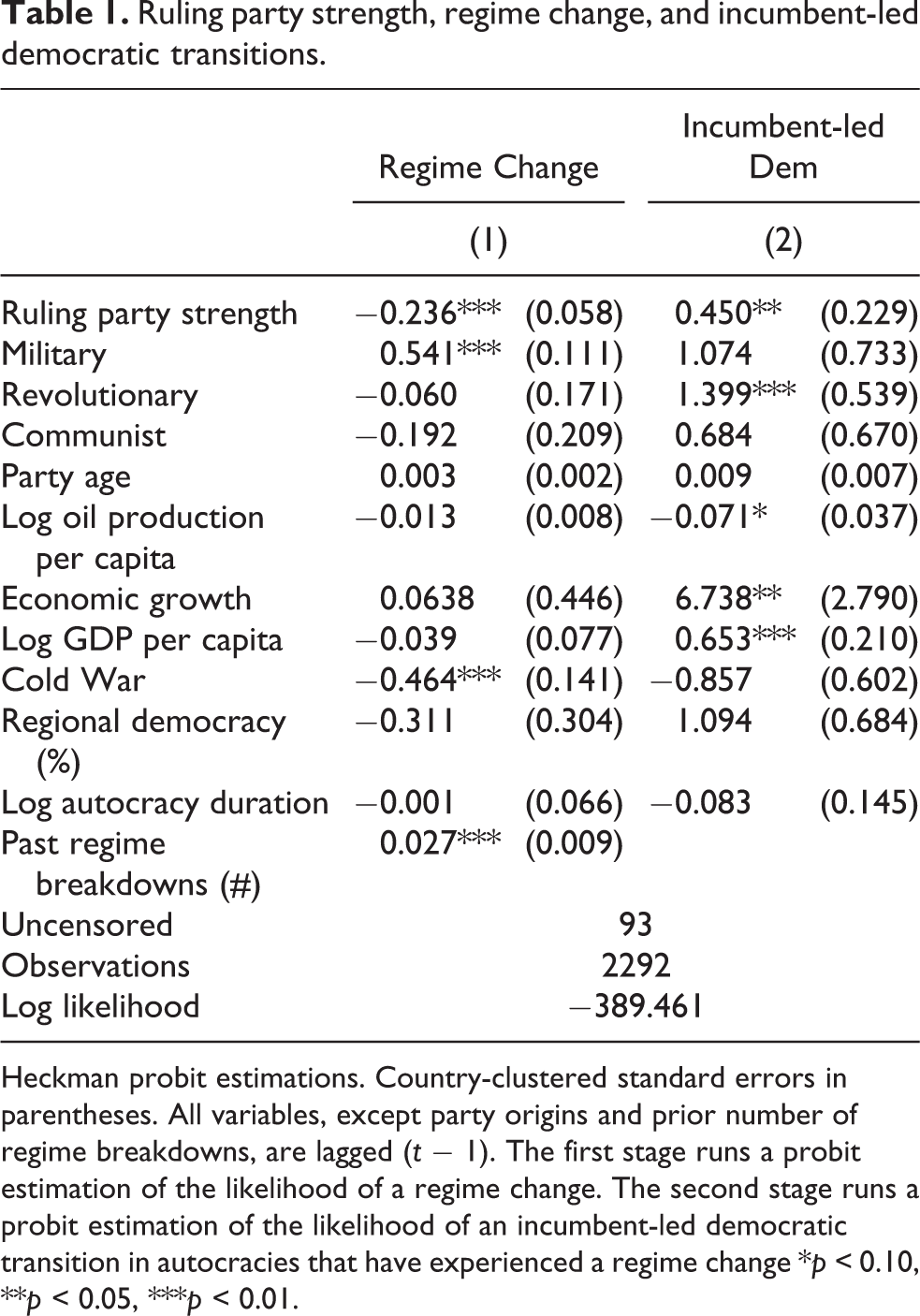
Heckman probit estimations. Country-clustered standard errors in parentheses. All variables, except party origins and prior number of regime breakdowns, are lagged (t − 1). The first stage runs a probit estimation of the likelihood of a regime change. The second stage runs a probit estimation of the likelihood of an incumbent-led democratic transition in autocracies that have experienced a regime change *p < 0.10, **p < 0.05, ***p < 0.01.
To facilitate the interpretation, Figure 1 presents the substantive magnitude of the effects of ruling party strength on the likelihood of regime change. As shown in the figure, shifting ruling party strength up its full range reduces the probability of regime change from 13.9 percent to 1.4 percent. For example, a ruling party that is similar in strength to Kyrgyzstan’s White Path Party (−2.86) is 11 percent more likely to collapse than a party as strong as Lao People’s Revolutionary Party in Laos (1.66).
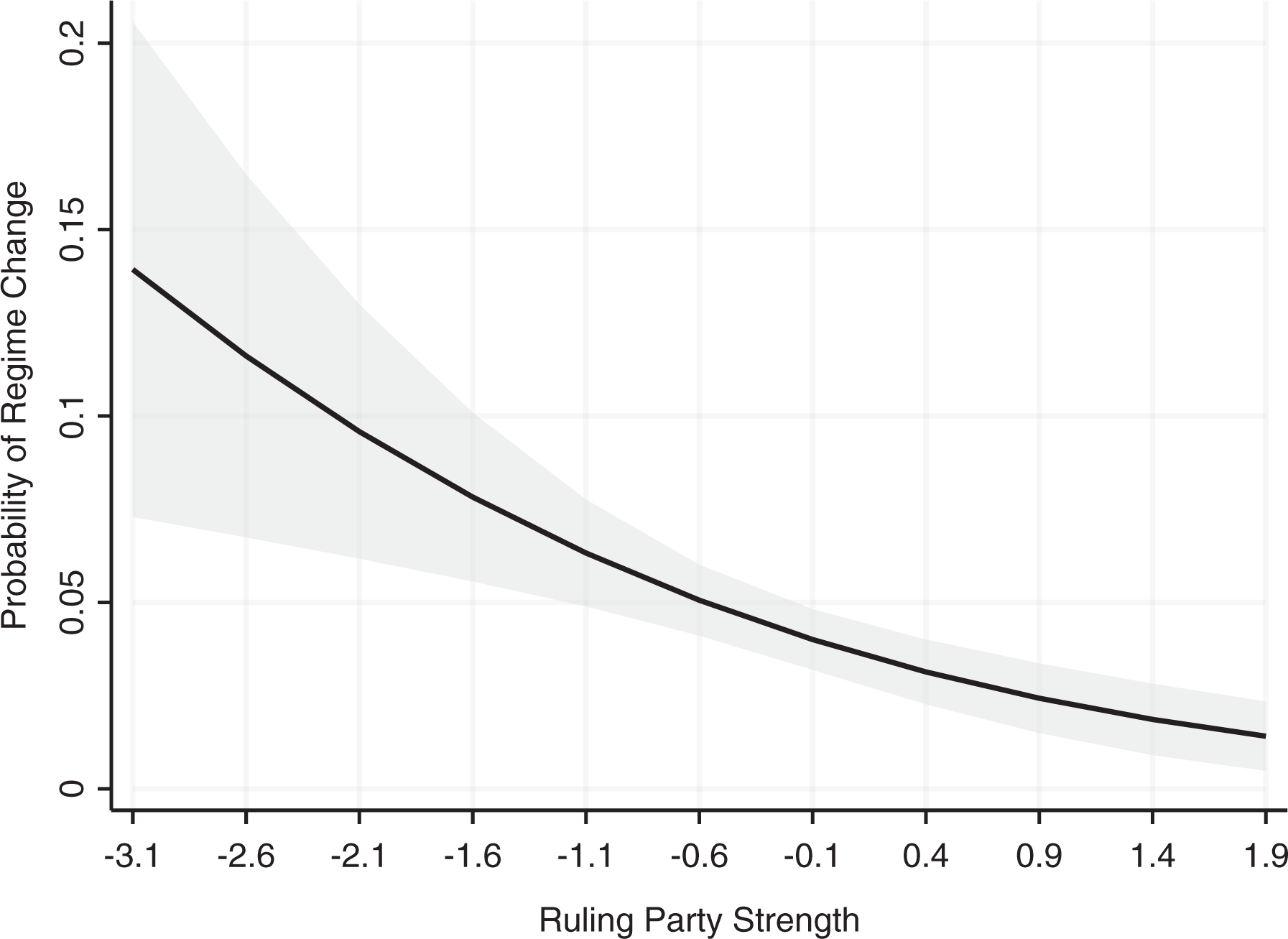
Estimated probabilities (with 95 percent confidence intervals) of regime change based on the first stage probit estimates in Table 1.
Figure 2 graphs the association between ruling party strength and the probability of incumbent-led democratization in the context of regime change. Moving from the lowest to the highest ruling party strength increases the probability of incumbent-led democratization from 11.6 percent to 43.3 percent. This shift roughly corresponds to the difference between Peru 2000 (−2.56), which collapsed after the resignation of President Alberto Fujimori amid international pressures and popular protests, and Sandinista National Liberation Front (1.55) of Nicaragua, which has organized competitive elections in 1984 and successfully steered the liberalization process by holding the upper hand in negotiations with the political opposition (Haggard et al., 2012: 80).
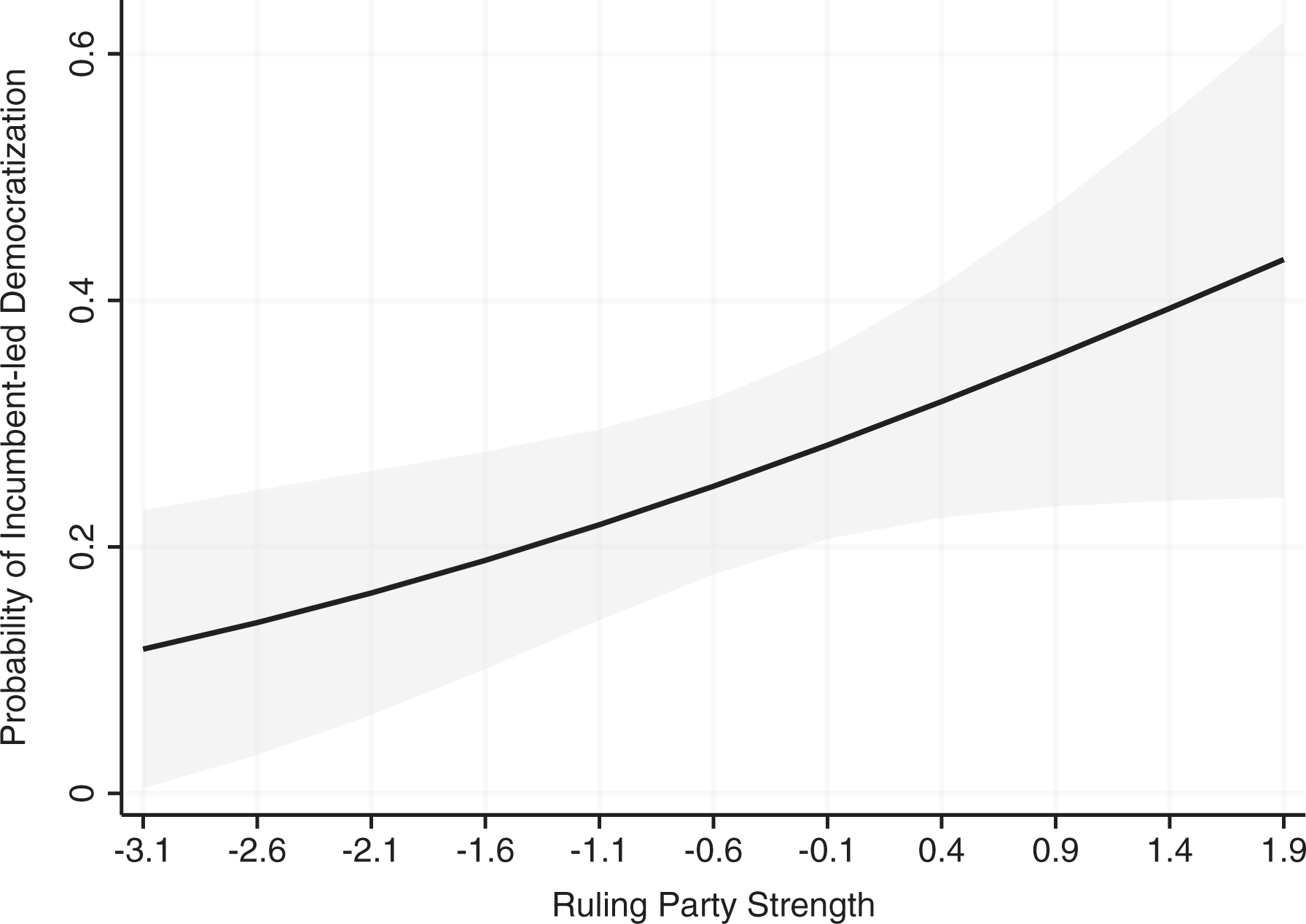
Estimated probabilities (with 95 percent confidence intervals) of incumbent-led democratization based on the second stage probit estimates in Table 1.
Overall, the results support the proposition that strong ruling parties create incentives and capabilities for incumbents to implement democratizing reforms to preempt political opposition during regime transitions. In other words, the findings show that incumbent-led democratic transition is the most likely pathway to regime change in autocracies with relatively strong ruling parties.
Turning to control variables, ruling parties’ founding origins are significantly associated Turning to control variables, ruling parties’ founding origins are significantly associated with the likelihood of regime change and incumbent-led democratic transitions. Ruling parties founded by military regimes are less durable than parties with other founding origins. 11 But military-founded ruling parties demonstrate no significant association with incumbent-led democratization. Ruling parties that have originated from revolutionary movements are more durable than other parties, but this difference is not statistically significant. Nevertheless, revolutionary ruling parties are significantly more likely to experience regime change in the form of incumbent-led democratization, likely because they are capable of facilitating elite coordination (Levitsky and Way, 2012).
Moreover, the results also show that oil production per capita is negatively associated with incumbent-led democratization. 12 Like Kennedy (2010) and Miller (2012), I find that economic development has different implications for regime change and democratization. The results indicate that economic development stabilizes autocracies but makes incumbent-led democratization a likely pathway to regime change. Moreover, the positive impact of economic growth on incumbent-led democratization are in line with previous studies that suggest economic growth enhances incumbents’ ability to control the transition process (Haggard and Kaufman, 1995).
Finally, the Cold War international environment is negatively associated with the likelihood of regime change and incumbent-led democratization. This highlights the role of external powers in stabilizing regimes as well as in pushing incumbents toward making democratic concessions to political opposition. In the absence of external pressures, autocracies with ruling parties seem to face a lower risk of a regime change. As such, when international actors’ demand for democratization is low, autocrats might have few incentives to opt for democratization, which reduces the likelihood of incumbent-led democratization.
I present additional tests in the Online Appendix. First, following Wooldridge (2010: Chapters 9 and 19), I run an instrumental variable regression with the main selection model (Table 1) to account for potential reverse causality between ruling party strength and regime outcomes. In the first step, I use mean regional levels of ruling party strength as an instrument for ruling party strength in a country. This follows from Bizzarro et al. (2018) who argue that political institutions are the product of diffusion in that countries are more likely to adopt particular institutions if their neighbors also adopt them. This should be a valid instrument because it is unlikely that regional levels of party strength to directly influence the likelihood of incumbent-led democratization in a country. 13 Results from instrumental variable estimations, which are in line with the main findings, are presented in Table 4 in the Online Appendix.
I run additional models controlling for region dummies and a measure of ethnic fractionalization from Nardulli et al. (2012) (see Table 5 and Table 6 in the Online Appendix). The results are substantively identical to those in Table 1. Last, I run models with reduced forms of the ruling party strength index excluding each individual component (Online Appendix Table 7). Results from the second stage probit regressions that predict incumbent-led democratization are sensitive to the exclusion of institutionalization, local branches, and active local presence from the index, suggesting that institutionalization and ruling parties’ nationwide active local presence are particularly important for incumbents’ incentives and abilities to guide democratization. These results lend further support to the present study’s argument and insights from the previous studies (e.g., Riedl et al., 2020).
Conclusion
This study examines the role of autocratic ruling party strength in democratic transitions. Building on existing insights that suggest autocratic incumbents often strategically transition to democracy when the costs of sustaining the autocratic status quo outweigh the costs of democratization (e.g. Acemoglu and Robinson, 2005; Riedl et al., 2020; Wright and Escribà-Folch, 2012), I contend that ruling party strength can facilitate the implementation of democratizing reforms by incumbent elites in a top-down fashion to preempt political opposition in the context of regime change. An important implication of this argument is that while strong ruling parties generally promote regime durability, they can simultaneously create incentives and capabilities for incumbents to initiate democratizing reforms in an attempt to avoid relatively more costly pathways to regime change.
In particular, this study augments recent insights into the democratizing effect of strong ruling parties (e.g., Riedl et al., 2020) by highlighting how internal party characteristics such as institutionalization and cohesion are key to understanding the conditions under which incumbent-led democratization becomes a likely mode of regime change. My argument suggests that while ruling parties’ perceived ability to thwart electoral challenges from political opposition might compel incumbents to initiate political reforms, their ability to ensure coordination among regime elites is also a critical source of party strength that shapes incumbents’ capacity to steer democratization without descending into internal struggle. Empirical tests based on the first party-level time-varying measure of ruling party strength corroborate the argument that incumbent-led democratic transitions are especially likely where ruling party qualities that enable regime elites to withstand pressures from outsider opposition groups are complemented with internal party attributes that promote elite coordination within the ruling coalition.
This study is a step toward a better understanding of how autocratic ruling parties are critical for shaping the processes of political reform during regime transitions. These parties have a wide-ranging influence on democratic development after regime transitions. How they manage transitions to democracy and adapt to changing regime dynamics have a long lasting influence on their ability to remain competitive in the long-run (Ishiyama, 1995, 1997; Langston, 2017; Orenstein, 1998) and ultimately on democratic quality (Grzymala-Busse, 2020; Ishiyama, 1999; Miller, 2019; Riedl, 2014; Waller, 1995). Future work can expand on these insights, providing further explanations about how ruling parties can implement political reforms that transcend the transition and engineer democratic institutions that advance their interests (e.g., Albertus and Menaldo, 2014).
Supplemental material
Supplemental Material, sj-pdf-1-ppq-10.1177_1354068820985280 - Autocratic ruling parties during regime transitions: Investigating the democratizing effect of strong ruling parties
Supplemental Material, sj-pdf-1-ppq-10.1177_1354068820985280 for Autocratic ruling parties during regime transitions: Investigating the democratizing effect of strong ruling parties by Berker Kavasoglu in Party Politics
Footnotes
Declaration of conflicting interests
The author(s) declared no potential conflicts of interest with respect to the research, authorship, and/or publication of this article.
Funding
The author(s) disclosed receipt of the following financial support for the research, authorship, and/or publication of this article: This research project was supported by Vetenskapsrådet, Grant 439-2014-38, PI: Ellen Lust, University of Gotneburg, Sweden; by Knut and Alice Wallenberg Foundation to Wallenberg Academy FellowPI: Staffan I. Lindberg, Grant 2018.0144, V-Dem Institute, University of Gothenburg, Sweden; by Vetenskapsrådet, Grant 2018-01614, PI: Anna Lührmann, V-Dem Institute, University of Gothenburg, Sweden.

Supplemental material
Supplemental material for this article is available online.
Notes
Author biography
References
Supplementary Material
Please find the following supplemental material available below.
For Open Access articles published under a Creative Commons License, all supplemental material carries the same license as the article it is associated with.
For non-Open Access articles published, all supplemental material carries a non-exclusive license, and permission requests for re-use of supplemental material or any part of supplemental material shall be sent directly to the copyright owner as specified in the copyright notice associated with the article.
