




Abstract
Political parties are increasingly confronted with electoral volatility. However, the support for some parties is more stable than that of others. Although it has been established that parties’ links to civil society stabilised their electorates in the period until the 1980s, it has not yet been investigated whether such links still fulfil this function in our volatile age. In this paper, we argue that traditional party connections, as well as links to modern day civil society organisations, continue to tie voters to parties. Using a novel dataset covering 149 parties in 29 elections in 14 West European countries, we establish that parties with stronger links to civil society do indeed have a more stable support base. This relationship holds for parties of the left and right. Our results demonstrate that parties’ societal embeddedness continues to play a role in understanding party competition in the 21st century.
Introduction
Political parties are increasingly confronted with high levels of electoral volatility. Since the 1970s volatility has been rising, with the number of highly volatile elections peaking since the 1990s (e.g. Chiaramonte and Emanuele, 2017; Drummond, 2006; Lane and Ersson, 2007; Mair, 2008; Sikk, 2005). However, some parties have a more volatile support base than others. The Dutch social democratic PvdA, for example, gained 12 percentage points in 2003, but lost 19 percentage points in 2017. Other (social democratic) parties experience far greater stability, with fewer of their voters switching to or from other parties. What explains these differences between parties?
This paper focuses on one specific factor that can be expected to affect the stability of a party’s support base: the ties of a party and its elite to organisations in civil society. Much of the relevant literature explains electoral volatility by the openness of the electoral system, the fragmentation of the party system, the entry of new parties, and convergence between mainstream parties (e.g. Chiaramonte and Emanuele, 2018, 2019; Dejaeghere and Dassonneville, 2017; Spoon and Klüver, 2019; Tavits, 2008). We acknowledge that these factors influence party system volatility (i.e. the total number of votes and/or seats that change between parties). However, they cannot account for differences in party volatility (i.e. the absolute change in individual parties’ vote and/or seat percentage at an election).
To account for variations in electoral volatility at the party level, we build on Bartolini and Mair’s (1990) seminal work on party competition and electoral availability. In this work, they argue that parties with stronger ties to society, a phenomenon they define as organisational density, are better able to bond voters, thereby limiting their availability to competitors. Analysing election outcomes in 13 countries between 1885 and 1985, they find support for their hypothesis. In countries in which parties have higher membership percentages and stronger ties to trade unions, party system volatility is usually lower. Hence, they conclude that the higher the level of organisational density in a party system, ‘the lower the propensity to change voting choice’ (Bartolini and Mair, 1990: 232). More recent studies, such as Arndt and Rennwald (2016), Mosimann et al. (2018) and Poguntke (2002), come to similar conclusions when studying specific party families, such as social democratic parties.
Most existing studies limit their analyses to formal membership of political parties and to the ties between political parties and labour unions. Yet, research has demonstrated that the membership of parties and trade unions has declined in recent years (Kelly, 2015; Scarrow and Gezgor, 2010; Scheuer, 2011; Van Biezen et al., 2012; Van Biezen and Poguntke, 2014; Van Haute and Gauja, 2015; Whiteley, 2011), and that trade unions have loosened their formal ties to political parties (e.g. Allern and Bale, 2017; Allern et al., 2007, 2019; Howell, 2001; Hyman and Grumbell-McCormick, 2010). On the basis of these findings, it might be expected that the density of organisational ties has become a less important predictor of electoral volatility at the party level. At the same time, other kinds of membership organisation have become more central to civil society. Both the range and the number of civil society organisations with a membership base in Europe have increased (Beyers et al., 2008; Dekker and Van den Broek, 2005; Jordan and Maloney, 2007) and it is plausible that party ties to this new and diverse civil society will stabilise parties electoral support, through for example parties alignment with and support for the goals of organised civil society (Jalali et al., 2012). So, by limiting their studies to ties between parties and trade unions, scholars risk not only underestimating the effects of organisational ties, but also biasing their findings towards parties that are traditionally tied to trade unions, such as social democratic parties. In theory, religious organisations could bond Christian democratic parties and their voters, and environmental protection groups could link Green parties and their supporters.
To examine the extent to which organisational ties account for the electoral stability of parties, we introduce a new dataset, covering 237 observations of vote share change for 149 parties spread over 29 elections in 14 countries. To measure parties’ ties to society, we use three key independent variables at the party level: 1) the ratio between a party’s vote and its number of members and 2) the proportion of a parties electorate in membership of a trade union – together capturing what Bartolini and Mair (1990) refer to as organisational density -, and 3) the average number of membership organisations to which party candidates belong – capturing what we introduce as parties’ connective density. The latter variable is measured using the newly released Comparative Candidate Survey (CCS, 2016, 2019). Through a series of regression analyses, we establish that the links of political parties to society still stabilise their electoral support. Parties with strong support amongst trade unionists and strong ties to other kinds of membership organisation are less likely to lose (or gain) large numbers of voters. Party membership, however, has ceased to be a significant determinant of electoral stability at the party level.
In this paper we make two main contributions to the literature on parties and elections. First, we re-conceptualise the way in which societal links between civil organisations and parties should be understood in the 21st century, emphasising the importance of looking beyond traditional organisations such as trade unions. Second, we show that parties’ societal embeddedness continues to be important when studying electoral change (cf. Allern and Bale, 2012), thereby opening up new avenues for understanding party-voter links.
This paper is structured as follows. In the first section we re-conceptualise party-society linkages, explain how such linkages can be expected to bond parties and their voters, and present our hypotheses about the relationship between parties’ societal ties and the stability of their electoral support. In the second section we operationalise a new measure of party-civil society connectedness and specify several models for testing our hypotheses. The results of our analyses are presented in the third section and a fourth section discusses conclusions and identifies areas for further research.
Encapsulating voters through societal ties
Following the seminal study of Bartolini and Mair (1990) various studies have provided evidence for the fact that the ties political parties maintain with civil society constrain the availability of voters to competitors. Parties with stronger ties are less likely to lose their supporters than parties with weaker links (Arndt and Rennwald, 2016; Mosimann et al., 2018; Poguntke, 2002). But how does this relationship actually work? We suggest that there are three mechanisms by which connections between parties and civil society organisations restrict the mobility of electorates: a solidaristic, a mobilising and an instrumental mechanism.
The first, a
The second, a
The third, an
Taken together the three mechanisms suggest that organised relationships between political parties and civil society stabilise voters’ attachment to parties through the diffusion of solidaristic norms, the mobilisation of constituencies of interest, and the provision of benefits and resources for the members of organisations. In our study, we do not seek to address the relative importance of these three causal mechanisms. This discussion does highlight, however, that organised relationships between parties and civil society operate at several levels – at the level of the party’s ‘base’ (i.e. members and supporters), and at the level of party elites. Strong membership links between a party and a civil society organisation likely mean that many members of that organisation vote for that party. At the same time, however, the contacts between elites within a party and actors in civil society organisations are also likely to foster links and stabilise support. Our expectation is, therefore, that solidaristic and instrumental mechanisms will be more important at the level of parties’ support base, while the mobilising mechanism will be more important at the level of party elites. These different types of relationships between parties and civil society organisations may well reinforce each other in constraining volatility.
In their seminal study, Bartolini and Mair (1990) introduced the concept of organisational density. This concept refers to the ties between parties and organisations at the level of their support base where the solidaristic and instrumental mechanisms are likely to be predominant. We distinguish this form of density from connections between parties and organised interests at the level of the party elite where the mobilising mechanism is key, a concept that we will refer to as connective density. Although traditional ties between parties and organised interests have weakened and electoral volatility has increased since Bartolini and Mair’s study was published, we still expect the mechanisms by which connections are translated into the encapsulation of electorates to work. We therefore hypothesise that stronger ties between parties and organised interests will lead to parties having more stable support bases. Hypothesis 1: Higher levels of organisational density will be associated with lower levels of electoral volatility at the party level; Hypothesis 2: Higher levels of connective density will be associated with lower levels of electoral volatility at the party level
Bartolini and Mair (1990) focused on the ties between trade unions and parties. However, the field of organised social life is very different today than it was when they developed the concept of organisational density. The world of work, so central to the organisation and mobilisation of political identities in the 20th century, has changed radically with a shift in low-wage employment to private services and the growth of precarious and fixed-term employment (Mosimann and Pontusson, 2017). From the perspective of political parties other forms of membership organisation have become important (Allern and Bale, 2012; Beyers et al., 2008; Rasmussen et al., 2018). To develop a fuller account of the role of organisational connections in stabilising electorates we need to look beyond trade unions to the evolution of a more diverse civil society and the nature of its ties with political parties (Allern et al., 2020).
Defined in broad organisational terms civil society consists of trade unions, business and professional associations, religious associations, interest and campaign groups, and social movements. CSOs are non-governmental and do not include commercial companies, professional lobbyists who may represent civil society to government, or office seeking organisations such as political parties (Beyers et al., 2008).
While the membership of trade unions and political parties has fallen across Western Europe (Kelly, 2015; Van Biezen and Poguntke, 2014) both the number, and membership, of CSOs has increased with the result that far more voters are active in them than in political parties. The diversity of the CSO population has also increased with growth in the number of organisations representing ‘diffuse’ interests (Beyers et al., 2008: 1113). As they have grown in membership and become more professionalised CSOs have acquired resources of information, expertise, and the capacity to mobilise citizens in support of public policy change. In support of policy advocacy CSOs have become an important influence on public opinion (Rasmussen et al., 2018). More information on the types of CSOs we study and on recent trends in their development is included in Appendix A in the online appendices.
The significance to political parties of these developments is that relationships with CSOs have the potential to provide access to large and growing numbers of voters, as well as to organisations with the resources to influence public opinion and mobilise constituencies shaping electoral outcomes in consequence. Traditional ties were based on formal organisational affiliations through party statutes and direct membership of parties themselves. The connections between parties and CSOs are in contrast characterised by overlapping memberships, membership affiliations of party ‘elites’, programmatic links and regular informal contacts between party headquaters and parliamentary groups, on the one hand, and CSOs on the other (Allern et al., 2020; Allern and Verge, 2017; Blings, 2018; Della Porta et al., 2017). Most importantly though, political parties retain incentives to seek connections with civil society and the mechanisms through which connections bond voters will have remained the same.
With the exception of a few works (Poguntke, 2002; Verge, 2012; Warner, 2000) the literature on the link between organisational connections and electoral volatility tends to focus primarily on trade unions and parties of the left. The seminal works in the field (Bartolini, 2000; Bartolini and Mair, 1990) focused on the role of mass parties of the left in mobilising workers and no equivalent studies have attempted a similarly all-encompassing cross-sectional and time series account of the role played by links between parties of the right and civil society. Right-wing parties might have stronger ties to business associations and religious groups, while left-wing parties are expected to be more connected to trade unions and organisations campaigning in the fields of civil rights and the environment (Allern, 2013; Verge, 2012). However, we see no theoretical reason why dense connections between right-wing parties and religious organisations or business associations should not tap into the mechanisms that translate organisational connections into stable support. Our final hypothesis H3 is therefore that higher levels of organisational and connective density will stabilise the electorates of both left and right wing parties. Hypothesis 3: The impact of organisational and connective density on electoral volatility at the party level will hold for parties of both the left and the right
Data and model operationalization
To test our hypotheses, we have compiled an original dataset that contains data on electoral volatility at the party level in 14 West European countries, as well as data on a range of relevant independent variables. The unit of analysis in the dataset is the political party per election year. The dataset consists of 237 observations for a total of 149 political parties at 29 elections in 14 countries. The countries, elections and parties included in the dataset are those covered by the Comparative Candidates Survey (CCS, 2016, 2019), on the basis of which we operationalise our key independent variable, namely our measure of connective density. Waves I and II of the CCS cover elections that took place between 2005 and 2017. The elections included in our dataset are those in Austria (2008), Belgium (2007, 2010, 2014), Denmark (2011), Finland (2007, 2011, 2015), Germany (2005, 2009, 2013, 2017), Greece (2007, 2009, May 2012, January 2015), Ireland (2007), Italy (2013) the Netherlands (2006), Norway (2009, 2013), Portugal (2009, 2011, 2015), Sweden (2010, 2014), Switzerland (2007, 2011), and the United Kingdom (2010). 1
Party level measures – Dependent variable (DV) and independent variables (IV’s)
We operationalise our dependent and independent variables at the party level by election year. Our dependent variable is the instability of each party’s electoral support. We measure this variable as the absolute change in each party’s vote percentage at each election compared to their vote percentage at the previous election. This gives us a simple scale variable for the percentage point change in electoral support for each party at each election. Data is sourced from the Political Data Yearbook published by the European Consortium for Political Research. 2 Appendix C in the online appendices provides more detail on the parties included in the data set. The values for this measure range from 0.00 to 30.74, with a mean of 2.91 and a standard deviation of 3.81.
Our two main independent variables are organisational density and connective density. Organisational density consists of links at the level of party members and supporters, links that are characterised by Lisi (2013) as participatory in nature. Connective density describes connections between party elites and the organisations in the environments relevant to parties’ electoral ambitions, links that are characterised by programmatic alignment and the activation by groups of pressure for policy goals, a process that intensifies around elections (Blings, 2018; McAdam and Tarrow, 2010).
Bartolini and Mair (1990) operationalise organisational density at the country level, combining measures for trade union membership and party membership. We build upon their insights, but we measure the two components of the concept separately at the party level. The proportion of a party’s electorate that is a member of a trade union measures party support amongst trade unionists in each election year. Data was sourced from voters’ answers to questions about both party choice and trade union membership in the European Social Survey (European Social Survey Cumulative File 1-8, 2018) in the case of 25 elections and supplemented where this was not available by answers to nearly identical questions in the Comparative Study of Electoral Systems (CSES) for 4 elections. Our measure for parties corresponds closely to country measures of Trade Union Density, parties in countries with higher levels of Trade Union Density having relatively high numbers of trade union voters. The party membership ratio is a well-established measure of the relative size or density of party membership used extensively in the literature on electoral volatility (see for example, Poguntke, 2002) and measured by party membership as a proportion of each party’s electorate in each election year. Data was sourced from the Members and Activists of Political Parties (MAPP) dataset (Van Haute et al., 2018), which has data for most European parties up to 2013. For other elections, data was gathered on the basis of research publications (Hooghe and Boonen, 2014; Van Biezen et al., 2012) and party sources (see Appendix C in the online appendices for more detail on sources for party membership).
To operationalise connective density, we develop a measure that expresses the connectedness of key party elites to organisations in civil society by deploying the extensive and growing data set on candidates memberships of categories of organisations in civil society provided by the Comparative Candidates Survey (CCS). Waves I and II of the CCS asked candidates for details of their membership of a range of organisations in civil society. We selected four categories of organisations (Trade Unions, Professional Associations, Interest Groups and Religious Associations) from Wave I and five categories of organisations (Trade Unions, Business Associations, Human and Civil Rights Organisations, Environmental groups, and Religious Associations) from Wave II for our measure. Following Bekkers (2005) the selection was made on the basis of an assessment of whether a type of membership was pertinent from the perspective of electoral mobilisation. On the basis of this criterion membership of sports or cultural associations, for example, was not included in the measure. 3 We coded the responses of each candidate with a value of 1 representing membership and 0 representing non-membership, and calculated mean values for the total categories of memberships for each party at each election covered by the CCS. In order to ensure consistency between the waves and correct for potentially higher reported values from Wave II as a result of a greater number of selected categories, we treated Professional Associations (in Wave I) and Business Associations (in Wave II) as equivalent and computed a new variable combining Civil Rights and Environmental Groups (both from Wave II). 4 The values for the measure of connective density show significant variation between parties. Connective density ranged from 0.0 for the Lijst Dedecker at the Belgian election of 2010 and 2.09 for the Kristelig Folkeparti at the Norwegian election of 2013.
To test hypothesis 3, which postulates that connective density is important for political parties irrespective of left-right ideology, we categorised all 149 parties in our dataset as either left- or right-wing on the basis of the Chapel Hill Expert Survey (CHES) dataset (Bakker et al., 2015). On the basis of our categorisation we constructed a dummy variable of left-right ideology, which takes the value of 1 when a party is left-wing and a value of 0 when a party is right-wing. 5
Control variables
To control for other potential influences on the stability of party support our models include control variables at both the party level and the level of party and political system. At the party level we control for party size, because electorally larger parties will have more voters to lose than smaller parties. We measure party size on the basis of the percentage vote of each party at the election preceding each election covered by the dataset.
At the country level we control first for the cultural heterogeneity of society. Bartolini and Mair (1990) demonstrate that more heterogeneous societies produce more electoral stability as ethnic, religious and linguistic identities limit the availability of electorates. At any moment in time individual countries will experience differing degrees of diversity on different measures and, over time, some types of diversity will change at different rates than others (Patsiurko et al., 2012). Because of this and in order to capture as much as possible of the reality of diversity in contemporary Western European societies we operationalise cultural heterogeneity at each election as an additive measure of two indices: The ethnic fractionalization index (EFI), measuring the probability that two individuals selected at random from a country are not from the same ethnic group.
6
This data is sourced from the Historical Index of Ethnic Fractionalization Dataset (HIEF) maintained by Harvard University (Drazanova, 2019). The religious density index (RDI) devised by the Pew Research Center in the United States, measuring the proportion of a country’s population in each of eight major religious groups. The RDI for the countries covered in this paper was estimated using data from the Religious Characteristics of States Data Set maintained by the Association of Religion Data Archives (ARDA) (Brown and James, 2019).
At the country level we also control for economic conditions with a measure of the change in gross domestic product in the year preceding each election. The source for this data is the World Bank – GDP growth (annual %) 1961–2019. 7
Additionally, we control for the number of parties contesting each election, as a higher numbers of parties at an election will provide voters with greater choice and incentivise voter mobility. We operationalise this by the number of political parties obtaining at least 2% of the national popular vote at each election. Finally, we control for electoral system change at the party system level because a substantial change in the electoral system is likely to influence constraints on voter choice and mobility (Bartolini and Mair, 1990: 146). We define electoral system change as a change in the franchise, a change in the mode of election of a representative chamber, or a change in the threshold required for representation in parliament, and believe this definition encompasses all substantial change in the period studied. We operationalise this control with a dummy variable taking the value 1 in cases where an election was preceded by a significant change in the electoral system and the value 0 in other cases.
In the analysis of this data we use Ordinary Least Squares Regression with robust standard errors clustered by election. 8 Checks for multicollinearity were run for all main models and in no instance was the Variance Inflation Factor (VIF) of any variable greater than 2.62 (number of parties in Model 1).
Results
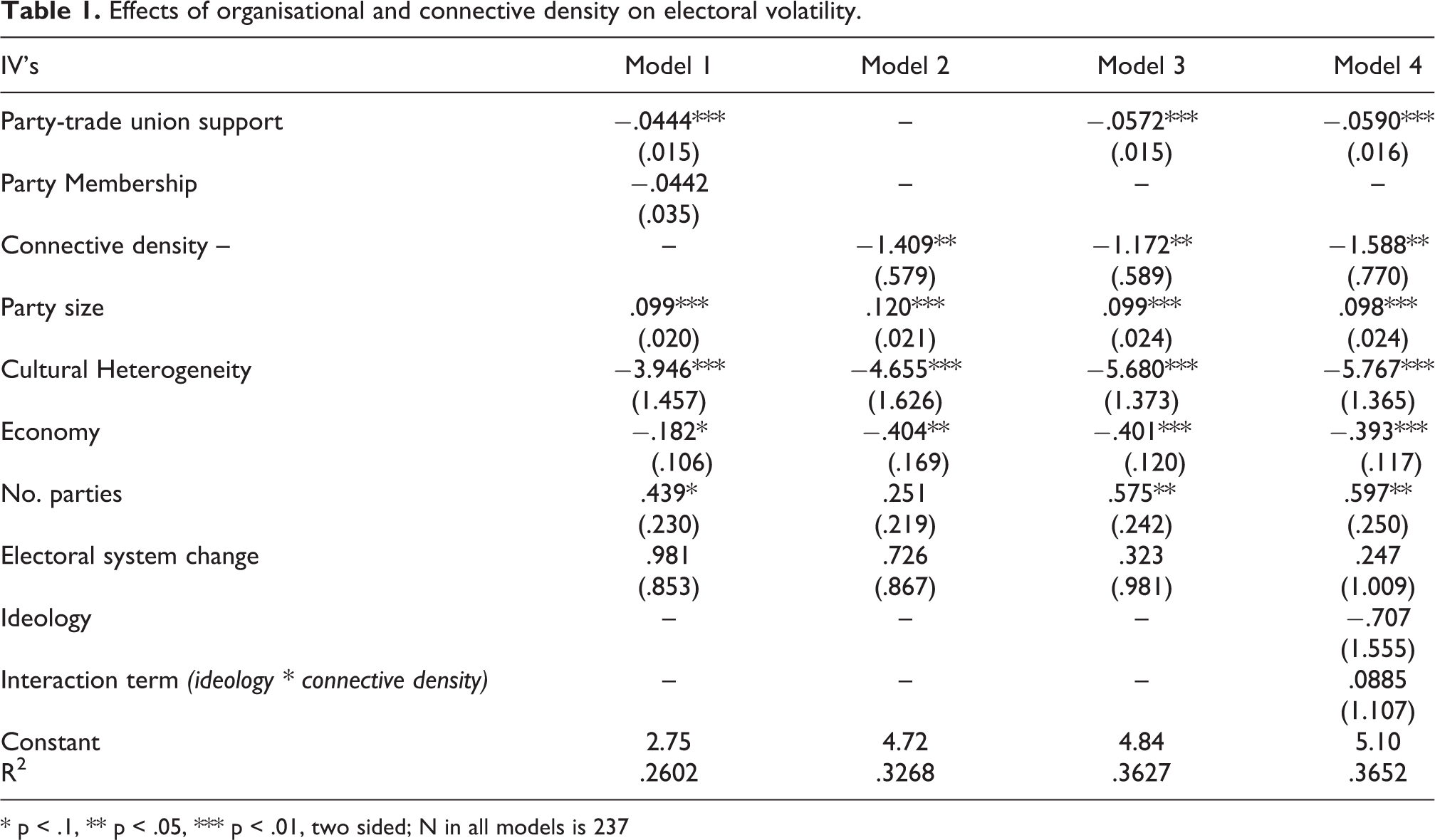
Table 1 displays the results of our regression analyses. In Model 1 we explore the impact of organisational density on electoral volatility. The effect of one component of organisational density, party membership, is insignificant. Parties with a sizable party membership do not have a more stable support base. The second component, party-trade union support, has a negative effect on volatility at the party level (significant at the .01 level). Parties with lower shares of trade union member support experience higher levels of volatility. These results partially confirm H1 that higher levels of organisational density are associated with more stable party vote share. The R2 for Model 1 is .260, thus explaining over a quarter of the variation in party vote share change. Of our controls, the effects of cultural heterogeneity, the economy, the number of parties and party size are significant.
Effects of organisational and connective density on electoral volatility.
* p < .1, ** p < .05, *** p < .01, two sided; N in all models is 237
In Model 2 we replace organisational density with our measure of connective density. The effect of connective density is significant at the .05 level. This result supports H2 that higher levels of parties’ connective density are associated with less electoral volatility at the party level. The R2 for Model 2 is .327, indicating that a model including connective density explains the variance in volatility somewhat better than one with organisational density. All of our control variables have a significant effect, with the exception of electoral system change and the number of parties in the party system.
In Models 1 and 2 we estimated the separate effects of organisational and connective density on volatility. In Model 3 we estimate the effects of both forms of density at the same time by re-introducing the significant component of organisational density, party-trade union support, from Model 1. Importantly, when controlling for organisational density, the effect of connective density on volatility remains significant at the .05 level. There is also an improvement in model fit, with R2 rising to .363. Hence, we can conclude that both forms of density play a role in stabilising party electorates.
Finally, in Model 4 we include a dummy of party ideology and its interaction with connective density. 9 Neither the left-right dummy for ideology nor its interaction with connective density attain significance and the effects of both organisational and connective density on volatility at the party level remain stable and significant. We confirm H3 that the restraining role of connective density on volatility at the party level holds for parties of both the left and right. Post model estimation indicates that making connections with civil society is a substantive way for a party to reduce average electoral volatility, a party with average levels of connective density is predicted to have 1.7 percentage points lower volatility than a party with no connections. 10
In sum, the results support our three hypotheses. Of our independent variables, only party membership plays no role in stabilising party electorates. However, the trade union support component of organisational density retains a stabilising role, especially when controlling for connective density.
Robustness checks
To assess whether our results are robust, we first estimated our models excluding outlying observations for changes in party vote share and ran models 3 and 4 with country fixed effects. The results of these analyses are shown in Tables D.5 and D.6 in online Appendix D. All substantive conclusions are robust to the exclusion of (sets of) outliers and with country fixed effects.
We also evaluated whether the observed relationship between party candidates and connective density might be due to an age effect. It is conceivable that older candidates have more connections and that parties with older candidate profiles in consequence have more dense connections. The results of these analyses in Table D.7 in online Appendix D show that there is no linear relationship across the elections between the age groups of candidates and connective density, with candidates aged between 46 and 54 having the most connections to society.
Third, we re-instated party membership into models 3 and 4, and estimated the models with additional control variables: each party’s government status at the time of elections, change in election turnout, and party polarisation. Inclusion of these additional controls did not affect our results. Details of these analyses are provided in online Appendix D.
Fourth, we tested whether the impact of organisational and connective density on parties’ electoral volatility held for both vote gains and vote losses. We included a dummy variable with 1 for all instances where parties gained votes and 0 for cases where parties lost support. We added an interaction between this dummy variable and connective density. While the main effect of connective density remained significant, the interaction with loss/gain was not (see online Appendix E). We conclude that higher levels of connective density limited party vote changes in an upward as well as downward direction.
Fifth, we ran our full model with an interaction of connective density and party size. This interaction was also not significant. So, here we also concluded that connective density has a similar effect on the stability of the electoral support of large as well as small parties.
The results of these tests are provided in online Appendix E. The impact of organisational density was also robust.
Finally, we, tested our models with each of the components of cultural heterogeneity included separately and as a further test of party ideology conducted analyses with three categories of party – left, right and centre. The results were substantively the same (see online Appendix E).
In sum, we can conclude that our results are robust. Organisational density and connective density have strong and significant dampening effects on electoral volatility at the party level.
Discussion and conclusions
To what extent is the stability of a party’s electoral support linked to the ties of a party and its candidates to organisations in society? Research focuses mainly on the formal institutional linkages of the mass membership parties of the 20th century. We study this question deploying an original dataset covering 29 elections in 14 Western European countries and operationalising a new measure of connections between political parties and the diverse population of organised civil society in the early 21st century. The main insight of our study is that, even in an era of increased volatility, the bonds that political parties have with voters through organisational links remain relevant. We have also shown that these bonds work for parties of both the left and the right.
Our findings have a number of important implications. First, citizens’ membership of and participation in CSOs, and the role played by CSOs in representing and mobilising public opinion in the increasingly heterogeneous societies of Western Europe, matter electorally. They remain important actors in electoral politics, despite the fact that the character of CSOs, as well as the nature of their ties to political parties has changed considerably over the years. In the 21st century, political parties work with a wider variety of CSOs and the ties that they have with them are less formal and rarely institutionalised. However, the role these ties play for political parties remains essentially the same. Connections to civil society give parties pathways to large numbers of voters and to organisations with the capacity to structure voters preferences.
Second, party membership no longer appears to play a part in stabilising party electorates. This is probably because few people are members of political parties nowadays (e.g., Van Biezen et al., 2012). Even when members of political parties are loyal to their party, their numbers are too small to stabilise the support of a party. From the perspective of the party, membership provides a valuable resource (Scarrow et al., 2017), and party membership offers opportunities for citizens with a strong sense of political efficacy to participate in the political system (Whiteley, 2011). However, party membership does not link parties to large groups of voters, a finding consistent with Hooghe and Kern’s (2015) study of the impact of party membership on political trust.
Third, our findings suggest that parties’ relationships with voters through societal organisations help sustain their resilience. Hence, the famous assertion of Katz and Mair (1995; see also Mair, 2013) that parties are abandoning society by retreating into the institutions of the state should be nuanced. In in the 21st century, political parties have strategic incentives to expand their ‘zone of engagement’ with citizens in organised civil society (Mair, 2013), as this stabilises their support.
Our findings suggest a number of fruitful avenues for further research. First, more work should be done to confirm the stabilising effect of connective density on party electorates, by including more counties and elections in future studies. There is also scope to explore the relationship between civil society and electoral stability at the level of the individual voter. We have found that parties’ connections to CSOs help stabilise their support, but are voters with extensive organisational affiliations also more loyal in their party choice at and between elections?
Second, since party connections to society matter electorally, further research into how parties invest in their affiliations to civil society will provide new insights into the competitive political strategies of parties in contemporary Europe. What explains differences in parties’ connective density both within and between countries? Do parties of different party families differ in their strategies in this regard and, if so, in what way? Which parties have been most successful in developing electorally effective connectivity and what factors explain relative success? Given that connections limit vote change in both directions do some parties, as Lisi suggests (2013), consciously seek higher connectivity as a means to electoral stability? And what differences are there between countries in the form taken by party connections to civil society with what consequences for party competition and electoral volatility?
The ‘connected’ political party of the 20th century characterised by mass membership, formal organisational ties, and party ownership of mass communication channels may have declined in significance, but we have shown that societal connectivity remains important to the electoral fortunes of political parties. The evolving characteristics of the newly connected party of the 21st century is we argue a subject of great importance to the study of competitive political strategy in Western Europe.
Supplemental material
Supplemental Material, sj-pdf-1-ppq-10.1177_1354068820980304 - Holding on to voters in volatile times: Bonding voters through party links with civil society
Supplemental Material, sj-pdf-1-ppq-10.1177_1354068820980304 for Holding on to voters in volatile times: Bonding voters through party links with civil society by Nick Martin, Sarah L de Lange and Wouter van der Brug in Party Politics
Footnotes
Acknowledgements
The authors would like to acknowledge Elin H. Allern, Professor of Political Science at the University of Oslo, for the opportunity to read a number of publications that were under review at the time this paper was written. They also wish to thank the anonymous reviewers of an earlier draft of this paper for several helpful comments and suggestions that contributed to improving the paper.
Declaration of conflicting interests
The author(s) declared no potential conflicts of interest with respect to the research, authorship, and/or publication of this article.
Funding
The author(s) received no financial support for the research, authorship, and/or publication of this article.

Notes
Supplemental material
Supplemental material for this article is available online.
Author biographies
References
Supplementary Material
Please find the following supplemental material available below.
For Open Access articles published under a Creative Commons License, all supplemental material carries the same license as the article it is associated with.
For non-Open Access articles published, all supplemental material carries a non-exclusive license, and permission requests for re-use of supplemental material or any part of supplemental material shall be sent directly to the copyright owner as specified in the copyright notice associated with the article.
