




Abstract
Western Europe has recently experienced the emergence of successful new parties, but while single parties or countries have been extensively studied, insufficient attention has been devoted to this phenomenon from a comparative and long-term perspective. By relying on an original data set covering 20 countries and 344 parliamentary elections, this article presents the first analysis of West European ‘genuinely new parties’ (GNPs) across time, countries and party families. We hypothesize that the parties differ not only in terms of their short- and long-term success but have a range of distinct development paths. Through a latent growth model, we provide a classification of GNPs in terms of their breakthrough and initial performance. According to the specific trajectory followed by new parties in the first five elections they contest, the model suggests five different classes of new parties in Western Europe: ‘explosive’, ‘meteoric’, ‘contender’, ‘flat’ and ‘flop’. The article discusses the implications of these findings also regarding the ability of the model to produce estimates and predictions about the future electoral performances of GNPs.
Introduction
Western Europe has recently experienced increasing electoral instability and the emergence of successful new parties, raising the prospect of party system de-structuring (Bolleyer, 2013; Chiaramonte and Emanuele, 2017; Dassonneville and Hooghe, 2017; Emanuele and Chiaramonte, 2018; Hérnandez and Kriesi, 2016; Hobolt and Tilley, 2016). While single parties, party families or countries have been extensively studied, insufficient attention has been devoted to the rise of new parties from a comprehensive, comparative and long-term perspective. This article presents the first large-scale exploratory analysis of West European ‘genuinely new parties’ (GNPs), a term that – originating from Sikk’s (2005) study of Central and Eastern Europe – highlights the difference between party system insiders and outsider new parties, or, in other words, parties established at the introduction of democracy and their successors.
However, instead of focusing on ‘static’ approaches based on the simple dichotomy between success and failure and looking at the number of new parties contesting elections or at their support in the initial election only (Harmel and Robertson, 1985; Hug, 2001; Lago and Martínez, 2011; Tavits, 2006), we analyse new party development trajectories using latent growth modelling (Jones and Nagin, 2012; Nagin, 2005). This approach originates in criminology and psychology; it was introduced in political science by Mustillo’s study of Latin American new parties (2009). This article aims to extend the approach to Western Europe and introduce recent methodological advancements.
Our original data set covering 344 parliamentary elections in 20 West European countries identifies 127 GNPs since 1945. We analyse their performance across countries, party families and over time. Latent growth modelling provides a classification of GNPs in terms of their breakthrough and subsequent performance. We find that based on GNPs’ first five elections they can be classified into five categories: ‘explosive’, ‘meteoric’, ‘contender’, ‘flat’ and ‘flop’. We also discuss the ability of the model to produce estimates and predictions about the future performances of GNPs. 1
The article is organized as follows: the next section reviews the different conceptualizations of new parties and approaches to study their success. The third section presents an empirical overview of GNP development across countries, party families and over time. The fourth section introduces the latent growth model, presents our methodological choices, the empirical analysis and the results, offering an original classification of GNPs based on the trajectories they follow after their initial elections. A concluding section discusses our main findings and their implications.
Analysing new party success
The emergence of green, left-libertarian and radical right parties in Western Europe since the 1980s broke up the golden age of stable, even frozen, party systems (Lipset and Rokkan, 1967). Their rise has sparked keen scholarly interest (Ignazi, 2003; Kitschelt, 1988, 1995; Müller Rommel, 1989; Poguntke, 1987). Many studies have focused on new party organization, ideology, factors explaining their success and paths to government (Deschouwer, 2008; Harmel, 1985; Harmel and Robertson, 1985; Hug, 2001; Lucardie, 2000). A successful wave of new parties since the millennium has reinvigorated research on these aspects and new party impact on party systems (Bolleyer, 2013; Bolleyer and Bytzek, 2013, 2017; Emanuele and Chiaramonte, 2018; Hino, 2012; Hobolt and Tilley, 2016; Lago and Martínez, 2011; Tavits, 2006).
Are all new parties created equal in terms of their footprint on their countries’ party systems? Most of the above-mentioned studies examine new parties only in their first election or whether a certain type of party has succeeded in a country. Generally, ‘success’ (breakthrough or presence) and ‘failure’ are defined as dichotomous categories. 2 This binary view also permeates research on party performance beyond their initial elections. Moreover, scholarly consensus has not been reached on what constitutes (a) a ‘new’ party and (b) ‘success’.
The definitions of ‘new party’ vary greatly. Inclusive definitions comprise parties that experience name changes, mergers and splits (Birch, 2003; Bolleyer, 2013; Harmel and Robertson, 1985; Hug, 2001; Powell and Tucker, 2014; Tavits, 2006; Zons, 2015). Restrictive definitions require a novel organization and novelty among personnel and leadership (Barnea and Rahat, 2011; Bartolini and Mair, 1990; Emanuele and Chiaramonte, 2018; Marinova, 2015; Sikk, 2005; Sikk and Köker, 2017). 3 This article relies on Sikk’s concept of GNPs as parties that ‘are not successors to any previous parliamentary parties, have a novel name and structure, and do not have any important figures from past democratic politics among their major members’ (2005: 399). This concept, based on the idea that new parties are those that are organizationally new, was originally used to analyse turbulent Central and Eastern European party systems but the distinction between party system outsiders and insiders is becoming more relevant in Western Europe given the fading party system stability (Chiaramonte and Emanuele, 2017; Dassonneville and Hooghe, 2017; Hérnandez and Kriesi, 2016).
The fortunes of new parties are usually studied through opposing categories such as success and failure, persistence and decline, survival and demise. However, such oppositions do not fully account for patterns of new party performance. Indeed, how to distinguish between ‘success’ and ‘failure’? Does success mean a party receiving many votes, entering parliament or the government? Can we talk about different degrees or patterns of success?
We suggest that new parties differ not only in terms of their short- and long-term ‘success’ but in their developmental paths. These trajectories depend, among other factors, on their initial level of success that can be used to predict whether a party will follow one path or another. In contrast to a ‘static’ approach focusing on the inaugural election (Harmel and Robertson, 1985; Hug, 2001; Lago and Martínez, 2011; Tavits, 2006) or simple success/failure dichotomy, we track party performance over a longer time period. Thereby, a more nuanced picture of party development emerges, distinguishing between parties that enter with similar levels of support but then diverge – some disappearing promptly, others becoming strong competitors to established parties. The fine-grained picture can, in turn, be used in future analyses of the impact of party-, country- and time-specific factors on party development.
To study party development paths, we use latent growth (or trajectory) models (LGM, see Jones and Nagin, 2012; Nagin, 2005; Proust-Lima et al., 2017). LGM uncovers latent (underlying) trajectories of a variable over time – in our case, new party vote share. Obviously, we do not expect all parties to follow the same latent trajectory. We know that some never properly take off and others fizzle out quickly while others maintain or even increase support over time. Assuming diversity, we use class-based LGM that allows one to ‘[identify] distinctive clusters of individual trajectories within the population’ (Jones and Nagin, 2012: 1). Latent classes with different trajectories have been used to study the development of parental depression (Barkmann et al., 2018), delinquent behaviour among adolescents (Reinecke, 2017), growth patterns among British ethnic minority children (Mebrahtu et al., 2015) and sleeping pill use among over-50s (Verger et al., 2017, identifying ‘non-users’, ‘quasi-continuous users’, ‘increasingly frequent users’, ‘decreasingly frequent users’ and ‘occasional users’). Mustillo (2009) introduced LGM in political science to analyse new party trajectories in Latin America but, as discussed below, we introduce methodological advancements compared to Mustillo’s pioneering study.
GNPs in Western Europe: Data and evidence
This article uses our comprehensive data set of 127 GNPs in 344 parliamentary elections (lower house) in 20 West European countries since the Second World War. 4 We start from the third democratic election in each country to focus on changes after the initial consolidation of democracy and structuring of the party system. 5 We include parties with 1% of votes at least in one election to exclude numerous parties with little relevance. Overall, the mean vote share of GNPs was only 1.4% (see Figure 1; Table B2 in Supplemental Material B) and only 28% of elections witnessed GNPs. Only in 39 elections (11%) was their combined support over 3% and only 10 registered an overall support over 10%.
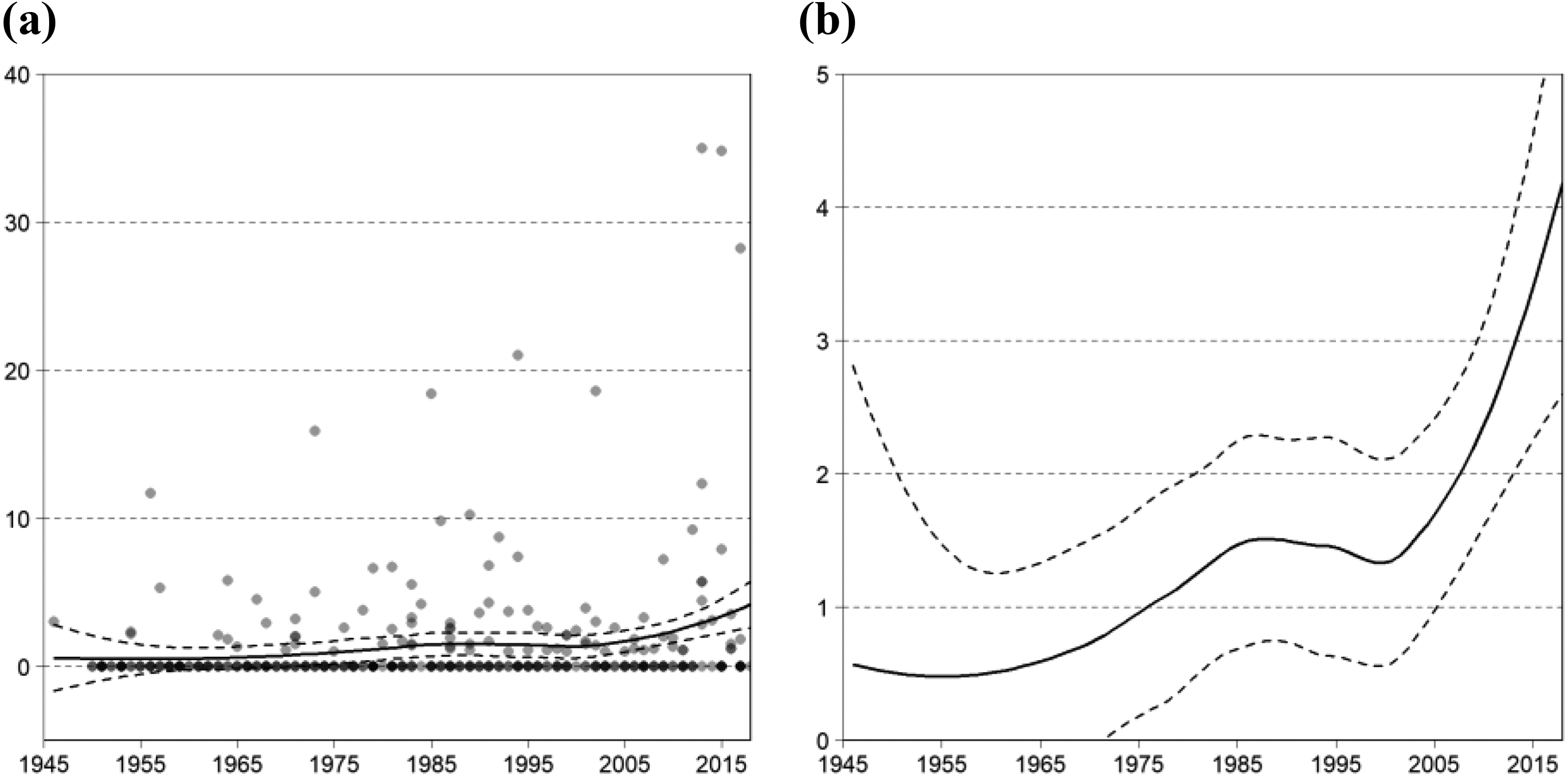
Total GNPs vote share (a) and moving average (b), 1945–2018. GNP: genuinely new party.
This confirms the ‘fundamental bias towards stability’ until the end of 1970s suggested by Bartolini and Mair (1990: 68). Since then, GNPs have become more numerous and stronger. The increase has been starkest since the turn of the century – only about a quarter of elections in our data set took place after 2000 but they account for more than a third of elections with GNP breakthroughs and half of elections with major breakthroughs (over 10%). The average support for GNPs has more than doubled since 2000 from about 1.5% to about 4% (Figure 1(b)).
Electoral instability has reached unprecedented levels in 2010s (Chiaramonte and Emanuele, 2017; Dassonneville and Hooghe, 2017; Hérnandez and Kriesi, 2016), both in terms of the number of GNPs and their mean electoral support (Figure 2). 6 The eight years between 2010 and 2018 witnessed more GNPs than over 30 years between 1945 and 1979 (totalling 46 and 138 elections, respectively). The average electoral support for GNPs soared from 15 to 1.5% before 2010 to 3.6% afterwards – more than doubling the figure for the already ‘stormy’ 1980s (1.5%). This recent wave of GNPs includes some particularly notable successes – the French La Republique en Marche (LaREM), Alternative for Germany (AfD), the Italian Five Star Movement (M5S) and the Spanish Podemos and Ciudadanos (Bordignon and Ceccarini, 2013; Decker, 2016; Gougou and Persico, 2017; Orriols and Cordero, 2016).
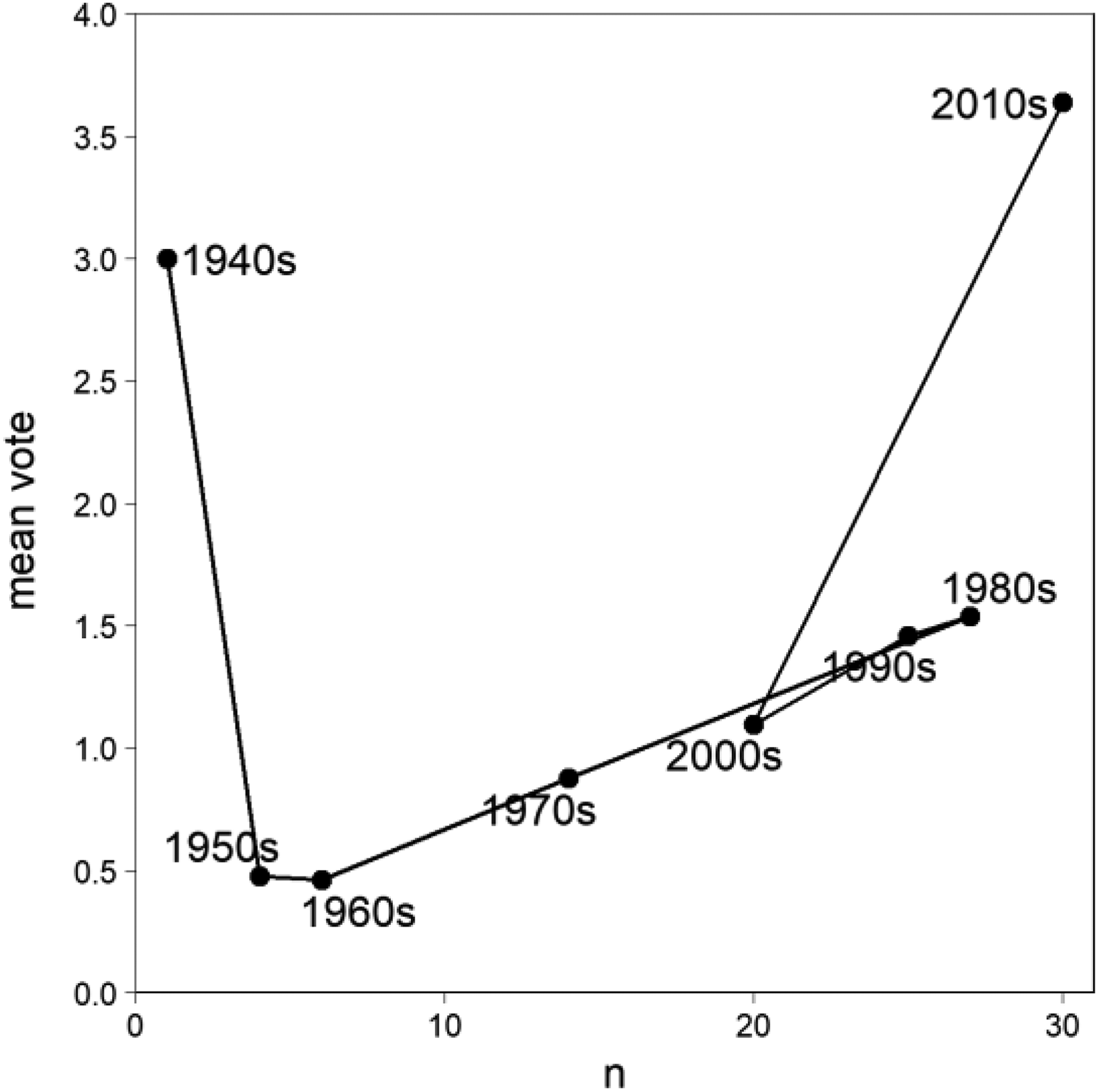
Number of GNPs and average support by decade. GNP: genuinely new party.
Even more remarkable than the rise in initial support has been the increased persistence of support (Figure 3). Support for GNPs increases when we move from their first election only to all contested elections combined, and the gap has widened in the last two decades. Indeed, nearly 25% of votes in the most recent elections have gone to parties established since the third democratic election, compared to about 10% in 1995. In other words, GNPs have become more successful both in their inaugural elections and in retaining or even increasing their support.
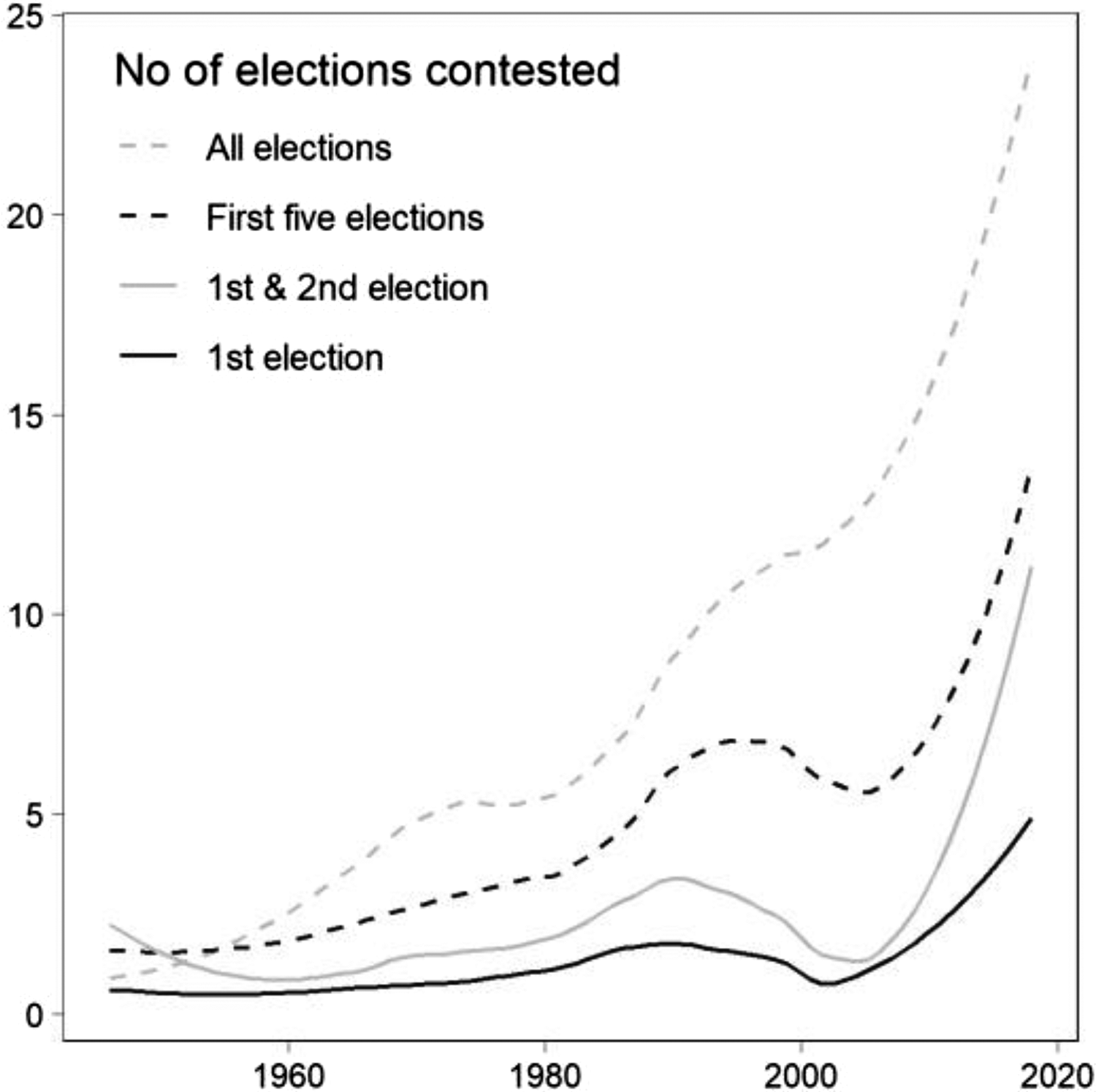
GNP support in different subsets of elections. GNP: genuinely new party.
Some countries have seen only a limited number of GNPs (Denmark, Portugal and Norway), while ‘party system innovation’ has been more vigorous in others (see Emanuele and Chiaramonte, 2018). 7 Iceland, Belgium, Italy and the Netherlands – countries that are relatively small or adopt permissive electoral systems (or both) – may boast the highest number of GNPs, but new parties have been stronger (if fewer in number) in Spain and France (Figure 4(b), see also Tables B1 and B2 and Figures B1 and B2 in Supplemental Material B). As suggested by Emanuele and Chiaramonte (2018), new parties have exerted the largest impact in Italy – particularly in the last decade, when they have won resounding 17.5% of votes on average (see Figure 4(a)). GNPs in Austria, Germany, France, Spain and Greece also reached a record high level of support in the last decade – exceeding the wave in 1980s, a subject of extensive scholarly interest (see Figures B2 and B3 in Supplemental Material B).
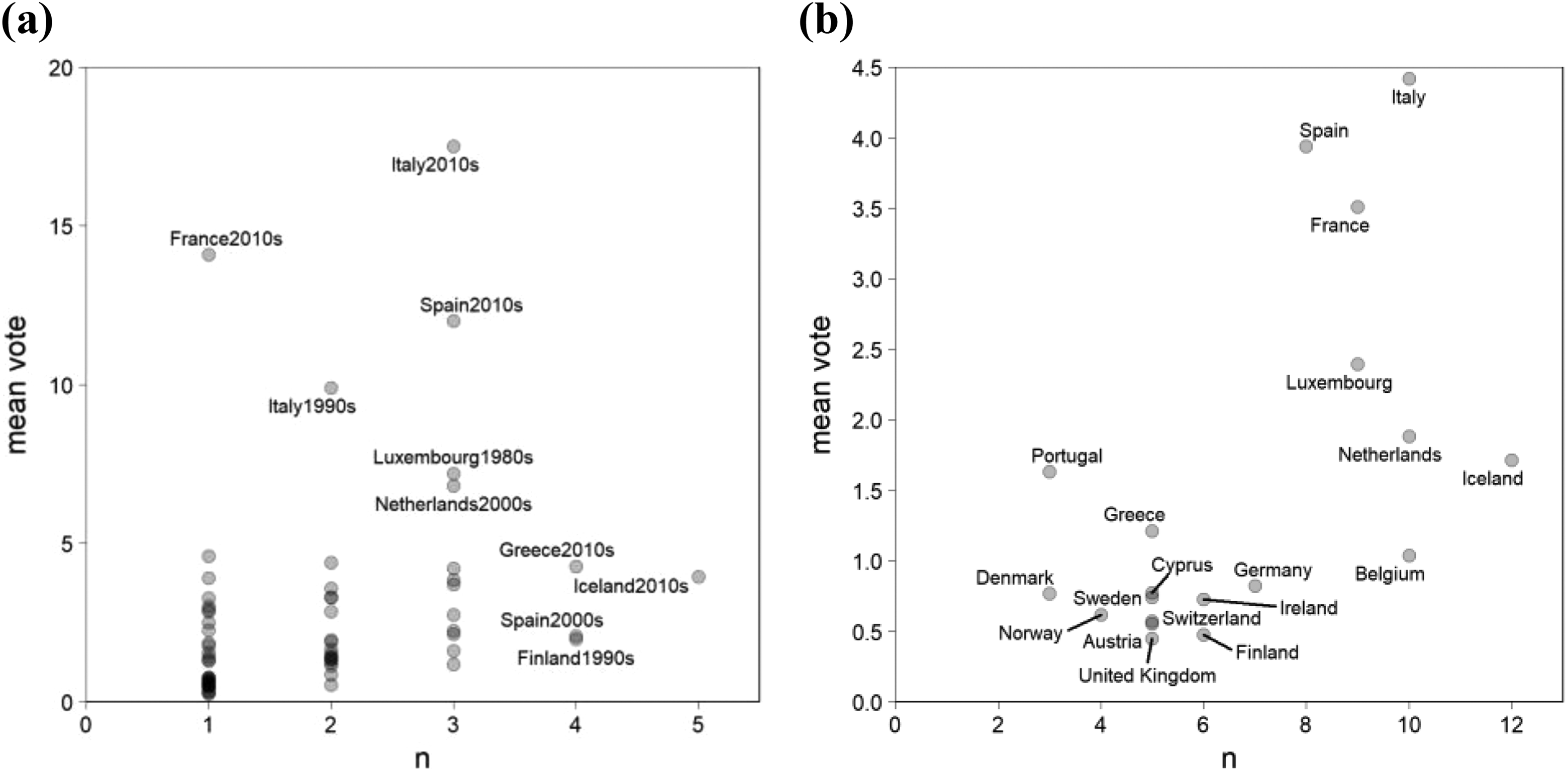
The number of new parties and mean vote share across decades (a) and countries (b), 1945–2018.
GNPs are more likely to belong to some party families than others – just three families account for more than half of them (Table 1). 8 Single-issue parties (e.g. ‘pirate’, pensioner and feminist parties) and ethno-regionalist parties (e.g. in Catalonia, the Canaries and Galicia) have been numerous but not particularly successful, especially over the longer term. Unsurprisingly, also common are the main new party families that have swept the European electoral scene since the 1980s – the Greens (Müller Rommel, 1989; Poguntke, 1987) and the radical right (Ignazi, 2003; Kitschelt, 1995). Still, their initial electoral success was on average similar to that of liberal, conservative and social-democratic parties. In the longer term, GNPs from most party families increased support (apart from social-democratic and special issue parties), confirming that if a party manages to survive, it grows stronger. However, despite the focus in literature on parties that politicize new issues, values and interests (Lucardie, 2000; Willey, 1998), new parties in the ideological mainstream have been electorally as successful.
Electoral performances of GNPs across party families.
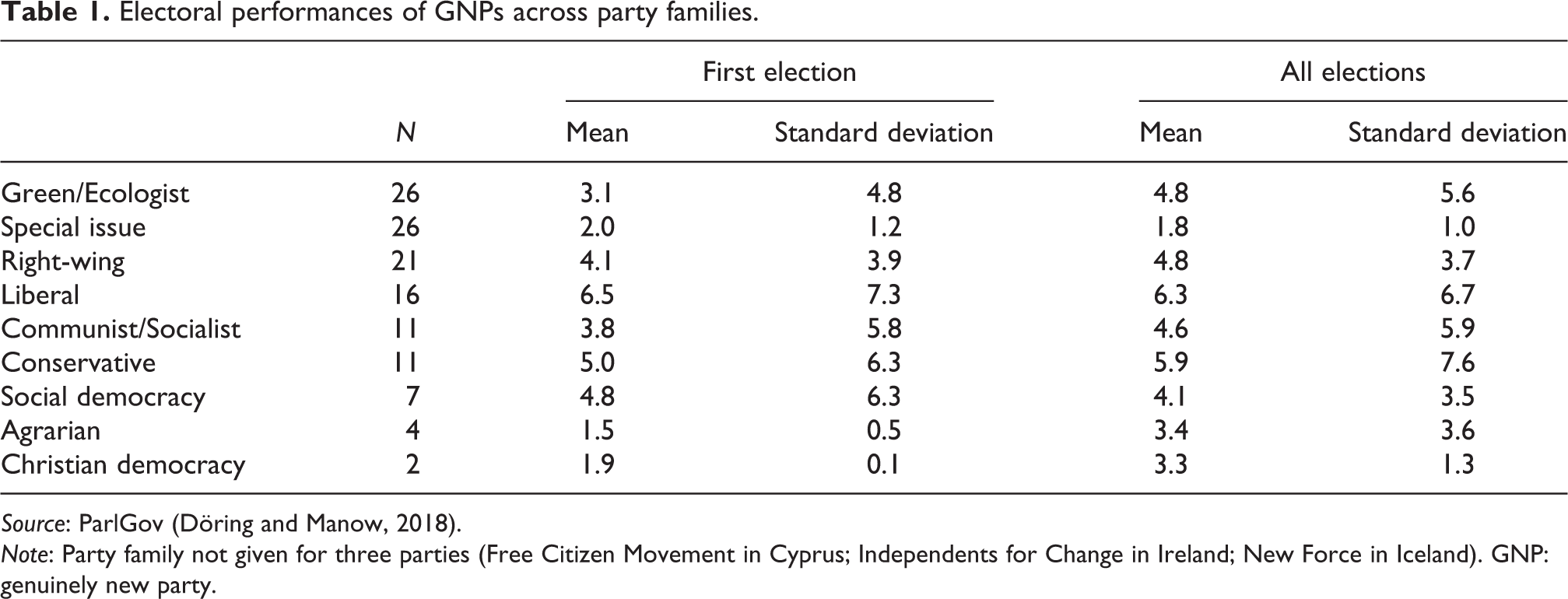
Source: ParlGov (Döring and Manow, 2018).
Note: Party family not given for three parties (Free Citizen Movement in Cyprus; Independents for Change in Ireland; New Force in Iceland). GNP: genuinely new party.
Analysis and results
The latent growth model
As discussed above, focusing on the number of party breakthroughs and their support in the initial election only paints a partial picture of GNP performance and their longer term impact on party systems. In this article, we go beyond breakthroughs and study the evolution of party support following their entry. We rely on class-based LGM (Jones and Nagin, 2012) that allows us to classify parties so that within each class they follow a similar trajectory over time. For example, some parties (e.g. ethnic parties) may be expected to enter with a moderate support and maintain it over time. In a linear model, an intercept (initial vote share) would suffice to describe this trajectory. However, parties with similar initial support can vary – some disappearing quickly (negative slope), others increasing support and challenging established parties (positive slope). A simple linear model clearly offers limited value as it only allows for unchanged support or change at a constant rate (Figure 5(a)). While parties can maintain its initial support, a constant rate of increase is less realistic as support can peak and certainly cannot continue eternally. A decrease at a constant rate is more problematic – even for parties with high initial support, this is likely to predict diving to negative vote shares.
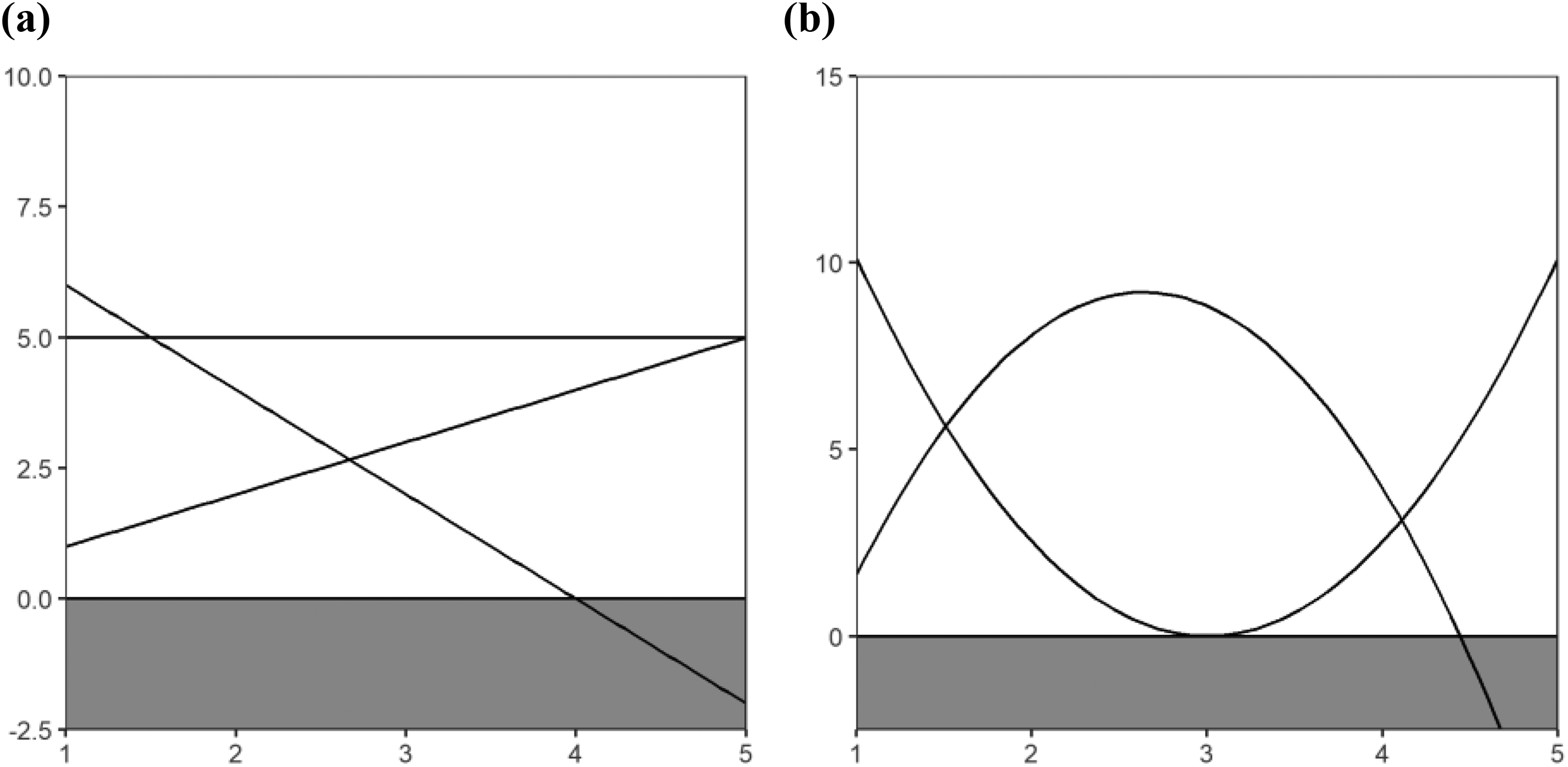
Linear trajectories (a) and quadratic trajectories (b).
Acknowledging these limitations, Mustillo (2009) models party trajectories using linear and quadratic functions. Still, quadratic terms provide only a partial cure (Figure 5(b)). They allow for curvilinear trajectories and flipping party fortunes but impose a perfect symmetry around the peak or bottom support. Upon reaching a peak, party support must decrease following a trajectory that exactly mirrors its rise. This is unrealistic and can again take parties into the impossible zone. Even more problematic are U-shaped quadratic trajectories that may predict that after a demise (bottoming at zero support), parties will raise like a phoenix from the ashes, mirroring the path of its downfall.
Therefore, we have used LGM with a beta link function implemented in the lcmm (latent class mixed models) package in R (Proust-Lima et al., 2017). 9 lcmm and the beta link function allow for flexible and meaningful modelling of party trajectories. Flexible because lcmm does not require a specification of the order of the functional form (constant, linear, quadratic etc.) before the analysis as required by the traj module in Stata (used by Mustillo). Meaningful because the beta link function imposes lower and upper boundaries on party vote shares; it assumes that trajectories are caught between zero and the maximum vote (for all parties in the model). Thereby, it becomes impossible for parties to fall below zero or grow perpetually. Moreover, lcmm allows for a more efficient estimation with fewer parameters compared to the quadratic model.
The LGM estimates ‘shape parameters’ – coefficients for time variable(s) and for the link function – for a number of latent trajectories set by the investigator. Population prevalence – how many parties fall into each class – is estimated for each of the trajectories. We compared models with a different number of latent trajectories and alternative specifications. 10 For choosing the optimal model, we followed statistical criteria, principally the Bayesian information criterion (BIC).
Having settled for ‘the best’ model, we found posterior class membership probabilities for each of the parties. These indicate the probability that a given party belongs to a particular class and allows to predict the future performance of recent GNPs – some of our most remarkable cases. It may be too early to assign these parties to any classes because we do not know its subsequent performance. For example, Emmanuel Macron’s LaREM has only contested one election and we do not dare to prophesize whether in future it will increase or decrease its support or even disappear. The model provides a posterior probability based on the information available – for LaREM, its vote share in 2017. Class membership can be determined more accurately for GNPs that have contested more elections. While uncertainty related to incomplete trajectories is unavoidable, great uncertainty for parties with complete trajectories would suggest a poorly fitting model. Conversely, a model with a good fit is one that classifies most parties with high class membership probabilities (Mustillo, 2009: 321).
Sample and methodological choices
We tracked the electoral performances of GNPs in the first five elections, starting from the one where they won at least 1% of the vote for the first time. We choose five elections following Mustillo’s argument that ‘the early years of a party’s life are developmentally distinctive from its mature years. The farther in time that we go from birth, the more the result will incorporate elements of a party’s life that are unrelated to early developmental characteristics’ (2009: 323). In other words, five elections provide sufficient time to observe the development of a new party into maturity, without incorporating later developments that have little to do with its initial path. 11
Our data set contains 385 party–election dyads; an average GNP contested 3.03 elections. 12 We distinguish between parties that cease to compete or merge with other parties and recently emerged parties that suffer from right-censoring. Otherwise, a disappearing party would look healthier than it actually is (Mustillo, 2009), Therefore, for exiting parties, we recorded a zero vote share after their last election; however, lcmm allows for the inclusion of recent parties (i.e. right-censored cases) in the modelling of trajectories and, thereby, also allows for predictions about the potential further development. We estimated models with one to six latent classes (i.e. party trajectory classes) to find a model with optimal fit based on BIC. Moving from one to five classes lowered BIC but adding a sixth class resulted in a poorer BIC. Hence, we found the five-class model to be optimal. 13
GNP trajectories
We labelled the five classes – mostly echoing Mustillo’s terminology – as ‘explosive’, ‘meteoric’, ‘contender’, ‘flat’ and ‘flop’. Their prevalence is fairly balanced: unsurprisingly, ‘flop’ parties constitute a majority (53.3%), the other half have experienced different starting levels and trajectories, going from the ‘flat’ one (13.4%) to the ‘explosive’ one (11%). Figure 6 (and Table B3 in Supplemental Material B) provides an overview of the optimal five-class LGM. 14
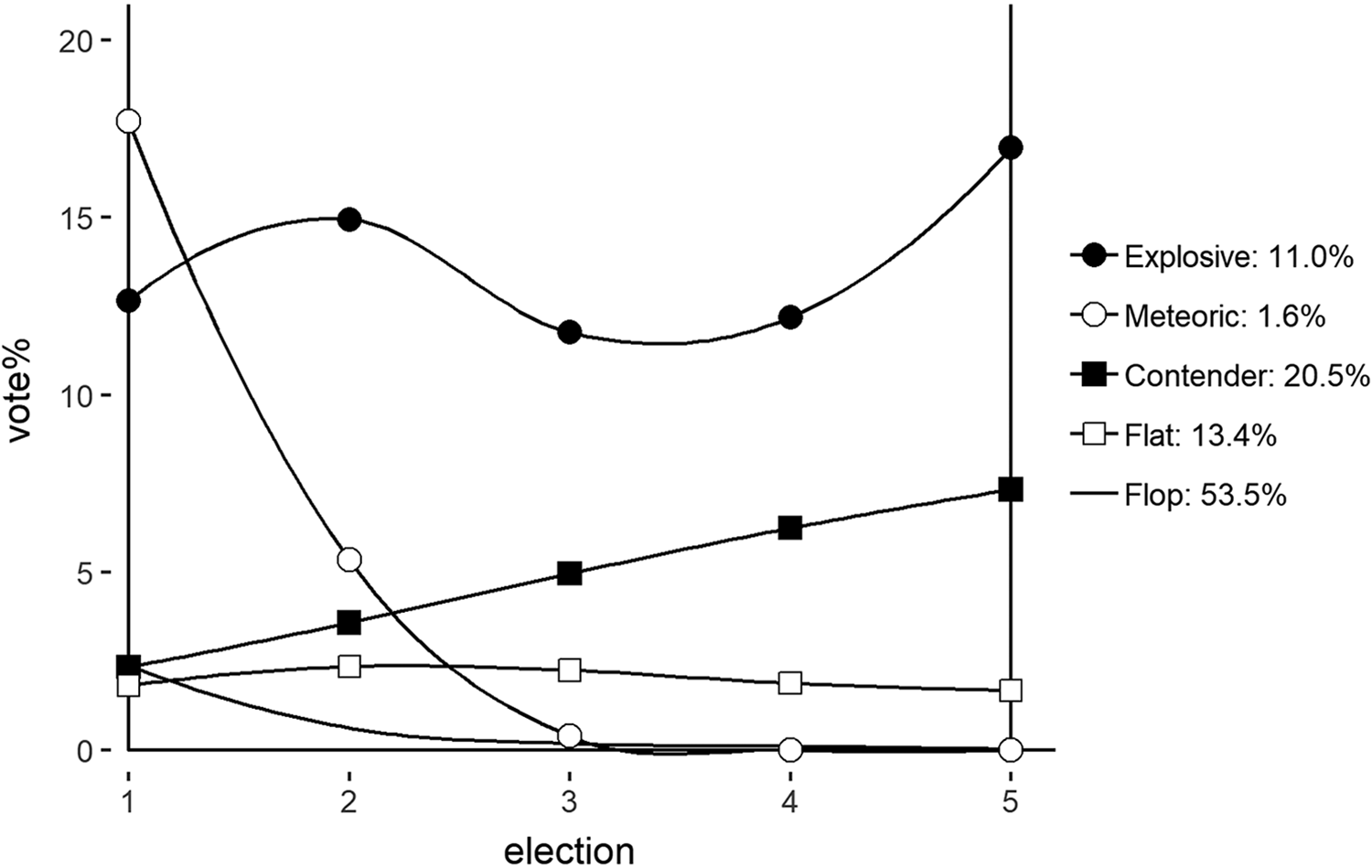
GNPs trajectories in Western Europe. GNP: genuinely new party.
The first class are explosive parties: their entry causes an electoral earthquake that leads to party system restructuring. ‘Explosive’ parties are strong from the beginning (mean support 12.7% in first elections), and their performance further improves in subsequent elections. As expected, given the bias towards stability, such parties have been rare in Western Europe. We find only 14 parties (11% of GNPs) that have followed the ‘explosive’ trajectory (e.g. the French Gaullist party, GAP, 15 and Forza Italia, FI) or have a potential to do so in future (e.g. Italian M5S and the Spanish Podemos; see Table 2). Both M5S and Podemos are classified as ‘explosive’ given their high support in the first election and improvement in the second election (M5S: 25.6% and 32.7%; Podemos: 20.8% and 21.3%). While this coincides with the swift institutionalization of these parties, the real test of the classification lies in their future performance. Interestingly, many parties in this class resemble ‘anti-establishment reform parties’ that combine ‘mainstream ideology on economic and socio-cultural issues with fierce anti-establishment rhetoric and demands for political reform, transparency and new ways of “doing politics”’. (Hanley and Sikk, 2016: 522). Parties like LaREM, M5S and Ciudadanos certainly fit this definition (Bordignon and Ceccarini, 2013; Lavezzolo and Ramiro, 2018). Likewise, GAP and FI, surfaced with strong anti-establishment rhetoric, becoming mainstream conservative parties only afterwards.
Party classification, by country.
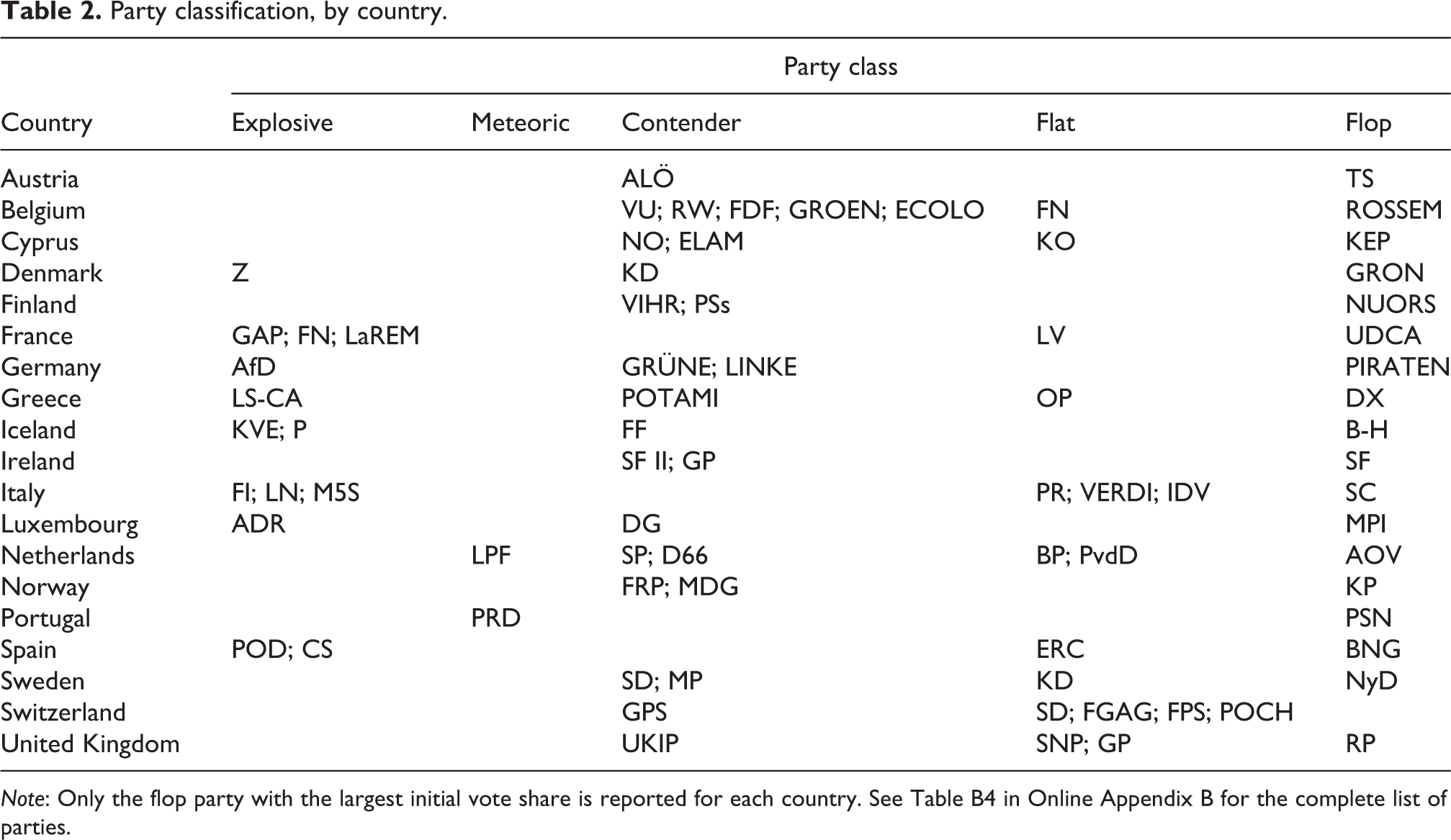
Note: Only the flop party with the largest initial vote share is reported for each country. See Table B4 in Supplemental Material B for the complete list of parties.
The second class of meteoric parties – borrowing a term from Taagepera (2006) – contains only two parties – the Dutch Pim Fortuyn List (LPF) and the Portuguese Democratic Renewal Party (PRD). They are characterized by an even stronger electoral performance in their first election than the ‘explosive’ class (17.7% on average). After a remarkable entry, ‘meteoric’ parties dramatically decline in the following elections and then disappear. Notably, LPF and PRD both nose-dived after the parties supported, but did not lead, the government after their maiden election; conversely, of the 14 explosive parties, only 1 (the Danish Progress Party, Z) provided the support for the governing coalition after their first election while two (Forza Italia and En Marche) led the government themselves. Our analysis suggests that parties entering with a high vote share (above 13%) are typically ‘explosive’ and likely to become part of the respective party system. ‘Meteoric’ parties diverge from ‘explosive’ ones after the first election as the confidence intervals for the trajectories only overlap in the first election.
Contenders enter with a meagre vote share (2.3% on average in first election) but subsequently increase their support and challenge established parties. Roughly one-fifth of all GNPs, this class is home to many ‘populist radical right parties’ (Mudde, 2014) such as the Belgian People’s Union (VU), the True Finns, the Norwegian Progress Party, the Sweden Democrats and the UKIP. It also includes the post-materialist Dutch D66, the German radical left PDS-Linke, and the Dutch Socialist Party (SP). SP shows the prototypical trajectory of ‘contenders’: it won 1.3% of votes in 1994 and continuously increased support, eventually reaching 16.6% in its fifth election (2006). ‘Contenders’ also include 10 particularly successful green parties (in Austria, Germany and Sweden) clearly distinguished from their ideological bedfellows elsewhere that have mostly followed ‘flat’ and ‘flop’ trajectories. 16
The most populated class is that of flop parties that contains more than half of the GNPs (53.5%). It consists of parties entering with a low vote share (2.4% on average) and rapidly falling into obscurity, usually after the second or the third election. In other words, these parties (and their ‘midwife voters’) probably overestimated their potential in the first place. This corroborates the idea that political entrepreneurs operate with bounded rationality (Simon, 1957). Many new parties should not be formed at all under full information on institutional constraints, electoral potential, competitor strength and so on (Hug, 2001).
While the flat trajectory shows the lowest initial performance (1.8% on average in the first election), unlike ‘flopped’ parties, their support does not fade away and stays fairly constant over time. This class contains 17 GNPs that are small but retain their support over time. Typical members of the class are the Green parties but also other niche parties (Meguid, 2005), such as the Dutch Party for the Animals, or ethno-regionalist parties (De Winter and Türsan, 1998), such as the Republican Left of Catalonia (ERC) and the Scottish National Party (SNP).
The finding that ‘flop’ parties is the most populated class is meaningful. It shows, on the one hand, that our results are consistent with the ‘bias toward stability’ argument (first and foremost, Bartolini and Mair, 1990). 17 On the other hand, it tells us that notwithstanding the recent wave of electoral instability (Chiaramonte and Emanuele, 2017; Hobolt and Tilley, 2016; Hérnandez and Kriesi, 2016), stability has been the fundamental feature of West European politics since 1945. More than two-thirds of GNPs in Western Europe did not significantly alter their countries’ party systems since they either rapidly disappeared (‘flop’) or maintained only niche support (‘flat’).
The posterior probabilities confirm the good fit and internal validity of the model. After excluding the 26 parties that have not contested five elections yet – for which a high level of uncertainty is expected – only 11 parties have a lower than 90% probability of membership in their class. 18
Our classes are somewhat different from those discovered by Mustillo (2009). Not only did the trajectories fail to mirror exactly the Latin American ones but the prevalence of classes also differed. 19 Among the 299 Latin American new parties and 758 party-year vote percentage observations, almost 90% of the cases belong to the ‘flop’ category, while the remainder are divided between ‘flat’, ‘contender’, ‘explosive’ and ‘flash’. 20 Differences were to be expected given the different nature of party systems in the two regions, particularly the level of party system institutionalization (Chiaramonte and Emanuele, 2017; Mainwaring and Scully, 1995; Sanchez, 2009). Overall, by comparing our findings with Mustillo’s ones, it clearly emerges that the birth of new parties in Western Europe is far less common than in Latin America, but once created, European new parties are more likely to persist over time.
While different from Latin America, Western Europe is not homogeneous in terms of new party development. Only eight of the 20 countries witnessed ‘explosive’ competitors (Table B6 in Supplemental Material B), with France and Italy at the forefront of party system transformation with three ‘explosive’ shocks each (Emanuele and Chiaramonte, 2018: 483). Conversely, ‘contenders’ are particularly common in Belgium (five, no other country has more than two) and ‘flat’ parties in Switzerland (four). These findings are understandable considering historical context. On the one hand, the traditionally consensual politics of Belgian elites have been prone to include new competitors into governing coalitions (Casal Bértoa and Enyedi, 2016; Lijphart, 1999). Accommodating elite behaviour clearly favours institutionalization and endurance of recently emerged parties. On the other hand, the highly decentralized Switzerland with its multiple cross-cutting cleavages is a fertile ground for small parties that maintain their niche support (Caramani, 2004; Lipset and Rokkan, 1967). Finally, the two smallest countries in our data set – Iceland and Luxembourg – interestingly account for nearly a quarter of ‘flopped’ parties. This could be due to the combination of the relative ease of setting up new parties and mobilizing some electoral support in small countries, and not particularly permissive electoral systems. 21 More generally, the role of electoral systems is limited. GNP trajectories in terms of seats are extremely similar to electoral ones (see Figure A1 in Supplemental Material A), except for the predictable parliamentary over-representation of stronger ‘explosive’ parties and an under-representation of all others. As expected, a majoritarian rule favours ‘viable’ parties that are strong enough to win a considerable number of votes in single-member districts (SMDs) (typically ‘explosive’) and small parties with a territorially concentrated support (e.g. SNP in the United Kingdom). Conversely, PR increase the chance of small party survival that may grow over time and become ‘contenders’ that is difficult in majoritarian systems, where ‘contenders’ must become very strong to challenge established parties in SMDs.
Trajectories after five elections
So far, we have focused on GNPs trajectories in the first five elections. But what happens to GNPs following the distinct trajectories afterwards? Do five elections provide a good guide to party’s future development, as we initially hypothesized? Figure 7 plots the trajectories of each class beyond the first five elections. On average, the support for parties that lasted five elections remains remarkably stable afterwards, although there is significant variation between individual parties. All ‘meteoric’ and ‘flop’ parties disappeared before the fifth election, the average support for other parties did not fall up to their 10th election and beyond. If anything, they grow stronger past the fifth election. Given that most ‘explosive’ parties are recent, the long-term growth reflects two pairs of parties that now represent different faces of conservatism in France and Italy: the Gaullist Party and the National Front; and Forza Italia and the Northern League. 22
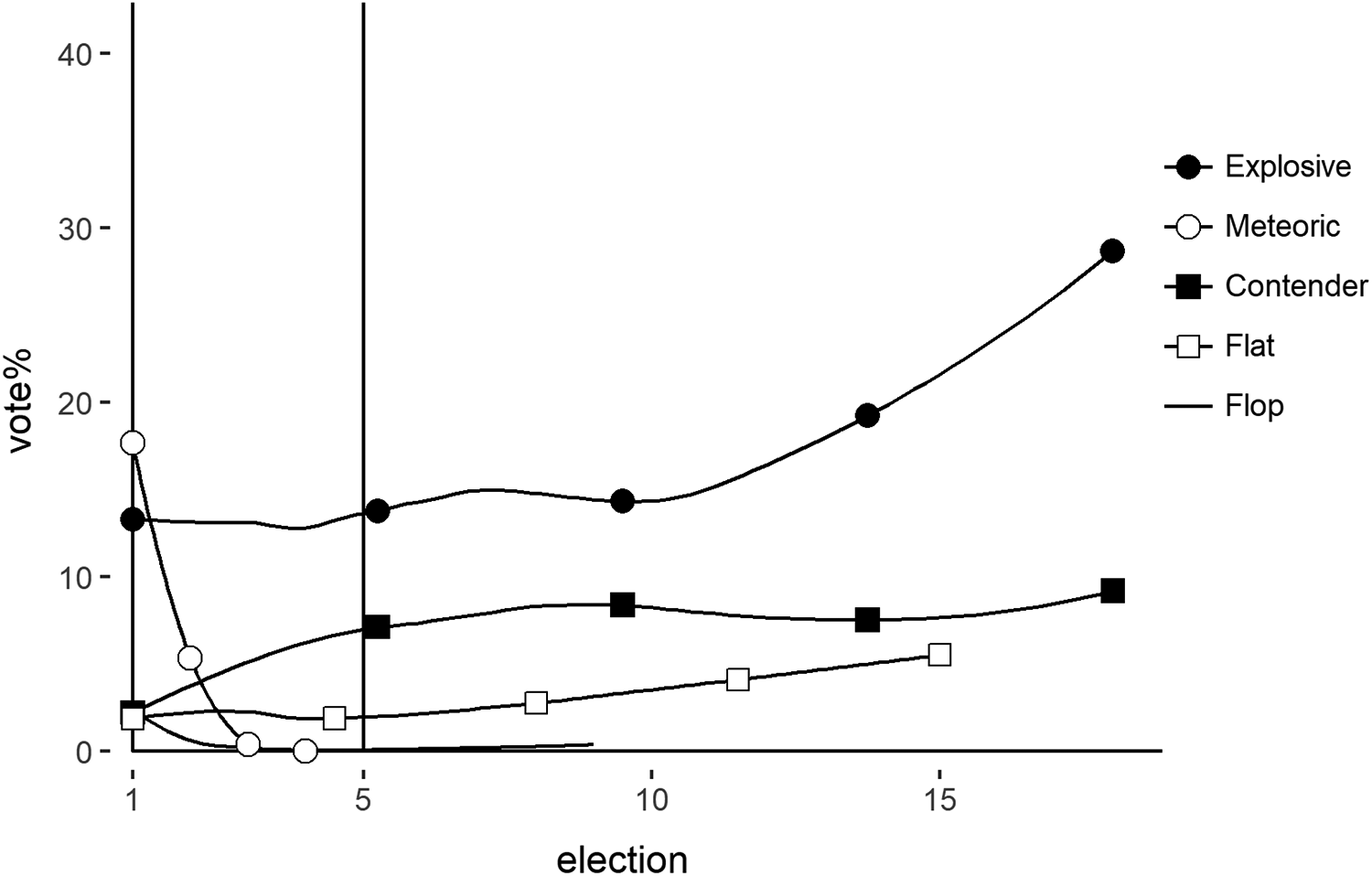
GNPs trajectories beyond the fifth election. GNP: genuinely new party.
Of the 26 ‘contender’ parties only 3 have by now exited; the rest are still competing elections with an average vote share of almost 10%. The result is interesting given the meagre support at the time of their entry and the class clearly deviating from the typical pattern for parties with low initial support. Indeed, most parties with 2–2.5% of votes in their initial election are doomed to ‘flop’ or maintain ‘flat’ support. Yet, even ‘flat’ parties tend to increase support after the fifth election, approaching the ‘contender’ class by election 15 (when confidence intervals overlap). This increase is mainly due to a class of parties that have been able to reach out beyond their niche support, like the Swedish Christian Democrats (11.8% by their 12th election in 1998), the French Greens and the Scottish National Party.
Overall, the fact that the classes that persist after the fifth election remain stable over time suggests that five elections provide a good guide to party’s future development. In other words, just like in a path dependent process (Pierson, 2000), the early stage of electoral development of GNPs is a critical juncture that shapes its future life path. This also hints that latent trajectories have some predictive capability. Given that parties in different classes tend to follow a trajectory over time, we can formulate future predictions based on first five elections. Some fundamental estimates may be already based on the vote share in the first election. First, a new party debuting with more than 12% of the votes is three times more likely to become an ‘explosion’ than a ‘meteor’. Second, a party emerging with a modest vote share (e.g. between 1% and 3%) has a 60% probability to fail shortly, a 17% chance of maintaining its niche, and a 23% chance of becoming a ‘contender’ in the respective party system. Finally, for a party with 3% to 12% in the first election uncertainty looms as virtually all scenarios are open: a quick failure is the most likely outcome (48%), but it holds almost the same chance of becoming a ‘contender’ (17%) or even an ‘explosive’ actor (28%).
Conclusion
This article has dealt with an increasingly common and important phenomenon, the emergence and success of GNPs in Western Europe. Compared to the existing literature on new parties, this article brings three key advancements. First, in contrast to an extensive but fragmented literature that has focused only on certain parties (usually the most successful ones), party families (i.e. green and radical right) or limited time frames, and has employed different and sometimes inconsistent definition of new parties, this article starts from a theoretically consolidated definition (i.e. GNPs) and offers a systematic data analysis. The article presents an original classification of GNPs based on a comprehensive data set covering all parliamentary elections since 1945 in 20 Western European countries. We show that recently, the electoral support for GNPs has surged. This is particularly pronounced in terms of their performance beyond the initial election – hence, in the last decade GNPs have not only become more popular but they have also become more likely to change their party systems. This raises the question of their long-term impacts.
This brings us to our second key innovation. In contrast to a literature that mainly focuses on the inaugural elections and models party performance in terms of success/failure, we adopt a dynamic approach, by studying GNP performance over their first five elections. We find that not only do GNPs vary in terms of their success beyond the first election, but they follow one of five distinct development paths. Most commonly, parties ‘flop’ – they are weak from the beginning and then dissipate. In absolute contrast, ‘explosive’ parties enter with a fanfare and leave a permanent footprint on their countries’ party systems. Notably, ‘meteoric’ parties – that are very successful very briefly and then burn out – have been less common than the ‘explosive’ ones. Two other types of parties have broken through and (mostly) remained important political players. ‘Flat’ and ‘contender’ parties make a shy entry in their maiden election – seldom reaching even five percent of the vote. However, they then stay around – ‘contenders’ generally increase their support over the first five elections while ‘flat’ parties hover around their initial level of support. Notably, ‘contenders’ are not only more common than ‘flat’ parties, but they are also more likely to survive over the longer term.
Our third key innovation for research on West European new parties is the use of state-of-the-art latent growth modelling, a novel methodology for political science and party research. In that, we build upon methodological advances since Mustillo’s pioneering use of the method for the study of Latin American parties. The implementation in R of lcmm allowed us to model trajectories in a way that does not violate common sense assumptions about the functional forms of the trajectories (particularly the lower limit of 0 on vote shares) and allows for more efficient estimation.
Overall, this article represents a substantial step forward in the study of new parties. However, we are conscious that this exploratory analysis is only the first step towards a fuller understanding of new parties. Our own plans include utilizing lcmm for the comparison of the West European trajectories analysed here to those in Central and Eastern Europe and Latin America that will yield new insights about party development in these regions, but the differences could also shed light on fundamental reasons why parties follow certain trajectories rather than others. This opens up new possibilities in the study of determinants of new party success, disappearance and performance such as using more advanced lcmm that involve covariates of trajectory ‘choice’ and modelling survival by classes.
Supplemental material
Supplemental_Material - Party crashers? Modeling genuinely new party development paths in Western Europe
Supplemental_Material for Party crashers? Modeling genuinely new party development paths in Western Europe by Vincenzo Emanuele and Allan Sikk in Party Politics
Footnotes
Authors’ note
A preliminary version of this article was presented at the 12th ECPR General Conference, Hamburg, 22–25 August 2018.
Declaration of conflicting interests
The author(s) declared no potential conflicts of interest with respect to the research, authorship, and/or publication of this article.
Funding
The author(s) received no financial support for the research, authorship, and/or publication of this article.
Supplemental material
Supplemental material for this article is available online.
Notes
Author biographies
 ).
).
References
Supplementary Material
Please find the following supplemental material available below.
For Open Access articles published under a Creative Commons License, all supplemental material carries the same license as the article it is associated with.
For non-Open Access articles published, all supplemental material carries a non-exclusive license, and permission requests for re-use of supplemental material or any part of supplemental material shall be sent directly to the copyright owner as specified in the copyright notice associated with the article.
