




Abstract
In spite of broad interest in internal party dynamics, with previous literature relatedly demonstrating that voters are not oblivious to party infighting, very little attention has been paid to the antecedents of voter perceptions of intra-party conflict. This article addresses this research deficit with the support of empirical evidence gathered over the course of the 2017 Austrian national election campaign. The study examines variations in perceived intra-party conflict over time, both across parties and within the same party. We find that although voter perceptions largely mirror actual distinctions in intra-party fighting, conspicuous individual-level variations can also be identified owing to attention to the election campaign and motivated reasoning in information processing. These results have important consequences for our understanding of voter perceptions of intra-party conflict and the role of election campaigns, with potential implications for party strategies during election campaigns.
Introduction
While polarization between political parties has recently attracted considerable attention in the United States and elsewhere (e.g., Dalton, 2008; Fiorina and Abrams, 2008; Iyengar and Westwood, 2014), intra-party fighting has been studied to a far lesser extent. This is surprising not only given that party unity is often deemed a precondition for a series of normative relevant phenomena, such as accountability between government and parliament (Bowler et al., 1999), and stands at the basis of the well-known ‘chain of delegation’ of democratic politics (Katz, 2014; Müller, 2000; Strøm, 2000) but also because party infighting increasingly characterizes contemporary politics in countries as diverse as the United States, United Kingdom and Italy, to name but a few. The ‘Bernie or Bust’ movement during the 2016 US presidential election, the uncertainty of both the Tory and Labour parties’ positions during the UK’s Brexit referendum in 2016 and the fission of large parts of the Democratic Party in Italy in 2017 are only some examples that indicate how intra-party conflict constitutes a large-scale phenomenon with significant consequences for election outcomes.
Previous literature has sought to explore both the determinants of intra-party conflict (e.g. Carey, 2009; Giannetti and Laver, 2009; Kam, 2009) and its consequences for a number of party-level factors, such as a party’s policy platform and party-switching behaviours(Bernauer and Bräuninger, 2009; Heller and Mershon, 2008), parliamentary policymaking, coalition formation and portfolio allocation (Giannetti and Benoit, 2008; Greene and Haber, 2016). Some recent studies have additionally examined the consequences for vote choice of parties that appear divided (Barrett, 2018; Greene and Haber, 2015; Lehrer and Lin, 2018). These studies show that perceptions matter with a substantial impact on both voters’ party preferences and behaviour. However, the determinants of voter perceptions of intra-party conflict remain underexplored. In particular, the literature has struggled to identify when citizens perceive political parties as disunited. Do perceptions of party infighting follow real-world developments? To what extent are these perceptions contingent upon voters’ partisan biases?
This gap in the existing literature is due on the one hand to the almost exclusive attention of informational theories to voting behaviour on the party ‘brand’, and how this provides heuristics that guide voters during the election process (Grynaviski, 2006, 2010; Lupu, 2016; Snyder and Ting, 2002). Internal divisions and their consequences for the party brand have remained largely overlooked and have regularly been dismissed as mere pettiness in everyday politics (see Barrett, 2018 and Klingelhöfer and Müller, 2018 for recent exceptions). On the other hand, this research gap owes to data and methodological limitations concerning both the objective measurement of party conflict (see Ceron, 2012) and the measurement of citizen perceptions of intra-party dynamics (Greene and Haber, 2015).
We aim to fill this gap by exploring the antecedents of perceptions of intra-party conflict, taking advantage of recent developments in Austrian national politics and panel data from the 2017 Austrian National Election Study (AUTNES; Wagner et al. 2018). In other words, we are interested in examining the mechanisms that underlie the perceptions of intra-party conflict. We posit attention on whether voters’ perceptions of intra-party conflict relate to real-world developments as well as on two further aspects that are theoretically expected to moderate these perceptions. First, we consider the role of campaign attention, which is expected to inform voters about real-world developments, and second, motivated reasoning, which should lead voters to resist real-world developments. In Austria, the months preceding the election were characterized by significant variation in intra-party conflict across parties, meaning that some of the main parties experienced extensive infighting, but not others. Furthermore, there was also temporal variation within the same party: some parties began the election campaign with a high degree of internal conflict but became relatively united soon before the election. During the time frame of the months preceding the election, we were able to include within the AUTNES panel study-specific measures of perceived intra-party conflict, repeating these questions over time with the same respondents. The data thus afford us the unique opportunity to examine voter perceptions and their development over the course of the entire election campaign. We find that while intra-party conflict developments extensively inform voter perceptions of this phenomenon, these perspectives are significantly moderated by partisanship and campaign attention.
At least three reasons exist regarding the importance of examining the question of what drives public perceptions of party infighting. First, given that voter perceptions of party unity have an electoral impact and may well affect a party’s survival, it is important to understand the extent to which perceptions have any basis in reality. Second, due to the impactful consequences of infighting on voters’ perceptions of party competence, and given the current level of public distrust in politics, it is worth exploring the factors that moderate these perceptions. Third, this topic is especially relevant today as party infighting has become an important subject within several countries’ political campaigns and has greatly influenced election outcomes and policy implementation, perhaps most clearly demonstrated in the Brexit negotiation case. We will return to some of these considerations in the conclusion section of this article.
Perceptions of intra-party conflict as dependent variable
Party unity is the extent to which a party’s goal is unified (Greene and Haber, 2015), that is, the extent to which in a given situation ‘group members can be observed to work together for the group’s goal in one and the same way’ (Özbudun, 1970: 305). This additionally involves the unity of action among party members as observed at party conventions or the parliament (e.g. Hazan, 2003). Conversely, intra-party conflict can be defined as a conflict that occurs when members of the same political party pursue conflictual, divergent political goals. In line with this definition, several instances can be deemed intra-party conflict, such as when the party does not speak with one voice on specific policy-related or strategic matters or when a dissenter appears, that is, an individual member who breaks with the majority position of his/her party. A party can consciously be ambivalent about policy positions in an attempt to attract more voters (Somer-Topcu, 2015). However, being ambivalent does not necessarily equal conflict or disunity. Intra-party conflict, as we define it, is characterized by instances in which individual actors within the same party are openly in conflict with one another over policy goals or strategic issues.
Intra-party dynamics are often cited as key determinants of both parties’ and leaders’ survival. It appears that parties and leaders ‘die’ more often by the hands of their own party comrades than by those of their political rivals (see Barrett, 2018). Increasingly today, with the ‘spectacularization and personalization of political communication’ (Mazzoleni, 2008: 3047), party infighting and party leadership contests receive wide attention in media coverage.
Despite the relevance of these events as well as their significant implications for electoral behaviour (e.g. Greene and Haber, 2015), we know very little about the sources of voter perceptions of intra-party conflict. Specifically, we aim to study the extent to which voters’ perceptions of party unity are grounded in reality. Although they could be driven by actual policy and non-policy party conflict, these perceptions may, in fact, be confounded by subjective determinants.
The existing literature shows that while voters do not pick up everything that parties do (Adams et al., 2011), they indeed respond to things like party ideological shifts on salient issues (Plescia and Staniek, 2017) or coalition membership (Fortunato and Stevenson, 2013). The starting point then is that if voter perceptions of intra-party conflict are based on actual policy or non-policy developments, they should reflect the variation in the amount of conflict that the parties actually experience at a specific point in time. This leads us to our baseline hypothesis:
Regardless of where intra-party conflict occurs – at party conventions, the parliament and so forth (Proksch and Slapin, 2015) – only a very small fraction of voters will experience or be able to observe it first-hand. Indeed, most voters will rely on information-seeking processes (Chaffee and Kanihan, 1997). Election campaigns may serve different ‘functions’, but they tend to generate large quantities of information about parties, candidates and details of policy proposals (Iyengar and Simon, 2000). It is precisely through this information that intra-party conflict becomes known to the average voter, too (see also Walgrave and De Swert, 2007). Although parties know that internal conflict is electorally harmful and while we can assume that they try to avoid it, especially during an election campaign, it is also true that specific events are often beyond party control. Party scandals, for example, seem to have become more common and prominent themes in election campaigns (Kumlin and Esaiasson, 2012). Given the power of election campaigns in influencing voters’ political knowledge (Banducci et al., 2017; Dimitrova et al., 2014), we expect that the more individuals are attentive to the election campaign, the more likely it is that their perceptions of intra-party conflict will follow real-world developments. Hence, we posit the following hypothesis:
There exists plenty of empirical evidence to anticipate that the effects of party infights are contingent upon the fit between occurrences of intra-party conflict and voters’ political predispositions. The public may not necessarily process political occurrences objectively or uniformly, as its perceptions of politics are strongly influenced by certain biases (e.g. Gunther et al., 2001). Voters’ subjective interpretations of political events have been uncovered by existing research in a variety of situations. For example, supporters of the parties forming the government are much more likely to perceive their government’s performance as rosier than is actually the case (e.g. Lewis-Beck, 2006). Voters even tend to ‘interpret’ election results subjectively in terms of who has ‘won’ or ‘lost’ the election based on their party preferences (Plescia, 2019).
Furthermore, the existing literature has demonstrated that people consistently implement dissonance-reduction strategies to alleviate the psychological discomfort of negative or counter-attitudinal information, a process often referred to as ‘motivated reasoning’ (Kunda, 1990). For instance, Bartels (2002) has identified extensive partisan rationalization, and whether or not an individual accepts an argument will depend on whether the piece of information is consistent with his or her political predispositions (Zaller, 1992). Partisan feelings also act as a perceptual screen influencing subsequent voter judgments (Campbell et al., 1960), with voters usually interpreting politically relevant information in line with their party preferences (e.g. Leeper and Slothuus, 2014). Given that party infighting is usually perceived as a problem for the party and is viewed negatively by the public (Barrett 2018; Greene and Haber 2015), more positive feelings towards a specific party will increase voters’ propensity to resist such information and hence potentially deny the prevalence of conflict within their party, keeping other individual-level variables (such as attention to the election campaign or political knowledge) constant. In other words, we expect party sympathy to moderate information on party infights, with the effect that the latter is less important when party preferences are stronger.
Internal party conflicts and the Austrian election in 2017
Our case study is the 2017 Austrian parliamentary election. There are two main reasons why Austria represents a good testing ground for our hypotheses. First, and historically speaking, Austria is a country that has witnessed an average level of intra-party conflict compared with other European countries (Müller, 1994; Saalfeld, 2008). To use Gerring’s (2008) words, this renders Austria a ‘typical’ and representative case study and a good point of comparison to these other countries. Second, as anticipated at the beginning of the article and with regards to intra-party conflict, during the months preceding the 2017 election, we could note both variation across parties at specific points in time as well as temporal variation within the same parties over the course of the election campaign.
Specifically, starting with across-party variation, prior to the election on 15 October 2017, some (but not all) parties experienced intense levels of intra-party conflict, resulting in observable consequences including the split of important party factions and the creation of new parties and leadership replacements (see Bodlos et al., 2018). Conspicuous within-party variation was also evident, especially within the Greens and the Austrian People’s Party (Österreichische Volkspartei; ÖVP) that have started the election campaigns very divided following their leadership replacement in May but appeared less conflicted afterwards. Conversely, for other parties like the Social Democratic Party of Austria (Sozialdemokratische Partei Österreichs, SPÖ), the conflict intensified in the run-up to the election.
Figure 1 presents several decisive moments during the 2017 election campaign. The timeline starts with the resignation of the then-party leader of the ÖVP, Reinhold Mitterlehner, on May 10. He publicly cited intra-party conflict as one of the main reasons for his decision to step down. Indeed, he criticized what he called his party’s ‘structural problem’ of being incapable of retaining a party leader for an extended period of time. 1 Mitterlehner was succeeded by the young Sebastian Kurz, who rebranded the party as the ‘New People’s Party’ (New-ÖVP). Just a few days later, the Green Party leader, Eva Glawischnig, resigned following long-term intra-party ‘quarrels and intrigues’, as described by the leading Austrian tabloid, the Kronen Zeitung. 2 Ulrike Lunacek was subsequently designated as the top candidate for the election campaign. Whereas party discord abated within the New-ÖVP soon after the leadership change, it continued for the Greens, reaching a peak during the party congress at the end of June 2017, when a long-term MP and founding member Peter Pilz quit and created his own splinter party the following month (Bodlos and Plescia, 2018). Intra-party conflict within the Greens only seemed to calm down during the heat of the election campaign in August and September.
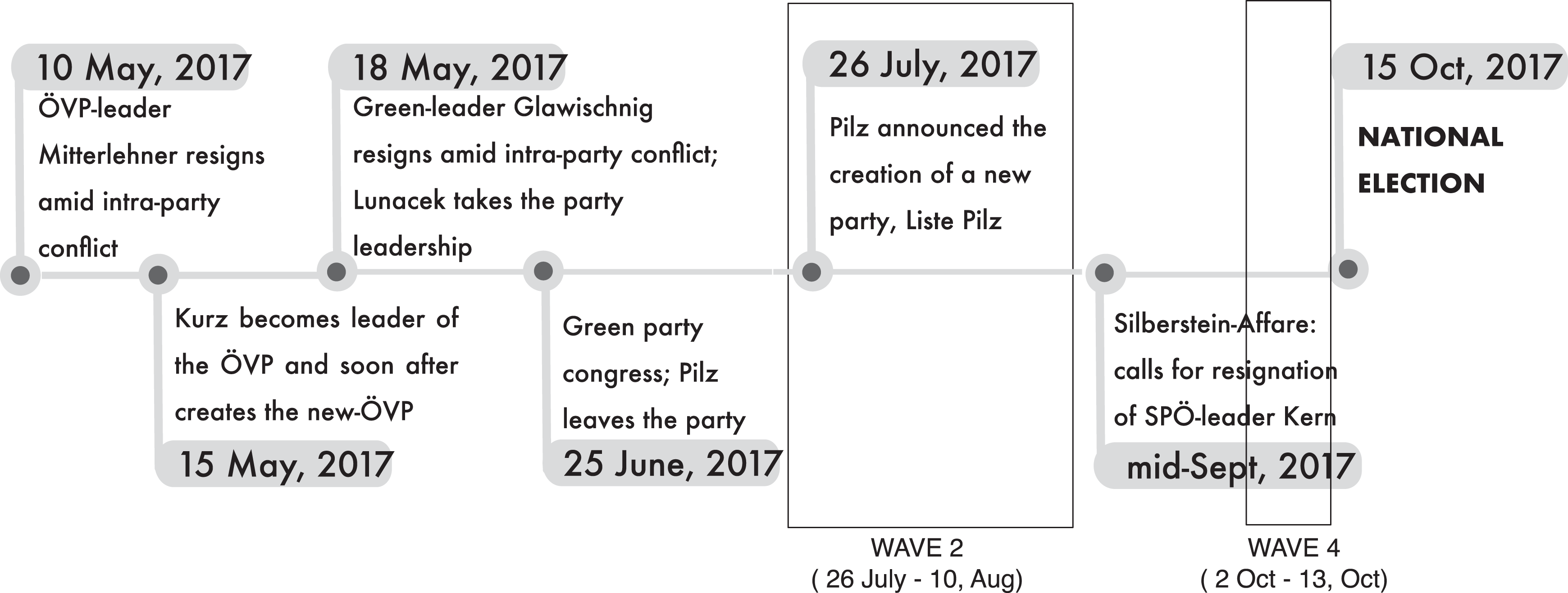
Timeline of the election campaign: May–October 2017.
While the ÖVP’s and Greens’ internal quarrels were extensively reported in the media during the summer before the election, other parties experienced a quieter period. On the one hand, the radical-right populist Freedom Party of Austria (Freiheitliche Partei Österreichs, FPÖ), which was characterized by considerable intra-party conflict during the period following the 1999 elections (Luther, 2003), culminating in the creation of the splinter party the Alliance for the Future of Austria (Bündnis Zukunft Österreich) by Jörg Haider in 2005, experienced relatively low levels of conflict after 2006. On the other hand, the incumbent SPÖ was historically characterized by high levels of intra-party conflict, concerning, for instance, candidate selection and differences in policy priorities (Weber, 2011). Conflict within the party had slightly diminished after the new leader, Christian Kern, took control in May 2016. However, at the end of the election campaign in 2017, some internal disputes regarding the party’s campaign adviser, Tal Silberstein, arose. Certainly, by the end of September 2017, the SPÖ had become implicated in both a corruption scandal and a social media page spreading fake news (Bodlos and Plescia, 2018). Regarding NEOS (New Austria and Liberal Forum; Das Neue Österreich und Liberales Forum), a centrist party created before the 2013 national election and attaining 5% of the votes (Dolezal and Zeglovits, 2014) and no intra-party conflicts emerged before or during the 2017 election campaign.
In sum, the above campaign dynamics and the diversity of party profiles present actual differences between parties in terms of intra-party conflict, implying that we should expect actual and clear differences in voter perceptions of these parties over the months proceeding Election Day.
Data
A third reason why Austria represents a good testing ground pertains to data availability because we are able to track voters’ evaluations of intra-party conflict in all of the main parties over the course of the election campaign. More precisely, to measure our dependent variable of perceived intra-party conflict, the AUTNES survey 3 asks respondents: ‘When you think of the following parties, how united or divided do you think they are internally?’ The scale ranges from 0 completely united to 10 completely divided. The list of parties includes the ÖVP, the New-ÖVP, SPÖ, FPÖ, Greens and NEOS. This question is asked in two different waves of the AUTNES panel: in wave 2, before the heat of the election campaign (26 July 2017 to 10 August 2017), and in wave 4, right before the election (2 October 2017 to 13 October 2017) as shown in Figure 1. Hence, we deal with intra-party conflicts on a rather general, abstract level without differentiating between specific types of intra-party conflicts, an issue we will also discuss later in the article.
In terms of our independent variables, we measure campaign attention through the survey question: ‘How closely did you follow the national electoral campaign during the last week?’ Answers range from not at all closely to very closely, with intermediate answers being not so closely and quite closely. Campaign attention was measured in wave 2 (M = 2.28, SD = 0.94) and wave 4 (M = 2.66, SD = .86), respectively. To measure party identification, we use a question asking respondents to identify the party to which they feel closest. This is measured exclusively in wave 1, and we assume that it remains constant across the months of the election campaign. In accordance with many existing theoretical accounts of partisan identification, we define partisanship as an enduring, persistent sentiment towards the party that is unlikely to change during the short time span of an election campaign (e.g. Bartels, 2002; Huddy et al., 2018). 4
In all regression models, we control for a series of variables that the existing literature suggests can influence voters’ perceptions of intra-party conflict. First, we control for media exposure (average use of TV, newspapers, radio, Internet and social media measured in wave 1; M = 2.72, SD = 1.08) and political knowledge (M = 0.52, SD = 0.29), both measured in wave 1. To measure the latter, we use survey questions aimed at measuring factual knowledge regarding Austrian politics. Specifically, we create an additive index based on six knowledge questions about Austrian politics and recode the values to range from 0 to 1 (Cronbach’s α = 0.71), where the two extremes stand for respondents not giving any correct answer or answering all questions correctly. 5 Including media exposure and political knowledge in our models enables us to disentangle the effects of media exposure and political knowledge from the actual information-seeking processes during the election campaign in which we are interested.
To isolate the effect of partisanship from other potential confounders, we control for a respondent’s ideological distance from the respective party. As discussed by Vegetti (2014), especially within polarized contexts, voters’ perceptions of parties’ competence may be driven by ideological proximity to a greater extent than partisanship. To this end, we control for the simple difference between respondents’ ideological self-placement, which ranges from 0 extreme left to 10 extreme right and respondents’ ideological placement of the specific party on the same scale. The variable is rescaled to range from 0 (ideologically congruent) to 1 (ideologically divergent; M = 0.30, SD = 0.25). We also control for satisfaction with government performance given that being more or less satisfied with the performance of the incumbent parties (SPÖ and ÖVP) may itself influence perceptions of these two parties’ levels of internal conflict (M = 1.78, SD = 0.77). This variable enters our models in interaction with a dummy variable that takes a value of 1 for the incumbent parties and 0 for all other parties. Three standard demographic variables are also added: age (in years), education (from low to high) and gender (female coded as 1). 6 For summary statistics on these variables, see Table A1 in the Online supplemental material.
Methods
Our empirical tests rely on a within–between random effects model. This choice is based on the several advantages that within–between random effects models provide relative to conventional fixed and random effects models when using panel data (Bell and Jones, 2015). Unlike the conventional random effects approach, which produces a weighted average of the within- and between-person effects, and in contrast to the fixed effects estimators that ignore all between-person variations, the within–between random effects model uses variation both within and between individuals to estimate the coefficients of independent variables. This is accomplished by including both person-specific means of time-varying predictors (representing between-person effects), and individual deviations from them (representing within-person effects), along with any time-constant predictors in a random effects model.
More specifically, in our models, party identification, and our control variables (e.g., age, gender) represent constant predictors that are assumed not to change during the election campaign. Instead, attention to the campaign has two main components. First is the between-person component, which refers to average differences in campaign attention between different individuals. It can be interpreted as showing the influence of enduring individual differences in average levels of attention to election campaigns. Second is the within-person component, which refers to a change in attention of any specific individual over the course of the election campaign. It can be thought of as capturing a short-lived tuning into the election campaign, an unusual deviation from one’s typical campaign attention. Our theoretical expectation, as stated in hypothesis 2, applies equally to both within- and between-variation and allows us to grasp these phenomena across parties.
Each respondent evaluated all six parties; for the purpose of the analysis, the data are ‘stacked’, and the unit of analysis is a ‘respondent × party’ combination. This allows us to examine the effect of our variables of interest on all parties simultaneously and not only on particular ones. Modelling all parties in one model offers a generalized picture of the effect of these evaluations.
Empirical findings
Before looking into within- and between-person differences, we begin with a simple linear regression model to gauge the average prediction of intra-party conflict by party during waves 2 and 4. Figure 2 displays adjusted predictions by party, keeping all other variables constant at their mean (full results reported in Online supplemental material Table A2). If hypothesis 1 is to be accepted, that is, if voter perceptions are based on actual intra-party conflict, both the Greens and the ÖVP should be perceived as the most internally divided parties in wave 2 (i.e. the beginning of the election campaign). Conflict perceptions of these two parties should, however, decline in wave 4 (i.e. at the end of the election campaign). Figure 2 shows that in wave 2 (dark markers), the parties that are perceived as most internally divided are the Greens as well as the two incumbent parties: the SPÖ and the ÖVP. Conversely, the parties that are perceived as being the least internally divided are the FPÖ, the NEOS and the New-ÖVP. 7 The comparison between the ÖVP and the New-ÖVP is quite telling. While the former is perceived as very internally divided, the rebranded party is perceived as being among the most unified in both waves. The predicted value for the New-ÖVP is significantly lower than for the ÖVP in both waves. We interpret this as an indication that the strategy of the new leader Sebastian Kurz to create a fresh image for his party after taking the leadership in May 2017 has been successful (see also Plescia et al., 2019).
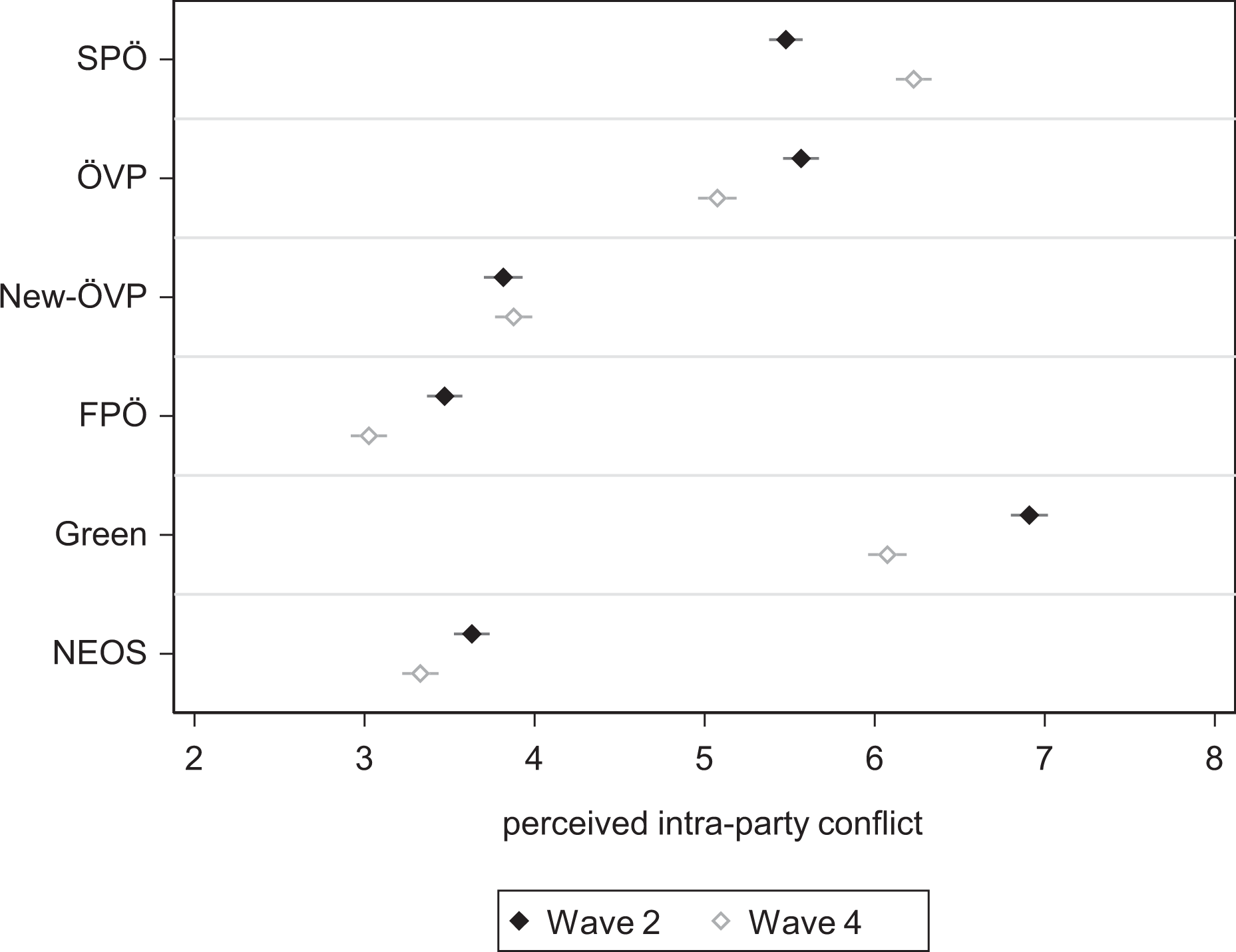
Mean prediction of perceptions of intra-party conflict by party. Note: based on models 1 and 2 in Online Supplemental material Table A2, respectively.
The situation is quite different in wave 4 (light markers), a period when the SPÖ became embroiled in a scandal surrounding its campaign adviser, and the party leadership was heavily criticized by leading party figures for its campaign strategy. 8 Now, the SPÖ is perceived as the most internally divided party, significantly more divided than any other party, but especially when compared with the NEOS and the FPÖ (see also Online supplemental material Table A2). Conversely, we may observe a substantial reduction in the amount of perceived conflict in both the two most internally divided parties in wave 2, namely the ÖVP and the Greens. In fact, in both cases, intra-party conflict has diminished over the period of the election campaign. Thus far, these findings provide support for hypothesis 1 because public perceptions of intra-party conflict appear to align with actual levels of intra-party conflict, offering strong face validity.
As a second step, we examine how perceptions vary across and within voters, focusing on two main moderators, namely campaign attention and party identification. To test hypotheses 2 and 3, we run models with an interaction between our categorical variable for party and campaign attention or party identification, respectively.
Starting with campaign attention, if hypothesis 2 is to be accepted, average predictions of intra-party conflict should align more with actual levels of intra-party conflict for voters with greater attention to campaign information (differences between individuals) as well as for individuals who increase their campaign attention during the election campaign (differences within individuals). Beginning with the former, Figure 3 displays adjusted predictions for the effect of different levels of campaign attention (x-axis) on perceptions of intra-party conflict (y-axis) by party (full results reported in Online supplemental material Table A3). It indicates that greater campaign attention is associated with an increase in perceptions of intra-party conflict for the SPÖ and especially the Greens, while for the remaining three parties, campaign attention decreases rather than increases perceptions of intra-party conflict, albeit the differences are non-significant for both the old and the New-ÖVP. This implies that greater campaign attention renders it more likely that a party is perceived as internally divided when it actually is more internally divided. What happens when respondents alter their campaign attention?
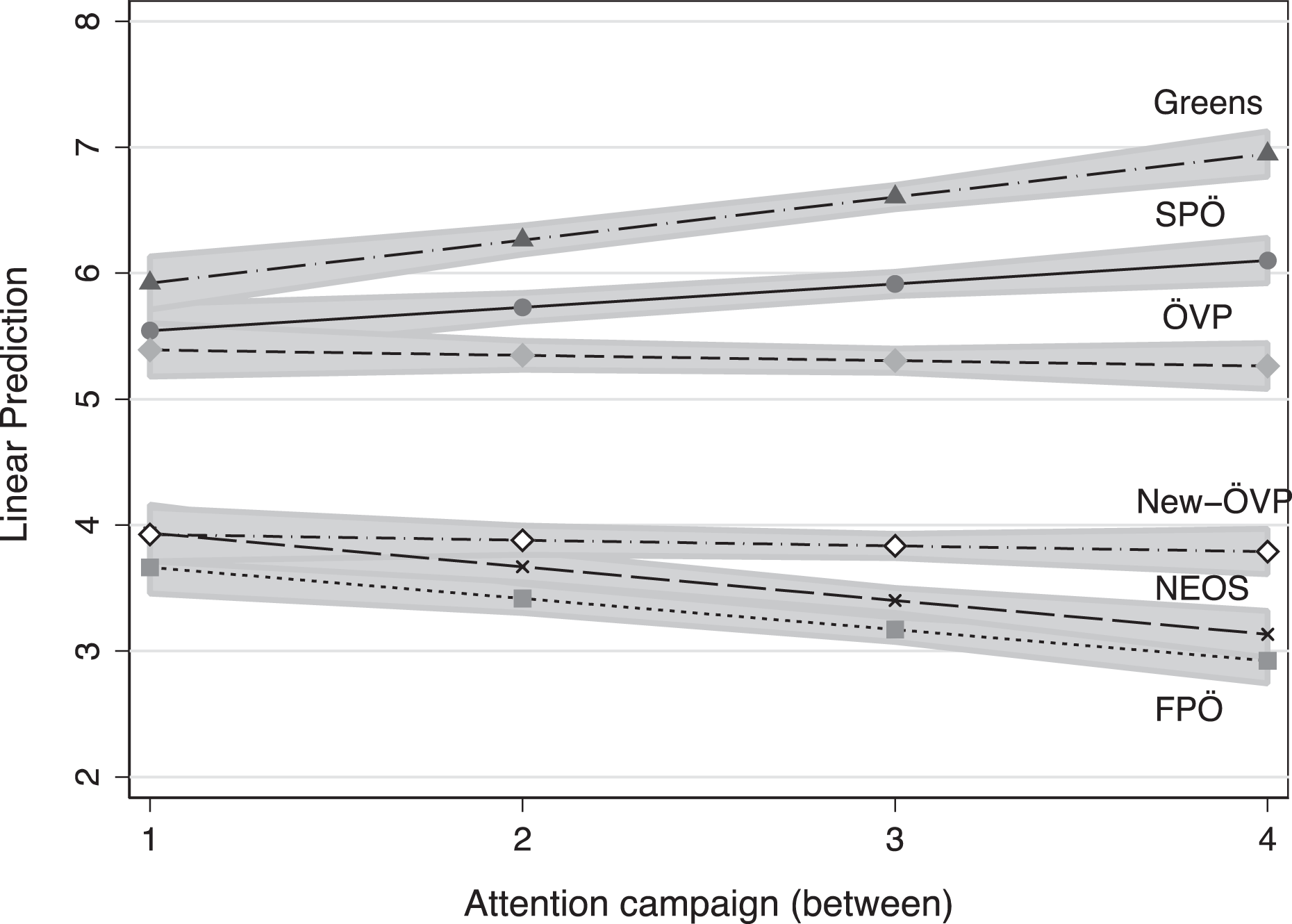
Adjusted prediction by between-individuals campaign attention. Note: based on model 2 in Online supplemental material Table A3.
Figure 4 displays adjusted predictions for the effect of changing levels of campaign attention between July/August and September/October 2017 (x-axis) on perceptions of intra-party conflict (y-axis) by party. In other words, it presents what happens if individual campaign attention increases during the election campaign (movement towards the right on the x-axis) or decreases (movement towards the left on the x-axis). This additional test enables us to check more systematically the temporal variation in average predictions of intra-party conflict by party. Recall that the levels of intra-party conflict decreased for the ÖVP and the Greens during the election campaign, whereas the SPÖ was the only party for which the level of intra-party conflict increased. Hence, greater attention to the campaign over time should lead to a reduction in perceptions of intra-party conflict for the Greens and the ÖVP and an increase for the SPÖ. Conversely, voters diminishing their attention over time would still perceive the Greens and the ÖVP as more and the SPÖ as less internally divided. There should be no effect for the other parties because there was no actual change in their levels of intra-party conflict.
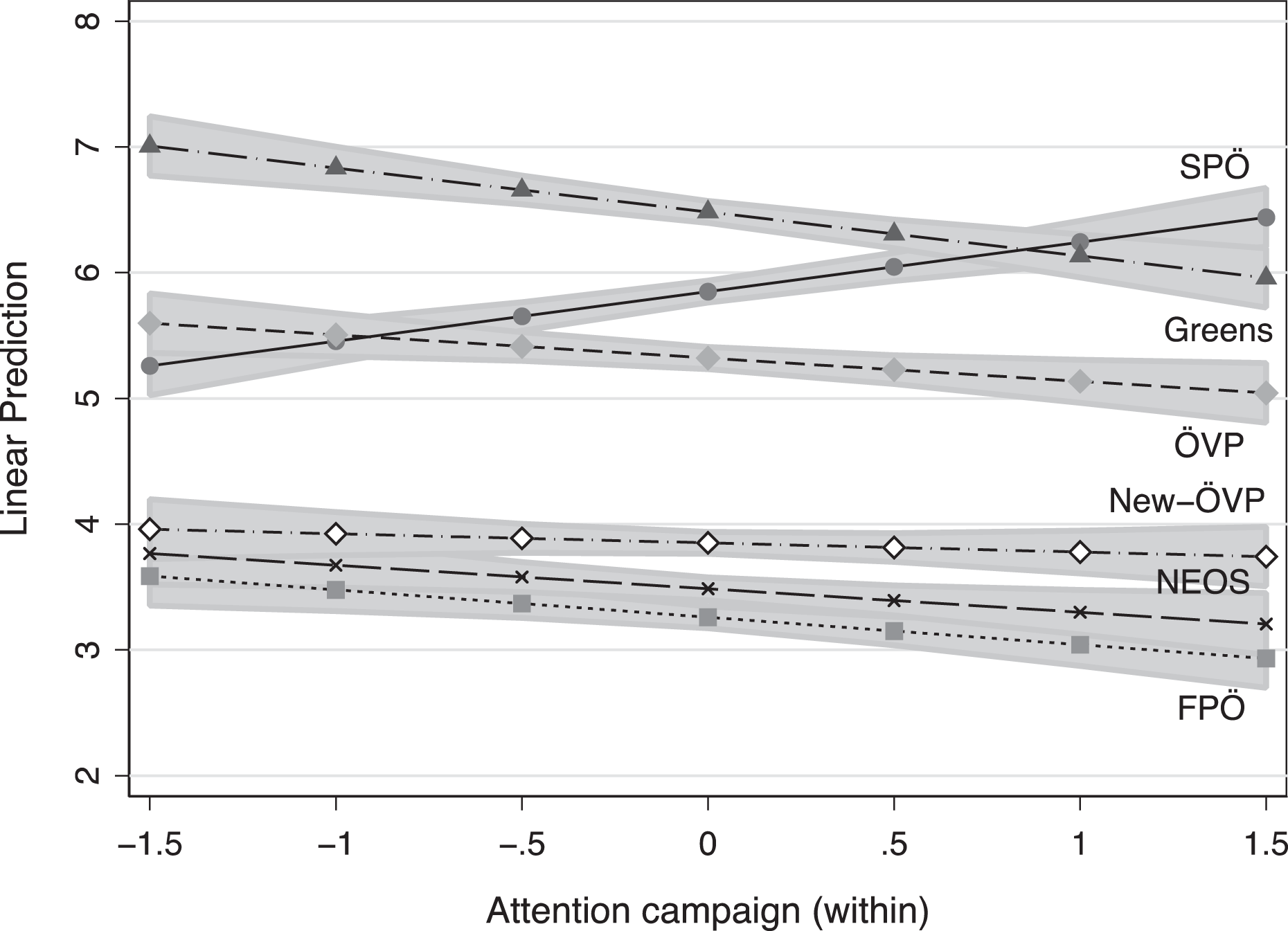
Adjusted prediction by within-individual changes of campaign attention. Note: based on model 3 in Online supplemental material Table A3.
Figure 4 shows that the within-variation in campaign attention is associated with substantially lower levels of perceived intra-party conflict for both the ÖVP and the Greens, while the opposite holds true for the SPÖ. There are no significant differences for the remaining parties (FPÖ, NEOS and New-ÖVP), for which the election campaign brought neither an increase nor a decrease in intra-party conflict. In sum, the results provide support for hypothesis 2, as it would appear that campaign attention renders it more likely that voters will perceive internal divisions within a specific party.
We now move to our final hypothesis, that is, the interaction between party identification and intra-party conflict. In line with hypothesis 3, we expect perceptions of intra-party conflict to be weaker for partisans compared with non-partisans at any point during the election campaign. In this regard, Figure 5 displays the results of the interaction effect by party. The results are straightforward: across all parties, partisans perceive their party as substantially less internally divided than their non-partisan counterparts. This constitutes clear evidence in support of hypothesis 3. Therefore, respondents seem to apply mechanisms of motivated reasoning when evaluating the internal unity of their party.
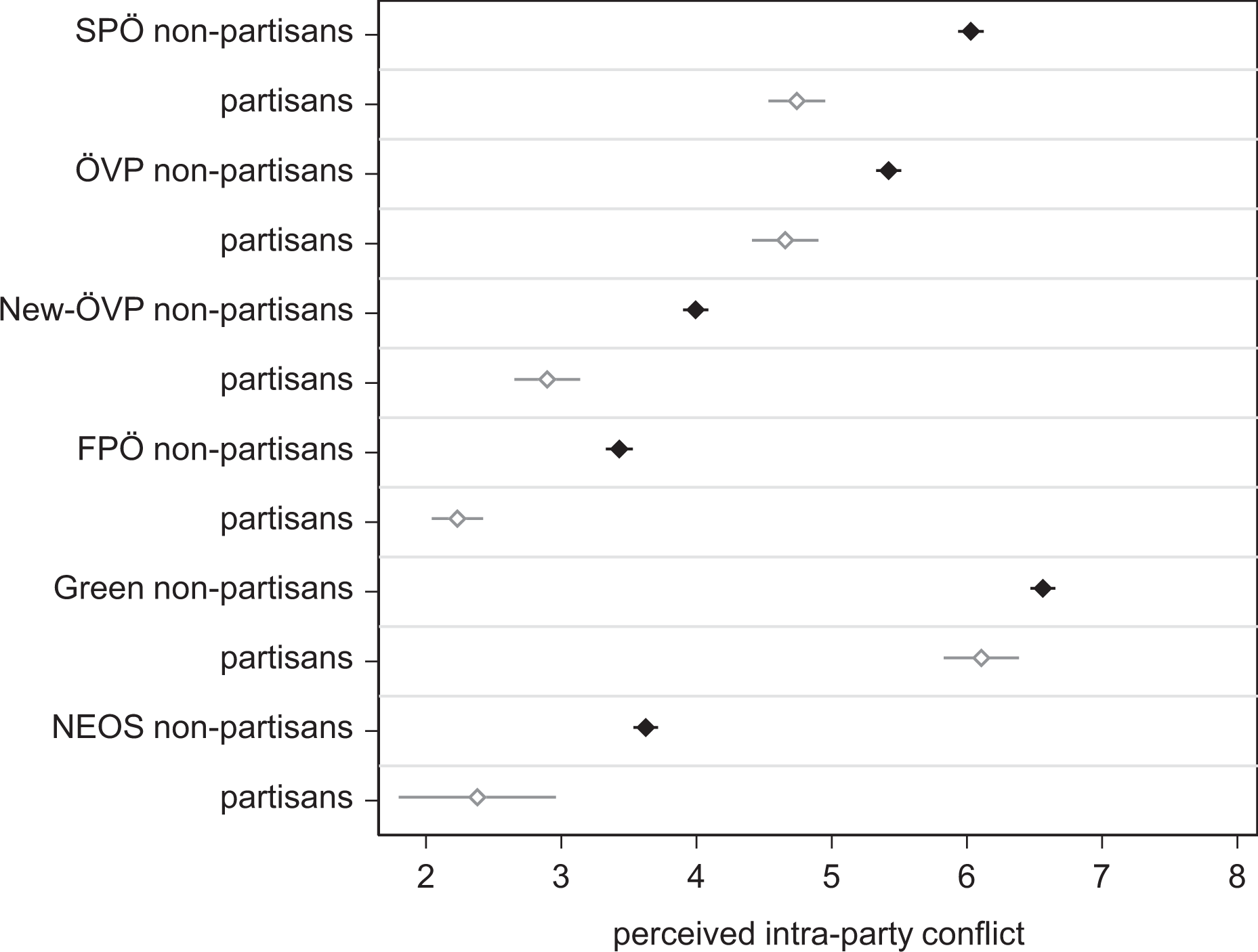
Adjusted prediction by party and partisanship. Note: based on model 4 in Online supplemental material Table A3.
One must, however, provide two important qualifications to this general finding. First, differences across parties and partisans still align with intra-party conflicts. Thus, average perceptions of intra-party conflict remain highest for the three most internally divided parties (ÖVP, SPÖ and the Greens) even if we look only at partisan respondents. Second, differences between partisans and non-partisans appear to be smaller when conflict is almost undeniable, even in the eyes of favourable beholders. For instance, for the Greens and the ÖVP, the differences between the two sub-groups are the smallest. In other words, when reality kicks in, partisans find it harder to turn a blind eye to internal party disputes.
The fact that partisanship is only measured in wave 1 requires us to assume that it remains stable throughout the electoral campaign. To test the extent to which the empirical findings hinge on this assumption, we rely on a variable that is highly correlated with partisanship but of which we have multiple measurements throughout the campaign: the propensity to vote (PTV). This variable measures the probability of support for each party separately using a scale from 0 would never vote for this party to 10 would certainly vote for this party. For most respondents, the party one identifies with (i.e. partisanship) in wave 1 also obtains the highest PTV-score throughout the campaign. This is the case in 85% of the cases in wave 2 and in 86% of the cases in wave 4. 9 The correlation between the party PTVs in waves 2 and 4 is about 0.85, demonstrating conspicuous stability over time. If we were to re-run our models using PTV instead of party identification to account for both between individuals and within individual differences, the empirical results would remain substantially unchanged (see Table A4 in the supplemental material).
We run additional models with a three-way interaction between party identification, campaign attention and our categorical party variable. The results (see Figures A1 and A2 in the Online supplemental material) provide further evidence that motivated reasoning is at work concerning the perception of intra-party conflict, irrespective of attention to campaign information: partisans are always less likely to perceive their ‘own’ party as internally conflicted relative to non-partisans.
Conclusion
Within political science, it is conventional to treat parties as unitary actors. Such unanimity stands at the very basis of a series of relevant phenomena, including ideological voting, and represents a prerequisite for electoral accountability because voters might find it difficult to punish a party that sends them discordant messages. Despite the importance of party unity, research has only recently begun to investigate the consequences of perceived (Greene and Haber, 2015) and objective intra-party conflict (Klingelhöfer and Müller, 2018) on voters (see also Barrett, 2018; Lehrer and Lin, 2018). These existing studies provide empirical evidence that perceptions of intra-party conflict matter and have a substantial impact on both voters’ preferences and behaviour.
In this article, we have focused on the antecedents of perceptions of party unity. This is important for at least three important reasons. First, as scholars of public opinion and voting behaviour, we aim to examine what drives citizen perceptions and whether such perceptions are biased or correspond to some extent to real-world developments. Second, such an investigation is relevant because completely distorted perceptions can undermine electoral accountability as well as the relationship between voters and parties. Third, this should matter to parties, because if perceptions of intra-party conflict fail to follow real-world developments, their strategic behaviour can become imperilled, even when they are not experiencing internal quarrels themselves.
Our results demonstrate that voters use real events on which to base their evaluations of party cohesion: indeed, the Greens were perceived as the most internally divided party, which is to be expected given the leadership issue and the formation of a new party in early summer 2017. Voter perceptions change during the election campaign, again following real-world developments across different parties and based on the objective amount of conflict they manifest. However, beyond these aggregate patterns, we also find conspicuous variation at the individual level in terms of attention to information regarding parties’ internal dynamics and preferences. The greater the attention to the election campaign, the more the voter perceptions align with real-world developments. At the same time, objective evaluations are biased, and perceptions of party unity are rosier for those who prefer the party in question. It is important to stress that the effects of party identification and campaign attention are robust to the inclusion in the models of ideological considerations as well as individual-level baseline differences in political knowledge and media exposure.
Although this article has exemplified the study of (perceived) intra-party conflict within a European multiparty system, our claims and results have relevance far beyond this specific case. In two-party systems such as the United States, intra-party conflict is more central to political and media discourse (Kane, 2019). Our findings on the dynamics and moderators of perceived intra-party conflict should thus inform understanding of other cases such as the ‘Bernie or Bust’ movement during the 2016 US presidential election.
More broadly, the article has highlighted the role of election campaigns in providing citizens with the information they require to assess parties, but it has also demonstrated that this role is important only when intra-party conflict is not obvious. In this regard, it would be worth exploring with more detailed data the extent to which the quality and quantity of information provided by the media has an influence on voter perceptions and to take a closer look at the difference between general conflict and conflict on specific issues, potentially through the use of an experimental survey methodology. Future research should also more closely examine the extent to which intra-party conflict can undermine parties’ electoral success, with specific attention to the type of conflict that takes place. Comparative analyses should also focus on the effects that the polarization of party alternatives can have on the working of the mechanisms highlighted in this article. Overall, we have shown that voters are not immune to intra-party conflict and that their perceptions, albeit moderated, largely correspond to real-world developments.
Supplemental material
supplemental_material - ‘The enemy within’: Campaign attention and motivated reasoning in voter perceptions of intra-party conflict
supplemental_material for ‘The enemy within’: Campaign attention and motivated reasoning in voter perceptions of intra-party conflict by Carolina Plescia, Sylvia Kritzinger and Jakob-Moritz Eberl in Party Politics
Footnotes
Acknowledgements
This paper was presented at the Internal seminar series at the Department of Government, University of Vienna. We greatly benefitted from comments by participants. The authors are also grateful to Zac Greene and Andrea Ceron for their precious feedback.
Declaration of conflicting interests
The author(s) declared no potential conflicts of interest with respect to the research, authorship, and/or publication of this article.
Funding
The author(s) received no financial support for the research, authorship, and/or publication of this article.

Supplemental material
Supplemental material for this article is available online.
Notes
Author biographies
References
Supplementary Material
Please find the following supplemental material available below.
For Open Access articles published under a Creative Commons License, all supplemental material carries the same license as the article it is associated with.
For non-Open Access articles published, all supplemental material carries a non-exclusive license, and permission requests for re-use of supplemental material or any part of supplemental material shall be sent directly to the copyright owner as specified in the copyright notice associated with the article.
