




Abstract
How do parties at different levels of government get their representatives to vote according to the party line? Employing the sequential decision-making approach to party unity, we explore the relative importance of cue-taking, party agreement, party loyalty, and party discipline as individual representative decision-making mechanisms. On the basis of the Dutch version of the PartiRep comparative Member of Parliament survey, we find few differences between national and subnational representatives when it comes to the first two mechanisms, but party loyalty and party discipline seem to play a less important role in determining representatives’ decision whether to vote with the party group line. This is, in part, in line with our theoretical expectation that subnational representatives are less likely to be motivated by office-seeking and vote-seeking than their national counterparts.
Introduction
Most studies on political parties in general, and those aiming to explain party unity more specifically, are based on analyses of national parliaments. These reveal that in (European) parliamentary democracies, party group unity is the rule rather than the exception, at least in terms of floor voting behavior. Of course, representation is not limited to the national level, and political parties are active in the electoral and legislative arenas at both the supranational and the subnational levels of government too. As such, the normative and rationalist arguments for party democracy and its associated criterion of party unity (Bowler et al., 1999; Cox and McCubbins, 1993; Strøm, 2003) can be argued to be applicable to these other levels of government as well. Party voting unity in the European Parliament (EP), which is found to have increased over time, has received a fair amount of scholarly attention (Attina, 1990; Bailer et al., 2009; Bowler and McElroy, 2015; Faas, 2003; Finke, 2014, 2015; Hix, 2002, 2004; Hix et al., 2005, 2007; Jensen and Spoon, 2010; Klüver and Spoon, 2015; Lindstädt et al., 2012; Meserve et al., 2017; Mühlböck, 2012; Rasmussen, 2008; Thierse, 2016). This attention is likely due to the relative novelty of the EP as a supranational institution, and the organization of national parties into EP political groups that adds a potentially competing principal to whom the Members of the European Parliament (MEPs) must answer (Hix, 2002), both of which make the EP case unique from an empirical and a theoretical perspective in the study of party unity. Another advantage of the EP is simply the availability of well-documented (roll call) voting data sets.
The number of studies on party unity, and especially its determinants, below the national level is more limited. However, as argued by Debus and Gross (2016) in their application of coalition theory to German local governments, the subnational level is a promising research area as it brings in new data, thus increasing the number of cases significantly, while allowing researchers to hold the institutional context and “time” constant. The potential as a new source of data may be even more important for researchers relying on survey data, as subnational politicians are less likely to suffer the survey fatigue that plagues many national Members of Parliament (MPs) (Bailer, 2014).
Existing research points in the direction that unified political party groups are the rule in representative assemblies in parliamentary democracies at the subnational (regional, provincial, and/or local) level as well (Copus, 1997a, 1997b; Cowley, 2001; Davidson-Schmich, 2000, 2001, 2003; Denters et al., 2013; Deschouwer, 2003; Dewan and Spirling, 2011; Patzelt, 2003). However, this does not mean that the way in which party groups achieve unity, and the relative importance of these different pathways to party unity, is the same. One way to explore whether this is the case is to study one country in which the institutions at the different levels of government are relatively similar, allowing us to keep a number of key contextual variables constant. Fortunately, we have attitudinal data for one country, the Netherlands, where the electoral and legislative institutions at the national and subnational levels of government are very similar, and the questions from the international-comparative 2010 PartiRep Elite Survey were put to national MPs, as well as both provincial and municipal councilors.
The aim of this article is modest, as it is a first step in cross-level (descriptive) comparison of the pathways to party unity (Andeweg and Thomassen, 2011); how do parties at different levels of government get their representatives to vote according to the party line? Based on Strøm’s (1990) rational choice behavioral theory of competitive parties, we theorize that subnational representatives are less likely to be motivated by office-seeking and vote-seeking, and as a consequence more likely to be driven by policy-seeking, than their national counterparts. Employing the sequential decision-making approach to party unity, we hypothesize that subnational representatives will be less likely to engage in cue-taking (H1), more likely to agree with their party group’s position in the first place (H2), but less likely to ascribe to norms of party loyalty and solidarity (H3), and be less sensitive to party leaders’ threat or use of party discipline (H4), than their national counterparts. Although we find few differences between representatives from the three levels of government when it comes to cue-taking and party agreement, it does seem to be the case that party loyalty and party discipline are more important for determining representatives’ voting behavior at the Dutch national level than at the subnational level.
The study of party unity at the subnational level
The fact that the political party is taken to be the main representative actor in many studies on electoral (Jeffery and Hough, 2001; Laffin et al., 2007; Scarrow, 1997), legislative (Allers et al., 2001; Jeffery, 1999), and government coalition politics (Bäck, 2003a, 2003b, 2008; Debus and Gross, 2016; Seitz, 2000; Skjaeveland et al., 2007) at the subnational level also indicates that the political party model stands at the basis of representation at the lower levels of government. There are also a few studies that focus on the subnational level that deal with party (voting) unity specifically. Copus (1997a, 1997b, 1999), for example, finds that municipal councilors in the United Kingdom struggle to combine the party group system, with its emphasis on party unity through loyalty and discipline, with their scrutiny role, but usually end up privileging the former over the latter. Patzelt (2003: 102) argues that in Germany, the 16 state (Länder) legislatures do not bother to keep any systematic record of individual members’ voting behavior (with the exception of the infrequent occurrence of roll call votes), because “…final unity of action is taken for granted to such a degree that neither the margin nor the actual composition of a German cabinet’s majority on the floor is treated as a topic worthy of documentation…” Stecker’s (2013) later analysis of party unity on roll call voting in 16 German state parliaments between 1990 and 2011 is one of the most comprehensive analyses of party voting at the subnational level; he also concludes that perfect unity is the rule rather than the exception.
Using Berlin’s 23 city district councils as a semi-experimental research design to discriminate between the explanatory power of the sociological and rationalist/institutionalist approaches with regard to party group (voting) unity, Davidson-Schmich (2000, 2001) finds that the vast majority of the party groups in western Berlin city district councils voted in unison. Party groups were less unified in eastern Berlin. Davidson-Schmich (2003) later extended her analysis of the German subnational level in her study of party voting unity in eastern German state legislatures during the 1990s, where party group unity increased dramatically throughout the first decade after Germany’s reunification. She also explicitly compares the voting behavior in these eastern German state legislatures to the voting behavior in the national Bundestag during its first terms (1949–1953, 1953–197, and 1957–1961), during which the development toward increased party voting unity was clearly mirrored. Finally, both Cowley (2001) and Dewan and Spirling (2011) explicitly compare party unity on roll call votes between the national Westminster parliament and the regional Scottish Parliament. Dewan and Spirling’s (2011) conclude that party group unity is “as prevalent and robust in the Scottish Parliament as in the House of Commons” (2011: 341). 1
Existing research on party unity at the subnational level thus reveals party (voting) unity to be as prevalent as it is at the national level. Little research has been done on how party unity is brought about, and none of the research on the determinants of party unity compares across government levels. The next section outlines the sequential decision-making approach that is used as a framework for the different pathways to obtain party unity. This is followed by a section explaining expectations with regard to differences between the levels.
The sequential decision-making model
As mentioned in the introduction, in most (European) parliamentary democracies, parliamentary party group unity is the rule rather than the exception, at least in terms of voting behavior. As such, both in and outside academia, political parties are often considered the main representative actors, and party unity is treated as a given. There is, however, a substantial body of literature that aims to unpack the party as a unitary actor (at the national level), seeking to explain party (voting) unity as resulting from processes and dynamics taking place within the political party, both at the group and individual level. Party unity is conceptualized as the aggregated outcome of individual MPs’ decision-making processes in determining whether to adhere to the party’s position. Within this research program (Itzkovitch-Malka and Hazan, 2017; Van Vonno, 2016; Van Vonno and Andeweg, 2014; Van Vonno et al., 2014), institutions are not held to influence final parliamentary party (voting) unity scores directly (Carey, 2009; Depauw, 2003; Depauw and Martin, 2009; Sieberer, 2006), but instead institutions are theorized to influence—either on their own or by being purposely used by other actors, such as the party (group) leadership—the decision-making process individual MPs’ employ when determining whether to toe the party line or not.
Following Kam (2009: 16), our theoretical argument concerning party unity, at any level of government, is that it “must be constructed one MP at a time”; it is the aggregate of individual MP decisions to vote in accordance with the party line or not. Each individual MP’s final vote is likely to result from a decision-making process that consists of a chain of multiple steps that are ordered in a particular sequence (see Figure 1). The “pathways to party [group] unity” (Andeweg and Thomassen, 2011), division of labor, party agreement, party loyalty (together comprising party cohesion), and party discipline, can be viewed as each affecting representatives’ decision-making process at a different stage.
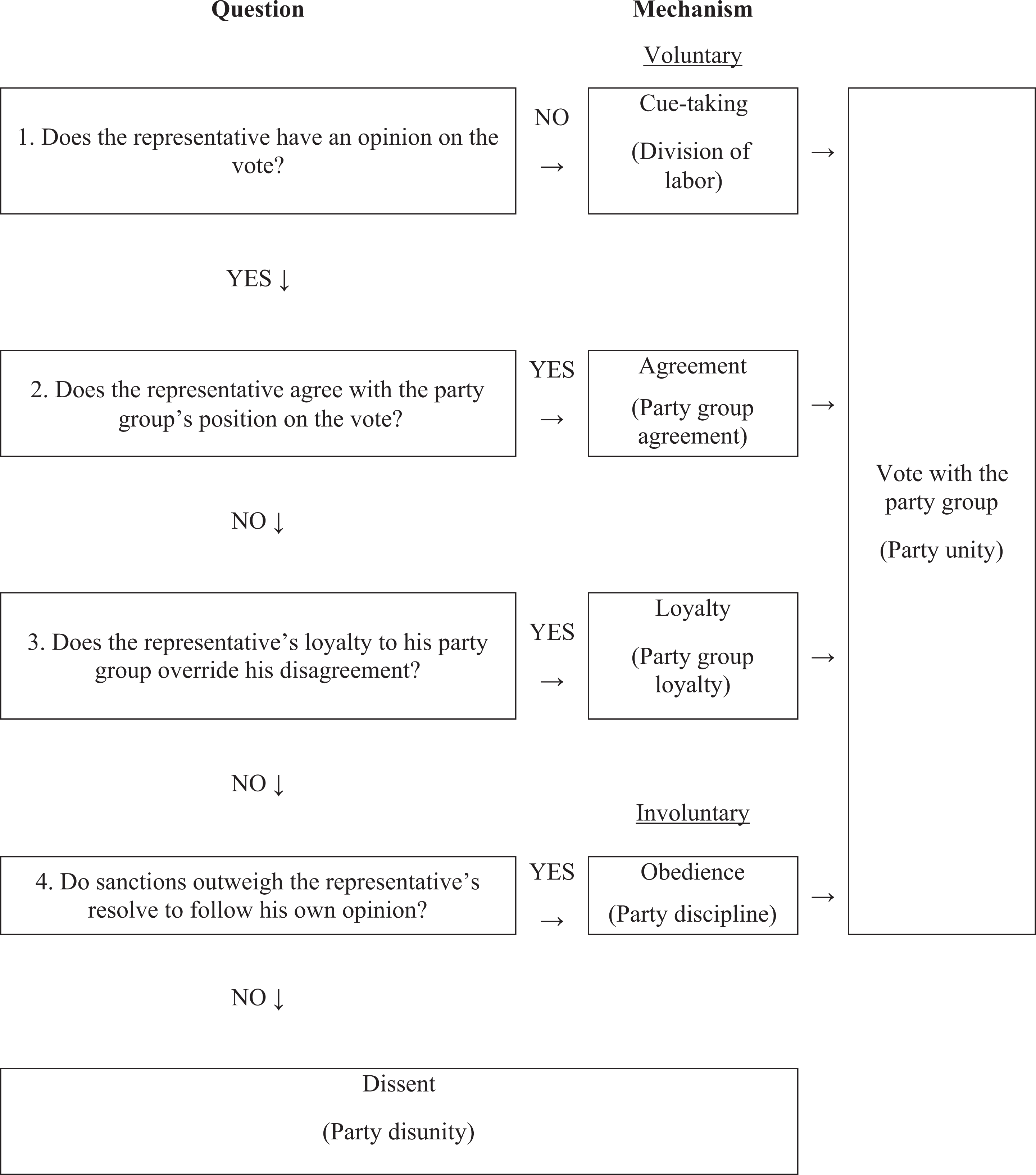
Representatives’ sequential decision-making process.
The pathway to party (voting) unity that parties are likely to rely on first is cue-taking. As a result of the substantial workload of parliament and division of labor applied within parliamentary party group (Andeweg and Thomassen, 2011; Skjaeveland, 2001), a representative may not have an opinion on all topics that are put to a vote. If the representative lacks an opinion on a specific vote, he will follow the voting cues given to him by his fellow party group member who is a specialist, or acts as the parliamentary party spokesperson, on the topic.
If the representative does have an opinion on the vote at hand, he moves on to the second decision-making stage. Now, he ascertains whether his own opinion on the vote is in agreement with his party group’s position. If so, he will vote in accordance with the party group line out of simple agreement. This decision-making mechanism is based on the preference homogeneity, or party agreement, pathway (Andeweg and Thomassen, 2011; Carey, 2007; Depauw, 2003; Krehbiel, 1993; Sieberer, 2006).
If the representative does not agree with his party group’s position, however, he moves on to the third decision-making mechanism, party group loyalty. If an MP subscribes to the norm of party group loyalty, he will disregard his own opinion and opt for the position of his party group of his own accord. This decision-making mechanism reflects the pathway to party group unity emphasized by sociological perspectives (Andeweg and Thomassen, 2011; Hazan, 2003; Jensen, 2000; Kam, 2009; Norton, 2003). The strength of party group loyalty is argued to be the result of a process of socialization; representatives internalize norms of solidarity through their previous party experience. Note that we are not implying that representatives who vote with their party out of simple agreement do not also subscribe to the norm of party loyalty, only that on a particular vote, it is not the relevant mechanisms that brings a representative to toe the party line.
If the representative does not subscribe to the norm of party group loyalty, or his conflict with the party group’s position is so intense that his loyalty does not supersede his disagreement, he could be moved to still vote with the party group in response to the anticipation, threat, promise, or actual application of party discipline in the form of positive and negative sanctions, which is the fourth decision-making stage. This is the pathway to party group unity specified by rational choice inspired approaches that maintain that political behavior is determined by a “logic of consequentiality” (Andeweg and Thomassen, 2011; Hazan, 2003; Jensen, 2000; Kam, 2009; Krehbiel, 1993; Norton, 2003). Finally, if the representative has an opinion on the topic that is at odds with the position of his party group, he does not subscribe to the norm of party group loyalty, and is not amenable to positive and negative sanctions, the representative will dissent and vote against the party group line (see Van Vonno et al., 2014; Van Vonno, 2016, for a more extensive explanation of the model). 2
Same pathways but different motivations
We have no reason to suspect that the way in which MPs decide whether to toe the party line on a specific vote differs between the levels of government. This does not automatically entail that the pathways to party unity and their associated decision-making mechanisms are of equal importance at the different levels. Within one country, the electoral and legislative institutions that are held to affect each of the pathways to party group unity may differ across levels, for example. One could also argue that there are differences between the national and subnational level that hold across countries, however.
For one thing, subnational parliaments, especially those at the local municipal level, tend to be smaller than national parliaments in terms of the number of legislative seats, which entails that party groups are generally smaller as well. Psychological research on small group cohesion has found group size to be a significant influence on how groups, and individuals within groups, function (Cummings et al., 1974; Hare, 1952; Mullen et al., 1994; Thomas and Clinton, 1963). Party group size (or seat share) is also included in a number of multivariate comparative analyses of party voting unity, usually as a control variable (Carey, 2007; Sieberer, 2006; Tavits, 2012). Sieberer (2006), however, explicitly hypothesizes that large parties are more likely to have more heterogeneous constellations of preferences (thus decreasing the role of party agreement as a pathway to party unity). He also argues that large parties also increase the party (group) leadership’s costs of monitoring individual members, which may also result in lower party unity (by decreasing the role of party discipline). Alternatively, in line with the sequential decision-making model, one could argue that the more heterogeneous constellation of preferences of large parties actually requires parties to rely on party discipline more often, regardless of whether the costs are higher are not.
Another way in which the levels of government differ is that whereas the number of national parliaments in one country is limited to one or two, territorial decentralization entails that at one subnational level, multiple representative assemblies exist, which means that the total number of seats that political parties need to fill is a lot higher than at the national level. In combination with the decrease in the number of party members (i.e. a decrease in the pool of potential candidates) experienced by European parties in general (Mair and Van Biezen, 2001; Van Biezen et al., 2012; Voerman, 2014), intraparty competition is likely to be lower at the subnational level (Kjaer, 2007). The higher demand, but lower supply, in terms of the quantity of candidates below the national level is likely to affect subnational party selectorates’ ability to apply strict candidate (re-)selection quality criteria, and also party (group) leaders’ ability to employ candidate selection as a disciplining tool. In terms of the former, parties at lower levels are likely to have a more difficulty composing a list of candidates in terms of required expertise and background, agree with all (or most) of the party’s policy positions, and who all subscribe to the norm of party loyalty.
Although Guérin and Kerrouche (2008) identify a trend toward the professionalization of local elected representatives in Europe, in most countries, subnational representatives are unable to “live off politics” (Weber, 1919) as national MPs do. The latter are usually employed full-time, whereas subnational representatives usually only engage in politics part-time (although many work overtime, see Guérin and Kerrouche, 2008: 192–3), and in some countries are even non-salaried, receiving only modest financial compensation for their work (Guérin and Kerrouche, 2008). They are thus less dependent on their political party for their livelihood, often retaining another (full-time) profession next to their council work (Verhelst et al., 2013). Moreover, given that only a small percentage of subnational representatives are eventually promoted to higher positions within their party organization or are selected as representatives at higher levels of government, subnational representatives are also less dependent on their political party in terms of their future career ambitions, which are likely to extend beyond the political realm.
From a rational-institutionalist theoretical perspective (Müller and Strøm, 1999; Strøm, 1990), political parties, and by extension their representative members, are held to be motivated by three goals: maximization of electoral votes, maximization of their share of government office seats, and maximization of the number of enacted policy proposals, according to their own policy program or preferences. Subnational politicians share these motivations with their national counterparts (Debus and Gross, 2016; Skjaeveland et al., 2007), but given the lower levels of intraparty competition, and that subnational councilors are less likely to be dependent on their political party for their (current and future) livelihood, we theorize that subnational politicians are more likely to place policy-seeking ahead of vote-seeking and office-seeking than MPs at the national level.
How do we then expect subnational councilors to differ from national MPs when it comes to their decision to vote with the party line or not? First off, we expect that subnational representatives are less likely to engage in cue-taking than national MPs (H1). If councilors are more likely to be policy-seeking, they are also more likely to be generalists and actually have a personal opinion on a (relatively) wider range of topics that are put to a vote within the representative assembly, than national MPs. We also expect that subnational representatives are more likely to frequently agree with the party than national MPs (H2). This argument is in part based on subnational councilors being more policy-oriented, but also the social-psychological finding that small groups are more likely to engage in consensus and unanimous decision-making (Buchanan and Tullock, 1962; Burawoy, 1979; Romme, 2004), and individual representatives are more involved in determining the position of the party group during the parliamentary party group meeting the first place.
When it comes to the third decision-making stage, party group loyalty, we expect that subnational representatives are less likely to subscribe to the norm of party loyalty than national MPs (H3). As a result of their stronger policy-motivation, when in disagreement with the party’s position, subnational representatives’ resolve to vote according to their own policy preferences will be stronger than it is among national MPs. Moreover, the strength of party group loyalty is argued to be the result of a process of socialization, and representatives internalize norms of solidarity through their previous party experience (Asher, 1973; Crowe, 1983; Kam, 2009; Rush and Giddings, 2011). Although research comparing career patterns across different levels of government is generally lacking, Pilet et al. (2014: 212–215) provide some evidence for the claim that MPs at the national level are more likely to have previous party experience and, therefore, more likely to strongly subscribe to the norm of party loyalty.
At the final stage of the decision-making process, representatives whose opinion on a vote conflicts with that of the party group, and who do not subscribe to the norm of party loyalty, are confronted with disciplinary measures by the party (group) leadership in order to elicit them to vote with the party group, albeit involuntarily. But because representatives at the lower levels of government do not depend as much on their party for their (future) livelihood, they have far less to lose when confronted with the (threat or promise of) sanctions when they threaten to dissent from the party group line, rendering the sanctions themselves less effective. Moreover, as a result of the large number of seats to fill at the subnational level, intraparty competition is lower, and parties are also limited in their ability to use candidate reselection as a credible disciplining tool. All in all, we expect that subnational representatives are less likely to be disciplined than national MPs (H4).
The Dutch case: Second chamber, provincial councils, and municipal councils
Party voting unity is, and always has been, very high in the Dutch Second Chamber (Van Vonno, 2016). Although we have limited hard voting data at the subnational levels, it seems safe to assume that party group unity is quite high at all levels of government in the Netherlands (Morlan, 1964; Van der Meij, 2013). The fact that many of the formal institutions that are deemed to influence party group unity are very similar at all three levels makes the Netherlands an ideal case for cross-level comparison.
First, representatives at all three levels of government are elected through direct elections every 4 years, and at all levels the electoral system is one of proportional representation with an open list. However, whereas at the national level, the fall of government may result in the dissolution of the Second Chamber and early elections, the electoral cycles at the subnational levels are fixed. There are 150 seats in the Second Chamber, and the number of seats to be distributed at the subnational levels varies between 39 and 55 in the 12 provincial councils and between 9 and 45 seats in the municipal councils. According to a recent survey of municipal parties regarding their experiences with candidate selection for the over 9500 municipal seats, Voerman and Boogers (2014) find that almost 50% indicate to indeed have trouble finding good candidates. This is especially the case in the smaller municipalities.
Next, the implementation of the 2002 Local Government Act and 2003 Provincial Government Act led to the replacement of the monistic system by one of strict dualism at the two subnational levels. This entails that at the municipal level, the position of alderman (wethouder) cannot be combined with membership of the municipal council, and at the provincial level, membership of the provincial government (Gedeputeerde Staten) is incompatible with that of the provincial council. Thus, executive-legislative relations at the subnational levels of government today mirror those at the national level where the position of (junior) minister cannot be combined with that of MP.
Finally, although formally a decentralized unitary system, the powers of the subnational levels of government are limited to such a degree that the Netherlands is generally considered a unitary system. In practice, the municipal, but especially the provincial level of government, has the power to act autonomously over only a relatively narrow set of policy areas and is to a large extent limited to the implementation and execution of legislation passed at the national level (this is referred to as co-administration or co-governance). Even when taking the continuous processes of decentralization into account, the fact is that the jurisdictions and powers of the three levels of government vary considerably, which could also influence how representatives come to their decision to vote with the party.
When it comes to the dependence of representatives on the party for their (current) and future livelihood, municipal councilors are officially non-salaried but receive a financial compensation of between 235 and 2200 euros per month (depending on municipal population size). The compensation received by provincial councilors is about 1100 euros per month (regardless of provincial population size). According to a 2014 online survey conducted by Gemeenteraad.nl (2014), over half (52%) of municipal councilors even have a full-time job. Councilors from small municipalities are most likely to combine their council work with a full-time job, whereas councilors from larger municipalities are more likely to work part-time. National MPs, on the other hand, have a salary of over 7300 euros per month. In other words, only at the national level, and in the largest municipal councils, are Dutch representatives likely to be able to live “off” politics.
PartiRep survey data set
The analysis of the decision-making mechanisms and pathways to party unity at the three levels of government in the Netherlands relies on data that were collected in the context of the PartiRep project. As is shown in Table 1, 42% of representatives of the Dutch Second Chamber participated in face-to-face interviews in the spring of 2010. At the provincial and municipal level, Dutch representatives were invited by e-mail to fill in an online version of survey, its question topics, and terminology specifically tailored to fit the context of the Dutch subnational level, which was available online in December 2010 and January 2011. At the provincial level, all 564 councilors were approached, resulting in a response rate of around 25%, with 20% completing the survey. At the municipal level, a stratified cluster sample based on council size was drawn. This yielded a response rate of about 26%, and a completion rate of 20%. As is often the case with lengthy Internet surveys, the attrition rate among provincial and municipal respondents is quite high (Crawford et al., 2001), despite the efforts that were made to shorten the Web-based version of the survey. 3
PartiRep MP survey response rates for the Dutch second chamber, provincial councils, and municipal councils.
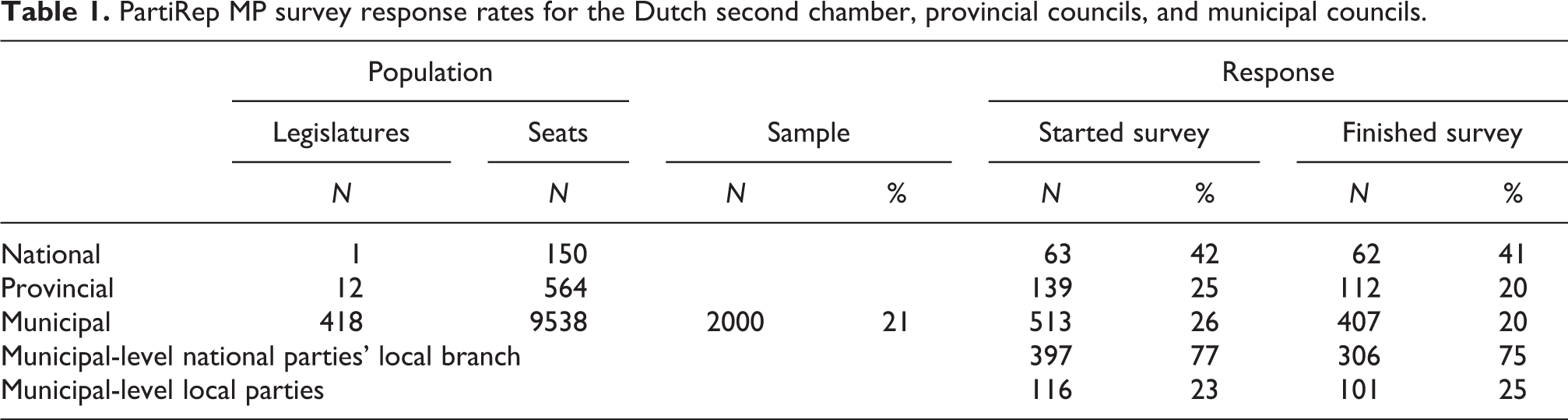
At both the provincial and municipal levels, the distribution of respondents across the various local branches of national parties is very similar to the distributions found in the population of council members (not shown in Table 1). Furthermore, of the municipal councilors who completed the survey, three-quarters are members of local branches of national parties and the remaining 25% are members of parties that are only active at the municipal level. These distributions are roughly equal to those found in the population of municipal councilors. 4
The pathways at three levels of government
Cue-taking
The survey unfortunately lacks a question that directly asks respondents about the role of cue-taking when it comes to voting, and we must therefore estimate its importance on the basis of other related questions. First, we asked representatives whether they consider themselves generalists or specialists and assume that the former are more likely to have an opinion on a wider range of topics. Generalists are in the majority at all three levels of government, and at the municipal level, the percentage of generalists is almost 10% point higher than at the other two levels of government, which is in line with our hypothesis, although the difference is admittedly not very large (see Table 2).
Specialist or generalist in the Dutch second chamber, provincial councils, and municipal councils (%).
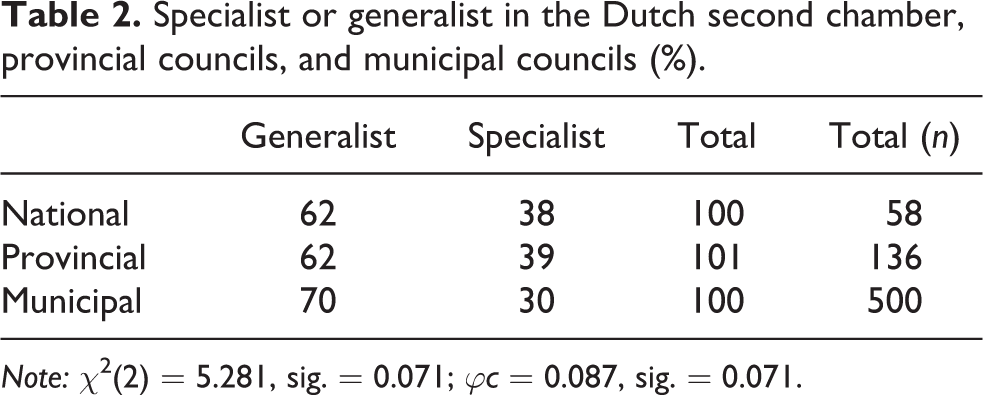
Note: χ2(2) = 5.281, sig. = 0.071; φc = 0.087, sig. = 0.071.
Respondents were also asked whether they consider it true or false that the parliamentary party spokesperson determines the position of the party on his topic, which is used as a means of gauging the division of labor which is likely to spur cue-taking. Most representatives at all levels consider it to be (mostly) true that the party group spokesperson determines the position of the party on his topic (see Table 3). However, the percentage of representatives who consider the statement (mostly) true is lower at the subnational level, and the percentage of representatives who answer (mostly) false is higher, which also point in the direction that subnational representatives are less likely to engage in cue-taking than national MPs.
“The parliamentary party spokesperson gets to determine the party’s position on his topic” in the Dutch second chamber, provincial councils, and municipal councils (%).
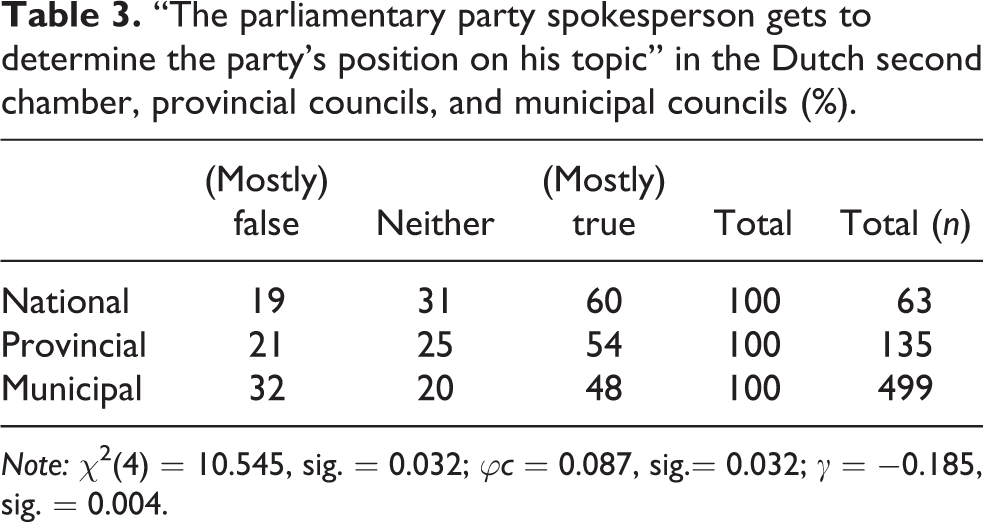
Note: χ2(4) = 10.545, sig. = 0.032; φc = 0.087, sig.= 0.032; γ = −0.185, sig. = 0.004.
Finally, we asked representatives what they consider to be the main decision-making center in their parliamentary party group (see Table 4). Whereas 61% of the respondents from the Second Chamber consider the party group’s meeting to be the main decision-making center, this percentage is significantly higher at the two subnational levels: respectively, 74% at the provincial level and 86% at the municipal level. At the national level, 33% of MPs select either the party group committees or specialists as the party group’s main decision-making center, as opposed to 23% of provincial councilors and only 11% of municipal councilors. Although we are unable to directly measure the role of cue-taking in representatives’ voting behavior, these distributions provide some evidence for the argument that subnational councilors are less likely to engage in cue-taking when it comes to voting according to the party line, as they are more likely to be generalists and actually be involved in the policy positioning of the party through the party group meeting.
The main decision-making center in the parliamentary party group in the Dutch second chamber, provincial councils, and municipal councils (%).
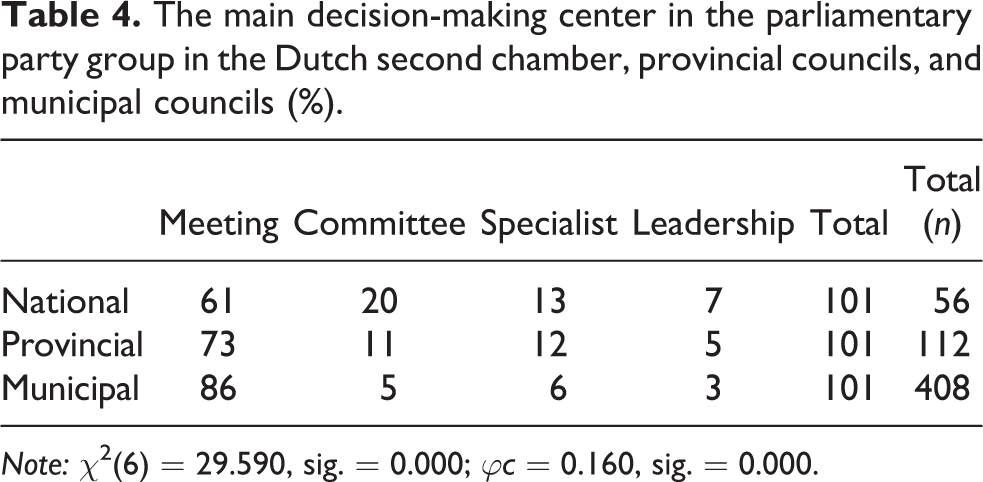
Note: χ2(6) = 29.590, sig. = 0.000; φc = 0.160, sig. = 0.000.
Party agreement
The issues that are relevant for the day-to-day decisions that are put to a vote in legislatures at the subnational level, however, differ from the national level in that they are less likely to be ideologically charged and are more likely to be of a practical, technocratic-administrative nature. Party agreement in terms of representatives’ own position and their perception of their party’s position on the left–right ideological scale, as is sometimes done in studies of party group homogeneity, is therefore too abstract a measure to gauge the true essence of party agreement at the subnational level (De Vries, 2000). In the PartiRep survey, respondents were also asked how often, in the last year, they found themselves in the position that their party had one opinion on a vote in the relevant representative assembly, and they personally had another. This question goes further than abstract ideological and policy scales: the question specifies two actors (the individual MP and the party) and the event (a difference of opinion over an upcoming vote) and provides quantifiable answering categories (the frequency of disagreement over months and years).
The majority of respondents at all levels of Dutch government indicate to disagree infrequently with the party’s position (answering that they either disagree only once a year or (almost) never), and thus at all levels parties can to a great extent rely on party agreement for the unity of their party group. In line with our hypothesis, provincial (84%) and municipal (81%) councilors are more likely to disagree infrequently than national MPs (71%; see Table 5). The difference is not very large and it is not statistically significant, however.
Party agreement (the frequency of disagreement with the party’s position on a vote in parliament) in the Dutch second chamber, provincial councils, and municipal councils (%).
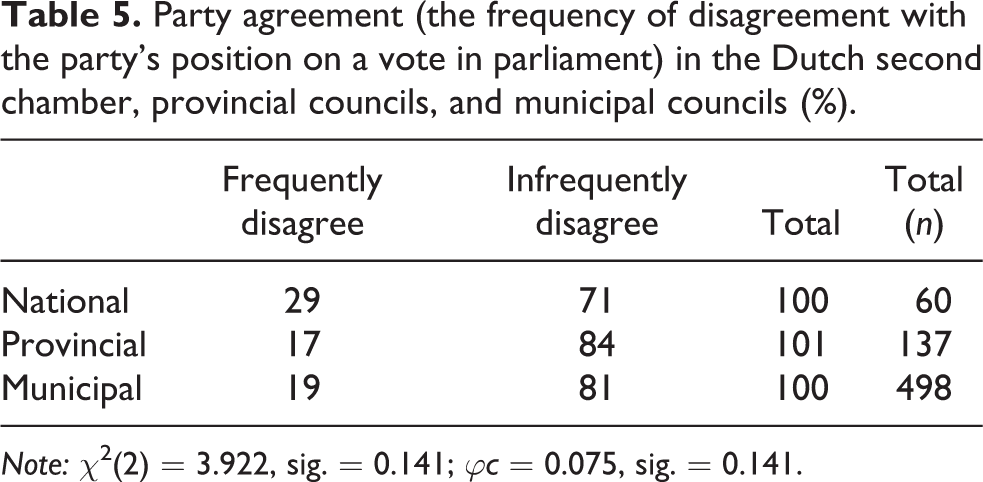
Note: χ2(2) = 3.922, sig. = 0.141; φc = 0.075, sig. = 0.141.
The fact that the percentage of representatives who consider the party meeting the main decision-making center of the party group increases as we move down the ladder of government levels (see Table 4) already provides some evidence for our reasoning that small groups are more likely to engage in consensus and unanimous decision-making, thus resulting in party agreement being a more important decision-making mechanism at the subnational level. We also asked respondents directly whether they feel involved in the decision-making in the party group. Although at all levels of government, very few representations indicate to feel (completely) uninvolved in party group decision-making, the percentage of representatives who select the extreme answering category “completely involved” increases by over 20% points as we move from the national to the municipal level (see the figures in the column “all” in Table 6). Table 6 also shows the relationship between representatives’ answers to the question about their involvement in party group decision-making cross-tabulated with their self-indicated frequency of disagreement. At all levels of government, party agreement increases as representatives feel more involved in the decision-making process in the party group. The relationship is, however, much stronger at the two subnational levels of government than at the national level.
Party agreement (the frequency of disagreement with the party’s position on a vote in parliament) and “I feel involved in the decision-making in the party group” in the Dutch second chamber, provincial councils, and municipal councils (%).
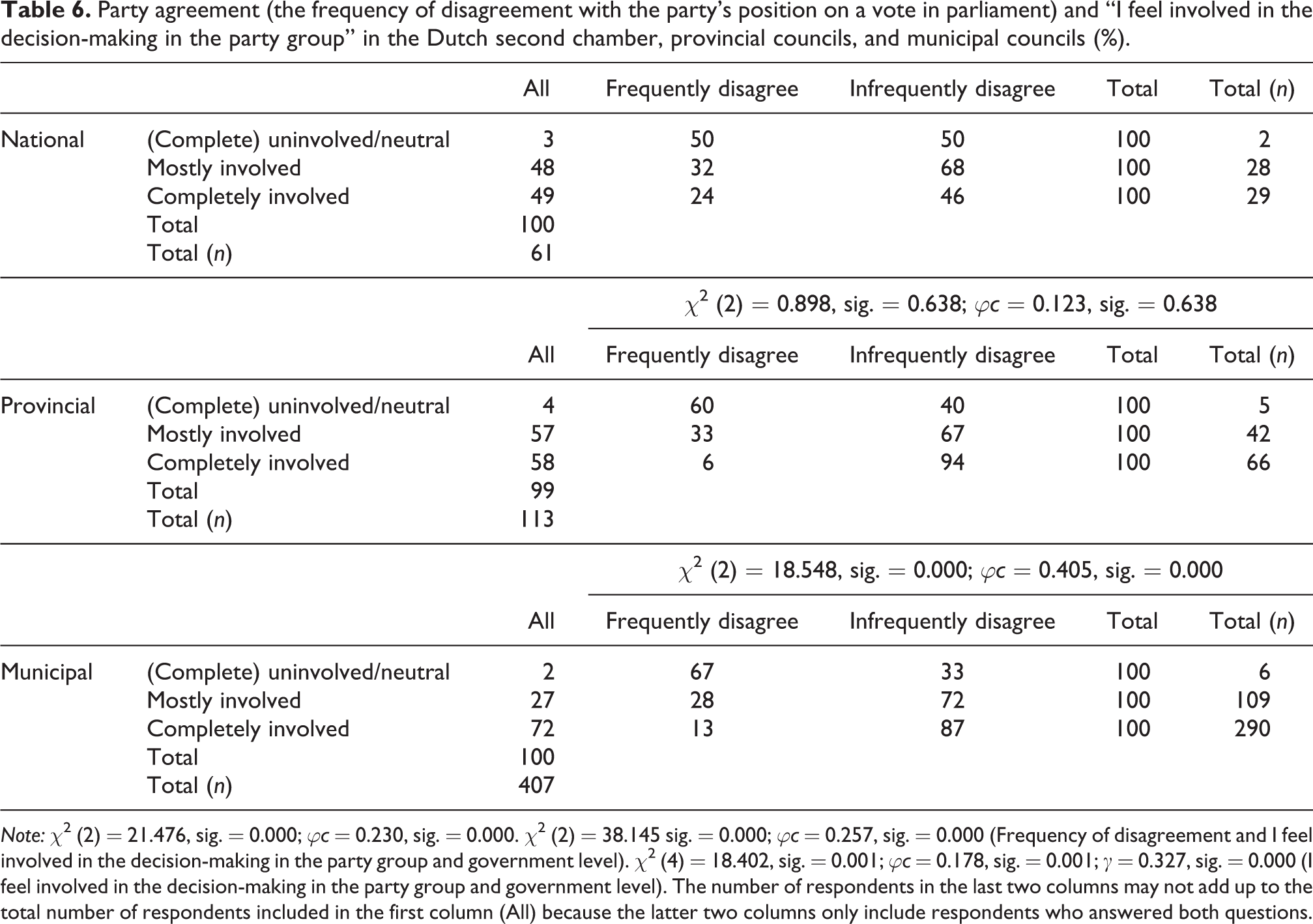
Note: χ2 (2) = 21.476, sig. = 0.000; φc = 0.230, sig. = 0.000. χ2 (2) = 38.145 sig. = 0.000; φc = 0.257, sig. = 0.000 (Frequency of disagreement and I feel involved in the decision-making in the party group and government level). χ2 (4) = 18.402, sig. = 0.001; φc = 0.178, sig. = 0.001; γ = 0.327, sig. = 0.000 (I feel involved in the decision-making in the party group and government level). The number of respondents in the last two columns may not add up to the total number of respondents included in the first column (All) because the latter two columns only include respondents who answered both questions.
Party loyalty
As a follow-up to the question about the frequency of disagreement, respondents were asked how an MP ought to vote in the situation that the party has one position on a vote in parliament, and they personally have a different opinion. The answering category “an MP ought to vote according to his party’s position” is taken to be indicative of a respondent’s subscription to the norm of party loyalty (Andeweg and Thomassen, 2011). The pattern is as we expect: whereas at the national level 86% of MPs indicate to vote according to the party’s position in the case of disagreement, 5 this percentage drops to 57% at the provincial level and only 40% at the municipal level (see Table 7). The norm of party loyalty seems to have a much stronger footing among national MPs than among subnational councilors.
Party loyalty (own opinion versus party’s position) in the Dutch second chamber, provincial councils, and municipal councils (%).
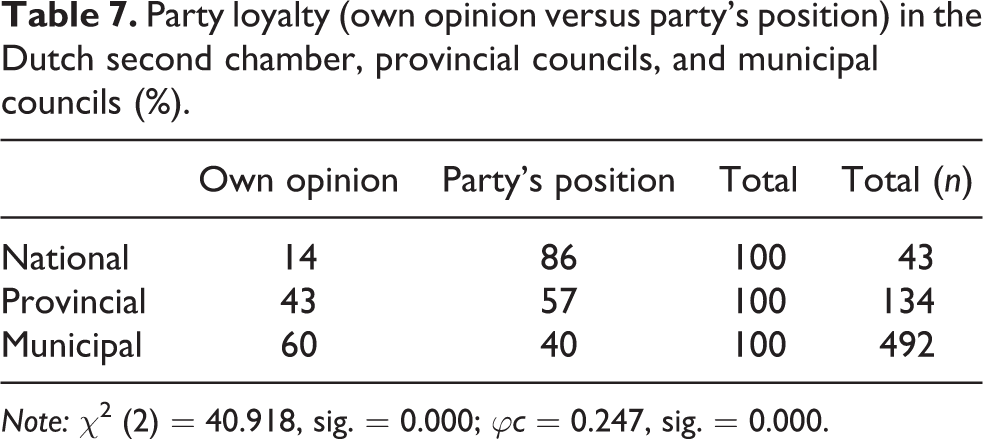
Note: χ2 (2) = 40.918, sig. = 0.000; φc = 0.247, sig. = 0.000.
As a second indicator of the internalization of norms of party loyalty and solidarity, we use a question that was included in the Dutch version of the survey which asked representatives to indicate what they consider more important: an individual representative’s freedom or the unity of the party. At all levels of government, the majority of representatives opt for party unity (see Table 8). There are, however, significant differences between the government levels when it comes to the distribution of responses along the scale. Whereas 82% of national level MPs place a high value on party unity (selecting a 4 or a 5 on the five-point scale), this figure drops to 65% among provincial and 51% among municipal councilors. Although at all levels very few representatives place a high value on an individual representative’s freedom, the relatively high percentage of subnational representatives who place themselves toward the middle of the scale indicates that these subnational councilors tend to opt for more of a balance between a representative’s freedom and party unity. This implies that the internalization of the norms of party loyalty is indeed probably weaker at the subnational levels than it is at the national level in the Netherlands.
“An individual representative’s freedom or party unity” in the Dutch second chamber, provincial councils, and municipal councils (%).

Note: χ2 (8) = 35.689, sig. = 0.000; φc = 0.245, sig.= 0.000; γ = −0.328, sig. = 0.000.
Party discipline
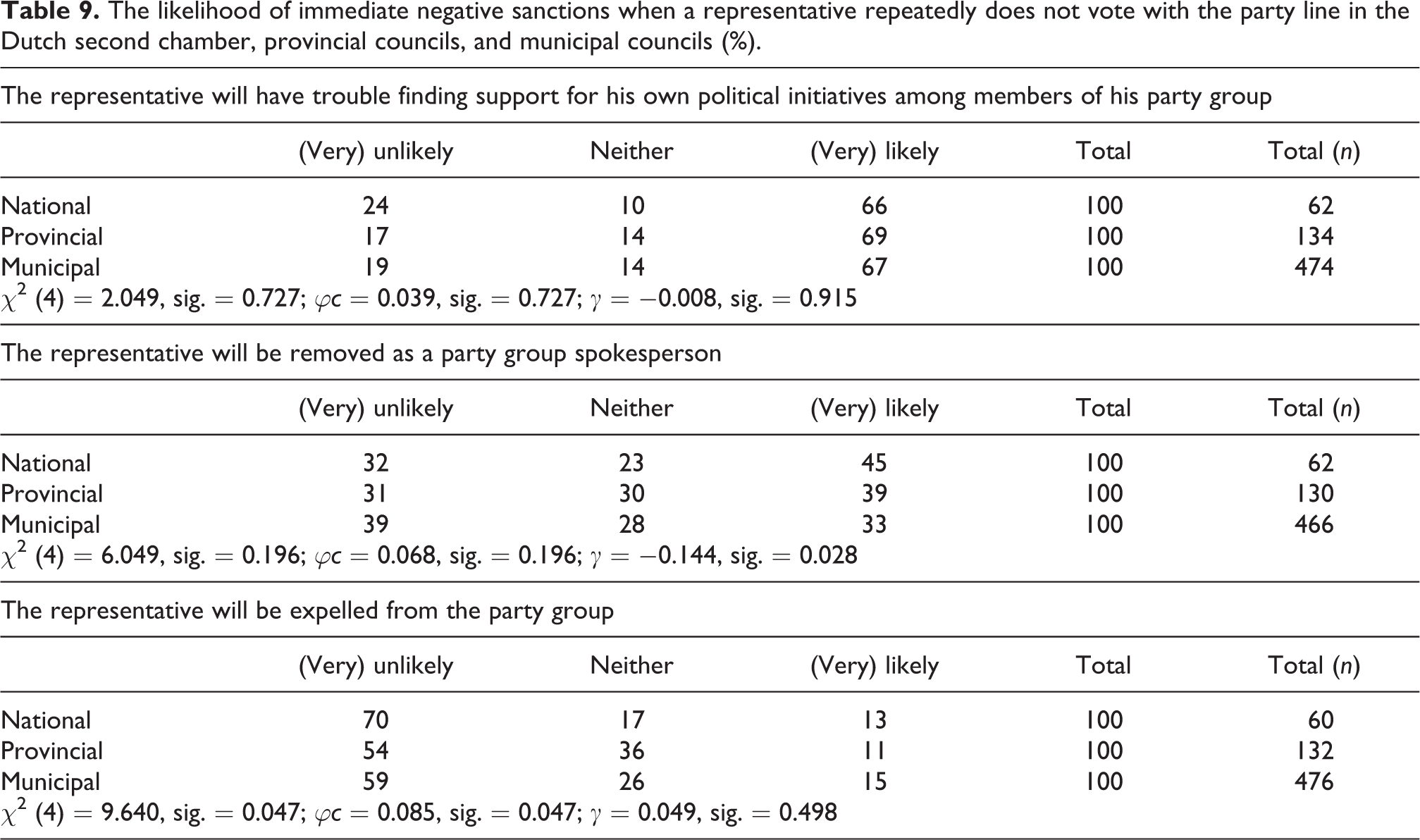
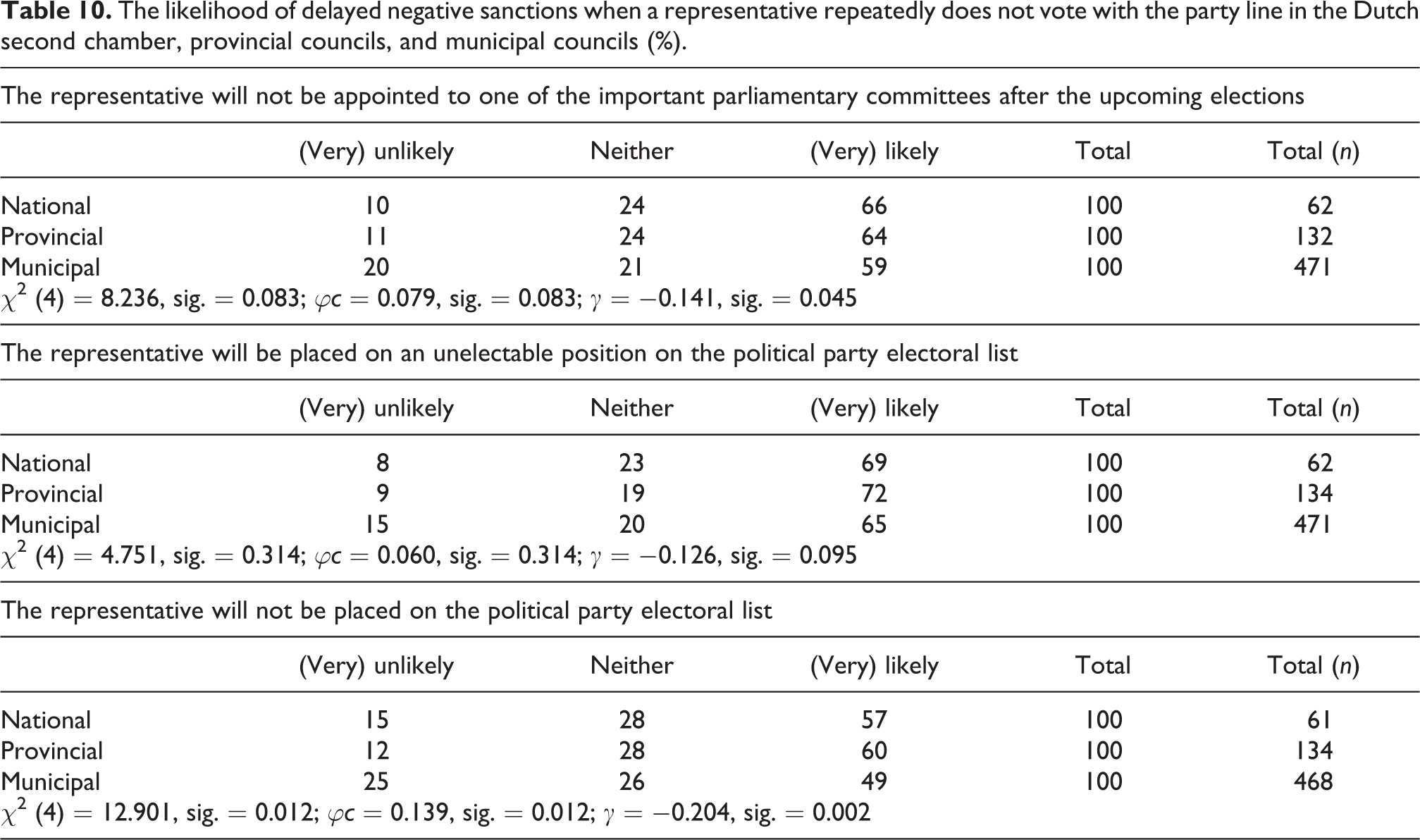
Although it is difficult to observe (the threat and/or application of) sanctions, in the Dutch version of the PartiRep Survey, we did ask representatives how likely sanctions are when a representative repeatedly does not vote according to the party line. This may give us some insight into which types of negative sanctions are actually applied by party (group) leaders to get their representatives to fall in line, although we are well aware that the sensitivity of party discipline may cause respondents to downplay their occurrence. Sanctions can vary in terms of their severity, their visibility to those outside the party group, and the extent to which they can be applied immediately (see Table 9) or are delayed until the next elections (Table 10). As we hypothesize that discipline is less effective, and therefore used less often, at the subnational level than at the national level, we also expect that subnational representative will consider the application of specific types of sanctions less likely than national MPs.
The likelihood of immediate negative sanctions when a representative repeatedly does not vote with the party line in the Dutch second chamber, provincial councils, and municipal councils (%).
The likelihood of delayed negative sanctions when a representative repeatedly does not vote with the party line in the Dutch second chamber, provincial councils, and municipal councils (%).
When it comes to punishing a representative who repeatedly does not toe the party line by removing him as a party group spokesperson from a committee (a reasonably severe, public sanction that can be applied by the party group leadership without much delay), the differences are as predicted: the percentage of who consider this a (very) unlikely sanction is higher at the subnational level. We also asked respondents whether a rebellious representative will have trouble finding support for his own political initiatives among the other members of his party group. This sanction can take place quite covertly within the boundaries of the party group, which minimizes the chance of negative consequences for the image of the political party. There are, however, very few differences between the levels of government when it comes to the percentage of representatives who consider this a (very) likely sanction (around two-thirds at all levels).
There are also almost no differences between the levels when it comes to those who consider the expulsion of an MP a (very) likely sanction (although in this case, these percentages are very low, ranging from 11% to 15%), but national MPs are again more prone to consider expulsion (very) unlikely (70%) than subnational representatives (54% at the provincial level and 59% at the municipal level). By expelling a representative, a party runs the risk of losing the seat (as in the Netherlands the representative can remain in parliament or the council as an independent member) and any control the party group might still have over the behavior of the representative. This is especially pressing for government (coalition) parties with a small majority. 6 This might explain why national MPs are more prone to consider this type of sanctions (very) unlikely than representatives at the subnational level, where coalitions are more often oversized.
Party (group) leaders may prefer sanctions in the long-term because applying too much pressure in the short-term may result in dissenters leaving the party group—and taking their seats with them. When it comes to the likelihood of delayed sanctions, the differences between the levels are as expected. Not being appointed to the important committees after the next elections, for instance, is considered quite likely at all levels of government, but the percentage of representatives who consider this a (very) unlikely sanction is twice as high at the municipal level (20%) as it is at the national and provincial levels. This sanction still involves a representative actually being renominated (and reelected), however. Depending on a party’s selectoral procedures, party (group) leaders can also punish a representative by placing him on an unelectable slot on the party electoral list for the next election, or excluding him from the electoral list completely, which in essence means ending the representative’s political career. 7 The use of the party electoral candidacy lists, as well as committee appointments, can conceal the use of discipline, because it is difficult to distinguish the application of sanctions from other factors motivating parties and representatives’ choices. 8
At all levels of government, at least two-thirds of representatives consider it (very) likely that a representative will be placed in an unelectable slot if he repeatedly votes against the party’s position. Being excluded from the party electoral list completely is also considered (very) likely by the majority of representatives at all levels. The percentage of representatives who consider these sanctions (very) likely is lowest at the municipal level, however, and one-fourth of municipal councilors even consider it (very) unlikely that a dissenting councilor will not be selected for the next elections. Threatening to exclude a councilor from the party electoral list is less likely to be interpreted as a realistic threat at the municipal level.
Different levels but few differences: So what?
We know that party (voting) unity is high at all levels of Dutch government. We hypothesized, however, that because intraparty competition is lower at the subnational level, and because representatives are less dependent on their party for their (current and future) livelihood, subnational councilors are likely to strike a different balance between political goals than national MPs, the former placing policy-seeking before vote-seeking an office-seeking. This then influences the relative importance of each of the decision-making mechanisms at the different levels of government.
For our first two mechanisms, cue-taking and party agreement, differences between the levels were in the predicted direction but not very large. At all levels of Dutch government, the voluntary mechanism of party agreement is likely to account for a very large share of party (voting) unity. We also found that both party loyalty when it comes to voting, and the internalization of the norm of party unity above the freedom of an individual representative, is much weaker at the subnational level than it is at the national level. And our inquiry into the likelihood of different types of sanctions seems to indicate that this pathway to party unity is indeed less effective and less often used at the subnational level than at the national level.
Taking the results for all four of the pathways to party unity together, it may be that it is not the case that subnational representatives are more motivated by policy than national MPs, but rather more simply that they are less concerned with office and votes. This may seem like stating the obvious, but it matters whether one is placed more highly, or that the other two are almost omitted. As political goals, the latter two are not only brought about by intraparty competition, but they also cause a certain degree of intraparty competition that may influence the relationship between representatives and inner workings of legislative party groups. Taking these two motivations out of the equation, or at least lessening their concern, can create very different intraparty (group) dynamics than at the national level. The fact that there is a strong relationship between subnational representatives’ feeling of involvement in party group decision-making and their frequency of disagreement entails that at these lower levels, party agreement is not only owed to preexisting exogenously formed policy preferences but also the result of collective decision-making and debate within the parliamentary party group. This seems to hint at the fact that party groups work more deliberatively at the subnational level and may be worthy of further exploration.
Fortunately, the subnational level of government has great potential for researchers as a new source of data that can be used to test political theories on a number of different topics developed at the national level. The Dutch version of the PartiRep survey that was held at the national, provincial, and municipal levels provides a rare opportunity to actually compare between the levels of government. The Dutch case, with its similar electoral and legislative institutions, is also an ideal case for cross-level descriptive comparison because it keeps key institutions related to party unity relatively constant and therefore allows the focus to be on the levels, which we theorize affects the balance in importance representatives ascribe to policy, office, and votes. Even so, the difference in powers and type of issues dealt with at the three levels of government may still have influenced our results, and the characteristics conducive to party unity and its pathways unique to the Dutch case should be kept in mind when generalizing beyond this case.
Footnotes
Acknowledgements
The author wishes to thank the three editors of this special edition, as well as the two anonymous reviewers, for their very useful feedback and advice.
Declaration of Conflicting Interests
The author(s) declared no potential conflicts of interest with respect to the research, authorship, and/or publication of this article.
Funding
The author(s) disclosed receipt of the following financial support for the research, authorship, and/or publication of this article: The 2010 PartiRep MP Survey, including the Dutch Extension to the provincial and municipal level, was financed by the Belgian Policy Office (BELSPO).
