




Abstract
Moral policing, the informal social regulation of behaviour through moral judgement, occurs globally, yet the processes that allow it to persist remain underexamined within psychological research. This article introduces the concept of preserved dissonance as the psychological mechanism that sustains moral policing, suggesting how incongruence can be carried forward rather than fully resolved. This study extends cognitive dissonance theory by integrating processes that appear in relationally enforced moral systems, as they are internalised, into an individualised moral self-governance framework. In doing so, the study introduces two culturally embedded responses: empowerment compartmentalisation and generational compartmentalisation. Together, these mechanisms represent analytically distinct but related forms of moral contradiction management. Derived from in-depth qualitative analysis of Egyptian participants, the concept of preserved dissonance suggests broader applicability across comparable moral environments as a process-level dynamic. These exploratory constructs generate testable hypotheses for future clinical and policy research.
Keywords
Introduction
In everyday life, individuals are often corrected and judged through informal moral regulation. This regulation frames personal conduct as a site of moral evaluation, positioning individuals as accountable moral subjects, not as passive recipients of social expectations. Therefore, accounts that treat these forms of regulation as the application of shared norms remain incomplete, as they leave unexamined how moral expectations become psychologically binding. This study conceptualises continuous informal moral regulation as moral policing, to foreground its repetitive, interpersonal and evaluative dimension. Although moral policing is often treated as a background feature of moral life, its analytical position within psychological theory remains unclear. Existing frameworks acknowledge the social shaping of moral policing; however, because it is sustained interpersonally rather than through codified rules, it reveals aspects of moral life, such as ambiguity, endurance, and relational accountability, that receive relatively limited attention in conventional psychological models. Importantly, informal moral regulation unfolds within environments shaped by cultural and institutional authorities, from technologically mediated surveillance (Zuboff, 2019) to moral authority grounded in religious and ideological traditions (Armstrong, 2019). In contexts where moral regulation is organised through overlapping moral frameworks, collective enforcement stabilises social coordination by providing shared criteria of acceptable conduct. However, incompatibility of values becomes unavoidable because competing claims lack a shared principle of resolution. When moral incompatibility is organised at the social level, a problem emerges that existing models have not yet fully addressed—how individuals live with such tension when non-compliance incurs social and psychological costs. What remains unresolved is whether individuals apprehend such tension as dissonance requiring resolution. From a psychological perspective, this raises a critical question about how such socially produced moral tensions are managed at the individual level, making cognitive dissonance theory a natural, but as yet under-specified, point of entry. Traditional models have largely historically prioritised individual rationality over relational embeddedness, under-theorising how sociocultural pressures shape psychological functioning. Recent developments have expanded the analytic focus to include non-deliberative accounts by highlighting cultural variation and value pluralism in moral judgement. Frameworks like Moral Foundations Theory (Graham et al., 2013), the social intuitionist model (Haidt, 2001), and cultural-developmental approaches (Jensen, 2008) are central to this shift. However, these models largely keep an episodic view of moral tension, raising questions about the psychological temporal organisation of sustained moral pressure in moral policing. These limitations highlight the need for a process-oriented psychological account. The question then is not whether moral expectations conflict, but what people do when moral conflict becomes routine and what this means for moral policing. The analysis follows the practical repertoires, that make such strain bearable in ordinary interaction. To ground these theoretical concerns empirically, the analysis turns to Egypt as a case where multiple inherited moral schemas coexist, making sustained moral contradiction visible through moral policing. These schemas create a moral environment where multiple evaluative standards simultaneously influence conduct. While grounded in the Egyptian context, examining these dynamics reveals process features of moral regulation that are likely to recur across other plural moral ecologies. In Egypt specifically, intersecting moral logics tightly entwine religious and cultural meaning-making, making contradiction an ordinary condition of moral participation. In daily social encounters, these traditions are expressed through interdependent social structures. This is because across many Egyptian social settings, family norms organise prolonged co-residence until marriage, and living alone remains uncommon and morally marked (Singerman, 1996). Such sustained relational proximity intensifies evaluative pressure, making generational negotiation a recurring feature of living moral contradiction. Scholars have noted long-term symbolic and social continuities in Egyptian society (Assmann, 2011), making competing moral logics socially intelligible and normatively expected. Contemporary Egyptian reasoning practices can be seen as adaptive responses to these moral frictions. Such an analytic orientation resonates with historically embedded cognitive traditions that emphasise pragmatic contradiction-management (Assmann, 2011). While drawing on earlier moral schemas, modern moral policing reflects changes in expressing moral authority and organising the cognitive-psychological function of moral conflict. This is because contemporary forms of moral accountability operate through externalised regulation practices. As a point of analytical contrast, earlier Egyptian ethical traditions, particularly canonical didactic texts, show how moral tension was historically seen as an internally managed process. In texts such as the Instruction of Ptahhotep (c. 2400 BCE), emotional discipline is shown as a process in which ‘the silent man’ listens, reflects, and responds with measured reasoning (Lichtheim, 1975). This historical contrast highlights a shift in Egypt’s macro-level moral dynamics, creating an environment where contradiction is likely to be psychologically contained through compartmentalisation (El Feki, 2015) and necessitating analysis of how contemporary actors respond, whether by compartmentalisation or other modes of psychological management, a question taken up in the present analysis. While discussed in the Egyptian context for interpretative grounding, this analysis is empirically anchored in accounts of a specific positional group of participants situated within these broader sites of moral tension. Subsequent sections revisit boundary conditions to illustrate how similar dynamics may function with variations across contexts. Accordingly, the paper advances from foundational psychological accounts to an analysis of their lived dynamics. The analysis proceeds by first revisiting cognitive dissonance as a psychological framework offering the most established account of how individuals manage inconsistency. It then examines how moral regulation is psychologically organised through everyday moral policing. On this basis, this study develops a process-level account of managing sustained moral contradiction in its lived context. In doing so, it introduces two culturally embedded forms of empowerment compartmentalisation and generational compartmentalisation – as modes through which moral tension is distributed across domains of selfhood and generational horizons.
The Psychological Lens: Cognitive Dissonance
Cognitive dissonance theory (CDT) has been foundational in studying how individuals manage competing moral demands. Its classical formulation suggests individuals experience psychological discomfort (dissonance) when holding inconsistent cognitions, including conflicting values, beliefs, or actions. To reduce personal incongruence, people use dissonance reduction strategies that change the self (e.g., attitudes/behaviour) or reorganise meaning (e.g. trivialisation, denial, selective exposure, psychological compartmentalisation) (Mayhew, 1997). Notably, several of these strategies resemble moral policing in form, including the drive for consistency, the discomfort caused by inconsistency, and strategies for reduction such as public alignment. This formal similarity, however, conceals important divergence in where the function of consistency is achieved. This divergence highlights a key issue in CDT, specifically its original framing of dissonance as internally generated, temporary, and resolved through internal realignment. This framing emphasises ‘coherence’ as an intra-psychic outcome, an emphasis that was rarely questioned in early research (Ren et al., 2025). While Festinger’s (1957) foundational model saw dissonance as a catalyst for internal change, moral policing shows that psychological discomfort arises from external conflicting demands, with ‘coherence’ pursued by regulating the social field. This outward orientation of coherence is further clarified by Social Identity Theory (Tajfel & Turner, 1979) which explains how externally oriented regulation stabilises in-group identity when internal value alignment is uncertain. In line with Eriksonian accounts that locate identity consolidation within relational validation; high-visibility situations turn inconsistency into a threat to identity recognition. In such contexts, dissonance related motivation is channelled into identity-repair work via publicly legible alignment with dominant group norms. Moral policing may thus serve as an effective strategy to reaffirm visible identity commitment (Marcia,1966), in-group acceptability (Tajfel & Turner, 1979), and cognitive consistency.
Subsequent studies expanded this ‘purely cognitive contradiction’ focus, with one important extension coming from Harmon-Jones et al. (2015), who reconceptualised dissonance as conflict between action tendencies. While this move links dissonance to behaviour and redirects attention to instances in which action precedes cognitive resolution, it still views dissonance mainly as an internal motivational state. This limitation becomes clearer when considering externalisation, which brings into view the possibility that moral conflict may not always be confined to the individual. This line of thought aligns with Vaidis and Bran (2014), who explored externalisation as a dissonance reduction strategy suited to relational settings. Their work illustrates how individuals ease internal discomfort by projecting moral responsibility onto others instead of changing their own actions, complicating assumptions about dissonance-related actions; yet externalisation is not always maladaptive and may hold social significance in interdependent contexts. This raises the question of whether externalisation functions merely as a reactive discharge of discomfort or whether it can operate as a purposeful form of agency, managing separation between belief and action. Despite recognition that moral action occurs in relational contexts, it remains unclear how social moral regulation relates to internal value integration, revealing a gap in understanding how external actions affect the management of inner moral tensions.
Recent work points to segmentation as a response to intensified moral visibility. Crockett (2017) shows that digital circulation leads individuals to manage contradiction by separating online and offline conduct, distributing moral accountability across contexts. Studies of interdependent moral reasoning similarly suggest incompatibilities need not be integrated to be contained; coherence is sustained through context-specific value enactments preserving collective legitimacy without clarifying how internal alignment is addressed (Tao & Jin, 2017). Related work on strategic compliance and situational responding further indicates that individuals may manage different dimensions of dissonance unevenly, responding selectively to situational demands rather than uniformly (Syna, 2023). However, segmentation is usually seen as a situational outcome of context or visibility, not as a distinct psychological mechanism. What lacks is a clear psychological specification is how segmentation functions and where the boundary lies between socially organised moral action and internally integrated moral experience. The recurrent observation that segmentation enables moral order raises the question of whether this apparent continuity reflects unresolved moral inconsistency carried forward.
In much of the literature, dissonance appears at rupture moments when inconsistency is visible, contested, or demands justification, casting moral tension as episodic (e.g., Jost, 2019). Even accounts locating contradiction in social and relational structures privilege points of heightened exposure, leaving unexamined the temporal work of managing tension outside crises. Time is typically treated as background duration, not a central moral regulation dimension, inviting consideration of the practical impact of recurring moral policing. Whereas segmented resolution highlights situational conflict management, system justification theory shifts focus to the social conditions normalising segmented compliance with dominant moral expectations (Jost, 2019). Although system justification theory broadens dissonance research by repositioning its function as a psychologically rationalised motivated defence of moral order, its focus on defensive compliance raises questions about whether strategic adaptation can also serve as a mode of accommodation (Owuamalam et al., 2016). If system-justifying responses function as strategic, adaptive regulation, moral contradiction need not interrupt moral action. However, existing accounts do not yet fully explain how action continues amid unresolved contradiction, highlighting to the need to expand how adaptation is understood in dissonance research.
At a broader disciplinary level, scholarship in moral psychology shows that the field has long prioritised rationalist and individualist accounts of moral judgement (Ellemers et al., 2019), while recent work shows moral priorities differ across social contexts (Atari et al., 2025). Experimental and scale-based research on bicultural and cross-cultural identity often uses designs that simplify contradiction, potentially obscuring the very processes of contextual separation that sustains contradiction in everyday moral life (Berry, 1997; Huynh et al., 2018). This limitation, noted by critiques of Western–Educated–Industrialized–Rich–Democratic (WEIRD) moral ecologies and cognitive dissonance lab paradigms, is addressed by recent calls for ethnographic alternatives (Sanches de Oliveira, & Baggs, 2023, 2025). Collectively these observations point to the need for reflexive qualitative ethnographic approaches grounded in psychology to capture how intersecting moral demands are actively kept workable – segmented and temporally handled – within the lived experience of self-organisation. Much of the literature proceeds as if the social legitimacy of moral action implies some degree of internal alignment, an assumption that is rarely examined directly.
This Study
Responding to these gaps, the present study approaches moral policing as a phenomenon that may be better understood through its psychological organisation, relational expression, and temporal endurance, not as a fixed moral stance. Instead of assuming dissonance is internally generated, it asks how moral contradiction may be produced, how it comes to be internalised, and how it is managed within relationships. The study uses an ethnographic qualitative design to explore how moral policing is lived. It situates this inquiry in contemporary Egypt, where visible moral regulation sparks public debate, enabling closer examination of the intersection of moral tension and enforcement in practice. The study explores whether such enactment alleviates or compounds the dissonance they seek to manage. Yet this alone does not explain how such a contradiction is psychologically organised over time. Although segmentation is empirically documented, its psychological status—as a mechanism, a patterned practice, or an outcome—remains underspecified. This study examines segmentation as a psychological mechanism to interrogate whether moral action depends on belief–behaviour alignment and dissonance resolution. Importantly, instead of treating segmentation as a uniform psychological response, the study examines how its operation is organised across relational and temporal contexts and what this implies for the organisation of moral contradiction. This speaks to a growing challenge within psychological theory: how to conceptualise moral life in social contexts increasingly shaped by repeated external regulation and sustained moral contradiction.
The overarching research question guiding this study is: How is moral dissonance lived and organised within everyday moral action in Egypt, such that moral policing persists?
Methods
Design
This study employed a qualitative reflexive design. Data were analysed thematically. The flexibility of thematic analysis suits capturing lived experiences and identifying patterned meanings across accounts. Unlike narrative or discourse analysis, which focus on language use or personal storytelling, thematic analysis integrates participants’ accounts into broader conceptual insights and has been empirically validated in studies on moral behaviours and identity conflicts (Nowell et al., 2017). This made it particularly appropriate for the inquiry linking individual moral policing experiences to broader psychological frameworks (Braun & Clarke, 2019). Coding was reviewed twice for thematic coherence. All stages of the research process, including data collection and interviews, were conducted solely by the researcher, ensuring consistency in both the approach and interpretation.
Participants
Participants were purposively recruited as a positionally coherent analytic site where coherence is understood as patterened relational positioning rather than demographic similarity (Nowell et al., 2017). The sample included five adults from three different generations (four women aged 25, 33, 55, and 56 years; one man aged 56 years), all identified as religiously observant to varying degrees, educated, English-fluent, and living in urban, middle-class Egyptian families with prolonged co-residence and dense intergenerational contact. This configuration intensified tension between global and local moral orders and allowed examination of participants’ responses to moral policing. The analysis used an interpretative approach based on reflexive thematic analysis and qualitative quality criteria (Malterud et al., 2016; Yardley, 2000). Although the sample comprised five participants, the study aimed to develop process-level psychological frameworks, rather than participant-level typologies. These frameworks arose across recurrent relational positions, moral situations, and temporal sequences observed within and across cases. At the level of data generation, each participant contributed multiple analytically distinct moments of moral tension, regulation, and accommodation, enabling examination of how the same psychological processes varied by relational authority, visibility, and context. Analytic adequacy was achieved through conceptual differentiation and internal variation, with sample adequacy determined by theoretical coherence and conceptual yield rather than saturation, aligning with principles of information power and theory-building qualitative research (Braun & Clarke, 2006, 2019). Participants share traits often associated with globally mobile elites, but analysis is situated within a shared moral ecology shaped by local moral surveillance and familial obligation. Claims are thus limited to this group’s relational dynamics, without implying demographic or national generalisation. According to the British Psychological Society (BPS, 2021) ethical guidance, participation was limited to individuals not currently experiencing diagnosed mental health conditions.
While this research acknowledges gender and generational divides, it does not explore other intersecting dimensions like class, sectarian identity, and neurodivergence. This is because the analytic aim was not to compare moral policing across social positions, but to isolate and theorise the organisation of a shared psychological mechanism unfolding across relational and temporal contexts. Extending the analysis across multiple identity axes would have required a comparative analytic logic, risking conceptual overextension and diluting process-level dynamics. Future research with larger or stratified samples may examine whether empowerment compartmentalisation and generational compartmentalisation differ under compounded marginalities.
Data Collection
Data were collected via semi-structured online interviews on Microsoft Teams. Semi-structured interviews were chosen because they enable deep engagement and flexible exploration of emergent themes. The interview schedule (see Appendix A) was applied loosely to let participants elaborate on their beliefs. Prompts were provided to encourage participants to reflect on their responses (Paine, 2015). Interviews were audio-recorded and transcribed verbatim for analysis.
Procedures
The recruitment flyer was shared in Facebook groups to recruit participants. Interested participants were encouraged to email the researcher. Prospective participants received the information sheet and consent form. They were asked to sign the consent form and confirm an interview time. Participants were then invited to a 45–60-min Microsoft Teams interview. Interviews included a brief re-screening to confirm eligibility. Participants were also debriefed at the end of the interview.
Ethical Considerations
Data were collected after ethical approval from Regent’s University in adherence to the BPS’s Code of Ethics and Conduct (2021). All participants provided written informed consent.
Data Analysis
Data analysis followed Braun and Clarke’s (2006) six-phase thematic analysis framework: familiarisation with the data, generating initial codes, identifying themes, reviewing themes, defining and naming themes, and writing the report. This method allows for the identification of patterns across data, meaning-making and drawing connections between data and theory. Abductive analysis was used to expand on and critique existing theories.
Epistemological Stance
This research adopts a critical–constructivist, culturally grounded feminist epistemological stance, recognising that knowledge is shaped by power, history, and location (Denscombe, 2024). This approach differs from realist and positivist stances by acknowledging that themes do not emerge naturally but are shaped by the researcher’s analytical choices.
Reflexivity
As an Egyptian woman educated in a British academic context, the author occupies a fragmented epistemic position, neither fully within the dominant academic tradition nor aligned with the moral conservatism of her cultural heritage. Rather than silencing the dissonance between these worlds, the author chose to work from within. The author’s aim was not to resolve the tension between global and traditional theories but to reveal their psychological implications. This has shaped the questions asked, the silences heard, and the frameworks developed because existing approaches could not explain the tension that the author sought to explore. In doing so, the author intended to create a space for knowledge that is neither derivative of dominant frameworks nor confined to traditional moral scripts, but is rooted in lived, fractured, and strategic realities. The author described this as ‘epistemic dissonance’—the discomfort of theorising from a position that must constantly justify itself—a cognitive-knowledge subset of preserved dissonance focused on contradictory truth frameworks. This position, although precarious, allows for a kind of clarity that can only emerge when one is not protected by a sense of belonging. This study’s contribution is to treat dissonance as a generative source of knowledge.
The present study draws on Finlay’s (2002) reflexivity framework, which emphasises the relationship between researchers and the research process. The author was aware of the shared cultural identities with the participants and the power imbalance that exists in researcher–participant relationships (Holmes, 2020).
To mitigate risk and ensure that the data analysis was authentic, the author maintained a detailed reflexive journal, which is a validated tool for examining personal assumptions and their impact on the research process (Wilkinson, 1988). When participants argued that their personal choices were sometimes limited by traditions, the author connected with their struggles. The author’s personal connection to this theme risked focusing excessively on the gendered aspects of moral policing. When the author revisited her reflexive journal, she became aware of the bias in her writing. To address this over-identification, the author reviewed the coding and actively sought alternative themes that could have been overlooked, such as generational divides and the role of social media in moral policing. To maintain objectivity, the author conducted multiple rounds of coding, specifically searching for unrelated themes.
The author’s understanding of Egyptian traditions empowered her to use culturally appropriate language during the interviews, which encouraged participants to share their beliefs more openly. Although this cultural familiarity helped the author build rapport, the author noticed during the first interview that the participant assumed that the author fully understood her experience; this assumption led the participant to believe that further clarification was unnecessary. To avoid superficial analysis, the author restructured the interview questions to be open-ended and used prompts to encourage participants to explain their perspectives in detail.
Conforming to BPS’s ethical standards was crucial when conducting this research, particularly with regard to anonymity, confidentiality, and informed consent. However, what stood out was that the participants chose to speak despite the weight surrounding discussions of morality. Participants shared their thoughts openly, reflecting a deep sense of trust, which was significant because the author was also situated within the same cultural framework. Their trust deepened the author’s ethical commitment to representing their voices with care and honesty.
Analysis
Themes and Subthemes Identified From Thematic Analysis
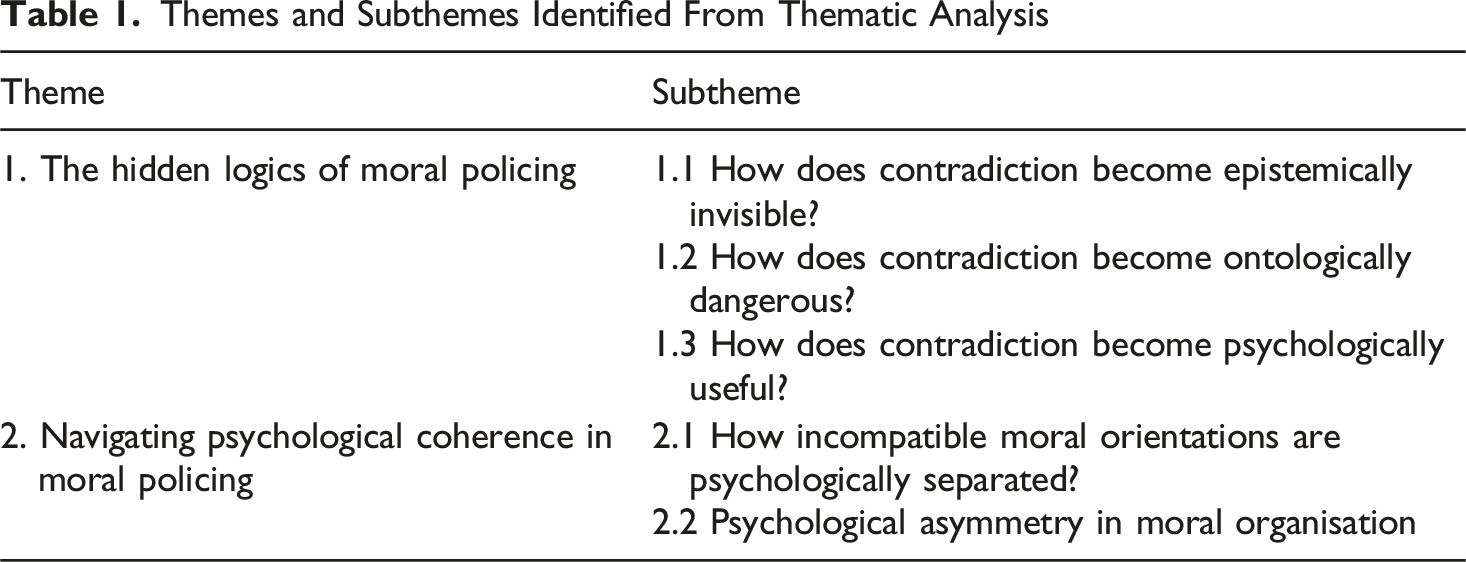
Theme Overview
The analytic process involved iterative rounds of coding that remained open to multiple thematic directions before converging on the two themes presented here. Early coding identified alternative patterns, including social media–mediated moral surveillance, religious conservatism, and resistance to globalisation. While present empirically, treating these strands as standalone themes risks reproducing surface-level categories describing where moral policing appears, not how moral contradiction is psychologically managed.
In line with a reflexive thematic analytic approach, themes were evaluated not just by frequency but by their ability to reveal the organising psychological processes underlying participants’ accounts; the two retained themes—the hidden logics of moral policing and navigating psychological coherence in moral policing—were chosen for cutting across descriptive domains and enabling examination of how moral contradiction is rendered invisible and accommodated within the self. Alternative thematic framings, such as generational authority and digital visibility, were analytically subsumed as sites where these processes unfold, not as independent explanatory endpoints. This analytic decision reflects this study’s aim to expand on CDT by highlighting how moral contradiction persists over time in relational moral environments. The first theme examines how moral policing is lived and reproduced while the second focuses on how individuals psychologically organise incompatible moral orientations under such regulation; together, they demonstrate how moral policing operates as a mechanism for managing moral dissonance. The following sections offer an interpretative analysis of these themes, drawing on participants’ narratives and situating them within the psychological frameworks outlined in the literature review.
The Hidden Logics of Moral Policing
This theme provides a culturally grounded entry point into broader discussions of moral regulation through the lens of CDT. The following sections will analyse the psychological tensions accompanying moral policing and the conditions under which those tensions are generated and managed. The analysis examines how tension is experienced as moral regulation unfolds. Three distinct moves structure this discussion, each addressing a different reorganisation through which moral continuity is secured, without yet specifying its ultimate accommodation.
How Does Contradiction Become Epistemically Invisible?
In the following accounts, moral contradiction is rendered difficult to apprehend by being displaced into uncertainty over how moral categories are defined and applied. Salma frames such uncertainty as epistemic confusion: ‘People often confuse religion with tradition, and everything here feels mixed up between the two.’ This formulation displaces responsibility for moral conflict away from any single actor by locating it in a shared moral environment where categories like ‘religion’ and ‘tradition’ lack stable boundaries. What is being experienced, then, is not simply disagreement about moral content (‘what is right’?) but ambiguity about classification (‘what counts as what’?). Gamilah added, ‘Many people do not know what’s actually from religion and what’s just culture’. Where the previous quote located this ambiguity in the local moral environment this one extends it across a population. The shift from ‘I’ to ‘many people’ scales the confusion outwards, implying that the religion-culture blur is not merely situational but routinely reproduced in interaction. This classificatory blur does not remain at the level of belief but becomes consequential when authorising action. Hassan changes the analytic focus from moral struggle to public moral action. He explains, ‘People believe it’s their duty to correct others because they think religion demands it’. The use of ‘believe’, rather than ‘should’, shows that this obligation is not experienced as an external norm but as an internal moral truth tied to identity, where obligation is felt, rather than reasoned. In this instance, sociocultural pressure transforms correction from a social expectation into a self-relevant moral imperative. Crucially, obligation is felt in a way that blocks interrogation into the contradiction itself between personal moral uncertainty and the enacted obligation to correct others. Moral policing is thus insulated from feeling like personal intrusion since it can be narrated in terms of fulfilling an external obligation as part of what it means to be morally responsible. The quote shows how a person positions themselves as acting ‘for religion’ rather than ‘for themselves’ but does not reveal the corrector’s inner conflict when their own conduct is questioned. Nothing in the speaker’s account foregrounds discomfort or ambivalence, suggesting that this tension is not necessarily apprehended as dissonance. That position is made more specific by Salma’s counterpoint that ‘They say it’s about religion, but often it’s more about their own interpretation’ separating the language of religious obligation from the social work that language performs. In doing so, responsibility is displaced by being attributed to ‘religion’ while the interpreter’s agency, drops out of view, so that the self is no longer the bearer of contradictory cognitions. The operative mechanism of moral policing here is framing, because inner conflict is redescribed before it reaches awareness. The speaker’s use of ‘often’ keeps this claim empirically modest while still indicating a recurrent pattern. Rahma’s observation, ‘Religion provides dignity…but cultural misinterpretations make it seem patriarchal’, further highlights how moral contradiction is staged as a problem of mediation. The tension is located in the translation layer between principle and practice. The contradiction then, is not framed as ‘I believe in two incompatible things’, but as ‘something that ought to dignify is rendered oppressive in its lived form.’ This creates a configuration in which ideal and lived reality coexist in a stable arrangement. The incongruence is not solved by rejecting religion nor by endorsing patriarchy instead, it is sustained through an explanatory split that protects the ideal from the evidence of its compromised enactment. Once contradiction is displaced onto interpretation, it also opens the question of who gets to interpret in the first place. A generational lens makes this interpretive struggle explicit. Younger generations challenged the link between religion and moral policing. As Rahma explained, ‘Younger people see moral policing as drawing on religion in ways that regulate rather than purely guide behaviour’ By opening with ‘younger people see’, the participant positions this as an interpretive diagnosis not simply about what moral policing ‘is’, but how it is read by those who encounter it under contemporary conditions. The central analytic move lies in the distinction between ‘guide’ which suggests accompaniment and ‘regulate’, by contrast, which implies monitoring, and correction, an attempt to align conduct with an enforceable standard. Finally, the generational framing is a signal of capacity to read moral language and its effects. It suggests that younger observers are able to distinguish between moral language that accompanies and moral language that governs and they recognising when ‘religion’ is being used to regulate social life. This recognition is itself consequential because it implies that moral policing is increasingly read through its effects rather than through its stated moral intentions.
Across these accounts, religion emerges less as a shared moral code than as a volatile interpretive field in which contradiction between what religion claims to be and what it actually does is offloaded onto public religious meaning, allowing people to coordinate around shared moral language while letting the self-remain detached from the conduct it names. Contradiction here is misrecognised as a classification error rather than a conflict between belief and action, allowing moral struggle to be reproduced without becoming an object of reflection. This reframing of contradiction as something external and continuous establishes the conditions under which moral policing can appear necessary, a dynamic that the next subtheme turns to by asking why this arrangement endures.
How Does Contradiction Become Ontologically Dangerous?
Participants linked moral policing to national identity, inviting it to be read as necessary for the maintenance of collective life. When moral norms are articulated through national belonging, enforcement is framed as protecting social cohesion, raising questions about its social functionality. Rahma stated: ‘We enforce these traditions because they are part of who we are as Egyptians’. Here, moral enforcement is justified through identity fusion, This framing subtly alters how disagreement is encountered, as moral questions are increasingly read through claims about who ‘we’ are. The appeal to ‘who we are as Egyptians’ anchors moral enforcement in collective self-definition, making tradition, not individually reasoned values, the criterion of group membership. The verb ‘enforce’ situates morality in relational action, where identity is secured through the capacity to compel conformity from others rather than through private adherence. In this configuration, tradition functions as a boundary-making device. However, when moral norms are tied to collective identity, disagreement no longer threatens belief but begins to implicate the continuity of being itself. This tension becomes more pronounced when participants reflect on the fragility of national unity. Gamilah warned that failing to uphold these norms ‘threatens our entire identity’. Enforcement becomes strategically adaptive as policing secures ontological stability by preventing cracks in the narrative of who ‘we’ are. This tension surfaced again when Rahma reframed tradition as a safeguard against unwanted modern influence, calling it ‘a defence mechanism against modernisation’. Describing moral policing as defence positions it as a response to historical and social change, not private moral conflict. This framing casts normative enforcement as a stabilising tool that protects familiar social arrangements from the disorganising effects of rapid change. In this sense, dissonance is produced by shifting cultural conditions that unsettle established ways of living. Taken together, Rahma’s framing of tradition as defence and Gamilah’s fear of identity loss suggest that moral boundary-keeping is not only collective but also sustained through psychological mechanisms that remain largely unspoken in these accounts. What appears socially as boundary-keeping thus also performs psychological work for the enforcer. Here Rahma’s and Gamilah’s surface-level certainty appear to operate as a response to deeper insecurity produced by threatened national identity as in their words Rahma frames it as a ‘defence’ and Gamilah articulates the tension as ‘identity threat’.
Together, these accounts reveal that national pride talk can also organise individual apprehension, revealing dissonance at the individual and national levels. Moral policing functions in these accounts as both a tool for social preservation and can also be a barrier to progress. Although it functions to stabilise the enforcer’s moral position, moral policing externalises the discomfort of cultural change onto the individual who deviates, suggesting that social continuity is secured at the cost of individual inclusion. What these accounts suggest is a prioritisation of collective legibility, showing how contradiction gets collectivised. What becomes visible is that moral action is organised to secure social continuity even as the self remains internally conflicted. However, what is left analytically open is whether this form of outward conformity resolves internal contradiction or merely stabilises action while leaving dissonance intact. This prepares the ground for the next subtheme, which turns from why moral policing is socially required to how it becomes personally invested.
How Does Contradiction Become Psychologically Useful?
Participants’ emphasis on the status gained through moral judgement suggests that enforcement is oriented toward securing moral legitimacy through self-positioning as much as it is to normative commitment. Gamilah noted, People feel like they’re better than the person they’re judging’. Gamilah’s observation indicates that comparative positioning against others is used as a self-affirming strategy. This relational differentiation transforms unresolved moral tension into a psychological resource that enables individuals to experience moral adequacy. Consequently, moral judgement functions here as a compensatory strategy for tension, allowing threatened self-worth to be externally affirmed without confronting internal inconsistency. What is being managed, then, is not moral disagreement but the threat of being morally insufficient in a space where worth is relationally evaluated. Rahma added: ‘They feel empowered and entitled because they believe they know better… even if they do not follow these norms privately’. Rahma’s account identifies the psychological separation that allows individuals to exercise normative power despite non-compliance, revealing a segmented moral economy in which outward regulation substitutes for inward coherence. Through this mechanism, moral enforcement becomes a source of empowerment that does not deny contradiction but renders moral inconsistency psychologically tolerable. Hayat reveals the psychology of the commanded saying, ‘They might pretend that they agree with the enforcer… but deep down they do not agree, they just conceal’. Crucially, this split is not experienced as inauthenticity but as strategic self-management, suggesting that moral segmentation is psychologically adaptive within environments where belonging depends on visibility, her account does not point to moral resolution, but to the acceptability of holding belief and behaviour apart. Compliance here is not a failure of agency, but one of its strategic expressions. This strategic concealment is made more explicit when Gamilah frames the tension through the lens of social desirability, as she puts it, ‘Some people care so much about social desirability that they conform just to look good in front of others, even when it goes against their own beliefs’. Here, ‘looking good’ operates as a form of moral safety, where regulation is meaningful because behaviour is seen, and being seen ‘wrong’ carries psychological costs.
At the level of language, this displacement is further stabilised discursively as participants rarely frame tensions in terms of confusion or conflict, instead they invoke moral certainty language (‘knowing better’, ‘agreeing’, ‘right’) that aims to foreclose ambiguity. Across participants, moral policing is presented as a tool that allows speakers to feel justified, entitled, and morally elevated. Within this framing, inconsistency is not experienced as something that unsettles the self; instead, it becomes something that can be worked through outwardly, by claiming the right to define what counts as ‘proper’ behaviour, a dynamic that the next subtheme develops by shifting from how people position themselves within contradiction to how contradiction is internally accommodated.
Navigating Psychological Coherence in Moral Policing
The analysis now turns away from the emergence of moral strain and toward the ways in which it is made workable in practice. These dynamics are developed through two connected subthemes. The first subtheme examines how moral tension is accommodated within the psych and the second subtheme explores how such accommodation is differentially shaped by relational and evaluative contexts. Together, they illuminate how moral policing becomes psychologically reproducible.
How Incompatible Moral Orientations Are Psychologically Separated
The following accounts show internal organisation where incompatible moral frameworks are activated in parallel, preventing them from confronting each other as contradictions. Hayat explained: ‘Older generations use moral policing to fight globalisation, believing it will protect our values. But this approach makes it harder for younger people like me to find a balance between our traditions and the world we’re a part of.’ Notably, Hayat does not describe moral policing as resolving this tension but instead intensifying the difficulty of navigating it. Her struggle to ‘find a balance’ reflects ongoing tension where local and global orders are forced into continual collision, with the psyche actively trying to accommodate incompatible duality. What is preserved then, is a functional separation where global and local moral orders are each recognised as valid within their own domains yet are prevented from confronting one another as mutually exclusive claims upon the self. This form of segmentation allows moral life to proceed even in the presence of tensions that would ordinarily demand resolution. While Hayat’s account locates tension in generational positioning, Hassan’s narrative shows how the same tension is sustained.
He noted: ‘We are told to resist global ideas, but at the same time, we use global tools… it’s like fighting globalisation while living it’. Hassan’s account makes this internal organisation more explicit. The formulation ‘we are told to resist’ positions resistance as a moral injunction that is externally adopted, while ‘we use global tools’ situates the self within practices that contradict that orientation. The hesitation is marked by the ellipsis ‘it’s like…’ which signals recognition of incompatibility, while leaving it structurally intact rather than bringing it into a single integrative account. Psychologically, this reflects a mechanism of segmentation that reflects incomplete value integration. This analysis shows how moral contradiction is made internally bearable but leaves open how that organisation is differentially structured across age, generational moral horizons and social hierarchies, a question taken up in the following subtheme.
Psychological Asymmetry in Moral Organisation
What becomes visible in the following narratives is that the psychological organisation of moral contradiction is shaped by asymmetrical social relations, where the psychological burden is unevenly allocated. As Gamilah explained moral positioning varies across age groups ‘Some people conform to societal expectations, while others firmly hold on to their personal beliefs regardless of what society expects. These differences often depend on factors such as age’. Gamilah’s observation situates moral life within a generational hierarchy. What differentiates these positions is not conviction but authority: younger actors are required to translate contradiction into outward conformity, while older actors are permitted to maintain belief continuity without behavioural compromise. Hayat’s comment that social media has made moral policing something ‘many more people feel entitled to do’ marks a shift in how moral hierarchy is distributed through interactional forms. Unlike generational authority, this entitlement is not anchored in age or status but in visibility and platform access. Crucially, even when framed as a generalised practice, moral correction remains asymmetrical as it presupposes a subject who may intervene and another who is positioned as correctable. Moral policing thus enacted through online peer-level interaction reproduces power by enabling virtual intervention, without reciprocal exposure or accountability. While Hayat’s account highlights how online moral intervention becomes increasingly available, Rahma brings into view what it is like to remain on the receiving end of such practices. Rahma articulated dissonance as an ongoing embodied emotional state. ‘They carry these inner conflicts every day, and even when they stay quiet, you can see the struggle in their eyes’. The detail that it remains visible ‘even when they stay quiet’, identifies the psychological cost produced by this asymmetrical organisation of moral tension. Importantly, the conflict persists even in the absence of action or speech, indicating the psyche is tasked with sustaining incompatible orientations internally. Turning ongoing self-containment into a form of psychological labour disproportionately borne by those with less moral authority. Hassan captured the organisation of this tension as follows: ‘We can be modern online and traditional at home’. His comment brings those accounts together through the intersection of online role-based moral authority and interactional entitlement where familial contexts reassert expectations of conformity offline. This spatial differentiation allows incompatible moral orientations to be activated in separate psychological domains, preserving social order while maintaining internal division. The coexistence he describes is thus not integrative but segmented and sustained through context-specific activation of moral roles as responses to moral policing. The modal ‘can’ signals permission and feasibility, marking the split as an available strategy, rather than a temporary inconsistency. The mechanism of psychological segmentation here functions so the self does not have to decide which orientation is actually authoritative, as each setting cues a different rule-set. The durability of this arrangement lies precisely in that avoidance. This reveals the organisation of dissonance as a functional adaptation that can diffuse open conflict. While Hassan’s account differentiates moral positioning by settings, Hayat’s later reflection traces a similar pattern unfolding across time.
Hayat reflected: ‘My grandparents say women used to wear what they wanted, but now they criticise us for doing the same’. Hayat’s example shows that moral standards here are organised through time and generational power rather than through principle. That temporal flip creates a lack of any stable moral standard, because right and wrong are defined by who is acting and when, not by what is being done. Through this process, the inconsistency between belief and action is handed down as contradiction, so younger generations inherit rules that already conflict with the lived history of those who enforce them. While older generations enforce traditions, the younger generation feels excluded by them, demonstrating that cultural conservatism can sustain social continuity while eroding intergenerational trust. Together these accounts show how moral life continues by redistributing strain not eliminating it.
Discussion
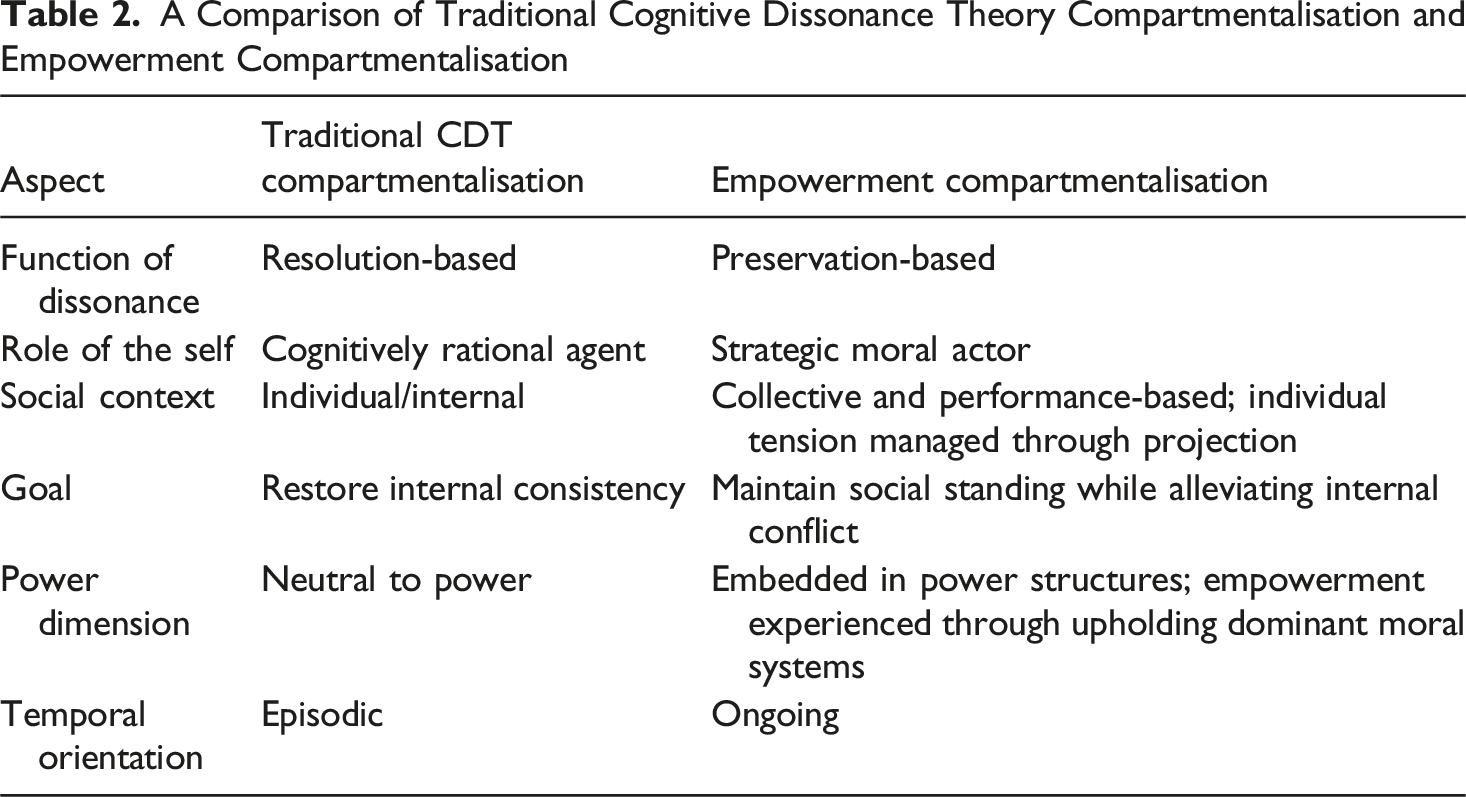
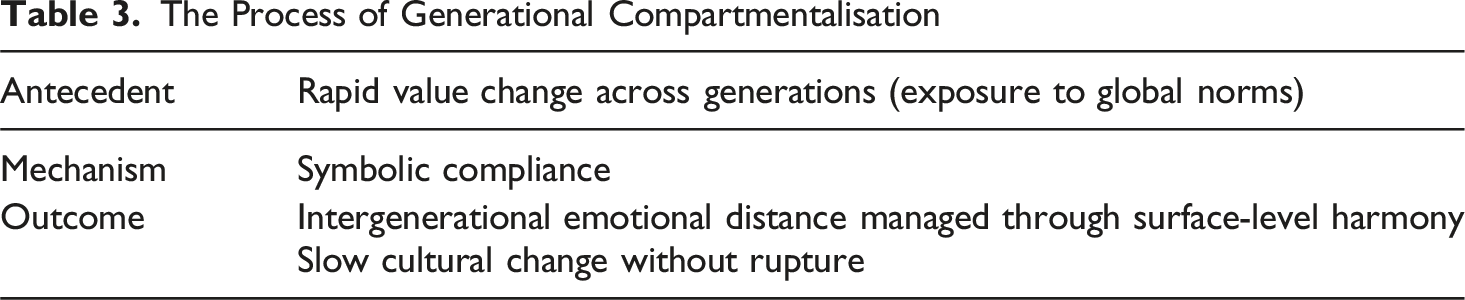
Across participants’ accounts, dissonance appears to originate in the moral environment, expanding on Cognitive Dissonance Theory. Dissonance becomes psychologically internalised as an affective sense of moral inadequacy, linked to a self-constituted through ongoing relational obligations and producing a felt pressure for resolution. Individuals attempt to restore clarity by enforcing moral certainty outwardly, attempting to reaffirm their own moral position through interpersonal moral regulation. However, this response addresses only the identity-based moral adequacy experiences rather than the dissonance itself. Because the underlying contradiction remains structurally embedded and dissonance is not apprehended as such, this apparent resolution does not produce internal cognitive or identity integration. Instead, dissonance is continually reproduced, operating largely outside conscious awareness and managed through repeated acts of moral policing. Participants’ narratives further suggest that rejecting an incompatible value is often unfeasible because it threatens social belonging and its internalised form as self-worth. As such, moral inconsistencies can increase or displace internal dissonance while still succeeding socially because preserving them sustains a coherent public identity and in-group belonging. This pattern is theorised here as preserved dissonance. By separating personal belief, public conduct, and moral enforcement into distinct psychological compartments, individuals can maintain moral authority publicly while postponing or entirely avoiding internal alignment. Segmentation thus allows individuals to sustain incompatible moral positions across contexts without experiencing them as internally conflicting. In this sense, segmentation operates both as a protective response to moral surveillance and as a driver of moral policing itself, enabling dissonance to endure over time. The present study conceptualises this strategy of segmentation as psychological compartmentalisation. Taken together, the findings situate dissonance as a socially circulating condition shaped by generational transmission, power gradients of authority, and the demands of moral visibility. As identified in the analysis, segmentation accross participants’ accounts operates through two compartmentalisation processes that are examined below: empowerment and generational compartmentalisation.
Empirical Insights
Empowerment Compartmentalisation
A Comparison of Traditional Cognitive Dissonance Theory Compartmentalisation and Empowerment Compartmentalisation
Generational Compartmentalisation
The Process of Generational Compartmentalisation
Because moral coordination also structures whose interpretations count as legitimate, the same compartmentalising logic of dissonance extents beyond moral action to the organisation of knowledge and meaning making. Epistemic dissonance therefore operates within this same sense, revealing how maintenance of coherence in participants’ accounts involves ongoing cooperation across competing epistemic frameworks, within which intelligibility is differentially sustained. While different epistemological traditions foreground distinct criteria for what counts as valid knowledge (Fricker, 2007), epistemic dissonance foregrounds how knowledge is negotiated, stabilised, and strategically held under conditions of epistemic plurality. Importantly, these findings also have implications beyond the immediate empirical context, in this awareness, epistemic dissonance functions as a generative methodological stance. This is particularly relevant for scholars working across Global South contexts and Western theoretical traditions, or those occupying hybrid academic positions shaped by feminist, or culturally grounded epistemologies. In such positions, epistemic fracture is not analytic weakness as it may enable heightened sensitivity to knowledge claims shaped by institutional and social positioning.
Broader Theoretical Contributions
Having established the empirical modes of organisation through which moral contradiction is managed, this section situates empowerment Compartmentalisation (EC) and Generational Compartmentalisation (GC) in relation to broader social psychological theories. As argued above, EC and GC conceptualise dissonance as a form of cultural adaptation. This framing aligns with cross-cultural evidence suggesting the pursuit of coherence and consistency is itself culturally variable rather than a universal psychological imperative (Markus & Kitayama, 2010). Viewed through this lens, cohesion no longer appears as only a uniformly integrative force. GC complicates Social Identity Theory’s emphasis on in-group cohesion by suggesting that cohesion may be sustained not despite, but through, intergenerational fracture and asymmetrical accommodation. Similarly, EC extends System Justification Theory’s account of defensive compliance by specifying a subjective mechanism through which conformity is experienced as agency even if it reproduces the hierarchies it appears to endorse, demonstrating how alignment with authority may simultaneously mask rupture.
Whereas Freud (1915/1957) conceptualised cognitive avoidance and repression primarily as unconscious defences, the present findings (EC & GC) invite a complementary interpretation in which avoidance may be intentionally mobilised as selective silence (EC) or negotiated deferral (GC). This reconceptualisation of avoidance opens a pathway to role-performance theories and broader accounts of social behaviour. EC and GC shift the analytic focus of these accounts (e.g., Goffman, 1959; Hu et al., 2020) by showing that conformity is not only concerned with managing impressions or emotions within interactional settings. Instead, performance emerges as a key mechanism through which dissonance is actively maintained and rendered socially workable. Recent work on moral performance and relational being has conceptualised identity as an ongoing process of relational negotiation (Pruit, 2021); however, EC and GC specify how such negotiation is structured by unresolved moral contradiction, power asymmetries, and temporal deferral.
Accordingly, this suggests that performances can become formative of social identity. Drawing on bicultural identity and acculturative stress models (Berry, 1997), EC and GC suggest that similar identity fractures may also occur within a single cultural context, even in the absence of formal cultural plurality. In dialogue with role negotiation theory (Swann et al., 2003), GC makes visible a more subtle process of identity-splitting by maintaining deference to authority while harbouring a latent drive towards transformation. This orientation contrasts with developmental models that focus on resolution through progressive identity integration. Rather than assuming stage resolution or synthesis as in Erikson’s (1968) or Marcia’s (1966) developmental frameworks, EC and GC point to the possibility that fracture itself may be selectively sustained as a mode of cultural identity continuity.
Distinctions Between Empowerment Compartmentalisation and Generational Compartmentalisation
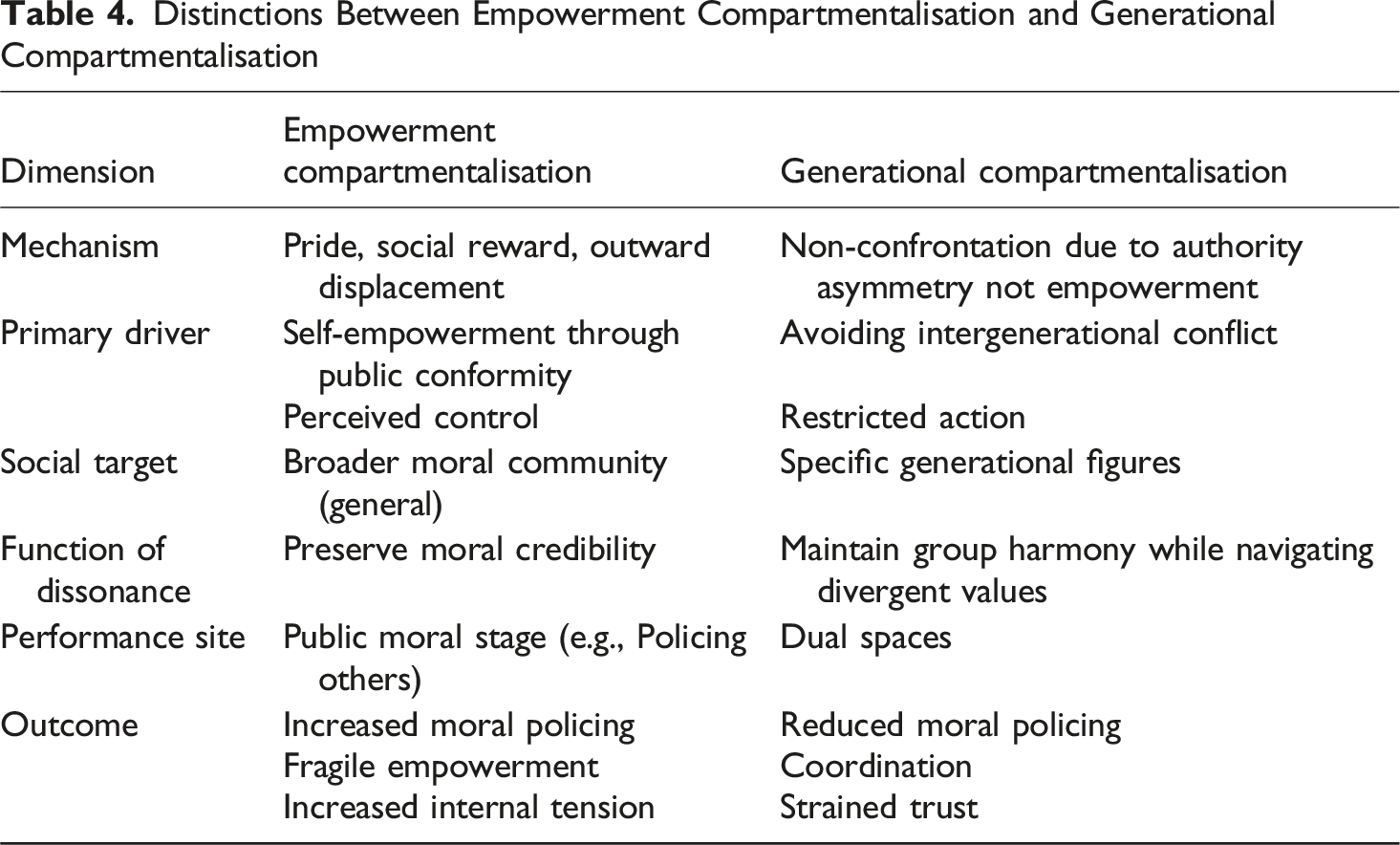
The comparison in Table 4 clarifies how EC and GC operate through distinct forms of compartmentalisation, yet it does not address the broader question of how such arrangements come to be socially stabilised or rendered problematic across contexts. The present study instead identifies the structural and sociocultural conditions under which preserved dissonance becomes visible and socially operative within the Egyptian context. Building on this, the following section considers the boundary conditions and cross-cultural transferability of preserved dissonance, leaving open how its functionality may be differently constituted.
Boundary Conditions and Cross-Cultural Transferability
Attention to boundary conditions situates preserved dissonance as a context-dependent process, whose organisation and coordinating effects are shaped by locally specific arrangements while remaining analytically comparable at the level of structure and process across settings. In the Egyptian context examined here, multigenerational households and collective public anxieties about moral decay contribute to sustaining this configuration of EC and GC by keeping moral legitimacy socially legible and subject to continuous evaluation. Under these conditions, its stabilising function depends on moral visibility being tethered to authority, dependency and belonging. When intergenerational dependence declines, moral authority becomes decentralised, or national belonging separates from family obligation, the regulatory function of preserved dissonance may weaken. This aligns with cross-cultural models that locate psychological processes in the ecological fit between cultural values and social institutions (Chiu et al., 2010).
Contextually, EC and GC capture adaptive structural strategies for managing moral contradiction that may emerge wherever moral legitimacy is publicly mediated. In such settings, ranging from corporate virtue signalling to populist moral campaigns, moral incongruities may translate into recognisable forms of belonging through public alignment and moral display. In EC, regulating others becomes a route to moral authority and agency, a dynamic that can be observable across workplace hierarchies, political populism, or religious orthodoxy.
These boundary conditions open pathways for comparative research to examine whether EC and GC vary across social contexts using quantitative and mixed-method approaches to assess when these strategies weaken or change form.
Clinical Implications
Although empowerment compartmentalisation and generational compartmentalisation may sometimes be socially functional, their prolonged operation may place psychological burden on those who diverge. Divergence is often interpreted as disloyalty to cultural heritage. However, strict adherence may prove equally unsustainable. As one participant captures the tension: ‘This makes it hard for me to find a balance between our traditions and the world we are a part of’. The consequence is a sense of not meeting the expectations of either traditional or modern values. At the individual level, these dynamics appear to fragment identity, inhibit authentic self-expression, and consequently foster emotional distance in personal relationships. Therefore, the findings generate preliminary clinical propositions that may inform culturally adaptive psychotherapy. For example, new conceptual tools that externalise and structure moral tension – such as hybrid identity integration framework (HIIF), role reversal dialogues (RRD), and reflective dissonance-focused journaling – may be explored.
HIIF could build on bicultural integration therapy (Berry, 1997; Huynh et al., 2018), to adapt it to contexts wherein intra-cultural rather than cross-cultural dissonance dominates. One hypothesis that could be tested is whether structured exercises that visually map family- or community-enforced values against personal values can reduce ‘all-or-nothing’ pressures. Future applied research may explore whether such mapping enables clients to negotiate middle-ground commitments, thereby constructing more coherent identity narratives and reducing confusion and self-doubt.
Clients who adopt the role of a ‘moral guardian’ to avoid being morally policed, yet continue to report inner conflict, suggest a hypothesis for future clinical testing: namely, that therapeutic interventions directly addressing illusory agency may reduce reliance on outward moral regulation. This is because it appears to function as a means of substitution for inner resolution. One conceptual strategy that warrants empirical examination is Role Reversal Dialogue (RRD). Comparable to role-play in cognitive behaviour therapy (CBT), RRD introduces a culturally specific layer by targeting the moral guardian voice described in EC. Future research could test whether encouraging clients to first defend their moral stance, and then to critically reflect on the contradictions it conceals, would enable them to recognise the protective but ultimately constraining function of the ‘guardian’ role. The working hypothesis is that, for certain clients, explicitly addressing illusory agency may enhance authentic integration.
Across participants’ accounts, the analysis identifies a conditional process in which strategies initially oriented toward preserving moral agency gradually consolidate into enduring constraints, culminating in moral entrapment.
The present study further proposes moral entrapment as a potential end-state of preserved dissonance, characterised by self-perpetuation of moral conflict. Moral entrapment advances existing accounts of internalised oppression (Freire, 1970) and Kowalski and Leary’s (1990) concept of role entrapment by specifying a psychological configuration in which constraint is actively reproduced through the exercise of moral responsibility rather than passive internalisation or role obligation alone. This moral entrapment construct is proposed here as an interpretive lens not as a diagnostic category. Rather than locating these forms of morally organised distress solely within DSM-5 (American Psychiatric Association, 2013) categories (e.g., anxiety or depression), the construct reframes symptoms as instrumental responses to cultural contradictions. A testable hypothesis is that explicitly naming moral entrapment in case formulation will shift attributions from ‘individual self-blame’ toward systemic sources of tension, reducing defensiveness and increasing therapeutic engagement. Taken together, these propositions specify how preserved dissonance can stabilise into a durable configuration of moral agency, thereby shaping both how individuals make sense of their distress and how such distress may be formulated clinically. Viewed through this lens, distress is not seen primarily as an individual dysfunction but an adaptive response to sustained moral contradiction and constrained moral agency. The proposed concepts and clinical strategies are therefore not offered as standalone interventions, but as heuristics to support more contextually grounded formulations that help clients articulate, negotiate, and integrate competing moral demands across private and public domains.
These formulation principles suggest that therapeutic change may depend less on resolving contradiction than on supporting clients’ capacity to hold competing moral commitments over time without destabilising internal coherence. This nuance encourages culturally responsive therapy models, such as culturally adapted CBT. These models could expand on ‘challenge the thought’ with Dual-Belief Integration CBT, helping clients test ways of holding both private and public values across contexts. Such culturally responsive adaptation resonates with frameworks in multicultural psychotherapy that emphasise contextualised meaning-making over symptom correction (Hwang, 2006). Operationalising this reformulation of therapeutic change at the level of practice requires methods that make moral contradiction visible. A related, methodologically tractable hypothesis worth investigating is whether Dissonance-focused Journaling, adapted from structured CBT journaling, can reinforce this integration by helping clients reflect on their moral switching between public and private selves. In such clinical research, participants could be asked to systematically document two types of experiences: (1) moments when they enforced communal norms or felt compelled to conform despite inner disagreement, and (2) moments when they acted in accordance with personal values, even in opposition to communal expectations. The testable hypothesis here is whether documenting these contrasts enhances clients’ awareness of the tension between outward enforcement and inward divergence. A further question is whether such awareness increases self-recognition of empowerment versus exhaustion within their coping strategies.
Finally, cross-cultural studies could examine whether these methods generalise across diverse client groups. Psychometric validation of process indicators (e.g., confirmatory factor analysis) can then be used to test its transferability and clinical relevance. These insights also have implications beyond the therapeutic setting, particularly for how they are experienced at the policy level.
Practical Implications
From a policy perspective, preserved dissonance may offer a diagnostic lens for understanding why dialogue-based interventions and reform initiatives often fail to generate durable change, despite appearing publicly accepted. The findings suggest that compliance may persist in the absence of belief when conformity functions as a strategy for maintaining moral legitimacy. In such contexts, public agreement operates as a misleading policy signal, reflecting strategic acquiescence shaped by relational and reputational pressures. As a result, surface-level social harmony may mask the gradual erosion of trust, authenticity, and intergenerational legitimacy. Policies that rely on visible compliance or consultative dialogue alone may therefore overestimate social cohesion, overlooking the underlying moral fractures that preserved dissonance allows to remain latent but unresolved. The present analysis addresses this persistent disjunction between macro-level public administration frameworks and the micro-level moral and psychological experiences through which policies are interpreted. This is done by introducing EC and GC, offering an opportunity to integrate psychological theory into public policy frameworks and examine how some policies are internalised or contested (DeLeon, 2006; Lee & Lim, 2010).
EC and GC highlight a tendency towards compartmentalisation, in which silence may function as a substitute for dialogue. Recognising this pattern may inform future applied policy research, for example exploratory ‘Inherited Agency’ workshops that map shared values and promote collaborative meaning-making, can be tested for their impact on fostering intergenerational cultural ownership through the discovery of new shared meanings.
In educational contexts, tools such as ‘dual-value journals’ could be piloted to help students normalise the tension between private and public beliefs, framing dissonance as developmental rather than deviant, and reducing premature stabilisation of moral meaning.
Furthermore, participants described moral strain as arising where religious obligation and cultural expectation became indistinguishable, and as being managed through ongoing interpretive negotiation rather than direct resolution. Policies that formally differentiate religious doctrine from customary moral norms may, therefore, help relocate moral judgment away from individual interpretation and toward clearer institutional boundaries.
Methodological Limitations and Future Directions
By focusing on urban, English-speaking Egyptians recruited online, this interpretative work captures a cohort shaped by both Western and local discourses. Conducting interviews in English inevitably shaped the cultural nuances of expression. This facilitated participants’ articulation of hybrid perspectives, foregrounding intensified moral tensions between globalisation and tradition that the study was designed to examine and enabled a coherent analytic focus. However, this scope excluded rural, non-English-speaking populations. Therefore, future work in participants’ first language, translated for analysis, would provide richer linguistic texture, enabling further validation and refinement of the conceptual scope of EC and GC across linguistic registers (Said, 2021). Further, ethnographic research could also enhance expansion of this work by incorporating rural data.
Given the study’s aim to elaborate psychological mechanisms rather than map population prevalence; analytic depth and conceptual saturation were prioritized over breadth. Consistent with qualitative theory-building studies in Culture & Psychology, this study drew on a small and generationally diverse sample. Therefore, it provides a foundation for future large-scale, mixed-method designs to evaluate the transferability of EC and GC.
Patterns of participation themselves offered insights into how generational positioning shapes engagement with morally sensitive topics. The reluctance of participants under 25 to engage in interviews reflects a generational tendency of confrontation avoidance, which GC is conceptually positioned to capture. However, this suggests that the findings apply primarily to adults, indicating future research opportunities among younger age groups to examine generational differences in depth. Future studies could use peer-led interviews to mitigate participation hierarchies, which could be done through familiar apps with chat functions to lower participation barriers. Such approaches would allow generational dynamics to be examined with greater sensitivity to age-specific power relations.
At the theoretical level, participation patterns open questions about how generationally situated moral tension unfolds over time. This discourse tentatively raises the possibility that internal conflict may contribute to gradual shifts in how moral policing is justified as individuals reconcile generational divides over time. Preliminary support for this possibility emerges from age-graded participation patterns, which were also mirrored in differences in how moral expectations were articulated across interviews, suggesting that generational position shapes not only willingness to speak but also modes of moral negotiation. To capture these processes empirically, future research could employ a longitudinal qualitative design involving generationally paired participants (e.g., parent–adult child or older–younger relatives), interviewed at multiple time points. Such a design would allow researchers to trace whether these negotiations result in gradual change in how the effects of moral policing are read by younger generations. Supplementing interviews with reflective diaries or voice-note entries, collected between interview waves could further capture moments of hesitation, self-monitoring, and relational calculation that are often smoothed over in retrospective accounts.
Attending to these intergenerational processes of moral negotiation over time also foregrounds forms of intergenerational meaning-making that are not fully captured by cognitive dissonance frameworks alone. While CDT provided a useful entry point, it does not capture the full complexity of intergenerational trauma or communal identity. Capturing this complexity is essential because the psychological strategies identified in this study are not responses to isolated dissonant beliefs, but to layered moral systems sustained across relational, cultural, and generational contexts. Future studies could integrate cultural trauma theory (Alexander, 2004) with cross-sectional approaches to broaden this scope. A historical–archival analysis combined with oral history interviews could illuminate how shifts in communal identity shaped psychological strategies of compartmentalisation and how survival operations, sometimes maladaptive, were transmitted across generations in the form of tradition. For instance, studies could examine whether EC and GC trace to cultural adaptation that unfolded as a gradual process marked by sustained generational dissonance.
Methodologically, this study engaged established qualitative tools reflexively by placing them in dialogue with locally grounded forms of meaning-making, illustrating how such approaches can be contextually extended and adapted to access culturally embedded moral reasoning. This reflexive positioning underscores the value of broadening the empirical bases through which moral experience is examined, including oral narratives, communal memory, and embodied forms of moral reasoning. Future research could build on this integration by incorporating indigenous and participatory methodologies, such as dialogical inquiry, storytelling circles, or narrative co-construction, as complementary strategies for examining meaning-making processes in culturally situated contexts. Such approach would further strengthen the ecological validity of EC and GC by testing their operation across a wider range of methodological lenses.
At the level of the analytic strategy, thematic analysis enabled the generation of EC and GC by connecting patterned narratives to broader theoretical debates. Reflexive coding safeguarded against purely descriptive reporting. Future discourse analysis could complement the findings by exploring how language constructs resistance or legitimacy, while narrative analysis could situate moral policing within lived stories and generational experiences. Together, these methodological extensions would allow EC and GC to be examined across historical transmission, everyday relational interactions and discursive practices, clarifying how they emerged and how they operate in present day moral regulation.
Examining EC and GC across these multiple analytic levels also foregrounds the interpretive role of the researcher, particularly when analysing culturally embedded moral processes that are shaped by shared history and relational position. The researcher’s Egyptian background created both the possibility of over-identification and unique opportunities for deeper cultural access. Reflexive journaling was used to mitigate bias and ensure analytical consistency. However, participatory designs could enrich future research by incorporating multiple analytical voices.
While the present study focuses specifically on moral policing as a site of norm enforcement, the findings open several avenues for further theoretical and empirical development. In particular, future research could deepen this analysis by tracing how preserved dissonance, maintained through repeated external moral enforcement, comes to be internalised as implicit self-policing, such that external moral surveillance is gradually reproduced within individuals’ own self-regulatory dialogue (Valsiner, 2014). Dialogical approaches may be especially useful for examining the implications of such internalisation beyond overt interpersonal enforcement (e.g., Hermans et al., 1992). This perspective provides a useful framework for examining how internalised moral positions become organised within the self, shaping inner dialogues that constrain the exploration of alternative identities or life trajectories even in the absence of explicit external sanction. Such dynamics could be examined through narrative-based interviews focusing on moments of moral hesitation or self-silencing.
Building on this, future research could also test whether EC and GC dynamics influence family functioning in measurable psychological terms. For example, quantitative survey studies could examine the links between these dynamics and markers such as emotional immaturity, relational withdrawal, and emotion dysregulation. Large-scale survey instruments, structural equation modelling, and cross-generational comparisons could assess whether these compartmentalisation strategies exacerbate or mitigate relational and affective outcomes.
Generational compartmentalisation (GC) may be extended beyond familial contexts to analyse how power asymmetries within hierarchical institutional settings, such as workplace, structure the perceived risks of moral questioning. Within such environments, individuals in lower-status positions may compartmentalise moral evaluations as a strategy for navigating authority, and material consequences. Future research could examine these dynamics through comparative qualitative designs across hierarchical positions, using dyadic interviews and vignette-based prompts to analyse how moral self-positioning is negotiated under conditions of unequal authority.
At the same time, qualitative methods, such as interpretative phenomenological analysis, grounded theory, or thematic analysis, remain vital for uncovering the subjective psychological effects of EC and GC. These approaches could illuminate how dissonance affects authenticity, intimacy, and intergenerational trust in greater detail.
The clinical and policy implications suggested by this model offer pathways for empirical testing. Intervention studies could trial family-based therapeutic programmes aimed at reducing the psychological costs of compartmentalisation (e.g., relational fragmentation, distrust) and evaluate outcomes through randomised controlled trials. In policy contexts, participatory action research could assess whether the suggested workshops reduce moral policing and foster resilience among families and communities, thereby testing the practical utility of EC and GC. Furthermore, comparative ethnographies and cross-cultural surveys across contexts that differ in their organisation of moral authority could provide insights into whether EC and GC adapt.
Beyond cross-cultural testing, digital spaces present another critical area of focus. The rise of moral signalling and cancel culture and participants’ own emphasis on online/offline compartmentalisation provide a way to examine whether EC can be detected in online forms of conformity. Digital discourse analysis and computational social media methods could trace how compartmentalisation plays out in the performance of moral conformity across different platforms.
Lastly, While EC and GC are distinct yet interrelated frameworks, empirically isolating their modes of functioning can be challenging, as individuals may draw on both strategies within the same socio-moral ecosystem. Analytical approaches such as narrative mapping or context-sensitive coding schemes may help trace how individuals dynamically shift between EC and GC within the sociomoral ecosystem.
Conclusion
This analysis conceptualises empowerment and generational compartmentalisation as culturally situated dissonance preservation strategies. Building on cognitive dissonance theory, this contribution shifts focus from inconsistency within individuals to the temporal and relational organisation of incongruence within its lived contexts. By locating moral policing within a broader economy of preserved dissonance, this work positions moral tension, rather than its resolution, as an empirical object of inquiry, pointing toward an epistemic shift that could broaden psychological inquiry to account for forms of contemporary social life shaped by enduring conflict. Importantly, this study does not seek to replace individual-level accounts of dissonance with a purely collective model. Instead, it situates dissonance across intersecting psychological and sociocultural domains. Although this approach is developed within a specific moral ecology, the mechanisms outlined above are not exclusively linked to one cultural setting. Analogous processes are identifiable across long-standing psychological traditions that examine how psychological tension is displaced. What varies across settings is not the presence of contradiction, but the social arrangements through which it may be sustained. Comparative and longitudinal research could further elaborate empowerment compartmentalisation and generational compartmentalisation by testing how these mechanisms travel and under what conditions they change form. By foregrounding how moral order is sustained, this perspective invites moral psychology to reconsider stability not coherence, as the central object of explanation. This raises a critical question: If moral order is maintained through the organisation of contradiction, what form of moral order is being produced?
Footnotes
Acknowledgements
I would like to express my gratitude to all those who supported me. Particularly Dr Kerem Soylemez and Dr Chris Robus for their encouragement throughout the completion of my dissertation. I also thank the participants of this study, my family and friends, my colleagues in the MSc Psychology programme, and Regent’s University in London.

Ethical Considerations
This study was approved by the Research Ethics Committee of Regent’s University London. Approval Reference number: 2183. All procedures were conducted in accordance with the British Psychological Society’s Code of Human Research Ethics (2014).
Consent to Participate
All participants provided written informed consent prior to participation in the study. They were assured of their anonymity, confidentiality, and right to withdraw without penalty.
Funding
The author received no financial support for the research, authorship or publication of this article.
Declaration of Conflicting Interests
The author declared no potential conflicts of interest with respect to the research, authorship, and/or publication of this article.
Data Availability Statement
The data used in this study is available from the corresponding author upon reasonable request.
Permissions
No copyrighted materials were used without permission. All data collected were original, and permission was obtained from participants for the use of anonymised excerpts in publications.