



Abstract
Irish Travellers were recognised as an indigenous ethnic minority in 2017, which was an important symbolic step in acknowledging the uniqueness of Traveller culture. Drawing on Zittoun & Gillespie’s concept of the imaginative loop, this paper explores how Irish Traveller men imagine the future for themselves and their community, in the context of being an ethnic minority group where mainstream society has restricted many of their cultural practices, including nomadism. Participants were six Irish Traveller men in the South of Ireland. Deductive thematic analysis was applied to the data using analytic dimensions of the imaginative loop model in terms of triggers, imaginative resources, dimensions of time, generalisation and plausibility, and intra-psychological or external outcomes. Emergent themes included Imagining possibilities: Discrimination as a constant; Pride and creation of a Traveller Hero; Where are we going? The rocky road to utopia; and ‘A fair crack of the whip’: Claiming an equal future for their children. Imagination emerged as a site which linked past experience/future possibilities but also as a site of resistance to cultural assimilative pressures, and one of protest and demand, as men asserted a right to equality and parity of esteem, and re-envisioned relationships with the settled community. Implications for mobilising imagination for addressing intergenerational discrimination and social trauma are discussed. Future research could engage with the settled Irish population to explore their imaginings of the future of the Travelling community and culture in Ireland.
This article explores the imagination of Irish Traveller men as they imagine the future both for themselves and for their community, in the context of being an ethnic minority group where mainstream society has restricted many of their cultural practices, including nomadism. It draws on the concept of imagination as a form of psychological travel in which the individual can uncouple from the experience of the proximal moment for a further distant time or place (Zittoun, 2020). We extend the analysis by Cangià and Zittoun (2020) which explores the interplay between imagination and mobility, through a case study of a cultural community where mobility is central to identity yet simultaneously constrained. Irish Travellers are an indigenous, traditionally nomadic, minority group in Ireland and the UK. The Irish Travelling community in Ireland is a small population of 32,949 people (Central Statistics Office, 2023) accounting for less than one percent of the total population. The Travelling community was conferred with ethnic minority status in Ireland in 2017 in recognition of their distinct heritage. Many Travellers are now settled, and three quarters of Travellers live in housing (73%), 18% live in a caravan, trailer or mobile home. Of these families, over half are on halting sites while others are on an unofficial or transient camping site. Identity is tied to mobility. McDonagh (1994, as cited in Donahue, McVeigh & Ward, 2005) captures how travelling is a mindset (psychological as much as physical) in the words of a Traveller man from his perspective: For Travellers, the physical fact of moving is just one aspect of a nomadic mind-set that permeates every aspect of our lives. Nomadism entails a way of looking at the world, a different way of perceiving things, a different attitude to accommodation, to work, to life in general [McDonagh, 1994: 95 cited in Donahue, McVeigh & Ward, 2005, p 5].
With the shift from a predominantly agrarian to an increasingly urban culture, Travellers became marginalised from their rural based economy of peddling and tinsmithing. Today in Ireland, Travellers account for one of the most stigmatised, marginalised, discriminated social groups, evidenced in housing, education, social and health indicators. Of Traveller men, 57% are employed to, at most, Primary level compared to 13.6% of the rest of the population, while 80.2 % of Travellers are unemployed (Central Statistics Office, 2016) . Although 84% of Travellers live in overcrowded housing, the budget for Traveller accommodation was cut by 90% from 40 million euro to 4 million euro between 2008 and 2013 in an austerity measure in response to the financial crisis at the time (Report on Recognition of Traveller Ethnicity, 2017). In a study of patients attending Irish Emergency Departments, male and female Traveller patients, older than 50 years of age, were found to have the highest risk for presenting with self-harm in Irish Emergency Departments compared to Irish White and other ethnicities (Kavalidou et al., 2023), while suicide-related ideation was higher for Traveller women over 50 years of age and for male Travellers between the ages of 30–39 years. These findings were attributed to the mental distress experienced by Travellers due to discrimination or poor physical health (Kavalidou et al., 2023).
Male Travellers have a mortality rate 3.7 times higher than the average for men in the general population, and nationally, the suicide rate among Travellers in Ireland is 6.6 times higher than that of the wider society (All Ireland Traveller Health Study, 2010), with over 65% of Traveller suicides occurring among those aged under 30 years (Walker, 2008) . A recent report, the South Dublin Travellers Report (2021), looked at the nature, extent and impact of suicide among the Traveller community in South Dublin. They found that more than two-thirds of Travellers have lost a loved one to suicide and almost 90% are worried about suicide in their community. Their report identified relentless racism and discrimination as the primary cause of suicide among Travellers. Furthermore, respondents were asked how confident they were that the voices of Travellers would be heard and consequentially, that things would change in relation to suicide. Just 14% of respondents were confident whilst nearly one half of respondents, 43%, were not confident of being heard and subsequent change.
Government policy towards the Travelling community has been described as that of “assimilation and cultural genocide”, in part through the criminalisation of nomadism (McVeigh, 2008, p. 100). Horses are central to Traveller collective memory and identity. Wave after wave of animal welfare legislation such as ‘The Control of the Horse Act 1996’ and ‘Control on Places where Horses are Kept Regulation’s (2014) has created an impossible paradox whereby the centrality of the tradition of keeping horses within the travelling community is acknowledged, but legislation requires suitable premises and grazing areas for horses while also ensuring there can be no requirement on local government authorities to provide such resources. These restrictions have made keeping horses difficult or impossible, with negative mental health repercussions, in particular for men (Wood, 2019).
This paper presents research which engaged with Traveller men to explore through imagination the question, individually and as a community, ‘‘Where are we going?”. As such, it differs from much of the existing research on Travellers which focus on ‘what currently is’ to engage men in a form of “world-making”, a personal and cultural exploration of what could be in a gravitational pull towards possible future(s) (Power et al., 2023). Glăveanu (2023) argues the capacity to envisage positive possibilities and the capacity to achieve these into the future is key to good mental health, while the converse, the inability to reimagine one’s life in a positive direction is an indicator of traumatic experiences.
Conceptually, this paper draws on Zittoun & Gillespie’s model of imagination (2016; 2018). In this model, imagination is triggered by some internal or external event, for example, boredom, or an invitation to imagine the future. This results in a rupture from the current ‘real’ moment and triggers imaginary processes in which experientially, one ‘loops into’ an imaginative loop, in which culturally available semiotic and material resources are drawn on and arranged in innovative or creative ways. There are three key dimensions of imagination in this model. The first dimension is time orientation, whereby the imaginative loop can be oriented towards the past or future. A second dimension is plausibility, whereby the imaginative loop may range along a continuum from the plausible to the implausible, that is have a “more or less degree of likelihood or possible realisation” (Zittoun & Gillespie, 2018, p. 18). Finally a third dimension is generality whereby the imaginative loop may draw on specific or concrete imaginative resources or may open out to a generalisation about one’s own or collective experience. The loop eventually returns to ‘here and now’ experience in the present moment but with some outcome for present or future experience, for example a shift in an emotional state or a creative insight to shape future actions in the world. The research question framing this study is How do Traveller men imagine the future for themselves and their community? Related questions of interest include what personal, social, and cultural resources are drawn into the imaginative loop to imagine the future, and what are the implications of such imaginings for lived experience in the real world.
Method
Data collection
This study used a qualitative approach involving semi-structured interviews to explore the research question. The verbal introduction to the project by the researcher included an emphasis on “telling your story”, an approach advocated in engagement with Traveller communities in research (Condon et al., 2019). Socially disadvantaged groups such as members of the Travelling community traditionally constitute a ‘hard to reach’ research population (Bomevski et al., 2014). Social exclusion is compounded by a history of mistrust and suspicion between Travellers and authorities, arising from a history of prejudice and discrimination (Matthews & Sweeney, 2017). Conversely, Traveller communities have strong internal structures through extended family networks, which is a key cultural resource when dealing with outsiders (Condon, Bedford & Ireland, 2019). Thus, it is important to create relationships of trust between the researcher and members of the Travelling community, and the existence of strong local networks may support participant recruitment. We used a purposive, snowball sampling strategy to identify Traveller men participants 1 .
In total, 6 male participants were recruited from 5 different halting sites in the south of Ireland. The youngest man was 23 years of age and the oldest was 65 years. A deliberate effort was made to recruit men of different age cohorts to capture the experiences of growing up in an Ireland that has become more urbanised and evolved economically, ethnically and culturally over recent decades. The six participants were Baby John, aged 23 years; ‘The Boy’, Aged 30 years; Johnny, Aged 34 years; Young Frankie, Aged 38 years; Old Doorey, Aged 58 years and Oul Tim, Aged 65 years. Mean age of participants was 41 years. Pseudonyms are used throughout.
Participants choose the interview sites and all interviews took place at the halting sites where participants lived. No financial incentives were offered, however; some of the men requested that their personal photograph and that of their families be taken, and a copy of these were given to participants. Interviews ranged from 40 minutes to 60 minutes. All interviews were recorded, transcribed verbatim, the recordings deleted after transcription, and identities and identifying information was anonymised. The Travelling community is considered a vulnerable population and literature pertaining to working with vulnerable populations (Greater Glasgow Ethical Guidelines for Conducting Research with Minority Ethnic Communities, 2004; Shaw et al., 2020) was considered. This included a consideration of the needs of any participants with difficulty with literacy skills. Language in both the study information sheet and informed consent sheet was kept clear and academic language avoided throughout. Walsh (author) had worked with various Traveller groups prior to commencement of the study and was familiar with the culture and social realities faced by the Irish Travelling community. Participation was voluntary and written informed consent was obtained. The School of Applied Psychology Research Ethics Committee, University College Cork Ireland, approved the research.
Andrews (2014) proposes that the process of imagination can be evoked through a process of storytelling and discussion, and the researcher utilised a series of questions based around this principle. The semi-structured interview schedule took a narrative approach. The interview opened by asking men what stories of the past or future for boys or men were told in their family or community as they were growing up? This was followed up by asking “What does success “I made it!” or “We made it!” mean to an Irish Traveller man?”. Men were asked about their idea of utopia (a state of things in which everything is perfect) as an Irish Traveller; for Traveller men; and for their community. This was followed by questions asking about their hopes and dreams for Traveller children’s future, and how they imagine the relationship between Traveller men and their community and the broader Irish society in the future.
Themes began to be repeated so that, by interview six, there was little new relevant new codes and/or categories found in the data which made a further contribution to the research question dimensions, nuances or variability. Guest et al. (2020), in a review of thematic saturation in qualitative research, found that “Using the ≤5% new information threshold, our findings indicate that typically 6–7 interviews will capture the majority of themes in a homogenous sample (6 interviews to reach 80% saturation)” (Guest et al., 2020, p. 13) .
Data analysis
Analytic dimensions and criteria related to each category of the imagination loop.
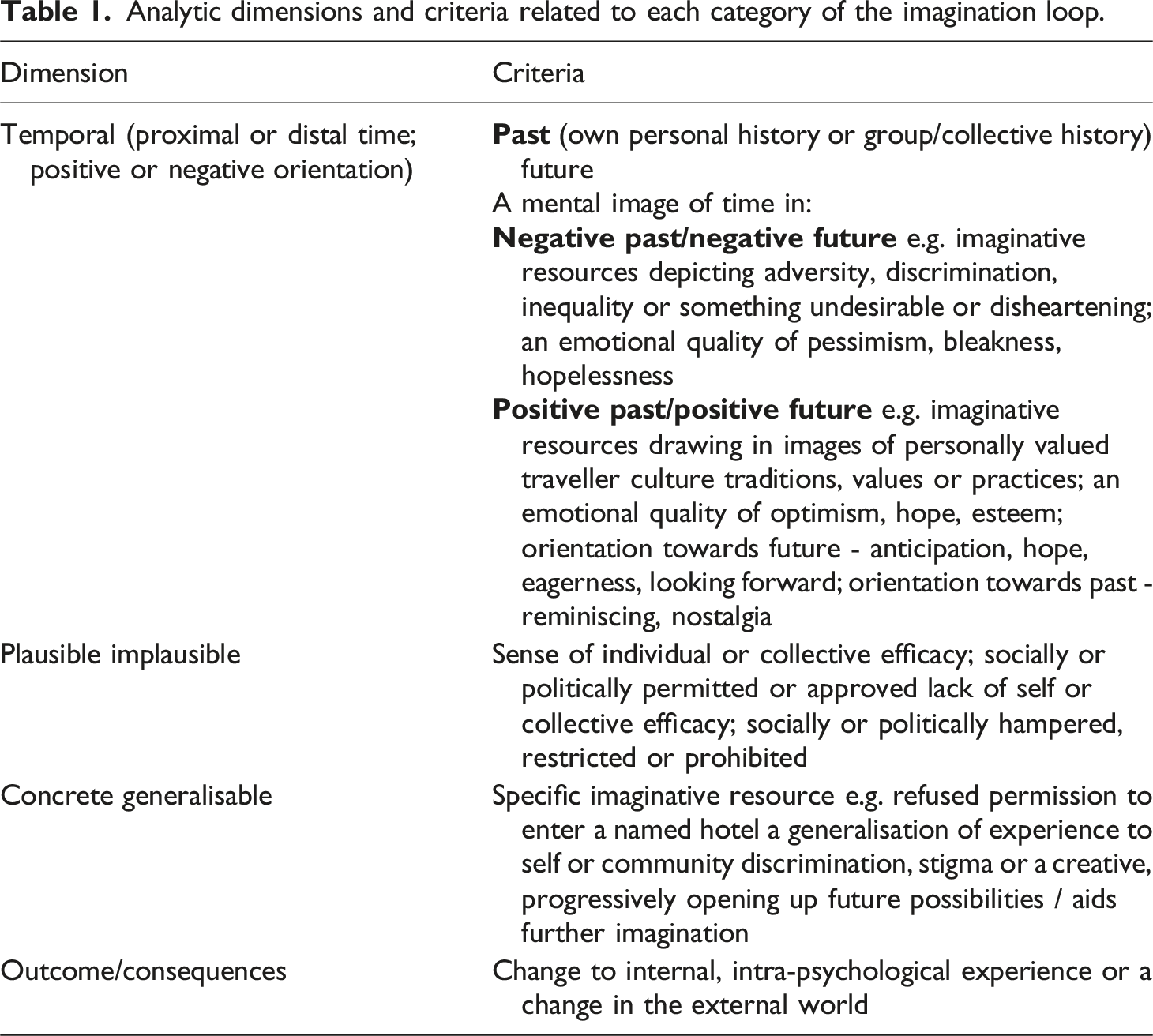
As seen in Table 1, we extended the temporal dimension of past/future to include an evaluative component, a positive/negative past and a positive/future. The positive past/positive future can be defined as imaginative resources which related to personally valued or socially esteemed Traveller culture, values or practices. This had an emotional quality of appreciation or nostalgia (positive past) or anticipation, optimism, hope (positive future). The negative past /negative future included imaginary resources depicting adversity, discrimination, inequality or some disheartening element. There was an emotional quality of bleakness (negative past) or pessimism or difficulty sustaining hope (negative future).
We analysed the plausible dimension as moments in imagination where there was evidence of a sense of individual or collective agency or alternatively a sense that the imagined representation was socially or politically permissible and therefore possible. Implausibility, on the other hand, was analysed as instances where there was a lack of self or collective efficacy, or the imaginative progression hit a wall of being socially or politically hampered, restricted or prohibited.
The concrete dimension was analysed through identification of specific experiential moments (e.g. a named insult) or the inclusion of concrete imaginative resources (e.g. a hotel) while the generalisable dimension was evidenced when there was a generalisation of experience to self or community for example discrimination.
Outcomes were identified as changes to intra-psychological experience or changes (or potential future changes) in the external world as a result of creative possibilities resulting from imaginative processes. This analytic framework provided a lens through which to interpret the data and develop themes. It is an experiential thematic analysis in so far as language “is conceptualized as reflecting the true nature of things or participants’ contextually situated unique realities or truths” (Braun & Clarke, 2022, p. 8).
Results
Imagining possibilities: Discrimination as a constant
Imaginative acts have to be understood in their historical and sociocultural sequence. Old Doorey (58 years) narrated a past time when the term ‘Tinker’ referred to a Tinker Smith and the craft of Tinsmithing, with positive connotations. In his own life time, he felt Travellers being called ‘Tinkers’ was synonymous with being treated like “they were only dirt” (Oul Doorey), capturing the changed perception of Travellers in the societal imagination. For Young Frankie, 20 years younger, he experienced the word ‘Tinker’ as synonymous with the derogatory word, ‘Knacker’, a word that may originally have referred to a saddle maker, and later to a person who worked at the “knackers yard” where old horses were put down as they were of no value but for that of their carcasses (Merriam-Webster dictionary).
When Young Frankie was asked if he could imagine that Traveller men would be accepted by the broader society of Ireland?’. This question triggered the following imaginative loop. “I think there will be a day in 20 or 30 year’s time that they will, but there will be a lot of work before they will be….Now I mean me myself, I am working and other Travellers is working and are making a few quid and they don’t need nothing off no one... So I think that’s a big step up because there’s a lot of Travellers working now, and they’re legit and through the books .. but there’s a lot of work to be done there yet to be honest with you. Like I play football and a lot of soccer myself, I see fellas in training and stuff, messing with their friends, and there be an accident and they wouldn’t mean it and they would call out ‘ahh you Knacker” and I look at him and they’d say “oh I’m sorry Frankie”. They do forgets themselves, they slips up on it,.and it’s things like that would hurt you, and then again like you don’t, you don’t be calling people names like that. It’s not nice. A knacker is a dead horse, not a human being, do you know what I mean? A knacker, if you have a knacker of a horse, ehh he’ll be brought out, killed and put down” (Young Frankie, 38 years).
Temporally, Young Frankie’s imaginative loop flowed towards a distal positive future 20 or 30 years hence, where Traveller men would be socially accepted. This was supported by concrete imaginative resources drawn from his life, and that of other Traveller men, as working legitimately, financially independent, paying their taxes. However as the loop progressed, it drew in a troubled and troubling moment in his recent past when he experienced a shift from being a part of his football group to being ‘othered’. This disrupted the plausibility of an imagined trajectory to social acceptance to one of increasing implausibility. The highly concrete imaginative resource, ‘ahh you Knacker’, drawn from the language of the settled community, has a very specific meaning which does not allow other possibilities. This was a prejudicial attack, in which, through the use of this term, enduring racism was mobilised, and there was a generalisation of experience to his community’s historical and traumatic experience of stigma and discrimination. He tried to make sense of it as an unintended, intrusive thought, ‘‘they do forgets themselves’, but future social acceptance, on a plausibility dimension, “is a big step up”. Interestingly however, the outcome of this imaginative loop is a shift in perspective from the position of victim to one of taking a moral stance calling out unacceptable behaviour, “you don’t be calling people names like that. It’s not nice”. There is a shift in internal experience through a re-ordering of moral social representations.
All six men talked about discrimination as a constant, detrimental experience in their lives. Past discrimination formed a template for future imaginings. Such imaginings had real world consequences as they limited their entry into and engagement in physical and public spaces of mainstream society, such as Public Houses (pubs). “Like there’s a lot of pubs in [city] where I wouldn’t be served and there’s a lot of pubs in [city] that I’ve never been in an that I’d be afraid to walk into because I'd be embarrassed that I wouldn’t get served in the pub” (Young Frankie, 38 years) To me as a young Traveller man it’s everywhere. I never left [city], I never moved and yet like I couldn’t count out in them five fingers places that I have been or that I could go in this town where I would feel comfortable or wanted” (Baby John, 23 years)
In imagining pubs that he has ‘never been in’ (Young Frankie) or pubs where he ‘could go’ (Baby John), the men engaged in position exchange (Gillespie, 2012); that is, in this imaginative space, they saw themselves through the gaze of the other; that is, the publican of the settled community, and also through their social link to a collective identity of Travellers, and a knowledge based on prior personal and collective experience, that they would neither be served nor wanted. Vygotsky (2004) noted “every construct of the imagination has an effect on our feelings, and if this construct does not in itself correspond to reality, nonetheless, the feelings it evokes are real feelings, feelings a person truly experiences” (Vygotsky, 2004, p. 19). The imaginative loop, in these instances, brought men into contact with an internalised shame (“I would be embarrassed that I wouldn’t get served”), the outcome of which inhibited action, not simply in the psychological realm but also in the lived world, limiting future possibilities, with political consequences for policies of inclusion (Glăveanu, 2023).
Although the education system has long been a site of discrimination for Traveller children (Doyle et al., 2020), participants had different subjective experiences of school. The older men had limited experience of primary school, and their memories of school included bullying, name calling and ostracization. In contrast, Baby John (23 years) did well in both primary and secondary School. A teacher recognised his potential and supported him to follow his dreams. This memory triggered the following imaginative loop for Baby John. “One of my biggest dreams was to be a guard [Irish Police Officer]and I applied to be a guard…oh, that must have been…(ponders) when I was 18 and I’m 23 now, that’s 5 year ago and I never heard a response. I filled in all the paperwork right, done everything, she helped me do it, (a career guidance officer), she showed me the ropes, showed me what to do, I done everything right, sent it all away. I never heard…[ponders] that’s 5 years ago. I never heard a response. So that was kind of it for me then. I didn’t want to go any further. That kind of put the hole then in going to college. I’d great support..people wanted me to prove the Travelling community, that if you wanted something, go for it, ya know, but once I never heard any response, from that day, it just put me in a position that I thought that - if I went to college and I worked really hard, really, really hard, that I still wouldn’t get where I wanted to be. When I left [name] Centre at 18, I filled out numerous CVs, I’ve handed them in numerous places all over this whole town for jobs I was well able for, and to be honest with you, my opinion is that they were never even got looked at. Once they seen my face and they knew who I was, just never even looked them over, to be honest.I never heard a single reply back” (Baby John, 23 years).
The imaginative loop, as described by Baby John, can be represented visually as follows (Figure 1). Imaginative loop when Baby John imagines his future dream to be a Police Officer.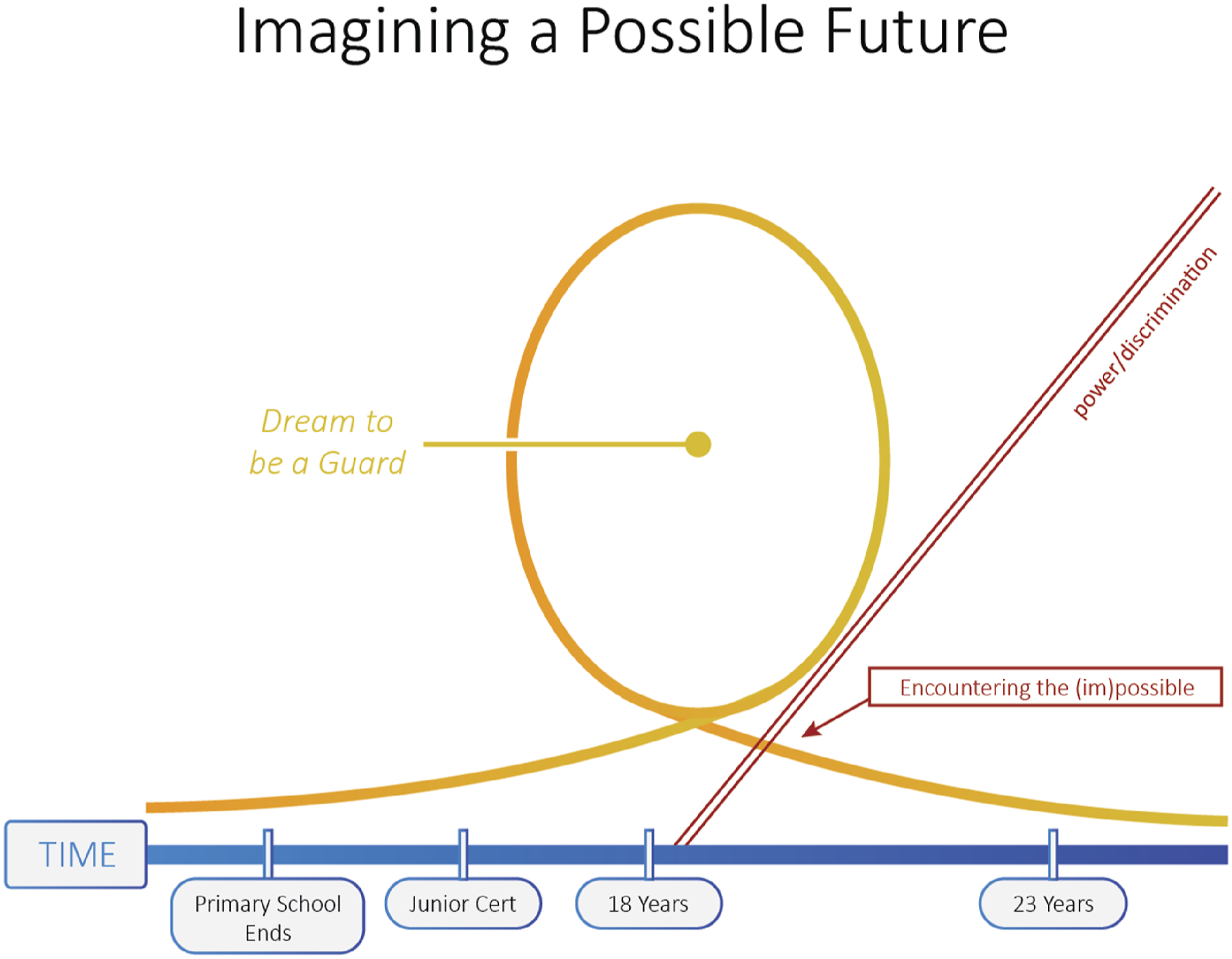
Imaginative processes can play a formative role in the transition from adolescence to young adulthood as the person conjures up an image of their future self (Zittoun & de Saint-Laurent, 2014). Thus, imagination becomes a developmental tool supporting a trajectory from ‘here’ to ‘there’. For Baby John, imagination looped to the past, to a dream that began in childhood to be a guard. Baby John was supported from both within and outside of his community, including by his guidance counsellor, to pursue his dream. This dream felt plausible, an achievable goal for a bright, eighteen year old looking to his future. It also offered a chance to disrupt historically negative, transgenerational memories of the education system which too often let down young Traveller men. His imaginative loop included his self-representation but also a collective representation; “people wanted me to prove the Travelling community, that if you wanted something, go for it”. In imagination, he represented a ‘what-could-be’.
As an imaginative act, it straddled a political space of plausibility- to be both ‘Traveller’ and ‘Guard’. In reality, it was highly implausible; a 2023 census of diversity within An Garda Síochána (Irish Police) showed that while 98% of 16,735 police identified as white Irish and 2% as non-Irish, not one police man or woman was a white Irish traveller (Central Statistics Office, 2023). Thus the plausibility/implausibility axis is related to power/discrimination (Figure 1). In the shift from imagination to action through the submission of an application, he encountered historically embedded discrimination- he received no response. He hit a brick wall of invisible power, which he attributed to being a member of the travelling community. From this concrete imaginative moment drawn from the past (submitting the application), there was a generalisation of experience to the future, an inability to sustain his imagining of such a future, and a progressive closing down of imaginative spaces “That put a hole in it…That was kind of it for me”. The outcome of this imaginative loop was reduced resources to aid imagination of a socially integrated career.
Similar incidences were reported by other men, thus linking individual and collective experiences. Ol Doorey recounted how, a number of years earlier when he was in his mid 40s, he went all over the city with CVs looking for work, even outside the city and no one would take him on; “I was only wasting time… I don’t know, when I said I was a Traveller, they said that’s it, they just didn’t want to know you.. “(Ol Doorey). Researcher: How did that make you feel? Ol Doorey: Very bad, that made me feel very bad, very down, very bad all together… “people get very depressed from being discriminated against… you know young boys like, young Travelling boys. Most of them you see is all depressed from being discriminated. They can't get a job sure and everywhere they go, they are turned down for a job. Ah sure that’s the reason they do suicide” (Ol Doorey-65.)
In these two examples, drawn from the youngest and oldest men in our sample, this imaginative loop shifts from imaginative representation (a plausible, concrete, proximal aspiration) which mobilises action to seek employment, to a realisation of the implausibility of a positive outcome; “I was only wasting my time”. The imaginative affective arc is from hopefulness, excitement focused engagement to frustration, even despair. Ol Doorey’s account then moves from his own concrete, proximal experience to generality and maximalisation as he reflects on the impact of continued social rejection and discrimination on the intra-psychological world of young traveller boys who may become depressed, and may even consider suicide as these social forces seem insurmountable. Suicide is an ultimate rejection of the capacity to imagine a positive future. In this way, the ability to imagine possibilities is tied to the political (Glăveanu, 2023), that what can be imagined but cannot be attained then becomes impossible to hold onto in the imaginative space and must be accepted or become a site of resistance.
Pride and creation of a Traveller hero
Although it was not part of the interview protocol, the concept of Traveller heroes emerged in men’s narratives. This spontaneous introduction of talk of hero’s was perhaps an act of agency and resistance, a counter-narrative of pride to the ‘othered’ narratives of social marginalisation and discrimination. The heroes of men’s stories were family members, boxers and those who had attained professional status, such as becoming a doctor. Heroes were of their community; as noted by Baby John, “We didn’t have any, we created our own” (Baby John-23 years). This highlights the separate imaginative worlds of Traveller and settled communities (Figure 2). Furthermore, an inability to see Traveller heroes represented in the settled community imaginary acted as a trigger by which men drew on cultural resources embedded in their intimate family and community stories to conjure up heroes of their own. In Figure 2, the dashed middle captures a representation of the participant’s imaginative movement when imagining “two worlds”, while the red “x” marks refer to the separate ‘hero’ representations that form part of the settled community cultural repertoire. Separate imaginative worlds of Traveller and settled community heroes.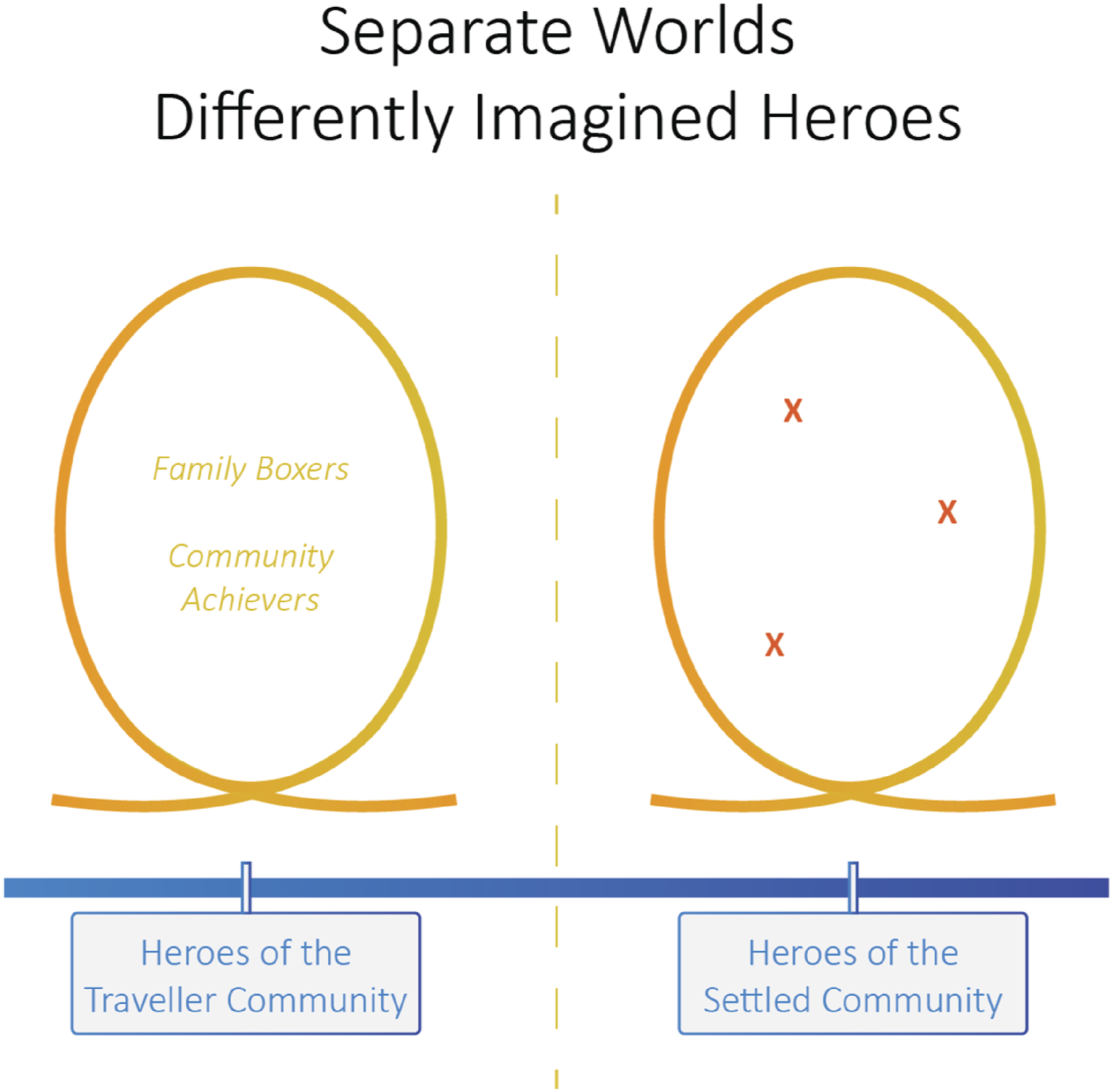
Old Tim recounted memories of an admired Uncle in the family: “We had a granduncle, Big Willie Reilly ehhh, fought in the Boer war, and he was in the war, in the Irish army, an’ he was an army boxer. Well now to look at him like, he was kind of a hero to us, ya know what I mean, an’ he had two sisters who were two nuns”. (Oul Tim, 65 years)
As a soldier and as a boxer, his granduncle was doubly positioned as a hero. The highly respected social position of becoming a nun was achieved by two grandaunts. Among the men, heroes were commonly drawn from one’s family and ancestors. My father would be on about his father again, sure. I think every Traveller man sees his father or grandfather as his hero..My father is my hero, and my grandfather- the two of them were the best men in the family” Young Frankie (38 years)
The world of Boxing, a sport followed by both Traveller and Settled communities, was also a source of hero creation. Young Frankie was asked if his father ever talked to him about a future where things could be better for traveller youth. This triggered an imaginative loop which began with him as a young boy being brought to the local boxing club by his father, and where he imagined himself representing Ireland in boxing. The following extract follows this imaginative loop. “like me and my brothers represented Ireland [in Boxing] and we represented Ireland and we won many Irish titles so to walk into a pub where you don't get any respect for it, where as if it was a settled person who won an Irish title he’d be all over the newspapers he’s all over everything but to a Traveller he’s kind of put on the backburner to be honest with you”...John Joe Nevin, [two time boxing Olympian] went. There’s a lot of Travellers producing good stuff, they should give them the same chance, you know what I mean. If that was a settled person he’d automatically be a hero but if it's a Traveller he's only another knacker you know what I mean?” (Young Frankie, 38 years).
The loop shifts from the positive past to a negative present, from a proud, concrete imaginative resource , we “represented Ireland” to drawing in the socially stigmatised semiotic resource of a Traveller as being perceived as “only another knacker”. The imaginative loop, which began by positioning Olympian boxers who are members of the Travelling community as heroes, was difficult to sustain on a positive trajectory as semiotic resources of discrimination flowed back in. The outcome of this imaginative loop is a shift from pride in ‘travellers producing good stuff’ to a remonstration at the societally generalised delegitimisation of traveller achievements.
This looping out from hero to discrimination was also evidenced by Johnny in the following extract: “I’d like there to be fairness, but hey listen…you could save a Settled man’s life and in that present moment, you are a hero, but when he gets up and brushes himself off, your still just a traveller (Johnny, 34 years).
Johnny imagines an act of bravery that should be accorded a hero’s status- that of saving a Settled man’s life- yet the imaginative act fades into a liminal state ‘he brushes himself off’, as it becomes impossible to sustain the heroic representation in the face of an imagined Settled community. Somehow past individual and collective experiences of negative portrayals of his ethnicity, and derogatory identifications come back to mind, resulting in an imaginative act of putting words into the mouth of the Settled ‘other’; “your still just a Traveller”. However in this context, the intra-psychological outcome is to resist the processes of internalising oppression (through his own call for fairness) and the imaginative loop closes to return to a ‘here and now’.
A similar imaginative loop is evidenced in a conversation with the researcher on a recent Doctoral degree bestowed upon a young Traveller woman in the University of Limerick: “Well, that’s a very proud thing for a Traveller to achieve an fair play ta her!, But to tell you the truth, the hardest thing about it though, is that, that same poor girl is still gonna face discrimination….even if she’s a doctor, that’s one million percent ” (The Boy, 30 years).
Painful experiences of normative historic, transgenerational denigration are resisted through the imaginative work of the creation of hero representations which ensures possibilities for individual and collective pride and self-worth. In imagination, the creation of a separate world of Traveller heroes, separate to the social representations of the settled community, is a way of honouring their own culture and community and resisting the internalisation of depreciating social representations.
‘Where are we going?’: The rocky road to utopia
Men were asked the question ‘‘What is your idea of utopia, a state of things in which everything is perfect, as an Irish Traveller?’ For five of the six men, this question triggered an image of utopia as an end to discrimination, parity of esteem and equality with the Settled population. “Well, I could imagine it to be a lot of things but the main thing I’d like for it to be is to be treated like everyone else”(Johnny-34.) If we just had our own little base and were just left alone, just to be left alone and to be treated the same as settled people, to be honest with you.” (Young Frankie-38.) Success like for me is that you could walk down there and go in anywhere and that you’re not discriminated against. Where even in my day you still couldn’t walk in anywhere”. (Ol Tim-65.)
However as Ol Tim begins to imagine a future where ‘you could walk down there and go in anywhere’, the imaginative loop immediately returns to how ‘even in my day’, this was an impossibility. A potential liminal space of agency and plausibility (to go in anywhere) is shut down as the imaginative resources that immediately come to mind are negative past experiences. The plausible quickly becomes implausible and it becomes hard to return to imagining this utopian future (Figure 3). Figure 3 captures the trajectory of men’s imaginative loop of utopia. Imagining utopia.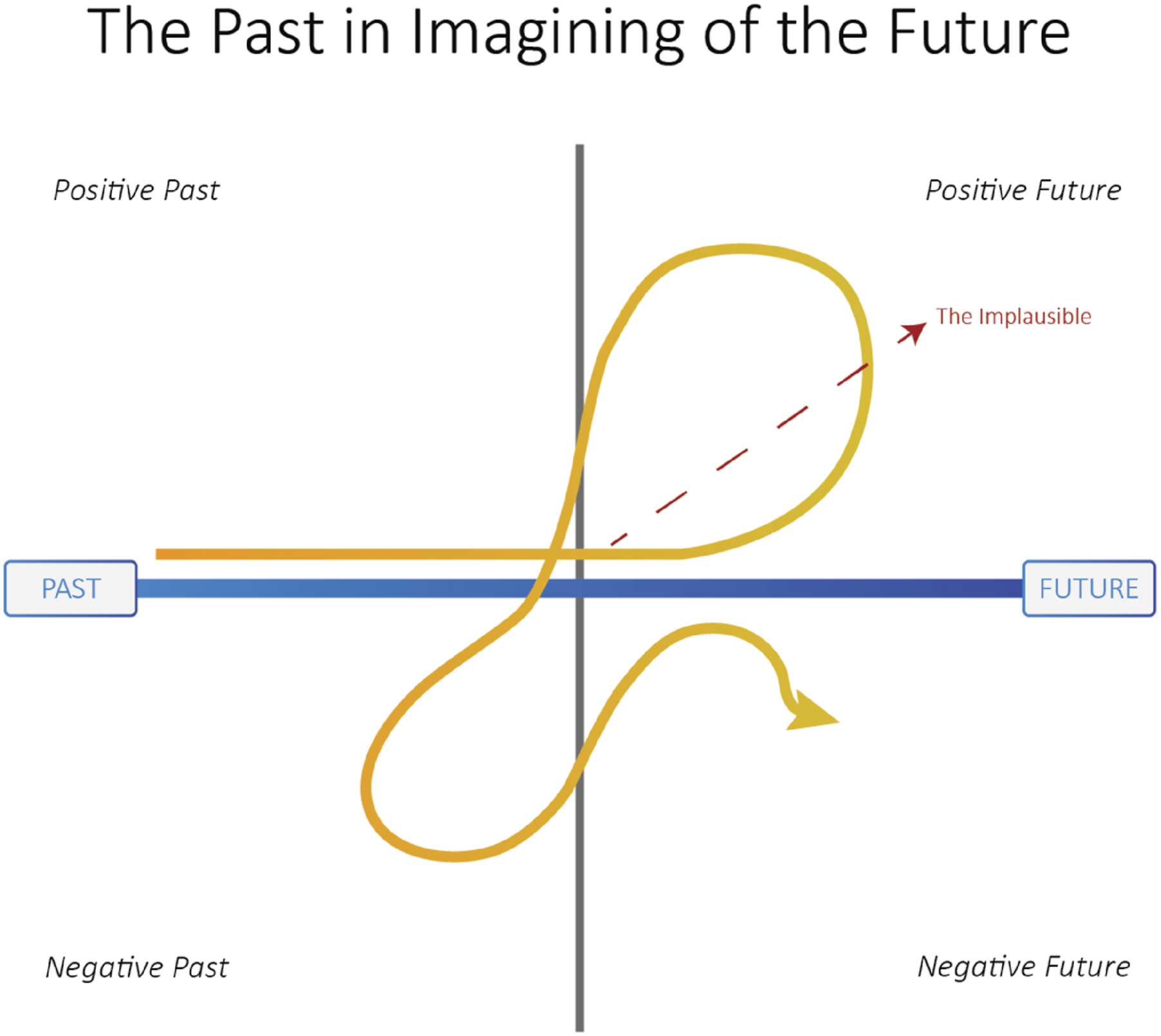
This imaginative loop trajectory can be seen in the following extract by Jonners (34 years), triggered by a request to imagine utopia for himself and his community. “For me….well yes, I’d love to see someday, like ou go to the local school and there’s a Traveller man working they're as a teacher or I like to see if you go over to a college you have a Traveller walking in there or if you go into a solicitors office there be a Traveller behind the counter or someday with the help of God a Traveller might own a hotel in [city]-…like ..for a Traveller man to walk in and to be accepted, that would be a great thing to him, would be worth more than money to him. Researcher: That would be utopia? Yea, like to walk into a place and to get accepted, but to walk in and be told this, “look I can’t serve your kind, no I don’t want any of your people in here, even though they never see ya before, …so ya….There a lot of Travellers killin’ themselves, an hanging themselves, and doing that - suicide is gone big, big, big in Travellers..that “I can’t serve your kind”. That would put a lot of pressure on people. (Jonner’s-34)
Jonner’s imaginative loop initially moves into a desired, positive future, drawing on semiotic resources of a Traveller man working as a teacher and a solicitor, being accepted the same as settled people. However this quickly shifts to the implausible. A concrete imaginative resource in a positive future, that of a Traveller owning a hotel, shifts to an intrusive resource from the negative past; a Settled hotel owner saying “I can’t serve your kind”. This makes it impossible to sustain a trajectory of a vision of this positive future. Culturalresources of present and past trauma, the pain of discrimination arose, drawing the loop into a symbolic space of negative experience, which then altered the outcome of the imaginative act. A symbolic representation of a positive future cannot be imaginatively sustained. There is then a generalisation of experience from self to community. This lack of acceptance is posited as a reason for the high suicide rates among Travellers. The outcome of this imaginative process is that, for Johnny, it raises a question about whether, in imagination, individual and collective survival can be sustained, as seen In his observation “There a lot of Travellers killin’ themselves..” The lack of ability to sustain a positive future in one’s mind has a quality noted by Davoine and Gaudillière (2004) in contexts of social trauma, of the sense of remembering something, but it is something which has not happened yet.
Yet within this, there is a voice of resistance. There is a call for the right to be able to set up their lives in ways compatible with their culture, including to keep their horses. The importance of the cultural attachment the men felt for their horses was explained by Baby John: Utopia would be, I suppose to have their own places for their horses, I’d like me own place for me and me family where we wasn’t on top of each other like cattle, that’s heaven to me but I reckon beggars don’t get to be choosers so I’ve a long wait, I’d say” (Baby John, 23 years)
In this extract, he asserts a right of Travellers to their cultural heritage of keeping horses. He also voices a demand that he should not have to live in overcrowded conditions “like cattle”. In staking these dual claims, making linkages between the demand for a place for horses, a place for family, he is arguing for a connection of his own family to Traveller cultural continuity. Yet he also sees “a long wait”.
This theme of the difficulty of sustaining a vision of a collective future in which Traveller culture endures in the face of ongoing official assimilationist pressures, is also echoed by Old Doorey …as life keeps going on, there won’t be any Itinerant [Traveller] left because there’s hardly no one travelling at the moment….if you went from here to another 20 year, I wouldn’t say that people will be even thinkin’ of themselves as Travellers..I mean, the most of em, we used to talk this Gammon, the Shelta, but none of my family knows it at the moment..tis dying out..because I’ve eleven [children] and they wouldn’t have a clue what I’d be talking about .., everyone is nearly settled an’ that’s the way its gonna be. ..and that will end the way of the Travelling life. (Old Doorey, 58 years).
As he looks 20 years into the future, he sees an end to the Travelling way of life, and while it is possible for him to imagine an assimilationist future, it is difficult for him to imagine one in which Traveller culture, in this case, having their own language of the Shelta and moving from place to place/non-settled and nomadic, continues.
In this temporal outreach into the future, there is a reach back into a long train of indigenous and post-colonial experience. Traveller culture has persisted in spite of discrimination but in the face of much suffering and cost. His concern is that cultural continuity will be difficult to maintain, in the face of ongoing assimilationist pressures. The men can articulate the future they desire but the reality is the community is under political and social pressure and it is difficult to sustain elements that are the essence of their culture, including moving with and keeping horses as is found in many societies in which nomadism is a way of life.
This failure to imagine an equal and inclusive future is borne of generational discrimination as it is found among men across different generational cohorts. Social trauma experienced by the community in the past and present has a direct impact on the capacity to sustain in imagination a plausible, personal utopia for their own future and that of their community while also staking a claim for the right of Traveller culture to have this vision, that is, to exist and thrive.
‘A fair crack of the whip’: Claiming an equal future for their children
Men were asked ‘What are your hopes and dreams for Traveller children’s future’? In their responses, they envisaged a future in which their children have the same rights and opportunities in society as other citizens. They position their children as central actors in an intergenerational project staking their claim for equality and respect, with a positive future trajectory (See Figure 4). Imaginative loop claiming an equal future for Traveller children.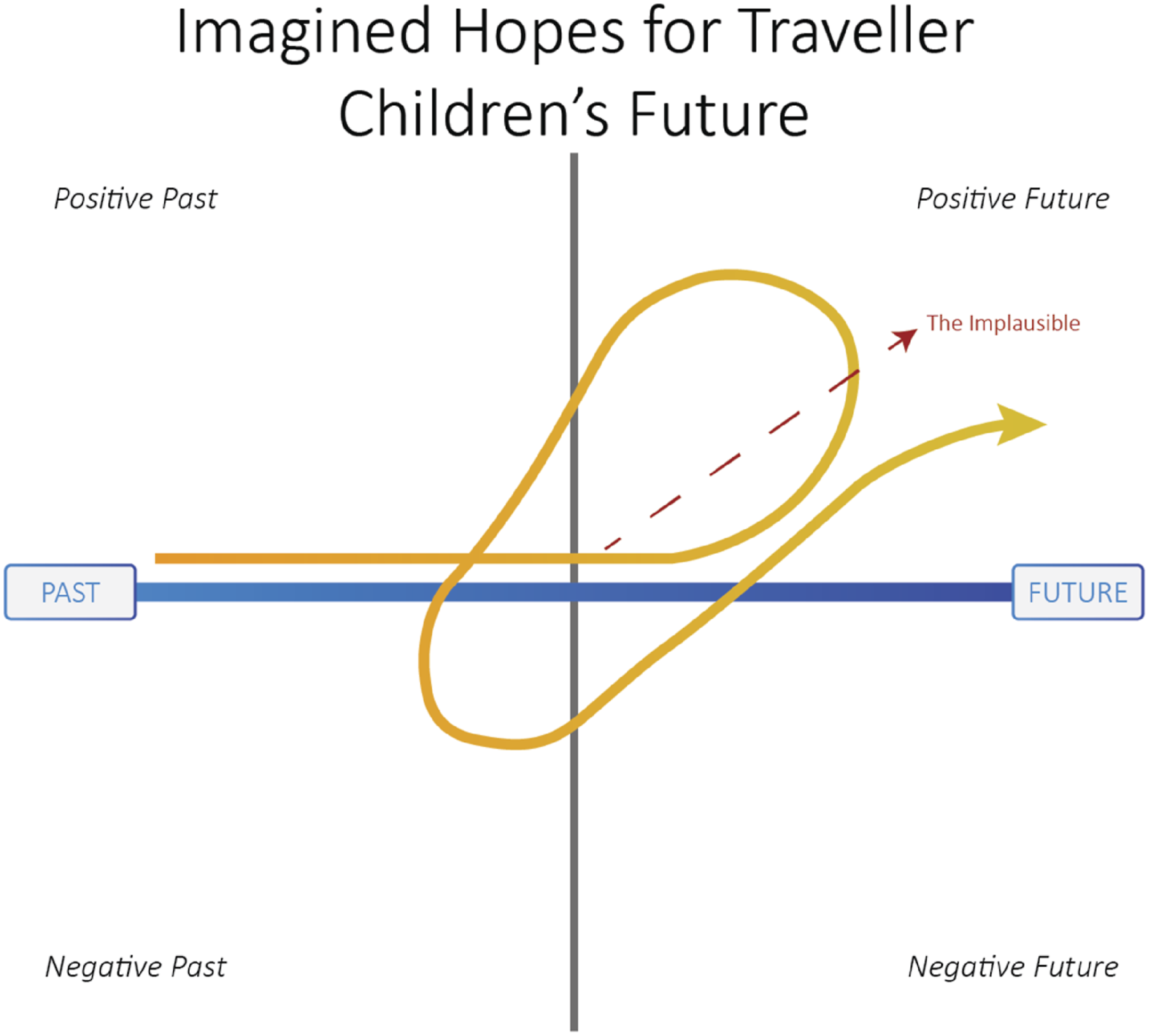
For Baby John, this question triggered an imaginative loop that extended his dream to go to college to that of his children: “My dream for my children would be for them to finish school maybe go to college. I wanted to go to college meself one time. I applied to be a guard do you know what I mean like, it wasn't as if I didn't want these things, I wanted these things. ….Well I’d like to think that my children could be in a settled person's home in the future interviewing them and if they found out that he or she was a traveller, that it wouldn’t make any difference to that person, do ya know what I mean. You know, he’s a human being, he sitting down, he is interviewing you, he’s talking to you, he can help you if you have a problem- if he can help he’ll help..if not, he can’t help. That’s the future I see for..even the young fellas and young ones coming up in the Travelling community now ”. (Baby John, 23 years).
In this extract, Baby John utilises imaginative resources drawn from this personal past of his dream of getting into Garda college to aid further imaginative possibilities for his children and collective Traveller children; a dream of going to college, perhaps becoming a researcher who interviews settled people, a generalisation of a dream from self to community. In the imaginative space, he bears witness to and celebrates this possibility. He voices his complaint - it wasn’t that he did not want to go to college himself- and claims this right for their children, transforming past personal pain to future anticipatory hope. In this regard, Baby John posits as plausible his imaginative act that his children will be treated the same as anybody else and not judged for their ethnicity, but by their ability to perform a task. It conveys an unspoken question, ‘why not’! The imaginative act of role reversal, that of a Traveller researcher interviewing, and making the offer to help a settled person, is transgressive. It turns normative social representations of the researcher and ‘researched’, the helper and the helped, on its head, creating new possibilities. Glaveanu (2023) argues “The recognition of some individuals and groups as ‘holding potential’ – and the rejection of this status for other individuals and groups – has decisive consequences for nature, human agency, opportunity to succeed, and the opportunity to enjoy a dignified life” (p.6). The elaboration of this image in the imaginary loop is a political, transformative act. Its outcome is to raise a further imaginative question of what - and who- would have to change for such normative role reversal to be possible? A call to greater Traveller political engagement is taken up by Young Frankie: I'd like to see, I’d like to see all of the Travellers have a fair crack at the whip...I’d like to see all the Travellers with a good education, I like to see them becoming teachers and doctors like what I said to you. I’d like to see Travellers more involved in becoming TD's and being in Sinn Féin and Fianna Fáil [Irish political parties] or whatever it is and all that crack do you know what I mean.” (Young Frankie, 38 years).
Young Frankie stakes a claim to see members of the Traveller community visible across the professions of Irish society, including within mainstream political parties. There is recent precedent for Traveller political representation as Senator Eileen Flynn was appointed to the Senate, the Upper House of the Irish Parliament, in 2020, and in 2022, she became the first member of the Traveller community to address Dáil Eireann [Irish Parliament]. Such representation becomes a cultural resource to support a vision of the world ‘out there’ and not just in the imaginative space. As such, it is a disruptive resource and forms part of the work of staking a claim for a flourishing Traveller culture and voice. It is also essential work given the importance of the capacity to imagine a positive future for individual and collective mental health.
Conclusion
The Irish Traveller community has experienced transgenerational social and spatial exclusion (Joyce, 2018). The analysis presented here has followed the loop of imagination model proposed by Zittoun and Gillespie (2016, 2018) and explored Irish Traveller men’s imagination of the future for themselves and their community in terms of triggers, imaginative resources, dimensions of time, generalisation and plausibility, and intra-psychological or external outcomes. It extended the temporal dimension to include positive/negative past and positive/negative future. In a way that allowed the analysis to link individual imagination to the history and experience of the collective group or to capture parallel processes between individual and collective experience. A key contribution of this paper is to show how past personal and collective experiences of discrimination entered the imaginative loop in the ‘here and now’ and made it difficult to sustain in imagination a positive future trajectory in which Travellers’ dreams and culture can be sustained and thrive (Figure 1, Figure 3).
At the same time, imagination was a site of resistance to cultural assimilative pressures. Acts of resistance in imagination included the creation of Traveller heroes, separate to those of the settled population which sustained an intra-psychological experience of ethnic pride (Figure 2). An analysis of the resources used to create these imaginative loops highlights both what is present (traveller family and community heroes) and absent (heroes from settled communities). The argument is made by participants that the converse would be found if one was to examine imaginative loops from the settled community that is an absence of Traveller heroes. This indicates that there is not only a spatial, but also an imaginative disconnection between Traveller and Settled communities with consequences in real-world relating. We can further imagine what might need to change in inter-community relations to galvanise a fluidity of imaginative resources across this divide which, in the analysis presented here, seem impermeable.
Interestingly, within the interviews, the generative use of imaginative ‘hero’ resources may have mobilised the direction of the interviews towards using the imaginative loop as a space of protest and demand, as the men asserted their right to equality and parity of esteem (Figure 2, Figure 4). From the interview location of a halting site, one man imagined a Traveller child as a future professional psychologist interviewing a settled person in their home, that is, a Traveller as a professional offering help to a settled interviewee. In imagination, there was a reversal of the stereotype of the helper-helped in a way that was transgressive of the established order. Men engaged in position exchange (Gillespie, 2012; Martin & Gillespie, 2022) as they distanced themselves from the present sphere of experience and in imagination, reversed the traditional roles and practices of Traveller-Settled interpersonal relations. This expanded the realms of social psychological positions and possibilities. In this, there is a call to a radical imagination (Alfred, 2010) in which relationships with the settled community are re-envisioned.
This does not detract from a parallel imagining of a loss of cultural continuity in the face of ongoing societal assimilationist pressures, a phenomenon associated with suicidality in Canada’s first nations communities and where the converse - reasserting cultural continuity - has been found to be a defence against suicide (Chandler & Lalonde, 1998). Womersley (2020) argues the mobilisation of imaginative processes may have a powerful role to play in trauma healing. In our analysis, concrete imaginative resources of employment rejection generalised to a link with historic and ongoing discrimination and suicidality. This mobilised emotions of frustration and discontent with the existing status quo of intercommunity relations. It arguably triggered imaginings of a need to break with how things are currently to deliver new visions of the future such as that envisioned in the example of position exchange in customary cultural roles cited above.
Thus, a critical question that emerges from the findings presented here is which communit (ies) need to engage in imaginative envisioning for social change? In the imaginative loops of Traveller men presented here, there was often a shift from plausibility to implausibility as elements of imagination came up against social and political hindrances or prohibited realities. These limited individual and collective efficacy, including imaginative efficacy. The imaginative focus shifts from the periphery to the centre; can the settled Irish community create space in their minds and in the physical world, to support a flourishing Traveller culture? Glaveanu (2023) makes the point that imagination is constrained by what went previously but “encountering impossibilities does not necessarily curtail the possible- it can even be a source of inspiration, a trigger for the need to overcome our current boundaries” (Glaveanu, 2023, p. 5).
A limitation of this study was that this study engaged a small, highly homogenous sample of six male members of the Traveller community recruited at halting sites in the south of Ireland. Participants were recruited within a well-defined community and specific demographic group. A greater range of views may emerge if the sampling strategy sought the participation of a wider representation of Traveller men such as Traveller men as they engage in mobility across Ireland and the UK.
Future research could seek to engage a wider cohort of Traveller men or include a gendered analysis by soliciting the imaginings of Traveller girls and women of the future for themselves and their community. It would be important also to engage with the settled Irish population to explore their imaginings of the future of the Travelling community and culture in Ireland.
This study has a number of important implications. It asks where responsibility for change is situated? Glaveanu (2023) notes, “The construction of norms, values, and ideologies around who, in society, is expected or has the right to discover new possibilities and, conversely, who is denied such opportunities is a political act” (Glaveanu, p. 6). Traveller organisations and political figures are highly active in advocating for space for Traveller culture to flourish but this also requires imaginative change within the broader Irish society; can imaginings of possibilities for change be realised in a political culture of “business as usual”? This calls for further imaginative disruption at a whole of society level.
Footnotes
Declaration of conflicting interests
The authors declared no potential conflicts of interest with respect to the research, authorship, and/or publication of this article.
Funding
The authors received no financial support for the research, authorship, and/or publication of this article.
