




Abstract
Introduction
Background
The Democratic Republic of the Congo (DRC) has been plagued by decades of political instability and protracted conflict (UN Refugee Agency, 2023). DRC is both a refugee-receiving and creating nation, with almost six million internally displaced people, over one million Congolese people seeking refuge in neighboring countries, and over half a million refugees from neighboring countries seeking refuge in DRC (UNHCR, 2024). Competition for the country’s rich and abundant natural resources and ethnic tensions have resulted in extensive violence and displacement (ACCORD, 2022). Gender-based violence, food insecurity and inaccessibility of education all exacerbate instability (UN Refugee Agency, 2023). The volatile situation in the region presents deeply entrenched humanitarian risks.
The humanitarian crisis in DRC is particularly felt by ethnic minority groups such as the Banyamulenge in South Kivu (ACCORD, 2022). Banyamulenge people are Tutsi pastoralists thought to have settled in DRC in the 19th century (Vlassenroot, 2002). Lifestyle and economic differences between the Banyamulenge and local communities ultimately led to conflict (Vlassenroot, 2002). Colonialism further exacerbated tensions (Verweijen & Vlassenroot, 2015). Decades of turbulence, constant exclusion and marginalization culminated in the Banyamulenge being denied Congolese citizenship (Vlassenroot, 2002). The slow genocide of the Banyamulenge goes relatively unnoticed internationally (Ntanyoma & Hintjens, 2022). Due to ongoing conflict, humanitarian interest in the plight of the Banyamulenge people is urgently needed. Therefore, this study sought to give voice to the lived experiences of Banyamulenge people who are now settled in Australia after a protracted journey of seeking safety and peace.
Trauma and posttrauma growth
Pre- and peri-migration traumatic experiences are risk factors for ongoing mental health issues (Miles et al., 2019), including increased risk of post-traumatic stress and prolonged grief disorder (Nickerson et al., 2014). However, refugees transitioning to Western societies, such as from the DRC to Australia, are often psycho-pathologized using the medical model of health, which can be unhelpful and is culturally insensitive (di Tomasso, 2010; Fang et al., 2015; Fennig & Denov, 2019). Further to this, theories of post-trauma growth have gained increasing attention. Research suggests that post-trauma distress can trigger a cognitive ruminative process whereby people experience positive transformative changes (Joseph, 2011). This is not to suggest a linear process of trauma, distress, then growth, but rather a non-linear and often coexistence of both distress and growth (Linley, 2004; Seligman et al., 2005). Therefore, ongoing mental health risks for refugees highlight the importance of mentally healthy environments during resettlement.
Context of reception
Contexts of reception refer to the social environments refugees experience in host nations (Bösch & Su, 2021), encapsulating external forces such as government policy, public attitudes and access to resources (Jensen, 2021). Scholars have referred to reception contexts as having three main categories: hostile, neutral, and positive (Bösch & Su, 2021). A substantial body of academic literature outlines the risks that hostile environments pose to the health and welfare of refugees (Coddington, 2021; Tomkow, 2020; Weller et al., 2019) including those of forcibly displaced children (Brittle, 2020). Australia has a strong identity as a multicultural society and has welcomed over 800,000 migrants since the end of World War II ended (Australian Parliament House, 2015). Australia’s commitment to humanitarian resettlement reflects the country’s values of freedom, dignity, equality and a ‘fair go’ (Department of Home Affairs, 2023).
Although multiculturalism and diversity are considered cornerstones of the national identity, it is often in the context of a white majority national identity (Ratnam, 2019). Indeed, despite a multicultural identity, macro-level attitudes towards refugees and asylum seekers in media, politics and policy are mixed. Strict immigration policy is widely supported (Muller, 2016), refugee-related political rhetoric is commonly harsh (Dempster & Hargrave, 2017; Parker, 2015; Peterie, 2016; Sharples et al., 2022) and mainstream national media coverage tends to be negative (Bleiker et al., 2013; Cooper et al., 2017; Parker, 2015; Sulaiman-Hill & Thompson, 2011). These examples highlight the potential for a mixed context of reception in Australia.
Theoretical considerations
Self-identity is shaped by contextual influences such as sociocultural processes and interactions with the new environment (Losoncz & Marlowe, 2020) and may therefore be a worthy consideration as refugees resettle in new countries. As refugees develop group membership to their new culture in addition to their heritage culture, a bicultural identity may form (Benet-Martínez & Haritatos, 2005). Bicultural identity integration is a process that occurs when an individual perceives compatibility and integration of their multiple cultural identities, an adaptive quality resulting in improved psychological adjustment (Chen et al., 2008). Two important factors in bicultural identity integration are cultural conflict and cultural distance, which can each impact a migrant’s ability to integrate multiple identities (Benet-Martínez & Haritatos, 2005). Whilst an acculturation framework incorporates integration as a potential strategy for migrants (Berry, 1997), Gamsakhurdia (2018) suggests a theory of proculturation. Proculturation is a process beginning in adolescence whereby self-identity is continually reconstructed based on the meaning that individuals attach to their lived experiences (Gamsakhurdia, 2018), which is pertinent to the current study. Gamsakhurdia (2019) highlights the curvilinear process of proculturation in meaning-making, synthesizing old and new meanings.
The current study
Given that media is so readily available and consumed (Boot et al., 2021), and refugee-related government policy is so important for those who have been forcibly displaced, the main objective of the current research aims to highlight how societal attitudes expressed through media and politics in a host country may influence young people’s mental health and well-being, positively and negatively. The primary research question is “what are the lived experience of Banyamulenge young people who resettled in Australia as refugees?” It focuses on the young people’s interpretation of the macro-attitudes they perceived during their resettlement and how they make meaning from these experiences. The study seeks to explore whether these perceived attitudes in the host community have impacted their mental health, well-being, and future life trajectories. This paper details the method used to collect and analyze the qualitative data, it documents the themes that emerged from the data and contextualizes the results among the wider literature in the discussion section. Strengths, limitations and suggestions for future research are also provided.
Method
The study design is an idiographic approach to explore sense-making and applied meaning to poorly understood phenomena with a small homogenous group (Smith et al., 2009). In-depth semi-structured interviews and Interpretative Phenomenological Analysis (IPA) were used to seek idiographic insights into the interpreted experiences of former refugees.
Participant demographics.
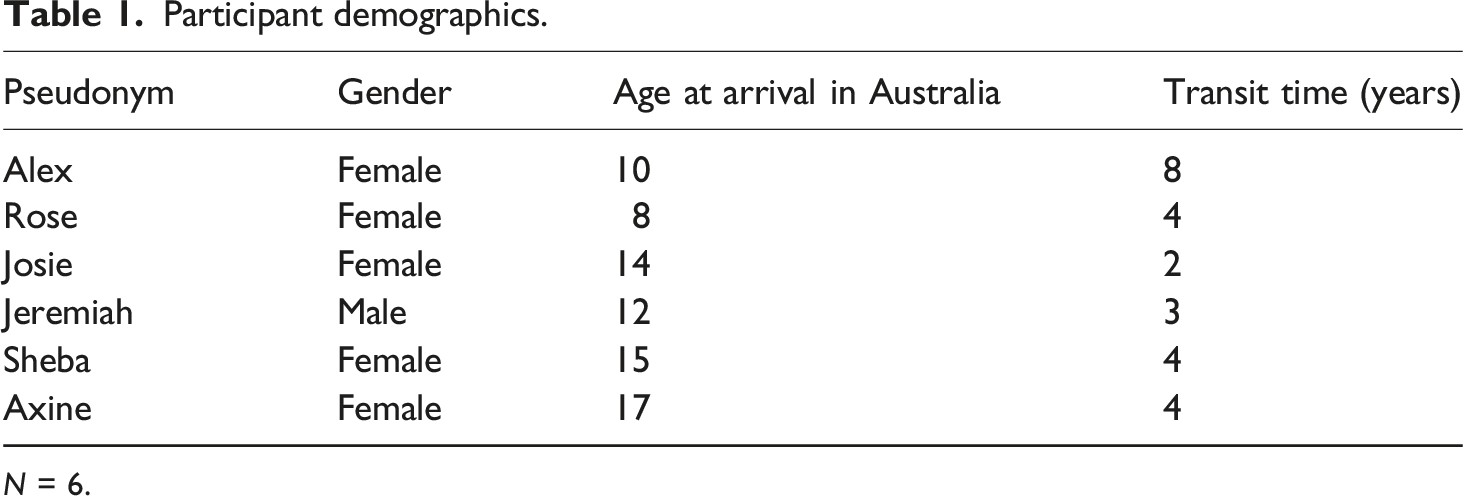
N = 6.
Following ethical approval from the university Human Research Ethics Committee, flyers and a short video were used to recruit participants through the lead author’s networks. Collegial support facilitated introductions to prospective participants through a snowballing effect, where participants offered introductions to other prospective participants. Due to the purposive and snowball sampling methods, homogeneity was achieved, with all participants sharing a history of forced displacement as part of the Banyamulenge people in the Democratic Republic of the Congo (DRC). Data were de-identified during analysis.
Interested parties were emailed a Participant Information Statement and a link to a digital consent form, demographic form, and wellbeing screening form. Seven people initially expressed interest in participating, though one person eventually withdrew her interest after completing the pre-interview consent and well-being forms. Consent and privacy information was contained in the Participant Information Statement and discussed verbally before the interview commenced, allowing the participants to ask any questions. Participants provided electronic consent and a well-being screen post-interview as well.
The lead author conducted the semi-structured interviews in a quiet, private space chosen by the participant, for example, the participant’s home. Interviews lasted approximately an hour and were audio recorded, transcribed verbatim by the lead author, and de-identified. Participants were invited to choose their own pseudonyms if they wished. The semi-structured interview questions were open-ended to ensure richness and depth of response from the participant (Smith et al., 2009), for example, “How do you feel you have changed, both positively and negatively, because of your experiences as a young person resettling in Australia?”
The analysis followed a well-documented step-by-step process to maintain rigor, robustness, and credibility (Smith et al., 2009). Initially, each transcript was analyzed as an individual case, and all cases were analyzed independently by the first and third authors. Authors immersed in the data by reading and re-reading transcripts, writing exploratory notes and constructing experiential statements. Experiential statements were then grouped thematically and sense-checked for alignment with the original transcript. Titles allocated to each cluster described the characteristics of the grouped experiential statements, becoming personal experiential themes. Following independent analysis, a joint analysis of each transcript, with robust discussion, resulted in agreement on themes. The first author then scoured the transcripts again for supporting quotes, with some sub-themes being removed for lack of interpretive evidence. A table was created showing all remaining themes and sub-themes for each transcript. The authors used the table to rearrange and collapse themes across the entire dataset of six transcripts. To minimize researcher bias, further vigorous discussion occurred iteratively during the write-up to cross-check themes and explore alternative interpretations.
This study explores how formerly displaced young adults in Australia make sense of their resettlement and the societal attitudes they encounter. Exploring subjective lived experiences lends itself to qualitative methods, which recognize that people make sense of the world based on their own experiences and knowledge. A constructivist perspective deems that there are multiple realities and that as critical realists, researchers should seek to understand each subjective perspective (Smith et al., 2009). In contrast, positivist approaches, such as quantitative methods, assume singular truth and observable phenomena. However, this approach cannot elicit nuances in complex experiences and interpretations of complex human phenomena as in the current study.
Worthiness and credibility are obtained using robust, systematic methodology and triangulation. Two researchers independently analyzed the transcripts, followed by an audit of each other’s themes and iterative discussion and analysis to reach an agreement and establish final themes. The second author provided accuracy and integrity checks over the protocols, results, and final write-up. Researcher reflection and analytical processes such as bracketing add validity (Ahern, 1999). Verbatim participant quotes validate the final themes and allow for reader critique.
The first author has a connection to the population of interest via a former colleague, though did not personally know anyone who participated. She has worked in non-clinical mental health for 15 years and voluntarily with refugee groups for the last five years. As a voluntary migrant to Australia, she has insights into migration challenges, though not via forced displacement. The second author is a clinical psychologist and researcher passionate about preventing mental ill-health and suicide and promoting wellbeing for all Australians. The third author is a senior academic, clinician, and experienced IPA researcher who seeks the lived experiences of complex trauma and post-trauma growth, including with refugee populations.
Results
Five themes emerge: Fleeing, rejection, and illusive safety, straddling two cultures, media stigmatizing identity, different is good, and growth and wellbeing. Themes convey turbulence, past trauma and how resettlement in Australia shapes a bicultural identity. As participants navigate old and new identities, they sense that negative and stereotypical media representations of refugees cause damage to self-confidence and create bias in members of the wider community. Over time, participants reconcile their differences as being good and their history as a source of pride. Their story eventuates in recognizing their strength of character and resilience, and a positive outlook for the future.
Fleeing, rejection, and illusive safety
This theme reflects the participants’ turbulent journey of fleeing for their lives and seeking safety through several countries when war suddenly strikes and of being othered and rejected along the way. Finding safety is elusive. Initially, they reflect on “a life before war … a pretty good life”. Unprecedented threat brings the immediacy of loss of family members, and cumulative traumatic events. Reflecting on these experiences as children at the time, their narratives reveal the chaos contaminating the transition out of “war … people dying on the streets”. The intense flight response numbs feelings, “you have no time for any emotions or anything”. Unable to find safety and protection, their parents’ decision is to continue fleeing perilous conditions in neighboring countries, “people with machetes, like long machetes … they broke the windows, and they poured petrol … the house started burning up … there is no triple zero”. Participants speak of being “kicked out” of homes in Kenya after fleeing Congo – “people don’t really trust you when they know that you’re not one of theirs”. As outsiders in their home country and in the transit countries, a sense of rejection for some participants leaves them questioning self and where they belong: It just makes me feel that we’re not welcome … are you meant to be here or like where you really meant to be? (Alex)
Self-doubt intensifies during initial resettlement in Australia, provoked by perceived low expectations from others who underestimate refugee’s abilities: They will never expect you to be as good as they are … they [sic] always expecting you to mess up. (Rose)
Among the turbulence and trauma of fleeing war and the arduous journey to resettlement, these participants hold loyally to their faith. They attribute protection from the brutality of real life to their God: I remember him [dad] just saying like, “just pray” and “that’s all like we can do now”. Yeah. So yeah, we, we were there just crying and praying to God … God heard our prayer. (Josie)
Straddling two cultures
For these young adults, there are opportunities and obstacles intersecting cultures, especially how to marry their former identity with the norms of a new culture. Initially referring to culture shock, “most things you see was the first time to saw it [sic] … we didn’t know how to use many stuffs [sic] here,” they lament the breakdown of their origin culture as their identities merge into their new culture: There’s nothing the same as back home, so erm [pause] like the way we dress, the way we speak, I’ve kind of lost my language, like I can still speak it but it’s not a lot, yeah, so I think yeah, my identity has kind of changed. (Alex)
Conversely, cultural norms weigh heavily on their changing sense of self, layered with parental minimization of their struggle to belong. The dynamic impact of straddling two cultures for them starkly contrasts with their parent’s refugee struggle as adults, who “think if you have food, that is enough”. Criticism and where to belong further unfolds when returning to Africa, with family members questioning their speech, language and dress, “so how you acting that, you forgot everything?”
Reflecting on contrasting heritage, conceptual beliefs and cultural responses to well-being, “I don’t think my mum even knows what a therapy person [is]”, mental health is taboo: Back in Africa they don’t, they don’t see it’s sickness … if you have depression they think you are just crazy and no one is care about you, no one want to know what’s going on. (Sheba)
Taboo creates stigma, and familiar patterns and beliefs impact help-seeking in the community: It’s hard for them to express their feelings, it’s hard for them to express what they’ve been through and be vulnerable ... I have seen people who are going through like mental, have mental issue, but they won’t acknowledge it because the community looks down on them. (Alex)
One participant also refers to the gender differences between the two cultures, the prioritization of men, the minimization of women who “can’t talk before men,” and being told, “remember you are a girl, you need to keep quiet”: If (parents) don’t have enough money, like a school fees, so they took only boys to school not the girls, so they just stayed at, at home, and do other work. (Axine)
Despite the struggles of Straddling two cultures, participants value their heritage culture deeply, sensing it will always be a part of them: I can never forget where I came from, and even though there’s, like other people, they didn’t like us, and they chasing us saying “go back to your country” whatever but, I feel like for me to say that I’m Congolese, I’m proud of that … my heart still calls Congo home yes, even though there’s problems, war … I feel like my country is everything, yeah, it’s who I am, I am Congolese. (Axine)
In embracing both cultures, participants perceive an expansion of their identity, rather than an erosion of one to the other. Having two cultures is gradually embraced as something to nourish who she is becoming: I have two culture and if you can say that, I know our culture, everything, everything in Australian as well [laugh] Yeah, that’s good thing. Even the language as well, yeah speaking my mother tongue and speaking English as well, I feel home. That’s a good thing yeah. (Axine)
Media stigmatizing identity
The media’s complex intersection with refugee identity is felt as an embarrassment that creates erroneous and false stigma within the broader society. Media representation, “it’s always war … just war and explosions”. Though often meant to arouse empathy, media representations disregard their strengths, victimizing them in stereotypical imagery: You see it on TV, it’s like a kid crying and they’re giving him water (Jeremiah)
The reiteration of traumatic events in media “gets inside you”, triggering post-trauma symptoms, invading sleep and dreams: You still feel like you’re not happy without energies and, but you can’t tell anyone why you’re not happy, why you are not sleeping, there is some time you made sleep and you start dreaming what you see. (Sheba)
Participants grapple with the media representations that reflect their own past but nonetheless feel the shame that is attached to the war-torn cliché: It’s like embarrassing to say that we are poor and you are refugee, like we didn’t go to school, we didn’t have food and stuff like that, or yeah, like the way we came here, I don’t know, you feel just embarrassed, yeah sometimes. (Axine)
The participants sense that the negative connotations of being a refugee – “urgh, those people they come as refugee, they don’t know anything, they didn’t go to school” subtly infiltrate the voluntary migration population in Australia. There is a sense that they are regarded as lesser than those who migrate – “there is some people they can pay for passport themselves they come here, they move here”.
Again, there is an undercurrent of negative biases such as criminal framing perceived by the participants. For example, Aline recognizes that Muslim refugees “get portrayed as like terrorists”. Similarly, participants sense that the media portrays Australia has having physical barriers penetrable to surreptitious criminals masquerading as refugees: It’s always like you know “they’re trying to break into our country”. (Rose)
Criminal framing and negative bias causes Alex to distrust her sense of self: It effects your whole identity … if you’re not accepted for who you are or like, it affects the way you portray yourself, yeah ‘cause it can make you want to be someone different than you are. (Alex)
Media representations of refugees are seen as a powerful manipulator of society’s behavior and their perception of refugees. An undercurrent of uncertainty and of being judged brings oscillation in connecting, making friends and ultimately, they preference those who have “gone through the same life experiences”: People see people coming from other countries, they think we’re coming to attack them or something, and like they think we’re coming to do something bad ‘cause they hear so much of fighting in our countries and they think we’re coming to bring that on here. (Alex)
Some internalize the media rhetoric distinguishing refugees from asylum seekers, placing emphasis on the “right process” of gaining a humanitarian visa and the “illegal route” of entering Australia by boat. Within this contamination of self and other narratives, it is acknowledged that one method of arrival is more socially acceptable than the other: If you start saying like these people are illegal it definitely brings a, you know, bad connotation … compared to if you say yeah these people yeah they are refugees but they’ve come legally. (Josie)
For some, the embarrassment and shame attached to the refugee identity results in an avoidance or hesitation in disclosure: I don’t really like to be called refugee … I don’t really recall as a refugee, just because I think it’s a negative thing, personally I think it’s, it’s a negative thing … I’m still proud of where I came from, my people, yeah. Just the word doesn’t sit right with me. (Jeremiah)
Different is good
Despite perceiving the refugee label as negative, there is a strong sense that Different is good, that their turbulent refugee journey, immersion in two cultures and their refugee identity create a rich and powerful history that these young people are part of. Interpreting Australia as a multicultural society helps participants to gain inspiration from others and be proud of their heritage: Before I used to think it’s only like me or, or us, Congolese, that’s a like a refugees or we have different culture than Australia, but I’ve seen that so many people from so many different countries like Muslim, they still wear like hijab and stuff, they never change, I was like oh, I can’t change, I’m not gonna change, I’m gonna be me and keep my culture, keep everything (Axine)
Multicultural celebrations of diversity, “bringing all the cultures together” amplifies their own stories and each other’s in an unwavering invitation to belong. Being different sparks curiosity, a desire to learn about the heritage from which they are dislocated: I’ve gone and done my own kind of like mini research … you feel like you wanna know where you come from … when you hear things that are happening and people like you know fundraising for like wars that are still happening yeah you get, you get interested in, you know you want to learn more. (Rose)
Despite feeling different initially during resettlement, participants eventually reflect on the myriad of similarities of human experience, regardless of refugee status: I started high school … being, you know, the only African … you actually start feeling that sense of being a minority … once you get to know people, you realize people are the same even across cultures like, we all want you know, the same things and feel the same way [laugh] act the same way and all that. (Josie)
Growth and wellbeing
Through both their own lived experience and vicariously through parental experiences, participants feel a strong sense of purpose in wanting to give back to their people. For some, it manifests as self-sacrificing and putting family first, whilst for others, there is a focus on Africa. So strong was this desire that “big dreams” shape their goals for the future: I want to go back home and then just be part of the, those people who develop the country, ‘cause [that’s] what made me thought to be a nurse. (Alex)
Jeremiah reflects on the emergence of coping skills and personal strength, feeling “a stronger thinker”, with more resilience than non-refugee peers. It is through overcoming war, persecution, and displacement that he develops the mindset for self-possession to flourish: Everyone goes through some stuff, but it’s how you, you overcome it, I think it’s really important and that’s what I’ve, that’s what has made me strong … because of my past, for me, I’m able to move on [more] quickly than anyone … I’ve had more, more stressful things than this, I’ve been more depressed than this so I know how to deal with it. (Jeremiah)
There is a deep sense of gratitude for the experiences they feel have shaped “who we are”. Participants poignantly recognize the sacrifices their parents made for the life they now live and appreciate: It has taught me to not take what I have here for granted … life can be unfair … I do hear stories my parents of what they’ve been through and then it just, it’s hard … I just think that [emotional voice] life’s not fair … when I think about it that I become more grateful. (Alex)
Surviving multiple layers of violence along their refugee journey bolsters their existential beliefs. Faith and prayer remain paramount in the participant’s lives as they recommit to spiritual growth and development: When you still have your breath of life and then yeah God with you then he can, he can be a story of hope. (Josie)
Perceiving access to an abundance of opportunities in Australia is the catalyst for thinking into the future, for striving and aspiring, “exploring further than my parents did than my grandparents did … working on bettering myself”. The richness of their experiences culminates in a growth out of adversity outlook and hope for the future: I start thinking more positive because I see tomorrow (Sheba) We are more able to think of everything we wanna do, tomorrow and how we wanna be tomorrow. (Jeremiah)
Discussion
The current study extends the literature regarding the resettlement experiences of refugee minorities in Australia. It offers rich idiographic insights into how these young adult Banyamulenge former refugees interpret their journey, identity, and future trajectories. This study offers a novel contribution to the literature by documenting the lived experiences of an underreported ethnic minority group, highlighting how macro attitudes expressed in media impact the well-being and self-identity of these young people. The study highlights a stronger commitment to a national Congolese identity than to their Banyamulenge ethnic identity. Most strikingly, these participants discussed past trauma and spoke enthusiastically about their future without triggering past trauma distress, suggesting growth out of adversity and various protective factors, such as faith and family support.
The theme, Fleeing, rejection and illusive safety, encompassed reflections of the time before resettlement in Australia, the journey of how they fled war, crossed borders and eventually resettled. Participants shared perceptions of dislocation, continually seeking safety from traumatic events, and being rejected and othered along the journey, similar to narratives of young Oromos Ethiopian refugees in Canada (Kumsa, 2006). The current participants interpreted exclusion and eviction as a lack of belonging and not knowing where to call home. Othering continued in Australia, as participants sensed that they were scrutinized closely due to their skin color as an obvious point of difference from the white majority during high school. This reflects previous research in which Australian high school students have cast doubt on the integrity of asylum seekers, fearing the other as a dangerous outsider, leading to social exclusion (Halse, 2018). Othering theory (Grove & Zwi, 2006) suggests that the current participants understood their lack of belonging based on being part of the refugee outgroup. With roots in social psychology and critical theory, othering theory underscores the processes by which an ingroup situates itself as superior to an outgroup (Brons, 2015). The outgroup often experiences exclusion and marginalization due to being othered (Grove & Zwi, 2006).
Traversing bicultural identities, participants reflected on the positives and negatives of Straddling two cultures. Microaggressions from their family in response to changes away from heritage culture were experienced, strengthening a generational clash with parents. In this instance, participants may have been experiencing cultural distance and cultural conflict as per bicultural identity integration theory (Benet-Martínez & Haritatos, 2005). In addition, intergenerational cultural dissonance is common in immigrant families (Choi et al., 2008). This dissonance has also been documented within refugee families, where youths must balance cultural pressures, bicultural identities, and parental expectations (Macaulay, 2021). In the current study, ancestral beliefs about mental health were difficult to reconcile for some participants as they gained awareness of social and emotional health and related supports in their new culture. A clash of cultures around restrictive gender norms for women and girls is noted in the literature (Macaulay, 2021; McCormack & Tapp, 2019) and was also present in the current study.
In contrast to previous research with Hazaras in Australia (Radford & Hetz, 2021), the participants in this study focused on a national Congolese identity rather than their Banyamulenge ethnicity. It may be that the ongoing lack of citizenship in DRC for Banyamulenge people increases attachment to their heritage country through a national identity, or it could be that for these participants, ethnic and national identities have been integrated (see Mastrotheodoros et al., 2021). Participants did not deny their ethnicity, rather, the discourse focused more on their nationality. Despite challenges associated with bicultural identity, participants interpreted an overall growth of pluralistic self and culture rather than a deficiency of cultural identity. The acceptance of, and pride in, a bicultural identity supported these participant’s wellbeing.
The theme, Media stigmatizing identity, encapsulated perceptions of stereotypical media rhetoric and the impacts on participant’s self-identity. Media representation infiltrates voluntary migrants’ psyche and their own, internalizing criminal frame messaging about those who come by boat. South Sudanese youths in Australia have discussed how negative media rhetoric makes them feel as though they are always being watched and treated as lesser (Pittaway & Dantas, 2021), echoing sentiments from the current participants who also feel judged and scrutinized by the community because of media narratives. Participants in the current study suggest that stereotypical and inaccurate representations of refugees impact the wider community’s attitudes towards refugees, resulting in embarrassment and shame about their identity, and a reluctance to disclose or openly share refugee status. Rejection of the negative connotations of the refugee label has been documented with former refugees in Canada (El-Bialy & Mulay, 2020). Severing ties with the refugee label can be deemed as the desire not to belong to an othered group (Kumsa, 2006). In distancing themselves from the refugee identity, participants may protect their sense of self, as in self-affirmation theory. Self-affirmation theory, proposed by Steele (1988), posits that people are driven by the desire to maintain a sense of self-worth and integrity (Sherman & Hartson, 2011). External threats to self-identity result in thoughts or behaviors that minimize the threat and restore self-integrity or self-worth (Howell, 2017). Similarly, self-affirmation processes may have mediated the effects of low societal expectations, willing the participants to work harder and achieve more than societally expected of them, suggesting a level of ego-protection (Steele, 1988).
In different is good, participants reflected on society’s acceptance and even celebration of their cultural differences as a source of pride and a sense of belonging. Although the refugee label is deemed negative for these participants, they felt welcome when their differences were celebrated. Through noting differences, participants discovered that they had more in common with Australian youth than they originally thought, which created a feeling of shared humanity. Further to this, some cultures are more adept at managing and accepting contradictions, referred to as dialectical thinking (Peng & Nisbett, 1999). Dialectical thinking involves an understanding that all things change and evolve, and that people can acknowledge multiple perspectives, including opposing and contradictory views. Therefore, the participant’s ability to think dialectically and tolerate cultural differences may have led them to perceive these points of difference in such a positive light.
Finally, the theme of Growth and well-being focuses on the vast personal and spiritual gains that these participants perceive since resettlement. Participants felt gratitude, reciprocity to help others and the capacity to aspire to achieve great things in the future. Post-trauma growth has been found in other young refugee populations, where the complexities of their past catalyzed a more positive present and future (McCormack & Tapp, 2019). Participants in the current study felt that their resettlement experiences promoted the growth of psychological wellbeing in domains such as personal growth and purpose in life. Participants associated family connections with their wellbeing, suggesting the protective nature of travelling with family members, rather than unaccompanied, which poses additional risks (von Werthern et al., 2019). The protective nature of familial support during traumatic events has been reported as long ago as during World War II (Freud & Burlingham, 1943). It is likely that for this group of former refugees, fleeing with family helped them to springboard out of adversity.
Strengths, limitations, and future research
This study’s small, purposive sample provides an in-depth, idiographic understanding of this under-explored topic. The study, however, is not generalizable to the wider population of young refugees resettling in Australia or Banyamulenge young people specifically, though the rich insights gained could help shape future larger, quantitative research. Similar future research could seek participants who have sought refuge in Australia but have not yet received refugee status determination, for example, those on Safe Haven Enterprise Visas (SHEVs) and Temporary Protection Visas (TPVs), as the precarity of their situation may precipitate alternate responses. Research may also seek insights from those formerly held in community or offshore detention due to the differentiation in media narratives between those who arrive on humanitarian visas and those who arrive by boat. Similar studies may also build on the current study’s insights by exploring these topics with unaccompanied minors. Future studies could also be conducted in countries offering local integration, such as those neighboring DRC.
The current study extends the literature regarding the resettlement experiences of refugee minorities in Australia. Within refugee and migration literature, individual ethnic groups and minorities can be subsumed within the broader refugee context. Refugees, however, are not homogeneous groups; rather, they have vast differences in culture, traditions, values, religion, languages, experiences of conflict and trauma, education, health, and networks in host communities (Burnett & Peel, 2001). Recruiting a sample from the same ethnic minority group helps to identify nuanced cultural-specific factors and challenges impacting wellbeing and the meaning that participants ascribe to them.
Conclusion
This study has documented the subjective interpretations of young former refugees who resettled in Australia. Participants experienced numerous traumatic events pre-migration and hardships during resettlement, yet past trauma distress was not triggered during the study. Findings suggest that protective factors for these participants, such as faith and family support, may have promoted growth out of adversity and an ability to disengage from previous traumas. The participants interpreted resettlement in Australia as integral to their bicultural identity, navigating two cultures and synthesizing elements from each into their new identity, whilst the potential for ongoing cultural clashes remained eight-plus years after resettlement.
Regarding resettlement contexts in Australia, which include societal attitudes, the participants felt somewhat removed from media rhetoric, not necessarily feeling commentary was aimed specifically at them. Rather, the media was perceived as stigmatizing towards refugees more generally, impacting their wellbeing, confidence, and self-esteem by threatening their self-identity and presenting challenges in other areas of their life, such as work, school, and friendships. Despite this, participants were positive about their future trajectories. Perceiving safety in Australia, free from persecution and conflict, helped to promote wellbeing, gratitude, and reciprocity whilst an opportunity to strive for the future promoted growth.
The current study has various implications. Findings may be useful in advising refugee protection bodies, such as UNHCR and host nation governments, about the impacts of macro-level attitudes on refugee wellbeing. It also highlights the importance of keeping families together as units for the protection that parents provide to their children through traumatic events. The study indicates the potential risk that stereotypical media narratives pose for retriggering former trauma responses, which has implications for safe media reporting of refugee issues. In addition to the robust links between discrimination and poorer health outcomes (Krieger, 2014; Ziersch et al., 2020), the current study contributes emerging evidence that macro attitudes, such as in media, also impact mental health. Stigmatizing media narratives that impact societal attitudes and subsequently increase discrimination towards refugees also has implications for the wellbeing and resettlement of refugees.
Footnotes
Acknowledgments
We thank the research participants who made time to share their experiences generously. This study is part of the first author’s Higher Degree Research program. The PhD scholarship is funded via the University of Newcastle and The Prevention Hub, an Australian Department of Health initiative.
Declaration of conflicting interests
The author(s) declared no potential conflicts of interest with respect to the research, authorship, and/or publication of this article.
Funding
The author(s) received no financial support for the research, authorship, and/or publication of this article.
CRediT author statement
Natasha Harding: conceptualisation, methodology, validation, investigation, formal analysis, writing – original draft, writing – review and editing, project administration. Sally Fitzpatrick: conceptualisation, writing – review and editing, supervision. Lynne McCormack: conceptualisation, methodology, validation, formal analysis, writing – review and editing, supervision.
