




Abstract
Policy developments associated with increased lifestyle-related regulations have compelled Travellers to re-assess their social worlds and adapt accordingly. Adopting a social constructionist epistemological stance, this qualitative study drew upon the Identity Process Theory, alongside Interpretative Phenomenological Analysis (IPA) as a broad framework to (1) explore the way in which non-Traveller women experience a sense of community integration upon marrying into the Traveller community, (2) to explicate the extent to which their experiences of integration impact upon their own identity, and (3) to develop an understanding of how these lived experiences inform the changes within Traveller culture through the process of integration. Semi-structured interviews were conducted with six women aged between 28–42 years living within the UK. Guided by the principles of IPA, three superordinate themes, each consisting of two subordinate themes emerged from the analysis: ‘Joining the culture’, ‘Cultural Clashes’, and ‘Changes to the self’. The findings highlighted that participant’s experienced interpersonal conflict and continuous negotiations between continuity and discontinuity, that had either positive or negative impacts to their individual identity. This paper has important implications for professionals who aim to provide support and enhance the overall wellbeing of individuals living between these two contrasting cultures.
Introduction
Travellers within the United Kingdom (UK) can be traced back as far as 1515 (Heaslip, 2015). They have often been depicted and stereotyped as a community that refuses to conform to societal norms (Richardson, 2006). This is partly due to their commitment to maintain a traditional nomadic lifestyle (Lloyd & McCluskey, 2008), which is a cultural characteristic that underpins the historic complexities surrounding the legal definitions, thanks to the inaccurate assumption that all Travellers lead this lifestyle (Taylor, 2011). Conversely, in contemporary UK, nomadism is largely unrepresentative of this ethnicity as there are approximately over 200,000 Gypsies and Travellers currently living a settled lifestyle in ‘bricks and mortar housing’ (Greenfields & Smith, 2010). This creates further controversies in determining the qualifying status of this ethnicity, as living a ‘settled’ lifestyle means they lose their ‘Traveller’ status, despite their hereditary entitlement. Yet, the continuous increase in policies and regulations (CRE, 2006; DfES, 2006; EHRC, 2015) encouraging the integration of Gypsies and Travellers into mainstream society, has meant that many have had to re-assess and adapt accordingly to the growing restrictions enforced upon their traditional lifestyles (Bhopal, 2004) and the impact this has to their cultural identities (Levinson, 2015).
As noted by Lloyd and McCluskey (2008), to therefore perceive cultural identity solely by the shared characteristics as one homogenous group is too simplistic as there are distinct differences, in terms of language, religion, ancestral decent, and cultural mores such as defined gender roles, patriarchy, strong preferences for family-based learning (Bancroft, 2001) and occupations (Hamilton, 2017), between the diverse ethnicities that are classified under this umbrella term ‘Gypsy, Roma, and Traveller (GRT)’ (Clark, 2007). For this research, participants unanimously identified their association to and preference for the term ‘Traveller’, as Gypsy reflected a foreign decent (Mayall, 1992).
Therefore, to reflect the preference of terminology (without the intention of causing offense or excluding others that use this term ethnically), and adhere to the criticisms, as well as acknowledging the contemporary social changes of sedentarism to Traveller lifestyles, alongside ensuring that a distinct cultural heritage is maintained, a definition established by Morris and Clements (2001; p.7) will be implemented to adequately adhere to the aims of this research: “Gypsy, whether English, Scottish, Welsh, or Irish Travellers, whether mobile, of limited mobility or no longer living in a mobile way of life but settled in housing or caravans on public or private sites”.
The concept of identity
At its simplest, Identity is a label we apply to ourselves and to others (Appiah, 2018). Within the inter-disciplinary perspectives, there is a consensus that identity undergoes continuous transformations whereby two components; personal identity and social identity, constantly intersect to create different variations of ourselves (Hall, 1996). Yet, how identity is formed is seen differently by the scholars associated to each psychological perspective.
For Psychosocial Development Theory (Erikson, 1968), identity formation occurs within the individual in a predetermined order of eight developmental stages. Individuals experience conflicts at each stage that will negatively or positively influence their identity continuity into late adulthood. Yet, this depicts identity as a stable concept, secured in the continuity of westernised societal predictability, disregarding other sociocultural contexts that are influenced respectively through collectivism or have different transitional conflicts into adulthood such as cultural rites of passage or child marriage to overcome (Greene & Stiefvater, 2019).
In contrast, the Social Identity Theory (Tajfel & Turner, 1979) arguably provides a more useful understanding of how a sense of identity is formed. By employing the universal processes of assimilation and social comparison, individuals apply them across different social contexts categorising those who are similar or share a common social identification as the in-group. Those who differ, are judged negatively as the out-group (Kawakami & Dion, 1993). Accentuation of the perceived similarities or differences results in enhancing outcomes for the self, but consequently encourages prejudice, discrimination, and racism towards others (Hewstone et al., 2012). As Sibley (1981) states, Travellers’ have historically been subjected to all three. Yet, with integration increasing, it means Travellers move closer to assimilating the aspirations of the majority. Although they may retain certain features of their separate cultural identity, the element of choice is an essential concept that appears to (1) enable partial or fragmented aspects of their identification to different groups and (2) enables their successful accommodation and co-existence with mainstream society.
Culture and subcultures: Minority influence
With its many interpretations, Culture is acknowledged as ‘the ways of life’ for a particular population, comprised of their shared language, beliefs, norms, rituals and morals, that are passed down through generations (Spencer-Oatey, 2012, p. 2). Traveller community culture is often viewed as a deviant subculture due to being constantly perceived as resisting the majority’s attempts to integrate them into mainstream society (Lloyd & McCluskey, 2008). While deviance is seen in the negative light in some cultures, for example collectivist cultures, minority influence theories demonstrate that deviance by subcultures and minority groups helps to break from dogmatic traditions opening room for reflection and change (McLeod, 2018). As many of the traditional norms and values of the minority contradict with those of mainstream society, subsequently, resistance and conflict are common reactions in a bid to maintain some forms of cultural identity (Bhopal, 2011).
Moscovici and Lage (1976) termed minority influence as a form of social influence that enables the change of views or opinions amongst the majority. For a minority to be influential, they must be consistent, coherent and self-assured in their behaviours, as this generates the power to introduce conflict as an alternative whereby the majority must become reconciled to. For Gypsies/Travellers, they have managed to indirectly impose minority influence through the support of individuals within mainstream society that represent and advocate for social changes, whilst maintaining their cultural identity. Liégeois (2007) proposes that the social structures associated to this cultural identity is their success at resisting eradication over time, and their continuous journey as a distinct ethnicity. In contrast, Pérez et al. (2001) argue that this resistance depicts a negative representation of the minority, subsequently, increasing the stigmatisation and discrimination towards them. Ironically, the victimisation that Travellers’ have historical endured, marginalising them to the edges of society, only drives their resistance to conform (Powell, 2008) but provides a justification for the persecution they endure (Casey, 2014).
Despite some of their successes to maintain their cultural identity markers, they face continuous racial oppression as many polices enforce them to adapt and assimilate to the ways of life of the majority. This is partly due to the social tension that occurs from how Travellers are portrayed within the media and treated by authorities and professionals alike (Sweeney & Matthews, 2017). Consequently, social stereotypes have historically been applied to some of their cultural markers, depicting Travellers as violent, criminal and fraudsters, rather than do an honest day’s work (Drummond, 2022). Yet, as Dahlgreen (2015) argues, the relationship breakdown between this ethnicity and mainstream society is fuelled further by these misinformed stereotypes and biased information. Naturally, Travellers have developed a mistrust towards others outside their community, which has and continues to make effective engagement with this ethnicity challenging.
The current study
This current study focused specifically on the experiences of women marrying into the Traveller culture by providing additional understanding of the drastic social changes that integration has had upon this culture, whilst amplifying the voices of an under-researched group. Utilising an Interpretative Phenomenological Analysis (IPA) as a broad framework, this research aims to explore and explicate the way in which non-Traveller women experience a sense of community integration upon marrying into the Traveller community and to what extent these experiences of integration impact upon their own identities, as well as develop an understanding of how these lived experiences informs the changes occurring within Traveller culture through the process of integration.
Methods
Design
A qualitative research design was used to provide a rich and in-depth exploration into women’s subjective experiences (Braun & Clarke, 2013). This study adopted a social constructionist epistemological position, hence treating accounts given by participants as social constructs.
Participants
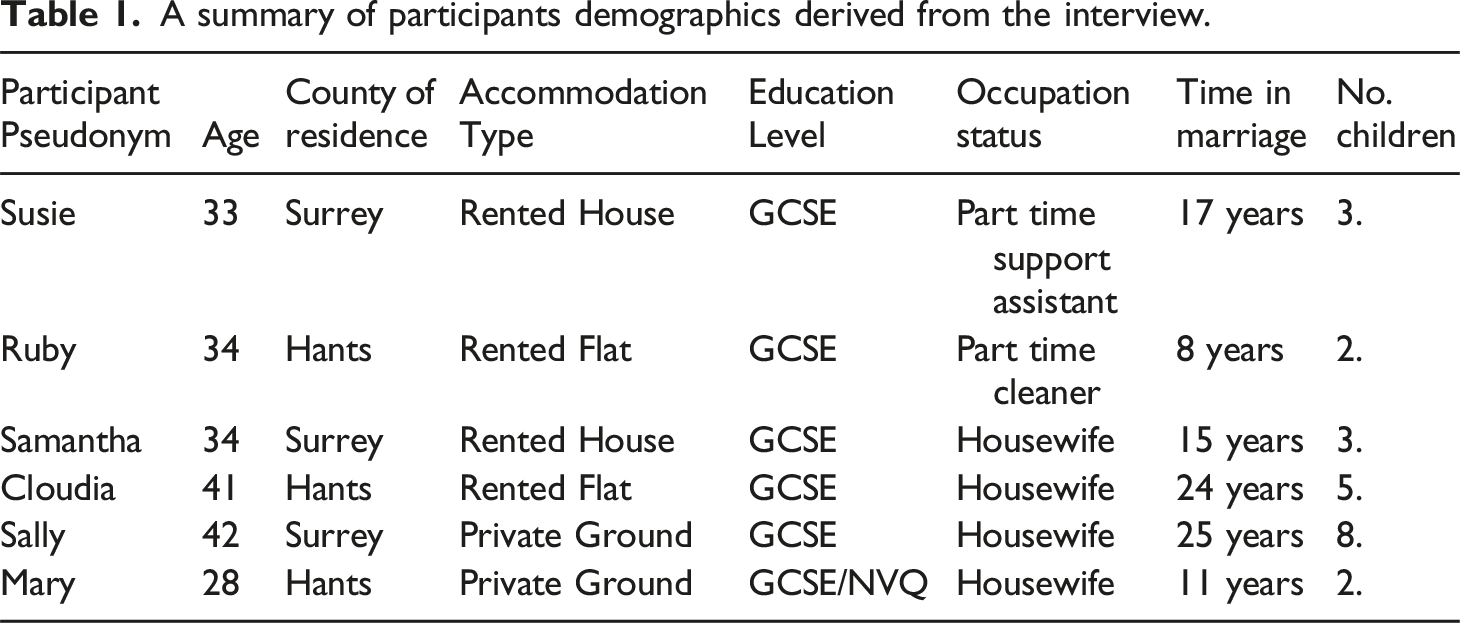
Purposive sampling of the first author’s own social network recruited two participants that met the inclusion criteria. Snowball sampling then recruited four additional participants (Mage = 35.3 years, range 28–42 years). The unintentional geographical location of all six participants fell within a 20-mile radius of Surrey and Hampshire, UK. Inclusion criteria required participants to be women living in the UK, who were not of Traveller ancestry but married into the culture and over the age of 18 years of age. The idiographic aim of the study sought a sample size in which individual voices and experiences could be located and heard through intense analysis of each interview transcript. Six interviews provided enough scope for developing cross-case generalities.
Materials and procedure
A summary of participants demographics derived from the interview.
Reflection
The research team sought to present and analyse the sources of data as accurately and as fair as possible. At the time of writing, the first author was a postgraduate student of psychology at a UK institution with interests in the psychological, social, and political perspectives surrounding the Gypsy, Roma and Traveller culture. Another author, MN has expertise in qualitative research methods, social and cultural psychology, and DF has an academic background in psychology more broadly. The analysis has benefitted from including different perspectives of the racial and gender inequalities, by shedding light on the emerging themes that can be reflective of the lived experiences that non-Traveller women marrying into the Traveller culture face in the UK.
Trustworthiness
This being a qualitative study, mitigating biases and assumptions was therefore paramount so Guba’s (1981) four constructs; credibility, transferability, dependability, and confirmability were implemented throughout this research to ensure rigour and trustworthiness. In doing so it became apparent that some of the initial interview questions could have been interpreted as assumptive, so the interview questions were re-formatted to reflect a less presumptuous and more inquisitive stance. Additionally, after each interview being transcribed and again after analysis, each participant was able to read through their content to ensure interpretations made by the first author, aligned with what participants really meant, enhancing the credibility and integrity of the data. The previous experiences involved with individuals from the Traveller culture meant an understanding of the participants terminology and many participants assumed that the first author shared similar experiences as they often used phrases such as “you know what I mean” or “you get me”. All responses were kept to a polite nod, avoiding any confirmation but overall, this assumption enabled participants to feel comfortable in opening up to build a trusting rapport, evident within the detailed and reliable data collected.
Analysis
To adhere to IPA’s framework, the analysis of each transcript is presented without any reference to existing psychological literature or theoretical perspective. Three superordinate and six subordinate themes emerged from an inductive, bottom-up approach across the data.
Superordinate theme 1: Joining the culture
Joining the culture was a unique experience but something that each woman was able to reflect upon. The subordinate theme “Family approval/rejections” captured these varying experiences of marrying into the Traveller culture and illustrated some of the reactions and outcomes that were a result of their marriage choice. The subordinate theme “Living in two worlds” encompassed the emotional and psychological impact that the women experienced, revealing the many cultural differences that, at times, conflicted with their own values, compelling participants to utilise psychological processes to manage these two contrasting worlds, that is, the world they were reared in and the world they married into.
Subordinate theme: Family approval/rejections
What is typically a time of happiness for most, a new relationship with their Traveller partner was instead clouded by feelings of doubt and uncertainty for all except one participant. Two participants in particular emphasised their concerns surrounding family reactions to their marriage. “…I always knew there might be an issue with us being together cos I’m not a Traveller” (
Susie’s concerns seem to arise from not being from Traveller ancestry. When Susie acknowledges “an issue with us being together”, she seems to indicate she has some existing knowledge or assumption that a woman from her partner’s own cultural heritage would have been more suited.
This process of contemplation was a similar experience shared by Sally: “…He was really worried about what his family would think of me cos I wasn’t a Traveller. He literally told me out right, if we do this, you have to live my way of life, I won’t be giving that up”
With this statement, Sally outlines her partner’s initial reluctance to commit to their marriage as he too shared concerns regarding his family’s approval for his choice of partner. Perhaps having this come from someone directly in the Traveller community is more significant, as it appears to no longer be just an assumption, rather, it reinforces the idea of there being an awareness of ‘going against’ the cultural tradition in marrying out of the community. And, as if to compensate for the violation of “giving up” one tradition, Sally is told “you have to live my way of life, I won’t be giving that up”. These are powerful words that seem to indicate a combination of her partner’s unwillingness to “give up” another aspect of his cultural identity.
Subordinate theme: “Living in two worlds”
Within the interviews all but one participant disclosed the contrast between the western perspective and the Traveller culture whereby a potential partner is only introduced to the family when they are certain they intend to spend the rest of their lives together, as it often involves joining two families together. Those outside the Traveller community are not believed to share similar morals and values or have a lack of understanding of the culture itself, therefore, many Travellers would not feel comfortable or consider ‘outsiders’ part of their collectivist culture. This conflict between the two contrasting cultures has been described by participants as “living in two worlds”.
Sally provides a compelling description of the conflict that some of these women have experienced as a result of integrating into a culturally different lifestyle. “…My mum wanted me to have this financially amazing life, she has a successful career and invested a fortune in me, I was privately educated but I always wanted to get married and have a huge family cos I don’t have any siblings at all. She was absolutely heartbroken when we got together, she was horrified, she called him undesirable. What do you want to be with that undesirable for? He’s no good” (
Sally’s narrative here seems to highlight two conflicting concepts whereby she encounters an internal battle between her own wants and desires; marriage, family, choice of husband, with the opposing wants that her mother has for her. One being a striking difference in cultural values. For Sally’s mother, she raised her daughter with education being of high value. By investing in a private education, it could be suggested that her mother wanted the best for her daughter and believed that a good education was the foundation to a “successful career” and having a “financially amazing life”. However, this contrasts with Sally’s own desires as she places more emphasis on “wanting to get married and have a huge family” - two highly valued concepts within the Traveller culture. The other conflicting concept was social class. Sally recalls her mother describing her choice of partner as “undesirable” and “no good”. Sally later revealed within her narrative that this stemmed from her mother’s privileged position in society, which meant she held negative stereotypical perceptions of Travellers being marginalised in society due to their lack of value on education, professional careers and social stability such as owning a home, that contrasted with the majority in society.
Superordinate theme 2: Culture clashes
This compelling superordinate theme highlights the ongoing process of negotiation that each participant experiences between their own sense of self, the expectations to uphold within the Travelling culture and the contrasting differences in the role of a women. Two subordinate themes, “it’s expected” and “the role of a woman”, captured each participant’s thoughts and feelings surrounding their experiences of cultural differences, thus, a clash when this significantly differs to the norms and values they were initially raised within.
Subordinate theme: “It’s expected”
Expectation was a prominent concept that every participant acknowledged. Within the Traveller culture there are expectancies surrounding certain traditions, beliefs, and gender roles. For some participants, this was notably different to the values internalised from being raised in the western individualistic culture. Susie describes how she accommodated some of these contrasting cultural expectations. “…it’s expected that women look after the home and children, so I just followed suit of the other women on the site. I learnt the ways, learnt what was expected or weren’t allowed in the culture”
From Susie’s narratives, she appears to be accommodating to the lifestyle, “I just followed suit of the other women on the site”, indicating she may have been unaware of the cultural expectations and utilised the other women as guides. It is likely she would have wanted to be accepted by the others living on the site, therefore, she willingly “learnt the ways” to assimilate and accommodate the new lifestyle accordingly. However, for Ruby, there were some cultural expectations that she struggled to accommodate. “…I was always one of the lads but that’s looked upon as slutty amongst Travellers, but that’s not me! I’ve just always been outgoing and a banterer [Joker], a lot like the blokes but that’s not allowed anymore. I do struggle with that cos even round my own in-laws, joking and having a laugh I find I kinda check myself and go to sit with the women instead but that’s not really who I am as a person, but it just saves all the drama”
In Ruby’s narrative, she describes how her personality clashes with the cultural expectation that married women should not engage in ‘banter’ with other males as this unintentional act can be considered promiscuous by others in the culture. Ruby’s consciousness of having to “check herself” suggests she is perhaps utilising a protective mechanism that subsequently means she suppresses her natural behaviours to “save all the drama”. It could be suggested that she is implying there is likely to be consequences if her demeanour is perceived negatively by others. Using the word drama, could imply that this type of behaviour is not an issue to Ruby, but she actively avoids it turning into a ‘big issue’ by others from the Traveller community. Her account coveys a strong sense of frustration in that she feels pressurised to conform to a particular way, despite it being contradictory to how she is as a person or how she was socialised in her own family, against the strict gender specific norms that appear to dominant the Traveller culture.
Subordinate theme: The role of the woman
Patriarchy was a prominent concept that arose in all participants interviews and has long been a defining cultural characteristic within the Traveller culture. For most of these women they married into the culture in their teens, therefore established the cultural expectations to fulfil their role as a married women at an early age. Mary implies her frustration of the gender equality and lack of autonomy within her marriage. “… something I did struggle with and still do which is a massive negative part of this lifestyle to me, is having to shut your mouth and not get involved in things. It’s considered ‘shameful’ and really against Traveller’s morals to intervene in a married couple, even if it’s turning nasty.”
Mary depicts a strong sense of powerlessness; it seems the cultural mores hold greater control over an individual to act or stand up for something, even if it’s considered morally right or wrong. The thought of bringing ‘shame’ to her husband by opposing the expectations of a women is something Mary frequently stated in her interview for many different aspects of the culture. Potentially, Mary is appeasing her husband to ensure she is considered ‘good enough’ within the culture. Perhaps she is aware that some traditions are engrained and hard to change as she appears to justify this to herself: “… You’re a woman, so you’re not superior to the man”
Superordinate theme 3: Changes to the self
This powerful theme highlights the direct changes made to each participant’s sense of self as a result of their experience of marrying into the Traveller culture. The two subordinate themes “It can be isolating” and “Positive impacts” both demonstrate how each experience had positive and negative impacts to one’s identity.
Subordinate theme: Positive impacts
Two participants expressed how their experience of marriage into the Traveller culture positively changed them as a person. “…Coming from my background to having such a strong extended family unit, a more stable homelife for my children makes me feel more complete, maybe that’s why I feel I am a stronger person now”. ( “…My life as it is now compared to my how my childhood was is totally non-comparable. I had nothing worth holding onto in my old life, those ways have been left. Although I’m not by blood, I do feel like I am one [Traveller] cos I’ve lived this lifestyle for 25 years now”.
Both Cloudia and Sally indicate a preference for the solidarity of an extended family unit that encompasses a collectivist culture. In comparison to their “old” lives, it seems they both feel they have internalised more positives from their marriage. Cloudia describes how a more “stable homelife” makes her “feel more complete”, indicating this could have been missing from her own childhood. Perhaps the cultural values placed on marriage and family within the Traveller culture enable her to feel a “stronger person” as it could provide her with confidence, knowing her own children will not endure anything similar to her own childhood. In this sense, maybe her marriage has fulfilled her emotional and psychological needs that could have been neglected within her childhood or arguably, remain missing if she had married someone from a westernised culture whereby, less importance is placed upon the value of marriage. When Sally states “she had nothing worth holding on to” it illustrates just how much more she feels she is gaining from her marriage. Perhaps the lack of emotional ties to her “old ways” were influential in why she accommodated so easily towards the Gypsy/Traveller lifestyle, to the point of “feeling like I am one”.
Subordinate theme: “It can be isolating”
For Ruby in particular, her experience of marrying into the Traveller culture has not had positive impacts to her sense of self. “…its just so isolating, I spend so much of my time checking myself and avoiding social situations, where I may have to act differently to how I would normally. I suffer with anxiety and everything now cos I find the culture has made me so paranoid in a sense you’re always being judged or worried bout what this person will think of you”.
It seems that the constant expectations to uphold is a significant contribute to Ruby feeling isolated and overly concerned with other’s opinions. Her experience is somewhat unique in this research. Compared to the other women, it is ironic that for Ruby, despite her previously acknowledging “loving the family aspect of this culture”, it could also be the very thing that elicits her “anxiety” and “paranoia” as it’s in these social scenarios that she constantly feels “being judged ”. Ruby did elaborate that her upbringing was very different in comparison to the Travellers way of life and talks about being “sheltered from a lot”, which may explain why she constantly expresses “feeling isolated ” in comparison to the other women. Perhaps Ruby did not want to openly discuss any cultural issues she has with her own family due to the differences between them and her husband. Maybe her sheltered life indicates her lack of experience or awareness of certain emotions or behaviours. It could be that not having the support or being able to communicate to her own immediate family is subsequently, the reason she feels more isolated than the other participants.
Discussion
This research extends existing literature pertaining to experiences of Travellers, by providing a rich and detailed insight into the now-culturally accepted lives of the non-Traveller women marrying into this community (Condon et al., 2019). In correspondence to Breakwell (1986), it provides a different perspective of how participants assimilate and accommodate living between two contrasting cultures. It was apparent that many varying conflicts had significant impacts to the women’s identities which provided the answers to the research questions. The three superordinate themes interlink and overlap with an overarching concept, that is, ‘an on-going process’ of maintaining continuity of aspects of their identity, in terms of their own heritage values and personalities, and adapting to the discontinuity, in terms of the challenges evoked from their marriage into the Traveller community. These concepts of continuity and discontinuity are continuously at play and interact with another central concept, that is, conflict. In this sense, the participants’ identity is fluid and formed through a complex, on-going development of negotiation, whereby the concept of conflict initiates the core processes of IPT; assimilation-accommodation and evaluation (Breakwell, 1986).
Within the first superordinate theme “Joining the culture”, participants expressed feelings of intrapersonal conflict in the form of worry and concern surrounding family reactions to their marriage choice. Perhaps the conscious awareness of the stark differences between the two cultures, in terms of traditions, values and collectivist ideologies, elicited this internal conflict as the continuity of their own heritage norms and values may be inevitable. Susie indicates this dilemma, “I learnt the ways, learnt what weren’t allowed in the culture”, indicating a discontinuity of her ‘own ways’ to accommodate the Traveller culture. This supports the findings of Greenfields and Smith (2010) who found equal dominance of the Traveller culture amongst participants with mixed ancestral heritage. Equally, When Sally’s partner declares “if we do this, you have to live my way of life, I won’t be giving that up”, it reflects the investment he holds towards his own culture (Tajfel & Turner, 1982) but also depicts how continuity can become threatened. In correspondence to Cemlyn et al. (2009) who reported that the taboo of marrying out of the Traveller culture will jeopardise cultural continuity, this factor seemed to have a strong influence over individuals’ commitment to their relationship and supports the findings of Bhopal (2004) whereby cultural discontinuity was feared amongst Travellers.
Within the second superordinate theme “Cultural Clashes”, every participant acknowledged having little autonomy within their marriage. This was expressed with mixed feelings within the women’s narratives and supported previous findings. Some were content and adjusted to their cultural role accordingly (Levinson, 2015), but others expressed feeling frustrated and oppressed by the patriarchal nature and the expected gender roles of the Traveller culture (Casey, 2014). As recognised by Hamilton (2016), the customs of Traveller culture differ significantly for women to the westernised perspective that promotes gender equality and independence therefore conflict arises within the individual. Ruby described feeling a sense of powerlessness and limited agency over her own personality that directly affected her behaviour. This corresponds with previous literature (Casey, 2014; Hamilton, 2016; Marcus, 2015) that indicates the psychological distress experienced by women within this culture is a by-product of their gender inequalities and expected behaviour ascribed to the female role.
The final superordinate theme “Changes to the self ” indicated feeling “a part of something bigger than me” and “more complete” from some participants. This supports findings from Tajfel and Turner (1982) whereby individuals from partial or disjointed groups, in this sense, some of the women who shared childhood experiences with some aspects of neglect, lead to full group assimilation when positive enhancements of the self are effective. Their sense of individual identity (‘I’) overlaps with the (‘we’), therefore boundaries become blurred and identity more distinct with the groups.
Conversely, some women experienced negative impacts to their sense of self, supporting the findings of Hall (1993). Similar to Jaspal and Breakwell (2014) wherein individuals will adopt deflecting or accepting coping strategies to negotiate their contrasting group identities, Ruby utilised both coping strategies throughout her narrative. Deflection, in the form of resistance to change was portrayed in her defiance to raise her daughters to accommodate the cultural expectations and gender specific norms associated to the Traveller culture. Accepting, was reflected within her acceptance of how life is, and her unwillingness to challenge the cultural norms. Every participant notably employed the accepting strategy to fully accommodate their new culture into their identity structure, supporting the findings of Rassool (1999) in the adaption and evolution of Traveller culture, rather than complete disappearance.
Implications and usefulness of the study
This study highlights implications that incur from association to this minority ethnic group. There are clear discrepancies within the current legal definition of Gypsy, Roma, and Traveller ethnicity which complicates who is applicable to claim political rights and “Traveller” status. These findings have clearly indicated that those with no cultural heritage to GRT ethnicity but married into or have ancestral heritage, identify and maintain this culture, therefore, they should be acknowledged and preserved the same political rights and status as those living a nomadic lifestyle by Governmental policy makers.
Equally, other societal professionals such as educators, social/support workers can be informed of the cultural challenges and conflicts that arise for individuals living between two cultures. Professionals need to be sensitive to this minority group to ensure they are adequately supported and that their overall psychological wellbeing is not negatively impacted further. This research found that more support is required from support workers, midwifes and health care practitioners, for these women to discuss and comprehend issues of patriarchal dominance or cultural gender inequality prominent in their contrasting worlds. Enhancing positive experiences of support, by having an informed understanding surrounding GRT ethnicity, will generate a more inclusive involvement that eliminates discriminative attitudes, resulting in greater educational outcomes and establish an awareness of their victimization, to empower them to effectively overcome any challenges or difficulties for a more positive self-concept. In turn, this reverses the long-held stereotypes by mainstream society of GRT’s and their perceptions of professional bodies.
Similarly, knowledge and awareness of these women is actively absent in tv documentaries, bringing implications to media domains. There focus has largely been an inaccurate, unrepresentative, and highly stylized depiction (Casey, 2014) of a very small portion associated to the GRT ethnicity and typically portrays their anti-social behaviour and site evictions (Richardson, 2007).
Therefore, the usefulness of this study can be depicted in its originality to identify the lived experiences of a under researched group. It provides an imperative for professionals to understand and acknowledge the conflicting cultural aspects that challenge and have direct impacts upon individuals’ identity. It enables discussion surrounding Traveller definition, status, heritage and rights within policy makers, the inclusiveness of GRT communities in schools, and equally, the need for support groups for the women within this community. Finally, it provides a basis for future research; academics can further explore the experiences of marriage into the GRT culture and its impact upon identity across the UK, in males also and amongst the next generation. A follow up study may be useful to further understand and highlight any changes that may occur over time, surrounding the ongoing processes of continuity and discontinuity to the women’s identities.
Conclusions
The originality of this study and its use of empirical evidence addresses a clear gap in academic research. By exploring an under researched group, within a psychological and theoretical framework, it offers a unique qualitative insight into the lived experiences of non-Traveller women marrying into an ethnic community that is largely overlooked, nor achieved with quantitative research. Utilising a semi-structured interview format allowed for clarity, probing and expansion in participants initial responses which generated up-to-date attitudes, thoughts and feelings experienced by non-Traveller women marrying into this typically self-protective culture.
The governmental policies enforcing the integration of Travellers into mainstream society has led to some of the significant changes in attitudes between these two cultures. It is within this research that acknowledgment of the complexities surrounding the now widely accepted intergroup intimate relations between Travellers and non-Traveller’s is evidenced through the women’s own experiences as well as the identification of some of the themes that influenced the interpersonal conflict experienced by women living between these two-contrasting cultures. This conflict appeared to be a direct consequence of continuously negotiating between continuity, in terms of maintaining aspects of their individual identity and discontinuity, in terms of adapting to the different cultural values and expected mores e.g gender specific roles and patriarchal superiority that are prominent aspects of the Travelling community, unaffected by the process of integration.
Despite homogeneity being impossible to uphold, this research remains an important case study whereby future research can further explore the experiences of marriage into the Traveller community and its impact upon identity, particularly for males, other cross-cultural marriages and as the relations between Travellers and non-Travellers continues to merge, within the next generation also. Although this study had a small sample size and participants unintentionally came from one region of the UK, the findings from this research can be used to inform professionals to better understand and appreciate the conflicting cultural challenges that these women, couples and their children experience within their social contexts so that support can be provided to enhance the overall well-being and inclusiveness within schools and political rights relating to claiming “Traveller” status of the individuals living between these two contrasting cultures.
Footnotes
Declaration of conflicting interests
The author(s) declared no potential conflicts of interest with respect to the research, authorship, and/or publication of this article.
Funding
The author(s) received no financial support for the research, authorship, and/or publication of this article.
