




Abstract
The development of a deepened sense of self in young adults is a complex process. In this paper, we report on an interdisciplinary research project on identity formation among students at the University of the Free State from the perspective of semiotic work. Based on work in psychology and semiotics, we interviewed fifty-seven students about their identity. In particular, we asked students to bring along ‘something’ that they thought represents their identity, and we asked them to explain their choice. We first performed a semiotic analysis on the representations the students brought and then coded their motivations for themes. We found identity formation along the lines suggested by existing literature, with themes related to the importance of finding both an authentic and relational sense of self in a growth process that contains elements of hardship and strength. The study did, however, find two points of interests, namely the fact that very few students brought a material representation with them as well as the fact that students oscillated between resilience and succumbing to pressure.
Introduction
Making sense of oneself and one’s place in the world is a dynamic lifelong process. This search for a deepened sense of self is especially prominent in young people’s lives as they transition into adulthood. It is a continuous meaning-making process that entails the reciprocal actions of creating and expressing an identity. Individuals are meaning-makers in the sense that they construct their identities using everyday events, social encounters, and available resources in a variety of cultural contexts (Rutherford, 2022). This would imply that identity formation is a semiotic activity through which young adults make sense or meaning of their existence, who they are, and how they fit into the world around them. They must answer basic questions about meaning such as ‘What does it mean to be me?’, ‘What is the meaning of being part of this or that tradition?’, or ‘What does it mean to be battling in my studies?’ Being at university offers emerging adult students a social context to explore new interpersonal interactions, incorporate diverse ideas, and reflect more abstractly about themselves and the world.
In this paper, we consider students’ identity formation from a semiotic perspective, that is, we are interested in the way in which identity formation entails semiotic work. This means that we are interested in the meaning or significance that students assign to issues of identity and the meanings that they incorporate into their identity. We operate with Marais (2019a, 2023a) conceptualisation of translation, namely that translation refers to the semiotic work that is performed to constrain semiotic material under teleological intent. A semiotic approach provides a number of affordances. First, it provides a researcher with the tools to study more than language in order to infer psycho-cultural processes (Parmentier, 2016). Second, its focus on the sign provides for a fine-grained analysis in which the details of meaning-making practices can be explored. Lastly, it offers a complexity perspective that does not reduce psycho-cultural processes to either materialism or idealism but sees the emergence of identity as an entanglement of matter-energy and ideas (Barad, 2007; Blumczynski, 2023).
This paper entails an interdisciplinary approach that combines psychology and semiotics in an effort to understand identity formation as semiotic work. In order to investigate this argument, we asked students at the University of the Free State (UFS) to bring any “thing” that represents their identity with them to an interview. While the interviews were much broader, this paper reports only on the semiotic analysis of the representamens that the students brought and their comments about the meaning of these representamens.
Conceptualisation
This paper brings together semiotics and psychology in an attempt to understand the semiotic work that students need to perform, at the development phase in which they find themselves, to create and express their identity.
Constructing a sense of self
Individuals’ developmental trajectories contain both commonalities and idiosyncratic elements. While a sense of self/identity can be seen as a subjective sense of sameness and continuity across time and space (Erikson, 1968), it is also a fluid and emergent process that evolves in interaction with the world. A sense of self thus simultaneously contains elements of sameness and distinctiveness, multiplicity and unity, permanence and change, and being and becoming (Andacht & Michel, 2005; Bamberg, 2011; Hermans, 2012; Märtsin, 2010).
Identity, culture, and language are intricately related (Hall, 1997). Identity construction (and reconstruction) is therefore embedded in social others and cultural worlds (Märtsin, 2010; Vygotsky, 1978). Socio-cultural contexts provide shared concepts, ideas, and images and thus frame how individuals select and interpret messages to shape their self-views and identities. Individuals are immersed in their social worlds and actively involved in negotiating and generating meaning during social interaction.
Identities are formed in dialogue (Hermans, 2012; Märtsin, 2010). This conversation is both intra-personal and inter-personal and results in the integration between inner (internal/personal) and outer (external/cultural) worlds (Rutherford, 2022). It is also a way to consolidate lived pasts, experienced presents, and imagined futures (McAdams, 2015). Individuals can use multiple modes of communication to represent themselves and their understanding of the world and to shape their relations with others and the world. Language is central in this process as it provides a frame for representation (Hall, 1997), but language is by no means the only mode of representation. For this reason, we are taking a semiotic approach to understanding how students make sense of themselves.
Things or signs are often used to reveal the self to the world and to represent the world in the mind (Vygotsky, 1978). Things in the world can carry both social and personal meanings (Hall, 1997). Valued things reflect elements of the self and can be indicators of one’s identity (Kroger & Adair, 2008). Identity artefacts (an instrument, sign, material thing, embodied practice, etc.) can be used as a form of identity creation and expression (Subero et al., 2018; Vygotsky, 1978), which is why we turn to semiotics in the next section.
Semiotics
In this paper, we follow Charles Peirce (1994), but we include recent thought on semiotic agency (Sharov & Tønneson, 2021) and social semiotics (Kress, 2010) in order to be able to consider the semiotic process as it plays out in the lives of students, that is, semiotic agents. Peirce has left semioticians with a rich conceptual apparatus. One of the most used of these is Peirce’s three types of signs, namely icon, index, and symbol. However, our focus in this paper is more basic. Peirce bases his sign theory in his version of phenomenology, which he calls phaneroscopy (CP 1.284; 1.286; 1.287). This means that, for Peirce, a sign is the phenomenological relationship between three relata. The first of these relata is the representamen, or what is in common parlance known as a sign (De Waal, 2013, pp. 78–81). He also conceptualizes the representamen as the sign vehicle, the material difference in which the sign as a whole is instantiated. The representamen is pure possibility as, in itself, it means nothing in particular; it just has potential meaning. The representamen is then phenomenologically related to the object, for which it stands. The object is first that which gives rise to the sign. This can be a matter-energy thing in the world, but it could also be an idea. This object is called the dynamic object. The object is then also that which is revealed through the sign, namely an idea for which the representamen stands, which Peirce calls the immediate object (De Waal, 2013, pp. 85–87; CP 4.536; 8.343, Hardwick, 1977). The third part of the sign is the interpretant, which is what is commonly referred to as the meaning of the sign. Peirce identifies three types of interpretants, namely an immediate interpretant, which is the range of possible meanings that could be interpreted, the dynamic interpretant, which is the actual interpretation, be it an emotion, action or concept to which the sign gives rise, and the final interpretant, which is the ultimate logical conclusion to be reached based on the sign, but which is reached seldom if ever (De Waal, 2013, pp. 81–85).
Diagrammatically, a sign can be represented as in Figure 1. It is important to keep in mind that, for Peirce, these three relata in relation to one another is the sign. A Peircean sign.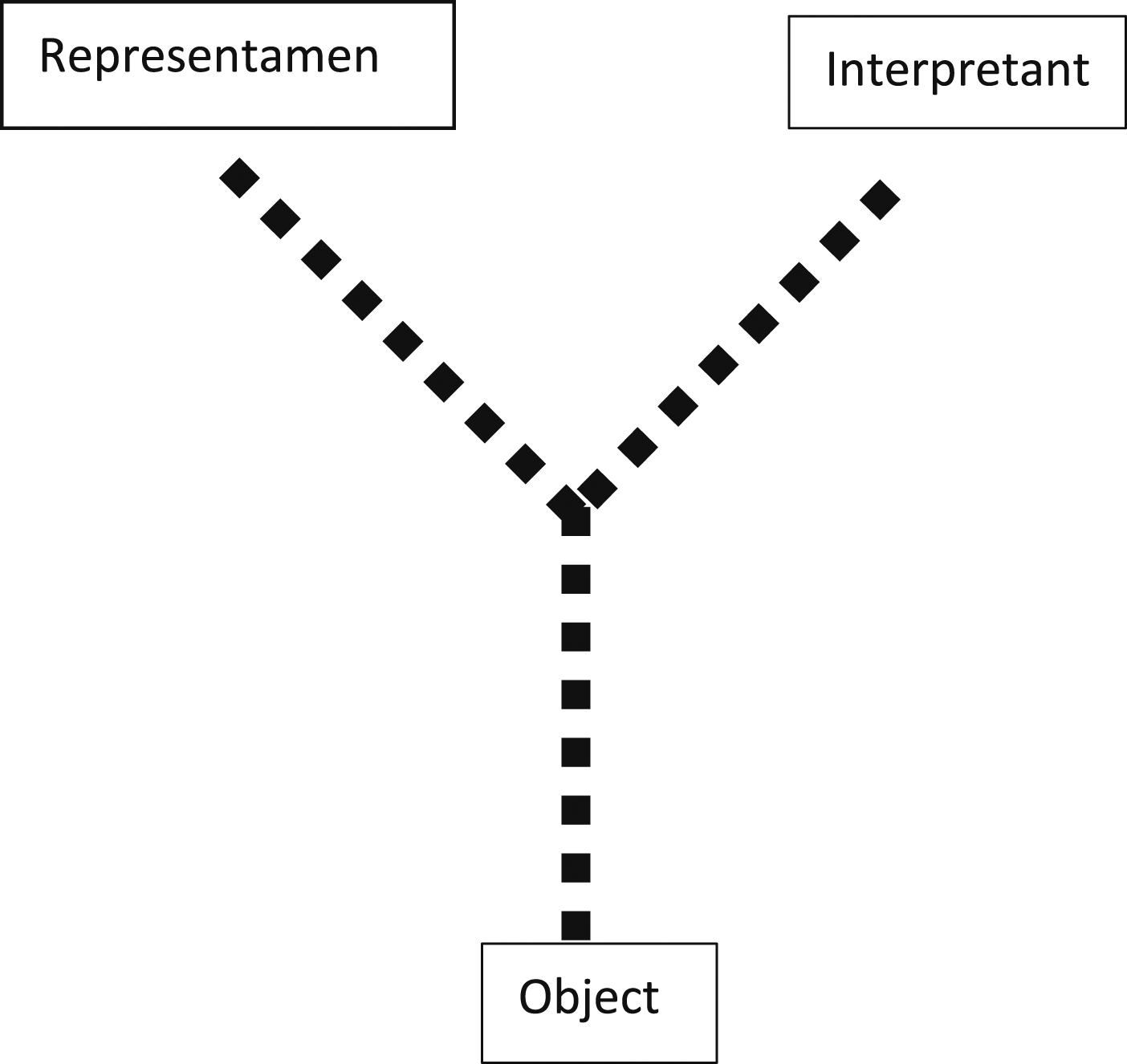
An example would be that the word ‘dog’, in English, is the representamen, which stands for the concept of a dog, as object, or for an actual dog. When relating the representamen and the object, I could think of a dog in general, but I could also think of my little Fido at home. From these figures, Peirce’s idea that a sign is something that stands for something else in some respect for someone becomes clear (CP 2.228). The representamen stands for the object in some respect, and it does so for an interpreter who creates the interpretant.
In an attempt to work out the implications of Peirce’s semiotics for translation theory, Marais (2019a, 2023a, 2023b, 2024) has suggested that translation be regarded as semiotic work. He bases this argument on Peirce’s statement that ‘… a meaning, … is, in its primary acceptation, the translation of a sign into another system of signs …’ (CP 4.127). Meaning, in Peirce’s conceptualisation, thus entails the reworking of existing signs into other, preferably more developed signs. Suggesting a synthesis between energy, information, and significance, Marais (2023a, pp. 38–45) argues that meaning is created through a translation process that entails the imposition of constraints on semiotic material. This process is always performed by semiotic agents (Sharov & Tønneson, 2021), and the semiotic agent always operates under some or other teleology (Deacon, 2007, 2008). Based on this conceptualisation, we are interested in the semiotic work that students perform to construct their identity and in the semiotic work they perform to communicate about their identity.
Since the 1990s, Hallidayan linguistics has expanded its original foundation in semiotics to allow for research on visual material and to provide a particular methodology for researching visual material semiotically. Because we are interested in meaning-construction over and above what is done through language, we chose social semiotics as methodology. Social semiotics also makes use of and is based to some extent in Peircean semiotics, but it has a more fine-tuned methodology with which to allow for empirical work on what has become known as multimodal texts (Jewitt et al., 2016; Kress, 2010). While one could argue that communication has always been multimodal to some extent, technological advances over the past century, in particular computational advances, had the effect of expanding the amount of multimodal communication and the ease of communicating multimodally. One of the implications of this observation would be the assumption that, when students construct their identity through communication, they do so multimodally. We therefore operated on the assumption that students would be well aware of and proficient in dealing with multimodal communication.
In this paper, we therefore consider the multimodal nature of student communication from a social semiotics perspective (Jewitt, et al., 2016). Social semiotics is one of the approaches to multimodality, and it is based in semiotics, critical discourse analysis and systemic functional linguistics. Its main aim is to study the construction of power and ideology through multimodal communication by considering the semiotic resources used as well as the interests of the sign-maker in designing a text.
The key interests of social semiotics are the following. First, social semioticians study the interest of the sign-maker as it relates to their positionality. Positionality here is clearly a social and cultural category, which means that social semioticians would be interested in the ways in which social-cultural situatedness constrain the interest of the sign-maker. Second, social semiotics argues that the interest shapes attention, which is always limited and therefore frames the interest. Here, social semioticians would be interested in how the limited attention of the sign-maker focuses their interest. Third, the implication would be that the selection of signs for the communication process is indicative of the interest that the sign-maker had in the first place.
Social semiotics studies therefore regard communication as an index of a meaning-making process (Marais, 2019b; Parmentier, 2016). In other words, the signs that were chosen for a particular communication task are indexes of the semiotic work that underlay that communication. Like a skilled tracker can deduce much from the spoor left by a lion, for example, how long ago the lion walked there, how fast it was walking, and whether it was healthy, a skilled social semiotician interprets the signs chosen by any sign-maker as traces of the thought process of that sign-maker.
It is important to understand that, in social semiotics, signs are regarded as semiotic resources that a community provides to the individual sign-maker for the purposes of communication. The sign-maker then chooses the most apt signs for a particular communicative intention. The point is, though, that these semiotic resources are socially and culturally constructed and therefore influenced. They are not neutral descriptions of the world but situated meaning-making responses that emerged in a particular social-cultural context.
Social semiotics is therefore interested in the design of a message, that is, the choices that a sign-maker makes as far as the semiotic resources and their arrangement are concerned in order to meet particular purposes (Jewitt, et al., 2016). Empirical work in social semiotics would thus be interested in the following questions: • Who made it and why? • How is the artefact structured, and what is its relationship to other discourses? • Who is the imagined reader/audience? • What does the artefact suggest about the imagined reader’s ‘life world’? • For what is the artefact expected to be used?
In this particular case, students were asked to share multimodal communication that might give an indication of their identity. Below, we report on the multimodal data we collected.
Methodology
Summative table of biographic characteristics.
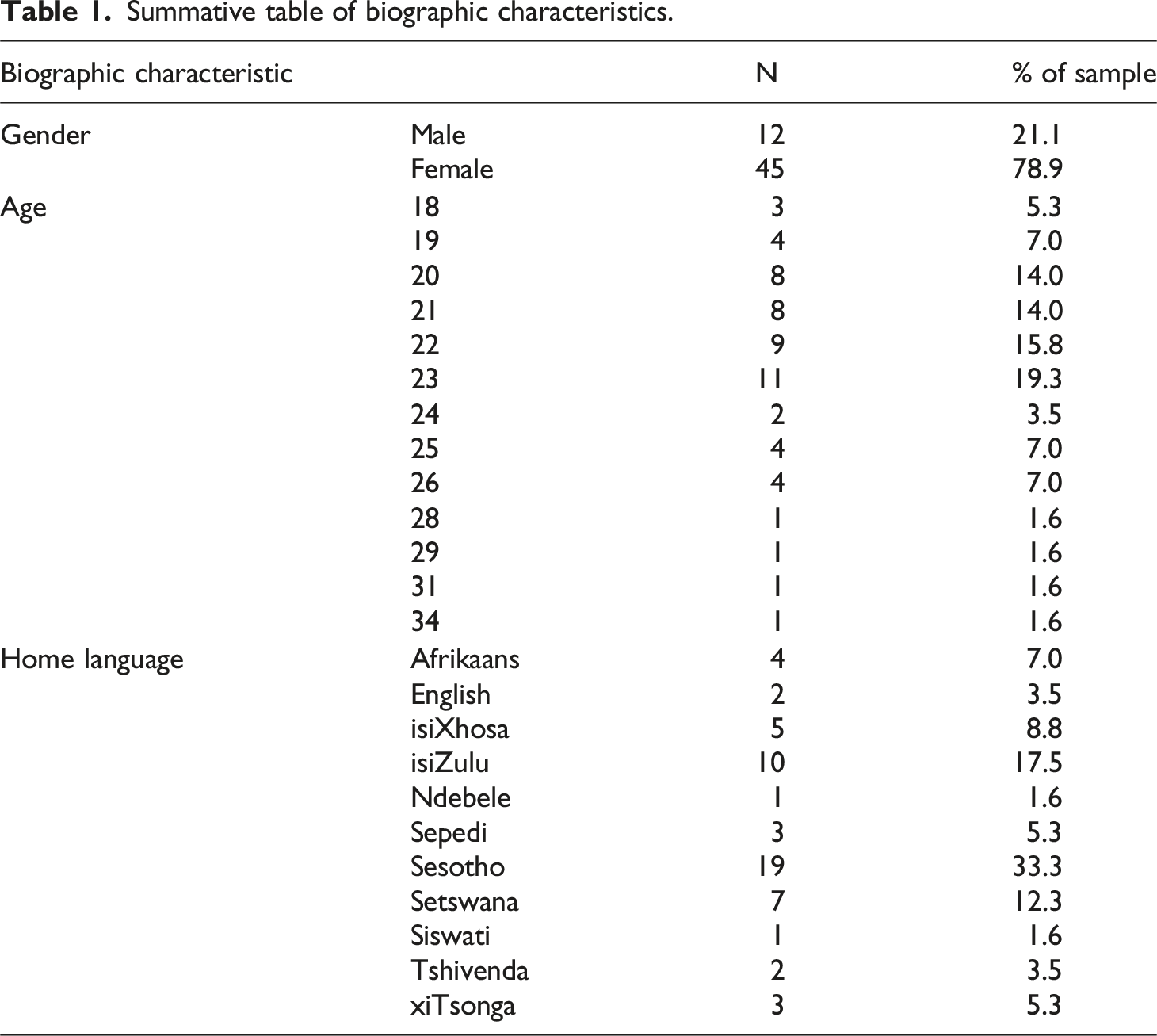
Each participant was invited to bring to the interview any “thing” that they associate with their identity. In preparation for the interview, they were asked: Think about something in your life that represents your identity views in life. Bring this along to the interview to share. The introductory part of the interview was a prompt for the student to talk about the choice of representamen and its resultant interpretant. They were asked to explain: Why is this important to you?, What does this say about you?, and In what way does this represent your identity/view of life? Each of the 57 interviews was recorded and transcribed verbatim for further analysis.
The analysis of the representamens was done from a Peircean perspective combined with a social-semiotic perspective to analyse the interests of sign-makers, that is, the students. Apart from the representamen, we analysed the students’ explanations to infer the object they had in mind as well as the interpretant that resulted from this semiotic work. The data presented us with an interesting tendency, namely that the majority of students (42) did not bring a material “thing”. Rather, they brought ideas about which they spoke. This trend caused us to draw a distinction between the media product (Elleström, 2023) and the mode (Kress, 2010) in order to clarify what we were dealing with. So, the semiotic material that we worked with was a verbal discussion, and sometimes (15 students) an artefact was added to that. One could therefore say that the mode of the representamen was a concept in 42 cases and a material artefact plus a concept in 15 of the cases. We report on the relevance of this methodological choice in the data analysis. We then constructed a representamen, object, and interpretant based on our interpretation of each student’s narrative about their representamen.
Results
To understand the semiotic work of students in interpreting and expressing their identity, we conducted both a semiotic analysis of the representamens that the students brought and a thematic analysis of their narratives about the meaning of these representamens.
Semiotic analysis
Only 15 of the 57 students that we interviewed brought something material with them. Most students just spoke about a memory or an idea that they have. The artefacts that were brought were memes (2), earphones (2), photos (6), a rosary (1), traditional beads (1), tattoos (2), and music (1). The dominant material form of communication, and hence the dominant media product (Elleström, 2023), was therefore spoken language. This in itself raised the question as to why so many students did not bring material artefacts. Is it the case that students live in what Maran (2020) calls the symbolosphere and that they do not see the need for or do not see as meaningful the material artefacts we were expecting. One could perhaps even argue that they do not draw a distinction between artefacts and their representations of artefacts, a tendency that Baudrillard (1994 [1981]) describe as living in a ‘simulacrum’ where the distinction between original and representation becomes blurred or disappears altogether. At this point, we cannot, with the data we collected, answer this question, but we think it might be worthwhile to explore in future.
We also analysed the modes of meaning-making used by students (Kress, 2010). The 42 students who did not bring any artefact therefore presented their memories or ideas about something that they have experienced or that they possess. The students therefore used language and narrative to talk about memories of artefacts that they found meaningful. We highlight this point to demonstrate the multiple layers of representation or semiotization that we are dealing with here. For instance, a student discussed the concept of a photo of a house leaning on a tree, which for them referred to the support of their family. It seems that the student used at least five levels of semiotization. They wanted to talk about their family (level 1), which was represented by a house leaning on a tree (level 2), of which the student had a photo that they did not bring along, which meant that they had a symbolic representation (level 3) of the photo (level 4), and the way in which they represented the concept was through an oral narrative (level 5). We did not ask about this, but we assumed that students would understand the difference between a photo and a representation of a photo if they were asked about it. However, in their experience, or from a phenomenological perspective, it seems that the material and the ideational, memory and materiality, flow into one large web that does not require differentiation. As indicated earlier, this observation seems to confirm Maran’s view that humans generally speaking see themselves as living in the symbolosphere with very little if any regard for the physio- and biospheres.
The represented modes of communication therefore entailed photos, printed books, elements of nature, video, music, memes, and tattoos. Music was by far the most popular mode used to explain their identity. Printed books were also quite popular, mostly the Bible. We assume that the music to which these students referred would be in electronic format, that is, on mobile phones and perhaps, here and there, a CD. The prevalence for electronic artefacts seems clear and is to be expected in 2023. We did not ask them in which format they read the Bible, but even if all references to the Bible was to a printed Bible, the preference for electronics seems clear. Students at this Global South university thus represent themselves predominantly through electronic media. In this trend, the Global South will probably not be different from the Global North. The question remains, however, if there are material differences between these two contexts, for example, preference for phones over computers.
Next, we worked on identifying a representamen for the meaning-making process through which the students explained their identity. As an example, the media product of one student was the verbal explanation of an thing, namely a photo (which we identified as the mode). We then took the concept that the student had in mind as the representamen, in this case a house leaning on a tree. From the student’s explanation of this representamen during the interview, we inferred that the object they had in mind was their family, and the interpretant that emerged from this semiotic process was that family is there to lean on, that is, for support.
The semiotic methodology we followed allowed us to analyse the difference between memories or ideas, on the one hand, and the matter-energy in which those were instantiated. The difference is relevant because of the complexity of representation that modern technology affords these students. In order to understand the identity-formation process in these students, we think it is relevant whether they represent themselves with something material or with memories or electronic representations. The materiality of the representation speaks to the way in which their identity emerges, and this analysis might be compared to analyses in other contexts, both space and time, and other cultures.
In the next section, we report on our analysis of these interpretants, which pertain to the topic under discussion, namely students’ identity. For this analysis, we coded the objects and interpretants that we inferred from each student’s interview.
Thematic analysis of objects and interpretants
For this section of the analysis, we focussed on participants’ narratives to understand how they interpret personal meaning from the objects. Our coding practices were informed by the coding guidelines suggested by Saldaña (2016). During the first round of coding, we worked systematically through the complete data set with an explorative stance. We assigned codes to the relevant and coherent ideas from the participants’ narratives. During subsequent cycles of coding, we developed and adjusted these initial codes in an attempt to capture the salient units of meaning. Each participant’s narrative was coded separately, after which the codes were organised and clustered into themes that represent a condensed overview of important meaning patterns. With each phase of the analysis, we worked individually at first, followed by reflective discussions to consolidate, distil, and also challenge our preliminary thoughts and themes.
Summary of themes and subthemes.
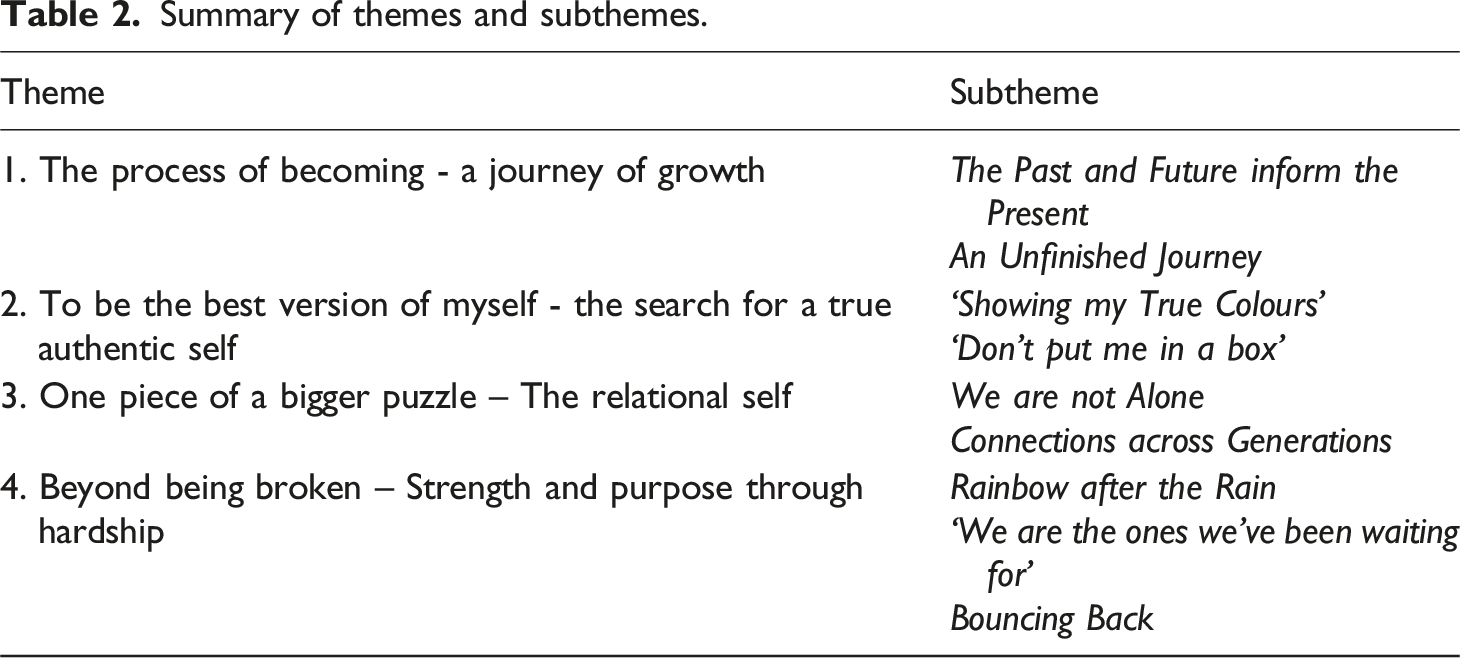
The uniqueness of participants’ identity expressions was seen in the variety of things introduced during the interviews. Some participants referred to memes, TedTalks, or quotes from books, such as Becoming (by Michelle Obama), We are the ones we’ve been waiting for (by Alice Walker), and the Bible. Some participants opted for more personal things such as a tattoo with personal meaning or their own name: “my name is my identity. I’m T*. My name means wisdom, So, my name basically represents who I am (M1)”. One participant presented himself and his mindset as his ‘brand’. Participants used things to represent their personality traits (i.e., strong as a tree, colourful as a sunset or rainbow, bright as a sunflower, resilient as a bouncing ball or a cat with nine lives). For some, the things related to their values and principles (i.e., fairness as represented by the Lady Justice statue). Things also signified interests (i.e., outdoor life, exercising, travelling, modelling, poetry, painting) and important relationships and roles (i.e., a family photo, rosary beads to represent religion, the pride flag to express gender, and traditional healer beads to signify the importance of cultural tradition). The most frequently chosen things related to elements of nature (rainbow/plants/trees/flowers/butterfly/sunflower) and music, especially gospel music such as Just Hold On (by Boyz II Men) and Firm Foundation (by Cody Carnes) and music with inspirational lyrics such as Rise Up (by Andra Day), One Call Away (by Charlie Puth), Kuth' angizule (by Shushubaby), Ee Ke Dumetse (by Oleseng Shuping); I am Woman (by Emmy Meli), Miss Independent (by Ne-Yo), and I’m Alive (by Celine Dion).
While all the things carried personal significance for each participant, these things served different functions in participants’ identity representations. For example, music: For some participants, music was a form of self-expression; it represented aspects of themselves: “remind me of who I am, a Christian, you know… it keeps me in intact with who I am (F3)”; and: “that song, that energy of it, represents my identity. I’m a fun-filled person (M2)”. For other participants, music captured experiences and connected emotions: “I also have a theme song for my life, like every situation in my life has a background song only I can hear (F2)”; and: “music reflects to things that I experienced in my everyday life […] like a medium that connects a lot of things. It connects a lot of vibes, a lot of people, have a lot of spirituality (C2)”. Music was also often mentioned as a source of inspiration for what participants strive to become: “It lifts my spirit […] the minute I hear the song, it’s kind of like ‘wake up, get out of that zone’ (J1)”; and: “whenever I just want to bring back the oomph in me, the excited me, I listen to Céline Dion’s song, I’m alive […] whenever I feel that my energy is at a zero […] the song that picks me up (M2)”.
Theme 1: The process of becoming - a journey of growth
Participants’ narratives pointed to identity formation as a process of growth. One participant used the image of a butterfly to describe the transformative process: “I believe very much in progression, I believe in different stages, and I believe that at the end, you’re going to transform into this beautiful butterfly and live your best life (Z1)”.
The past and future inform the present
This process of identity formation contained elements of the past, present, and future. In describing their identity representations, many participants reflected on their past and articulated how ‘what they have been through’ informs who they are today. Participants also emphasised how the anticipation of a better future served as inspiration. For example, one participant explained how the lyrics of a song “is kind of like a letter from my future self to me. So, whenever I am at the verge of giving up […] it is kind of like my future self, telling me that: ‘you can get through this, remember you are doing this for me’ (J1)”.
An unfinished journey
Participants used statements that describe an ongoing and continuous process of change: “we are going on this journey of life […] I am still going forward even though I don’t know where my journey will lead one day (N3)”. It was described as an uncertain learning process: “in life, it’s always trial and error (F1)”. Like natural seasons, it fluctuates between times of growth and times of stagnation: “the tree also grows. Some seasons it’s green. Some seasons it’s brown, and it shed leaves […] I grow, I bloom. And there are some dark days where I also shed some (D1)”. One participant used the image of a colourful sunset to explain this: “it represents me as a late bloomer in life […] sunset is something that happens, not throughout the day, not like morning, but like later in the day, so I feel it represents me as a late bloomer, someone who’s done things later, discovered things later (X1)”. In reflecting on their development, participants expressed a hopeful attitude toward a deepened sense of self: “I would like to think that I am emerging into myself, you know. I am at the stage where the butterfly is coming out of that cocoon that it’s been in, and you know, learning to just stretch your wings, I haven’t spread them yet. I am still learning to stretch my wings (Z1)”.
Theme 2: To be the best version of myself - the search for a true authentic self
Many of the participants emphasised how they strive to become their best possible selves: “pushed me to be the person who always strives to be a better person in terms of everything. I make sure that I’m flexible, I adapt, I change, I grow, and so on, so as to make sure that I can keep up (N2)”.
‘Showing my true colours’
Authenticity was prioritised and many participants mentioned the need to become truer versions of themselves. One participant identified with the message in the book Becoming: “exploring myself beyond the mask that I wear; just becoming my authentic self and allowing people to see me for who I truly am (B1)”. Identifying with the Pride Flag, another participant explained: “I am unique; I mean, I am special; I am everything that I wanna be […] The colours are all bright and shiny […] never hold back, be out there as bold as the colours are […] be proud of who you are […] embrace yourself and just like love yourself (Q2)”. Participants emphasised the importance of self-acceptance: “because I am enough just the way I am (P1)”; self-awareness: “just listen to your heart (E2)”; and self-reflection: “seeing yourself is one of the best pleasures in life […]to always look at myself whenever or wherever I’m going, as long as there’s a reflection (E1)”. In addition to this, self-care was seen as important during this process. One participant used the example of a Bonsai tree to explain the importance of continuous self-care: “you have to nurture yourself in order to get good results, how you take care of yourself, only surround yourself with positive energy (F1)”.
‘Don’t put me in a box’
In this search for authenticity, participants portrayed a strong self-focus: “I see myself as a sunflower because I believe I have a bright personality; it just identifies with my whole aura (I2)”; and “I’m a very colourful person (W1)”. They wanted their (and others’) uniqueness to be recognised: “I also believe that everybody grows differently […] I am the type of person who allows people to be themselves […] I would like to live in a world where I’m also allowed to be and do the same thing (Z1)”. Evident in participants’ narratives was their need to be appreciated in their multi-dimensionality: “I have different identities based on the different aspects of my life (G3)”; “I like to say that I have multiple personalities (V1)”; and “a person is not black and white […] you’re not one thing […] you are not one-dimensional […] it’s bits and parts that make up you. […] I am all these things in one. Don’t try to put me in a box (M3)”.
Theme 3: One piece of a bigger puzzle – the relational self
Many participants described the relational nature of the self: “I’m a piece of the puzzle, so there’s somewhere in this world that I fit in. So, one way or another, I will find that space (U1)”.
We are not alone
The importance of belonging was emphasised: “I believe that we are not alone, like we belong somewhere, and the minute you know where you belong, that is where you are going to draw strength (K3)”. Participants explained how identity development is embedded in interaction with others: “to share your stories with other people (H1)”; and: “you meet different people, and they have an impact on your life and whom you end up becoming, you know, you touch them, and they touch you, and you develop and become the type of person that you want to be. You learn a lot about yourself through interactions with other people (Z1)”.
In their search for self, they found strength in connection with others: “I’m very keen on support, support contributes to my identity (A1)”. Using the image of a tree, one participant explained the importance of others: “It provides fresh oxygen for others, and it also, like, supports people. It gives shade (D1)”. The reciprocal nature of these relationships (not only receiving but also giving) was clear: “I am a very helpful person. I would go above and beyond […] go out of my way to help people. That is just who I am (Y1)”; and: “if a friend needs help, I am gonna be there […] do not have to go through these things alone […] fun times, tough times, I am there (J1)”.
Connections across generations
Family connections were prominent in many narratives. Participants were grateful for their family’s presence in their lives and especially appreciated family support during difficult times: “my family is always there for me to support me and to build me or to just lift me up when I need that push (A1)”. Beyond support, families also provided direction in their identity search: “my family is the centre of almost everything I do, the decisions I make […] they also affect how I structure and direct my life (K3)”. One participant described how his family contributes to his identity by using a family photo: “the picture tells me how important I am to the two generations, which is my parents’ generation and the generation of my children, cause I’m the cross bridge between the two generations (B2)”. Another participant explained how her tattoo reminds her of her relationship with her grandmother: “my grandmother was everything to me. She was my life. We had a great bond […] I feel like there’s somebody behind me […] I’m living for my grandmother, so everything that I do, I do it for my grandmother (J3)”.
Another prominent relational aspect was seen in participants’ spirituality and connection with a higher self/power. Many participants used images such as texts from the Bible, rosary beads, and gospel songs to explain how they find their identity as a child of God: “I am a child of God, which means I am love worthy, and I am valuable, and this made me new (H3)”. They expressed how faith in a higher power served as protection, strength, and guidance during difficult times: “the rosary is like a strong weapon like it is my protector, it is protecting me everywhere I go (J2)”. Connections to culture and ancestors were also mentioned: “being connected with your ancestors and just living life with that connection and not allowing anything to break it (G2)”.
Theme 4: Beyond being broken – strength and purpose through hardship
A significant theme, evident across all the narratives, was experiences related to hardship. Participants often mentioned ‘tough times’ in the form of academic, personal, and existential stressors: “I really, really, really have issues (E1)”; “I’m just tired, like, I’m just a tired student. (Q1)”; and: “I’m facing a lot of challenges, academic pressure, and I’m asking myself a lot of questions (B3)”.
Rainbow after the rain
Participants often reflected on the purpose of suffering and hardship: “after difficult times, something good will come […] rainbow is beautiful […] kind of like a symbol of I should not give up, it won’t always rain, it won’t always be dark days, there will always be light (R1)”. They believed in renewal and second chances: “if you are alive, you get a chance to try again (M2)”; and: “a cat metaphorically has nine lives which represents the fact that you can give people second chances over and over; it’s never too late to correct a mistake […] if something is going upside down and chaotic now, eventually you will be okay, and you will land on your feet (G3)”. Their narratives were filled with a search for encouragement and motivation: “Block out all the negativity and just focus on all the positivity […] every stone that’s thrown my way, I just take it and built (Q2)”. As mentioned, many participants used music as inspiration: “songs that uplift me […]it has taken me out of a dark space (V1)”. They referred to lyrics to remind them of this: “life seems easy when I listen to that song. I feel like everything is possible for me (P2)”; and: “whenever I am falling back, I remind myself that I am Miss Independent and I need to stand up (D3)”.
‘We are the ones we’ve been waiting for’
By reflecting on their own hardship, participants also found purpose in their power to be change agents and inspiration to others: “to be the voice of the voiceless women (O2)”. One participant identified with the statue of Lady Justice that exemplifies: “bringing justice to people […] speaking up for less fortunate people […] people from marginalised communities like our grandmothers in the rural areas who do not have access to their rights (N1)”. It is this purpose that motivated them to remain hopeful during times of difficulty: “although sometimes we feel tired and broken down, there are certain things and certain people we need to rise up for […] there are days where I want to quit, but I think of all these people […] I need to rise up for them (Y1)”. Another participant explained how the message from the book We are the ones we’ve been waiting for: “inspires me to do more […] I realise that change can be brought forth by me […] I should continue fighting; stand firm in the ideals that I believe in (C1)”.
Bouncing back
Participants portrayed attitudes of resilience in facing the difficulties of life. They emphasised how their strength is built through hardship: “In my life, I have had so many complications in life, but I managed to bounce off […] My life fluctuates, it goes up and down, but at the end, I always reach the point where like, I know I have made it (H2)”.
They were confident in their ability to stand firm and to remain true to themselves during life’s trials: “just wanna keep going, even if it’s hard […] I’m always looking forward to moving, to not giving up (W1)”; and: “there is no struggle bigger than me […] I’m persistent, I’m a hard worker, and I’m bright. I’m ambitious, I’m smart, and I’m resilient. (M1)”. Reflecting on the image of a tree, another participant mentioned: “a tree is so strong […], and I am not easily shaken. Even if I got through so many challenges, I still remain myself. (O1)”
Participants frequently articulated how a deepened sense of self was reached through these challenging experiences: “butterfly starts as a caterpillar and turns into something beautiful. I would say it says that I was once a person in a bad situation I overcame (K2)”. One participant used the image of a Rubik’s cube that needs to be transformed from fragmented pieces to a holistic image: “I’m always changing, I’m always trying, I’m always figuring myself, trying to find out who am I […] I am a broken person who’s always made and who gets broken again. (W1)”.
Conclusions
One of the issues raised by the data is the point that the majority of students did not bring material representations of their identity to the interviews. Apart from the discussion of this issue above, we think it might be worthwhile to explore the prevalence of this phenomenon further. On the one hand, it could only be that they forgot. On the other hand, it would be interesting to compare this phenomenon in students from different backgrounds, for example, Global North or Global South, urban and rural backgrounds, different economic backgrounds, and different universities. Is this an indication of a generation of students whose lived experience does not allow for much distinction between reality and representation, or are there other factors that contribute to this propensity?
Whether reflecting on a material thing brought to the interview or a representation of this thing, all the participants could narrate how these things carry both social and personal meaning to them, reveal elements of their identities, and represent their understanding of others and the world (as also postulated by Hall, 1997; Kroger & Adair, 2008; Vygotsky, 1978). While our interviews were aimed at eliciting participants’ internal sense-making, their conversations were marked by the intertwined nature of their inner/personal and outer/cultural worlds (Rutherford, 2022). For example, many of the things they presented such as a family photo, the Bible, the pride flag, rosary beads, or traditional healer beads carried socio-cultural meaning. Furthermore, participants expressed how they are immersed in their social and cultural worlds (Märtsin, 2010; Vygotsky, 1978). They accentuated their relational self, as ‘One Piece of a Bigger Puzzle’, and their connections with others, across generations, also with nature and the spiritual world.
The young people in our research emphasised how their search for a deepened sense of self is prominent as they transition into adulthood. They were active “meaning-makers” (Rutherford, 2022) in the sense that they constructed their identities using everyday events (e.g., academic pressure as student), social encounters (with friends and family), and available resources (e.g., books, music). The interplay between distinctiveness and sameness during identity formation (Bamberg, 2011; Hermans, 2012) was seen in how some participants focussed on very idiosyncratic aspects of the self (such as their name, tattoo, or brand) while others emphasised their social identities (through family, religion, and cultural values). As argued by Hermans (2012) and Märtsin (2010), their identities simultaneously contained elements of unity and multiplicity. While participants were actively searching for their distinctive (unifying) authentic selves (e.g., in the theme ‘Showing my True Colours’), they also accentuated their multi-dimensionality (in the theme, ‘Don’t put me in a box’).
Identity formation is a continuous meaning-making process that spans across a lifetime (Erikson, 1968). Participants echoed this in their reference to the ‘seasons of life’. The intricacies of balancing continuity and change across time and space (Andacht & Michel, 2005; Bamberg, 2011; Hermans, 2012; Märtsin, 2010) were clear. Participants expressed how they were simultaneously ‘being’ and ‘becoming’. Their conversations were filled with evidence that these artefacts can be used not only as a form of identity expression but also as an identity creation (Rutherford, 2022; Subero et al., 2018; Vygotsky, 1978). Specifically in the theme, ‘An Unfinished Journey’, the fluid and emergent nature of the young participants’ current identities (e.g., transforming into butterflies) was confirmed. Things represented who they are (e.g., their current personal strengths and value systems) but also who they strive to be (their future selves). The theme ‘The Past and Future inform the Present’ demonstrated how a narrative identity (Bamberg, 2011; McAdams, 2015) is seen in the consolidation of lived pasts, experienced presents, and imagined futures. For our participants, resilience, ‘Beyond being broken’ was a prominent theme in their life narratives.
Another issue that piqued our interest relates to exactly the last issue of the previous paragraph. We were not sure as to whether to interpret the data we discussed in subsection 4 above as an indication of resilience, which would be a positive interpretation, or an indication of suffering or battling against overwhelming odds, which would be a negative interpretation. The former interpretation would reflect a group of students that are resilient despite difficult circumstances. The latter interpretation would see students in a constant struggle for survival, feeling overwhelmed, and under constant stress. This part of the data probably allows us some very preliminary and limited insight in the identity-formation process of students in societies in transition. On the one hand, one indeed sees resilience and an identity built around the determination to succeed. On the other hand, one probably also sees the pressure on students to attain upward mobility, carrying the expectations of families on their shoulders. Against the historical background in South Africa where Black students were mostly sent to colleges, a university education brings with it the promise of upward mobility but also the pressures that go with the promise. Semiotically, this tension is clear in the representations and the interpretations thereof by the students. One of the topics that emerge from this data and that needs further investigation is thus the effect that this tension might have on the identity that students develop. Seen positively, they might emerge as tough and resilient. Seen negatively, they might emerge with hero complexes, always seeing themselves as the winners against massive odds.
The frequent use of things related to nature and music (especially gospel music) was noticeable. Further investigation into this, to ascertain whether this reflects the choices of a specific generation or whether it is tied to societal or cultural trends in South Africa, will be interesting.
Footnotes
Declaration of conflicting interests
The author(s) declared no potential conflicts of interest with respect to the research, authorship, and/or publication of this article.
Funding
The author(s) disclosed receipt of the following financial support for the research, authorship, and/or publication of this article: This research project is funded by an Interdisciplinary Research Grant from the Office of the Vice-Rector: Research and Internationalisation, University of the Free State.
