




Abstract
In each given situation, our words and deeds carry signs and meanings that are contingent on, and reflect, the social-ecological semiotic settings. The purpose of this work is to better understand the complex organization of psyche, language, and culture. The process of hyper-generalization brings affective and cognitive opposites into the whole sign field and guides the whole relating with the world. As well, the process of semiotic mediation entails signs constraining and enhancing both interpersonal and intrapersonal psychological processes and experiences, including through nested systems (the levels of the individual-the relationship-the community-the societal). We present data for Australia and Thailand on Hofstede’s six culture dimensions, that is, power distance, uncertainty avoidance, masculinity/femininity, individualism/collectivism, short-term/long-term orientation & restraint/indulgence. An idealized and dynamic model of relations of Hofstede’s six culture dimensions and four indeterminate pronouns (e.g., ‘every’-one, ‘some’-one, ‘any’-one, ‘no’ one) is proposed. As a framework for construing the complex semiotic organization of (western, English-speaking) culture and psyche, four “cyclical” regulatory statements are outlined, regarding personal constraint, personal enhancement, cultural constraint, and cultural enhancement in language and culture, that is, in semiotic cultural psychology. Examples on the values of caring for people and planet are given to illustrate the social-ecological semiotic framework.
Introduction
In the 21st century, cultural contact means that people maintain, adapt and/or transform their behaviour to the given situation (as Kurt Lewin stated in the equation that: Behaviour = function (person * environment). However, the person’s cultural identity and their unique personality entail both ongoing assimilation (growth) and accommodation (change) in the cognitive and cultural realms (Rutherford, 2010/11), that is, in the ‘physical town square’ and in the digital space/s (from the internet and internet culture). In this paper, we assert that imbalances in assimilation and/or accommodation may create ‘disorder’ in psyche, language, and culture, across nested systems of the individual-the relationship-the community-the societal. Of course, this can lead to social-ecological (semiotic) tipping points, regime shifts, and knock-on (cascading) effects, which may lead to complex re-organisation (self-organisation and/or socio-cultural organisation – Rutherford, 2023) or social-ecological (semiotic) system collapse, for instance. Therefore, we investigate sense and meaning making systems in, and from, the complex semiotic relationships of people and their environment/s (i.e., social-ecological semiosis).
Hence, the objective of this paper is to better understand these complex social-ecological semiotic relations of psyche, language, and culture. We do this by studying the relationships of culture (dimensions) and semiotic signs (pronouns) in Thailand and Australia. Thus, the scope of the paper is around Thai and Australian culture and language from empirical (secondary research evidence) and conceptual (idealized and ‘organized’) perspectives.
Social-ecological semiosis, hyper-generalization, and semiotic mediation
The words and gestures we use, and the meanings they carry, need to be understood and work in social-ecological setting/s. We argue that social-ecological semiosis involves hyper-generalization in semiotic mediation in nested social-ecological systems. For Valsiner et al. (2021), the notion of hyper-generalization involves the disappearance of (affective and cognitive) opposites into a whole ‘sign’ field spreading over the entire psyche and guiding the whole relating with the world. In turn, semiotic mediation entails construction and use of signs to regulate [constrain] (and [enhance] both) interpersonal and intrapersonal psychological processes and experiences, through a hierarchy of semiotic mechanisms (Valsiner, 2001; 2023). The social-ecological model on nested levels of environmental context provides a suggested hierarchy of organisation settings. The levels are ‘the individual’, ‘the relationship’, ‘the community’, and ‘the societal’ (Dahlberg & Krug, 2002). Of course, there is peer-to-peer (social networks) as well as top-down and bottom-up ‘organization.’
Consistent with the concept of social-ecological semiotics as the interplay of culture and nature in sign and meaning systems, Jay Lemke (1995/2005) has developed ‘ecosocial dynamics’ as a theory at the intersection of social semiotics and complex systems theory. It has two main features: (1) the social-cultural system of practices and artifacts and the ecosystem of environmental processes regarded as a single unified system, and (2) semiotic practices are also material processes and the meanings they make play an essential place in the overall dynamics of the total system. These social-ecological system dynamics occurs on and across multiple timescales (Lemke, 1995/2005).
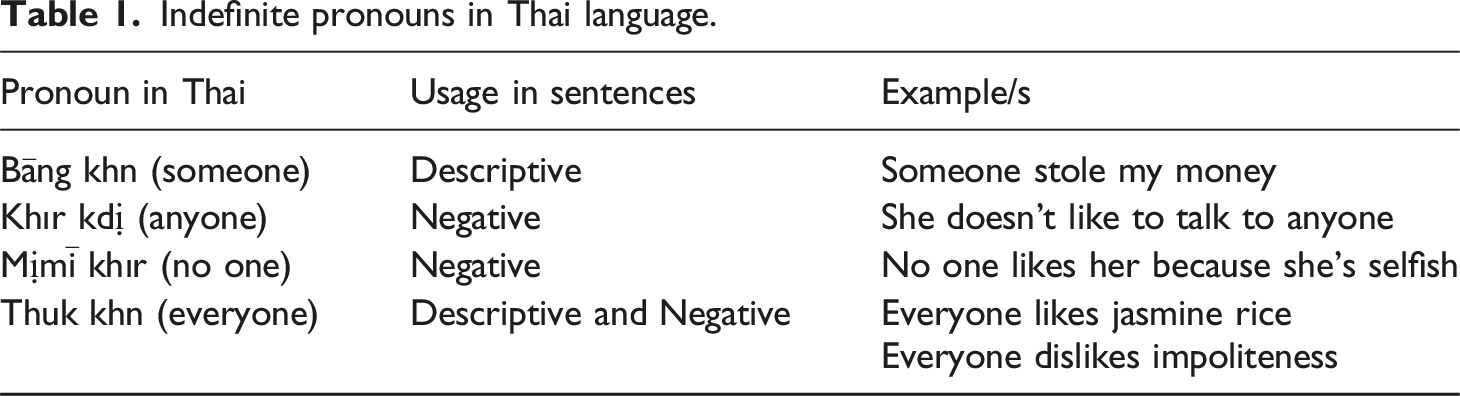
Indefinite pronouns in Thai and English
Indefinite pronouns in Thai language.
Indefinite pronouns in English language.
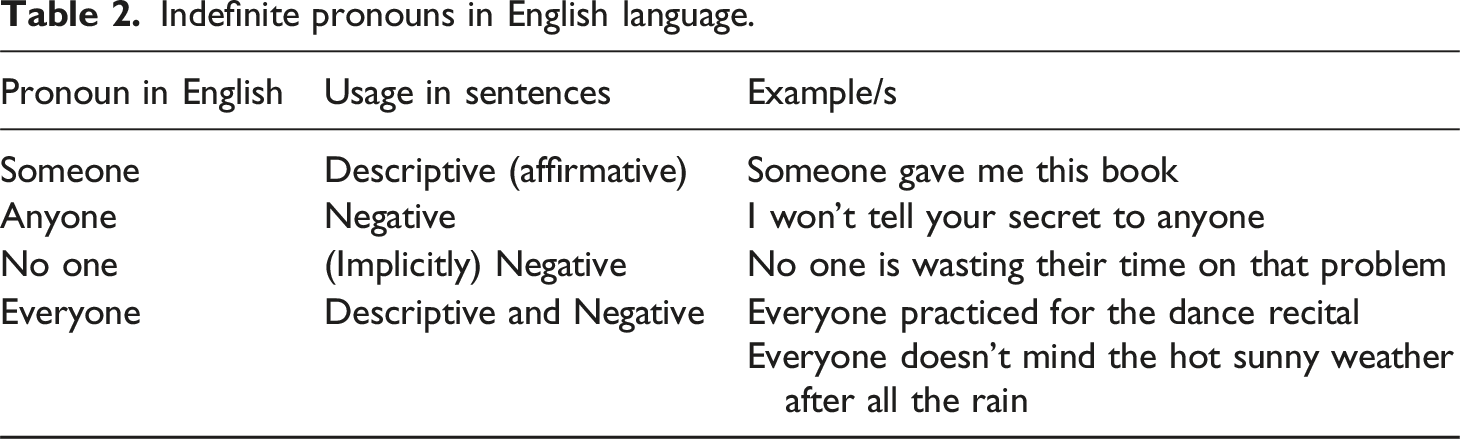
Importantly, Thai culture and language is relatively ‘high context’ (e.g., Hall, 1976), that is, it has a communicative style that is highly sensitive to message cues like gesture, tone, and overall cultural psychological context. Relatively speaking, Australian culture and (English) language is ‘low context’, that is, it has a communicative style that is more explicit and straightforward (a ‘sign’ can apply across a range of cultural psychological contexts).
Hofstede’s six culture dimensions: an ‘open system’ survey research process?
We argue that Geert Hofstede’s (Hofstede, 2011; Hofstede et al., 2010) six cultural dimensions in the conception and expression of national culture and character provide a framework for considering the organisation of psyche and culture (e.g., a person’s or a people’s sense of ‘self’ and ‘other’ in environmental context). We construe the six dimensions as follows: power distance (the degree of acceptance or normalisation of social power inequalities in social-ecological situations); uncertainty avoidance (the relative need for certainty, or capacity to cope with ambiguity, in social-ecological situations); individualism/collectivism (the tendency to see oneself as an efficacious individual or to perceive oneself as nested in wider social wholes); masculinity/femininity (the tendency to use force or ego-strength in social relations as compared to showing concern/empathy for others and practicing social-perspective taking); short-term/long-term orientation (the tendency to focus on past and present vs. a focus on the future); and indulgence/restraint (the tendency to reward oneself & meet one’s needs vs. the tendency to restrain oneself & sublimate one’s needs in social-ecological situations).
Importantly, it is necessary to view Hofstede and Minkov’s (2013) (survey) research method (Values Survey Module, VSM, 2013 Questionnaire) as an open systems process (Valsiner et al., 2017), whereby each respondent’s questionnaire responses are idiographic in nature. Thus, group (national, averaged) results should be regarded cautiously as they may mask individual responses and psychological processes. Of note, Beugelsdijk and Welzel (2018) recently analysed data from 110 contemporary national cultures and found three (rather than Hofstede’s six) culture dimensions/factors: collectivism-individualism; duty-joy; and distrust-trust. One important trend they revealed was greater emphasis on individualism and ‘joy’ in younger generations across countries. This may be partly explained by increases in economic development. As people experience higher existential security and more socio-economic opportunities in life, they may become more individualistic and joyous. Nevertheless, comparative country differences in culture dimensions persisted over time (Beugelsdijk & Welzel, 2018).
Another limitation of Hofstede’s culture dimensions approach is that it seems to assume that nation-states have evolved and developed independently. However, the sociologist and economic historian Immanuel Wallerstein (1974) (e.g., 1974) argues that the (capitalist economic) ‘world system’ has evolved through open system power relations among nations, whereby rich (‘core’) countries have exploited poor (‘peripheral’) countries. Semi-peripheral countries comprise an in-between ‘middle class’. Present-day Australia is a relatively core (rich) country and present-day Thailand is a relatively (‘semi’)-peripheral country.
Culture dimensions data for Australia and Thailand
Data for Hofstede’s culture dimensions for Thailand and Australia are reported because they represent Eastern and Western societies, respectively. In addition, these national cultures were partly chosen because the lead writer/author has previously conducted cultural-psychological research on these societies (Rutherford, 1993) and in view of the second author’s interest in behavioural research and her cultural-psychological experience with Thai (and English) language and Thai (and western) culture.
With Valsiner et al.’s. (2017) work in mind, Padley et al. (2022) report Hofstede and colleagues’ research findings for Australia: low power distance (PD) (score 38/100), very high individualism (IND) (score 90/100), intermediate to high masculinity (MAS) (score 61/100), intermediate uncertainty avoidance (UNC) (score 51/100), low long-term orientation (high S/T) (score 21/100 for long-term orientation) and high indulgence (low RES or restraint) (score 71/100 for indulgence). Padley et al. (2022) state that these findings for Australia are like those for Canada, the USA, and New Zealand but different to Western Europe and developing countries.
Employing four of Hofstede’s six culture dimensions in a Thai context, Chaisilwattana and Punnakitikashem (2017) note that: for power distance, Thais view age and seniority (rather than performance and knowledge) as traditionally paramount in conducting power relations; for collectivism (interpreted as social relationship orientation), Thais tend to be respectful, considerate, and non-confrontational, such as in team situations; for femininity, Thais favour nurturing, caring, and patient (cooperative instead of competitive) relationships; and for uncertainty avoidance, Thais are governed by ‘top-down’ (hierarchical) rules and procedures that exert (social) control.
More broadly, drawing on Hofstede’s research (Hofstede-Centre), Ahlqvist and Andersson (2017) report that Thais score 64/100 for power distance (intermediate to high PD), 20/100 for individualism (low IND), 34/100 for masculinity (low MAS), 64/100 for uncertainty avoidance (intermediate to high UNC), 32/100 for long-term orientation (high S/T orientation), and 35/100 for indulgence (low indulgence or intermediate to high RES or restraint).
Hofstede’s six culture dimensions & four indeterminate pronouns: an idealized model
In Figure 1, we outline idealized relationships of Hofstede’s culture dimensions and four indeterminate personal pronouns, that is ‘every’, ‘some’, ‘no’, and ‘any’ (e.g., everybody, everyone, everything; somebody, someone, something; nobody, no-one, nothing; and anybody, anyone, anything). The argument is that indeterminate/indefinite pronouns carry ‘power’, and that the ‘organized’ person and culture is neither too overwhelmed nor too under-responsive to them in social-ecological situations. Also, there should not be over- or under-compensation (e.g., in cognitive and cultural assimilation and accommodation). Idealistic organizational relationships of Hofstede’s 6 culture dimensions and four indeterminate personal pronouns. [Note: PD = power distance; IND = individualism/collectivism; MAS = masculinity/femininity; UNC = uncertainty avoidance; S/T = short-term orientation/long-term orientation; and RES = restraint/indulgence].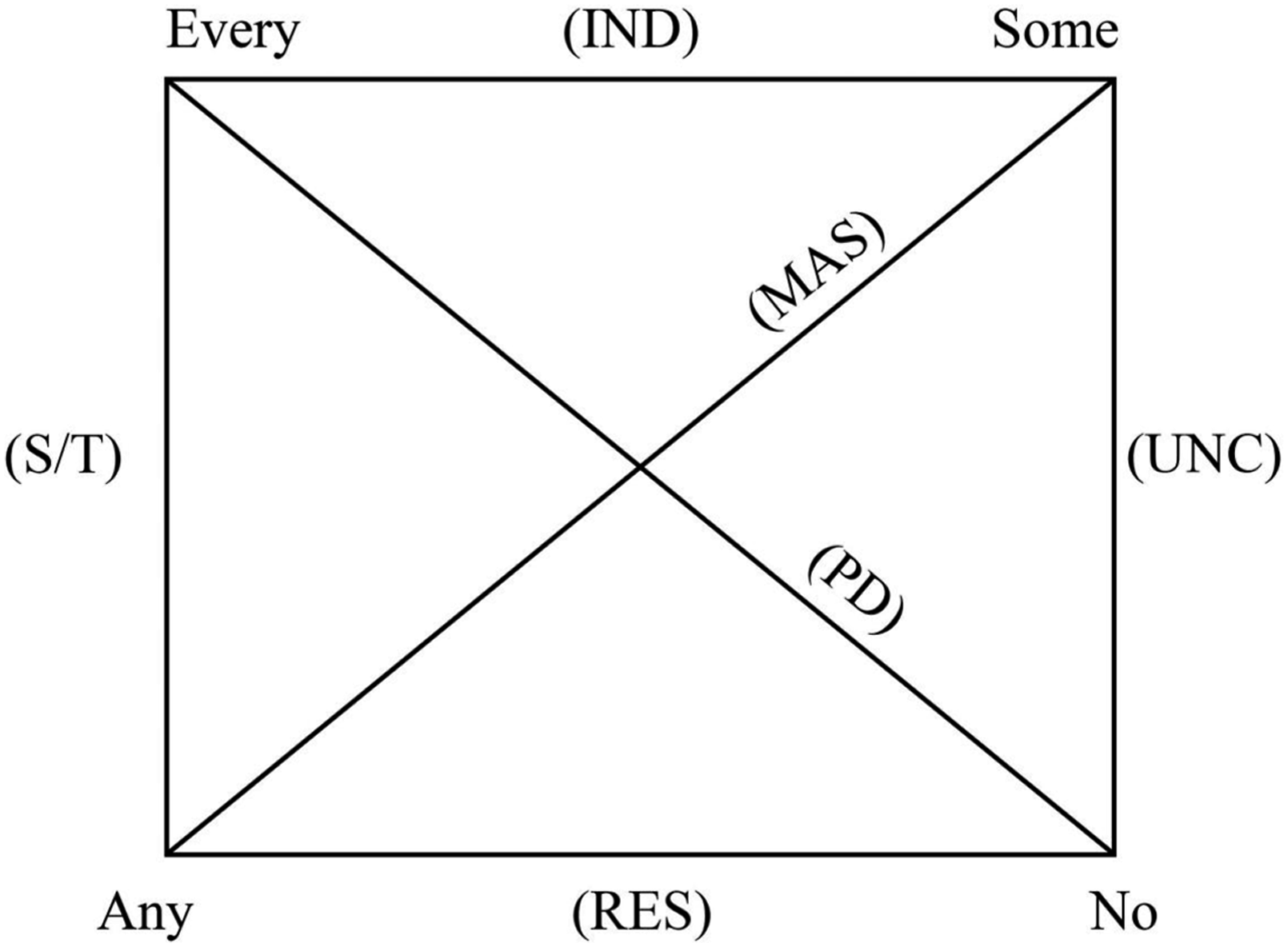
Model caveats and features
It must be understood upfront that it is assumed that relatively ‘western’, English speaking cultures like in Australia are more likely to use social support words (e.g., “everyone” is equal) and self-control words (e.g., “someone” is to blame). In contrast, relatively ‘eastern’ cultures like Thailand may be more likely to use social control words (e.g., “no one” likes her because she’s selfish) and self-support words (e.g., She doesn’t like to talk to “anyone”). These cultural contrasts are one reason why these cultures are chosen for study.
In Figure 1, it is contended that power distance (PD) can relate the pronouns ‘every’ and ‘no’; that uncertainty avoidance (UNC) can relate pronouns ‘some’ and ‘no’; that individualism (IND) can relate the pronouns ‘every’ and ‘some’; that masculinity/femininity (MAS) can relate the pronouns ‘some’ and ‘any’; long-term versus short-term orientation (S/T) can relate the pronouns ‘every’ and ‘any’; and indulgence/restraint (RES) can relate the pronouns ‘any’ and ‘no’.
The model in Figure 1 is dynamic (with moving and interrelating parts) and the robustness of the idealized relationships of cultural dimensions and personal pronouns may be balanced by this complex cultural semiotic dynamism (i.e., a lack of efficacy of one relationship could be counteracted by the efficacy of other relationships in the whole).
By way of illustration, four of the six idealized relations in Figure 1 that seem easier to argue for are now outlined.
First, since Australians display low power distance, that is, they favor everyone being equal and since Thais display high power distance, that is, they accept/show deference to a ladder of social status or authority, then semiotically “everyone is equal” in Australia (as an egalitarian society – e.g., Evason, 2016), and “no-one is of equal status” in Thailand.
Some examples in Thai language of everyone seeing themself (‘I’) in context of unequal ‘social status’ are kinship terms like/phiː/(meaning ‘an elder sister or brother’),/nɔːŋ/(meaning a ‘younger brother or sister'),/phɔː/(male speaker; meaning ‘a father’),/mæː/(female speaker; kinship term meaning ‘a mother’),/ta:/(male speaker; meaning ‘a grandfather’),/yai:/(female speaker; meaning ‘a grandmother’); and occupation terms like/khruː/(meaning ‘a teacher’),/aa-jaanː/(meaning ‘a professor’), and/mɔː/(meaning ‘a doctor’). It must be understood that honorifics are embedded into the pronominal system. The Thai language is highly contextualized and multifaceted, which means Thai people select the suitable pronouns according to their position in the social hierarchy.
Second, since Australians display high individualism and since Thais show high collectivism, then semiotically “someone controls themself” in Australia (e.g., Williams & Ricciardelli, 2003 - strategies for self-control), while “everyone is interdependent” in Thailand. There are many Thai proverbs related to harmony and interdependency. For example, the famous proverb “nam-phueng-ruea-suea-phueng-pa” means ‘the necessity of water depends on the existence of boats’ or that ‘the survival of tigers is dependent upon the existence of the forest’. Another Thai proverb stressing interdependency “song hua-dee-khaw-hua-diaw” means that ‘two heads are better than one’.
Third, since Australians display intermediate to high “ego-drive”, forcefulness or masculinity and since Thais display high femininity or a premium on care and social perspective-taking skills, then semiotically “someone must know why and how it happened” in Australia, while “anyone is tolerant” in Buddhistic Thailand. In Thailand, there is a concept of “kreng jai” which means to be afraid to do something that might hurt other people’s feelings or cause inconvenience. Another key aspect of Thai culture is to keep from losing face. It is often considered better to leave potential problems unaddressed rather than risk the humiliation of other people. There is also a Thai word “Jai Yen” (jai, “heart or mind”) + (yen, “cool”). Jai yen refers to a heart/mind characterized by composure, calm, and patience. The ability to take it easy in tense situations is highly admirable in Thai culture. Conversely, being forceful in Thai culture can cause one to lose face.
Fourth, since Australians display low long-time orientation or are more “in the moment” and since Thais also display short-term orientation such as “quick results” in business, then ideally “everything is as it is” in Australia as a pragmatic culture, while “anything is ephemeral” in Thailand as a Buddhist society – with a cycle of birth-death-rebirth. Western culture is task-focused and direct, while Thai culture has a more relaxed attitude and is indirect. Thai culture is rooted in concepts of “sabai” (relaxation), “sanook” (fun) and “mai pen rai” (never mind). These concepts make Thais ‘carefree and reckless’ about life or work. For example, the Thai proverb “/suk˨˩.ʔaw˧.pʰaw˩˩˦.kin˧/” means inattentive or sloppy about doing things. In Thai culture being able to say, I’m all done with work, I don’t have to work, and I’m relaxing, is considered a key goal.
The other relationships in Figure 1 are less defendable. Firstly, since Australians display intermediate uncertainty avoidance and since Thais display an avoidance of uncertainty, then ideally “someone is ‘certain’” in Australia, but “no-one can be ‘certain” in Thailand. For Thais, there is the concept of “mai pen rai” (translated to “never mind”), which implies ‘this too shall pass.’ It is a Thai concept to avoid frustration and confrontation (associated with uncertainty). The Thai culture is present-oriented, and Thais give little attention to past or future events since they consider them uncertain and unknown. Therefore, Thai cultures rely on immediate results, and they tend not to plan. Australian’s take the attitude that “She’ll be right” in response to difficult (including uncertain, stressful) situations (e.g., Osmond, 2000).
Secondly, while Australians seem to display relatively high indulgence and Thais display intermediate indulgence, then ideally “no-one misses the opportunity for fun” in Thailand, while “anyone likes having fun” in Australia. However, in practice in Thailand, semiotically “everyone is fun seeking”. In our opinion, Western culture is more purpose-driven and takes life more seriously than Thai culture. Generally, Thai people have the sense of enjoying life and love being in a state of “sanook” (fun) and “sabai” (relaxed, comfortable, contentment and inner peace). However, Australians also like having fun (Griffth International, 2018) and being relaxed (having “no worries”) (Osmond, 2000).
A framework of social-ecological systems, hyper-generalization, and semiotic mediation
Upfront, it is to be observed that we employ ‘environmental’ issues as a good illustration of our conceptual approach because sustainability of human practices in social, ecological, and social-ecological systems relies on how we make sense of, give meaning to (e.g., tell stories about), and address existential crises in the world and planet around us. These complex social-ecological semiotic relationships are why the connection of language and culture, in the context of environmentalism, is important herein.
We claim that social-ecological semiosis entails self-organization as ‘within relations’ of psyche and culture, and socio-cultural (collaborative) organization as ‘between & among relations’ of psyche and culture.
Therefore, influenced by Rutherford (2022, 2023) and Valsiner (2001, 2021, 2023), We assert that in (western, English-speaking) culture and psyche there are the following “cyclical” relationships of semiotic signs (personal and indefinite pronouns):
[1] ‘I’ create ‘You’ (as ‘Someone’) to constrain ‘Me’ (c.f., Valsiner, 1999)
This statement provides
In Australia, Botha and Dahmann (2021) define self-control as the ability to override short term impulses for longer term gain (see Cobb-Clark et al., 2019 for a wider review of the research). Indeed, the Australian research suggests that those with more self-control tend to be healthier and more satisfied in life. However, a lack of self-control has been associated with intimate partner violence (Wolbers et al., 2023) and internet addiction (Li et al., 2021).
To illustrate statement [1], in biospheric & altruistic values, that is, caring for planet and people (c.f., Wang et al., 2021), semiotically someone concerned for environmental sustainability would reduce their personal waste. Thus, there can be sustainable relations at the personal scale, involving self-organising complexity, and resulting in incremental environmental reform.
The disappearance of affective and cognitive (‘social’) opposites into a whole sign field across the entire psyche and the whole relating with the world (i.e., ‘hyper-generalization’) in the semiotic mediation of the ‘personally constrained’ ‘Someone’ [statement 1 above] may ensure a vibrant psyche and culture. However, an incapacity or unwillingness to do so may lead to being overwhelmed by, or under-compensating for, the power of the social-ecological semiotic system of signs.
[2] How ‘You’ (as ‘Anyone’) support ‘Me’ enhances my sense of ‘I’ (c.f., Valsiner, 1998 on the sociogenesis of personality)
This statement provides
Australian cross-temporal research into self esteem (which we regard as an indicator of ‘self-support’) (Hamamura & Septarini, 2017) finds that self-other equality (horizontal individualism – individuals being of “equal value”) in Australia has led to no strengthening of a norm of positive self-esteem over time, as compared with American culture (vertical individualism – e.g., individual’s capacity to become a “self-made success”).
To illustrate statement [2], in caring for people and planet (Wang et al., 2021), semiotically anyone concerned for environmental sustainability would plant more trees locally. Thus, there can be sustainable relations at the personal scale, involving self-organising complexity, and resulting in incremental environmental reform.
Hyper-generalization in ‘personally enhanced’ semiotic mediation of ‘Anyone’ [statement 2 above] may also ensure a vibrant psyche and culture. However, dysfunctionality may lead to the disempowerment of persons in social-ecological semiotic systems (e.g., a breakdown in the individual-relationship-community-societal social-ecological system).
[3] ‘We’ imagine ‘Them’ (as ‘No-one’) to constrain ‘Us’ (c.f., Valsiner, 2007 on culture in minds and societies; Rutherford, 2022)
This statement provides
In American sociology, George Hebert Mead (1934, 1938) has written about social control in the context of the organized (socio) genesis of the self. Lawrence and Valsiner (2003) update this organized personal (and collective) ‘sense’ system as entailing (mutual) internalization and externalization processes, whereby human ideas and meanings move from the inter-psychological world to the intra-psychological world and back again. In wider sociology, there is the work of Michel Foucault on social control through social institutions (Lianos 2003) such as the practice of ‘medical dominance’ in drug harm minimization approaches (see Miller, 2001 for an application to the Australian setting).
To illustrate statement [3], in caring for people and planet, semiotically no-one concerned about environmental sustainability would increase their collective ecological footprint. Thus, there can be sustainable relations at the international scale, involving socio-culturally organising complexity, and resulting in relatively radical transformation in environmental practice.
Hyper-generalization in ‘culturally constrained’ semiotic mediation of ‘No-one’ [in statement 3] may ensure a healthy psyche and culture. However, dysfunctionality may lead to top-down ‘power over’ rather than bottom-up ‘power for’ in social-ecological semiotic processes (e.g., a breakdown in the societal-community- relationship-individual system).
[4] The way ‘They’ (as ‘Everyone’) support ‘Us’ enhances our ‘We-ness’ (c.f., Valsiner, 2007)
This statement provides
Khawaja et al. (2018) note that social support has been defined as the perception of being cared for by others (including in the processes of enculturation and acculturation). It has been found that social support facilitates good social adjustment, lowers levels of psychological stress, and is associated with fewer depressive symptoms (e.g., Khawaja et al., 2018 – in culturally and linguistically diverse Australian youth).
To illustrate statement [4], in caring for people and planet, semiotically everyone concerned about environmental sustainability would decrease their collective ecological footprint. Thus, there can be sustainable relations at the international scale, involving socio-culturally organising complexity, and resulting in relatively radical transformation in environmental practice.
Hyper-generalization in ‘culturally enhanced’ semiotic mediation of ‘Everyone’ [in statement 4] may also ensure a healthy psyche and culture. However, dysfunctionality may lead to less peer-to-peer ‘power with’ social-ecological semiotic processes (e.g., a breakdown in the societal-community- relationship-individual system).
Limitations of these regulatory statements
Non-western cultures & non-English speaking people may not regulate themselves in these semiotic cultural psychological ways. Of note, Thai people tend to see everything as a whole and feel closely connected to environment around them. In general, Thais integrate themselves in relation to some hierarchy, and as such generally view themselves less as free agents and more as components of a larger organizational structure, both inside and outside of work. This tendency expresses itself in the Thai tendency towards deference towards their elders, who are seen as having free agency. For Thais, it is not a matter of ‘I’ versus ‘You’ but of superior/older versus inferior/younger, and it is that hierarchy that places constraints on behaviour. This external hierarchy structure dictates a lot of social interactions and social events so that the elder gets the deference they feel entitled to, and the inferior does a sufficient display of being subordinate or else loses face. These relations are deeply encoded in language, for example, the variety of words relegated for royalty and aristocracy. They can do what they want, and we must bear-what-we-must and do so smilingly. Indeed, “do whatever you want” for Thais is not freedom, but a harsh rejection because to do what you want means ignoring the social order expectations and constitutes a headstrong loss of face. However, Thailand is shifting in culture towards relatively more individualism and masculinity.
In addition to these constrained (and constraining) hierarchical relations in Thai semiotic cultural psychology, we suggest that the growing individualism and masculinity may commensurately raise (semiotic) cultural psychological issues of self-control, self-support, and social support relations. For instance, a lack of self-control has been found in relation to intimate partner violence in Thailand (Kerley et al., 2008). Of interest to self-support relations, the notion of self-compassion - a self-attitude from Buddhist psychology relating to being kind instead of harshly critical toward oneself, seeing one’s behaviour in context of larger human experience as well as holding painful feelings in mindful awareness (Neff et al., 2008) – has been applied to Thai adolescent female body image and self-esteem (Pisitsungkagarn et al., 2014). On social support relations, it has been found that Thai adolescent fathers can lack social supports they need in social networks, and this could affect how they manage their transition to fatherhood, as well as how they provide for their newborns and care for their domestic partners (Uengwongsapat, 2022).
Of course, while we talk about within (intra)personal (self-organizing) semiotic cultural relations and between/among inter-national (sociocultural) semiotic cultural relations in the above framework, there are also between/among (inter)personal (sociocultural) semiotic cultural relations and within national (self-organizing) semiotic cultural relations.
It is for future cultural psychological research to test the utility of the model (Figure 1) and the conceptual framework (Statements 1–4), including in non-western cultures and non-English speaking contexts.
Discussion
To recap, in any given situation, behavior is a function of the interaction/s of the person and the environment. Social-ecological semiotics raise issues of the relations of language and culture in nested social-ecological settings (the individual-the relationship-the community-the societal) for the organization of psyche, language, and culture. A key question is: Are contemporary cultures and societies governed by dynamic cultural dimensions and complex sign systems? One answer is that context and nuance matter in both language and culture.
In the 3rd decade of the 21st century, we assert that there is a cultural tension between ‘globalization’ and ‘national sovereignty’. On the process of globalization, the role of technology (e.g., the internet and smart devices) has facilitated the exchange and spread of cultural values and practices for sustainable futures (e.g., Johnston, 1998; Pink, 2022). However, there has also been an emerging strategic competition between the US and China as the major world powers (Winkler, 2023). This has encouraged the growth of countries acting in the ‘national interest’ or protecting their national sovereignty. For example, Fozdar (2021) finds a nationalist rather than ‘postnational’ (world without borders) or ‘cosmopolitan’ (viewing oneself as a world citizen) orientation in Australia’s leadership in the context of addressing the COVID-19 pandemic as a public health crisis.
The relevance of all this to the organization of psyche, language, and culture is that the traditional distinction between analytic thinking and perception, and an independent social orientation, in westerners and holistic thinking and perception, and interdependent social orientation, in easterners (e.g., Varnum et al., 2010) may be breaking down. Nevertheless, Panpothong and Phakdeephasook (2023) find that Thai self-construal in language remains predominantly interdependent. Applying western models of culture dimensions like Hofstede’s to eastern (business) cultures in countries such as Thailand, Japan and Malaysia should, therefore, be cautiously approached (Harada, 2017).
Globalization has led to urbanization in Thailand (e.g., Bangkok as a ‘mega-city’) and has added to the cultural mix in Australian urban centers (e.g., Sydney and Melbourne). National sovereignty in Australia has seen the strengthening of relations with like-minded liberal democracies (e.g., Marles, 2023). The issue for cultural psychology is the degree to which Thais and Australians, for example, are individually and collectively looking in and/or looking out?
The urbanization in Thailand has seen a challenge to traditional cultural values, with younger generations becoming more assertive than older generations about their personal rights and freedoms (Farrell & Phungsoonthorn, 2020; Wangkiat, 2016). Anecdotally, there seems to be a corresponding shift towards individualism and masculinity (assertiveness) in younger Thais (Wangkiat, 2016), due to this urbanization as well as the influence of the internet and internet culture.
Influenced by technologically mediated conversations about the existential threat/s from climate change, younger Australians and younger Thais seem more aware of and concerned about the relationships of people and the planet (Bangkok Post, 2020; Jones, 2023) (i.e., the idea that in the world we are all interconnected and must work together to address global warming).
Concerns and risks in future study
Models are but heuristic simplifications of reality (e.g., Keren & Breugelmans, 2020). They can help frame investigations of reality but are not reality. Therefore, testing the value of cultural psychological models like ours involves gauging whether data collected from real world social-ecological semiotic problems such as effective political discourse on climate change policy (Foss, 2018) - perhaps involving complex sociocultural political organization (c.f., Carriere, 2024) - provide valuable insights for human ends like averting the risks of tipping points in the climate system, flowing from abrupt and/or irreversible qualitative changes triggered by self-perpetuating feedback (Abrams et al., 2023 on tipping points).
The main conceptual risk in our approach to modelling the complex organization of psyche, language and culture is over-complication, that is, too much ‘complexity’ in our modelling of social-ecological semiotic system complexity. Thus, the goal is to get the ideational balance ‘just right’.
The main risk for future empirical research is failing to test real world problems, such as in political discourse on climate change, in a way that best operationalizes the complex organization of psyche, language, and culture. For instance, Foss (2018) uses a qualitative methodology to examine use of federal funding for energy efficiency and conservation initiatives by municipalities in Texas, USA. Interviews with municipal staff provided a detailed and nuanced description of the political discourse of energy issues and climate change planning. In this way, research can contribute to better policy and practice by and within government/s.
Conclusion
To conclude, social-ecological relations of language and culture have been considered in the context of Thailand and Australia, especially for the complex organization of psyche, language, and culture. Mindful of its empirical and conceptual limitations, national data on Hofstede’s six culture dimensions are provided and idealized theoretical relations of these dimensions with reference to four indefinite pronouns (some, any, no, every) are modelled. A framework for hyper-generalization and semiotic mediation in four “cyclical regulatory” relations is outlined. These regulatory statements cover personal constraint (self-control), personal enhancement (self-support), cultural constraint (social control), and cultural enhancement (social support). It is for future cultural psychological research to test the utility of the model and conceptual framework as they make sense of, give meaning to, and address existential crises facing the contemporary world.
Footnotes
Declaration of conflicting interests
The authors declared no potential conflicts of interest with respect to the research, authorship, and/or publication of this article.
Funding
The authors received no financial support for the research, authorship, and/or publication of this article.
