




Abstract
What is it that develops in adult life? Development through work and family life have been documented and theorised in detail, but much less is known about what is learned beyond these domains, through people’s engagements in hobbies or when out of work (e.g., unemployed, retired). We argue that adult development can be addressed in general terms, beyond domain specificity; drawing on our sociocultural psychology framework, and assuming an open-system perspective, we highlight the two processes of progressive differentiation and psychological distancing in diverse domains of activity. To address development over time, we explore 20 years of people’s lives through the longitudinal analysis of online diaries. A combination of quantitative and qualitative analysis enables us to identify people’s experiences of rupture and transitions, the diversity of their domains of interests, and how these change over time. Based on a case-study, we show that, if the general direction of development does entail progressive differentiation and distanciation, these processes can also be hindered by the cumulation of vulnerabilising events. Finally, we show that some domains, such as the long-standing activity of diary writing, can itself be used as resource for adult development.
What is it that develops in adult life, and under which conditions? It is well established that adults learn in specific domains of activity, and especially in the domains of daily life that that are most invested (e.g., family, professional). It is also widely agreed that ruptures and transitions in the lifecourse are significant occasions for change and development. But how can we qualify what is learnt? And are there not ruptures that may impede learning and development? These questions are challenging because they cannot be observed in short time periods and thus require access to people’s lives in diverse domains, over a long period of time.
Our goal is to contribute to the theorisation of adult development using longitudinal diary data. Specifically, we will show that learning and development in adult life manifests as changing experiences within domains of activity and their mutual relations, and that it tends to entail progressive differentiation and distanciation. Our secondary goal is to show that learning and development in adulthood can also be put at stake, and especially, that it can be hindered by vulnerability.
The article proceeds through four sections: the first reviews the literature on adult learning and development, presents our sociocultural perspective, and our theoretical propositions. It thus suggests the conditions at which development may occur, but also, when it can be put at risk and lead to vulnerability. The second section presents our methodology, the analysis of longitudinal on-line diaries. The third section presents the case-study of the trajectory of a man over 20 years, which both grounded our theoretical frame, and acts as exemplary. The fourth section concludes our analysis by highlighting its main contributions and opening new routes.
Theorising adult learning and development
Classical developmental psychology has long examined the development of children into adolescence, neglecting adulthood. Jean Piaget thus wondered how, once general structures were acquired, adults would developed in differentiated ways depending on their “vital interests” – a lawyer would not develop the same skills than a physicist or a locksmith (Piaget, 1972). Over the last fifteen years, however, with the need to adjust to the changes of the professional world, there is growing interest in learning and development in adult life.
In this section, we sketch the contour of the field and position our sociocultural perspective on adult development. Specifically, first, we will distinguish between different modes of knowledge depending on their cultural formalisation; second, to models considering adult development as characterised by expertise and wisdom, we will prefer a more general understanding in terms of differentiation and distanciation.
Learning and development in adult life
People are always developing, as their courses of life unfold in specific, cultural and changing historical environments, and as they engage in a diversity of relationships and activities, which both are enabled by their previous experiences and the possibilities of what could happen (Baltes et al., 2006; Elder & Giele, 2009; Levy et al., 2005). Although developmental psychology has long focused on children and youth, adulthood and older age have gained growing attention in the last half century (Demick & Andreoletti, 2003; Demuth & Keller, 2011; Elder, 2002). Regarding adult life, there has been a growing interest in learning and development at work, in the family, and in everyday experiences (Bidart, 2006; Bühler & Nikitin, 2020; Willis & Martin, 2005).
Both learning and development suppose that a person’s capacity to act or think changes. There is a longstanding discussion on the relationship between learning and development; usually, learning is about the stable acquisition of a certain skill or competence, while development involves the more general reorganisation of a person’s capacity to think, in relationship to others and specific objects (Kallio, 2020a; Perret-Clermont & Carugati, 2001).
Especially when it comes to adult learning and development, different lines of research have developed (Fleming, 2021; Hager, 2021). A whole range of studies examine the presence or change of some function, or capacity (e.g., cognition, coping, attachment style, identity, well-being (Henry et al., 2022; Németh & Bernáth, 2022; Schaie & Willis, 2010)). Some studies have searched for how people learn expertise in their main domain of experience, typically, work (Bélanger, 2011; Bourgeois, 2012; Clot, 2002; Cohen-Scali, 2012; Tynjälä, 2008; Tynjälä et al., 2022); others examine how adults learn as they engage in new domains (Bélanger, 2011; Demuth & Keller, 2011; Muller & Perret-Clermont, 1999); studies examine development in line with typical family life-stages (parenting, children leaving home, etc.) (Bronfenbrenner, 1986; Cowan & Cowan, 2003; Hoare, 2009); and finally, research has examined how adults learn from experience, inspired by John Dewey (Passarelli & Kolb, 2021). The problem is that these lines of studies are anchored in different traditions and tend to isolate and highlight extremely different processes (ranging from coping, to psychosocial development, to cognition, etc.) rather than studying the person as a whole.
In contrast, adopting a sociocultural perspective, we will consider learning and development across and between domains of experience. In any situated activity, people are likely to learn – ways of doing, moving, interacting, understanding, making sense - and consequently to develop (Zittoun et al., 2013; Cole & Engeström, 2007; Valsiner, 2021). It is widely established that people learn via practice and participation in habitual activities, and that they are especially likely to learn when exposed to newness: gaps, or ruptures are triggers for the emergence of new conduct, and with it, learning and development (Zittoun et al., 2003, 2013; Dewey, 1896; Piaget, 1977; Valsiner, 2021). When the apparition of some conduct can be transposed or generalized to new situation, it has been learned; when it requires a wider reorganisation of people’s ways of acting and understanding, it becomes development. Of course, what processes are developed depends on the types of knowledge involved, and development depends on how these specific forms are expanded beyond specific domains of activity.
Modes of knowledge
Theories of learning rely on different assumptions of what knowledge is, and on how to differentiate or characterize types of knowledge. Authors have proposed various typologies, depending on the processes they require (e.g., declarative, procedural, regulatory, sociocultural (Tynjälä et al., 2020)), whether they apply to natural or social or human kinds (e.g., cognition vs. meaning making (Arendt, 1978; Zittoun, 2022b; Kallio, 2020a)) or their formalisation (formal or informal (Werquin, 2010)).
Adopting a sociocultural psychological framework, we distinguish three modes of knowledge, depending on their inner organisation as well as their sociocultural regulation. First, spheres of experience designate sets of practices that a person develops in an idiosyncratic way and that she or he constitutes as “the same,” involving specific relationship to others, practices, meaning, and affective tonalities. These involve pseudo-concepts (Vygotsky et al., 1934) and develop with time (Zittoun, 2012; Zittoun & Gillespie, 2015, 2016). Second, cultural subsystems involve modes of knowledge (meaning, practices) which are shared by a group to whom the person belongs. These are informally transmitted and developed, yet have belonging values, and so tend to be socially regulated (e.g., how to behave with friends on a Saturday night out, how to be a voluntary fireman, etc.) (Geertz, 1972; Rogoff, 1995, 2003). Third, formal knowledges are culturally carved out and usually formally taught, so that it takes a type of culturally sanctioned teaching or learning to be acquired. These are usually secondarised, that is, accompanied by a discourse over the system itself (e.g., mathematics, law, classical music, etc.); these therefore require more distancing (Zittoun, 2022a; Grossen & Muller Mirza, 2020; Rochex, 1998). Each of these three modes of knowledge can apply in any domain, either socially sanctioned (e.g., work) or not (e.g., a gang) (Hundeide, 2005), and take place in a variety of lived contexts – specific settings, with their social framing, etc. (Zittoun, 2013; Goffman, 1974; Grossen & Perret-Clermont, 1992). In addition, these modes can engage different ways of thinking, submitted to different forms of cultural regulation (reasoning, meaning-making and daydreaming) (Zittoun, 2024), and be applied in different ways in different domains.
From specific to general expertise in adult life
Learning and development can take place in all domains of life, and via any mode of knowledge. How do these develop within and between specific domains of activity during adulthood?
In the professional domain, learning and development is usually called expertise. Expertise requires a form of systematisation of experience and knowledge across instances and situations and over time. For instance, Tynjälä et al. (2020) write that: experts have larger and more integrative knowledge units, and their representations of information are more functional and abstract than those of novices […]; basic functions related to tasks or the job are automated in experts; […] experts outperform novices in their metacognitive and reflective thinking; […] in addition to explicit knowledge, experts have tacit or implicit knowledge that accumulates with experience. This kind of knowledge makes it possible to make fast decisions on the basis of what is often called intuition. […] In situations where circumstances radically deviate from the norm, experts may decide to break learned rules […]. Thus, experts’ thinking is more holistic than the thinking of novices. It seems that the quality of thinking is associated with the quality and amount of knowledge (Tynjälä et al., 2020, pp. 166–167).
Furthermore, in this line of studies, authors have identified what they call a “contextual integrative thinking,” which involves features of “postformal” and “relativistic-dialectical thinking” (Kallio, 2020a, p. 24). Hence, experts are supposed to evaluate situation in complex manners, combining a multiplicity of expertise, at times in teams, with their social and emotional components, and also taking in account the specificities of the sociocultural context (Kallio, 2011; 2020b).
Another form of specific adult learning is related to what is meant to be a general form of decision making; it is what researchers have identified as “practical wisdom,” or phronesis (Kristjánsson et al., 2021; Tynjälä et al., 2020) – as alternative to the much debated concept of wisdom (Baltes, 2004; Baltes & Kunzmann, 2004; Glück, 2015). With this, authors search for the sorts of ability to make sound decisions in cases of morally complex matters, regardless of the context (professional or not), solutions that show some virtue orienting toward a “good life.” In a recent attempt to conceptualise such capacity, Kristijansson and colleagues propose a “neo-Aristotelian phronesis model,” a model of wise (phronetic) decision-making that conceives of morality in realist terms and sees moral considerations as reason informed. It explicates two main sources of moral motivation, one emerging from specific virtues and one that emerges from the blueprint function of phronesis, how those motivations are synergistically integrated, and how the blueprint function is gradually refined in the light of experiential knowledge. It also provides a nuanced account of the balancing of reason and emotion (Kristjánsson et al., 2021, p. 252).
Thus, in adult learning and development, expertise applies in professional domains, and in more general terms, people may develop phronesis when it comes to decision-making. This raises two problems: first, we can question the inherent normativity of these constructs: how do we establish the norm of rightful expertise, and who fixes virtue? Second, what does occur outside of these two domains of experience, the professional and moral decision? For instance, what happens if the person quits their job? Do these forms of expertise also apply to other domains in which people engage, such as hobbies, or autodidact knowledge? Do people develop understandings across domains? We examine these two problems in turn.
Development as an open-ended process: differentiation and distanciation
One of the problems of studying learning and development in adults is that it tends to be oriented toward ideal norms in specific domains of activity; the expert professional is the most proficient at work, the person with phronesis makes moral decisions with virtue. Learning a given skill is of course always about acquiring new sets of skills or understandings; the “more” is simply comparative (e.g., one can now drive and could not before), or “better” (e.g., one drives more safely than before). Yet this is still locally normative: why would knowing how to drive be better than not driving at all? Or, is knowing how to shoot people better than not? Hence, there is an implicit normativity in any evaluation of learning, and it is clearer when one speaks of development, and even more in terms of moral virtue. One can admit that the “goal” of an acquisition that turns change into a “development” is always cultural-specific and defined according to certain local meanings (Raeff, 2016). Yet it is possible to address the problem differently. We propose to conceptualise change in a more abstract way. We suggest that change is developmental when it does not prevent new possibilities from emerging. Conversely, change is not developmental when it leads the person to a dead-end – either because of self-alienation, or alienation for significant others (Zittoun, 2006; Zittoun & Perret-Clermont, 2009). This idea, of maintaining the possibility for change, relies on a meta-theoretical understanding of development. More specifically, using the assumptions of an open dynamic system theoretical perspective and a process ontology: for such an approach, change and movement are primary, and only accidentally entities stabilise in temporary equilibrium – identified as systems (Gilbert et al., 2015; Van Geert, 2009; Witherington, 2007; Witherington & Boom, 2019). From such perspectives, there is the possibility to evaluate and describe development within the system: thus, a non-developmental system is simply an inert system.
On this basis, we rely on theories of human developmental that use these open system principles, such as Piaget and partly Vygotsky (van Geert, 1998, 2000). This open system approach is also evident in the work of Werner and Kaplan (1963) who proposed the “orthogenetic principle,” according to which: Developmental change refers to changes that involve moving “from a state of relative globality and undifferentiatedness towards states of increasing differentiation and hierarchic integration” (Werner & Kaplan, 1963/1984, p. 7). To differentiate means to make distinctions among phenomena and to integrate means to coordinate phenomena. With regard to action in general, differentiation refers to the distinctions that can be made within and among action constituents, as well as to the refinement of action constituent functioning. In general, integration refers to the ways in which action constituents and subconstituents are connected (Raeff, 2016, p. 60).
Although Werner and Kaplan’s work was mainly focused on children’s development, such understanding has been adopted, corroborated, discussed or amended by a series of developmental psychologists interested in adult development (Bibace & Kharlamov, 2013; Müller et al., 2013; Valsiner, 2005), by scholars of Bartlett and post-Bartlettians (Wagoner, 2013, 2017), by specialists of Vygotsky and in post-Vygotskian scholarship, and other attempts to propose holistic approaches to human development (Gillespie & Zittoun, 2013; Zittoun et al., 2013). This approach gives us a basis to theorise the fact that adults’ experiences develop in different domains linked to different contexts and social frames, demanding different modes of knowledge. In addition, and more important here, it gives us a general principle to address learning and development in any of these domains. Theoretically, indeed it should be able to account for the fact that, in any domain of knowledge, people may develop new understandings, ways of acting or meaning making via differentiation and progressive integration. In contrast to normative propositions, here the “norm” (“better” expertise or knowledge) is thus given by a criterion related to the system itself: it is about the acquisition of more stability of the system (e.g., equilibrium) or towards – at least locally – more stable organisation.
From the sociocultural psychological and dialogical perspective that we adopt, learning and development also occur along a second principle, that of distanciation from experience, that is, its elaboration through semiotic means. With time and experience, activities and meanings are not just “happening” here and now; they can make sense, because the person relates them to other experiences, in the past, the future, or in parallel. Specifically, distanciation through semiotic elaboration can be said to occur on three main dimensions: progressive generalisation (this c is a case of C), relation to time (past, present and future: this c is similar to a past c, or resembles an expected f), or imagination (what if this case c would become a d) (Zittoun, 2014; Zittoun & Gillespie, 2016, 2022). Distanciation is thus not simply vertical – it is not only about hierachisation; it is about semiotic mediation in a diversity of direction or along a diversity of dimensions (Gillespie et al., 2024; Neuman, 2014; Valsiner, 2021)
Ruptures, resources, and vulnerability in adult development
Of course, this does not need to be uniform; as assumed by open system theory, and also suggested by Werner and Kaplan’s “cyclical” understanding of development, some parts of knowledge may function at a lesser level of integration, or some organisation may be locally or more generally lost – temporarily or more generally. Such understanding also “provides a systematic conceptual basis for distinguishing among different kinds of change (e.g., development, regression, deterioration)” (Raeff, 2016, p. 68). Hence, do the processes of differentiation and hierarchisation apply together and always?
One of the ways to look at this is to examine what could put learning and development at risk. Research has shown that, if learning and development are occurring all life long, these dynamics are especially catalysed when people experience ruptures (Levy et al., 2005; Sapin et al., 2014). It is also clear that people can find a great diversity of resources to support processes of transition, including learning and sense-making, that may follow: social relationships, institutions, past experience, and a wide series of cultural elements can be used as resources to support such dynamics (Zittoun, 2006, 2012; Gillespie & Zittoun, 2010b; Gillespie et al., 2008; Masdonati & Ziitoun, 2012; Mehmeti & Zittoun, 2019). Transitions are thus key moment in the study of life trajectories, and life course learning and development (Zittoun, 2006; Hviid & Zittoun, 2008; Korhonen et al., 2019; Sapin et al., 2014; Stauber et al., 2022). In these conditions, most transitions are occasions for development; yet in some occurrences, the difficulties raised by the ruptures destabilise the person who may have struggle to find or mobilise appropriate resources. In developmental system terms, the system is off balance, either locally or more fundamentally, until some reorganisation brings equilibrium. In these moments, ruptures can become vulnerabilising events – if vulnerability designates the fact that, during a given rupture, a person lacks resources to create a new equilibrium (Spini et al., 2017).
Theoretical propositions
In this article, which aims to contribute to theory of development in adulthood, we examine various routes of learning and development in adult lives. We make three main propositions. First, we suggest that over their course of life, people engage in different domains of interest, both formal and informal – diverse spheres of experience, cultural subsystem of knowledge, or formal knowledge – and, over time, are likely to develop expertise in them (i.e., more differentiated and distanciated knowledge within these domains). Second, to overcome the limit of studies examining mainly adult development in one domain (e.g., work or family life), we propose to examine how, in each domain, knowledge may become differentiated and distanciated, as well as the overall configuration of these domains, including the relations between domains. Third, as people meet ruptures which may disrupt one or many of these domains of experience, that is, challenge their usual dynamic equilibrium, they are likely to draw on a diversity of resources – including from other domains - and thus engage in a transition, leading to learning and development. However, when they lack resources, ruptures are likely to become vulnerabilising events, jeopardising equilibration and thus learning and development in adult life.
In order to ground these propositions empirically, we anchor our investigation in longitudinal data: three online diaries written for over twenty years. In the next section, we explain our empirical decisions.
Methodology
They royal road to study adult development is longitudinal data over a long period of adulthood, and if possible, from youth and into older age. Although there has been an increase of longitudinal studies (e.g., Malone et al., 2016; Schaie & Willis, 2010), these are costly and generate complex data; in addition, their need of obtaining standardised data often leads them to lose the thickness of the data, and so it is often difficult to properly understand people’s subjective experience. As sense-making plays a central role in our understanding of adult development, we have turned to longitudinal qualitative data (Hollstein, 2021). In the past, we have used the rich material provided by diaries (Zittoun, 2014; Zittoun & Gillespie, 2015, 2022; Zittoun et al., 2008; Zittoun et al., 2008), working diaries (Zittoun, 2021), as well as other qualitative longitudinal documentaries (Gillespie, 2005; Zittoun, 2016, 2017a; Zittoun & de Saint-Laurent, 2015). If these data are rich enough to document the development of persons in their changing sociocultural environment over many years, they require patient manual analysis, and are often limited by the collecting and editing work made my curators or documentalists.
Here, we turn to a newly set of naturally occurring and accessible source of data: online public diaries. Online diaries are written by people who spontaneously chose to write a diary, yet do so on an online platform rather than as a private document. People thus write in a regular manner, during a long period of time, about their lives. Their writing is only loosely constrained by the format of the online platforms, and by their awareness of having a potentially real (Lejeune, 2000) – not only imaginary – audience of other members of the platform or a general audience, who at times reply to the entries. Although they write under a pseudonym, each diarist can choose to render some pages fully public, other password protected. They are thus free of writing whatever comes to mind, with the frequency and the extension they wish, and to integrate images and other non-textual material.
These diaries can be treated as naturally occurring data. Not only do they give us unique access to people’s daily concerns and their domains of interest. In addition, we have also access to how people make sense of what they experience. In effect, our sociocultural framework emphasises the dialogical and semiotically mediated nature of mind (Neuman, 2014; Valsiner, 2021; Vygotsky et al., 1934). This has epistemological and methodological consequences. Indeed, from such a standpoint, it is assumed that people producing self-writing are not only externalising thoughts and experience, but they are also thinking through their experience (Gillespie, & Zittoun, 2010a, 2013). Diaries thus can offer valuable longitudinal data to study a great variety of psychological processes (e.g., rupture and transitions, narrative processes, historicization, meaning-making and semiotic elaboration, identity transformation, uses of resources, community dynamics, etc.) (Gillespie & Zittoun, 2010a; Zittoun & Gillespie, 2012, 2022; Gillespie et al., 2008; Gillespie et al., 2008; Marcos et al., 2023; Grossen, 2015; Kenten, 2010; Ricoeur, 1996).
Treated as longitudinal qualitative data, these online diaries give access to two layers of sense-making: first, people report on experiences they have had, and how they made sense of them alone or with others; second, in the process of narrating experiences into the diary, the diarists are having a new sensemaking experience – that we witness in “real time”. This implies that we do not have access to people’s experience itself, but only the aspects of people’s experience that they chose to express or reflect via diary writing. In that sense, the experience is always, and already verbally mediated, and thus semiotic elaboration has already taken place (Zittoun, 2021).
This has consequences for the operationalisation of concepts. Hence, we cannot observe domains of activity or settings in which people act or interact; yet we can identify people’s preferred mentioned themes, their usual semantic fields, and the formal changes by which people address them. Hence, we don’t see the differentiation or distanciation of the activity; yet we may see differentiated modes of semiotic mediation, which would correspond to different modes of knowledge. It is on this basis that we can make hypothesis about developmental dynamics at work.
Participants
We identified 420 diaries from a variety of online diary sites (such as OpenDiary, Prosebox, LiveJournal, etc.) with 11–22 years of writing between 1999 and 2021; we contacted 225 diarists who had produced good enough quality diaries, that is, that wrote regular entries for many years. Each of these persons was then personally contacted, informed about the research project, and asked for consent for their diary to be analysed, with or without disclosure of the pseudo they use for their diaries. Note that we took this ethical precaution despite the fact that these diaries are public; 39 gave their consent to have their data used. Out of these, we then focused on three diarists who wrote regularly for about 20 years, and that have contrasting life experiences (one woman and two men, one in UK and two in the US, some meeting difficult events in their youth then overcoming them, more or less, or meeting difficult events later in life; some being professional writers, some not; having different domains of interest, etc.). Accordingly we chose three contrasting diaries and constituted them into case studies for our further analysis, thus giving ground for generalising from contrasting case studies (Allport, 1962; Flyvbjerg, 2011; Molenaar & Valsiner, 2008; Schreier, 2018). We downloaded the diaries, and converted them into formats suitable for mixed method analysis. For this article, we will foreground one of the three persons and use the other two cases as contrasting background.
Analysis
The three diaries contain between 737 thousand and 980 thousand words each, so we analysed nearly 3 million words in total. In order to navigate through the diaries we use a mixed-method recursive design (Gillespie et al., 2024; Creswell & Creswell, 2017). On the one hand, the diaries were analysed with Python, using natural language processing techniques and big qualitative data visualisation techniques; simultaneously, they were qualitatively analysed via Atlas-ti. Most of the categories of analysis were identified through an abductive process, trying to identify observables corresponding to developmental theoretical constructs (Peirce, 1878; Reichertz, 2014; Valsiner, 2017; Zittoun, 2017b). We operationalised the concepts we were interested in the following way.
First, to identify ruptures in people’s lives – that is, people’s experience of the end of the taken-for-granted, a modification in their modes of acting or meaning-making – we calculated the overall “sentiment” tone of their entries. Sentiment is calculated as the sum of positive and negative sentiment identified using the VADER sentiment algorithm (Hutto & Gilbert, 2014). We noticed that these overall sentiment curves can have sudden peaks; when it is the case, the corresponding entries in the diary indicate an important rupturing event in the life of the diarist (e.g., the person retires, the mother died, s/he attempted suicide, etc.). On this basis, going back and forth between an automatic analysis and a qualitative one, we retraced a biographical chronology for each participant, an important step in biographical analysis as well as in the analysis of self-writings (Rosenthal, 1993; Zittoun & Gillespie, 2022). On these biographical lines, we indicated both collective crises (9/11 in 2001, the subprime crises in 2007-08, the COVID-19 in 2019-21) and personal ruptures.
Second, we identified the diarists’ main domains of life. For this, we started by reading the diary, and thematically analysed the main topics they write about. We then automatised the analyses of these domains by searching semantic fields associated to the topic. For each person, we identified three to five domains, going back and forth between the two analyses. We could thus observe the variation of the importance of these domains for each person with time, by identifying how many words related to each domain was actually there, or what percentage from the writing it constitutes. This enabled us to see how different domains change relative importance over the course of a life.
Third, we operationalised differentiation via the richness of the vocabulary for a given domain, and by using readability statistics to measure the complexity of sentences in each domain over time. Hence, it is possible to speak of cinema with a limited vocabulary, or, if one has been trained to filmmaking or film-critic, one can learn much more differentiated terms to describe the photography, the editing, acting, the direction, etc. Similarly, one can build complex argumentative sentences in specific domains.
Fourth, we analysed distanciation qualitatively in selected sequences, according to the three dimensions identified above: time, abstraction, and imagination.
Guiding research propositions
Assuming that people’s courses of life are marked by ruptures, uses of resources and potential vulnerabilising ruptures, we pursued the three guiding ideas. First, with time, people’s domain of expertise may diversify, and their mutual relations may change. Second, within each domain, we can observe increased differentiation and distanciation over time. And third, we explore the possibility that vulnerabilising ruptures may decrease this movement.
Analysing the lifecourse: development and vulnerability
Lifecourse theory emphasises studying courses of life in their sociocultural contexts, as punctuated by crises, as part of interrelated lives, and as continuous development (Elder & Giele, 2009; Sapin et al., 2014). Two of the three diarists we studied were teenagers in 2000, one was a man in his 40s; two live in the US, one in the UK.
When studying courses of life over twenty years, one meets the normative transitions that one may expect: people finish school, enter the job market, have partners, have children, see their parents age, develop various interests. None of the three diarist we chose has a conventional or normative pathway. Ernst is a single man, who studied, was a teacher, then a journalist and social worker, also a photography enthusiast, who became the main carer for his ageing mother. Jeanne, from a divorced family, went to college, worked as a nurse in a nursing home, had two children in her twenties, but then lost her former partner, a drug addict. Ken, who graduated from University, had ambitions to create films, but had had a daughter as teenager, and spent his life jobless.
The three diarists experience societal ruptures: 9/11, the subprime crises in 2007–08, the covid-19 pandemic crises. In addition, all three diarists experience important ruptures that considerably affected their lives. Ernst worked as a journalist, and after a period of depression, as social worker; the main rupture he experienced and that was vulnerabilising, is connected to the cumulation of his retirement and becoming the main caregiver for his mother with dementia (Marcos et al., 2022). Jeanne in contrast had a difficult youth, with a suicide attempt – an indication of extreme vulnerability. She later recovered, yet experienced various ruptures connected to motherhood and romantic partners (Marcos et al., 2022). Finally, Ken broke up with his girlfriend and finished University in the early 2000 s, with the ambition of becoming a filmmaker; since, he ended up long-term unemployed, experiencing frustration and regrets; it is possible that Ken’s difficulty to find a job was related to structural issues in the post- 9/11 and subprime years. In this paper, we will focus on Ken’s diary.
In what follows, we explore our theoretical proposals by first, examining Ken’s domains of interests and the change of their relative importance over time. Second, we question how each domain is differentiated, how this differentiation changes over time, and how, at different moments, Ken engages in distanciation. Third, we try to explain these changes in link to vulnerability in the lifecourse. 1. Ken’s changing domains of interest
At the beginning of his diary, in the early 2000, Ken is a young man who enjoys his studies, and discovers his life aspiration – to become a film maker: You know, it’s strange. I’ve been looking back on the past year recently. Last year I was very much in woe is me mode. The only thing I had to look forward to was my sisters wedding. Now, one year later, I am in college, doing some thing I love. And discovering new talents. Yes. Me. Talents. Before I’d have said that my main talents were cross stitch, maybe writing short stories and possibly singing The Time Warp. Now, I can direct, I can edit and my scriptwriting tutor claims that I am the best student in the class. (March, 2004)
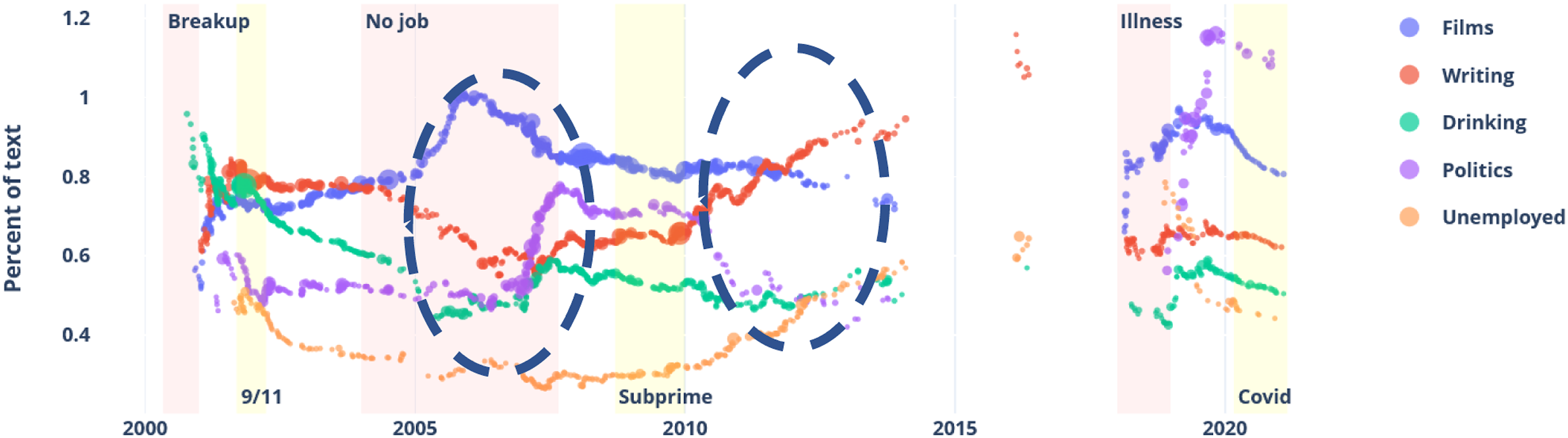
Ken has different main domains of interest. The most important one is the domain of films, including watching and making films. After his studies into filmmaking, he does not find work in the film industry; he only has occasional jobs, such as at a bank or at Amazon. His unemployment becomes a source of concern, and one of the themes he often writes about. Also, Ken started drinking as a young man, and this habit becomes more persistent over the years. Finally, like most diarists, Ken also reflects on his writing (Marcos et al., 2022). It is thus about these five domains that Ken writes most – films, politics, writing, being unemployed, and drinking.
In terms of the relative importance of these domains of life, we can examine the simple measure of overall percent of the text, as can be seen in Figure 1. As a young man, Ken writes mainly about films, with a peak in the mid-2000s, after the end of his studies; with the realisation that he will not find work in the domain, politics starts to take more and more place in the diary. We can thus see a clear inversion of the peak of cinema writing with writing about politics around 2007, indicated on the graph by the doted oval on the left. Progressively, there is also a growing space given to writing, which includes both the writing of the diary itself, and short stories; around 2012, writing takes more importance than films in the diary, as indicated by the oval on the right. Finally, drinking and concerns about unemployment - as Ken goes in and out of jobs – remain constantly present, yet with less importance. 2. Differentiation in Ken’s life domains over time Percentage of words pertaining to specific domains for Ken over 20 years.
The literature suggested that people tend to develop expertise in their professional domain over time. Hence, in our data, Jeanne does not write much in percentage terms about her work as a nurse; but over time, in that domain, her vocabulary becomes increasingly differentiated. Ernst, who spends much time taking pictures, has also a growing vocabulary in relation to photography, which was initially connected to his profession as a reporter and became an important leisure activity and resource. But what about Ken, who remained unemployed?
Ken studies cinema in his youth, so we could think that this is a domain in which he develops expertise; but what happens to it as time passes and he cannot work in that domain? And what about his other domains of interest?
First, let us consider the domain that Ken invested most via his studies: films. In Figure 2, we represent the ratio of unique words used in each domain relative to all the words used in the domain, to map differentiation longitudinally in the domain. In regard to writing about cinema, the curve on the graph is quite stable between 2002 and 2006, then slowly declines after 2010; in 2017 there is a sudden fall, highlighted with a dotted oval. So let us examine how Ken writes in 2005 and in 2019. Ratio of vocabulary to words per domain in Ken’s diary (a ratio of 1 means each word written about the domain is unique, a ratio of .5 means that the vocabulary of words used in the domain is half the wordcount for the domain, and thus a higher ratio indicates a more differentiated domain, with les repetition of the same phrases).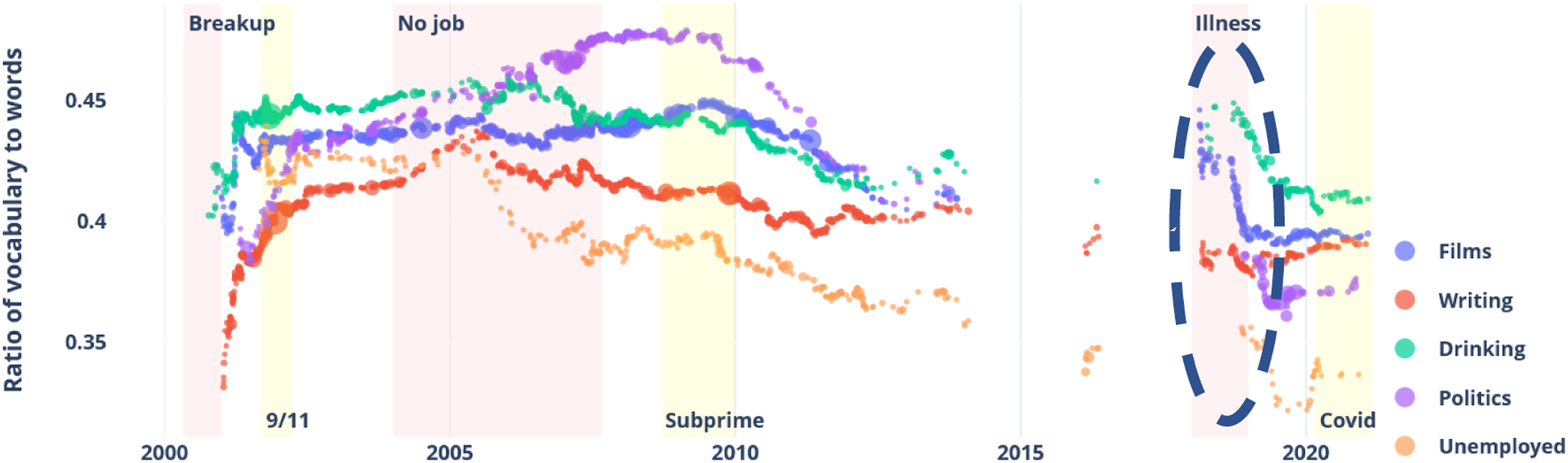
First, here is a typical entry 2005 (shortly after he ended his studies) called “Movie thingies”: The only Oscar Scorcese will win will be a lifetime achievement award. Delighted that Charlie Kaufman won for best original screenplay, even if he did look uncomfortable up there. Eternal Sunshine was by far the best script last year. […] The last piece of voice casting for The Hitchhikers Guide to the Galaxy film has been announced. Emma Thompson will be the voice of Deap Thought. […] Actually, the next month or so is quite exciting for me. On March 26th, the brand new series of Dr Who starts in Britain. (In Canada, I believe, CBC will be showing it from April 5th. Dunno about anywhere else.) And then about a month later, as I’ve said, Hitchhikers on the big screen. Yay! Tarantino claims he lost interest in directing a Bond film when Pierce Brosnan was sacked. Good. It’s no secret that I’m not a Tarantino fan, and I feel he would have ruined it. […] Meanwhile Joss Whedon has been announced as the writer/director for the Joel Silver produced Wonder Woman film. This, in turn, has lead to just about every Buffy/Angel/Firefly female being linked to the title role. Whedon and Silver, however, seem to be leaning towards an unknown. It does kinda surprise me that Whedon would want to do this. It seems as though this is territory he covered with Buffy. (March, 2005)
In such an entry, Ken shows his interest in and knowledge of cinema: who directs which films, who produces them, and who will play in them, in a wide range – from TV series, to blockbusters and independent cinema – together with care for release dates of films in the UK and abroad. A few days later, Ken writes in details about the recently releases The Hitchhikers Guide to the Galaxy (Jennings, 2005). The entry starts with the name of director, author and the whole cast. Then, Ken is attentive to the film composition: its opening, the special effects, the actors’ performances, and the quality of the script compared to the original book. He can also make links between this film and others. In short, Ken has studied cinema, and thus has formal knowledge of it, with a specialised vocabulary and a large body of knowledge easily retrieved; his comments are differentiated and specialised, typical of one with expertise (Kallio, 2020a).
In terms of distanciation, in the two sequences, Ken’s makes sense of events by progressively distancing from them: a movie comes out, and Ken connects it to his past expectation (“I was expecting the film”), before moving forward to the future (“it is quite exciting”). This is a form of distancing from the present via a loop from past to future. Second, Ken distanciates by using verb of reflection (“it does kind of surprises me”), by connecting unrelated facts, and by reflecting hypothetically (“I knew this would happen”). All these processes are form of semiotic elaboration, both through temporal thinking, abstraction, and imagination.
How does differentiation change after leaving college, when in Figure 2 there is a drop in lexical diversity about films, and do we find the same distanciation dynamics? In 2019, there is an entry in which Ken writes about his birthday, the presents he got, the fact that he went out drinking, and then about films: Watched the first episode of the new season of Discovery on Friday. It was good. I also watched both the Fyre Festival documentaries. I enjoyed them both, but preferred the Netflix one. It looks at the problems it caused for businesses on the island, rather than focusing on the attendees who got conned. (January, 2019)
And, a few months later: Game of Thrones tonight! Can’t wait. Also, finally got a release date for the new season of Veronica Mars. […]
1
Finished watching Wrestlemania on Saturday. Wasn’t the best, but not bad. (April, 2019)
Hence, Ken is still watching many films, but now mainly on Netflix; he does not describe their features in detail anymore, he just makes general evaluations. Ken’s writing about films has lost precision and differentiation: technical appreciation of the quality of the film features is replaced by a gross appreciation of the content, and a wide and cultivated interest for different types of films is replaced by comments on mass-market productions. Sentiment intensity over time for Ken.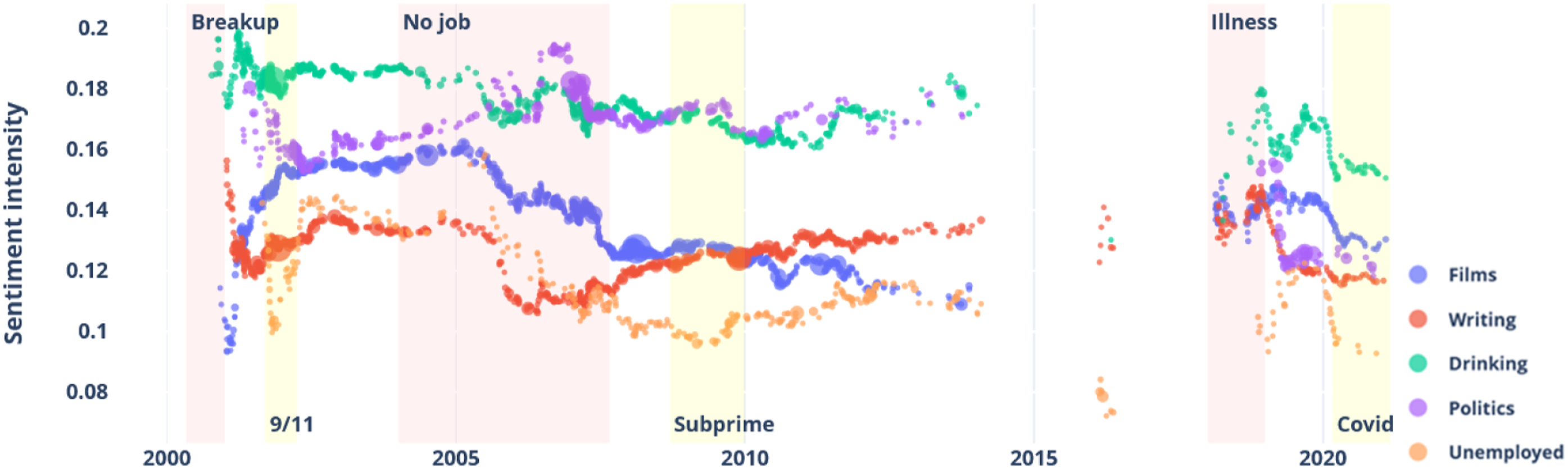
In terms of distancing, Ken mainly reports the recent past (“Watched the first episode,” “finished watching”), or anticipates the immediate future (“Game of Thrones tonight”); yet he does not relate these events, and in that sense, the writing does hardly distance from immediate or close experience. In addition, the facts are juxtaposed, there is no attempt to relate events or fact; and there is no complex evaluation or exploration of alternative. In other words, there is no distanciation in terms of abstraction or imagination.
Importantly, there is another domain of interest which grew in differentiation for a couple of years after the end of college: Ken’s interest in politics. For instance, in this entry in November 2008, Ken writes about his family, comments quite precisely on a film he just went to see at the cinema, then moves to politics: Then, finally, at 4 am GMT, it was announced that Obama had won. And me and my friends went ballistic. We watched McCains concession speach then, the greatest interview ever. Ladies and gentlemen, I give you Gore Vidal versus David Dimbleby: Then Obama spoke. He spoke with the clarity and vision I have seen from him before (most notably in his acceptance speech) and proved why he was the right choice. Couple more election things: There is a lot of talk about what the Republican party should do now with a lot saying they should go back to their conservative roots. Not sure about that, but what they need to do is learn from Obama and energise the youth of today. At the moment it is a vicious cycle with young people being seen as lazy and politically apathetic, so no attempt is made to engage and energise them. Therefore, young people don’t see the point in bothering with elections as no-one is speaking to them. Hopefully Obama’s campaign has proven that if you do engage with them, if you do energise them, they will be more than happy and get involved. And they might teach their elders a thing or two. (BTW: this is a lesson that the British parties need to learn as well.) (November 2008)
Such an entry shows Ken’s interest and knowledge in current US politics: he knows about candidates and their programs, about campaigns and challenges. In the entry, he mentions friends with whom he discusses politics, and also there is an active link to the journal Newsweek. In terms of distanciation, Ken actively makes sense by connecting Obama’s campaign with the present, evaluation the situation – which requires abstraction – and reasoning hypothetically, which requires imagination. Such distanciation, Ken partly does via the mediation of a dialogical community, by taking the perspective of the others (Zittoun & Gillespie, 2022). Hence, politics for Ken is a differentiated domain of knowledge, in which he engages in complex reasoning, and that is validated by a community – he is developing a specific cultural subsystem (Zittoun, 2022a, 2024).
Hence, we propose that Ken has progressively disinvested cinema as domain of expertise; it has consequentially become de-differentiated and de-distanced. He has also developed another domain of knowledge around politics, which is differentiated and distanced. 3. Vulnerabilising ruptures and changes in expertise
How can we explain these changes? In past work, it has been shown that ruptures are occasions for learning and development; but for such transitions to happen, people need to use the right personal, institutional, social or symbolic resources (Sapin et al., 2014; Levy et al., 2005; Zittoun et al., 2003, 2008). But what if the rupture is unresolved, if there is no transition toward a new equilibrium? Vulnerability arises when a person does not have the resources to deal with the rupture (Spini et al., 2017), and thus, perhaps, vulnerability may also explain the difficulty to maintain and develop a given domain of interest. Our idea is that vulnerabilising events may be accompanied by emotional disengagement.
One measure of emotional engagement is sentiment intensity (the sum of positive and negative emotional words), that marks moments of ruptures in people’s lives. For instance, in the life of Ernst, there is a very clear peak of intensity, the highest in the whole diary, when he retires (Marcos et al., 2022). In the life of Ken, however (Figure 3), the intensity of drinking has a peak in his youth when his girlfriend leaves him; the intensity of feeling associated to films drops after 2005, after he is unsuccessful in finding a job in the domain; a second small peak occurs in politics around 2005, when Ken is very concerned with Bush’s politics and Guantanamo on the one hand, and Blair’s government on the other. Other small peaks appear around 2013 and 2018, both connected to drinking. Interestingly, writing (his diary and essays) seems to slowly and steadily gain emotional intensity, indicating that his writing becomes increasingly invested.
The most striking characteristic of all these curves, compared to other diarists we examined, is thus that there is no sharp increase of reduction of intensity the rupture over time. One possible explanation might be that the source of the rupture – the impossibility to work in the film domain – is actually ongoing and unending.
It is possible that Ken could have found resources to support his life; yet if films were the main domain of investment, in principle providing with symbolic resources. In effect, symbolic resources enable one to elaborate experience, including containing and transforming affects, distancing, guiding perspective changes, learning new knowledge, and guiding identity transformation (Zittoun, 2006, 2013; Stenner & Zittoun, 2020). However films are precisely the domain from which Ken was excluded (Zittoun, 2006).
In contrast, the most consistently intensively invested domain is drinking alcohol, mainly with friends and sometimes alone. In his case, the measures suggest that it is mostly positive sentiments that are associated with this domain. Indeed, Ken uses alcohol as an important resource – it is often mentioned in the diary, and at times part of the title of entries (e.g., “I need a freaking drink,” 2018). Yet the use of alcohol as resource, that may temporarily reduce anxiety, does not necessarily support sense-making about experiences. In effect, alcohol tends to foster more concrete modes of thinking, and inhibits distancing or elaborating experience (Pirlot, 2002; Poupard et al., 2004). Hence, if it is alcohol that replaces cinema as main domain of investment, we may observe a vulnerabilising trajectory – because it does not enable him to work through ruptures. However, our analysis suggests two more domains of life which may provide further resources: politics and the diary itself.
First, politics is strongly invested; it may seem to fail having the sort of supporting effects that films have when used as symbolic resources, as it does not directly enable elaborating personal experiences. However, it is possible that thinking through politics also enables Ken to have a better understanding of the world that creates the difficult conditions in which he lives (being long-term unemployed, being dependent on social services, having a loan, etc.). Ken’s political entries report details about political debates, events and discussions; yet it is with little explicit mention on why and how this affects him directly. However, a closer look reveals that they support active sense-making. For instance, in an entry called “We’re sorry, Boris. We’re afraid we can’t do that,” as Brexit is discussed at the parliament, he writes: The first thing that happened was the anti No Deal bill got Royal Ascent and became the law of the land. Now, this is important, because Boris Johnson has said he would rather be dead in a ditch than ask the EU for an extension. If he doesn’t ask for the extension, though, he’s breaking the law. Now, there was the idea that he could send the extension request along with a side letter asking the EU to ignore it, but it turns out that won’t be possible. (September, 2019)
In such an entry, the discourse is differentiated and elaborated; in addition, there are indications of Ken actively reasoning with these events: “the first thing”; “now this is important”; “if, then” – suggest distanciation and active elaboration. Hence, it is possible that politics becomes a domain of life which enables him, in a distanced way, to work through experience. The fact that this domain is so emotionally invested may suggest that Ken finds in there a way to express his feelings, and by thinking these events through, to elaborate some of his own emotional experiences.
Second, despite his hardships, Ken continues to write in his diary over more than 20 years. This dedication suggests that it is repeatedly being used for something. On the one hand, he reports his daily thoughts and experience, addressing them to an audience. In addition, he uses the diary as “technology of the self” by which he repeatedly generates commitments (Marcos et al., 2023) – such as promising to reduce his drinking, to do more exercise, or make a new job application. He also reports about the short stories he writes, submitting some to writing concourses. For example: “this story is genuinely the best thing I’ve ever written” (2012). Writing is probably an activity by which Ken learns to make sense of his experience through time, and via which he builds a community of readers.
Overall, although Ken seems to live a life with vulnerabilising conditions – the disinvestment of films, partial unemployment, drinking – his investment and increased commitments to other domains – his own diary, writing, and politics – appear to offer a range of resources that enable him to re-balance and learn and develop in new domains.
Conclusion
This article examined adult development from a lifecourse perspective. Based on a theoretical reflection and on the analysis of longitudinal data, we made three propositions. First, as people have relationships, work, engage in hobbies and pursue their interests, they learn and develop within different domains, in which they can build knowledge and experience – which may be more or less socially acknowledged and systematically organised. Second, development occurs as people engage in these domains, through progressive differentiation and distanciation. However, to understand the person as a whole over time, one must also consider the relations between domains, and the overall dynamic of life – for example using the writing domain to do sense-making about problems in the work domain. Third, we have seen that the relatively stable equilibrium one person may have can be perturbed by a rupture, which may invite new learning and new elaboration, but also may involve a renegotiation of the system and its balance and thus can potentially even become more vulnerabilising.
In the case of Ken, we have seen how an adverse event (long term unemployment) can be vulnerabilising, leading him to disinvest in films, which leads to dedifferentiation within the domain and a loss of distanciation. However, and this is the idea we emphasise here, developmental and temporal dynamics may bring people to reorganise experience and thus invest in new or other domains, and develop new forms of expertise and engagement. Development – with differentiation and distanciation – may occur in any domains of people’s lives in society, and each of them may contribute to the person’s elaboration of experience.
In this article, we have made three theoretical propositions to expand current understanding of adult development. In effect, psychological research on development in adulthood has long been normatively focused on work and family. Here, we have adopted a more general, open-system perspective, assuming that psychological development occurs in diverse domains, and that each domain can have differentiation or de-differentiation, distancing or de-distancing, in a person’s constant search for an equilibrium within their environment and for themselves. Such an approach may give us a new chance to observe and understand the diversity of developmental trajectories in our changing world. Because the theoretical propositions have a high degree of generality – they are anchored in meta-theory and are situated in the history of psychology (Allport, 1963; Piaget, 1972; Valsiner, 2005, 2007; Witherington & Boom, 2019; Zavershneva & Van der Veer, 2018) – it is about the articulation of sociogenesis and ontogenesis, rupture and transitions, life domains and their transformation over time, distantiation, general dynamics of equilibration of overall configuration of life domains, etc., - it can be applied in very diverse studies based both on qualitative and quantitative data. We thus believe that such beginning of theorisation can help us to work toward an integrative understanding of human development, from youth, to adulthood, into older age.
Second, our enquiry into lifecourse development over a long period of time made us also aware of how collective crises and ruptures may affect specific individuals, and how, when they are in social positions which restrains their potential resources, impede their goals and wishes, and therefore their development. Here, we hope to contribute to the growing field researching vulnerability in the lifecourse (Spini et al., 2017; Spini & Widmer, 2023): our unique contribution is to highlight the first person perspective of the human experience of vulnerability, only accessible through qualitative longitudinal data.
The third contribution of our article is, as corollary, methodological. We have used rich naturally occurring qualitative longitudinal data in the form of online diaries. We believe that such data offers great potential for developmental research, precisely because it is both thick and longitudinal, and thus affords an innovative combination of qualitative and automated analytical techniques (Gillespie et al., Submitted; Neuman, 2014). In addition, with the rapid expansion of new computing techniques, there are immense possibilities for analysing voluminous qualitative data, which would be unfeasible to study manually. However, it is important not to use blind computing; these approaches need to be solidly grounded in theory. In addition, although these data are public, they are produced by persons who chose to expose their lives, but not always are willing to see their lives turned into data; this requires an additional ethical care. Hence, we make both an invitation to examine the potential of rich online longitudinal data, and a call for theoretical and ethical prudence.
Altogether, we hope to invite further exploration in the sociocultural study of the lifecourse. It is self-evident that human development occurs in time, especially over long durations (i.e., decades). In order to challenge and refine our theories, we need methodological innovation in locating rich qualitative longitudinal datasets and also in analysing such data. Tackling the analysis, ethics, and sharing of such data, we propose, could yield significant advances in the study of human cultural development.
Footnotes
Declaration of Conflicting Interests
The author(s) declared no potential conflicts of interest with respect to the research, authorship, and/or publication of this article.
Funding
The author(s) disclosed receipt of the following financial support for the research, authorship, and/or publication of this article: This paper is an outcome of a project supported by the Swiss National Science Foundation, via the Swiss National Centre of Competence in Research LIVES (nccr-LIVES) “Overcoming Vulnerability: Life Course Perspectives”.
