



Abstract
There is a lack of research that focuses on the lived experiences of British Yemeni young people in the UK as they pertain to their learning and development. This paper aims to bridge the gap by exploring the case of Nuha, an 18-year-old British Yemeni young woman, as she navigates the conduct of her everyday life. The paper presents a developed conceptual model and associated methodological approach for exploring Nuha. It does so by first reviewing what might be viewed as dominant approaches to the study of ethnic young people’s experiences that advocate a social identity theory. A critique of such thinking is developed that takes issue with much of this writing that has the potential for an essentialised abstracted approach. The paper instead advocates the use of a subjectively focused, practice orientated and yet culturally sensitive approach to exploring human behaviour in the context of the conduct of everyday life. Based on an analytical matrix that is developed from such thinking, I examine Nuha’s life experiences using Dreier’s theory of a person. In doing so, I recognise the additional importance of personhood in practice that provide a reference point for exploring more deeply the learning and development of Nuha. The research is generated through a case study narrative that is analysed dialectically through theory, recognising how theory is simultaneously driven by the data. The paper concludes with arguments made about the centrality of an extended and developed sense of the conduct of everyday life to get at the nuanced evolving sense of being and doing for British Yemeni young people.
Introduction
This article presents a case study of a young British Yemeni woman, Nuha, examining her daily experiences through the conduct of everyday life. The data, presented in the study, is drawn from a larger doctoral study of six British Yemeni young people, conducted over nineteen months, documenting the experiences of members of this overlooked and under-represented community. The study was guided by two research questions: (1) What types of everyday experiences do British Yemeni young people have? (2) What different forms of learning and development do British Yemeni young people experience over time?
In answering these questions, it is important to explore the conduct of everyday life as it connects to the field of ethnicity, learning and development of young people. This study was provoked by own reflections as a Yemeni woman and as a schoolteacher about the lived lives of young British Yemeni young people as they learn and develop in the UK. One of things that was immediately apparent is that this is under-research area which is at odds with the fact that Yemeni communities are some of the oldest and most established ethnic communities in the UK (Geaves, 2012). Insight into the daily lives of British Yemeni young people today provides an in-depth knowledge on the social practices of such community.
The focus of this paper is the development of a conceptual methodological framework that is both theoretical and empirical with particular attempts at acquiring a novel approach for undertaking this study. In particular, it integrates Dreier’s theory of a person (Ole Dreier, 2011) and Roth’s ideas of personhood in practice (Roth, 2020), and uses the analytic lens of intersectionality and post-colonial theory, to enable the interlinking between agency, structures, and cultures. This article focuses on Dreier and Roth’s contribution, and I elaborate more on intersectionality and post-colonial theory in another article (Ahmed, 2023). This framework emerged and evolved throughout the research process and deductive-inductive-abductive approach (Assarroudi et al., 2018; Hsieh & Shannon, 2005; Okoli, 2021) was produced, summarised in Figure 1. In this article, I narrate how the sequence of this approach emerged and evolved, describing its application in the analysis of the case study of Nuha. The deductive-inductive-abductive approach applied in this study.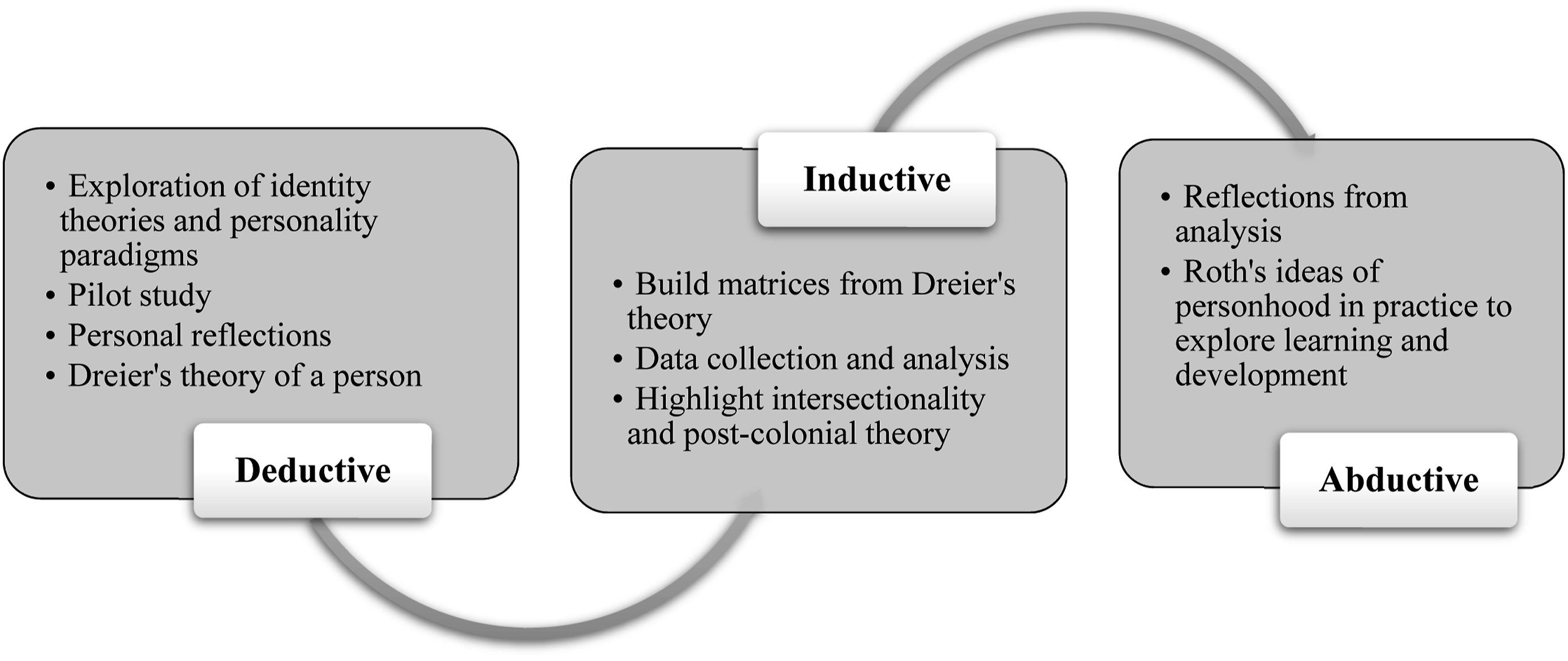
I build my deductive theory through a critical exploration of various ideas of identity and personality that result in utilising Dreier’s theory of a person (Dreier, 2011) and the conduct of everyday life. I then explore Nuha inductively in relation to the conduct of everyday life. I go on to show how using Dreier’s theory of a person does not completely explore or explain Nuha’s learning and development and thus I focus on Roth’s idea of personhood in practice as a way of moving things forward abductively.
Methodological approach
In undertaking the research, there was an initial attempt at scoping some key explanatory approaches to thinking about lived lives of British Yemeni young people. At the early stages of the research, issues of youth identity and agency were explored through examining some major work by Côté and Levine, that presented ideas in and around the social construction of identity, reflexivity, and associated action (Côté, 2006; Côte & Levine, 1983). These were the initial concepts that enabled my thinking about some of the factors in young people’s lives. At the same time, I argue that the historic lived lives of British Yemeni young people require notions of intersectionality (Gopaldas, 2012; McCall, 2008) and postcolonial theorisations (Bhabha, 2012; Halliday, 2013; Kour, 2005) in order to make sense of their identity and agency. This is because intersectionality provides a possible platform to explore different identity structure markers that are found in British Yemeni young people, and post-colonial, provides ways of understanding how the past may have influenced the present living and being of Yemenis in Britain.
Much of the research on the lives and living of young people have to a lesser or greater extent focused on notions of identity and agency. In particular, social identity theory attempts to explain how and why individuals identify as members of a group, and to quantify the impact of that identification on their behaviour (Ashforth & Mael, 1989; Stets & Burke, 2000). Some of its main concepts include inter-group comparisons, self-categorization, and optimal distinctiveness (Billig et al., 1991; Cerulo, 1997). Although useful, there is a tendency in some of the main thinking to bleach out elements of individual subjectivity with a stronger focus on social identity. This overlooks the importance of history and culture, simplifies the significance of self-esteem, and makes claims about in-group bias that may not be supported by the data. Such an approach, in many respects, abstracts individuals from the actual conduct of everyday living and the factors that pertain to such living (Schraube, 2013).
In addition, there are also weaknesses with the focus on reflexivity and the social construction of identity influencing agency. This is because social construction of identity does not explore activity and the social arrangements within those activities, but rather focuses on the self as it is formed through interactions with others and in relation to social, cultural, and political contexts. In other words, social identity theories seemed to focus too strongly on ‘in group’ articulations of subjectivity that do not fully pertain to notions of variety and diversity in the living of life. This became even more pronounced when I reflected on my own experiences of my lived life, and from my experiences with working within the Yemeni community and engaging with young people. What became troubling for me, in exploring some of the traditional theories, is that they focused too strongly on the homogenous ideas of social groups in understanding agency and structure. My own reflection suggests that although there are some homogeneities, there is also some heterogeneity and traditional theories only partially expose this. These issues also tend to essentialise what it means to be a British Yemeni young person, and I argue that one needs to go beyond this and explore more strongly the living and being of these young people, one that goes beyond an individual and psychological perspective of the social and identity that bleaches out a deep social, historical, and cultural relational ecological perspective.
One such approach is through the conduct of everyday life, characterised by the works of several scholars (Højholt & Schraube, 2015; Holzkamp, 1995; Schraube & Osterkamp, 2013b; Kristensen & Schraube, 2014). Such scholars have provided significant contributions to understanding people as active subjects within the contexts of their everyday living and being. Through encapsulating the actions and associated socially-located self-understanding by which individuals actively organize their daily life, the social and material contexts of those lives can be reflected (Hybholt et al., 2020). This includes the way people collectively participate in everyday practice and their efforts to handle their activities, concerns, relations, and conditions in different action contexts (Bandura, 1999). Guided by this literature and other prominent critical psychologists (Hodgetts et al., 2010; Schraube, 2013; Schraube & Osterkamp, 2013a; Spitzer et al., 1975), Dreier (2011) develops ideas that are associated with the cross-contextuality of the conduct of life. Specifically, his ideas of personal trajectories of participation became the basis for his theory in understanding personality and the conduct of everyday life (Dreier, 2011). Such an approach comprehensively opens a focused direction in studying people’s activities, movements, and participations in and through the social structures of their everyday practice.
Dreier centralises his theory around a relational person-situation-activity context, focusing on how studying action and activity provide a deep understanding to the conduct of everyday life of an individual. Such understanding avoids many of the abstractions associated with an overly cognitive and individualised reflexive understanding of young people’s agency. This has directed me to take the position that understanding personality and identity is most accurately achieved through looking at the consequences of relational actions and phenomena experienced and narrated by the young person, and, theorised in terms of the way a person is dialectically both a subject of and subjected to their surroundings. This gives a sense of meaning and motives of those different activities in which a person takes part emerge from aspects of society and its social arrangements.
Dreier’s theory is rooted in the way a person conducts their daily life and denotes both a holistic and agentic approach to personality. It also concentrates on the concrete practice of activity which highlights both agency and the social arrangements that pertain to that agency (Dreier, 2011). Through focusing on activity that provides a much more grounded, practical experiential way of thinking about agency, the theory moves away from an overly cognitive, reflective, potentially abstracted narrated approach. In Dreier’s theory of a person, people are considered as existing in movement across time and context, allowing researchers to “grasp how the order of everyday lives affects the functioning of persons” (Dreier, 2011, p1, line 9). This theory bypasses the limitations in research on personality by “strengthening the ecological validity of theorizing and of empirical findings by approaching personality from the perspective of the everyday lives of persons.” (Dreier, 2011, p9, lines13-15). On account of its power and ability to provide a stronger and contextual way of understanding the nature of lived lives, Dreier’s theory has been chosen as the central theoretical framework for data analysis in this study and provides a consistent platform to do so. Dreier’s theory of a person is about understand the person as active participants involved in their own personal trajectories in relation to structural arrangements of social practice.
Using Dreier’s theoretical proposal in his paper: “Personality and the conduct of everyday life” (Dreier, 2011), I developed an analytic matric. The theory is presented with reference to Dreier’s ideas of (1) order and arrangement, (2) situated participation and movement, and (3) the conduct of everyday life. These three elements formed the main analysis and allow researchers to grasp how the order of everyday life, in its arrangements, movement and participation, affects the functioning of the person. Dreier provides the principle for understanding the phenomena by offering this much needed set of thinking tools. This is because it articulates the subjective experience, thoughts, and actions involved in people’s creation and organisation of their activities, tasks, projects, and participations in and across different social contexts in the fabric of everyday life. The coding frame are used as a data extraction tool and provided a systematic way of interpreting young people’s narrative and, in this particular case, that of Nuha.
Methods and material
The study examined the experiences of six British Yemeni young people living in Birmingham in the context of the conduct of everyday life using the person-situation-activity approach. One of the participants was Nuha. After receiving her signed consent form, I gave Nuha a disposable camera and asked her to take photographs (Wang & Burris, 1994) of activities during one routine and one non-routine day, providing knowledge on how she lives through routines as well as during time-outs (Heintzelman & King, 2019; Dreier, 2011). In the form of semi-structured interviews (Cohen & Crabtree, 2006), Nuha was then asked to talk about the significance and meaning of her photographs (Hurworth, 2003) and so the photographs were used as tools for the interview process (Wang & Burris, 1997). The narratives of Nuha’s daily activities were co-constructed, with the photographs providing a platform for the discussions. This process was then repeated, nineteen months later to study areas of learning and development for Nuha.
An analysis of an extract from Nuha’s interview transcript.

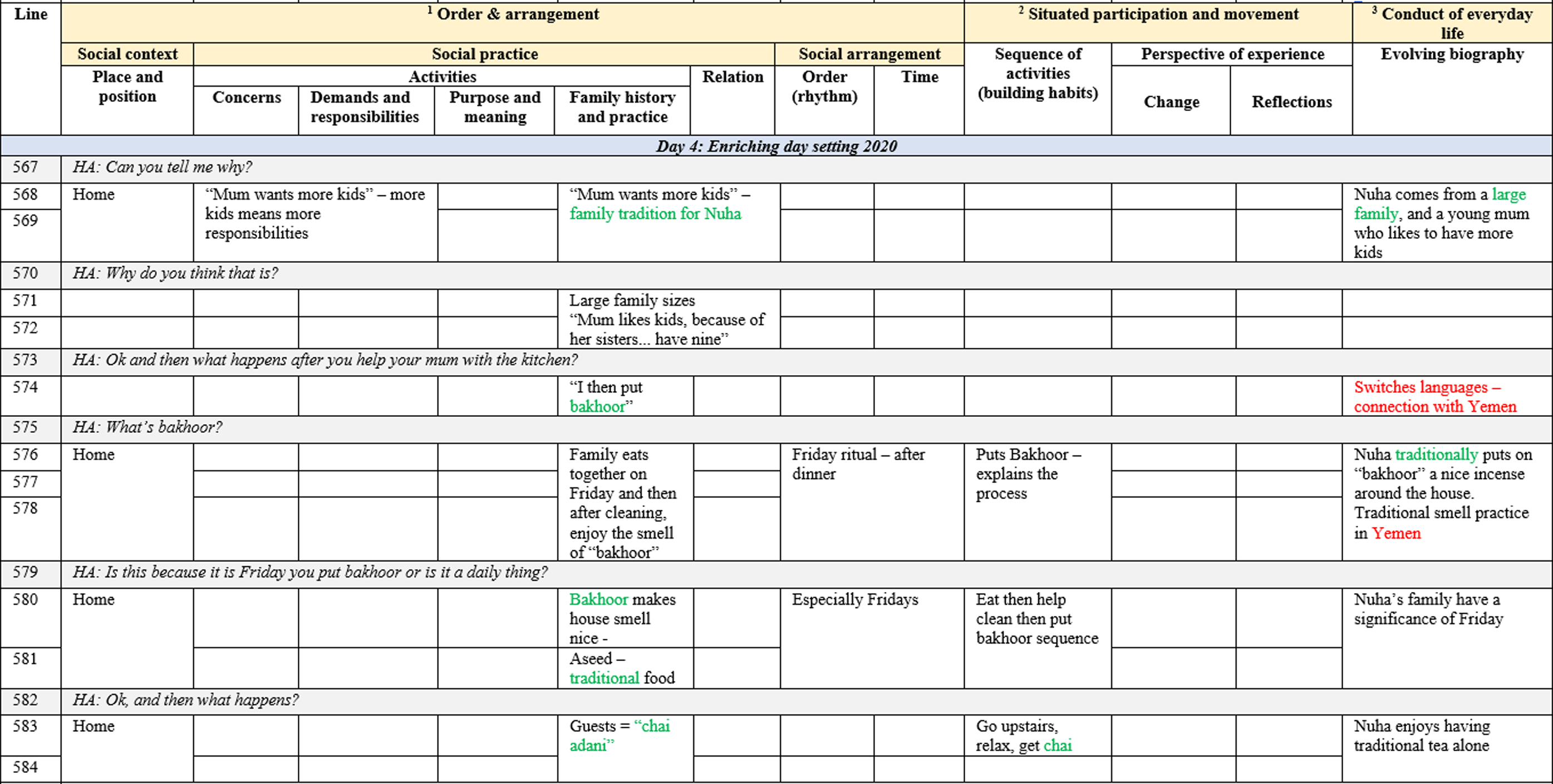
Nuha’s interview transcripts were analysed line by line. There were many overlaps between the different elements in the heading of Table 1 - some elements merged, and others placed in more than one section. This led to further evaluation evolving from the data. The analysis was done in this way because the lived lives of a person cannot be fragmented into compartments, and clear overlaps between social context, practices and relations are evident. For example, when Nuha talks about what she does on a Friday, as part of her routine day, the analysis is both placed under social context (place – home), family history and practices (eating together on Friday), order and time (Friday rituals happen after dinner), sequence of activity (habit built of perfuming the house on Fridays) and part of her evolving biography (in which Nuha perfumes the house with an incense (Bakhoor) and this is also done traditionally in Yemen). These overlap gives the participant a sense of being one person as they act across different social fields (Holzkamp, 2015). Nevertheless, analysis being completed in this way provided a structured and forensic system for the detailed organisation and categorisation of the data. References in the transcripts to intersectionality-related markers or post-colonial concerns were highlighted within and throughout the table (shown in Table 1 in green and red, respectively). It is noteworthy that I make the concept of the conduct of everyday life more pertinent in the analysis of experiences by using it in a way that is more sensitised to post-colonial and intersectional arguments. Together, this constructed the research text. The interviews were audio-recorded and then transcribed verbatim.
Results
Introducing Nuha
Nuha is a young woman, born in Birmingham, whose parents migrated to Britain as young adults. She is the second child of a family of seven and was living with her parents at the time of the study. Nuha’s conduct of everyday life is articulated through her activities, and her biography is a combination of perhaps predetermined roles she plays as a family member, student, employee, and, at times, a friend. As she moves within and across different contexts and experiences, her mode of participation varies according to the diverse contexts she participates in. These contexts embody specific positions, social relationships, scopes of possibilities and personal concerns for her, which when enabled, become evolving roles for her. Her narrative shows her activities as she starts to think about, and articulate elements of what adulthood may hold for her.
Nuha’s activities are also clearly located in elements of her culture, family practices and histories, which illustrate the interactivities of her social identity structures in cultivating her lived experiences. Such structures show a presence of aspects of post-colonial elements as well as intersectional themes. For example, when Nuha narrates an activity she does in a non-routine, enriching day setting - making Yemeni tea - she not only switches languages, but also relates to an activity that is, until today, practiced in Yemen and appreciated by guests both in Birmingham and Yemen. There is a sense of Nuha connecting with her ancestral homeland, while at the same time engaging with everyday events of the British society.
Building Nuha’s portrait
Using guidance from Rodríguez-Dorans and Jacobs (2020) and Lawrence-Lightfoot (2016), a narrative portrait of Nuha is produced, offering a representation into Nuha’s life that is not static, but rather linked to the evolving story of her life. This evolving portrait, reflects, interprets, and communicates Nuha’s narrated experiences, while at the same time respecting her voice by working only with the structure of the text. Figure 2 displays a timeline narrative of Nuha’s activities on four non-consecutive days. A developed timeline narrative of Nuha’s activities.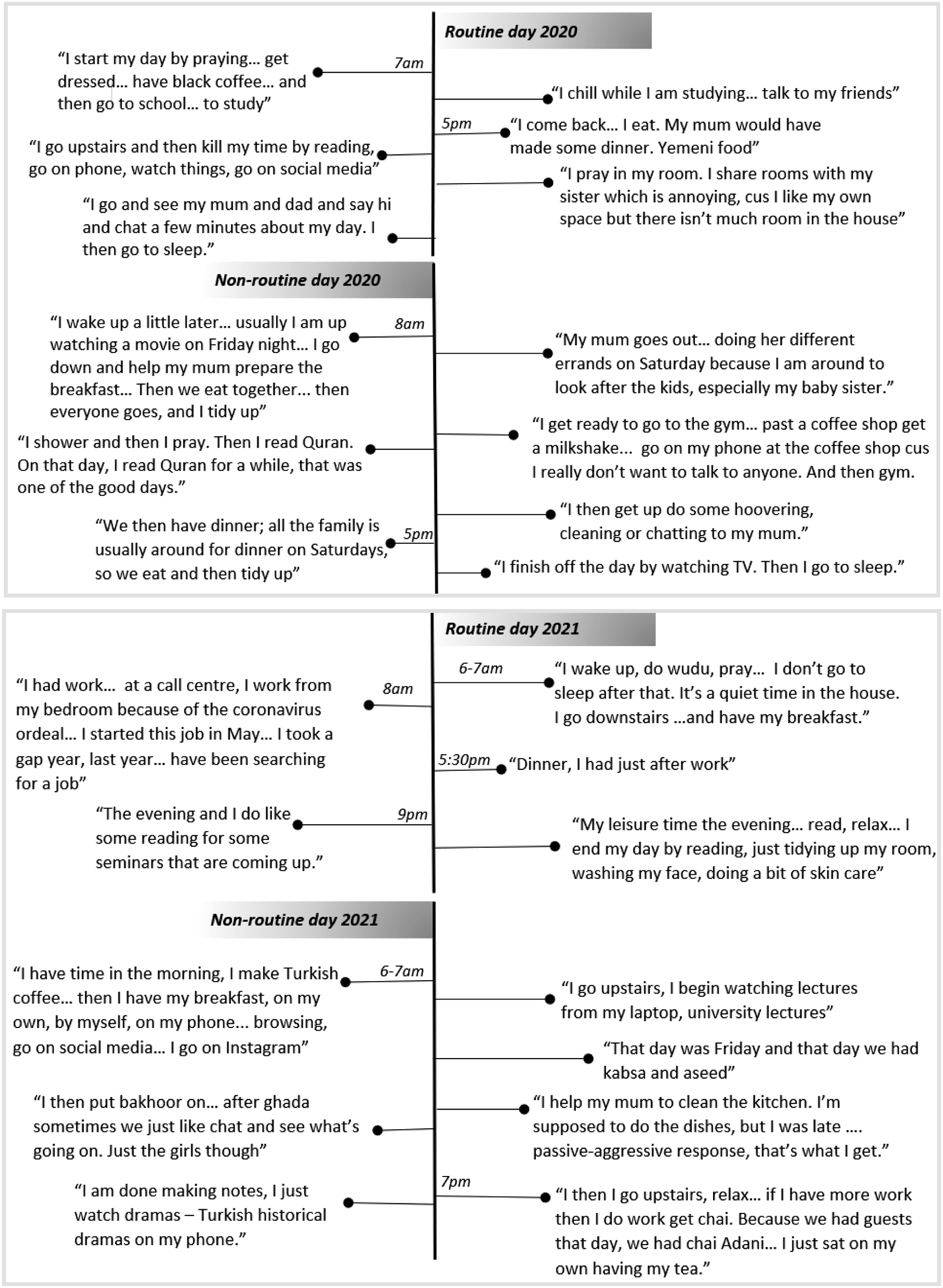
Although the depictions are from the participant’s narrative of their personal life, my position and subjectivity as the researcher also played a part in the narrative construction and so the portrait becomes my story of Nuha. In this way, the filters through which questions were asked, data gathered and analysed, and findings reported shown (Sutton & Austin, 2015) are made apparent. This is a much more active, engaging position through which I help to shape the story’s coherence and aesthetic (Lawrence-Lightfoot, 2012; Welty, 2011). Nuha is not simply telling her story, she enacts it (Pentland, 1999) and my editorial work captures her essence and qualities of her character and history in ways that display her active living and being. It also reflects a negotiation between how Nuha sees herself and how she tells her story (Anderson, 2012; McAdams & McLean, 2013). With these negotiations in mind, I crafted Nuha’s portrait by selecting extracts from the interviews, specifically those that are repeated, and action based. In this way, I analysed the narrative portrait using the conduct of everyday life, one which enabled me to avoid abstraction representation of Nuha.
The timeline, shown in Figure 2, is an analytic tool used to help in the process of creating narrative portraits. I have adapted Rodriguez-Dorans timeline (2020) by choosing quotes from Nuha’s transcript to depict the activities Nuha performed, and, in Figure 3, I have added my own narrative to fill the time gap between the 2 years. Nuha’s activities between non-routine day 2020 and routine day 2021.
Across this timeline, there are many conversations in which there are connections between Nuha’s activities and her social identity structures, her order and arrangements and situated
Nuha’s story
Nuha carries out activities show the parameters of her lived experiences. She begins her day, at home, by either performing daily religious rituals, such as prayer and reading the Holy Quran, or by carrying out domestic responsibilities, such as helping her mother with breakfast. She ends her day by cleaning up after dinner and taking time out for herself for skin care, watching television or browsing her phone. These activities have become part of her morning and evening routines and a habit that she builds cumulatively. Time and order are also part of her daily routine; some actions are regular, such as waking up early, some are (not only regular but) focused on time, such as praying, while others are based on the demands and responsibilities required of her, mainly by her parents, such as cleaning and babysitting.
Nuha’s domestic responsibilities in the house occupies a large amount of her time and establishes her prescribed role in the family. This is highlighted in the photos she took of her daily actions and through discussions throughout her narrative. Photo 1 shows Nuha’s one-year old baby sister. Although this photograph does not present a clear picture of Nuha’s domestic duties, it led to a rich discussion on her responsibilities in the home. “I babysit her… I do like being active and having something to do. I sometimes can’t be bothered, or tired and no one really appreciates it… I shouldn’t really complain because I know my mum does, like way more, and like this is my duty, and if I don’t do it, my mum has to do it all by herself and it’s not really fair on her, when there are so many of us. I don’t want to feel guilty… I do feel like it’s like a bit of a burden. Like when I go outside or something, my mum is just like, well you can’t, cos it’s just like I need help”. Nuha’s One-year old sister.
Establishing a routine of everyday life means that Nuha does not have to scrutinize and doubt every aspect of what she is doing as she goes along with her day, creating practical and cyclical routines and regular arrangements, and providing a possible framework to resolving everyday practical tasks and demands. Nuha helps her mother in the smooth running of her family - she cooks, cleans, does the laundry, and looks after her younger siblings. Her mother is a housewife, running or managing her family’s home. It seems that Nuha is taking on some of that responsibility and although feels her importance in her family, especially in helping her mother, she finds having many siblings a “burden” because it limits her ability to go out, socialise, work, read or watch TV drama. In fact, Nuha blames her mum for having many children: “What can I do? My mum wants more kids.” Her extended family in Yemen also have large families and Nuha’s mother continues this family tradition, perhaps due to the expectations of the family’s wider society.
Despite feelings of being overwhelmed and unappreciated, Nuha accepts and endures her domestic responsibilities - her sense of duty and responsibility take precedence over her own wants and desires. She does, however, learn to negotiate and form a balance between activities and commitments across social context and days. She plans the days in the week so that she can have time for herself. She wakes up earlier than the rest of her siblings so that she has time to have breakfast quietly and alone, while browsing her phone and going on social media. When she finishes her family duties, she goes to her room, or moves elsewhere to drink her tea, on her own for a “bit of peace”. Photos 2 and 3 show some of the activities she does to ensure she has some time to herself. Milkshake (left). Coffee, cereal bowl, and her phone (right).
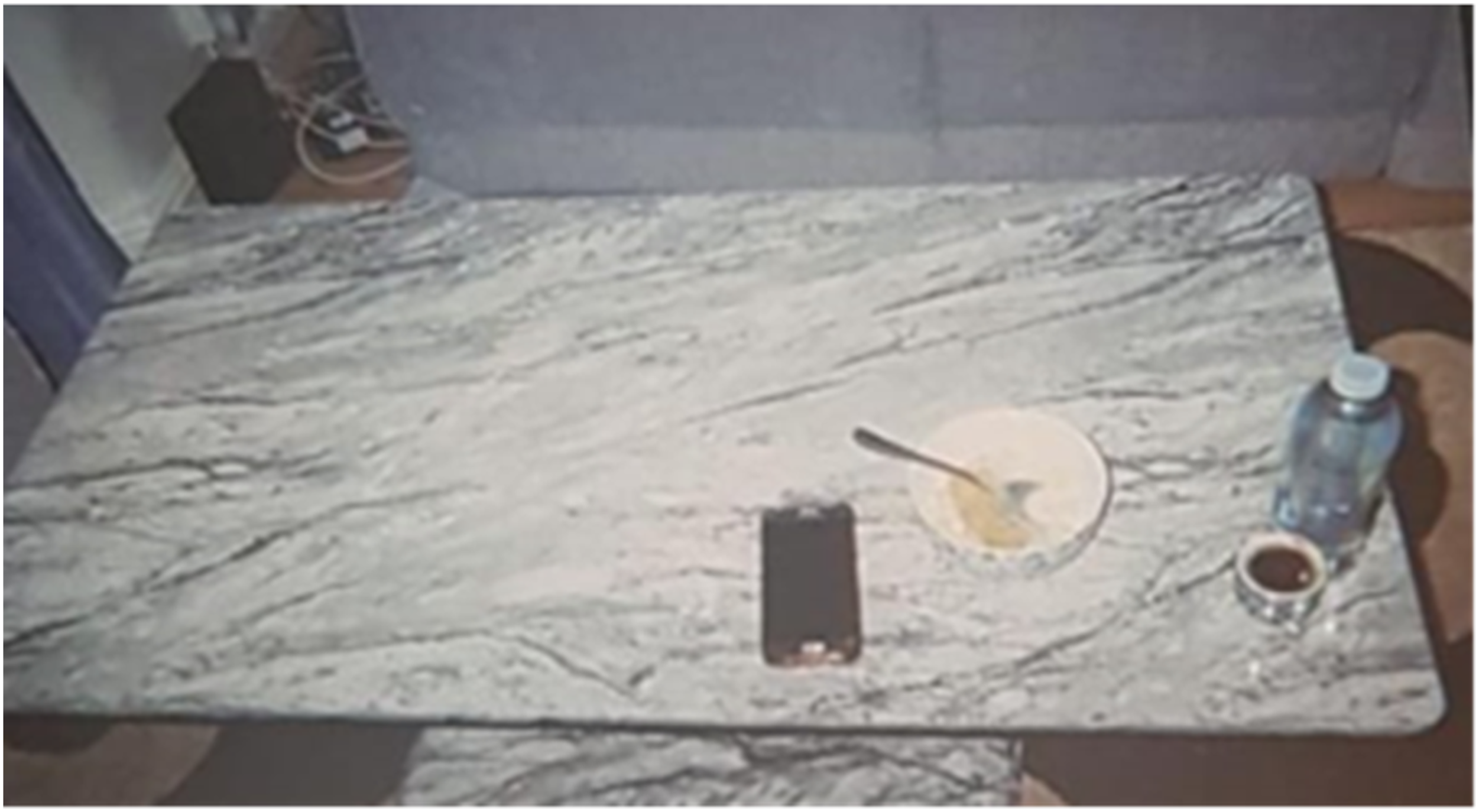
“I get a milkshake. I go on my phone at the coffee shop cos I really don’t want to talk to anyone (left) I have my breakfast, on my own, by myself, on my phone (right)”
Nuha values down time, especially in the evenings, and she “enjoys [her] own company”. She finds being on her phone is her ‘alone time’, while at the same time it allows her to “connect … to others”, the outside world - in a way that suits her schedule. Although she shares a room with her younger sister, she finds space by putting on her headphones to “zone out of” her surroundings. In visiting a coffee shop, she is alone again, doesn’t go out with friends, and doesn’t talk to anyone, perhaps emphasising the value she places in having quiet time.
Nuha’s friends are also limited and the interactions she has with others are linked to her social contexts, primarily her home, college/university, or work. Although separate from each other, these are linked with other social contexts in particular ways which channel how social practices may be pursued across them. When in college, she studies with her friends, but only interacts with them in college. When at home, she interacts with family or spends time on her own watching a drama series, which she then talks about with her friends back in college the next day. Her family life and college life seem separate yet linked. When circumstances change, such as working from home, or studying virtually due to COVID-19 lockdown, she finds a system to make her work, study, and family life work, albeit from home. She learns to differentiate between times of work, family responsibility and leisure. Although she finds this “a challenge”, it has become manageable as she learns to “merge days”, which enables her to facilitate this effectively. The merging of social context, activities and relations also affects the formation of friendship groups. Since taking a gap year, Nuha feels she no longer has friends. “I meet up occasionally but yeah, I don’t know, is it because I get exhausted around people, or is it because I just don’t have friends, I don’t know…It’s just like that, because when you stay at home for so long, it’s like your social battery is sort of drained… you just become less social... I feel like every time I do get a chance to talk to anyone, I just like to drown them in my words, cos you know, I am not used to it”.
The cumulatively social arrangements around Nuha, having to work from home and study online, have suppressed her chances of finding opportunities to socialise with people other than family and such an experience of being without others has led to her feeling “exhausted around people” and her “social battery” becoming “drained”.
With reference to her choices of friends, Nuha also highlights her understanding of the differences between British and Yemeni cultures. Prior to her gap year, Nuha states that she associated with those that have similar religious values to her. She gives an example of this: “I don’t want to hear who she has slept with, or who he is dating. It doesn’t relate to me. All the English and non-Muslim girls I know all they talk about is their boyfriends and what they do. I’m just not interested in that”. Although “British values might say that it is ok”, Nuha’s religious expectations and ethnic historical practices oppose this and so her culture is reflected through her religious beliefs and associations. She explains: “We Muslims, and Yemenis, believe that is wrong, but in this country… might say that is fine, because of what things are like for them”. In this statement, Nuha shows where she belongs by using “we” and “them” and over the timeframe of the study, Nuha views the difference as related to religious practices, which is also embedded in her culture. The way in which Nuha classifies others and positions herself in her society is interesting, implying either transition from one social status to another, or affirmation of her own belief and social practices. This enables her to reclaim control over her definition of self and agency.
Nuha’s main interactions are with her immediate family - her mother, siblings and occasionally her father. Outside this circle, she does not socialise much with others. During the period between the first two interviews, I also came to unravel the relationship Nuha has with her father, a working man whose prime responsibility is financing his family. Although she rarely mentions him in her narrative, when discussing her activities during her gap year, particularly with reference to exploring her career options, she did talk about the family restrictions imposed by her father with regards to moving away from home. “In London, I wanted to study History and Arabic, which is kind of different because … here in Birmingham the only courses I could do were like History and English Language, not very multi-cultural…and that was like very European Christian history, history that I can’t relate to as an ethnic girl, as a Yemeni British girl. So, I wanted to learn more about my own history… Things didn’t work out… my dad’s changing moods. His mood, it like changes a lot and we just like have to deal with it… It’s because I am a Yemeni girl… I don’t think it’s just their own personal views, it’s just when you are like around people who think like that. I’m like frustrated. This topic kind of annoys me… My mum didn’t actually have a problem with me going, as long as I had like a friend. My dad was just like no, altogether, yeah, so that was out of the question. So, I was like just like oopsy, I just had like a gap year cos I like had other plans… my dad just said no.”
This extract reveals several layers in the order and arrangements of Nuha’s social practices. She is concerned because she is not allowed to go to university outside Birmingham and is frustrated because she is unable to make her own choices in this regard. She sees this as a cultural injustice because of the social structures that she feels bounds by, “being a Yemeni girl”. Later in her narrative, she explains that it is “traditional in Yemeni cultures for girls to stay at home”. However, Nuha acknowledges that this is a generalisation and later, contradicts herself by saying that “not all Yemeni families are like that”. Therefore, her situation is specific to her family and her “upbringing”. This paints a portrait of Nuha’s family practice and history, being different to other families. Social identity structures of gender and ethnicity may, together, have influenced her past experiences and she feels may also affect her current and future plans. Nuha also highlights some of the problems regarding the educational courses provided at local universities. Despite living in Birmingham - a city that is “supposed to be called multicultural but in reality, it isn’t, cos there is so much segregation within Birmingham” – she displays her concerns in the lack of ethnically inclusive courses, ones that should “relate” to her as an “ethnic girl”.
Analysis and discussion
In this section, I discuss how I made sense of Nuha’s narrative using Dreier’s theory of a person in the conduct of everyday life, bringing in some key ideas of her story. In documenting areas of her learning and development in the context of her social practices, I also highlight some of the limitations of Dreier’s theory with respect to Nuha’s case particularly. I explore other ways in which learning, and development, can be recognized, specifically using Roth’s ideas of personhood in practice (Roth, 2020).
Nuha’s conduct of everyday life is formed as an amalgamation between the order and arrangements of her daily experiences and the extent to which she participates and moves in different situations. Her social context is limited to her home, college, and work and, only occasionally, a coffee shop and the gym. This is also linked to her social relations and the time she spends with different people - the reasons behind this are linked to her having family responsibilities as well as demands from college and work. Her social activities also tend to have purpose - she prays because “it is part of [her] faith”, she “works for money”, she cooks or cleans to “help out”, she studies “to set some foundations”. In this way, Nuha attaches meaning to her daily practices. The sequence of events and perspective of her lived experiences enable her to build habits, which can change or develop depending on various circumstances. Putting this together, a portrait of Nuha’s conduct of everyday life can be depicted.
Nuha’s order and arrangement is made of her social contexts – her home, college, university, the gym, and work – her social practices, which include her activities and relations, and her social arrangements, which constitutes the time and order of her daily living - from her different schedules and routines to the way she priorities different aspects of her home and work. Her activities are driven by four main elements. The first is the concerns she has, and this includes her lack of freedom in choosing a university outside Birmingham, in going out because she has family responsibility, and in the deficiencies in her finances. This last concern encourages her to earn her own money through work. The second is the demands and responsibilities she has in her home, and this is also connected to her concerns. Nuha helps around the house, cooks, cleans and babysitting and she feels this gives her purpose and meaning. This is the third element that drives her activities: purpose and meanings. This is again connected to her concerns as well as her responsibilities. She chooses to pray and read Quran because it gives her a “boost” and she feels it is part of her responsibility as a Muslim woman. Her career choice is also related to her concern of not being allowed to move away to study, she chooses to study law in support of women, perhaps a way to play her role in her own accomplishments. Fourthly, there are family histories and practices that are very much interconnected her Nuha’s social identity structures of gender, ethnicity, and religion and this is where the analytic lens of intersectionality and post-colonialism becomes more apparent. Her religious beliefs and ideas of sexuality, feminism, marriage and family dynamics and responsibility seem to come from her family beliefs also, and she notes the difference between her religious beliefs and what British society may deem to be acceptable. This fourth element is also heavily connected to her concerns, demands and responsibilities as well as what she values in purpose and meaning. All these four elements that drive her activities is also very much linked to her relations – primarily her mother, father, siblings, and some friends, and all connect with her social context, practices and arrangements.
Nuha social context and arrangements are very much connected to her social practices which focus primarily on her activities and relations. For example, she spends a large amount of time (arrangements) at home (context) either doing family errands or studying/working (practice). These elements must be seen in connection with the other. Within her practices, she has certain concerns (such as not being allowed to go away to study), and this in turn connects to her relationship with not only her father, but also with her social identity structures of age, ethnicity and religion. Although she feels a sense of purpose and meaning when she carries out house duties, she values having time alone.
Nuha’s participation and movement is seen through the habits she builds in her mundane day setting, and this also ties to her social context, arrangement, and practices. Juggling between her university studies and work is accomplished often early in the morning or late in the evening, when the family are asleep, and although there has been changes to the way she used to work – before Covid times – she plays different roles in accomplishing her own way of manging the tasks and times of her day. Both Nuha’s order and arrangements as well as her situated participation and movement contribute to an understanding of the conduct of her everyday life. In this way, Nuha’s story is articulated in relation to the conduct of her daily life through the order, arrangement, participation, and movement of her living and being.
Nuha’s conduct of everyday life is also demonstrated through her endeavours to get important things done, and through the way she prioritises her activities in accordance with what is important to her living and being. Her sequence of events and perspective of experiences evolves as she continues to perform activities in different ways, to enable her to secure demands and personal preferences, coordinate and negotiate her daily living practices. She undergoes regular activities such as waking up early, to have some quiet time, as well as focused actions such as reading and praying. She learns to juggle between university studies, working remotely as well as on-site, as well as family responsibilities, learning through change and reflection, and with time, build habits of such activities. This analysis is formulating from Dreier’s theory of a person, and we begin to understand some of the important elements within the evolving life of Nuha. However, in exploring her story, there are elements concerning learning and development that are not completely covered by Dreier’s theory of a person. The data inductively seems to create some tensions with the theory. For example, when Nuha gets a “passive-aggressive response” from her mum for not doing the dishes, she learns to “take it”. Although this may be part of her way of changing or adapting, upon reflection, Dreier’s theory only has limited scope for documenting whether this is part of the learning process for Nuha in terms of how she sees her actions, or a developmental shift in her thinking and being and so personhood.
Nuha’s narrative shows that a person’s biography is constantly evolving and shifting with continuity of experiences. Although Dreier expresses some features of the process of learning in personal trajectories of participation in structures of social practice (Dreier, 2003, 2008, 2009), his ideas are more focused on institutional arrangements. Dreier considers knowledge as a means to, and learning as a modification of, practical ability (Dreier, 2003). His work is predominantly in relation to modes of participation (Dreier, 2008) and is also centred on how this is applicable and exemplified in psychotherapy (Dreier, 2007). This does not apply so readily to the case of Nuha. There are also elements in her narrative that do not seem to be fully reflected by Dreier’s work, and this led me to seek a supplementary, yet interlinked, concept or idea.
In the attempt to locate theoretical tools that will add to, complement, and develop Dreier’s work, while at the same time allowing a full grasp of Nuha’s narrative, I searched for ideas that privilege actions, but, at the same time, encompass ways to account for learning and development. This enabled the thinking to be driven a little further into principles which examine learning and development as active, process-based approaches that are personal and participant centred (Elkjær, 1995), socially constructed through the interaction of prior experiences and new events (Fosnot & Perry, 1996), and which also take the approach of this research. The quest was to locate concepts which centred on learning as not only comprising cognitive, emotional and social/societal dimensions (Illeris, 2003) but also focused on learning by doing. In other words, the personal construction of learning is through experiences and experiencing in living and being, in all realms of the individual’s practices.
As a concept, the conduct of everyday life has been developed in the context of learning and development by many scholars, and the literature on learning is vast and strongly balkanized by different subject matters. Some scholars have focused on how, where, and why people learn within education settings (Højholt, 2008; Kimonen & Nevalainen, 2005; Schraube & Marvakis, 2015), while others have centred their work on associated learning principles that help researchers take a more holistic understanding of learning and development, for example life-long, life-wide and life-deep learning principles (Banks et al., 2007). Bell et al.’s work on cultural learning pathways focuses on specific intertwined learning outcomes which develop through cultural experiences, helping to explain aspects of process, progress, and complication in the context of social practices (Bell et al., 2013). The link between this study and the approach suggested by Bell et al. (2012) is that the theoretical framework is considered from a situated learning stance, understanding that the social and material pragmatics of sense-making and action are paramount in learning. These studies have been very helpful in developing an appreciation of agency and structure in the experiences of people in the context of the conduct of everyday life. They also show examples of where Dreier’s theory may have influenced, or perhaps been influenced, such studies.
However, in terms of additional forms of writing that provide a more particular focus which relates more to the case study of Nuha, other critical psychologists, although utilising similar ideas, have gone in a different direction that focus more strongly on ways of analysing and documenting learning and developing in the lived lives of young people. One such critical psychologist is Roth (2020). Through engaging with the research literature and from discussion with my colleagues, there are some ideas from Roth on personhood in practice (Roth, 2016), which seems to enable a full elaboration of Nuha’s experience of learning and development. Furthermore, this study does not ask questions regarding how, where, or why people learn, rather its focus is on documenting the forms of learning and development that British Yemeni young people experience over time (the second research question). I argue that, within the context of this research, Roth develops a different level of thinking. His ideas on actions and activity have parallel elements to Dreier’s theory of a person. However, Roth’s ideas go beyond Dreier’s theory by allowing the exploration of ideas of learning processes and developmental shifts that seem to chime with Nuha’s story in various ways, as I show in the remaining part of this paper. This provides an additional set of thinking tools that facilitate the articulation of learning and development in the continuity of Nuha’s experiences. This abductive process of engaging with Roth’s ideas was developed while working with Nuha’s story and derived from the inductive questioning of my initial deductive approach. Subsequently, Roth’s understanding of personhood in practice became operational in the further analysis of Nuha’s data.
The portrait of Nuha, shown in Figure 4, displays areas of her living and doings, which is suggestive of her being. Her conduct for everyday life is an amalgamation of her social context, within her social practices organised throughout her social arrangements. She builds habits in her sequence of events that is both displayed in her regular and focused actions throughout the days. In the continuity of experiences, there is an evolving and shifting sense of learning by doing shown in Nuha’s narrative. This is where Roth’s contribution to the analysis of Nuha’s narrative substantiates, particularly in reference to change, learning and development. Nuha’s adaptive habits are embedded in her actions, the reflexive perception of such experiences, as well as the circumstances of the situation and in development in the form of cumulative-quantitative shifts, in how she sees her doing, but through transformative-qualitative changes in her personhood. As shown in Figure 4, Nuha experiences cumulative experiences, for example spending her gap year not having much of a purpose, experiencing low-paid unfulfilling jobs, feeling upset about not being able to study away from home, as well as other factors, has perhaps, together, influenced her decision to study Law at university and find her current career direction. This is what Roth describes as personhood in practice; Nuha is learning as she is doing (practicing). The daily realities of Nuha’s living are shown through doing. Although it is not clear how transformative this will be for Nuha and can only been seen through her continuity in her experiences, what is clear is that Nuha’s personality is not a given, but constantly evolving and shifting. Such evolution is a continuing amalgam of all the experiential actions and moments in her different contexts. For Nuha, as well as many others, social arrangements and heritage are not static aspects - of course there is a reproduction of activities that young people do, but there are also critical incidents, moments of reflection, unexpected changes that may come into her life, and at that point, there is a point of reflexivity, where she will have to reconfigurate her habits and thoughts and make different decisions that may take her to different ways and avenues of doing. These moments create opportunities for her to change and develop. Nuha’s portrait - conduct of everyday life and personhood in practice.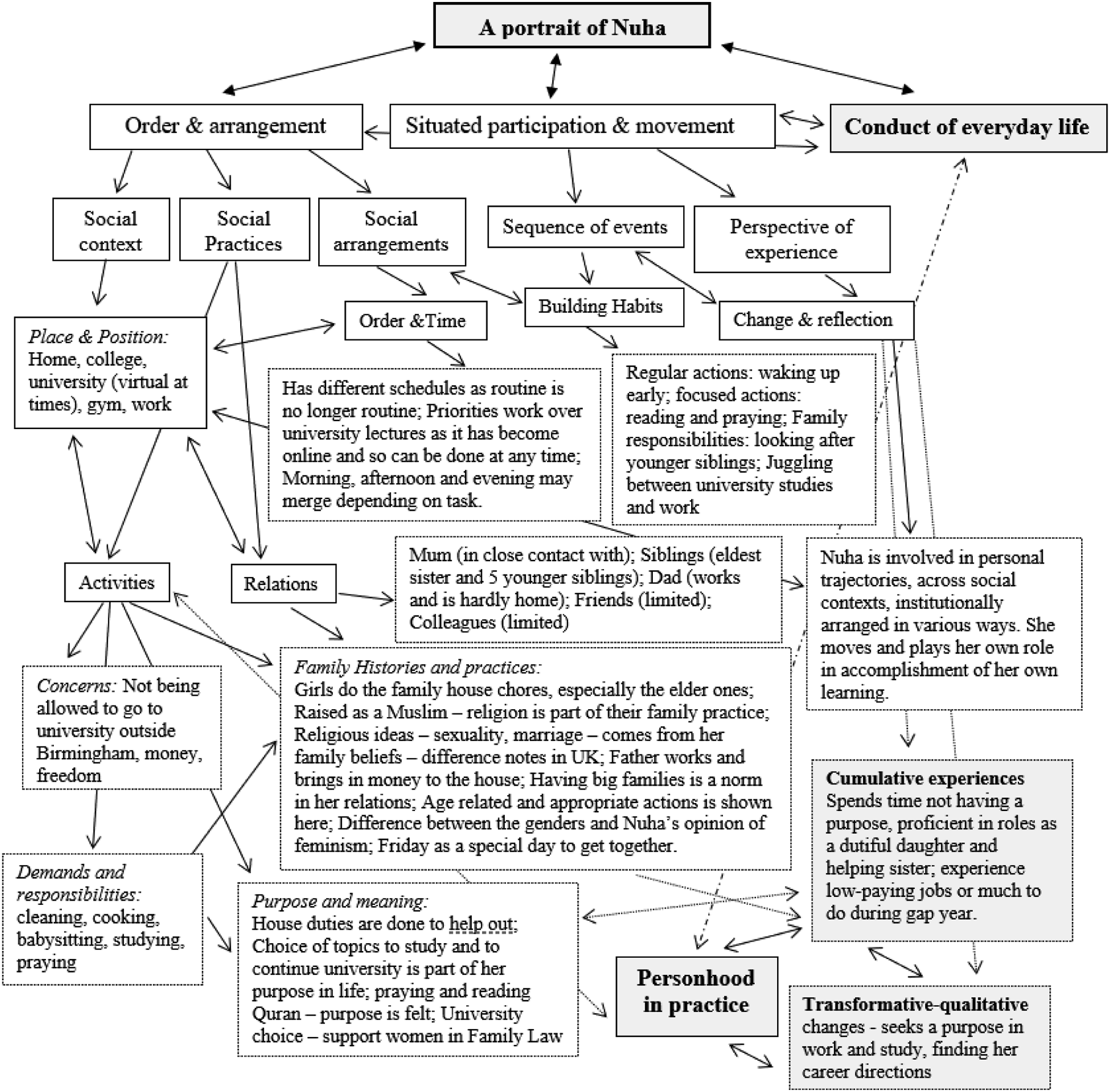
Concluding remarks
This article has described a conceptual framework combining Dreier’s theory of a person and Roth’s ideas on learning and development to address a phenomenon that poses questions regarding what it means and takes to be a person. The framework emerged and evolved throughout the research process. It was built deductively through a critical exploration of various ideas of identity and personality that resulted in utilising Dreier’s theory of a person to study human behaviour in the context of the relational conduct of everyday life – an approach that emphasised everyday living, through a person-situation-activity approach. Focusing on actions to explain the nature of lived lives, Dreier’s theory provided a robust articulation of lived experiences as well as the associated identities and personalities that inform such experiences. A matrix from Dreier’s theory was then built and used to analyse six case study inductively. The example that is given in this article is that of the case study of Nuha. The study utilises using photos and semi-structured interviews as methods and this was an effective approach to stimulate the participant to discuss their world from their own unique perspective and experience.
Upon reflection on the data and because some of the tensions between theory and data - with regards to certain insufficiencies in describing the continuity of experiences - it became apparent that a further adaptation was necessary to focus more explicitly on areas of learning and development. This was provided by Roth’s ideas of personhood in practice, and so was used a supplementary theory to enhance data analysis. The additional importance of personhood in practice is recognised in this article because it provides a reference point for exploring more deeply the learning and development of the participants. In Roth’s ideas, a rich understanding of cumulative and transformative change is displayed, which was used to consolidate and improve on Dreier’s ideas of the conduct of everyday life.
Thinking with Dreier and Roth in combination, a portrait of Nuha was produced indicating how different moments - in the experiencing and as experienced - may suggest who she is and who she is becoming in a multidirectional way. Different parts of her life contribute to mediating other parts, some of her practices are more dominant than others and this form a network and connections to other activities, each with relative importance and relations. The self-understanding which Nuha develops includes the commitments she makes, how she coordinates and negotiates her various practices, the opportunities she seizes, and how she responds to situations, challenges, and setbacks. There are certain changes that Nuha would like to see in her conduct of everyday life, with the most prominent being increasing her circle of friends so that she can socialise and carry out other collective activities. She acknowledges that events and experiences are yet to happen which may change this depending on other social order, arrangement, participation, and movement that she may participate in. Nuha’s engagement and priorities will continuously evolve as she reflects on such experiences and this will develop, and perhaps change the conduct of her everyday life. Through Nuha’s narrative portrait, I have depicted social phenomena through her story of daily life experiences helping to capture contextual nuances that are otherwise overlooked. Furthermore, I have shown how the development of conceptual frameworks and theories is required to get a firm understanding of both classical and contemporary theories in the context of the research.
This article also showed how theoretical development can be further enhanced by utilising an analytical lens of intersectionality and post-colonial theory. Nuha, as a young Muslim female with Yemeni heritage and a British nationality, conducts her life in a manner which shows how the interactivity of social identity structure fosters her life experiences. She regularly prays in her routine and non-routine days as it helps her connect with her Lord, she makes Yemeni food which allows her to connect to her heritage and she explores various career options which are made possible in the British society in which she is embedded in. These are just some of the examples which she Nuha engages with that are not only personal, but which form part of larger situational, organisational, cultural, and historical narratives that helps researchers to understand the cultural and social arrangements of experiences that, inevitably, reflects a broad picture of the dynamics and interactions between self and society where human subjectivities are a reflection of, but not determined by, the social, historical and cultural arrangements.
By building a portrait of Nuha in a layered and interpretive manner, I have produced a representation of the texture and nuance of such human experiences, capturing the complexity, dynamics, and subtlety of experience and organisational life. Although I started by exploring how Nuha’s identity, as a young woman with cultural hybridity, I also detected that social identity structures were not sufficient in understanding how she conducts her everyday life experiences. Using Dreier’s theory of a person as a deductive approach facilitated this understanding and has provided a valuable insight in the application of this theory inductively to Nuha’s narrative. However, the theory did not fully account for learning and development and, so, a final abductive approach, using Roth’s ideas of personhood in practice, granted an all-inclusive approach to analysing Nuha’s narrative, with the interconnecting focus being activities and actions.
The framework adopts Dreier’s theory of the conduct of everyday life (2011) to explore personality as governed by actions, and Roth’s understanding of personhood in practice (2020) to examine the notion of learning and development, both examining the evolving and developing cultural dynamics of young people. There are similarities between Dreier and Roth in the context and notion of action and doing in exploring experiences. Both scholars are heavily critical of mainstream psychological approaches particularly the notion of the individualised sense of a person’s being as it seems to do a disservice to the relational cultural element of the self. Dreier views the characteristic of person and environment as slightly distinct (yet indirectly connected), while Roth perceives them as completely interconnected and integrated – in other words, you can’t see the person unless you see the environment in which they live in so that a person is a consequence of the environmental relational activities they engage with.
In exploring Dreier’s theory of a person, in relation to my participants, learning and development is not completely accounted for. Dreier discusses sequence of events in building habits, and perspectives of experiences in change and development, but what Roth does is adds that in examining further how critical incidents or moments of reflections can be used to exploring more experiential notions of agency. I focus on Roth’s idea of personhood in practice in a way to explore how a person’s adaptive habits are embedded in their actions, the reflexive perception of such experiences, as well as the circumstances of the situation, the occurrence of marker events or critical incidents – all point to the possibilities of change and development. Although Dreier’s brings some of these ideas forward, I use Roth’s ideas to show how these changes can be in the form of cumulative-quantitative shifts, in how a young person sees their doing, and through transformative-qualitative changes in personhood.
I recognise the additional importance of personhood in practice because it provides a reference point for exploring more deeply the learning and development of young people. I show, with the example of the case study of Nuha, how, in applying combinations of these theories and ideas to British Yemeni young people, a deeper sense of understanding their cultural, historical, and social embedded experiences is possible. This gives us a sense of who they are, taking together their views and perspectives of a person and their environment in the context of their lived lives. In Roth’s ideas, I found a rich understanding of change, which I used to consolidate and improve on Dreier’s ideas of the conduct of everyday life.
As a critical reflection on this study, the continuity of experiences is only explored at two points in Nuha’s life. Although this provides certain information, more could be obtained on the development shifts, particularly transformative changes, if the research is conducted over a longer time frame. In this way, the longitudinal research would have been conducted through time, and not only over time (Neale, 2016). Furthermore, this study does not ask questions regarding how, where, or why people learn, and only focuses on documenting the forms of learning and development that British Yemeni young people experience over time. Perhaps more, longer studies of this kind can be employed to tackle and explore these questions, providing recommendations for policy and practice.
This paper has shown that a collection of approaches may be necessary and imperative in capturing the biographic totality of a person’s lived experiences, and in producing a portrait of the evolving person. This paper, therefore, uses powerful concepts - conduct of everyday life, personhood in practice in analysing learning and development in the context of a person’s social practices and an analytic lens of intersectionality and post-colonialism - in combination, contributing new understandings of young people’s experiences. In the analyses, I have shown how Dreier’s theory of a person unfolds the examination of the subjective dimensions of person-situation-activity, offering a way of linking research on personality with research on social processes. People conduct their everyday lives, they continue to experience, learn, and develop as they move, participate, and engage across different social contexts. Although I have used this framework to articulate the conduct of everyday life in a specific case study, I argue that it can also be applied to others as it favours a more ecologically valid approach to theorising personality and the conduct of everyday life.
Footnotes
Declaration of conflicting interests
The author(s) declared no potential conflicts of interest with respect to the research, authorship, and/or publication of this article.
Funding
The author(s) received no financial support for the research, authorship, and/or publication of this article.
