



Abstract
The legalization of recreational cannabis consumption in Canada created a cultural conflict for international students from China, where the use of cannabis is heavily criminalized and deemed immoral. This conceptual paper theorizes this cultural conflict experienced by Chinese international students in Canada by applying three theories from macro to micro levels. Neoliberalism is first used to understand how this cultural conflict exposes collisions between the neoliberal West and the rising economic power of China as illustrated through Chinese students studying in Canada. Next, acculturation theory focuses on these students’ cultural transition and provides further insight into potential strategies for their handling of specific cultural conflicts such as cannabis use. Lastly, Cloninger’s theory of substance use is adopted to explore Chinese international students’ individual reasoning about cannabis use, particularly how they make decisions based on evaluations of various conditions. Building upon the above analyses, an integrated conceptual model is further formed to help us understand Chinese students’ potential perception of cannabis use in Canada. This conceptual framework provides an important theoretical and conceptual base for future research and practice, from which to further explore cannabis use in the context of cultural transition of different immigrant and migrant groups.
Introduction
Over 100,000 international students from China came to Canada to study in 2021, a population that has remained a large and steady number in Canada’s international education sector (ICEF Monitor, 2022). As Chinese culture is distinctly different from Canadian culture, the potential for cultural conflicts during Chinese international students’ intercultural contact is thus possible (Liu, 2016). For example, Chen and Zhou (2019) suggested that Chinese international students, who come from a collectivistic culture, often encountered cultural conflicts in the individualistic culture in Canada, as they tended to prioritize group benefits (e.g., not interrupting classes by not asking questions) in China, whereas in Canada, individual demands and benefits are emphasized more (e.g., asking questions directly in classes). In addition, Ge et al. (2019) pointed out that profound influences of Confucianism (a traditional philosophy in China) on Chinese international students may also increase their chances of facing cultural conflicts in Canadian classrooms, as Confucianism emphasizes modesty and obedience to the authorities, but Canadian education encourages self-expression and challenging instructors academically. Yang (2005) also stated that as language is the embodiment of social norms and cultural values, limited English proficiency may thus prevent Chinese international students from accurately understanding Canadian culture (e.g., do not understand their Canadian professors and peers) and result in cultural conflicts. Therefore, from these examples, it is seen that cultural conflicts are illustrated through the contextual changes and have been consistently experienced by Chinese international students in Canada.
However, a significant cultural conflict, that has not been investigated, is legalized cannabis use in Canada. While Canada legalized recreational cannabis, cannabis use is still criminalized in China (Feng & Jie, 2019). This sharp contrast in the legality of cannabis use may challenge Chinese international students’ perception of cannabis use, and affect how they perceive and deal with this substance in Canada. Surprisingly, relevant conceptual, theoretical, and empirical evidence on this topic remains extremely rare. In one such study, McCann (2018) found that when Chinese international students were in China, they had negative perceptions about cannabis and none of them used it. After they studied in the USA and Canada, 10% of these students had tried cannabis (McCann, 2018). Building on the limited findings, this paper aims to contribute to the literature by conceptualizing how Chinese international students process their decision to use (or not use) cannabis while studying in Canada.
This paper begins by presenting the opposite connotations of cannabis use in both China and Canada, to examine how these differences are deeply rooted in each country’s macro cultural context. Neoliberalism is then introduced to uncover how these differences regarding cannabis use reflect the collisions between the dominant neoliberal West and the rising power of China in this contemporary era. This contrast is examined through Chinese international students, who move from China to Canada and undergo the negotiations between Chinese and White Canadian English and French cultures. Acculturation theory is then applied to analyze the possibility of how Chinese international students, as non-Western migrants, interact with their new Canadian culture from both sociocultural and psychological perspectives, a discussion that generates possible new insights into understanding their strategies of dealing with cannabis use. Cloninger’s theory of substance use is then used to understand cannabis use from individual perspectives, in particular how Chinese international students deal with this substance based on their individual reasoning about different conditions. From this analysis, a conceptual model that integrates three levels of analysis (macro neoliberal cross-cultural context, meso interactions with the new culture, and micro individual handling of cannabis) is articulated and discussed to further strengthen the connections between these theories and Chinese international students’ perception of cannabis use in Canada.
International students’ settlement is often overlooked, as issues during this process are either regarded as personal issues, or their temporary status does not ‘deserve’ more attention from mainstream Canadian society (Zhao & Bhuyan, 2023). Findings from this conceptualization provide a reference to understand other underrepresented groups that share similar situations, and emphasize that their settlement is an important social justice issue. Through cannabis use, a proxy of cultural conflicts, immigrants’ and migrants’ acculturation and settlement can be better understood in an integrative manner, a situation that better guides relevant research and practice in the cross-cultural context.
Cultural and contextual differences about drug use between China and Canada
Drug prohibition in China
Symbol of drugs in Chinese history and society
The Opium Wars in the 19th century profoundly changed China’s destiny (Roblin, 2017). Escalating conflicts in the opium trade between China and the United Kingdom eventually triggered the Opium Wars (Rose, 2019). The Qing dynasty of China lost and was then forced to open its doors and sign unequal treaties (e.g., granting indemnity and ceding territories) with the West (Rose, 2019). This loss marked the beginning of a century of humiliation of China in the modern history when China was perceived as becoming conquered by Western colonialism (Shi-xu, 2014; Zhao et al., 2021). The Opium Wars are written into contemporary China’s history textbooks as key events and used to educate youngsters about the consequences and dangers of drug use (Roblin, 2017). The use of drugs is thus symbolic in China, as it relates to the loss of national pride and status.
Given the historical context, it is not surprised that drug use is negatively perceived in Chinese society. The Chinese believe that using drugs is a representative of personal failure, and that cannabis can be addictive and trigger more serious drug use (Zhang & Chin, 2015). Drug using is stigmatized and perceived as a moral issue (Luo et al., 2019). As Chinese society also emphasizes morality in a collectivistic context and how it is strongly built upon social relations to which individuals always belong (Shi-xu, 2014; Zhao et al., 2021), therefore, using cannabis or any kind of drugs, which is regarded as misconduct in Chinese society, may eventually damage an individual’s social relationships and their own reputation in this collectivistic society.
China’s laws and policies on drugs
After the People’s Republic of China (PRC) was established in 1949, definitions and categorizations of drugs were specified, and the use of drugs was further regulated (Legal Daily, 2019). According to the Article 357 in the Criminal Law of the PRC, the Chinese government treats cannabis and other drugs such as heroin all equally as illicit substances (National People’s Congress, 1997). Section Seven in China’s Criminal Law has defined and explained eleven drug-related crimes (National People’s Congress, 1997). Talking illicit drug possession for example, individuals who possess over one kilogram of any kind of drug can be punished with the maximum life sentence (National People’s Congress, 1997). Moreover, despite legalization of cannabis use in Canada, the Chinese government has issued a statement to remind Chinese international students and visitors that they should not use cannabis in Canada (Zhang, 2018).
Drug use in contemporary China
Since all drug use is illegal in China, drug use by youth in China is low. In a study conducted by Li et al. (2013), of 2,668 Chinese students between the ages of 15 and 23, the researchers found that 1.2% had engaged in oral use of illegal drugs, while 1.4% had used injection drugs. Another systematic review found that among 531,842 youth aged 10–24, 1.70% reported having used illegal drugs in their lifetime, with cannabis being the fifth most used drug (Wang et al., 2017).
Legalization and use of cannabis in Canada
Background
In 2018, the Canadian government legalized non-medical cannabis use (Sandhu et al., 2019). Canada became the second country in the world and the first Western developed country to legalize recreational cannabis use (Schlote, 2018). Legalization was intended to promote public health and safety, deter criminal activity, and support more responsible use (Sandhu et al., 2019). Cannabis use among Canadians is common. Prior to legalization, approximately 43% of Canadians claimed to have used cannabis in their lifetime (Hajizadeh, 2016). Indeed, in decades leading up to legalization, an increasing majority of Canadians agreed to the decriminalization or legalization of cannabis (Hajizadeh, 2016). This robust public support drew media attention and ultimately propelled the issue of legalizing cannabis into a political issue (Hajizadeh, 2016).
Reasons
In addition to addressing cannabis use as a public health issue, there are other reasons that may have influenced the Canadian government’s decision to legalize cannabis. From an economic perspective, since legalization, cannabis has added 43.5 billion dollars to Canada’s gross domestic product and created at least 98,000 jobs to the labour market (Deloitte.). Another reason might be that the legalization will reduce cannabis-related crimes in the black market (Hajizadeh, 2016), as producing, possessing, and consuming cannabis will be regulated by the government. Since the rate of cannabis use among Canadian youth (15-year-old) is higher than that in Europe and North America (World Health Organization, 2012), legalization also prevents youth from purchasing cannabis to protect their health (Coulson, 2018). Legalization of cannabis may also reduce criminalization caused by racial bias in the criminal justice system, as Indigenous and African individuals were nine and five times more likely to be arrested than their Caucasian counterparts when faced with criminal charges related to cannabis use (Owusu-Bempah, 2019). Public funding in support of cannabis legalization and regulation also increases to protect traditionally over-policed communities and young people (Munn, 2018).
Cannabis use among Canadians
To better understand the impact of legalizing cannabis use, the Government of Canada has been conducting annual surveys, and these surveys have shown that youth (from 16 to 24 years old) are more likely to be consuming cannabis than other groups in the past 12 month each year (e.g., Government of Canada, 2017; 2021). This trend is also reflected in surveys conducted in Canadian universities, as a previous survey, with more than 23,000 Canadian university students, found that prior to legalization, students who self-reported using cannabis (i.e., from daily use to less than once a year) ranged from 23.4% to 56.4% in 49 universities across Canada (Brownell, 2018). Research has also found that the ongoing discourse regarding legalization of cannabis has led to the normalization of cannabis consumption, with increased numbers of youth experimenting with cannabis, despite cannabis remaining illegal for them (Ali et al., 2022).
Theoretical lens
The above section highlights stark contextual differences related to cannabis use between Canada and China, and illustrates that cannabis use in Canada can be a potential cultural conflict for international students from China. In this section, we further adopt and integrate three theoretical lenses to conceptualize how Chinese international students deal with cannabis use in this cross-cultural context.
Neoliberalism
Neoliberalism represents a political and economic theory that champions a free-market doctrine originating from Western countries as the main driver for economic and political activities around the world (Stephens, 2016). It emphasizes that economic activities should be self-regulated, and that governments should liberate the market rather than heavily intervene in it, by allowing the power of the market to generate capital (Hyslop, 2018). Neoliberalism further spreads across the world, profoundly shaped different sectors (e.g., immigration, higher education, legalization of cannabis), and absorbed them into this global neoliberal system that features Western hegemony.
Immigration and international students in neoliberalism
Due to colonization, racism and white privilege, Western countries have often been regarded as having more ‘successful’ and ‘globally privileged’ cultures (Stephens, 2016). The power differential between white Western nations and the rest of the world is highlighted via non-white global populations pursuit of “whiteness” for economic and social betterment at the expense of local values, traditions, and cultures (Nair, 2022). This situation was also illustrated through Canada’s early immigration policies in which assimilation was accentuated and Caucasian immigrants were more welcomed (Zhao et al., 2022). Recognizing drawbacks of these immigration policies (e.g., neglecting non-Western immigrants’ experience of integration and equity; Zhao et al., 2022), multiculturalism was put forward in 1988 and adopted as a national identity point in Canada (Griffith, 2015), to embrace integration as opposed to assimilation (Government of Canada, 1967), enable immigrants from non-Western backgrounds to continue practicing their own cultures, as well as ensure immigrants’ contributions to the establishment of Canada (Griffith, 2015). Even though multiculturalism—a political and social product—has improved immigrants’ experience of integrating into Canada, Thobani (2007) criticized that this policy is still racist but transformed to a covert format where non-Western immigrants/migrants are still required to acquire white English and French cultures (e.g., speaking fluent English or French) and evaluated by these cultures, despite that they can maintain their own cultures. For international students, they are also recruited to supply underfunded educational institutions in the neoliberal West through their high tuition fees, and can further become permanent residents to reduce shortages in the labour market (Castles, 2010). This population is also parallel to inequitable international capital flow to the West that results from the prevalence of neoliberalism (Stephens, 2016). Hence, ‘neoliberal multiculturalism’ is also put forward by Kymlicka (2013) to depict how Canadian multiculturalism is reframed by neoliberalism to essentially maximize economic potentials of immigrants/migrants; through allowing them to maintain their own cultures and strong connections with their home countries, more capital flow can be brought by these immigrants and migrants to Canada. Based on the above analyses, international students in Canada, as racialized migrants, are still subordinate to this Canadian cultural hierarchy that features dominant white English and French cultures, and may have to adopt some Canadian cultural values or social norms in order to be considered as being integrated, even though cultural diversity and equity seem to be established by multiculturalism (Thobani, 2007; Zhao et al., 2022). Cannabis use in Canada can thus be an emblematic case.
Legalization of cannabis in neoliberalism
From an economic perspective, the market for cannabis in Canada has shown enormous economic benefit, a central tenant of neoliberalism (Molina, 2019). Moreover, as support for legalization of cannabis from the public also increased (Miller, 2018), cannabis use has become prevalent especially among younger individuals, including those at Canadian educational institutions (Belmonte, 2019). These factors help drive a strong market demand for cannabis. Culturally, cannabis use has also been normalized in Canada (Ali et al., 2022). Some researchers suggested that cannabis attaches to the cultural hierarchy and reflects this ‘white’, ‘male’, and ‘middle-class’ dominant culture (Mabee, 2019; Schlussel, 2017). This attachment to the mainstream culture may further affect non-Western immigrants’ perception of cannabis use.
Application to Chinese international students in Canada
Influences of neoliberalism mentioned above can be further discussed with respect to Chinese international students in Canada to illustrate these intertwined relationships. It is also noted that their cultural background (e.g., Chinese history, social norms, and laws) and individual factors (e.g., intention to stay in Canada permanently) may also generate a variety of interactions with neoliberalism.
After the economic reform in 1978, China was opened to the world and began to feel the influences of neoliberalism (Wu, 2010). However, in stark distinction from the West, it is largely operated based on governmental regulation and under the influence of the state (Nonini, 2008). China’s ongoing development and progress to the global stage has challenged the assumptions of neoliberal system established by the West, influencing both international and domestic attitudes (Ikenberry, 2008). For example, compared to previous generations of Chinese international students that permanently left China for better lives in developed countries, further assimilating into host cultures due to China’s weak development (Yan, 2017), the new generation may perceive studying abroad as a way of improving their future competitiveness within China, not necessarily assimilating into Canada and accepting Canadian values (Mok et al., 2018; Xiang, 2017). Regardless, global economic, political, and social orders formed by neoliberalism are not easily altered (Ikenberry, 2008). Indeed, Western countries are still perceived to lead in science and technology, and there are ongoing political and ideological conflicts between China (i.e., socialism and communism) and the West (i.e., capitalism and neoliberalism) (Fish, 2018). These conflicts further have impacts at the micro level. In particular, the intention of Chinese international students to stay in Canada after graduation can illustrate how they manage these conflicts and further affect their understanding and interpretation of living in Canada. Since cannabis use has different historical roots, cultural meanings, and social norms between Canada and China, and Chinese international students inevitably face these differences after migrating to Canada, how they navigate this conflict through searching for various strategies is a dynamic process in which individuals evaluate cultural variations based on their self-perceived positions shaped by the intercultural contact (Shi-xu, 2014; 2022). For example, those who want to stay may try to fit in and accept Canadian social norms to be ‘successful’ (Zhang, 2018), including use of cannabis as a way of integrating into local culture (Feng & Jie, 2019). This position towards Canadian culture, with the strong intention to stay in Canada, may mediate Chinese students’ initial shocked reaction to recreational cannabis use in Canada and help them justify this conduct. Alternatively, those who plan to return to China may participate less in Canadian culture and choose instead to self-govern with Chinese values and nationalism (Zhang, 2018; Zhao, 2019), staying loyal to Chinese laws and resisting using cannabis (Mitri, 2018). Coming from the de-Westernizing perspective (Shi-xu, 2014), these students may thus exert their human agency shaped by Chinese traditions (e.g., history, values, social norms) when making decisions in their intercultural encounters.
Acculturation theory
Whether or not Chinese international students choose to use cannabis while studying in Canada can be further analyzed by applying acculturation theory to their experience of navigating cultural transition within Canada. The prevalent bi-dimensional acculturation concept suggests that acculturation involves interactions between individuals’ original culture and the culture of host countries (Cheung-Blunden & Juang, 2008). The acculturation process has the potential to be stressful, with the different value systems of the original and host culture potentially coming into conflict and causing tension for the individual experiencing them both. Berry (2017) suggested that during acculturation, individuals and their cultural groups experience both sociocultural and psychological changes due to the constant contact with the new culture. This viewpoint elucidates that acculturation can be understood from two aspects, sociocultural and psychological adjustment (Zhang & Goodson, 2011), and further form an integrated acculturation model (Oguri & Gudykunst, 2002).
Sociocultural adjustment
Sociocultural adjustment refers to individuals’ ability to fit in the new environment and emphasizes whether an individual is ‘doing well’ in the new culture (Berry, 2017). Based on Berry’s bidimensional model, sociocultural adjustment can be interpreted through four acculturation dimensions (i.e., integration, marginalization, separation, and assimilation; Berry, 1997). Integration means that individuals can reach a balance between two cultures; they can acquire the new culture while also keep their original culture (Fox et al., 2013). Assimilation means that individuals only receive the new culture and abandon their heritage culture (Cheung-Blunden & Juang, 2008). Separation means that individuals only choose to keep their original culture and do not accept the new culture (Berry, 1997). Finally, marginalization means that individuals reject both cultures (Fox et al., 2013). These four dimensions display the relations between individuals’ original culture and the new culture of host countries, describing the negotiation process of how individuals may interact with the new culture (Ward et al., 1998).
Psychological adjustment
Psychological adjustment refers to individuals’ psychological well-being during acculturation and emphasizes whether individuals are ‘feeling well’ (Berry, 2017; Ward et al., 1998). Hirai et al. (2015) indicated that psychological adjustment can be understood from individuals’ stress and related coping strategies. Acculturative stress can be caused by environmental changes (e.g., physiological, social) when individuals move to a new culture (Shin et al., 2017). Coping strategies refer to a series of behavioural, psychological, and cognitive solutions that individual uses to minimize acculturative stress (Kosic, 2004). Different stress and coping strategies may also result in different outcomes. To further elaborate on psychological adjustment, Berry (2006) proposed a psychological model that consisted of acculturative stress, coping strategies and acculturation outcomes, as well as contextual and individual factors. Specifically, acculturation experience is illustrated through the contact between individuals’ society of origin (e.g., political & economic contexts) and the new society (e.g., social support). Acculturative stressors (e.g., problem appraisal) and stress (e.g., anxiety) further emerge from acculturation experience; however, stressors and stress are also affected by moderating factors before acculturation (e.g., language, motivation) and during acculturation (e.g., coping strategies). Adaptation (e.g., psychological, social) can be achieved by integrating the factors mentioned above.
Applications to immigrants’ and ethnic minority groups’ substance use
Previous studies have shown an increase in the use of substances for immigrants acculturating to Western cultures (McQueen et al., 2003; Orozco & Lukas, 2000). Martinez et al. (2017) examined how acculturation affects Hispanic immigrants’ substance use; they found that participants who exhibited a high level of Hispanicism (traditional Hispanic values) had lower chance of using substance while a high level of Americanism result in more substance use. Ahmmad and Adkins (2019) explored the relationship between acculturation and substance use among Asian Americans, and found that individuals with Vietnamese and Chinese ethnicities have the lowest rates of substance use, whereas multiracial Asians have higher rates of using substances. These findings may be attributed by differences among ethnic groups when reconciling between American and their heritage cultures. These studies regarding immigrants and ethnic groups analyze how minority immigrants perceive substance use in Western cultures, and provide references to further understand Chinese international students’ substance use. However, acculturation in these studies was often measured as the single variable without distinguishing sociocultural and psychological adjustments, which prevents us from knowing how these adjustments relate to substance use.
Connection to Chinese international students
For Chinese international students, distinct differences between Chinese and Canadian cultures may cause challenges for them and thus trigger acculturative stress (Xue, 2018). Cannabis use, as a site of cultural conflicts for Chinese international students, can impose acculturation stress on them due to its opposite connotations between China and Canada. Acculturative stress can be further aggravated by the lack of social support and weak social ties (Bertram et al., 2014). However, their preparation for the new environment, individual willingness to take part in the host culture, and motivations to fit into the new culture also play important roles in facilitating the acculturation process (Brunette et al., 2011; Chirkov et al., 2008). Based on Berry’s acculturation models, Cao et al. (2017) found that most of the Chinese international students adopted integration as the acculturation strategy in Belgium, and factors such as previous adaptation experience and local language proficiency were important indicators of acculturation strategies. Zhang and Goodson (2011) found that close social connection with locals mediated Chinese international students’ acculturation dimensions and psychological adjustment, and social interactions with locals moderated their acculturation dimensions and depression, a finding that shows relations between coping strategies and acculturation outcomes. However, how sociocultural and psychological adjustments can explain Chinese students’ handling of cannabis use in Canada remains unclear. Based on above findings, it is possible that they might adopt integration by accepting the cultural norm of cannabis use in Canada, but not using this substance due to the influences of Chinese culture. As well, their interactions with Canadian friends and exposure to different information sources such as Canadian media outlets may mediate acculturation stress resulted from this cultural conflict, help Chinese international students appraise cannabis use differently, and further accept cannabis use in Canada.
Cloninger’s theory of substance use
Substance use involves individual reasoning. Cloninger’s theory of substance use can be helpful in conceptualizing Chinese international students’ individual reasoning about cannabis use in cultural transition. It was originally utilized to understand individuals’ personality dimensions (i.e., Cloninger’s tridimensional personality that includes novelty seeking, reward dependence, and harm avoidance; Chen et al., 2002) and has been found effective in understanding individuals’ substance use, including use of illicit drugs (Roddy, 2018). Some researchers further expanded this theory to four dimensions (harm avoidance, novelty seeking, task reward dependence or persistence, and social reward dependence) (e.g., Wills et al., 1999). Particularly, in this theory, individuals’ propensity to utilize substances is evaluated through the lenses of behaviours activation, inhibition, and maintenance (Chen et al., 2002; Weyers et al., 1995), and connects to the influences of the social environment (Cloninger, 1987). The established utility of this explanatory model (e.g., Parmar & Kaloiya, 2018) makes it a sound theory to apply to the current conceptual analysis of how Chinese international students may choose to utilize cannabis.
The application of this theory on youths, adults, and their substance use
Cloninger’s theory has been utilized to investigate substance use among youths and adults. Vladimirov et al. (2018) investigated alcohol use of people from 31 to 46 years old; they found that novelty seeking was associated with increasing alcohol use and heavy use, while the higher levels of harm avoidance related to abstinence, especially among male participants, and low levels of reward dependence were related to alcohol misuse among female participants. Seyed Hashemi et al. (2019) investigated these dimensions among drugs users, and they found that compared with non-drug users, drug users had higher scores on novelty seeking and harm avoidance but low scores on reward dependence and persistence. While Cloninger’s theory has been applied to explore use of drugs among Chinese individuals (e.g., Chang et al., 2007), empirical studies specifically targeting cannabis use among Chinese immigrants and migrants in the West are rare. This research gap suggests that this theory needs to be further examined in the context of immigration and migration.
Application to Chinese international students
Although literature regarding Cloninger’s theory and Chinese international students’ substance use was not found, by analyzing and applying the four factors to Chinese international students, an argument can be made to utilize this theory to explore their perceptions of cannabis use.
Studies have found that novelty seeking is significantly related to the increasing substance (e.g., cannabis) use for people from 18 to 35 years old (Foulds et al., 2017). It is hypothesized that Chinese students who have never had cannabis in China may choose to use cannabis in Canada as a way of experiencing a new stimulus (McCann, 2018). Indeed as cannabis use has become increasingly normalized, and generally provides pleasant effects on individuals (e.g., mood lifting, feelings of relaxation; Burgess, 2019), Chinese international students may be more likely to utilize cannabis while in Canada.
Harm avoidance may influence perception of cannabis use depending on the possible consequences of using cannabis in Canada. For example, if Chinese international students perceive that using cannabis will result in negative consequences (e.g., being punished upon return to China), then it is unlikely that students will use cannabis (Zhang, 2018). Similar processes have been recorded among undocumented immigrants in the USA. Studies have found that these individuals are less likely to engage in illicit drug use, due to the potential for detrimental effects on their ability to remain in the United States (Light et al., 2017). On the contrary, those who think less negatively about cannabis might accept and use it (Friese, 2017). For example, from the Western perspective, even though cannabis does have adverse effects such as lethargy (Gonzales, 2020), it is generally thought of as being a safer drug (e.g., less death caused by overdose) than opioids (Monte et al., 2015).
Reward dependence can be utilized to hypothesize that Chinese international students’ cannabis use might be conditioned (i.e., social reward dependence) by the acceptance of cannabis in Canadian society (e.g., seeing increasing cannabis stores on the street; CBC News, 2019), as well as the ‘cannabis culture’ formed at Canadian universities (Belmonte, 2019; Brownell, 2018). These “rewards” may significantly affect Chinese international students’ perception of cannabis use. Specifically, they might acquire cannabis use through their peers and social events (Butler, 2016; Friese, 2017), and further reinforce this behavior by continuous social interactions. However, their task reward dependence might also affect this behaviour; for instance, low academic achievement has been found related to high rate of cannabis use (Cox et al., 2007). It is possible that Chinese students who prioritize their academic achievement might be more likely to disapprove substance use than those who do not (Li & Armstrong, 2009).
Overall, Cloninger’s theory considers both environmental and genetic variances in relation to analyzing an individual’s personality, and can possibly help us understand how Chinese international students’ reason about cannabis use in this cross-cultural context.
An integrated conceptual model
Knitting together the three levels of analysis previously described, a bi-directional conceptual model (Figure 1) is thus put forward. Read horizontally, this model describes Chinese international students’ cultural interactions with cannabis, examined through three factors. The first factor highlights the interactions between the rising power of China and the hegemonic neoliberal West. This assertion highlights the dynamic position of Chinese students in Canadian society (e.g., higher education, immigration) in the macro context. The second factor addresses the inevitable cultural transition that Chinese international students experience, in which two types of adjustments (i.e., sociocultural, psychological) are presented to demonstrate how Chinese students deal with cultural conflicts. The third factor is cannabis itself. Specifically, the prohibition of cannabis in China and the legalization of cannabis in Canada are compared, indicating the tension that cannabis use causes as it is a distinct cultural conflict in Chinese international students’ cultural transition. These horizontal factors indicate the inevitability of cultural collisions between China and Canada, and can be gradually narrowed down from the macro global context to meso cultural transition, and eventually to the micro cannabis issues, a distinct cultural symbol, and a proxy for cultural conflicts. A vertical reading of the conceptual model elaborates on how these three-level (macro, meso, micro) cultural transitions are connected. The application of neoliberalism offers a critical theoretical lens to uncover deep-rooted cultural differences between the rising China and the neoliberal Canada. Legalization of cannabis is adapted into the neoliberal order that centers Western countries and can impose profound influences on non-Western migrants, yet dynamic changes of China in the global context may give leverage to Chinese students to deal with this neoliberal order and the affiliated cannabis use differently. Acculturation theory is applied to further expand upon in this conceptualization of cannabis use and to link to Chinese international students’ cultural transition. Particularly, as cannabis is normalized within cultures heavily influenced by neoliberalism and reflect social norms that perpetuate the white mainstream culture (Mabee, 2019; Schlussel, 2017), Chinese international students may apply different sociocultural dimensions when dealing with cultural differences symbolized by cannabis. These dimensions are interrelated with different coping strategies that respond to the acculturative stressor and cannabis use, eventually leading to a variety of acculturation outcomes. The application of Cloninger’s theory of substance use expands the analysis and informs how Chinese international students individually evaluate and take actions to use or not use cannabis in Canada, integrating the effects of the macro and meso influences mentioned above. This integration enriches the content of this theory, and further advances our consideration of how individuals from non-Western cultural backgrounds may deal with substance use when these substances also represent different meanings in their heritage culture. Overall, this integrative model illustrates how Chinese international students navigate cannabis use, a site of cultural conflict, based on the intertwined influences of the macro context, meso intercultural contact, as well as micro individual agency. Conceptual model of Chinese international students’ perception of cannabis use in Canada 60 × 88 mm (300 × 300 DPI).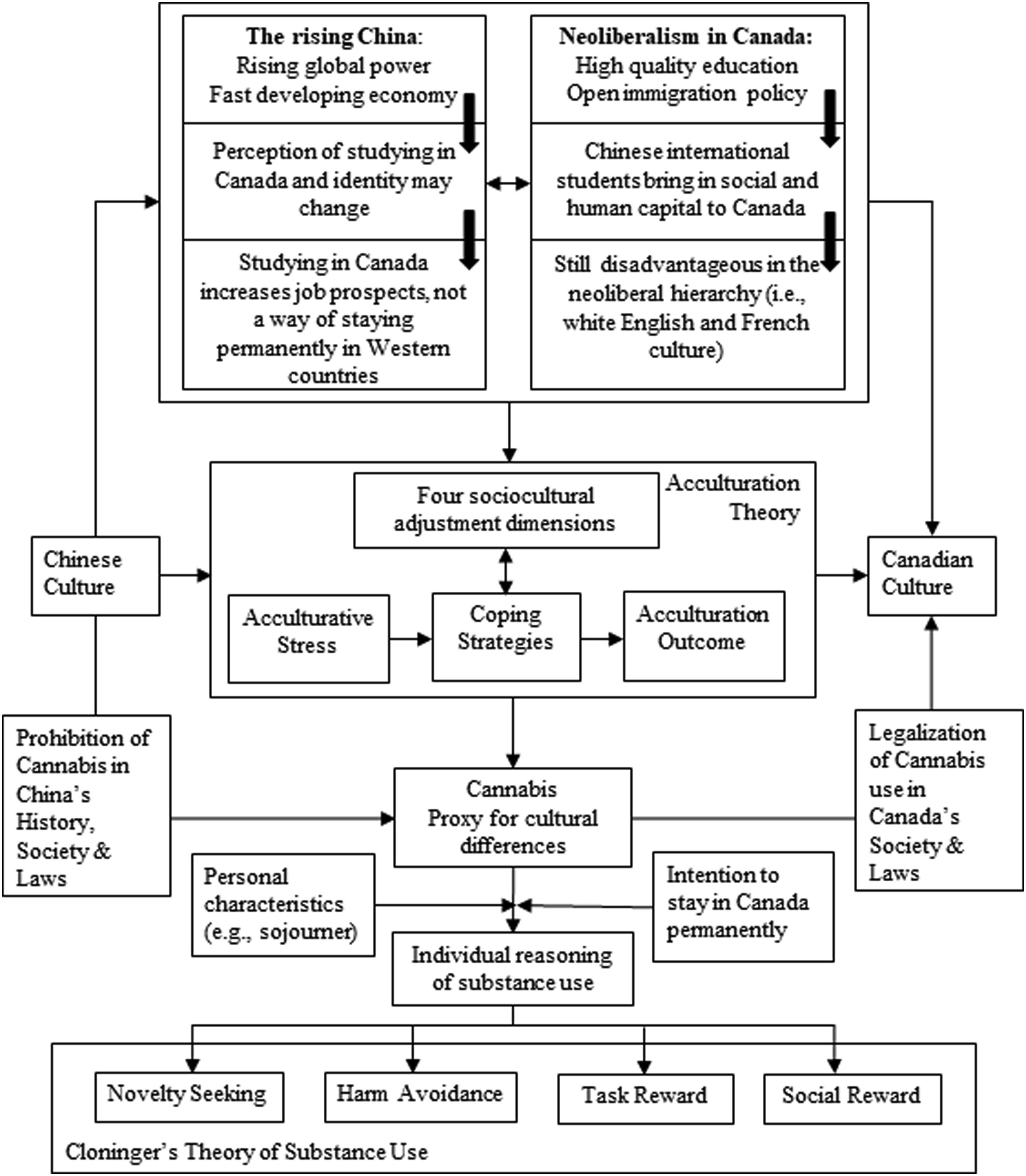
Notably, these three theories complement each other. Neoliberalism provides a unique structural perspective (e.g., political and economic differences across countries and their changes in the global context) to enrich our understanding of acculturation theory in a dynamic manner. Acculturation theory adds an intercultural lens, so that substance use can be appropriately put in the cross-cultural context to expand the application of Cloninger’s theory of substance use. Cloninger’s theory of substance use provides a reflexive lens that has the potential for connecting individual reasoning about substance use with different levels of contexts, and enriches neoliberalism and acculturation theory by exploring how specific cultural conflict processed by individuals is profoundly influenced by this dynamic cross-cultural context. In addition, combined vertical and horizontal reading of the model also facilitates a dynamic and holistic perspective, from which we can better understand the cultural transition that Chinese international students are faced with and how they further deal with cannabis use in this transition.
Nevertheless, each theory applied in this model also has limitations and future theorical and empirical research is warranted to continually advance our understanding of immigrants’ and migrants’ experiences with cultural conflicts. For example, neoliberalism still prioritizes the world order from a Western perspective. By decolonizing discussions of cannabis use to include these dynamic global changes, the experiences of underrepresented immigrants or migrants in Western countries can thus be better assessed. Shi-xu, 2014; Zhao & Bhuyan, 2023 also suggested that intercultural dialogues need to be unpacked from the diversity and equity lenses to better combat eurocentrism. As well, acculturation theory does not reflect the dynamic changes (e.g., political, economic) of each immigrant or migrant group, and clearer integration between sociocultural and psychological adjustments are also needed. Finally, Cloninger’s theory of substance also needs to be more culturally sensitive, as it does not examine how various cultural backgrounds affect individuals’ substance use, or how substances that contain different cultural meanings affect individuals’ reasoning (Miettunen et al., 2006).
Conclusion
By considering cultural and contextual differences experienced by Chinese international students, a new perspective emerges when reviewing the effects of the neoliberal power on Chinese international students’ cultural adaptation and potential for cannabis use. The integration of neoliberalism, acculturation and Cloninger’s theory provides a comprehensive framework to conceptualize Chinese international students’ perceptions and use of cannabis, highlighting the complexity of cultural conflicts that immigrants and migrants are faced with in the cross-cultural context. The framework can shed light on the cross-cultural studies and substance use related research, as we continue to understand how migrants navigate the cultural differences and conflicts.
Footnotes
Declaration of Conflicting Interests
The author(s) declared no potential conflicts of interest with respect to the research, authorship, and/or publication of this article.
Funding
The authors received no financial support for the research, authorship, and/or publication of this article.
