




Abstract
The effects of school refusal on one’s life depend on how the adolescent lives their life after refusing school. Previous studies have focused on meaning making for past refusal and have not adequately addressed the changes and transitions after school refusal. The current study elaborates on the richness of the transitions of adolescents who refused to go to school, based on the socio-cultural psychology of life course. By looking at school refusal from the perspective of the life course theory, we found that school refusal was a process of questioning normality. In addition, by using Yamada’s relational model of people and environments (Yamada, 1987, 2010), we found there are three patterns in the adolescents’ transitions: a) expanding their involvement in the here and now by encountering resources and then expanding reality, b) reforming relationships in the here and now by representing an other’s world and then reconstructing reality, and c) blocking their involvement in the here and now by touching resources and then escaping from reality. We discuss formation of resistance and richness of transition which would bring richness to our lives.
Introduction
School absenteeism has attracted the attention of professionals in various fields, including psychology, psychiatry, sociology, education, and public health. In a society where learning in the school setting has become widespread and commonplace, school absenteeism is often seen as a sign of mental and physical illness and resistance to adult society. Research has shown that school absenteeism includes problems such as violence, suicide attempts, delinquency-related behaviors, and illness (Kearney, 2008), and adolescents who exhibit high school-refusal behavior are more likely to experience higher somatization, obsession compulsion, interpersonal sensitivity, depression, and anxiety (Gonzalves, Diaz-Herrero, Vicent, Sanmartin, Perez-Sanchez, & Gracia-Fernandez, 2022) and psychosocial problems in adulthood (Hibbet & Fogelman, 1990; Rocque et al., 2017). School absenteeism includes a variety of conditions and is also referred to as school refusal, truancy, school withdrawal, and school exclusion, depending on the reason for the absence and the researcher’s discipline (Heyne et al., 2019). School refusal refers to problems due to emotional difficulties such as anxiety, distress, worries, and is linked to internalizing difficulties, while truancy refers to illegal, unexcused school absenteeism, associated with delinquency and externalizing behavior problems (Kearney et al., 2019). It has also been reported that school withdrawal is often associated with parent-initiated reasons, and school exclusion is often associated with school-initiated reasons (Kearney et al., 2019). This study focuses on school refusal, which is associated with the internalization of difficulties and anxiety.
Previous studies, which deal with experiences of the children or adolescents who refuse school, understand school refusal as experience of anxiety, sad mood (Heyne et al., 2021), and difficulties (Dannow, Esbjorn, & Risom, 2020). We consider that the absence from school itself doesn’t cause sad mood or difficulties, but rather the sense of “deviation from normality” brings sad mood and difficulties. In other words, we argue that normality is the key to understanding the phenomenon of school refusal. Normality is defined as “the character or state of being normal” (Oxford English Dictionary) and includes norms, expectations, and common sense within a society. The concept of normality is rarely studied directly because it is so broad, but we often live our lives referring to, contemplating, and rejecting so-called normality. Winslade & Monk (2007) referred to normality based on the narrative view that discourse shapes problems; all terms contain criteria for normality, and people become sensitive to the implied normality when they deviate from it. In other words, normality is always implied in our everyday communication, and even outside of medical diagnoses, it has the function of dividing people into normal and abnormal.
Given this perspective, how to deal with normality during and after school refusal becomes an important issue. Previous studies have suggested that the psychological trauma or emotional symptoms related with school refusal does not disappear easily (Elliot & Place, 2017; Saito et al., 2005). Also, their experiences of school refusal were characterized by disbelief, blame, and punishment (Baker & Bishop, 2015). However, if one can use the time during school refusal to think about how to live their life, then school refusal can be an opportunity to take initiative and regain autonomy (Devenney, 2021; Fujioka, 2005; Kanzaki & Suzuki, 2021; Yoneyama, 1999; 2000). Also, students can rebuild their lives by experiencing interconnectivity and psychological safety (Halligan & Cryer, 2022), as well as substantial adjustment and strong relationships with teachers (Brede et al., 2017). It is not an easy task, but if one can give meaning to normality through their school refusal experience, it becomes possible to lead a healthy life.
The current study investigated the transitions of adolescents who refused to go to school, based on the socio-cultural psychology of life course, to understand their meaning making of normality. In the socio-cultural psychology of life course, it is proposed that the life course of a person can be understood by rupture and transition, imagination, and resources (Zittoun, 2007a; 2007b; 2012). When a person experiences a rupture that disrupts the norm of everyday life, and then uses resources and imaginations to move away from the here and now to create the next norm, it is called a transition. By relying on the socio-cultural life course theory, researchers can approach the first-person perspective and question the rupture and normality for the individual, instead of assuming that school refusal is a deviation. However, the theory makes no mention of “how” a person uses resources during transition. In transition, the way in which resources are used is more important than its content (Gillespie & Zittoun, 2010), and analyzing the way in which resources are used during transition could provide a richer understanding of the process of change in adolescents through school refusal. Therefore, this study aims to clarify the transition process of facing normality through school refusal by relying on the socio-cultural life course theory, and analyze how resources are used during the transition by introducing Yamada’s model (details in later sections).
Life course after school refusal
The effects of school refusal on one’s life depend on how the adolescent lives their life after refusing school. Previous studies on life course of adolescents who refused school have shown that the meaning of school refusal can be constructed both positively and negatively depending on how adolescents live after school refusal. For example, Morita (2003) focused on life after school refusal and found that school refusal can be interpreted positively when students encounter people they get along well with or pursue their desired career after school refusal. School refusal has long been viewed negatively in pathological models, but some researchers such as Yoneyama (2000) and (Stroobant & Jones, 2006) see school refusal as an opportunity to break out of pathological discourses and redefine oneself.
How adolescents reconstruct their life after school refusal is an important issue in practice and research. It is necessary to accompany them in the process of taking steps toward the future while also accepting the non-attendance in their past, rather than dismissing the fact that it happened or focusing only on non-attendance. As Kido (2009) suggested, the individual neither considers school refusal as something that requires treatment, nor underestimates the drawbacks of school refusal. Rather, they are placed in a situation where they continue to live their lives while embracing the consequences of school refusal. Research that looks at their whole lives, not just their school experiences, also shows a process in which absences are chosen to help them get through difficult transitions and rebuild their lives with the support of relationships and a sense of agency (Williams, 2021). We need to take a long-term perspective and understand school refusal along with their lives.
However, previous studies have focused on meaning making for past refusal and have not adequately addressed the changes and transitions after school refusal. In other words, previous studies have examined what they were, instead of what they are becoming (Valsiner, 2008; 2016). Studies that have given attention to the meaning making of school refusals have often asked questions about past refusal experiences, for example, whether or not they would return to school, or how they felt about having been out of school. As a result, the adolescents’ thoughts and future intents were not sufficiently addressed.
Therefore, this study relies on a socio-cultural approach to understand the life course after school refusal. This theory has been formed based on a cultural psychological approach with the question of how to portray people’s life courses in a context where it is difficult to see clear goals as indicated by developmental theories (Zittoun, 2007a; 2012; 2015). This theory takes the view that people live various spheres of experiences, such as doing housework at home, going to school or cram school to study, and playing with friends after school. The sphere of experience is a configuration of experiences, activities, representations, and feelings, occurring recurrently in a social setting (Zittoun, 2016). In addition, when “one sphere of experience, one bit of ‘taken-for-granted’ life disappears” (Zittoun, 2015, p.133), it is called a rupture. In the socio-cultural psychology of life course, rupture is not based on objective facts but instead on the individual’s subjective experience, which makes it possible for researchers to view rupture and transition from the adolescent’s perspective (Gallardo et al., 2014).
How people use resources: capturing the rich transitions
When rupture occurs, people can use their imagination to form a new sphere of experience (Zittoun, 2015). Imagination is “the process by which we temporarily disengage from the here and now of proximal experiences, to engage in distal experiences” (Zittoun, 2015, p.137). Thinking about today’s dinner, temporarily disengaging from a painful reality, and envisioning a brighter future are all examples of imagination. Imagination “has the power to reorient the socially situated activity and to transform the ongoing proximal sphere of experience” (Zittoun, 2015, p.142).
Imagination does not take place inside the individual, but instead occurs through the use of resources in a socio-cultural context. Zittoun (2007b) reported the case of Julia, a student who experienced ruptures of the death of grandmother and homesickness when she entered university. She was able to use a rock band as a symbolic resource to expand her social ideas and scope of action. Hale & Abreu (2010) described the process by which Portuguese youths experiencing the rupture of moving to England as immigrants generated a new cultural self through dialogue with both their Portuguese teachers and the things they left behind in Portugal. They suggested that “when the other is experienced as constructive and meaningful to the self, it is symbolic and thus the physical presence of that person is not necessarily needed” (Hale & Abreu, 2010, p.412). Kanzaki & Suzuki (2021) suggested that symbolic resources support the regaining of a sense of control. Imagination is strongly connected with symbolic resources, and these previous studies help us to realize that it is not only physical others that support life after school refusal.
In the socio-cultural psychology of life course, the resources are only viewed as “used” for imagination and transition, so it is an important issue within research to find a rich relationship between resources, imagination, and transition. For this purpose, this study adopts Yamada’s relational model of people and environments (Yamada, 1987, 2010; 2019). Yamada (1987, 2010) proposed a triangular model of action in which “See/keep a distance,” “Take/work on,” and “Sing/resonate” are the vertices of a triangle, and “Touch,” “Represent,” and “Encounter” are placed between them (Figure 1). “See” means to look at an object from a distance. On the other hand, when we “Take” an object, we approach it and bring it into our own domain. “Sing” also approaches an object, but “Sing” has no give-and-take relationship like “Take,” and refers to a resonant relationship in which people breathe together in the same place. The relationship between a person and things is characterized by the axis of “See – Take,” and the relationship between people is characterized by the axis of “See – Sing.” Yamada’s triangular model of action.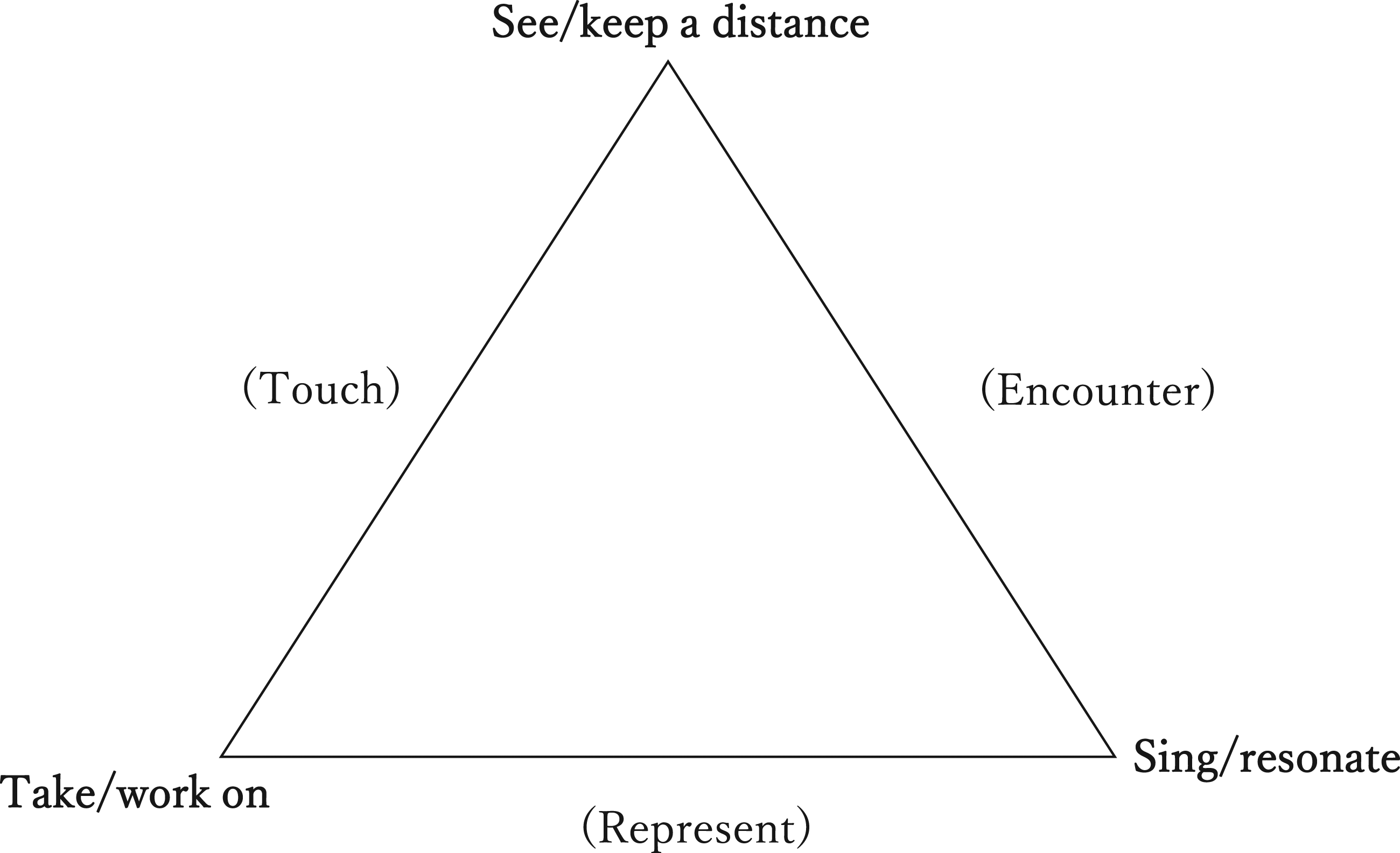
In addition, between “See” and “Take,” there is a state of contact between a person and things called “Touch,” where the distance from the object is not as great as in “See,” but it is not contained in one’s own domain as in “Take.” Also, between “See” and “Sing,” there is “Encounter,” which is not as distant from the object as in “See,” and it does not combine with it as in “Sing,” but instead is located closely. And in between “Take” and “Sing” there is “Represent,” which is neither confrontational like “Take” nor resonant like “Sing,” but instead makes the external world touchable. “Represent” consists of sympathy and identification, but it does not put the object in its own territory, and instead merely changes its location. While Yamada’s triangular model is based on infancy, we took this model in a broader sense and used it as a frame to deepen our understanding of the relationship between people and resources in transition.
School refusal as questioning normality
Here, we propose to grasp the life during and after school refusal by relying on the socio-cultural psychology of the life course and Yamada’s model of actions. By looking at school refusal from the perspective of the life course theory, we found that school refusal was a process of questioning normality. In addition, by using Yamada’s model, we found there are three patterns in the adolescents’ transitions.
Individuals transition by:
1) Expanding their involvement in the here and now by encountering resources and then expanding reality 2) Reforming relationships in the here and now by representing an other’s world and then reconstructing reality. 3) Blocking their involvement in the here and now by touching resources and then escaping from reality
In the following sections, we will explain the details of our case study and elaborate on our findings.
Methods
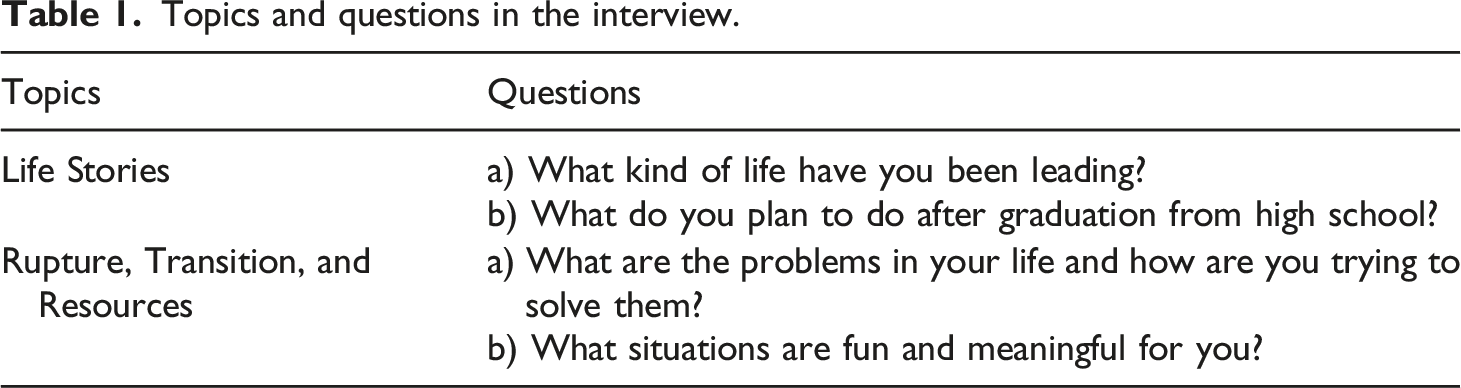
Topics and questions in the interview.
Analysis
We have attempted to provide a comprehensive explanation by repeating the following three steps for each individual in our study. 1) Use the concepts of rupture and transition to capture the individual’s whole life process Analytical question: What did the student take for granted? How did it fall apart? 2) Examine what and how resources were used to support their transition Analytical question: What resources were used to create a new norm? How were they used? 3) Analyze the functions of the resources Analytical question: What is the function of the resource in reference to Yamada’s model of action?
Single case study
This report focuses on a 17-year-old girl, Miki (pseudonym), one of the five participants. A carefully chosen single case study can represent a general principle (Valsiner, 2015). Therefore, we selected Miki who had experienced all three patterns of transition described in later section. Miki talked a great deal about anime, friends, and her sister as her resources, but the meaning of each resource differed depending on the time frame. Miki was in her third year at high school and was a member of an art course and a manga club. She decided to enter a vocational school for art after graduating from high school.
Ethical consideration
We explained to the students in advance that they did not have to talk about anything they did not want to talk about and that they would not be disadvantaged if they interrupted or withdrew from the interview, and we then obtained their consent. All personal information was saved in a manner in which individuals could not be identified. At the end of the analysis, we contacted Miki and obtained her consent for publication.
Results
A slightly different but “normal” life
Miki loved anime and drawing but hated studying. Partly due to the influence of her older sister, who is one year older than her, Miki had been watching anime and drawing pictures ever since she could remember. Her parents told her to study and do her homework, but she rebelled and played games or drew pictures.
Because her elementary school was very small, she didn’t have friends with whom she could talk about anime, and so she followed adults around. She said that when she brought up the topic of anime to her classmates, she got the feeling that they didn’t get it. Miki did not get social recognitions from her classmates and parents. Instead of talking to her classmates, Miki often talked to her grandfather, or other adults she met in religious settings or her neighborhood.
In the upper grades of elementary school, her older sister began to be bullied, and Miki started skipping school with her sister. Because it was a small school, she had been able to hear her sister being bullied in the classroom next to her. In the interview, she said, “I didn’t feel sad about the bullying, rather I thought it wasn’t fair that only my sister skipped school. My sister was also worried about being alone, so she kept asking me not to go to school. Yeah, I think it was more like I was using my sister. Hmm....”
Deviating from “normal” life: loss of a grandfather, school refusal, and exposing the body
When her beloved grandfather passed away, Miki had no more energy to go to school. Miki had lived most of her life with her grandfather, so his death was unbearable. Her grandfather was one of the few adults who gave her social recognition of her existence, so she lost powerful support for her existence by the death of grandfather. Even after she became well, she kept refusing to attend school because she felt that she couldn’t catch up in her classes.
Along with her increased time at home, Miki increased her time using the internet, and she began exposing her naked body on live streaming. She tried to seek out social recognition and found exposing her body on the internet after being alienated from her friends and the death of grandfather. She said, “I was a junior high school student and not supposed to do that kind of stuff, but I exposed my body. That’s what I’ve been doing. It’s very much a shameful history for me now.”
This experience instilled in her a sense that she had led a life totally different from others and that she was not normal. Bullying and disputes with teachers are often covered in the topic of school refusal, but the exposure of one’s body on the internet is rarely covered. That’s why Miki wanted to share during the interview that there are youth like her. Miki’s story suggests that young people may take a variety of actions in and out of the norms in their search for social recognition.
Expanding her normality by connecting with people
After the rupture of exposure, encountering friends through anime helped Miki to transition. Miki attended a high school, where she joined the same manga club as her older sister. The other members in the manga club were able to talk with her about anime, so Miki could comfortably communicate with them. Miki’s interest in anime had put her in a slightly unusual position in elementary school, but at the high school, she was able to meet and connect with people through this interest.
By finding a new group of young people with whom she can share her interests, she got social recognition without alienation. Encountering friends expanded the scope of Miki’s normality. By communicating with her friends, Miki was able to understand their various backgrounds. And her feeling that she was not normal disappeared. Her friends also had many problems, so Miki realized that she wasn’t alone and that her difficulties were not unusual. She said, “I think my vision broadened, and I realized my problems are nothing to worry about. What I was suffering from was usual and normal.” Thus, Miki moved from her rupture of “deviation from normality” by extending her normality.
Miki could create her new life with her friends at the manga club as a resource. Miki certainly approached them with her own will, but whether or not they could become friends was out of her control. In this sense, she was able to encounter them, as indicated by her statement, “I met a good friend by chance.”
Being uncomfortable with religious events
Her older sister, the person closest to her, was diagnosed with gender identity disorder. 1 Miki said it was “all thanks to my sister” that she was able to expand her school life. Taking her sister as an example, Miki entered the same high school and joined the same manga club as her sister. And the manga club allowed her to get in touch with her current friends. In this sense, Miki relied on her sister, and her sister’s diagnosis of a “disorder” made her feel very uncomfortable.
Miki also became uncomfortable with the concept of gender and being coerced into participating in events. She had participated in religious events with her family for a long time. These events emphasized clothing and musical instruments to be separated by gender, and gender roles were usually fixed. Her sister neither took on her role nor wore traditional female clothes. In another instance, members were advised to “do volunteer work or proselytizing” even when Miki felt ill and couldn’t get out of bed. Miki gradually began to question both the necessity to participate and the fixed gender roles in such events.
Her discomfort spread to the widely perceived gender roles in Japanese society as a whole. Miki realized that the normality she had been struggling with had been imposed on her by the society. She said, “How narrow-minded Japan is, for not accepting homosexuals. Japanese society doesn’t acknowledge their weddings, registrations, etc….” Thus, Miki began to have a rupture, questioning things that she and her society had taken for granted.
Resisting the socially constructed normality
She began to resist the prevailing beliefs of society in order to broaden the perspectives of people who don’t question norms. She says that since individuals who are directly affected tend to worry about the approval of others which makes it difficult for them to go against the norms, as someone who is only indirectly related, she wants to go against the norms and work toward broadening the public’s perspective. She hopes that people will come to see gender identity disorder as “a characteristic of an individual” rather than a disability.
For Miki, her sister is the person who is always there for her, and she has lived her life following her sister. She sympathized with the world in which her sister lives and expressed her resistance to society while accompanying her. It can be said that viewing the world from her sister’s perspective was a resource of transition for Miki.
She tried to survive the difficult reality by escaping into the fantasy world of manga and anime
Discussions
School refusal as a representation of questioning normality
From Miki’s life course it was suggested that the absence from school itself didn’t cause hurt and loss, but rather the sense of “deviation from normality” brought hurt and loss. There is an emphasis on being the same as others, in terms of behavior, topics of interest, and relationships. Miki’s story of not being able to make friends in elementary school because of her involvement in anime is an example of how homogeneity in topics of interest is necessary to interact with others. In this way, normality is instilled at school and at home, and withdrawing from these places brings about a sense of “deviation from normality.”
School refusal can bring hurt and loss due to the “deviation from normality,” but it can also serve as an opportunity to create a new normality, depending on how the adolescents live their life after school refusal. According to Yoneyama (2000), the phenomenon of school refusal, “initiated by children who feel their life is threatened by Japanese schools, has the potential to transform that society” (p. 79). When seen from a cultural psychology perspective, deviating from what society considers normal (attending school) can promote diversity in development (Shirai, 2014; Zittoun, 2012). One can question normality after they experience incompatibility or discomfort at school.
Questioning normality becomes possible when the individual both deviates from and re-enters norms. Miki did not simply end up deviating from normality; by re-entering it through encountering and communicating with her current friends, she was able to understand the social construction of norms. Adolescents who continuously live a life that’s considered normal by society do not have the opportunity to consider this normality, but at the same time, adolescents who endlessly continue to deviate from the norm of society only experience the feeling of “not being normal.” Thus, it is very important for adolescents to have the opportunity to both deviate from and re-enter normality, in order to notice and resist the social construction of normality. It is no exaggeration to say that the moratorium (Erikson, 1968) is for such exploration.
Furthermore, Miki was not only able to question normality but also act out against it, due to the formation of resistance (Figure 2). Miki formed her own unique normality by bringing the sphere of experience of meeting people through anime into the sphere of experience of sex/gender. In line with Valsiner (2020), when the direction of X and the direction of Y are in opposition, it is maintenance, but when catalytic factors enter between X and Y, we can see a dynamic whole in which the two generate each other. In Miki’s case, the direction of X (deviating from normal due to sexual exposure), and the direction of Y (her sister suffering from gender identity disorder), are antagonistic. With the antagonism intact, Miki is unable to connect herself, someone who sought to relate to others by exposing her femininity, to her sister, who is biologically female but identifies as male. However, by bringing in the sphere of experience of meeting people through anime, Miki found that normality is constituted into a social construct. By doing so, she created a triangle of herself, her sister, and the socially constructed normality, and found a way for herself to resist the constructed normality. The formation of resistance. (a) maintenance (b) resistance.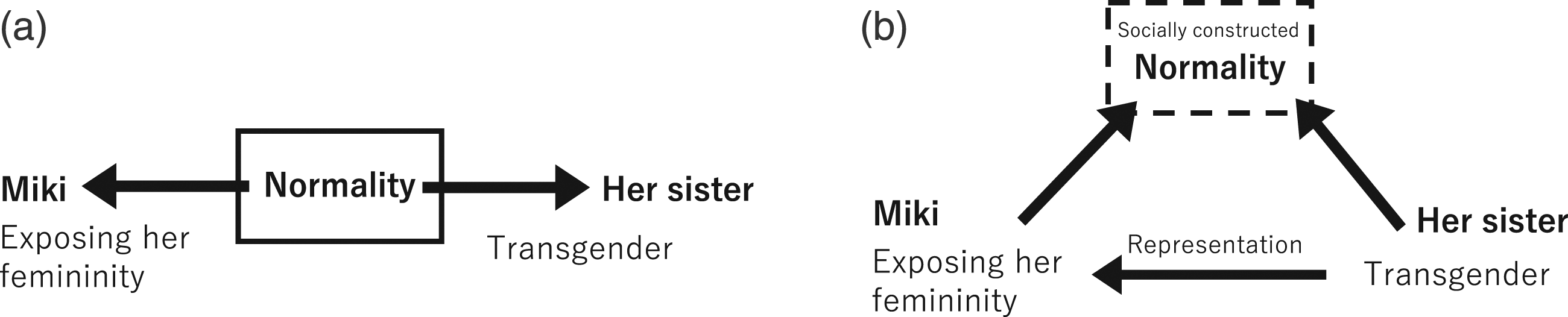
Rich variation in transition: relationship with resources
We found richness in the variations of the transitions. While the socio-cultural psychology of life course is very versatile and can encompass individual cases, we attempted to capture the transition in a more concrete dimension. The transition process was elaborated with reference to Yamada (2010, 2019), and at least the following three patterns of transition were observed. ➢ By “encountering” her friends, Miki expanded her involvement in the here and now. She approached the members in the manga club with her own will, but it was out of her control whether they could become friends or not. Because an aspect of the encounter was coincidental, her reality and normality were expanded during the encounter. For example, you may be able to expand your horizons during an active search if also by chance, you encounter moments that move you. One’s world view can expand when transitioning through “encountering.” ➢ By “representing” her sister’s world, Miki tried to resist normality. Similar to encountering, representation is a way to approach an object. Both encountering and representation are based on an empathic engagement with an object, but representation requires the individual to stay in place and bring the object into their own world, while encountering refers to the individual and object meeting (Yamada, 2010). In Miki’s case, it’s evident she brought her sister’s gender world into her own world. This is because there is a relative distance kept between her world and her sister’s world, meaning that she did not identify with her sister, but at the same time she did not view her sister’s world as an outsider either. When one is too involved in something, it can become difficult to fight against it. Transition that occurs by representing another world can bring resistance to the here and now. ➢ By “touching” objects in the fantasy world, Miki tried to block out involvement in the here and now. Miki said that touching the fantasy objects, stuffed animals, etc., heals her and allows her to escape from reality. Touching can promote the creation of a world that is just for herself and that object, at least for that moment. For instance, the moment when you see your favorite actor, or the moment when you relax in a hot tub, all other things will temporarily fade away and another world will be created during that time. The newly created world does not update or change the real world, it just exists separately. It goes without saying that the creation of these other worlds is also an important resource for life and transitions.
These results suggest that there are numerous ways in which a new normal for a person can be created. Marstin, Chang, & Obst (2016) studied how cultural tools are part of stress coping. They found that music, internet, and TV are the most often used, and that it’s used in numerous ways, such as for withdrawal or for stress management and engagement. Although Marstin, Chang, & Obst (2016) and the current study are focused on a different research question, both studies suggest how richly people face reality.
Conclusion
This study investigated the transitions of adolescents who refused to go to school, based on the socio-cultural psychology of life course. When adolescents experience rupture and try to create a new normality, they can use rich resources and have multiple ways of transitioning. Through our research on school refusal, we found that there are various ways to relate with the world. The three modalities of uses of resources that we identified were related; expanding reality, representing her sisters’ world, and escaping from reality are not exclusive categories, but rather inclusive categories that occur in the process of development. This suggests the dynamics and multiplicity of adolescent development. In addition, we found that there was a tacit understanding of normality in our society, and that school refusal could be an opportunity to create a crack in this tacit normality and create a new norm. Up until now, school refusal was perceived as deviance and illness and as an object of special support and treatment. However, if we view school refusal as an event in life-long transition, then school refusal can be viewed as a positive opportunity for development. We believe that this study was able to depict one aspect of the rich transitions in the lives of those who had refused to attend school at some point in their adolescence. However, this study does not consider the extent to which the findings can be applied, nor does it address cases of long-lasting ruptures. In the future, we would like to further extend the three types of transitions through additional case studies and theoretical elaborations.
Footnotes
Declaration of conflicting interests
The author(s) declared no potential conflicts of interest with respect to the research, authorship, and/or publication of this article.
Funding
The author(s) disclosed receipt of the following financial support for the research, authorship, and/or publication of this article: This work was supported by the JSPS KAKENHI (19K14399).
