



Abstract
In this article, the author addresses the mechanisms of the acculturation of people who move across different cultural communities (immigrants, refugees, sojourners, international students, etc.). It starts by analyzing Alfred Schutz’s essay ‘Stranger’ and then connects it to the theory of sociocultural models (TSCM) (Chirkov, 2020a). Schutz’s treatise provides background and a conceptual map for articulating the mechanisms of acculturation. The TSCM elaborates on these concepts and hypotheses and justifies the proposed understanding of the psychological and sociocultural basis of acculturation. The primary idea of this approach to acculturation is that migrants experience a clash and tension between two sets of sociocultural models: from their home communities and from their host communities. Newcomers must understand the sources of this tension; in turn, they must reflect on it and then develop strategies for reconciling these two sets of models. During this process, their selves, rationality, reflective capacities, agency and intellectual autonomy become the primary means for their acculturation success.
In 1944, Austrian-American phenomenological philosopher and sociologist Alfred Schutz 1 published ‘Stranger: An essay on social psychology’ (1944), which examined the nature of the barriers that newcomers experience when they move to and join a new group or community. According to Schutz, examples of such transitions include immigrants arriving in the countries of their new settlement, rural youth entering college, newlywed husbands adjusting to life in their wifes’ house (or vice versa); city dwellers moving to a small town in a rural area; fresh recruits joining the Army, or newly convicted individuals being transferred to a prison cell. 2 In all these instances, a person who was socialized and who functioned in one sociocultural environment moves to a different environment – a new community, a particular social group, or a social institution. In all these instances, the stranger experiences a shock that prevents him or her from quickly adjusting to and smoothly performing within the new milieu. Simultaneously, the community or group that this person enters experiences the presence of the stranger among their members and reacts to his or her existence in some way. To describe these processes, acculturation researchers use various terms including ‘acculturation’ (Redfield et al., 1936), ‘assimilation’ (Taft, 1953, 1957), ‘adjustment’ (Ex, 1966), ‘adaptation’ (Ward & Kennedy, 1999), ‘acculturative stress’ (Berry, 2006), ‘enculturation’ (Weinreich, 2009) or ‘proculturation’ (Gamsakhurdia, 2020) among others. Schutz’s essay examines the nature of acculturation or, more specifically, the mechanisms of acculturation. In this paper, I will stay with the term acculturation, 3 which definition most closely relates to the processes that I will be examining in this essay.
The outline of the mechanism of acculturation according to Schutz
Schutz starts his essay by introducing the concept of cultural pattern of group life, which he suggests includes ‘all the peculiar valuations, institutions, and systems of orientation and guidance (such as the folkways, mores, laws, habits, customs, etiquette, fashions) which … characterize – if not constitute – any social group at a given moment in its history’ (pp. 499–500). In the group, each member uses this pattern to organize his or her acts in relation to his or her needs, interests and desires while coordinating these actions with the fellow in-group members to achieve communal goals. The cultural pattern of communal life supplies group members with collective knowledge about the world and gives them ready-made recipes for interpreting events in a community and acting toward things, events, and other people to attain the best outcomes with minimal efforts and while trying to avoid undesirable consequences. The community transfers this pattern together with a related stock of knowledge and practices to future generations; specifically, parents, teachers, and other authorities convey these items to children. This transference guarantees that the communal sociocultural life goes uninterrupted. Through its internalization, new members become socialized and enculturated into the community.
Generally speaking, this cultural pattern designates the typical problems of group life (for example, finding a partner, marrying him or her, building a family, raising children, educating them, and so on) and it provides typical solutions to these problems for typical group members. Hence, together with the notion of ‘cultural pattern’, Schutz used the term the system of typifications. 4 In addition to typification, the group cultural pattern highlights the relevant aspects of the environment, people and situations to which members of the community must attend. It also sets the goals for people’s communal strivings and designates values and moral codes that justify these goals. Saying this differently, the cultural pattern identifies relevant items and explains why they are relevant to members of the community. Hence, Schutz coined the notion of the system of relevances.
Schutz also introduced two other concepts – a scheme of interpretation and a scheme of expression – which clarify the functions of the cultural pattern in organizing group life. ‘A scheme of interpretation’ is used ‘for interpreting the social world’ (Schutz, 1970, p. 81). In turn, ‘a scheme of expression’ is ‘a precept for actions… whoever wants to obtain a certain result has to proceed as indicated by the recipe provided for this purpose’ (p. 501). 5 Thus, the cultural pattern serves as people’s interpretive lenses to allow them to perceive and understand the world, including various events, things, other people, and themselves. Based on these interpretations, it also generates and guides people’s actions through schemes of expression.
A remarkable attribute of these patterns, schemes and recipes is that for people in a community they are taken-for-granted tools for interpreting, understanding and acting in the community. This taken-for-grantedness means that people accept the recipes and schemes of their cultural patterns without deep thinking and without understanding the reasons for their existence or the assumptions behind them. ‘Thus it is the function of the cultural pattern to eliminate troublesome inquiries by offering ready-made directions for use, to replace truth hard to attain by comfortable truisms and to substitute the self-explanatory for the questionable’ (p. 501). Hence, the cultural pattern of group life represents a community-based, easy-to-use normative mechanism for regulating people’s actions.
A community’s cultural pattern serves its regulatory function as long as social life in the community continues to unfold uninterrupted and as long as it is comprised of the same typical situations that can be dealt with using the same typical solutions. Ultimately, something may happen to the community that will change its natural and typical flow of life that has been regulated by the validated schemes of understanding and expression. A group or community may be occupied, colonized, or conquered by another group; in such cases, its members become introduced to different cultural patterns (for this case see the definition of acculturation by Redfield et al. (1936)). When this occurs, ‘the cultural pattern [of people’s own community] no longer functions as a system of tested recipes at hand’ (p. 502) and members discover the locality and historicity of their traditional ways of life.
Such a disruption of the typical flow of communal life may also happen at the individual level when a person moves to another cultural community and finds him or herself a stranger to its members. What Schutz described as the content of the home community of the stranger – the cultural pattern of the group life, the schemes of interpretation and expression, the stock of knowledge and recipes for orientation and action – can be symmetrically applied to the host community that this stranger joins. Thus, this host group has its cultural pattern of group life with its unique mores, folkways, laws and customs as well as its unique stock of knowledge, systems of typification and relevances, schemes of interpretation and expression, habits of thinking, and scripts for resolving typical problems. The hosting group has everything that the stranger had in his or her home community – but these items have different content. Consequently, a newly arrived stranger quickly becomes aware of these discrepancies and tries to bridge this gap using various means.
It is natural to expect that upon arrival, the stranger would start to apply the schemes and scripts from his or her home to the new environment in an attempt to resolve similar situations by using the recipes stored in his or her memory. Pretty soon, he or she would discover that these recipes, which worked reliably back home, are inadequate in the new community. The situations that are typical in the host community are different; moreover, their interpretations are not the same and the required actions are correspondently altered.
Thus, the stranger discovers that his or her old habits do not work and that he or she does not know and does not share the new ones. The fundamental challenge the stranger faces is that he or she now must question almost everything in his or her new life (for example, how to greet another person, how to resolve conflicts, how to react to insult, and many other mundane situations); everything needs to be explored and thoroughly examined. The easy and taken-for-granted interactions that had taken place in his or her home community are gone and every event, encounter and conflict in the new group becomes an issue to be resolved through reflections and contemplations. Even more, the host community’s systems of interpretation and expression do not have authority for the stranger, and they are experienced as alien, unnatural and questionable prescriptions for life. Consequently, the stranger finds him or herself in a peculiar and stressful situation where his or her existing tools for life do not work anymore. Moreover, the new ones are unknown, ridiculed or have questionable authority and usefulness. Thus, acculturation stress builds up out of these incongruencies. This is how Schutz presents his understanding of acculturation stress: For the approaching stranger, however, the pattern of the approached group does not guarantee an objective chance for success but rather a pure subjective likelihood which has to be checked step by step, that is, he has to make sure that the solutions suggested by the new scheme will also produce the desired effect for him in his special position as outsider and newcomer who has not brought within his grasp the whole system of the cultural pattern but who is rather puzzled by its inconsistency, incoherence, and lack of clarity. (p. 506)
He continues: In other words, the cultural pattern of the approached group is to the stranger not a shelter but a field of adventure, not a matter of course but a questionable topic of investigation, not an instrument for disentangling problematic situations but a problematic situation itself and one hard to master. (p. 506)
Therefore, the incongruency between the cultural patterns of a stranger’s old and new cultural communities and the lack of tools the newcomer has to navigate within the cultural patterns of the new life create for this newcomer unavoidable barriers for a smooth and conflict-free entry into and functioning in the new environment. Consequently, the next questions one asks are, how could the newcomer resolve this discrepancy? and how could he or she secure entry into the new community and, in turn, function successfully within it?
Schutz interpreted the process of the stranger’s incorporation into a new group in the following way. He suggests that it starts with him or her being a simple observer of foreign life. Although such a stance is acceptable at the first stages after joining a new group, in the long run, it is not sufficient for an individual who wants to become a member of a new community. This observational examination of a new life soon must be replaced by acting upon one’s deductions by trying to achieve one’s goals in the new environment. Thus, the second phase is a transition from being an onlooker to becoming a member of the cast who ‘enters as a partner into social relations with his co-actors and participates henceforth in the action in progress’ (p. 503). Through this co-acting with the stranger’s hosts, their initially alien and unnatural cultural patterns start to emerge as meaningful; their contours become filled with experience and their applications start to bring the desired outcomes. Still, these patterns are not yet the unquestionable and taken-for-granted ways of running one’s life; rather, they are rationally comprehended and deliberately executed practices.
Cultural patterns of group life are not made up of isolated pieces of knowledge, recipes and schemes; rather, they are represented as systems of ‘coinciding schemes of interpretation as well as of expression’ (p. 504). That is how they are seen by any enculturated members of a group. Even if our stranger sees separate pieces of this system, he or she cannot grasp its holistic and systemic nature. In turn, he or she may insert these pieces of foreign cultural patterns into the system of recipes from his or her home group, even though this scaffolding may help only little in his or her integration into a new group. As Schutz explained, the stranger does not feel the foreign cultural patterns ‘from within’. These patterns are not his or hers; rather, they are rationally extracted rituals of the required behaviours.
In summary, the stranger’s acculturative stress and its related challenges and concerns are determined by the discrepancies between his or her home cultural patterns and the patterns of the host group. The problem of discovering, analyzing, learning and internalizing the new patterns of social life and reconciling them with the old cultural patterns is at the essence of newcomers' acculturation into his or her new sociocultural environment.
The theory of sociocultural models and the mechanisms of acculturation
As a phenomenological sociologist, Schutz envisioned his primary goal to examine and understand the nature and structure of people’s everyday life-worlds (Schutz & Luckmann, 1973). Acculturation was not the topic of his primary scientific interests; therefore, his sketch of the dynamics of acculturation may benefit by being further elaborated upon, both theoretically and conceptually, with consideration of his other works as well as the writings of subsequent scholars. In the rest of the article, I will outline the theory of sociocultural models (TSCM) (Chirkov, 2020a), which was strongly influenced by the work of Schutz and incorporates many of his ideas. Then, I will follow the logic of the acculturation processes described by Schutz and apply the TSCM upon it to elaborate further on the dynamics and mechanisms of acculturation.
The sociocultural mechanisms of social behaviour regulation: An introduction
People who live in and identify themselves with their communities face the fundamental challenge of coordinating their activities to achieve personal and communal goals. Living in groups and coordinating social life has been (and remains) the necessary condition of human survival (Caporael, 2007; Tomasello, 2014). A community of individuals who become concerned with these challenges is called a moral or cultural community. The cultural community cares about the behaviours and experiences of its members in their efforts to ensure that these behaviours serve the purpose of the common good. To execute this care and to address possible concerns, members of cultural communities reach (explicitly or implicitly) agreements on various factors including on how to make sense of and treat various events and situations in their community, how to deal with other people and themselves within their communal life, how to solve various problems that arise, and how to behave within the community. Without developing such ‘conventional cultural practices’ and, based on them, ‘cultural common ground’ (Tomasello, 2014), successful communal life is impossible.
According to many evolutionary scholars, this tendency toward developing such a system of communal regulation (Culture) emerged naturally during the evolution of humans (Chase, 2006; Tomasello, 2014). In his shared intentionality theory, Tomasello identified three phases in the development of the psychosociocultural regulation of human behaviour during evolution: individual intentionality, joint (social) intentionality, and collective (cultural) intentionality. The final stage, collective intentionality, is the phase when human groups faced the necessity of inventing collective normative prescriptions and practices that all members of a group must accept, approve of and execute. According to Tomasello, the emerged cultural regulation that is based on collective norms, traditions and practices created group cohesion as well as effective intergroup cooperation and coordination. Moreover, the group norms that emerged created evolutionary pressure for developing humans’ social, cognitive and communicative capabilities. Through the mechanism of cultural evolution, these have become the essence of the Homo Sapience’s mentality. Therefore, the development of cultural normative systems was the pivotal mechanism in regulating the communal and individual lives of evolving humans and, consequently, it facilitated the emergence of modern humans’ minds. Tomasello’s cultural normative system strongly corresponds with Schutz’s notion of the cultural pattern of group life.
The construction of such normative prescriptions serves the interests of both the community and its members. The community seeks to create ways of solving the typical problems of group living: how to hunt, fish, cook, raise children, greet each other, solve conflicts, govern communal affairs, and so on. This uniformity fuses the experiences of the group members and contributes to their social cohesion. In turn, tight social cohesion constitutes the primary condition of achieving communal goals and, ultimately, ensuring the survival of the community. In addition, the development of the group’s normative skills, knowledge and practices makes transmitting its collective knowledge possible. When facing typical problems, members do not need to invent their solutions from scratch; rather, they can use the typical solutions located in the collective depository of wisdom.
The existence and importance of these normative communal prescriptions and regulations as well as these deposits of the group’s knowledge and skills were recognized by social philosophers, scholars and social researchers several centuries ago. Starting with the somewhat romantic German term of volksgeist (spirit of the people or people’s mind/mentality) (Jahoda, 1992; Klautke, 2013; Smith, 2005), this recognition has undergone numerous conceptual innovations and modifications since this time. Here are several of the most prominent ones: collective representations by Durkheim (1912/2008), generalized others and generalized social attitudes by Mead (1934/1962), social representations by Moscovici (1961/2008), cultural patterns of groups life and the system of typifications and relevances by Schutz (1944; Schutz & Luckmann, 1973), the social/institutional stock of knowledge by Berger and Luckmann (1966/1989), and cultural models by Shore (1996), D’Andrade (1995), and their colleagues (Holland & Quinn, 1987). All these concepts and ideas are congruent in their articulations of the mechanisms of the sociocultural regulation of people’s behaviours even though they emphasize different aspects of it. Therefore, for sociocultural psychological research, it was natural to bring them together under a unifying theoretical umbrella. Correspondently, the theory of sociocultural models (TSCM) was formulated by Chirkov (2020). This theory is a relatively systematic synthesis of the ideas elaborated upon by the above-mentioned scholars. In turn, this synthesis allows social and cultural psychologists as well as other social scientists to think in-depth about the cultural regulation of human mental development and functioning.
The theory of sociocultural models in a nutshell
According to the TSCM, the normative communal mechanism of the psychosociocultural regulation of people’s behaviours and experiences consists of a system of sociocultural models (SCM). Sociocultural models are collectively intentional and collectively intersubjective mechanisms for regulating experiences, cognitions, and actions of members of the community. These models are comprised of public/communal and internalized/mental aspects that continuously co-construct each other through social interactions among members of the community. These models are shared and taken-for-granted schemes for interpreting and scripts for acting in the world. (Chirkov, 2020b, p. 129)
SCM have a unique social ontology. They are collectively intended and intersubjectively shared by the members of a community (Jankovic & Ludwig, 2018; Schweikard & Schmid, 2021; Searle, 2006, 2010; Tuomela, 2013). This means that SCM do not exist independently of people’s involvement with them. By acting according to these models, these people externalize and instantiate these models in collectively intentional things (Shweder, 1991), such as money, bank and banking, employment and work, marriage and divorces, crimes and court hearings, and many others. Community members mentally represent and evaluate these intentional things in the form of collectively intentional mental states. 6 Thus, SCM are simultaneously public (collectively intentional things) and mental (collectively intentional states). These two poles coexist through the interactions among people who are engaged with and enacting these models.
Members of any community not only collectively intend their SCM, but they also intersubjectively share these models. The intersubjectivity of SCM, means that all members of the community know that all the other community members have the same (or similar) representations, beliefs, and knowledge about these models and that they use them in roughly the same ways (Berger & Luckmann, 1966/1989). Hence, I know that you know how to work properly and earn good money and I know that you know that I know how to correctly take care of the earned money and properly invest them. We all know that others in our community all know these ways of work and money management (D’Andrade, 1987). Intersubjectively shared beliefs, attitudes, thoughts and feelings about constructed intentional things make these intentional mental states and representations collectively owned by all members of a community. Through this sharing, the collectively intentional entities become constituents of these people’s life-worlds and their mentalities. As Schutz emphasized, the everyday life-worlds of people are not their private worlds; rather, they are the worlds shared and constituted together with other members of the community (Schutz & Luckmann, 1973). Moreover, he stressed that people’s life-worlds make up the social reality in which they live. Therefore, SCM are intimately involved in constructing the social reality of people’s collective existence.
The public, communal, visible, tangible, externalized and instantiated aspects of SCM have numerous forms and manifestations. Community guests may see and document myriads of manifestations including churches and temples, libraries with their books and journals; architecture and the organization of public spaces; ways of dressing and the differences in the attire of people belonging to different sub-groups; rituals of greeting, solving conflicts, hosting guests and sleeping arrangements; and manners of eating and decorating houses and homes, among others.
In addition to these tangible forms of the public aspects of SCM, there are collectively shared schemes of interpreting and understanding the elements of communal life: the meaning of being a man or a woman; the understanding of what is the moral and right thing to do and why; the importance and meaning of those who are in power; and many other collective understandings and evaluations are shared among people. These items constitute the communal public stocks of symbols and interpretive schemes.
Another feature of SCM is that they are not only the communal public phenomena, but they simultaneously make up a part of people’s mentalities because of these models’ corresponding intentional mental states. The public forms become meaningful and can work only if the members of the community have tools for their interpretations and implementations. People must have mental schemes to interpret particular gestures as greetings and other gestures as insults; they must have interpretive lenses to make sense of women and men in different situations before approaching them and requesting something. These tools are internalized aspects of SCM. These aspects are comprised of collectively intentional mental states and the adopted schemes of expression and interpretation that come with the corresponding SCM. Ultimately, these two foci of sociocultural models – communal/public and internalized/mental – like Yin and Yang in the Taoist teaching, are inseparable parts of the system and only together can they constitute the functioning whole – the sociocultural model (Hannerz, 1992; Shore, 1996) (see Figure 1). Interrelationships between public and internalized aspects of SCM.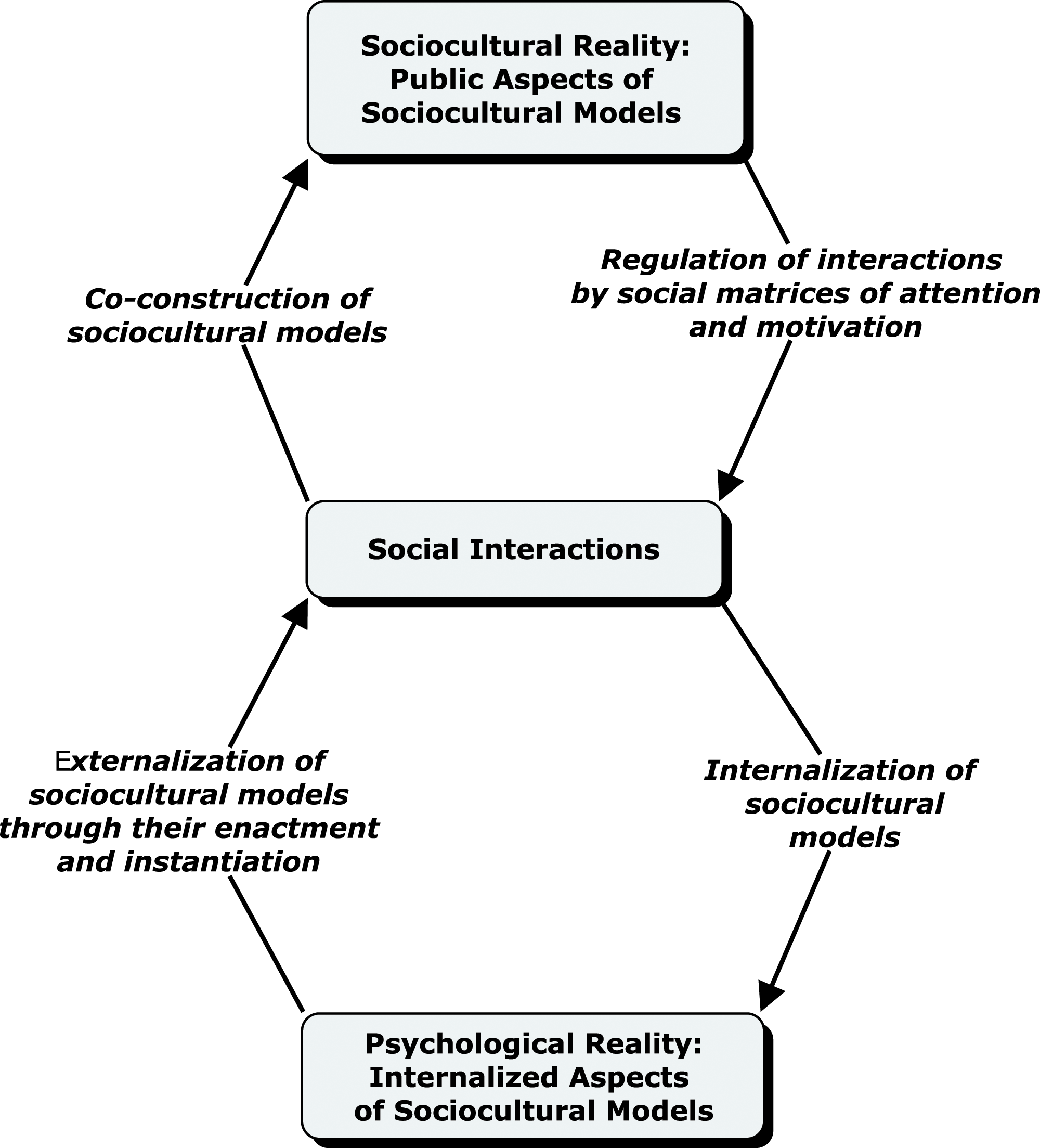
The crucial advantage of regulating through SCM is that the schemes, lenses and scripts of these models are taken-for-granted. This means that the evaluations, interpretations, decision making and acting that are initiated by SCM are executed automatically and subconsciously, without people reflecting or contemplating about them. The most common answers to the question ‘Why are you behaving this way?’ is ‘Because this is the right thing to do’ or ‘This is how people in my community behave; this is how we do things’. 7 By executing these models nearly automatically, members of the community, first, co-create the environment that they perceive as an objective ‘matter-of-fact’ reality. Second, because of this feeling of reality, people acquire the sense of ontological security that is crucial for their feelings of belonging, identity and wellness. 8 Third, taken-for-granted actions do not require overt explanations and justifications and they are understood without any comments – they are performed naturally, the same way people breathe. Taken-for-granted actions embrace and reinforce the SCM that generate them. They save people’s cognitive resources. This allows them to focus on the idiosyncrasies of their situations and their individual goals. Taken-for-granted behaviours support people’s identification with their community and they make interactions with their fellow community members seamless and effective. Through their taken-for-grantedness, SCM enter the biographies of members of the community, and, because of this, these models become the sources that justify people’s social existence. The taken-for-grantedness of the mental aspects of SCM is achieved through their internalization (Valsiner, 2014) and their subsequent transformation into habitus. 9 The term ‘habitus’ expresses well the automatic nature of the mental aspects of SCM and their nearly instinctive regulative function in generating actions and in interpreting them.
SCM and their corresponding habitus have a history. It is important (both for members of a community as well as for researchers) to uncover this historicity and arbitrariness of SCM to avoid the danger of culture reification and to arm communities with the understanding that if their models are outdated and not functional any longer, they can be changed, modified, or replaced by new ones.
This presentation outlines the nature of SCM and the sociocultural regulation of the stranger’s experience and behaviour in his or her home community as well as in future host community. In addition to these two sets of SCM, another component of the proposed mechanisms of acculturation is the stranger’s self and its ability to be agentic.
Sociocultural models, the development of the Self and the person’s autonomous agency
The human Self is another important component of the TSCM. The Self is included in this theory to address the fact that despite all the powers SCM have in shaping individuals’ mentalities and behaviours, people have the capacity to discover these models and then to extract and analyze them. The Self gives people the power to reflect upon and examine their cultural milius.
The Self gives people the power to reflect upon and examine their cultural milieus. The Self is the process by which the individual experiences oneself in the world and, in turn, the process of reflecting on this experience. The Self is the centre of the person’s mental existence, of reasoning and acting as considered from the perspective of the functioning individual. Thus, the Self is ‘understood as an embodied first-person perspective (an “I”), the worldly experience of which enable a constantly evolving self-understanding (a “me”) with sufficient stability and coherence to permit generally effective personal functioning in the biophysical and sociocultural world in which it develops’ (Martin et al., 2009, p. 110). The Self is developed in the sociocultural world. Subsequently, persons with the developed Self acquire the capability of self-understanding, including understanding the models that exist in their cultural environments.
Based on the ideas of Herbert Mead, self-researchers (Blumer, 1966; Martin, 2005, 2008; Rochat, 2009) emphasize that the Self ‘cannot arise other than through experience of the attitudes, actions, and perspectives of others’ (Martin, 2005, p. 214). Consequently, the person’s Self is socially constructed through interactions with others (p. 214). The very nature of SCM – their collective intentionality and intersubjectivity – and the way of their acquisition – through interactions with and mediation by members of the community – these models supply individuals with conditions for the emergence of the agentic, perspectival and reflective Self and correspondently, the sense of self and self-consciousness. Such attributes of the Self must be trained and then realized through the continued distancing from and reflecting upon a person’s mental representations, emotional states and the meanings that they have (Chirkov, 2017).
Among these mental representations are those that result from the internalization of SCM. Thus, a person with the mature Self has the power to make him or herself aware of, distance from, and then reflect upon one’s internalized communal representations, systems of meaning, and schemes of interpretation and expression imposed by one’s culture. After analyzing their SCM, individuals may continue endorsing their models or they may reject them and look for alternative ones (for instance, many citizens of Western countries have started practicing Buddhism and other Eastern spiritual and religious practices to avoid the primary Western SCM of commercialism, competitiveness and dehumanization). They may decide to fight the existing SCM of oppression (for example, attacks against the SCM of inferiority and otherness of Black people in the US, Aboriginal and Black people in Canada, and LGBTQ+ individuals around the world). Or they may choose to leave the community that has a particular set of SCM with which they disagree and move to another community where the SCM are better suited to them (note: immigration is frequently driven by this motive). Therefore, the Self may bring to people relative 10 autonomy and freedom from the dominant SCM and create the potentiality of exercising their self-determined agency. 11 This means that neither prescriptions of one’s models, nor expectations of others but exclusively one’s sense of self and the sense of what is the right thing to do determine one’s actions (see the definition of human agency in footnote 8). Therefore, people with the mature Self acquire relative freedom from these models and develop relative psychological autonomy that allows them to set their own rules for meaning-making, interpretations, and actions – either in their home or host communities.
To finish this presentation of Schutz’s sketch of the sociocultural regulation of humans’ actions and the TSCM, I list the functions that the models perform in people’s lives. They construct people’s social realities and aid the transcendence of their individual beings by merging them with the larger social whole. SCM simultaneously execute social control and regulation of people’s actions and practices. They perform these functions by typifying the communal social reality, its primary problems, and their solutions; consequently, they deposit them all into the collective memory of the community. SCM accumulate and retain communal knowledge and skills. These models serve as systems of relevances (and irrelevances) (Zerubavel, 1997). This function is executed through the social matrix of attention (Campo, 2015) and the social matrix of motivation (Schutz, 1970b). These two matrices organize people’s attention – what to pay attention to and what not – and prescribe structures of the goals and motives that members of the community must execute. Sociocultural models support the moral values behind both social matrices and serve as mechanisms that generate schemes of expression and schemes of interpretation. In this way, SCM provide meaning and regulative power for social interactions. These models are linguistically furnished, and they offer the basis for the development of people’s self, self-consciousness and sociocultural identities.
Sociocultural models and the mechanism of acculturation
I focused on the nature and functions of SCM in such detail because it is crucial to show how and why they are important for the social lives of people as well as to realize how many vital functions they execute, both in sociocultural and mental domains. Now that I have examined SCM, it is possible to articulate the mechanism of acculturation. The problem of acculturation for immigrants emerges because of the gap between the SCM of the home and host cultural communities (see Figure 2). Acculturation gap between the home and host sociocultural models.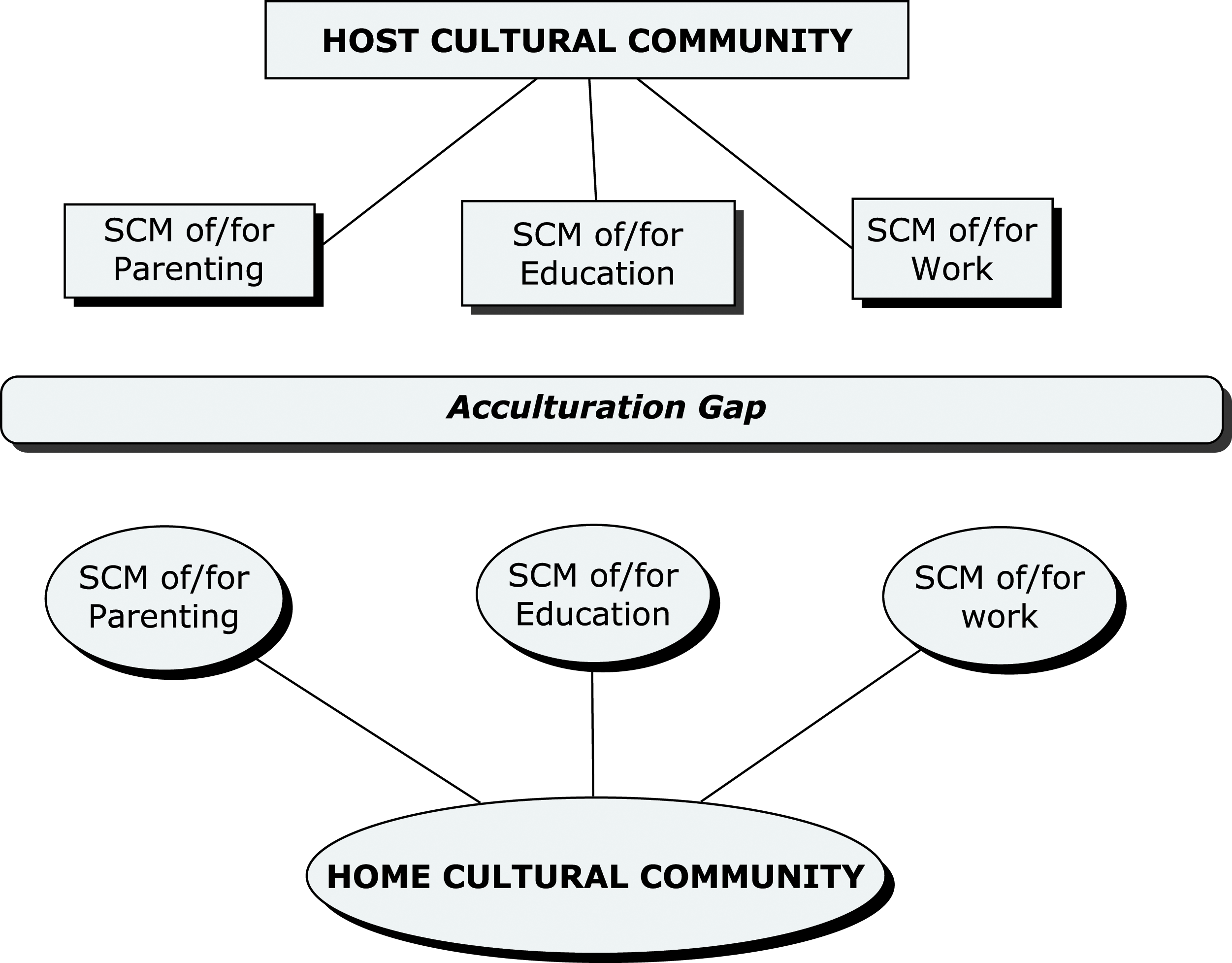
The concept of ‘mechanisms’ comes to this essay from the philosophy of critical realism (Bhaskar, 1975/2008). Based on this paradigm, the mechanisms of acculturation are defined as systems of sociocultural and mental powers and forces that causally determine and guide the dynamics of the stranger’s behaviours and experiences in a new sociocultural environment. These mechanisms are hidden and unobservable and they are not directly available for empirical verification. But they are real and constitute the object of the science of acculturation. These mechanisms can be inferred (retroducted) by researchers based on their theoretical and conceptual frameworks, disciplined imaginations, and the existing empirical evidence about immigration and acculturation.
Acculturation is a set of processes a newcomer undertakes to recognize, reflect upon, and reconcile the SCM of one’s home and host cultural communities. Acculturation involves a deliberate, reflective and, for the most part, comparative analysis of the systems of relevances, schemes of expression and interpretation, moral values, typical practices, and the means of their control that exist in the acculturating person’s original and new cultures. These are discrepancies between the taken-for-granted, familiar, and habitual social realities of a person’s home community and the new, unfamiliar, and sometimes even not hospitable host cultural community. These discrepancies create tension in the stranger’s psyche that needs to be addressed and eased through his or her voluntary efforts. The person’s Self is at the centre of these deliberate efforts of reconciling the two systems of models. The mature Self provides the individual with the ability to distance him or herself from both sets of models and to contemplate solutions for reconciling them and navigating between them. The acculturating person has various options to do so. Acculturation progresses within the context of the interactions, both physical and symbolic, with the members of the home and new cultural communities. It requires time and may continue for months and even years. Acculturation is an open-ended, continuous process that includes progress, relapses and twists, which make it practically impossible to predict and control (see Figure 3). The mechanism of acculturation. Solid lines indicate components of acculturation mechanism. Dotted lines denote the process of acculturation.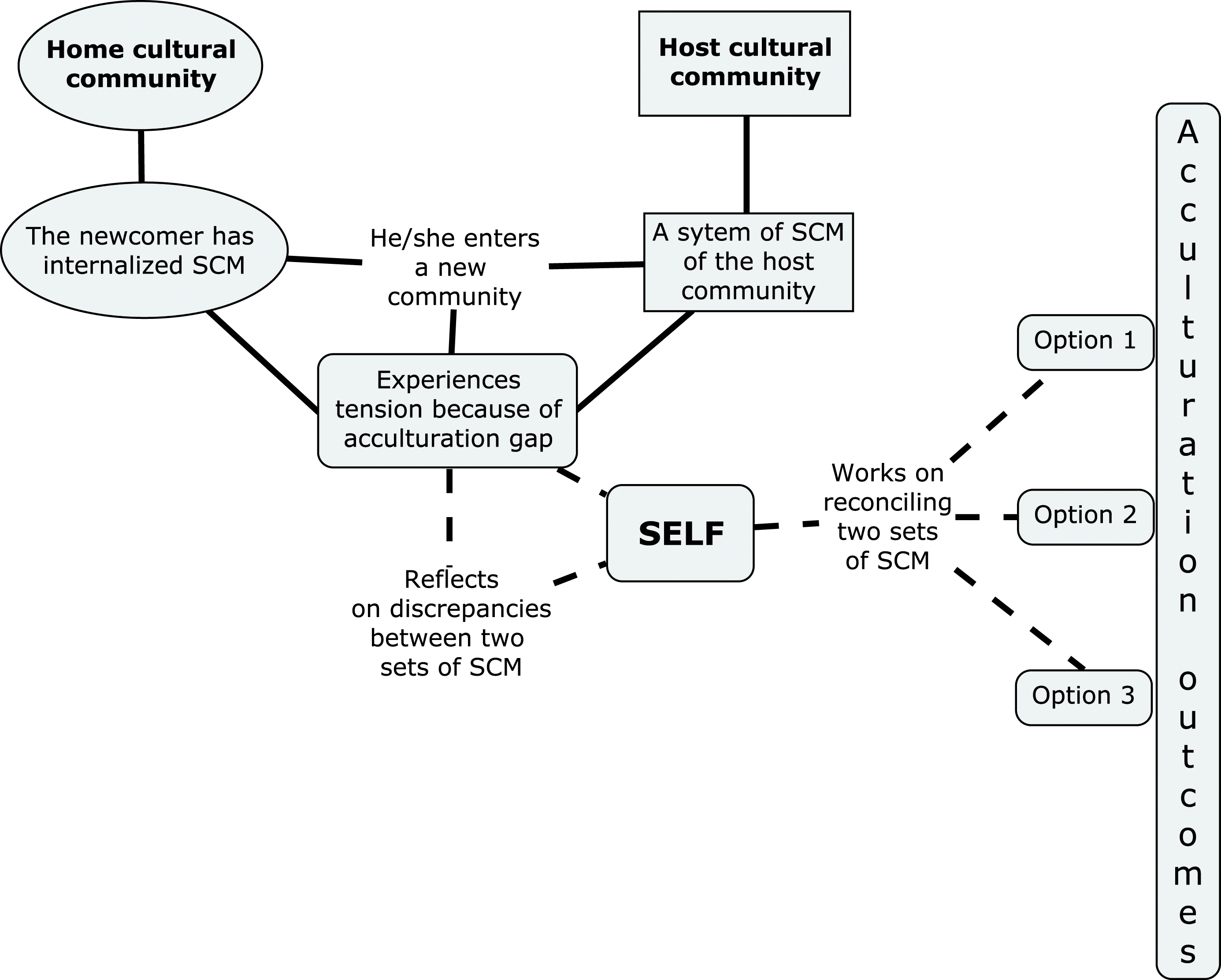
The mechanism of acculturation in action
- Our stranger who enters a host community is equipped with internalized SCM related to all domains of his or her life in his or her home country. In addition, he or she has a reflective perspectival Self, together with knowledge, stereotypes and expectations about the host cultural community. The stranger develops motivation to move to another country (migration motivation) and motivation toward embracing or rejecting the systems of SCM of the host community (acculturation motivation). As a developed individual, he or she has certain personality characteristics (temperament, openness/closeness to new experiences, extraversion/introversion) that may facilitate or hinder the process of acculturation. In addition to these individual and personal factors related to the stranger, there are also factors related to the host community that may influence the stranger’s acculturation. These include its system of sociocultural models; the community members’ knowledge of and expectations about newcomers and hosts corresponding attitudes toward them (openness and willingness to embrace the guests compared with suspicion and defensiveness regarding their presence). All these factors create a dynamic field of forces and powers where the processes of acculturation unfold. - The Self plays a crucial role in the mechanisms of acculturation. When the prescriptions from the home SCM no longer work and the models of the host community are alien, the only survival tool that remains for the stranger is his or her Self. If a stranger possesses a mature Self and has the skills of distancing, reflecting upon, and understanding others’ perspectives, then that stranger’s interactions with the members of a host community become less unpredictable and stressful. - The stranger enters a new community and realizes that he or she cannot function there in the same way he or she did in his or her home community. The newcomer experiences ontological insecurity because his or her taken-for-granted social reality is shattered. He or she may experience uncertainty, existential anxiety, fear, the feeling of loss, emptiness and other mental correlates of acculturation stress. If the stranger does not understand the causes of such states, his or her mental health may deteriorate and prevent him or her from attaining successful adaptation and acculturation. Such states may be exaggerated if there are negative attitudes shown by the members of the host community and possible prejudice and discrimination. Our newcomer may become aware of the discrepancy of the cultural patterns of his or her home and host communities; thus, for the newcomer, the problem of acculturation emerges. - The stranger starts his or her entry into the host community by using habitus that is grounded in the stranger’s home-based internalized SCM. They do not work or work only partially. As a result, acculturation stress is experienced (see above). If the Self is not mature and agentic enough to reflect on the old habitus, the stranger may be stuck with his or her old models and experience barriers toward accepting and learning the new ones. In contrast, if the Self is agentic and mature, then the processes of reflecting upon and reinterpreting old models and related habitus may take place, and the stranger may free him or herself to learn the new models. Notably, he or she must have the motivation to do this. Acculturation motivation involves the intention and skills of exploring and learning new SCM. - The stranger starts observing and learning the host community’s cultural patterns. ‘Cold’ learning (without strong affective involvement) and the superficial application of these patterns (models) begin (Morris et al., 2019). In the human mind, information related to the functioning of SCM is managed through the dual-process mechanism that includes reflective and impulsive cognitive systems (Strack & Deutsch, 2004, 2014). The home-country habitus is processed mostly through the impulsive, subconscious and automatic system that provides quick and efficient processing of information that is embedded in typical and familiar situations. When the situations change or barriers toward successful functioning emerge, the stranger uses the reflective system. The move to another community is exactly this event, which requires the stranger to switch from the impulsive system of processing information to the reflective one. This switch happens under the guidance of the stranger’s reflective Self. Using his or her Self, the stranger evaluates unfolding situations and make a shift from the impulsive system of regulation to the reflective one. - Our stranger critically reflects on the host country’s models and continuously compares them with the models and patterns from his or her home country. Here, the stranger’s Self is in action again. The stranger gains declarative knowledge about the host community through observation and ‘cold’ learning of the new SCM (Morris et al., 2019). This means that he or she may learn some verbalized and institutionalized rules, norms, and prescriptions. But such acquisitions do not generate procedural knowledge, which is related to developing doxa and habitus regarding new practices, customs, and rituals. Rather, this type of knowledge comes mostly through the experience of participating in these practices and rituals and being successful in doing so. Without having the procedural knowledge/experience of the host culture’s SCM, it is nearly impossible to successfully function in a new culture. - Our stranger starts interacting with host nationals to achieve his or her goals. For the stranger, these interactions are far from being smooth, easy and taken-for-granted. During these interactions, if he or she achieves his or her goals without causing conflicts and tensions with locals, then it is possible that our stranger gets access to SCM and that he or she can start developing procedural knowledge of them. The process of acculturation can only be complete through continued interactions with locals that are reflected upon and corrected if needed. - Through numerous repetitions of these interactions and goals achievement, our stranger starts to internalize new models, develop procedural knowledge about them and make them his or her own regulative mechanisms of social actions and experiences. Nonetheless, the regulation of the stranger’s behaviour bounces back and forth between the reflective and impulsive modes, making the functioning of the acculturating individual a complex mix of several systems of models and various cognitive regulative processes, which are all under the guidance of the ever-vigilant Self. A comparative analysis of the two sets of models is continued and the new models acquire meaning and functionality for our stranger. - Our stranger lives and functions in the new community within different domains, including family, food preparation and consumption, dressing and grooming, work, children’s education, health care and many others. Each domain has corresponding models in both the stranger’s home and host communities. As such, our stranger compares and makes choices within each of these domains. In some domains, it is very difficult to switch to the new models; for example, it can be challenging to change eating habits, family and parenting practices, some elements of dressing, and other more private ones. Other domains, such as work and work relations, health care and children’s education, may require that our stranger learns new models quickly because he or she must use them frequently. Because of these differences, acculturation unfolds as a heterogeneous process that is more intense and deeper in some domains and much less intense in others. - The process of applying, testing and verifying different models, analyzing their results, and reflecting on outcomes may continue for months if not years. The results of these processes are unpredictable: our stranger may fully endorse and internalize some SCM of the new community and identify oneself with them. Simultaneously, he or she may remain committed to some SCM from his or her home culture and remain faithful to them even though potential challenges may arise. During acculturation, a problem of loyalty to and identity with either community remains an important existential concern for the acculturating stranger.
Methodological implications
The suggested mechanism of acculturation as a process of negotiation and reconciliation of two systems of SCM under the guidance of the stranger’s Self brings several methodological implications for acculturation research. The primary goals of such research are to compare two sets of SCM, to uncover the sources of potential tension between them, and to examine what strangers do to navigate these two sets of models to achieve successful acculturation. Therefore, the first step in acculturation studies should be to examine SCM. Depending on the primary domain of interest of the researcher, this could be SCM of work, health care, education or many others. Studying SCM to investigate acculturation should start by studying the public aspects of SCM in the stranger’s home and host communities. Doing a comparative analysis of these may indicate the objective sources of conflict between the two sets of models and the influence this conflict has on the strangers’ behaviours and experiences. Subsequently, the researcher may decide to study the level of internalization the stranger has with the home-culture models and the level of identification he or she has with that culture. This step will indicate how deeply the home SCM are entrenched in our stranger’s mind and how strongly they may hinder his or her acculturation. The next step is to explore the stranger’s Self, its maturity and ability to navigate in the new environment. Examining some other psychological attributes of our stranger may complement the study: his or her personality traits related to acculturation, migration motivation, acculturation motivation, knowledge and stereotypes about the host community and some others may be relevant to the project.
The units of analysis in acculturation should be newcomers, their families and related individuals. Thus, a case-based approach should be implemented instead of using a variable-based approach. It is highly preferable to study acculturation using a longitudinal design because acculturation is a set of processes that unfold in time. If a researcher’s timeframe and/or resources do not allow him or her to implement a longitudinal design, then he or she may conduct a series of narrative interviews complemented by observations, interviews with people who interacted with our strangers and some other methods. Analyzing strangers’ narratives could be one of the primary methods of revealing the dynamic of acculturation.
It would also be recommended to utilize the comparative analysis to study the mechanisms, processes and outcomes of acculturation. In this approach, researchers compare groups of strangers/immigrants who have achieved different levels of advancement in their acculturation. The markers of advancement may differ depending on the purpose of the study (mental health indicators, academic achievements, employment history and achievements, quality of personal relationships, involvement in communal life, etc.). By investigating immigrants with different levels of acculturation advancement, researchers may infer the mechanisms that are responsible for the variety of successes. They may compare the cultural models with which they are involved, the maturity of their selves, the differences in the dynamic of navigation between their two sets of models, their coping strategies, and other aspects of the mechanisms of acculturation.
From the description of this approach to acculturation, it is clear that it is inappropriate to apply statistical methods to uncover the mechanism of acculturation. The proposed understanding of the mechanisms of acculturation leaves no place for statistics-driven research that is based on large samples of immigrants and the application of standardized measures. Statistical associations provide researchers with accounts of covariances among variables. These variables do not reflect the complexity of the acculturation dynamics. Moreover, the correlations among them do not reveal the real forces and powers that work in the immigrants’ field of acculturation. These correlations are abstract and mostly arbitrarily created correspondences that may have little relation to the real processes of acculturation (Chirkov & Anderson, 2018). Acculturation is a complex psychological and sociocultural phenomenon that, by its very nature, cannot be approached by an a-cultural, deindividualized and a-contextual use of Western-based questionnaires. Therefore, acculturation research must focus on using case-based, longitudinal or cross-sectional, and comparative designs that include a rich arsenal of methods and techniques rooted in the realist and interpretivist paradigms.
Conclusion
In this essay, I presented an approach to studying acculturation based on the theory of sociocultural models. Its primary thesis is that the mechanism of acculturation is comprised of reflecting upon, comparing, navigating through, and accommodating two sets of SCM – one from the immigrant’s home culture and the other from his or her host community. This theory is rooted in critical realist philosophy and incorporates elements of interpretivism (Chirkov, 2020b). Using the TSCM allows researchers to approach acculturation as a set of processes that unfold in the sociocultural field of the host community as well as in the mind of the acculturating person. It treats acculturation as a psychosociocultural phenomenon that can be addressed using a case-based approach, a longitudinal design and comparative analysis. Numerous qualitative methods can be used to study acculturation. Demographics and other social statistics may complement this inquiry. In contrast, statistical and variable-based inquiries into mechanisms of acculturation fit this approach poorly and should be phased out.
Footnotes
Declaration of conflicting interests
The author(s) declared no potential conflicts of interest with respect to the research, authorship, and/or publication of this article.
Funding
The author(s) received no financial support for the research, authorship, and/or publication of this article.
