




Abstract
Since the 1980s, psychologists and management scholars have contributed significantly to the popularity of the idea of culture in organizations. A common and tenacious pitfall surrounding this idea, at times pointed out by these scholars themselves, is that culture is too often hypostatized and superimposed upon people. In doing so, this can have harmful consequences for employees at every level of organization. In this article, we reiterate this critique, challenge familiar managerial notions used to address “shared” behavior among employees, and answer to an old but neglected call to bring back real people to the forefront of our analyses. Based upon our adaptation of the enactive approach to the social tuning of behavior developed by Paul Voestermans and Theo Verheggen—made applicable in empirical studies on culture change conducted by the first author of this article—and inspired by principles of Gestalt, we propose a novel heuristic model to address organizational culture change. We attempt to do so both from an analytical and interventionist standpoint, while avoiding attributing causality to the idea of culture.
Introduction
The idea of organizational culture can be traced back to psychoanalyst Elliot Jacques with the publication of a case study titled The Changing Culture of a Factory in 1951. Scholarly interest in the concept of organizational culture grew in the 1980s and 1990s (Alvesson, 2013a; Schein, 1996, 2004). Now in the early 2020s, it is time to come to a conclusion because, we contend, the promise of this idea has disappointed. Instead of clarifying, it has contributed to obscuring organizational phenomena, from fraudulent behavior to malignant ways in which glass ceilings and “systemic” racism are maintained.
As practicing management consultants, our hunch that something is off emerged from observing an odd deadlock as soon as organizational issues are raised in terms of culture; culture is discursively turned into a cause, while it never really is causal. Sifting through professional and academic literature on culture change (viz., ten Have et al., 2017), we found our informed hunch confirmed and noticed three persistent challenges. First, even though the studies that we assessed claim to capture culture, these studies are difficult to compare since they are based on widely different paradigms. Scholars in, what we term, “the field of management and organization” (M&O) acknowledge this challenge (e.g., Alvesson, 2013a; Martin, 1992; Sackmann, 1991; Schein, 2004; White, 2017). Second, the normativity of organizational practices deemed “cultural” remains inadequately explained. Culture is often understood as—sets of—mystically “internalized” and “shared” values. This is akin to what Alvesson (2013a) terms the sin of “consensualizing culture” (p. 203). Soon after culture is hypostatized and granted agency. The fallacy of hypostatization is “the frequent tendency to consider purely conceptual constructs as real substances or forces, i.e., to make them into and to regard them as separate, distinct, actual, or personal existences.” (Foley, 1937, pp. 491–492). Numerous scholars from adjacent disciplines (e.g., Adams & Markus, 2001; Hermans & Kempen, 1998; Said, 1978; Voestermans & Verheggen, 2013), but also from M&O (e.g., Alvesson, 2013a; Baskerville, 2003), raised concerns about the problem of the hypostatization of culture in explanations of group-typical practices or cross-cultural differences. Third, most M&O literature, we contend, does not sufficiently reflect actual culture change practices. With few exceptions, M&O literature on culture presents sanitized, abstract versions of an organizational practice that is, in fact, ambiguous, localized, expressive, and sensibly physical. Alvesson (2013a) referred to this type of literature as “MUUC literature”; the acronym representing the simplistic, top-down idea of a “managerially-led unitary and unique culture” (p. 179), which appeals to narcissistic make-believe rather than reality (Alvesson, 2013a, 2013b). With respect to practice, early on M&O scholars issued warnings against the abuse of the idea of culture to exercise control (Czarniawska-Joerges, 1992) and against “culture vultures” (Scott-Morgan, 1994, p. 15) knocking money out of gullible managers’ pockets. Commonly heard and often marketed as fact is that culture is a powerful force. Organizational leaders tend to believe that culture is a major determinant of success or failure (e.g., Folz, 2016). Methods and tools have been developed to build safety cultures (e.g., McKinnon, 2014), high-performance cultures (e.g., De Waal, 2007), and innovation cultures (e.g., Beswick et al., 2015). This suggests that there is some consensus on how culture can be assessed, how it influences behavior, and how it can be changed. As pointed out above, this is, however, not the case (Alvesson, 2013a; Schein, 2004; White, 2017).
Misperceptions about culture in psychology, for example, culture postulated as a force, as something to be “internalized” by an individual and “shared” among a collective (Verheggen, 2005), permeate M&O as well, in academia, and, we contend, even more so in practice. How people are being pushed into action by culture seems impossible to explain by means of sound psychological theory. This is because, according to Verheggen (2005), descriptive labels put on observed regularities in behavior can never be causal. Instead of causal phantasies, what is needed are approaches that enable us to come to grips with a sultry, preverbal realm that might—or might not—become manifest under catalytic conditions (Cabell & Valsiner, 2014; Lotman, 1992/2009). What people do among each other is determined by real feelings and real stakes, but not by abstractions superimposed upon them. The proposition of culture as a causal force is not only problematic for theorists working within the niche of their discipline but even more so for practitioners for whom influencing people’s behavior is a main objective.
Although the myth of a causal culture is busted (e.g., Adams & Markus, 2001; Baerveldt et al., 2001; Baerveldt & Verheggen, 2012; Valsiner, 2007), the problematic surrounding the deployment of this notion has not worked its way into the awareness of mainstream M&O (Alvesson, 2013a; Parker, 2000; White, 2017). The held premise that culture is a force is wrong, and results in the creation of complex theories of culture that in their core represent well-hidden circular reasoning loops. These are theories wherein the label becomes the explanation and/or the observed norm becomes the driver. The inherent complexity of these theories, in turn, obfuscates this underlying error. Obviously, such a trend is not conducive to understanding why people do as they do. It is not surprising then that culture change interventions are said to have a low success rate (e.g., Meaney & Pung, 2008; Smith, 2002; Tatton, 2015) and can have negative consequences. Harris and Ogbonna (2002) found that culture change programmes can be hijacked, “degenerating into cost-cutting, customer service or delayering initiatives.” (p. 39), can turn into ritualistic happenings themselves, or digress into management “ivory tower” hobbyism.
In this article, we mirror our proposition against the ideas of leading M&O scholars, mainly those of social psychologist Edgar H. Schein, that point in a similar direction yet are also fundamentally different. We subscribe to Schein’s view, for example, that measuring culture will not reveal levers of change that are actionable: “Not only does this create fuzzy theory and research that is made significant only by massaging the data statistically, but the results are often useless to the practitioner” (Schein, 1996, p. 232). From there, we take it one step further. Instead of upholding the notion of culture by construing it as a force or as creating forces on the background to be reckoned with (Schein, 2004), a radically different viewpoint is advocated. That is, interjecting culture obscures understanding why people do as they do.
Since the notion of culture is firmly embedded within M&O discourse—and is not about to disappear anytime soon— it may still be used to refer to regularities in behavior, that is, social patterning (e.g., Van Maanen, 1979), but without discursively turning it into an operational determinant of behavior. In this article, culture is understood as nothing more and nothing less than an invitation to empirically investigate what happens between people among their own kin and kind within their own cultivated environments. In doing so, we attempt to bend our investigation toward actual human experience, in the unique contexts in which experience flows (e.g, Alvesson, 2013a; Baerveldt & Verheggen, 1999; Baerveldt et al., 2001; Valsiner, 2014a, 2014b), and to come to grips with the implied “in-betweenness” of meaning production (e.g., Baerveldt, 1998; Buber, 1947/2002; Voestermans & Verheggen, 2013).
Study of people versus the hypostatization of culture
For all the merits of “social” psychology—for M&O scholars, an eminent field to take inspiration from (ten Have et al., 2019)—the state of affairs in this field has been criticized for the imbalance between empiricist and constructionist accounts of the social (Greenwood, 1994), for positing cognitive structures as determinants of behavior (Potter & Wetherell, 1987), for an overemphasis on survey research and statistics (Clegg, 2009; Valsiner, 2014a, 2014b), and for linguistically turning people into things (Biber & Gray, 2010; Billig, 2013). All this criticism has in common the revival of an older but neglected call to bring back real people—as active agents—to the forefront of our analyses (see also Buber, 1947/2002; Homans, 1964).
The epistemological error of taking culture for an operational determinant of behavior is sometimes traced back to sociologist Durkheim (1895/1958) who coined the term “collective consciousness.” This “consciousness” is thought to exist independently from any one individual and to constrain the behavior of an individual who is part of that collective (Greenwood, 1994). Although Durkheim brought in several nuances and his notion can be understood in a number of different ways (e.g., Verheggen, 1996), it is not far-fetched to assume that his work understood as such set the stage for the way the notion of culture (as “collective consciousness”) is deployed in M&O. Culture is hypostatized and subsequently becomes part of a circular reasoning loop; if detailed knowledge lacks of why people do as they do, the gap is filled by superimposing culture. Thereafter culture becomes the explanation. To those who are aware of this fallacy, Verheggen and Baerveldt (2007) warn that resorting to alternative notions, such as “shared” values, climate, or “collective” mindsets, is not the solution either. Evidently, these notions are equally problematic because the underlying epistemological problems remain unresolved: How are values shared? How are mindsets collective? And how do these notions, that might indeed signify observed regularities in behavior, determine behavior?
Disguised as an explanation, culture is often misused as a metaphor, label, or excuse (Voestermans & Verheggen, 2013). Alvesson (2013a) warns that: “An appealing metaphor—in the sense of a literal device—may stand in the way of a less elegant but more accurate and elaborate description.” (p. 20). The use of metaphors may evoke strong feelings. Culture can be deployed for the purpose of provoking fear, for instance, as in a “tsunami of immigrants” and a “clash of cultures.” This, in turn, can help to push populist agendas (Staerklé & Green, 2018). In a similar vein, culture is misused as a label. Labels create divisions that obscure the production of behavior and the diverse histories of people. As with metaphors, these labels can then be deployed to position “them” against “us” (Brubaker, 2017; Voestermans & Verheggen, 2013). Alvesson (2013a) terms this usage the sin of “otherizing culture” (p. 203). Culture can also be misused as an excuse, to obstruct change (Rollenhagen, 2010) or to disperse the blame put on those involved in unethical organizational practices (e.g., Rauwald, 2018).
To our audiences working in the field of M&O, we stress that our critique is not some rearguard action appropriated from certain niches in psychology. The mistake of positing culture as a causal force has consequences and is harmful to employees at every level of organization. Supervisory authorities of corporations in the Netherlands, for instance, demand from corporations to perform culture audits. If the results of the audits disappoint, these authorities, that have the legal mandate to impose sanctions, demand culture change (e.g., Ottow et al., 2020). Meanwhile, these authorities struggle to explain what they mean when they deploy the term culture yet still claim that culture is something to be “implemented” (see also Alvesson, 2013a). Top executives (the supervised) are held accountable for their organizational cultures (e.g., Monitoring Committee Corporate Governance, 2016). In turn and on the hired advice of consultancies, these executives submit employees to filling out surveys with little relevance to the experience-near issues they face. The aggregate outcomes that these surveys generate nonetheless put employees at risk of becoming subjected to interventions that are likely to fail because the behavioral science fundamentals are misguided. The latter statement may seem exaggerated, but if the managerial levers pulled—to solve real issues—are reified phantoms, we have a duty to address this. It is therefore that we publicly make the case that these supervisory practices are unfair both to executives as well as to the lower-ranking employees these executives are supposed to lead (e.g., Graamans et al., 2016).
Accurate and actionable descriptions of behavioral patterns
In this article, a model is proposed that can be used to identify how and on what basis organizational members reciprocally attune their behavior and to better understand the tenacity of recurrent patterns of conduct. Ferreting out these dynamics locally, that is, in context, we contend, reveals levers of change that resonate at an experiential level. Change endeavors initiated on this basis are naturally embedded in local arrangements and, therefore, encounter less resistance.
In an ethnographic study on boardroom dynamics, we started to apply and refine our ideas. In this first exercise, the objective was to examine which behavioral patterns could be distinguished and how these patterns arose among members that were party to a newly configured board (Graamans et al., 2014). In another study, the failed introduction of cheaper surgical suture following a tender was investigated. As a tangible artifact, especially for cardiothoracic surgeons, surgical suture appears to be more than just stitching material and is, figuratively speaking, “tied” to professional accountability, highly specialized skills and craftsmanship, life and death, and patient care in a uniquely physical and affective manner. Surgical suture, therefore, is not to be evaluated only in terms of purchasing cost or evidence-based standards of quality (Graamans et al., 2020). Beyond the scope of any single organization, we also studied change interventions aimed at stopping girl circumcision within pastoral communities. A similar theme arose. Girl circumcision is not only a human rights and public health issue. It is also a rite of passage that evokes deep feelings of group belonging (Graamans et al., 2019a, 2019b). On the basis of these studies, our approach is further customized and made applicable to M&O, both from an analytical and interventionist standpoint.
Agreements, conventions, and arrangements
Social psychologist John D. Greenwood (1994) argues that an intrinsically social group (i.e., non-aggregate group) is constituted by agreements, conventions, and arrangements (ACAs). The content of emotions such as pride, anger, and shame is best explained, according to Greenwood, with reference to these ACAs. However, he does not expand upon a conceptual and analytical distinction between these three notions, although he hints at the affective, embodied structuring of preferences, feelings, and tastes within intrinsically social groups. In a footnote only, he briefly elaborates on these notions in the following manner: The terms “arrangement, convention, and agreement” are employed to mark increasing degrees of explicit recognition by parties to such forms of association, and to allow for the possibility that non-linguistic animals can engage in forms of social action and constitute social collectives. I do not hold these forms of association to be exhaustive, but offer no analysis of the differences between these and other forms of association in this work (1994, p. 101).
The ideas hinted at by Greenwood are further developed by Voestermans and Verheggen (2013). Their innovations, in turn, are inspired by the enactive theory originally put forward by Maturana and Varela (1998). It is argued that meanings are generated in the second-order coordination of attention and behavior between similarly embodied beings, through cooperation and sequential play. To clarify the order, first-order coordination entails a rudimentary control over the physical body with reference to itself and an inanimate environment, such as hand-eye coordination when climbing a rock. Similar to the ideas of Buber (1947/2002) and with strong emphasis on preverbal bodily coordination, it is only through practices within a viable community of fellow practitioners (i.e., second-order coordination) that the physical body becomes affectively structured and attuned to its environment. This “expressive” body, or corps-sujet (Merleau-Ponty, 1945), is not limited anymore by the boundaries of skin but is also an ornamented body of meaning and fashion (see also Valsiner, 2019; Voestermans & Verheggen, 2013).
Attunement—ongoing and mutual—is the key mechanism by which the sum total of our senses, or sensorium, becomes affectively structured. It is also a key concept that underlies the model outlined in this article. Verheggen (2005) uses the notion of attunement quite broadly to explain how we got into enduring grooves of behavior in the first place: “And like the premise of having a body, the communities in which people are incorporated are immediately given. As such, attunement occurs before reflexive elaboration” (p. 165). Clemmens (2012) defines attunement as the skill of “opening or reaching out with my senses to whatever ‘echoes’ or shifts in the field” (p. 42). “Field,” avoiding the fallacy of hypostatization, is not to be understood as some kind of magical force field but as the context-rich, sensible, and sensuous space in-between—in case of a therapist–client dyad—two embodied beings. This is akin to the idea of a semiosphere (Hoffmeyer, 1996; Lotman, 1990/2000; Valsiner, 2014a), with physicality prominently at its core. Clemmens’ Gestalt-based approach to attunement is referenced here because—as a skill—it opens up possibilities for guided change in therapeutic settings, and beyond (Bar-Yoseph Levine, 2012).
As expounded above, attempting to understand the compelling nature of “the way we do things around here” (Deal & Kennedy, 1982, p. 4) in terms of values oftentimes triggers ascribing causality to values. But people are expressive beings, much more than they are rational beings that act upon abstractions. Through daily routines, play and casual interaction within a particular group and environment, one’s preferences, feelings, and tastes get attuned to that group. Due to similarities in preferences, feelings and tastes, interactions tend to run smoothly. Of course, as part of formulating an organizational strategy values need to be accounted for, but the compellingness, or normativity, of professional practices is best explained by adopting a more holistic, embodied approach to social patterning. Voestermans and Verheggen (2013) propose a psychology of culture that addresses the different ways in which people attune their behavior among one other. The anchor points of their analytical proposition are three “identifiers of belonging to a real group” (2013, p. 92): ACAs. The regularities of behavior that can be observed are constituted by sets of these ACAs. The hallmark of agreements is that they are easy to articulate and also relatively easy to change. In organizations, we can think of job descriptions, codes of conduct, organograms, and statements about “the” organizational culture. However, if members of a team, organization, or professional sector spend considerable time together, they will develop more implicit ways on the basis of which to conduct themselves. With some effort, people are usually able to articulate these conventions, although they will be careful to disclose them. In organizations, we can think of the unwritten power structure that can be quite different from formal job descriptions and the way it is depicted in organograms (Graamans et al., 2014; Scott-Morgan, 1994). Another characteristic of groups formed on the basis of conventions, and even more so on the basis of arrangements, is that these groups are increasingly tightly knit, exclusive, and often elite. People are most involved and derive the deepest sense of belonging from group membership if their behaviors are primarily shaped on the basis of arrangements. Arrangements are inherently difficult to articulate. Arrangements—leading up to the crux of what is implied with ongoing, mutual attunement and embodiment—are about the styling of the body and calibration of its senses over time within the group one belongs to and within a specifically cultivated environment. Once the senses are attuned to the group, it leads not only to smooth interaction between its members but also to a deep sense of group belonging, in part and in turn due to similarities in preferences and tastes. At this stage, rules and agreements have become superfluous and so has the need to talk about people’s behavior in terms of “sharing” or “internalizing” abstract sets of values.
It needs to be mentioned here that embodiment, as in “culture as embodiment” or embodied cognition, is expanded upon by researchers on earlier or parallel tracks (e.g., Barrett, 2011; Chemero, 2001a, 2009; Varela et al., 1991) and has been applied to organizational contexts (e.g., White, 2017). Also, the idea of “arrangements,” as conceptualized in this article, bears similarity to ecological psychologist Gibson’s (1966, 1979/1986) original idea of “affordances” to pay more attention to environment and embodiment in explanations of how behavior is generated and how animals and humans alike, in turn, become part of a group by learning these affordances (see also Chemero, 2001b, 2003; Williams & Costall, 2000). This similarity is especially apparent in the definition of affordances proposed by Rietveld and Kiverstein as “relations between aspects of a material environment and abilities available in a form of life” (2014, p. 335). In their article, they go on to explain that by participating in sociocultural practices, humans particularly cultivate or “sculp” their environment. The unreflective actions triggered within this environment are normative in a sense that they follow patterns without formal rules being explicated. This strongly resembles the idea of a social arrangement as “that very much taken-for-granted environment that people shape themselves, and that in turn helps to shape the behaviors and feelings of people, and even triggers them” (Voestermans & Verheggen 2013, p. 96), and the way arrangements are then contrasted with formal agreements. In this article, we stay true to the term arrangement because it fits the original frame on which we base our empirical endeavors and also because it explicitly links the intrinsically social nature of emotions, feelings, and the affective structuring of the body to the idea of culture. As will be expanded upon in the next paragraphs, it does so by clarifying the depth of feelings of belonging and sense of identity derived from being part of a group based on whether members primarily shape their behavior on the basis of agreements, conventions, and/or arrangements.
Conceptual pieces of the frame presented in this article have been expanded upon by M&O scholars, such as the role of emotion during strategic change (Huy, 2011, 2012), as well as sensemaking and enactment (Weick, 1969, 1995) and materiality (Carlile et al., 2013; Tsoukas, 2005) to better understand “organizing.” The different ways in which these notions are understood are of inspiration but less suitable to be transplanted into an integral psychological theory of culture. For example, within our frame, there is no need to distinguish between individual level and collective emotions (e.g., Huy, 2012) since the underlying enactive theory explains how emotions and cognitions are intrinsically social from the very beginning (Maturana & Varela, 1998; Voestermans & Verheggen, 2013). Organizational scholar Karl Weick’s idea of enacted sensemaking is akin to the enactive approach that we adopt in this article. Similar to social arrangements, “enacted environments contain real objects such as reactors, pipes and valves” (Weick, 1988, p. 307). His detailed and insightful descriptions of how crises unfold (e.g., Weick, 1993, 2010) demonstrate that cognition, and the ways people act upon their socio-material world cannot be separated. In this article however, our focus is less on the prevention of exceptional crises and disasters but specifically on changing enduring practices that affectively structure our senses and that in M&O are frequently highlighted as “cultural.”
ACAs are plotted on the inversely related dimensions of involvement and articulation. Agreements are explicit, changeable, debatable, and experience-remote (i.e., low involvement, high articulation). Arrangements, plotted at the opposite side of these linear inversely related dimensions, are implicit, tenacious, ingrained into the physical body, and experience-near (i.e., high involvement, low articulation). Conventions take up a theoretical middle position and are therefore plotted in between. Voestermans and Verheggen (2013) built a bipolarity into their original proposition; if an identifier is plotted high on one dimension, it is automatically plotted low on the other. In this article, an adaptation is proposed, departing from the strict linearity of the original framework. Arrangements can trigger unreflective behaviors. They are highly embodied, directly tied to a tangible environment, and expressed in practices, such as lovemaking, gestures, and mannerisms. Enacting these practices calibrates the senses and streamlines corresponding feelings. Since, as we contend, these arrangements sometimes do find expression and are made explicit through art, music, dance, and humor, an adaptation to the original framework is proposed by separating the dimensions of involvement and articulation on two perpendicular axes, as shown in Figure 1. Evidently, a new category had to be invented. An identifier plotted in the lower left quadrant would signify an almost vegetative state, or maybe—if one is spiritually inclined—an otherworldly state. Articulation and involvement.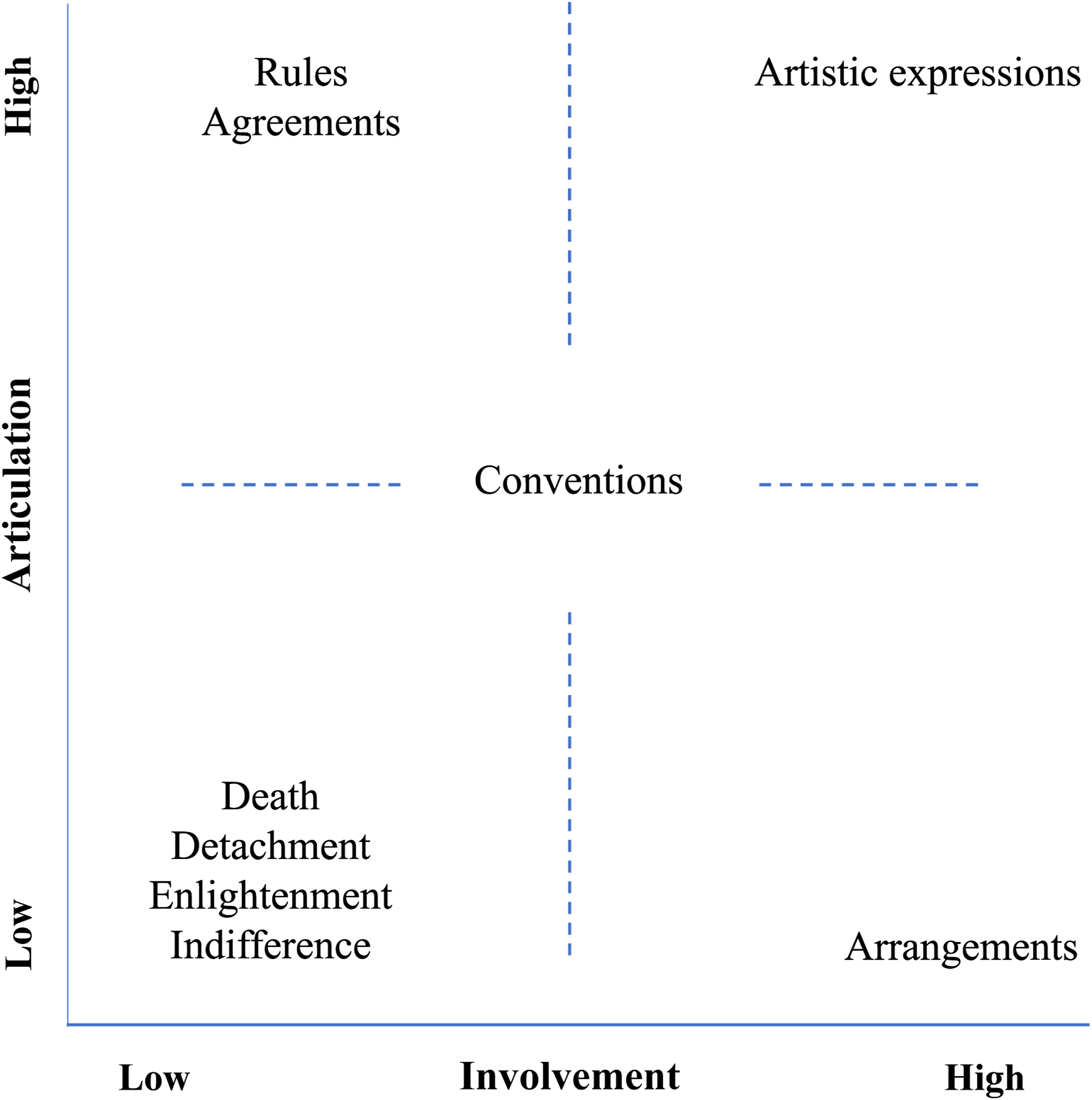
Unraveling arrangements
Fleshing out relevant social arrangements empirically is best done by adopting a phenomenological and participatory approach. Arrangements are taken-for-granted and do not immediately reveal themselves by direct questioning. The “taken-for-grantedness” of arrangements is not to be understood in a cognitivist sense, as unconscious, internalized mental frames that trigger behavioral output. Although unarticulated arrangements are observable through embodied practice, it is these social arrangements that are often unaccounted for in current debates about intimacy, sexual harassment on the work floor, racism, glass ceilings, and gender inequality more general. Men in an old boys’ network of executives may subscribe to their corporate values of diversity and inclusion yet feel out of element in their own embodied dealings with an ambitious woman that takes position in their board. An indigenously Dutch human resource employee might shun any idea of being racist yet during a job interview with a first-generation African immigrant he or she may be unaware of split-second embodied interactions that leave both interviewer and applicant with an awkward feeling afterwards. From childhood onward, their sensoria are attuned differently, the firmness of a handshake, direction of gaze, or duration of eye contact. The applicant may have acumen for the job, but unsmooth interaction with the interviewer may nonetheless result in the unjust rejection of his or her application.
For M&O practitioners to reveal—and possibly change—these social arrangements, in which the most tenacious behaviors are generated, relevant to the least understood change failures, they need to take part in local organizational practices. In their book, Voestermans and Verheggen only state that: “It takes a trained eye to notice how everything is arranged and how it keeps people in place” (2013, p. 99). It is here that we appropriate “The Bricoleur Model of Psychological Practice” (Smedslund, 2012)—which we employed ourselves—admittedly without being aware of the term at the time (e.g., Graamans et al., 2019a, 2019b). This bricoleur approach, as we practice it, integrates sound qualitative research skills, a base attitude of suspended judgment, informal conversation, best available scientific evidence, and exploring the ongoing and mutual attunement between researcher and research participant (see also Smedslund & Ross, 2014). We emphasize the importance of participant observation of forms of art, humor, informal storytelling, or other creative expressions that might hint at underlying social arrangements. Parker’s (2006) article titled “The Counter Culture of Organisation,” for instance, provides some interesting leads of which comical artifacts to look for as units of analysis.
The next step in this article is to expand in more detail upon what kind of management levers—as well as insurmountable barriers—can be revealed by conducting analyses along the ACA framework.
Alternative approach to culture change
In this article, an approach is presented to address issues that in M&O would often fall under the banner of culture (see Figure 2). First, when an issue is raised in terms of culture, the way the notion itself is deployed needs to be evaluated. This is, in effect, a discursive psychological exercise (Potter & Whetherell, 1987, 1995; Willig, 2008). If culture is misused as a metaphor, label, or excuse, this proximate issue itself needs to be addressed instead of calling for a culture audit that could carry the risk of falling prey to an unnecessary culture intervention. There are, however, also instances where the term is used to indicate that certain behavioral dynamics are not properly understood (see also Alvesson, 2013a). These nonspecific dynamics or patterns are then tentatively hypothesized (not hypostatized) as to lie at the core of the problem or solution. Construed as such the term can be understood as an invite for closer empirical examination. Intervention repertoire for organizational culture change.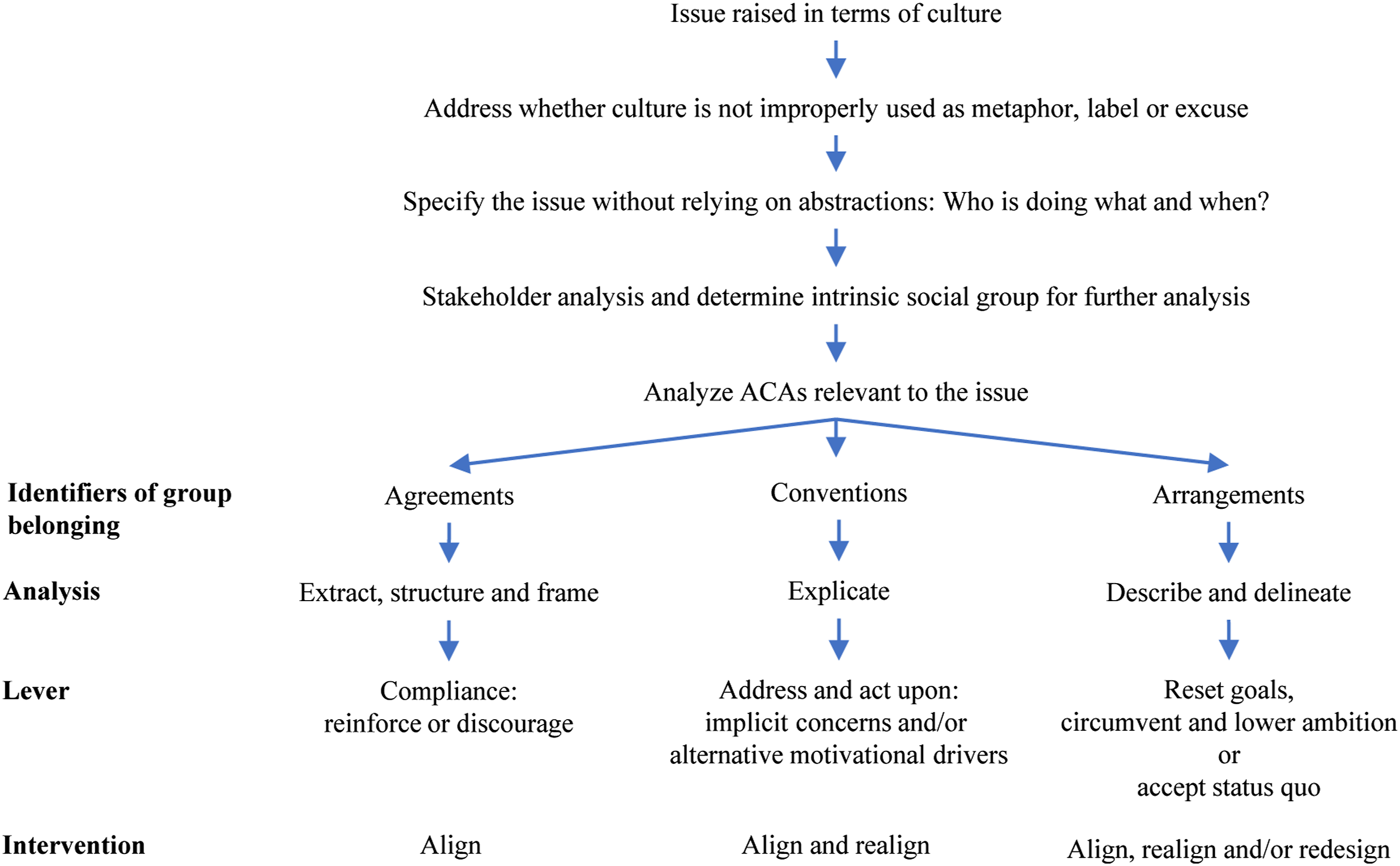
In clarifying the issue—which can be a dysfunctional pattern or an organizational objective—on which further analysis will be centered, it is recommended to use action language instead of reified language (e.g., Billig, 2013; Schafer, 1976). So instead of talking about “sharing,” “embracing,” “adopting,” and “internalizing” values or “implementing” cultures, we recommend to specify who is doing what and get a clear idea and strong feel about the stakes involved. The focus can lie on teams, departments, organizations, sectors, or communities, as long as its members are party to sets of ACAs and as long as they derive at least some sense of belonging from being part of that group.
By investigating behavioral dynamics along the lines of the ACA framework, inconsistencies on the level of agreements might be revealed, that can be solved relatively easily. Relevant agreements can be extracted by conducting desk research on board minutes, strategic policy plans, job descriptions, and other organizational data. If innovative behaviors are desired, then these behaviors need to be facilitated and rewarded accordingly. So, if this is not yet the case, an effective intervention would be to put a reward system in place that is in alignment with the intended organizational objective. Of course, this is not groundbreaking and can be done—preferably so—without positing “innovation culture” into the explanatory mix. However, as all managers are aware, it is not always that simple and straightforward. In these more complex cases, it is tempting to resort to activating more rules and policies and persuading employees with watertight arguments. These are legitimate management levers but oftentimes complicate things even further. People can be committed to distinct ways of minding their business, whatever the rules imposed upon them or whatever the agreements they have formally agreed upon. In these cases, conducting analyses along the dimensions of articulation and involvement by means of the ACA framework will likely reveal a paradox between the formally agreed upon rules and the more implicit conventions on the basis of which members of a team, department, or organization conduct themselves. These underlying conventions need to be explicated and skillfully addressed. Creatively searching for win-win solutions and realignment of agreements and conventions is then the preferred way of intervening.
But sometimes, despite all well-intended effort, change is just not happening. Some group practices really are so tenacious that any attempt to change or manage those practices in even the slightest way—especially if initiated by those perceived as outsiders—has no effect or an opposite effect. The latter can mean a further strengthening of the practice. The practice is made salient by labeling it as “dysfunctional” or “harmful.” If an outsider—a consultant, an interim manager, or a newly appointed top manager—pushes for change too hard, these labels become matters of group identity, badges of honor, so to speak. This is likely to occur in tightly knit groups or communities whose members have shaped their behavior on the basis of arrangements which involve them “to the bone,” that is, are highly embodied. It is not that these arrangements are completely unchangeable, but the uncomfortable message is that M&O practitioners here are working at the limits of changeability, and they might become target of repercussion if they push too hard. This is an uncomfortable prediction but can help practitioners to pause and adjust, by resetting goals previously set, or by lowering ambitions, or in some cases by accepting the loss entirely.
Of course, there are issues where the rationale for change is so convincing and the consequences of accepting the status quo so severe that it is morally or ethically unacceptable to stop exploring opportunities for change. A good example is related to a field study conducted by the first author with social relevance beyond the narrower scope of M&O. A multidisciplinary study was conducted on ways of encouraging people to abandon the practice of girl circumcision. The cultural psychological approach advocated in this article was adopted to organize the different analyses (Graamans et al., 2019a, 2019b). The rationale for change was undisputed; the cultural practice of girl circumcision is harmful and constitutes a violation of human rights. It is clear that although this cultural practice is part of complex sets of ACAs, something needs to be done to save young girls from getting cut on their private parts. Especially in these very complex cases surrounding harmful, culturally embedded practices, a thorough assessment with the help of a framework that allows for the detailed mapping of different perspectives from a variety of people within and around the community is warranted. Any lever of change revealed as a result of such analyses can, when pulled, expected to be connected to a whole range of related issues. Had we only relied on aggregate outcomes—such as the effect of an intervention on attitudes, as measured, toward “female genital mutilation” (FGM)—we would not have captured, for instance, how people can speak out against FGM yet still cut their daughters, and vice versa. We needed to stay as close to the phenomenon as possible, as change unfolds in ambiguous ways (Wagoner, 2009). Although this study was conducted on a health issue beyond the direct influence of any single organization, the implications are also relevant for M&O. If people shape their behavior on the basis of arrangements and managers choose to push for change, they are well advised to be ready to act upon a whole range of related issues. If they are not, a deadlock can occur and the change initiative is likely to fail. This was the case, as mentioned earlier, when hospital management tried to make cardiothoracic surgeons operate with surgical suture from a different supplier (Graamans et al., 2020).
If after careful analysis changing ingrained patterns is still the objective, leaders are advised not to “play boss” but rather to courageously join in to experiment with alternative shapes of behavior (Bar-Yoseph Levine, 2008). Similar to Verheggen (2005), Clemmens (2012) uses the analogy of a dance—“a mutually embodied interactive dance” (p. 41)—and describes four skills needed within the therapist–client dyad that, we propose, might guide culture change (see also Lichtenberg, 2008). These skills are named embodiment, that is, being present in the here and now, attunement, that is, reaching out in a mutual exchange, resonance, that is, sensing what attunement does with one’s own embodiment, and finally articulation, that is, mutually reflecting on subtle shifts and changes, and exploring the possibility for alternative, more soothing experiences. Evidently, these experimentations need an inbuilt flexibility—“playfulness” here might be an improper term considering the seriousness of issues at stake in some of our case studies—to facilitate change and to establish more suitable patterns. All the above is not a standard part of the curriculum in our business schools. So for M&O practitioners applying these ideas might run counter to what they have learned to be sound managerial practice and thus requires an exercise in flip-thinking to be able to facilitate this kind of change in a truly bottom-up fashion.
Conclusion
In this article, a cultural psychological frame is proposed to address issues that go under the banner of organizational culture. Such an approach, we contend, is highly needed because it enables M&O scholars and practitioners alike to dissect behavioral patterns within a given professional group and facilitate change in a less propositional and more experiential manner. An added benefit is that this framework allows for the integration of different methods depending on the thoroughness required to solve the issue. For our own empirical endeavors, for example, we employed discourse analytical methods to make sense of the ambivalent and ambiguous ways people speak. We note here, that despite our critique on overly relying on abstractions in the pursuit of understanding recurrent patterns of behavior as they arise between people, we do not disregard the importance of concepts and abstract notions, and “languaging” (Maturana & Varela, 1998, p. 234) as an embodied, expressive practice. We also drew inspiration from principles of Gestalt that can be put to practice beyond the therapeutic dyad (e.g., Bar-Yoseph Levine, 2012). In this article, we have not succumbed to the false promise of “seven-steps-for-successful-culture-change.” There are no quick fixes. We invite those in the field of M&O and beyond, to answer upon the neglected call to come up with additional, innovative ways to study and act upon what happens between people (Buber, 1947/2002; Homans, 1964); in more complex organizations, and at different levels of application, that is, micro, meso, and macro. In doing so, we recommend to shun both managerial jargon and academese so that all we do as practitioners and scholars will be easily explicable to and resonate with the people concerned. We contend that from such analyses management levers will emerge that can do justice to the experiential aspect of culture change management. We make, again, an urgent call to adopt a more holistic approach to the management of people instead of positing culture as something to be implemented. The latter has continuously proved to be setting the stage for failure.
Footnotes
Declaration of Conflicting Interests
The author(s) declared no potential conflicts of interest with respect to the research, authorship, and/or publication of this article.
Funding
The author(s) received no financial support for the research, authorship, and/or publication of this article.
