



Abstract
In this article, we suggest that our semiotic understanding of embodiment could be expanded to include a socially exalted individual, who embodies a symbol. To illustrate this argument, we draw on an ongoing research project that examines fandom rhetoric and debates around the ‘Greatest of all time’ or the GOAT symbol in Tennis. Grounding Bakhtin’s tri-distinctions of identity, I-for-myself, I-for-other and other-for-me, in a Kantian hermeneutic tradition, we perform a theoretically informed analysis of the GOAT debate. None of the three tri-components exists in isolation; rather, they interact in a reflexive dialogue which continually shapes and re-shapes individual consciousness and experiences of embodiment. We apply a ‘romanticism aesthetic activity’ analytical framework to the tri-distinctions of identity, that consists of ‘creative’ and ‘critical’ rhetoric, within which we found genres of ‘myth’, ‘art’ and ‘science’. Each genre functions through disparate means to exalt or metamorphise an individual (our focus is on Roger Federer) into a cultural symbol, and that the symbolic form of GOAT reflexively organises the emotional field and identities for those fans deeply invested in it. This article contributes to the current cultural psychological literature on understanding the mediation of people to symbols in a new digital age.
Introduction
Language is the substrata of Bakhtinian philosophy concerning identity, culture, and society. It is, therefore, also the crux of his mediations on self-consciousness, social interaction, and cultural formation. Bakhtin’s (1981, 1984, 1990) work has been particularly influential in connecting the body to the symbol at various levels of dialogue: the word and connotation level (Creswell and Sullivan, 2020), perspective adaptation as a cultural activity in the dialogical self (Gillespie & Cornish, 2010; Hermans, 2001), emotional microdialogues (Burkitt, 2014; Sullivan, 2012), and cultural-historical genres (Barat et al., 2013; Markova & Novaes, 2020; Salgado & Clegg, 2011; Sullivan, 2012). Although Bakhtin advocates flexibility in the definition of ‘genre,’ he argues that genres are not limited to understanding artistic forms of literary texts. Rather, genres within utterances carry the potential to disclose human experience. Here, genres are understood as refining our understanding of different realms of experience by underscoring individual relationships with a particular event, time, and space (Bakhtin, 1984, 1986). In the case of this paper, Roger Federer (Federer) and his fandom in cyberspace.
Moreover, the interface between body and semiotics has received much attention in cultural psychology because it opens a window to lived cultural experience. We know, for example, that foundational metaphors, are organised by the body (Johnson, 2008; Lakoff & Johnson, 1980), and its orientation in space. We also know that signs are akin to body skin (Nedergaard, 2016), which unite biology and culture and contain sensor information in flux. Finally, we know that signs are resources for affecting the mind (Gillespie & Zittoun, 2010), as opposed to tools, and can even resurrect the presence of absent Other, which Leiman (2002) refers to as ‘epiphanic’ signs. Our argument in this article is two-fold. Firstly, we argue that, in fandom rhetoric, the reciprocal intersubjectivity between the self and other holds the potential of metamorphising the other into an epiphanic symbolic form, specifically that of the GOAT (Greatest of All Time). Secondly, as we delineate below, this not only offers an alternative embodiment focused perspective of the ‘dialogical self’ (Hermans, 2001, 2002), but also illustrates a key epistemological distinction Bakhtin makes between abstract and lived truth. That, in itself, is relatively inconsequential, if not for the point that it suggests another level of dialogical analysis of the body and sign: that of the incarnated symbolic form. For instance, scholarship tends to view dialogical interactions in terms of levels of analysis for everyday experience: between micro, meso and macro (Cornish, 2020; Gillespie & Cornish, 2010), or the shifting dynamics between the self (ego), other (alter), and object (Markova, 2003). There is relatively little in cultural psychology, however, on individuals who become a cultural symbol. The life adventures of some individuals define the vague, abstract meaning of the symbol. For example, Christ and ‘love’, Socrates and ‘wisdom’ (Bakhtin, 1984), and in our case, Federer as GOAT. As the analysis reveals, although fans often quibble about the precise contours of the meaning of GOAT, the noteworthy point, is that a particular individual contains the metamorphic potential to be a ‘demon or divine’ and embody a concept such as ‘evil or good’. Furthermore, our analysis also reveals the reciprocal relationship between Federer and his fans as an aesthetic and ethical relationship. It is not only Federer’s experience of embodiment that is re-shaped through fan rhetoric but Federer, on and off the court, also functions as an idol. An idol gives them hope, and whose tennis is akin to a divine experience, hence, our choice to focus on Federer. Our analysis discloses a generic phenomenon unique to Federer fandom: religion and artistry, which distinguishes him from his competitors. The roots of this phenomenon, arguably, stem from an article by Foster Wallace, a self-proclaimed Federer fan, (2006) entitled Roger Federer as Religious Experience. Wallace’s (2006) writing style moves away from journalistic reporting, or the genre of science, towards a genre of poetics. Wallace’s piece was the first to liken Federer, his style of tennis, and the beauty of his movement on-court to a religious experience. It is not only noteworthy because Federer was the first sports personality to evoke such responses within tennis, but also that this poetic genre, and its association with Federer in fan rhetoric has only strengthened over time.
Bakhtin and hermeneutics: Tri-part dialogical self, abstract lived experience and the symbolic form
We see the shift of Bakhtin’s meditations on the self-other emerge in his early works on architectonic and aesthetics (Bakhtin, 1981, 1990), which has a distinctly Kantian flavour. While Kant draws attention to the extratemporal conditions of understanding in a priori structures of time and space, Bakhtin sees understanding as aesthetic and ethical (Nielsen, 2002) and grounded in the particularity of time and space, or what he calls ‘chronotope’. For instance, he draws attention to the distinction between truth as abstract (Istina) a la Kant and truth as lived (Pravda) in culture. ‘Pravda’ originated from Russian concepts of ‘right’ or ‘just’, more importantly, the term is utilised when referring to the conditional mode of ‘someone’s truth’, or ‘true to someone’ (Falla et al., 1995). Additionally, Istina refers to genuine truth, the cognisant recognition or perception of what exists objectively. Bakhtin, however, uses istina to refer to what is a priori or theoretically true, therefore, denying the independent or objective existence of istina. In this sense, istina does not attain dana (becomes an objective truth) and is always posited zadana (exists as a subject truth) within the mindful judgement, or act of the subject (Bakhtin, 1990). Consequently, since a single act, or judgement, of a truth essentially constitutes a truth (for someone), making the truth pravda, it follows that istina is necessarily posited in pravda. Bakhtin (1990) maintains that abstract knowledge has an ‘autonomous truth [istina]’, of which validity is ‘sufficient unto itself, absolute, and eternal’. In other words, the truth of abstract knowledge is a priori; based on experience, a truth that required no evidence (Bakhtin, 1990, pp. 49, 10). However, as a priori truth is ideal and extratemporal, it does not exist within itself. Hence, it requires to be cognised by a subject for it to exist. Subsequently, although a priori (x) is valid independently of the ‘I think, or act’, it is brought into existence by the subject through their formation of the ‘I think, or act’. Intrinsically, Bakhtin (1990) continues, the ‘I think, or act’ embodies the truth as istina (because x has a priori validity) for the subject as pravda (because of a particular act). Our analysis below of the romantic aesthetic activity between Federer and his fans, which exalts him to GOAThood is an example of a priori (a truth for his fans).
For example, in his later work on Dostoevsky , Bakhtin (1984) gives the mythological examples of Christ who embodies ‘the word of God’, and is ‘the word made flesh’. Similarly, Socrates, who tests abstract truths against experiential truths in the Socratic method, himself becomes the embodiment of philosophical inquiry through the Socratic method. Bakhtin’s concern with aesthetics and authorship leads him to a view of the body whereby it is musculo-skeletal structure is ‘given value’ (or not) by others in different perspectival arrangements: I-for-other (e.g. being granted the value of awesome by the other) and other-for-me (e.g. considering the other to be awesome), which he calls soul and I-for-myself (e.g. being a mystery to myself), which he calls spirit (Bakhtin, 1990; Markova & Novaes, 2020; Sullivan & McCarthy, 2005).
Consciousness itself is given birth in the realm of heavily intoned affective language and we come to know our own body through its relationship with others. This tri-partite division of self-complements the multitude of positions that are available in the ‘dialogical self’ (Hermans 2001, 2002). For any one of a multitude of social ‘positions’ the self can adopt as a priori truth (istina), there is the potential for three different value-laded perspectives on the meaning of that position simultaneously in dialogue with one another (pravda): the presentation of self to others (I-for-others); the imagined and actual response of others from their position (others-for-me) and the unknown aspects of the position one seeks to understand (I-for-myself). The self’s relationship to the other is a relationship to a whole not only exemplifies the other as cognitive form, personifying meaning, but also as concrete actuality. The whole of the other, therefore, exists on the boundary between the other as form and the other as living event.
This is a relationship of knowing where it is possible to enter an authorial relationship with the Other where that Other is creatively ‘vivified’ or bestowed a form; a ‘soul’ in Bakhtin’s words (Klinger, 2008; Sullivan, 2007), and these various forms of generic relationships are what lie at the nucleus of aesthetic activity. This bestowal of form is what Badshaw (2016) refers to as ‘divine grace’. Divine grace does not hold religious connotations, here. Rather, it indicates the aesthetic recognition (grace), which is bestowed upon the other-for-me by external sources (divine). As touched on earlier, this power of transformation is profoundly intersubjective and dyadic while in his later work (Bakhtin, 1981, 1984) he concentrates on the power of metamorphosis to reveal the ‘laughing side’ of sacred cultural symbols, such as the transformations of religious figures into figures of fun in carnival. In both cases the metamorphic potential of the other-for-me is available as a unique Other in a particular time and space, and a more abstract Other that can be collectively re-created through iconic imagery. In doing so, the other becomes a culturally available epiphanic sign (Leiman, 2002) whose presence is definitional of the meaning of a cultural concept and what they do in their life has the potential to change understanding of that cultural symbol. As Markova and Novaes (2020) point out, the self is bifurcated between its indivisible corporeal presence and its re-creation in the eyes of the other. In this re-creation, however, the other-for-me can be dialogically created and contested in the public sphere. The other may not be known personally but their particularity (Pravda) interweaves with a generality (istina) such that they become a means of knowing a cultural concept, such as greatness, greed, evil and so on, because they embody and symbolise that concept.
The inspiration for this magic realism is probably gained from Cassirer’s Philosophy of Symbolic Forms (cited once by Bakhtin but as Poole (1998) comments, a significant influence). Bakhtin develops Cassirer’s ‘symbolic form’ by explicitly fusing it with theories of knowing, or epistemology. Symbolic Forms, Cassirer (1953) writes, derive from collective acts of social understandings. Cassirer argues that the most primitive symbolic form, ‘myth’ dialectically leads to higher symbolic forms such as ‘science’ and ‘art’. In myth, what he calls the ‘expressive’, emotional, function is supreme. The symbol does not simply represent the ‘thing’, but in fact ‘is’ the ‘thing’ (Cassirer, 1953, p. 38, original emphasis). These symbolic forms captivate imagination, and are dependent on outside forces such as deities, demons and other authoritative agents. For example, when the image of a God or words of God is itself considered to be a manifestation of God (see Gell, 1998). Lyric poetry, chants, images all evoke emotion, participation and awe.
Bakhtin cultivates Cassirer’s symbolic form in two aspects. Firstly, by drawing attention to its relationship with a dialogical ‘truth’, where abstract symbolic forms can become an embodied lived experience, as outlined above. Secondly, it also ingrains the symbolic form with ‘romanticism’ aesthetic activity. In contrast to genres of art and science, which can be interpreted as dichotomous, this is a form-giving aesthetic that is alternatively loving, creative and critical. Reed (2014) argues that concepts of romanticism are ‘not contradictory alternatives but complementary ones’ (Reed, 2014, p. 08). He hinges this on Bakhtin’s (1981) writings on cultural phenomenon and his argument that ideological content of cultural utterances. All utterances, for instance, participate in the ‘unitary language’ of a social group or given genre: It is possible to give a concrete and detailed analysis of any utterance, once having exposed it as a contradiction-ridden, tension filled unity of two embattled tendencies in the life of language (Bakhtin, 1981, p. 272).
Romanticism, Reed (2014) continues contradicts itself. Although, romantic imagination entails the genres of creative and sublime, it also coincided with genres of rationality and doubt. Their distinct modes give rise to two forms of aesthetic activity: the ‘creative’, where rhetoric is endowed with the power of generating myths and symbolic forms, and the ‘critical’, replete with irony and doubt. ‘Romanticism’ aesthetic activity, therefore, can be defined as following the same theoretical principles of Bakhtin’s (1990) author-hero aesthetic activity, but with addition of ‘creative’ and ‘critical’ modes of rhetoric, which endow utterances with dialogic texture and tension (Reed, 2014). Bakhtinian ‘romanticism’ aesthetic activity is framed around genres of art, myth, religion (creative aesthetics), science and doubt (critical aesthetics). Moreover, the mythological, artistic, religious and scientific inter-relate and adjust to the everyday life adventures of the individual, realised in intense cultural commentary in the online public sphere. Through applying ‘romanticism’ aesthetic activity, our analysis reveals how a similar dialogical phenomenon is apparent in fan rhetoric.
Our brief tour through Bakhtin’s neo-Kantian theory of self-other dialogue sensitises us to the importance of creative understanding in a cultural context – helpfully broken down further as a mythological, scientific and artistic context. Our research question is how does cultural exaltation of an individual emerge from ‘Romanticism’ aesthetic activity? Specifically how Federer as the GOAT, is the Pravda for his fans, and their online rhetoric invokes the others-for-me’s corresponding counter part of ‘soul’ (I-for-other), and this is illustrated by Federer’s, subtle yet significant, response to fan rhetoric, particularly as he approaches retirement. However, as mentioned above, the relationship between Federer and his fans is reciprocal.
Therefore, during our analysis we explore: (1) how Romantic aesthetic genres within fan rhetoric initiate transcendental imagery through ‘creative aesthetics’, with a particular focus on myth and art; (2) how ‘critical aesthetic’ rhetoric generates genres of science and doubt and (3) the reciprocal and shifting nature of the Other, initially it is Federer and then his fans. Before addressing this interplay, we will first outline some methodological details of our illustrative dataset in what is a top-down, theoretical analysis.
Data collection
There are two types of data we chose to examine in this project. The first type was comments about Federer after he won his three most recent Grand Slams titles: the Australian Open for his 18th Grand Slam in 2017, beating his greatest rival, Rafael Nadal); Wimbledon for his 19th Grand Slam in 2017; the Australian Open for his 20th Grand Slam in 2018. In all three cases, what is at stake over this 13-month period is who truly embodies the GOAT (Greatest of all time). Here the other, that is the Tennis Player, is re-incarnated as a GOAT in fan sites (with images of an actual goat used next to the player’s name/image) as a sign of their greatness. We conduct an analysis of the top entries of fan responses to Federer specific articles on a major online platform (the official ATP website). Given the notable span of his career, we will be focussing our analysis on the rhetoric generated during the build up to, and considering, Federer’s most recent aforementioned professional achievements. As online fan boards can accumulate several hundred comments, for a manageable dataset we opted to analyse the top 100 comments from each online fan board after the final of each GS, respectively. With the rise of new media platforms such as Twitter, Youtube and Instagram, which offer instant and direct accessibility to a worldwide audience, much has been written around the utilisation of said platforms by athletes to address their fan base (Smith & Sanderson, 2015). There is, however, little research on how fan bases use said media platforms. Considering the scope of the research, we thought it important to also consider the reaction and responses of the addresses, specifically on Twitter. For consistency we collected tweets with the following hashtag: #Federer18, #Federer19 and #Federer20 and analyses the top 20 Tweets. Finally, we analyse YouTube tribute videos for Federer, created by fans, after his three GS wins. To explore the tension within fandoms, we also examine fan rhetoric from apposing fandoms, which contain critical aesthetics, with particular focus on genres of doubt and scientific rationality. Namely those of Rafael Nadal and Novak Djokovic, who at the time of writing this paper, are the other contenders for the GOAT accolade.
Previously, we also explained that, for Bakhtin (1990) a priori (Federer as GOAT) cannot exist in a vacuum, it requires to be cognised for itself by the subject (Federer). Our second type of data, therefore, will be Federer’s interview transcripts while accepting his 20th grand slam title, and his recent refusal to play during the pandemic due to limited fan numbers inside stadiums.
Data analysis
Considering that our project appropriates a genre as a linguistic form-shaping-idea, when it becomes embodied in dialogue, we locate the central creative and critical aesthetics emerging from fan rhetoric activity online. More specifically, we examined how the construction of each comment is dependent on either genre such as science and doubt for critical aesthetics (statistics, game analysis and time), and genres such as myth and poetics for creative aesthetics (supplicating, revering, congratulating and beauty). Moreover, we analysed whom the utterances of the posts addressed (Federer himself, other fan bases and fellow fans). To illustrate the reciprocal dialogical relationship between Federer and his fandom, in his post-win acceptance speeches, we examine his direct reference to his fans and their direct impact on his activities.
Furthermore, we chose to use Sullivan’s (2012) method of illustrative ‘soundbites’ from the data. This is because many of the ‘comments’ were short, terse comments and, soundbites refer to small-scale unusual ‘forms of expression’, which give discourse a ‘textured feeling of heaviness and lightness and colour as discourse becomes lived experiences’ (Clark and Holuquist, 1984, p. 10). More importantly, it aligns with this dialogical theoretical framework applied in this project. For example, the identified soundbites, which will encompass a particular viewpoint and genre, can be considered as a dialogical interaction between fans and Federer (Sullivan, 2012), which can disclose how the ‘participants’ involved within fandom rhetoric can anticipate opposing fandom’s judgements and address them. Moreover, Sullivan (2012) suggests that presenting these as a ‘table of dialogue’ is a useful way of including multiple voices in a dialogical analysis. In doing so, we also move beyond surface-level analysis to understand the context in which certain words frequently appear. We simultaneously map the emerging genres against dimensions of the tri-part dialogical self. Once a particular genre and soundbite has been identified, for instance, we then focused on the romantic aesthetic activity within the dataset, considering how fans constructed descriptions, produced accounts of pivotal events (grand slam), and generally managed their interest in Federer and/or tennis. Finally, we identified reoccurring patterns in fan rhetoric, which not only constructed a mythical consciousness for Federer’s fandom, through creative and critical aesthetic activity, but also exalted Federer to a symbolic form. We take the same approach to Federer’s acceptance speeches.
Ethics
Our project received ethical approval from the University of Bradford. For the purposes of this project, our ethics also complied with the latest guidance from the BPS for Internet-Mediated Research (2018). For instance, although sensitive data is not being utilised, for anonymity and confidentiality, all usernames have been replaced with numbers.
Analysis
Creative aesthetics and myth
Soundbites, fan forums post-Australian Open win 2017 and Wimbledon win 2017.
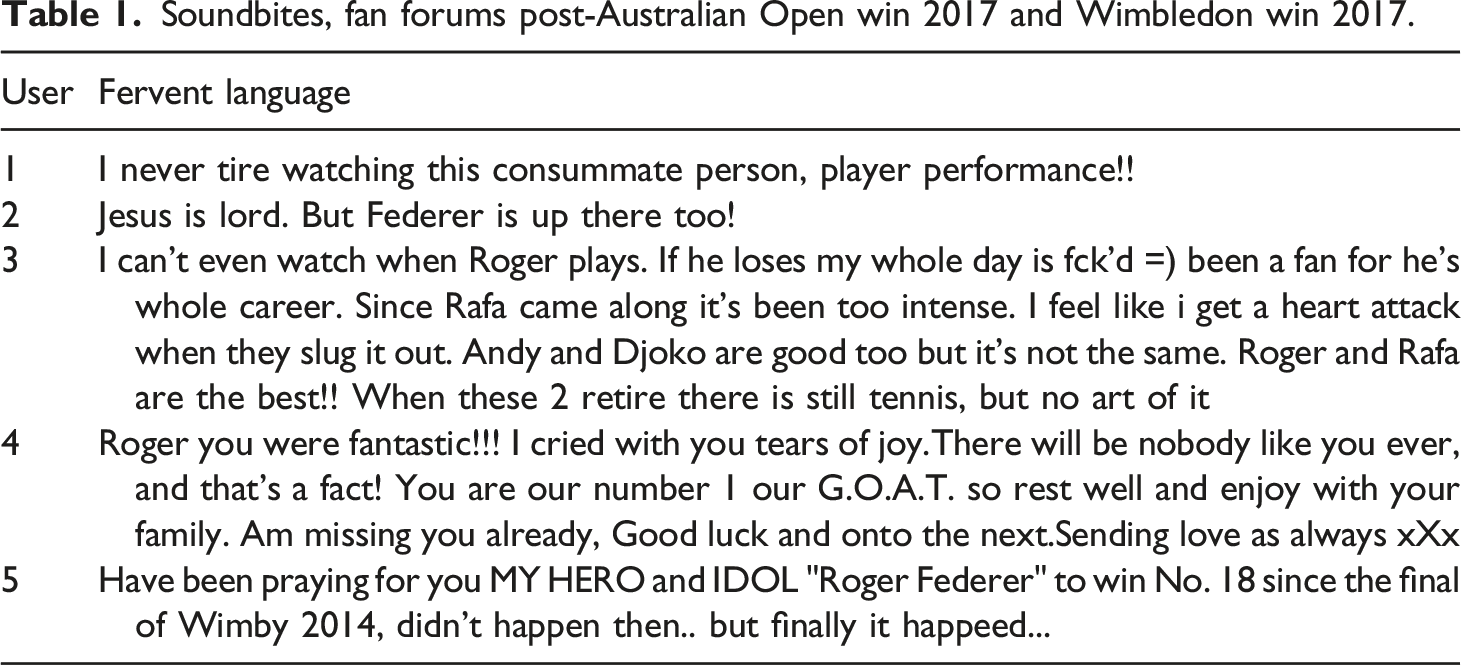
It inspires awe in the immediacy of the moment. In this regard, myth and art articulate a ‘categorical truth’ (Bayer, 2006). This categorical truth, akin to Bakhtin’s a priori, is a transgression of musculo-skeletal structural boundaries and the rejuvenation of Federer as GOAT. This absoluteness encompasses ‘meanings and stylistic combinations of language’, which spur the development of mythical images (Bakhtin, 1981, p. 369). This is a reoccurring pattern in fan rhetorical activity, as we noted similar language 7 months later when Federer won his eighth Wimbledon title (Table 1).
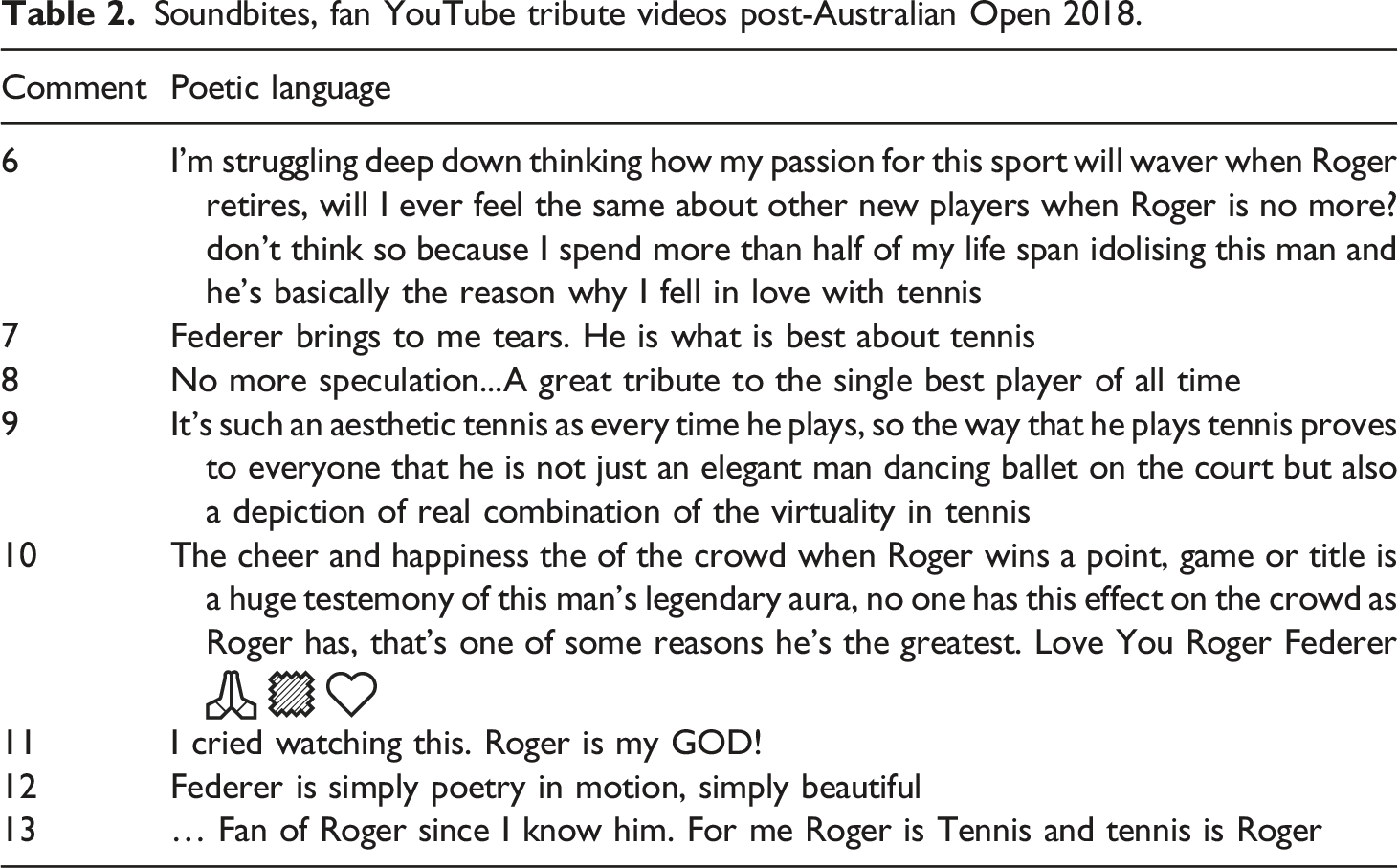
More widely, in both cases, the language becomes both fervent and poetic:
For example, prayer to God that Federer will win; the emotional intensity of feeling a ‘heart attack’ coming on and having their whole day ‘fck’d’ if he loses (comment 3), crying ‘tears of joy’ and never tiring from watching him play (comment 5). Such soundbites, through modes of creative aesthetics, resonate poetic language, which Bakhtin identifies as ‘language of the Gods’ (Bakhtin, 1981, p. 287). Fans not only pray to God for Federer, but for many, Federer is ‘God’. He is a ‘hero’, an ‘idol’, ‘up there’ with Jesus’ (comment 2). The other-for-me (Federer) has metamorphosised from a regular human being to something much greater – a GOAT; as is the case with poetic language (1981), through which the ‘hero’ is given distance from normal human experience.
Soundbites, fan YouTube tribute videos post-Australian Open 2018.
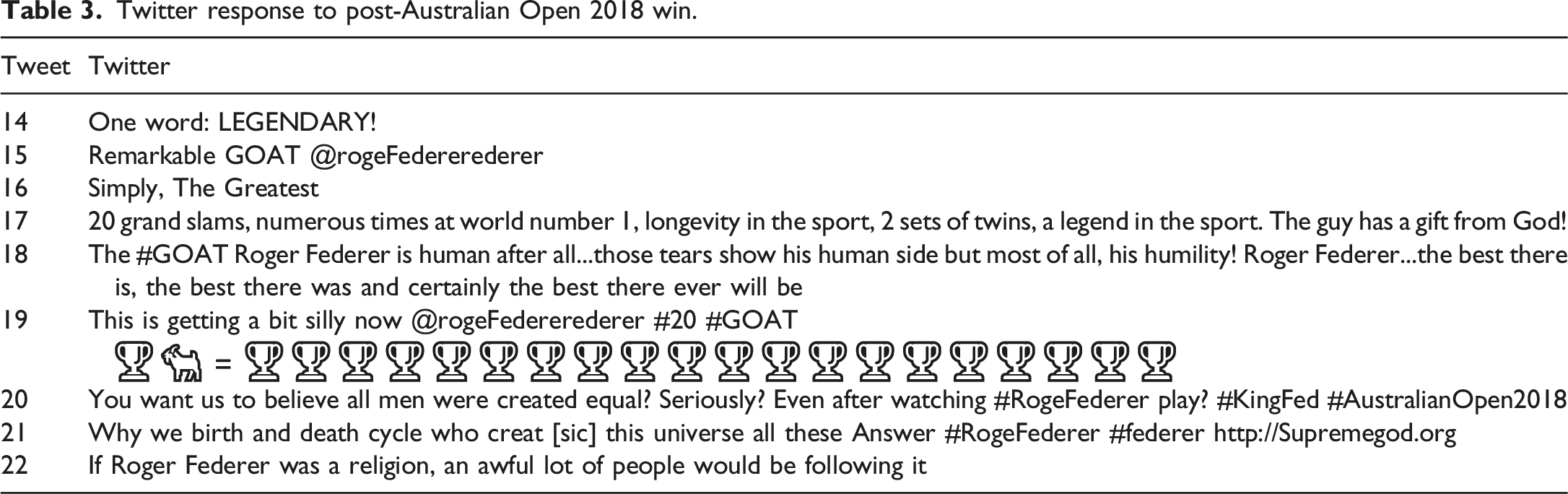
Twitter response to post-Australian Open 2018 win.
Federer comments regarding his fan base.
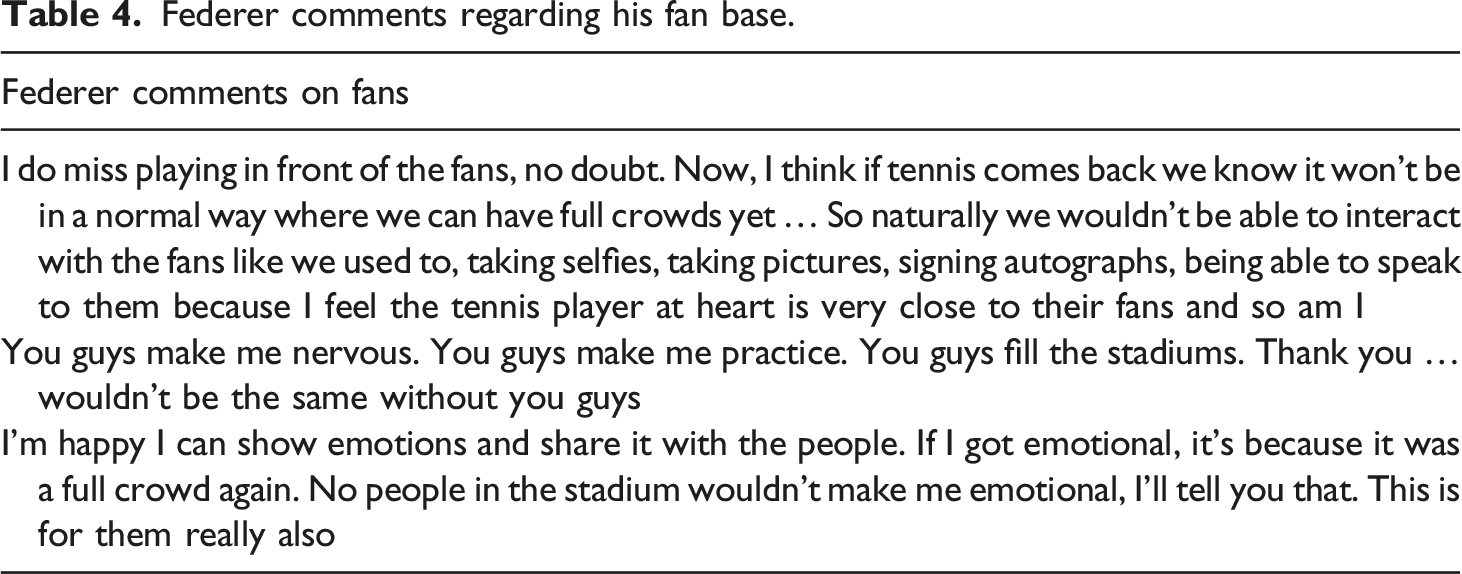
Moreover, drawing on Kant, Cassirer (1953, 1955) notes that the categories of space, time, substance, and causality are distinctive in myth, and suggests that because there is no essential difference between the substance and its representation (Federer and his image), and the part contains the whole which is held together by the emotional complexity of events and ‘fellow-feelings’. Within this dialogical ‘matrix’, Federer’s performance has an indicative, causal impact on the emotional well-being of the fan (here fans are the Other). Simultaneously, the fans’ emotional incantations (prayer) can have a causal influence on his performance (here Federer is the Other). Bakhtin’s tri-part dialogicality is rooted in reciprocity. The I-for-other, for instance, is not only organised as adoring, enthralled by Federer’s ‘greatness’, but are part of a larger ‘chorus’ of praise. They develop a sense of ‘fellow-feeling’, maintaining that through religionistic type rituals, their prayers attain validity, and can possibly be able to influence Federer’s career.
Twitter responses (see Table 3) are a more explicit example of not only the metamorphic nature of the other-for-me in cyberspace, in this instance Federer, who is simply referred to in his symbolic form (the virtual body of a goat), but also the genre of religion. As Bakhtin notes, ‘… the body as value can be located only on the ethical plane, on the aesthetic plane, and to some extent on the religious plane’ (1990, p. 47). Moving away from traditional theology, this section has illustrated how fan poetical rhetorical, with in a creative aesthetic paradigm, initiates an alternative form of religious experience that only Federer can offer. Due to ‘fellow-feelings’, this form is one of ‘inwardness’ and what Reed (2014) labels ‘religion of the heart’ (Reed, 2014, p. 14).
In the analysis above, by analysing the poetic genre through creative aesthetic activity, we have not only outlined how the I-for-other (Federer) begins to emerge as an embodiment of GOAT, but also the mythical religious experience, experienced by fans. Essentially, Federer is positioned as I-for-other because he gives them ‘hope’, is ‘inspiration’, and regardless of the number of GS he attains, he will be their ‘favorite … for life’. For Bakhtin (1981) poetic language is unitary, inflexible and assigns meaning without compromise.
However, Bakhtin’s (1984) maintains the importance of ‘syncrisis’ and ‘anacrisis’ in a dialogical aesthetic relationship. The former encapsulates a ‘juxtaposition of various points of view’, while the latter is defined as ‘the provocation of the word by the word’ (Bakhtin, 1984, p. 110–111), and both are foundational for critical romantic aesthetics activity (Reed, 2014). In context of our project, they shift fan interaction from monolithic poetic rhetoric, and mobilise it towards polyphony, where different points of view to draw out the perspective of the other-for-me. Below, the other-for-me is represented by Federer’s fan base and the fan bases of his rivals for the GOAT accolade. As explored below, alternative fan bases quibble over who rightly deserves GOAThood, through genres of doubt and science (a la Cassirer).
Critical aesthetics: Having GOAT doubt
Soundbites for time, temporality and a priori.
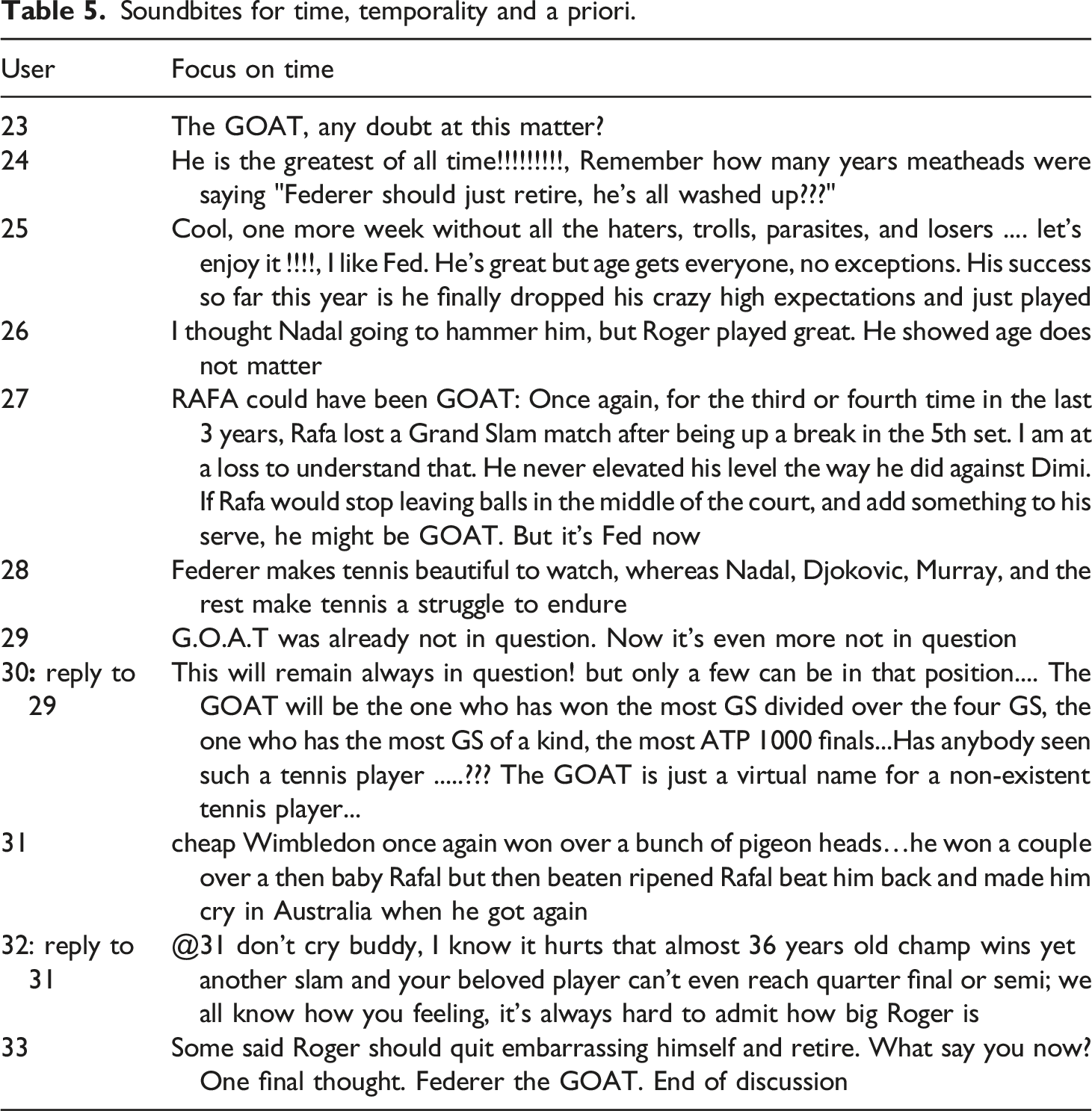
It is the doubt from others, and for some within the Federer fandom, regarding him as GOAT, that displays the critical aesthetic activity, where responses not only shape Federer as GOAT by denigrating his opponents and comparing his talents to theirs, but also idealising his ‘style of playing is timeless’. Federer makes tennis beautiful to watch as opposed to something to endure. In contrast to the chorus of agreement and universal, emotional crowning of Federer as ‘the GOAT’, the presence of ‘meatheads’ who do not agree or who are negative are rounded on after his Grand Slam victory. Comment 24 brings in this negative voice directly: ‘Federer should just retire; he is all washed up’, while comment 33 brings this voice in indirectly … ‘he should quit embarrassing himself and retire’. There is some element of joy that Federer’s victory proves these meatheads wrong. This means that the I-for-other is organised as a keyboard warrior – defending Federer’s rightful place as the embodiment of the GOAT. There is also acceptance of the definitive proof, by his victory. Comment 27 suggests that RAFA could have been the GOAT if he had elevated his level but that now its Federer’s (this was before Nadal’s victory at the French Open).
Throughout our dataset, there is a pervasive concern with age and Federer’s ageing body. This version of the other-for-me is one where biology meets the GOAT symbol, or eternal time meets historical temporality. For instance, despite rival fan bases insistence that Federer’s time is coming to an end, the a priori of Federer as GOAT is maintained as fans deliver advice and strategies available for him to prolong his career. Generally, this takes the form of advising him to take more rest between tournaments and end points faster. In critical aesthetic activity, an interesting relationship develop between a priori, subjectivity, and the symbolic form is disclosed; that of alternative fan bases as an Other. The ‘meatheads’ as a third Other who doubt the myth allow a space for argumentation, emotional revenge (‘What say you now’) and the use of rhetoric to prove them wrong. The GOAT-Federer as other-for-me is more indigent. His metamorphosis, for instance, could reverse and the embodiment of him as the GOAT cease. In eternal time, arguably, this would be the case. In an online historical temporality time–space, however, the I-for-other (Federer fans) become keyboard warriors to draw out what is their a priori (pravda) rather than the categorical truth (istina). In an online ‘duration without end’ time-space, Federer continues to embody the GOAT, even if the doubters are presented as quite stupid, and Federer’s physical body ages. Moreover, the agency to maintain their a priori in cyberspace, allows fans a sense of causality that is no longer only dependent on their ritualistic incantations, as is the case with creative aesthetics. Rather it is also embedded within their critical aesthetics, and on Federer listening to their advice (or someone else’s advice that echoes their advice), which is only possible in cyberspace. In this regard, the future security of Federer in the GOAT form is protected by the agency of fans to maintain their a priori.
In this final section, we focus on science, a pivotal element for the emergence of Cassirer (1955) symbolic form and an essential genre in the Bakhtinian critical aesthetic activity of Federer’s fandom. Science dialectically, according to Cassirer, is opposed to the poetic rhetoric of art and myth. Scientific truth does not vary from culture to culture and seeks to eliminate the subjective and the personal, or the a priori, with its universal truths. Another way of conceptualising this is to say that statistics rule judgements around who is the greatest of all time in tennis, or the GOAT. The key statistic alternative fandoms, and some Federer fans, is that his number of Grand Slam titles is larger than Nadal’s number (although this is no longer true at the time of writing) and Djokovic’s number. With this, however, comes the anxiety that he may be overtaken in this number and therefore someone else may embody the GOAT, someone without the same artistic qualities of Federer. In our analysis, there are many examples of this but a wider usage of statistics, science and a concern with objectivity.
‘Critical Aesthetics’ of science: The objective contours of the embodied GOAT
Soundbites for the genre of science.
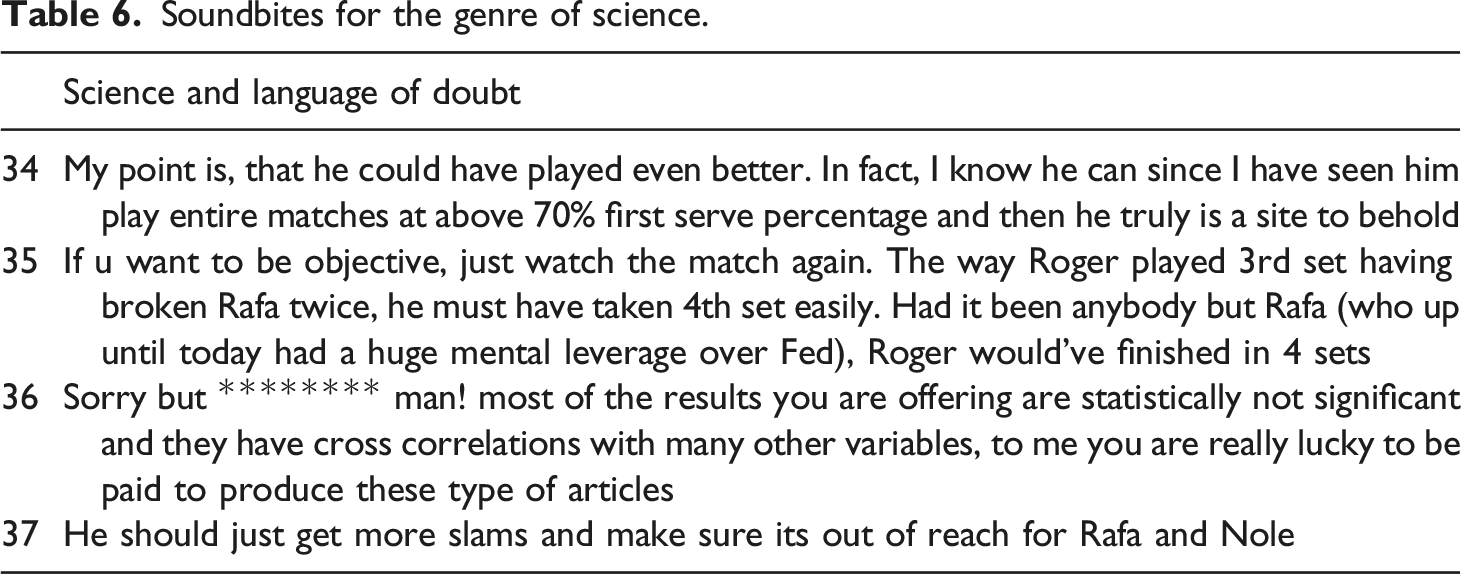
This reliance on science from alternative fan bases (first serve percentages, statistical significance and being objective) brings a different set of values and prerequisites required to embody GOAT. In doing so, the scientific genre, via critical aesthetics, magnifies the ‘artificiality rather than the naturalness’ (Reed, 2014, p. 85). In contrast to the complex myth-like deity of the poetic genre, here, the other-for-me metamorphosises into a more machine-like Being; of having a cyborg quality, governed not so much by artistry and beauty. For example, fans draw on percentages of serve ‘70% first serve percentage and then he truly is a site (sic) to behold’ (comment 34), or of sets lost and won, ‘Roger would have finished in four sets’ (comment 35), and of number of slams in comparison to his competitors, ‘make sure its out of reach for Rafa and Nole’ (comment 37).
Use of science seeks to give an objective edge to the GOAT form such that Federer’s embodiment of it is universal rather than a particular preference. Of course, other statistics can be used to counter this. For example, that he is older than his competitors and by the time they are his age they may have overtaken him. That is not the point however – its rather that it stakes the frame of reference for what is the GOAT on a set of numbers, that can be disproven. Hence, the immense emotional value we can see in myth and creative aesthetic poetics is opposed to the science symbolic form that contains the potential, through the high value it places on numbers, to crush this emotional field.
Here, the I-for-other (fans) becomes an objective Other, disavowing rather than creating a symbolic truth, as is the case with the subjective Other in creative aesthetic activity. In this genre, the Other’s own personal participation (prayer that Federer will win) is unimportant. Events are caused instead by forces, known by science, outside of any one control, and dependent on a scientific object that can be transparently revealed akin to a machine. In this regard, this cultural form of quasi-science stands opposed to the creative aesthetic activity of myth and art. Nonetheless, the quasi-science genre can still allow a deep appreciation of phenomenal artistic beauty, but it is fixed within statistical technicalities.
Conclusion
Applying Bakhtin’s theoretical framework of romantic aesthetic activity (Reed, 2014), supplemented by Cassirer’s (1953, 1955) symbolic form, this article has argued for the metamorphic potential of a publicly exalted individual into a cultural symbolic form. In doing so, we have also attempted to revitalise the discussion around Bakhtin’s hermeneutic tri-dialogical self; specifically, the transformative ability of the other-for-me. Our analysis, for example, disclosed an intersubjective dialogical relationship between Federer and his fandom where, via critical aesthetic activity and creative aesthetic activity, which are essential components of romantic aesthetic activity, Federer fans re-imagine and re-shape him as the GOAT.
Moreover, cyberspace offers fans a chronotropic time–space where creative aesthetic rhetoric forges a mythical reality, which comprises of its own internal congruity and integrity, derived from myth, which then fortifies the myth. Poetic fan language, then, becomes the architect of truth and the mode by which individuals, in our case Federer fans, substitute mythical truth (Pravda) for abstract truth (Istina) (Bakhtin, 1981, p. 369). Embedded within the same fan rhetoric, however, we noted the modes of critical aesthetic activity, emerging from genres of doubt and science; initiated by individuals within the Federer fan base, as well as Nadal and Djokovic fans.
Beyond tennis, putting someone on a pedestal, and exalting who they are, serves an important cultural function. It allows culture to ‘know’ the meaning of abstract symbols like The Greatest by embodying them. While scientific truth and rationality is a dominant form of understanding in everyday culture, the deliberate representation of symbols through aesthetically heightening emotions makes these truths more compelling than the commands of scientific reason, which is escalated by anonymity and confidentiality offered by cyberspaces. Therefore, as online communication culture becomes increasingly prominent, so does the need to critically assess its impact on individual embodied lived experience. As does the need to critically understand pivotal social media issues regarding the construction of norms and ideological pathways, particularly in terms of ethical and moral responsibilities in a new digital age. It would be interesting to examine, in future research, how the interplay of myth, science and art help embody our cultural heroes (and anti-heroes) into cultural symbols, whose biographies are used to deepen our understanding of the breakthroughs they articulate.
Footnotes
Declaration of Conflicting Interests
The author(s) declared no potential conflicts of interest with respect to the research, authorship, and/or publication of this article.
Funding
The author(s) received no financial support for the research, authorship, and/or publication of this article.
